
Sickle Cell Disease: Core Concepts for the
FD
Published · 22 slides · 0 views
1 / 1
Description
Sickle Cell Disease: Core Concepts for the Emergency Physician and Nurse Vaso-occlusive Crisis: Pain Assessment Management Mariam Kayle, MSN, RN, CCNS PhD Student Duke University School of Nursing Paula Tanabe, PhD, RN, FAEN, FAAN
Related Topics
Share
Embed code
Download this presentation From Below
"Sickle Cell Disease: Core Concepts for the" is the property of its rightful owner. Permission is granted to download and print the materials on this website for personal, non-commercial use only, and to display it on your personal computer provided you do not modify the materials and that you retain all copyright notices contained in the materials. By downloading content from our website, you accept the terms of this agreement.
Presentation Transcript
01
Sickle Cell Disease: Core Concepts for
the Emergency Physician and Nurse
Vaso-occlusive Crisis:
Pain Assessment &Management Mariam Kayle, MSN, RN, CCNS
PhD Student
Duke University School of Nursing
Paula Tanabe, PhD, RN, FAEN, FAAN
Associate Professor
Duke University, Schools of Nursing and Medicine<br>
PhD Student
Duke University School of Nursing
Paula Tanabe, PhD, RN, FAEN, FAAN
Associate Professor
Duke University, Schools of Nursing and Medicine<br>
02
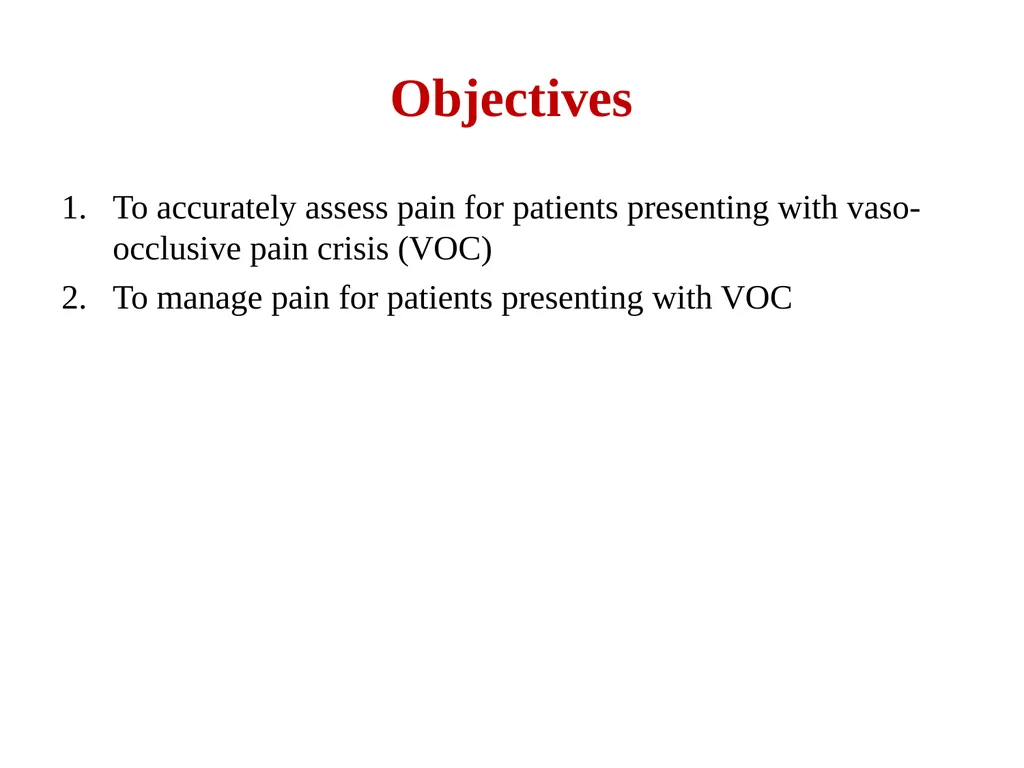
Objectives To accurately assess pain for patients presenting with vaso-occlusive pain crisis (VOC)
To manage pain for patients presenting with VOC<br>
To manage pain for patients presenting with VOC<br>
03
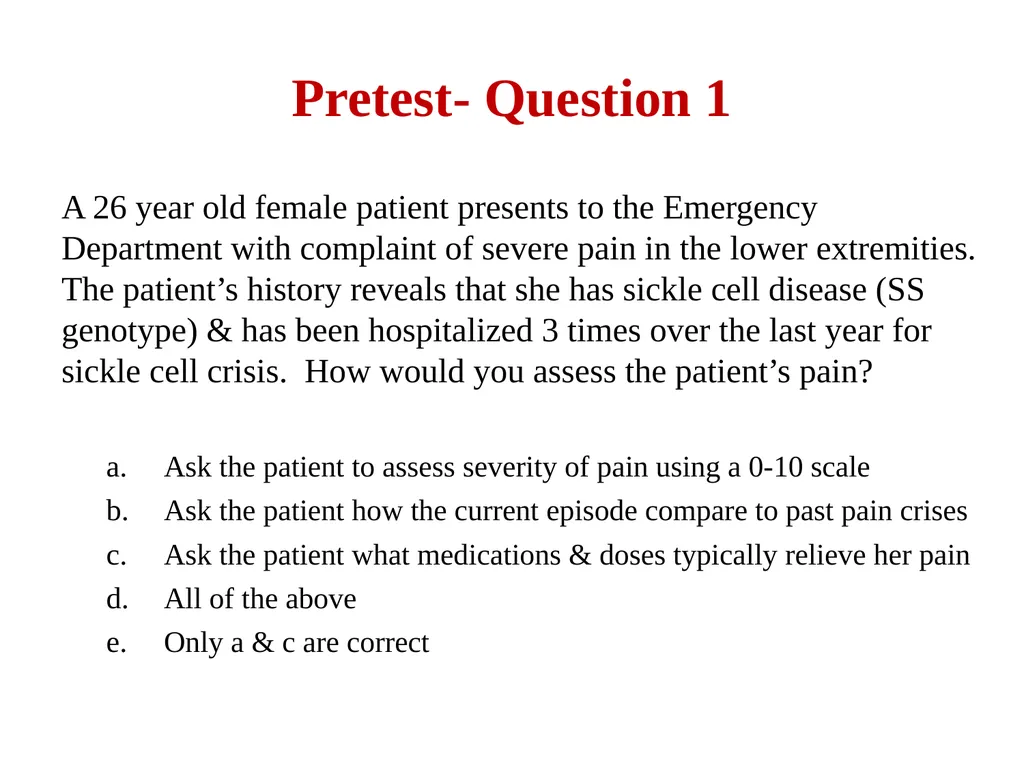
Pretest- Question 1 A 26 year old female patient presents to the Emergency Department with complaint of severe pain in the lower extremities. The patient’s history reveals that she has sickle cell disease (SS genotype) & has been hospitalized 3 times over the last year for sickle cell crisis. How would you assess the patient’s pain?
Ask the patient to assess severity of pain using a 0-10 scale
Ask the patient how the current episode compare to past pain crises
Ask the patient what medications & doses typically relieve her pain
All of the above
Only a & c are correct<br>
Ask the patient to assess severity of pain using a 0-10 scale
Ask the patient how the current episode compare to past pain crises
Ask the patient what medications & doses typically relieve her pain
All of the above
Only a & c are correct<br>
04
Pretest- Question 2 A 43 years old male patient with sickle cell disease presents to the Emergency Department with sickle cell crisis. He complains of severe pain (8/10) in the back. Patient weighs 100 kg. What would be an appropriate initial management for pain?
Administer 5 mg Morphine Sulfate IM
Administer IV hydration and IV ketorolac
Administer 10 mg Morphine Sulfate IV
Administer 1 mg Hydromorphone IV<br>
Administer 5 mg Morphine Sulfate IM
Administer IV hydration and IV ketorolac
Administer 10 mg Morphine Sulfate IV
Administer 1 mg Hydromorphone IV<br>
05
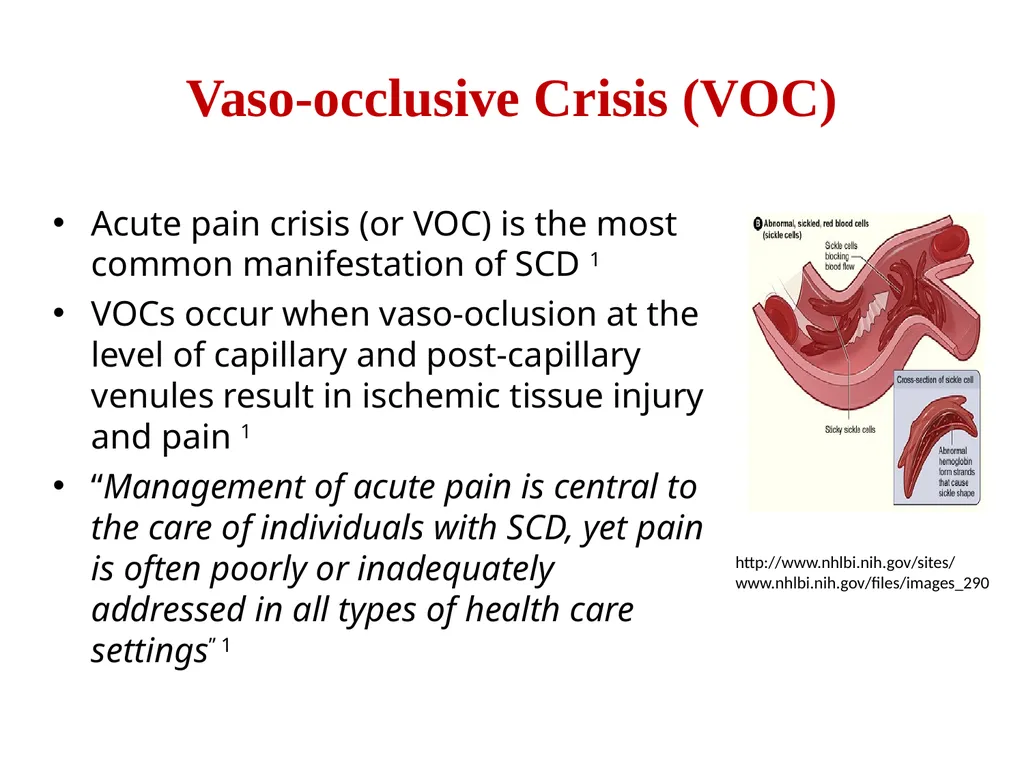
Vaso-occlusive Crisis (VOC) Acute pain crisis (or VOC) is the most common manifestation of SCD 1
VOCs occur when vaso-oclusion at the level of capillary and post-capillary venules result in ischemic tissue injury and pain 1
“Management of acute pain is central to the care of individuals with SCD, yet pain is often poorly or inadequately addressed in all types of health care settings” 1 http://www.nhlbi.nih.gov/sites/www.nhlbi.nih.gov/files/images_290<br>
VOCs occur when vaso-oclusion at the level of capillary and post-capillary venules result in ischemic tissue injury and pain 1
“Management of acute pain is central to the care of individuals with SCD, yet pain is often poorly or inadequately addressed in all types of health care settings” 1 http://www.nhlbi.nih.gov/sites/www.nhlbi.nih.gov/files/images_290<br>
06
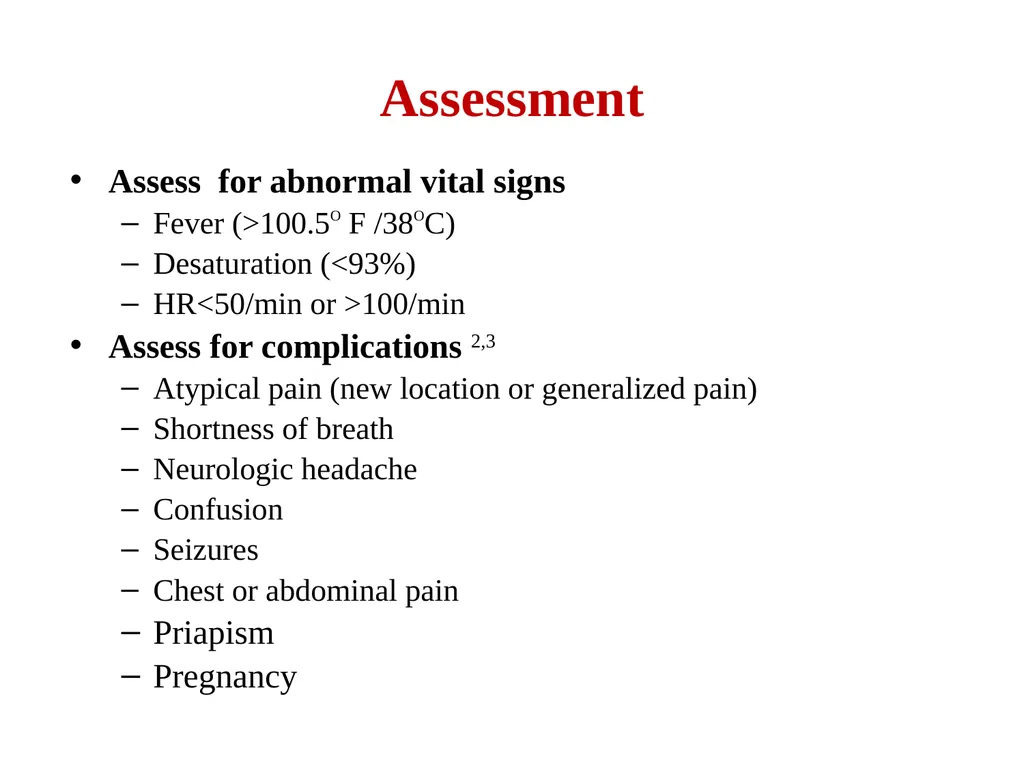
Assessment Assess for abnormal vital signs
Fever (>100.5O F /38OC)
Desaturation (<93%)
HR<50/min or >100/min
Assess for complications 2,3
Atypical pain (new location or generalized pain)
Shortness of breath
Neurologic headache
Confusion
Seizures
Chest or abdominal pain
Priapism
Pregnancy<br>
Fever (>100.5O F /38OC)
Desaturation (<93%)
HR<50/min or >100/min
Assess for complications 2,3
Atypical pain (new location or generalized pain)
Shortness of breath
Neurologic headache
Confusion
Seizures
Chest or abdominal pain
Priapism
Pregnancy<br>
07
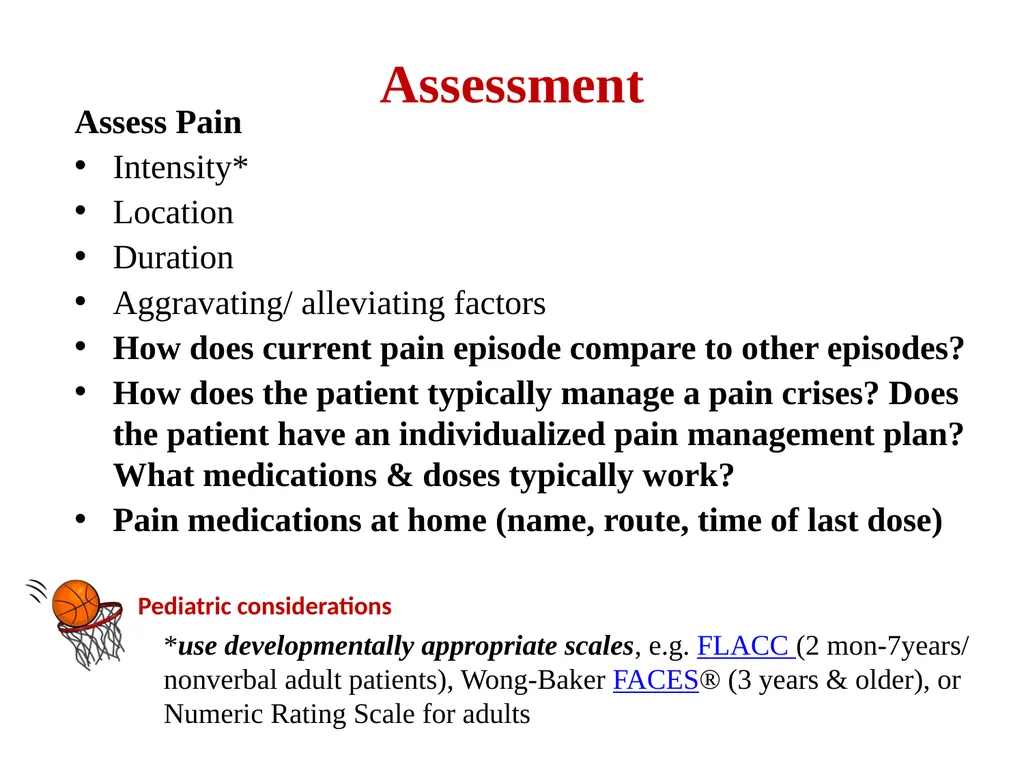
Assessment Assess Pain
Intensity*
Location
Duration
Aggravating/ alleviating factors
How does current pain episode compare to other episodes?
How does the patient typically manage a pain crises? Does the patient have an individualized pain management plan? What medications & doses typically work?
Pain medications at home (name, route, time of last dose) *use developmentally appropriate scales, e.g. FLACC (2 mon-7years/ nonverbal adult patients), Wong-Baker FACES® (3 years & older), or Numeric Rating Scale for adults Pediatric considerations<br>
Intensity*
Location
Duration
Aggravating/ alleviating factors
How does current pain episode compare to other episodes?
How does the patient typically manage a pain crises? Does the patient have an individualized pain management plan? What medications & doses typically work?
Pain medications at home (name, route, time of last dose) *use developmentally appropriate scales, e.g. FLACC (2 mon-7years/ nonverbal adult patients), Wong-Baker FACES® (3 years & older), or Numeric Rating Scale for adults Pediatric considerations<br>
08
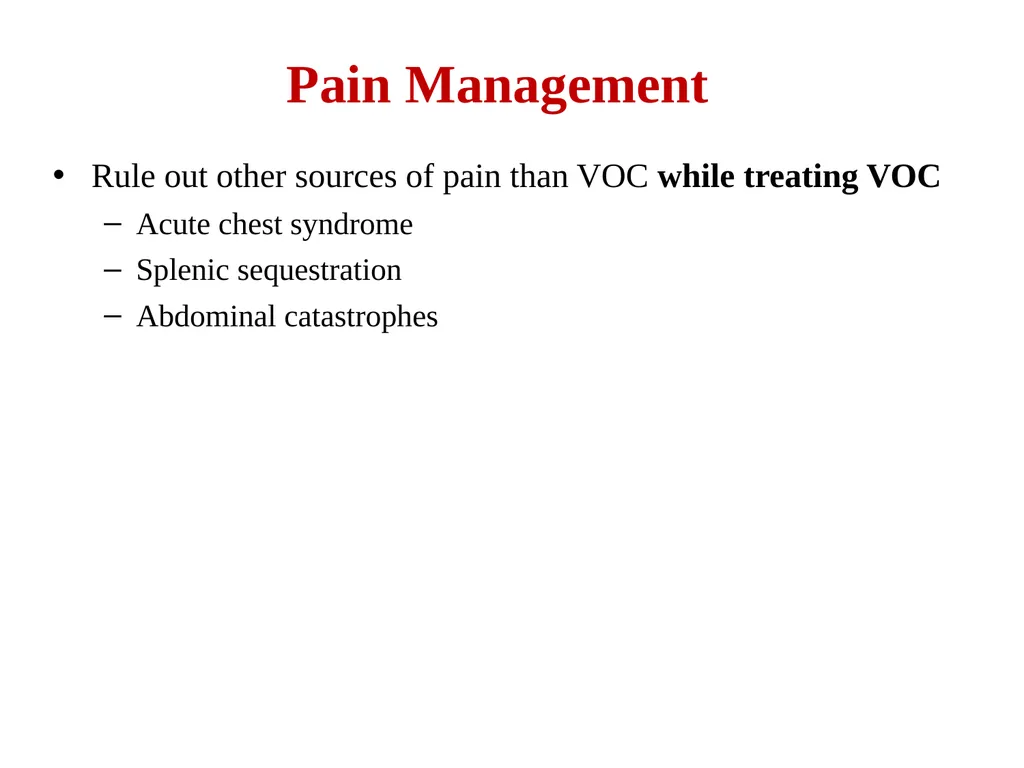
Pain Management Rule out other sources of pain than VOC while treating VOC
Acute chest syndrome
Splenic sequestration
Abdominal catastrophes<br>
Acute chest syndrome
Splenic sequestration
Abdominal catastrophes<br>
09
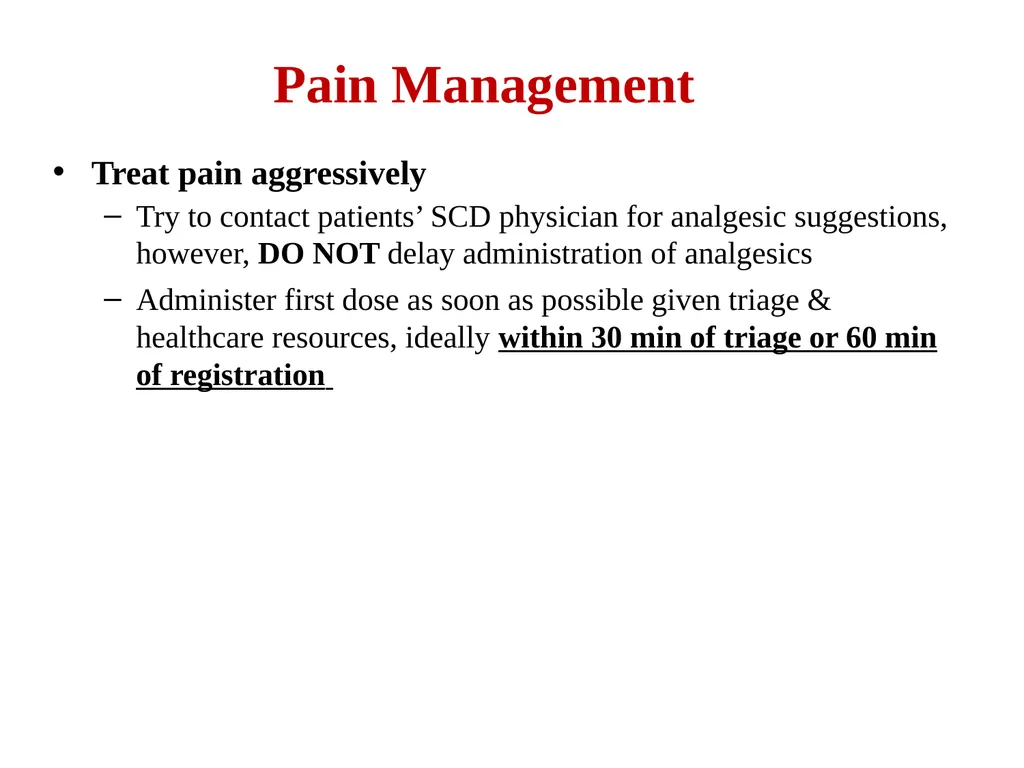
Pain Management Treat pain aggressively
Try to contact patients’ SCD physician for analgesic suggestions, however, DO NOT delay administration of analgesics
Administer first dose as soon as possible given triage & healthcare resources, ideally within 30 min of triage or 60 min of registration<br>
Try to contact patients’ SCD physician for analgesic suggestions, however, DO NOT delay administration of analgesics
Administer first dose as soon as possible given triage & healthcare resources, ideally within 30 min of triage or 60 min of registration<br>
10
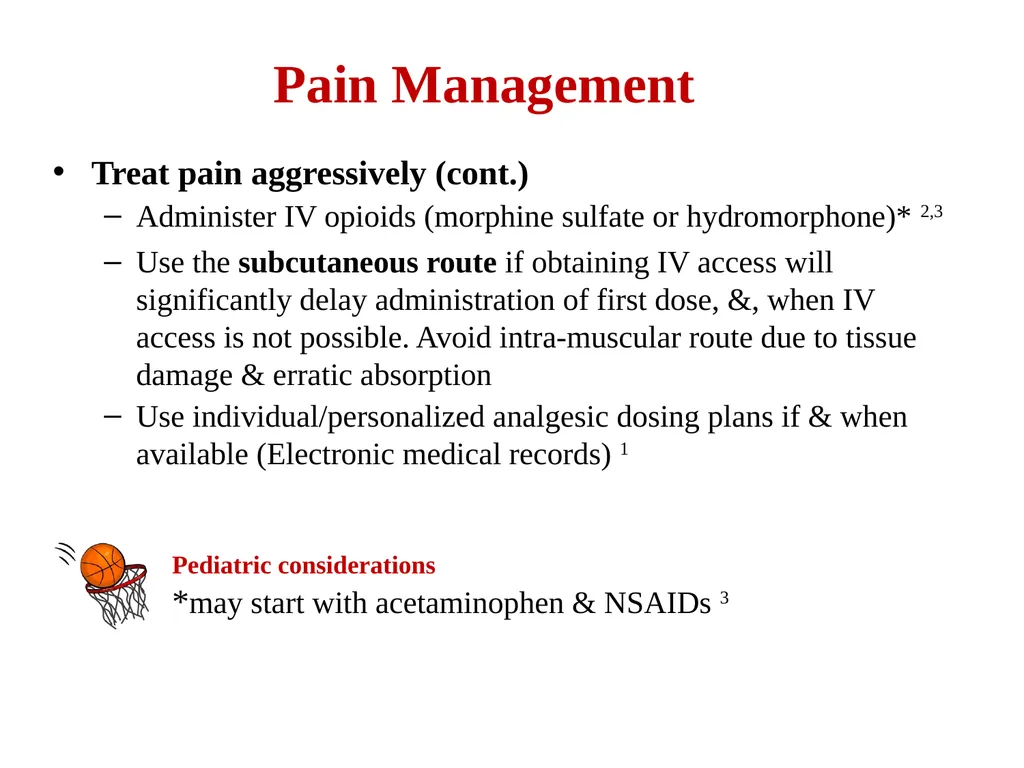
Pain Management Treat pain aggressively (cont.)
Administer IV opioids (morphine sulfate or hydromorphone)* 2,3
Use the subcutaneous route if obtaining IV access will significantly delay administration of first dose, &, when IV access is not possible. Avoid intra-muscular route due to tissue damage & erratic absorption
Use individual/personalized analgesic dosing plans if & when available (Electronic medical records) 1 Pediatric considerations
*may start with acetaminophen & NSAIDs 3<br>
Administer IV opioids (morphine sulfate or hydromorphone)* 2,3
Use the subcutaneous route if obtaining IV access will significantly delay administration of first dose, &, when IV access is not possible. Avoid intra-muscular route due to tissue damage & erratic absorption
Use individual/personalized analgesic dosing plans if & when available (Electronic medical records) 1 Pediatric considerations
*may start with acetaminophen & NSAIDs 3<br>
11
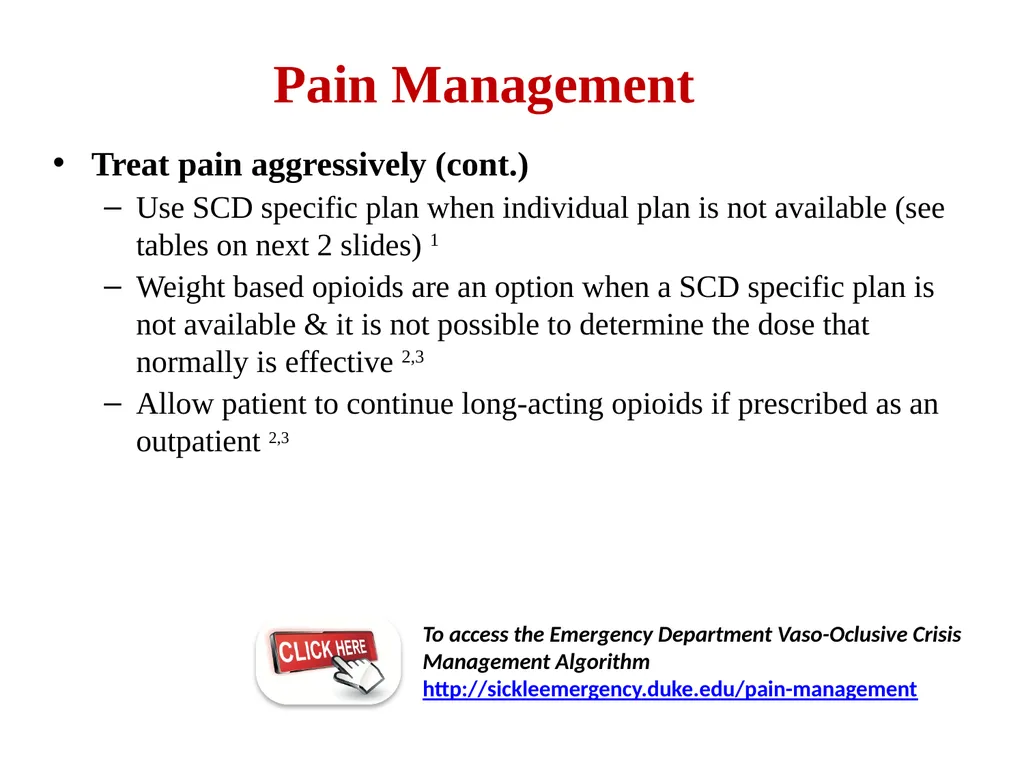
Pain Management Treat pain aggressively (cont.)
Use SCD specific plan when individual plan is not available (see tables on next 2 slides) 1
Weight based opioids are an option when a SCD specific plan is not available & it is not possible to determine the dose that normally is effective 2,3
Allow patient to continue long-acting opioids if prescribed as an outpatient 2,3 To access the Emergency Department Vaso-Oclusive Crisis Management Algorithm
http://sickleemergency.duke.edu/pain-management<br>
Use SCD specific plan when individual plan is not available (see tables on next 2 slides) 1
Weight based opioids are an option when a SCD specific plan is not available & it is not possible to determine the dose that normally is effective 2,3
Allow patient to continue long-acting opioids if prescribed as an outpatient 2,3 To access the Emergency Department Vaso-Oclusive Crisis Management Algorithm
http://sickleemergency.duke.edu/pain-management<br>
12
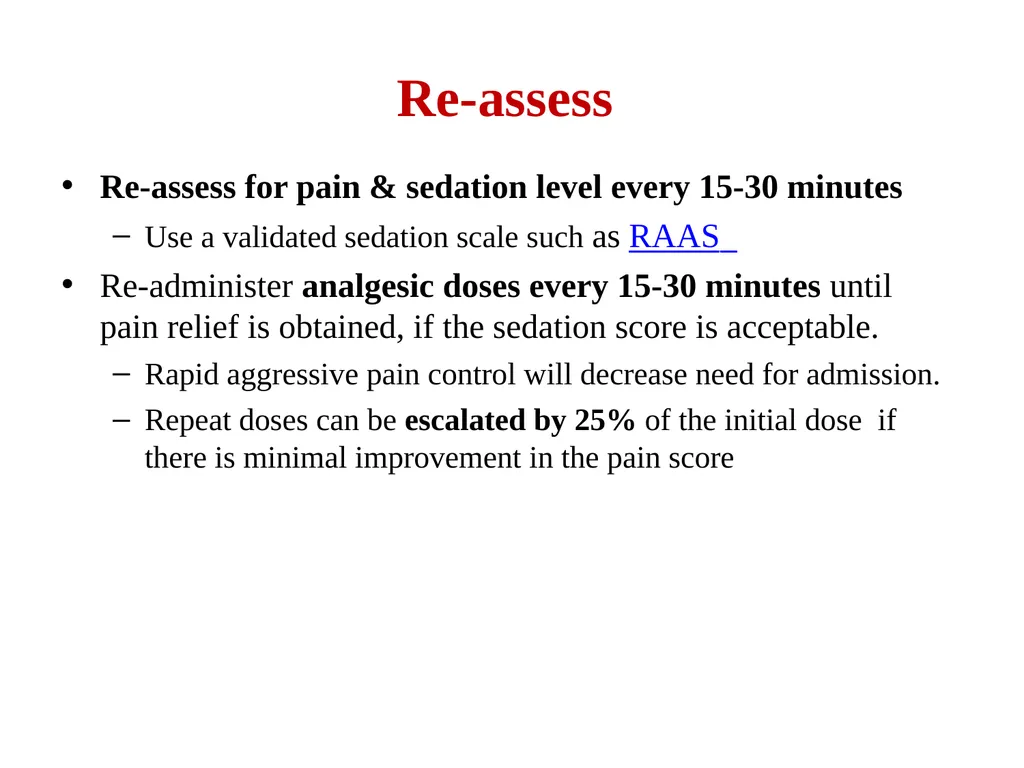
Re-assess Re-assess for pain & sedation level every 15-30 minutes
Use a validated sedation scale such as RAAS
Re-administer analgesic doses every 15-30 minutes until pain relief is obtained, if the sedation score is acceptable.
Rapid aggressive pain control will decrease need for admission.
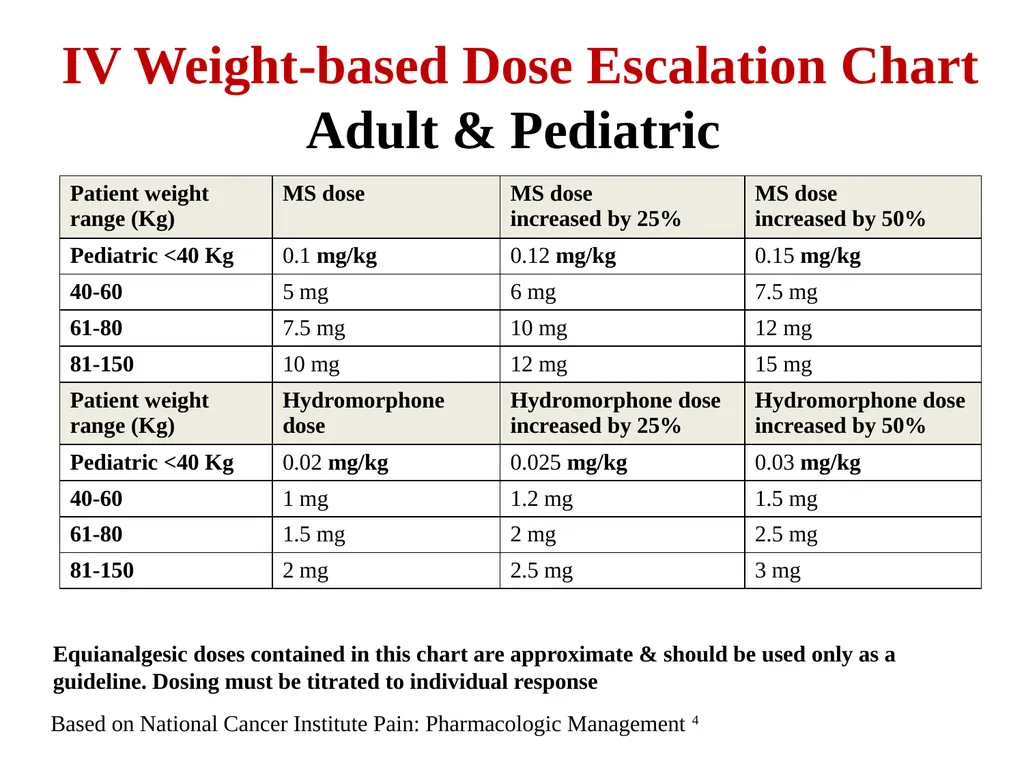
Repeat doses can be escalated by 25% of the initial dose if there is minimal improvement in the pain score<br>
Use a validated sedation scale such as RAAS
Re-administer analgesic doses every 15-30 minutes until pain relief is obtained, if the sedation score is acceptable.
Rapid aggressive pain control will decrease need for admission.
Repeat doses can be escalated by 25% of the initial dose if there is minimal improvement in the pain score<br>
13
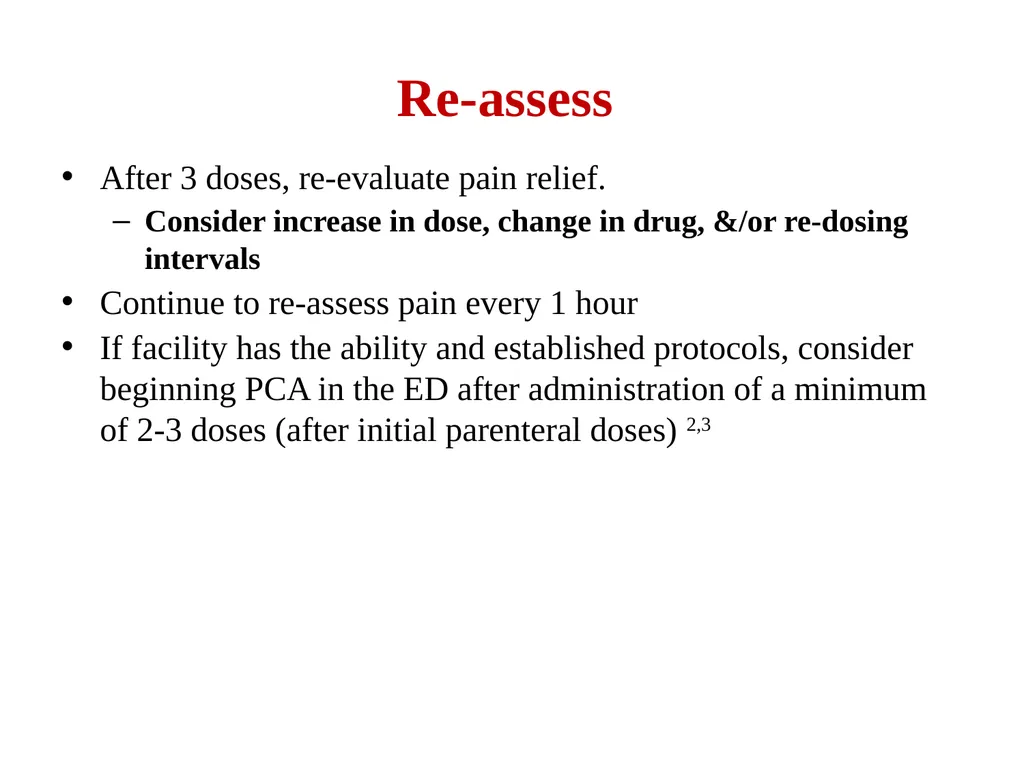
Re-assess After 3 doses, re-evaluate pain relief.
Consider increase in dose, change in drug, &/or re-dosing intervals
Continue to re-assess pain every 1 hour
If facility has the ability and established protocols, consider beginning PCA in the ED after administration of a minimum of 2-3 doses (after initial parenteral doses) 2,3<br>
Consider increase in dose, change in drug, &/or re-dosing intervals
Continue to re-assess pain every 1 hour
If facility has the ability and established protocols, consider beginning PCA in the ED after administration of a minimum of 2-3 doses (after initial parenteral doses) 2,3<br>
14
Weight-based Dosing chart-
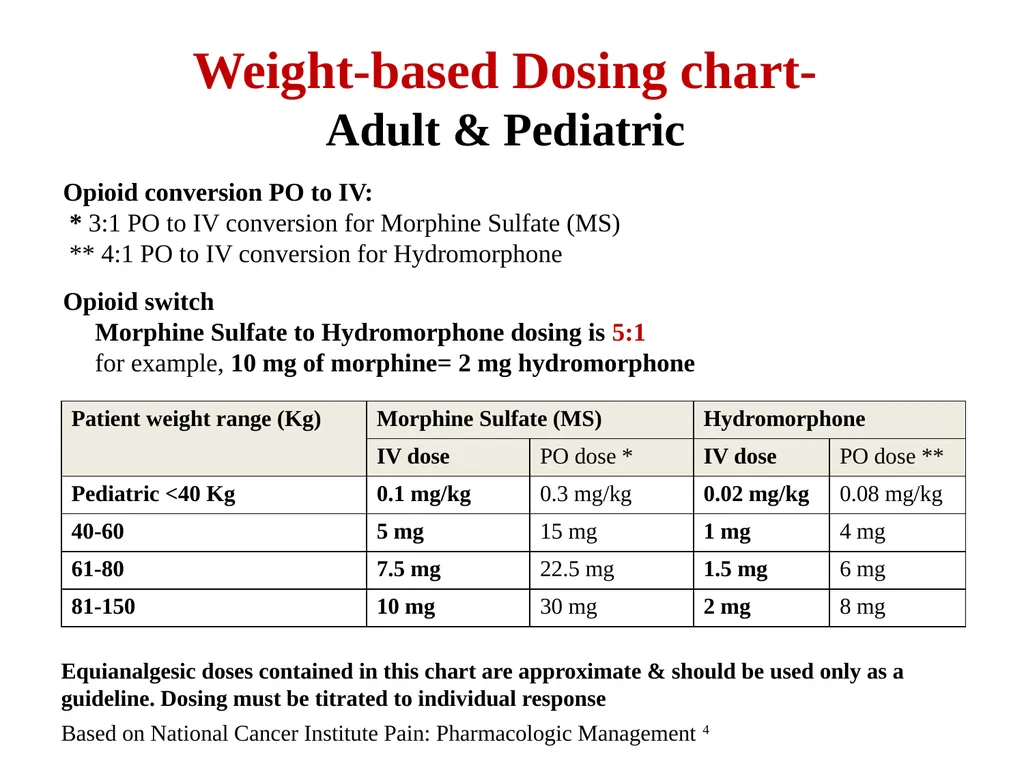
Adult & Pediatric Based on National Cancer Institute Pain: Pharmacologic Management 4 Equianalgesic doses contained in this chart are approximate & should be used only as a guideline. Dosing must be titrated to individual response Opioid conversion PO to IV:
* 3:1 PO to IV conversion for Morphine Sulfate (MS)
** 4:1 PO to IV conversion for Hydromorphone
Opioid switch
Morphine Sulfate to Hydromorphone dosing is 5:1
for example, 10 mg of morphine= 2 mg hydromorphone<br>
* 3:1 PO to IV conversion for Morphine Sulfate (MS)
** 4:1 PO to IV conversion for Hydromorphone
Opioid switch
Morphine Sulfate to Hydromorphone dosing is 5:1
for example, 10 mg of morphine= 2 mg hydromorphone<br>
15
IV Weight-based Dose Escalation Chart
Adult & Pediatric Equianalgesic doses contained in this chart are approximate & should be used only as a guideline. Dosing must be titrated to individual response Based on National Cancer Institute Pain: Pharmacologic Management 4<br>
16
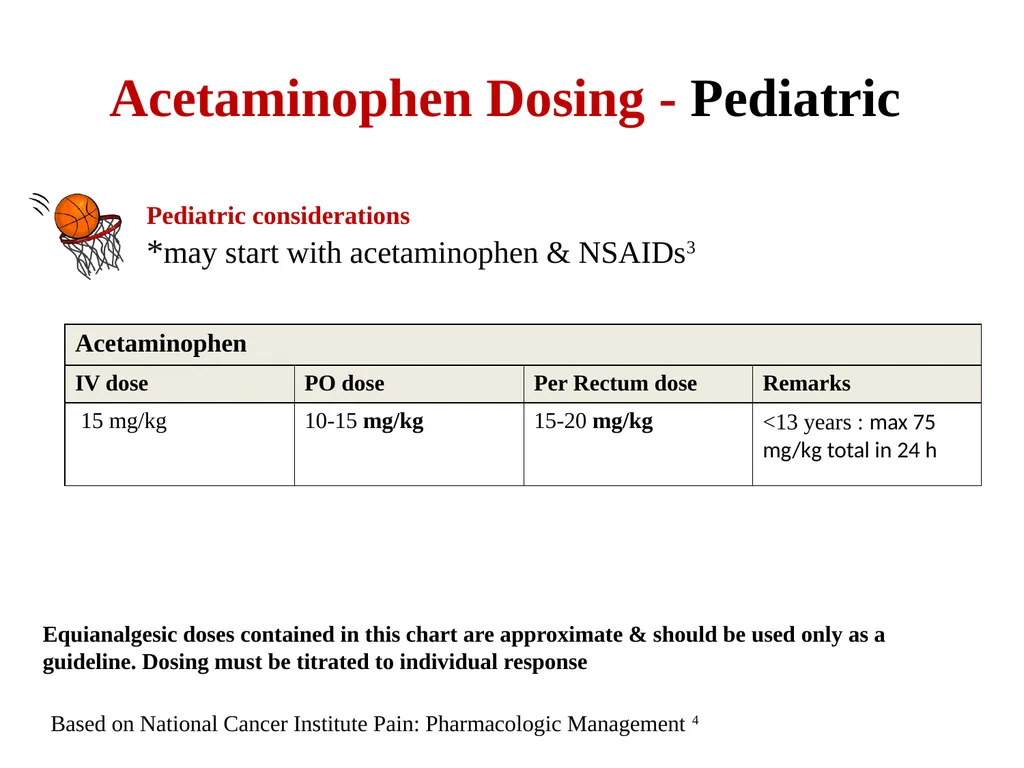
Acetaminophen Dosing - Pediatric Based on National Cancer Institute Pain: Pharmacologic Management 4 Equianalgesic doses contained in this chart are approximate & should be used only as a guideline. Dosing must be titrated to individual response Pediatric considerations
*may start with acetaminophen & NSAIDs3<br>
*may start with acetaminophen & NSAIDs3<br>
17
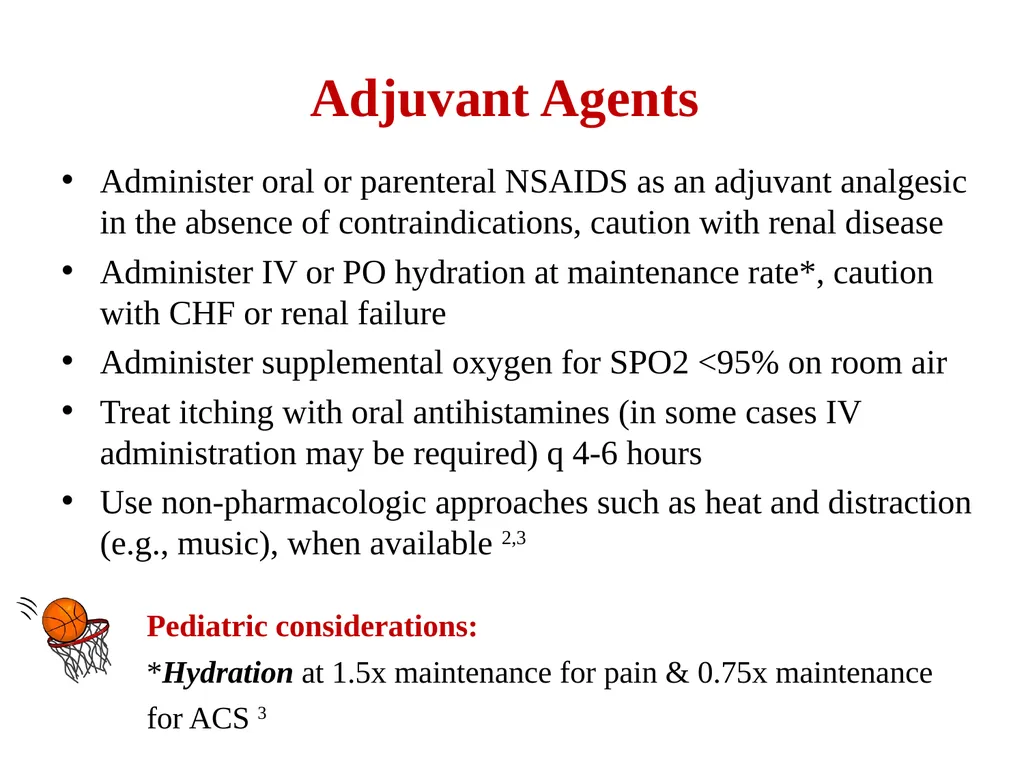
Adjuvant Agents Administer oral or parenteral NSAIDS as an adjuvant analgesic in the absence of contraindications, caution with renal disease
Administer IV or PO hydration at maintenance rate*, caution with CHF or renal failure
Administer supplemental oxygen for SPO2 <95% on room air
Treat itching with oral antihistamines (in some cases IV administration may be required) q 4-6 hours
Use non-pharmacologic approaches such as heat and distraction (e.g., music), when available 2,3 Pediatric considerations:
*Hydration at 1.5x maintenance for pain & 0.75x maintenance
for ACS 3<br>
Administer IV or PO hydration at maintenance rate*, caution with CHF or renal failure
Administer supplemental oxygen for SPO2 <95% on room air
Treat itching with oral antihistamines (in some cases IV administration may be required) q 4-6 hours
Use non-pharmacologic approaches such as heat and distraction (e.g., music), when available 2,3 Pediatric considerations:
*Hydration at 1.5x maintenance for pain & 0.75x maintenance
for ACS 3<br>
18
Clinical Scenario https://www.youtube.com/watch?v=IMSJmLtU_R4
Copy and paste the link into your browser.<br>
Copy and paste the link into your browser.<br>
19
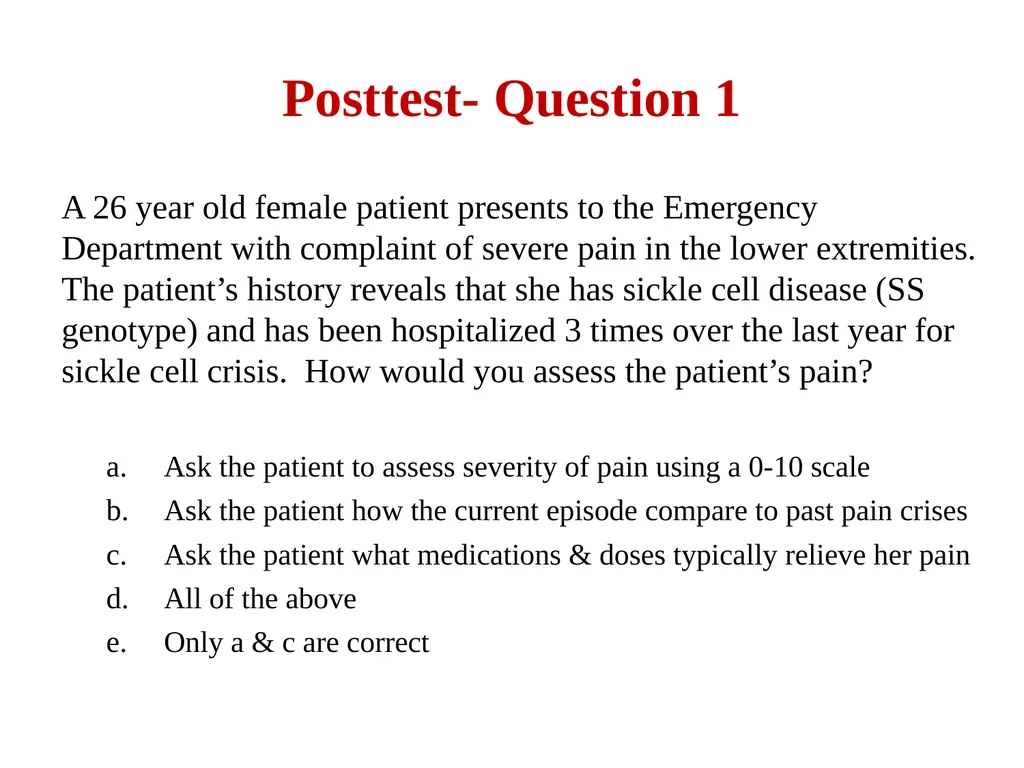
Posttest- Question 1 A 26 year old female patient presents to the Emergency Department with complaint of severe pain in the lower extremities. The patient’s history reveals that she has sickle cell disease (SS genotype) and has been hospitalized 3 times over the last year for sickle cell crisis. How would you assess the patient’s pain?
Ask the patient to assess severity of pain using a 0-10 scale
Ask the patient how the current episode compare to past pain crises
Ask the patient what medications & doses typically relieve her pain
All of the above
Only a & c are correct<br>
Ask the patient to assess severity of pain using a 0-10 scale
Ask the patient how the current episode compare to past pain crises
Ask the patient what medications & doses typically relieve her pain
All of the above
Only a & c are correct<br>
20
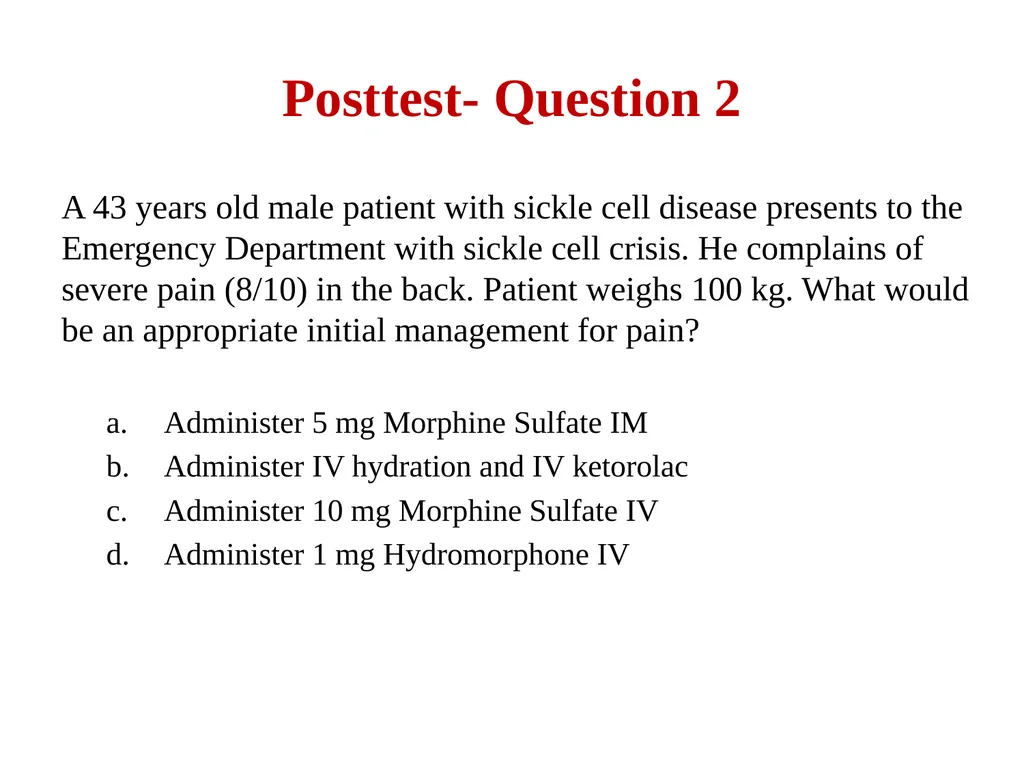
Posttest- Question 2 A 43 years old male patient with sickle cell disease presents to the Emergency Department with sickle cell crisis. He complains of severe pain (8/10) in the back. Patient weighs 100 kg. What would be an appropriate initial management for pain?
Administer 5 mg Morphine Sulfate IM
Administer IV hydration and IV ketorolac
Administer 10 mg Morphine Sulfate IV
Administer 1 mg Hydromorphone IV<br>
Administer 5 mg Morphine Sulfate IM
Administer IV hydration and IV ketorolac
Administer 10 mg Morphine Sulfate IV
Administer 1 mg Hydromorphone IV<br>
21
Posttest Answers & Rationale Question 1
Answer : d) All of the above
Rationale: Pain assessment should include an assessment of intensity, how does this episode compare to other episodes, & what medications and doses typically relieve the pain. Please see slide 7 for more details
Question 2
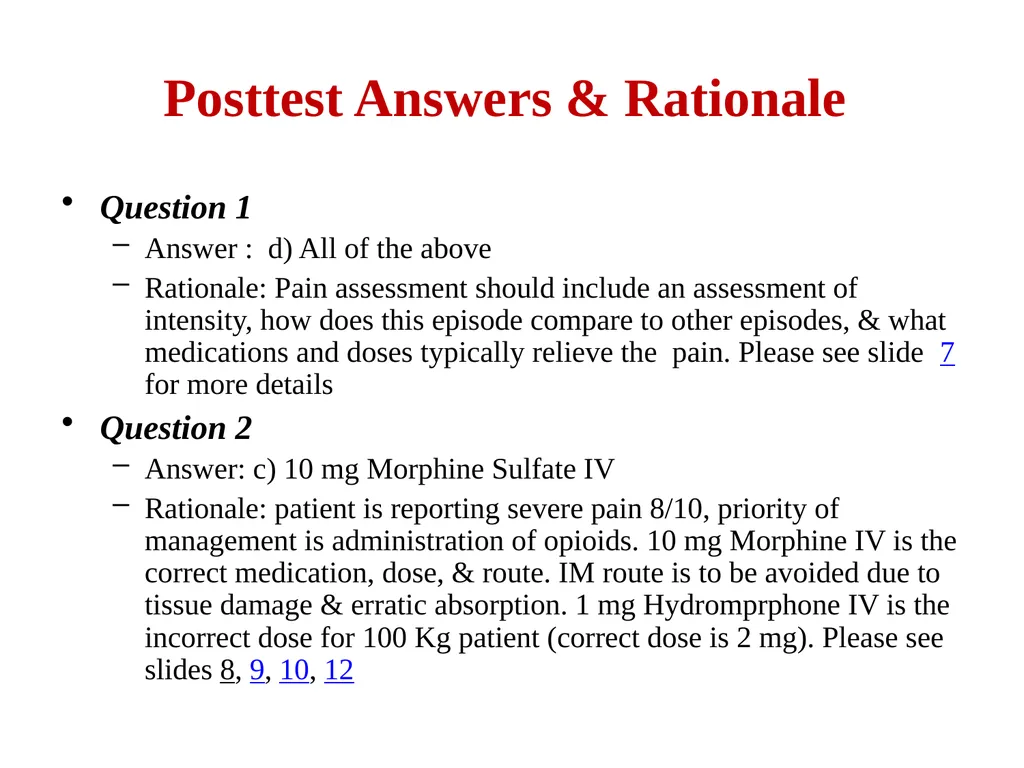
Answer: c) 10 mg Morphine Sulfate IV
Rationale: patient is reporting severe pain 8/10, priority of management is administration of opioids. 10 mg Morphine IV is the correct medication, dose, & route. IM route is to be avoided due to tissue damage & erratic absorption. 1 mg Hydromprphone IV is the incorrect dose for 100 Kg patient (correct dose is 2 mg). Please see slides 8, 9, 10, 12<br>
Answer : d) All of the above
Rationale: Pain assessment should include an assessment of intensity, how does this episode compare to other episodes, & what medications and doses typically relieve the pain. Please see slide 7 for more details
Question 2
Answer: c) 10 mg Morphine Sulfate IV
Rationale: patient is reporting severe pain 8/10, priority of management is administration of opioids. 10 mg Morphine IV is the correct medication, dose, & route. IM route is to be avoided due to tissue damage & erratic absorption. 1 mg Hydromprphone IV is the incorrect dose for 100 Kg patient (correct dose is 2 mg). Please see slides 8, 9, 10, 12<br>
22
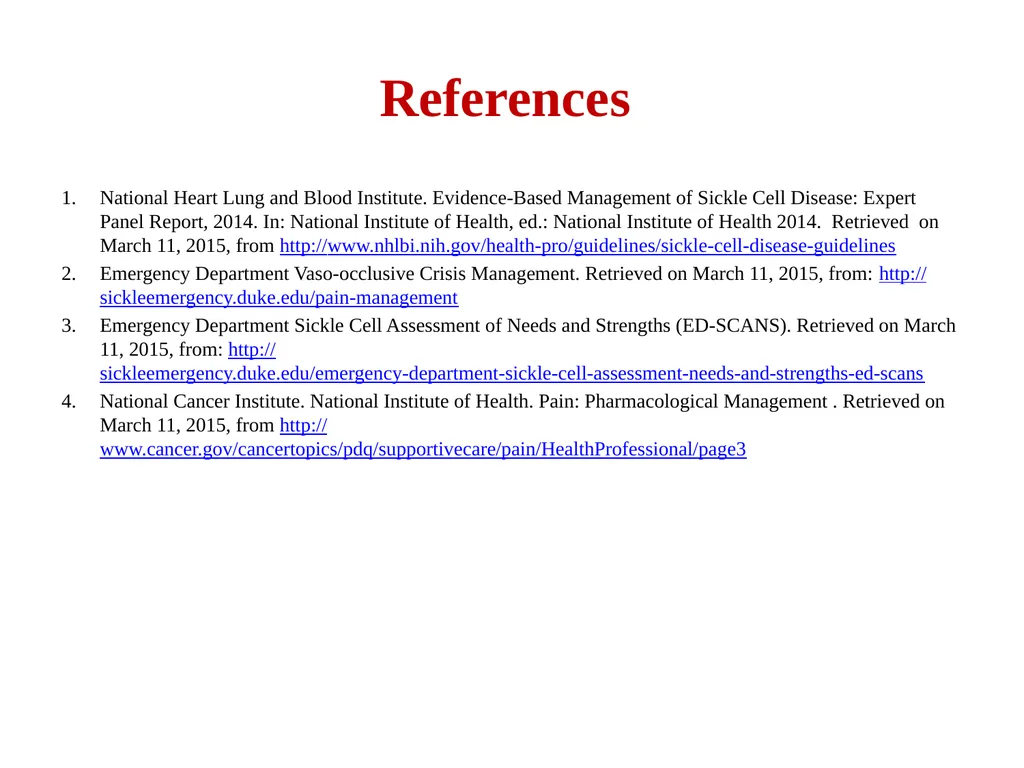
References National Heart Lung and Blood Institute. Evidence-Based Management of Sickle Cell Disease: Expert Panel Report, 2014. In: National Institute of Health, ed.: National Institute of Health 2014. Retrieved on March 11, 2015, from http://www.nhlbi.nih.gov/health-pro/guidelines/sickle-cell-disease-guidelines
Emergency Department Vaso-occlusive Crisis Management. Retrieved on March 11, 2015, from: http://sickleemergency.duke.edu/pain-management
Emergency Department Sickle Cell Assessment of Needs and Strengths (ED-SCANS). Retrieved on March 11, 2015, from: http://sickleemergency.duke.edu/emergency-department-sickle-cell-assessment-needs-and-strengths-ed-scans
National Cancer Institute. National Institute of Health. Pain: Pharmacological Management . Retrieved on March 11, 2015, from http://www.cancer.gov/cancertopics/pdq/supportivecare/pain/HealthProfessional/page3<br>
Emergency Department Vaso-occlusive Crisis Management. Retrieved on March 11, 2015, from: http://sickleemergency.duke.edu/pain-management
Emergency Department Sickle Cell Assessment of Needs and Strengths (ED-SCANS). Retrieved on March 11, 2015, from: http://sickleemergency.duke.edu/emergency-department-sickle-cell-assessment-needs-and-strengths-ed-scans
National Cancer Institute. National Institute of Health. Pain: Pharmacological Management . Retrieved on March 11, 2015, from http://www.cancer.gov/cancertopics/pdq/supportivecare/pain/HealthProfessional/page3<br>