Simplex (quick recap) Replace all the inequality constraints by equalities, using slack variables 8 constraints 5 variables (i.e., 5 dimensional space) any vertex solution corresponds to the intersection of 5 tight constraints. 3 of these
"Simplex (quick recap) Replace all the inequality" is the property of its rightful owner. Permission is granted to
download and print the materials on this website for personal, non-commercial use only, and to display it
on your personal computer provided you do not modify the materials and that you retain all copyright
notices contained in the materials. By downloading content from our website, you accept the terms of this
agreement.
Presentation Transcript
01
Simplex (quick recap)<br>
02
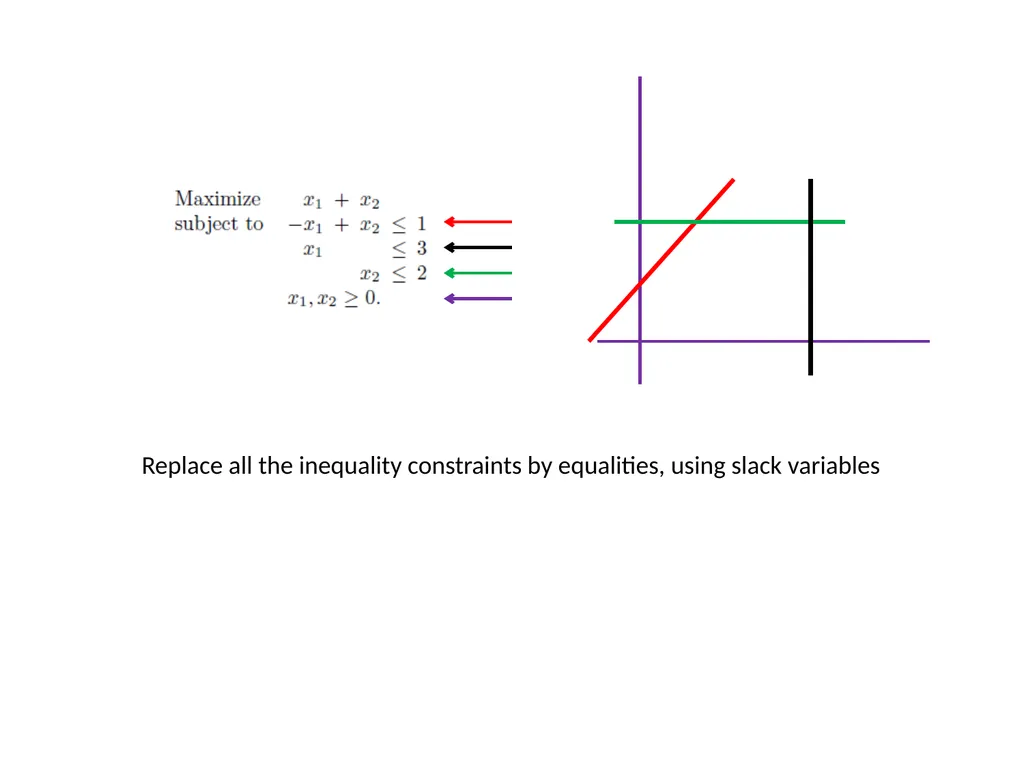
Replace all the inequality constraints by equalities, using slack variables<br>
03
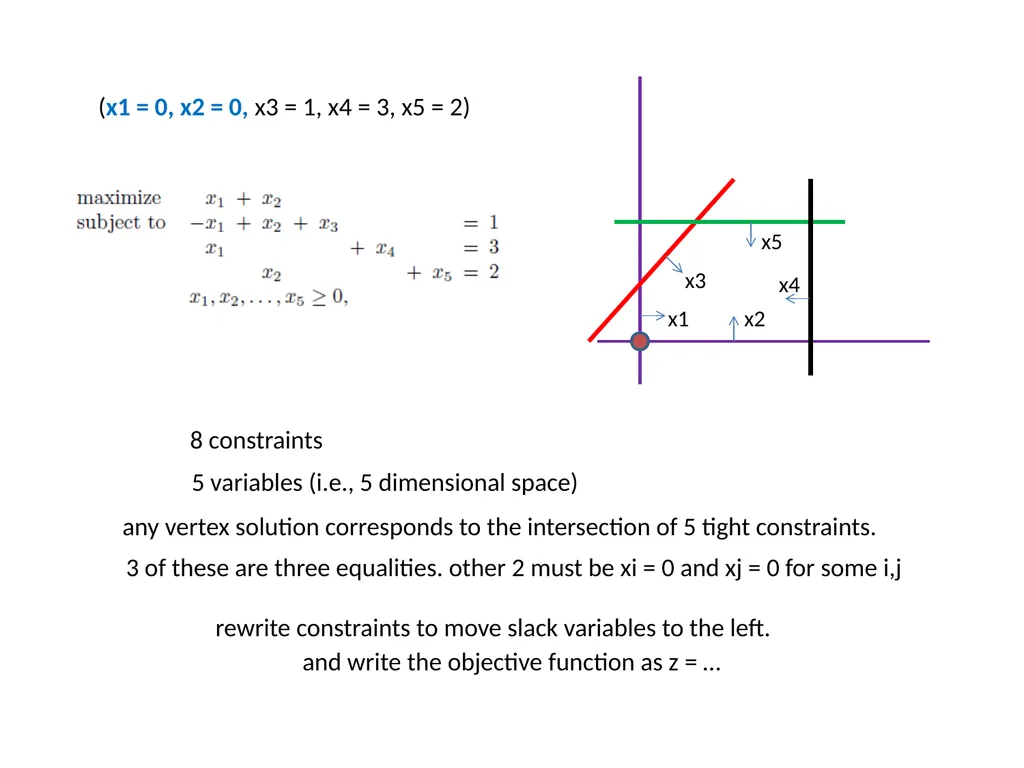
8 constraints 5 variables (i.e., 5 dimensional space) any vertex solution corresponds to the intersection of 5 tight constraints. 3 of these are three equalities. other 2 must be xi = 0 and xj = 0 for some i,j x2 x1 x3 x4 x5 (x1 = 0, x2 = 0, x3 = 1, x4 = 3, x5 = 2) rewrite constraints to move slack variables to the left. and write the objective function as z = …<br>
04
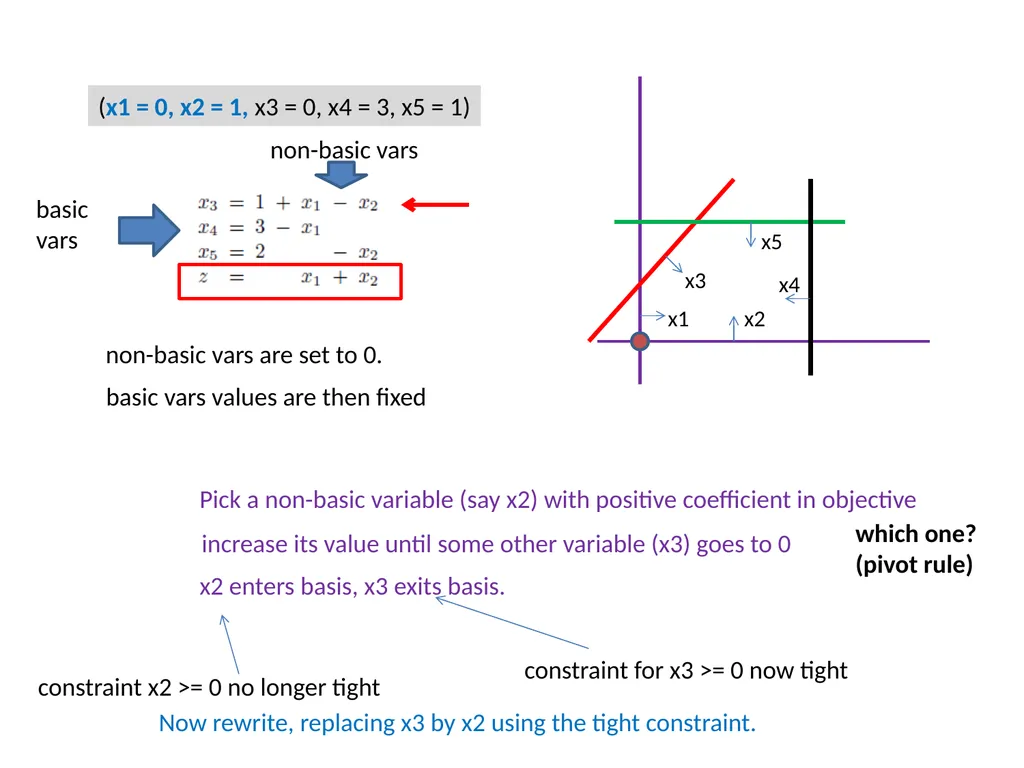
non-basic vars basic
vars non-basic vars are set to 0. basic vars values are then fixed Pick a non-basic variable (say x2) with positive coefficient in objective increase its value until some other variable (x3) goes to 0 x2 enters basis, x3 exits basis. x2 x1 x3 x4 x5 (x1 = 0, x2 = 0, x3 = 1, x4 = 3, x5 = 2) which one?
(pivot rule) constraint for x3 >= 0 now tight constraint x2 >= 0 no longer tight Now rewrite, replacing x3 by x2 using the tight constraint. (x1 = 0, x2 = 1, x3 = 0, x4 = 3, x5 = 1)<br>
05
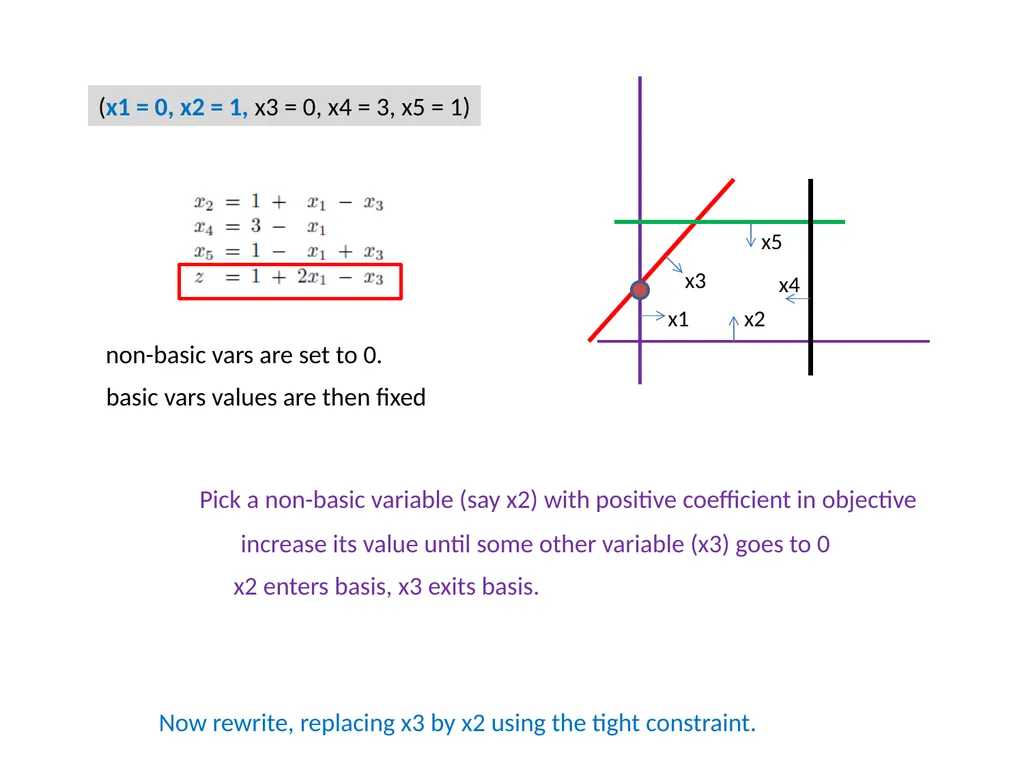
non-basic vars are set to 0. basic vars values are then fixed (x1 = 0, x2 = 1, x3 = 0, x4 = 3, x5 = 1) x2 x1 x3 x4 x5 Pick a non-basic variable (say x2) with positive coefficient in objective increase its value until some other variable (x3) goes to 0 x2 enters basis, x3 exits basis. Now rewrite, replacing x3 by x2 using the tight constraint.<br>
06
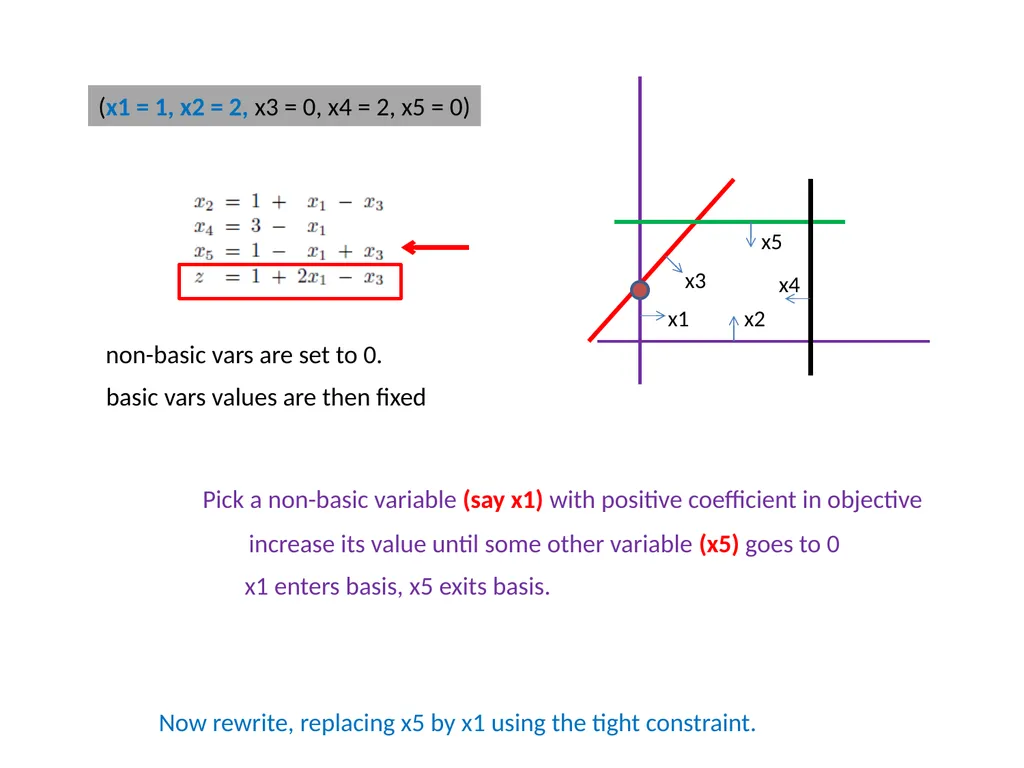
non-basic vars are set to 0. basic vars values are then fixed Pick a non-basic variable (say x1) with positive coefficient in objective increase its value until some other variable (x5) goes to 0 x1 enters basis, x5 exits basis. (x1 = 0, x2 = 1, x3 = 0, x4 = 3, x5 = 1) x2 x1 x3 x4 x5 (x1 = 1, x2 = 2, x3 = 0, x4 = 2, x5 = 0) Now rewrite, replacing x5 by x1 using the tight constraint.<br>
07
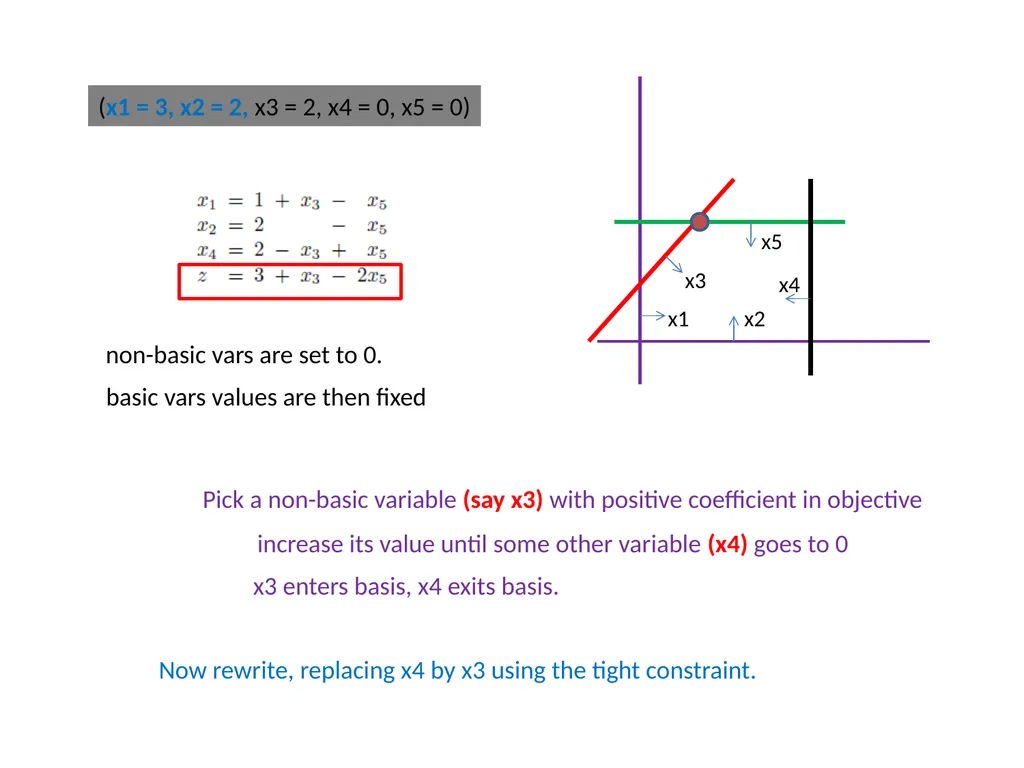
non-basic vars are set to 0. basic vars values are then fixed Pick a non-basic variable (say x3) with positive coefficient in objective increase its value until some other variable (x4) goes to 0 x3 enters basis, x4 exits basis. x2 x1 x3 x4 x5 (x1 = 1, x2 = 2, x3 = 0, x4 = 2, x5 = 0) (x1 = 3, x2 = 2, x3 = 2, x4 = 0, x5 = 0) Now rewrite, replacing x4 by x3 using the tight constraint.<br>
08
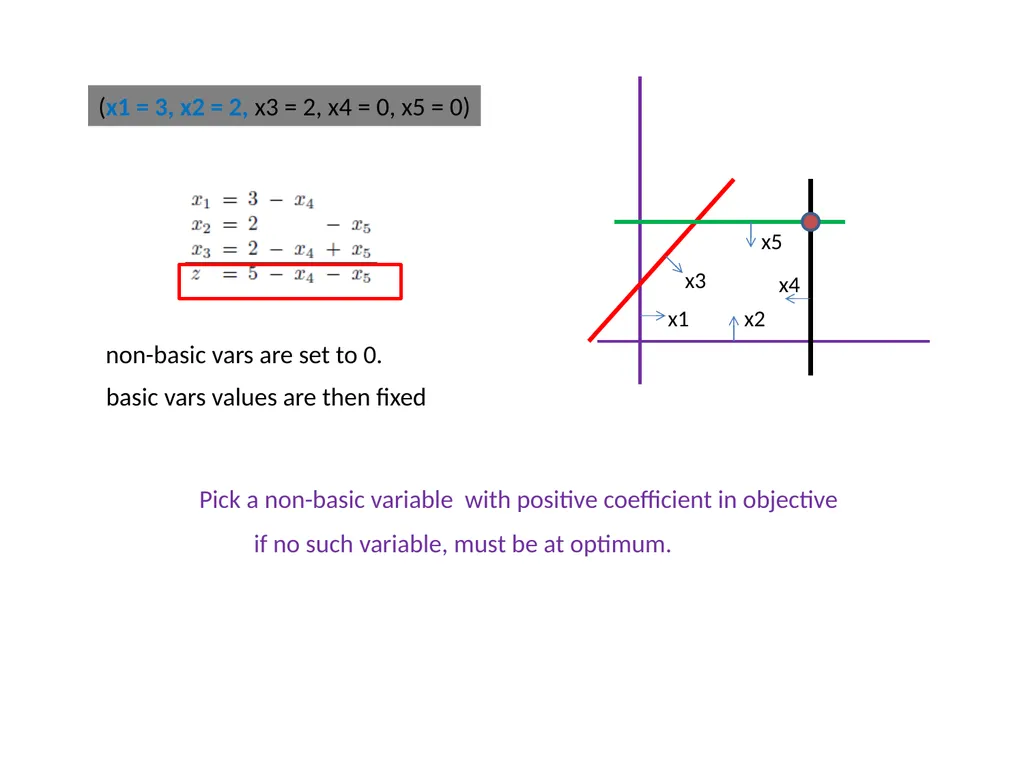
non-basic vars are set to 0. basic vars values are then fixed Pick a non-basic variable with positive coefficient in objective if no such variable, must be at optimum. (x1 = 3, x2 = 2, x3 = 2, x4 = 0, x5 = 0) x2 x1 x3 x4 x5<br>
09
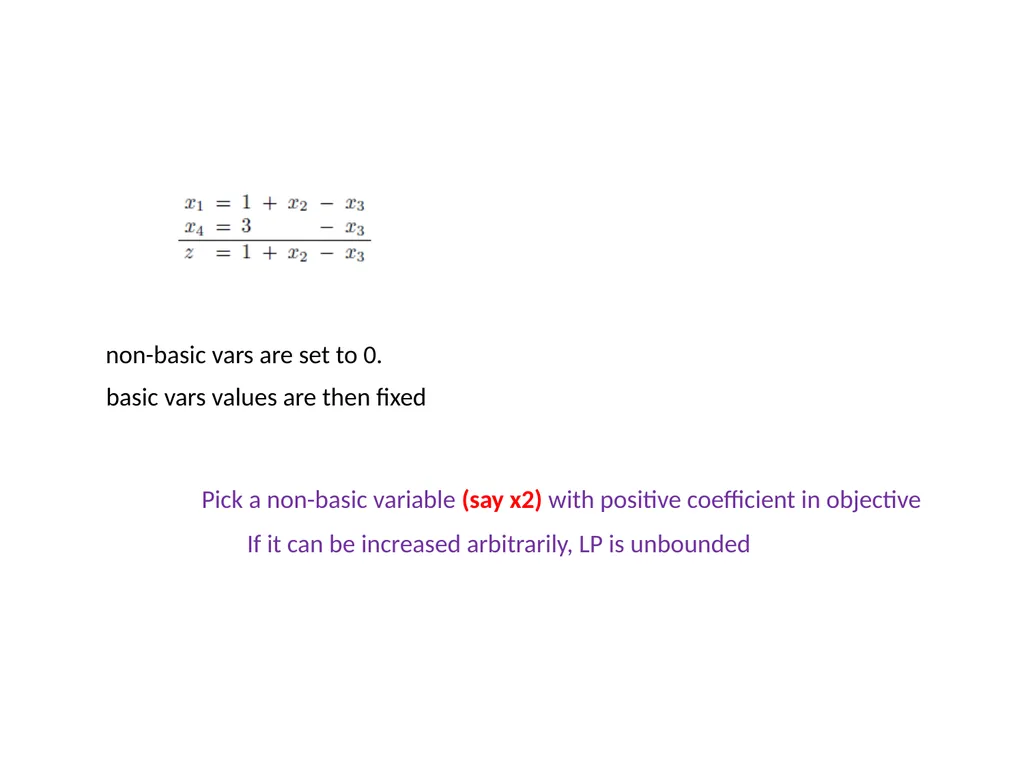
Pick a non-basic variable (say x2) with positive coefficient in objective non-basic vars are set to 0. basic vars values are then fixed If it can be increased arbitrarily, LP is unbounded<br>
10
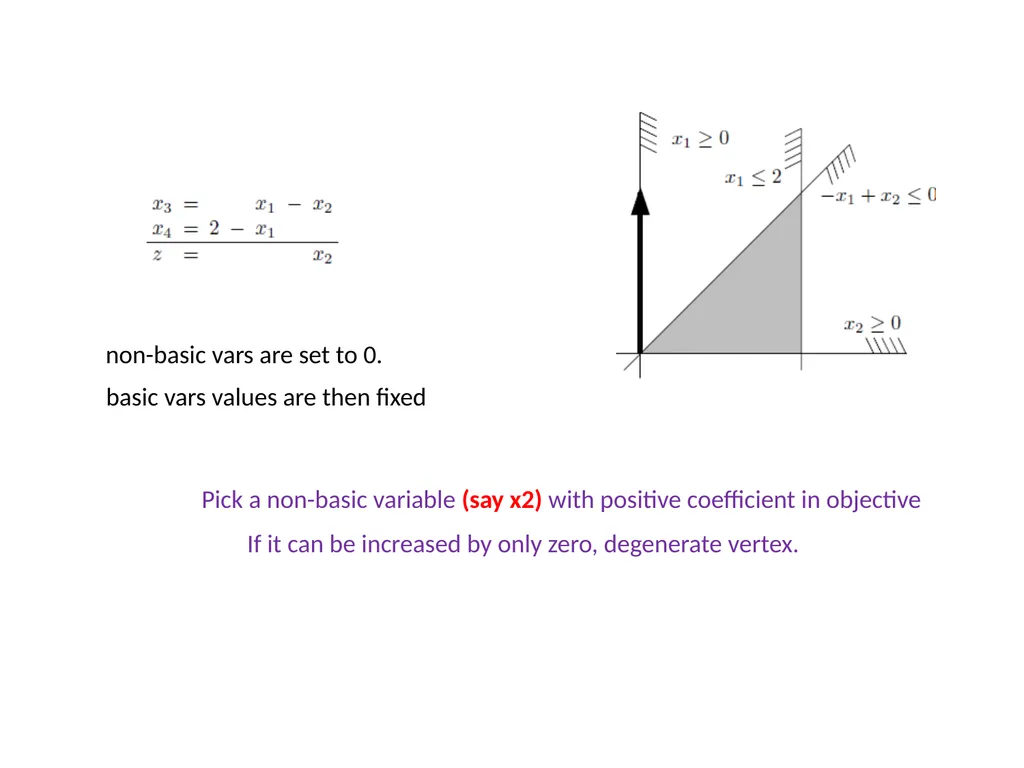
Pick a non-basic variable (say x2) with positive coefficient in objective non-basic vars are set to 0. basic vars values are then fixed If it can be increased by only zero, degenerate vertex.<br>
11
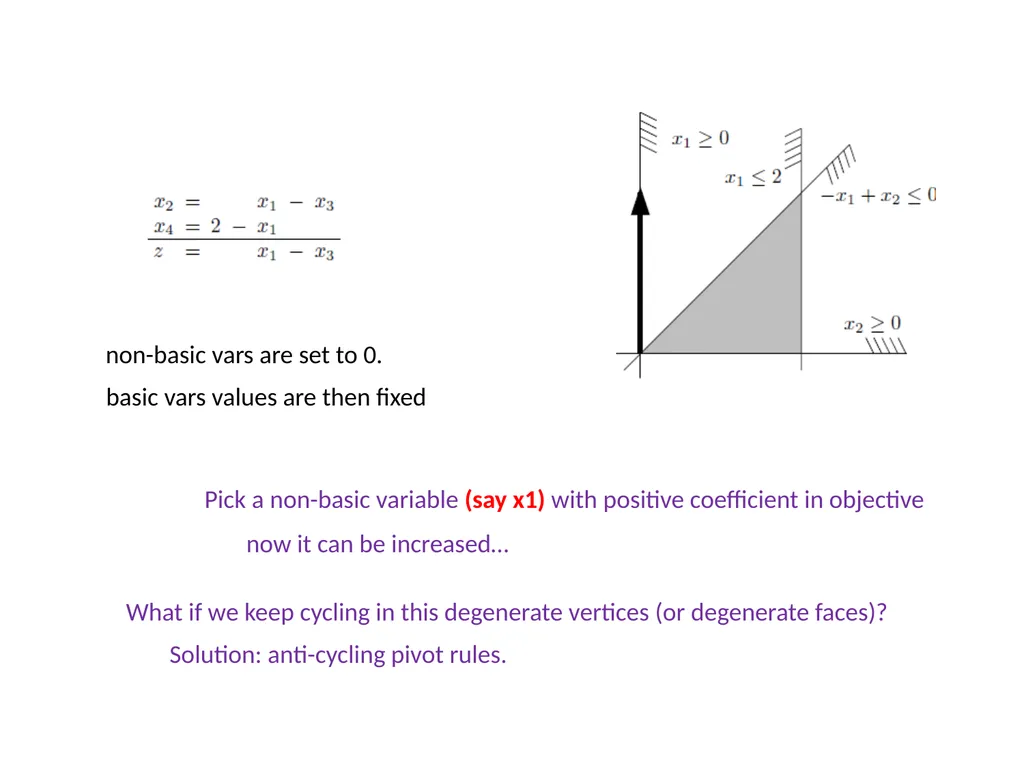
Pick a non-basic variable (say x1) with positive coefficient in objective non-basic vars are set to 0. basic vars values are then fixed now it can be increased… What if we keep cycling in this degenerate vertices (or degenerate faces)? Solution: anti-cycling pivot rules.<br>
12
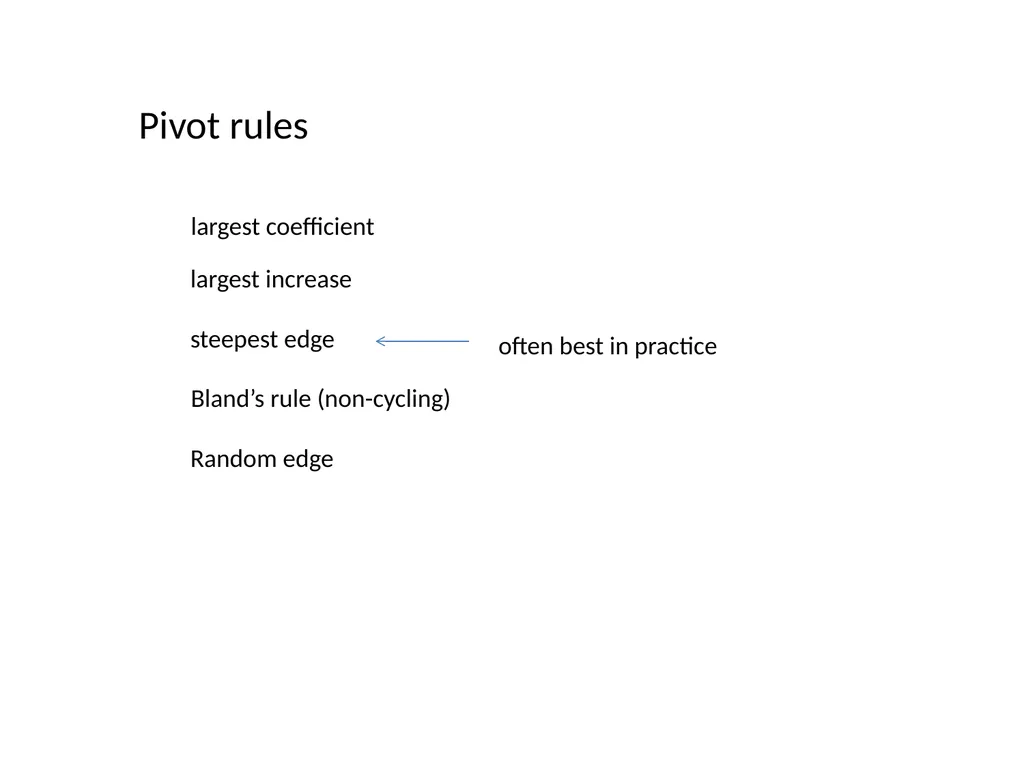
Pivot rules largest coefficient largest increase steepest edge Bland’s rule (non-cycling) Random edge often best in practice<br>