
Sing, Sing, Sing! Book 3 “Aim Even Higher” Sing
AS
Published · 40 slides · 0 views
1 / 1
Description
Sing, Sing, Sing! Book 3 Aim Even Higher Sing Sing Sing! A progressive Singing Scheme from Hertfordshire Music Services Primary Music Team. Singing is great, and we do it for lots of reasons; there are songs from different times and
Related Topics
Share
Embed code
Download this presentation From Below
"Sing, Sing, Sing! Book 3 “Aim Even Higher” Sing" is the property of its rightful owner. Permission is granted to download and print the materials on this website for personal, non-commercial use only, and to display it on your personal computer provided you do not modify the materials and that you retain all copyright notices contained in the materials. By downloading content from our website, you accept the terms of this agreement.
Presentation Transcript
01
Sing, Sing, Sing!
Book 3
“Aim Even Higher”<br>
02
Sing Sing Sing!
A progressive Singing Scheme from Hertfordshire Music Service’s Primary Music Team.
Singing is great, and we do it for lots of reasons; there are songs from different times and places, songs in different languages which offer us a flavour of a range of cultures, and a whole host of styles and genres. We use it to make music together, to learn about something, to come together, to express our emotions and to celebrate.
We know that singing has many benefits. But what about Progression in Singing, the actual learning how to sing?
We progress through:
Quality (doing something better and with more attention to detail)
Demand (being able to tackle harder things)
Range (widening our knowledge and repertoire)
Progression through Quality and Demand depend on us using material at the correct level for children to be able to have the most success.<br>
A progressive Singing Scheme from Hertfordshire Music Service’s Primary Music Team.
Singing is great, and we do it for lots of reasons; there are songs from different times and places, songs in different languages which offer us a flavour of a range of cultures, and a whole host of styles and genres. We use it to make music together, to learn about something, to come together, to express our emotions and to celebrate.
We know that singing has many benefits. But what about Progression in Singing, the actual learning how to sing?
We progress through:
Quality (doing something better and with more attention to detail)
Demand (being able to tackle harder things)
Range (widening our knowledge and repertoire)
Progression through Quality and Demand depend on us using material at the correct level for children to be able to have the most success.<br>
03
All songs help us to expand our range, but which songs actually help us to learn to sing and to improve it, to pitch-match, to use vowels to make and carry sound and consonants to carry meaning? To use rhythm and phrase to convey the emotion and message of a song? To use dynamics to really light up a performance?
Looking at song books it can be difficult to work out which songs to chose to allow children’s voices to develop systematically and naturally, with attention to detail and satisfaction of a good job done.
This is where Sing Sing Sing! comes in. Think of it as a Reading Scheme for singing where all the work on selecting material for progression has been done for you.
This doesn’t mean that you can’t sing any other songs - far from it! Having a singing ‘scheme’ will allow you to use other songs for all the purposes you need. Just as using a Reading Scheme it doesn’t mean we deny children access to other books - think of those other songs as Library Books to enhance our pleasure and enjoyment of singing!<br>
Looking at song books it can be difficult to work out which songs to chose to allow children’s voices to develop systematically and naturally, with attention to detail and satisfaction of a good job done.
This is where Sing Sing Sing! comes in. Think of it as a Reading Scheme for singing where all the work on selecting material for progression has been done for you.
This doesn’t mean that you can’t sing any other songs - far from it! Having a singing ‘scheme’ will allow you to use other songs for all the purposes you need. Just as using a Reading Scheme it doesn’t mean we deny children access to other books - think of those other songs as Library Books to enhance our pleasure and enjoyment of singing!<br>
04
Sing, Sing, Sing! comes in 3 ‘e-books’:
Off We Go for Years 1 and 2
Moving On Up for Years 3 and 4
Aim Even Higher for Years 5 and 6
Each ‘book’ has around 20 songs which can be spread across the two school years they are designed for. They are mostly short, allowing you to concentrate on quality rather than quantity. There are no lengthy words to learn; everything has been chosen for a musical purpose and there is room for repetition and consolidation to build the children’s confidence and familiarity.<br>
Off We Go for Years 1 and 2
Moving On Up for Years 3 and 4
Aim Even Higher for Years 5 and 6
Each ‘book’ has around 20 songs which can be spread across the two school years they are designed for. They are mostly short, allowing you to concentrate on quality rather than quantity. There are no lengthy words to learn; everything has been chosen for a musical purpose and there is room for repetition and consolidation to build the children’s confidence and familiarity.<br>
05
They are designed to be used in classrooms, projected onto boards, with the musical notation visible as well as the words. We know that children can become familiar with musical notation by being exposed to it little and often, and that they begin to identify melodic shape and rhythmic features this way. Features of notation can be pointed out as you learn.
All you need is there, and there are teacher notes to support the learning. We have chosen these songs because we know children love them, as well as developing their singing skills, and we hope that you will enjoy singing them with your class.
The HMS Primary Music Team<br>
All you need is there, and there are teacher notes to support the learning. We have chosen these songs because we know children love them, as well as developing their singing skills, and we hope that you will enjoy singing them with your class.
The HMS Primary Music Team<br>
06
Aim Even Higher This pack is designed to support teachers and all adults working with children in years five and six but can be used with younger children if musically able. We have chosen more complex songs, some with actions.
Although no music reading is required, we have included notation for those who prefer to use it.
No instrumental accompaniment is needed but can often be added to enhance final performances. Some suggestions are provided.
The audio examples are for reference only to help you to remember the songs.
The pack also refers to cross-curricular links, where relevant, to enrich and enhance your Creative Curriculum, with a range of activities to suit all learning styles.<br>
Although no music reading is required, we have included notation for those who prefer to use it.
No instrumental accompaniment is needed but can often be added to enhance final performances. Some suggestions are provided.
The audio examples are for reference only to help you to remember the songs.
The pack also refers to cross-curricular links, where relevant, to enrich and enhance your Creative Curriculum, with a range of activities to suit all learning styles.<br>
07
The Benefits of Singing Singing can enhance mental wellbeing, is inclusive and can help build a community to which all children can belong.
It can help reduce stress, raise self-esteem, boost immune systems, improve cognitive development and language acquisition.
Additional short ‘bursts’ of singing can be fitted in throughout the school day; it is not always necessary to set aside a specific time.<br>
It can help reduce stress, raise self-esteem, boost immune systems, improve cognitive development and language acquisition.
Additional short ‘bursts’ of singing can be fitted in throughout the school day; it is not always necessary to set aside a specific time.<br>
08
Setting the Expectation This pack is designed to help stretch and develop children’s voices further. There is a greater emphasis on part-singing, maintaining their own line with an awareness of how the different parts fit together.
Be rigorous in helping them to achieve a beautiful, unforced sound where all voices blend.
All adults need to demonstrate good singing posture:
Stand feet slightly apart, relaxed shoulders, arms loosely by side.
If chairs are available, establish a ‘singing seat’ position, sitting away from the back of the chair, feet tucked slightly underneath, feet together and hands flat in laps.
Wherever possible avoid sitting on the floor. Some slides include extra information and key vocabulary for pupils. This supports and/or extends their knowledge and understanding of the music they are learning.<br>
Be rigorous in helping them to achieve a beautiful, unforced sound where all voices blend.
All adults need to demonstrate good singing posture:
Stand feet slightly apart, relaxed shoulders, arms loosely by side.
If chairs are available, establish a ‘singing seat’ position, sitting away from the back of the chair, feet tucked slightly underneath, feet together and hands flat in laps.
Wherever possible avoid sitting on the floor. Some slides include extra information and key vocabulary for pupils. This supports and/or extends their knowledge and understanding of the music they are learning.<br>
09
Skills Progression Distinguishing speaking and singing voices
Finding the pulse
Pitch matching
Individual singing
Awareness of phrase
Rhythm and duration (including rests)
Rhythm and pulse
Using the thinking voice
Comparatives [faster/slower/louder/quieter/higher/lower] Please refer to our Singing Skill Progression Document for further information and detail.<br>
Finding the pulse
Pitch matching
Individual singing
Awareness of phrase
Rhythm and duration (including rests)
Rhythm and pulse
Using the thinking voice
Comparatives [faster/slower/louder/quieter/higher/lower] Please refer to our Singing Skill Progression Document for further information and detail.<br>
10
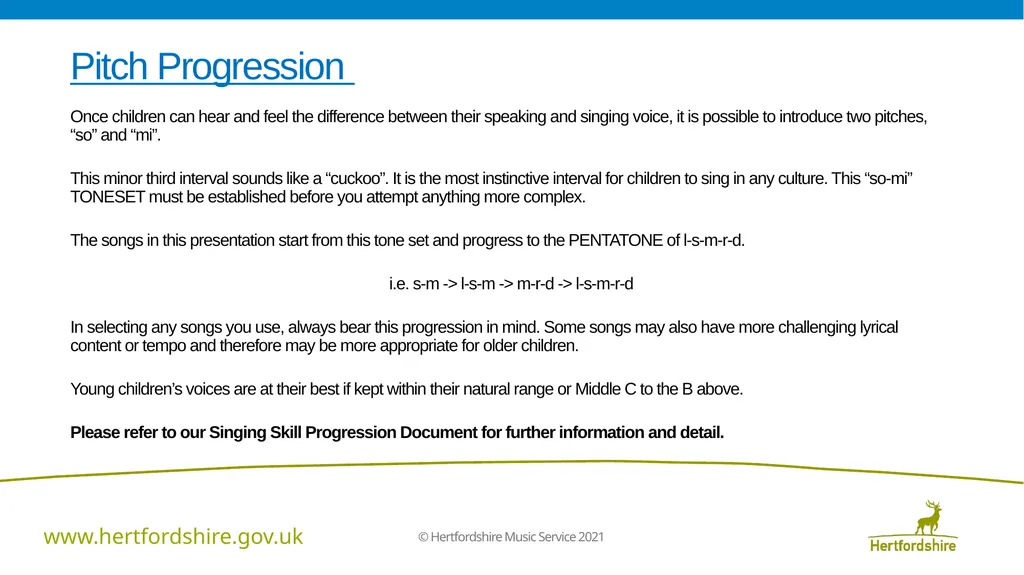
Pitch Progression Once children can hear and feel the difference between their speaking and singing voice, it is possible to introduce two pitches, “so” and “mi”.
This minor third interval sounds like a “cuckoo”. It is the most instinctive interval for children to sing in any culture. This “so-mi” TONESET must be established before you attempt anything more complex.
The songs in this presentation start from this tone set and progress to the PENTATONE of l-s-m-r-d.
i.e. s-m -> l-s-m -> m-r-d -> l-s-m-r-d
In selecting any songs you use, always bear this progression in mind. Some songs may also have more challenging lyrical content or tempo and therefore may be more appropriate for older children.
Young children’s voices are at their best if kept within their natural range or Middle C to the B above.
Please refer to our Singing Skill Progression Document for further information and detail.<br>
This minor third interval sounds like a “cuckoo”. It is the most instinctive interval for children to sing in any culture. This “so-mi” TONESET must be established before you attempt anything more complex.
The songs in this presentation start from this tone set and progress to the PENTATONE of l-s-m-r-d.
i.e. s-m -> l-s-m -> m-r-d -> l-s-m-r-d
In selecting any songs you use, always bear this progression in mind. Some songs may also have more challenging lyrical content or tempo and therefore may be more appropriate for older children.
Young children’s voices are at their best if kept within their natural range or Middle C to the B above.
Please refer to our Singing Skill Progression Document for further information and detail.<br>
11
How to Teach a Song Make sure you feel confident with the song before starting to teach it.
Establish a visual ‘my turn, your turn’ system.
Sing the whole song (or just the first verse) through TWICE by yourself. This is to allow their aural memory to work effectively. We need to allow ears to work before voices can reproduce accurately.
Teach the song phrase by phrase, ensuring the children repeat accurately before moving on.
Always sing the starting note, we suggest a sung “Off we go” at the starting pitch and tempo.
By the end of the learning process, children should be able to sing the song without any adult assistance, including having a child as the “Off we go” song leader.
This method of teaching a song reinforces highly focussed listening.<br>
Establish a visual ‘my turn, your turn’ system.
Sing the whole song (or just the first verse) through TWICE by yourself. This is to allow their aural memory to work effectively. We need to allow ears to work before voices can reproduce accurately.
Teach the song phrase by phrase, ensuring the children repeat accurately before moving on.
Always sing the starting note, we suggest a sung “Off we go” at the starting pitch and tempo.
By the end of the learning process, children should be able to sing the song without any adult assistance, including having a child as the “Off we go” song leader.
This method of teaching a song reinforces highly focussed listening.<br>
12
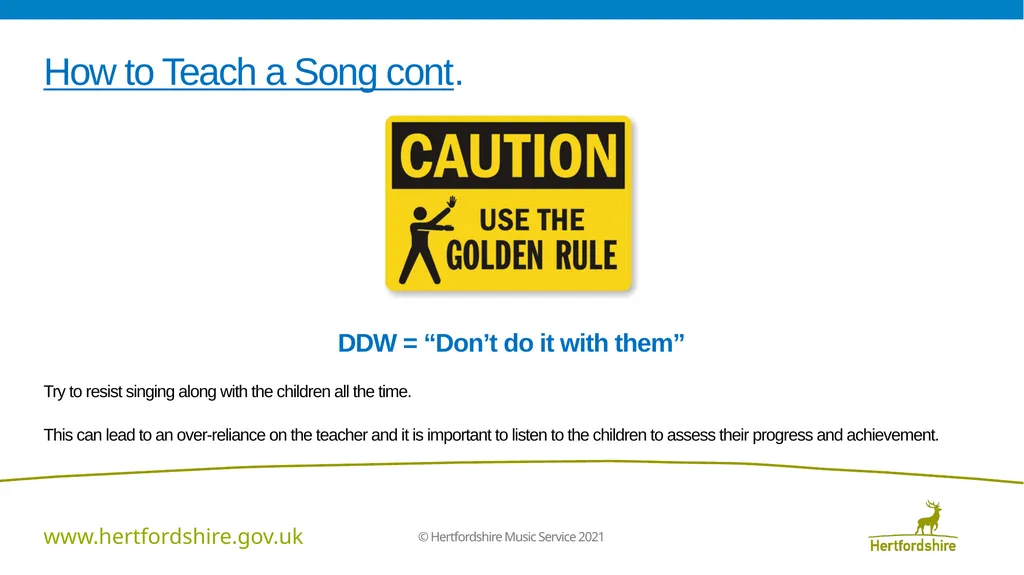
How to Teach a Song cont. DDW = “Don’t do it with them”
Try to resist singing along with the children all the time.
This can lead to an over-reliance on the teacher and it is important to listen to the children to assess their progress and achievement.<br>
Try to resist singing along with the children all the time.
This can lead to an over-reliance on the teacher and it is important to listen to the children to assess their progress and achievement.<br>
13
Other Activities: Get the children to choose a song they know well and:
Find the pulse
Tap the rhythm pattern
Sing some sections aloud, some in ‘thinking voice’
Sing the songs higher or lower (pitch)
Sing the songs faster or slower (tempo)
Sing the songs louder or quieter (dynamics)
Show the phrases with ‘Rainbow Arms’
Rehearse the songs in pairs or small groups to share with the class
Once everyone is confident, move on to simple part-singing, combining some of the songs as ‘partner songs:
Try combining Dads with Bounce High; and Chest, Knee, Toe with All ‘Round the Brickyard. Eventually, you can fit all four songs together!<br>
Find the pulse
Tap the rhythm pattern
Sing some sections aloud, some in ‘thinking voice’
Sing the songs higher or lower (pitch)
Sing the songs faster or slower (tempo)
Sing the songs louder or quieter (dynamics)
Show the phrases with ‘Rainbow Arms’
Rehearse the songs in pairs or small groups to share with the class
Once everyone is confident, move on to simple part-singing, combining some of the songs as ‘partner songs:
Try combining Dads with Bounce High; and Chest, Knee, Toe with All ‘Round the Brickyard. Eventually, you can fit all four songs together!<br>
14
How to download the audio files… In order to keep the power point files small we have not embedded the audio files; they can be located by following the following link:
https://soundcloud.com/hertsmusic/Songbook 3
To download the track(s) click on the download icon (hover the mouse over the track name to see it) and save in your chosen location. You will need to create a Soundcloud account to download files.
To embed into the slideshow simply drag and drop from your chosen folder onto the relevant slide and resize/reposition as required.
Alternatively you can play them directly from your chosen folder or stream them each time you use them if you prefer.<br>
https://soundcloud.com/hertsmusic/Songbook 3
To download the track(s) click on the download icon (hover the mouse over the track name to see it) and save in your chosen location. You will need to create a Soundcloud account to download files.
To embed into the slideshow simply drag and drop from your chosen folder onto the relevant slide and resize/reposition as required.
Alternatively you can play them directly from your chosen folder or stream them each time you use them if you prefer.<br>
15
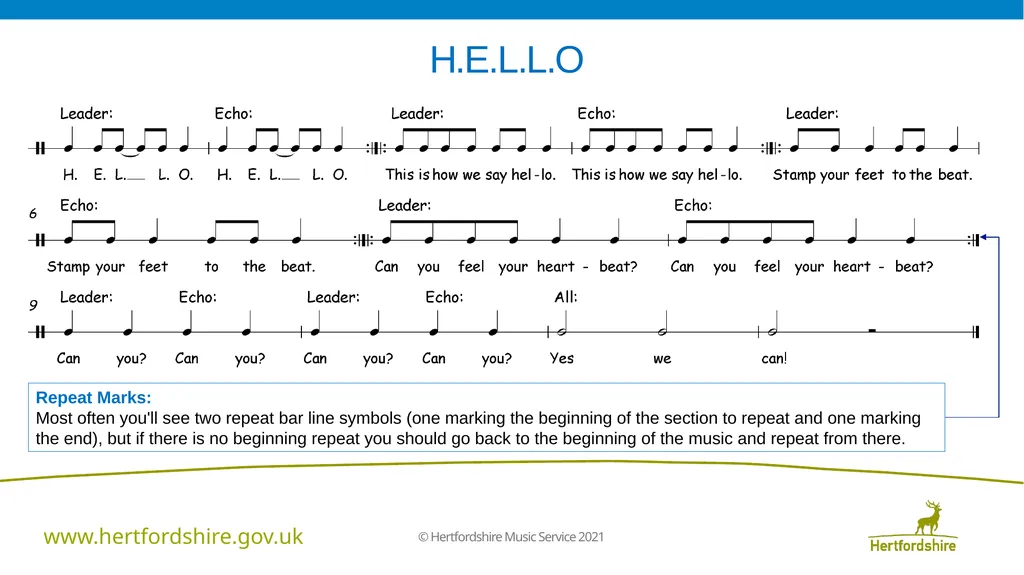
The Songs H.E.L.L.O Identifying pulse and rhythm
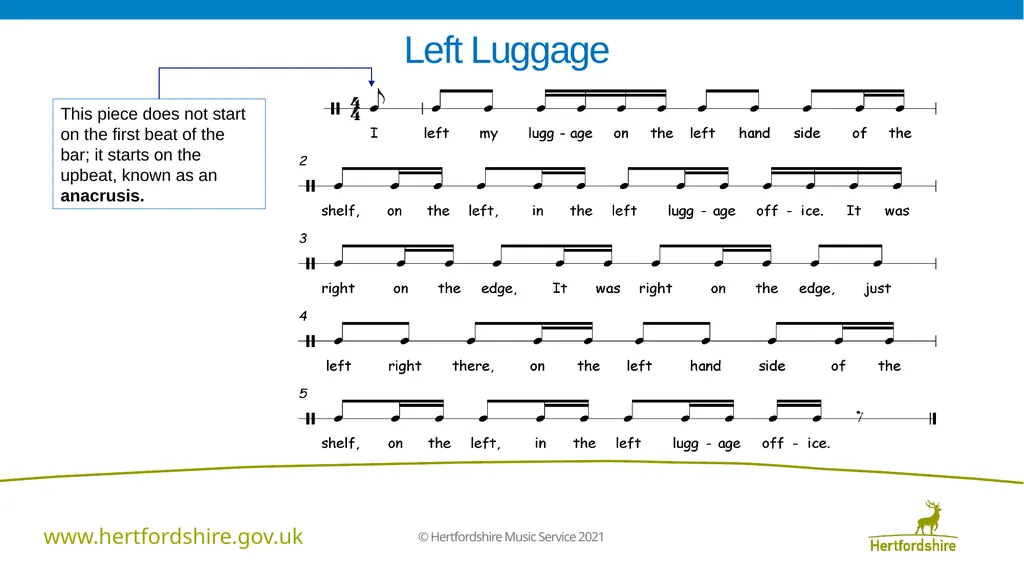
Left Luggage Diction (pronunciation), a round, internalising sounds
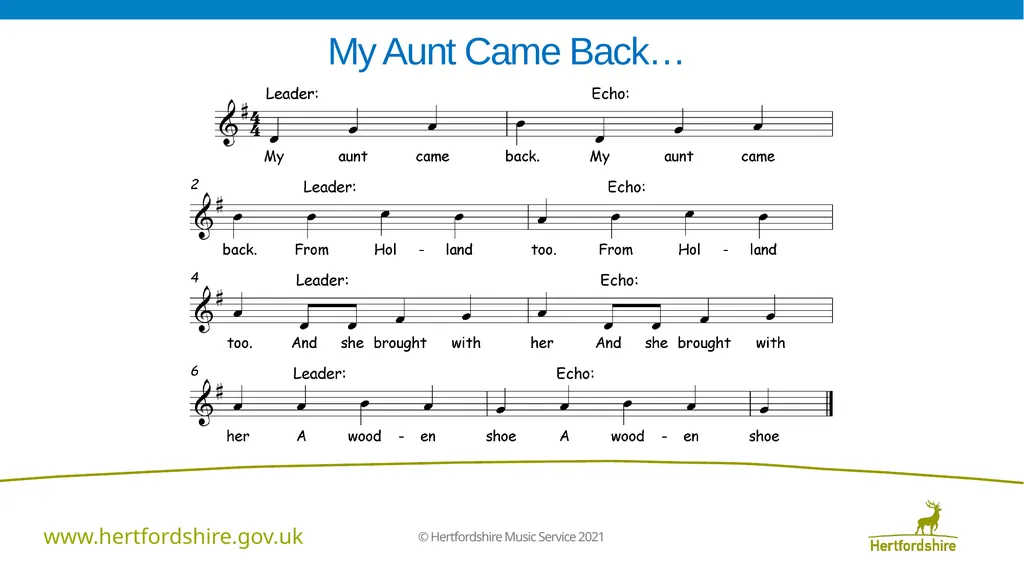
My Aunt Came Back Small leaps in melody, echoing the leader
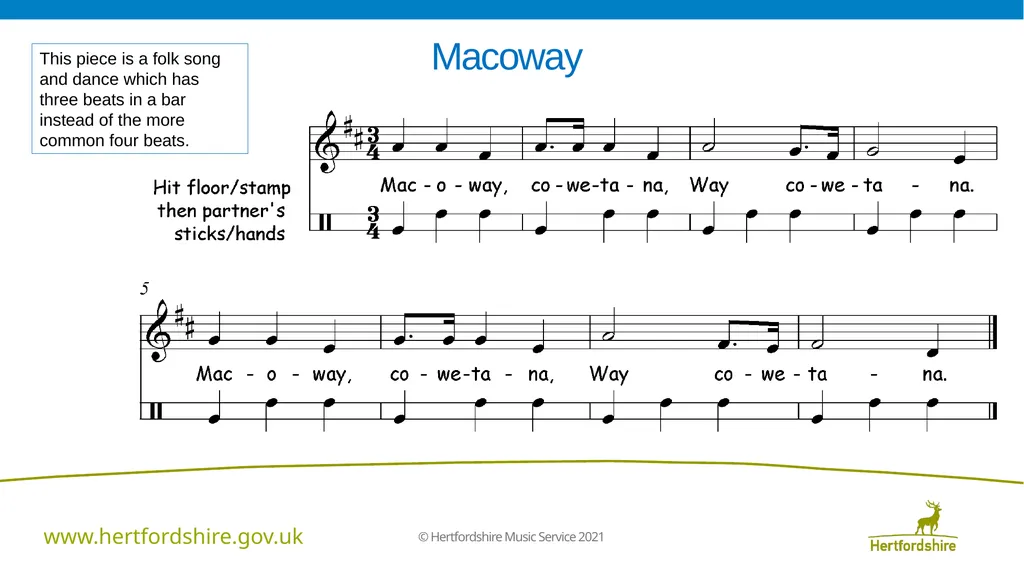
Macoway Dotted rhythms, phrasing, 3-beats in a bar
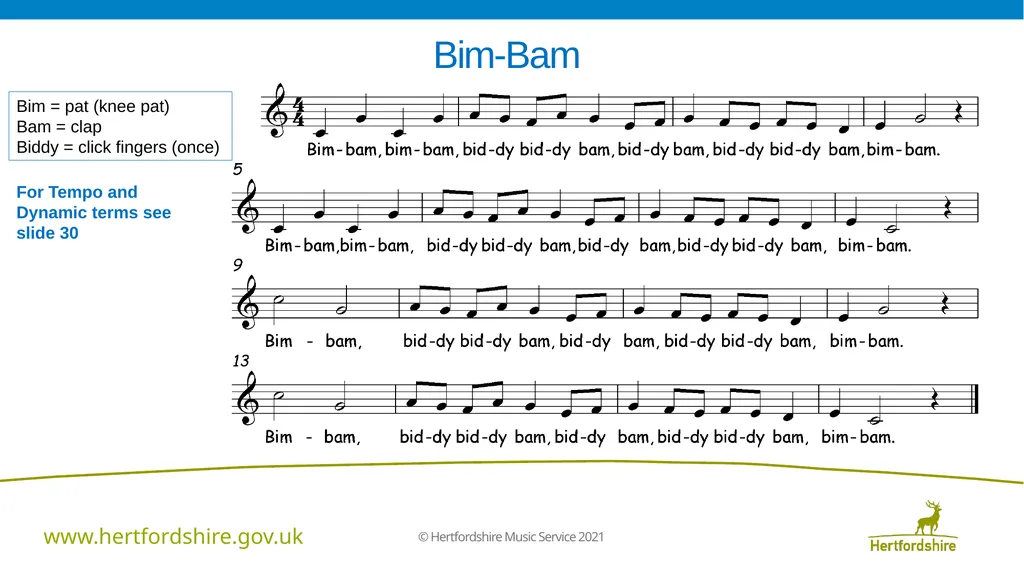
Bim-Bam Octave range, breath control, diction
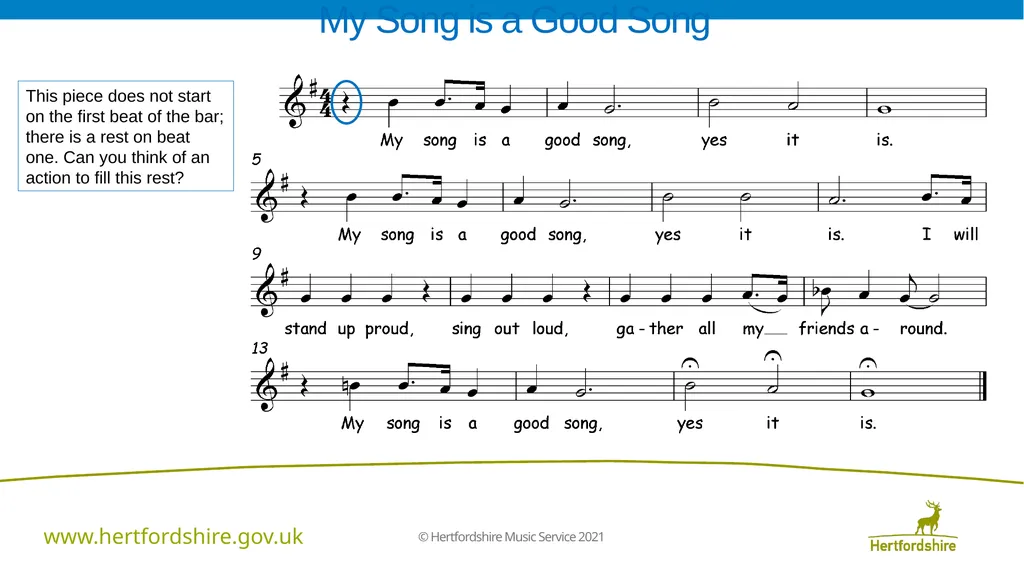
My Song is a Good Song Breath control, dotted rhythms, intonation
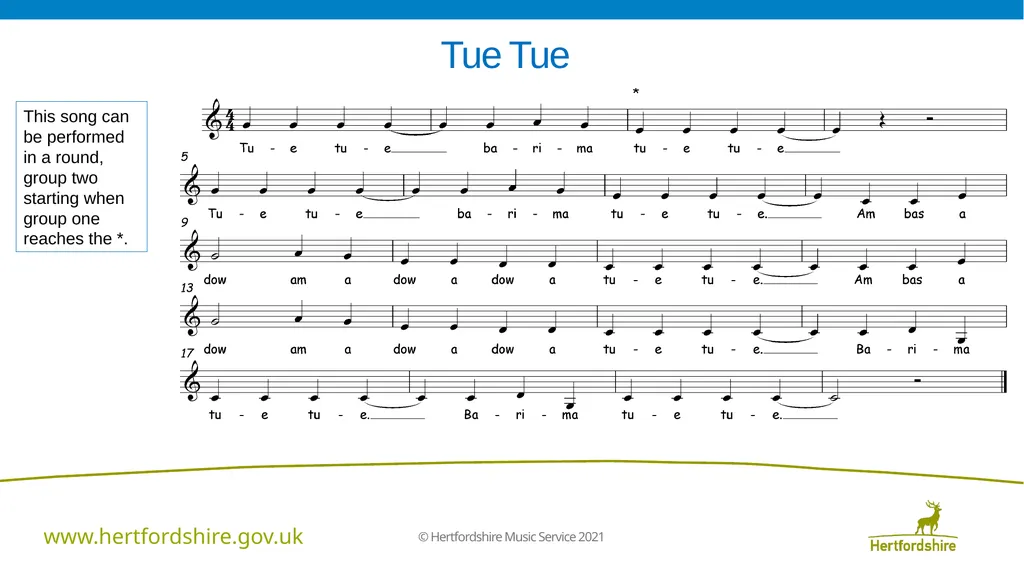
Tue Tue Pentatonic, 2-part round, ostinato
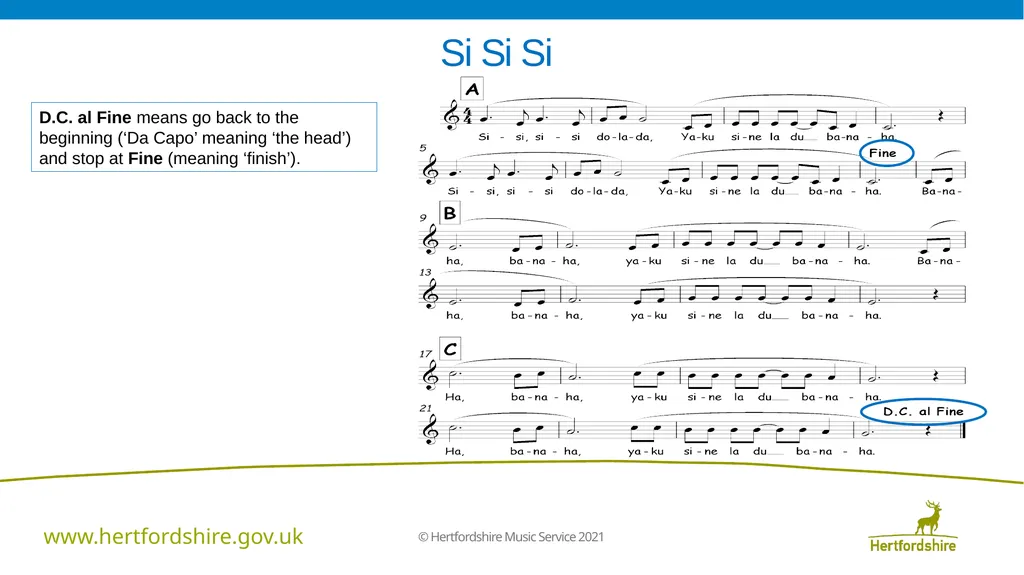
Si Si Si Breath control, phrasing, range of an octave
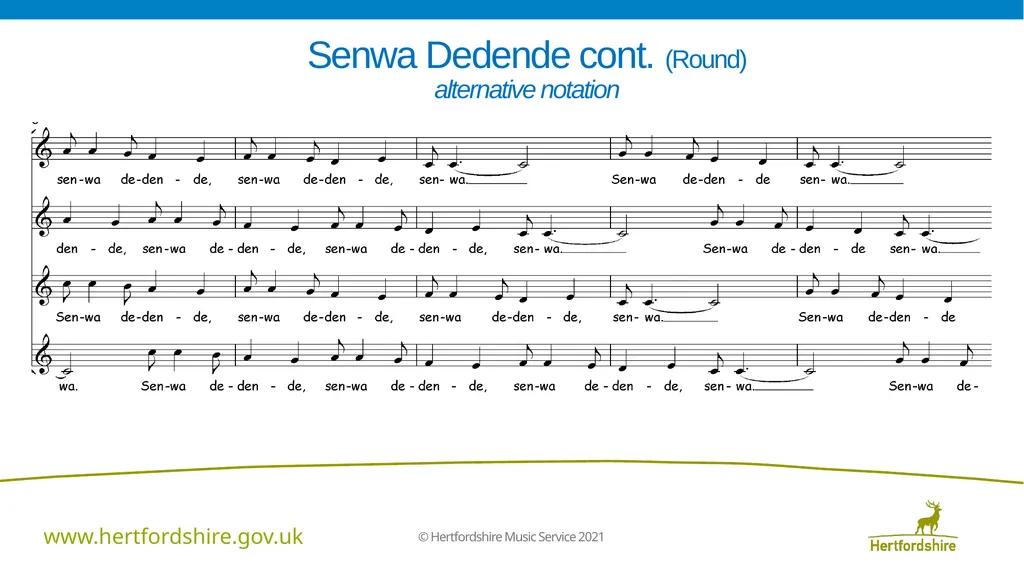
Senwa Dedende A 4 part round, ostinato, melodic sequences
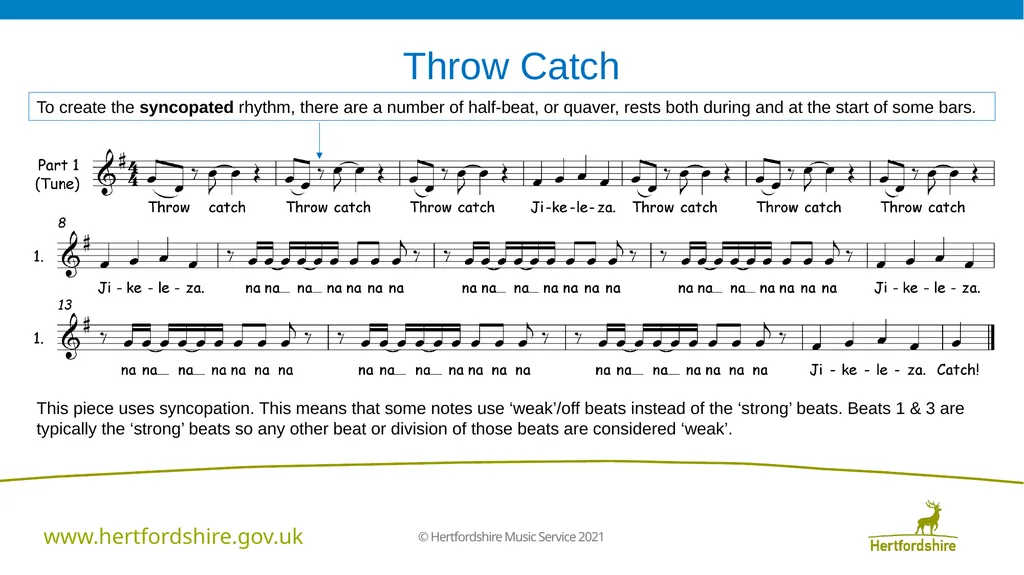
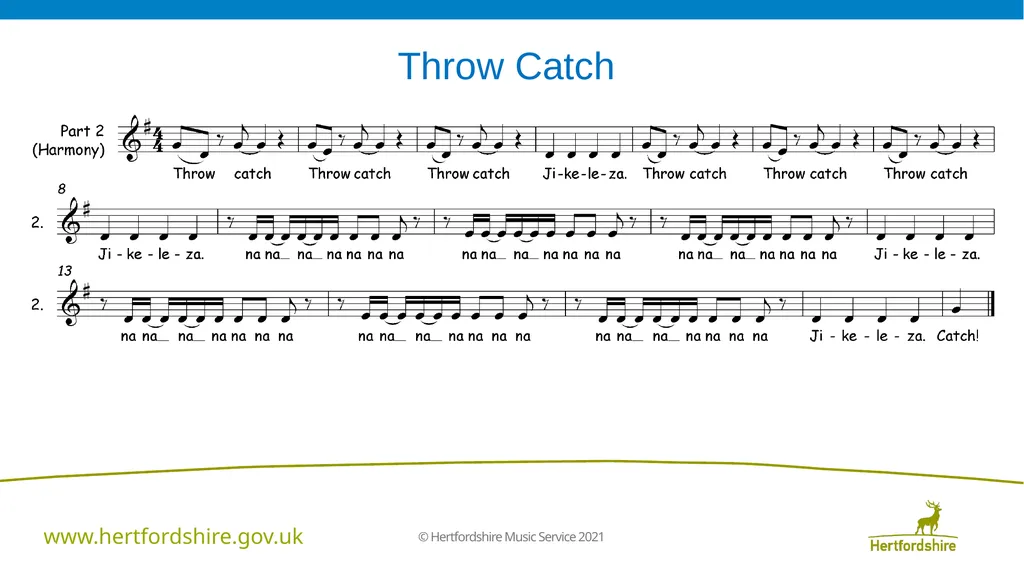
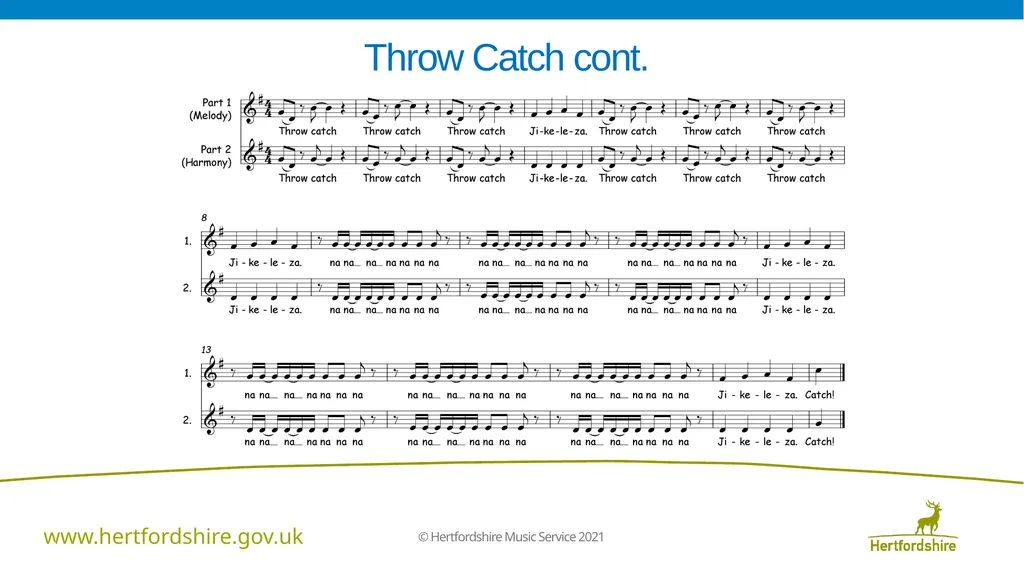
Throw Catch 2-part harmony, range of a 7th, syncopation
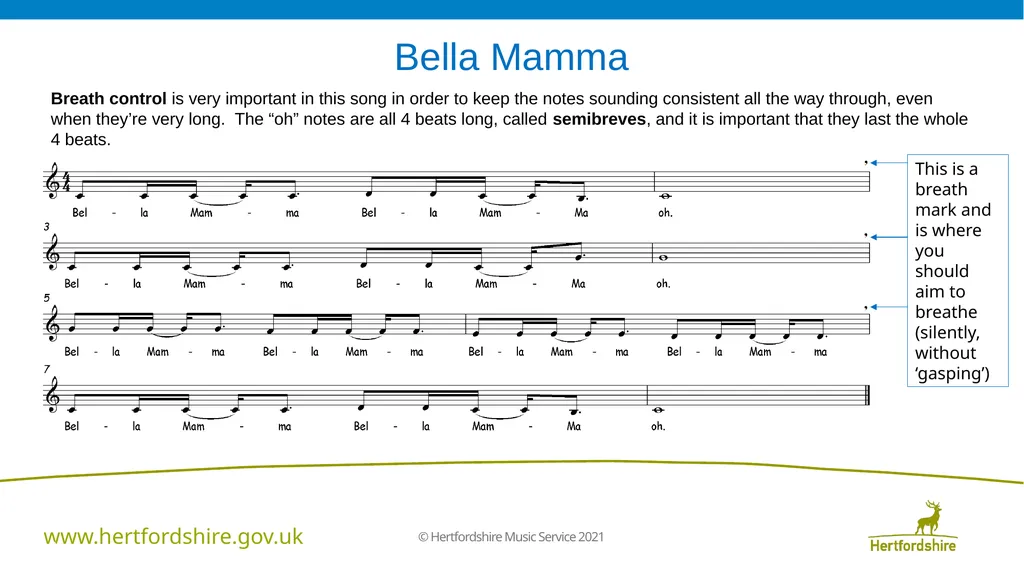
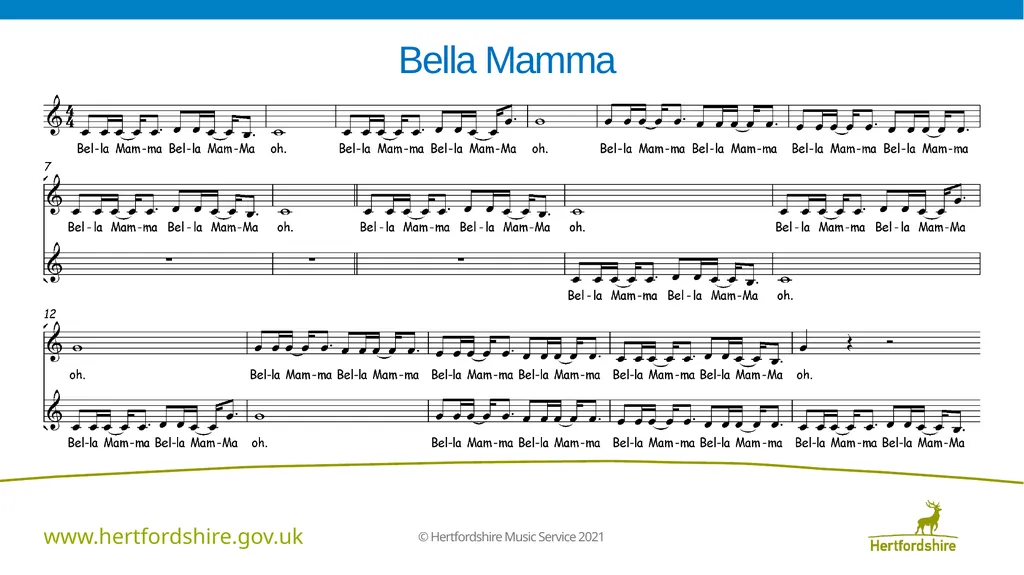
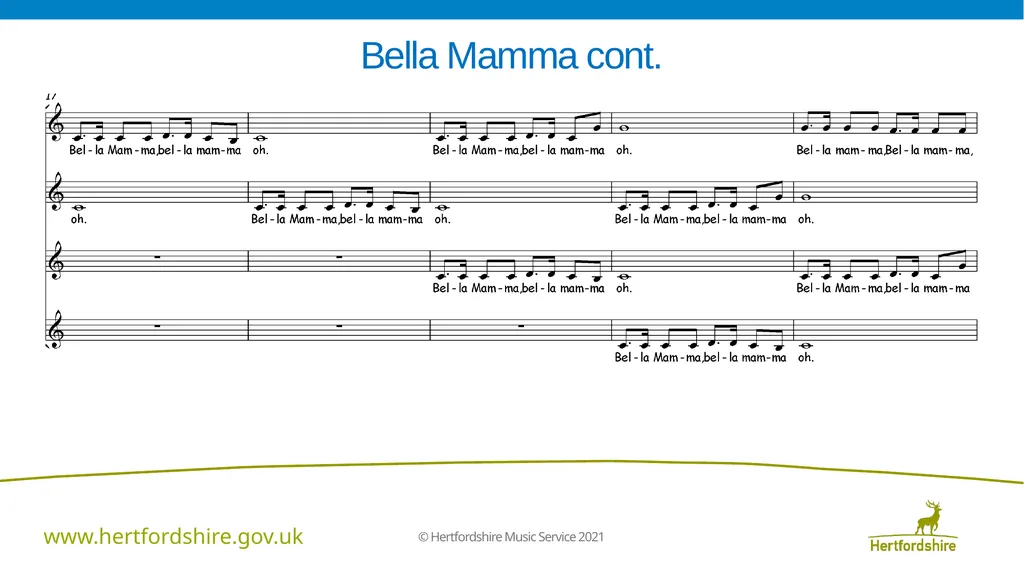
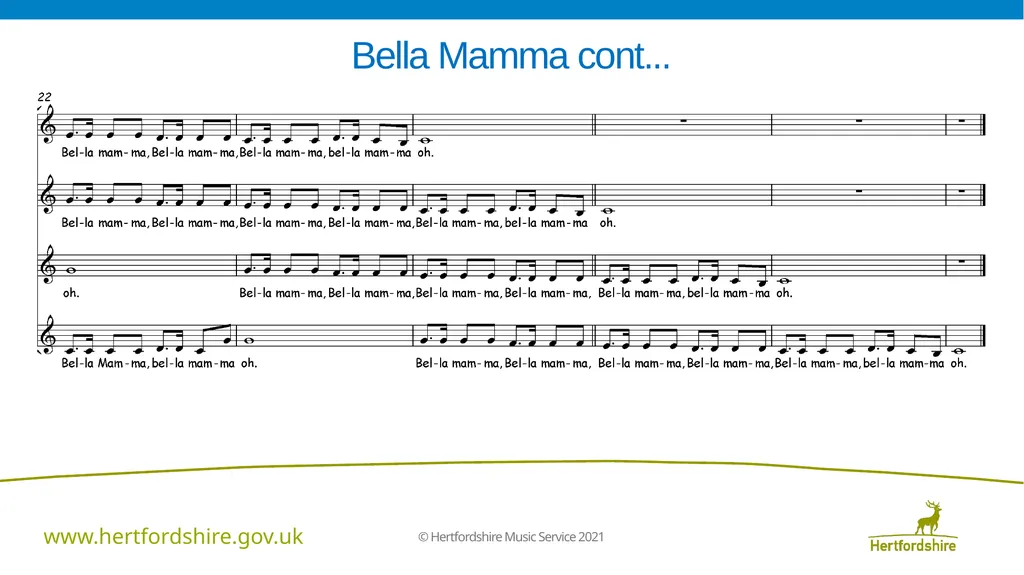
Bella Mamma A 4-part song, syncopation, dotted rhythms, breath control
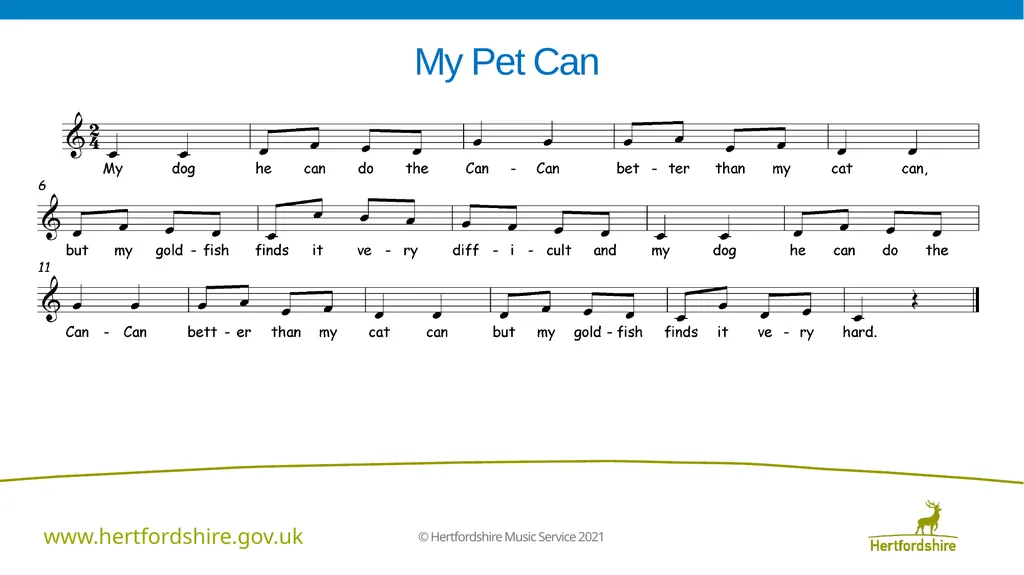
My Pet Can An octave range, and an octave leap followed by a scale at speed<br>
Left Luggage Diction (pronunciation), a round, internalising sounds
My Aunt Came Back Small leaps in melody, echoing the leader
Macoway Dotted rhythms, phrasing, 3-beats in a bar
Bim-Bam Octave range, breath control, diction
My Song is a Good Song Breath control, dotted rhythms, intonation
Tue Tue Pentatonic, 2-part round, ostinato
Si Si Si Breath control, phrasing, range of an octave
Senwa Dedende A 4 part round, ostinato, melodic sequences
Throw Catch 2-part harmony, range of a 7th, syncopation
Bella Mamma A 4-part song, syncopation, dotted rhythms, breath control
My Pet Can An octave range, and an octave leap followed by a scale at speed<br>
16
H.E.L.L.O Repeat Marks:
Most often you'll see two repeat bar line symbols (one marking the beginning of the section to repeat and one marking the end), but if there is no beginning repeat you should go back to the beginning of the music and repeat from there.<br>
Most often you'll see two repeat bar line symbols (one marking the beginning of the section to repeat and one marking the end), but if there is no beginning repeat you should go back to the beginning of the music and repeat from there.<br>
17
Left Luggage This piece does not start on the first beat of the bar; it starts on the upbeat, known as an anacrusis.<br>
18
My Aunt Came Back…<br>
19
Macoway This piece is a folk song and dance which has three beats in a bar instead of the more common four beats.<br>
20
Bim-Bam Bim = pat (knee pat)
Bam = clap
Biddy = click fingers (once) For Tempo and Dynamic terms see slide 30<br>
Bam = clap
Biddy = click fingers (once) For Tempo and Dynamic terms see slide 30<br>
21
My Song is a Good Song This piece does not start on the first beat of the bar; there is a rest on beat one. Can you think of an action to fill this rest?<br>
22
Tue Tue This song can be performed in a round, group two starting when group one reaches the *.<br>
23
Si Si Si D.C. al Fine means go back to the beginning (‘Da Capo’ meaning ‘the head’) and stop at Fine (meaning ‘finish’).<br>
24
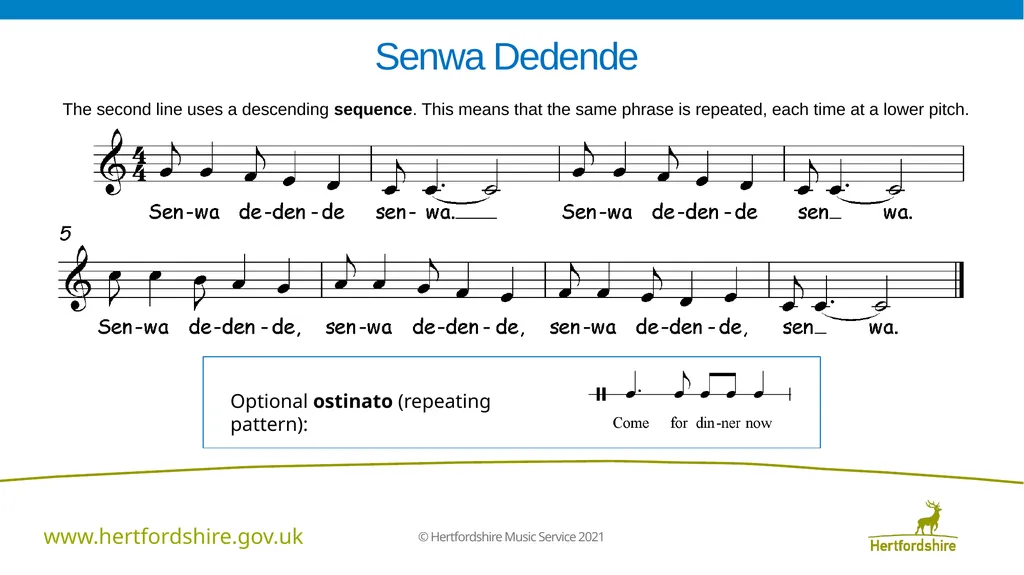
Senwa Dedende The second line uses a descending sequence. This means that the same phrase is repeated, each time at a lower pitch.<br>
25
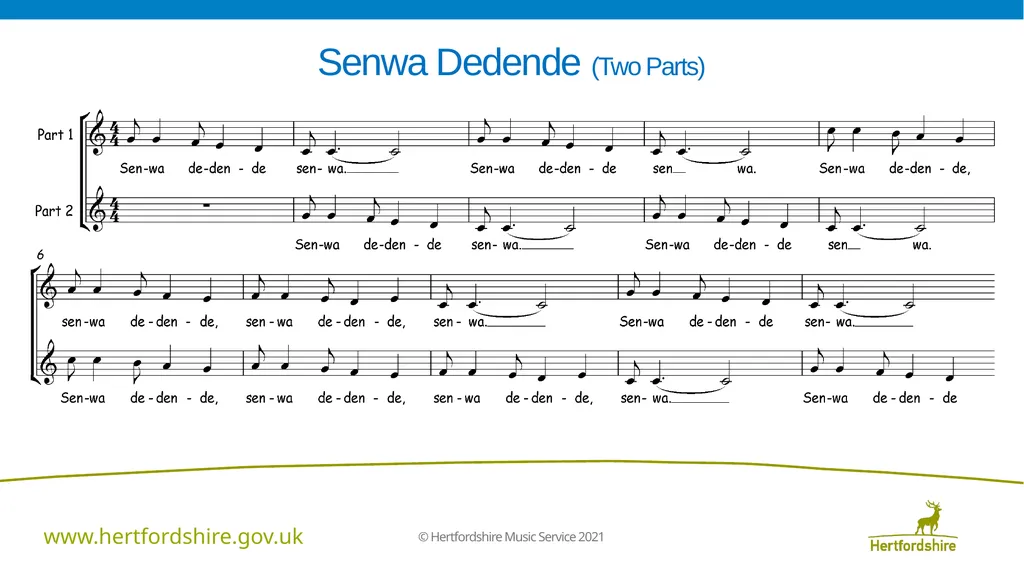
Senwa Dedende (Two Parts)<br>
26
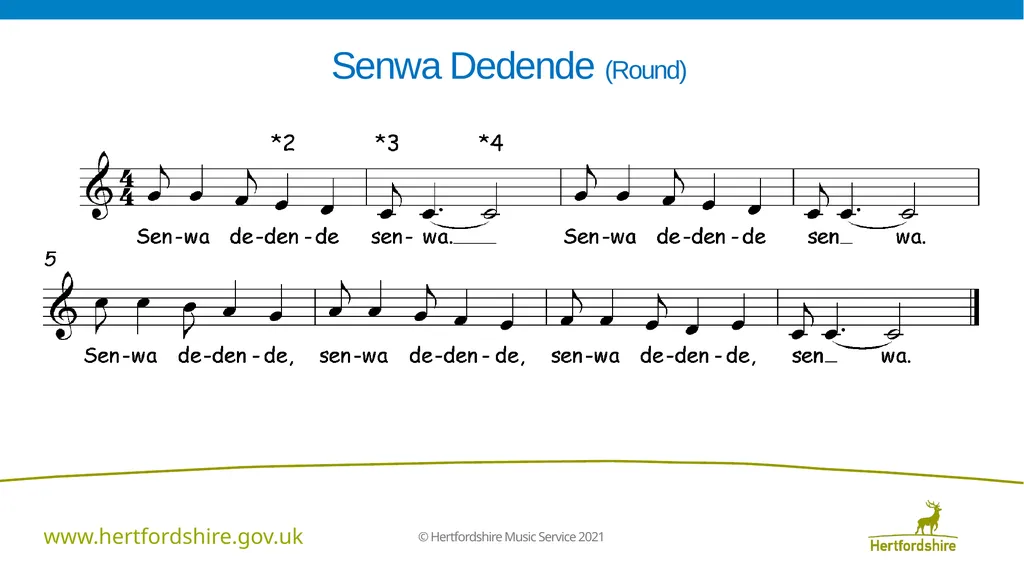
Senwa Dedende (Round)<br>
27
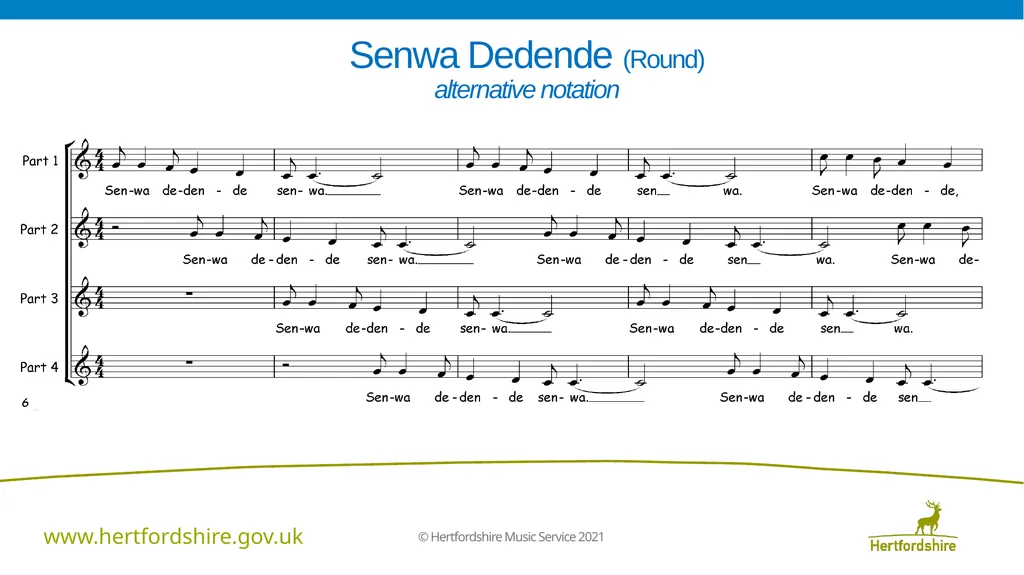
Senwa Dedende (Round)
alternative notation<br>
28
Senwa Dedende cont. (Round)
alternative notation<br>
29
Throw Catch This piece uses syncopation. This means that some notes use ‘weak’/off beats instead of the ‘strong’ beats. Beats 1 & 3 are typically the ‘strong’ beats so any other beat or division of those beats are considered ‘weak’. To create the syncopated rhythm, there are a number of half-beat, or quaver, rests both during and at the start of some bars.<br>
30
Throw Catch<br>
31
Throw Catch cont.<br>
32
Bella Mamma Breath control is very important in this song in order to keep the notes sounding consistent all the way through, even when they’re very long. The “oh” notes are all 4 beats long, called semibreves, and it is important that they last the whole 4 beats. This is a breath mark and is where you should aim to breathe (silently, without ‘gasping’)<br>
33
Bella Mamma<br>
34
Bella Mamma cont.<br>
35
Bella Mamma cont...<br>
36
My Pet Can<br>
37
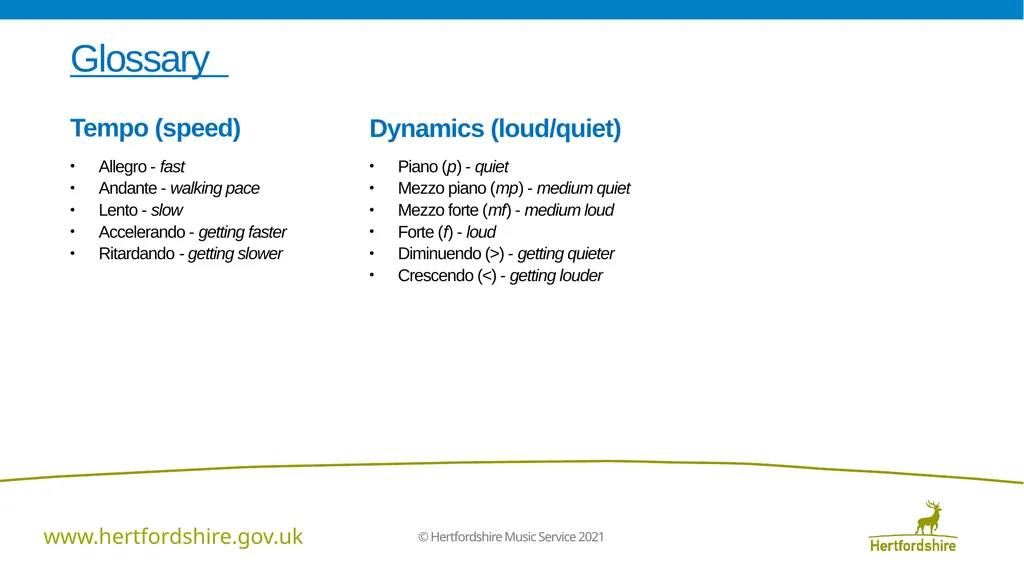
Glossary Tempo (speed) Allegro - fast
Andante - walking pace
Lento - slow
Accelerando - getting faster
Ritardando - getting slower Dynamics (loud/quiet) Piano (p) - quiet
Mezzo piano (mp) - medium quiet
Mezzo forte (mf) - medium loud
Forte (f) - loud
Diminuendo (>) - getting quieter
Crescendo (<) - getting louder<br>
Andante - walking pace
Lento - slow
Accelerando - getting faster
Ritardando - getting slower Dynamics (loud/quiet) Piano (p) - quiet
Mezzo piano (mp) - medium quiet
Mezzo forte (mf) - medium loud
Forte (f) - loud
Diminuendo (>) - getting quieter
Crescendo (<) - getting louder<br>
38
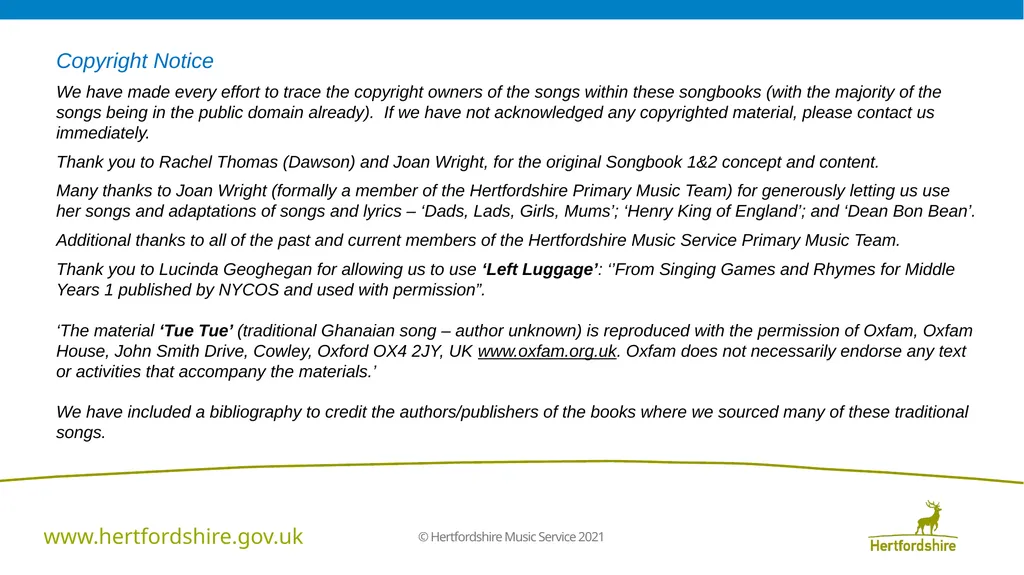
Copyright Notice
We have made every effort to trace the copyright owners of the songs within these songbooks (with the majority of the songs being in the public domain already). If we have not acknowledged any copyrighted material, please contact us immediately.
Thank you to Rachel Thomas (Dawson) and Joan Wright, for the original Songbook 1&2 concept and content.
Many thanks to Joan Wright (formally a member of the Hertfordshire Primary Music Team) for generously letting us use her songs and adaptations of songs and lyrics – ‘Dads, Lads, Girls, Mums’; ‘Henry King of England’; and ‘Dean Bon Bean’.
Additional thanks to all of the past and current members of the Hertfordshire Music Service Primary Music Team.
Thank you to Lucinda Geoghegan for allowing us to use ‘Left Luggage’: ‘’From Singing Games and Rhymes for Middle Years 1 published by NYCOS and used with permission”.
‘The material ‘Tue Tue’ (traditional Ghanaian song – author unknown) is reproduced with the permission of Oxfam, Oxfam House, John Smith Drive, Cowley, Oxford OX4 2JY, UK www.oxfam.org.uk. Oxfam does not necessarily endorse any text or activities that accompany the materials.’
We have included a bibliography to credit the authors/publishers of the books where we sourced many of these traditional songs.<br>
We have made every effort to trace the copyright owners of the songs within these songbooks (with the majority of the songs being in the public domain already). If we have not acknowledged any copyrighted material, please contact us immediately.
Thank you to Rachel Thomas (Dawson) and Joan Wright, for the original Songbook 1&2 concept and content.
Many thanks to Joan Wright (formally a member of the Hertfordshire Primary Music Team) for generously letting us use her songs and adaptations of songs and lyrics – ‘Dads, Lads, Girls, Mums’; ‘Henry King of England’; and ‘Dean Bon Bean’.
Additional thanks to all of the past and current members of the Hertfordshire Music Service Primary Music Team.
Thank you to Lucinda Geoghegan for allowing us to use ‘Left Luggage’: ‘’From Singing Games and Rhymes for Middle Years 1 published by NYCOS and used with permission”.
‘The material ‘Tue Tue’ (traditional Ghanaian song – author unknown) is reproduced with the permission of Oxfam, Oxfam House, John Smith Drive, Cowley, Oxford OX4 2JY, UK www.oxfam.org.uk. Oxfam does not necessarily endorse any text or activities that accompany the materials.’
We have included a bibliography to credit the authors/publishers of the books where we sourced many of these traditional songs.<br>
39
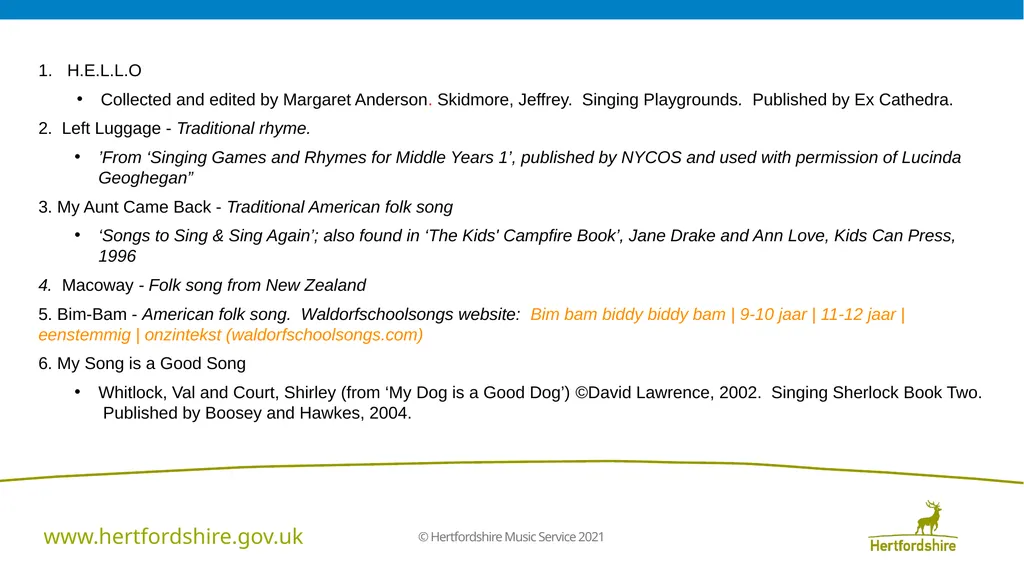
H.E.L.L.O
Collected and edited by Margaret Anderson. Skidmore, Jeffrey. Singing Playgrounds. Published by Ex Cathedra.
2. Left Luggage - Traditional rhyme.
’From ‘Singing Games and Rhymes for Middle Years 1’, published by NYCOS and used with permission of Lucinda Geoghegan”
3. My Aunt Came Back - Traditional American folk song
‘Songs to Sing & Sing Again’; also found in ‘The Kids' Campfire Book’, Jane Drake and Ann Love, Kids Can Press, 1996
4. Macoway - Folk song from New Zealand
5. Bim-Bam - American folk song. Waldorfschoolsongs website: Bim bam biddy biddy bam | 9-10 jaar | 11-12 jaar | eenstemmig | onzintekst (waldorfschoolsongs.com)
6. My Song is a Good Song
Whitlock, Val and Court, Shirley (from ‘My Dog is a Good Dog’) ©David Lawrence, 2002. Singing Sherlock Book Two. Published by Boosey and Hawkes, 2004.<br>
Collected and edited by Margaret Anderson. Skidmore, Jeffrey. Singing Playgrounds. Published by Ex Cathedra.
2. Left Luggage - Traditional rhyme.
’From ‘Singing Games and Rhymes for Middle Years 1’, published by NYCOS and used with permission of Lucinda Geoghegan”
3. My Aunt Came Back - Traditional American folk song
‘Songs to Sing & Sing Again’; also found in ‘The Kids' Campfire Book’, Jane Drake and Ann Love, Kids Can Press, 1996
4. Macoway - Folk song from New Zealand
5. Bim-Bam - American folk song. Waldorfschoolsongs website: Bim bam biddy biddy bam | 9-10 jaar | 11-12 jaar | eenstemmig | onzintekst (waldorfschoolsongs.com)
6. My Song is a Good Song
Whitlock, Val and Court, Shirley (from ‘My Dog is a Good Dog’) ©David Lawrence, 2002. Singing Sherlock Book Two. Published by Boosey and Hawkes, 2004.<br>
40
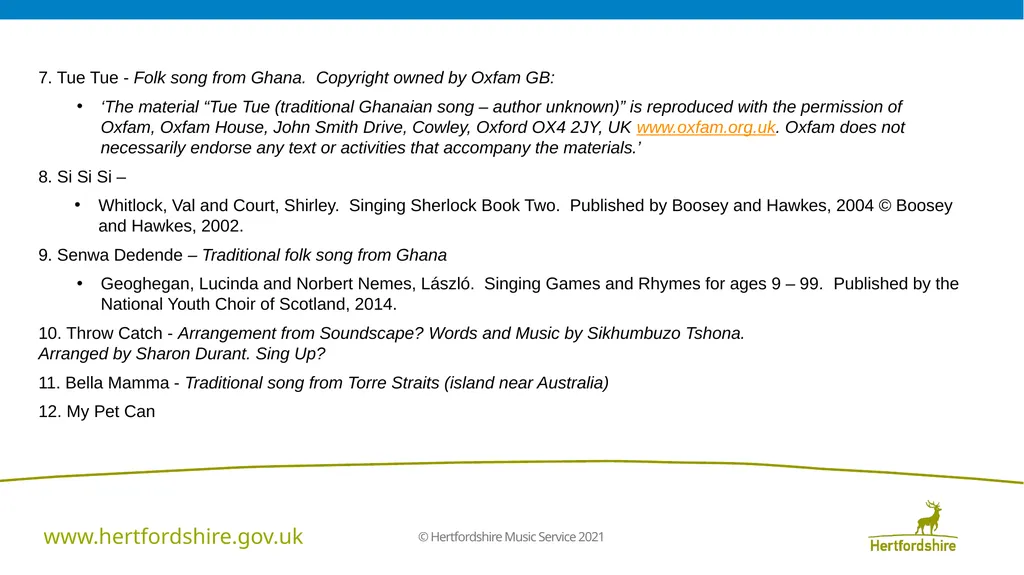
7. Tue Tue - Folk song from Ghana. Copyright owned by Oxfam GB:
‘The material “Tue Tue (traditional Ghanaian song – author unknown)” is reproduced with the permission of Oxfam, Oxfam House, John Smith Drive, Cowley, Oxford OX4 2JY, UK www.oxfam.org.uk. Oxfam does not necessarily endorse any text or activities that accompany the materials.’
8. Si Si Si –
Whitlock, Val and Court, Shirley. Singing Sherlock Book Two. Published by Boosey and Hawkes, 2004 © Boosey and Hawkes, 2002.
9. Senwa Dedende – Traditional folk song from Ghana
Geoghegan, Lucinda and Norbert Nemes, László. Singing Games and Rhymes for ages 9 – 99. Published by the National Youth Choir of Scotland, 2014.
10. Throw Catch - Arrangement from Soundscape? Words and Music by Sikhumbuzo Tshona. Arranged by Sharon Durant. Sing Up?
11. Bella Mamma - Traditional song from Torre Straits (island near Australia)
12. My Pet Can<br>
‘The material “Tue Tue (traditional Ghanaian song – author unknown)” is reproduced with the permission of Oxfam, Oxfam House, John Smith Drive, Cowley, Oxford OX4 2JY, UK www.oxfam.org.uk. Oxfam does not necessarily endorse any text or activities that accompany the materials.’
8. Si Si Si –
Whitlock, Val and Court, Shirley. Singing Sherlock Book Two. Published by Boosey and Hawkes, 2004 © Boosey and Hawkes, 2002.
9. Senwa Dedende – Traditional folk song from Ghana
Geoghegan, Lucinda and Norbert Nemes, László. Singing Games and Rhymes for ages 9 – 99. Published by the National Youth Choir of Scotland, 2014.
10. Throw Catch - Arrangement from Soundscape? Words and Music by Sikhumbuzo Tshona. Arranged by Sharon Durant. Sing Up?
11. Bella Mamma - Traditional song from Torre Straits (island near Australia)
12. My Pet Can<br>