Single use plastics and Extended Producer Responsibility: Recent gazzetted legislation on plastics 1 Briefing to Portfolio Committee 13 October 2020 PROBLEM STATEMENT PLASTIC WASTE Plastics are inexpensive, lightweight and durable
"Single use plastics and Extended Producer" is the property of its rightful owner. Permission is granted to
download and print the materials on this website for personal, non-commercial use only, and to display it
on your personal computer provided you do not modify the materials and that you retain all copyright
notices contained in the materials. By downloading content from our website, you accept the terms of this
agreement.
Presentation Transcript
01
Single use plastics and Extended Producer Responsibility: Recent gazzetted legislation on plastics 1 Briefing to Portfolio Committee
13 October 2020<br>
02
PROBLEM STATEMENT – PLASTIC WASTE Plastics are inexpensive, lightweight and durable materials and find use in a wide range of applications. Consequently, plastic litter has a high propensity to end up in the environment, particularly in waterways and the marine marine environment, where globally this litter is of huge environmental concern.
In addition, ~25% of households do not receive refuse removal services in line with the National Domestic Waste Collection Standards and this exacerbates illegal dumping and plastic litter. 2<br>
03
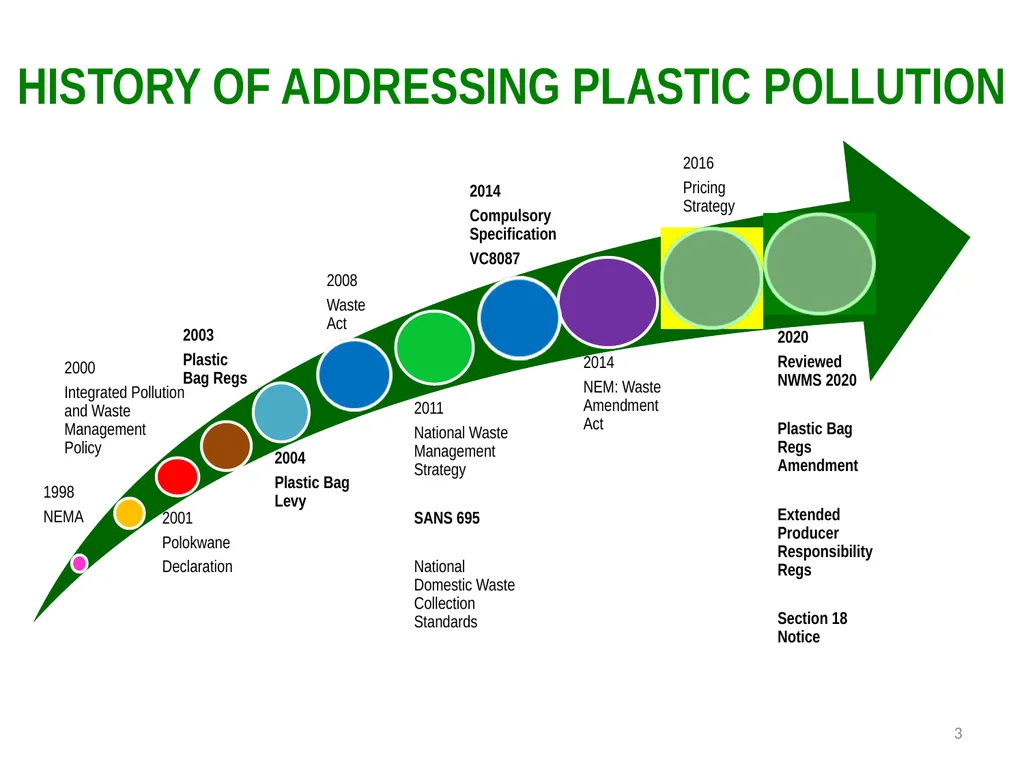
2011
National Waste Management Strategy
SANS 695
National Domestic Waste Collection Standards 2014
NEM: Waste Amendment Act 2001
Polokwane
Declaration 2003
Plastic Bag Regs 2004
Plastic Bag Levy HISTORY OF ADDRESSING PLASTIC POLLUTION 2020
Reviewed NWMS 2020
2019 – FIRST PLASTIC COLLOQUIUM - AIMS Creation of a platform to engage representatives from the 3 spheres of Government, Private Sector and Civil Society in building more effective partnerships to enhance plastic waste management.
Promotion of discussions on sustainable management of plastic waste in the country.
Creation of a national platform for the exchange of information on best practice, identifying and addressing bottlenecks with regards to management of plastic waste in the country.
Identification of key economic opportunities that could be realised from plastic waste and discuss how to incorporate the informal sector in plastic waste recycling.
Deliberation on mechanisms for the effective delivery of waste management services by municipalities and support thereof.
Deliberation on technologies for plastic waste management suitable for South Africa.
The contribution of the plastic waste sector to the Circular Economy.
The theme of the Colloquium 2019 was: Plastic Waste and the Circular Economy 4<br>
05
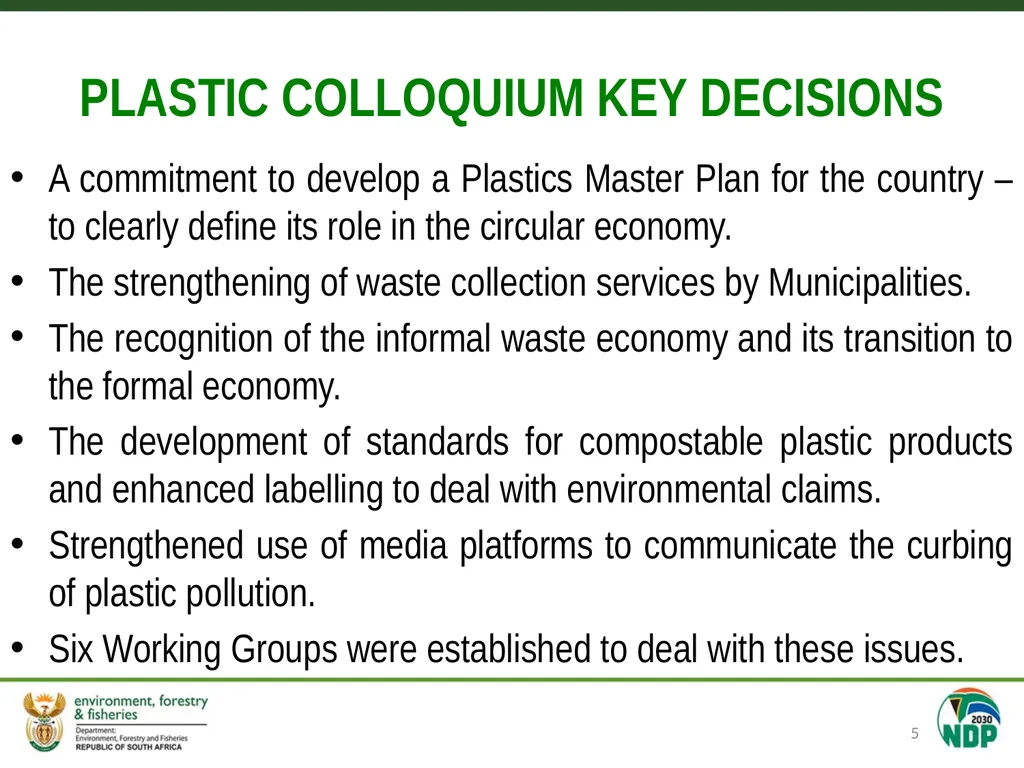
PLASTIC COLLOQUIUM KEY DECISIONS A commitment to develop a Plastics Master Plan for the country – to clearly define its role in the circular economy.
The strengthening of waste collection services by Municipalities.
The recognition of the informal waste economy and its transition to the formal economy.
The development of standards for compostable plastic products and enhanced labelling to deal with environmental claims.
Strengthened use of media platforms to communicate the curbing of plastic pollution.
Six Working Groups were established to deal with these issues. 5<br>
06
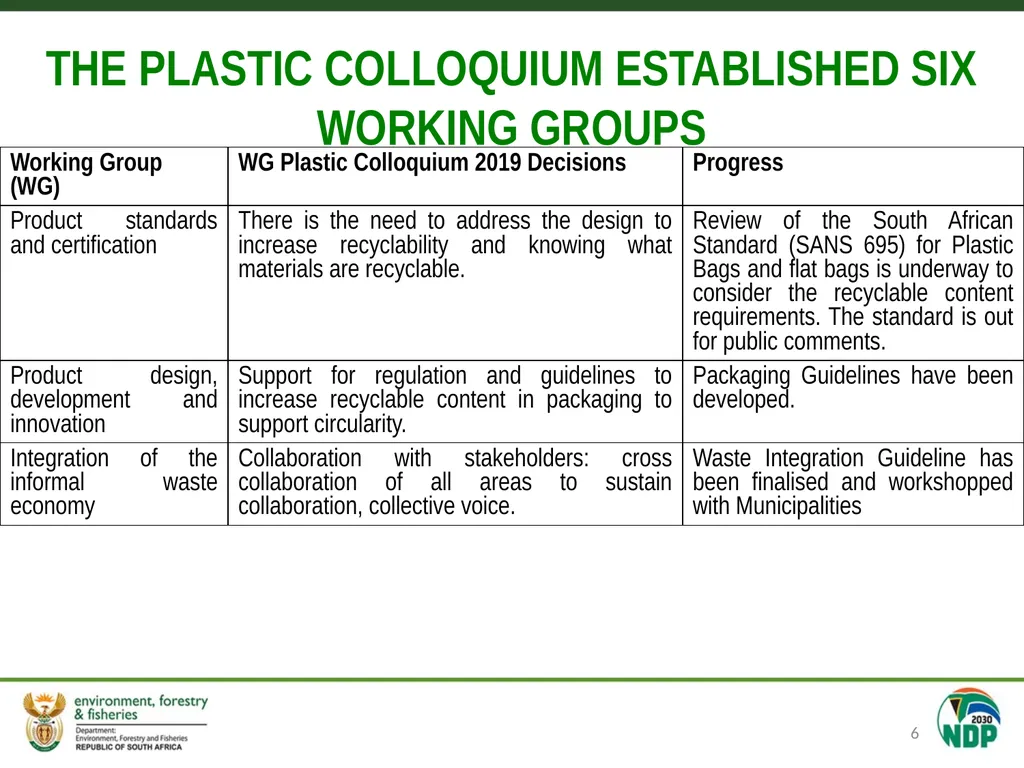
THE PLASTIC COLLOQUIUM ESTABLISHED SIX WORKING GROUPS 6<br>
07
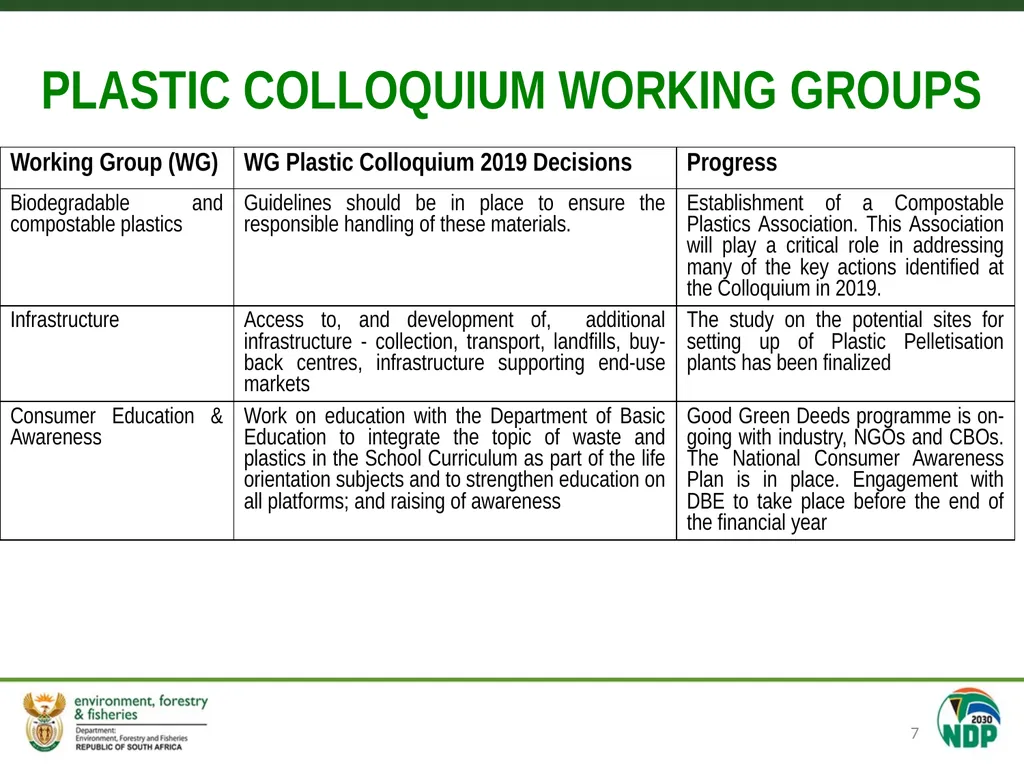
PLASTIC COLLOQUIUM WORKING GROUPS 7<br>
08
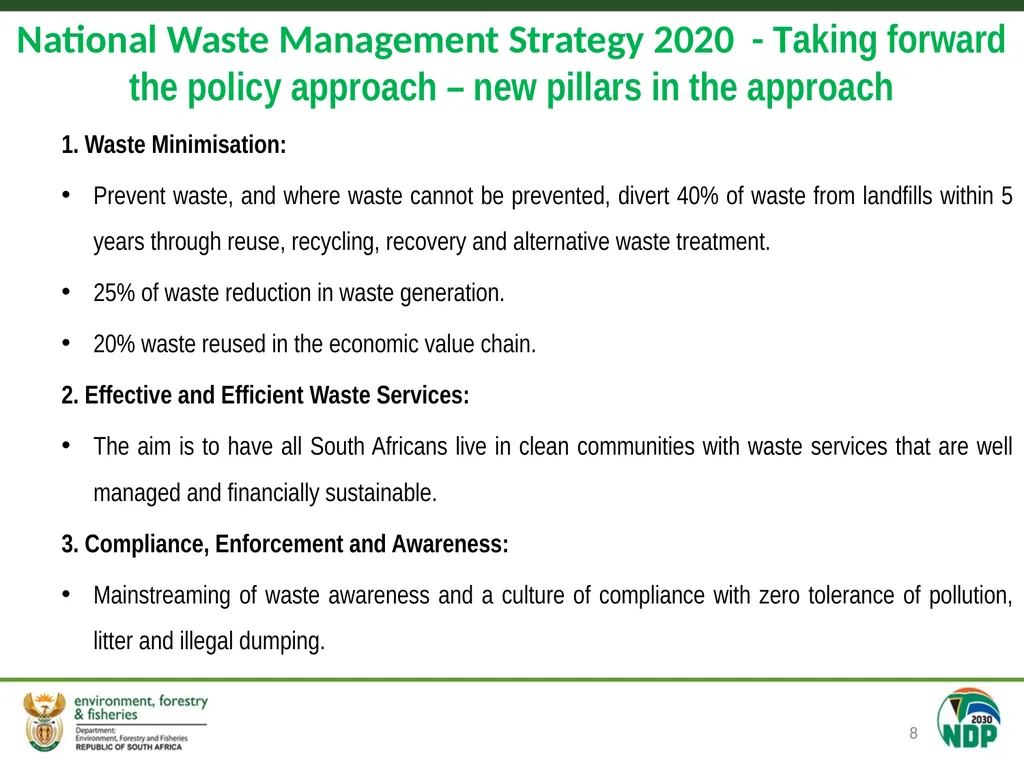
National Waste Management Strategy 2020 - Taking forward the policy approach – new pillars in the approach 1. Waste Minimisation:
Prevent waste, and where waste cannot be prevented, divert 40% of waste from landfills within 5 years through reuse, recycling, recovery and alternative waste treatment.
25% of waste reduction in waste generation.
20% waste reused in the economic value chain.
2. Effective and Efficient Waste Services:
The aim is to have all South Africans live in clean communities with waste services that are well managed and financially sustainable.
3. Compliance, Enforcement and Awareness:
Mainstreaming of waste awareness and a culture of compliance with zero tolerance of pollution, litter and illegal dumping. 8<br>
09
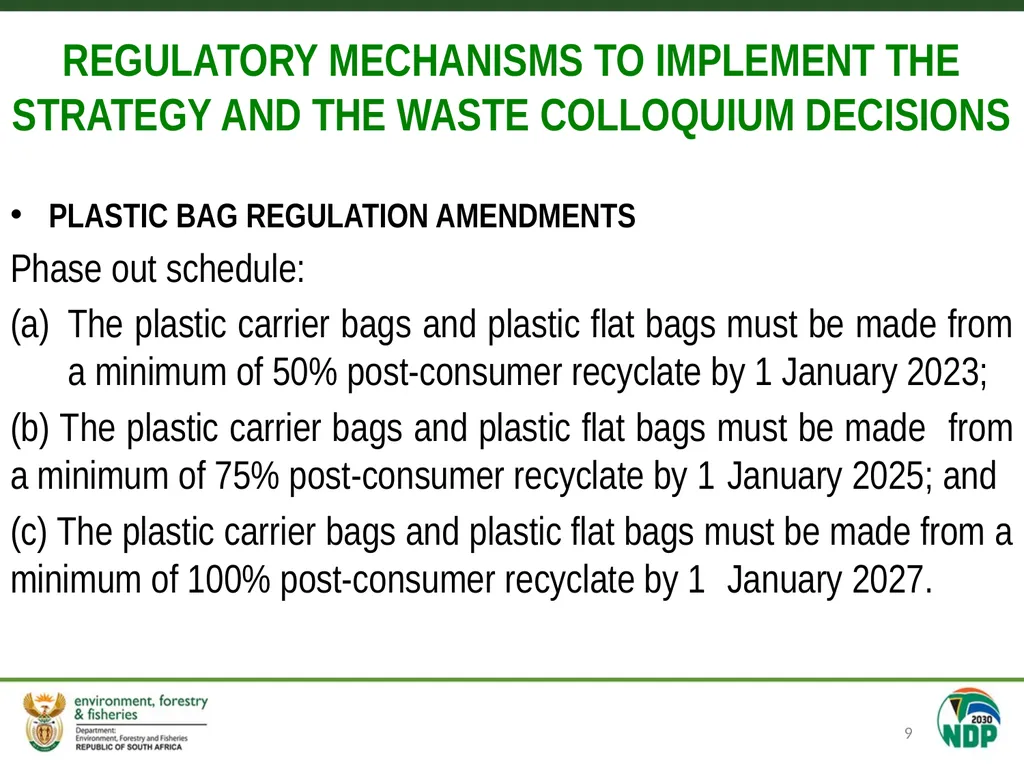
REGULATORY MECHANISMS TO IMPLEMENT THE STRATEGY AND THE WASTE COLLOQUIUM DECISIONS PLASTIC BAG REGULATION AMENDMENTS
Phase out schedule:
The plastic carrier bags and plastic flat bags must be made from a minimum of 50% post-consumer recyclate by 1 January 2023;
(b) The plastic carrier bags and plastic flat bags must be made from a minimum of 75% post-consumer recyclate by 1 January 2025; and
(c) The plastic carrier bags and plastic flat bags must be made from a minimum of 100% post-consumer recyclate by 1 January 2027. 9<br>
10
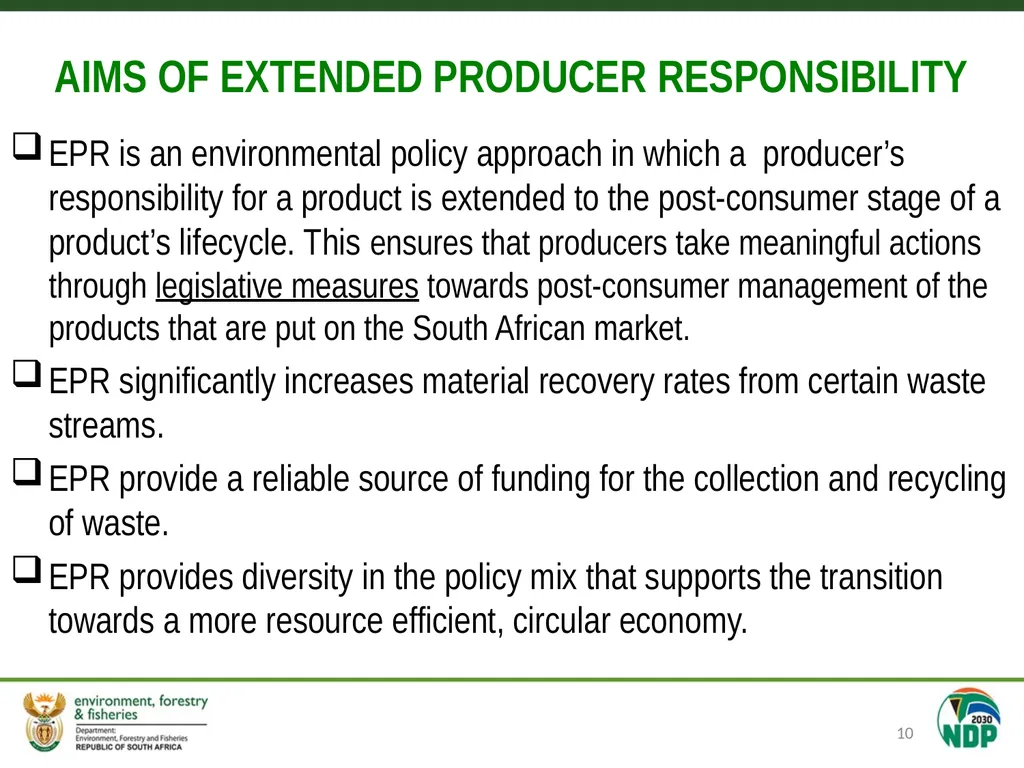
AIMS OF EXTENDED PRODUCER RESPONSIBILITY EPR is an environmental policy approach in which a producer’s responsibility for a product is extended to the post-consumer stage of a product’s lifecycle. This ensures that producers take meaningful actions through legislative measures towards post-consumer management of the products that are put on the South African market.
EPR significantly increases material recovery rates from certain waste streams.
EPR provide a reliable source of funding for the collection and recycling of waste.
EPR provides diversity in the policy mix that supports the transition towards a more resource efficient, circular economy. 10<br>
11
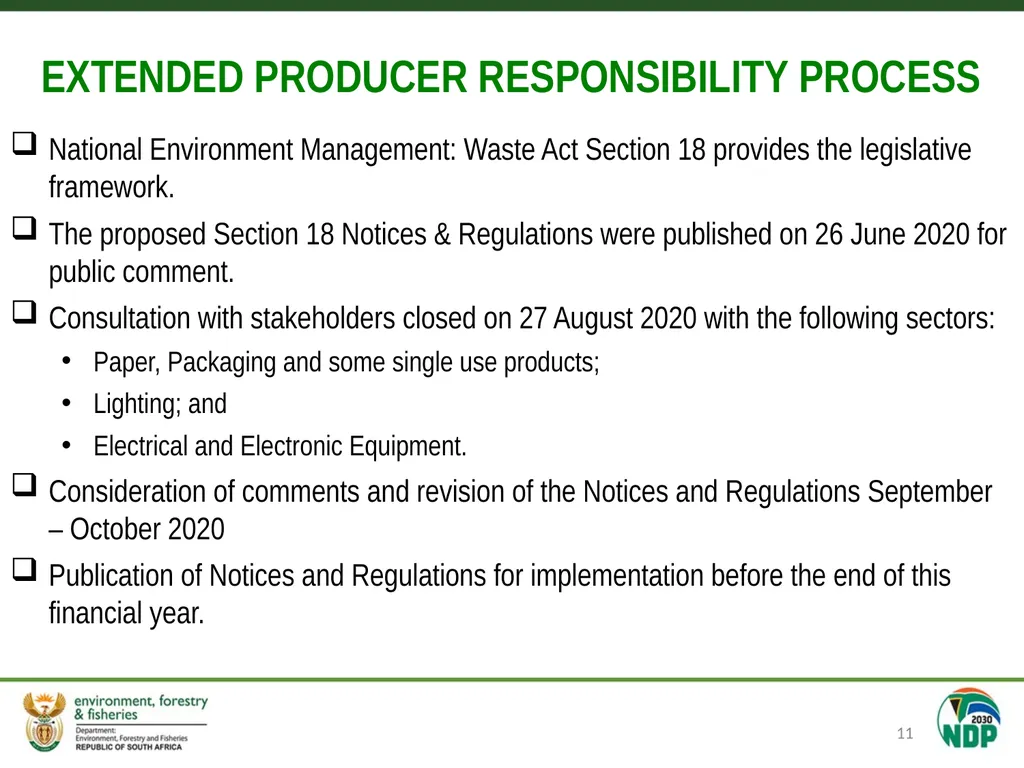
EXTENDED PRODUCER RESPONSIBILITY PROCESS National Environment Management: Waste Act Section 18 provides the legislative framework.
The proposed Section 18 Notices & Regulations were published on 26 June 2020 for public comment.
Consultation with stakeholders closed on 27 August 2020 with the following sectors:
Paper, Packaging and some single use products;
Lighting; and
Electrical and Electronic Equipment.
Consideration of comments and revision of the Notices and Regulations September – October 2020
Publication of Notices and Regulations for implementation before the end of this financial year. 11<br>
12
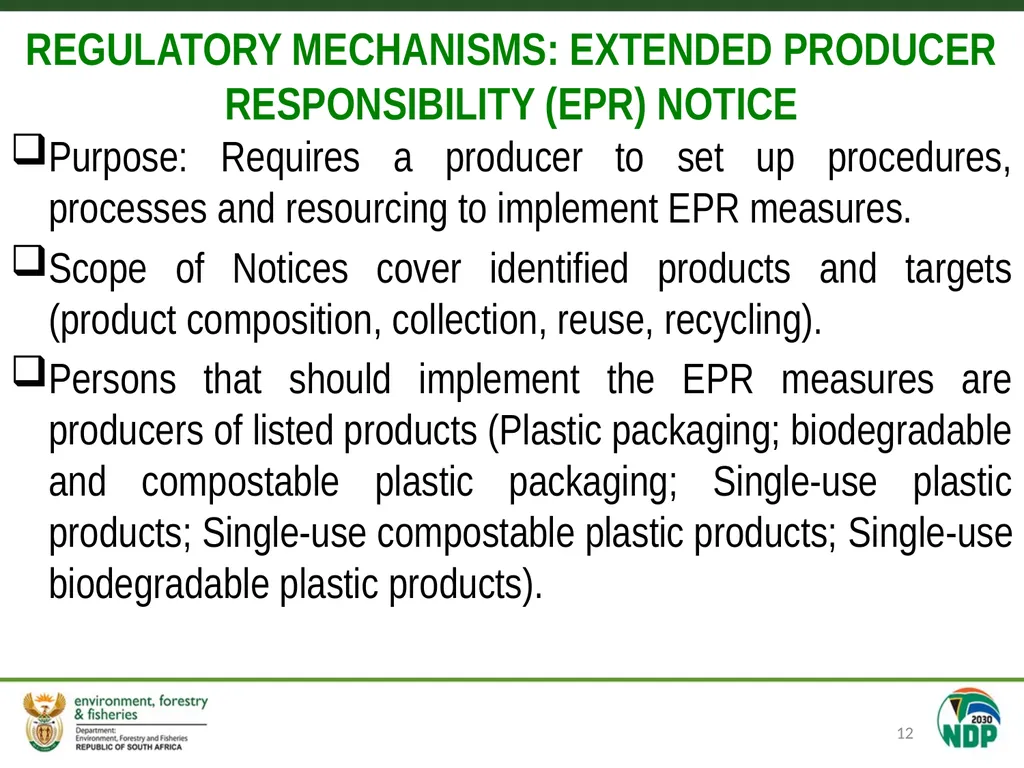
REGULATORY MECHANISMS: EXTENDED PRODUCER RESPONSIBILITY (EPR) NOTICE Purpose: Requires a producer to set up procedures, processes and resourcing to implement EPR measures.
Scope of Notices cover identified products and targets (product composition, collection, reuse, recycling).
Persons that should implement the EPR measures are producers of listed products (Plastic packaging; biodegradable and compostable plastic packaging; Single-use plastic products; Single-use compostable plastic products; Single-use biodegradable plastic products). 12<br>
13
REGULATORY MECHANISMS: EPR Regulations Extended Producer Responsibility measures include:
Establish and implement an Extended Producer Responsibility scheme or join another scheme.
Finance the extended producer responsibility scheme.
Provision for the collection, sorting, recycling and recovery of waste arising from the identified products.
Mid-year report on the performance measured against the set targets.
Annual performance reports must be submitted to the Department. 13<br>
14
WAY FORWARD – NEXT STEPS Implementing the NWMS and continued implementation of Working Group priorities as per the 2019 Plastics Colloquium Decisions.
Strengthened implementation of Regulatory mechanisms (EPR, Recyclate-focused product design, green procurement, and so forth) contribute to waste reduction, reuse, recycling and recovery.
Numerous public consultations and engagements have been held to solicit comments on the 3 gazettes
Proposed Amendment of the Plastic Bag Regulations
Proposed Extended Producer Responsibility Regulations
Proposed Extended Producer Responsibility Notice on Paper, Packaging and other Single Use Products.
The public comments are under consideration and revised gazettes for final implementation are to be published in this financial year.
Increased access to delivery of waste services along with increased plastic waste recycling will contribute to alleviating the problem of plastic litter.
Combating plastic litter requires effective anti-littering education campaigns targeted at consumers alongside a compliance culture by producers. 14<br>