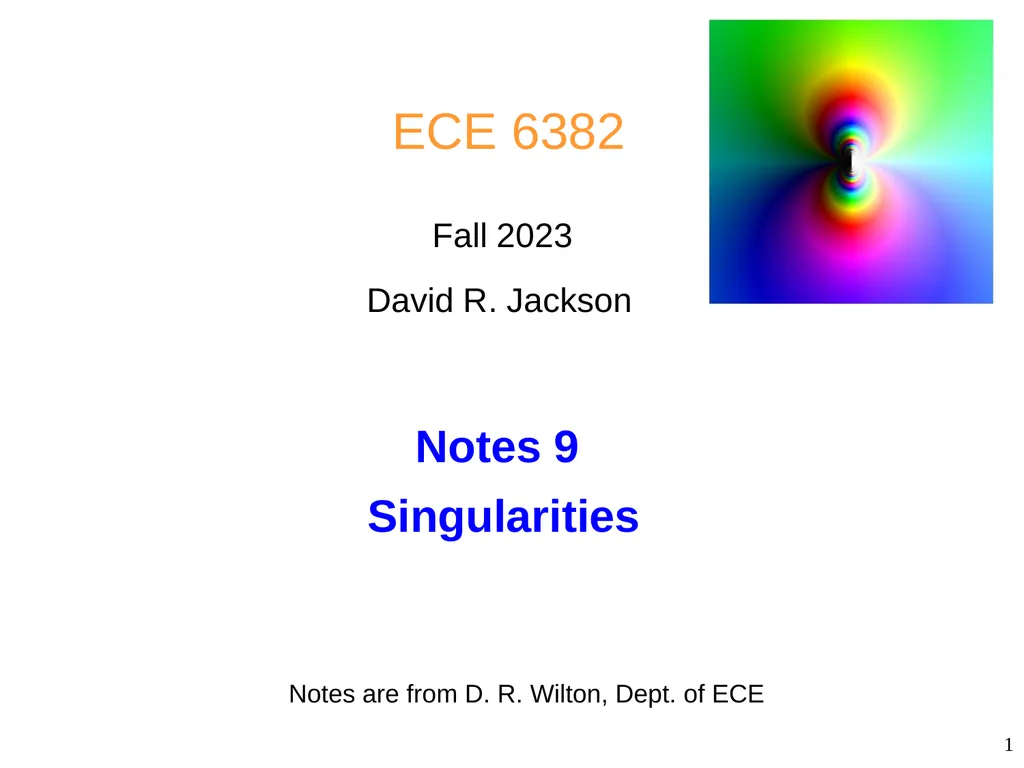
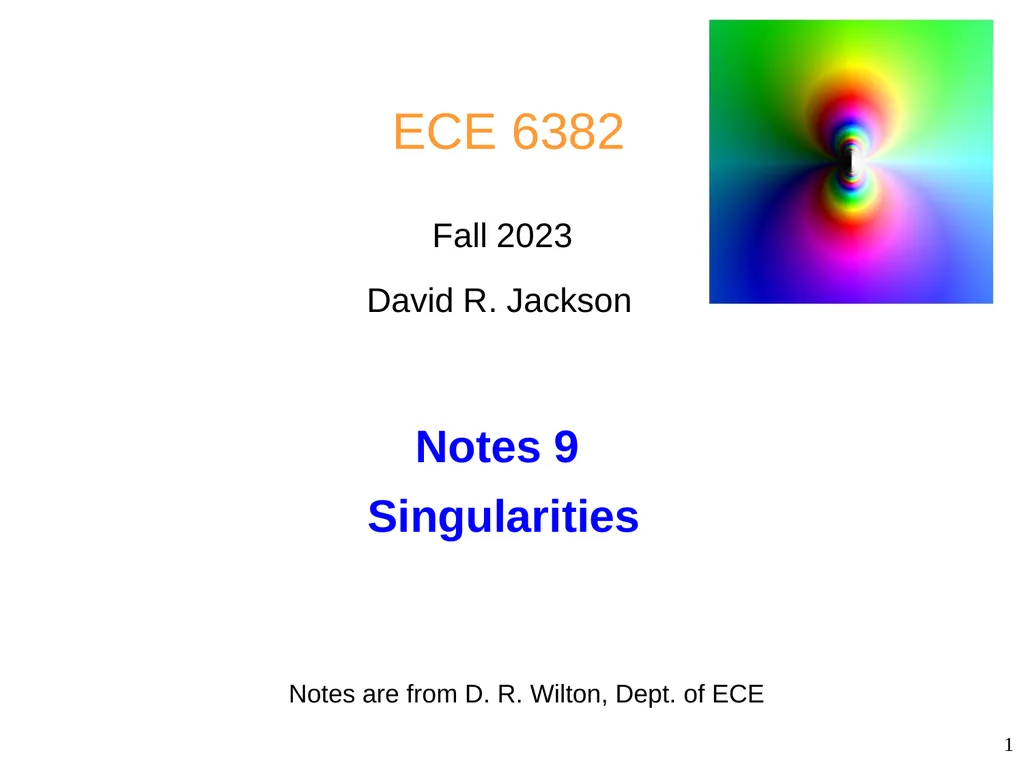
Singularities ECE 6382 Notes are from D. R. Wilton, Dept. of ECE 1 David R. Jackson Fall 2023 Notes 9 Singularity A point zs is a singularity of the function f (z) if the function is not analytic at zs. (The function does not necessarily
"Singularities ECE 6382 Notes are from D. R." is the property of its rightful owner. Permission is granted to
download and print the materials on this website for personal, non-commercial use only, and to display it
on your personal computer provided you do not modify the materials and that you retain all copyright
notices contained in the materials. By downloading content from our website, you accept the terms of this
agreement.
Presentation Transcript
01
Singularities ECE 6382 Notes are from D. R. Wilton, Dept. of ECE 1 David R. Jackson Fall 2023 Notes 9<br>
02
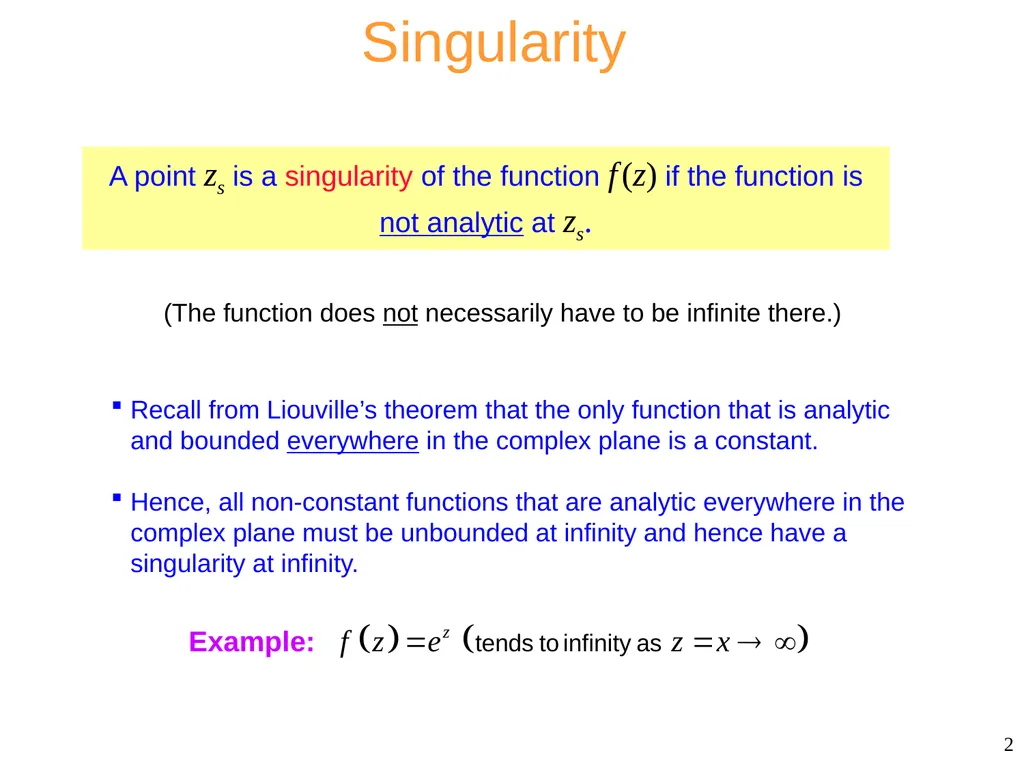
Singularity A point zs is a singularity of the function f (z) if the function is not analytic at zs. (The function does not necessarily have to be infinite there.) Recall from Liouville’s theorem that the only function that is analytic and bounded everywhere in the complex plane is a constant.
Hence, all non-constant functions that are analytic everywhere in the complex plane must be unbounded at infinity and hence have a singularity at infinity. 2 Example:<br>
03
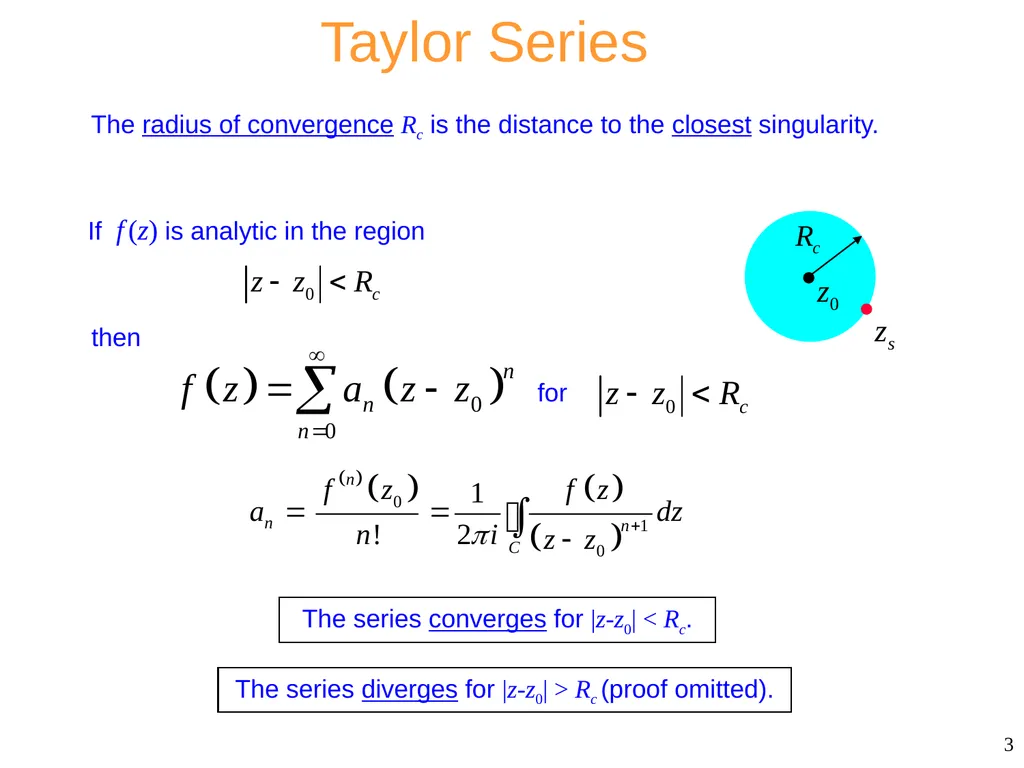
Taylor Series If f (z) is analytic in the region then for The series converges for |z-z0| < Rc. The radius of convergence Rc is the distance to the closest singularity. 3 The series diverges for |z-z0| > Rc (proof omitted).<br>
04
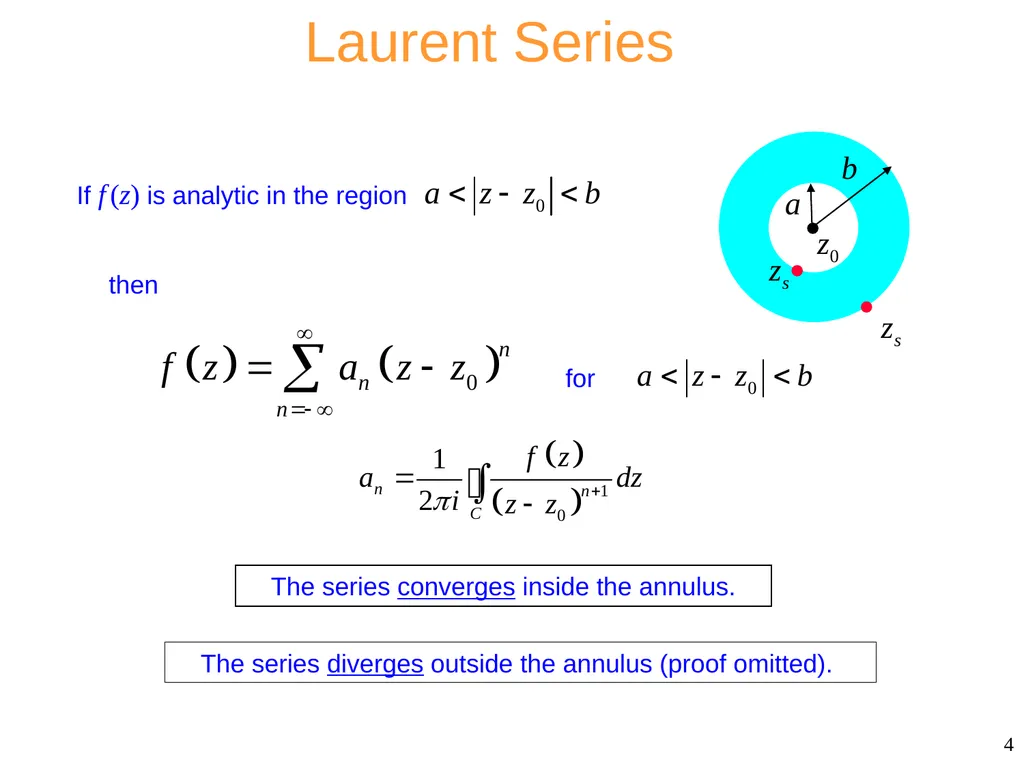
Laurent Series If f (z) is analytic in the region then for 4 The series diverges outside the annulus (proof omitted). The series converges inside the annulus.<br>
05
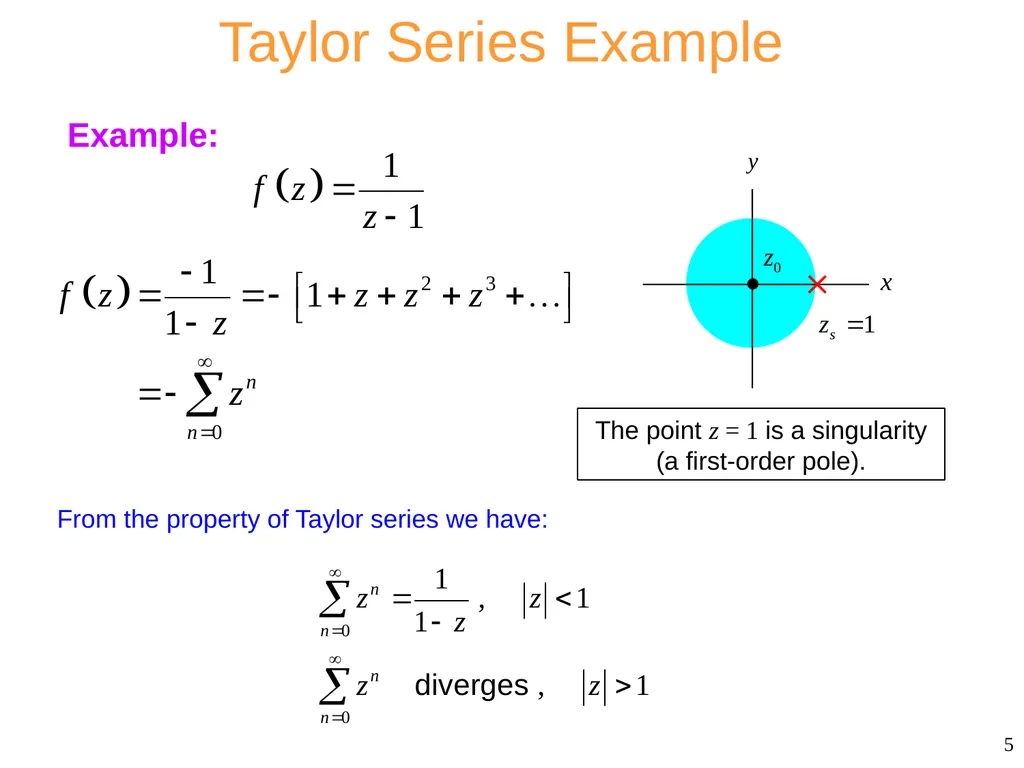
Taylor Series Example Example: From the property of Taylor series we have: The point z = 1 is a singularity (a first-order pole). 5<br>
06
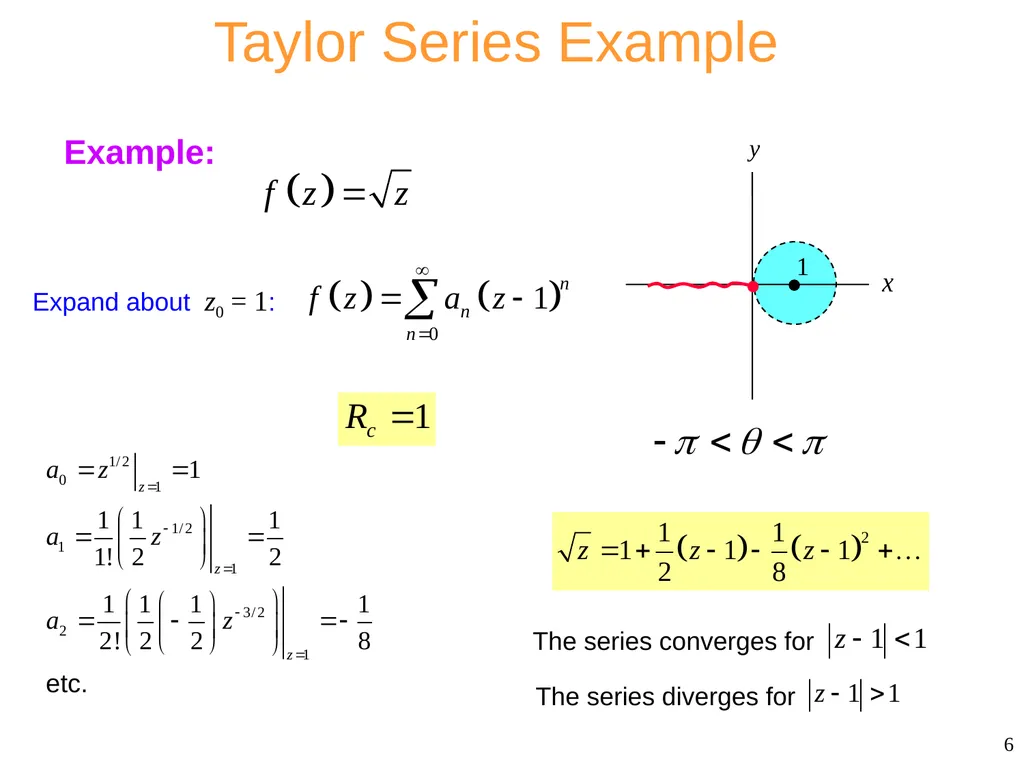
Example: Expand about z0 = 1: The series converges for The series diverges for Taylor Series Example 6<br>
07
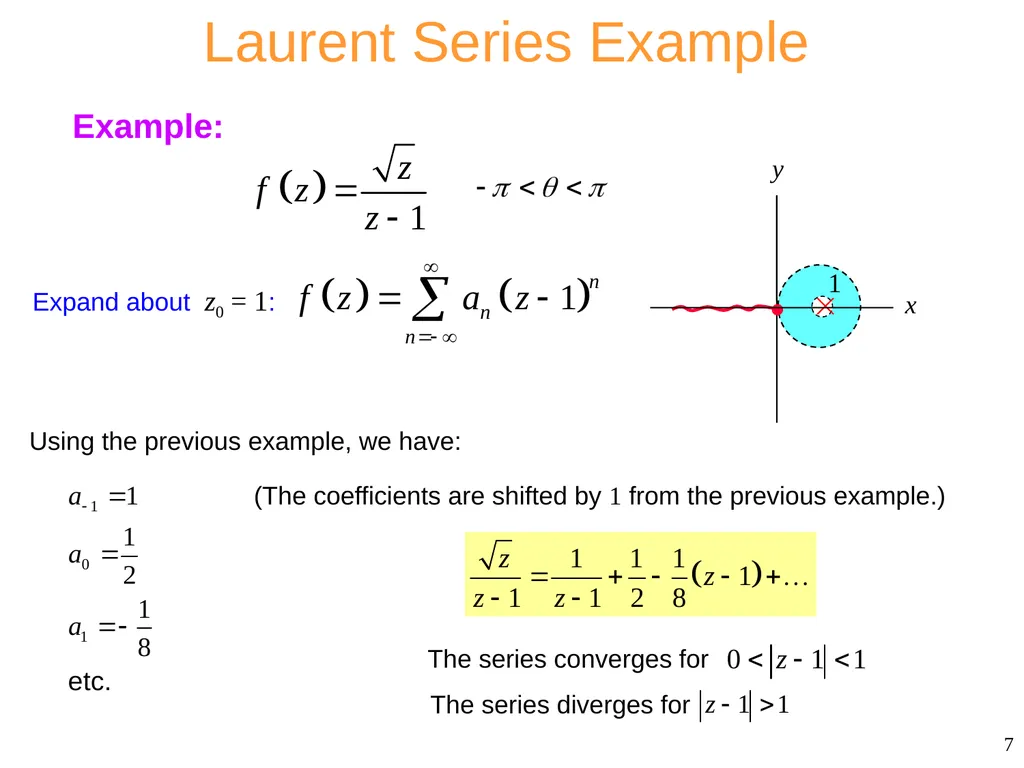
Example: Expand about z0 = 1: The series converges for The series diverges for Laurent Series Example Using the previous example, we have: (The coefficients are shifted by 1 from the previous example.) 7<br>
08
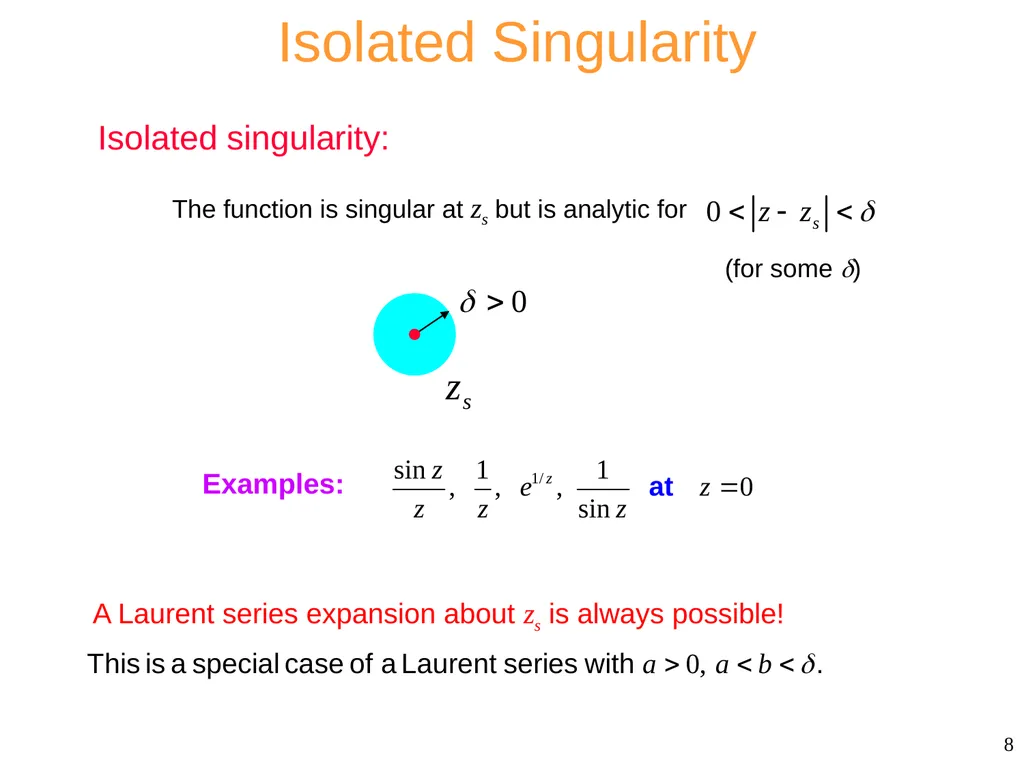
Isolated Singularity Isolated singularity: The function is singular at zs but is analytic for Examples: A Laurent series expansion about zs is always possible! 8 (for some )<br>
09
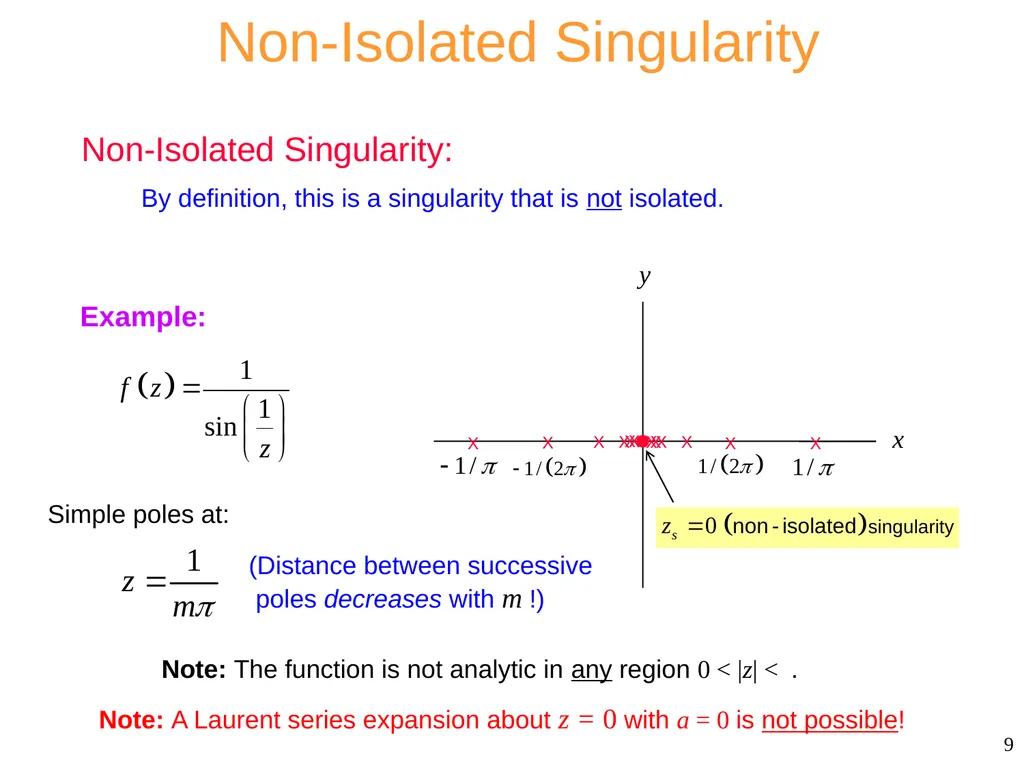
Non-Isolated Singularity Non-Isolated Singularity: By definition, this is a singularity that is not isolated. Example: Simple poles at: Note: A Laurent series expansion about z = 0 with a = 0 is not possible! (Distance between successive
poles decreases with m !) 9 Note: The function is not analytic in any region 0 < |z| < .<br>
10
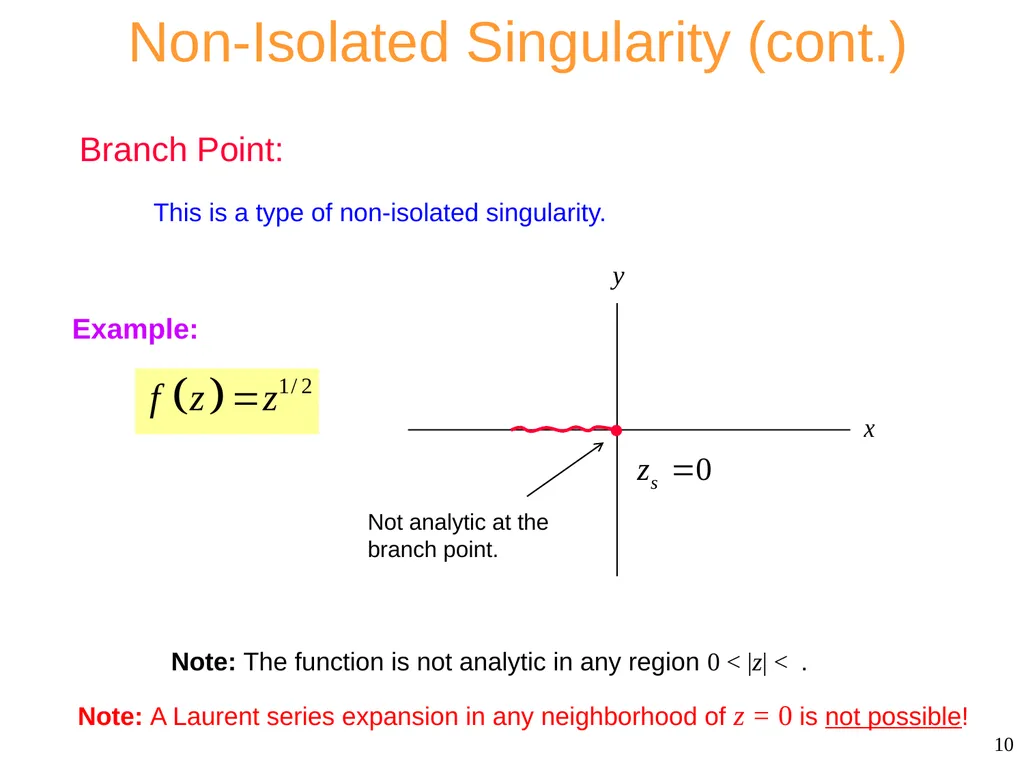
Branch Point: This is a type of non-isolated singularity. Example: Non-Isolated Singularity (cont.) 10 Note: The function is not analytic in any region 0 < |z| < . Note: A Laurent series expansion in any neighborhood of z = 0 is not possible!<br>
11
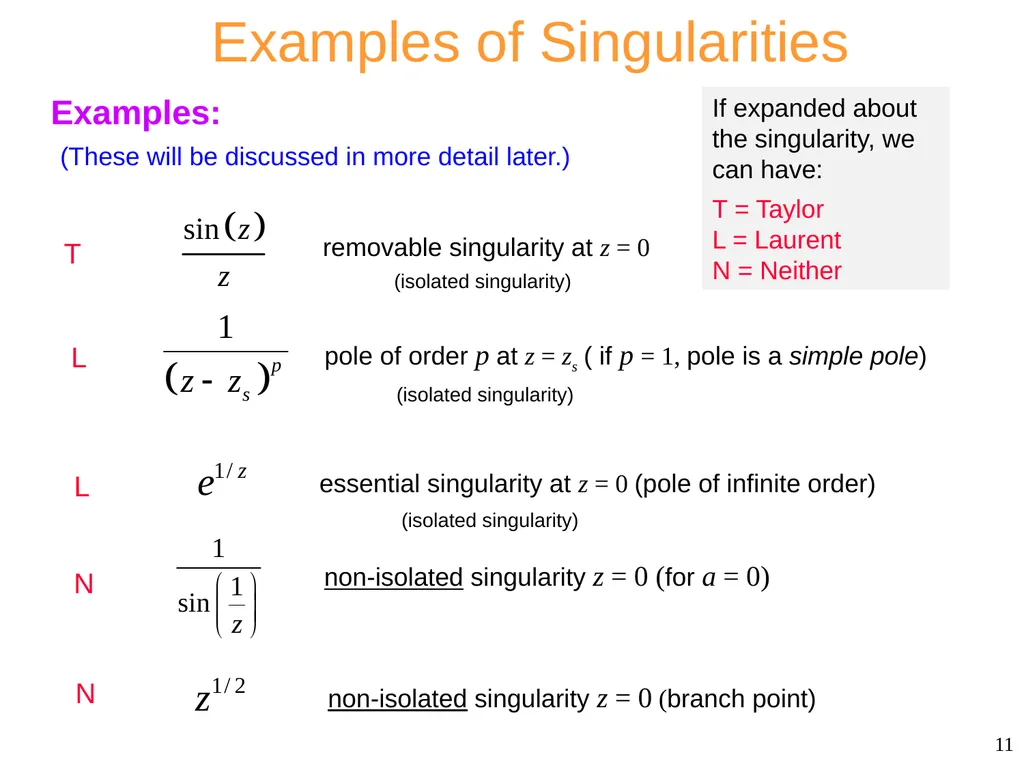
Examples of Singularities Examples:
(These will be discussed in more detail later.) pole of order p at z = zs ( if p = 1, pole is a simple pole) essential singularity at z = 0 (pole of infinite order) non-isolated singularity z = 0 (branch point) removable singularity at z = 0 non-isolated singularity z = 0 (for a = 0) T L L N N If expanded about
the singularity, we
can have:
T = Taylor
L = Laurent
N = Neither 11 (isolated singularity) (isolated singularity) (isolated singularity)<br>
12
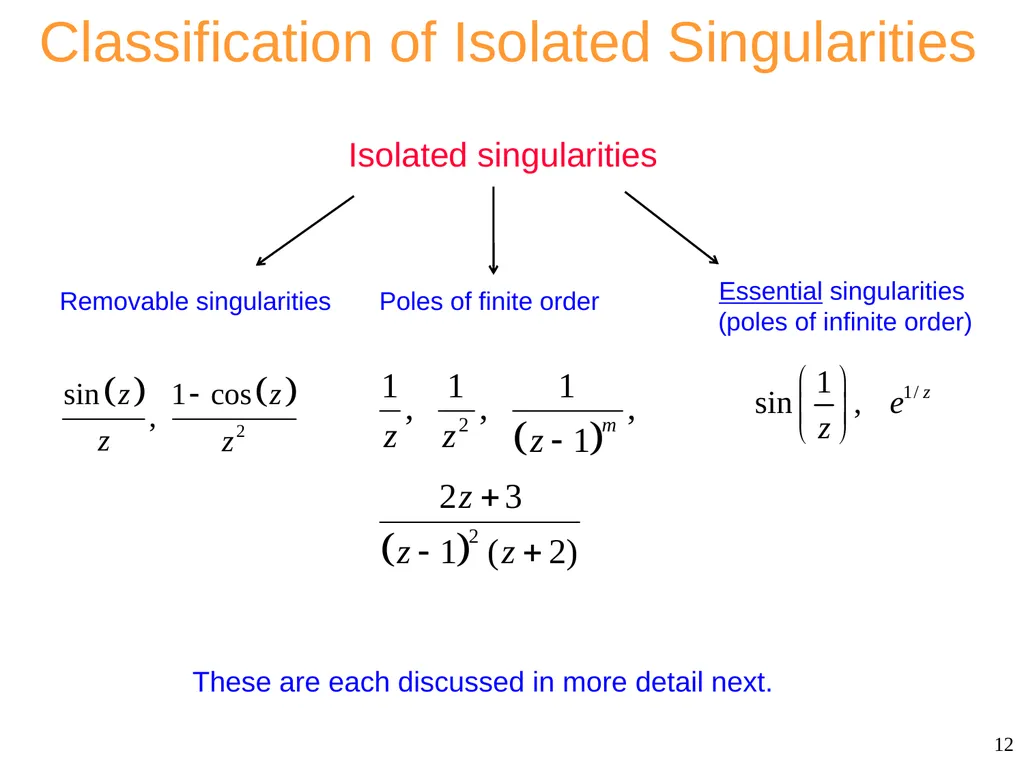
Classification of Isolated Singularities Isolated singularities Removable singularities Poles of finite order Essential singularities
(poles of infinite order) These are each discussed in more detail next. 12<br>
13
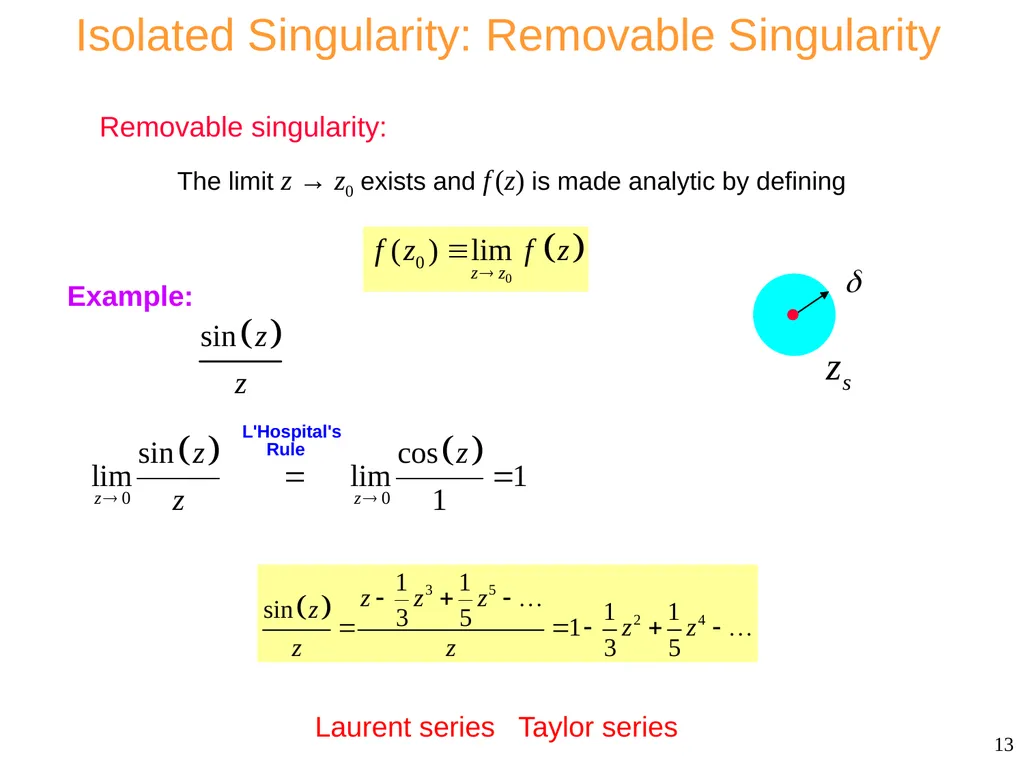
Isolated Singularity: Removable Singularity The limit z → z0 exists and f (z) is made analytic by defining Example: Removable singularity: Laurent series Taylor series 13<br>
14
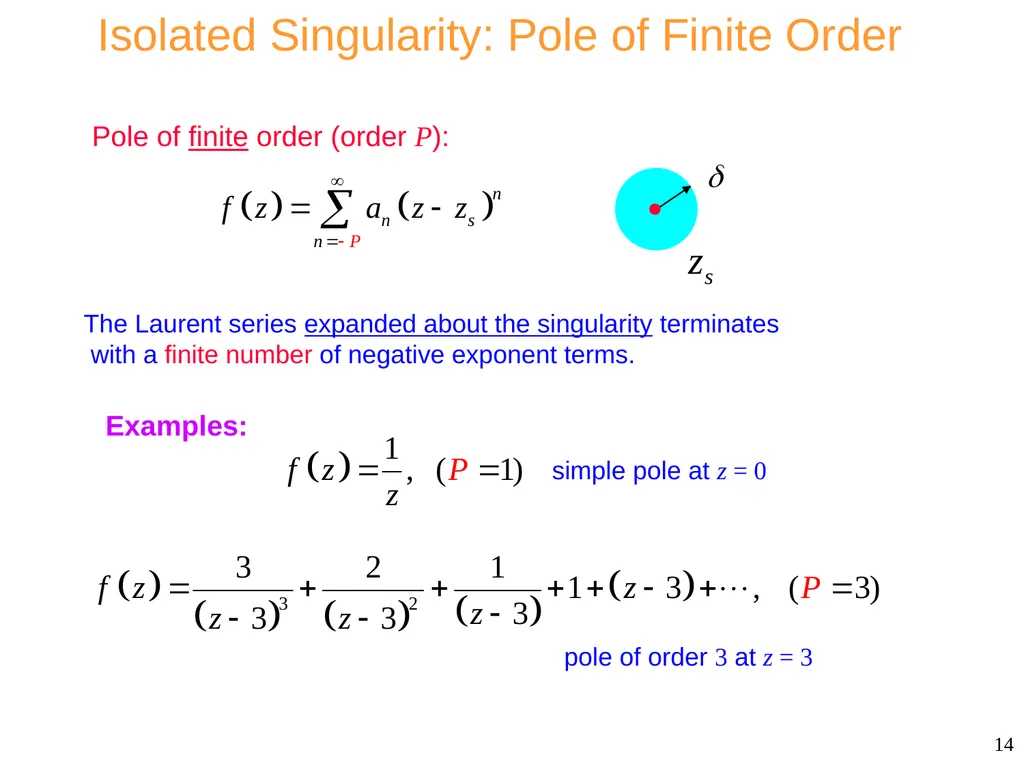
Pole of finite order (order P): The Laurent series expanded about the singularity terminates
with a finite number of negative exponent terms. Examples: Isolated Singularity: Pole of Finite Order simple pole at z = 0 pole of order 3 at z = 3 14<br>
15
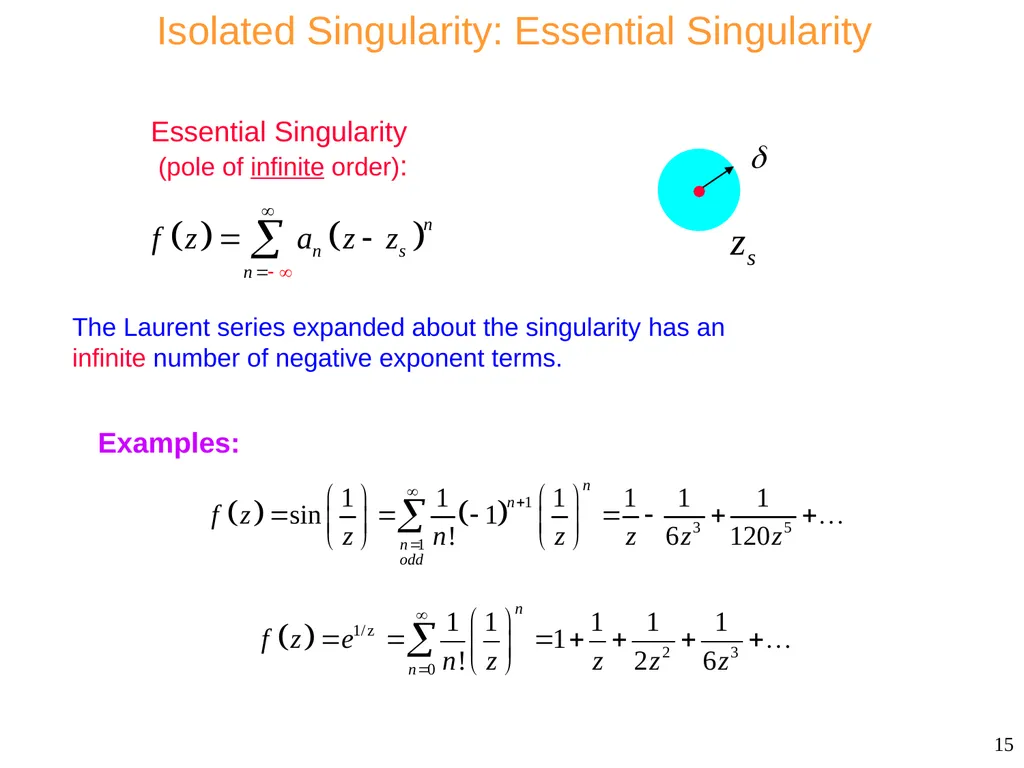
Isolated Singularity: Essential Singularity Essential Singularity
(pole of infinite order): The Laurent series expanded about the singularity has an
infinite number of negative exponent terms. Examples: 15<br>
16
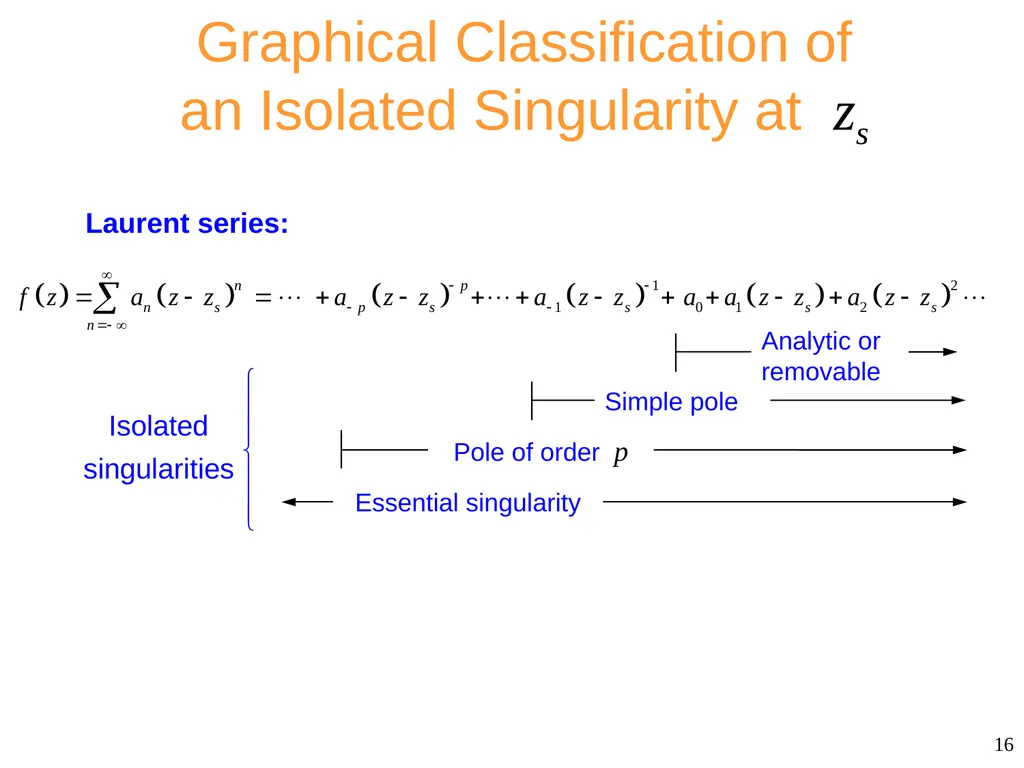
Graphical Classification of an Isolated Singularity at zs Pole of order p 16 Laurent series: Essential singularity<br>
17
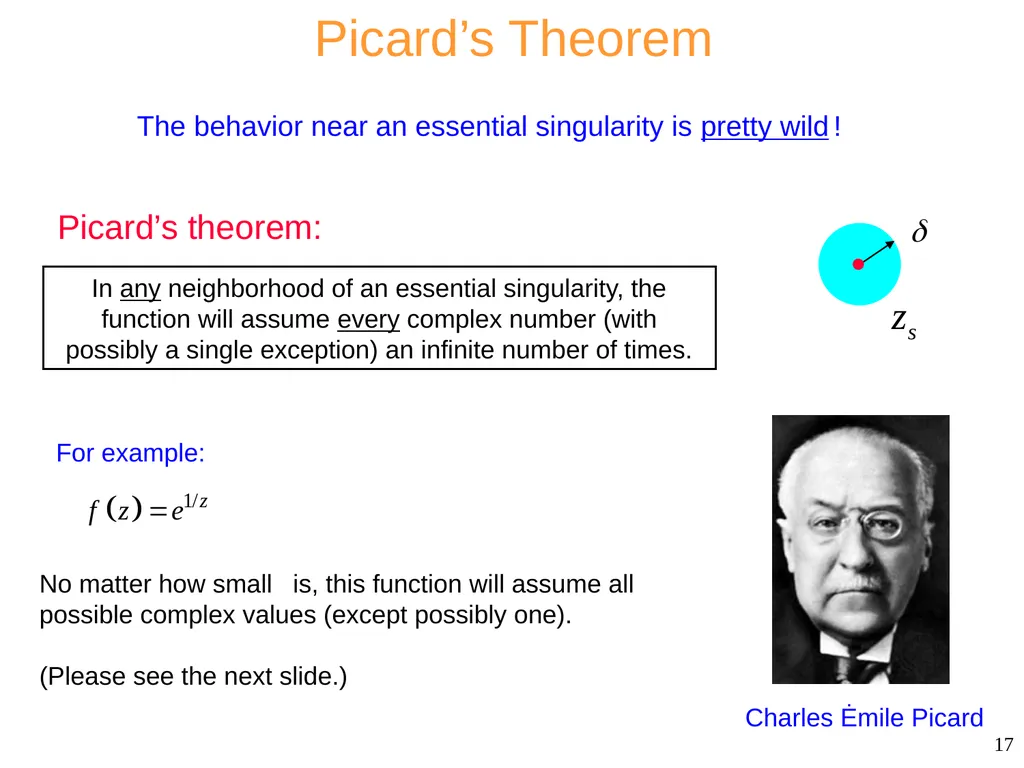
Picard’s Theorem The behavior near an essential singularity is pretty wild ! Picard’s theorem: In any neighborhood of an essential singularity, the function will assume every complex number (with possibly a single exception) an infinite number of times. For example: No matter how small is, this function will assume all possible complex values (except possibly one).
(Please see the next slide.) 17 Charles Ėmile Picard<br>
18
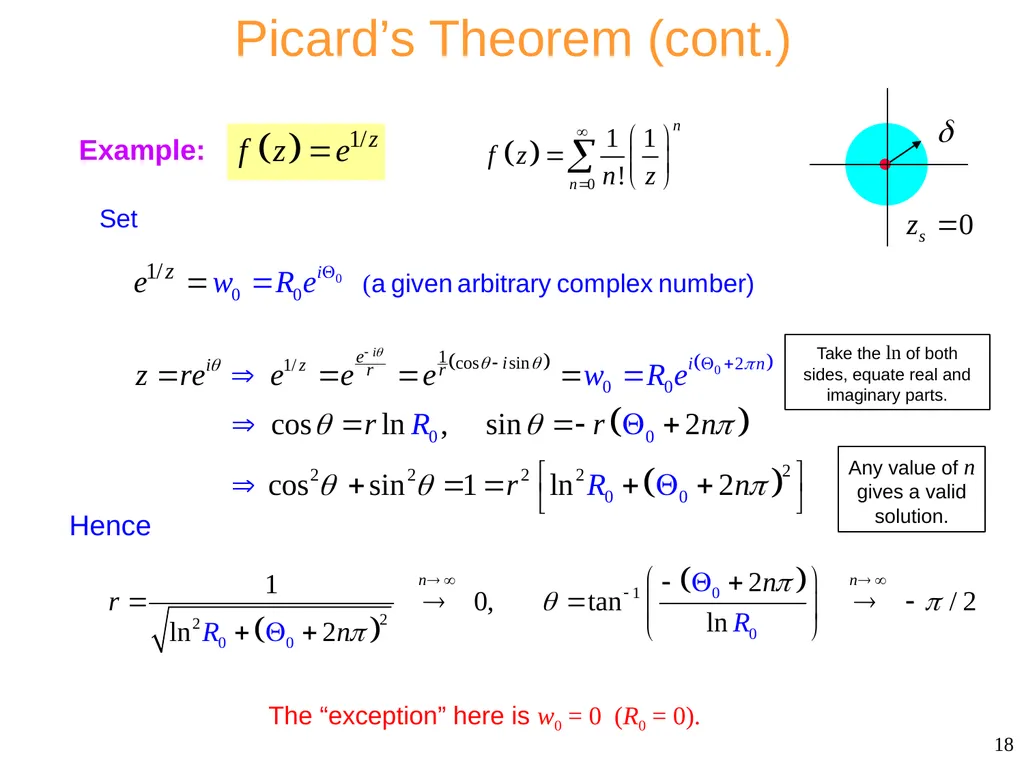
Picard’s Theorem (cont.) Example: Set Hence The “exception” here is w0 = 0 (R0 = 0). 18 Take the ln of both sides, equate real and imaginary parts. Any value of n gives a valid solution.<br>
19
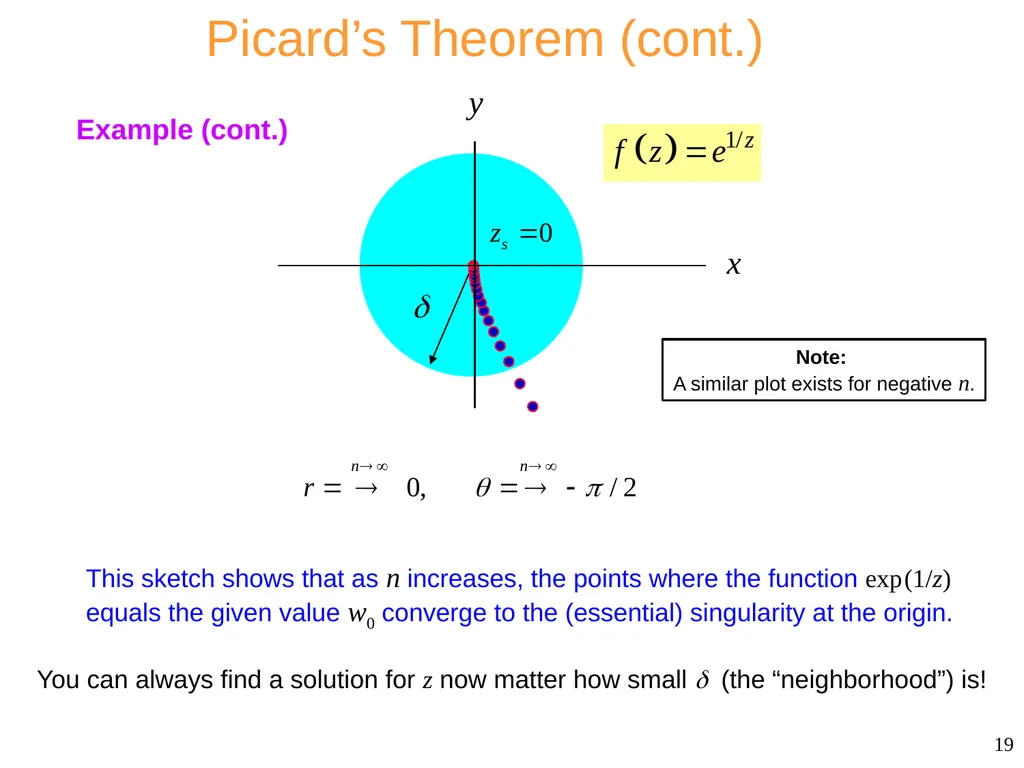
Picard’s Theorem (cont.) Example (cont.) This sketch shows that as n increases, the points where the function exp (1/z) equals the given value w0 converge to the (essential) singularity at the origin. You can always find a solution for z now matter how small (the “neighborhood”) is! 19<br>
20
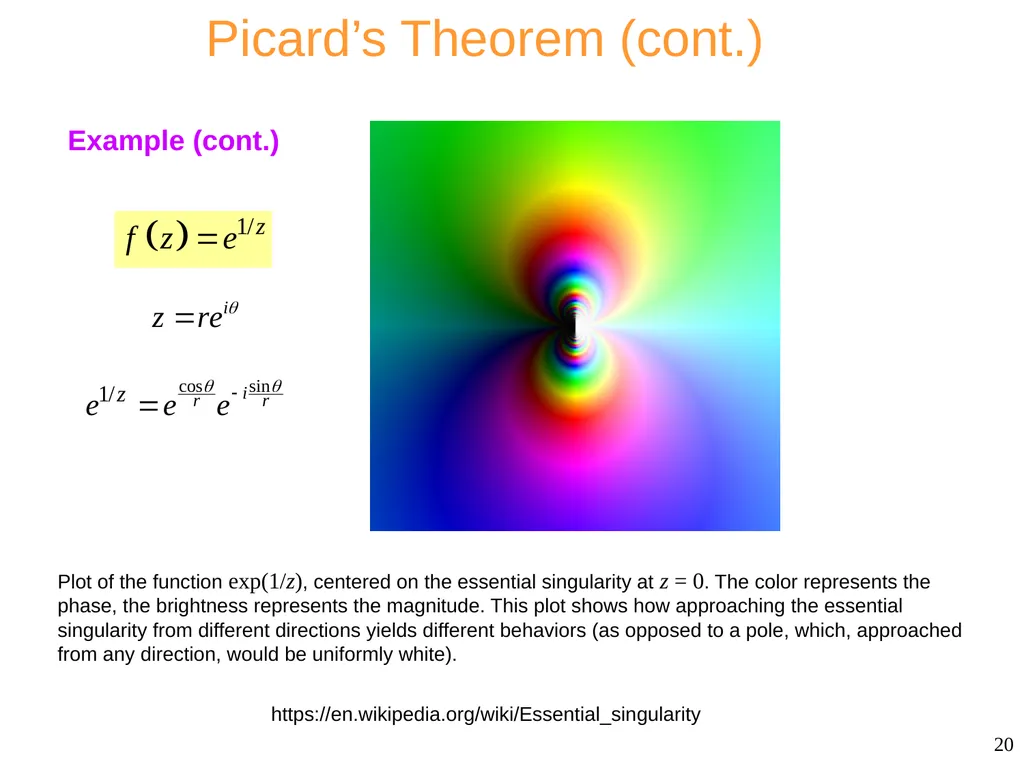
Picard’s Theorem (cont.) Example (cont.) 20 Plot of the function exp(1/z), centered on the essential singularity at z = 0. The color represents the phase, the brightness represents the magnitude. This plot shows how approaching the essential singularity from different directions yields different behaviors (as opposed to a pole, which, approached from any direction, would be uniformly white). https://en.wikipedia.org/wiki/Essential_singularity<br>
21
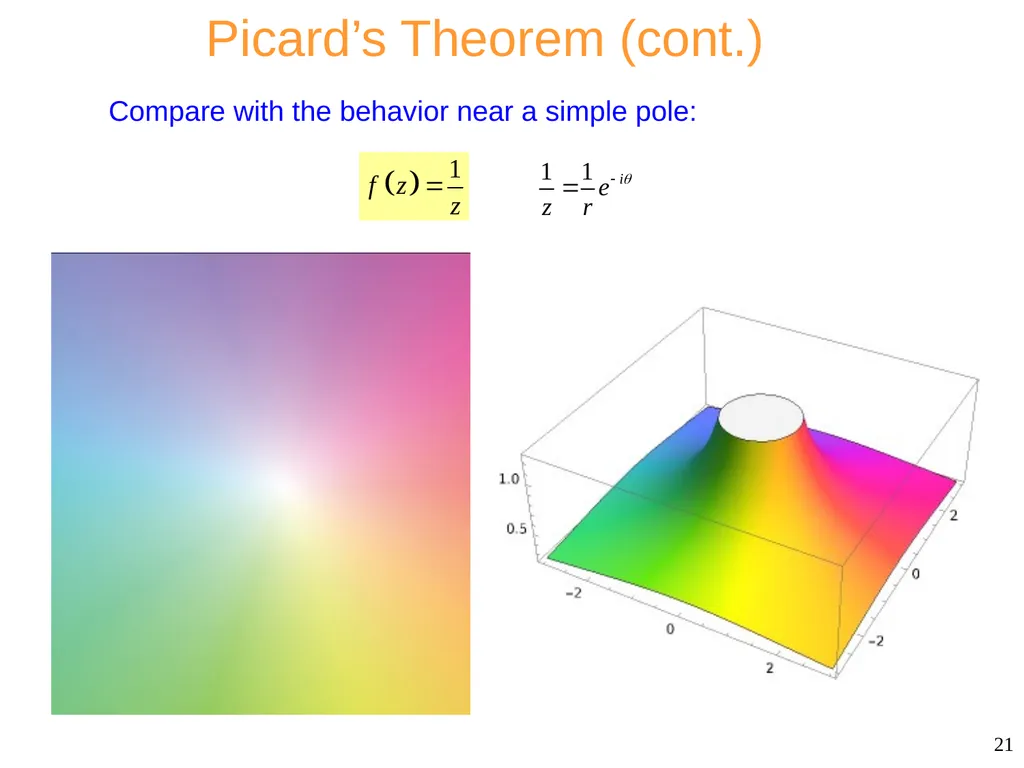
Picard’s Theorem (cont.) 21 Compare with the behavior near a simple pole:<br>
22
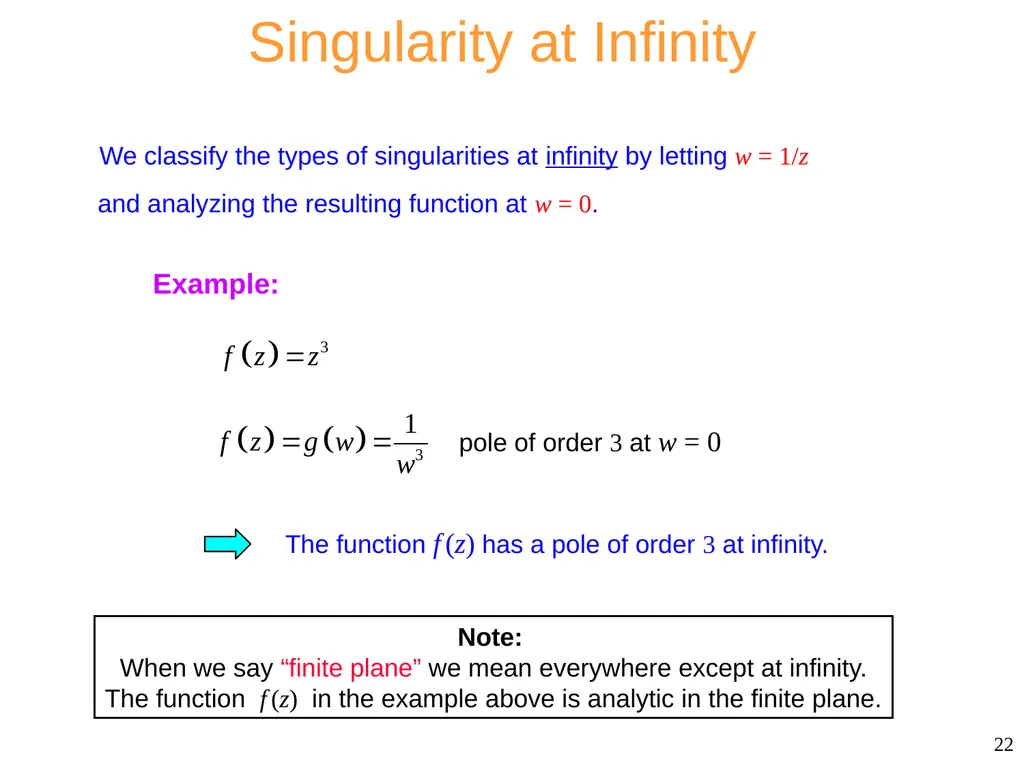
Singularity at Infinity Example: pole of order 3 at w = 0 The function f (z) has a pole of order 3 at infinity. Note:
When we say “finite plane” we mean everywhere except at infinity.
The function f (z) in the example above is analytic in the finite plane. We classify the types of singularities at infinity by letting w = 1/z and analyzing the resulting function at w = 0. 22<br>
23
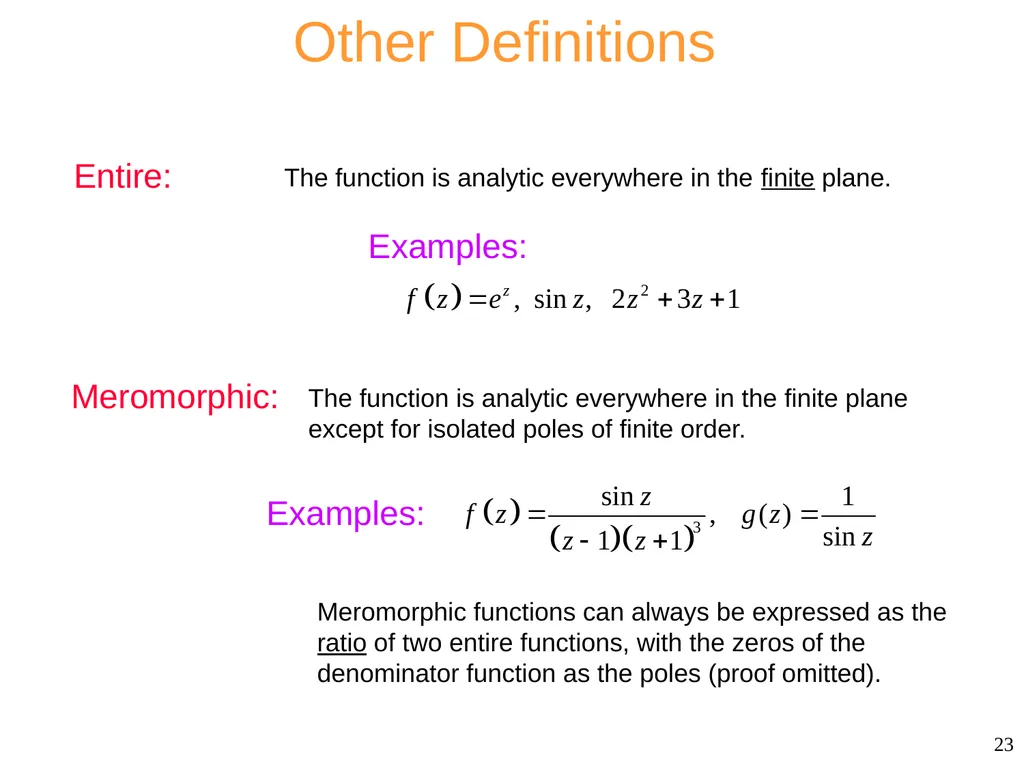
Other Definitions Meromorphic: The function is analytic everywhere in the finite plane except for isolated poles of finite order. Examples: Entire: The function is analytic everywhere in the finite plane. Examples: Meromorphic functions can always be expressed as the ratio of two entire functions, with the zeros of the denominator function as the poles (proof omitted). 23<br>