
Situation Ethics Recap What do the pictures
DJ
Published · 33 slides · 0 views
1 / 1

Description
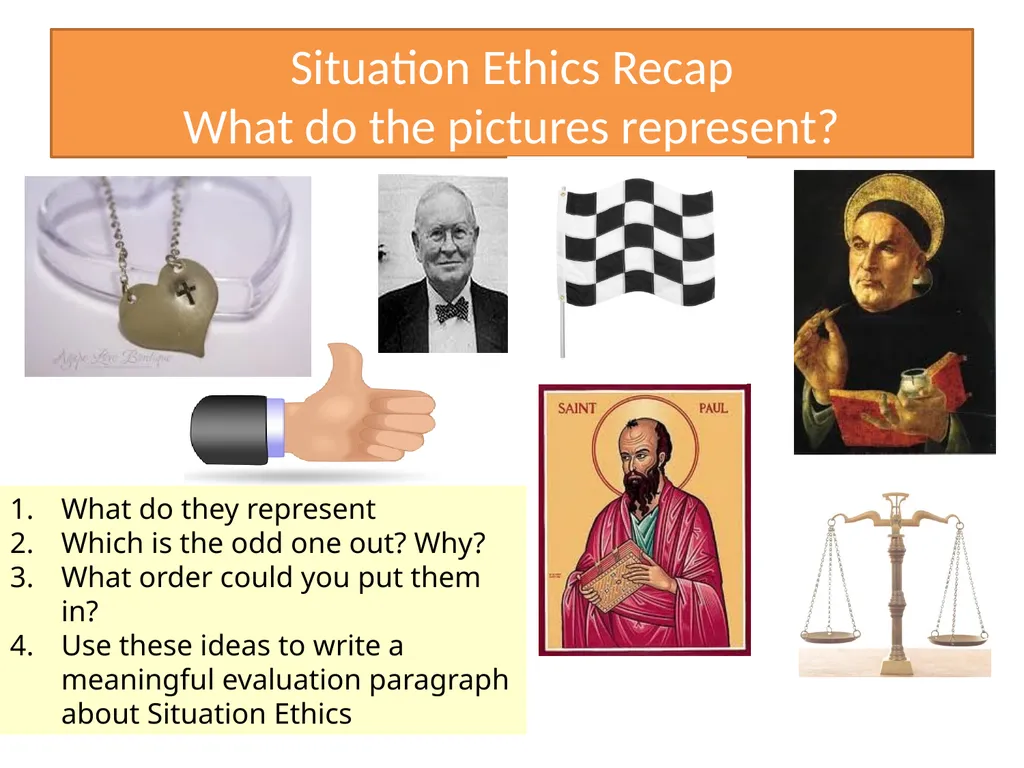
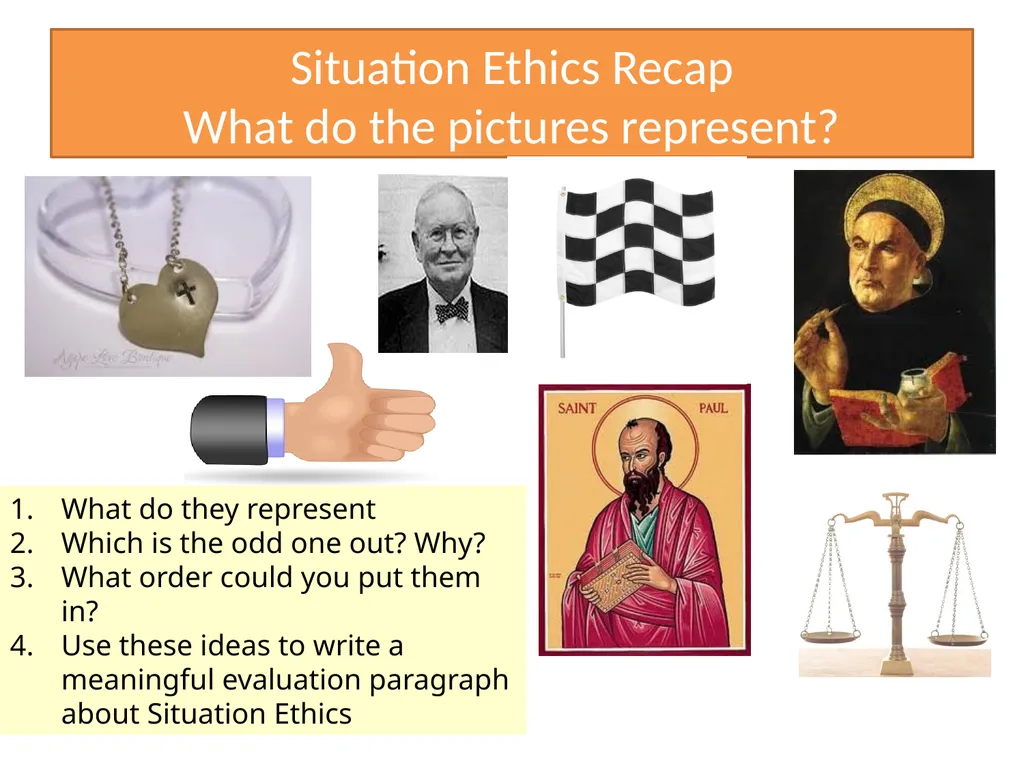
Situation Ethics Recap What do the pictures represent? What do they represent Which is the odd one out? Why? What order could you put them in? Use these ideas to write a meaningful evaluation paragraph about Situation Ethics Four Working
Related Topics
Share
Embed code
Download this presentation From Below
"Situation Ethics Recap What do the pictures" is the property of its rightful owner. Permission is granted to download and print the materials on this website for personal, non-commercial use only, and to display it on your personal computer provided you do not modify the materials and that you retain all copyright notices contained in the materials. By downloading content from our website, you accept the terms of this agreement.
Presentation Transcript
01
Situation Ethics Recap
What do the pictures represent? What do they represent
Which is the odd one out? Why?
What order could you put them in?
Use these ideas to write a meaningful evaluation paragraph about Situation Ethics<br>
Which is the odd one out? Why?
What order could you put them in?
Use these ideas to write a meaningful evaluation paragraph about Situation Ethics<br>
02
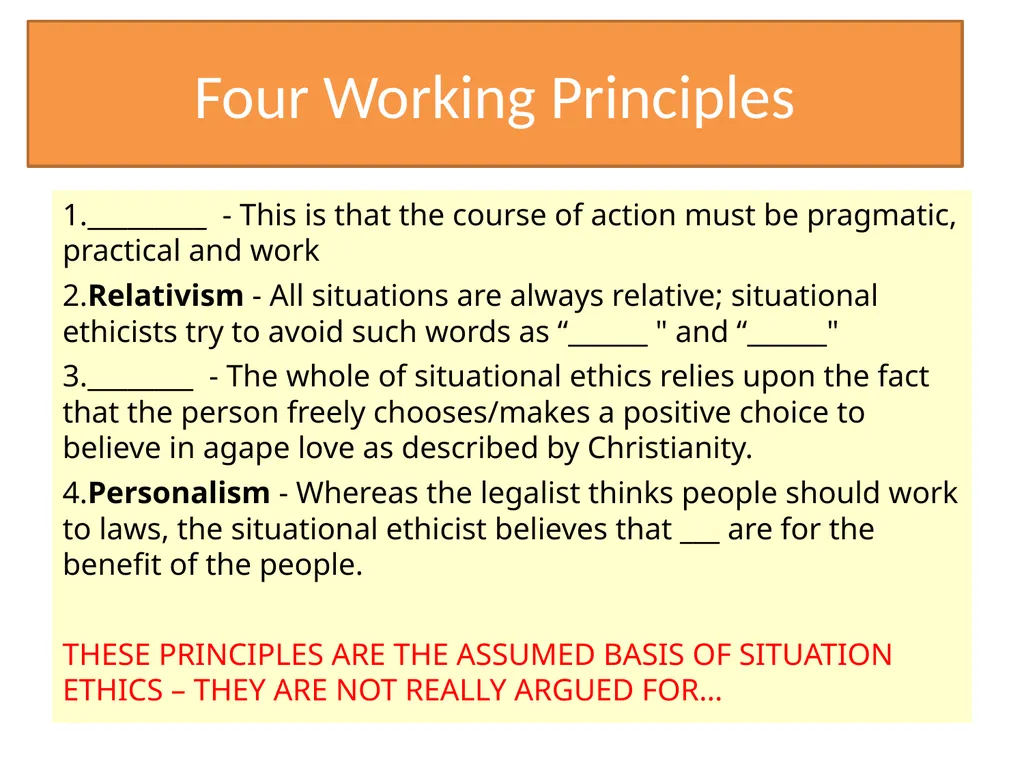
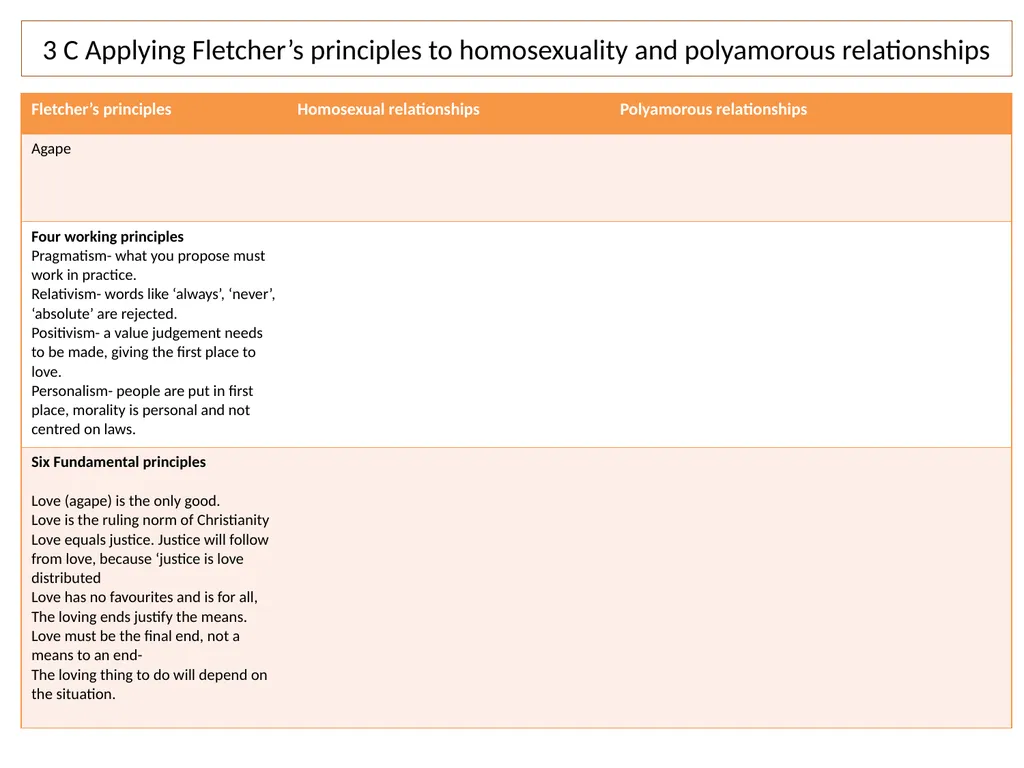
Four Working Principles 1._________ - This is that the course of action must be pragmatic, practical and work
2.Relativism - All situations are always relative; situational ethicists try to avoid such words as “______ " and “______"
3.________ - The whole of situational ethics relies upon the fact that the person freely chooses/makes a positive choice to believe in agape love as described by Christianity.
4.Personalism - Whereas the legalist thinks people should work to laws, the situational ethicist believes that ___ are for the benefit of the people.
THESE PRINCIPLES ARE THE ASSUMED BASIS OF SITUATION ETHICS – THEY ARE NOT REALLY ARGUED FOR…<br>
2.Relativism - All situations are always relative; situational ethicists try to avoid such words as “______ " and “______"
3.________ - The whole of situational ethics relies upon the fact that the person freely chooses/makes a positive choice to believe in agape love as described by Christianity.
4.Personalism - Whereas the legalist thinks people should work to laws, the situational ethicist believes that ___ are for the benefit of the people.
THESE PRINCIPLES ARE THE ASSUMED BASIS OF SITUATION ETHICS – THEY ARE NOT REALLY ARGUED FOR…<br>
03
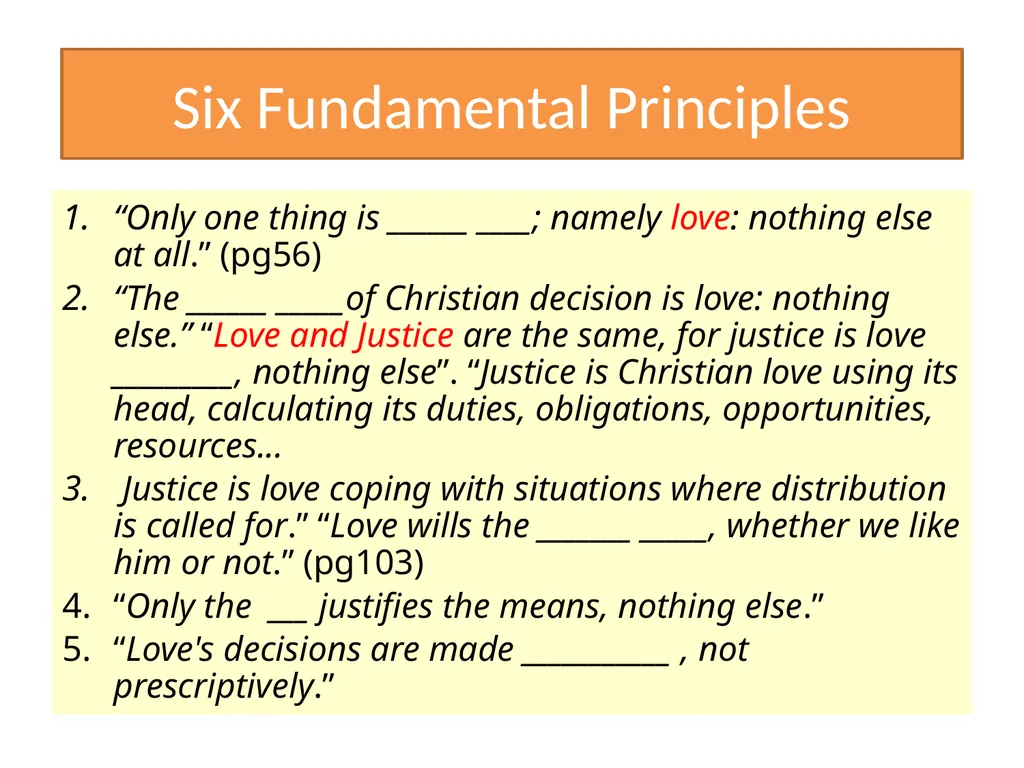
Six Fundamental Principles “Only one thing is ______ ____; namely love: nothing else at all.” (pg56)
“The ______ _____of Christian decision is love: nothing else.” “Love and Justice are the same, for justice is love _________, nothing else”. “Justice is Christian love using its head, calculating its duties, obligations, opportunities, resources...
Justice is love coping with situations where distribution is called for.” “Love wills the _______ _____, whether we like him or not.” (pg103)
“Only the ___ justifies the means, nothing else.”
“Love's decisions are made ___________ , not prescriptively.”<br>
“The ______ _____of Christian decision is love: nothing else.” “Love and Justice are the same, for justice is love _________, nothing else”. “Justice is Christian love using its head, calculating its duties, obligations, opportunities, resources...
Justice is love coping with situations where distribution is called for.” “Love wills the _______ _____, whether we like him or not.” (pg103)
“Only the ___ justifies the means, nothing else.”
“Love's decisions are made ___________ , not prescriptively.”<br>
04
Exam preparation Practice the ‘Explain the features of Fletcher’s Situation Ethics.’ A01 20 marks
In pairs you have 10 mins to discuss and write your own practise structure for the question.
Do this in bullet point format.<br>
In pairs you have 10 mins to discuss and write your own practise structure for the question.
Do this in bullet point format.<br>
05
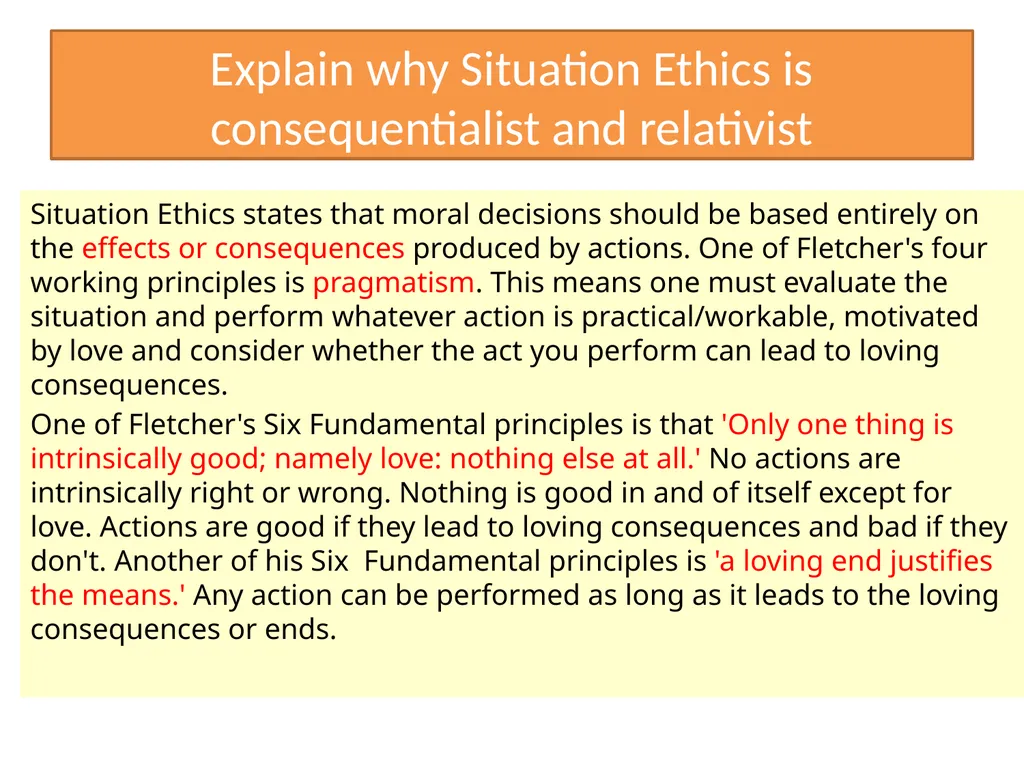
Explain why Situation Ethics is consequentialist and relativist Situation Ethics states that moral decisions should be based entirely on the effects or consequences produced by actions. One of Fletcher's four working principles is pragmatism. This means one must evaluate the situation and perform whatever action is practical/workable, motivated by love and consider whether the act you perform can lead to loving consequences.
One of Fletcher's Six Fundamental principles is that 'Only one thing is intrinsically good; namely love: nothing else at all.' No actions are intrinsically right or wrong. Nothing is good in and of itself except for love. Actions are good if they lead to loving consequences and bad if they don't. Another of his Six Fundamental principles is 'a loving end justifies the means.' Any action can be performed as long as it leads to the loving consequences or ends.<br>
One of Fletcher's Six Fundamental principles is that 'Only one thing is intrinsically good; namely love: nothing else at all.' No actions are intrinsically right or wrong. Nothing is good in and of itself except for love. Actions are good if they lead to loving consequences and bad if they don't. Another of his Six Fundamental principles is 'a loving end justifies the means.' Any action can be performed as long as it leads to the loving consequences or ends.<br>
06
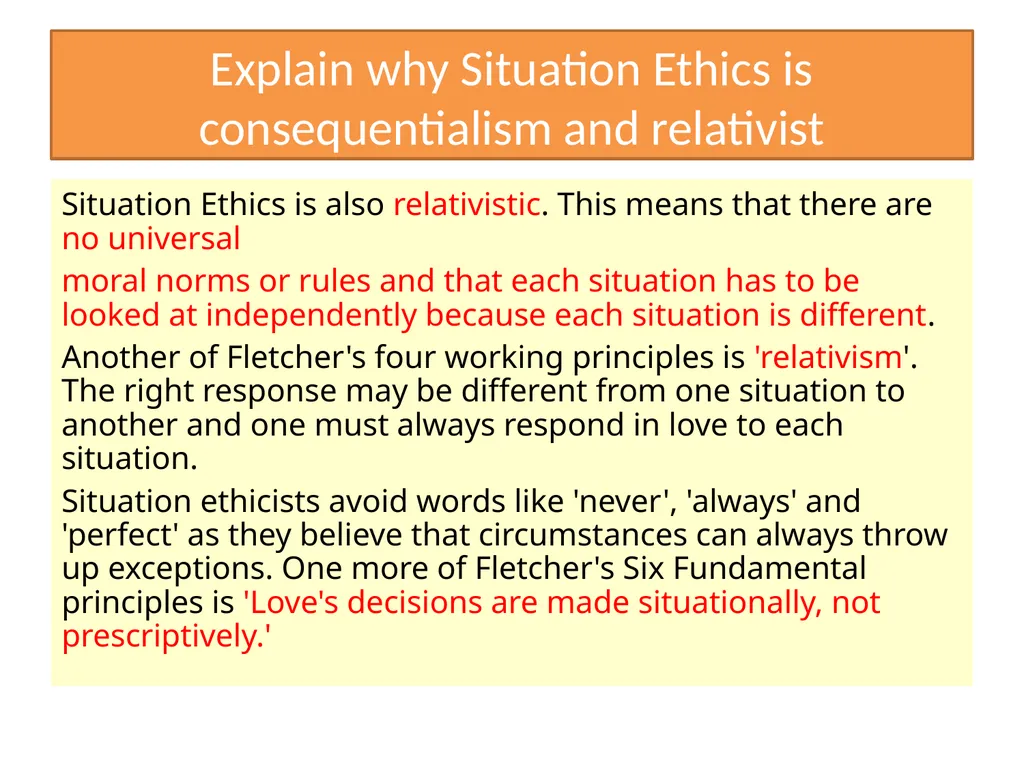
Situation Ethics is also relativistic. This means that there are no universal
moral norms or rules and that each situation has to be looked at independently because each situation is different.
Another of Fletcher's four working principles is 'relativism'. The right response may be different from one situation to another and one must always respond in love to each situation.
Situation ethicists avoid words like 'never', 'always' and 'perfect' as they believe that circumstances can always throw up exceptions. One more of Fletcher's Six Fundamental principles is 'Love's decisions are made situationally, not prescriptively.' Explain why Situation Ethics is consequentialism and relativist<br>
moral norms or rules and that each situation has to be looked at independently because each situation is different.
Another of Fletcher's four working principles is 'relativism'. The right response may be different from one situation to another and one must always respond in love to each situation.
Situation ethicists avoid words like 'never', 'always' and 'perfect' as they believe that circumstances can always throw up exceptions. One more of Fletcher's Six Fundamental principles is 'Love's decisions are made situationally, not prescriptively.' Explain why Situation Ethics is consequentialism and relativist<br>
07
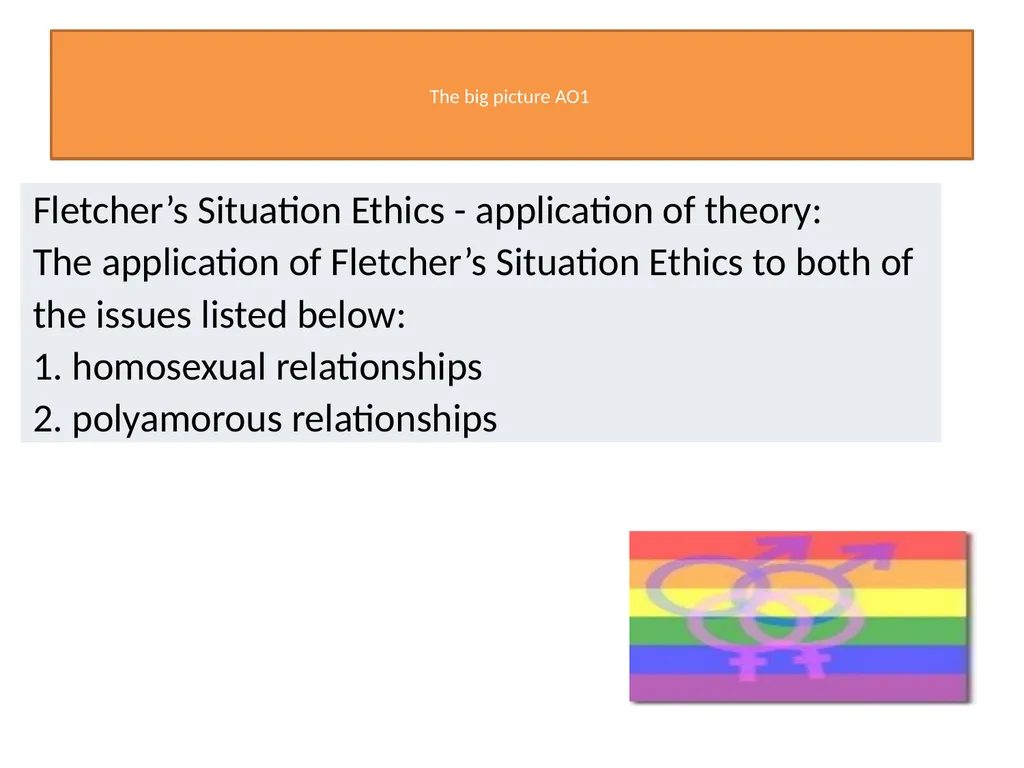
The big picture AO1<br>
08
Homosexual relationships In the 1960s homosexuality was illegal.
Fletcher believed this was wrong and thought the laws about sexuality were outdated, inconsistent, hypocritical but more importantly unjust. Fletcher wrote a paper ‘Sex Offences: an ethical view’, ‘Some forms of sexual activity are historically and conventionally related to criminal law, such as ….homosexuality’. He was unhappy with the Church influence ‘The Anglo-American policy has been a very inconsistent one, trending to dead letter laws and hypocrisy’.
To treat people with prejudice ad discrimination on account of heir sexuality was not a legal approach let alone a Christian approach.
Idea sin is unreliable, it’s a mistake to base it on religious law , the only sanction criminal law is the common interest , public order and the collective good. The Wolfenden report – a government-initiated investigation to explore the problems of prostitution and homosexuality, published in 1957
It came to the conclusion that it is wrong for criminal law to intervene in what homosexuals did in their own home and therefore consenting adults should be given the freedom to explore their sexuality.
These recommendations did not come into force until 1967<br>
Fletcher believed this was wrong and thought the laws about sexuality were outdated, inconsistent, hypocritical but more importantly unjust. Fletcher wrote a paper ‘Sex Offences: an ethical view’, ‘Some forms of sexual activity are historically and conventionally related to criminal law, such as ….homosexuality’. He was unhappy with the Church influence ‘The Anglo-American policy has been a very inconsistent one, trending to dead letter laws and hypocrisy’.
To treat people with prejudice ad discrimination on account of heir sexuality was not a legal approach let alone a Christian approach.
Idea sin is unreliable, it’s a mistake to base it on religious law , the only sanction criminal law is the common interest , public order and the collective good. The Wolfenden report – a government-initiated investigation to explore the problems of prostitution and homosexuality, published in 1957
It came to the conclusion that it is wrong for criminal law to intervene in what homosexuals did in their own home and therefore consenting adults should be given the freedom to explore their sexuality.
These recommendations did not come into force until 1967<br>
09
Homosexual relationships Fletcher supported the Wolfenden report and noted that it stated that the law should not concern itself with immorality or sin. He believed laws shouldn’t be based on religious ideas about sin.
Fletcher claimed ‘there is some boundary between personal existence and the social membership. There is some range for private choice and personal taste.
Fletcher believed sex laws should be restricted to: age of consent; infringement of public decency; acts involving assault, violence, duress or fraud.
Summarise Fletcher’s attitude to moral issues and the law in one sentence The Wolfenden report – a government-initiated investigation to explore the problems of prostitution and homosexuality, published in 1957
It came to the conclusion that it is wrong for criminal law to intervene in what homosexuals did in their own home and therefore consenting adults should be given the freedom to explore their sexuality.
These recommendations did not come into force until 1967<br>
Fletcher claimed ‘there is some boundary between personal existence and the social membership. There is some range for private choice and personal taste.
Fletcher believed sex laws should be restricted to: age of consent; infringement of public decency; acts involving assault, violence, duress or fraud.
Summarise Fletcher’s attitude to moral issues and the law in one sentence The Wolfenden report – a government-initiated investigation to explore the problems of prostitution and homosexuality, published in 1957
It came to the conclusion that it is wrong for criminal law to intervene in what homosexuals did in their own home and therefore consenting adults should be given the freedom to explore their sexuality.
These recommendations did not come into force until 1967<br>
10
Homosexual relationships
Legal developments
s 1967: the age of consent for homosexual males was 21
1994: age of consent 18
2000: age of consent 16 for both heterosexuals and homosexuals
2003: The Sexual Offences Act – completely overhauled the outdated procedures for dealing with sexual offences
2013: Legislation about same sex marriage The privacy law that was initially seen to be right and a breakthrough, was later seen to have become an admission of disagreement.
To be truly equal freedom of expression in public needs to be acknowledged.<br>
1994: age of consent 18
2000: age of consent 16 for both heterosexuals and homosexuals
2003: The Sexual Offences Act – completely overhauled the outdated procedures for dealing with sexual offences
2013: Legislation about same sex marriage The privacy law that was initially seen to be right and a breakthrough, was later seen to have become an admission of disagreement.
To be truly equal freedom of expression in public needs to be acknowledged.<br>
11
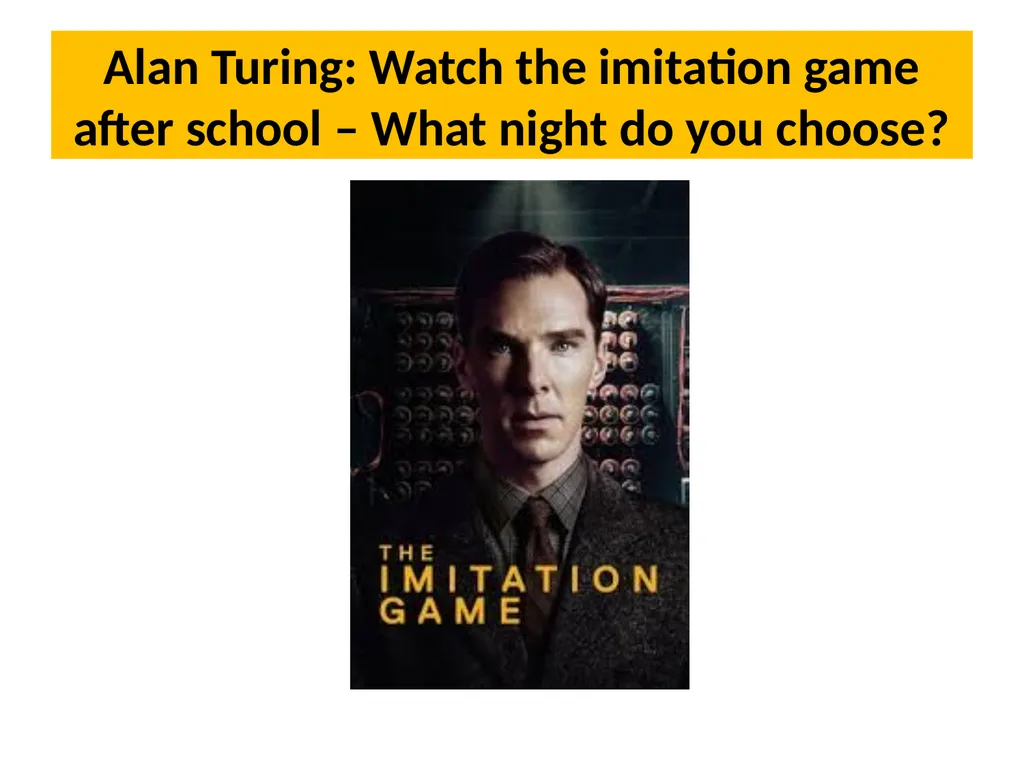
Alan Turing: Watch the imitation game after school – What night do you choose?<br>
12
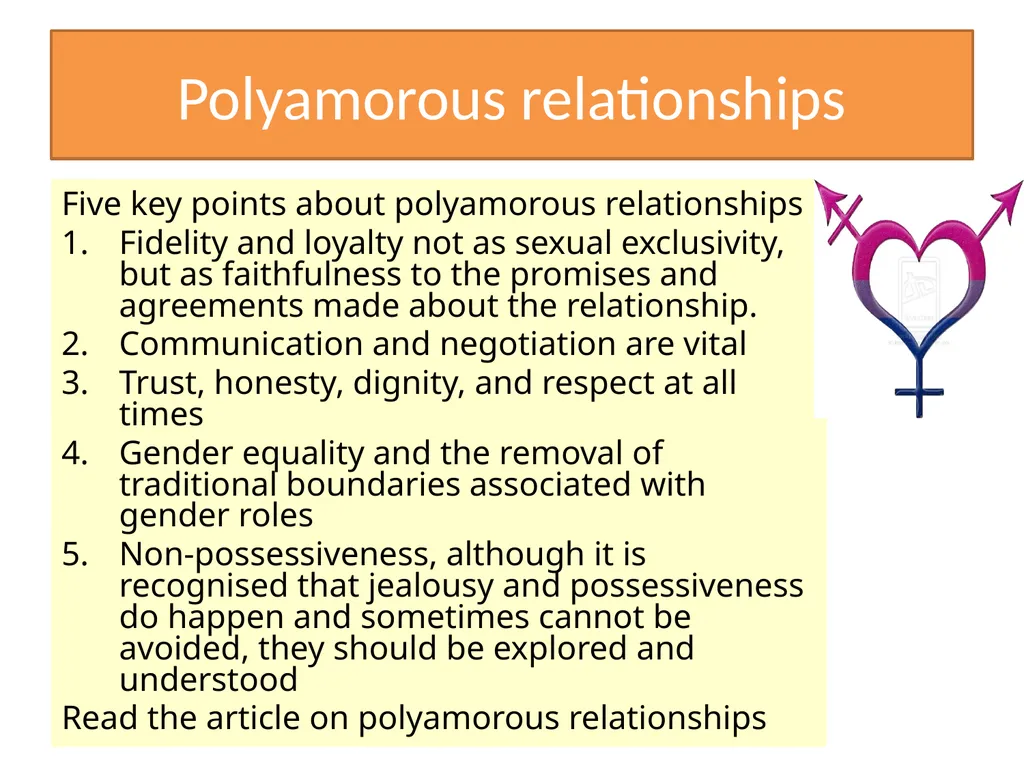
Polyamorous relationships Five key points about polyamorous relationships
Fidelity and loyalty not as sexual exclusivity, but as faithfulness to the promises and agreements made about the relationship.
Communication and negotiation are vital
Trust, honesty, dignity, and respect at all times
Gender equality and the removal of traditional boundaries associated with gender roles
Non-possessiveness, although it is recognised that jealousy and possessiveness do happen and sometimes cannot be avoided, they should be explored and understood
Read the article on polyamorous relationships<br>
Fidelity and loyalty not as sexual exclusivity, but as faithfulness to the promises and agreements made about the relationship.
Communication and negotiation are vital
Trust, honesty, dignity, and respect at all times
Gender equality and the removal of traditional boundaries associated with gender roles
Non-possessiveness, although it is recognised that jealousy and possessiveness do happen and sometimes cannot be avoided, they should be explored and understood
Read the article on polyamorous relationships<br>
13
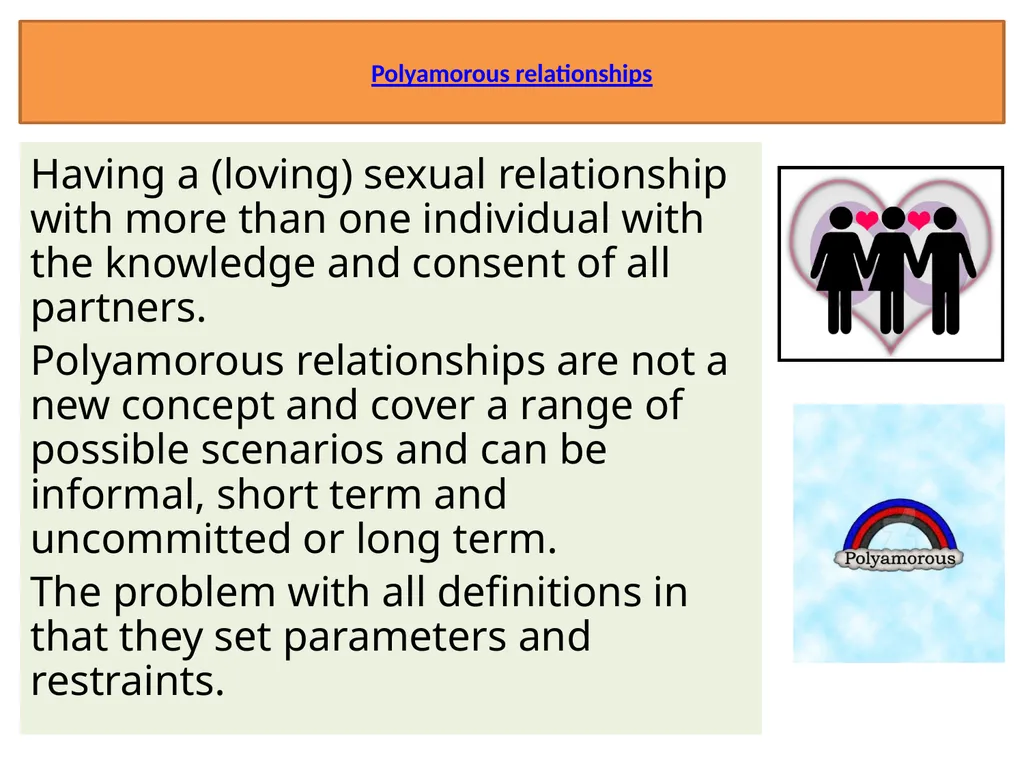
Polyamorous relationships Having a (loving) sexual relationship with more than one individual with the knowledge and consent of all partners.
Polyamorous relationships are not a new concept and cover a range of possible scenarios and can be informal, short term and uncommitted or long term.
The problem with all definitions in that they set parameters and restraints.<br>
Polyamorous relationships are not a new concept and cover a range of possible scenarios and can be informal, short term and uncommitted or long term.
The problem with all definitions in that they set parameters and restraints.<br>
14
Application of Situation Ethics Homosexual relationships Polyamorous relationships<br>
15
Applying Fletcher’s principles to homosexuality and polyamorous relationships Fletcher believed sexual relationships were a matter of personal individual freedom
Homosexuality and polyamory should have the same treatment as a monogamous relationship - not legalistic but according to the agape principle. Polyamorous relationships should be treated the same as monogamous relationships, Situation ethics sets itself apart from antinomianism.
Principle agape would support the law as long as its done in private , does not contravene human rights , offend public decency.
The four working and six fundamental principles would be applied to judge a relationship, is it pragmatic? Personal? It supports the basis agapeic concern ‘neighbour’. The loving acceptance of end justifies the means and that justice in this situation.<br>
Homosexuality and polyamory should have the same treatment as a monogamous relationship - not legalistic but according to the agape principle. Polyamorous relationships should be treated the same as monogamous relationships, Situation ethics sets itself apart from antinomianism.
Principle agape would support the law as long as its done in private , does not contravene human rights , offend public decency.
The four working and six fundamental principles would be applied to judge a relationship, is it pragmatic? Personal? It supports the basis agapeic concern ‘neighbour’. The loving acceptance of end justifies the means and that justice in this situation.<br>
16
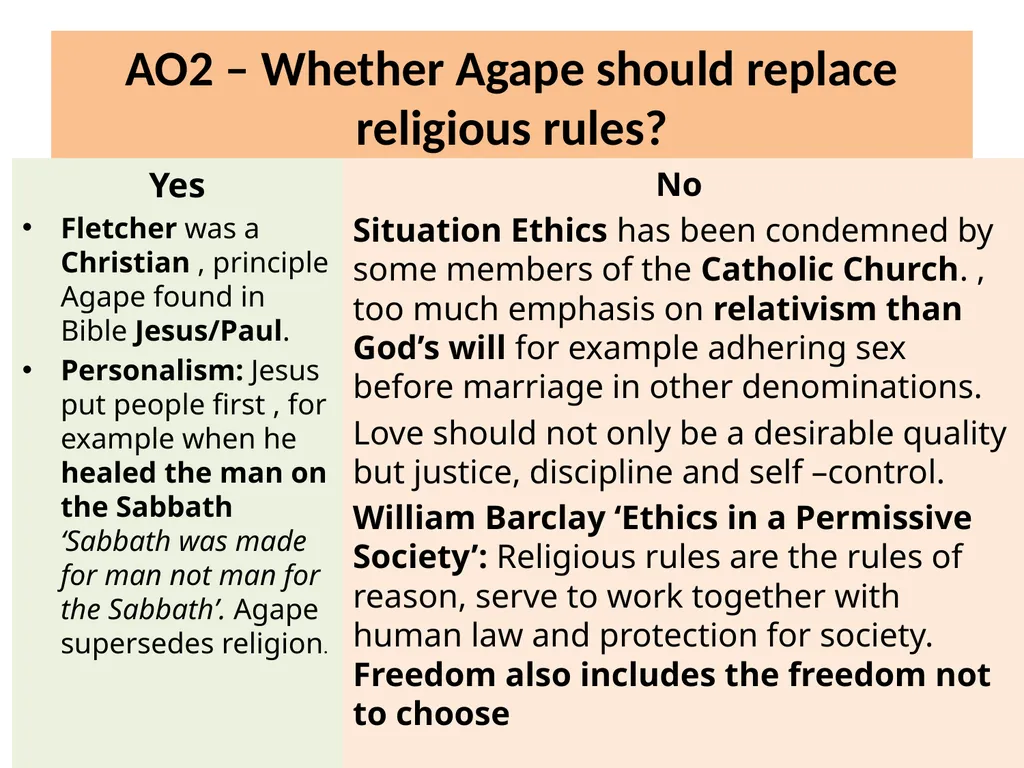
AO2 – Whether Agape should replace religious rules? Yes
Fletcher was a Christian , principle Agape found in Bible Jesus/Paul.
Personalism: Jesus put people first , for example when he healed the man on the Sabbath ‘Sabbath was made for man not man for the Sabbath’. Agape supersedes religion. No
Situation Ethics has been condemned by some members of the Catholic Church. , too much emphasis on relativism than God’s will for example adhering sex before marriage in other denominations.
Love should not only be a desirable quality but justice, discipline and self –control.
William Barclay ‘Ethics in a Permissive Society’: Religious rules are the rules of reason, serve to work together with human law and protection for society. Freedom also includes the freedom not to choose<br>
Fletcher was a Christian , principle Agape found in Bible Jesus/Paul.
Personalism: Jesus put people first , for example when he healed the man on the Sabbath ‘Sabbath was made for man not man for the Sabbath’. Agape supersedes religion. No
Situation Ethics has been condemned by some members of the Catholic Church. , too much emphasis on relativism than God’s will for example adhering sex before marriage in other denominations.
Love should not only be a desirable quality but justice, discipline and self –control.
William Barclay ‘Ethics in a Permissive Society’: Religious rules are the rules of reason, serve to work together with human law and protection for society. Freedom also includes the freedom not to choose<br>
17
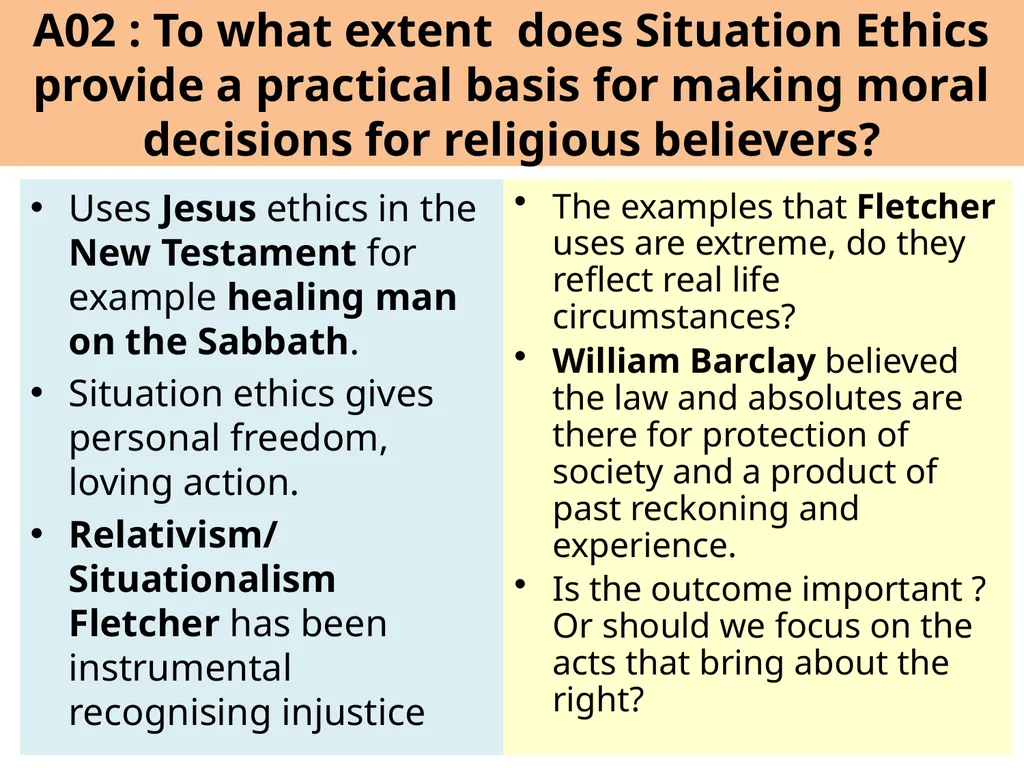
A02 : To what extent does Situation Ethics provide a practical basis for making moral decisions for religious believers? Uses Jesus ethics in the New Testament for example healing man on the Sabbath.
Situation ethics gives personal freedom, loving action.
Relativism/ Situationalism Fletcher has been instrumental recognising injustice The examples that Fletcher uses are extreme, do they reflect real life circumstances?
William Barclay believed the law and absolutes are there for protection of society and a product of past reckoning and experience.
Is the outcome important ? Or should we focus on the acts that bring about the right?<br>
Situation ethics gives personal freedom, loving action.
Relativism/ Situationalism Fletcher has been instrumental recognising injustice The examples that Fletcher uses are extreme, do they reflect real life circumstances?
William Barclay believed the law and absolutes are there for protection of society and a product of past reckoning and experience.
Is the outcome important ? Or should we focus on the acts that bring about the right?<br>
18
Mark 3:1-6 Jesus Heals on the Sabbath 3 Another time Jesus went into the synagogue, and a man with a shriveled hand was there. 2 Some of them were looking for a reason to accuse Jesus, so they watched him closely to see if he would heal him on the Sabbath. 3 Jesus said to the man with the shriveled hand, “Stand up in front of everyone.”
4 Then Jesus asked them, “Which is lawful on the Sabbath: to do good or to do evil, to save life or to kill?” But they remained silent.
5 He looked around at them in anger and, deeply distressed at their stubborn hearts, said to the man, “Stretch out your hand.” He stretched it out, and his hand was completely restored. 6 Then the Pharisees went out and began to plot with the Herodians how they might kill Jesus.<br>
4 Then Jesus asked them, “Which is lawful on the Sabbath: to do good or to do evil, to save life or to kill?” But they remained silent.
5 He looked around at them in anger and, deeply distressed at their stubborn hearts, said to the man, “Stretch out your hand.” He stretched it out, and his hand was completely restored. 6 Then the Pharisees went out and began to plot with the Herodians how they might kill Jesus.<br>
19
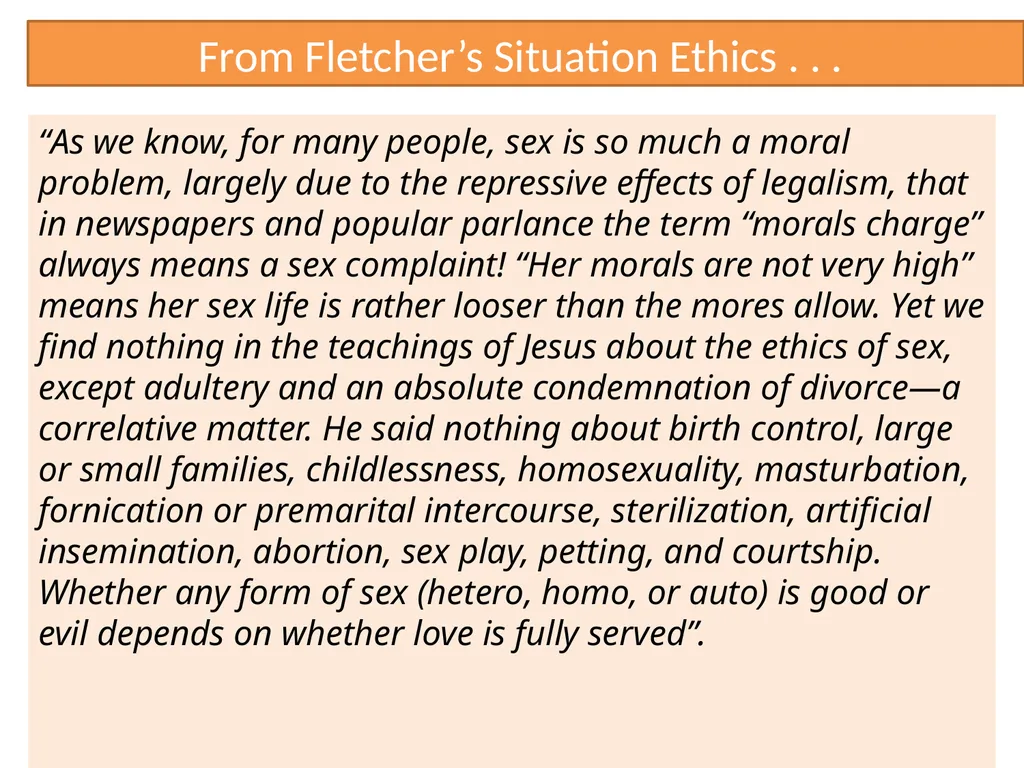
From Fletcher’s Situation Ethics . . . “As we know, for many people, sex is so much a moral problem, largely due to the repressive effects of legalism, that in newspapers and popular parlance the term “morals charge” always means a sex complaint! “Her morals are not very high” means her sex life is rather looser than the mores allow. Yet we find nothing in the teachings of Jesus about the ethics of sex, except adultery and an absolute condemnation of divorce—a correlative matter. He said nothing about birth control, large or small families, childlessness, homosexuality, masturbation, fornication or premarital intercourse, sterilization, artificial insemination, abortion, sex play, petting, and courtship. Whether any form of sex (hetero, homo, or auto) is good or evil depends on whether love is fully served”.<br>
20
Reading for gist Here are some extracts from Joseph Fletcher’s Situation Ethics. Try reading each paragraph for the gist – the essential point, and then summarise the essential point in one sentence underneath each paragraph. Then try applying it to polyamory.<br>
21
3 C Applying Fletcher’s principles to homosexuality and polyamorous relationships<br>
22
Fletcher’s examples
Fletcher developed his theory by drawing on a wide range of cases that could not be resolved by applying fixed rules and principles.
Learn the examples that follow
How could they be use in an AO1 answer?
How could they be used in an AO2 answer?<br>
Fletcher developed his theory by drawing on a wide range of cases that could not be resolved by applying fixed rules and principles.
Learn the examples that follow
How could they be use in an AO1 answer?
How could they be used in an AO2 answer?<br>
23
The case studies These case studies were drafted by Joseph Fletcher to represent how Natural Law and other legalistic approaches would not be suitable in every situation
They demonstrate examples where Christians have to put aside their usual norms or laws, to do the ‘loving’ thing
Jesus, Fletcher believes, would have done the same as evidence in the Bible suggests<br>
They demonstrate examples where Christians have to put aside their usual norms or laws, to do the ‘loving’ thing
Jesus, Fletcher believes, would have done the same as evidence in the Bible suggests<br>
24
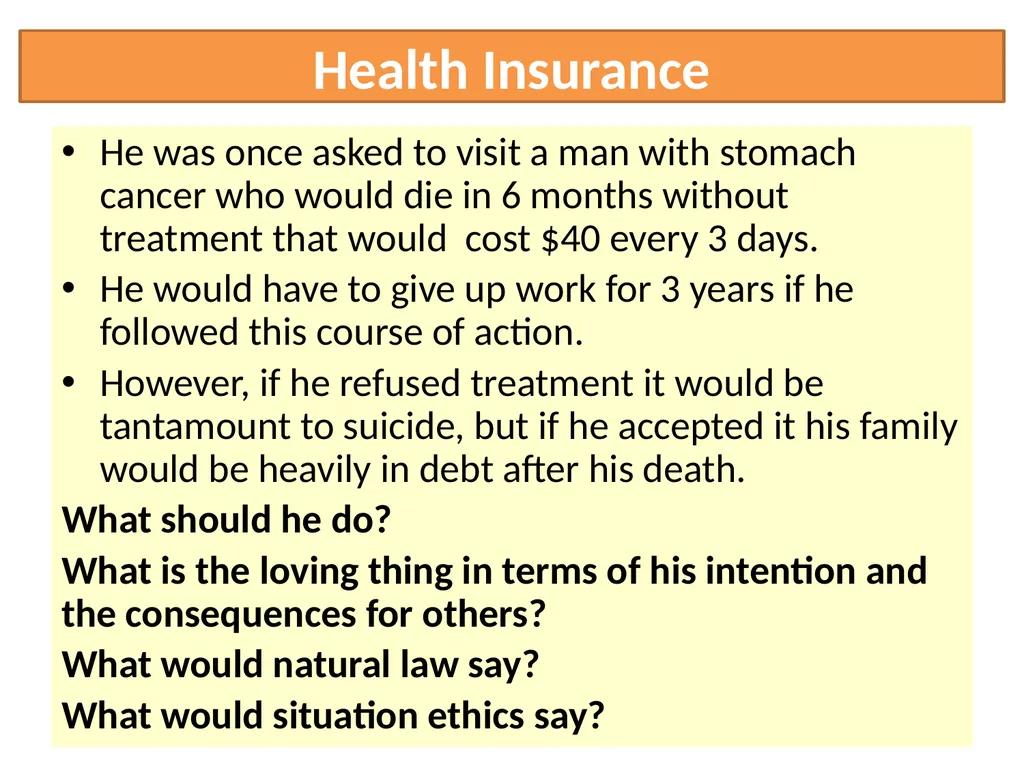
Health Insurance He was once asked to visit a man with stomach cancer who would die in 6 months without treatment that would cost $40 every 3 days.
He would have to give up work for 3 years if he followed this course of action.
However, if he refused treatment it would be tantamount to suicide, but if he accepted it his family would be heavily in debt after his death.
What should he do?
What is the loving thing in terms of his intention and the consequences for others?
What would natural law say?
What would situation ethics say?<br>
He would have to give up work for 3 years if he followed this course of action.
However, if he refused treatment it would be tantamount to suicide, but if he accepted it his family would be heavily in debt after his death.
What should he do?
What is the loving thing in terms of his intention and the consequences for others?
What would natural law say?
What would situation ethics say?<br>
25
Fletcher’s examples…
The insurance problem… “I dropped in on a patient at the hospital who explained that he only had a set time to live. The doctors could give him some pills (that would cost $40 every three days) that would keep him alive for the next three years, but if he didn't take the pills, he’d be dead within six months. Now he was insured for $100,000, double indemnity and that was all the insurance he had. But if he took the pills and lived past next October when the insurance was up for renewal, they were bound to refuse the renewal, and his insurance would be cancelled. So he told me that he was thinking that if he didn't take the pills, then his family would get left with some security, and asked my advice on the situation.”<br>
26
Fletcher’s examples…
Hiroshima “When the atomic bomb was dropped on Hiroshima, the plane crew were silent. Captain Lewis uttered six words, "My God, what have we done?" Three days later another one fell on Nagasaki. About 152,000 were killed, many times more were wounded and burned, to die later. The next day Japan sued for peace. When deciding whether to use "the most terrible weapon ever known" the US President appointed an Interim Committee made up of distinguished and responsible people in the government. Most but not all of its military advisors favoured using it. Top-level scientists said they could find no acceptable alternative to using it, but they were opposed by equally able scientists. After lengthy discussions, the committee decided that the lives saved by ending the war swiftly by using this weapon outweighed the lives destroyed by using it and thought that the best course of action.”
Summary
What would situation ethics say?
What would natural law say?<br>
Summary
What would situation ethics say?
What would natural law say?<br>
27
Fletcher’s examples…
Honey Trap… I was reading "Biblical Faith and Social Ethics“ (Clinton Gardner's book) on a shuttle plane to New York. Next to me sat a young woman of about twenty-eight or so, attractive and well turned out in expensive clothes of good taste. She showed some interest in my book, and I asked if she'd like to look at it. "No", she said, "I'd rather talk." What about? "Me." I knew this meant good-bye to the reading. "I have a problem I'm confused about. You might help me to decide," she explained... There was a war going on that her government believed could be stopped by some clever use of espionage and blackmail. However, this meant she had to seduce and sleep with an enemy spy in order to lure him into blackmail. Now this went against her morals, but if it brought the war to an end, saving thousands of lives, would it be worth breaking those standards?”
Summary
What would situation ethics say?
What would natural law say?<br>
Summary
What would situation ethics say?
What would natural law say?<br>
28
Fletcher’s examples…
Means to an end? “in Ukraine, Mrs. Bergmeier (a POW) learned through a sympathetic commandant that her husband and family were trying to keep together and find her. But the rules allowed them to release her to Germany only if she was pregnant, in which case she would be returned as a liability. She turned things over in her mind and finally asked a friendly Volga German camp guard to impregnate her, which he did. Her condition being medically verified, she was sent back to Berlin and to her family. They welcomed her with open arms, even when she told them how she had managed it. And when the child was born, they all loved him because of what he had done for them. After the christening, they met up with their local pastor and discussed the morality of the situation.”<br>
29
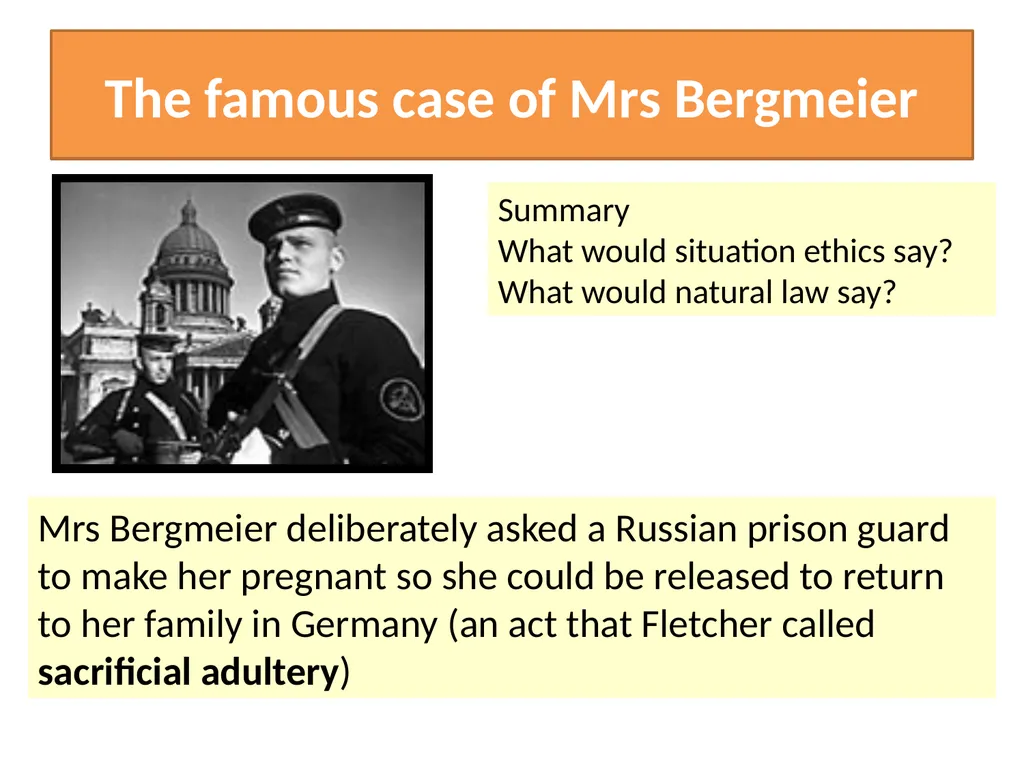
The famous case of Mrs Bergmeier Mrs Bergmeier deliberately asked a Russian prison guard to make her pregnant so she could be released to return to her family in Germany (an act that Fletcher called sacrificial adultery) Summary
What would situation ethics say?
What would natural law say?<br>
What would situation ethics say?
What would natural law say?<br>
30
The 4 Case Studies – Market Place In your groups, read the case study you have been given
Write a summary of the story on your a3 sheet and decide how situation ethics and natural law would approach this dilemma.<br>
Write a summary of the story on your a3 sheet and decide how situation ethics and natural law would approach this dilemma.<br>
31
The 4 Case Studies – Market Place On your A3 sheet try and represent your case study using pictures and no more than 15 individual words
Select someone who will remain at ‘base’ to explain your case study and picture to the other groups.
The other members of the group must go to the other 3 tables (1 table each) and complete the case study mind maps
You have 3mins at each table, before going back to base and reciting the information back to your ‘base’ tutor
Everyone in your group should check your mind maps and learning.<br>
Select someone who will remain at ‘base’ to explain your case study and picture to the other groups.
The other members of the group must go to the other 3 tables (1 table each) and complete the case study mind maps
You have 3mins at each table, before going back to base and reciting the information back to your ‘base’ tutor
Everyone in your group should check your mind maps and learning.<br>
32
Plenary – True or False Stay standing if you think...
1) Fletcher agreed with the Hiroshima bomb attacks
2) Fletcher believed sex should always be within a loving marriage
3) Natural Law would approve of a man taking his own life as it is to help preserve the life of his family with £100,000
4) Contextual ethics believe that to love someone sometimes means sleeping with someone else<br>
1) Fletcher agreed with the Hiroshima bomb attacks
2) Fletcher believed sex should always be within a loving marriage
3) Natural Law would approve of a man taking his own life as it is to help preserve the life of his family with £100,000
4) Contextual ethics believe that to love someone sometimes means sleeping with someone else<br>
33
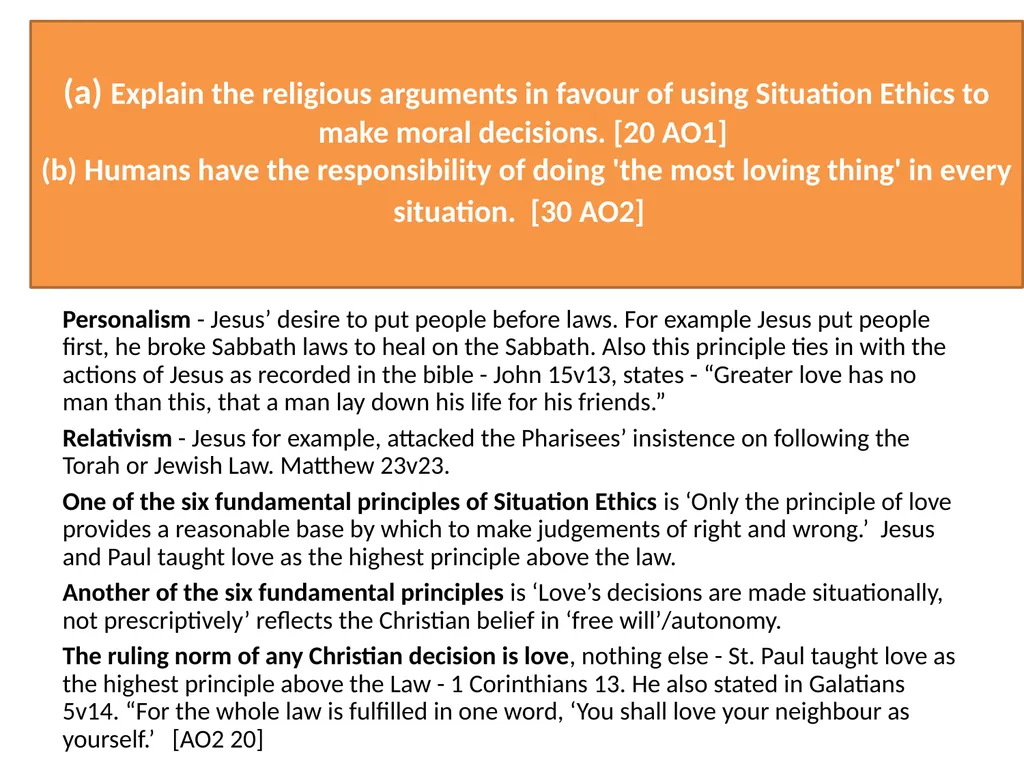
(a) Explain the religious arguments in favour of using Situation Ethics to make moral decisions. [20 AO1]
(b) Humans have the responsibility of doing 'the most loving thing' in every situation. [30 AO2] Personalism - Jesus’ desire to put people before laws. For example Jesus put people first, he broke Sabbath laws to heal on the Sabbath. Also this principle ties in with the actions of Jesus as recorded in the bible - John 15v13, states - “Greater love has no man than this, that a man lay down his life for his friends.”
Relativism - Jesus for example, attacked the Pharisees’ insistence on following the Torah or Jewish Law. Matthew 23v23.
One of the six fundamental principles of Situation Ethics is ‘Only the principle of love provides a reasonable base by which to make judgements of right and wrong.’ Jesus and Paul taught love as the highest principle above the law.
Another of the six fundamental principles is ‘Love’s decisions are made situationally, not prescriptively’ reflects the Christian belief in ‘free will’/autonomy.
The ruling norm of any Christian decision is love, nothing else - St. Paul taught love as the highest principle above the Law - 1 Corinthians 13. He also stated in Galatians 5v14. “For the whole law is fulfilled in one word, ‘You shall love your neighbour as yourself.’ [AO2 20]<br>
Relativism - Jesus for example, attacked the Pharisees’ insistence on following the Torah or Jewish Law. Matthew 23v23.
One of the six fundamental principles of Situation Ethics is ‘Only the principle of love provides a reasonable base by which to make judgements of right and wrong.’ Jesus and Paul taught love as the highest principle above the law.
Another of the six fundamental principles is ‘Love’s decisions are made situationally, not prescriptively’ reflects the Christian belief in ‘free will’/autonomy.
The ruling norm of any Christian decision is love, nothing else - St. Paul taught love as the highest principle above the Law - 1 Corinthians 13. He also stated in Galatians 5v14. “For the whole law is fulfilled in one word, ‘You shall love your neighbour as yourself.’ [AO2 20]<br>