
Skills assessment For Supervisor or Leader role

Description: Skills assessment For Supervisor or Leader role Content Section 1: How to use the skills assessment Working with my manager to complete the skills assessment Make sure you identify with the day-to-day work described in this role category,
Related Topics
Download Presentation
"Skills assessment For Supervisor or Leader role" is the property of its rightful owner. Permission is granted to download and print the materials on this website for personal, non-commercial use only, and to display it on your personal computer provided you do not modify the materials and that you retain all copyright notices contained in the materials. By downloading content from our website, you accept the terms of this agreement.
Presentation Transcript
slide1. Skills assessment For Supervisor or Leader role<br>
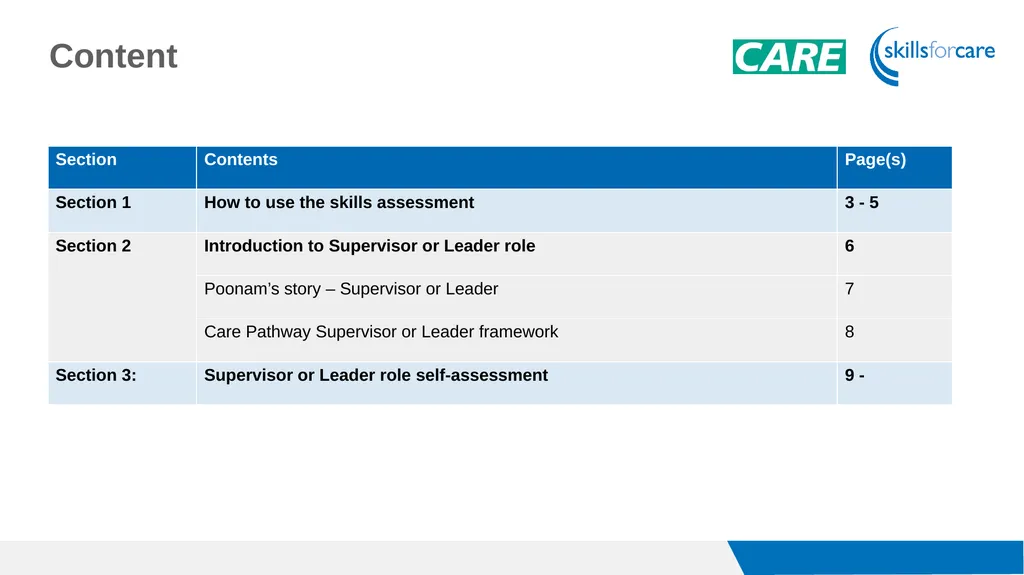
slide2. Content<br>
slide3. Section 1: How to use the skills assessment<br>
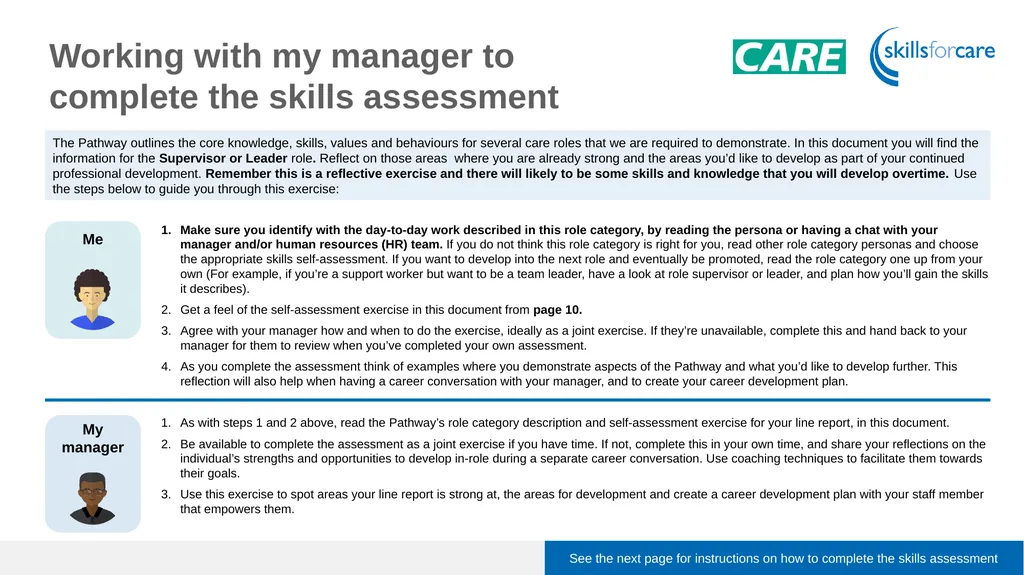
slide4. Working with my manager to
complete the skills assessment Make sure you identify with the day-to-day work described in this role category, by reading the persona or having a chat with your manager and/or human resources (HR) team. If you do not think this role category is right for you, read other role category personas and choose the appropriate skills self-assessment. If you want to develop into the next role and eventually be promoted, read the role category one up from your own (For example, if you’re a support worker but want to be a team leader, have a look at role supervisor or leader, and plan how you’ll gain the skills it describes).
Get a feel of the self-assessment exercise in this document from page 10.
Agree with your manager how and when to do the exercise, ideally as a joint exercise. If they’re unavailable, complete this and hand back to your manager for them to review when you’ve completed your own assessment.
As you complete the assessment think of examples where you demonstrate aspects of the Pathway and what you’d like to develop further. This reflection will also help when having a career conversation with your manager, and to create your career development plan. As with steps 1 and 2 above, read the Pathway’s role category description and self-assessment exercise for your line report, in this document.
Be available to complete the assessment as a joint exercise if you have time. If not, complete this in your own time, and share your reflections on the individual’s strengths and opportunities to develop in-role during a separate career conversation. Use coaching techniques to facilitate them towards their goals.
Use this exercise to spot areas your line report is strong at, the areas for development and create a career development plan with your staff member that empowers them. See the next page for instructions on how to complete the skills assessment The Pathway outlines the core knowledge, skills, values and behaviours for several care roles that we are required to demonstrate. In this document you will find the information for the Supervisor or Leader role. Reflect on those areas where you are already strong and the areas you’d like to develop as part of your continued professional development. Remember this is a reflective exercise and there will likely to be some skills and knowledge that you will develop overtime. Use the steps below to guide you through this exercise:<br>
slide5. How to use the skills assessment
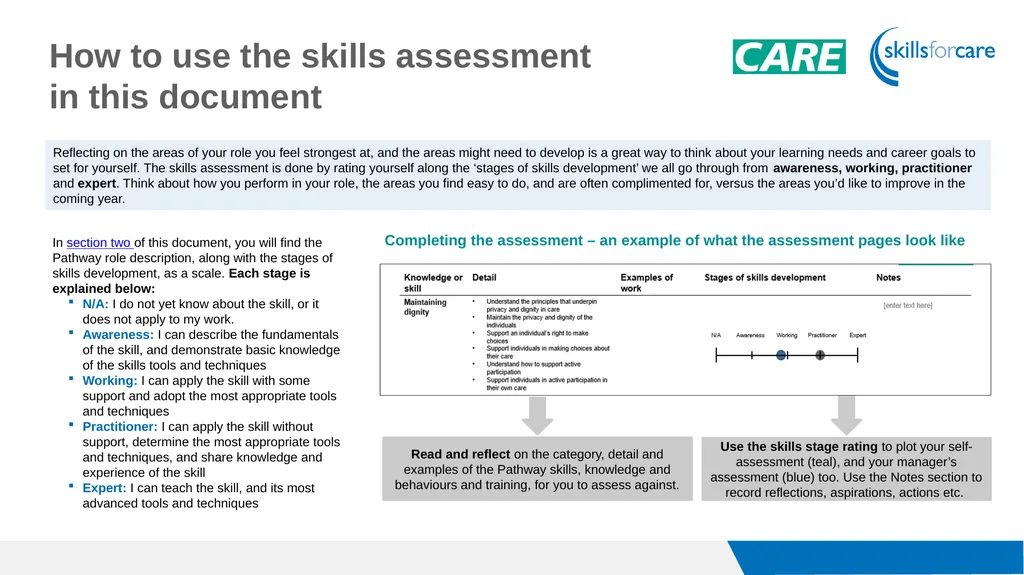
in this document Reflecting on the areas of your role you feel strongest at, and the areas might need to develop is a great way to think about your learning needs and career goals to set for yourself. The skills assessment is done by rating yourself along the ‘stages of skills development’ we all go through from awareness, working, practitioner and expert. Think about how you perform in your role, the areas you find easy to do, and are often complimented for, versus the areas you’d like to improve in the coming year. In section two of this document, you will find the Pathway role description, along with the stages of skills development, as a scale. Each stage is explained below:
N/A: I do not yet know about the skill, or it does not apply to my work.
Awareness: I can describe the fundamentals of the skill, and demonstrate basic knowledge of the skills tools and techniques
Working: I can apply the skill with some support and adopt the most appropriate tools and techniques
Practitioner: I can apply the skill without support, determine the most appropriate tools and techniques, and share knowledge and experience of the skill
Expert: I can teach the skill, and its most advanced tools and techniques Read and reflect on the category, detail and examples of the Pathway skills, knowledge and behaviours and training, for you to assess against. Use the skills stage rating to plot your self-assessment (teal), and your manager’s assessment (blue) too. Use the Notes section to record reflections, aspirations, actions etc. Completing the assessment – an example of what the assessment pages look like<br>
slide6. Section 2: Introduction to Supervisor or Leader role<br>
slide7. Poonam’s story – Supervisor
or Leader Poonam has worked in social care since leaving school, and now is a senior care and support worker within a supported living setting with responsibility for both advanced care and leading and managing a team of care and support workers. She completed her Lead Adult Care Worker apprenticeship 2 years ago, which included a Level 3 Diploma in Care.
In her role, she has responsibility for the performance management and leadership of her team, and has to mentor more junior care and support workers and coach her team to provide quality care and support. In her development plan with her manager, she identified the need to develop skills around supervision, coaching and mentoring as well as developing her interest in leadership skills.
She is thinking about her future career opportunities now. She has the experience and knowledge to be able to concentrate on a specialist area of care, developing more in-depth knowledge and skills to support people with a range of support needs, or she could choose to develop her management and leadership skills and aim to become a registered manager. Both options provide opportunities to advance her career and to develop her learning and skills further.
Poonam will use her annual appraisal as an opportunity to discuss these options with her manager and look at where she might develop. Each option will provide her with a challenge in terms of her development, but Poonam enjoys learning and likes the motivation of supporting not only those who use care services but also her colleagues who are developing in their own roles and seeing them gain more skills.
Whichever path Poonam chooses, she will be making a difference to people, supporting them to live their best lives, something that gives her great job satisfaction.<br>
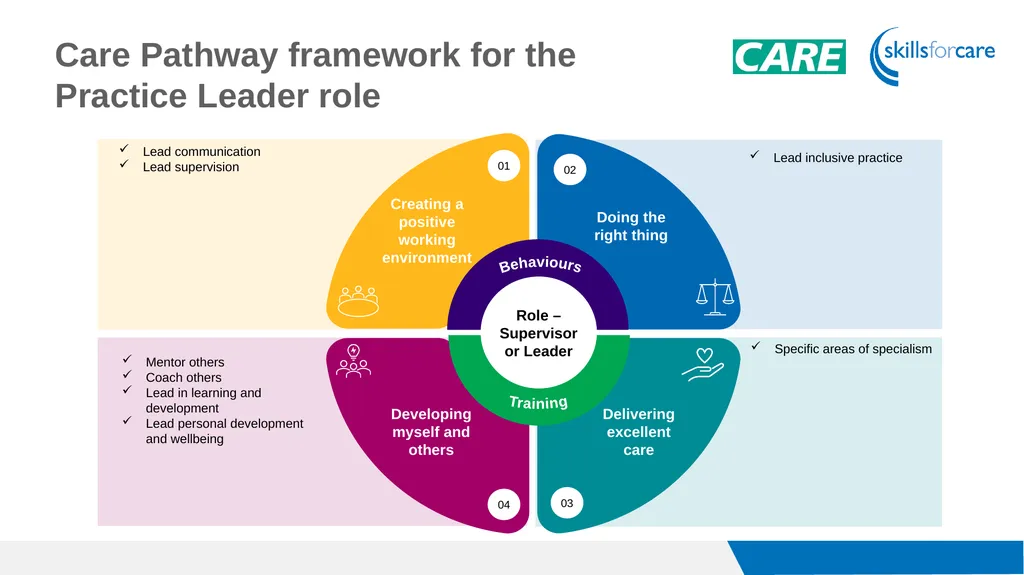
slide8. Behaviours Role – Supervisor or Leader Behaviours Training Care Pathway framework for the
Practice Leader role<br>
slide9. Section 3: Supervisor or Leader role assessment<br>
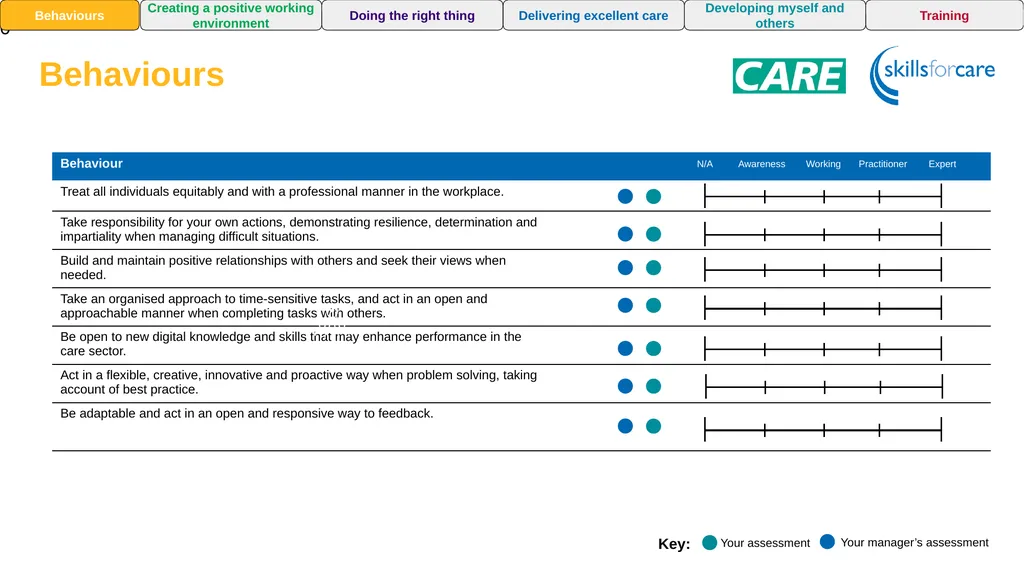
slide10. Your assessment Your manager’s assessment Key: 10 Behaviours Training Doing the right thing Creating a positive working environment Delivering excellent care Developing myself and others Behaviours Awareness Expert Working Practitioner N/A<br>
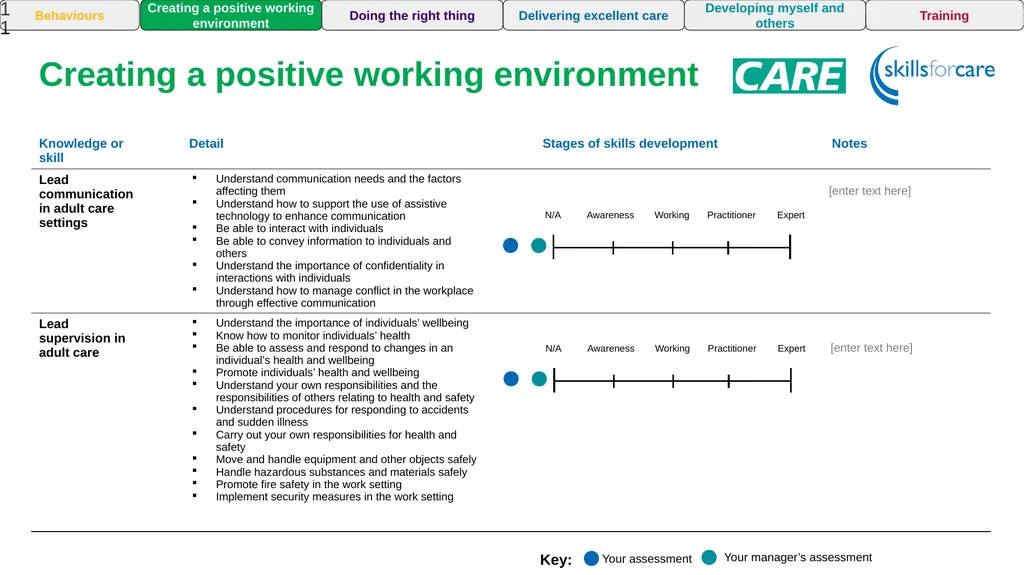
slide11. 11 Behaviours Training Doing the right thing Creating a positive working environment Delivering excellent care Developing myself and others Creating a positive working environment Key: Your assessment Your manager’s assessment Awareness [enter text here] Awareness Awareness N/A [enter text here]<br>
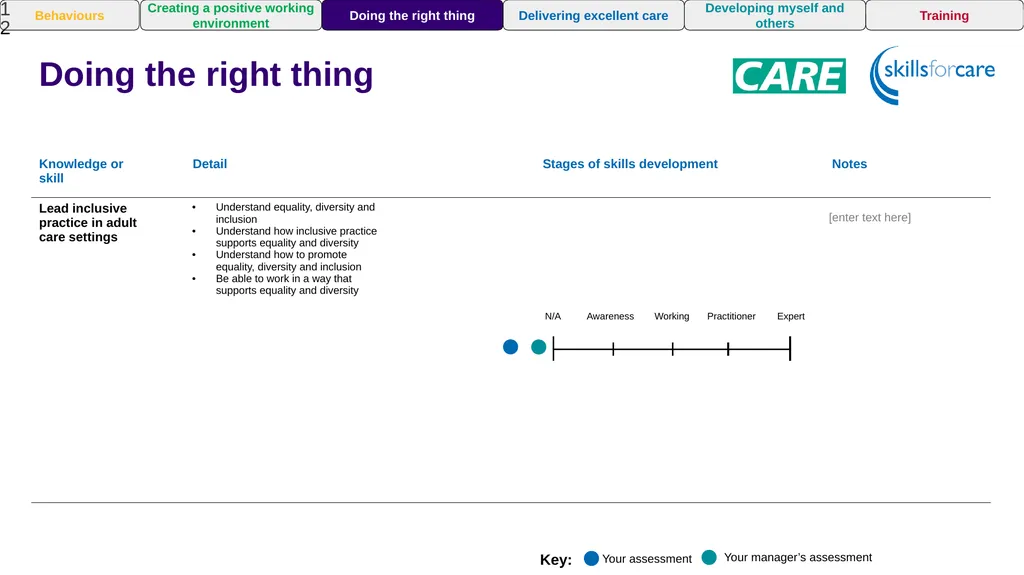
slide12. 12 Behaviours Training Doing the right thing Creating a positive working environment Delivering excellent care Developing myself and others Doing the right thing Key: Your assessment Your manager’s assessment Awareness N/A [enter text here]<br>
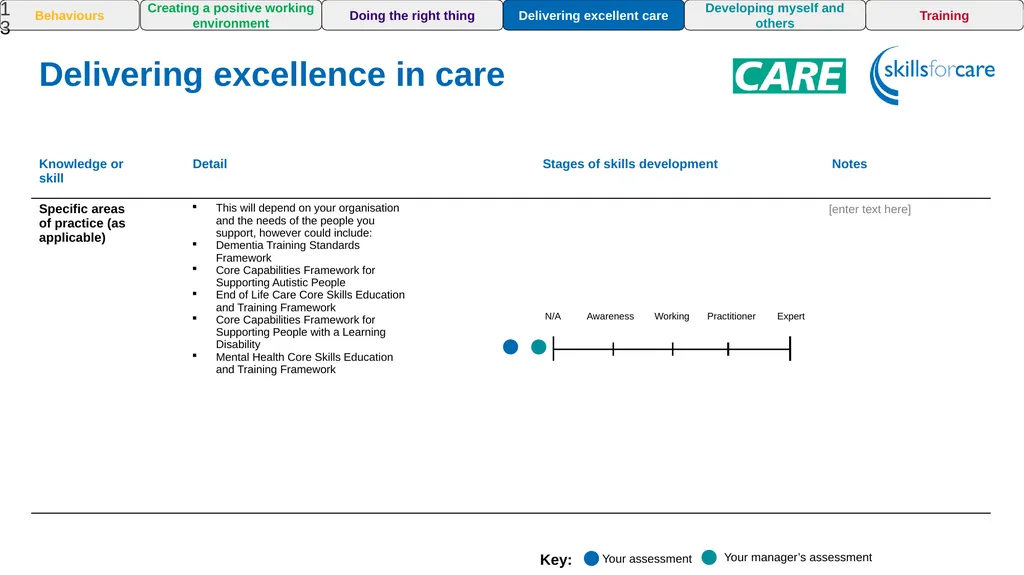
slide13. 13 Behaviours Training Doing the right thing Creating a positive working environment Delivering excellent care Developing myself and others Awareness Delivering excellence in care Key: Your assessment Your manager’s assessment Awareness N/A [enter text here]<br>
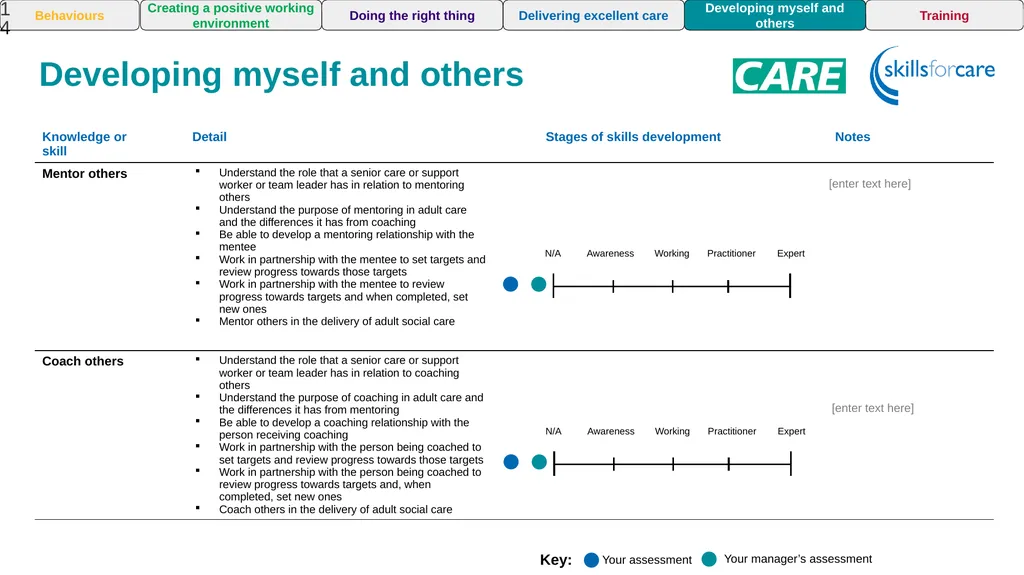
slide14. 14 Behaviours Training Doing the right thing Creating a positive working environment Delivering excellent care Developing myself and others Awareness Developing myself and others Key: Your assessment Your manager’s assessment Awareness Awareness N/A [enter text here] [enter text here]<br>
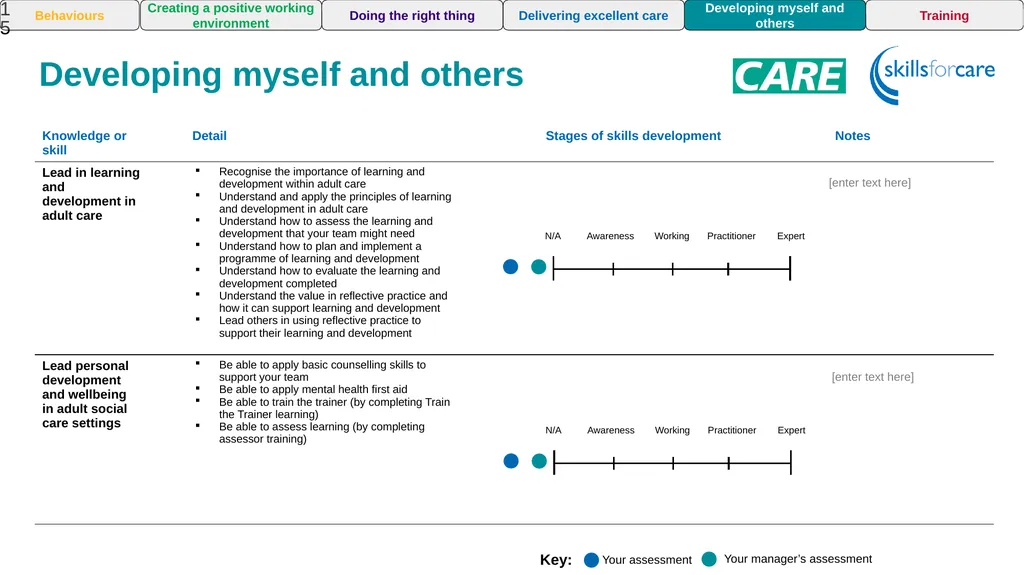
slide15. 15 Behaviours Training Doing the right thing Creating a positive working environment Delivering excellent care Developing myself and others Awareness Developing myself and others Key: Your assessment Your manager’s assessment Awareness Awareness N/A [enter text here] [enter text here]<br>
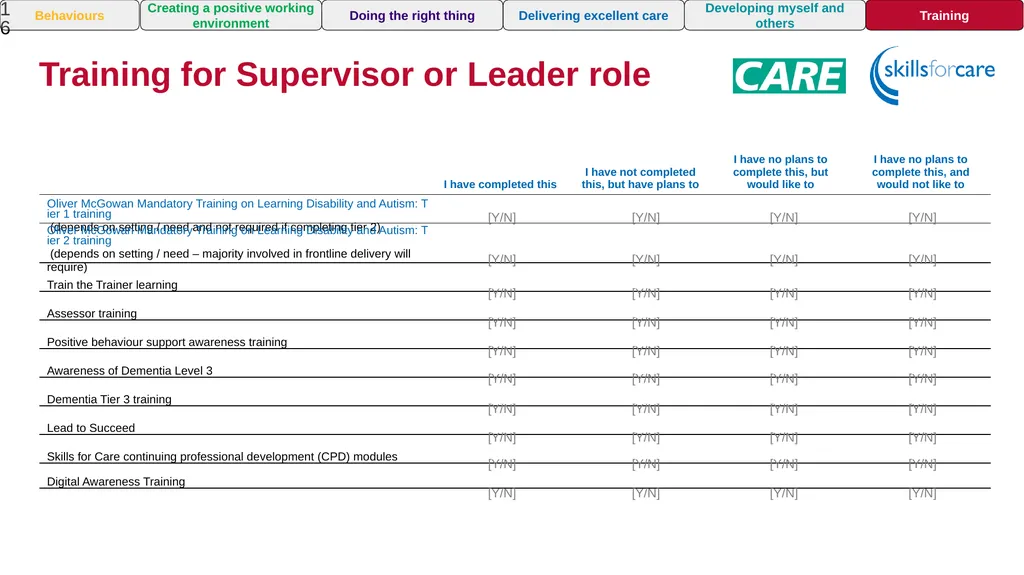
slide16. 16 Behaviours Training Doing the right thing Creating a positive working environment Delivering excellent care Developing myself and others Training for Supervisor or Leader role [Y/N] [Y/N] [Y/N] [Y/N] [Y/N] [Y/N] [Y/N] [Y/N] [Y/N] [Y/N] [Y/N] [Y/N] [Y/N] [Y/N] [Y/N] [Y/N] [Y/N] [Y/N] [Y/N] [Y/N] [Y/N] [Y/N] [Y/N] [Y/N] [Y/N] [Y/N] [Y/N] [Y/N] [Y/N] [Y/N] [Y/N] [Y/N] [Y/N] [Y/N] [Y/N] [Y/N] [Y/N] [Y/N] [Y/N] [Y/N]<br>
slide17. Skills assessment complete!<br>
slide2. Content<br>
slide3. Section 1: How to use the skills assessment<br>
slide4. Working with my manager to
complete the skills assessment Make sure you identify with the day-to-day work described in this role category, by reading the persona or having a chat with your manager and/or human resources (HR) team. If you do not think this role category is right for you, read other role category personas and choose the appropriate skills self-assessment. If you want to develop into the next role and eventually be promoted, read the role category one up from your own (For example, if you’re a support worker but want to be a team leader, have a look at role supervisor or leader, and plan how you’ll gain the skills it describes).
Get a feel of the self-assessment exercise in this document from page 10.
Agree with your manager how and when to do the exercise, ideally as a joint exercise. If they’re unavailable, complete this and hand back to your manager for them to review when you’ve completed your own assessment.
As you complete the assessment think of examples where you demonstrate aspects of the Pathway and what you’d like to develop further. This reflection will also help when having a career conversation with your manager, and to create your career development plan. As with steps 1 and 2 above, read the Pathway’s role category description and self-assessment exercise for your line report, in this document.
Be available to complete the assessment as a joint exercise if you have time. If not, complete this in your own time, and share your reflections on the individual’s strengths and opportunities to develop in-role during a separate career conversation. Use coaching techniques to facilitate them towards their goals.
Use this exercise to spot areas your line report is strong at, the areas for development and create a career development plan with your staff member that empowers them. See the next page for instructions on how to complete the skills assessment The Pathway outlines the core knowledge, skills, values and behaviours for several care roles that we are required to demonstrate. In this document you will find the information for the Supervisor or Leader role. Reflect on those areas where you are already strong and the areas you’d like to develop as part of your continued professional development. Remember this is a reflective exercise and there will likely to be some skills and knowledge that you will develop overtime. Use the steps below to guide you through this exercise:<br>
slide5. How to use the skills assessment
in this document Reflecting on the areas of your role you feel strongest at, and the areas might need to develop is a great way to think about your learning needs and career goals to set for yourself. The skills assessment is done by rating yourself along the ‘stages of skills development’ we all go through from awareness, working, practitioner and expert. Think about how you perform in your role, the areas you find easy to do, and are often complimented for, versus the areas you’d like to improve in the coming year. In section two of this document, you will find the Pathway role description, along with the stages of skills development, as a scale. Each stage is explained below:
N/A: I do not yet know about the skill, or it does not apply to my work.
Awareness: I can describe the fundamentals of the skill, and demonstrate basic knowledge of the skills tools and techniques
Working: I can apply the skill with some support and adopt the most appropriate tools and techniques
Practitioner: I can apply the skill without support, determine the most appropriate tools and techniques, and share knowledge and experience of the skill
Expert: I can teach the skill, and its most advanced tools and techniques Read and reflect on the category, detail and examples of the Pathway skills, knowledge and behaviours and training, for you to assess against. Use the skills stage rating to plot your self-assessment (teal), and your manager’s assessment (blue) too. Use the Notes section to record reflections, aspirations, actions etc. Completing the assessment – an example of what the assessment pages look like<br>
slide6. Section 2: Introduction to Supervisor or Leader role<br>
slide7. Poonam’s story – Supervisor
or Leader Poonam has worked in social care since leaving school, and now is a senior care and support worker within a supported living setting with responsibility for both advanced care and leading and managing a team of care and support workers. She completed her Lead Adult Care Worker apprenticeship 2 years ago, which included a Level 3 Diploma in Care.
In her role, she has responsibility for the performance management and leadership of her team, and has to mentor more junior care and support workers and coach her team to provide quality care and support. In her development plan with her manager, she identified the need to develop skills around supervision, coaching and mentoring as well as developing her interest in leadership skills.
She is thinking about her future career opportunities now. She has the experience and knowledge to be able to concentrate on a specialist area of care, developing more in-depth knowledge and skills to support people with a range of support needs, or she could choose to develop her management and leadership skills and aim to become a registered manager. Both options provide opportunities to advance her career and to develop her learning and skills further.
Poonam will use her annual appraisal as an opportunity to discuss these options with her manager and look at where she might develop. Each option will provide her with a challenge in terms of her development, but Poonam enjoys learning and likes the motivation of supporting not only those who use care services but also her colleagues who are developing in their own roles and seeing them gain more skills.
Whichever path Poonam chooses, she will be making a difference to people, supporting them to live their best lives, something that gives her great job satisfaction.<br>
slide8. Behaviours Role – Supervisor or Leader Behaviours Training Care Pathway framework for the
Practice Leader role<br>
slide9. Section 3: Supervisor or Leader role assessment<br>
slide10. Your assessment Your manager’s assessment Key: 10 Behaviours Training Doing the right thing Creating a positive working environment Delivering excellent care Developing myself and others Behaviours Awareness Expert Working Practitioner N/A<br>
slide11. 11 Behaviours Training Doing the right thing Creating a positive working environment Delivering excellent care Developing myself and others Creating a positive working environment Key: Your assessment Your manager’s assessment Awareness [enter text here] Awareness Awareness N/A [enter text here]<br>
slide12. 12 Behaviours Training Doing the right thing Creating a positive working environment Delivering excellent care Developing myself and others Doing the right thing Key: Your assessment Your manager’s assessment Awareness N/A [enter text here]<br>
slide13. 13 Behaviours Training Doing the right thing Creating a positive working environment Delivering excellent care Developing myself and others Awareness Delivering excellence in care Key: Your assessment Your manager’s assessment Awareness N/A [enter text here]<br>
slide14. 14 Behaviours Training Doing the right thing Creating a positive working environment Delivering excellent care Developing myself and others Awareness Developing myself and others Key: Your assessment Your manager’s assessment Awareness Awareness N/A [enter text here] [enter text here]<br>
slide15. 15 Behaviours Training Doing the right thing Creating a positive working environment Delivering excellent care Developing myself and others Awareness Developing myself and others Key: Your assessment Your manager’s assessment Awareness Awareness N/A [enter text here] [enter text here]<br>
slide16. 16 Behaviours Training Doing the right thing Creating a positive working environment Delivering excellent care Developing myself and others Training for Supervisor or Leader role [Y/N] [Y/N] [Y/N] [Y/N] [Y/N] [Y/N] [Y/N] [Y/N] [Y/N] [Y/N] [Y/N] [Y/N] [Y/N] [Y/N] [Y/N] [Y/N] [Y/N] [Y/N] [Y/N] [Y/N] [Y/N] [Y/N] [Y/N] [Y/N] [Y/N] [Y/N] [Y/N] [Y/N] [Y/N] [Y/N] [Y/N] [Y/N] [Y/N] [Y/N] [Y/N] [Y/N] [Y/N] [Y/N] [Y/N] [Y/N]<br>
slide17. Skills assessment complete!<br>