03
Effects of Sleep Loss Impairment in mood, cognitive performance and motor skills are noted as one approaches 30 hours of wakefulness.
After 10 hours of wakefulness, hourly declines in psychomotor performance are seen.
By 17 hours of wakefulness, psychomotor performance is equivalent to that seen in alcohol intoxication.
Tasks that require sustained vigilance are most vulnerable to sleep loss. Accuracy can be maintained, but at the expense of efficiency.
Olson, Drage & Auger (2009). CHEST, 136(5).<br>
04
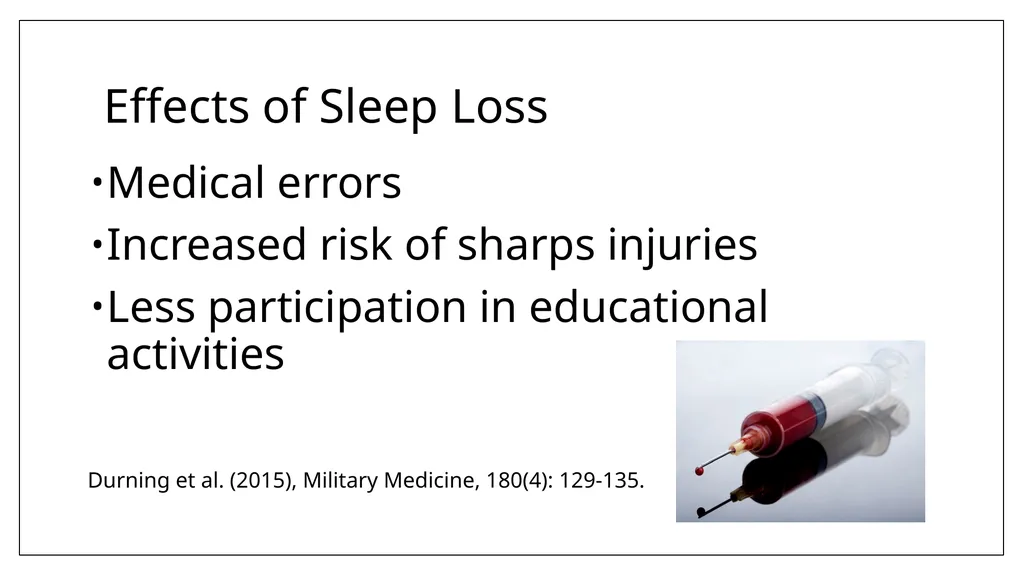
Effects of Sleep Loss Medical errors
Increased risk of sharps injuries
Less participation in educational activities
Durning et al. (2015), Military Medicine, 180(4): 129-135.<br>
05
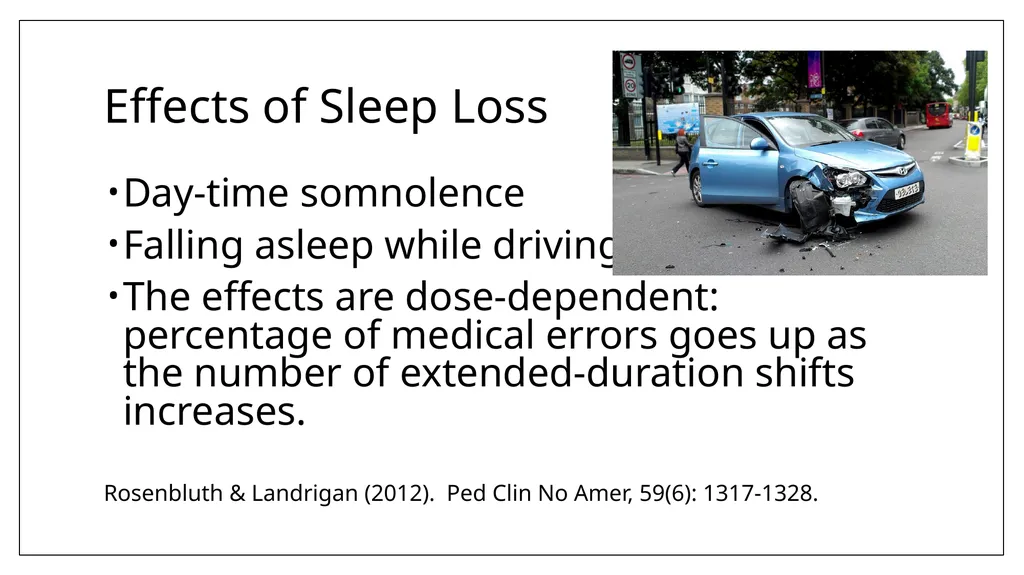
Effects of Sleep Loss Day-time somnolence
Falling asleep while driving
The effects are dose-dependent: percentage of medical errors goes up as the number of extended-duration shifts increases.
Rosenbluth & Landrigan (2012). Ped Clin No Amer, 59(6): 1317-1328.<br>
06
In addition, there are dose-dependent changes in: Attention lapses
Depressed mood
Reduced Cognitive Performance
Olson, Drage & Auger (2009) CHEST, 136(5)<br>
07
Neuropsychological Effects of Sleep Loss Impaired episodic memory encoding
Decision making
Divergent thinking
fMRI shows decreased activation in prefrontal cortex.
Durning et al. (2015). Military Medicine, 180(4): 129-135<br>
08
Complex vs. Simple Tasks Degradations in performance are seen in both and are dose-dependent.
Impact of sleep deprivation on complex tasks is less severe than on simple tasks.
Wickens et al. (2015). Human Factors, 57(6): 930-946.<br>
09
Other effects On the tail end of a long-call shift, residents reported less empathy toward their patients, which seems to have led to less patient-centered communication.
Passalacqua & Segrin (2012). Health Communication, 27(5).
Sleep-deprived pediatric residents were less patient –centered in their communication
Philibert et al. (2013). Annu. Rev. Med., 64: 467-83.<br>
10
Sleep Loss and Mood Sleep loss co-occurs frequently with mood disorders.
Sleep loss disrupts emotion regulation:
Hyper-reaction in the amygdala to negative emotional stimuli has been observed with sleep loss.
Decreased functional connectivity with the prefrontal cortex also observed in sleep deprivation.
Thus, hyper-limbic reactivity combined with failure of top-down inhibition by the frontal lobe can lead to irritability and affective instability.
van der Helm & Walker (2009)<br>
11
Sleep Loss and Memory Sleep loss impairs next-day learning.
van der Helm & Walker (2009)
Sleep before learning is necessary for encoding of certain memories
Sleep after learning is necessary for consolidation of certain memories
Walker (2008)<br>
12
Sleep Loss and Emotional Memory Whereas emotional arousal has enhancing effects on memory formation, sleep loss affects this in unique ways:
Most profound impact is on positive emotional stimuli
A somewhat lesser impact on emotionally neutral stimuli
Negative emotional memories are more resistant to the effects of sleep loss
Sleep deprivation reduces memories associated with positive emotions and leaves those tinged with negative emotions largely untouched.<br>
13
Lack of sleep primes us for selective inclusion of negative experiences in our awareness
So, we wake up tired and grumpy!<br>
14
What do they mean by sleep deprivation? Restriction of sleep to 6 hours per night (or two hours less than normal) for just under 2 weeks.
Olson, Drage & Auger (2009). CHEST, 136(5).<br>
15
Signs of Sleepiness Irritability, moodiness
Disinhibition
Impaired memory retrieval
Inflexible thinking
Impaired planning skills
Intrusive sleepiness<br>
16
How good are we at judging our own sleepiness? Not very!
Even as performance measures decline, subjects’ ratings of sleepiness suggest that they believe they are acclimating to sleep loss.
Individuals may notice subjective feelings of sleepiness early on, but lose awareness of the progression of their fatigue and performance deficits as time goes on.
Olson, Drage & Auger (2009). CHEST, 136(5).<br>
17
So….. Ask your colleagues to help you monitor your fatigue.<br>
18
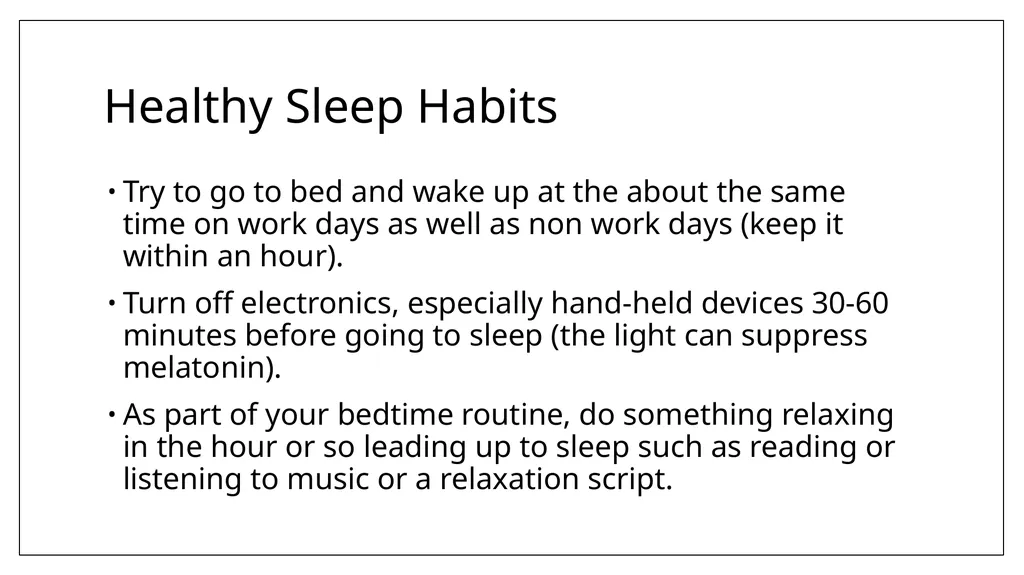
Healthy Sleep Habits Try to go to bed and wake up at the about the same time on work days as well as non work days (keep it within an hour).
Turn off electronics, especially hand-held devices 30-60 minutes before going to sleep (the light can suppress melatonin).
As part of your bedtime routine, do something relaxing in the hour or so leading up to sleep such as reading or listening to music or a relaxation script.<br>
19
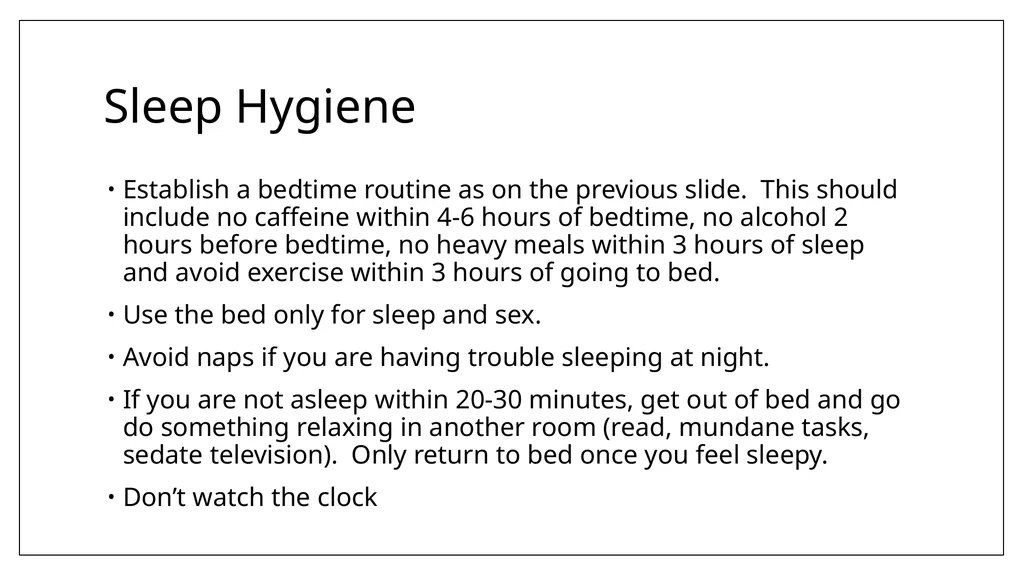
Sleep Hygiene Establish a bedtime routine as on the previous slide. This should include no caffeine within 4-6 hours of bedtime, no alcohol 2 hours before bedtime, no heavy meals within 3 hours of sleep and avoid exercise within 3 hours of going to bed.
Use the bed only for sleep and sex.
Avoid naps if you are having trouble sleeping at night.
If you are not asleep within 20-30 minutes, get out of bed and go do something relaxing in another room (read, mundane tasks, sedate television). Only return to bed once you feel sleepy.
Don’t watch the clock<br>
20
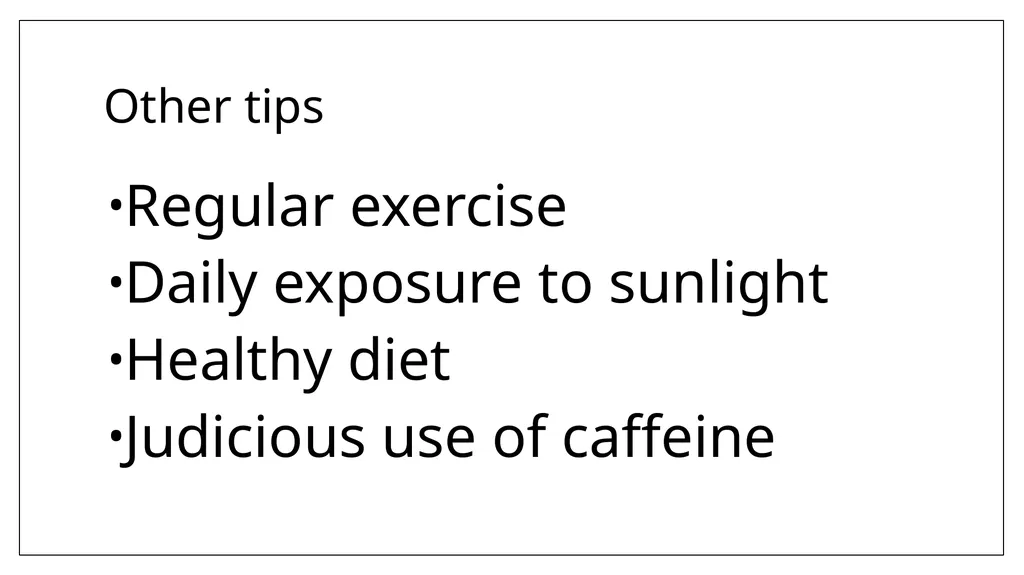
Other tips Regular exercise
Daily exposure to sunlight
Healthy diet
Judicious use of caffeine<br>
21
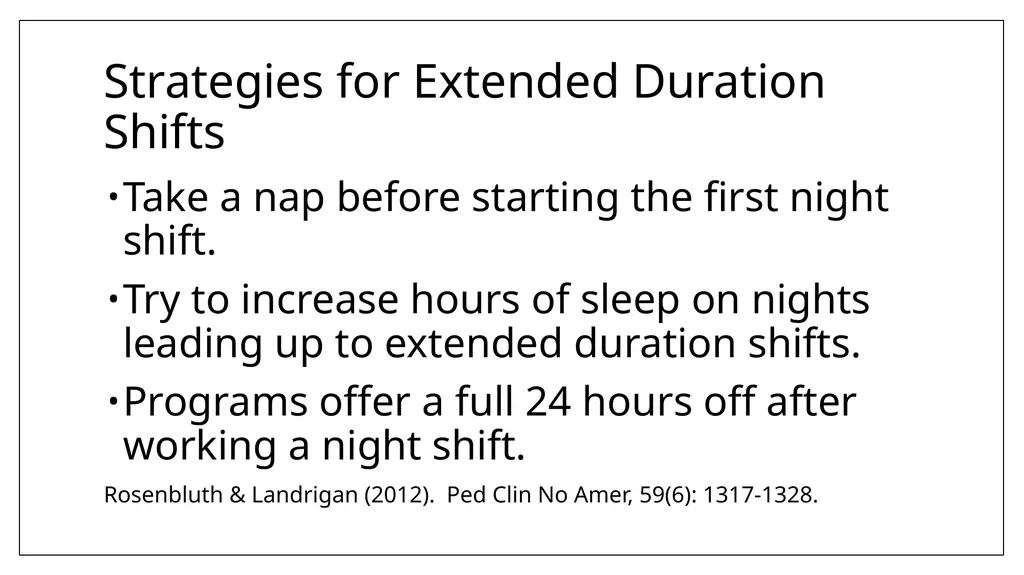
Strategies for Extended Duration Shifts Take a nap before starting the first night shift.
Try to increase hours of sleep on nights leading up to extended duration shifts.
Programs offer a full 24 hours off after working a night shift.
Rosenbluth & Landrigan (2012). Ped Clin No Amer, 59(6): 1317-1328.<br>
22
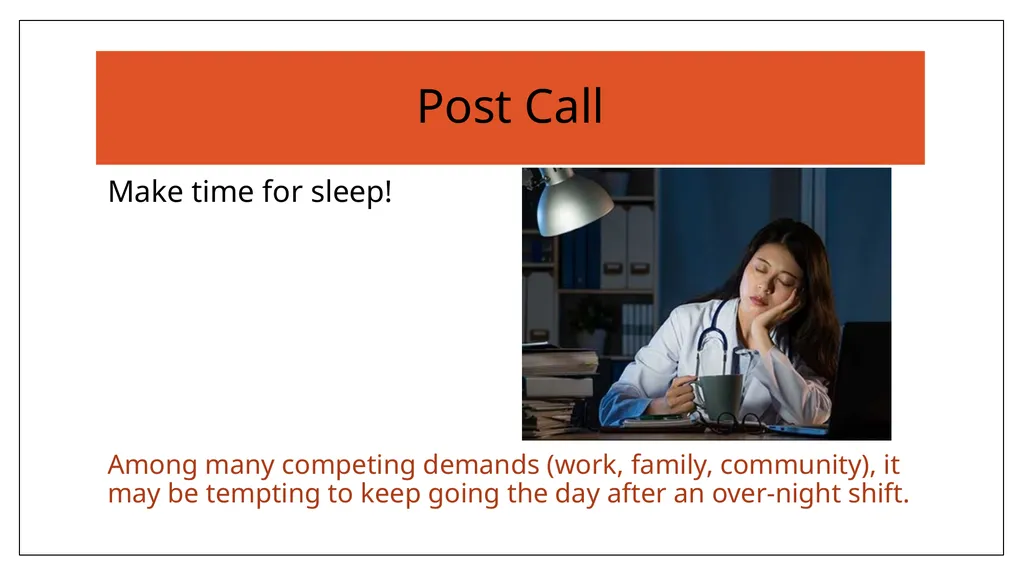
Post Call Make time for sleep!
Among many competing demands (work, family, community), it may be tempting to keep going the day after an over-night shift.<br>
23
Steps to take if you recognize fatigue: Contact your Program Director or program leadership so that appropriate steps can be taken including:
Provide coverage so you can sleep. Each MCWAH program has a contingency plan for continuity of care when housestaff is unable to perform their duties due to fatigue.
Arrange safe transportation. All programs will reimburse for rides home if the resident is too tired.
Identify available sleep rooms in the hospital.<br>
24
Behavioral Health Services for Residents Intake Coordinator: Carolyn Bischel, MS, LPC:
414-955-8933
cbischel@mcw.edu
Messages are confidential
We maintain confidentiality from moment the phone call is made
Messages returned within 1 work day
Messages left after hours returned next day
For emergencies, call 414-955-8900 and ask to have the clinician on call paged.<br>