
>>Slide 1 IL-NET National Training and Technical
PC
Published · 36 slides · 0 views

1 / 1
Description
Slide 1 IL-NET National Training and Technical Assistance Center for Independent Living ILRUs IL-NET National Training and Technical Assistance Center for Independent Living 1 Slide 2 Creating an Effective CIL, SILC DSE Relationship
Related Topics
Share
Embed code
Download this presentation From Below
">>Slide 1 IL-NET National Training and Technical" is the property of its rightful owner. Permission is granted to download and print the materials on this website for personal, non-commercial use only, and to display it on your personal computer provided you do not modify the materials and that you retain all copyright notices contained in the materials. By downloading content from our website, you accept the terms of this agreement.
Presentation Transcript
01
>>Slide 1 IL-NET National
Training and Technical Assistance Center for Independent Living ILRU’s IL-NET National Training and Technical Assistance Center for Independent Living 1<br>
Training and Technical Assistance Center for Independent Living ILRU’s IL-NET National Training and Technical Assistance Center for Independent Living 1<br>
02
>> Slide 2
Creating an Effective
CIL, SILC & DSE Relationship
Moderator: Paula McElwee
Panelists: Erica McFadden
Ed Ahern
Kimball Gray
Jennifer Martin
Peter Nye
October 19, 2022 2<br>
03
>>Slide 3
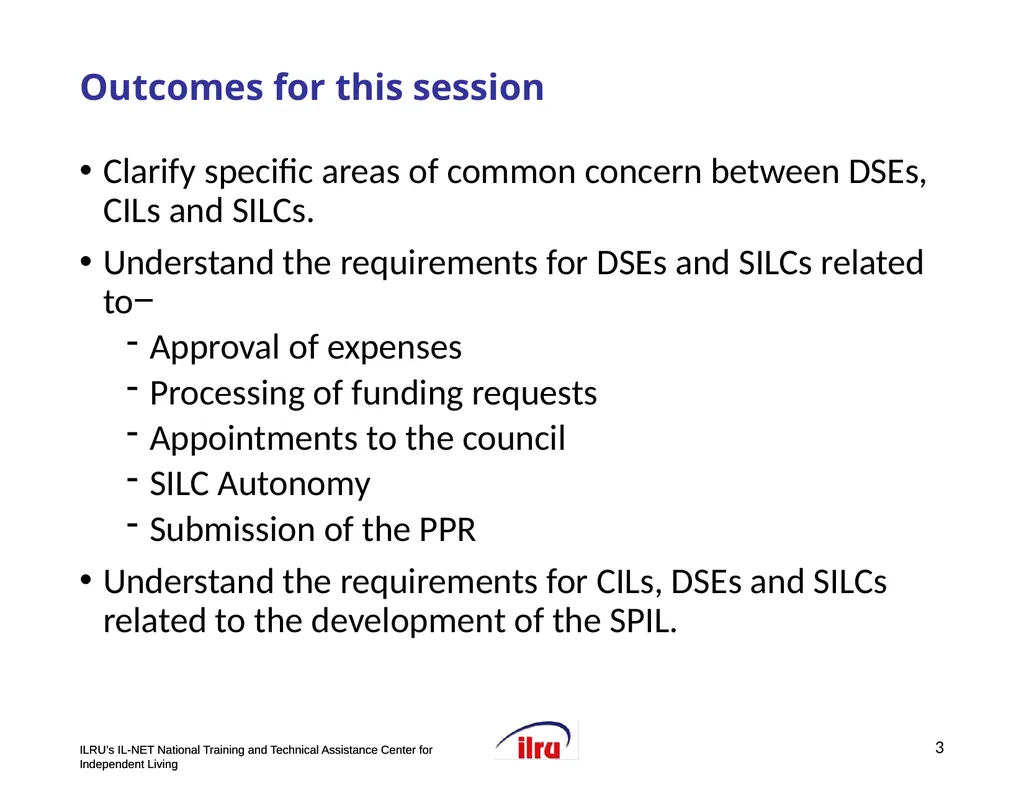
Outcomes for this session Clarify specific areas of common concern between DSEs, CILs and SILCs.
Understand the requirements for DSEs and SILCs related to‒
Approval of expenses
Processing of funding requests
Appointments to the council
SILC Autonomy
Submission of the PPR
Understand the requirements for CILs, DSEs and SILCs related to the development of the SPIL. 3<br>
Understand the requirements for DSEs and SILCs related to‒
Approval of expenses
Processing of funding requests
Appointments to the council
SILC Autonomy
Submission of the PPR
Understand the requirements for CILs, DSEs and SILCs related to the development of the SPIL. 3<br>
04
>>Slide 4
We expect lots of questions. Help us answer you… Ask questions by typing your question using the Q&A tab, not the chat. Use the chat for comments.
We have developed this presentation by addressing the many questions we received from both SILCs and DSEs in their peer calls.
Please focus your questions on what is being presented. Jumping ahead won’t be very efficient.
Questions will be answered at the end of the presentation. Be patient please. 4<br>
We have developed this presentation by addressing the many questions we received from both SILCs and DSEs in their peer calls.
Please focus your questions on what is being presented. Jumping ahead won’t be very efficient.
Questions will be answered at the end of the presentation. Be patient please. 4<br>
05
>> Slide 5
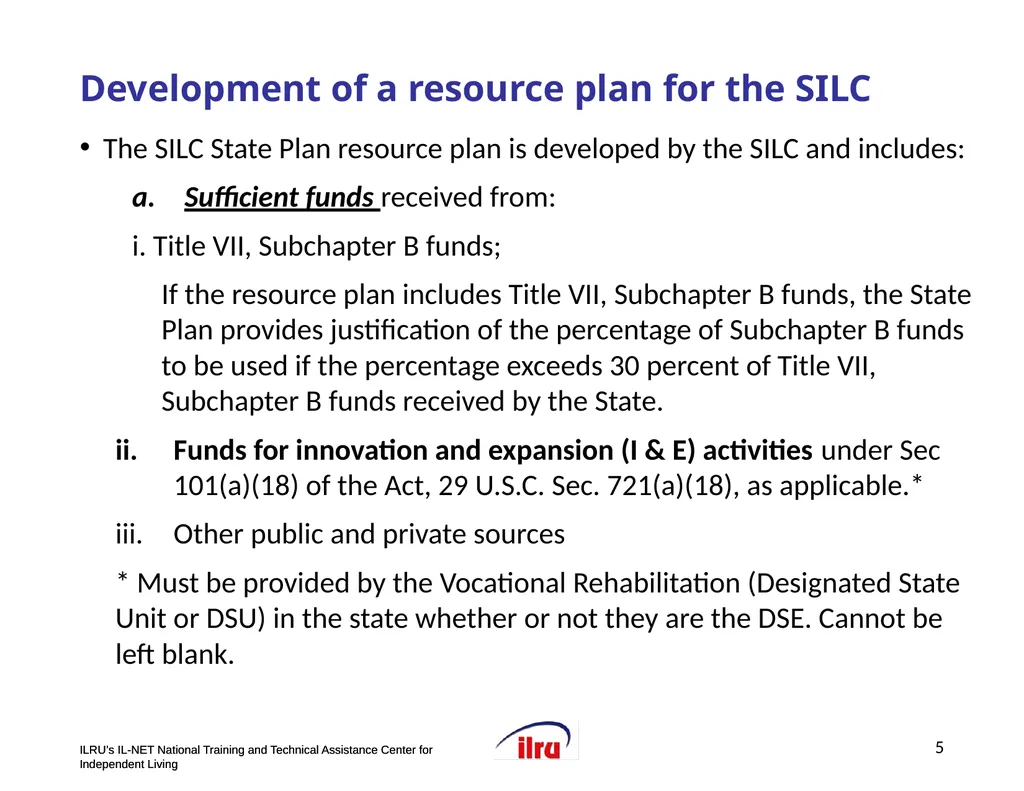
Development of a resource plan for the SILC The SILC State Plan resource plan is developed by the SILC and includes:
Sufficient funds received from:
i. Title VII, Subchapter B funds;
If the resource plan includes Title VII, Subchapter B funds, the State Plan provides justification of the percentage of Subchapter B funds to be used if the percentage exceeds 30 percent of Title VII, Subchapter B funds received by the State.
Funds for innovation and expansion (I & E) activities under Sec 101(a)(18) of the Act, 29 U.S.C. Sec. 721(a)(18), as applicable.*
Other public and private sources
* Must be provided by the Vocational Rehabilitation (Designated State Unit or DSU) in the state whether or not they are the DSE. Cannot be left blank. 5<br>
Sufficient funds received from:
i. Title VII, Subchapter B funds;
If the resource plan includes Title VII, Subchapter B funds, the State Plan provides justification of the percentage of Subchapter B funds to be used if the percentage exceeds 30 percent of Title VII, Subchapter B funds received by the State.
Funds for innovation and expansion (I & E) activities under Sec 101(a)(18) of the Act, 29 U.S.C. Sec. 721(a)(18), as applicable.*
Other public and private sources
* Must be provided by the Vocational Rehabilitation (Designated State Unit or DSU) in the state whether or not they are the DSE. Cannot be left blank. 5<br>
06
>>Slide 6
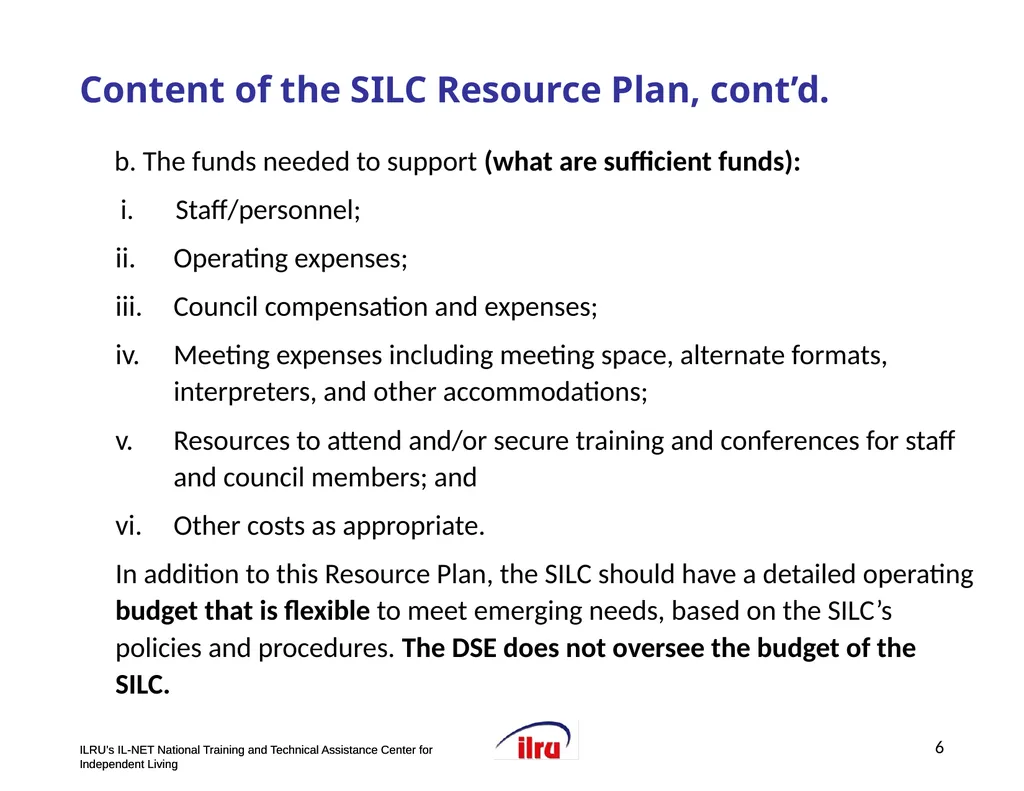
Content of the SILC Resource Plan, cont’d. b. The funds needed to support (what are sufficient funds):
i. Staff/personnel;
Operating expenses;
Council compensation and expenses;
Meeting expenses including meeting space, alternate formats, interpreters, and other accommodations;
Resources to attend and/or secure training and conferences for staff and council members; and
Other costs as appropriate.
In addition to this Resource Plan, the SILC should have a detailed operating budget that is flexible to meet emerging needs, based on the SILC’s policies and procedures. The DSE does not oversee the budget of the SILC. 6<br>
i. Staff/personnel;
Operating expenses;
Council compensation and expenses;
Meeting expenses including meeting space, alternate formats, interpreters, and other accommodations;
Resources to attend and/or secure training and conferences for staff and council members; and
Other costs as appropriate.
In addition to this Resource Plan, the SILC should have a detailed operating budget that is flexible to meet emerging needs, based on the SILC’s policies and procedures. The DSE does not oversee the budget of the SILC. 6<br>
07
>>Slide 7
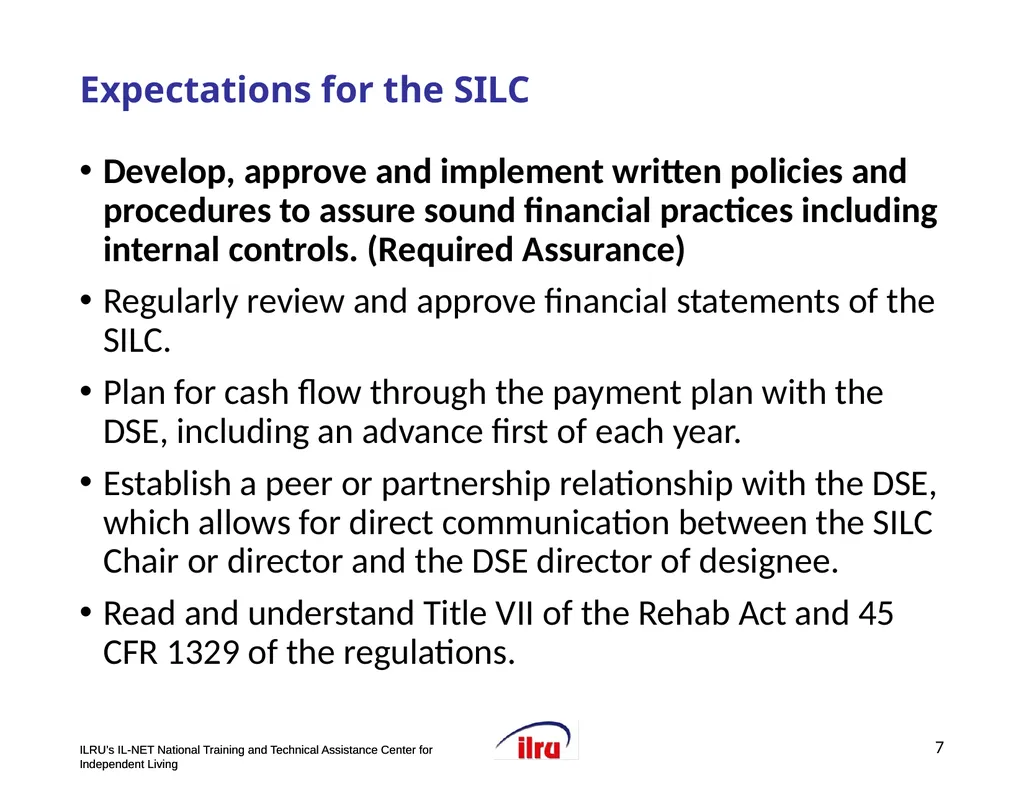
Expectations for the SILC Develop, approve and implement written policies and procedures to assure sound financial practices including internal controls. (Required Assurance)
Regularly review and approve financial statements of the SILC.
Plan for cash flow through the payment plan with the DSE, including an advance first of each year.
Establish a peer or partnership relationship with the DSE, which allows for direct communication between the SILC Chair or director and the DSE director of designee.
Read and understand Title VII of the Rehab Act and 45 CFR 1329 of the regulations. 7<br>
Regularly review and approve financial statements of the SILC.
Plan for cash flow through the payment plan with the DSE, including an advance first of each year.
Establish a peer or partnership relationship with the DSE, which allows for direct communication between the SILC Chair or director and the DSE director of designee.
Read and understand Title VII of the Rehab Act and 45 CFR 1329 of the regulations. 7<br>
08
>>Slide 8
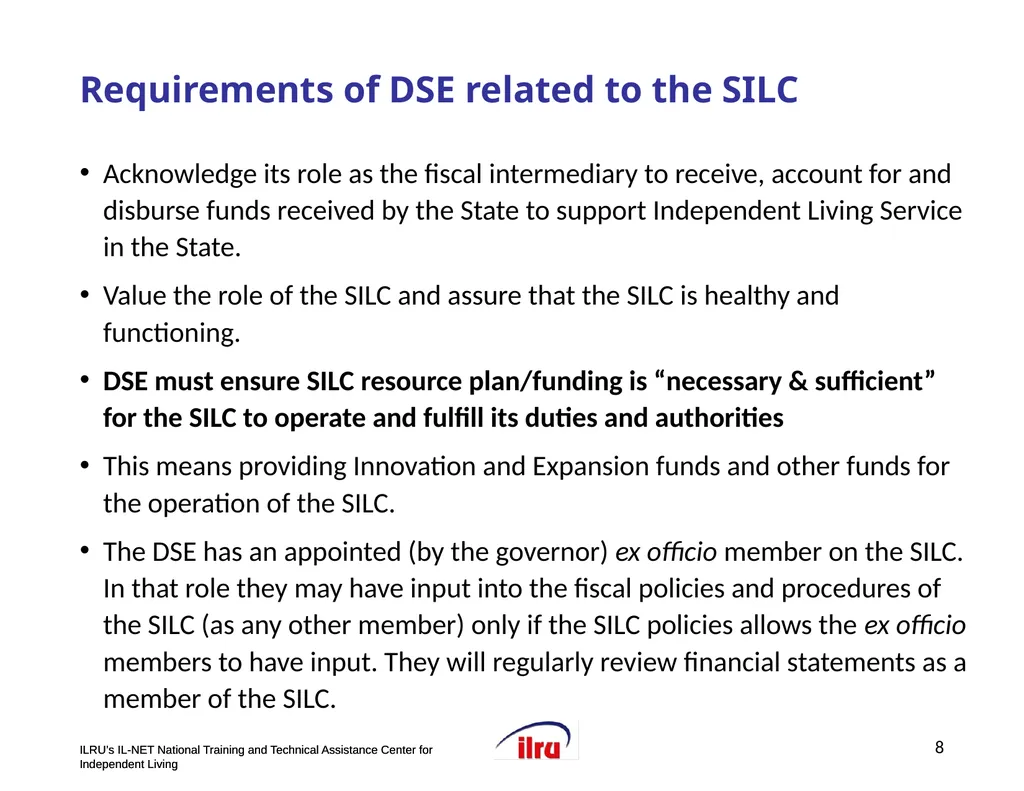
Requirements of DSE related to the SILC Acknowledge its role as the fiscal intermediary to receive, account for and disburse funds received by the State to support Independent Living Service in the State.
Value the role of the SILC and assure that the SILC is healthy and functioning.
DSE must ensure SILC resource plan/funding is “necessary & sufficient” for the SILC to operate and fulfill its duties and authorities
This means providing Innovation and Expansion funds and other funds for the operation of the SILC.
The DSE has an appointed (by the governor) ex officio member on the SILC. In that role they may have input into the fiscal policies and procedures of the SILC (as any other member) only if the SILC policies allows the ex officio members to have input. They will regularly review financial statements as a member of the SILC. 8<br>
Value the role of the SILC and assure that the SILC is healthy and functioning.
DSE must ensure SILC resource plan/funding is “necessary & sufficient” for the SILC to operate and fulfill its duties and authorities
This means providing Innovation and Expansion funds and other funds for the operation of the SILC.
The DSE has an appointed (by the governor) ex officio member on the SILC. In that role they may have input into the fiscal policies and procedures of the SILC (as any other member) only if the SILC policies allows the ex officio members to have input. They will regularly review financial statements as a member of the SILC. 8<br>
09
>>Slide 9
Designated State Entity Assurances re: SILC The DSE must make timely and prompt payments to the SILCs and to Part B funded CILs:
When the reimbursement method is used, the DSE must make a payment within 30 calendar days after receipt of the billing, unless the agency or pass-through entity reasonably believes the request to be improper;
When necessary, the DSE will advance payments to Part B funded SILCs and CILs to cover its estimated disbursement needs for an initial period generally geared to the mutually agreed upon disbursing cycle; 9<br>
When the reimbursement method is used, the DSE must make a payment within 30 calendar days after receipt of the billing, unless the agency or pass-through entity reasonably believes the request to be improper;
When necessary, the DSE will advance payments to Part B funded SILCs and CILs to cover its estimated disbursement needs for an initial period generally geared to the mutually agreed upon disbursing cycle; 9<br>
10
>>Slide 10
Designated State Entity Assurances, cont’d. 2 The DSE must make timely and prompt payments to SILCs and Part B funded CILs (cont.):
The payment plan should include advance payments to maintain cash flow.
The DSE will accept requests for advance payments and reimbursements at least monthly when electronic fund transfers are not used, and as often as necessary when electronic transfers are used, in accordance with the provisions of the Electronic Fund Transfer Act (15 U.S.C. 1693-1693r); 10<br>
The payment plan should include advance payments to maintain cash flow.
The DSE will accept requests for advance payments and reimbursements at least monthly when electronic fund transfers are not used, and as often as necessary when electronic transfers are used, in accordance with the provisions of the Electronic Fund Transfer Act (15 U.S.C. 1693-1693r); 10<br>
11
>>Slide 11
Barriers for prompt payment DSE determination that the expense is not included in the resource plan.
Notes: The SILC can adjust its budget as part of its regular operations. It is NOT the DSE’s responsibility to oversee the details of the budget.
The DSE’s invoice and payment process is cumbersome.
Note: The SILC receives pass through funds which should not require such complicated processes.
DSE classification of the SILC. The SILC is a sub-recipient of federal funds, not contractor or subcontractor.
Note: This applies specifically to all funds included in the SILC Resource Plan. 11<br>
Notes: The SILC can adjust its budget as part of its regular operations. It is NOT the DSE’s responsibility to oversee the details of the budget.
The DSE’s invoice and payment process is cumbersome.
Note: The SILC receives pass through funds which should not require such complicated processes.
DSE classification of the SILC. The SILC is a sub-recipient of federal funds, not contractor or subcontractor.
Note: This applies specifically to all funds included in the SILC Resource Plan. 11<br>
12
>> Slide 12
Disallowing SILC Expenses Does DSE have authority to disallow SILC expenses?
No!
Does the DSE “approve” the SILC budget? Expenses?
No!
How does this affect SILC autonomy required by law?
It is the SILC responsibility to know what costs are allowable and to oversee its operations.
The DSE agrees to the SILC fiscal decisions in the SPIL, not after the fact. 12<br>
No!
Does the DSE “approve” the SILC budget? Expenses?
No!
How does this affect SILC autonomy required by law?
It is the SILC responsibility to know what costs are allowable and to oversee its operations.
The DSE agrees to the SILC fiscal decisions in the SPIL, not after the fact. 12<br>
13
>> Slide 13
More from DSE Assurances The DSE will not interfere with the business or operations of the SILC that include but are not limited to:
a. Expenditure of federal funds, b. Meeting schedules and agendas, c. SILC board business, d. Voting actions of the SILC Board, e. Personnel actions, f. Allowable travel, g. Trainings
*Did you know the DSE Assurances are included on the NOA (Notice of Award) you receive for Part B money? They are also found here: https://tinyurl.com/3sbbd2u7 13<br>
a. Expenditure of federal funds, b. Meeting schedules and agendas, c. SILC board business, d. Voting actions of the SILC Board, e. Personnel actions, f. Allowable travel, g. Trainings
*Did you know the DSE Assurances are included on the NOA (Notice of Award) you receive for Part B money? They are also found here: https://tinyurl.com/3sbbd2u7 13<br>
14
>>Slide 14
Questions and Answers Please type your questions in the Q & A box. We will answer all the questions at the end of the presentation.
Please don’t use the chat for questions, but feel free to put any comments there for our later review. 14<br>
Please don’t use the chat for questions, but feel free to put any comments there for our later review. 14<br>
15
>>Slide 15
When the SILC utilizes DSE staff The DSE and SILC need to agree on how the person is paid/how their time is tracked and the SILC billed for their time.
The SILC selects and supervises the staff person’s work for the SILC and evaluates their performance.
The SILC cannot be established as an entity within a state agency in accordance with 45 CFR 1329.14(b).
So if the SILC staff is employed by the DSE, there must be a separation of duties related to the SILC itself, and full autonomy on the part of the SILC to select and supervise those duties. 15<br>
The SILC selects and supervises the staff person’s work for the SILC and evaluates their performance.
The SILC cannot be established as an entity within a state agency in accordance with 45 CFR 1329.14(b).
So if the SILC staff is employed by the DSE, there must be a separation of duties related to the SILC itself, and full autonomy on the part of the SILC to select and supervise those duties. 15<br>
16
>> Slide 16
SILC Autonomy What are some of the ways that the SILC assures its Autonomy?
Selects and supervises own staff (even if assigned/paid by DSE)
Develops and manages own budget and expenses
SILC submits recommendations for appointment to Governor or appointing authority
Fulfills responsibilities in the Rehab Act
Complies with laws and regulations 16<br>
Selects and supervises own staff (even if assigned/paid by DSE)
Develops and manages own budget and expenses
SILC submits recommendations for appointment to Governor or appointing authority
Fulfills responsibilities in the Rehab Act
Complies with laws and regulations 16<br>
17
>> Slide 17
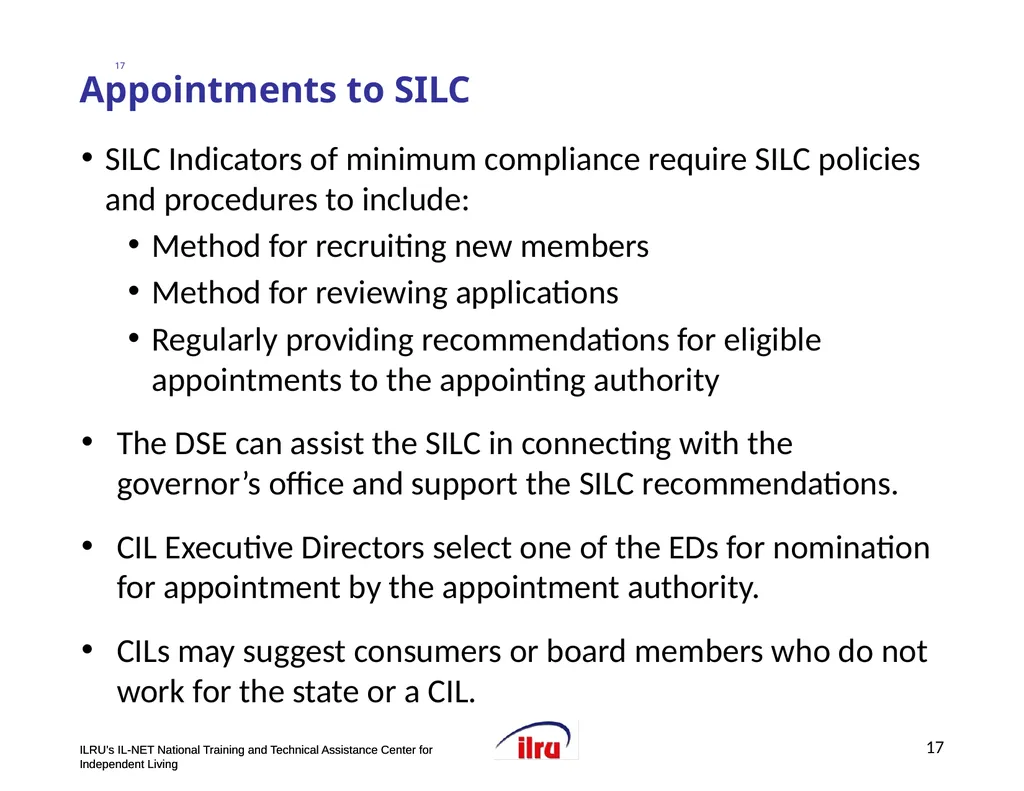
Appointments to SILC SILC Indicators of minimum compliance require SILC policies and procedures to include:
Method for recruiting new members
Method for reviewing applications
Regularly providing recommendations for eligible appointments to the appointing authority
The DSE can assist the SILC in connecting with the governor’s office and support the SILC recommendations.
CIL Executive Directors select one of the EDs for nomination for appointment by the appointment authority.
CILs may suggest consumers or board members who do not work for the state or a CIL. 17<br>
Method for recruiting new members
Method for reviewing applications
Regularly providing recommendations for eligible appointments to the appointing authority
The DSE can assist the SILC in connecting with the governor’s office and support the SILC recommendations.
CIL Executive Directors select one of the EDs for nomination for appointment by the appointment authority.
CILs may suggest consumers or board members who do not work for the state or a CIL. 17<br>
18
>>Slide 18
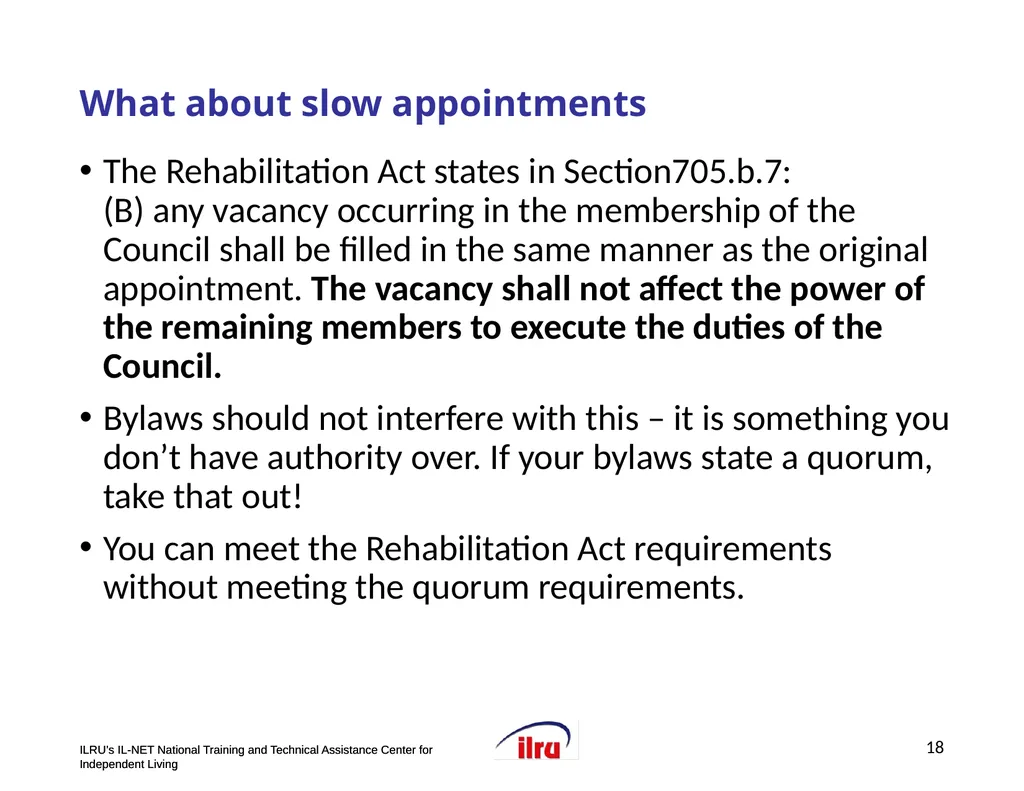
What about slow appointments The Rehabilitation Act states in Section705.b.7:
(B) any vacancy occurring in the membership of the Council shall be filled in the same manner as the original appointment. The vacancy shall not affect the power of the remaining members to execute the duties of the Council.
Bylaws should not interfere with this – it is something you don’t have authority over. If your bylaws state a quorum, take that out!
You can meet the Rehabilitation Act requirements without meeting the quorum requirements. 18<br>
Bylaws should not interfere with this – it is something you don’t have authority over. If your bylaws state a quorum, take that out!
You can meet the Rehabilitation Act requirements without meeting the quorum requirements. 18<br>
19
>> Slide 19
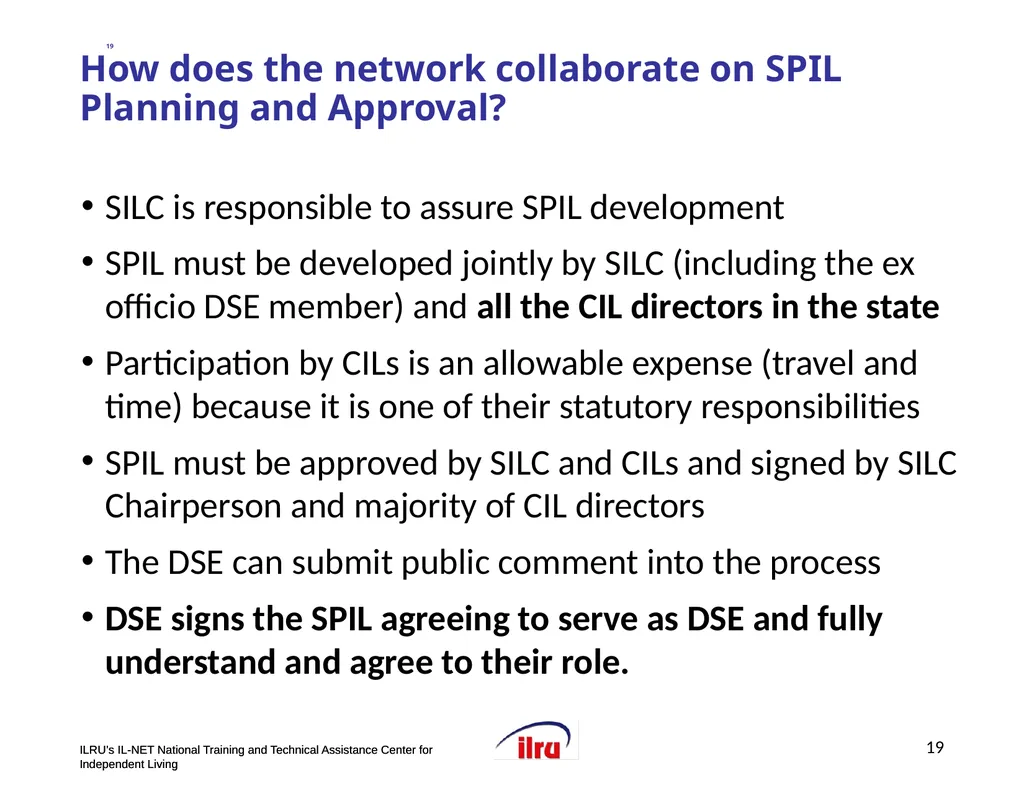
How does the network collaborate on SPIL Planning and Approval? SILC is responsible to assure SPIL development
SPIL must be developed jointly by SILC (including the ex officio DSE member) and all the CIL directors in the state
Participation by CILs is an allowable expense (travel and time) because it is one of their statutory responsibilities
SPIL must be approved by SILC and CILs and signed by SILC Chairperson and majority of CIL directors
The DSE can submit public comment into the process
DSE signs the SPIL agreeing to serve as DSE and fully understand and agree to their role. 19<br>
SPIL must be developed jointly by SILC (including the ex officio DSE member) and all the CIL directors in the state
Participation by CILs is an allowable expense (travel and time) because it is one of their statutory responsibilities
SPIL must be approved by SILC and CILs and signed by SILC Chairperson and majority of CIL directors
The DSE can submit public comment into the process
DSE signs the SPIL agreeing to serve as DSE and fully understand and agree to their role. 19<br>
20
>>Slide 20
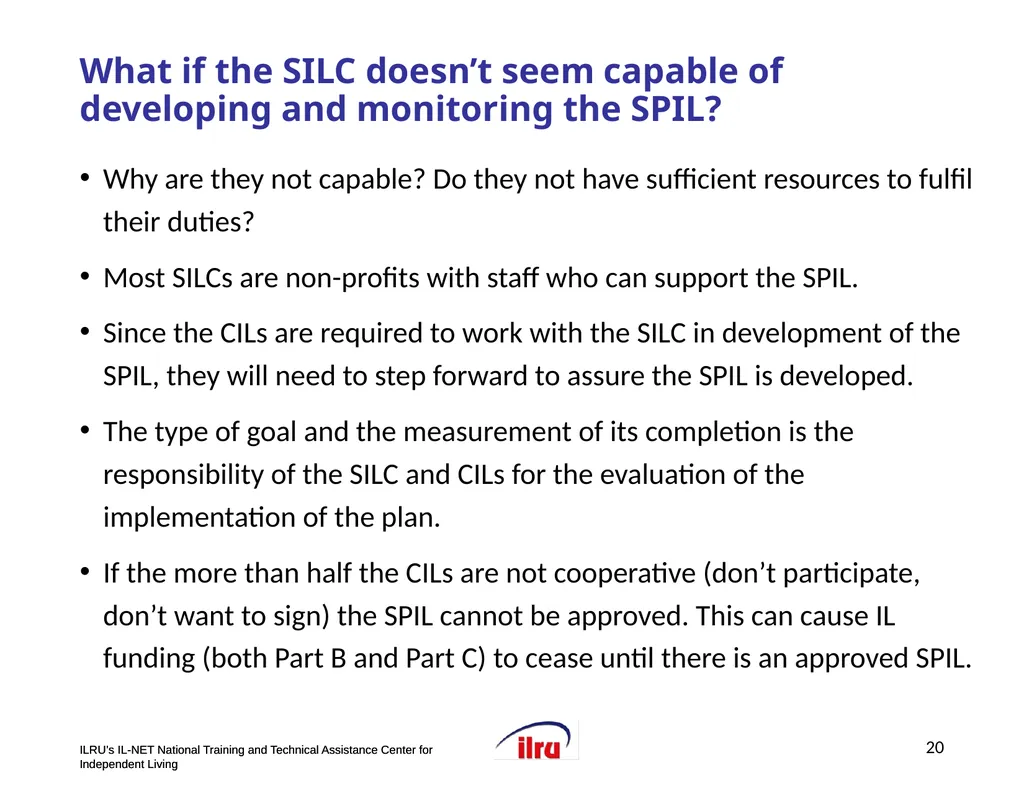
What if the SILC doesn’t seem capable of developing and monitoring the SPIL? Why are they not capable? Do they not have sufficient resources to fulfil their duties?
Most SILCs are non-profits with staff who can support the SPIL.
Since the CILs are required to work with the SILC in development of the SPIL, they will need to step forward to assure the SPIL is developed.
The type of goal and the measurement of its completion is the responsibility of the SILC and CILs for the evaluation of the implementation of the plan.
If the more than half the CILs are not cooperative (don’t participate, don’t want to sign) the SPIL cannot be approved. This can cause IL funding (both Part B and Part C) to cease until there is an approved SPIL. 20<br>
Most SILCs are non-profits with staff who can support the SPIL.
Since the CILs are required to work with the SILC in development of the SPIL, they will need to step forward to assure the SPIL is developed.
The type of goal and the measurement of its completion is the responsibility of the SILC and CILs for the evaluation of the implementation of the plan.
If the more than half the CILs are not cooperative (don’t participate, don’t want to sign) the SPIL cannot be approved. This can cause IL funding (both Part B and Part C) to cease until there is an approved SPIL. 20<br>
21
>>Slide 21
Questions and Answers Please type your questions in the Q & A box. We will answer all the questions at the end of the presentation.
Please don’t use the chat for questions, but feel free to put any comments there for our later review. 21<br>
Please don’t use the chat for questions, but feel free to put any comments there for our later review. 21<br>
22
>>Slide 22
The SILC receives public input into the development of the SPIL including public hearings during development of the draft. In accordance with 45 CFR 1329.17(f) ensuring:
a. Adequate documentation of the State Plan development process, including but not limited to, a written process setting forth how input will be gathered from the state’s centers for independent living and individuals with disabilities throughout the state, and the process for how the information collected is considered.
b. All meetings regarding State Plan development and review are open to the public and provides advance notice of such meetings in accordance with existing State and federal laws and 45 CFR 1329.17(f)(2)(i)-(ii); 22<br>
23
>>Slide 23
Public input, cont’d. c. Meetings seeking public input regarding the State Plan provides advance notice of such meetings in accordance with existing State and federal laws, and 45 CFR 1329.17(f)(2)(i);
d. Public meeting locations, where public input is being taken, are accessible to all people with disabilities, including, but not limited to:
i. proximity to public transportation,
ii. physical accessibility, and
iii. effective communication and accommodations that include auxiliary aids and services, necessary to make the meeting accessible to all people with disabilities.
e. Materials available electronically must be 508 compliant and, upon request, available in alternative and accessible format including other commonly spoken
languages. 23<br>
24
>>Slide 24
Section 3.2 of the SPIL CILs receiving 722 Part C funds will continue to receive those funds and funds cannot be redistributed through the SPIL. They are direct grants to those community programs.
CILs in designated 723 states may redistribute Part C funds with the agreement of a majority of the CILs.
Service areas may be adjusted through the SPIL, with the agreement of at least half the CILs. The PO must be notified as the internal procedures for this need to be updated.
Note: you just received detailed information regarding SPIL amendments, what is technical and what is substantive, regarding this or any other section. 24<br>
CILs in designated 723 states may redistribute Part C funds with the agreement of a majority of the CILs.
Service areas may be adjusted through the SPIL, with the agreement of at least half the CILs. The PO must be notified as the internal procedures for this need to be updated.
Note: you just received detailed information regarding SPIL amendments, what is technical and what is substantive, regarding this or any other section. 24<br>
25
>>Slide 25
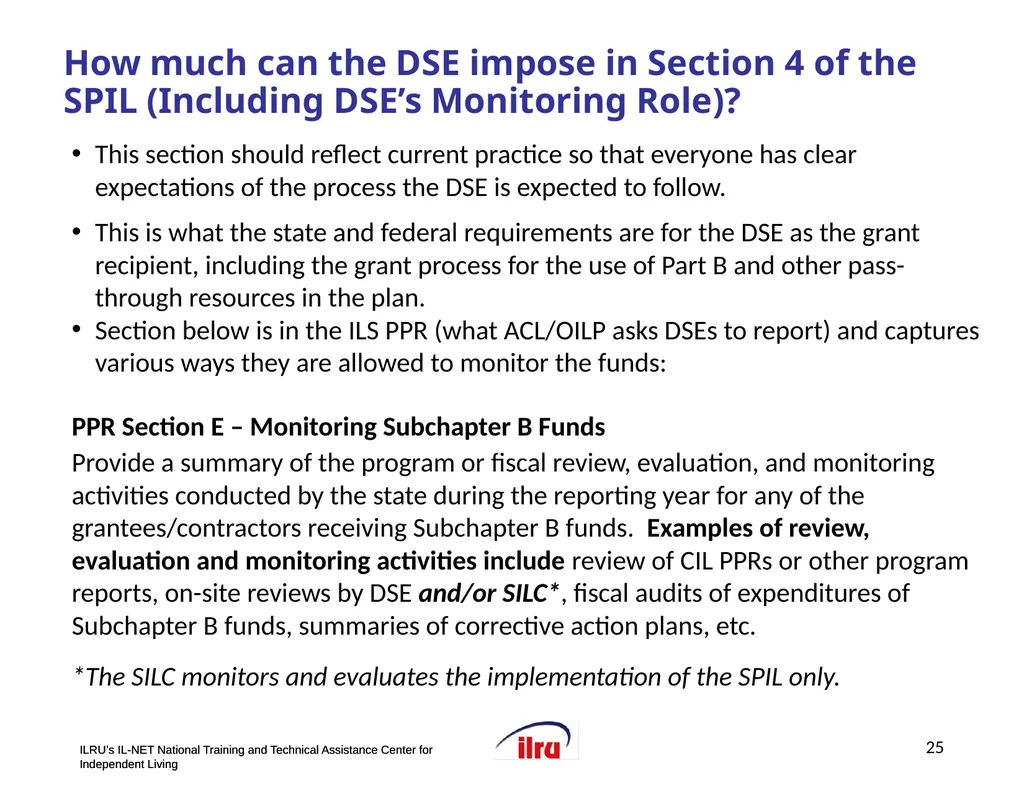
How much can the DSE impose in Section 4 of the SPIL (Including DSE’s Monitoring Role)? This section should reflect current practice so that everyone has clear expectations of the process the DSE is expected to follow.
This is what the state and federal requirements are for the DSE as the grant recipient, including the grant process for the use of Part B and other pass-through resources in the plan.
Section below is in the ILS PPR (what ACL/OILP asks DSEs to report) and captures various ways they are allowed to monitor the funds:
PPR Section E – Monitoring Subchapter B Funds
Provide a summary of the program or fiscal review, evaluation, and monitoring activities conducted by the state during the reporting year for any of the grantees/contractors receiving Subchapter B funds. Examples of review, evaluation and monitoring activities include review of CIL PPRs or other program reports, on-site reviews by DSE and/or SILC*, fiscal audits of expenditures of Subchapter B funds, summaries of corrective action plans, etc.
*The SILC monitors and evaluates the implementation of the SPIL only. 25<br>
This is what the state and federal requirements are for the DSE as the grant recipient, including the grant process for the use of Part B and other pass-through resources in the plan.
Section below is in the ILS PPR (what ACL/OILP asks DSEs to report) and captures various ways they are allowed to monitor the funds:
PPR Section E – Monitoring Subchapter B Funds
Provide a summary of the program or fiscal review, evaluation, and monitoring activities conducted by the state during the reporting year for any of the grantees/contractors receiving Subchapter B funds. Examples of review, evaluation and monitoring activities include review of CIL PPRs or other program reports, on-site reviews by DSE and/or SILC*, fiscal audits of expenditures of Subchapter B funds, summaries of corrective action plans, etc.
*The SILC monitors and evaluates the implementation of the SPIL only. 25<br>
26
>>Slide 26
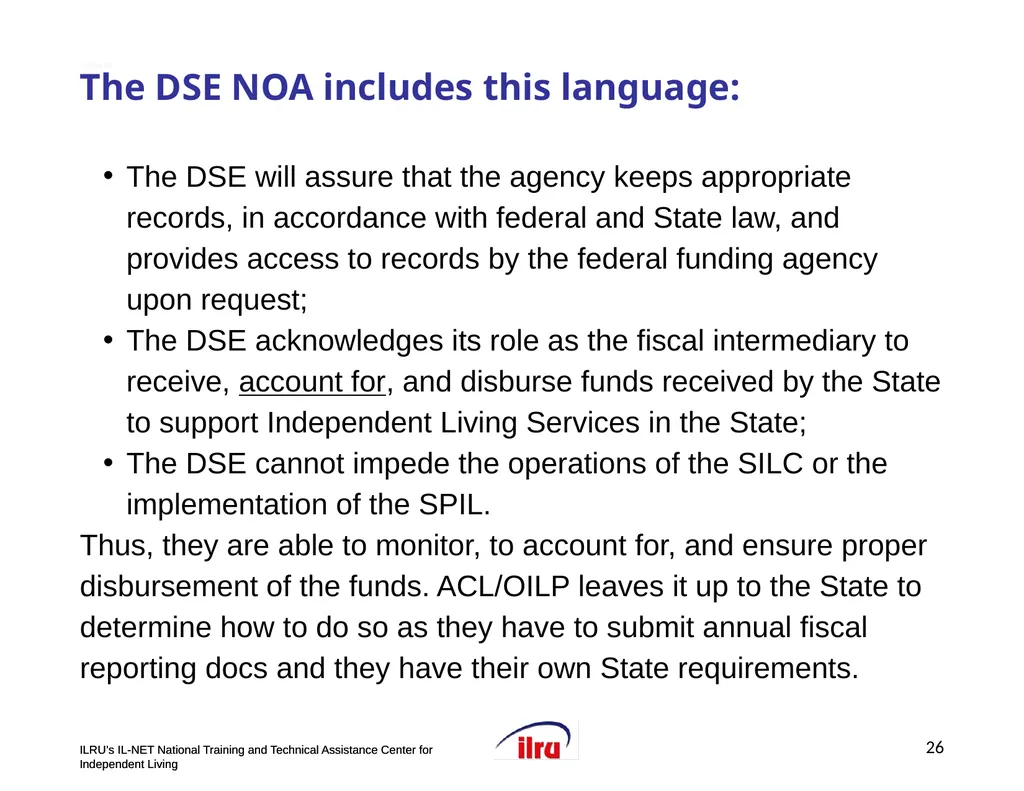
The DSE NOA includes this language: The DSE will assure that the agency keeps appropriate records, in accordance with federal and State law, and provides access to records by the federal funding agency upon request;
The DSE acknowledges its role as the fiscal intermediary to receive, account for, and disburse funds received by the State to support Independent Living Services in the State;
The DSE cannot impede the operations of the SILC or the implementation of the SPIL.
Thus, they are able to monitor, to account for, and ensure proper disbursement of the funds. ACL/OILP leaves it up to the State to determine how to do so as they have to submit annual fiscal reporting docs and they have their own State requirements. 26<br>
The DSE acknowledges its role as the fiscal intermediary to receive, account for, and disburse funds received by the State to support Independent Living Services in the State;
The DSE cannot impede the operations of the SILC or the implementation of the SPIL.
Thus, they are able to monitor, to account for, and ensure proper disbursement of the funds. ACL/OILP leaves it up to the State to determine how to do so as they have to submit annual fiscal reporting docs and they have their own State requirements. 26<br>
27
>>Slide 27
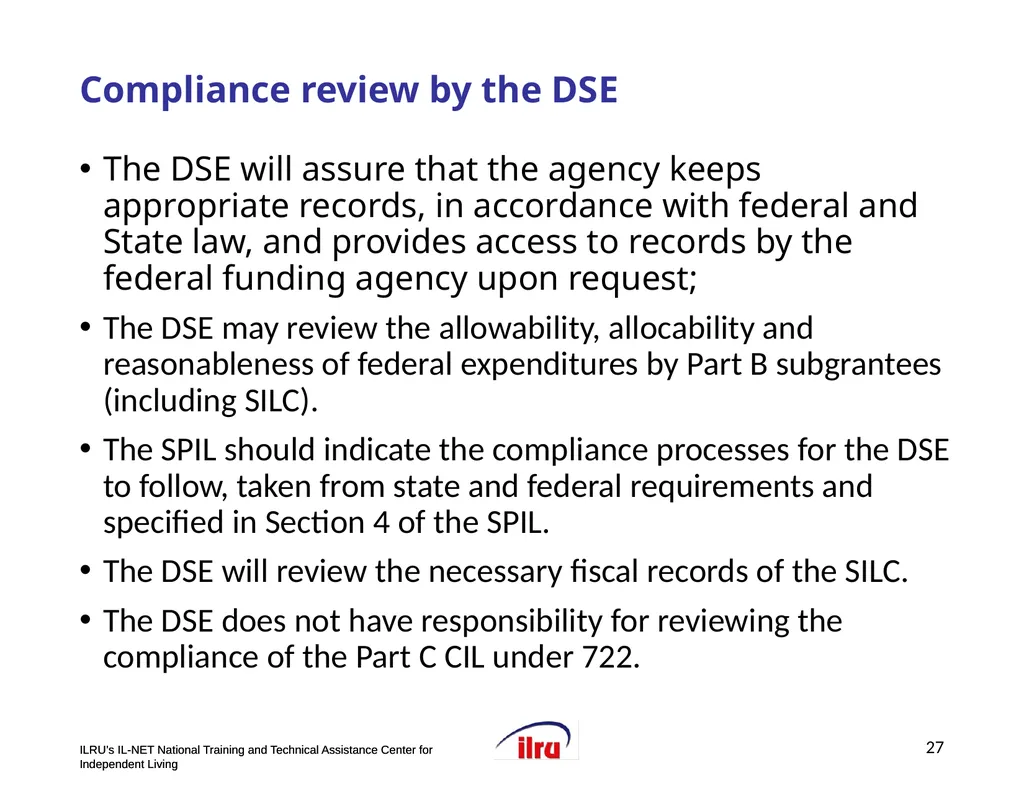
Compliance review by the DSE The DSE will assure that the agency keeps appropriate records, in accordance with federal and State law, and provides access to records by the federal funding agency upon request;
The DSE may review the allowability, allocability and reasonableness of federal expenditures by Part B subgrantees (including SILC).
The SPIL should indicate the compliance processes for the DSE to follow, taken from state and federal requirements and specified in Section 4 of the SPIL.
The DSE will review the necessary fiscal records of the SILC.
The DSE does not have responsibility for reviewing the compliance of the Part C CIL under 722. 27<br>
The DSE may review the allowability, allocability and reasonableness of federal expenditures by Part B subgrantees (including SILC).
The SPIL should indicate the compliance processes for the DSE to follow, taken from state and federal requirements and specified in Section 4 of the SPIL.
The DSE will review the necessary fiscal records of the SILC.
The DSE does not have responsibility for reviewing the compliance of the Part C CIL under 722. 27<br>
28
>>Slide 28
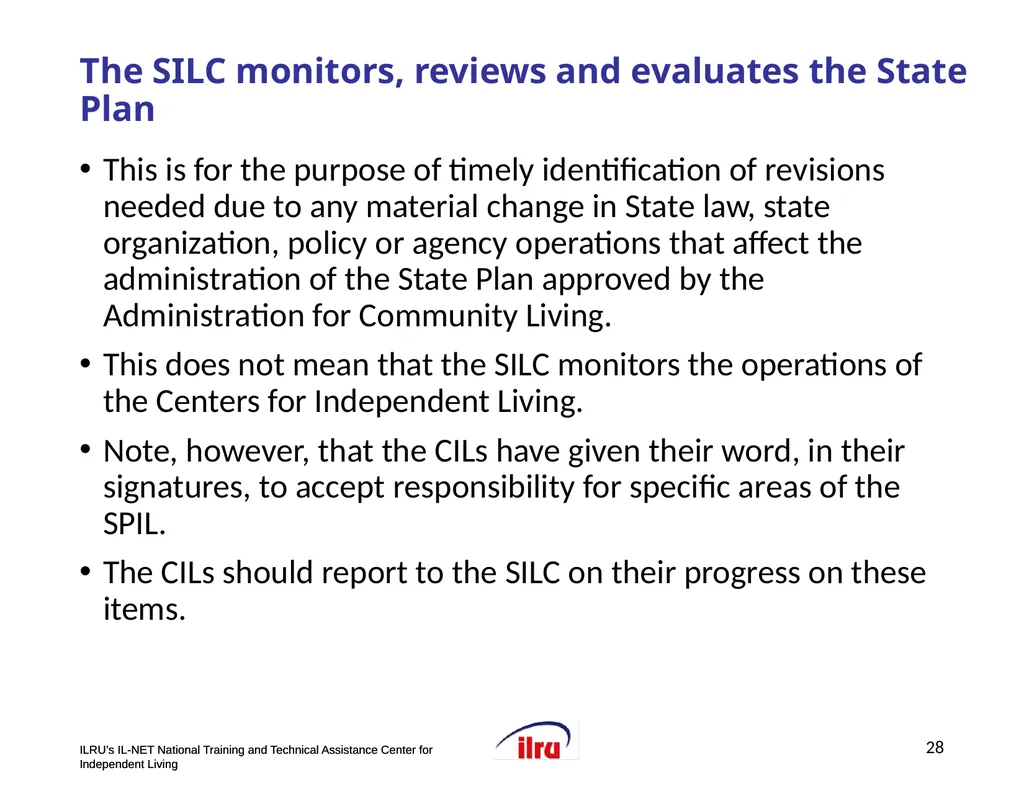
The SILC monitors, reviews and evaluates the State Plan This is for the purpose of timely identification of revisions needed due to any material change in State law, state organization, policy or agency operations that affect the administration of the State Plan approved by the Administration for Community Living.
This does not mean that the SILC monitors the operations of the Centers for Independent Living.
Note, however, that the CILs have given their word, in their signatures, to accept responsibility for specific areas of the SPIL.
The CILs should report to the SILC on their progress on these items. 28<br>
This does not mean that the SILC monitors the operations of the Centers for Independent Living.
Note, however, that the CILs have given their word, in their signatures, to accept responsibility for specific areas of the SPIL.
The CILs should report to the SILC on their progress on these items. 28<br>
29
>>Slide 29
Role of CILs in the SILC – support vs interference There is to be a full, voting member on the SILC that is an Executive Director chosen by all the EDs in the state and appointed by the appointing authority.
The law clearly prioritizes people with disabilities that represent the community, not those who work for a center or the state. This is how the SILC implements consumer control, a key belief of Independent Living.
Fifty-one percent of the members of the SILC must be people with disabilities who do not work for either a center or the state.
A CIL may urge consumers or board members with disabilities to apply to be on the SILC. They do not work for the center.
During a meeting, only the council should discuss items and vote; CIL staff in attendance do not speak unless included on the agenda and recognized by the chair. 29<br>
The law clearly prioritizes people with disabilities that represent the community, not those who work for a center or the state. This is how the SILC implements consumer control, a key belief of Independent Living.
Fifty-one percent of the members of the SILC must be people with disabilities who do not work for either a center or the state.
A CIL may urge consumers or board members with disabilities to apply to be on the SILC. They do not work for the center.
During a meeting, only the council should discuss items and vote; CIL staff in attendance do not speak unless included on the agenda and recognized by the chair. 29<br>
30
>>Slide 30
How does the DSE or a CIL get a copy of approved SPIL? A past SPIL (2019) is available on the ACL website. The next two SPILs are not yet posted.
The SILC should provide this public, approved document to anyone upon request.
Your Program Officer at ACL can provide a copy of your state’s approved SPIL upon request. 30<br>
The SILC should provide this public, approved document to anyone upon request.
Your Program Officer at ACL can provide a copy of your state’s approved SPIL upon request. 30<br>
31
>>Slide 32
Evaluation Survey We appreciate your feedback! Look for the link in the Chat for your convenience as we approach the end of the presentation. 31<br>
32
>>Slide 33
Questions and Answers We will go through the questions in the Q & A with the time we have remaining.
If we feel there is a duplicate question we will mark it as answered.
If we don’t get to all the questions we will follow up later. 32<br>
If we feel there is a duplicate question we will mark it as answered.
If we don’t get to all the questions we will follow up later. 32<br>
33
>>Slide 34
Resources The Rehabilitation Act: https://www2.ed.gov/policy/speced/leg/rehab/rehabilitation-act-of-1973-amended-by-wioa.pdf
SILC Indicators and SILC and DSE Assurances: https://www.ilru.org/sites/default/files/publications/SILC%20Indicators%20and%20SILC%20and%20DSE%20Assurances%201.2018.pdf
Independent Living Regulations: https://www.ecfr.gov/current/title-45/subtitle-B/chapter-XIII/subchapter-C/part-1329 33<br>
SILC Indicators and SILC and DSE Assurances: https://www.ilru.org/sites/default/files/publications/SILC%20Indicators%20and%20SILC%20and%20DSE%20Assurances%201.2018.pdf
Independent Living Regulations: https://www.ecfr.gov/current/title-45/subtitle-B/chapter-XIII/subchapter-C/part-1329 33<br>
34
>> Slide 34
For additional TA contact: Paula McElwee - paulamcelwee.ilru@gmail.com; 559-250-3082
Your Program Officer. You can find their contact information at https://acl.gov/programs/aging-and-disability-networks/centers-independent-living, by going to the first + dropdown near the end of the page. 34<br>
Your Program Officer. You can find their contact information at https://acl.gov/programs/aging-and-disability-networks/centers-independent-living, by going to the first + dropdown near the end of the page. 34<br>
35
>> Slide 35
Evaluation Survey Any final questions?
Directly following the webinar, you will see a short evaluation survey to complete on your screen, or you can click the link below. We appreciate your feedback!
https://uthtmc.az1.qualtrics.com/jfe/form/SV_5dq3UTRe2E2tKw6 35<br>
Directly following the webinar, you will see a short evaluation survey to complete on your screen, or you can click the link below. We appreciate your feedback!
https://uthtmc.az1.qualtrics.com/jfe/form/SV_5dq3UTRe2E2tKw6 35<br>
36
>> Slide 36
IL-NET Attribution The IL-NET is supported by grant numbers 90ILTA0001 and 90ISTA0001 from the U.S. Administration for Community Living, Department of Health and Human Services, Washington, D.C. 20201. Grantees undertaking projects under government sponsorship are encouraged to express freely their findings and conclusions. Points of view or opinions do not, therefore, necessarily represent official Administration for Community Living policy. 36<br>