
Slide Set Five A: Contractual Capacity Last Time –
LS
Published · 15 slides · 0 views
1 / 1


Description
Slide Set Five A: Contractual Capacity Last Time We Spoke About: The Rights in Contracts Part One: FoundersCommon LawDefinitionElementsNature Contract Formation Offer Part Two: DefinitionRequirementsTermination Contract Formation
Related Topics
Share
Embed code
Download this presentation From Below
"Slide Set Five A: Contractual Capacity Last Time –" is the property of its rightful owner. Permission is granted to download and print the materials on this website for personal, non-commercial use only, and to display it on your personal computer provided you do not modify the materials and that you retain all copyright notices contained in the materials. By downloading content from our website, you accept the terms of this agreement.
Presentation Transcript
01
Slide Set Five A:
Contractual Capacity<br>
Contractual Capacity<br>
02
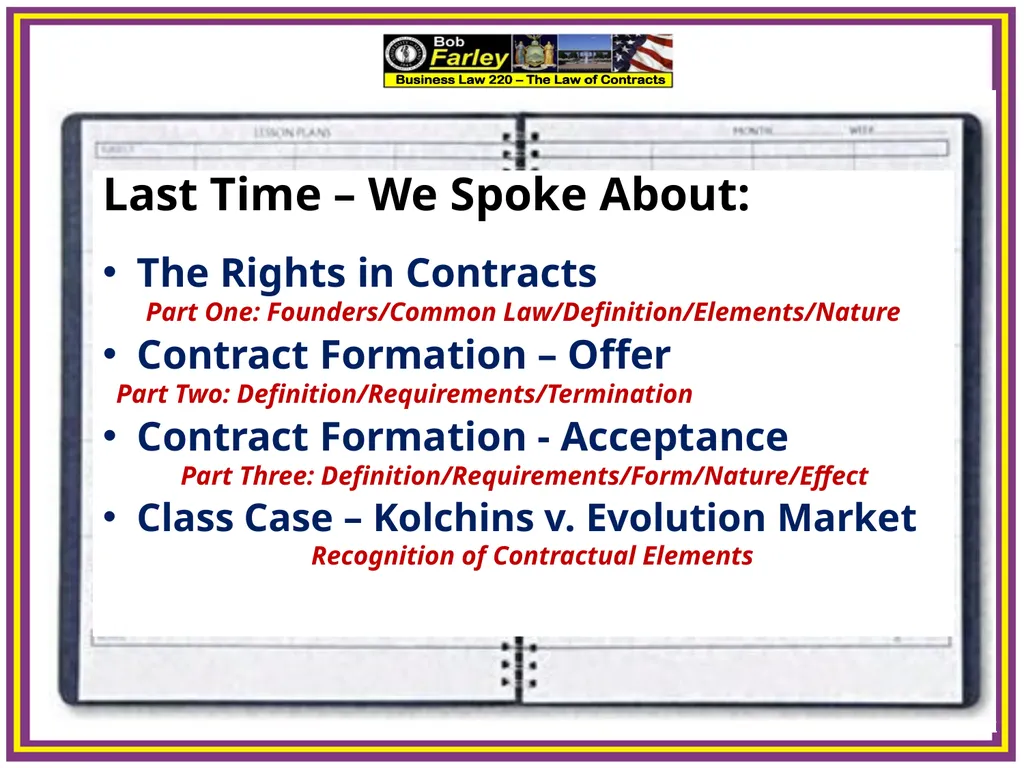
Last Time – We Spoke About:
The Rights in Contracts
Part One: Founders/Common Law/Definition/Elements/Nature
Contract Formation – Offer
Part Two: Definition/Requirements/Termination
Contract Formation - Acceptance
Part Three: Definition/Requirements/Form/Nature/Effect
Class Case – Kolchins v. Evolution Market
Recognition of Contractual Elements 2<br>
The Rights in Contracts
Part One: Founders/Common Law/Definition/Elements/Nature
Contract Formation – Offer
Part Two: Definition/Requirements/Termination
Contract Formation - Acceptance
Part Three: Definition/Requirements/Form/Nature/Effect
Class Case – Kolchins v. Evolution Market
Recognition of Contractual Elements 2<br>
03
Tonight – We Will Speak About:
Contractual Capacity
Part One: Definitions /Minors / Incompetents / Intoxication
Mistake
Part Two: Unilateral Mistake / Mutual Mistake / Transcriptions
Deception or Pressure
Part Three: Intentional Misrepresentation/Fraud/NonDisclosure
Class Case – Gerstein v. Broad Hollow Co.
Requirement of Free Will to Contract<br>
Contractual Capacity
Part One: Definitions /Minors / Incompetents / Intoxication
Mistake
Part Two: Unilateral Mistake / Mutual Mistake / Transcriptions
Deception or Pressure
Part Three: Intentional Misrepresentation/Fraud/NonDisclosure
Class Case – Gerstein v. Broad Hollow Co.
Requirement of Free Will to Contract<br>
04
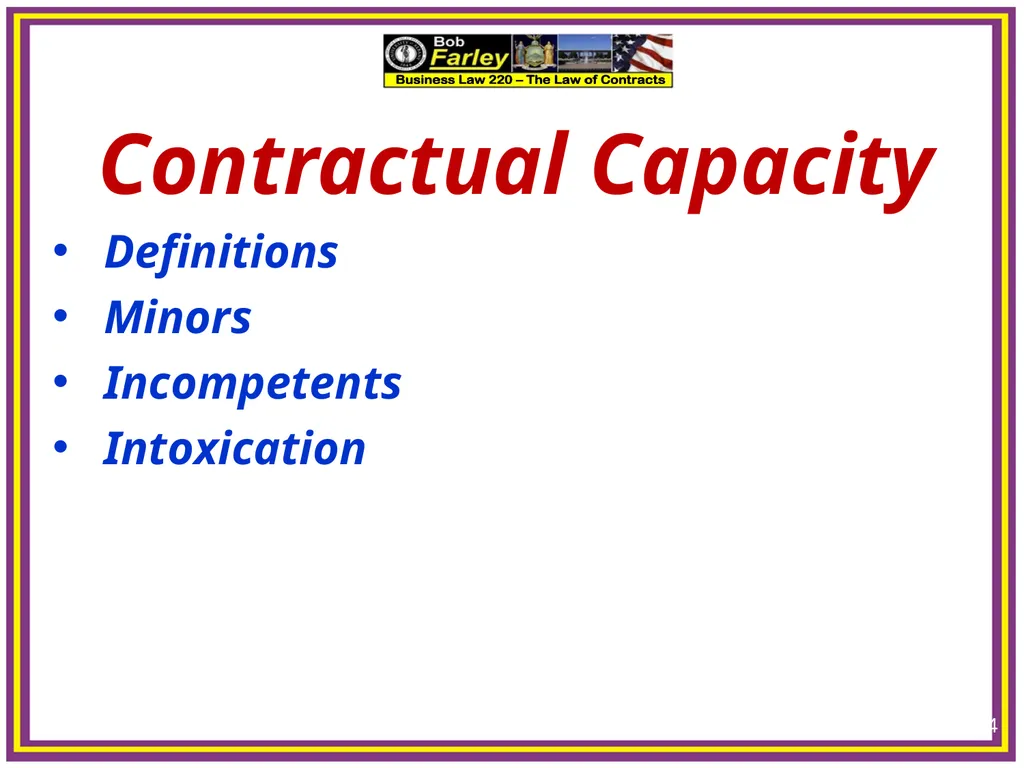
Contractual Capacity
Definitions
Minors
Incompetents
Intoxication 4<br>
Definitions
Minors
Incompetents
Intoxication 4<br>
05
Contractual Capacity
Definition
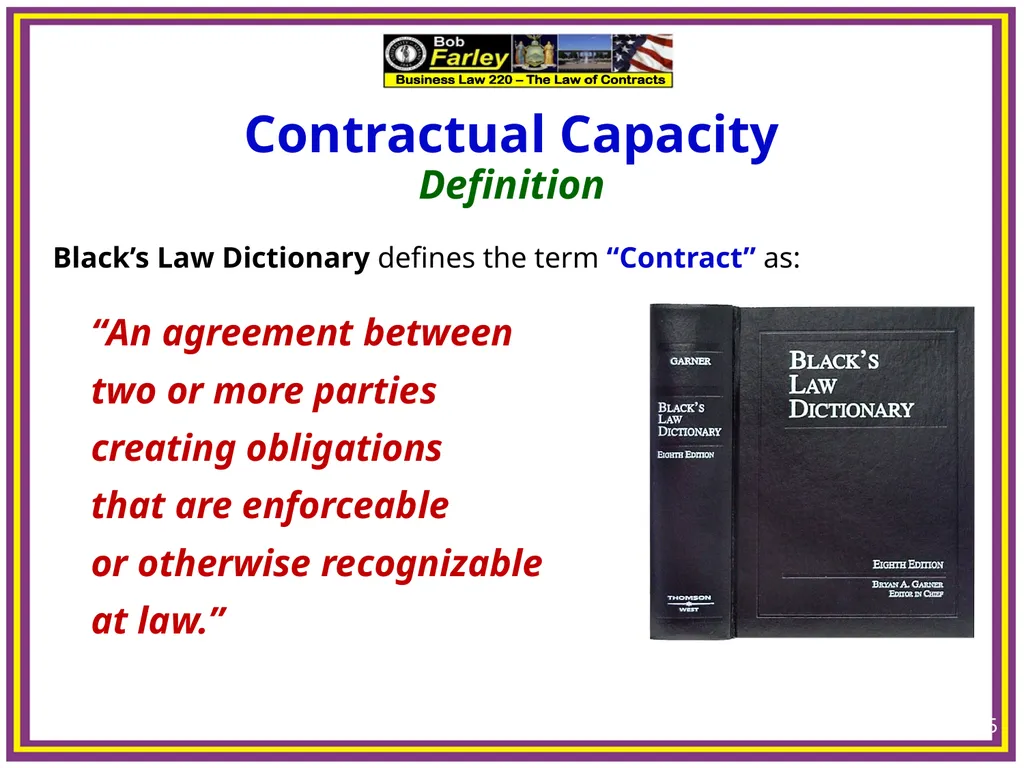
Black’s Law Dictionary defines the term “Contract” as:
“An agreement between
two or more parties
creating obligations
that are enforceable
or otherwise recognizable
at law.” 5<br>
Definition
Black’s Law Dictionary defines the term “Contract” as:
“An agreement between
two or more parties
creating obligations
that are enforceable
or otherwise recognizable
at law.” 5<br>
06
Contractual Capacity
Definition - Elements of a Contract
In Accordance with Common Law, the Elements of a Contract include:
Agreement,
Between Competent Parties,
Based on Genuine Assent,
Supported by Consideration,
for Lawful Purpose Subject Matter,
in Legal Form.<br>
Definition - Elements of a Contract
In Accordance with Common Law, the Elements of a Contract include:
Agreement,
Between Competent Parties,
Based on Genuine Assent,
Supported by Consideration,
for Lawful Purpose Subject Matter,
in Legal Form.<br>
07
Contractual Capacity
Definition – Competency and Capacity
To be a valid Contract, it must be between competent parties.
According to Black’s law dictionary, competence
is defined as:
“A basic or minimal ability to do something”
But legal competency to contract is also based on
a concept known as “capacity”, which is defined as:
“The power to create or enter into a legal relation under the same circumstances in which a normal person would have such power to do so.
Age and mental health are both elements of capacity.<br>
Definition – Competency and Capacity
To be a valid Contract, it must be between competent parties.
According to Black’s law dictionary, competence
is defined as:
“A basic or minimal ability to do something”
But legal competency to contract is also based on
a concept known as “capacity”, which is defined as:
“The power to create or enter into a legal relation under the same circumstances in which a normal person would have such power to do so.
Age and mental health are both elements of capacity.<br>
08
Contractual Capacity
Definition – Capacity to Contract - Generally
More specifically, Contractual Capacity has been defined as:
“The ability to understand that a contract is being made, and to comprehend its general meaning, to the extent that genuine assent may be given to its terms.”
Status Incapacity: Minors (persons under 18 - the legal age of majority) do not have the legal capacity to contract. If they have been emancipated from their parents, however, they are presumed to have capacity. Contracts with minors are therefore often found to be voidable at the option of the minor.
Factual Incapacity: Mental incompetence due to mental illness, brain injury, or intoxication from medication, illegal drugs or alcohol.<br>
Definition – Capacity to Contract - Generally
More specifically, Contractual Capacity has been defined as:
“The ability to understand that a contract is being made, and to comprehend its general meaning, to the extent that genuine assent may be given to its terms.”
Status Incapacity: Minors (persons under 18 - the legal age of majority) do not have the legal capacity to contract. If they have been emancipated from their parents, however, they are presumed to have capacity. Contracts with minors are therefore often found to be voidable at the option of the minor.
Factual Incapacity: Mental incompetence due to mental illness, brain injury, or intoxication from medication, illegal drugs or alcohol.<br>
09
Contractual Capacity
Definition – Capacity to Contract - Reasoning
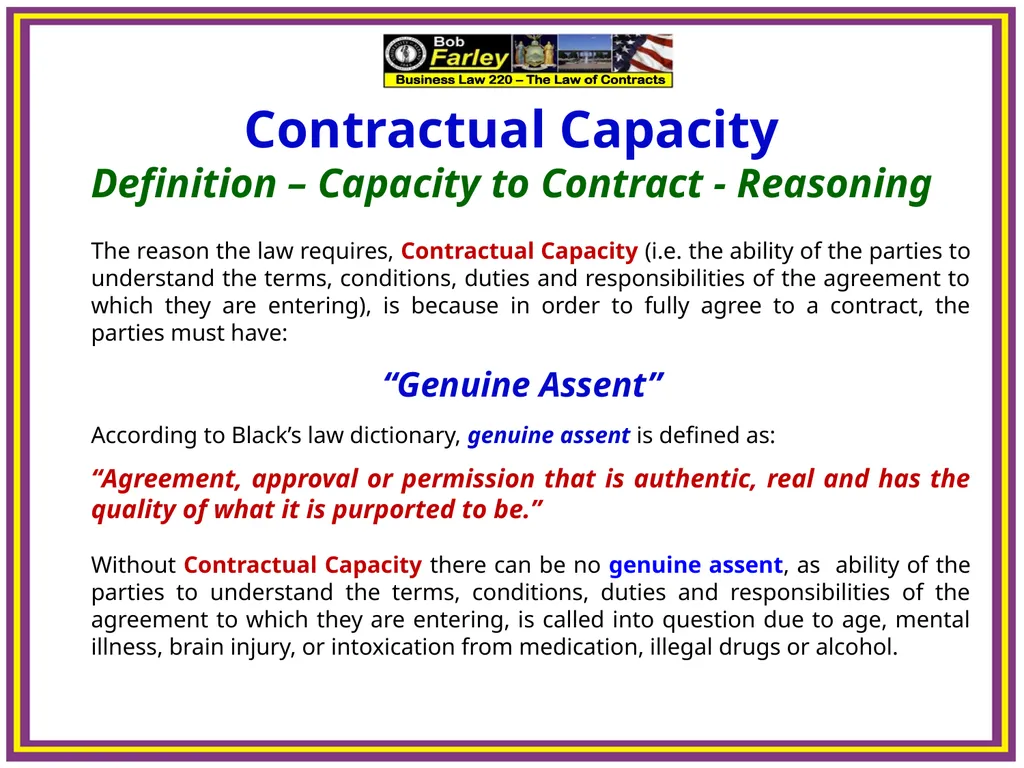
The reason the law requires, Contractual Capacity (i.e. the ability of the parties to understand the terms, conditions, duties and responsibilities of the agreement to which they are entering), is because in order to fully agree to a contract, the parties must have:
“Genuine Assent”
According to Black’s law dictionary, genuine assent is defined as:
“Agreement, approval or permission that is authentic, real and has the quality of what it is purported to be.”
Without Contractual Capacity there can be no genuine assent, as ability of the parties to understand the terms, conditions, duties and responsibilities of the agreement to which they are entering, is called into question due to age, mental illness, brain injury, or intoxication from medication, illegal drugs or alcohol.<br>
Definition – Capacity to Contract - Reasoning
The reason the law requires, Contractual Capacity (i.e. the ability of the parties to understand the terms, conditions, duties and responsibilities of the agreement to which they are entering), is because in order to fully agree to a contract, the parties must have:
“Genuine Assent”
According to Black’s law dictionary, genuine assent is defined as:
“Agreement, approval or permission that is authentic, real and has the quality of what it is purported to be.”
Without Contractual Capacity there can be no genuine assent, as ability of the parties to understand the terms, conditions, duties and responsibilities of the agreement to which they are entering, is called into question due to age, mental illness, brain injury, or intoxication from medication, illegal drugs or alcohol.<br>
10
Contractual Capacity
Definition – Capacity to Contract - Minors
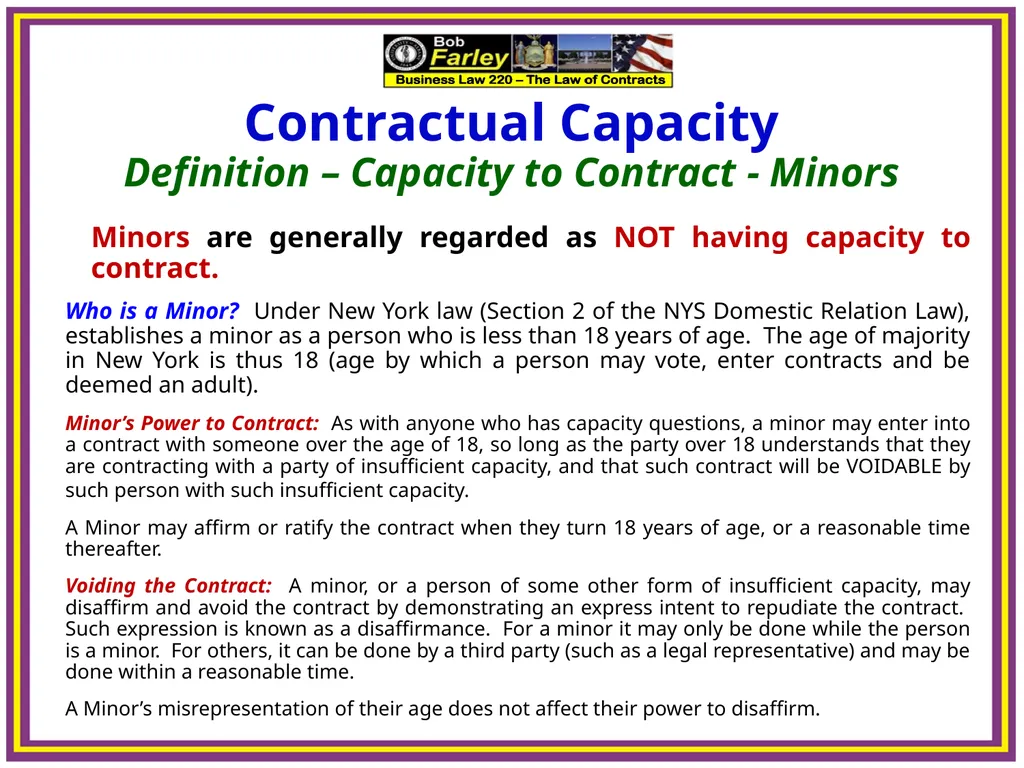
Minors are generally regarded as NOT having capacity to contract.
Who is a Minor? Under New York law (Section 2 of the NYS Domestic Relation Law), establishes a minor as a person who is less than 18 years of age. The age of majority in New York is thus 18 (age by which a person may vote, enter contracts and be deemed an adult).
Minor’s Power to Contract: As with anyone who has capacity questions, a minor may enter into a contract with someone over the age of 18, so long as the party over 18 understands that they are contracting with a party of insufficient capacity, and that such contract will be VOIDABLE by such person with such insufficient capacity.
A Minor may affirm or ratify the contract when they turn 18 years of age, or a reasonable time thereafter.
Voiding the Contract: A minor, or a person of some other form of insufficient capacity, may disaffirm and avoid the contract by demonstrating an express intent to repudiate the contract. Such expression is known as a disaffirmance. For a minor it may only be done while the person is a minor. For others, it can be done by a third party (such as a legal representative) and may be done within a reasonable time.
A Minor’s misrepresentation of their age does not affect their power to disaffirm.<br>
Definition – Capacity to Contract - Minors
Minors are generally regarded as NOT having capacity to contract.
Who is a Minor? Under New York law (Section 2 of the NYS Domestic Relation Law), establishes a minor as a person who is less than 18 years of age. The age of majority in New York is thus 18 (age by which a person may vote, enter contracts and be deemed an adult).
Minor’s Power to Contract: As with anyone who has capacity questions, a minor may enter into a contract with someone over the age of 18, so long as the party over 18 understands that they are contracting with a party of insufficient capacity, and that such contract will be VOIDABLE by such person with such insufficient capacity.
A Minor may affirm or ratify the contract when they turn 18 years of age, or a reasonable time thereafter.
Voiding the Contract: A minor, or a person of some other form of insufficient capacity, may disaffirm and avoid the contract by demonstrating an express intent to repudiate the contract. Such expression is known as a disaffirmance. For a minor it may only be done while the person is a minor. For others, it can be done by a third party (such as a legal representative) and may be done within a reasonable time.
A Minor’s misrepresentation of their age does not affect their power to disaffirm.<br>
11
Contractual Capacity
Definition – Capacity to Contract - Minors
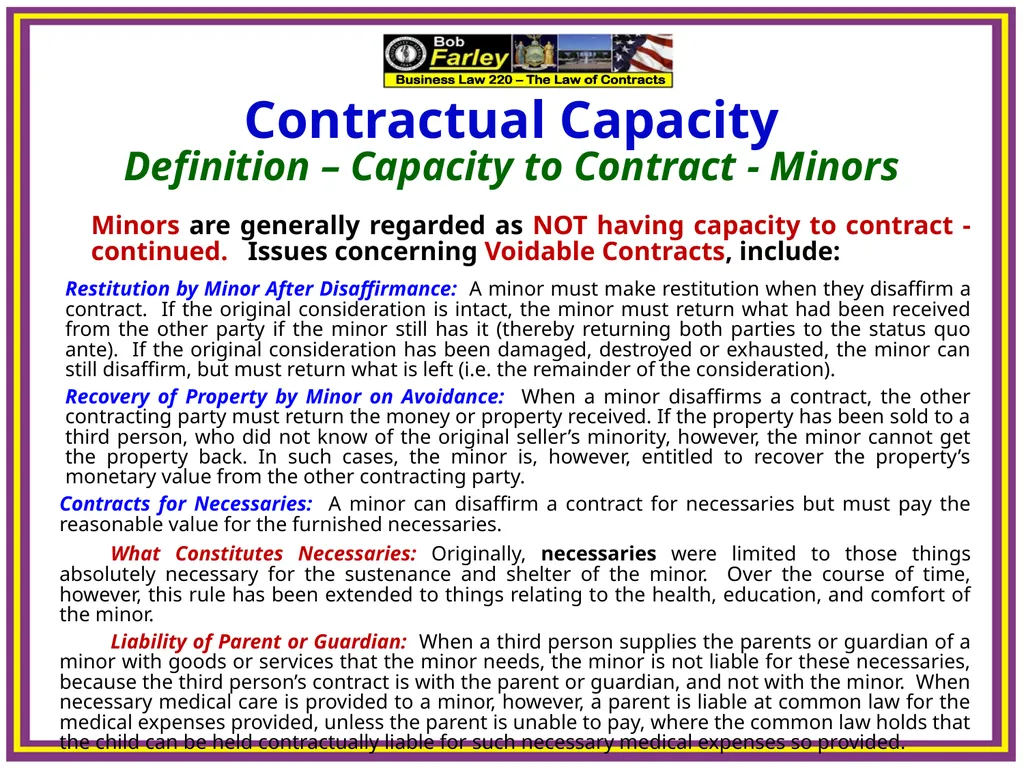
Minors are generally regarded as NOT having capacity to contract - continued. Issues concerning Voidable Contracts, include:
Restitution by Minor After Disaffirmance: A minor must make restitution when they disaffirm a contract. If the original consideration is intact, the minor must return what had been received from the other party if the minor still has it (thereby returning both parties to the status quo ante). If the original consideration has been damaged, destroyed or exhausted, the minor can still disaffirm, but must return what is left (i.e. the remainder of the consideration).
Recovery of Property by Minor on Avoidance: When a minor disaffirms a contract, the other contracting party must return the money or property received. If the property has been sold to a third person, who did not know of the original seller’s minority, however, the minor cannot get the property back. In such cases, the minor is, however, entitled to recover the property’s monetary value from the other contracting party.
Contracts for Necessaries: A minor can disaffirm a contract for necessaries but must pay the reasonable value for the furnished necessaries.
What Constitutes Necessaries: Originally, necessaries were limited to those things absolutely necessary for the sustenance and shelter of the minor. Over the course of time, however, this rule has been extended to things relating to the health, education, and comfort of the minor.
Liability of Parent or Guardian: When a third person supplies the parents or guardian of a minor with goods or services that the minor needs, the minor is not liable for these necessaries, because the third person’s contract is with the parent or guardian, and not with the minor. When necessary medical care is provided to a minor, however, a parent is liable at common law for the medical expenses provided, unless the parent is unable to pay, where the common law holds that the child can be held contractually liable for such necessary medical expenses so provided.<br>
Definition – Capacity to Contract - Minors
Minors are generally regarded as NOT having capacity to contract - continued. Issues concerning Voidable Contracts, include:
Restitution by Minor After Disaffirmance: A minor must make restitution when they disaffirm a contract. If the original consideration is intact, the minor must return what had been received from the other party if the minor still has it (thereby returning both parties to the status quo ante). If the original consideration has been damaged, destroyed or exhausted, the minor can still disaffirm, but must return what is left (i.e. the remainder of the consideration).
Recovery of Property by Minor on Avoidance: When a minor disaffirms a contract, the other contracting party must return the money or property received. If the property has been sold to a third person, who did not know of the original seller’s minority, however, the minor cannot get the property back. In such cases, the minor is, however, entitled to recover the property’s monetary value from the other contracting party.
Contracts for Necessaries: A minor can disaffirm a contract for necessaries but must pay the reasonable value for the furnished necessaries.
What Constitutes Necessaries: Originally, necessaries were limited to those things absolutely necessary for the sustenance and shelter of the minor. Over the course of time, however, this rule has been extended to things relating to the health, education, and comfort of the minor.
Liability of Parent or Guardian: When a third person supplies the parents or guardian of a minor with goods or services that the minor needs, the minor is not liable for these necessaries, because the third person’s contract is with the parent or guardian, and not with the minor. When necessary medical care is provided to a minor, however, a parent is liable at common law for the medical expenses provided, unless the parent is unable to pay, where the common law holds that the child can be held contractually liable for such necessary medical expenses so provided.<br>
12
Contractual Capacity
Definition – Capacity to Contract - Minors
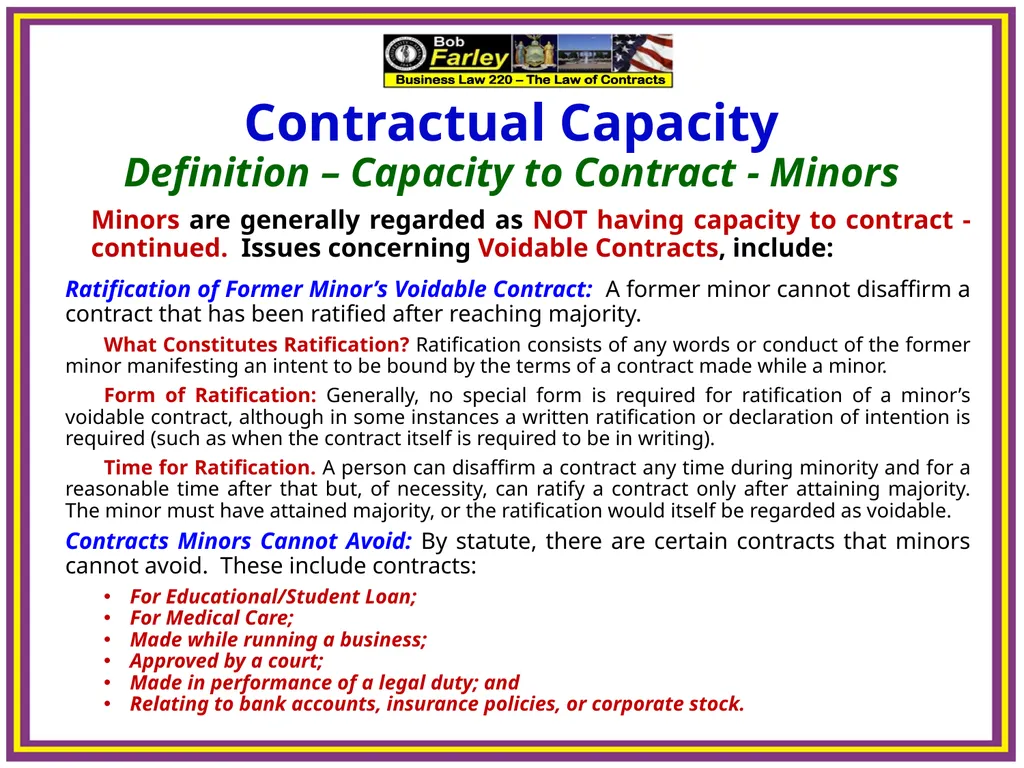
Minors are generally regarded as NOT having capacity to contract - continued. Issues concerning Voidable Contracts, include:
Ratification of Former Minor’s Voidable Contract: A former minor cannot disaffirm a contract that has been ratified after reaching majority.
What Constitutes Ratification? Ratification consists of any words or conduct of the former minor manifesting an intent to be bound by the terms of a contract made while a minor.
Form of Ratification: Generally, no special form is required for ratification of a minor’s voidable contract, although in some instances a written ratification or declaration of intention is required (such as when the contract itself is required to be in writing).
Time for Ratification. A person can disaffirm a contract any time during minority and for a reasonable time after that but, of necessity, can ratify a contract only after attaining majority. The minor must have attained majority, or the ratification would itself be regarded as voidable.
Contracts Minors Cannot Avoid: By statute, there are certain contracts that minors cannot avoid. These include contracts:
For Educational/Student Loan;
For Medical Care;
Made while running a business;
Approved by a court;
Made in performance of a legal duty; and
Relating to bank accounts, insurance policies, or corporate stock.<br>
Definition – Capacity to Contract - Minors
Minors are generally regarded as NOT having capacity to contract - continued. Issues concerning Voidable Contracts, include:
Ratification of Former Minor’s Voidable Contract: A former minor cannot disaffirm a contract that has been ratified after reaching majority.
What Constitutes Ratification? Ratification consists of any words or conduct of the former minor manifesting an intent to be bound by the terms of a contract made while a minor.
Form of Ratification: Generally, no special form is required for ratification of a minor’s voidable contract, although in some instances a written ratification or declaration of intention is required (such as when the contract itself is required to be in writing).
Time for Ratification. A person can disaffirm a contract any time during minority and for a reasonable time after that but, of necessity, can ratify a contract only after attaining majority. The minor must have attained majority, or the ratification would itself be regarded as voidable.
Contracts Minors Cannot Avoid: By statute, there are certain contracts that minors cannot avoid. These include contracts:
For Educational/Student Loan;
For Medical Care;
Made while running a business;
Approved by a court;
Made in performance of a legal duty; and
Relating to bank accounts, insurance policies, or corporate stock.<br>
13
Contractual Capacity
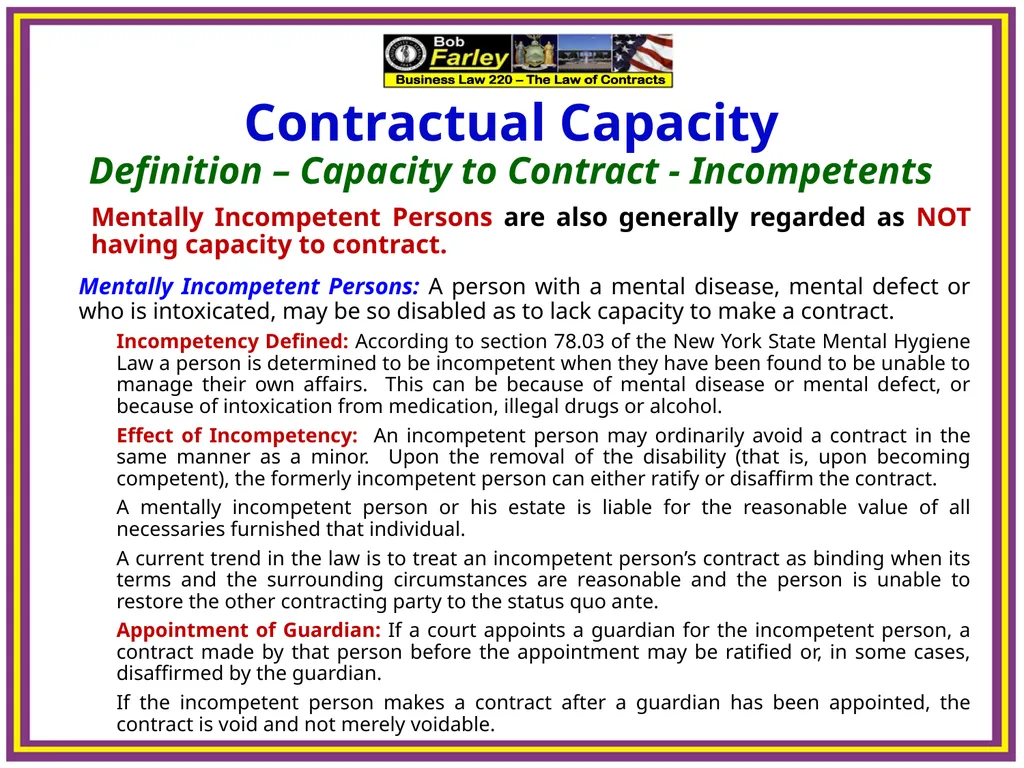
Definition – Capacity to Contract - Incompetents
Mentally Incompetent Persons are also generally regarded as NOT having capacity to contract.
Mentally Incompetent Persons: A person with a mental disease, mental defect or who is intoxicated, may be so disabled as to lack capacity to make a contract.
Incompetency Defined: According to section 78.03 of the New York State Mental Hygiene Law a person is determined to be incompetent when they have been found to be unable to manage their own affairs. This can be because of mental disease or mental defect, or because of intoxication from medication, illegal drugs or alcohol.
Effect of Incompetency: An incompetent person may ordinarily avoid a contract in the same manner as a minor. Upon the removal of the disability (that is, upon becoming competent), the formerly incompetent person can either ratify or disaffirm the contract.
A mentally incompetent person or his estate is liable for the reasonable value of all necessaries furnished that individual.
A current trend in the law is to treat an incompetent person’s contract as binding when its terms and the surrounding circumstances are reasonable and the person is unable to restore the other contracting party to the status quo ante.
Appointment of Guardian: If a court appoints a guardian for the incompetent person, a contract made by that person before the appointment may be ratified or, in some cases, disaffirmed by the guardian.
If the incompetent person makes a contract after a guardian has been appointed, the contract is void and not merely voidable.<br>
Definition – Capacity to Contract - Incompetents
Mentally Incompetent Persons are also generally regarded as NOT having capacity to contract.
Mentally Incompetent Persons: A person with a mental disease, mental defect or who is intoxicated, may be so disabled as to lack capacity to make a contract.
Incompetency Defined: According to section 78.03 of the New York State Mental Hygiene Law a person is determined to be incompetent when they have been found to be unable to manage their own affairs. This can be because of mental disease or mental defect, or because of intoxication from medication, illegal drugs or alcohol.
Effect of Incompetency: An incompetent person may ordinarily avoid a contract in the same manner as a minor. Upon the removal of the disability (that is, upon becoming competent), the formerly incompetent person can either ratify or disaffirm the contract.
A mentally incompetent person or his estate is liable for the reasonable value of all necessaries furnished that individual.
A current trend in the law is to treat an incompetent person’s contract as binding when its terms and the surrounding circumstances are reasonable and the person is unable to restore the other contracting party to the status quo ante.
Appointment of Guardian: If a court appoints a guardian for the incompetent person, a contract made by that person before the appointment may be ratified or, in some cases, disaffirmed by the guardian.
If the incompetent person makes a contract after a guardian has been appointed, the contract is void and not merely voidable.<br>
14
Contractual Capacity
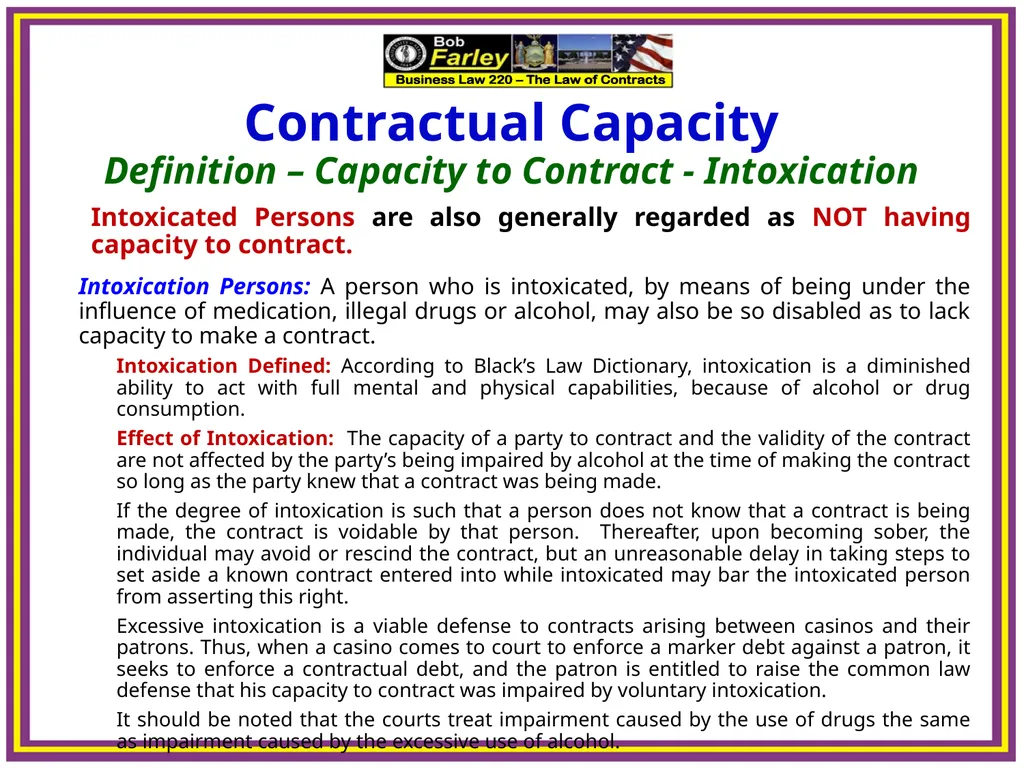
Definition – Capacity to Contract - Intoxication
Intoxicated Persons are also generally regarded as NOT having capacity to contract.
Intoxication Persons: A person who is intoxicated, by means of being under the influence of medication, illegal drugs or alcohol, may also be so disabled as to lack capacity to make a contract.
Intoxication Defined: According to Black’s Law Dictionary, intoxication is a diminished ability to act with full mental and physical capabilities, because of alcohol or drug consumption.
Effect of Intoxication: The capacity of a party to contract and the validity of the contract are not affected by the party’s being impaired by alcohol at the time of making the contract so long as the party knew that a contract was being made.
If the degree of intoxication is such that a person does not know that a contract is being made, the contract is voidable by that person. Thereafter, upon becoming sober, the individual may avoid or rescind the contract, but an unreasonable delay in taking steps to set aside a known contract entered into while intoxicated may bar the intoxicated person from asserting this right.
Excessive intoxication is a viable defense to contracts arising between casinos and their patrons. Thus, when a casino comes to court to enforce a marker debt against a patron, it seeks to enforce a contractual debt, and the patron is entitled to raise the common law defense that his capacity to contract was impaired by voluntary intoxication.
It should be noted that the courts treat impairment caused by the use of drugs the same as impairment caused by the excessive use of alcohol.<br>
Definition – Capacity to Contract - Intoxication
Intoxicated Persons are also generally regarded as NOT having capacity to contract.
Intoxication Persons: A person who is intoxicated, by means of being under the influence of medication, illegal drugs or alcohol, may also be so disabled as to lack capacity to make a contract.
Intoxication Defined: According to Black’s Law Dictionary, intoxication is a diminished ability to act with full mental and physical capabilities, because of alcohol or drug consumption.
Effect of Intoxication: The capacity of a party to contract and the validity of the contract are not affected by the party’s being impaired by alcohol at the time of making the contract so long as the party knew that a contract was being made.
If the degree of intoxication is such that a person does not know that a contract is being made, the contract is voidable by that person. Thereafter, upon becoming sober, the individual may avoid or rescind the contract, but an unreasonable delay in taking steps to set aside a known contract entered into while intoxicated may bar the intoxicated person from asserting this right.
Excessive intoxication is a viable defense to contracts arising between casinos and their patrons. Thus, when a casino comes to court to enforce a marker debt against a patron, it seeks to enforce a contractual debt, and the patron is entitled to raise the common law defense that his capacity to contract was impaired by voluntary intoxication.
It should be noted that the courts treat impairment caused by the use of drugs the same as impairment caused by the excessive use of alcohol.<br>
15
Thank you for Coming
For next time – Review Assignments as follows on the Webpage:
Lecture Slides
Selected Readings
Cases and Exercises
We are a hot bench.
Questions?<br>
For next time – Review Assignments as follows on the Webpage:
Lecture Slides
Selected Readings
Cases and Exercises
We are a hot bench.
Questions?<br>