
Slide Set Three A: Preincorporation Last Time We
PM
Published · 21 slides · 0 views

1 / 1


Description
Slide Set Three A: Preincorporation Last Time We Spoke About: The Nature of a Corporation Part One: Origins of the Corporation Definitions Artificial Person The Types of Corporations Part Two: 1. Business Corporations 2. Professional
Related Topics
Share
Embed code
Download this presentation From Below
"Slide Set Three A: Preincorporation Last Time We" is the property of its rightful owner. Permission is granted to download and print the materials on this website for personal, non-commercial use only, and to display it on your personal computer provided you do not modify the materials and that you retain all copyright notices contained in the materials. By downloading content from our website, you accept the terms of this agreement.
Presentation Transcript
01
Slide Set Three A:
Preincorporation<br>
Preincorporation<br>
02
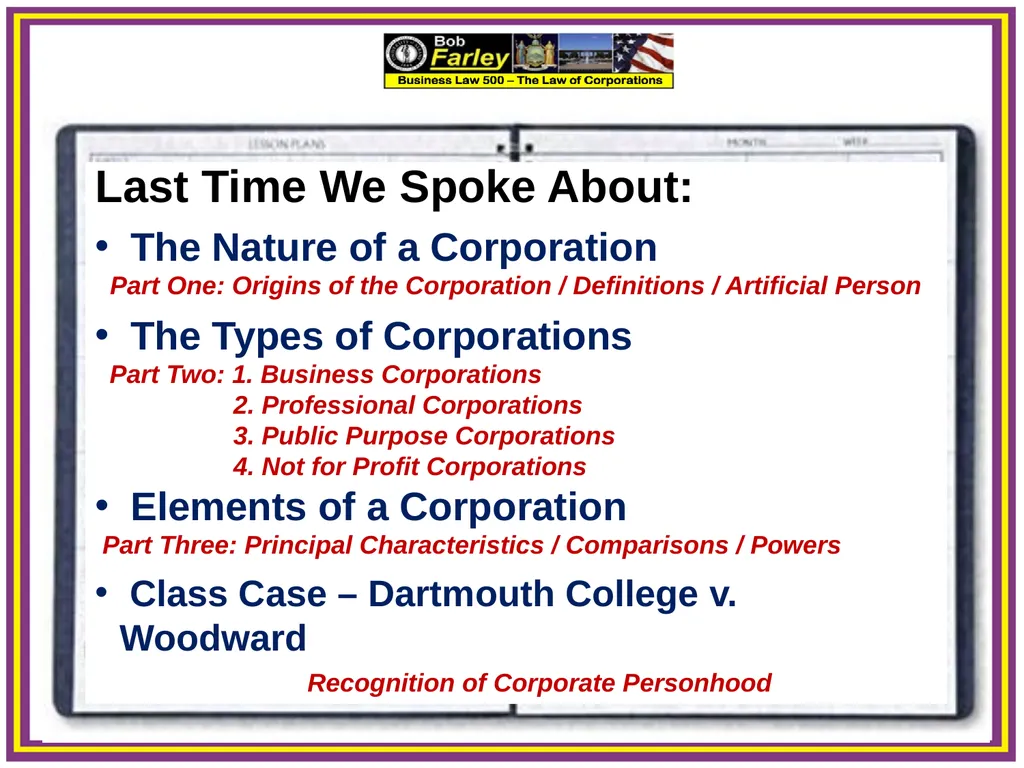
Last Time We Spoke About:
The Nature of a Corporation
Part One: Origins of the Corporation / Definitions / Artificial Person
The Types of Corporations
Part Two: 1. Business Corporations
2. Professional Corporations
3. Public Purpose Corporations
4. Not for Profit Corporations
Elements of a Corporation
Part Three: Principal Characteristics / Comparisons / Powers
Class Case – Dartmouth College v. Woodward
Recognition of Corporate Personhood<br>
The Nature of a Corporation
Part One: Origins of the Corporation / Definitions / Artificial Person
The Types of Corporations
Part Two: 1. Business Corporations
2. Professional Corporations
3. Public Purpose Corporations
4. Not for Profit Corporations
Elements of a Corporation
Part Three: Principal Characteristics / Comparisons / Powers
Class Case – Dartmouth College v. Woodward
Recognition of Corporate Personhood<br>
03
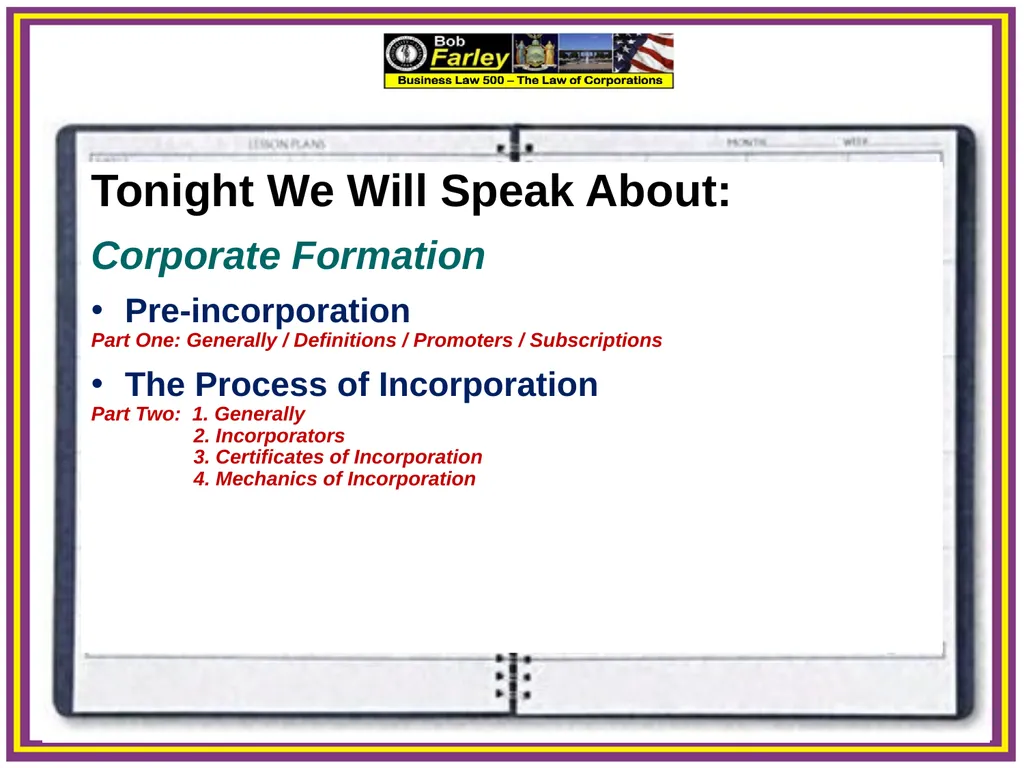
Tonight We Will Speak About:
Corporate Formation
Pre-incorporation
Part One: Generally / Definitions / Promoters / Subscriptions
The Process of Incorporation
Part Two: 1. Generally
2. Incorporators
3. Certificates of Incorporation
4. Mechanics of Incorporation<br>
Corporate Formation
Pre-incorporation
Part One: Generally / Definitions / Promoters / Subscriptions
The Process of Incorporation
Part Two: 1. Generally
2. Incorporators
3. Certificates of Incorporation
4. Mechanics of Incorporation<br>
04
4 Part One:
Corporations
Generally<br>
Corporations
Generally<br>
05
5 Corporations
Generally
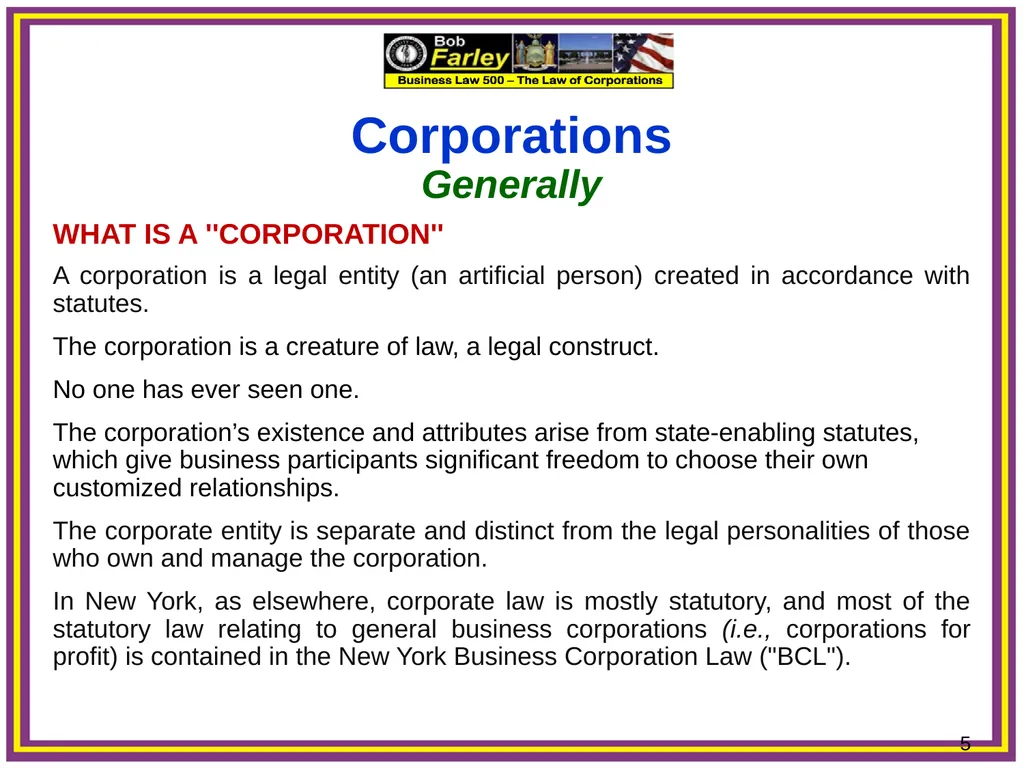
WHAT IS A ''CORPORATION''
A corporation is a legal entity (an artificial person) created in accordance with statutes.
The corporation is a creature of law, a legal construct.
No one has ever seen one.
The corporation’s existence and attributes arise from state-enabling statutes, which give business participants significant freedom to choose their own customized relationships.
The corporate entity is separate and distinct from the legal personalities of those who own and manage the corporation.
In New York, as elsewhere, corporate law is mostly statutory, and most of the statutory law relating to general business corporations (i.e., corporations for profit) is contained in the New York Business Corporation Law ("BCL").<br>
Generally
WHAT IS A ''CORPORATION''
A corporation is a legal entity (an artificial person) created in accordance with statutes.
The corporation is a creature of law, a legal construct.
No one has ever seen one.
The corporation’s existence and attributes arise from state-enabling statutes, which give business participants significant freedom to choose their own customized relationships.
The corporate entity is separate and distinct from the legal personalities of those who own and manage the corporation.
In New York, as elsewhere, corporate law is mostly statutory, and most of the statutory law relating to general business corporations (i.e., corporations for profit) is contained in the New York Business Corporation Law ("BCL").<br>
06
Corporations
Generally - Definitions
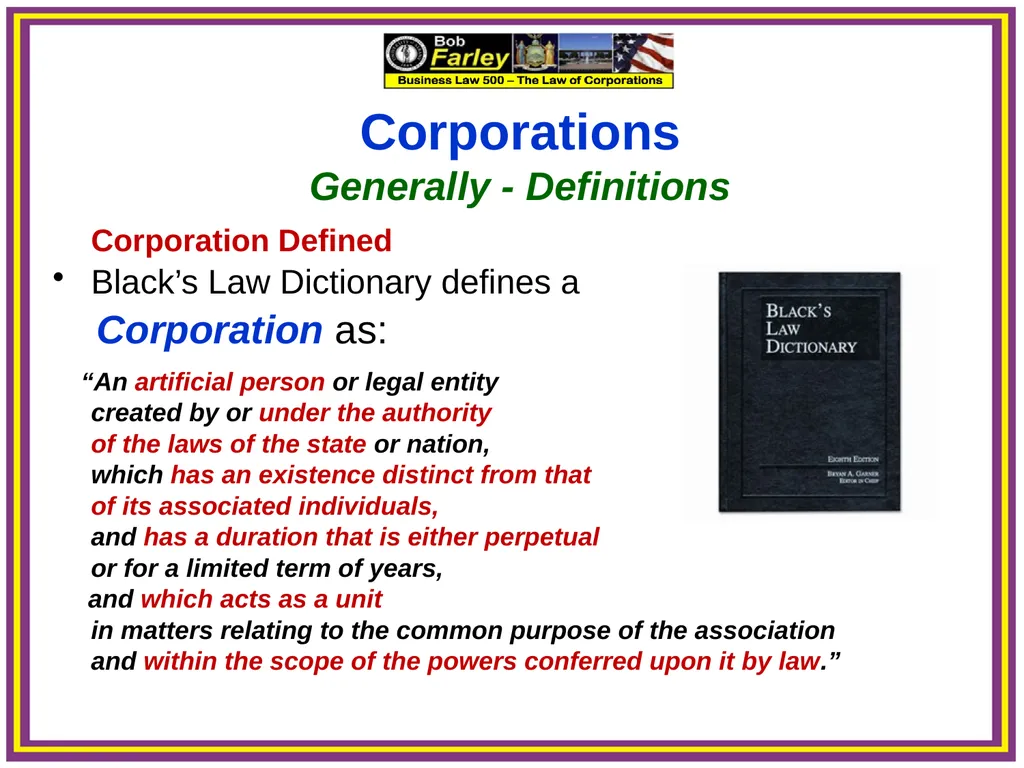
Corporation Defined
Black’s Law Dictionary defines a
Corporation as:
“An artificial person or legal entity
created by or under the authority
of the laws of the state or nation,
which has an existence distinct from that
of its associated individuals,
and has a duration that is either perpetual
or for a limited term of years,
and which acts as a unit
in matters relating to the common purpose of the association
and within the scope of the powers conferred upon it by law.”<br>
Generally - Definitions
Corporation Defined
Black’s Law Dictionary defines a
Corporation as:
“An artificial person or legal entity
created by or under the authority
of the laws of the state or nation,
which has an existence distinct from that
of its associated individuals,
and has a duration that is either perpetual
or for a limited term of years,
and which acts as a unit
in matters relating to the common purpose of the association
and within the scope of the powers conferred upon it by law.”<br>
07
Corporations
Generally - Definitions
MEANING OF ''CORPORATION''
A corporation is a legal entity (an artificial person) created in accordance with statutes.
The corporate entity is separate and distinct from the legal personalities of those who own and manage the corporation.
In New York, as elsewhere, corporate law is mostly statutory, and most of the statutory law relating to general business corporations (i.e., corporations for profit) is contained in the New York Business Corporation Law ("BCL").<br>
Generally - Definitions
MEANING OF ''CORPORATION''
A corporation is a legal entity (an artificial person) created in accordance with statutes.
The corporate entity is separate and distinct from the legal personalities of those who own and manage the corporation.
In New York, as elsewhere, corporate law is mostly statutory, and most of the statutory law relating to general business corporations (i.e., corporations for profit) is contained in the New York Business Corporation Law ("BCL").<br>
08
Corporations
Generally - Principal Characteristics
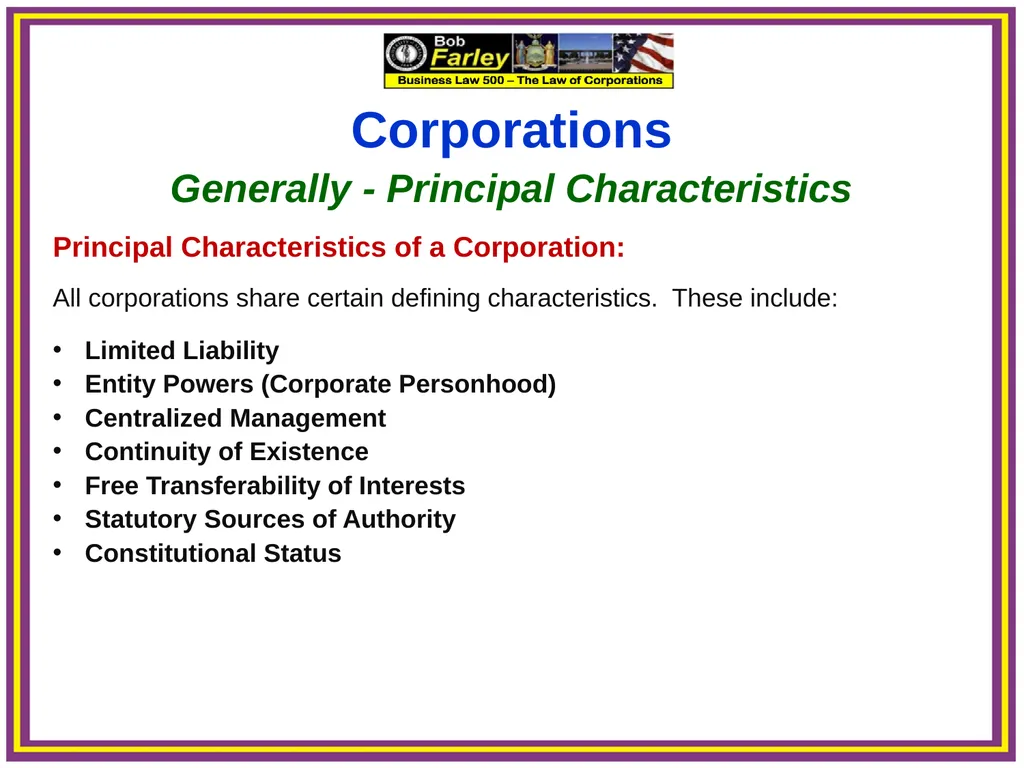
Principal Characteristics of a Corporation:
All corporations share certain defining characteristics. These include:
Limited Liability
Entity Powers (Corporate Personhood)
Centralized Management
Continuity of Existence
Free Transferability of Interests
Statutory Sources of Authority
Constitutional Status<br>
Generally - Principal Characteristics
Principal Characteristics of a Corporation:
All corporations share certain defining characteristics. These include:
Limited Liability
Entity Powers (Corporate Personhood)
Centralized Management
Continuity of Existence
Free Transferability of Interests
Statutory Sources of Authority
Constitutional Status<br>
09
Corporations
Generally - Powers of the Corporation
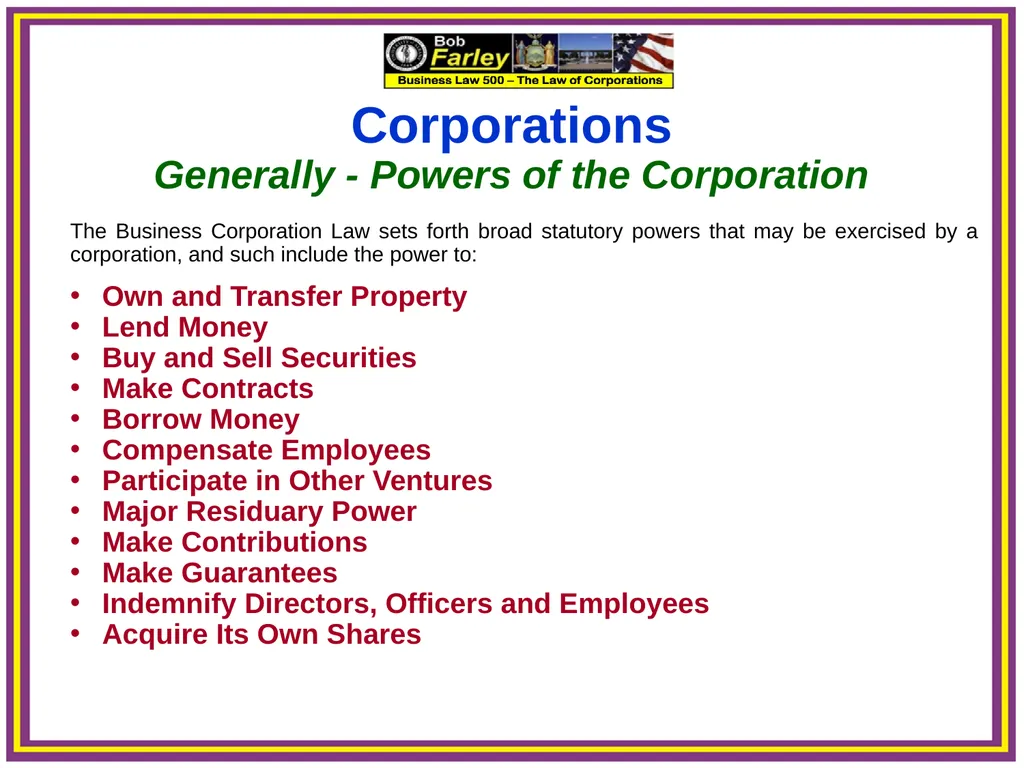
The Business Corporation Law sets forth broad statutory powers that may be exercised by a corporation, and such include the power to:
Own and Transfer Property
Lend Money
Buy and Sell Securities
Make Contracts
Borrow Money
Compensate Employees
Participate in Other Ventures
Major Residuary Power
Make Contributions
Make Guarantees
Indemnify Directors, Officers and Employees
Acquire Its Own Shares<br>
Generally - Powers of the Corporation
The Business Corporation Law sets forth broad statutory powers that may be exercised by a corporation, and such include the power to:
Own and Transfer Property
Lend Money
Buy and Sell Securities
Make Contracts
Borrow Money
Compensate Employees
Participate in Other Ventures
Major Residuary Power
Make Contributions
Make Guarantees
Indemnify Directors, Officers and Employees
Acquire Its Own Shares<br>
10
Part Two:
Corporate Formation
Generally<br>
Corporate Formation
Generally<br>
11
Corporate Formation
Generally
Preliminary Incorporation Activities
Corporate Formation - Generally
Promoters
Subscriptions<br>
Generally
Preliminary Incorporation Activities
Corporate Formation - Generally
Promoters
Subscriptions<br>
12
Corporate Formation
Generally
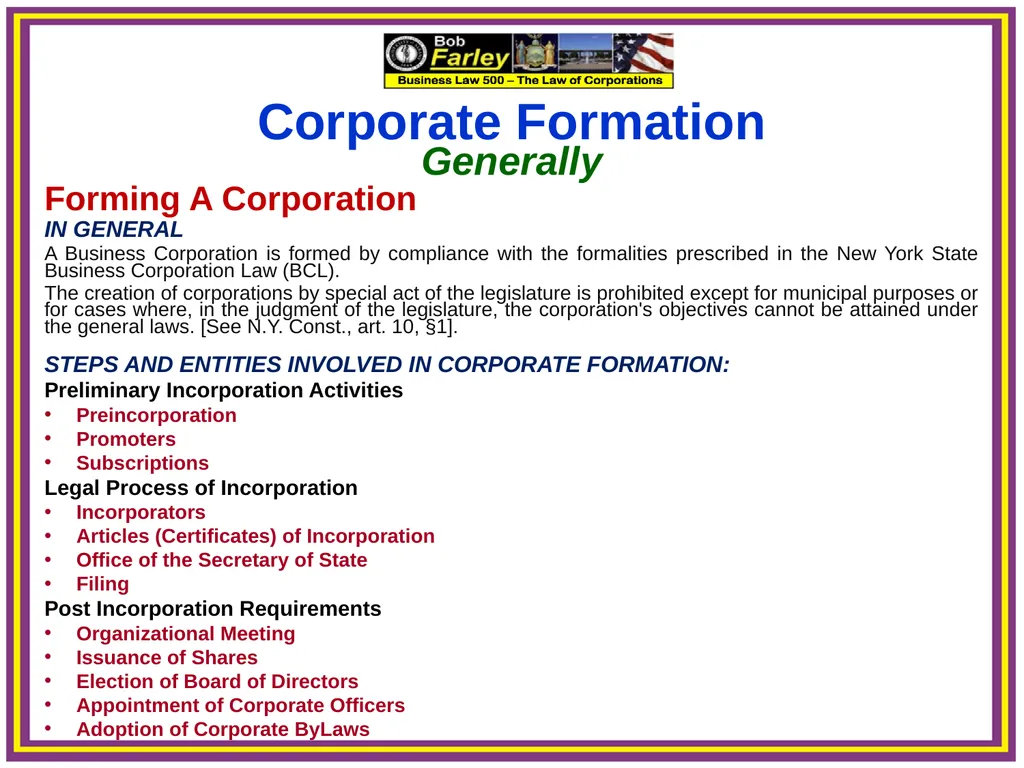
Forming A Corporation
IN GENERAL
A Business Corporation is formed by compliance with the formalities prescribed in the New York State Business Corporation Law (BCL).
The creation of corporations by special act of the legislature is prohibited except for municipal purposes or for cases where, in the judgment of the legislature, the corporation's objectives cannot be attained under the general laws. [See N.Y. Const., art. 10, §1].
STEPS AND ENTITIES INVOLVED IN CORPORATE FORMATION:
Preliminary Incorporation Activities
Preincorporation
Promoters
Subscriptions
Legal Process of Incorporation
Incorporators
Articles (Certificates) of Incorporation
Office of the Secretary of State
Filing
Post Incorporation Requirements
Organizational Meeting
Issuance of Shares
Election of Board of Directors
Appointment of Corporate Officers
Adoption of Corporate ByLaws<br>
Generally
Forming A Corporation
IN GENERAL
A Business Corporation is formed by compliance with the formalities prescribed in the New York State Business Corporation Law (BCL).
The creation of corporations by special act of the legislature is prohibited except for municipal purposes or for cases where, in the judgment of the legislature, the corporation's objectives cannot be attained under the general laws. [See N.Y. Const., art. 10, §1].
STEPS AND ENTITIES INVOLVED IN CORPORATE FORMATION:
Preliminary Incorporation Activities
Preincorporation
Promoters
Subscriptions
Legal Process of Incorporation
Incorporators
Articles (Certificates) of Incorporation
Office of the Secretary of State
Filing
Post Incorporation Requirements
Organizational Meeting
Issuance of Shares
Election of Board of Directors
Appointment of Corporate Officers
Adoption of Corporate ByLaws<br>
13
Part Three:
Corporate Formation
Promoters<br>
Corporate Formation
Promoters<br>
14
Corporate Formation
Pre-Incorporation
Promoters:
Definition: As used by the courts, the term "promoter" has been defined as:
“A fiduciary who provides the organizational initiative for the founding of a business enterprise, and who sets in motion all that needs to be done to form the corporation that will conduct the business enterprise”
As expressed above, it has been a term discussed in case law, and is not defined in the business corporation law. It is therefore not a term of art, but rather a term of Business.
Role of Promoters: The role of a promoter includes:
Working on a plan to build, organize and bring about a new business enterprise;
Bringing together persons interested in the new enterprise;
Preparing the prospectus, advertising and documentation promoting the new company;
Aiding in the procurement of subscriptions for shares in the future corporation; and
Ending their role and liabilities upon the functioning of the new corporation.
Security and Exchange Commission Definition: Rule 405 (a) defines a promoter as a person, who, acting alone or in conjunction with other persons directly or indirectly takes the initiative in founding or organizing the business enterprise.<br>
Pre-Incorporation
Promoters:
Definition: As used by the courts, the term "promoter" has been defined as:
“A fiduciary who provides the organizational initiative for the founding of a business enterprise, and who sets in motion all that needs to be done to form the corporation that will conduct the business enterprise”
As expressed above, it has been a term discussed in case law, and is not defined in the business corporation law. It is therefore not a term of art, but rather a term of Business.
Role of Promoters: The role of a promoter includes:
Working on a plan to build, organize and bring about a new business enterprise;
Bringing together persons interested in the new enterprise;
Preparing the prospectus, advertising and documentation promoting the new company;
Aiding in the procurement of subscriptions for shares in the future corporation; and
Ending their role and liabilities upon the functioning of the new corporation.
Security and Exchange Commission Definition: Rule 405 (a) defines a promoter as a person, who, acting alone or in conjunction with other persons directly or indirectly takes the initiative in founding or organizing the business enterprise.<br>
15
Corporate Formation
Pre-Incorporation
Promoters as Fiduciaries:
Promoters are fiduciaries to the future corporation they seek to have formed.
Defined: A fiduciary is defined as:
“ A person who is required to act for the benefit of another person on all matters within the scope of their relationship and who owes such other person the duties of good faith, trust, confidence and candor”
Such promoters, in their role as fiduciaries, advance efforts and resources to contribute to corporate formation in the early stages of a new business enterprise.
Duties of Promoters: The duties of a promoter flow from their position as fiduciary. Accordingly, they have wide powers to organize the formation of a corporation. Although they are not an agent (since the corporation has yet to come into existence) their legal relationship as a fiduciary with the proposed corporation they promote, and as to those persons whom they induce to become shareholders, is pronounced and serious.
Liability of Promoters: Promoters are personally liable for contracts made on behalf of the corporation before its existence. The corporation is not liable on these contracts unless and until it adopts them through ratification after it comes into existence. They are also liable for any untrue statements on a prospectus, for fraud in promoting the corporation, for misapplication or wrongful retention of corporate property, for misfeasance or breach of trust in representing the corporation to third parties.<br>
Pre-Incorporation
Promoters as Fiduciaries:
Promoters are fiduciaries to the future corporation they seek to have formed.
Defined: A fiduciary is defined as:
“ A person who is required to act for the benefit of another person on all matters within the scope of their relationship and who owes such other person the duties of good faith, trust, confidence and candor”
Such promoters, in their role as fiduciaries, advance efforts and resources to contribute to corporate formation in the early stages of a new business enterprise.
Duties of Promoters: The duties of a promoter flow from their position as fiduciary. Accordingly, they have wide powers to organize the formation of a corporation. Although they are not an agent (since the corporation has yet to come into existence) their legal relationship as a fiduciary with the proposed corporation they promote, and as to those persons whom they induce to become shareholders, is pronounced and serious.
Liability of Promoters: Promoters are personally liable for contracts made on behalf of the corporation before its existence. The corporation is not liable on these contracts unless and until it adopts them through ratification after it comes into existence. They are also liable for any untrue statements on a prospectus, for fraud in promoting the corporation, for misapplication or wrongful retention of corporate property, for misfeasance or breach of trust in representing the corporation to third parties.<br>
16
Corporate Formation
Pre-Incorporation
Promoters Duties to ''Outside'' Investors
Profits Taken After ''Outsiders'' Come In: Once "outside" investors come into the picture, promoters are charged with fiduciary obligations of disclosure and accountability to the corporation for their secret profits and profits from self-dealing-unless there is at least consent or ratification. [See Northridge, supra, app. from remand, 10 A.D.2d 244. aff'd, 9 N.Y.2d 818 (1961)].
Profits Taken Before "Outsiders" Come In: Promoters must also account to the corporation for profits from self-dealing before "outsiders" came in if the issuance of the additional shares to uninformed outsiders was contemplated or the public was invited to become original subscribers.
Exception: The promoters are not accountable for profits of which the outsiders had notice. [Northridge, supra]
When Promoters' Fiduciary Duties Terminate: The fiduciary duty of promoters to the corporation is not "enlarged" by introduction of new shareholders several years after the complained-of transactions. [See Continental Securities Co. v. Belmont, 168 A.D. 483 (1915), aff'd, 222 N.Y. 673 (1918)].
However, promoters do have a fiduciary duty to the corporation both:
I) As to investors who subscribed while the promoters were in control; and
2) As to transactions that were fixed in their terms while the promoters were in control, even if the subscribers purchase and the transactions are consummated after the promoters dispose of their interests. [See Shore Terrace Cooperative, Inc. v. Roche, 25 A.D.2d 666 (1966)].<br>
Pre-Incorporation
Promoters Duties to ''Outside'' Investors
Profits Taken After ''Outsiders'' Come In: Once "outside" investors come into the picture, promoters are charged with fiduciary obligations of disclosure and accountability to the corporation for their secret profits and profits from self-dealing-unless there is at least consent or ratification. [See Northridge, supra, app. from remand, 10 A.D.2d 244. aff'd, 9 N.Y.2d 818 (1961)].
Profits Taken Before "Outsiders" Come In: Promoters must also account to the corporation for profits from self-dealing before "outsiders" came in if the issuance of the additional shares to uninformed outsiders was contemplated or the public was invited to become original subscribers.
Exception: The promoters are not accountable for profits of which the outsiders had notice. [Northridge, supra]
When Promoters' Fiduciary Duties Terminate: The fiduciary duty of promoters to the corporation is not "enlarged" by introduction of new shareholders several years after the complained-of transactions. [See Continental Securities Co. v. Belmont, 168 A.D. 483 (1915), aff'd, 222 N.Y. 673 (1918)].
However, promoters do have a fiduciary duty to the corporation both:
I) As to investors who subscribed while the promoters were in control; and
2) As to transactions that were fixed in their terms while the promoters were in control, even if the subscribers purchase and the transactions are consummated after the promoters dispose of their interests. [See Shore Terrace Cooperative, Inc. v. Roche, 25 A.D.2d 666 (1966)].<br>
17
Corporate Formation
Pre-Incorporation
Liability of Corporation/Promoter on Contracts With Third Parties
General Rule: "Adoption“: A contract signed by a promoter before the corporate existence begins, cannot, in its inception, be the corporation's contract, or binding upon the corporation. This is because an a nonexistent entity cannot be deemed as liable for actions taken before it came into existence. The corporation, once legally formed, however, may become liable on the promoter's contract by "adopting" (ratifying) it.
Express Adoption: Adoption" may be express, i.e . by a positive, authorized act. [See Reif v. Williams Sportswear, Inc., 9 NY2d 387 (1961)].
Adoption by Implication: "Adoption" may also be implied from an acceptance of the benefits with full knowledge (through the corporation's officers) of the contract's existence. [See Morgan v. Bon Bon Co., 222 N.Y. 22 (1917)].
"Alter Ego” of Predecessor: A corporation will be liable on preincorporation contracts when it takes over completely the assets of an unincorporated predecessor and becomes the "alter ego" of its promoters. [See Reif, supra].
Retained Liability of Promoter: New York courts have recognized the general rule that holds the promoter personally liable for contracts entered into "on behalf" of a proposed (but still nonexistent) corporation. [See Puro Filter Corp. v. Trembley, 266 A.D. 750 (1943)].
However, courts have also held the promoter not subject to personal liability where either:
Intention of the Parties: The intention of parties was evidently to bind only the corporation or;
Novation: There is a novation of the contract where the third party agreed to look only to the corporation for responsibility.
Enforcement by Corporation: A preincorporation agreement intended for the benefit of the proposed corporation is enforceable by the corporation if the corporation expressly or impliedly adopts the contract and acts in furtherance of contracts are sufficient for this purpose. [See S&B Rubber & Chemical Corp. v. Stein, 7 N.Y.S.2d 553, aff'd, 255 A.D. 1012 (1938)]<br>
Pre-Incorporation
Liability of Corporation/Promoter on Contracts With Third Parties
General Rule: "Adoption“: A contract signed by a promoter before the corporate existence begins, cannot, in its inception, be the corporation's contract, or binding upon the corporation. This is because an a nonexistent entity cannot be deemed as liable for actions taken before it came into existence. The corporation, once legally formed, however, may become liable on the promoter's contract by "adopting" (ratifying) it.
Express Adoption: Adoption" may be express, i.e . by a positive, authorized act. [See Reif v. Williams Sportswear, Inc., 9 NY2d 387 (1961)].
Adoption by Implication: "Adoption" may also be implied from an acceptance of the benefits with full knowledge (through the corporation's officers) of the contract's existence. [See Morgan v. Bon Bon Co., 222 N.Y. 22 (1917)].
"Alter Ego” of Predecessor: A corporation will be liable on preincorporation contracts when it takes over completely the assets of an unincorporated predecessor and becomes the "alter ego" of its promoters. [See Reif, supra].
Retained Liability of Promoter: New York courts have recognized the general rule that holds the promoter personally liable for contracts entered into "on behalf" of a proposed (but still nonexistent) corporation. [See Puro Filter Corp. v. Trembley, 266 A.D. 750 (1943)].
However, courts have also held the promoter not subject to personal liability where either:
Intention of the Parties: The intention of parties was evidently to bind only the corporation or;
Novation: There is a novation of the contract where the third party agreed to look only to the corporation for responsibility.
Enforcement by Corporation: A preincorporation agreement intended for the benefit of the proposed corporation is enforceable by the corporation if the corporation expressly or impliedly adopts the contract and acts in furtherance of contracts are sufficient for this purpose. [See S&B Rubber & Chemical Corp. v. Stein, 7 N.Y.S.2d 553, aff'd, 255 A.D. 1012 (1938)]<br>
18
Part Four:
Corporate Formation
Subscriptions<br>
Corporate Formation
Subscriptions<br>
19
Corporate Formation
Pre-Incorporation
Subscriptions:
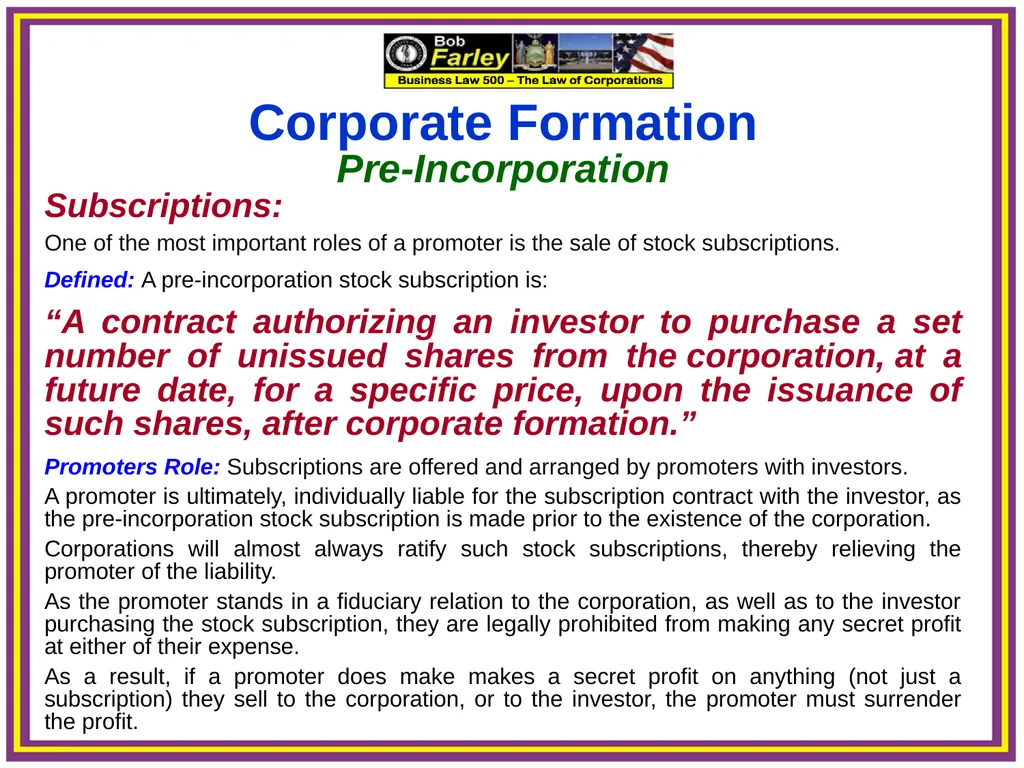
One of the most important roles of a promoter is the sale of stock subscriptions.
Defined: A pre-incorporation stock subscription is:
“A contract authorizing an investor to purchase a set number of unissued shares from the corporation, at a future date, for a specific price, upon the issuance of such shares, after corporate formation.”
Promoters Role: Subscriptions are offered and arranged by promoters with investors.
A promoter is ultimately, individually liable for the subscription contract with the investor, as the pre-incorporation stock subscription is made prior to the existence of the corporation.
Corporations will almost always ratify such stock subscriptions, thereby relieving the promoter of the liability.
As the promoter stands in a fiduciary relation to the corporation, as well as to the investor purchasing the stock subscription, they are legally prohibited from making any secret profit at either of their expense.
As a result, if a promoter does make makes a secret profit on anything (not just a subscription) they sell to the corporation, or to the investor, the promoter must surrender the profit.<br>
Pre-Incorporation
Subscriptions:
One of the most important roles of a promoter is the sale of stock subscriptions.
Defined: A pre-incorporation stock subscription is:
“A contract authorizing an investor to purchase a set number of unissued shares from the corporation, at a future date, for a specific price, upon the issuance of such shares, after corporate formation.”
Promoters Role: Subscriptions are offered and arranged by promoters with investors.
A promoter is ultimately, individually liable for the subscription contract with the investor, as the pre-incorporation stock subscription is made prior to the existence of the corporation.
Corporations will almost always ratify such stock subscriptions, thereby relieving the promoter of the liability.
As the promoter stands in a fiduciary relation to the corporation, as well as to the investor purchasing the stock subscription, they are legally prohibited from making any secret profit at either of their expense.
As a result, if a promoter does make makes a secret profit on anything (not just a subscription) they sell to the corporation, or to the investor, the promoter must surrender the profit.<br>
20
Corporate Formation
Pre-Incorporation
Subscriptions:
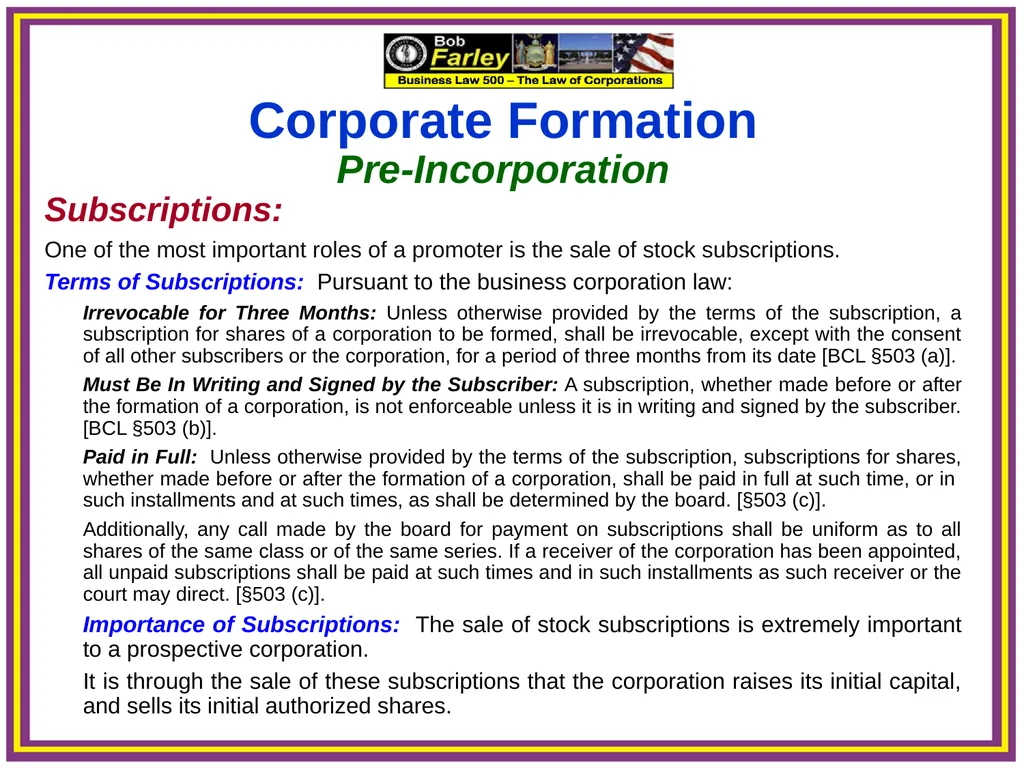
One of the most important roles of a promoter is the sale of stock subscriptions.
Terms of Subscriptions: Pursuant to the business corporation law:
Irrevocable for Three Months: Unless otherwise provided by the terms of the subscription, a subscription for shares of a corporation to be formed, shall be irrevocable, except with the consent of all other subscribers or the corporation, for a period of three months from its date [BCL §503 (a)].
Must Be In Writing and Signed by the Subscriber: A subscription, whether made before or after the formation of a corporation, is not enforceable unless it is in writing and signed by the subscriber. [BCL §503 (b)].
Paid in Full: Unless otherwise provided by the terms of the subscription, subscriptions for shares, whether made before or after the formation of a corporation, shall be paid in full at such time, or in such installments and at such times, as shall be determined by the board. [§503 (c)].
Additionally, any call made by the board for payment on subscriptions shall be uniform as to all shares of the same class or of the same series. If a receiver of the corporation has been appointed, all unpaid subscriptions shall be paid at such times and in such installments as such receiver or the court may direct. [§503 (c)].
Importance of Subscriptions: The sale of stock subscriptions is extremely important to a prospective corporation.
It is through the sale of these subscriptions that the corporation raises its initial capital, and sells its initial authorized shares.<br>
Pre-Incorporation
Subscriptions:
One of the most important roles of a promoter is the sale of stock subscriptions.
Terms of Subscriptions: Pursuant to the business corporation law:
Irrevocable for Three Months: Unless otherwise provided by the terms of the subscription, a subscription for shares of a corporation to be formed, shall be irrevocable, except with the consent of all other subscribers or the corporation, for a period of three months from its date [BCL §503 (a)].
Must Be In Writing and Signed by the Subscriber: A subscription, whether made before or after the formation of a corporation, is not enforceable unless it is in writing and signed by the subscriber. [BCL §503 (b)].
Paid in Full: Unless otherwise provided by the terms of the subscription, subscriptions for shares, whether made before or after the formation of a corporation, shall be paid in full at such time, or in such installments and at such times, as shall be determined by the board. [§503 (c)].
Additionally, any call made by the board for payment on subscriptions shall be uniform as to all shares of the same class or of the same series. If a receiver of the corporation has been appointed, all unpaid subscriptions shall be paid at such times and in such installments as such receiver or the court may direct. [§503 (c)].
Importance of Subscriptions: The sale of stock subscriptions is extremely important to a prospective corporation.
It is through the sale of these subscriptions that the corporation raises its initial capital, and sells its initial authorized shares.<br>
21
End of Class Three A
For next time – Review Assignments as follows on the Webpage:
Lecture Slides
Selected Readings
Cases and Exercises
We are a hot bench.
Questions?<br>
For next time – Review Assignments as follows on the Webpage:
Lecture Slides
Selected Readings
Cases and Exercises
We are a hot bench.
Questions?<br>