
Smaller and Faster: Data Compression in
MJ
Published · 22 slides · 0 views
1 / 1

Description
Smaller and Faster: Data Compression in areaDetector Mark Rivers GeoSoilEnviroCARS, Advanced Photon Source University of Chicago Last talk at NSLS-II was May 2018 ADCore releases since then: R3-4, R3-5, R3-6 (soon) This talk: New data
Related Topics
Share
Embed code
Download this presentation From Below
"Smaller and Faster: Data Compression in" is the property of its rightful owner. Permission is granted to download and print the materials on this website for personal, non-commercial use only, and to display it on your personal computer provided you do not modify the materials and that you retain all copyright notices contained in the materials. By downloading content from our website, you accept the terms of this agreement.
Presentation Transcript
01
Smaller and Faster:
Data Compression in areaDetector Mark Rivers
GeoSoilEnviroCARS, Advanced Photon Source
University of Chicago<br>
Data Compression in areaDetector Mark Rivers
GeoSoilEnviroCARS, Advanced Photon Source
University of Chicago<br>
02
Last talk at NSLS-II was May 2018
ADCore releases since then: R3-4, R3-5, R3-6 (soon)
This talk:
New data compression features
Demo of data compression
Other major features from these releases
Second talk: Enhanced Support for GenICam Cameras and Detectors Outline<br>
ADCore releases since then: R3-4, R3-5, R3-6 (soon)
This talk:
New data compression features
Demo of data compression
Other major features from these releases
Second talk: Enhanced Support for GenICam Cameras and Detectors Outline<br>
03
We are already in the era of “big data” with existing detectors. Eiger, Pilatus, Lambda, PCO, FLIR/Point Grey, Xspress 3, etc.
Can all produce data faster than most disk systems can handle
All exceed 1 Gbit network capacity, and some exceed 10 Gbit.
Rapidly fill up disks
Will become a more serious issue with coming upgrades
Increased count rates will allow existing detectors to run at their maximum speed
New generations of even faster detectors will be coming
Data compression can help with these issues
Must be fast and easy to use Data Compression Motivation<br>
Can all produce data faster than most disk systems can handle
All exceed 1 Gbit network capacity, and some exceed 10 Gbit.
Rapidly fill up disks
Will become a more serious issue with coming upgrades
Increased count rates will allow existing detectors to run at their maximum speed
New generations of even faster detectors will be coming
Data compression can help with these issues
Must be fast and easy to use Data Compression Motivation<br>
04
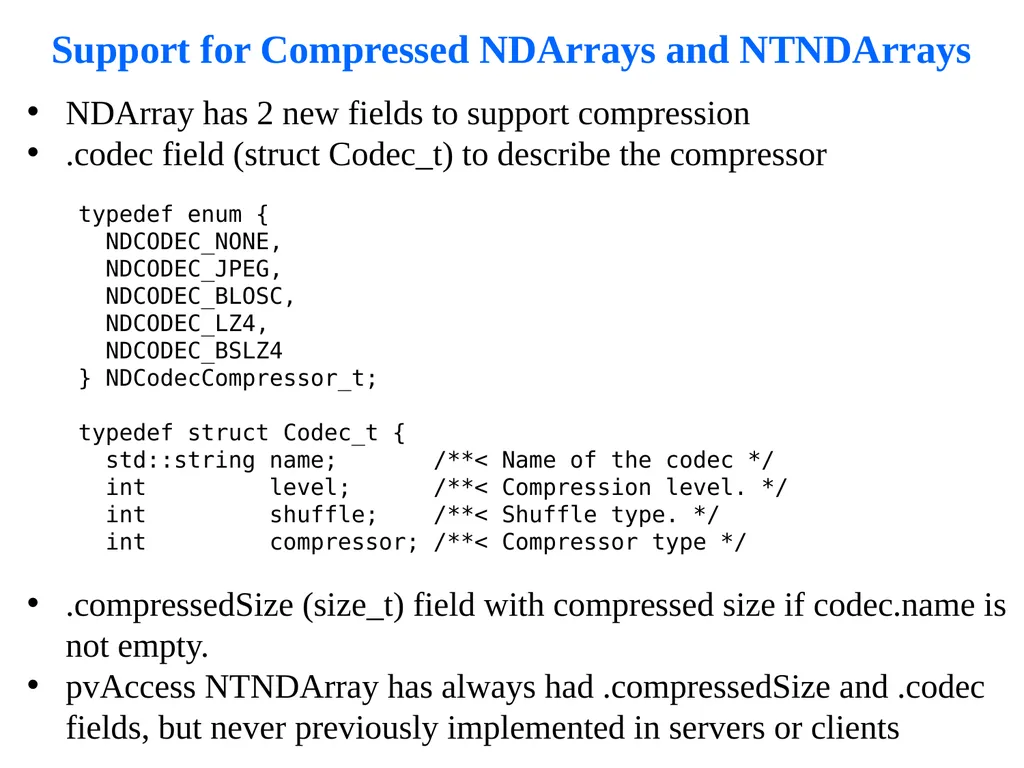
Support for Compressed NDArrays and NTNDArrays NDArray has 2 new fields to support compression
.codec field (struct Codec_t) to describe the compressor
typedef enum {
NDCODEC_NONE,
NDCODEC_JPEG,
NDCODEC_BLOSC,
NDCODEC_LZ4,
NDCODEC_BSLZ4
} NDCodecCompressor_t;
typedef struct Codec_t {
std::string name; /**< Name of the codec */
int level; /**< Compression level. */
int shuffle; /**< Shuffle type. */
int compressor; /**< Compressor type */
.compressedSize (size_t) field with compressed size if codec.name is not empty.
pvAccess NTNDArray has always had .compressedSize and .codec fields, but never previously implemented in servers or clients<br>
.codec field (struct Codec_t) to describe the compressor
typedef enum {
NDCODEC_NONE,
NDCODEC_JPEG,
NDCODEC_BLOSC,
NDCODEC_LZ4,
NDCODEC_BSLZ4
} NDCodecCompressor_t;
typedef struct Codec_t {
std::string name; /**< Name of the codec */
int level; /**< Compression level. */
int shuffle; /**< Shuffle type. */
int compressor; /**< Compressor type */
.compressedSize (size_t) field with compressed size if codec.name is not empty.
pvAccess NTNDArray has always had .compressedSize and .codec fields, but never previously implemented in servers or clients<br>
05
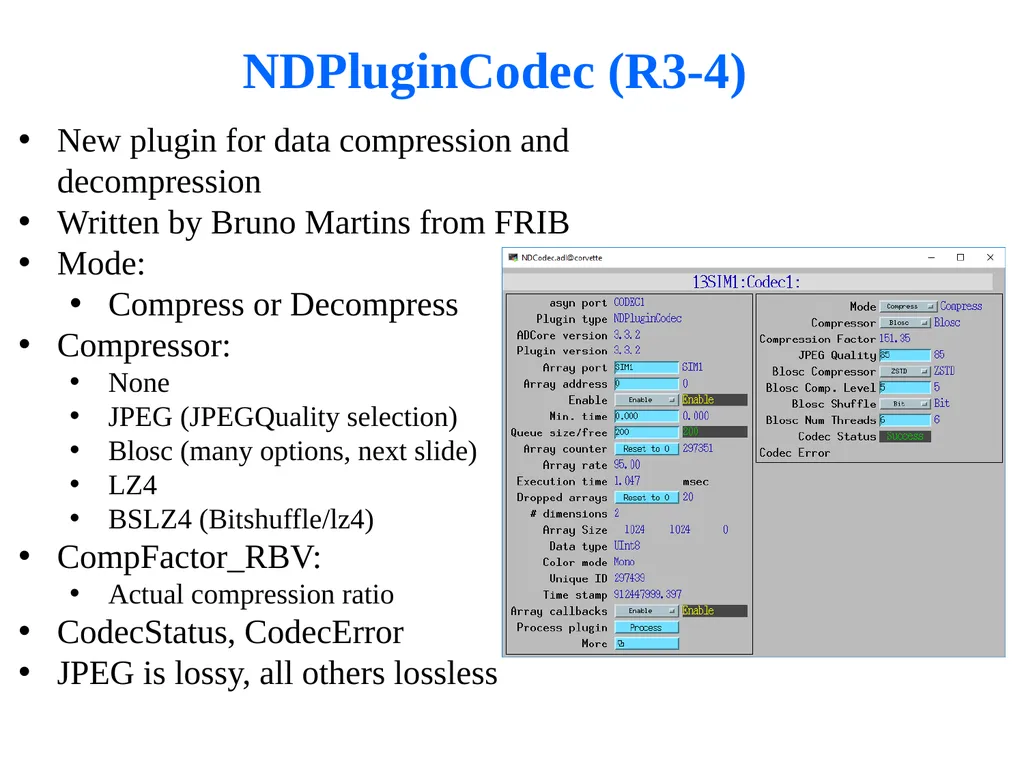
NDPluginCodec (R3-4) New plugin for data compression and decompression
Written by Bruno Martins from FRIB
Mode:
Compress or Decompress
Compressor:
None
JPEG (JPEGQuality selection)
Blosc (many options, next slide)
LZ4
BSLZ4 (Bitshuffle/lz4)
CompFactor_RBV:
Actual compression ratio
CodecStatus, CodecError
JPEG is lossy, all others lossless<br>
Written by Bruno Martins from FRIB
Mode:
Compress or Decompress
Compressor:
None
JPEG (JPEGQuality selection)
Blosc (many options, next slide)
LZ4
BSLZ4 (Bitshuffle/lz4)
CompFactor_RBV:
Actual compression ratio
CodecStatus, CodecError
JPEG is lossy, all others lossless<br>
06
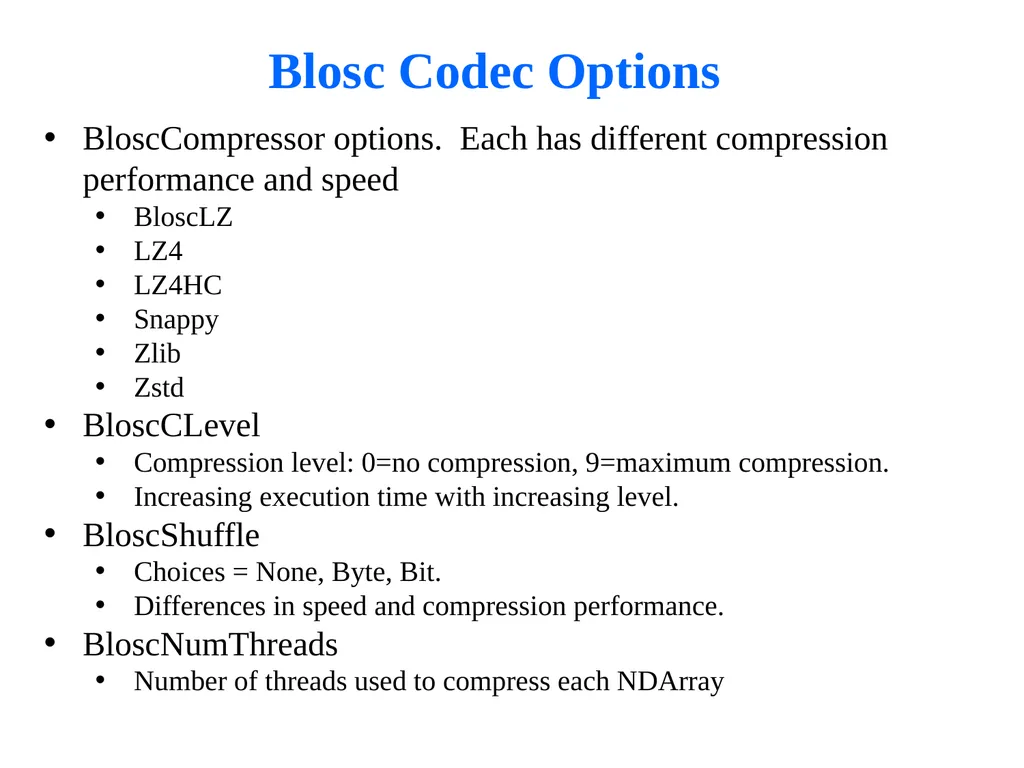
Blosc Codec Options BloscCompressor options. Each has different compression performance and speed
BloscLZ
LZ4
LZ4HC
Snappy
Zlib
Zstd
BloscCLevel
Compression level: 0=no compression, 9=maximum compression.
Increasing execution time with increasing level.
BloscShuffle
Choices = None, Byte, Bit.
Differences in speed and compression performance.
BloscNumThreads
Number of threads used to compress each NDArray<br>
BloscLZ
LZ4
LZ4HC
Snappy
Zlib
Zstd
BloscCLevel
Compression level: 0=no compression, 9=maximum compression.
Increasing execution time with increasing level.
BloscShuffle
Choices = None, Byte, Bit.
Differences in speed and compression performance.
BloscNumThreads
Number of threads used to compress each NDArray<br>
07
LZ4 and BSLZ4 Codecs These are the codecs used by the Eiger server from Dectris
They don’t use the Blosc codecs, but rather the native LZ4 and Bitshuffle/LZ4 codecs.
Dectris server can optionally use these compressions for HDF5 files saved locally on their server
Dectris server always uses one of these compressions for data streamed over the ZeroMQ socket interface to the ADEiger driver
These can now be decoded directly in ADEiger, or passed as compressed NDArrays to NDPluginCodec and other plugins
Compressed arrays can be passed directly to NDFileHDF5 to be written with newly supported direct chunk write feature. More on this later.<br>
They don’t use the Blosc codecs, but rather the native LZ4 and Bitshuffle/LZ4 codecs.
Dectris server can optionally use these compressions for HDF5 files saved locally on their server
Dectris server always uses one of these compressions for data streamed over the ZeroMQ socket interface to the ADEiger driver
These can now be decoded directly in ADEiger, or passed as compressed NDArrays to NDPluginCodec and other plugins
Compressed arrays can be passed directly to NDFileHDF5 to be written with newly supported direct chunk write feature. More on this later.<br>
08
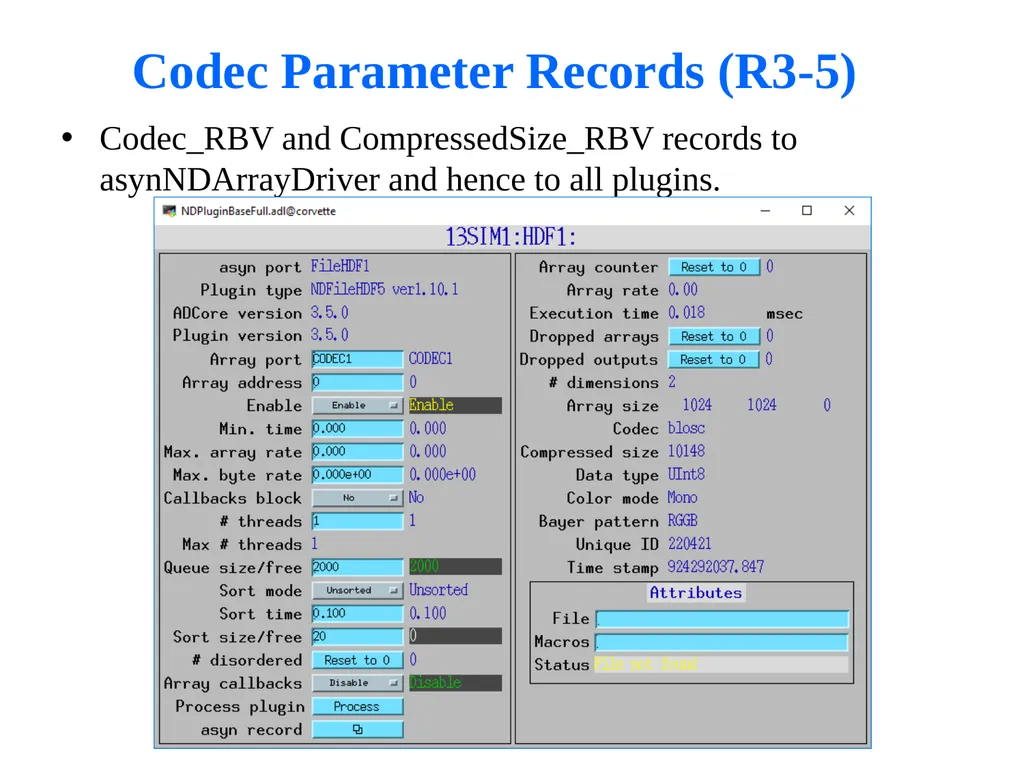
Codec Parameter Records (R3-5) Codec_RBV and CompressedSize_RBV records to asynNDArrayDriver and hence to all plugins.<br>
09
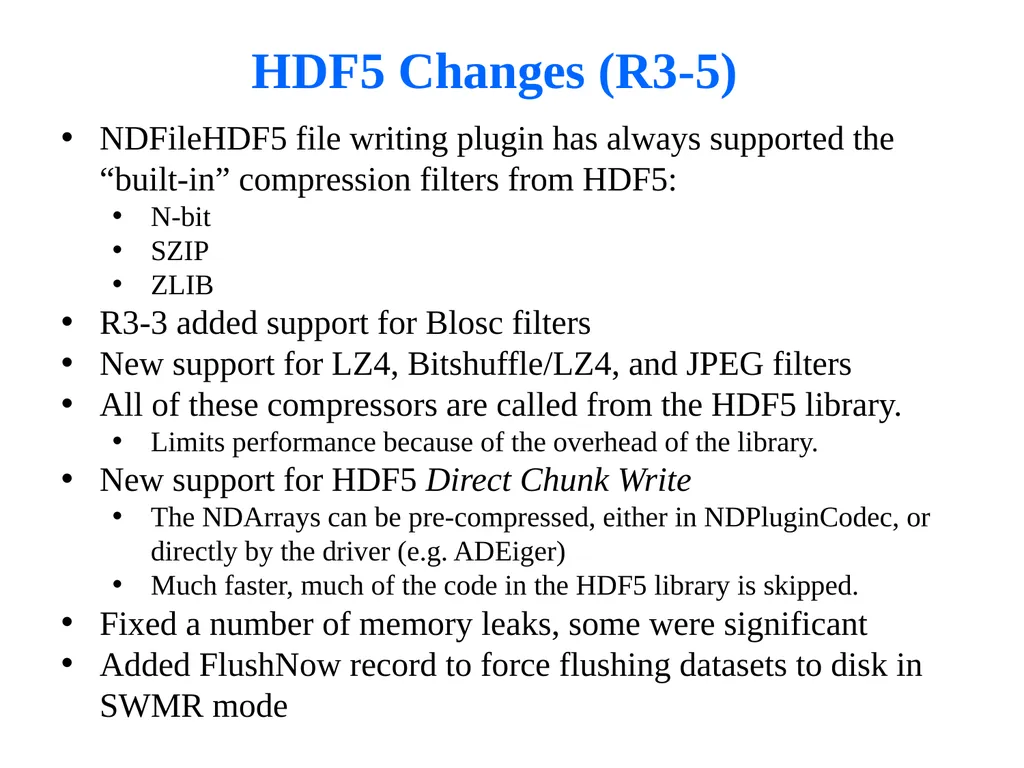
HDF5 Changes (R3-5) NDFileHDF5 file writing plugin has always supported the “built-in” compression filters from HDF5:
N-bit
SZIP
ZLIB
R3-3 added support for Blosc filters
New support for LZ4, Bitshuffle/LZ4, and JPEG filters
All of these compressors are called from the HDF5 library.
Limits performance because of the overhead of the library.
New support for HDF5 Direct Chunk Write
The NDArrays can be pre-compressed, either in NDPluginCodec, or directly by the driver (e.g. ADEiger)
Much faster, much of the code in the HDF5 library is skipped.
Fixed a number of memory leaks, some were significant
Added FlushNow record to force flushing datasets to disk in SWMR mode<br>
N-bit
SZIP
ZLIB
R3-3 added support for Blosc filters
New support for LZ4, Bitshuffle/LZ4, and JPEG filters
All of these compressors are called from the HDF5 library.
Limits performance because of the overhead of the library.
New support for HDF5 Direct Chunk Write
The NDArrays can be pre-compressed, either in NDPluginCodec, or directly by the driver (e.g. ADEiger)
Much faster, much of the code in the HDF5 library is skipped.
Fixed a number of memory leaks, some were significant
Added FlushNow record to force flushing datasets to disk in SWMR mode<br>
10
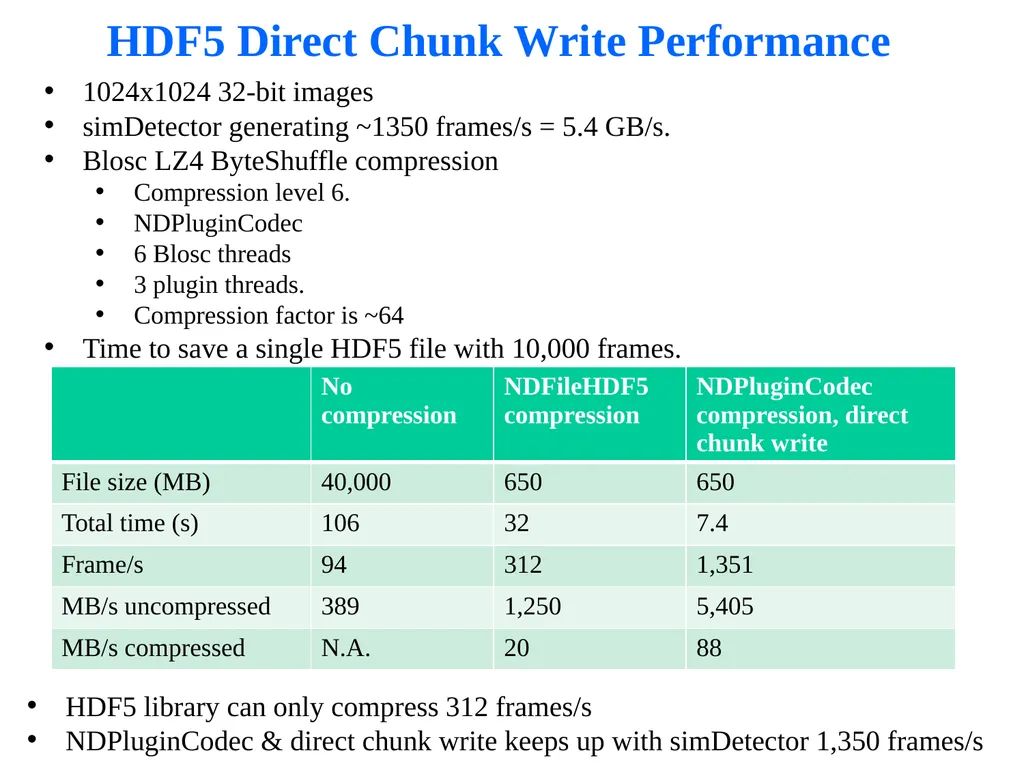
HDF5 Direct Chunk Write Performance 1024x1024 32-bit images
simDetector generating ~1350 frames/s = 5.4 GB/s.
Blosc LZ4 ByteShuffle compression
Compression level 6.
NDPluginCodec
6 Blosc threads
3 plugin threads.
Compression factor is ~64
Time to save a single HDF5 file with 10,000 frames. HDF5 library can only compress 312 frames/s
NDPluginCodec & direct chunk write keeps up with simDetector 1,350 frames/s<br>
simDetector generating ~1350 frames/s = 5.4 GB/s.
Blosc LZ4 ByteShuffle compression
Compression level 6.
NDPluginCodec
6 Blosc threads
3 plugin threads.
Compression factor is ~64
Time to save a single HDF5 file with 10,000 frames. HDF5 library can only compress 312 frames/s
NDPluginCodec & direct chunk write keeps up with simDetector 1,350 frames/s<br>
11
HDF5 Decompression Plugin Filters
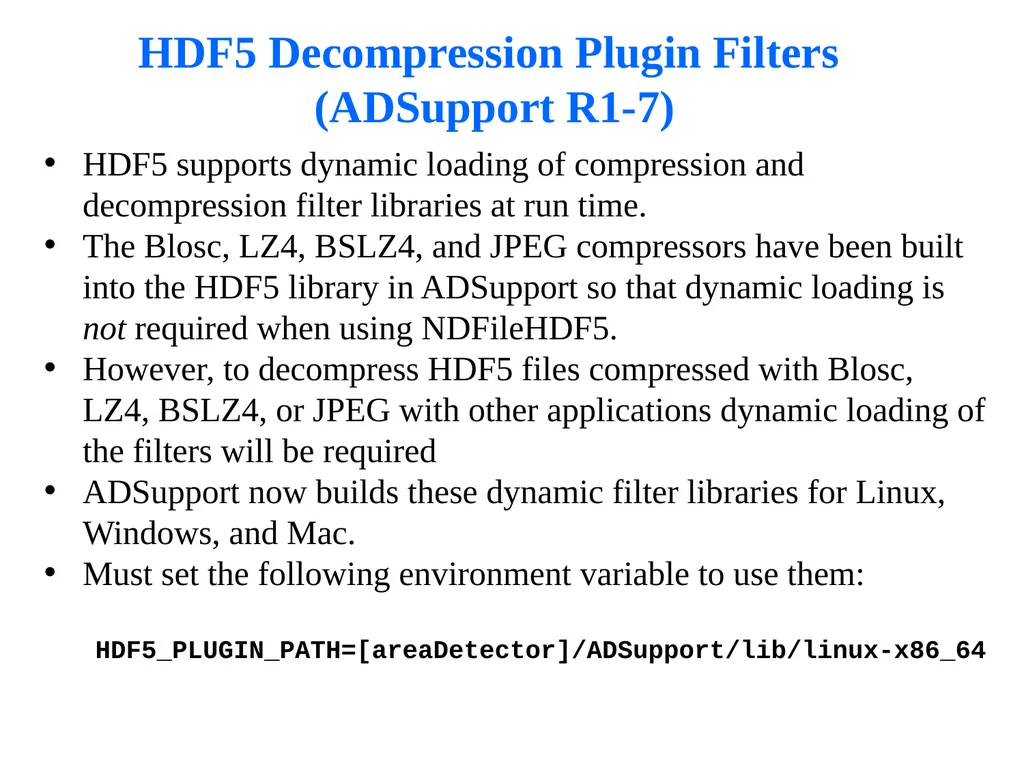
(ADSupport R1-7) HDF5 supports dynamic loading of compression and decompression filter libraries at run time.
The Blosc, LZ4, BSLZ4, and JPEG compressors have been built into the HDF5 library in ADSupport so that dynamic loading is not required when using NDFileHDF5.
However, to decompress HDF5 files compressed with Blosc, LZ4, BSLZ4, or JPEG with other applications dynamic loading of the filters will be required
ADSupport now builds these dynamic filter libraries for Linux, Windows, and Mac.
Must set the following environment variable to use them:
HDF5_PLUGIN_PATH=[areaDetector]/ADSupport/lib/linux-x86_64<br>
The Blosc, LZ4, BSLZ4, and JPEG compressors have been built into the HDF5 library in ADSupport so that dynamic loading is not required when using NDFileHDF5.
However, to decompress HDF5 files compressed with Blosc, LZ4, BSLZ4, or JPEG with other applications dynamic loading of the filters will be required
ADSupport now builds these dynamic filter libraries for Linux, Windows, and Mac.
Must set the following environment variable to use them:
HDF5_PLUGIN_PATH=[areaDetector]/ADSupport/lib/linux-x86_64<br>
12
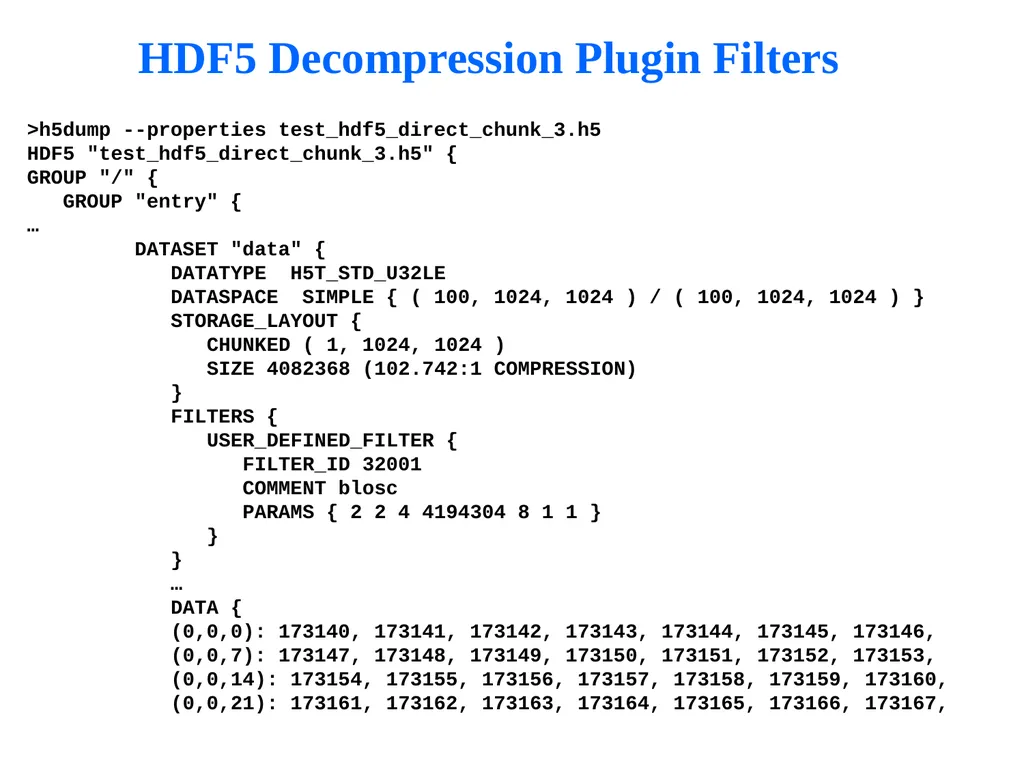
HDF5 Decompression Plugin Filters >h5dump --properties test_hdf5_direct_chunk_3.h5
HDF5 "test_hdf5_direct_chunk_3.h5" {
GROUP "/" {
GROUP "entry" {
…
DATASET "data" {
DATATYPE H5T_STD_U32LE
DATASPACE SIMPLE { ( 100, 1024, 1024 ) / ( 100, 1024, 1024 ) }
STORAGE_LAYOUT {
CHUNKED ( 1, 1024, 1024 )
SIZE 4082368 (102.742:1 COMPRESSION)
}
FILTERS {
USER_DEFINED_FILTER {
FILTER_ID 32001
COMMENT blosc
PARAMS { 2 2 4 4194304 8 1 1 }
}
}
…
DATA {
(0,0,0): 173140, 173141, 173142, 173143, 173144, 173145, 173146,
(0,0,7): 173147, 173148, 173149, 173150, 173151, 173152, 173153,
(0,0,14): 173154, 173155, 173156, 173157, 173158, 173159, 173160,
(0,0,21): 173161, 173162, 173163, 173164, 173165, 173166, 173167,<br>
HDF5 "test_hdf5_direct_chunk_3.h5" {
GROUP "/" {
GROUP "entry" {
…
DATASET "data" {
DATATYPE H5T_STD_U32LE
DATASPACE SIMPLE { ( 100, 1024, 1024 ) / ( 100, 1024, 1024 ) }
STORAGE_LAYOUT {
CHUNKED ( 1, 1024, 1024 )
SIZE 4082368 (102.742:1 COMPRESSION)
}
FILTERS {
USER_DEFINED_FILTER {
FILTER_ID 32001
COMMENT blosc
PARAMS { 2 2 4 4194304 8 1 1 }
}
}
…
DATA {
(0,0,0): 173140, 173141, 173142, 173143, 173144, 173145, 173146,
(0,0,7): 173147, 173148, 173149, 173150, 173151, 173152, 173153,
(0,0,14): 173154, 173155, 173156, 173157, 173158, 173159, 173160,
(0,0,21): 173161, 173162, 173163, 173164, 173165, 173166, 173167,<br>
13
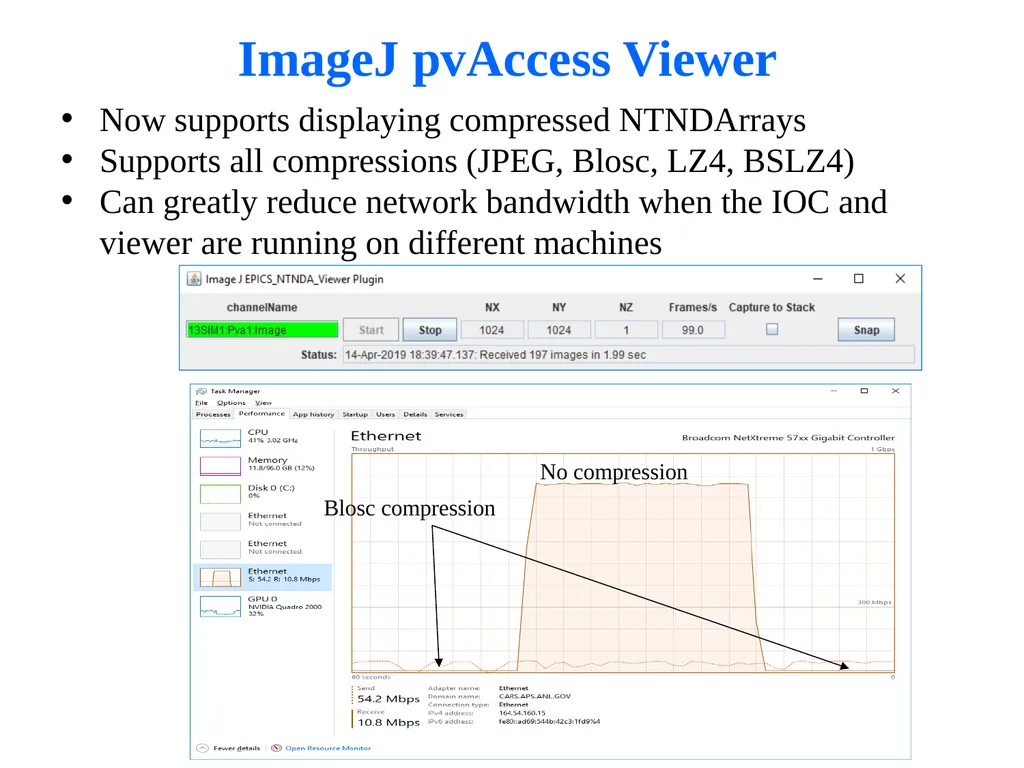
ImageJ pvAccess Viewer Now supports displaying compressed NTNDArrays
Supports all compressions (JPEG, Blosc, LZ4, BSLZ4)
Can greatly reduce network bandwidth when the IOC and viewer are running on different machines<br>
Supports all compressions (JPEG, Blosc, LZ4, BSLZ4)
Can greatly reduce network bandwidth when the IOC and viewer are running on different machines<br>
14
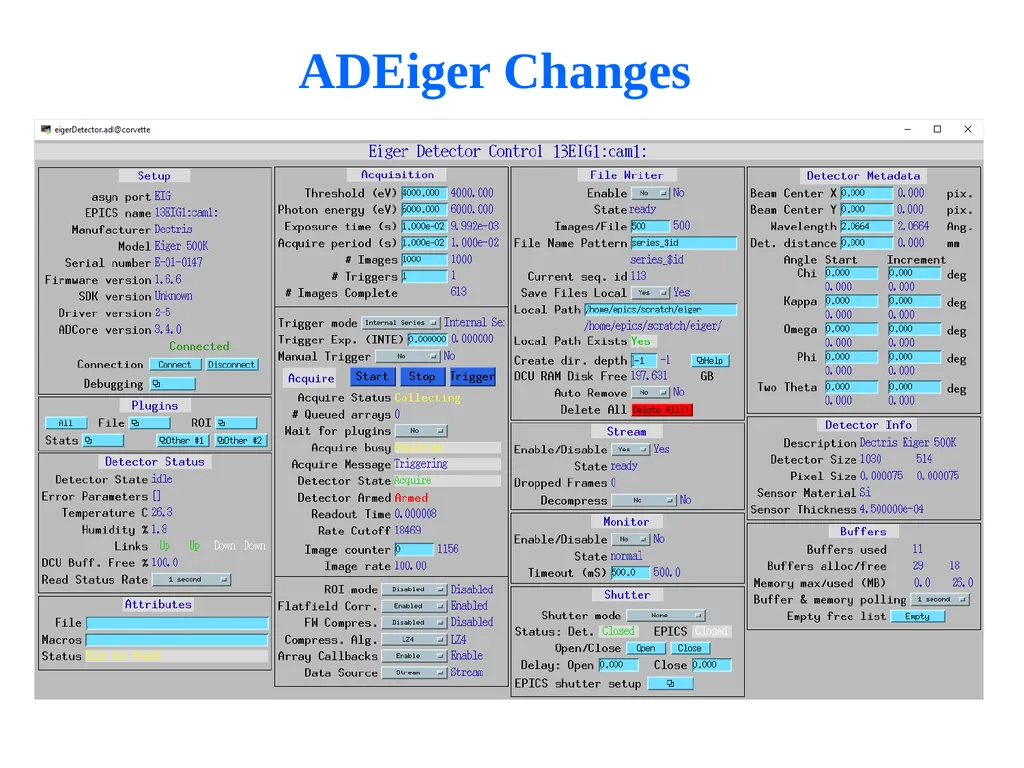
ADEiger Changes Now supports Bitshuffle/LZ4 on Stream interface over ZeroMQ
Previously only LZ4 was supported
New StreamDecompress bo record to enable/disable decompression. If disabled:
NDFileHDF5 can use Direct Chunk Write without ever decompressing
NDPluginPva can send to ImageJ without ever decompressing
NDPluginCodec can decompress for other plugins like NDPluginStats, etc.<br>
Previously only LZ4 was supported
New StreamDecompress bo record to enable/disable decompression. If disabled:
NDFileHDF5 can use Direct Chunk Write without ever decompressing
NDPluginPva can send to ImageJ without ever decompressing
NDPluginCodec can decompress for other plugins like NDPluginStats, etc.<br>
15
ADEiger Changes<br>
16
Compression Demonstration Running simDetector on Linux machine
Running medm and ImageJ on a Windows machine in my office
Connected to Linux machine with 1 Gbit Ethernet
Displaying here with VNC<br>
Running medm and ImageJ on a Windows machine in my office
Connected to Linux machine with 1 Gbit Ethernet
Displaying here with VNC<br>
17
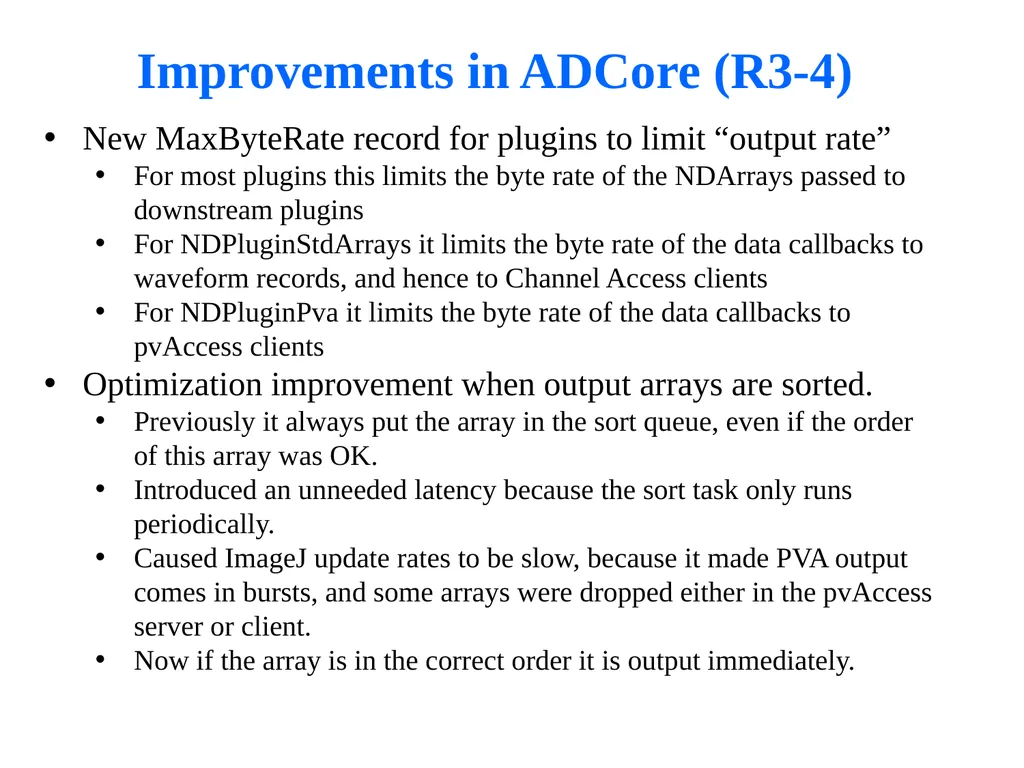
Improvements in ADCore (R3-4) New MaxByteRate record for plugins to limit “output rate”
For most plugins this limits the byte rate of the NDArrays passed to downstream plugins
For NDPluginStdArrays it limits the byte rate of the data callbacks to waveform records, and hence to Channel Access clients
For NDPluginPva it limits the byte rate of the data callbacks to pvAccess clients
Optimization improvement when output arrays are sorted.
Previously it always put the array in the sort queue, even if the order of this array was OK.
Introduced an unneeded latency because the sort task only runs periodically.
Caused ImageJ update rates to be slow, because it made PVA output comes in bursts, and some arrays were dropped either in the pvAccess server or client.
Now if the array is in the correct order it is output immediately.<br>
For most plugins this limits the byte rate of the NDArrays passed to downstream plugins
For NDPluginStdArrays it limits the byte rate of the data callbacks to waveform records, and hence to Channel Access clients
For NDPluginPva it limits the byte rate of the data callbacks to pvAccess clients
Optimization improvement when output arrays are sorted.
Previously it always put the array in the sort queue, even if the order of this array was OK.
Introduced an unneeded latency because the sort task only runs periodically.
Caused ImageJ update rates to be slow, because it made PVA output comes in bursts, and some arrays were dropped either in the pvAccess server or client.
Now if the array is in the correct order it is output immediately.<br>
18
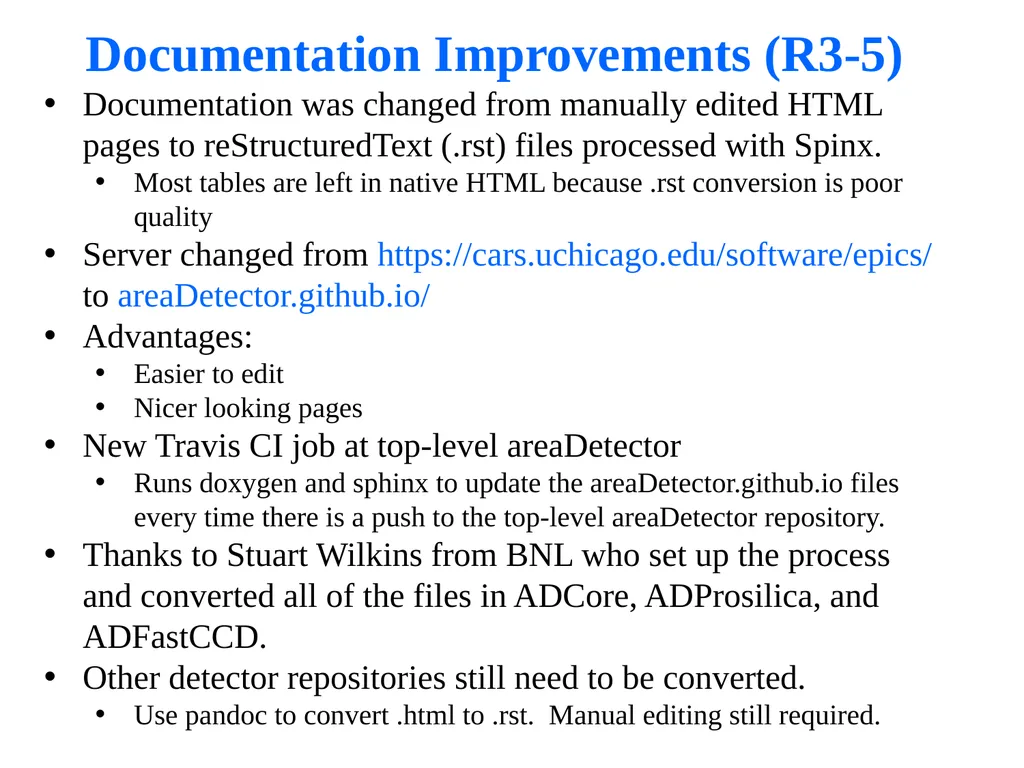
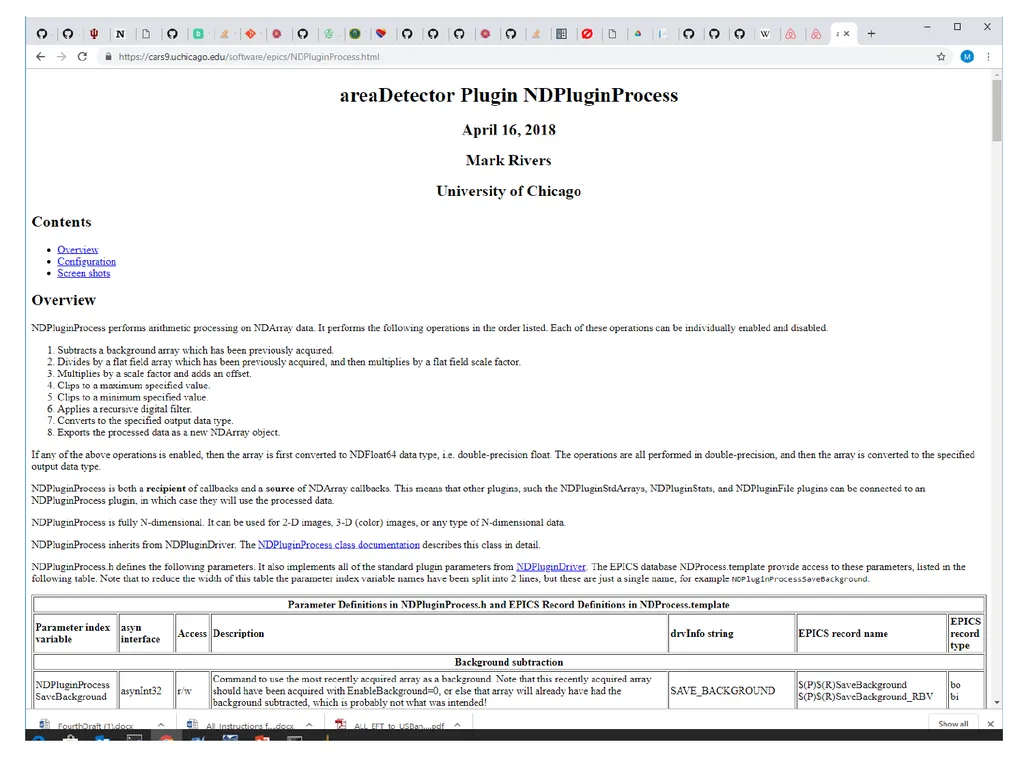
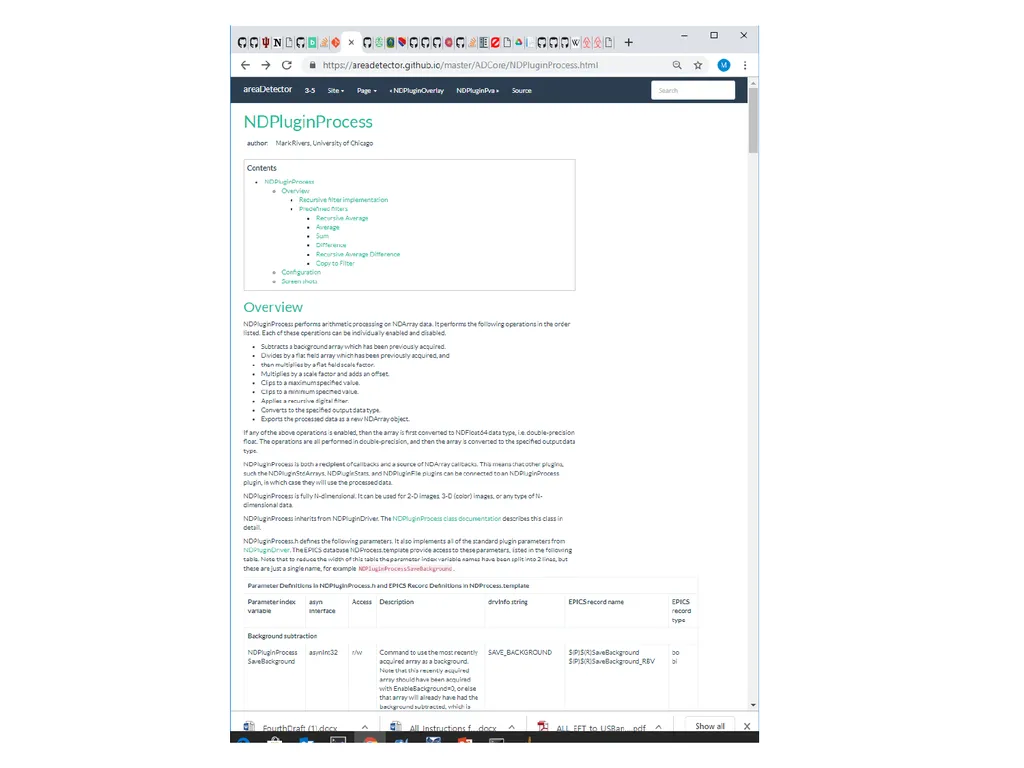
Documentation Improvements (R3-5) Documentation was changed from manually edited HTML pages to reStructuredText (.rst) files processed with Spinx.
Most tables are left in native HTML because .rst conversion is poor quality
Server changed from https://cars.uchicago.edu/software/epics/ to areaDetector.github.io/
Advantages:
Easier to edit
Nicer looking pages
New Travis CI job at top-level areaDetector
Runs doxygen and sphinx to update the areaDetector.github.io files every time there is a push to the top-level areaDetector repository.
Thanks to Stuart Wilkins from BNL who set up the process and converted all of the files in ADCore, ADProsilica, and ADFastCCD.
Other detector repositories still need to be converted.
Use pandoc to convert .html to .rst. Manual editing still required.<br>
Most tables are left in native HTML because .rst conversion is poor quality
Server changed from https://cars.uchicago.edu/software/epics/ to areaDetector.github.io/
Advantages:
Easier to edit
Nicer looking pages
New Travis CI job at top-level areaDetector
Runs doxygen and sphinx to update the areaDetector.github.io files every time there is a push to the top-level areaDetector repository.
Thanks to Stuart Wilkins from BNL who set up the process and converted all of the files in ADCore, ADProsilica, and ADFastCCD.
Other detector repositories still need to be converted.
Use pandoc to convert .html to .rst. Manual editing still required.<br>
19
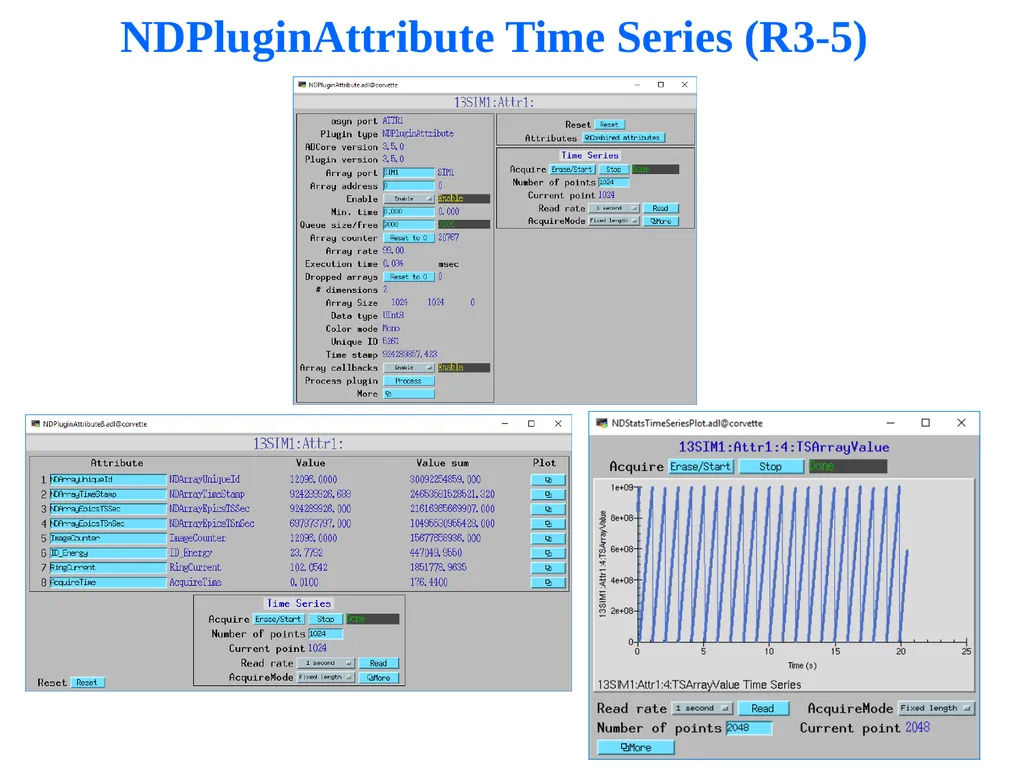
NDPluginAttribute Time Series (R3-5) Previously NDPluginAttribute time series code was internal
Changed so that it now uses NDPluginTimeSeries, same change that was made to NDPluginStats in R3-5
Fewer lines of code, and adds Circular Buffer mode
The time-series waveform PVs are the same
The PVs to control the time-series (start/stop, # of points) have changed, so clients may need modifications<br>
Changed so that it now uses NDPluginTimeSeries, same change that was made to NDPluginStats in R3-5
Fewer lines of code, and adds Circular Buffer mode
The time-series waveform PVs are the same
The PVs to control the time-series (start/stop, # of points) have changed, so clients may need modifications<br>
20
NDPluginAttribute Time Series (R3-5)<br>