
Smart Access: Building Access Company Overview of

Published  . 0 views
↓ Download
Smart Access: Building Access Company Overview of
1 / 1
Smart Access: Building Access Company Overview of - slide 1 of 21 Smart Access: Building Access Company Overview of - slide 2 of 21 Smart Access: Building Access Company Overview of - slide 3 of 21 Smart Access: Building Access Company Overview of - slide 4 of 21 Smart Access: Building Access Company Overview of - slide 5 of 21 Smart Access: Building Access Company Overview of - slide 6 of 21 Smart Access: Building Access Company Overview of - slide 7 of 21 Smart Access: Building Access Company Overview of - slide 8 of 21 Smart Access: Building Access Company Overview of - slide 9 of 21 Smart Access: Building Access Company Overview of - slide 10 of 21 Smart Access: Building Access Company Overview of - slide 11 of 21 Smart Access: Building Access Company Overview of - slide 12 of 21 Smart Access: Building Access Company Overview of - slide 13 of 21 Smart Access: Building Access Company Overview of - slide 14 of 21 Smart Access: Building Access Company Overview of - slide 15 of 21 Smart Access: Building Access Company Overview of - slide 16 of 21 Smart Access: Building Access Company Overview of - slide 17 of 21 Smart Access: Building Access Company Overview of - slide 18 of 21 Smart Access: Building Access Company Overview of - slide 19 of 21 Smart Access: Building Access Company Overview of - slide 20 of 21 Smart Access: Building Access Company Overview of - slide 21 of 21
Description: Smart Access: Building Access Company Overview of SmartAccess SmartAccess is a building security and access company that uses connected technology, information systems, IoT, and artificial intelligence to allow access to buildings.

Related Topics

Download Presentation

"Smart Access: Building Access Company Overview of" is the property of its rightful owner. Permission is granted to download and print the materials on this website for personal, non-commercial use only, and to display it on your personal computer provided you do not modify the materials and that you retain all copyright notices contained in the materials. By downloading content from our website, you accept the terms of this agreement.

Presentation Transcript

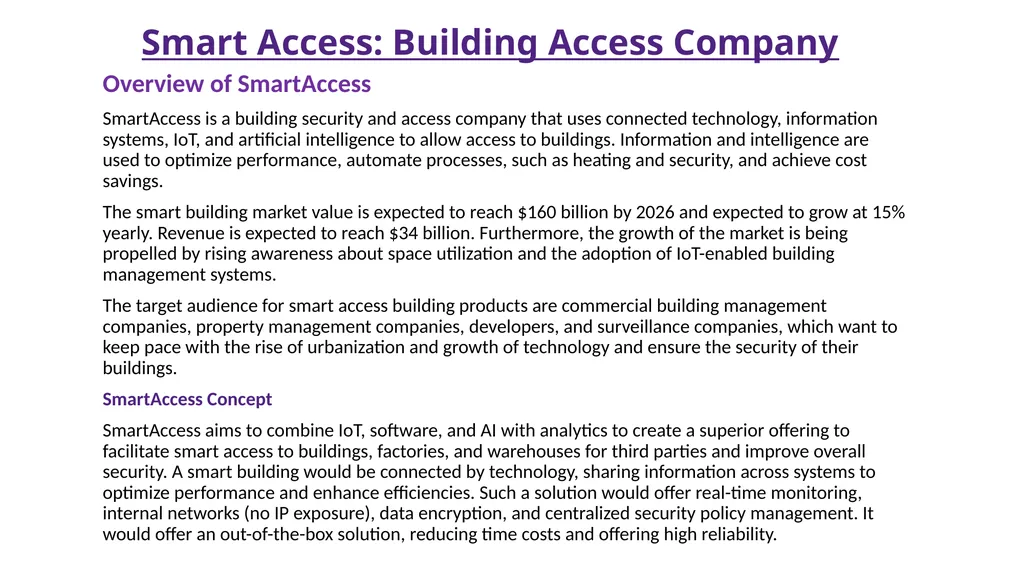
slide1. Smart Access: Building Access Company Overview of SmartAccess
SmartAccess is a building security and access company that uses connected technology, information systems, IoT, and artificial intelligence to allow access to buildings. Information and intelligence are used to optimize performance, automate processes, such as heating and security, and achieve cost savings.
The smart building market value is expected to reach $160 billion by 2026 and expected to grow at 15% yearly. Revenue is expected to reach $34 billion. Furthermore, the growth of the market is being propelled by rising awareness about space utilization and the adoption of IoT-enabled building management systems.
The target audience for smart access building products are commercial building management companies, property management companies, developers, and surveillance companies, which want to keep pace with the rise of urbanization and growth of technology and ensure the security of their buildings.
SmartAccess Concept
SmartAccess aims to combine IoT, software, and AI with analytics to create a superior offering to facilitate smart access to buildings, factories, and warehouses for third parties and improve overall security. A smart building would be connected by technology, sharing information across systems to optimize performance and enhance efficiencies. Such a solution would offer real-time monitoring, internal networks (no IP exposure), data encryption, and centralized security policy management. It would offer an out-of-the-box solution, reducing time costs and offering high reliability.<br>
slide2. Customer Benefits
● Improved experience: Physical safety and security, tenant/visitor comfort and satisfaction
● Efficient operations: Preventative and predictive maintenance, reduced operating costs
● Increased sustainability: Energy and water cost savings, decreased carbon footprint, optimized building space

Customer Pain Points
● Residents, employees, guests, and workers experience friction and a less-than-ideal experience when they are unable to access a building when they need to
● Tenants, operators, and owners want better security options
● Tenant preferences are constantly changing with technology advancement and the growth of IoT and AI-enabled products and services
Northwestern Kellogg Professional Certificate in Product Management

Current Alternatives
Many current solutions offer automated technology but not intelligent solutions where the technology based on sensor readings makes decisions, such as offering automated access, instead of humans.
Key Challenges and Risks
● Key challenges include efficient power supply and requirement of critical equipment, such as controllers, actuators, safety modules, and voltage regulators
● Risks include security breaches and the possibility of digital vandalism and cyberattacks with hackers accessing control systems

Competition
Johnson Controls offers a range of access control products to suit buildings and establishments of various sizes and types. The company provides comprehensive solutions for security needs, including biometric and electric access control hardware and integrated software. Their extensive solutions not only ensure that a security system is well equipped to safeguard assets but also capable of doing much more.
Siemens offers scalable and reliable access control systems to solve a variety of access challenges for corporate complexes, single buildings, and more. These offerings include SiPass, a powerful and integrated access control system, SIPORT, a customized and comprehensive access control for high-security requirements, and Siveillance Identity, a self-service and web-based portal that offers access request management across multiple sites.
Cisco smart building solutions offers a suite of products to ensure and enhance the safety, security, and efficiency of the future of smart buildings. They prioritize sustainable operations, security (with advanced edge-to-cloud solutions) and create meaningful customer experiences through seamless wired and wireless digital experiences with Cisco DNA Spaces.
Opportunity Hypothesis
We believe that facilities and management companies will want to offer smart identity-based access capabilities to specific buildings they manage so that employees, residents, guests, or third parties can have a smooth, hassle-free access experience.
Your Assignment
Your task is to create a complete product development plan for SmartAccess. There are seven deliverables that focus primarily on the inbound product development and six deliverables that focus on the outbound product development. Complete and submit each deliverable as you progress throughout the program. In Week 20, you will get the opportunity to refine and elaborate on each deliverable as you compose your final presentation and product development plan. Northwestern Kellogg Professional Certificate in Product Management<br>
slide4. Jobs to be Done – Ceyone Jha When I step closer to the door of my building/home, I want doors to open by itself, so I can go out without bulky keys
When there is any leak or smoke in my home, I want alerts on my phone, so I can call someone to secure my home and belongings
When I am home, I want a thermostat that remembers my preference, so I don’t keep waking up in the night to adjust the temperature
When I want to know how much energy each appliance/device is using in real time, I want a web platform to view everything together, so I can optimize the energy consumption of my household
When I am away from home, I want my home monitored and send alerts for unusual activities, so I can feel at peace that my home and belongings are safe High Value Opportunities(Ceyone Jha) When I step closer to the door of my building/home, I want doors to open by itself, so I can go out without bulky keys
When there is any leak or smoke in my home, I want alerts on my phone, so I can call someone to secure my home and belongings
When I want to know how much energy each appliance/device is using, I want a web platform to view energy consumption of all the devices/systems in my house in one screen, so I can optimize the energy consumption of my household<br>
slide5. Product Opportunity Brief<br>
slide6. Product Opportunity Brief Product concept:
SmartAccess helps increase the efficiency in building operations by automating several tasks such as temperature and humidity control, smart lighting systems through IOT devices and connected systems. Automating several repetitive tasks by recognizing patterns assists facility manager to manage the facility smoothly saving on operational costs in the long run.
SmartAccess can enhance building security by utilizing IoT devices such as cameras, motion sensors, occupancy counters, water leak detectors, fire detectors that send automated alerts to the respective departments about any potential threats without waiting for someone to take an action in-person.
SmartAccess has an additional layer of security i.e., biometrics which can’t be duplicated or hacked providing buildings with confidential information such as banks, public offices with best security feature they can have.
SmartAccess enables users to manage their home from anywhere using connected systems without having to remember to turn off lights, stove, oven, heating, sprinkler or security system etc.

Business model: The smart building market value is expected to reach $160 billion by 2026 and expected to grow at 15% yearly. Revenue is expected to reach $34 billion.
For a product like SMARTAccess, SAAS business model with a layer of transactions is optimum. Since the product is mostly software based with one aspect of supporting hardware and equipment, SAAS makes most sense. The customer will get a guarantee of seamless integration of the system when they buy hardware through our preferred partners. The customers will get a package price model for software plus supporting hardware. Thus there will be a layer of transaction business model involved along with SAAS.

Risks:
There is a learning curve associated with using technology. When older buildings are overhauled, there might be resistance from technology averse users.
Since everything will be on internal network, physical threats can be eliminated however cyber threats can be damaging to the company reputation
The product needs highly skilled developers which is a huge investment before the product starts generating any income<br>
slide7. MVP and User Story for Ceyone Jha System Integration 1. As a user, I want the thermostat to adjust the temperature on its own depending upon the weather outside, so that I don’t have to keep adjusting the temperature manually E1: Automated control System of the building E2: Data storage on cloud 2. As a user, I want the lights to turn on when I walk into an area and turn off when no one is in the area, so that I don’t have to remember turning them off every time the room is empty saving on my electricity bill 3. As a user, I want the doors to unlock on their own for the authorized people, so that I don’t have to be home always for my service providers such as cleaners/plumbers/electricians 4. As a user, I want the thermostat to remember my preferences of temperature depending upon the climate outside, so that I can sleep through the night without worrying about being too cold or hot 6. As a user, I want an online log of entry/exit of authorized people from my apartment with time stamp while I am away, so that I exactly know who is at home in my absence and what time did they leave 5. As a user, I want the lighting fixtures to remember my preferences on intensity of light at different times of the day, so that I don’t have to manually turn off the light when there is sunlight coming into the room and I don’t need artificial light Note – Hierarchy of the chart is Theme -> Epic -> User stories<br>
slide8. Onboarding of Customers 1. As a user, I want to be able to enter my personal details, so that I can create an account E3:Registration on Web Portal E4:Registration on mobile App 2. As a user, I want to login, so that I can access my account 3. As a user, I want to be able to change my password seamlessly with non-hackable security features, so that only I can access my account 4. As a user, I want to create an account on mobile using biometrics, so that only I can access my account 6. As a user, I want alerts on my mobile app, so that if there is any leak or smoke in my home while away I can take immediate action 5. As a user, I want to login on my mobile app, so that I can access the control systems in my home from anywhere MVP and User Story for Ceyone Jha Note – Hierarchy of the chart is Theme -> Epic -> User stories<br>
slide9. Type of MVP SmartAccess is an expensive product to build since it requires many expensive equipment, data storage on cloud, and a web/mobile interface which needs to be intuitive and user friendly. Firstly, I would recommend using a crowdsourced MVP to test the idea of having an integrated system with the control features to see how many users would be interested to buy. It is important to test an MVP before investing in building even a prototype for a product of such magnitude. Such products are cost and resource intensive.

After getting a certain success rate I would go build a single feature prototype to provide users a glimpse of the functionality our product can provide. With single feature, we can test the most valuable need of the customers from the product and build on it based on customer feedback.<br>
slide10. Market Sizing and Business Model TAM SAM SOM Total addressable market – 79 B Worldwide
(Based on #2) Serviceable addressable market( North America)
$ 31.6B Serviceable obtainable market
United States
$12 B
(Based on #1) Business Model

The smart building market value is expected to reach $160 billion by 2026 and expected to grow at 15% yearly. Revenue is expected to reach $34 billion.
For a product like SMARTAccess, SAAS business model with a layer of transactions is optimum. Since the product is mostly software based with one aspect of supporting hardware and equipment, SAAS makes most sense. The customer will get a guarantee of seamless integration of the system when they buy hardware through our preferred partners. The customers will get a package price model for software plus supporting hardware. Thus there will be a layer of transaction business model involved along with SAAS.<br>
slide11. 1. The global building access control security market is expected to secure a market value worth US $11.89 billion in 2023. During the forecast period from 2023 to 2033, the market is likely to dispatch a CAGR of 14% while generating a value worth US$ 44.2 billion. The increasing demand for smart buildings and infrastructure will be driving the demand for the building access control security market in the future. Source: Future Market Insights 2. The global smart buildings market size stood at USD 72.6 billion in 2021 and is projected to grow at a CAGR of 10.9% to reach over USD 121.6 billion by the end of 2026.Various factors such as increased demand for energy-efficient systems dues to increased energy consumption and costs, advancement in IoT and PoE solution, the increasing net zero, and regulatory changes are expected to drive the adoption of Smart buildings solutions and services Source: MARKETSANDMARKETS 3. Revenue in the Smart Cities market is projected to reach US$89.49bn in 2023. In global comparison, most revenue will be generated in the United States (US$11.12bn in 2023) Source: Statista.com 4. Number of ADT subscribers in US - 6.7M (Source: Statista.com) 5. Market size of the security services in U.S - $48.2B (Source: Statista.com) Market Sizing - Sources and Hypothesis<br>
slide12. Defining the Five S's of Smartaccess Strategy: Why this app exists in the first place
Describe what the user gets out of using this app
Improved experience: Physical safety and security, tenant/visitor comfort and satisfaction
Efficient operations: Preventative and predictive maintenance, reduced operating costs
Increased sustainability: Energy and water cost savings, decreased carbon footprint, optimized building space
real-time monitoring, internal networks (no IP exposure), data encryption, and centralized security policy management
Describe what the organization/company gets out of offering this app/service
Emerge as leader in smart integrated solution
Increase customer engagement and dependency
Growth in Revenue
Scope: The features and functions available within the app (e.g., what is in and out of scope)
What actions can the user take in this app?
See the log of users entering/exiting the premise
Monitor the energy usage of all connected systems
Monitor the alerts from systems
Same app doesn’t work in other geographic location – App is geographic/currency specific
What actions can the user not take in this app that might have been a consideration for the product team?
Add automatic scheduling for maintenance through the app
Structure: The user flow or journey (e.g., how each screen connects to one another)
What are the key activities users can do within this app?
How does user set up his profile?
What visualizations user wants to monitor usage/performance of systems?
How does customer set up payments?
How does customer monitors access points to the building?
Consider one of those activities and list out the steps (e.g., press on the Libby app icon, select the search bar on the Homepage, and enter the name of the e-book you are looking for)
How does customer create a profile?
Open Smartaccess.com > click get username > fill personal details, payment details > Submit<br>
slide13. Defining the Five S's of Smartaccess Skeleton: The interface design (e.g., what you want the users to do), navigation design (e.g., where you want the user to go next), and information design (e.g., ideas you want to be communicated to the user)
Consider the steps of the structure (e.g., user flow) you described above and list the key considerations and aspects for the three parts of the skeleton
Interface design – The website/app will have interactive graphics with hover over for detailed information. Most of the visuals will be drilldown, and clickable
Navigation design – There’s a horizontal navigation bar at the top of the screen that stays consistent irrespective of what screen customer arrives at, enabling the user to move around the site seamlessly. The search bar helps find important information instantly
Information design – After the registration page the screen displays information depending upon the role of the user in the building (tenant/property manager/security/maintenance manager)

Surface: The visual and interactive elements on the screen
Logo is clickable which takes user to the home screen. The search bar, and header has links that stays consistent throughout the site. All the visualizations will have date range to select and see the data<br>
slide14. Wireframe SmartAccess Landing Page<br>
slide15. Product Roadmap: SmartAccess Jan 15 Project Kickoff Design the digital access card for mobile devices Integrate all the small appliances on the internal network Signup on web platform Executive Review<br>
slide16. Positioning and Messaging - SmartAccess For commercial building management companies, property management companies, developers, and surveillance companies, who want to have an out of the box solution for centralized security policy management with high reliability and operational efficiency, SmartAccess is the solution that not only manages access to buildings, but also optimizes performance, automate processes, and achieve cost savings for the building. Unlike Johnson controls, we don’t offer just security control but an integrated solution for urban buildings.

Messaging pillar #1
Feel Secure
Biometric security authentication of residents of the building
Strict security protocols for visitors
24/7 surveillance of the building

Messaging pillar #2
Digital Access
Contactless key cards
Security protocols and authentications on digital keys
Apple wallets compatible key cards for access

Messaging pillar #3
Save Money
Monitor the usage and optimization of energy
Automate maintenance alerts
Use energy efficient appliances<br>
slide17. SmartAccess – Elevator Pitch Our clients say “Adoption of SmartAccess has dramatically improved the customer satisfaction rate from 3.5 to 4.2. We are perceived as environmentally friendly company offering world class experience to our tenants. – V.P, Altura real estate management company”<br>
slide18. SmartAccess – Pathways for Growth SmartAccess will have SAAS business model and will have tiers of subscription in the product. Smart Access will primarily focus on North American geographical market, and highly urbanized pockets of Europe.
For the growth, I would recommend deploying a combination of 2 strategies in the order listed below -
Share of Wallet –
Leveraging existing customer base is very important for the sales growth of a SAAS product. Firstly, I would recommend targeting accounts enrolled only for security access management subscription and converting those into integrated solution subscription tier. Next target accounts with integrated solutions subscription for upgrade to premium subscription that offers all inclusive capabilities such as analytics/visualizations and personalization. We will primarily target large corporate commercial buildings that have multiple tenants seeking high customer satisfaction for upgrade to premium subscription. Revenue generated from premium subscription customers alone will generate high profit. We will begin with companies having real estate in tier 1 cities such as New York, San Francisco, Chicago, Boston, and Washington D.C. In the next round we will target companies with real estate in Seattle, Atlanta, Austin, and Philadelphia. In the subsequent rounds we will offer incentives to companies to upgrade subscription/convert their buildings in smaller cities to smart buildings.
For conversions within subscriptions from existing customers we will closely monitor their usage patterns, needs and challenges to provide a customized solution in terms of access and pricing for their need. We will also incentivize conversions for existing customers. Taking such measures will help us capture all the business from the existing customer pool, and save on company’s investment for increasing sales growth.

Share of Market – Under this strategy we will begin expanding to old school companies that have historic properties in highly urban locales, and are building new smart buildings in other areas. We will offer them free evals of their old buildings and discounted conversion plan into smart building if they signup subscription with us for their new buildings. Most of the big commercial real estate companies have high value property in New York and California area which are in the need of technological upgrades. This is going to be a layered offer which will limit competition for SmartAccess since converting an old building into a smart building is challenging, however SmartAccess has a plan already in place for such offerings. Next strategy for increasing market share will be to have exclusive partnerships with security camera companies such as Ring or Blink which will instantly give us access to end customer. It will provide free marketing for the company thereby putting us higher in list of consideration for building management companies. The company will start offering a consulting service for real estate companies to build efficient operations. This offer will be a segway for the sales team to enter at the right time and convert a potential lead into the Smart Access customer. For saturated markets, we will run campaign to attract competitor’s customers. The campaign will provide free premium subscription for visualizations, and personalization for three months with any tier of subscription.<br>
slide19. Growth Tactic - SmartAccess SmartAccess is a SAAS product. The first and foremost thing the marketing tactic needs to do for the business is to create awareness and visibility about the product. Then the marketing efforts should be directed around acquiring attention of potential customers so that they enter the funnel as leads. Next the targeted efforts need to be made for nurturing those leads to convert them as subscribed customers. As per the buyer persona, we are targeting middle aged gen x and millennials who are tech savvy. Most of the people matching our buyer persona will own multiple digital devices and will research every bit of information online before making any decisions.
Considering the buyer persona in mind I will choose SEO, social media, and Blog to help create awareness and visibility about the product. White Papers/Blog are an essential part of the marketing tactic to establish trust and transparency for such a complicated interconnected system product. These tactics will also serve as touchpoints for leads to enter the funnel. Since our middle-aged Gen x lead prefer personalized communication, Email marketing will help deliver tailored content. Influencer marketing will help in the final stages of decision making when the customer will look for feedback or affirmations from industry leaders or customers.
SEO
Social Media
Email Marketing
Blog
White Paper
Influencer Marketing<br>
slide20. Data Strategy and Testing Plan for SmartAccess Data Strategy for SmartAccess is going to account for the growth plan and all the questions different divisions of SmartAccess will seek answers for in future. We cannot answer questions on data that we did not collect. At the same time we cannot collect all the data. Hence, I will begin with collecting all the questions we would like to answer that will support our growth plan.

Based on the roadmap here’s the data strategy that I will suggest –
PII data with demographic details will be collected for customers with contract value for each account.
Customer interaction with the interface will be logged in the data base to see what features are driving engagement and what features are bringing the customer satisfaction score low.
The marketing campaign cost data needs to be saved to see CAC, where we are losing the customer in the sales funnel.
Additionally, the sales calls and customer service call notes need to be saved to keep a tap on customer sentiment and difficulties.
All the interaction, marketing data and PII data will be saved on a cloud-based database.

How will you use data in your business? Is there a strategy for data storage and retrieval?
I will use data to introduce personalization features and variations in the product line. Data will also be used to see what features are redundant and can be trimmed down. Data will be used to measure customer satisfaction. The access card ID will be stored on cloud in no SQL database so that retrieval and authentication will be faster. All other data will be stored in a SQL database and will be retrieved using SQL or cubes.

Is this something you’ll need to consider upfront with your engineering team?
Yes, the engineering team will need to build capabilities alongside to capture and store all the interactions with the product and important authentication IDS. Since it’s a security and access product, there will need to be high data security protocols.

Do you already know what data you’ll want to collect or store and how you’ll use it?
Yes, the data points listed is going to be collected and used for improving the product.

Is there a flywheel effect or something you can use to build a competitive advantage over time? Is there something that can create a moat against any potential upstarts?
The interconnected system and personalization at the consumer level will build the competitive advantage for the product and the company.<br>
slide21. Machine Learning and AI 1. Thoughts about where machine learning might fit into your product. This could be to improve the user experience, the operationalization of the product, the back-end experience, etc.
Machine learning will be used to predict maintenance of the devices and systems connected on the internal network of SMARTAccess. Machine learning will predict the wear out time of devices depending upon the usage, and climatic conditions. For instance – Predicting and sending reminders to change air filters, predict wear and tear of electric fittings, predicting maintenance of thermostat based on usage and environmental factors. The machine learning model will help smooth operationalization of product which in turn will limit downtime of systems thus contributing to the positive user experience.

2. Once you have determined where machine learning might fit into your product from the options mentioned above, speak a bit about what type of machine learning model you might use, what benefit you’d get from it, and why that type of model would be most helpful.
I would use a semi-supervised machine learning model for recommendation system. The recommendation system would gauge the usage of customers and recommend pre-set features early in the usage lifecycle. However, as the user matures in the system and starts using all the capabilities of the system the model will train on itself and provide recommendations based on where the user is in the maturity lifecycle. I would also recommend classification-based model to predict maintenance of the system which will reduce the downtime.

3. What is the ROI you would expect to get from this? What level of required effort would make it a worthwhile investment?
If implemented right, the well-designed model will reduce the operations cost, minimize downtime of the system, and help gather customer usage patterns. All this will help establish SMARTACCESS a reliable and trustworthy brand with high customer satisfaction. This in turn will help the product have a competitive advantage in the industry. Having a dedicated data scientist and data engineer at the beginning/launch to set up and train the model is going to be a worthwhile investment. Upon product maturity the model will be trained already, thus return on investment is going to be huge.<br>
slide22. Deliverables
Inbound deliverables
1. (Week 2) Target persona: Conduct customer research and gather insights on customer pain points in order to develop a target persona for the end user of your product and the problem you are trying to solve
2. (Week 3) Jobs to be done (JTBD) : Create a list of 5–10 jobs-to-be-done stories related to the target customer. Based on your identified JTBD, identify 3–4 high-value opportunities
3. (Week 3) Product opportunity brief: Create a narrative that articulates why your product is worth investing in. Your product opportunity brief should include the following:
a. Executive summary
b. Market size
c. Target customer
d. Product concept
e. Business model
f. Risks
4. (Week 4) Epics, themes, user stories, and MVP: Identify four epics for your product and build out three key user stories for each epic. Define the MVP for your product
5. (Week 6) Product opportunity (TAM, SAM, SOM) and business model: Define and evaluate the product opportunity by completing a market sizing template for the total addressable market (TAM), serviceable addressable market (SAM), and serviceable obtainable market (SOM) for your product. Determine which business model would be the most efficient for your product and explain your choice
6. (Week 7) Wireframe: Using a tool such as Balsamiq, Miro, or Figma, create a minimum of three screen wireframes for your product
7. (Week 9) Product roadmap: Develop a high-level roadmap for your product using a roadmapping tool, such as Miro or Trello. Focus only on the near-term timeframe (0–12 months) and define the first three sprints
Outbound deliverables
1. (Week 11) Value proposition and positioning statement: Determine the customer value proposition for your product. Describe the benefits you plan to offer and how you plan to differentiate your product from the competing alternatives. Also explain how you will position your product
2. (Week 12) Product pitch: Create a sales pitch for your product to share with potential customers and stakeholders. In your sales pitch, define the customer problem, describe the key benefits you offer, and how you solve the customer problem
3. (Week 14) Customer and market development strategies: Define a growth plan for your product, including customer development and market development. Identify two customer adjacencies and two
Northwestern Kellogg Professional Certificate in Product Management market adjacencies you would pursue
4. (Week 15) Growth hacking strategies: Define the OMTM (One Metric That Matters) and two to three growth hacking strategies or tactics you would use for your product
5. (Week 17) Experimentation and testing plan: Identify a business outcome you would like to achieve with your product. Once you have identified this outcome or goal, design an experiment and a testing plan for how you would test a hypothesis to improve your selected business outcome or goal
6. (Week 17) Automation and ML opportunity: Explain how ML/AI methods will optimize your product offering. Determine which methods or applications of ML/AI would apply to your product and how it would enhance the offer to your customers. Explain how you plan to infuse ML and AI to improve the performance/effectiveness of your product Submission by Pritisha Jha<br>