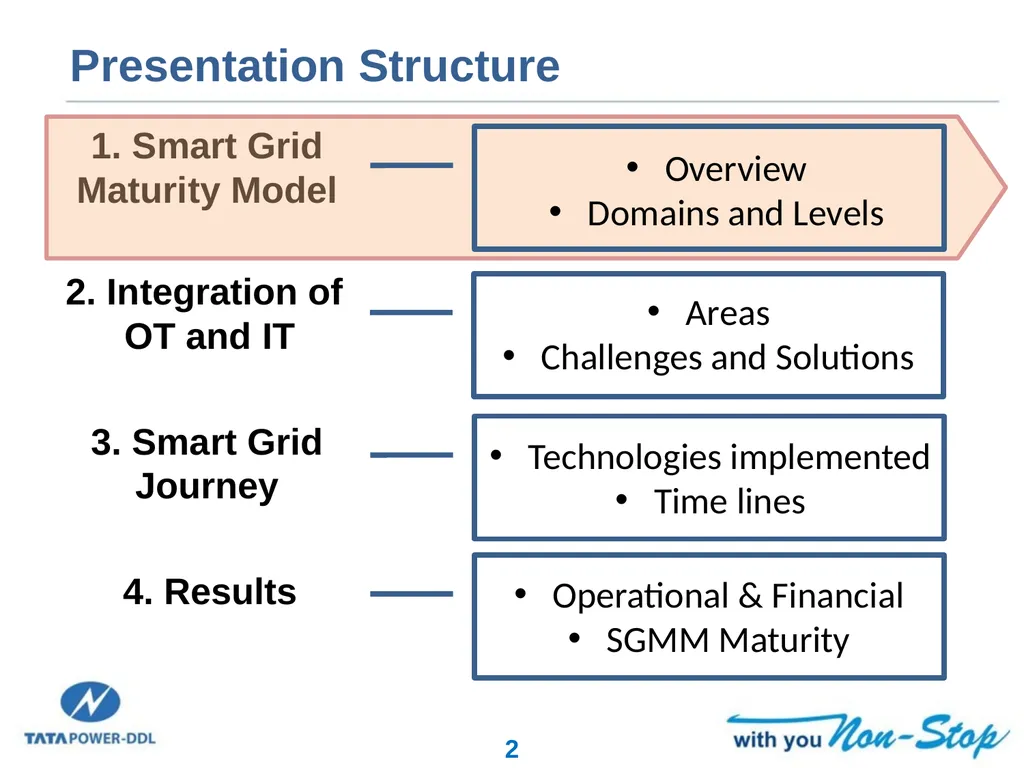
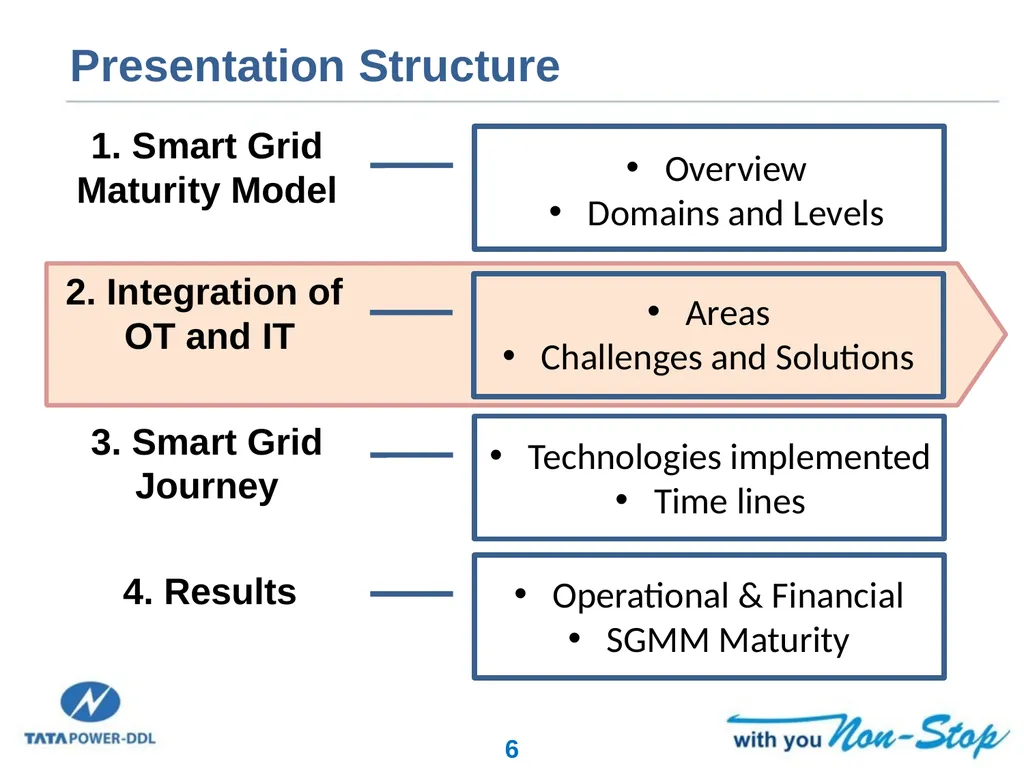
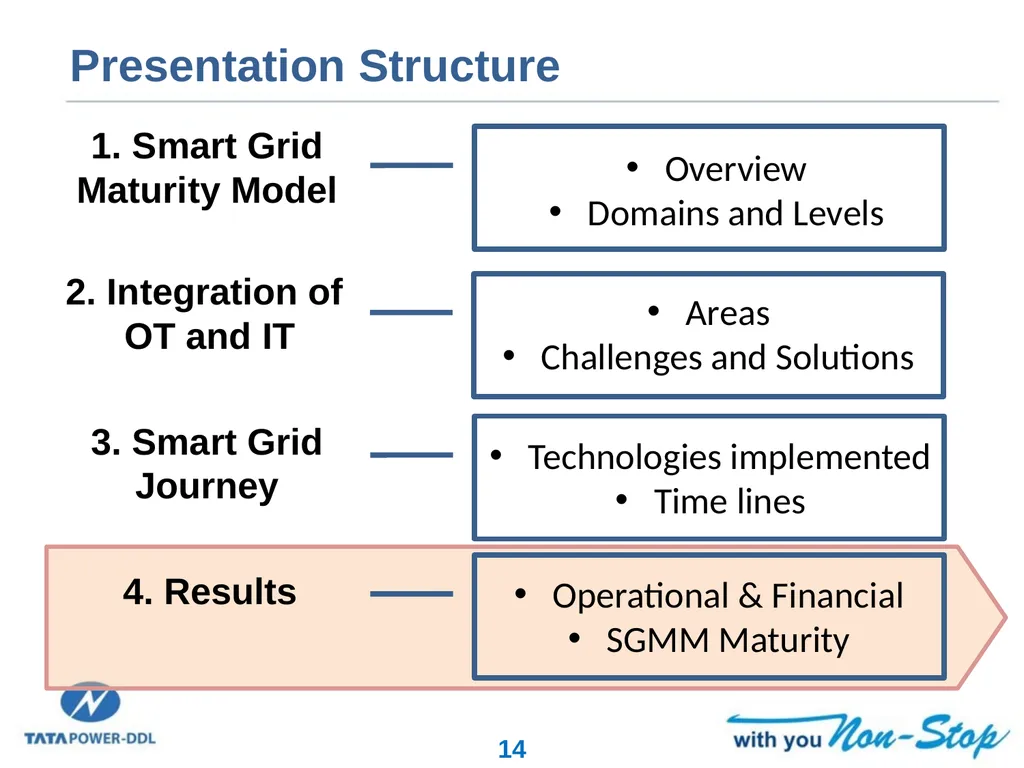
Smart Grid Implementation in India Experiences and Learnings Arup Ghosh Sr Advisor and Director arup.ghoshtatapower-ddl.com Presentation Structure 2 1. Smart Grid Maturity Model Smart Grid Maturity Model - Overview 3 Source: SEI
"Smart Grid Implementation in India Experiences and" is the property of its rightful owner. Permission is granted to
download and print the materials on this website for personal, non-commercial use only, and to display it
on your personal computer provided you do not modify the materials and that you retain all copyright
notices contained in the materials. By downloading content from our website, you accept the terms of this
agreement.
Presentation Transcript
01
Smart Grid Implementation in India Experiences and Learnings Arup Ghosh
Sr Advisor and Director
arup.ghosh@tatapower-ddl.com<br>
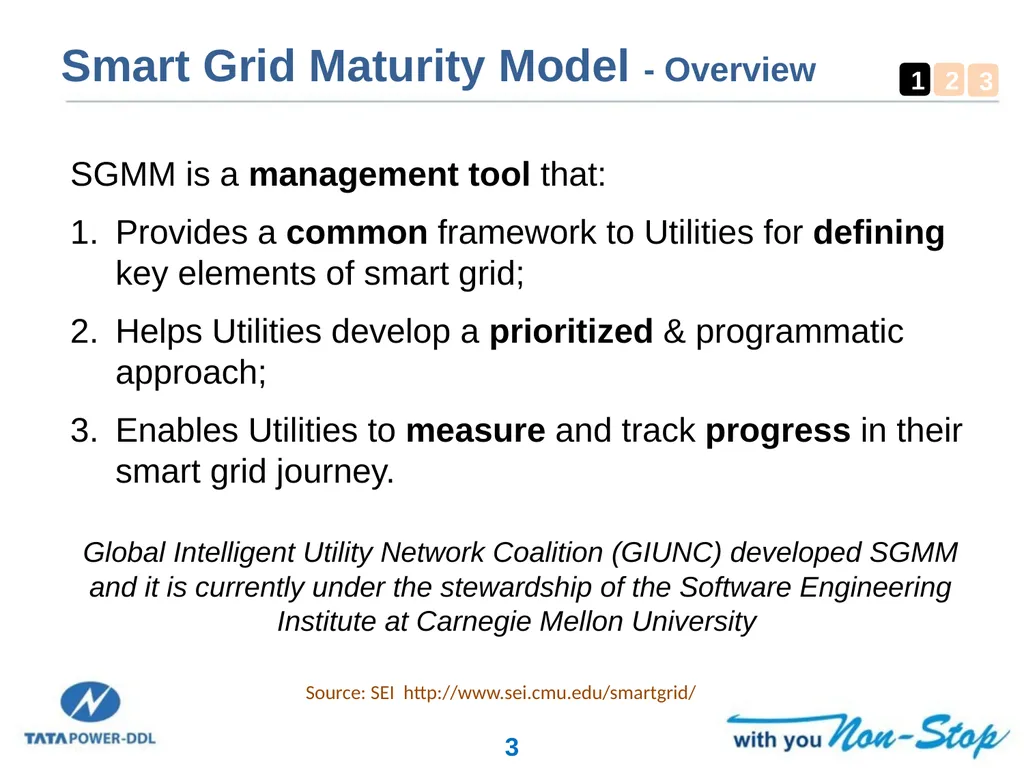
Smart Grid Maturity Model - Overview 3 Source: SEI http://www.sei.cmu.edu/smartgrid/ SGMM is a management tool that:
Provides a common framework to Utilities for defining key elements of smart grid;
Helps Utilities develop a prioritized & programmatic approach;
Enables Utilities to measure and track progress in their smart grid journey. Global Intelligent Utility Network Coalition (GIUNC) developed SGMM and it is currently under the stewardship of the Software Engineering Institute at Carnegie Mellon University<br>
04
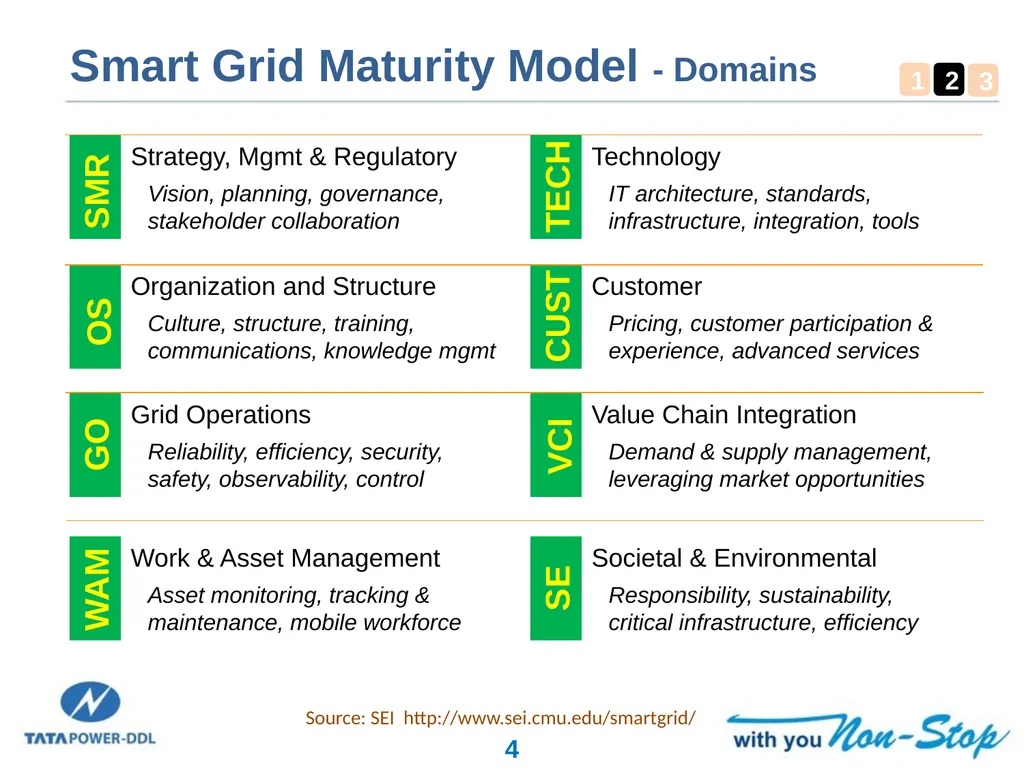
Smart Grid Maturity Model - Domains 4 Source: SEI http://www.sei.cmu.edu/smartgrid/<br>
05
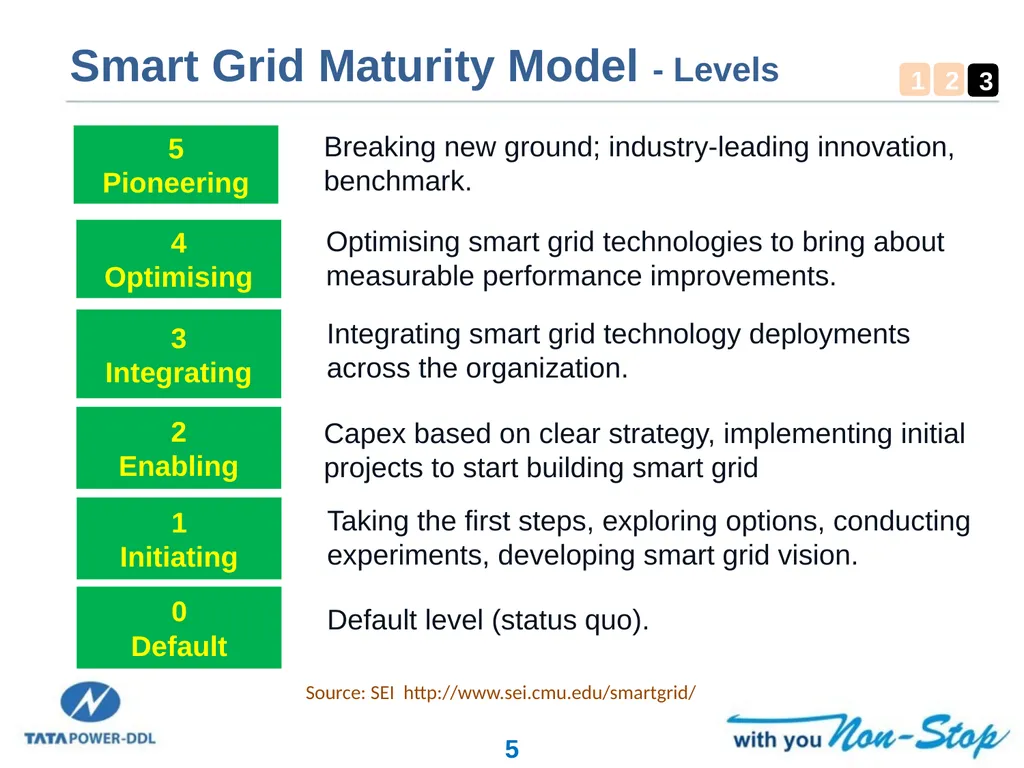
Smart Grid Maturity Model - Levels 5 Source: SEI http://www.sei.cmu.edu/smartgrid/<br>
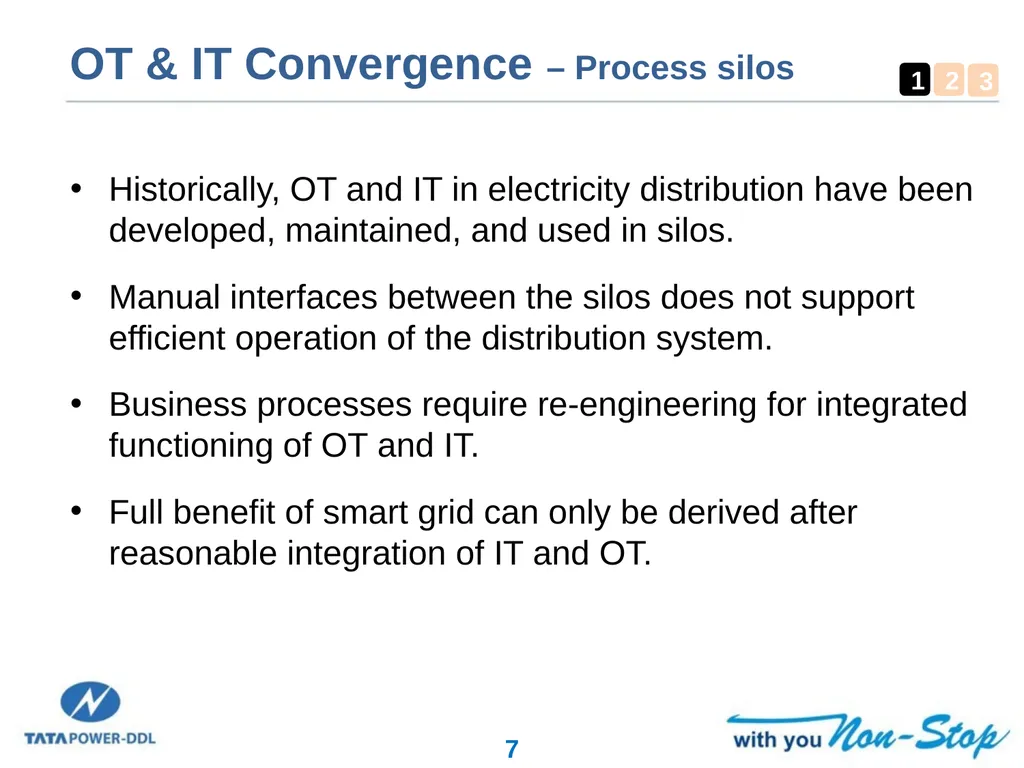
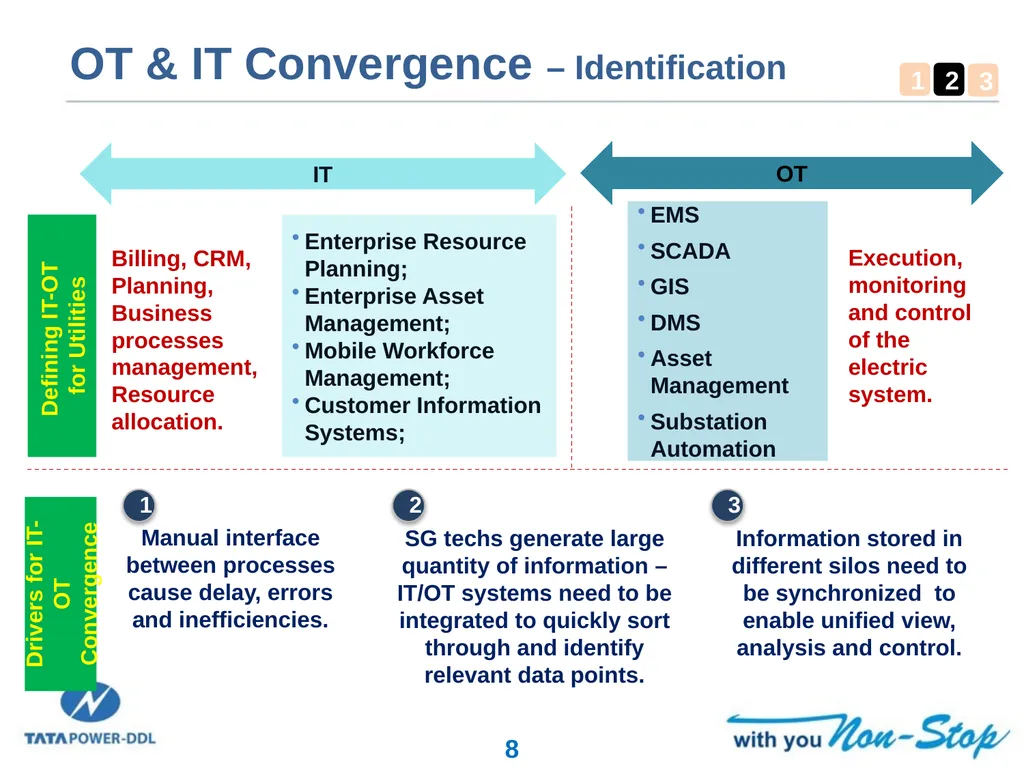
OT & IT Convergence – Process silos 7 Historically, OT and IT in electricity distribution have been developed, maintained, and used in silos.
Manual interfaces between the silos does not support efficient operation of the distribution system.
Business processes require re-engineering for integrated functioning of OT and IT.
Full benefit of smart grid can only be derived after reasonable integration of IT and OT.<br>
08
Information stored in different silos need to be synchronized to enable unified view, analysis and control. SG techs generate large quantity of information – IT/OT systems need to be integrated to quickly sort through and identify relevant data points. OT & IT Convergence – Identification 8 Enterprise Resource Planning;
Enterprise Asset Management;
Mobile Workforce Management;
Customer Information Systems; EMS
SCADA
GIS
DMS
Asset Management
Substation Automation Execution, monitoring and control of the electric system. Billing, CRM, Planning, Business processes management, Resource allocation. IT OT Defining IT-OT
for Utilities Manual interface between processes cause delay, errors and inefficiencies. Drivers for IT-OT Convergence 2 1 3<br>
09
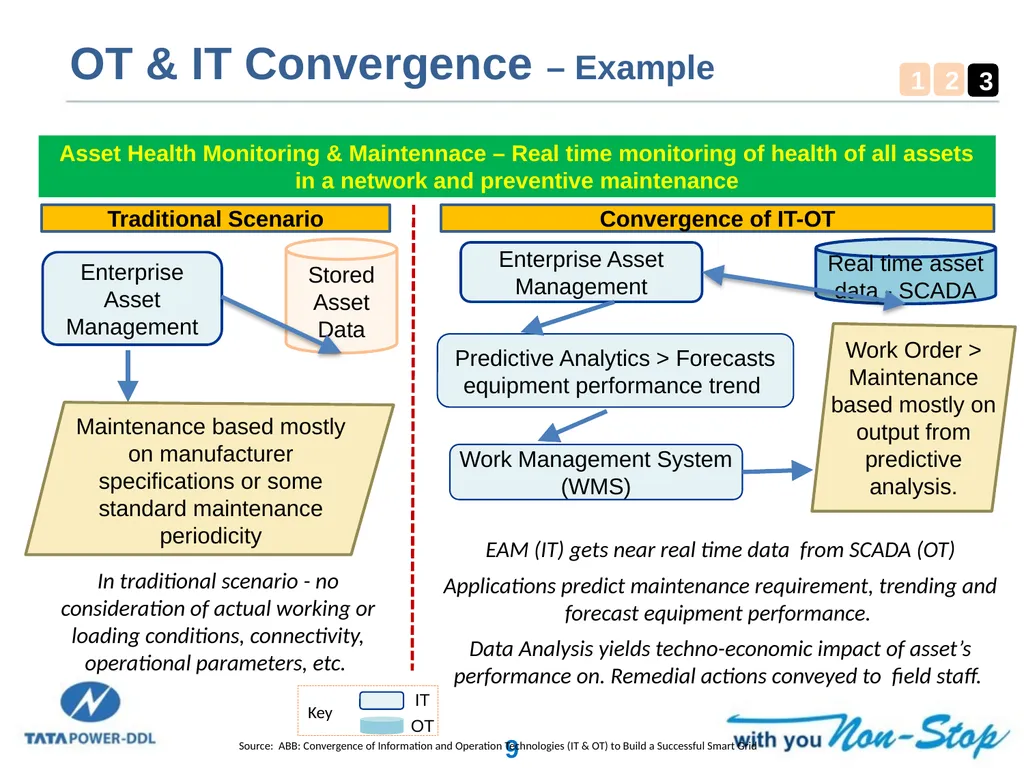
OT & IT Convergence – Example 9 Enterprise Asset Management Traditional Scenario Convergence of IT-OT Stored Asset Data Enterprise Asset Management Real time asset data - SCADA Predictive Analytics > Forecasts equipment performance trend Work Order > Maintenance based mostly on output from predictive analysis. Maintenance based mostly on manufacturer specifications or some standard maintenance periodicity Work Management System (WMS) Asset Health Monitoring & Maintennace – Real time monitoring of health of all assets in a network and preventive maintenance Source: ABB: Convergence of Information and Operation Technologies (IT & OT) to Build a Successful Smart Grid In traditional scenario - no consideration of actual working or loading conditions, connectivity, operational parameters, etc. EAM (IT) gets near real time data from SCADA (OT)
Applications predict maintenance requirement, trending and forecast equipment performance.
Data Analysis yields techno-economic impact of asset’s performance on. Remedial actions conveyed to field staff.<br>
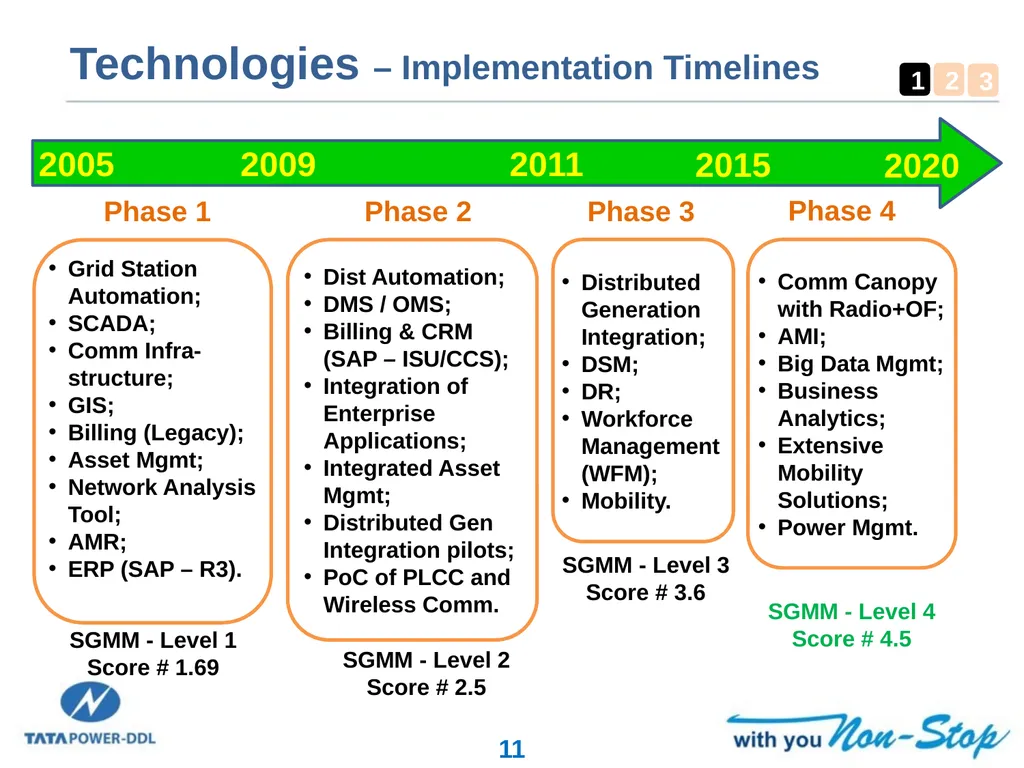
Technologies – Implementation Timelines 11 2009 2011 2005 Grid Station Automation;
SCADA;
Comm Infra-structure;
GIS;
Billing (Legacy);
Asset Mgmt;
Network Analysis Tool;
AMR;
ERP (SAP – R3). Dist Automation;
DMS / OMS;
Billing & CRM (SAP – ISU/CCS);
Integration of Enterprise Applications;
Integrated Asset Mgmt;
Distributed Gen Integration pilots;
PoC of PLCC and Wireless Comm. Distributed Generation Integration;
DSM;
DR;
Workforce Management (WFM);
Mobility. Comm Canopy with Radio+OF;
AMI;
Big Data Mgmt;
Business Analytics;
Extensive Mobility Solutions;
Power Mgmt. Phase 1 Phase 2 Phase 3 SGMM - Level 1
Score # 1.69 SGMM - Level 2
Score # 2.5 SGMM - Level 3
Score # 3.6 SGMM - Level 4
Score # 4.5 2015 Phase 4 2020<br>
12
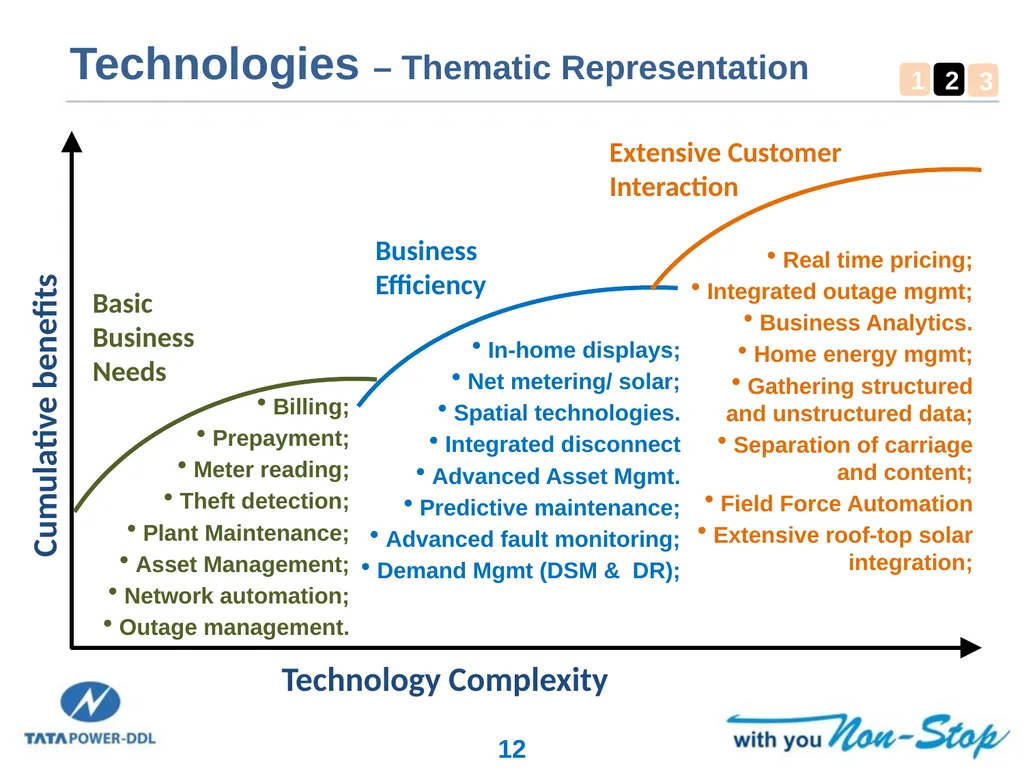
Technologies – Thematic Representation 12 Basic Business Needs Business Efficiency Extensive Customer Interaction Billing;
Prepayment;
Meter reading;
Theft detection;
Plant Maintenance;
Asset Management;
Network automation;
Outage management. Real time pricing;
Integrated outage mgmt;
Business Analytics.
Home energy mgmt;
Gathering structured and unstructured data;
Separation of carriage and content;
Field Force Automation
Extensive roof-top solar integration; In-home displays;
Net metering/ solar;
Spatial technologies.
Integrated disconnect
Advanced Asset Mgmt.
Predictive maintenance;
Advanced fault monitoring;
Demand Mgmt (DSM & DR); Cumulative benefits Technology Complexity<br>
13
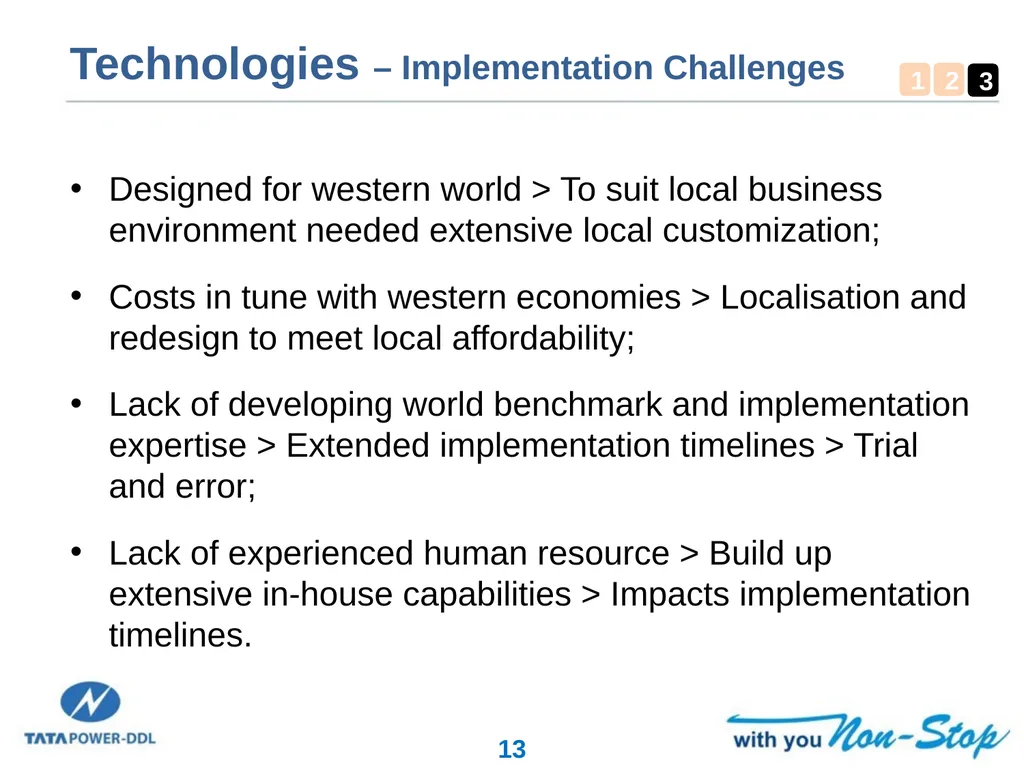
Technologies – Implementation Challenges 13 Designed for western world > To suit local business environment needed extensive local customization;
Costs in tune with western economies > Localisation and redesign to meet local affordability;
Lack of developing world benchmark and implementation expertise > Extended implementation timelines > Trial and error;
Lack of experienced human resource > Build up extensive in-house capabilities > Impacts implementation timelines.<br>