SME FINANCING OPPORTUNITIES BRIDGING THE GAP South Africa SMME Conference Services Forum 1 South Africa SMME Conference Birchwood Hotel 21 October 2010 Outline Introduction SMME financing landscape Factors inhibiting small business growth
Related Topics
Share
Embed code
Download this presentation From Below
"SME FINANCING OPPORTUNITIES – BRIDGING THE GAP" is the property of its rightful owner. Permission is granted to
download and print the materials on this website for personal, non-commercial use only, and to display it
on your personal computer provided you do not modify the materials and that you retain all copyright
notices contained in the materials. By downloading content from our website, you accept the terms of this
agreement.
Presentation Transcript
01
SME FINANCING OPPORTUNITIES – BRIDGING THE GAP South Africa SMME Conference Services Forum 1<br>
02
South Africa SMME Conference
Birchwood Hotel
21 October 2010<br>
03
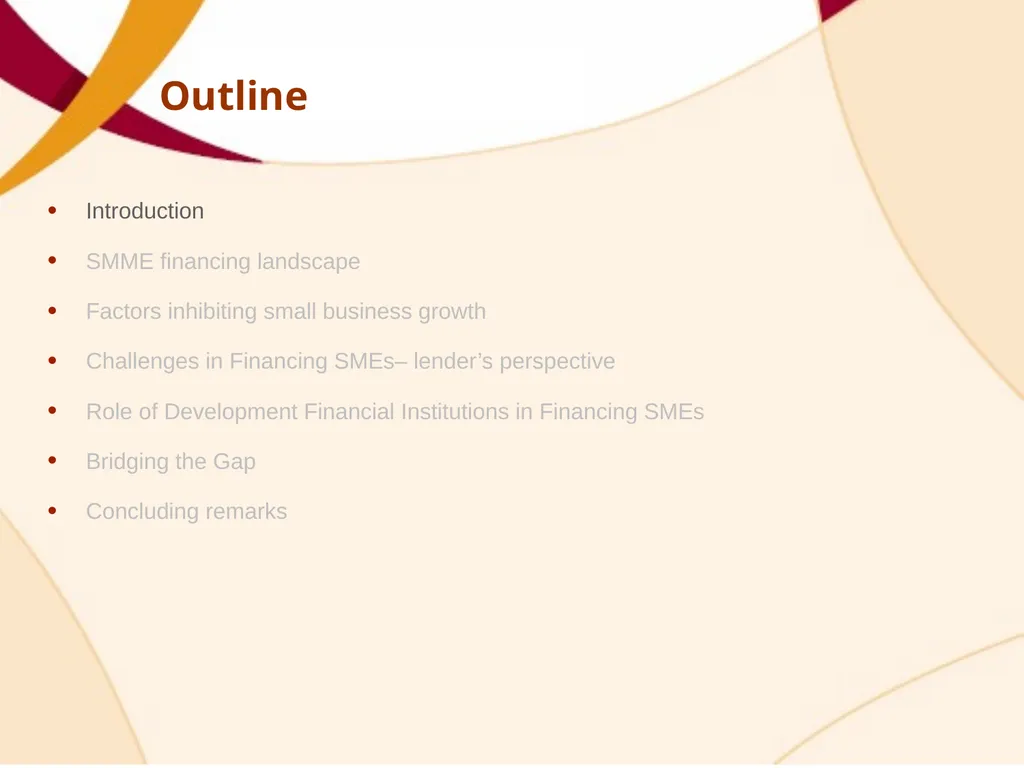
Outline Introduction
SMME financing landscape
Factors inhibiting small business growth
Challenges in Financing SMEs– lender’s perspective
Role of Development Financial Institutions in Financing SMEs
Bridging the Gap
Concluding remarks<br>
04
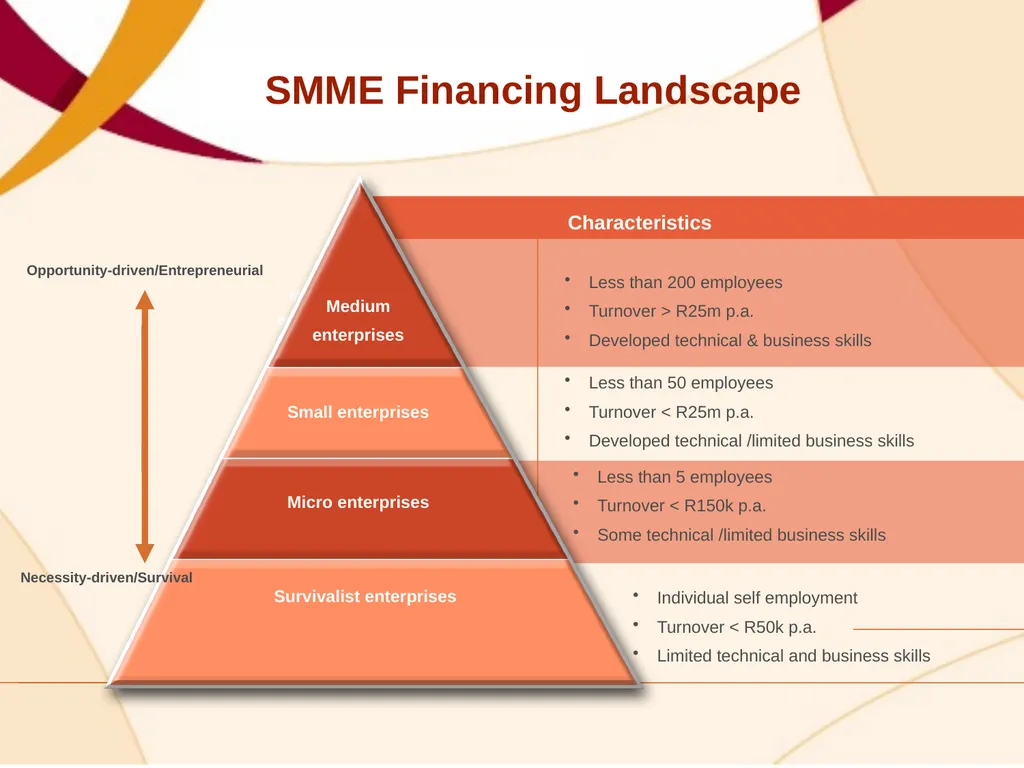
Medium
enterprises Small enterprises Micro enterprises Survivalist enterprises Less than 200 employees
Turnover > R25m p.a.
Developed technical & business skills Less than 50 employees
Turnover < R25m p.a.
Developed technical /limited business skills Less than 5 employees
Turnover < R150k p.a.
Some technical /limited business skills Individual self employment
Turnover < R50k p.a.
Limited technical and business skills Opportunity-driven/Entrepreneurial Necessity-driven/Survival Medium
enterprises Small enterprises Micro enterprises Survivalist enterprises Characteristics SMME Financing Landscape<br>
05
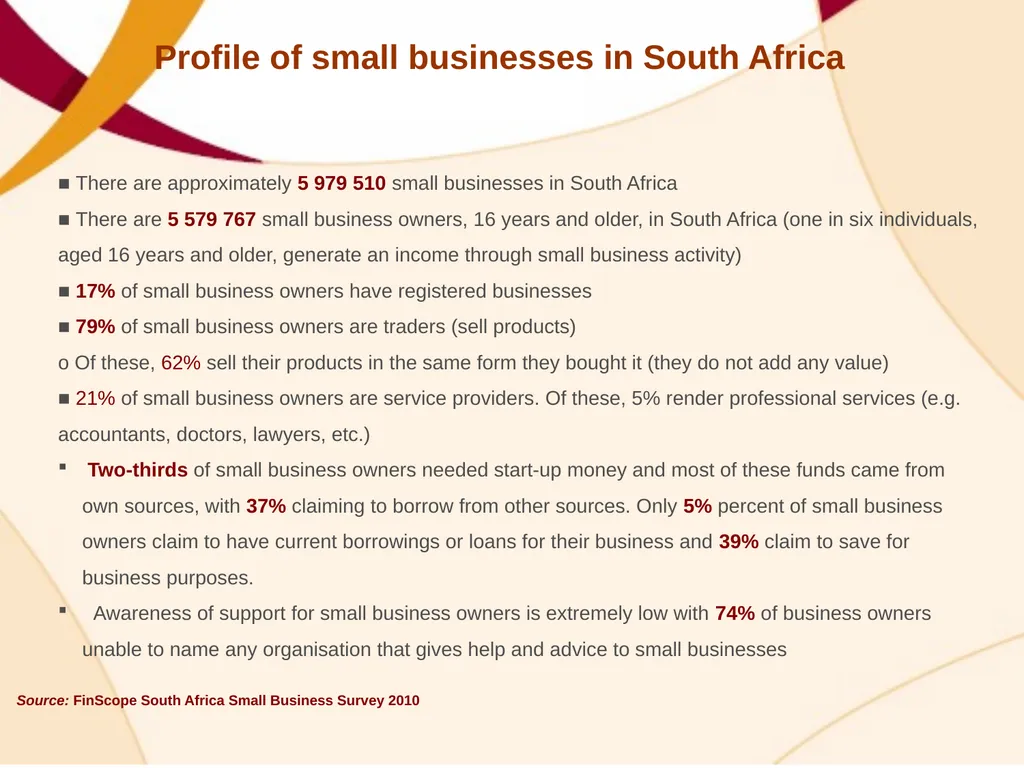
Profile of small businesses in South Africa ■ There are approximately 5 979 510 small businesses in South Africa
■ There are 5 579 767 small business owners, 16 years and older, in South Africa (one in six individuals, aged 16 years and older, generate an income through small business activity)
■ 17% of small business owners have registered businesses
■ 79% of small business owners are traders (sell products)
o Of these, 62% sell their products in the same form they bought it (they do not add any value)
■ 21% of small business owners are service providers. Of these, 5% render professional services (e.g. accountants, doctors, lawyers, etc.)
Two-thirds of small business owners needed start-up money and most of these funds came from own sources, with 37% claiming to borrow from other sources. Only 5% percent of small business owners claim to have current borrowings or loans for their business and 39% claim to save for business purposes.
Awareness of support for small business owners is extremely low with 74% of business owners unable to name any organisation that gives help and advice to small businesses Source: FinScope South Africa Small Business Survey 2010<br>
06
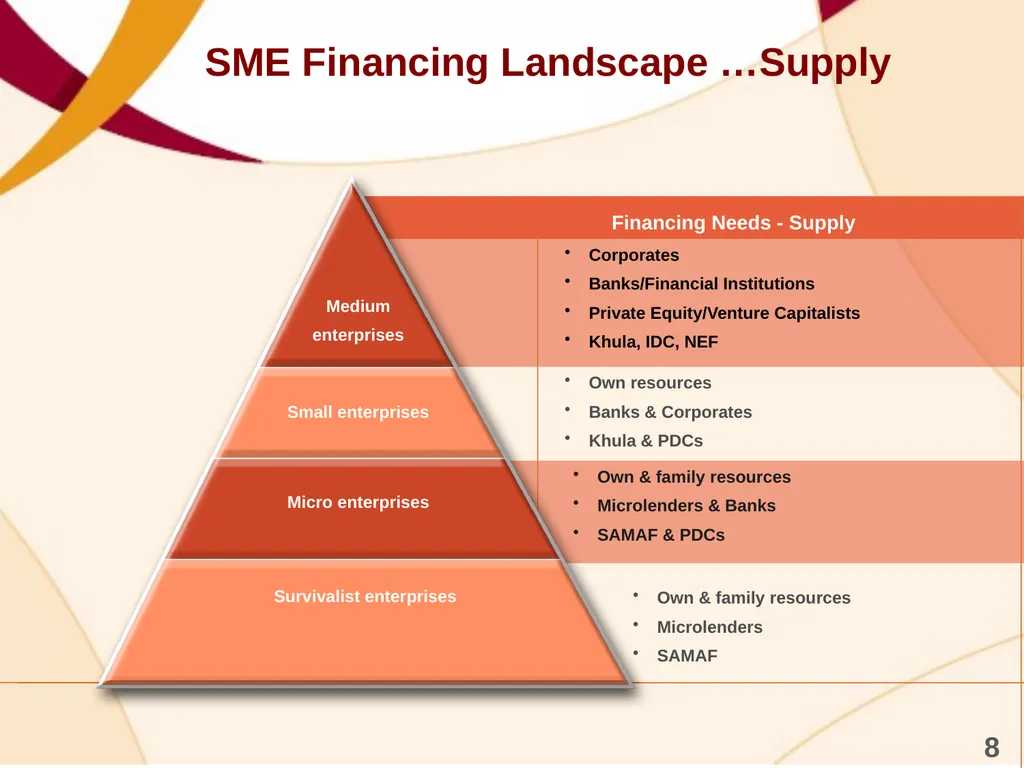
Medium
enterprises Small enterprises Micro enterprises Survivalist enterprises Corporates
Banks/Financial Institutions
Private Equity/Venture Capitalists
Khula, IDC, NEF Own resources
Banks & Corporates
Khula & PDCs Own & family resources
Microlenders & Banks
SAMAF & PDCs Own & family resources
Microlenders
SAMAF Medium
enterprises Small enterprises Micro enterprises Survivalist enterprises Financing Needs - Supply SME Financing Landscape …Supply 8<br>
07
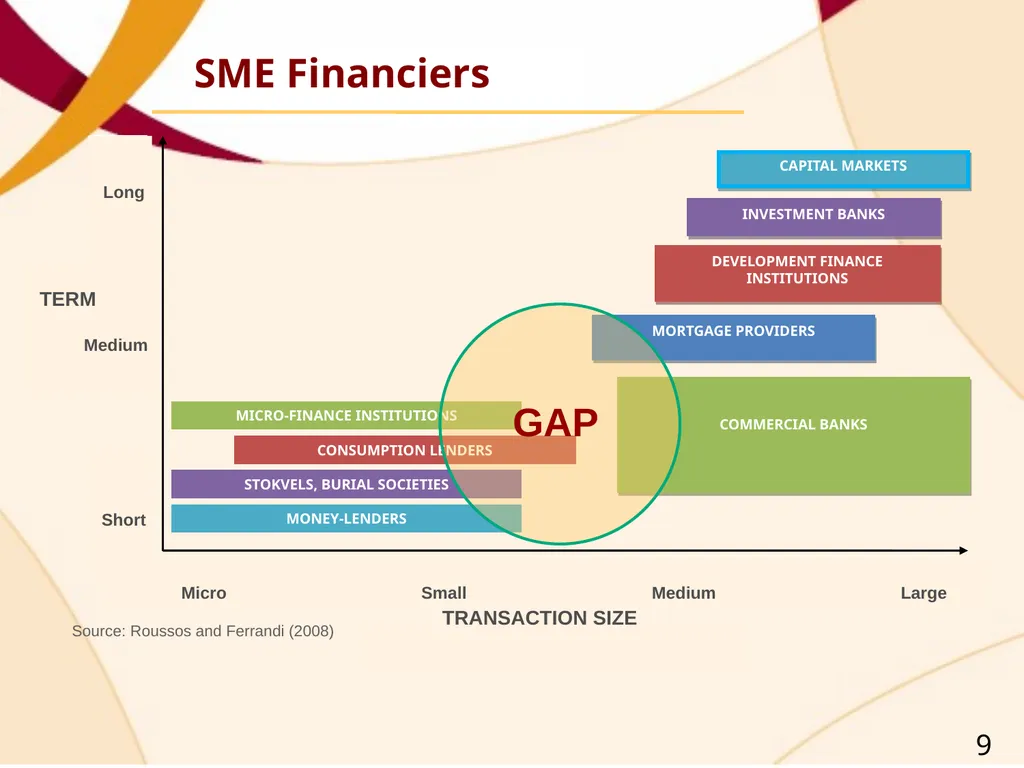
SME Financiers Source: Roussos and Ferrandi (2008) Long-term Short-term TERM Micro Medium Large Small MONEY-LENDERS STOKVELS, BURIAL SOCIETIES CONSUMPTION LENDERS MICRO-FINANCE INSTITUTIONS COMMERCIAL BANKS MORTGAGE PROVIDERS DEVELOPMENT FINANCE INSTITUTIONS INVESTMENT BANKS CAPITAL MARKETS TRANSACTION SIZE Medium- term GAP Long Medium Short TERM TRANSACTION SIZE Micro Small Medium Large 9<br>
08
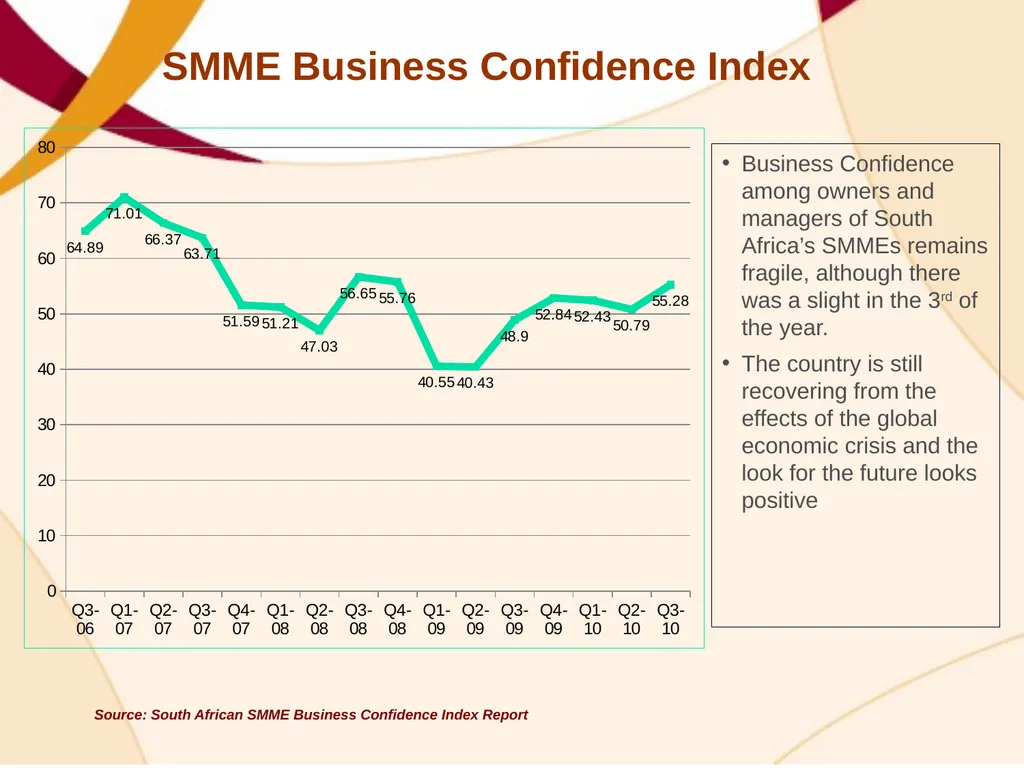
SMME Business Confidence Index Source: South African SMME Business Confidence Index Report Business Confidence among owners and managers of South Africa’s SMMEs remains fragile, although there was a slight in the 3rd of the year.
The country is still recovering from the effects of the global economic crisis and the look for the future looks positive<br>
09
Outline Introduction
SMME financing landscape
Factors inhibiting small business growth
Access to finance challenges – lender’s perspective
Role of Development Financial Institutions in Financing SMEs
Bridging the Gap
Concluding remarks<br>
10
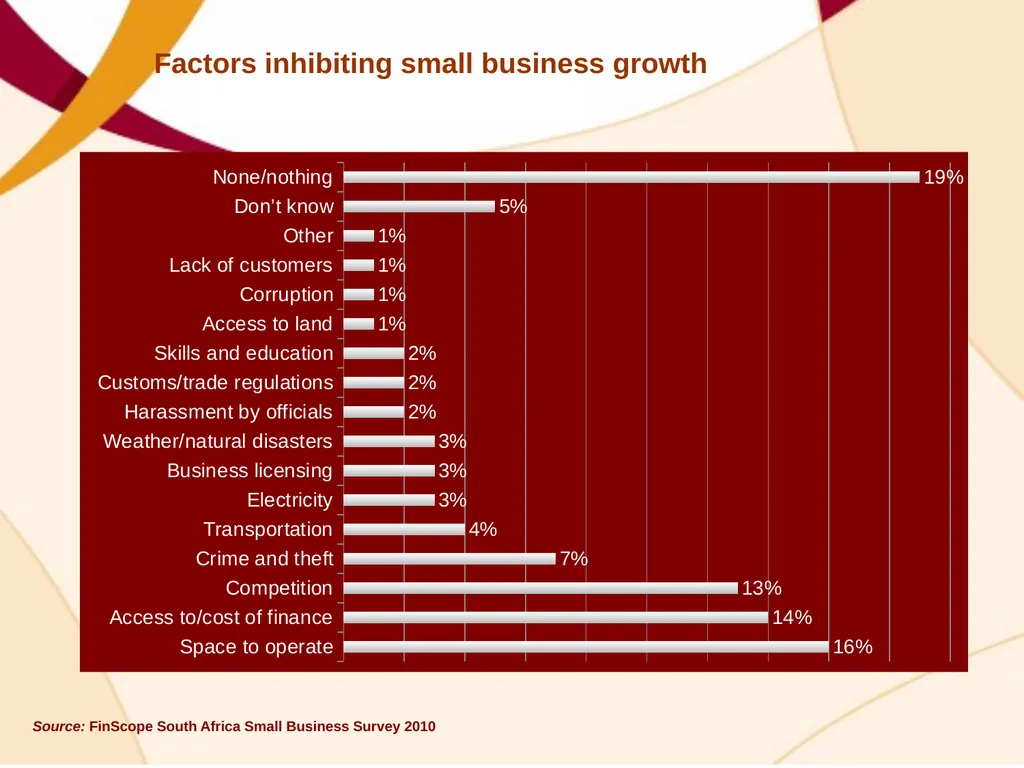
Source: FinScope South Africa Small Business Survey 2010 Factors inhibiting small business growth<br>
11
Outline Introduction
SMME financing landscape
Factors inhibiting small business growth
Challenges in Financing SMEs– lender’s perspective
Role of Development Financial Institutions in Financing SMEs
Concluding remarks<br>
12
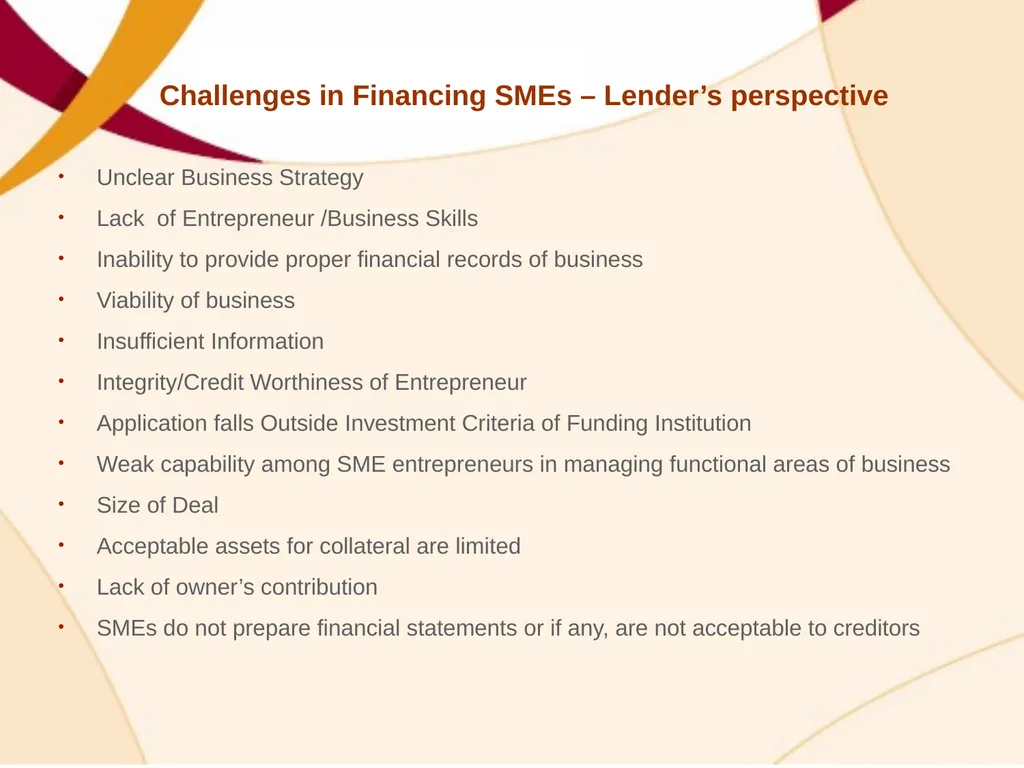
Challenges in Financing SMEs – Lender’s perspective Unclear Business Strategy
Lack of Entrepreneur /Business Skills
Inability to provide proper financial records of business
Viability of business
Insufficient Information
Integrity/Credit Worthiness of Entrepreneur
Application falls Outside Investment Criteria of Funding Institution
Weak capability among SME entrepreneurs in managing functional areas of business
Size of Deal
Acceptable assets for collateral are limited
Lack of owner’s contribution
SMEs do not prepare financial statements or if any, are not acceptable to creditors<br>
13
Outline Introduction
SMME financing landscape
Factors inhibiting small business growth
Access to finance challenges – lender’s perspective
Role of Development Financial Institutions in Financing SMEs
Concluding remarks<br>
14
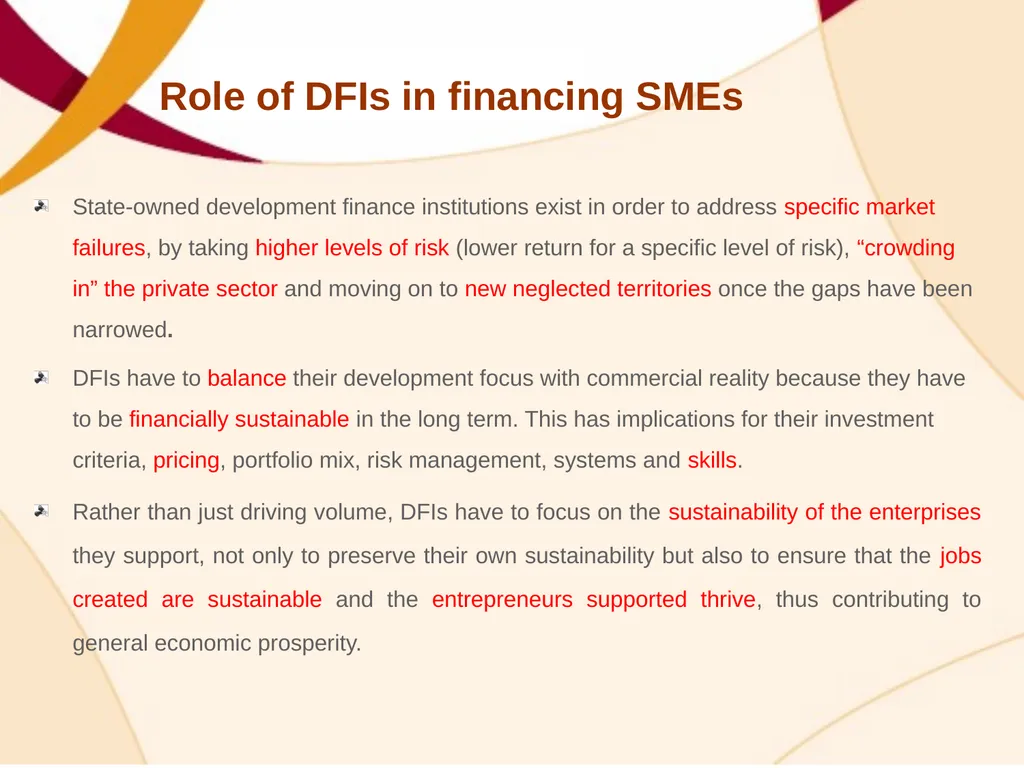
Role of DFIs in financing SMEs State-owned development finance institutions exist in order to address specific market failures, by taking higher levels of risk (lower return for a specific level of risk), “crowding in” the private sector and moving on to new neglected territories once the gaps have been narrowed.
DFIs have to balance their development focus with commercial reality because they have to be financially sustainable in the long term. This has implications for their investment criteria, pricing, portfolio mix, risk management, systems and skills.
Rather than just driving volume, DFIs have to focus on the sustainability of the enterprises they support, not only to preserve their own sustainability but also to ensure that the jobs created are sustainable and the entrepreneurs supported thrive, thus contributing to general economic prosperity.<br>
15
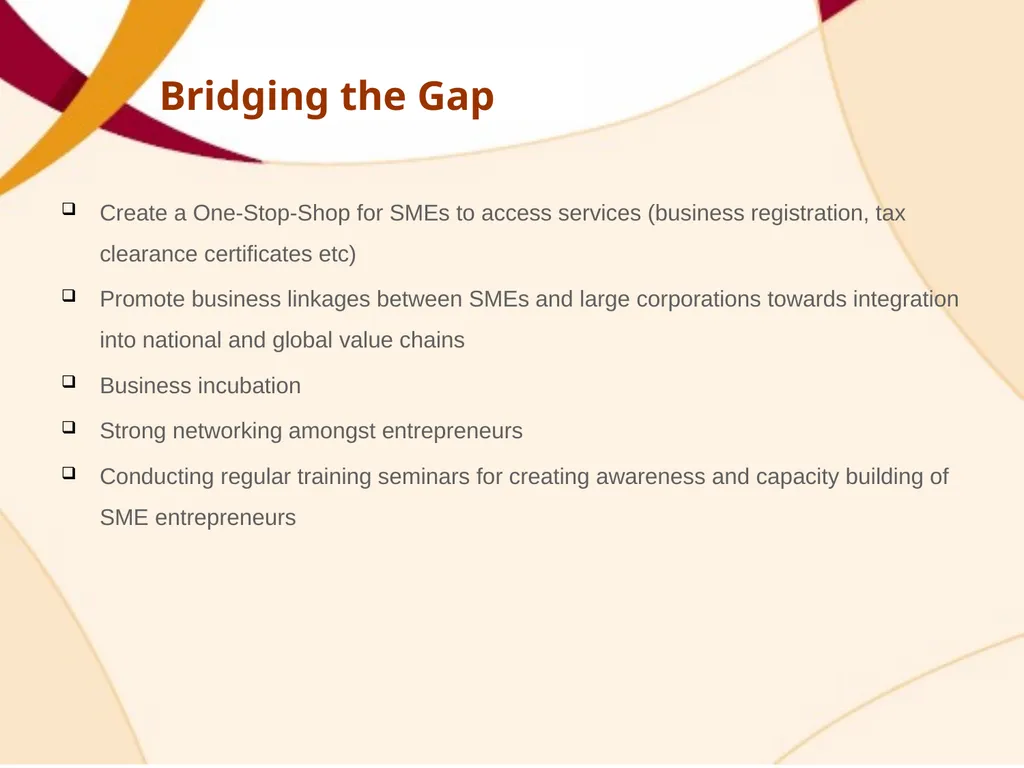
Bridging the Gap Create a One-Stop-Shop for SMEs to access services (business registration, tax clearance certificates etc)
Promote business linkages between SMEs and large corporations towards integration into national and global value chains
Business incubation
Strong networking amongst entrepreneurs
Conducting regular training seminars for creating awareness and capacity building of SME entrepreneurs<br>
16
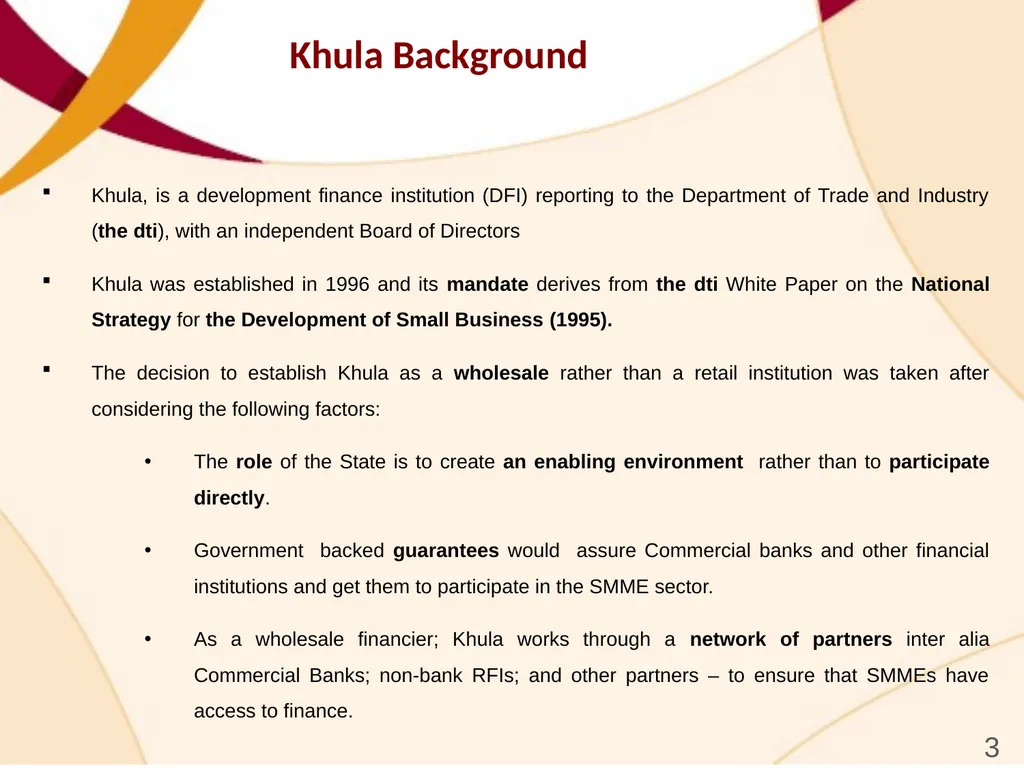
Khula Background Khula, is a development finance institution (DFI) reporting to the Department of Trade and Industry (the dti), with an independent Board of Directors
Khula was established in 1996 and its mandate derives from the dti White Paper on the National Strategy for the Development of Small Business (1995).
The decision to establish Khula as a wholesale rather than a retail institution was taken after considering the following factors:
The role of the State is to create an enabling environment rather than to participate directly.
Government backed guarantees would assure Commercial banks and other financial institutions and get them to participate in the SMME sector.
As a wholesale financier; Khula works through a network of partners inter alia Commercial Banks; non-bank RFIs; and other partners – to ensure that SMMEs have access to finance. 3<br>
17
Khula’s Mandate is focused on three key areas … Long-term objective Access to finance for SMEs Create sustainable SMEs; in the mainstream economy, thereby contribute to economic development Promote access to finance Financial sustainability Development impact 6<br>
18
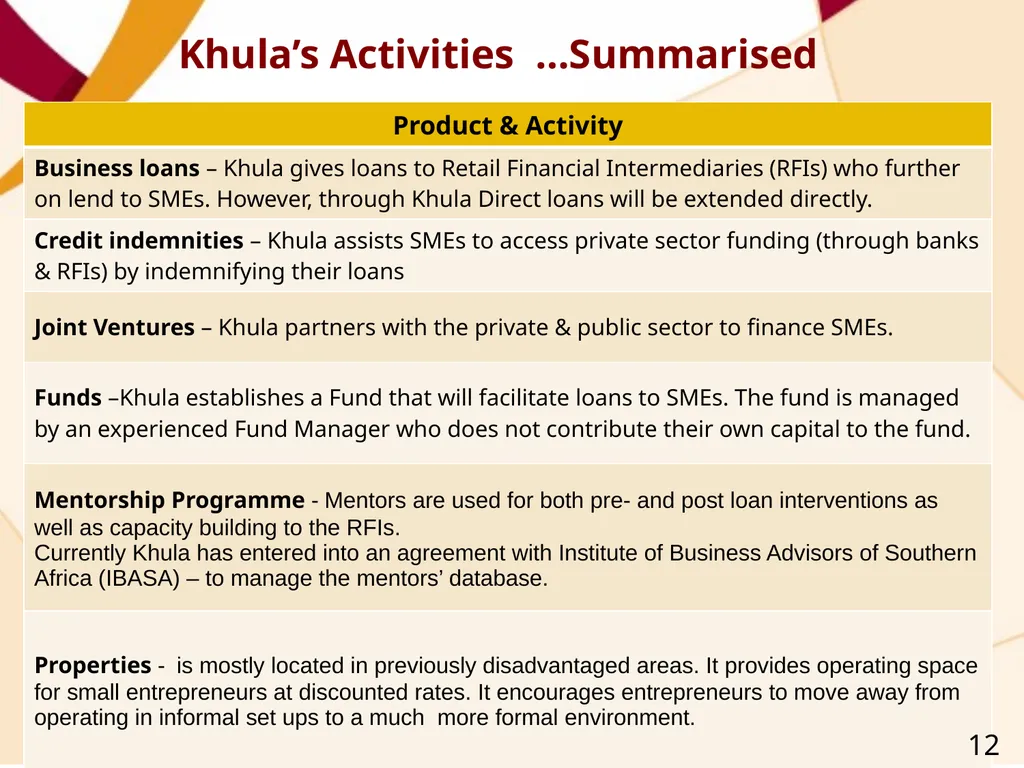
Khula’s Activities …Summarised 12<br>
19
Financing Partners 13<br>
20
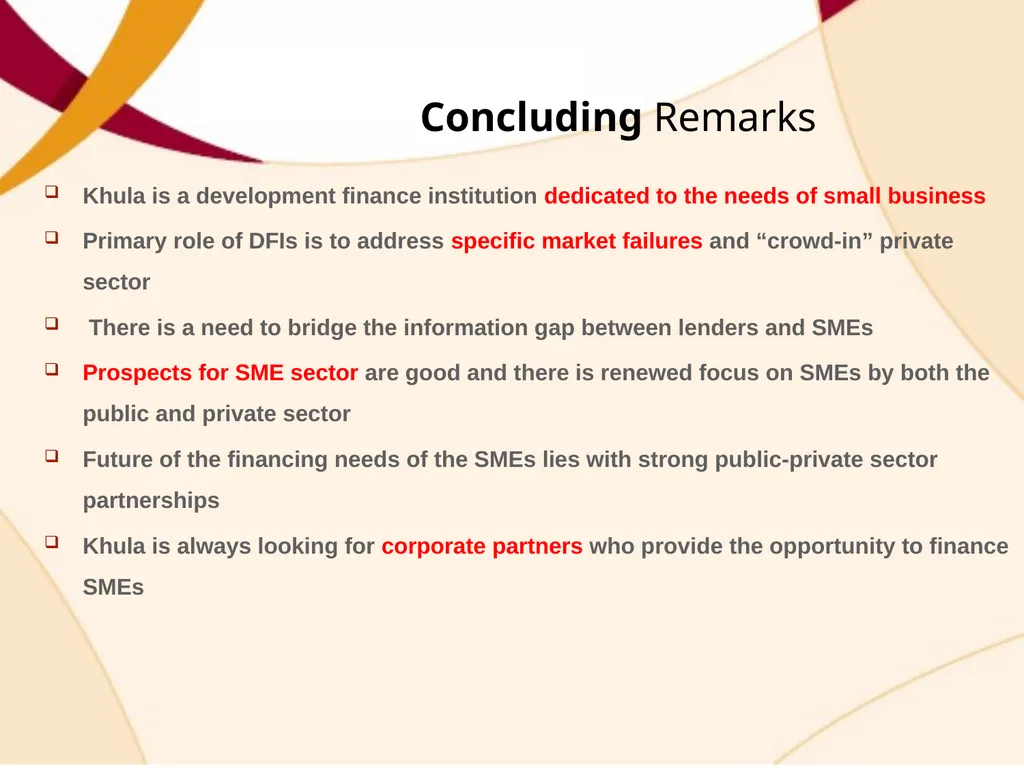
Concluding Remarks Khula is a development finance institution dedicated to the needs of small business
Primary role of DFIs is to address specific market failures and “crowd-in” private sector
There is a need to bridge the information gap between lenders and SMEs
Prospects for SME sector are good and there is renewed focus on SMEs by both the public and private sector
Future of the financing needs of the SMEs lies with strong public-private sector partnerships
Khula is always looking for corporate partners who provide the opportunity to finance SMEs<br>
21
THANK YOU Khula Client Liaison Centre number
08600 KHULA (54852) Website - http://www.khula.org.za Email - helpline@khula.org.za<br>