Snowboarding Official Rules The Basics Sport
Description: Snowboarding Official Rules The Basics Sport Season December - February Super G Novice, Intermediate, Advanced Giant Slalom Novice, Intermediate, Advanced Slalom Novice, Intermediate, Advanced Uniform Snowboarders should wear appropriate
Related Topics
Download Presentation
"Snowboarding Official Rules The Basics Sport" is the property of its rightful owner. Permission is granted to download and print the materials on this website for personal, non-commercial use only, and to display it on your personal computer provided you do not modify the materials and that you retain all copyright notices contained in the materials. By downloading content from our website, you accept the terms of this agreement.
Presentation Transcript
slide1. Snowboarding Official Rules<br>
slide2. The Basics Sport Season
December - February
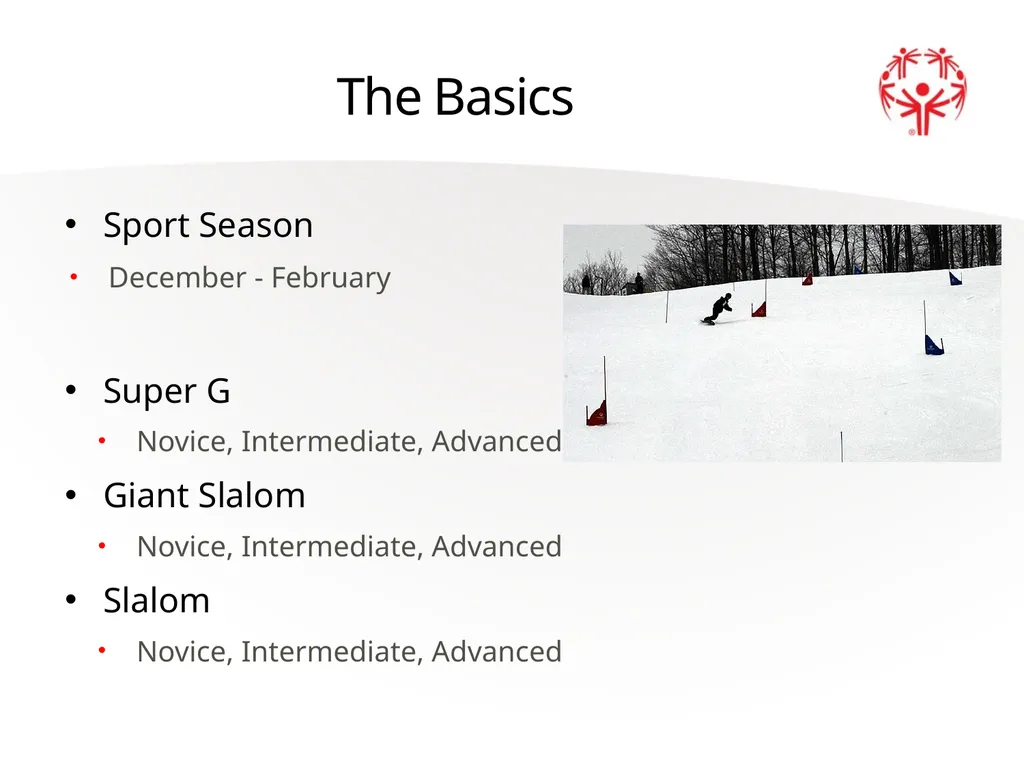
Super G
Novice, Intermediate, Advanced
Giant Slalom
Novice, Intermediate, Advanced
Slalom
Novice, Intermediate, Advanced<br>
slide3. Uniform Snowboarders should wear appropriate winter sports attire. Warm ski gloves or mittens, a hat, headband or ski mask, and sunglasses or goggles are recommended. Optional items include wrist guards and kneepads. All clothing should be conducive to freedom of movement.
Bibs: All competitors must wear competition bibs with numbers for both time trial and finals races.
Helmets: Ski racing helmets are required.
Snowboards must be equipped with a board leash. Competition equipment such as boards, bindings, and poles must pass all appropriate safety guidelines.<br>
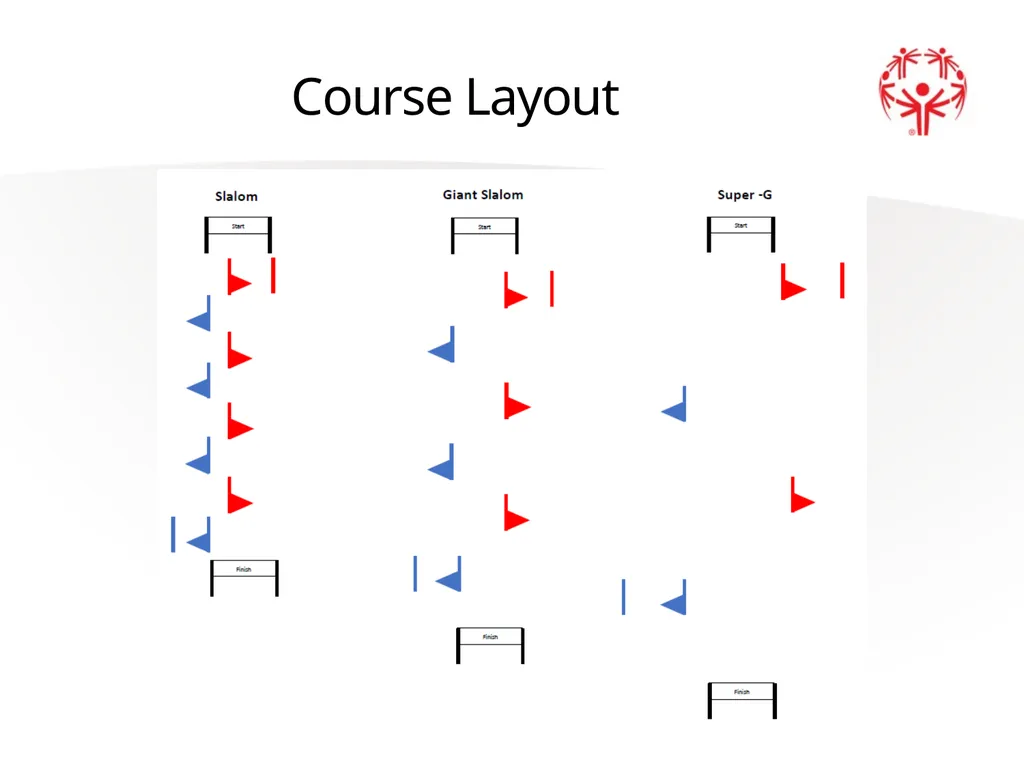
slide4. Course Layout Slalom:
One slalom pole, and a short stubby pole, connected by a triangular banner, shall be used to establish a slalom gate. A Single Pole Slalom has no outside pole except for the first and last gate. The first gate should always be red.<br>
slide5. Course Layout Giant Slalom and Super-G:
In Giant Slalom and Super-G, a pole and a short stubby pole, connected by a triangular banner, constitute a gate.
For Giant Slalom, the distance from the turning pole to the outside pole across the fall line is 4 to 8 meters.
The Super-G distance is no less than 8 meters.
The first gate, or sets of gates, after the start should always be red.<br>
slide6. Course Layout<br>
slide7. Course Layout When it is possible, electric timing equipment will be used. If not possible, hand-held timing will be utilized.
Gate judges shall be responsible for timing the one-minute rule.
Adequate protection for the start and finish areas shall be provided. Fencing and/or pop fencing may be used.
Start and finish banners shall be used.<br>
slide8. Divisioning All coaches are reminded to review the sections in the Official Special Olympics Winter Sports Rules for clarifications of divisioning and age groupings.
Novice, intermediate and advanced skiers shall have two Time Trial runs on a modified giant slalom course of their ability level, with the fastest time used to determine their division for competition. If there is time, divisioning time trials may be conducted for each event. In the first run of competition in each division, the fastest time trial starts first, the slowest last.<br>
slide9. Divisioning If an athlete does not perform at the level they are registered for, the games officials have the authority to move the athlete to their correct level. If an athlete performs in an unsafe manner they will be disqualified.<br>
slide10. Competition Equipment Athletes must use the same attire and equipment for divisioning and finals. Changes in attire (from a jacket to a speed suit for example), or in equipment (from a freestyle board to a race board), will result in disqualification.
An FIS (Federation Internationale du Ski) helmet approved for alpine ski racing or snowboarding is required on all forerunners and athletes in official training and competition for all ability levels in all events.
Helmets are required for all coaches to be granted access to the field of play.<br>
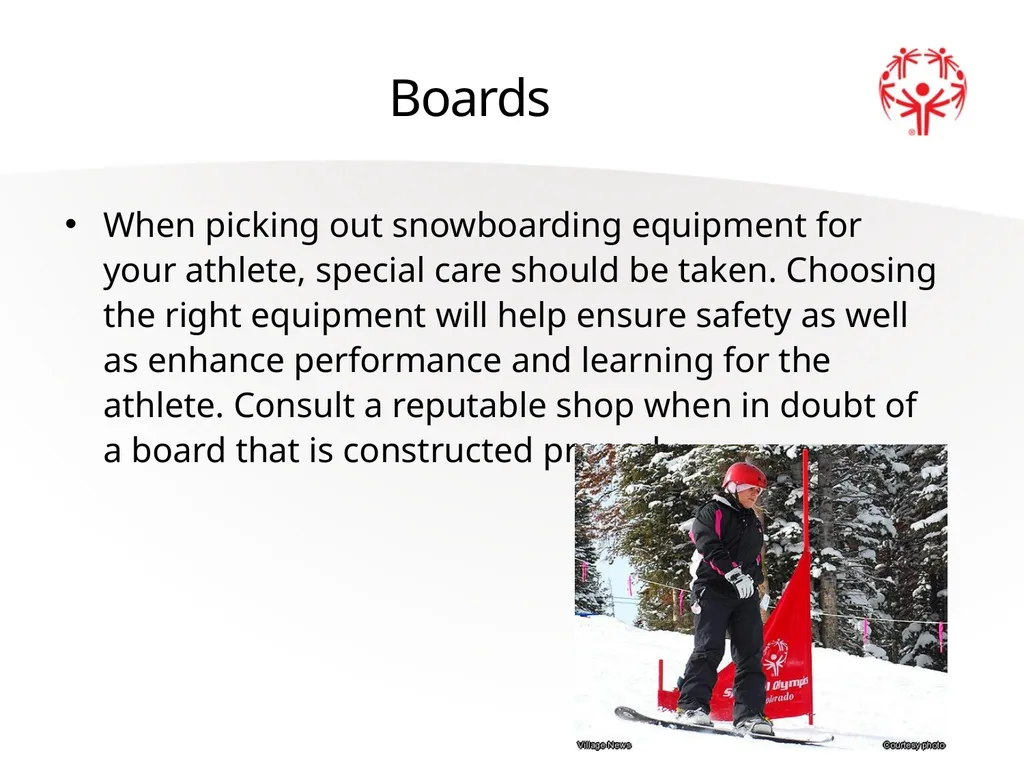
slide11. Boards When picking out snowboarding equipment for your athlete, special care should be taken. Choosing the right equipment will help ensure safety as well as enhance performance and learning for the athlete. Consult a reputable shop when in doubt of a board that is constructed properly.<br>
slide12. Start All start areas shall be flat enabling the athletes to stand in the start in either a relaxed or ready position.
For all snowboard events, the start command shall be “5-4-3-2-1-Go!” The timer begins when the athlete’s front boot crosses the start line or electric timer is activated. Care should be given for providing easy access to this area as well as securing the area from the flow of general public skier traffic.
A gate has been passed correctly when both the competitor’s snowboard tip and both feet have passed across the gate closest to where the infraction occurred. Starts<br>
slide13. Start A gate has been passed correctly when both the competitor’s snowboard tip and both feet have passed across the gate closest to where the infraction occurred.
The start and finish lines are the same as a gate line.
In the event that a competitor removes a pole from its vertical position before the competitor’s snowboard tip and both feet have passed the gate line, the snowboard tip and feet must pass the original gate.
A competitor who receives assistance of any kind shall be disqualified Correct Passage<br>
slide14. One-Minute Rule During competition, if the competitor moves out of the general direction of the line of the course (falls or misses a gate), he/she has one minute from the time of deviation to re-enter the course.
A competitor who fails to adhere to this time limit, or receives assistance of any kind, shall be disqualified.
Disqualification shall be determined on the gate card by the gate judge assigned to the gate closest to where the infraction occurred.
The gate judge is responsible for timing the two minutes.<br>
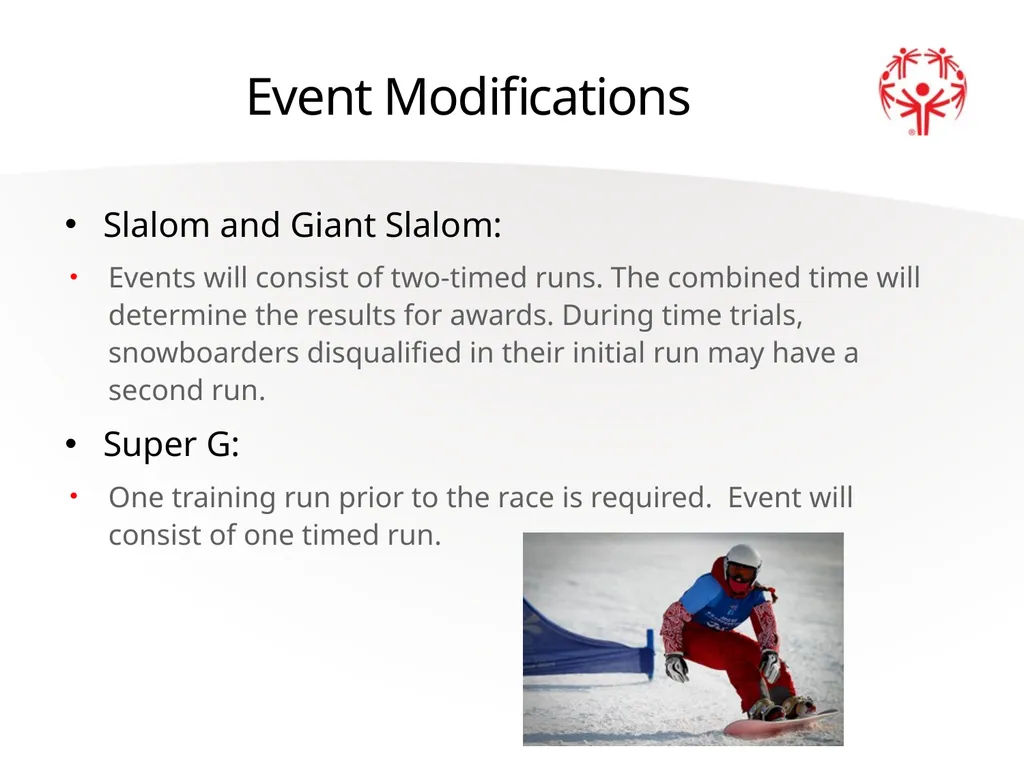
slide15. Event Modifications Slalom and Giant Slalom:
Events will consist of two-timed runs. The combined time will determine the results for awards. During time trials, snowboarders disqualified in their initial run may have a second run.
Super G:
One training run prior to the race is required. Event will consist of one timed run.<br>
slide16. Injuries The most common injuries, especially for beginners, occur in the fingers and wrists because they take the brunt of the fall’s impact. Making a fist keeps your fingers from splaying out and your wrists from hyperextending. No matter which way you fall, always make a fist.
Absorbing impact with your knees helps to lessen the force with which you fall. By landing on your bent knees, you avoid the “Tim-berrrrr!” effect of falling straight over face first.<br>
slide17. Injuries Along with making fists, using your forearms (instead of just your hands) helps to keep your wrists from hyperextending. Putting your forearms down also helps protect your face from slamming into the snow.<br>
slide18. Friendly Reminders Always stay in control and be able to stop or avoid other people or objects.
People ahead of you have the right of way. It is your responsibility to avoid them.
You must not stop where you obstruct a run or are not visible from above.
Whenever starting downhill or merging into a trail, look uphill and yield to others uphill from you.
Always use devices to help prevent runaway equipment.<br>
slide19. Friendly Reminders Observe all posted signs and warnings. Keep off closed trails and out of closed areas.
Prior to using any lift, you must have the knowledge and ability to load, ride and unload safely.<br>
slide20. Terms Backside - Refers to the side of the board where the riders heels are, also known as the Heel Side.
Base - The bottom of a snowboard
Frontside - Refers to the side of the board where the rider’s toes are
Gate - A marker on the course, in the shape of a triangle, that the rider must pass at the smaller side; exits as both blue and red
Carve - A turn made with a minimum of skidding, in which the entire length of the snowboard's edge passes through the same point in the snow<br>
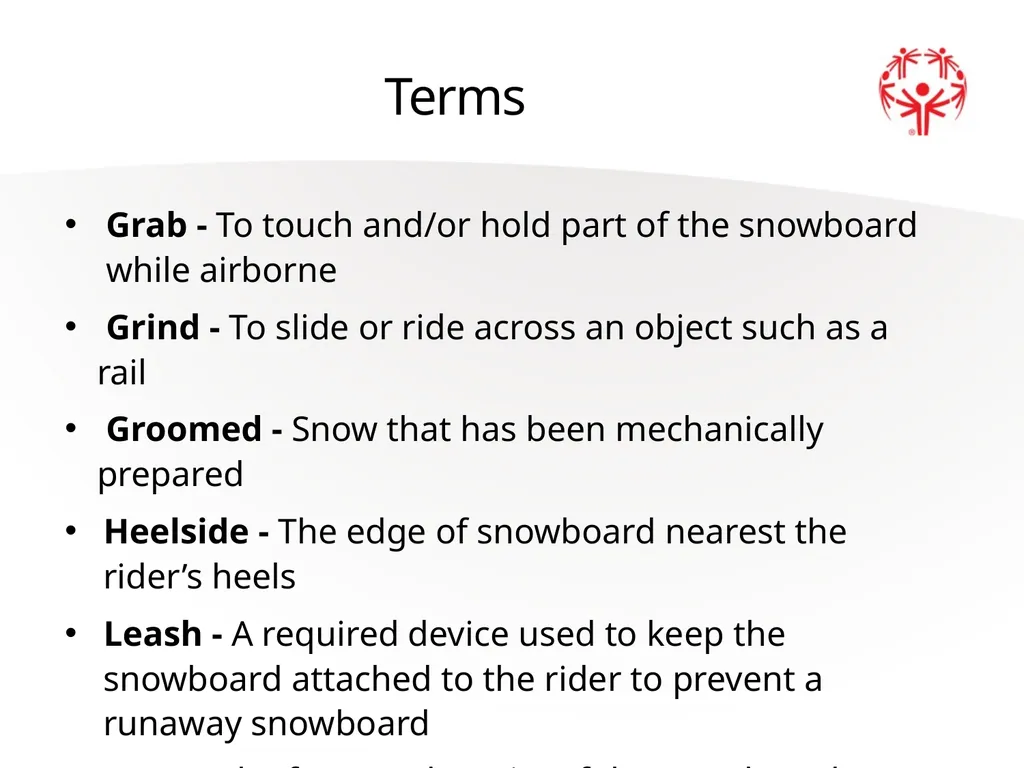
slide21. Terms Grab - To touch and/or hold part of the snowboard while airborne
Grind - To slide or ride across an object such as a rail
Groomed - Snow that has been mechanically prepared
Heelside - The edge of snowboard nearest the rider’s heels
Leash - A required device used to keep the snowboard attached to the rider to prevent a runaway snowboard
Nose - The front end, or tip, of the snowboard<br>
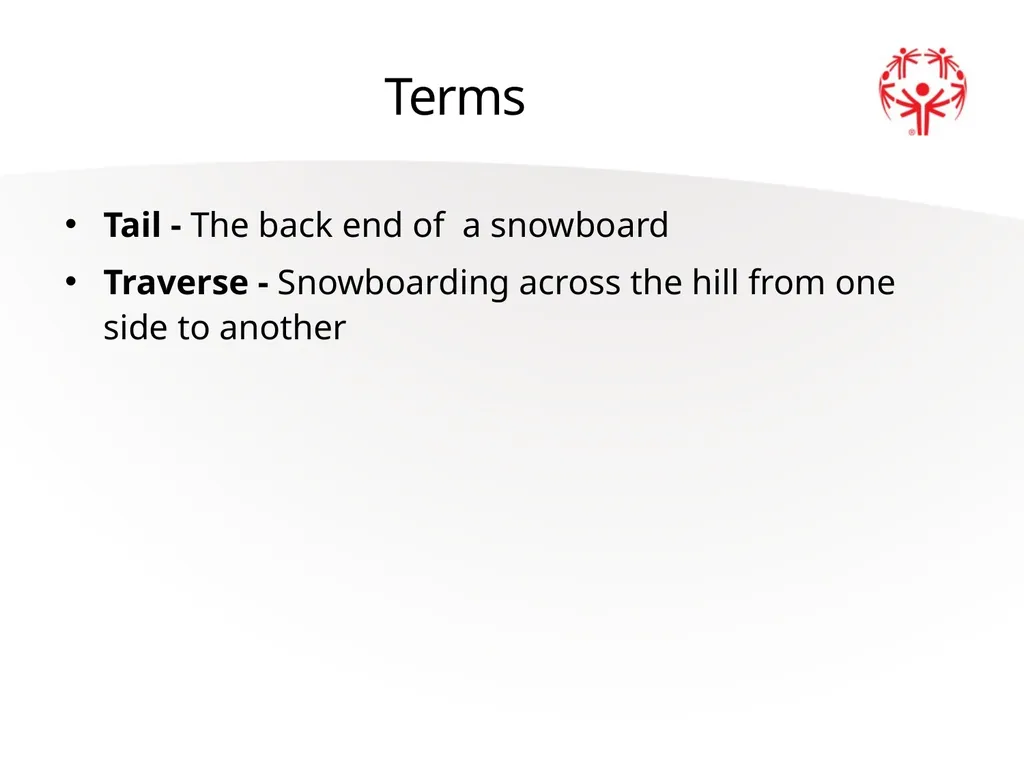
slide22. Terms Tail - The back end of a snowboard
Traverse - Snowboarding across the hill from one side to another<br>

slide2. The Basics Sport Season
December - February
Super G
Novice, Intermediate, Advanced
Giant Slalom
Novice, Intermediate, Advanced
Slalom
Novice, Intermediate, Advanced<br>
slide3. Uniform Snowboarders should wear appropriate winter sports attire. Warm ski gloves or mittens, a hat, headband or ski mask, and sunglasses or goggles are recommended. Optional items include wrist guards and kneepads. All clothing should be conducive to freedom of movement.
Bibs: All competitors must wear competition bibs with numbers for both time trial and finals races.
Helmets: Ski racing helmets are required.
Snowboards must be equipped with a board leash. Competition equipment such as boards, bindings, and poles must pass all appropriate safety guidelines.<br>
slide4. Course Layout Slalom:
One slalom pole, and a short stubby pole, connected by a triangular banner, shall be used to establish a slalom gate. A Single Pole Slalom has no outside pole except for the first and last gate. The first gate should always be red.<br>
slide5. Course Layout Giant Slalom and Super-G:
In Giant Slalom and Super-G, a pole and a short stubby pole, connected by a triangular banner, constitute a gate.
For Giant Slalom, the distance from the turning pole to the outside pole across the fall line is 4 to 8 meters.
The Super-G distance is no less than 8 meters.
The first gate, or sets of gates, after the start should always be red.<br>
slide6. Course Layout<br>
slide7. Course Layout When it is possible, electric timing equipment will be used. If not possible, hand-held timing will be utilized.
Gate judges shall be responsible for timing the one-minute rule.
Adequate protection for the start and finish areas shall be provided. Fencing and/or pop fencing may be used.
Start and finish banners shall be used.<br>
slide8. Divisioning All coaches are reminded to review the sections in the Official Special Olympics Winter Sports Rules for clarifications of divisioning and age groupings.
Novice, intermediate and advanced skiers shall have two Time Trial runs on a modified giant slalom course of their ability level, with the fastest time used to determine their division for competition. If there is time, divisioning time trials may be conducted for each event. In the first run of competition in each division, the fastest time trial starts first, the slowest last.<br>
slide9. Divisioning If an athlete does not perform at the level they are registered for, the games officials have the authority to move the athlete to their correct level. If an athlete performs in an unsafe manner they will be disqualified.<br>
slide10. Competition Equipment Athletes must use the same attire and equipment for divisioning and finals. Changes in attire (from a jacket to a speed suit for example), or in equipment (from a freestyle board to a race board), will result in disqualification.
An FIS (Federation Internationale du Ski) helmet approved for alpine ski racing or snowboarding is required on all forerunners and athletes in official training and competition for all ability levels in all events.
Helmets are required for all coaches to be granted access to the field of play.<br>
slide11. Boards When picking out snowboarding equipment for your athlete, special care should be taken. Choosing the right equipment will help ensure safety as well as enhance performance and learning for the athlete. Consult a reputable shop when in doubt of a board that is constructed properly.<br>
slide12. Start All start areas shall be flat enabling the athletes to stand in the start in either a relaxed or ready position.
For all snowboard events, the start command shall be “5-4-3-2-1-Go!” The timer begins when the athlete’s front boot crosses the start line or electric timer is activated. Care should be given for providing easy access to this area as well as securing the area from the flow of general public skier traffic.
A gate has been passed correctly when both the competitor’s snowboard tip and both feet have passed across the gate closest to where the infraction occurred. Starts<br>
slide13. Start A gate has been passed correctly when both the competitor’s snowboard tip and both feet have passed across the gate closest to where the infraction occurred.
The start and finish lines are the same as a gate line.
In the event that a competitor removes a pole from its vertical position before the competitor’s snowboard tip and both feet have passed the gate line, the snowboard tip and feet must pass the original gate.
A competitor who receives assistance of any kind shall be disqualified Correct Passage<br>
slide14. One-Minute Rule During competition, if the competitor moves out of the general direction of the line of the course (falls or misses a gate), he/she has one minute from the time of deviation to re-enter the course.
A competitor who fails to adhere to this time limit, or receives assistance of any kind, shall be disqualified.
Disqualification shall be determined on the gate card by the gate judge assigned to the gate closest to where the infraction occurred.
The gate judge is responsible for timing the two minutes.<br>
slide15. Event Modifications Slalom and Giant Slalom:
Events will consist of two-timed runs. The combined time will determine the results for awards. During time trials, snowboarders disqualified in their initial run may have a second run.
Super G:
One training run prior to the race is required. Event will consist of one timed run.<br>
slide16. Injuries The most common injuries, especially for beginners, occur in the fingers and wrists because they take the brunt of the fall’s impact. Making a fist keeps your fingers from splaying out and your wrists from hyperextending. No matter which way you fall, always make a fist.
Absorbing impact with your knees helps to lessen the force with which you fall. By landing on your bent knees, you avoid the “Tim-berrrrr!” effect of falling straight over face first.<br>
slide17. Injuries Along with making fists, using your forearms (instead of just your hands) helps to keep your wrists from hyperextending. Putting your forearms down also helps protect your face from slamming into the snow.<br>
slide18. Friendly Reminders Always stay in control and be able to stop or avoid other people or objects.
People ahead of you have the right of way. It is your responsibility to avoid them.
You must not stop where you obstruct a run or are not visible from above.
Whenever starting downhill or merging into a trail, look uphill and yield to others uphill from you.
Always use devices to help prevent runaway equipment.<br>
slide19. Friendly Reminders Observe all posted signs and warnings. Keep off closed trails and out of closed areas.
Prior to using any lift, you must have the knowledge and ability to load, ride and unload safely.<br>
slide20. Terms Backside - Refers to the side of the board where the riders heels are, also known as the Heel Side.
Base - The bottom of a snowboard
Frontside - Refers to the side of the board where the rider’s toes are
Gate - A marker on the course, in the shape of a triangle, that the rider must pass at the smaller side; exits as both blue and red
Carve - A turn made with a minimum of skidding, in which the entire length of the snowboard's edge passes through the same point in the snow<br>
slide21. Terms Grab - To touch and/or hold part of the snowboard while airborne
Grind - To slide or ride across an object such as a rail
Groomed - Snow that has been mechanically prepared
Heelside - The edge of snowboard nearest the rider’s heels
Leash - A required device used to keep the snowboard attached to the rider to prevent a runaway snowboard
Nose - The front end, or tip, of the snowboard<br>
slide22. Terms Tail - The back end of a snowboard
Traverse - Snowboarding across the hill from one side to another<br>