Social Networking Why social media? Traditional media, such as television, newspaper,radio, and magazines, are oneway, static broadcast technologies. distribute their own content. A blog post, tweet, or YouTube video can be produced and
"Social Networking Why social media? Traditional" is the property of its rightful owner. Permission is granted to
download and print the materials on this website for personal, non-commercial use only, and to display it
on your personal computer provided you do not modify the materials and that you retain all copyright
notices contained in the materials. By downloading content from our website, you accept the terms of this
agreement.
Presentation Transcript
01
Social Networking<br>
02
Why social media? Traditional media, such as television, newspaper,radio, and magazines, are oneway, static
broadcast technologies.
distribute their own content. A blog post, tweet, or YouTube video can be produced and viewed by millions virtually for free. Examples
blogs,
microblogs (Twitter),
social networks (Facebook, LinkedIn),
media-sharing sites (YouTube, Flickr),
Social bookmarking and voting sites (Digg, Reddit),
review sites (Yelp),
forums, and virtual worlds (Second Life)<br>
03
Companies & Social media IBM owns more than 100 different blogs, several official Twitter accounts, and a popular
forum called developerWorks.
Dell has popular IdeaStorm website, where users add ideas for new product lines and enhancements, vote them up or down, and comment on submissions.
Because of the site, Dell has started to ship computers with Linux installed, and has added
Community support.<br>
04
Companies & Social media Big brands have also faced embarrassment on social media
Example :
two Domino’s Pizza employees posted a video
to YouTube showing them defiling food
Motrin released a commercial that offered its product as a solution to the pain women experience when carrying babies<br>
05
Small business & Social media A small specialty baker in New Jersey, Pink Cake Box, leverages nearly every type of social media that exists to build a substantial brand<br>
06
Twitter and Microblogging limits the size of each post
contain only 140 characters
Started in 2009
requires very little investment of time,
to announce offers or events, promote new blog posts,<br>
07
History In 2004, a group of technologists and activists created an organizational tool called TXTmob - protesters at the 2004 political conventions to communicate through short text messages
web-based podcasting startup Odeo was failing
Jack Dorsey proposed an SMS broadcast system similar to and inspired by TXTmob
thus Twitter was built in March 2006
Popularity increased<br>
08
Protocol Account – individual/company
Username selection- users for name with underscore and numbers are less.
Avatar
Image 48x48 pixel – company logo / user photo
Bio
160 characters in a section called “Bio”<br>
09
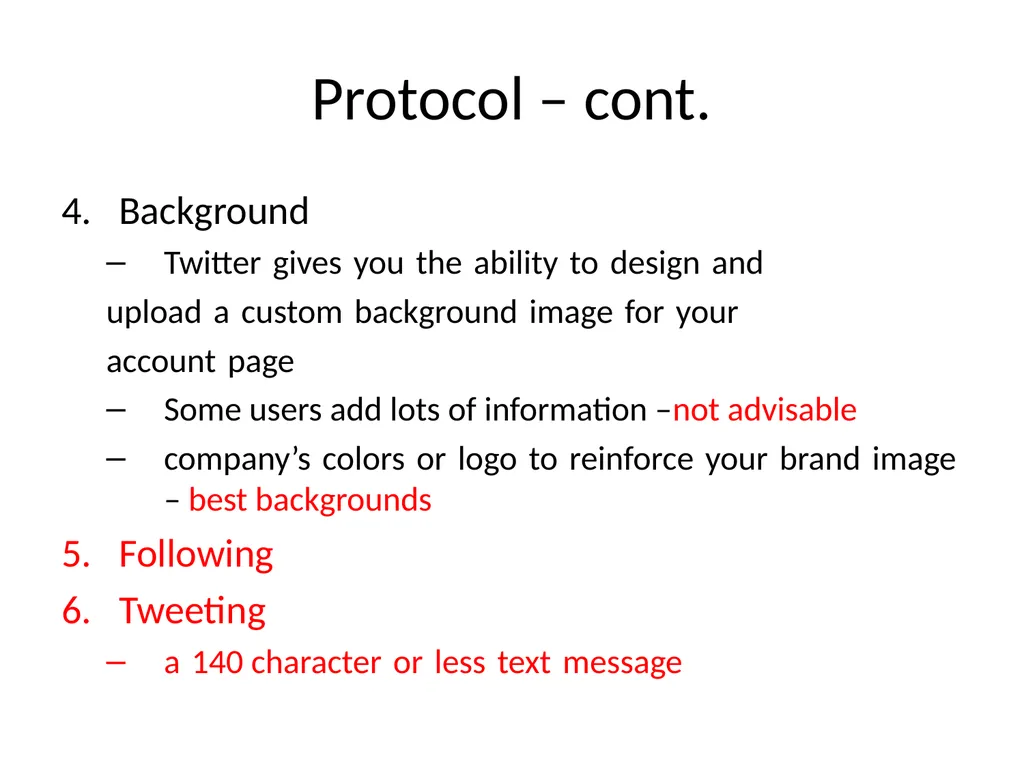
Protocol – cont. Background
Twitter gives you the ability to design and
upload a custom background image for your
account page
Some users add lots of information –not advisable
company’s colors or logo to reinforce your brand image – best backgrounds
Following
Tweeting
a 140 character or less text message<br>
10
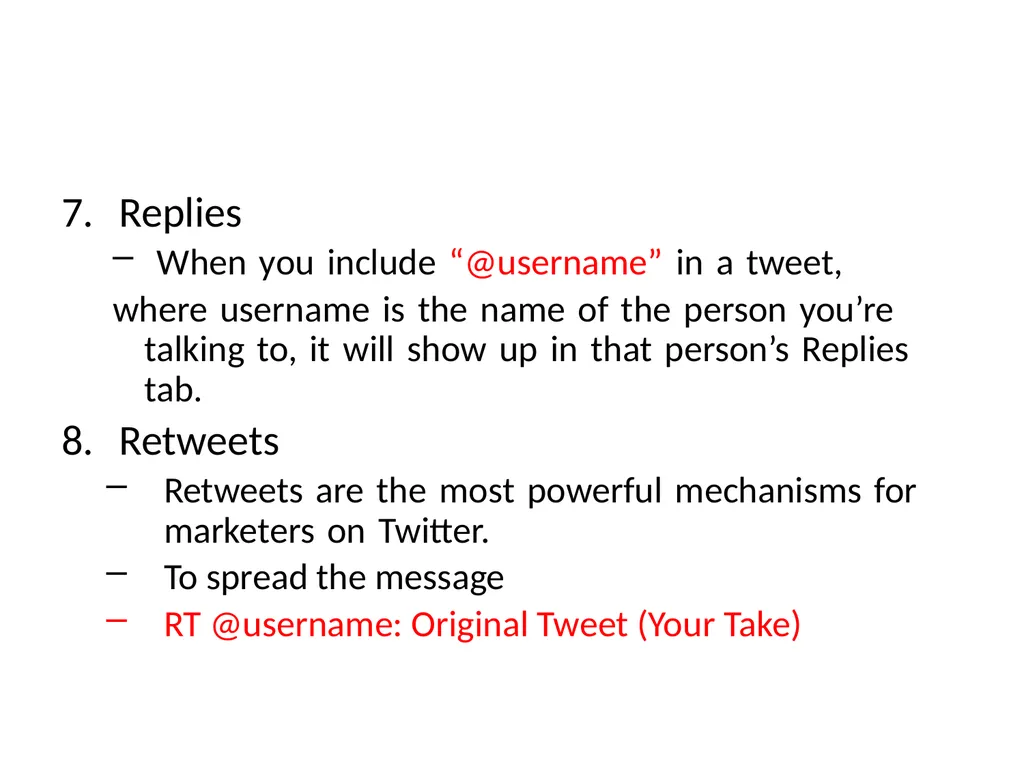
Replies
When you include “@username” in a tweet,
where username is the name of the person you’re talking to, it will show up in that person’s Replies tab.
Retweets
Retweets are the most powerful mechanisms for marketers on Twitter.
To spread the message
RT @username: Original Tweet (Your Take)<br>
11
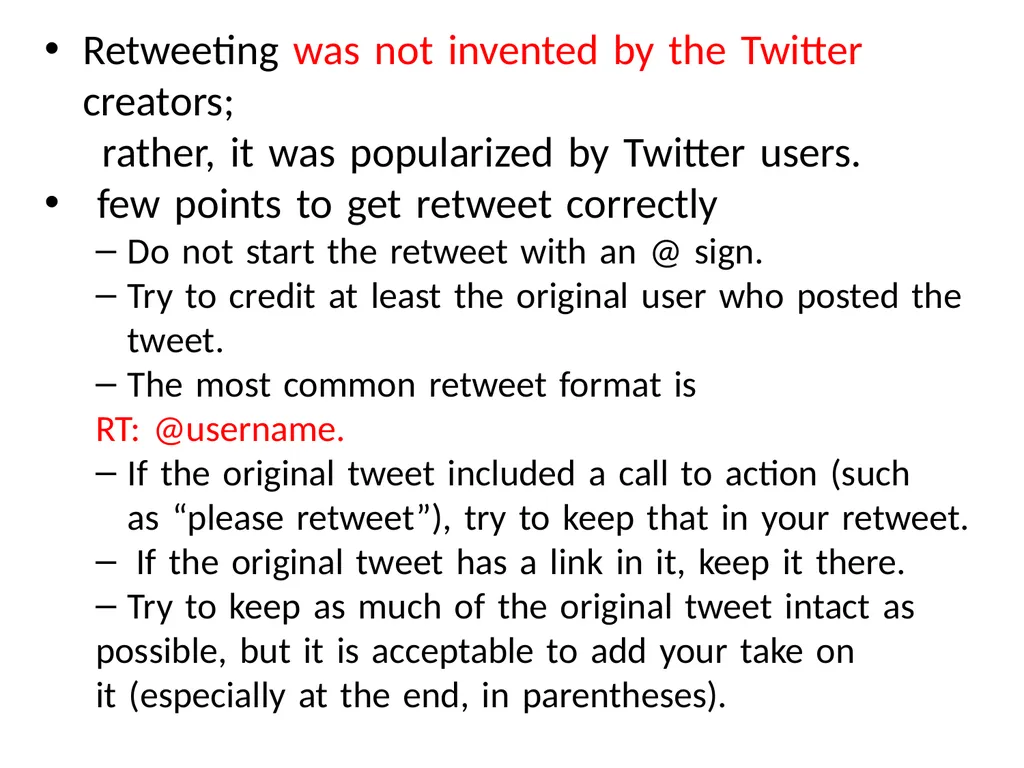
Retweeting was not invented by the Twitter creators;
rather, it was popularized by Twitter users.
few points to get retweet correctly
Do not start the retweet with an @ sign.
Try to credit at least the original user who posted the tweet.
The most common retweet format is
RT: @username.
If the original tweet included a call to action (such as “please retweet”), try to keep that in your retweet.
If the original tweet has a link in it, keep it there.
Try to keep as much of the original tweet intact as
possible, but it is acceptable to add your take on
it (especially at the end, in parentheses).<br>
12
Direct Messages
Several web tools are available to set up what are called auto-DMs
Trending Topics
Popular events, news, and memes
Twitter community is currently interested in and talking about
Hashtags
(#), a hashtag is used to indicate that a certain tweet is about the same topic as every other tweet using the same tag.
campaigns, news, political events and issues, and conferences<br>
13
Shortened URLs
URL-shortening services:
TinyURL (http://TinyURL.com)
It does not offer click tracking,
Bit.ly (http://bit.ly)
The default shortener for Twitter.com and TweetDeck, bit.ly allows
you to create an account and analyze the number of clicks your
short URLs are getting.
Ow.ly (http://ow.ly)
Ow.ly is integrated into the HootSuite application, which allows click tracking as well as tweet scheduling.<br>
14
Clients
Twitter was originally built for messaging from mobile phones via SMS
Applications that support tweeting from phone are
TweetDeck
TweetDeck is free and runs on Adobe Air, so you can use it on Mac, Windows, and many types of Linux machines that simplify managing lots of followers, such
as groups, searches, and Twitpic integration
Tweetie
Tweetie is an application for Macs and iPhones.<br>
15
Twhirl
Twhirl is another Adobe Air desktop application. It includes a spellchecker and is designed to be very simple and easy to use, making it a good client for new Twitter users.
HootSuite
HootSuite is my favorite webbased Twitter client. It allows teams to manage single (or multiple) accounts, and
it includes functionality to schedule tweets to be posted in the future.
It is integrated with the Ow.ly URL shortener, and offers extensive
analytics regarding clicks and mentions of your brand<br>