
SOCIAL SECURITY SYSTEMS IN UGANDA Country Paper on
T
Published · 38 slides · 0 views

1 / 1

Description
SOCIAL SECURITY SYSTEMS IN UGANDA Country Paper on Social Security Systems Presented By Beth Ansiimire Ministry of Finance, Planning and Economic Development 1 Presentation Outline Uganda Facts and Figures Uganda Map, Flag and Coat of Arms
Related Topics
Share
Embed code
Download this presentation From Below
"SOCIAL SECURITY SYSTEMS IN UGANDA Country Paper on" is the property of its rightful owner. Permission is granted to download and print the materials on this website for personal, non-commercial use only, and to display it on your personal computer provided you do not modify the materials and that you retain all copyright notices contained in the materials. By downloading content from our website, you accept the terms of this agreement.
Presentation Transcript
01
SOCIAL SECURITY SYSTEMS IN UGANDA Country Paper on Social Security Systems
Presented By Beth Ansiimire
Ministry of Finance, Planning and Economic Development 1<br>
02
Presentation Outline Uganda Facts and Figures
Uganda Map, Flag and Coat of Arms
People and Culture
Turkish Investments in Uganda
Economic Overview
Background to Social Security in Uganda
History of social security in Uganda
Institutional framework
Legal and policy framework of social security 2<br>
03
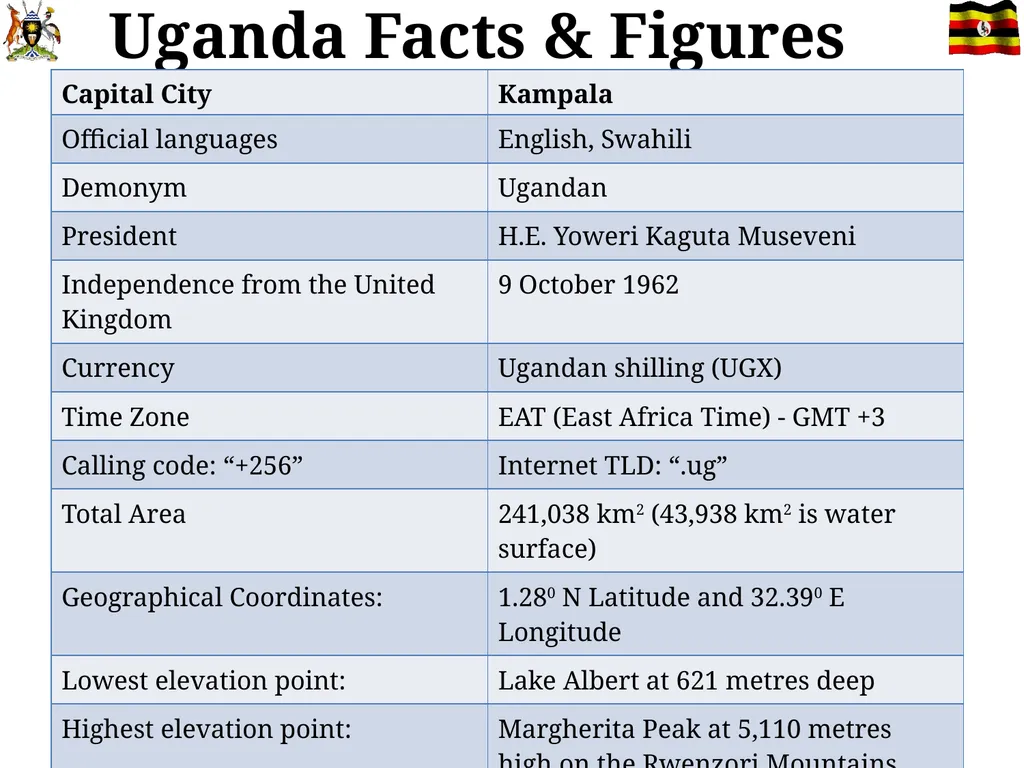
Uganda Facts & Figures 3<br>
04
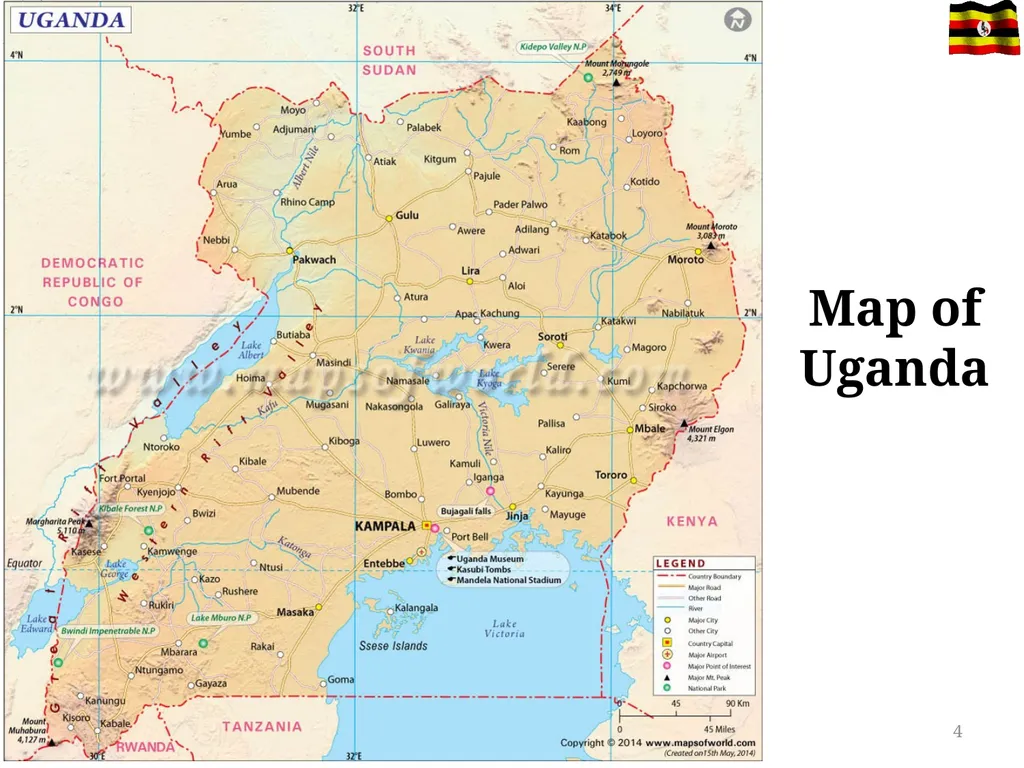
Map of Uganda 4<br>
05
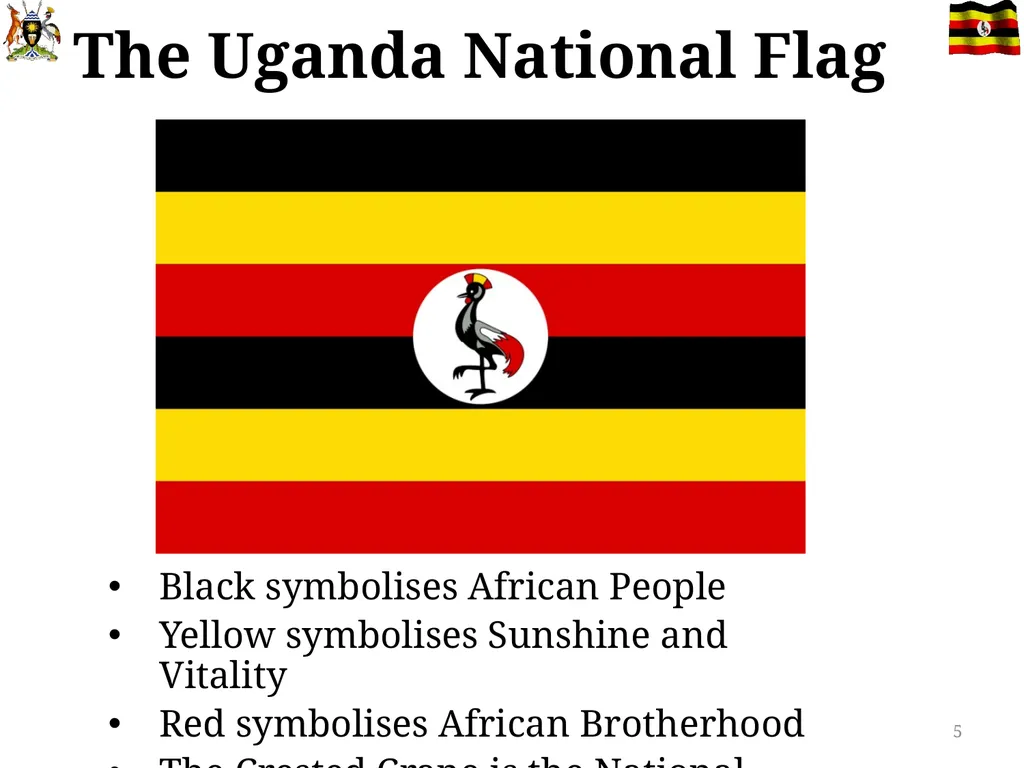
The Uganda National Flag Black symbolises African People
Yellow symbolises Sunshine and Vitality
Red symbolises African Brotherhood
The Crested Crane is the National Emblem 5<br>
06
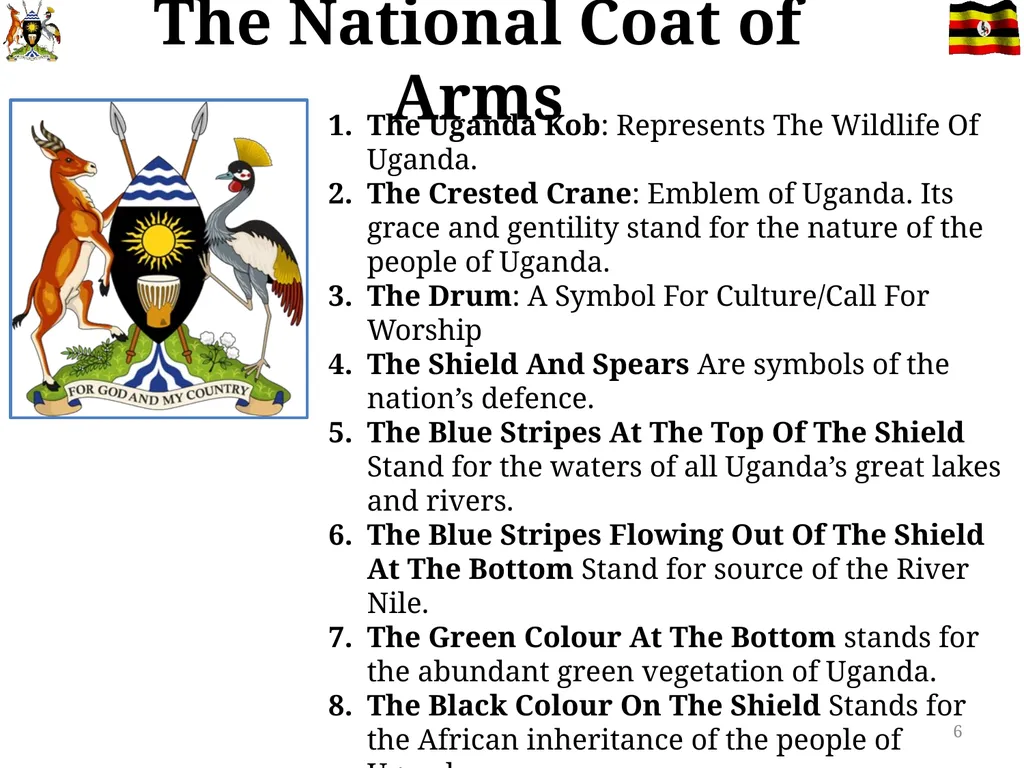
The National Coat of Arms The Uganda Kob: Represents The Wildlife Of Uganda.
The Crested Crane: Emblem of Uganda. Its grace and gentility stand for the nature of the people of Uganda.
The Drum: A Symbol For Culture/Call For Worship
The Shield And Spears Are symbols of the nation’s defence.
The Blue Stripes At The Top Of The Shield Stand for the waters of all Uganda’s great lakes and rivers.
The Blue Stripes Flowing Out Of The Shield At The Bottom Stand for source of the River Nile.
The Green Colour At The Bottom stands for the abundant green vegetation of Uganda.
The Black Colour On The Shield Stands for the African inheritance of the people of Uganda.
Coffee And Cotton: Traditional cash crops and show that Uganda is an agricultural country.
The Sun Signifies tropical climate with plenty of sunshine.
For God and My Country is the Motto of Uganda. 6<br>
07
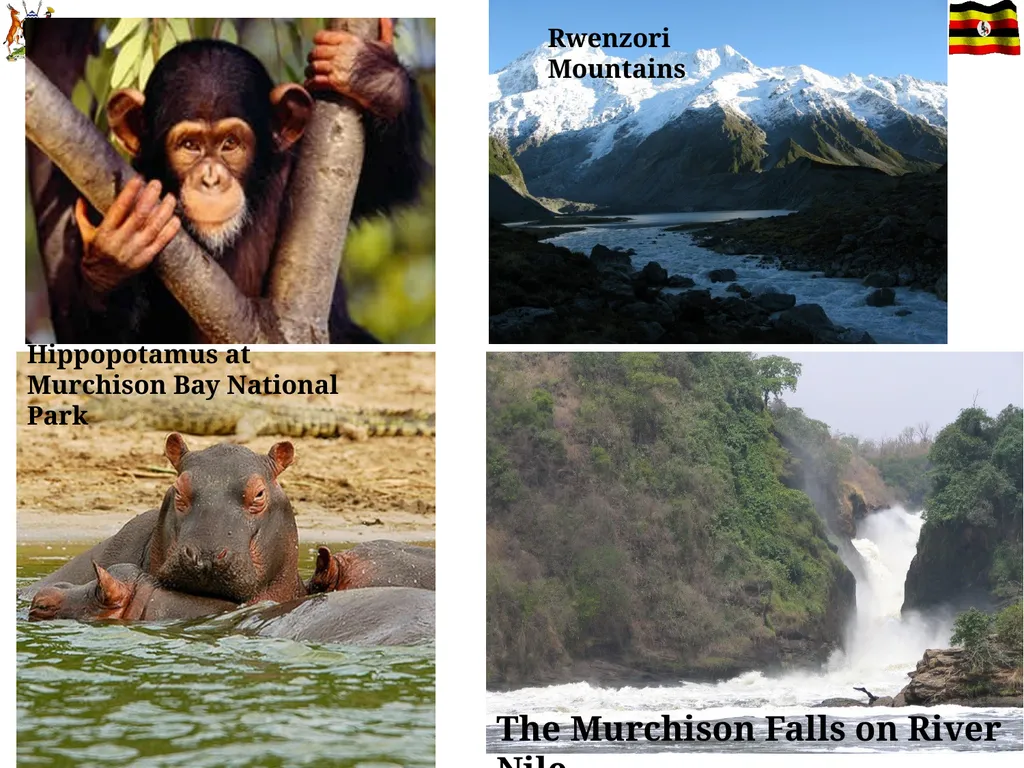
The Murchison Falls on River Nile 7 Hippopotamus at Murchison Bay National Park Rwenzori Mountains<br>
08
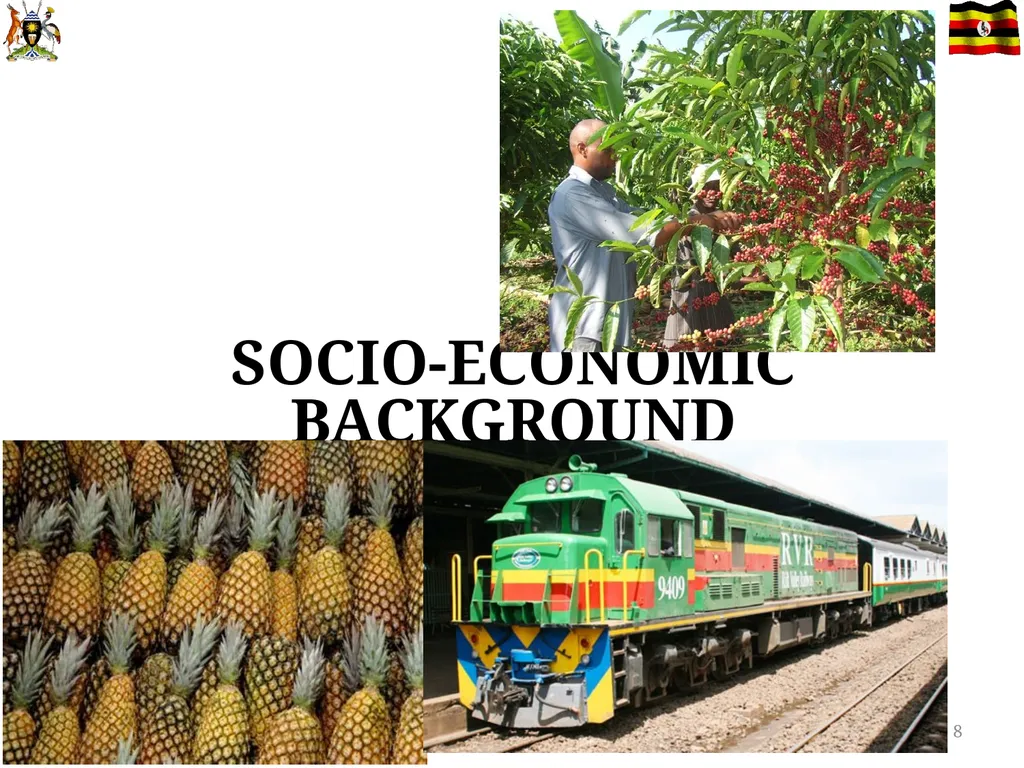
SOCIO-ECONOMIC BACKGROUND 8<br>
09
People and Culture Uganda is a multilingual and multi-ethnic society with 56 legally recognised ethnic groups and languages.
English is the first official national language; mostly used in schools and courts of law.
Swahili is the second official national language; mainly used in the army and police forces.
Luganda and Swahili are the most widely used native languages.
77% of Ugandans depend on Agriculture, employing over 4.5 million smallholder farmers with another 2.5 million people in agricultural related activities such as transportation, processing and manufacturing.
There is freedom of worship in Uganda, but the majority are Christians, Muslims, others. 9<br>
10
Turkish Investments in Uganda There are a number of Turkish investments in Uganda that include:-
The Turko group and ASB Group of Companies are some of the biggest contributors to employment and economic growth in Uganda, with multi-billion dollar investments in agriculture and agro processing.
Turkish Light Academy is one of the leading performing secondary schools with best grades.
Turkish Airlines with flights from Entebbe Airport on a daily basis connecting Uganda to the World. 10<br>
11
Economic Overview Recent economic performance has been positive, underpinned by sound economic policies and strong implementation. The economy is projected to grow at 5.3% during this FY.
Inflation has remained low despite global and regional shocks - Annual core inflation stood at 7.1% as at January 2016 while headline inflation stood at 7.6% during the same period.
There is exchange rate flexibility. However, recent depreciation pressures have led the Central Bank to tighten the monetary policy stance to keep inflation low. 11<br>
12
Economic Overview cont’d Real GDP growth is estimated to grow at 5.75% in FY2015/16.
The current account deficit is set to widen to about 8.5% of GDP reflecting increasing capital goods imports, but international reserves remain adequate.
Tax revenue has been increasing, and the fiscal deficit is estimated at 4.5% of GDP, below previous projections, on account of a sharp tax revenue increase. 12<br>
13
Exports and Imports as at January 2016 Overall balance of payments has been negatively affected by the poor performance of exports largely due to political instability faced by some of our trading partners in the region and an economic slowdown in Europe, a surge in import demand, as well as net outflow of short term capital in equity and government securities.
Total export revenue as at end January 2016 was estimated at US$240.07 million, compared to imports of US$456.78 million over the same period.
The surge in import demand has been inevitable, given an increase in infrastructure investments in oil, the road network and Karuma and Isimba Hydropower projects. 13<br>
14
Social Security as a right “Everyone, as a member of society, has the right to social security and is entitled to realization, through national effort and international co-operation and in accordance with the organization and resources of each State, of the economic, social and cultural rights indispensable for his dignity and the free development of his personality.” (Universal Declaration of Human Rights Article 22) 14<br>
15
Background to social security in Uganda Social security has evolved over time in Uganda, like in most of sub-Saharan Africa; it is firmly rooted in the country’s institutions and traditions.
In the pre-colonial period, Africans lived in mutual support networks of community, extended family and clan groups.
Social security was embedded within the cultural norms as a form of solidarity and assistance to people within clans and communities, who were unable to take care of themselves. These normally included orphans and vulnerable children, widows, older persons, persons with disability, and the terminally ill. 15<br>
16
Social security structure in Uganda Uganda inherited a formal social security system established by the colonial administration that caters for both public and private employees.
Uganda has a multi-tier pension system model with contributory social insurance, non-contributory direct income support and voluntary private pension schemes.
However, the traditional (informal) social support mechanisms (kinship, extended family and mutual support groups) are the most important social security providers in the country, particularly to those in the informal sector. 16<br>
17
History of Social protection in Uganda A public service pension scheme was established in 1927 to cater for employees of the British Protectorate in Uganda.
The Armed Forces Pension Scheme was then established and first implemented in 1935 to provide social protection to retired soldiers.
Following the establishment of this scheme, a number of other schemes were created, including the Public Sector Pension Scheme, which was first established on 1 January, 1946 to provide retirement benefits to public servants (World Bank Economic Outlook June, 2014) 17<br>
18
History cont’d In 1946, the Department of Compensation, originally known as the Pension Department, was created after the enactment of the Pension Act (Ministry of Public Service, 2014).
In line with article 22 of the Universal Declaration of Human Rights on 12 December, 1948, the colonial government in Uganda formed a social security department in the Ministry of Labour, which was the precursor of the present National Social Security Fund.
Initially the teachers had a different pension arrangement through the provident fund, which was a contributory scheme. They used to contribute to this fund and money would later be distributed back as pension (International Policy Centre for Inclusive Growth, n.d.) 18<br>
19
History cont’d In 1953, the teachers fund was introduced and all the money that had been collected under the provident fund was distributed to them. This was the period when the teachers joined the current public service pension scheme in Uganda targeting all the civil servants.
In 1985, the Government of Uganda established the National Social Security Fund (NSSF) to provide social security to private sector workers.
In addition, other voluntary schemes have been established by a range of employers to provide retirement benefits to their employees(These usually take 10% of employees salary on a monthly basis that is then disbursed to them at the end of every year) 19<br>
20
Current Social Security Schemes These schemes include :-
Formal
Public service pension scheme,
NSSF,
Parliamentary Pension Scheme
Informal /private
Schemes run by different Life Insurance
companies with policy covers ranging from 5 to 15 years 20<br>
21
Current Social Security Schemes cont’d Semi-formal security systems which take the form of aid kits
include:-
Burial societies;
Saving clubs; and,
Credit schemes. 21<br>
22
Institutional Framework for Social Security in Uganda There are a number of institutions in Uganda that are responsible
for social security management and provision. These include:-
The Ministry of Gender, Labour and Social Development (MGLSD), through the Directorate of Social Protection, is the leading institution in Uganda responsible for policy development and implementation oversight of social protection programmes and interventions.
The Ministry of Public Service is responsible for the administration and management of the Public Service Pension Scheme through the Department of Compensation. 22<br>
23
Institutional Framework cont’d The Ministry of Finance, Planning and Economic Development (MFPED) mobilizes, allocates and releases funds in the national budget to finance social security in the social development and other sectors. It also plays a lead role in the governance of public and private pension schemes, including the fiscal arrangements for both and appoints the board and management of the NSSF (Office of the President, 2013; Office of the Auditor General, 2010) 23<br>
24
Institutional Framework cont’d The Ministry of Health is the overall agency responsible for health provision in Uganda and is spearheading the introduction of the National Health Insurance Scheme (NHIS) through drafting the National Health Insurance Bill that proposes to extend contributory health insurance to formal workers.
The Uganda Retirement Benefits Regulatory Authority (URBRA) is an independent authority whose mandate is to regulate the establishment, management and operation of retirement benefit schemes in both the private and public sectors and was created by the Uganda Retirement Benefits Regulatory Authority Act, 2011. 24<br>
25
Legal and Policy Framework of Social Security Uganda has ratified various conventions with social security
provisions at both international and regional levels that include:-
Uganda is a signatory to the Universal Declaration of Human Rights (1948), which recognizes social security provisions.
On 21 January 1987, Uganda ratified the International Covenant on Economic, Social and Cultural Rights (1966). Article 9 recognizes the right of everyone to social security, including social insurance. 25<br>
26
Legal and Policy Framework of Social Security Uganda has not yet ratified the ILO Covenant 102 on Minimum Standards of Social Security (1952), which covers a wider scope of social security. Benefits covered include injury benefit; family benefit; unemployment benefit; maternity benefit; invalidity benefit; and survivors’ benefit (ILO, 1952).
Despite the fact that Uganda has not yet ratified this covenant, some of the above benefits have been domesticated into the legislative framework that recognizes social security provisions. 26<br>
27
Legal and Policy Framework of Social Security cont’d In 2002, Uganda adopted the Madrid Plan of Action on Ageing (MIPAA, 2002), which calls on the signatory nations to ensure that social protection systems respond to the needs of older persons.
Uganda adopted the Livingstone Call for Action in 2006, which sets out commitments to social protection and calls on countries in Africa to put in place costed plans for the implementation of direct income support programmes (The Livingstone Call for Action, 2006). 27<br>
28
Legal and Policy Framework of Social Security cont’d The Pensions Act (Cap. 281, Laws of Uganda) regulates pension arrangements for traditional civil servants, primary and secondary school teachers, police officers, prison officers, doctors and public employees in the judiciary. The Act also covers civil servants in local authorities.
Furthermore, Uganda adopted the African Union Social Policy Framework (2008) that calls on African member states to recognize the need for social protection programmes. 28<br>
29
Legal and Policy Framework of Social Security cont’d The Armed Forces Pension Act (Cap. 295) established on 3 September, 1939 acknowledges the need for social security through providing for the payment of pensions, gratuities and other allowances in respect of the death, disablement or sickness of serving members of the armed forces.
The National Social Security Fund Act, 1985 (Cap. 222) recognizes the establishment of a National Social Security Fund (NSSF) and the need to provide for its membership, the payment of contributions to, and the payment of benefits out of, the fund and for other purposes. 29<br>
30
Legal and Policy Framework of Social Security cont’d NSSF is a provident fund (pays out contributions in lump sum). The scheme was instituted with a core objective to protect employees against the uncertainties of social and economic life.
The scheme is mandatory for employers that have five or more employees. The contribution rate of NSSF is 15% shared at 5% and 10% by the employee and employer respectively.
The Local Government Act, 1997 (Cap. 243) recognizes pensions as one of the benefits for local government staff under the terms and conditions of service of local government staff. 30<br>
31
Legal and Policy Framework of Social Security cont’d The Employment Act, 2006 entitles women to maternity leave and men to paternity leave in employment. Section 36 (1) of the Act states as follows:
‘[a] female employee shall, as a consequence of pregnancy, have the right to a period of sixty working days’ leave from work on full wages hereafter referred to as maternity leave of which four weeks shall follow the childbirth or miscarriage. 31<br>
32
Legal and Policy Framework of Social Security cont’d The Parliamentary Pensions Act, 2007 makes provision for a contributory pension scheme for Members of Parliament (MPs) and members of staff of Parliament.
It also establishes a Parliamentary Pensions Fund for payment or granting of pensions or retirement benefits to MPs and members of staff of Parliament. 32<br>
33
Legal and Policy Framework of Social Security cont’d Uganda Vision 2040 identifies, under section 5.4, the need for the development and implementation of social protection systems to respond to the needs of vulnerable groups such as the elderly, orphaned children, and the disabled, among others.
The vision further recognizes the need for the development of a universal health insurance system through public-private partnerships. 33<br>
34
Legal and Policy Framework of Social Security cont’d The Workers’ Compensation Act, 2000 (Cap. 225) entitles employees to automatic compensation for any personal injury from an accident arising out of and in the course of his employment, even if the injury results from the employee’s negligence.
The Retirement Benefits Regulatory Authority Act, 2011 established a Retirement Benefits Regulatory Authority whose objective is to regulate the establishment, management and operation of retirement benefits schemes in Uganda in both the private and public sectors. 34<br>
35
Legal and Policy Framework of Social Security The 1995 Constitution of the Republic of Uganda provides an overarching and firm basis for social security interventions. Article 14 states as follows:
‘all Ugandans enjoy rights and opportunities and access to education, health services ... decent shelter, adequate clothing, food security and pension and retirement benefits and the National Objectives and Directive Principles of State Policy specifically oblige the State to make ‘reasonable provision for the welfare and maintenance of the aged’. 35<br>
36
Social Security Schemes coverage 1.9 million people are covered by formal social security schemes representing 14% of the labour force.
NSSF has a total membership of 1.5 million and a total asset base of Ugx.4.4 trillion (Around US$1.3 billion).
The other 45 registered schemes have a total of about 400,000 members and an asset base of Ugx.700 billion (Around US$ 207.67 million). 36<br>
37
ACKNOWLEDGEMENT The Government of the Republic of Turkey and SESRIC for offering my country, and myself in particular, an opportunity to participate in this workshop.
The Embassy of Turkey in Kampala, Uganda for efficient processing of my application and the visa grant.
The Ministry of Foreign Affairs, Uganda for facilitating the application process.
The Ministry of Finance, Planning and Economic Development, my employer, for granting authorization to participate in the workshop. 37<br>
38
Thank you for Listening!
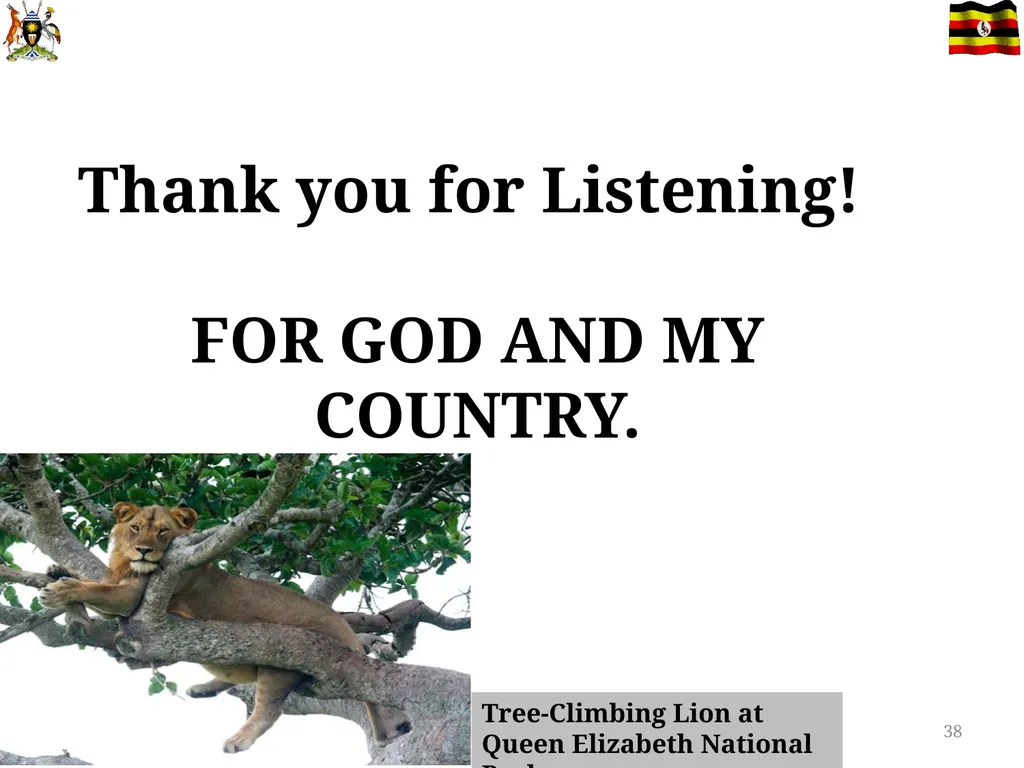
FOR GOD AND MY COUNTRY. Tree-Climbing Lion at
Queen Elizabeth National Park 38<br>