
SOCIAL TRUST AND CONSUMPTION EXPENDITURE DECISIONS
MY
Published · 52 slides · 0 views

1 / 1


Description
SOCIAL TRUST AND CONSUMPTION EXPENDITURE DECISIONS OF FARM-BASED BIOFORTIFIED FOODS IN SELECTED DISTRICTS OF MALAWI Policy Analysis for Sustainable Healthy Foods in African Retail Markets Sarah Tione, Patrick K Chimseu, Chimwemwe
Related Topics
Share
Embed code
Download this presentation From Below
"SOCIAL TRUST AND CONSUMPTION EXPENDITURE DECISIONS" is the property of its rightful owner. Permission is granted to download and print the materials on this website for personal, non-commercial use only, and to display it on your personal computer provided you do not modify the materials and that you retain all copyright notices contained in the materials. By downloading content from our website, you accept the terms of this agreement.
Presentation Transcript
01
SOCIAL TRUST AND CONSUMPTION EXPENDITURE DECISIONS OF FARM-BASED BIOFORTIFIED FOODS IN SELECTED DISTRICTS OF MALAWI
Policy Analysis for Sustainable & Healthy Foods in African Retail Markets Sarah Tione, Patrick K Chimseu, Chimwemwe Ng’ong’ola, Ronald Phiri, Humprey Chatenga, and Chrispin Kaphaika.
15th April 2025 AERC Bringing Rigour and Evidence to Economic Policy Making in Africa Improve quality | Ensure Sustainability | Expand influence<br>
15th April 2025 AERC Bringing Rigour and Evidence to Economic Policy Making in Africa Improve quality | Ensure Sustainability | Expand influence<br>
02
AERC Bringing Rigour and Evidence to Economic Policy Making in Africa Improve quality | Ensure Sustainability | Expand influence Presentation Outline Introduction
The Problem
Objectives & Hypotheses
Methodology- Data, Study Area, Analytical Framework
Results
Policy Implications<br>
The Problem
Objectives & Hypotheses
Methodology- Data, Study Area, Analytical Framework
Results
Policy Implications<br>
03
1. Introduction Social trust is one form of social capital that is important for influencing decisions (Coleman, 1988; Wang et al., 2021)
The theory posits that persons with high social trust are optimistic about the future and confident in society, and they can trust what other people are saying for their benefit (Coleman, 1988; Tamilina & Tamilina, 2018)
Kwon (2019) defined in-group social trust as trust in family members, friends or members of the same group or association while defining out-group social trust as the generalized trust towards strangers or people outside the associated group boundaries.<br>
The theory posits that persons with high social trust are optimistic about the future and confident in society, and they can trust what other people are saying for their benefit (Coleman, 1988; Tamilina & Tamilina, 2018)
Kwon (2019) defined in-group social trust as trust in family members, friends or members of the same group or association while defining out-group social trust as the generalized trust towards strangers or people outside the associated group boundaries.<br>
04
1. Introduction Although consumption studies often look at trust in the physical or food product (Vega-Zamora et al., 2019), the factors and the system that build such product trust remain an empirical question, especially in developing countries within Africa.
Understanding the individual in-group and out-group social trust could be important for assessing the personal decisions towards developmental interventions promoted across countries.<br>
Understanding the individual in-group and out-group social trust could be important for assessing the personal decisions towards developmental interventions promoted across countries.<br>
05
2. The Problem As the world strives to achieve the Sustainable Development Goals (SDGs) by 2030, there are growing concerns about rising global hunger measured by the prevalence of undernourishment (PoU) (Unicef, 2024)
The 2024 State of Food Security and Nutrition in the World report (Unicef, 2024) has put a spotlight on the reversed trends towards achieving zero hunger and undernutrition, particularly in Africa
The statistics within sub-Saharan Africa are also on the rise,
Persistent malnutrition problems of stunting, wasting and underweight that are affecting human capital development in the continent.<br>
The 2024 State of Food Security and Nutrition in the World report (Unicef, 2024) has put a spotlight on the reversed trends towards achieving zero hunger and undernutrition, particularly in Africa
The statistics within sub-Saharan Africa are also on the rise,
Persistent malnutrition problems of stunting, wasting and underweight that are affecting human capital development in the continent.<br>
06
2. The Problem From the 2024 Demographic and Household Survey for Malawi
38% of children under age 5 are stunted compared to 37% in 2017.
Of the under-five children, 2% are wasted, 10% are underweight, and 6% are overweight.
The last Malawi Micronutrient Survey (MNS) showed that over 56% of reproductive-age women in Malawi suffered from Vitamin A deficiency (National Statistics Office, 2017).
This is exacerbated by the poor quality of diets, with only 17% of Malawians meeting the minimum dietary diversity in 2020 a reduction from 25% in 2014 (Unicef, 2023).<br>
38% of children under age 5 are stunted compared to 37% in 2017.
Of the under-five children, 2% are wasted, 10% are underweight, and 6% are overweight.
The last Malawi Micronutrient Survey (MNS) showed that over 56% of reproductive-age women in Malawi suffered from Vitamin A deficiency (National Statistics Office, 2017).
This is exacerbated by the poor quality of diets, with only 17% of Malawians meeting the minimum dietary diversity in 2020 a reduction from 25% in 2014 (Unicef, 2023).<br>
07
3. The Rationale To reverse malnutrition and enhance human capital development, countries continue to invest in programs that support scaling up nutrition-sensitive agriculture like biofortification of farm-based crops.
One such intervention is the biofortification of agricultural-based food products that rural households produce or procure in local markets for household consumption.
Biofortification generally refers to the biological enrichment of food crops with either macro or micronutrients using agronomic practices, conventional plant breeding, or genetic engineering (Bouis & Saltzman, 2017)<br>
One such intervention is the biofortification of agricultural-based food products that rural households produce or procure in local markets for household consumption.
Biofortification generally refers to the biological enrichment of food crops with either macro or micronutrients using agronomic practices, conventional plant breeding, or genetic engineering (Bouis & Saltzman, 2017)<br>
08
3. The Rationale Biofortification has proved to be a cost-effective means of delivering micronutrients to populations that may have limited access to diverse diets and other micronutrient interventions (ibid, 2017).
The orange-fresh sweet potato (OFSP) and quality protein maize (QPM, often referred to as yellow maize) are two of the biofortified farm-based crops being promoted across Africa, including in Malawi.
The OFSP is a sweet potato dosed with vitamin A while QPM is a mutant maize with elevated levels of lysine and tryptophan (Kaphaika et al., 2023; Nyakurwa et al., 2017).<br>
The orange-fresh sweet potato (OFSP) and quality protein maize (QPM, often referred to as yellow maize) are two of the biofortified farm-based crops being promoted across Africa, including in Malawi.
The OFSP is a sweet potato dosed with vitamin A while QPM is a mutant maize with elevated levels of lysine and tryptophan (Kaphaika et al., 2023; Nyakurwa et al., 2017).<br>
09
3. The Rationale The biofortification of these crops aligns with high consumption of maize as a staple crop across Africa and sweet potato as the alternative starch food crop to maize
Despite the stipulated benefits, the uptake of orange fresh sweet potato (OSFP) and quality protein maize (QPM) biofortified crops remains low in Africa
This study assesses the associated effect of social or interpersonal trust and willingness to pay on consumption and expenditure decisions<br>
Despite the stipulated benefits, the uptake of orange fresh sweet potato (OSFP) and quality protein maize (QPM) biofortified crops remains low in Africa
This study assesses the associated effect of social or interpersonal trust and willingness to pay on consumption and expenditure decisions<br>
10
3. Rationale Understanding the individual in-group and out-group social trust could be important for assessing the personal decisions towards developmental interventions promoted across countries.
Social trust is founded on beliefs of honesty, integrity and reliability of others or “having faith in people” (Taylor et al., 2007)
This study aims to understand the associated impact of social trust on consumption and expenditure decisions of rural households in selected districts within Malawi, a country in sub-Saharan Africa.<br>
Social trust is founded on beliefs of honesty, integrity and reliability of others or “having faith in people” (Taylor et al., 2007)
This study aims to understand the associated impact of social trust on consumption and expenditure decisions of rural households in selected districts within Malawi, a country in sub-Saharan Africa.<br>
11
4. Objective and Hypotheses Objective1: Determine the effect of social trust on consumer decisions of OFSP and QPM.
Hypotheses
H1: Higher social trust of household decision-makers increases the likelihood of households consuming OFSP and yellow maize,
H2: Higher social trust of household decision-makers increases the extent of households consuming OFSP and yellow maize.<br>
Hypotheses
H1: Higher social trust of household decision-makers increases the likelihood of households consuming OFSP and yellow maize,
H2: Higher social trust of household decision-makers increases the extent of households consuming OFSP and yellow maize.<br>
12
4. Objective and Hypotheses Objective 2: To assess the associated effect of social trust on consumer Willingness to Pay for OFSP and QPM
Hypotheses
H3: Higher social trust increases the extent of Willingness to Pay for OFSP and yellow maize among rural households<br>
Hypotheses
H3: Higher social trust increases the extent of Willingness to Pay for OFSP and yellow maize among rural households<br>
13
5. Scientific Contribution The contribution of our study is two-fold.
We contribute to the limited literature on the uptake of QPM assessed together with OFSP uptake.
We integrate the understanding of the effect of elicited social or interpersonal trust in rural household consumption decisions, an important behavioural factor in determining development decisions.<br>
We contribute to the limited literature on the uptake of QPM assessed together with OFSP uptake.
We integrate the understanding of the effect of elicited social or interpersonal trust in rural household consumption decisions, an important behavioural factor in determining development decisions.<br>
14
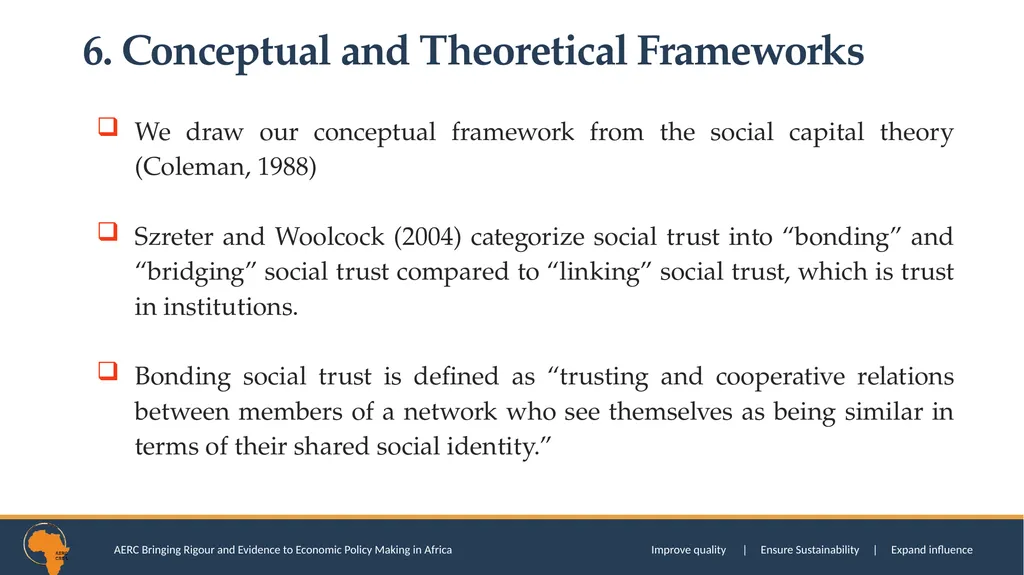
6. Conceptual and Theoretical Frameworks We draw our conceptual framework from the social capital theory (Coleman, 1988)
Szreter and Woolcock (2004) categorize social trust into “bonding” and “bridging” social trust compared to “linking” social trust, which is trust in institutions.
Bonding social trust is defined as “trusting and cooperative relations between members of a network who see themselves as being similar in terms of their shared social identity.”<br>
Szreter and Woolcock (2004) categorize social trust into “bonding” and “bridging” social trust compared to “linking” social trust, which is trust in institutions.
Bonding social trust is defined as “trusting and cooperative relations between members of a network who see themselves as being similar in terms of their shared social identity.”<br>
15
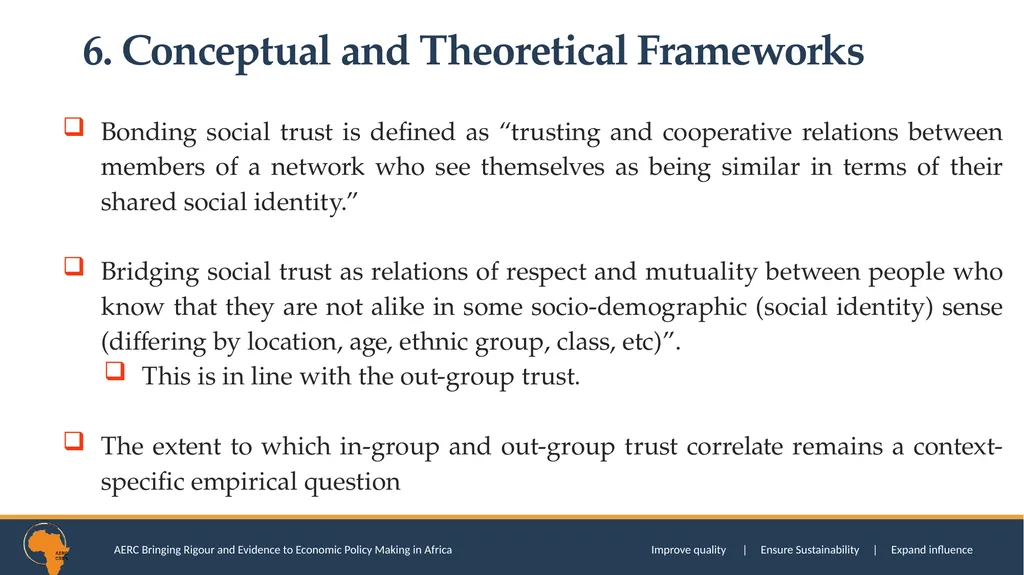
6. Conceptual and Theoretical Frameworks Bonding social trust is defined as “trusting and cooperative relations between members of a network who see themselves as being similar in terms of their shared social identity.”
Bridging social trust as relations of respect and mutuality between people who know that they are not alike in some socio-demographic (social identity) sense (differing by location, age, ethnic group, class, etc)”.
This is in line with the out-group trust.
The extent to which in-group and out-group trust correlate remains a context-specific empirical question<br>
Bridging social trust as relations of respect and mutuality between people who know that they are not alike in some socio-demographic (social identity) sense (differing by location, age, ethnic group, class, etc)”.
This is in line with the out-group trust.
The extent to which in-group and out-group trust correlate remains a context-specific empirical question<br>
16
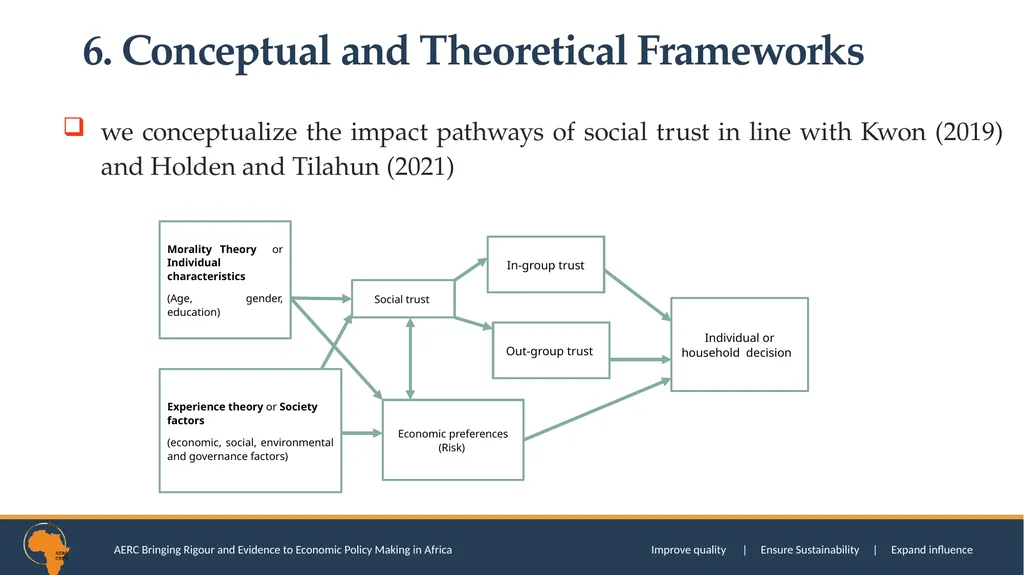
6. Conceptual and Theoretical Frameworks we conceptualize the impact pathways of social trust in line with Kwon (2019) and Holden and Tilahun (2021)<br>
17
6. Conceptual and Theoretical Frameworks The intrinsic social trust shapes the way people trust those within their circles (in-group) and strangers (out-group)
The in-group and out-group trust, thus influences the observed individual or household decisions.
Related to the experience theory, people also develop economic preferences like risk, that relate to social preferences like social trust, which also influence individual or household decisions (Holden & Tilahun, 2021)
We elicit the individual social trust of the household head or spouse and the willingness to pay for OFSP and QPM.<br>
The in-group and out-group trust, thus influences the observed individual or household decisions.
Related to the experience theory, people also develop economic preferences like risk, that relate to social preferences like social trust, which also influence individual or household decisions (Holden & Tilahun, 2021)
We elicit the individual social trust of the household head or spouse and the willingness to pay for OFSP and QPM.<br>
18
6. Conceptual and Theoretical Frameworks Scholars have used two approaches to place a value on goods and services: the revealed preference for goods with a market and the stated preference for goods that do not have an existing market (Alberini, 2019).
Our paper uses the choice experiment for consumers to state how much to pay for a certain amount of OFSP and QPM based on their intrinsic value for the associated attributes.
The paper also applies the household utility maximization theory (Sadoulet & de Janvry, 1995).<br>
Our paper uses the choice experiment for consumers to state how much to pay for a certain amount of OFSP and QPM based on their intrinsic value for the associated attributes.
The paper also applies the household utility maximization theory (Sadoulet & de Janvry, 1995).<br>
19
6. Conceptual and Theoretical Frameworks The household model describes a farm household as an institution that integrates production, consumption, and marketing decisions over time.
As a farm household, they produce own food using own labour and sell the surplus produce and/or labour.
The non-separability of the production and consumption decisions implies that one can assess both consumption and production decisions among farm households
Decisions can include price decisions, risk behaviour, and on and off-farm agricultural decisions.<br>
As a farm household, they produce own food using own labour and sell the surplus produce and/or labour.
The non-separability of the production and consumption decisions implies that one can assess both consumption and production decisions among farm households
Decisions can include price decisions, risk behaviour, and on and off-farm agricultural decisions.<br>
20
7. Methodology Sampling and Data
The study used a multi-stage sampling technique
The study used a semi-structured questionnaire programmed in Survey Solution to collect data from Dowa, Mchinji, and Kasungu districts, within the central region of Malawi.
These districts were selected because they are among the highest producers of both OFSP and QPM while also being net buyers of food crops.
The total household sample was 421 with 37, 27, and 36 percent from Kasungu, Mchinji and Dowa districts.<br>
The study used a multi-stage sampling technique
The study used a semi-structured questionnaire programmed in Survey Solution to collect data from Dowa, Mchinji, and Kasungu districts, within the central region of Malawi.
These districts were selected because they are among the highest producers of both OFSP and QPM while also being net buyers of food crops.
The total household sample was 421 with 37, 27, and 36 percent from Kasungu, Mchinji and Dowa districts.<br>
21
7. Methodology Trust Game
We used the simple Berg, Dickhaut, and McCabe, (BDM) investment game to elicit social trust.
The game involves two participants playing as both a sender (trustor) and receiver(trustee).
As a sender, each person was given a certain amount of money of MK1000 (USD0.58) and could send any amount or none to the receiver, categorized as in-group or outgroup.<br>
We used the simple Berg, Dickhaut, and McCabe, (BDM) investment game to elicit social trust.
The game involves two participants playing as both a sender (trustor) and receiver(trustee).
As a sender, each person was given a certain amount of money of MK1000 (USD0.58) and could send any amount or none to the receiver, categorized as in-group or outgroup.<br>
22
7. Methodology Trust Game
The sender was asked how much they would be ready to send if the other individual
was an unknown person within their village (ingroup)
was an unknown person in another community within the same district (outgroup)
For any amount that the sender was sending to either in-group or out-group members, the game design was to triple the amount and give it to the receiver (the trust amount).<br>
The sender was asked how much they would be ready to send if the other individual
was an unknown person within their village (ingroup)
was an unknown person in another community within the same district (outgroup)
For any amount that the sender was sending to either in-group or out-group members, the game design was to triple the amount and give it to the receiver (the trust amount).<br>
23
7. Methodology Trust Game
The receiver then could send any amount of the money she/he has received back to the sender (the trustworthiness amount).
The game ends after the sender and the receiver have sent their chosen amounts.
We rolled a six-sided die to determine the real game outcome between in-group and outgroup members.
This outcome is what determined the generalized trust since it was a random outcome from either in-group or out-group.<br>
The receiver then could send any amount of the money she/he has received back to the sender (the trustworthiness amount).
The game ends after the sender and the receiver have sent their chosen amounts.
We rolled a six-sided die to determine the real game outcome between in-group and outgroup members.
This outcome is what determined the generalized trust since it was a random outcome from either in-group or out-group.<br>
24
7. Methodology Trust Game
The receiver then could send any amount of the money she/he has received back to the sender (the trustworthiness amount).
The game ends after the sender and the receiver have sent their chosen amounts.
We rolled a six-sided die to determine the real game outcome between in-group and outgroup members.
This outcome is what determined the generalized trust since it was a random outcome from either in-group or out-group.<br>
The receiver then could send any amount of the money she/he has received back to the sender (the trustworthiness amount).
The game ends after the sender and the receiver have sent their chosen amounts.
We rolled a six-sided die to determine the real game outcome between in-group and outgroup members.
This outcome is what determined the generalized trust since it was a random outcome from either in-group or out-group.<br>
25
7. Methodology Trust Game
To assess social trust, we looked at the share of the initial endowment sent to either ingroup or outgroup members, which we define as in-group or out-group social trust, respectively.
Based on the real game outcome (combined ingroup and outgroup), we calculated the share of the sent amount to get the generalized trust<br>
To assess social trust, we looked at the share of the initial endowment sent to either ingroup or outgroup members, which we define as in-group or out-group social trust, respectively.
Based on the real game outcome (combined ingroup and outgroup), we calculated the share of the sent amount to get the generalized trust<br>
26
7. Methodology Willingness to Pay
To collect data on willingness to pay, we showed the respondents a picture of 10 Kgs of QPM in a bucket and a picture of 7 pieces of medium-sized OFSP placed on a selling bench.
The bucket was used because it is a common tool used in the marketplaces within the country.
Based on the provided context, the respondents answered the minimum and maximum bid amount in Malawi Kwacha but also provided the actual value they would be willing to pay for the associated amount.
The analysis does not include those who are not willing to pay any amount to avoid statistical noise in the analysis.<br>
To collect data on willingness to pay, we showed the respondents a picture of 10 Kgs of QPM in a bucket and a picture of 7 pieces of medium-sized OFSP placed on a selling bench.
The bucket was used because it is a common tool used in the marketplaces within the country.
Based on the provided context, the respondents answered the minimum and maximum bid amount in Malawi Kwacha but also provided the actual value they would be willing to pay for the associated amount.
The analysis does not include those who are not willing to pay any amount to avoid statistical noise in the analysis.<br>
27
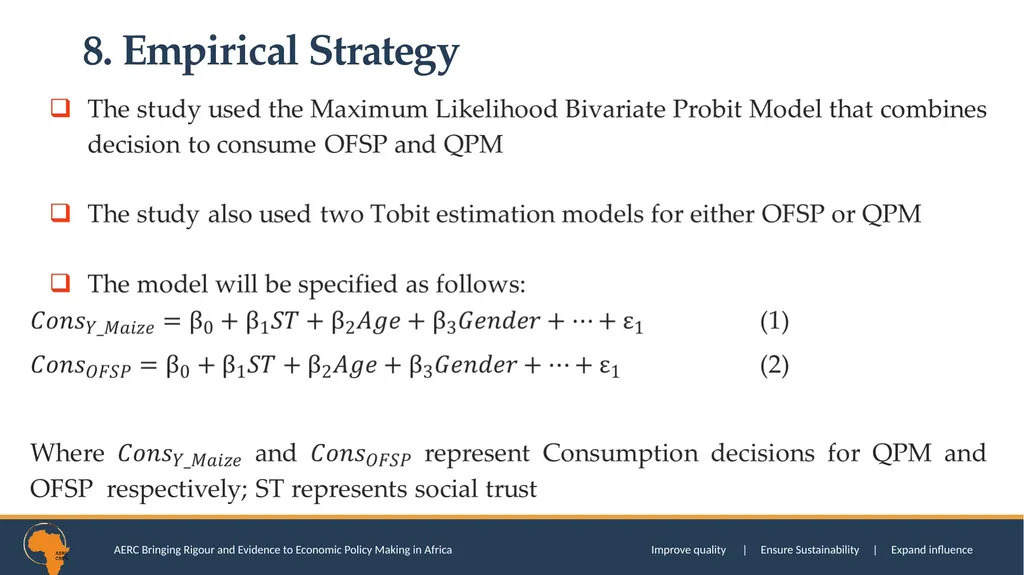
8. Empirical Strategy<br>
28
Results and Discussion<br>
29
Descriptive Statistics<br>
30
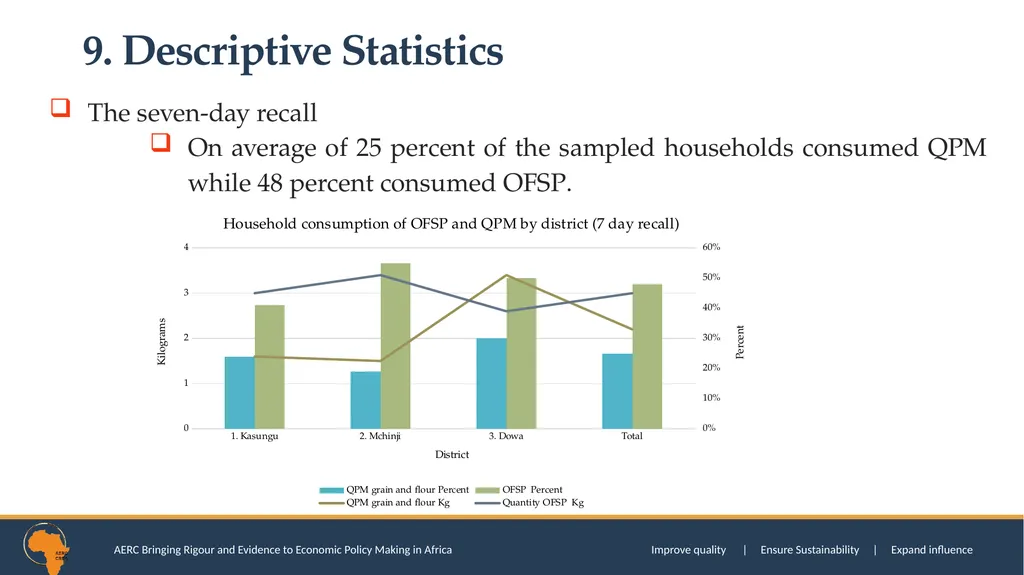
9. Descriptive Statistics The seven-day recall
On average of 25 percent of the sampled households consumed QPM while 48 percent consumed OFSP.<br>
On average of 25 percent of the sampled households consumed QPM while 48 percent consumed OFSP.<br>
31
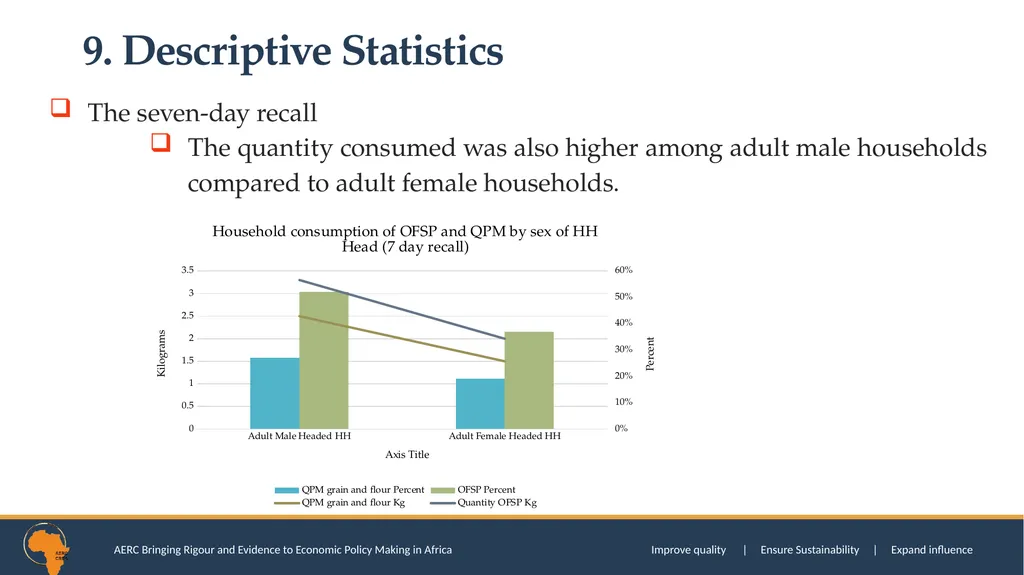
9. Descriptive Statistics The seven-day recall
The quantity consumed was also higher among adult male households compared to adult female households.<br>
The quantity consumed was also higher among adult male households compared to adult female households.<br>
32
9. Descriptive Statistics<br>
33
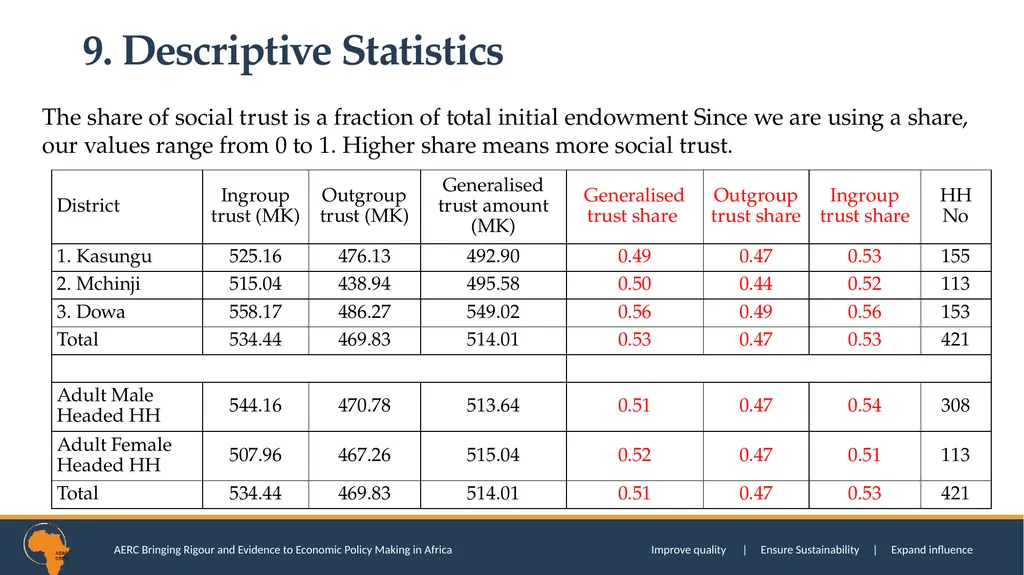
The share of social trust is a fraction of total initial endowment Since we are using a share, our values range from 0 to 1. Higher share means more social trust. 9. Descriptive Statistics<br>
34
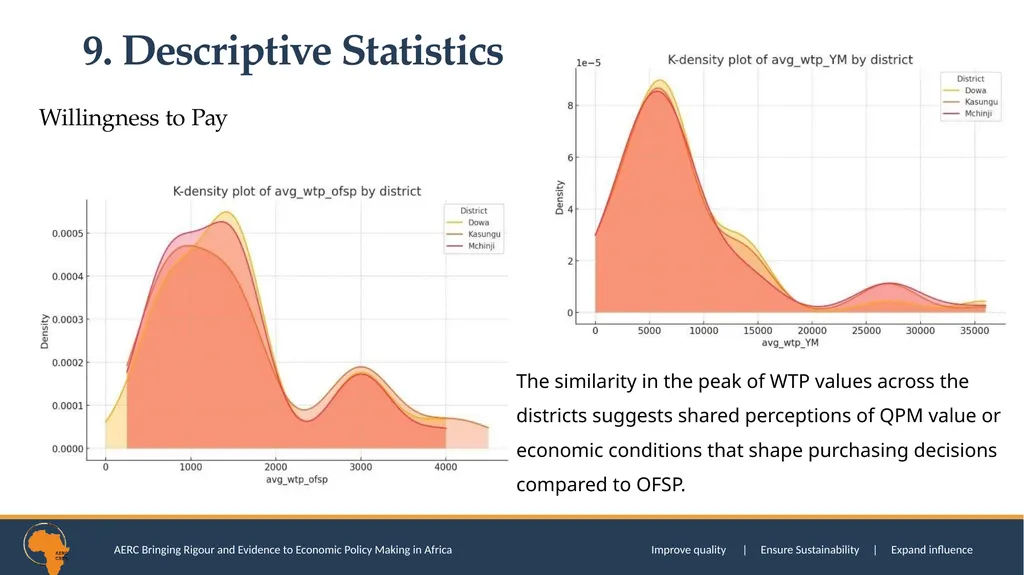
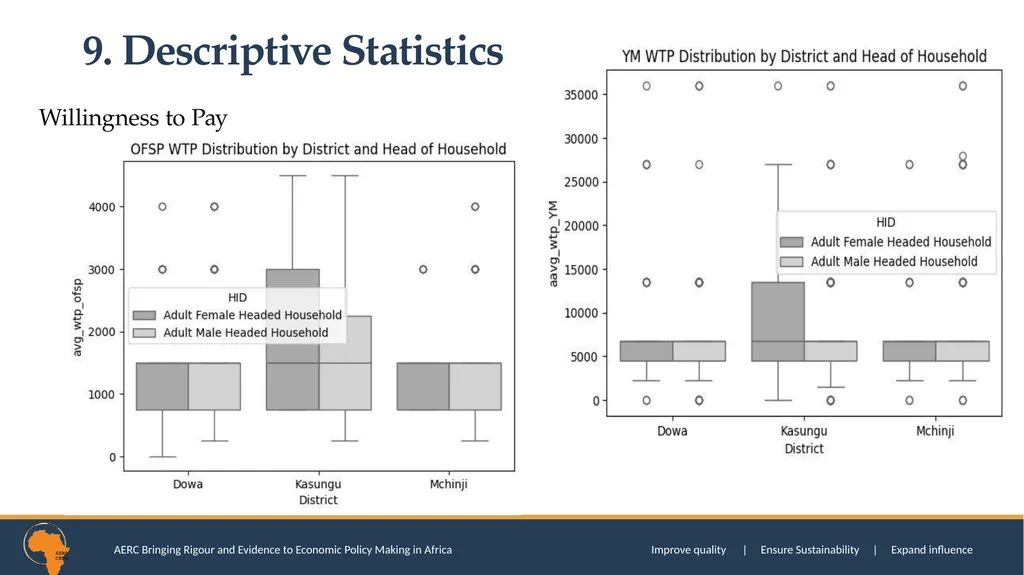
9. Descriptive Statistics Willingness to Pay The similarity in the peak of WTP values across the districts suggests shared perceptions of QPM value or economic conditions that shape purchasing decisions compared to OFSP.<br>
35
9. Descriptive Statistics Willingness to Pay<br>
36
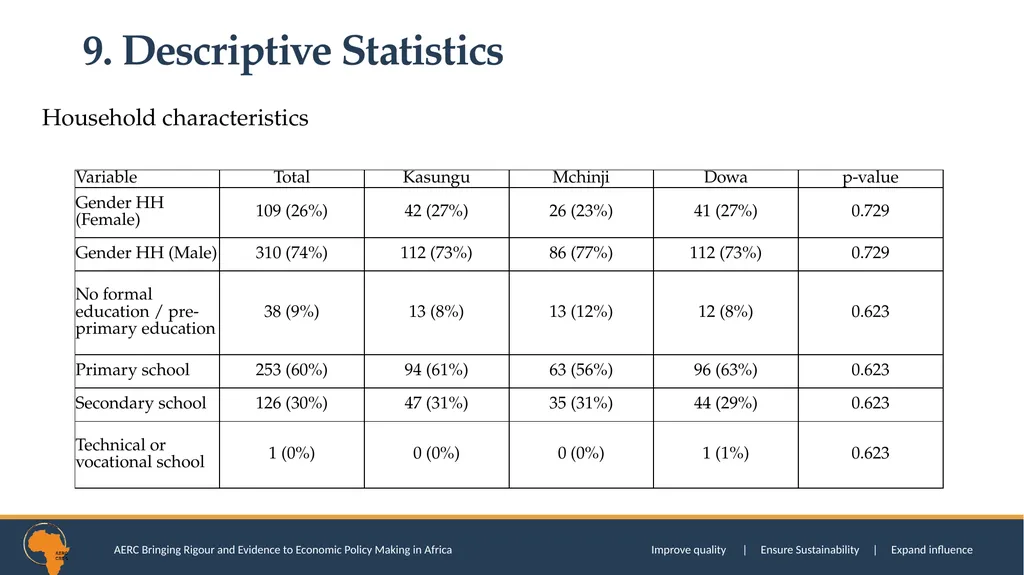
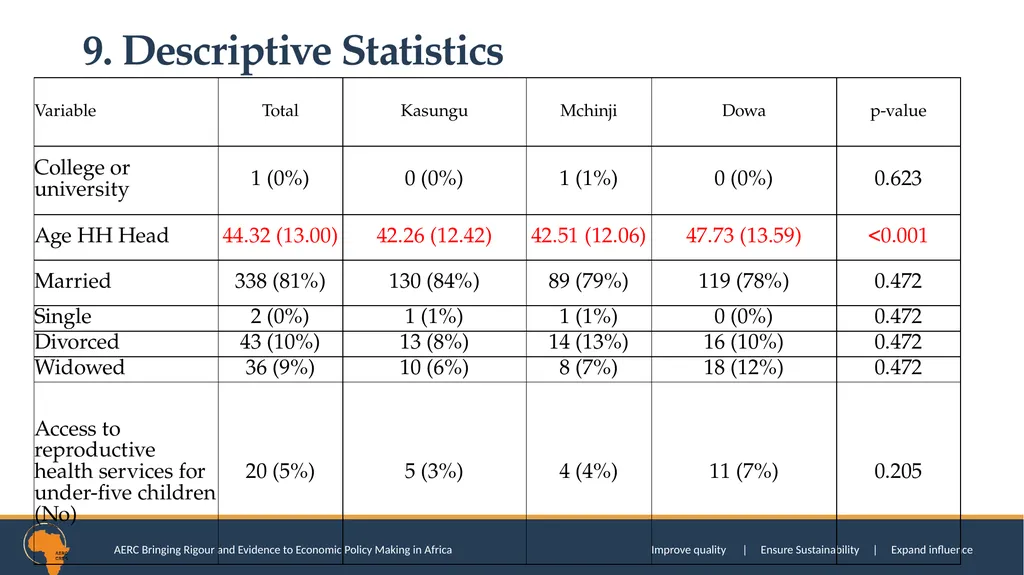
9. Descriptive Statistics Household characteristics<br>
37
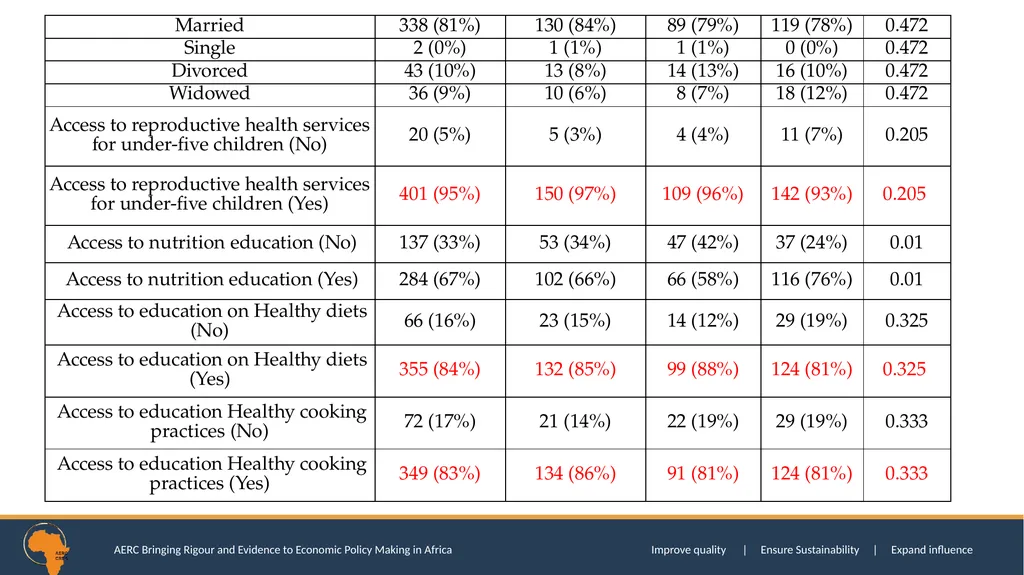
9. Descriptive Statistics<br>
38
Analytical Results<br>
39
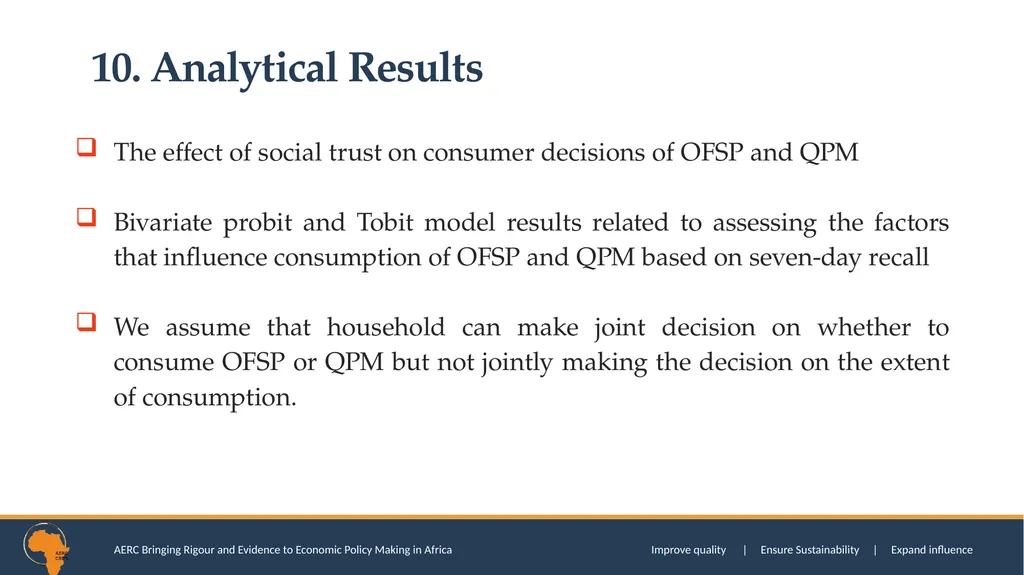
10. Analytical Results The effect of social trust on consumer decisions of OFSP and QPM
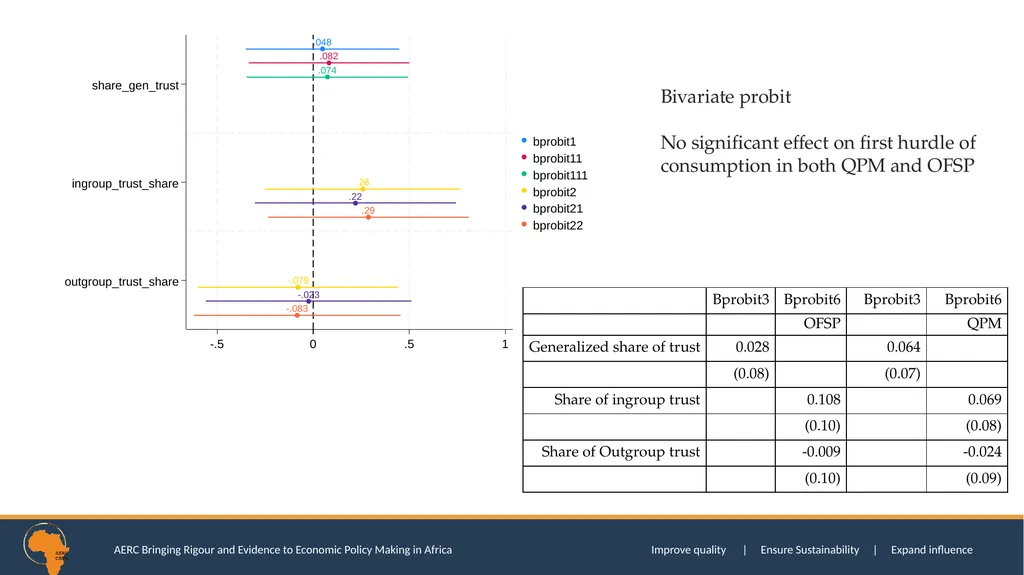
Bivariate probit and Tobit model results related to assessing the factors that influence consumption of OFSP and QPM based on seven-day recall
We assume that household can make joint decision on whether to consume OFSP or QPM but not jointly making the decision on the extent of consumption.<br>
Bivariate probit and Tobit model results related to assessing the factors that influence consumption of OFSP and QPM based on seven-day recall
We assume that household can make joint decision on whether to consume OFSP or QPM but not jointly making the decision on the extent of consumption.<br>
40
Bivariate probit
No significant effect on first hurdle of consumption in both QPM and OFSP<br>
No significant effect on first hurdle of consumption in both QPM and OFSP<br>
41
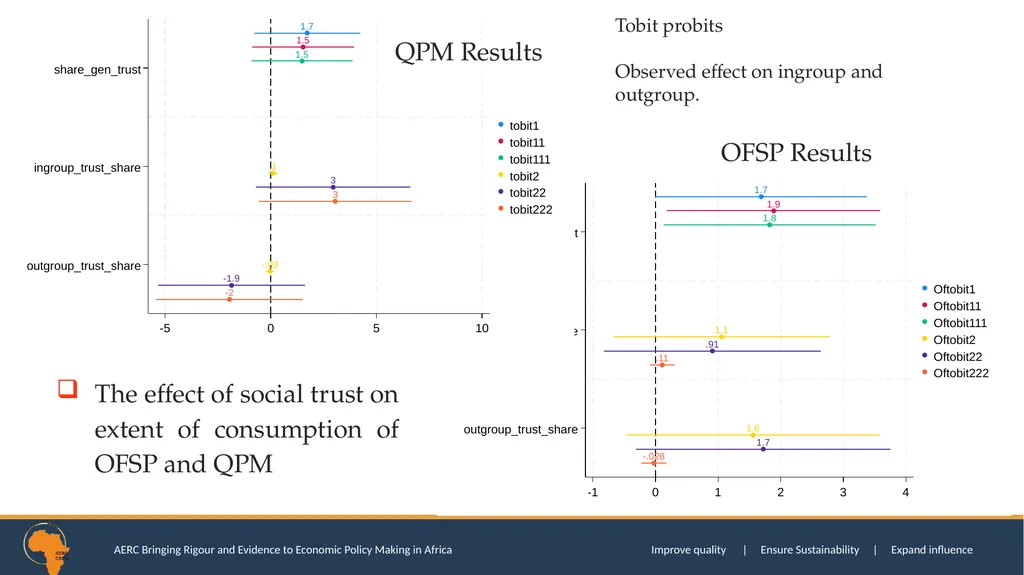
The effect of social trust on extent of consumption of OFSP and QPM QPM Results OFSP Results Tobit probits
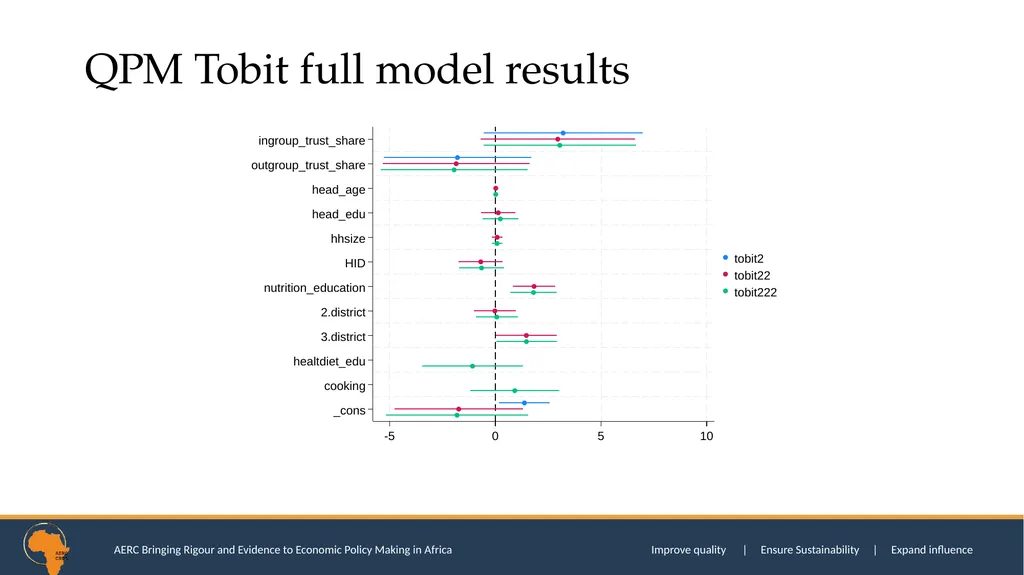
Observed effect on ingroup and outgroup.<br>
Observed effect on ingroup and outgroup.<br>
42
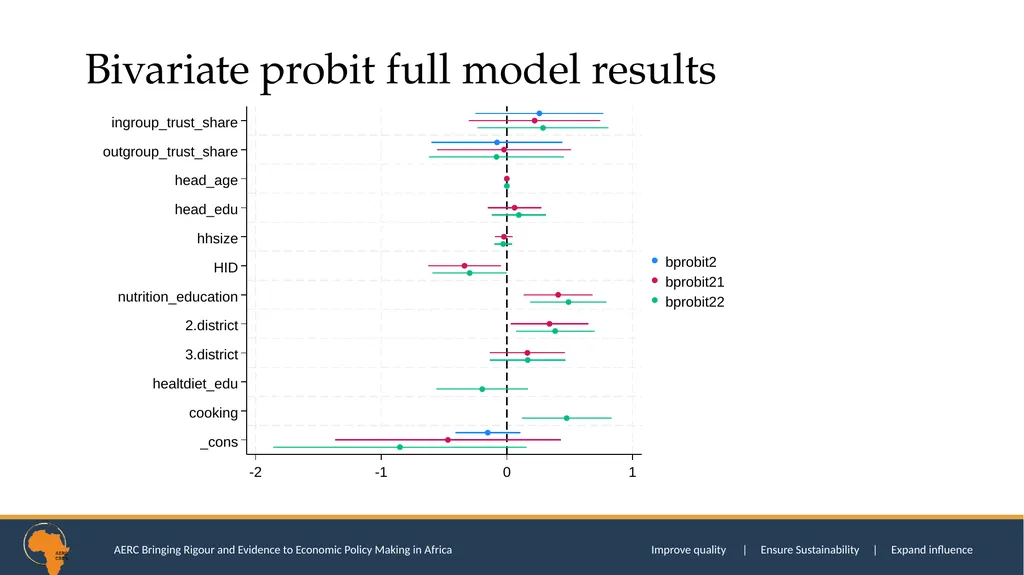
Bivariate probit full model results<br>
43
QPM Tobit full model results<br>
44
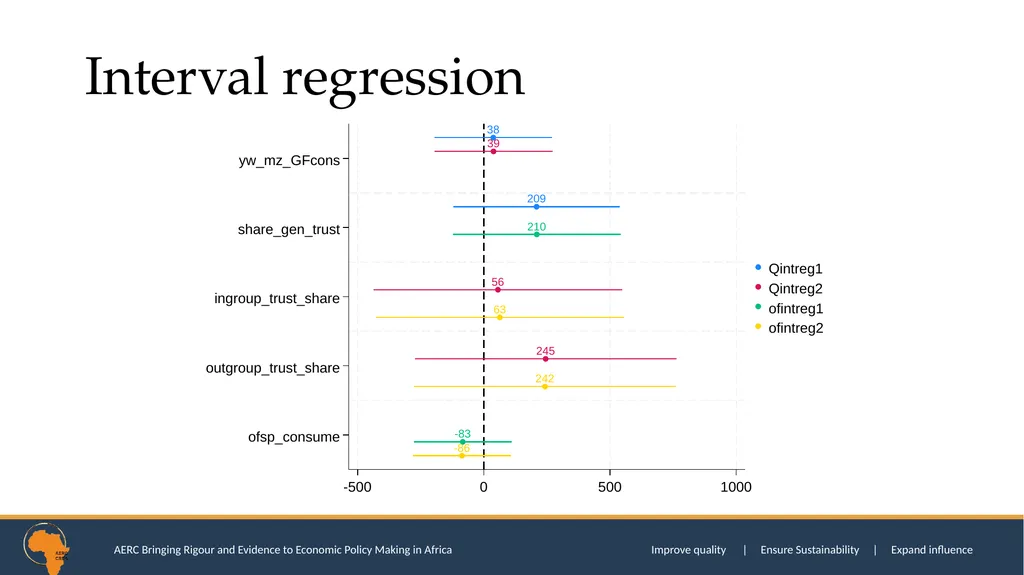
Interval regression<br>
45
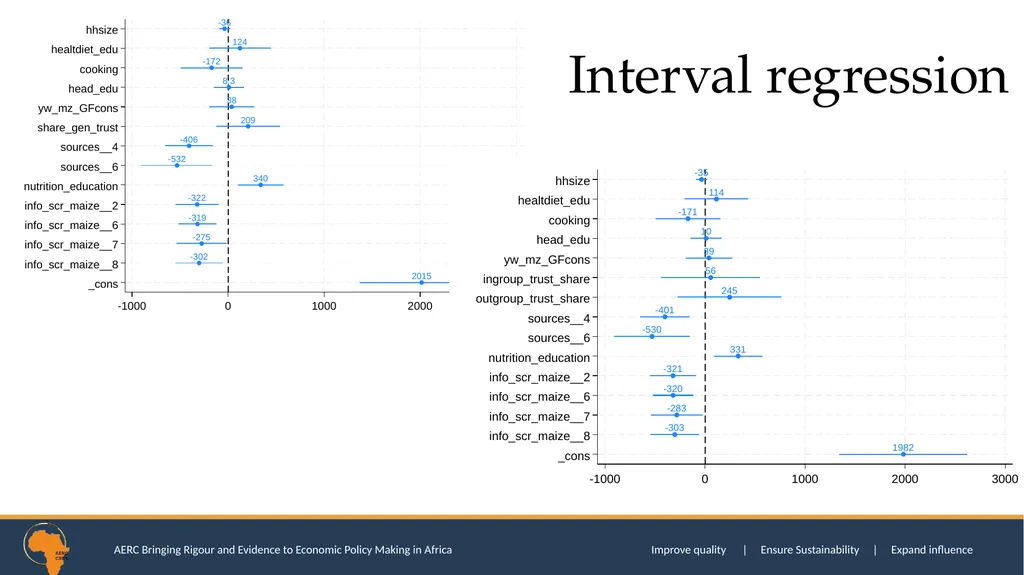
Interval regression<br>
46
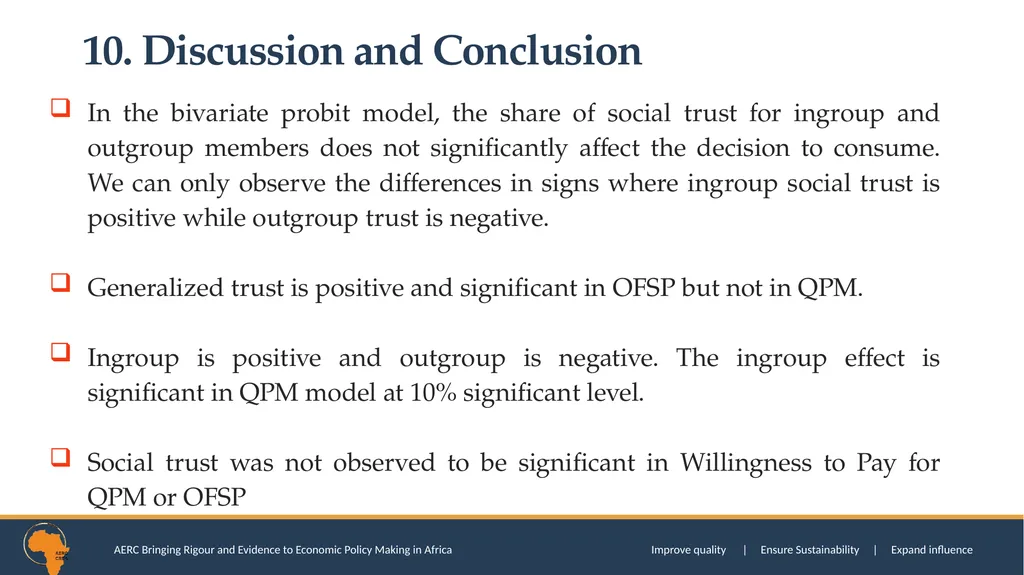
10. Discussion and Conclusion In the bivariate probit model, the share of social trust for ingroup and outgroup members does not significantly affect the decision to consume. We can only observe the differences in signs where ingroup social trust is positive while outgroup trust is negative.
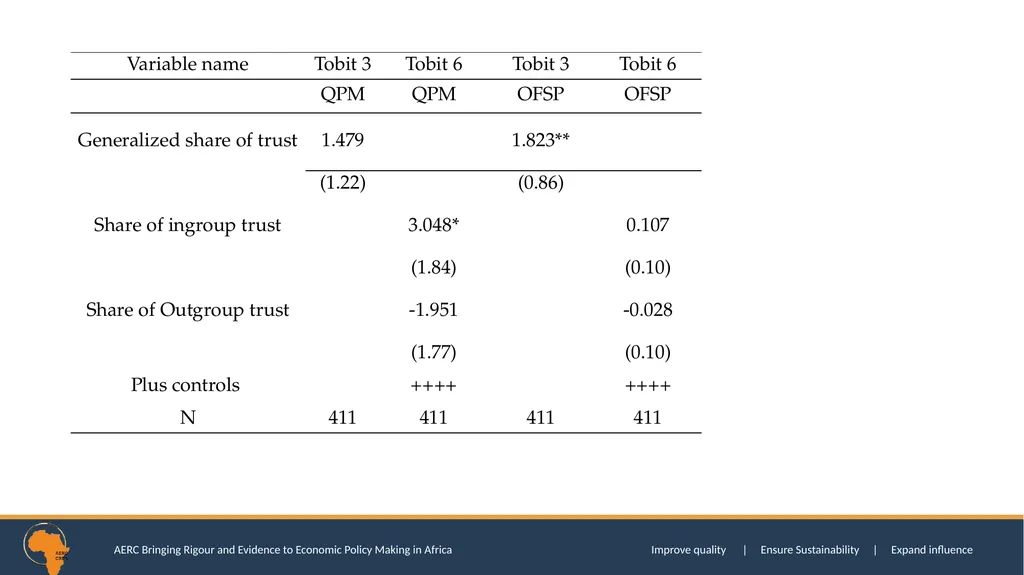
Generalized trust is positive and significant in OFSP but not in QPM.
Ingroup is positive and outgroup is negative. The ingroup effect is significant in QPM model at 10% significant level.
Social trust was not observed to be significant in Willingness to Pay for QPM or OFSP<br>
Generalized trust is positive and significant in OFSP but not in QPM.
Ingroup is positive and outgroup is negative. The ingroup effect is significant in QPM model at 10% significant level.
Social trust was not observed to be significant in Willingness to Pay for QPM or OFSP<br>
47
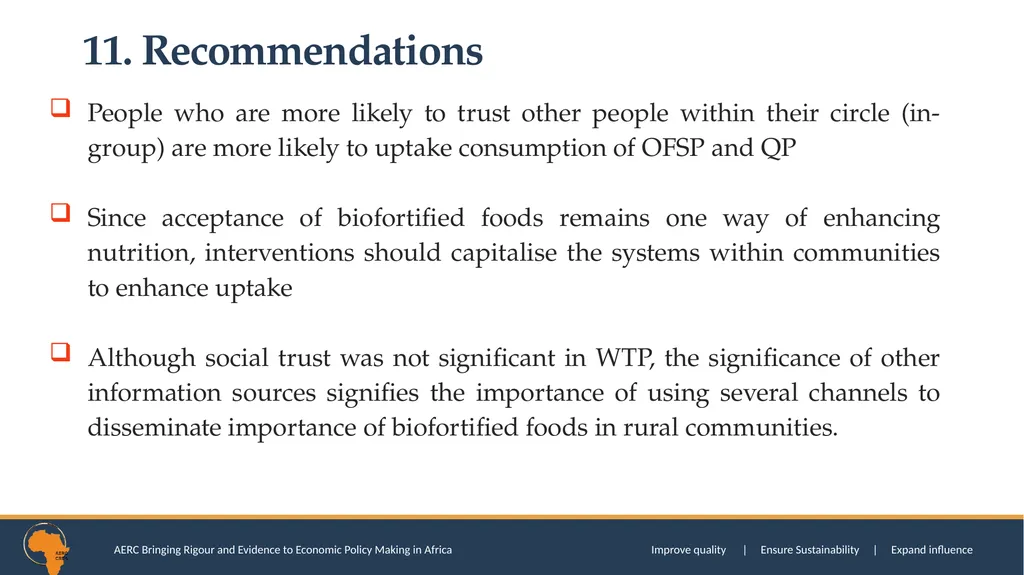
11. Recommendations People who are more likely to trust other people within their circle (in-group) are more likely to uptake consumption of OFSP and QP
Since acceptance of biofortified foods remains one way of enhancing nutrition, interventions should capitalise the systems within communities to enhance uptake
Although social trust was not significant in WTP, the significance of other information sources signifies the importance of using several channels to disseminate importance of biofortified foods in rural communities.<br>
Since acceptance of biofortified foods remains one way of enhancing nutrition, interventions should capitalise the systems within communities to enhance uptake
Although social trust was not significant in WTP, the significance of other information sources signifies the importance of using several channels to disseminate importance of biofortified foods in rural communities.<br>
48
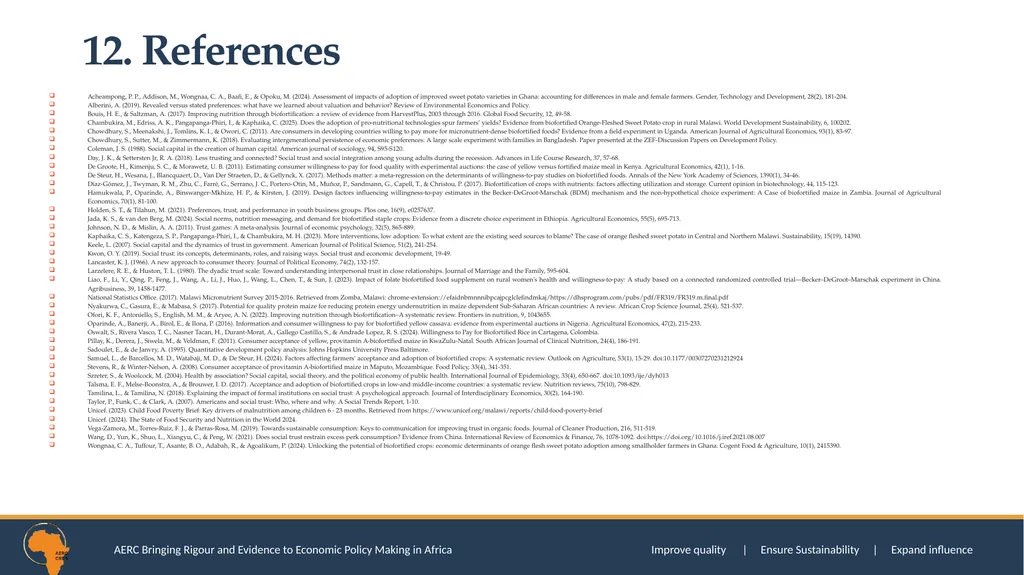
12. References Acheampong, P. P., Addison, M., Wongnaa, C. A., Baafi, E., & Opoku, M. (2024). Assessment of impacts of adoption of improved sweet potato varieties in Ghana: accounting for differences in male and female farmers. Gender, Technology and Development, 28(2), 181-204.
Alberini, A. (2019). Revealed versus stated preferences: what have we learned about valuation and behavior? Review of Environmental Economics and Policy.
Bouis, H. E., & Saltzman, A. (2017). Improving nutrition through biofortification: a review of evidence from HarvestPlus, 2003 through 2016. Global Food Security, 12, 49-58.
Chambukira, M., Edriss, A. K., Pangapanga-Phiri, I., & Kaphaika, C. (2025). Does the adoption of pro-nutritional technologies spur farmers’ yields? Evidence from biofortified Orange-Fleshed Sweet Potato crop in rural Malawi. World Development Sustainability, 6, 100202.
Chowdhury, S., Meenakshi, J., Tomlins, K. I., & Owori, C. (2011). Are consumers in developing countries willing to pay more for micronutrient‐dense biofortified foods? Evidence from a field experiment in Uganda. American Journal of Agricultural Economics, 93(1), 83-97.
Chowdhury, S., Sutter, M., & Zimmermann, K. (2018). Evaluating intergenerational persistence of economic preferences: A large scale experiment with families in Bangladesh. Paper presented at the ZEF-Discussion Papers on Development Policy.
Coleman, J. S. (1988). Social capital in the creation of human capital. American journal of sociology, 94, S95-S120.
Day, J. K., & Settersten Jr, R. A. (2018). Less trusting and connected? Social trust and social integration among young adults during the recession. Advances in Life Course Research, 37, 57-68.
De Groote, H., Kimenju, S. C., & Morawetz, U. B. (2011). Estimating consumer willingness to pay for food quality with experimental auctions: the case of yellow versus fortified maize meal in Kenya. Agricultural Economics, 42(1), 1-16.
De Steur, H., Wesana, J., Blancquaert, D., Van Der Straeten, D., & Gellynck, X. (2017). Methods matter: a meta‐regression on the determinants of willingness‐to‐pay studies on biofortified foods. Annals of the New York Academy of Sciences, 1390(1), 34-46.
Díaz-Gómez, J., Twyman, R. M., Zhu, C., Farré, G., Serrano, J. C., Portero-Otin, M., Muñoz, P., Sandmann, G., Capell, T., & Christou, P. (2017). Biofortification of crops with nutrients: factors affecting utilization and storage. Current opinion in biotechnology, 44, 115-123.
Hamukwala, P., Oparinde, A., Binswanger‐Mkhize, H. P., & Kirsten, J. (2019). Design factors influencing willingness‐to‐pay estimates in the Becker‐DeGroot‐Marschak (BDM) mechanism and the non‐hypothetical choice experiment: A Case of biofortified maize in Zambia. Journal of Agricultural Economics, 70(1), 81-100.
Holden, S. T., & Tilahun, M. (2021). Preferences, trust, and performance in youth business groups. Plos one, 16(9), e0257637.
Jada, K. S., & van den Berg, M. (2024). Social norms, nutrition messaging, and demand for biofortified staple crops: Evidence from a discrete choice experiment in Ethiopia. Agricultural Economics, 55(5), 695-713.
Johnson, N. D., & Mislin, A. A. (2011). Trust games: A meta-analysis. Journal of economic psychology, 32(5), 865-889.
Kaphaika, C. S., Katengeza, S. P., Pangapanga-Phiri, I., & Chambukira, M. H. (2023). More interventions, low adoption: To what extent are the existing seed sources to blame? The case of orange fleshed sweet potato in Central and Northern Malawi. Sustainability, 15(19), 14390.
Keele, L. (2007). Social capital and the dynamics of trust in government. American Journal of Political Science, 51(2), 241-254.
Kwon, O. Y. (2019). Social trust: its concepts, determinants, roles, and raising ways. Social trust and economic development, 19-49.
Lancaster, K. J. (1966). A new approach to consumer theory. Journal of Political Economy, 74(2), 132-157.
Larzelere, R. E., & Huston, T. L. (1980). The dyadic trust scale: Toward understanding interpersonal trust in close relationships. Journal of Marriage and the Family, 595-604.
Liao, F., Li, Y., Qing, P., Feng, J., Wang, A., Li, J., Huo, J., Wang, L., Chen, T., & Sun, J. (2023). Impact of folate biofortified food supplement on rural women's health and willingness‐to‐pay: A study based on a connected randomized controlled trial—Becker–DeGroot–Marschak experiment in China. Agribusiness, 39, 1458-1477.
National Statistics Office. (2017). Malawi Micronutrient Survey 2015-2016. Retrieved from Zomba, Malawi: chrome-extension://efaidnbmnnnibpcajpcglclefindmkaj/https://dhsprogram.com/pubs/pdf/FR319/FR319.m.final.pdf
Nyakurwa, C., Gasura, E., & Mabasa, S. (2017). Potential for quality protein maize for reducing protein energy undernutrition in maize dependent Sub-Saharan African countries: A review. African Crop Science Journal, 25(4), 521-537.
Ofori, K. F., Antoniello, S., English, M. M., & Aryee, A. N. (2022). Improving nutrition through biofortification–A systematic review. Frontiers in nutrition, 9, 1043655.
Oparinde, A., Banerji, A., Birol, E., & Ilona, P. (2016). Information and consumer willingness to pay for biofortified yellow cassava: evidence from experimental auctions in Nigeria. Agricultural Economics, 47(2), 215-233.
Oswalt, S., Rivera Vasco, T. C., Nasner Tacan, H., Durant-Morat, A., Gallego Castillo, S., & Andrade Lopez, R. S. (2024). Willingness to Pay for Biofortified Rice in Cartagena, Colombia.
Pillay, K., Derera, J., Siwela, M., & Veldman, F. (2011). Consumer acceptance of yellow, provitamin A-biofortified maize in KwaZulu-Natal. South African Journal of Clinical Nutrition, 24(4), 186-191.
Sadoulet, E., & de Janvry, A. (1995). Quantitative development policy analysis: Johns Hopkins University Press Baltimore.
Samuel, L., de Barcellos, M. D., Watabaji, M. D., & De Steur, H. (2024). Factors affecting farmers’ acceptance and adoption of biofortified crops: A systematic review. Outlook on Agriculture, 53(1), 15-29. doi:10.1177/00307270231212924
Stevens, R., & Winter-Nelson, A. (2008). Consumer acceptance of provitamin A-biofortified maize in Maputo, Mozambique. Food Policy, 33(4), 341-351.
Szreter, S., & Woolcock, M. (2004). Health by association? Social capital, social theory, and the political economy of public health. International Journal of Epidemiology, 33(4), 650-667. doi:10.1093/ije/dyh013
Talsma, E. F., Melse-Boonstra, A., & Brouwer, I. D. (2017). Acceptance and adoption of biofortified crops in low-and middle-income countries: a systematic review. Nutrition reviews, 75(10), 798-829.
Tamilina, L., & Tamilina, N. (2018). Explaining the impact of formal institutions on social trust: A psychological approach. Journal of Interdisciplinary Economics, 30(2), 164-190.
Taylor, P., Funk, C., & Clark, A. (2007). Americans and social trust: Who, where and why. A Social Trends Report, 1-10.
Unicef. (2023). Child Food Poverty Brief: Key drivers of malnutrition among children 6 - 23 months. Retrieved from https://www.unicef.org/malawi/reports/child-food-poverty-brief
Unicef. (2024). The State of Food Security and Nutrition in the World 2024.
Vega-Zamora, M., Torres-Ruiz, F. J., & Parras-Rosa, M. (2019). Towards sustainable consumption: Keys to communication for improving trust in organic foods. Journal of Cleaner Production, 216, 511-519.
Wang, D., Yun, K., Shuo, L., Xiangyu, C., & Peng, W. (2021). Does social trust restrain excess perk consumption? Evidence from China. International Review of Economics & Finance, 76, 1078-1092. doi:https://doi.org/10.1016/j.iref.2021.08.007
Wongnaa, C. A., Tuffour, T., Asante, B. O., Adabah, R., & Agoalikum, P. (2024). Unlocking the potential of biofortified crops: economic determinants of orange flesh sweet potato adoption among smallholder farmers in Ghana. Cogent Food & Agriculture, 10(1), 2415390.<br>
Alberini, A. (2019). Revealed versus stated preferences: what have we learned about valuation and behavior? Review of Environmental Economics and Policy.
Bouis, H. E., & Saltzman, A. (2017). Improving nutrition through biofortification: a review of evidence from HarvestPlus, 2003 through 2016. Global Food Security, 12, 49-58.
Chambukira, M., Edriss, A. K., Pangapanga-Phiri, I., & Kaphaika, C. (2025). Does the adoption of pro-nutritional technologies spur farmers’ yields? Evidence from biofortified Orange-Fleshed Sweet Potato crop in rural Malawi. World Development Sustainability, 6, 100202.
Chowdhury, S., Meenakshi, J., Tomlins, K. I., & Owori, C. (2011). Are consumers in developing countries willing to pay more for micronutrient‐dense biofortified foods? Evidence from a field experiment in Uganda. American Journal of Agricultural Economics, 93(1), 83-97.
Chowdhury, S., Sutter, M., & Zimmermann, K. (2018). Evaluating intergenerational persistence of economic preferences: A large scale experiment with families in Bangladesh. Paper presented at the ZEF-Discussion Papers on Development Policy.
Coleman, J. S. (1988). Social capital in the creation of human capital. American journal of sociology, 94, S95-S120.
Day, J. K., & Settersten Jr, R. A. (2018). Less trusting and connected? Social trust and social integration among young adults during the recession. Advances in Life Course Research, 37, 57-68.
De Groote, H., Kimenju, S. C., & Morawetz, U. B. (2011). Estimating consumer willingness to pay for food quality with experimental auctions: the case of yellow versus fortified maize meal in Kenya. Agricultural Economics, 42(1), 1-16.
De Steur, H., Wesana, J., Blancquaert, D., Van Der Straeten, D., & Gellynck, X. (2017). Methods matter: a meta‐regression on the determinants of willingness‐to‐pay studies on biofortified foods. Annals of the New York Academy of Sciences, 1390(1), 34-46.
Díaz-Gómez, J., Twyman, R. M., Zhu, C., Farré, G., Serrano, J. C., Portero-Otin, M., Muñoz, P., Sandmann, G., Capell, T., & Christou, P. (2017). Biofortification of crops with nutrients: factors affecting utilization and storage. Current opinion in biotechnology, 44, 115-123.
Hamukwala, P., Oparinde, A., Binswanger‐Mkhize, H. P., & Kirsten, J. (2019). Design factors influencing willingness‐to‐pay estimates in the Becker‐DeGroot‐Marschak (BDM) mechanism and the non‐hypothetical choice experiment: A Case of biofortified maize in Zambia. Journal of Agricultural Economics, 70(1), 81-100.
Holden, S. T., & Tilahun, M. (2021). Preferences, trust, and performance in youth business groups. Plos one, 16(9), e0257637.
Jada, K. S., & van den Berg, M. (2024). Social norms, nutrition messaging, and demand for biofortified staple crops: Evidence from a discrete choice experiment in Ethiopia. Agricultural Economics, 55(5), 695-713.
Johnson, N. D., & Mislin, A. A. (2011). Trust games: A meta-analysis. Journal of economic psychology, 32(5), 865-889.
Kaphaika, C. S., Katengeza, S. P., Pangapanga-Phiri, I., & Chambukira, M. H. (2023). More interventions, low adoption: To what extent are the existing seed sources to blame? The case of orange fleshed sweet potato in Central and Northern Malawi. Sustainability, 15(19), 14390.
Keele, L. (2007). Social capital and the dynamics of trust in government. American Journal of Political Science, 51(2), 241-254.
Kwon, O. Y. (2019). Social trust: its concepts, determinants, roles, and raising ways. Social trust and economic development, 19-49.
Lancaster, K. J. (1966). A new approach to consumer theory. Journal of Political Economy, 74(2), 132-157.
Larzelere, R. E., & Huston, T. L. (1980). The dyadic trust scale: Toward understanding interpersonal trust in close relationships. Journal of Marriage and the Family, 595-604.
Liao, F., Li, Y., Qing, P., Feng, J., Wang, A., Li, J., Huo, J., Wang, L., Chen, T., & Sun, J. (2023). Impact of folate biofortified food supplement on rural women's health and willingness‐to‐pay: A study based on a connected randomized controlled trial—Becker–DeGroot–Marschak experiment in China. Agribusiness, 39, 1458-1477.
National Statistics Office. (2017). Malawi Micronutrient Survey 2015-2016. Retrieved from Zomba, Malawi: chrome-extension://efaidnbmnnnibpcajpcglclefindmkaj/https://dhsprogram.com/pubs/pdf/FR319/FR319.m.final.pdf
Nyakurwa, C., Gasura, E., & Mabasa, S. (2017). Potential for quality protein maize for reducing protein energy undernutrition in maize dependent Sub-Saharan African countries: A review. African Crop Science Journal, 25(4), 521-537.
Ofori, K. F., Antoniello, S., English, M. M., & Aryee, A. N. (2022). Improving nutrition through biofortification–A systematic review. Frontiers in nutrition, 9, 1043655.
Oparinde, A., Banerji, A., Birol, E., & Ilona, P. (2016). Information and consumer willingness to pay for biofortified yellow cassava: evidence from experimental auctions in Nigeria. Agricultural Economics, 47(2), 215-233.
Oswalt, S., Rivera Vasco, T. C., Nasner Tacan, H., Durant-Morat, A., Gallego Castillo, S., & Andrade Lopez, R. S. (2024). Willingness to Pay for Biofortified Rice in Cartagena, Colombia.
Pillay, K., Derera, J., Siwela, M., & Veldman, F. (2011). Consumer acceptance of yellow, provitamin A-biofortified maize in KwaZulu-Natal. South African Journal of Clinical Nutrition, 24(4), 186-191.
Sadoulet, E., & de Janvry, A. (1995). Quantitative development policy analysis: Johns Hopkins University Press Baltimore.
Samuel, L., de Barcellos, M. D., Watabaji, M. D., & De Steur, H. (2024). Factors affecting farmers’ acceptance and adoption of biofortified crops: A systematic review. Outlook on Agriculture, 53(1), 15-29. doi:10.1177/00307270231212924
Stevens, R., & Winter-Nelson, A. (2008). Consumer acceptance of provitamin A-biofortified maize in Maputo, Mozambique. Food Policy, 33(4), 341-351.
Szreter, S., & Woolcock, M. (2004). Health by association? Social capital, social theory, and the political economy of public health. International Journal of Epidemiology, 33(4), 650-667. doi:10.1093/ije/dyh013
Talsma, E. F., Melse-Boonstra, A., & Brouwer, I. D. (2017). Acceptance and adoption of biofortified crops in low-and middle-income countries: a systematic review. Nutrition reviews, 75(10), 798-829.
Tamilina, L., & Tamilina, N. (2018). Explaining the impact of formal institutions on social trust: A psychological approach. Journal of Interdisciplinary Economics, 30(2), 164-190.
Taylor, P., Funk, C., & Clark, A. (2007). Americans and social trust: Who, where and why. A Social Trends Report, 1-10.
Unicef. (2023). Child Food Poverty Brief: Key drivers of malnutrition among children 6 - 23 months. Retrieved from https://www.unicef.org/malawi/reports/child-food-poverty-brief
Unicef. (2024). The State of Food Security and Nutrition in the World 2024.
Vega-Zamora, M., Torres-Ruiz, F. J., & Parras-Rosa, M. (2019). Towards sustainable consumption: Keys to communication for improving trust in organic foods. Journal of Cleaner Production, 216, 511-519.
Wang, D., Yun, K., Shuo, L., Xiangyu, C., & Peng, W. (2021). Does social trust restrain excess perk consumption? Evidence from China. International Review of Economics & Finance, 76, 1078-1092. doi:https://doi.org/10.1016/j.iref.2021.08.007
Wongnaa, C. A., Tuffour, T., Asante, B. O., Adabah, R., & Agoalikum, P. (2024). Unlocking the potential of biofortified crops: economic determinants of orange flesh sweet potato adoption among smallholder farmers in Ghana. Cogent Food & Agriculture, 10(1), 2415390.<br>
49
Open for Discussion Thank you<br>
50
R<br>