04
Cisco Visual Networking Index predicts 66x increase in mobile traffic mainly mobile video the incoming 5 years will show Can WiFi, WiMax, or LTE deal with such growth?<br>
05
Today’s Wireless Video Is Unscalable<br>
06
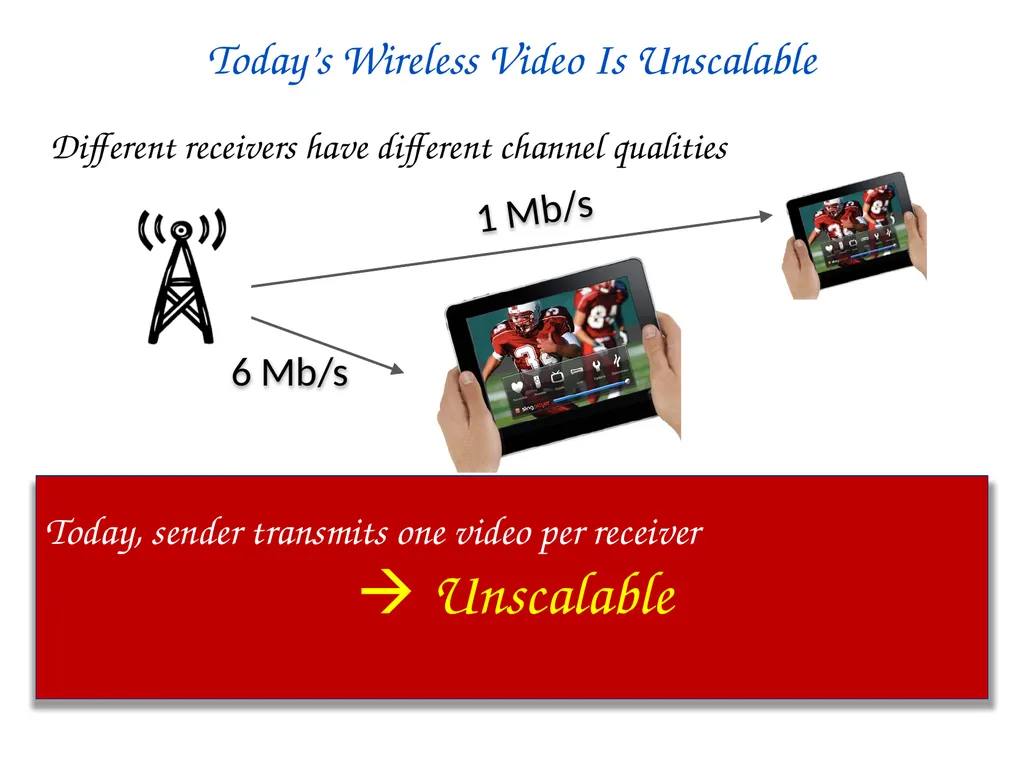
Today’s Wireless Video Is Unscalable Different receivers have different channel qualities 6 Mb/s 1 Mb/s In current wireless, sender has to pick one bitrate Broadcast one stream to all receiver
Reduce all to the performance of worst receiver Today, sender transmits one video per receiver
Unscalable<br>
07
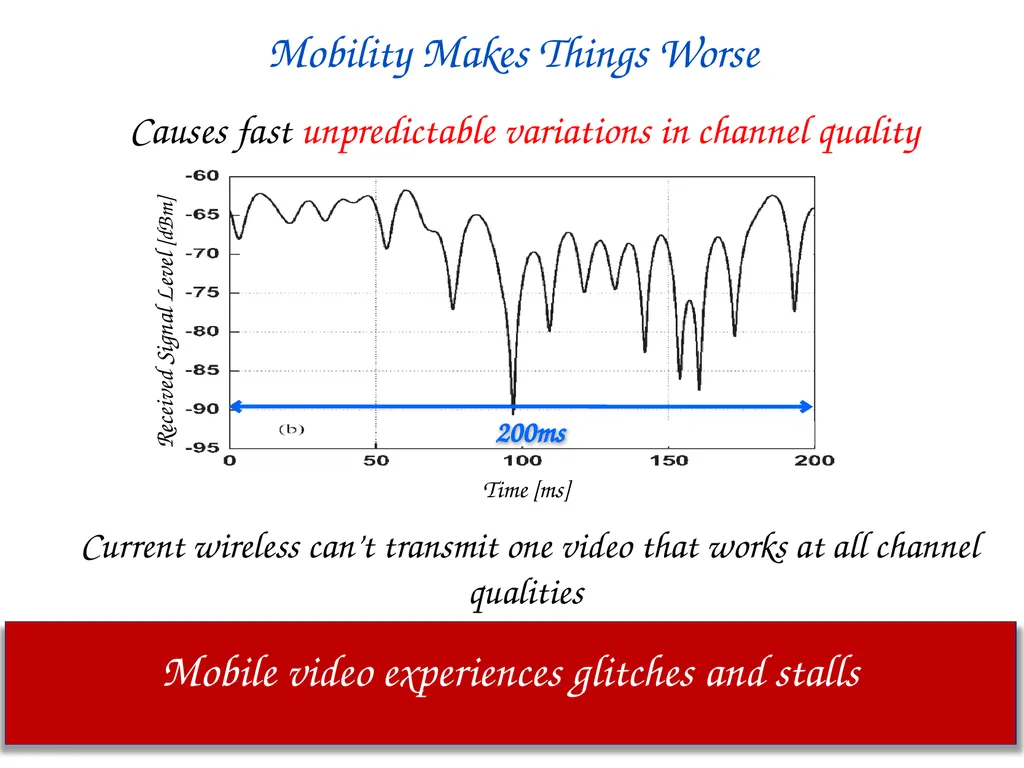
Mobility Makes Things Worse Causes fast unpredictable variations in channel quality Current wireless can’t transmit one video that works at all channel qualities Mobile video experiences glitches and stalls<br>
08
Problem Today’s WiMax, WiFi, … Cannot transmit one video stream that satisfies all channel qualities<br>
10
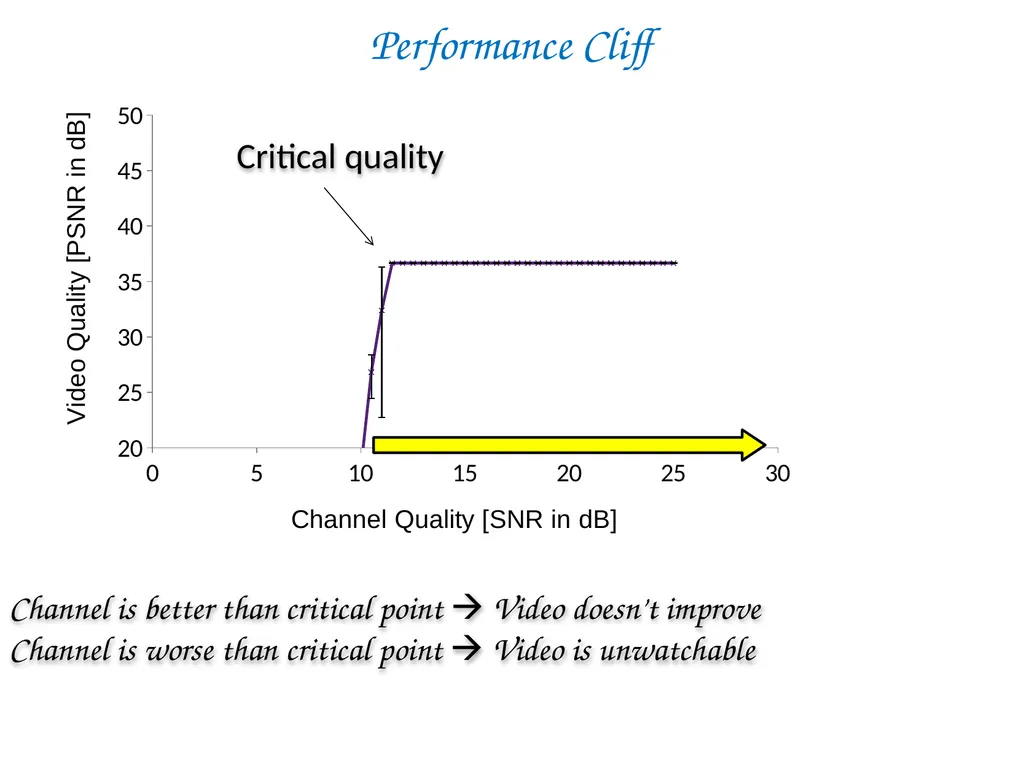
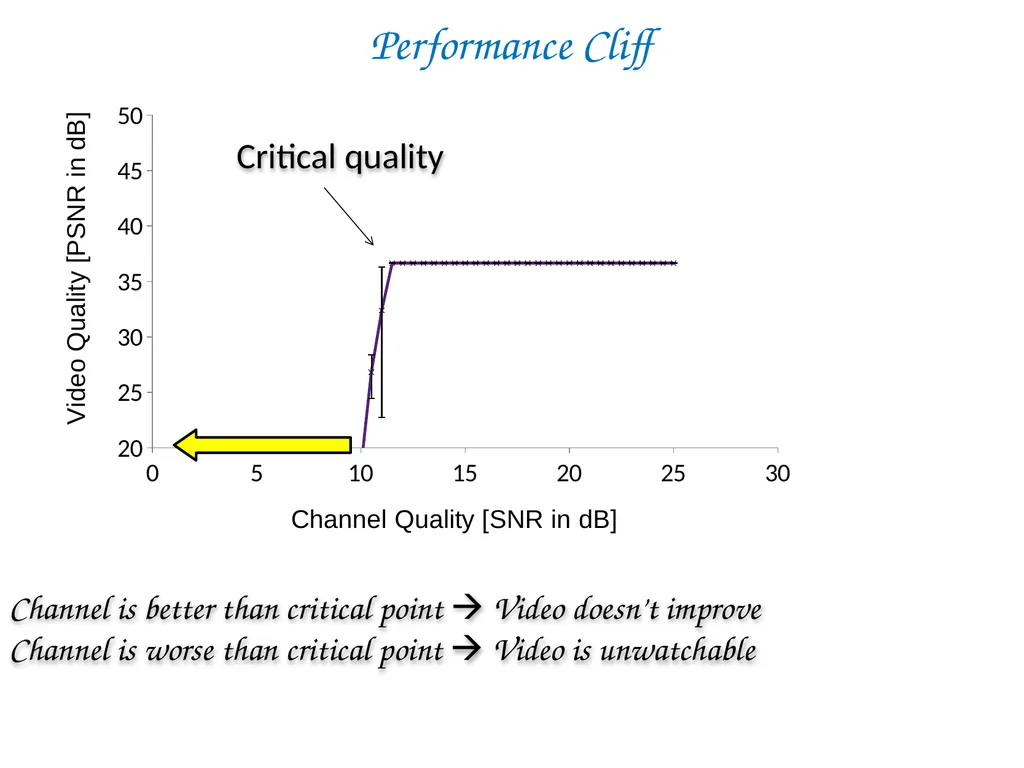
Performance Cliff Channel is better than critical point Video doesn’t improve
Channel is worse than critical point Video is unwatchable Critical quality<br>
11
Performance Cliff Channel is better than critical point Video doesn’t improve
Channel is worse than critical point Video is unwatchable Critical quality<br>
12
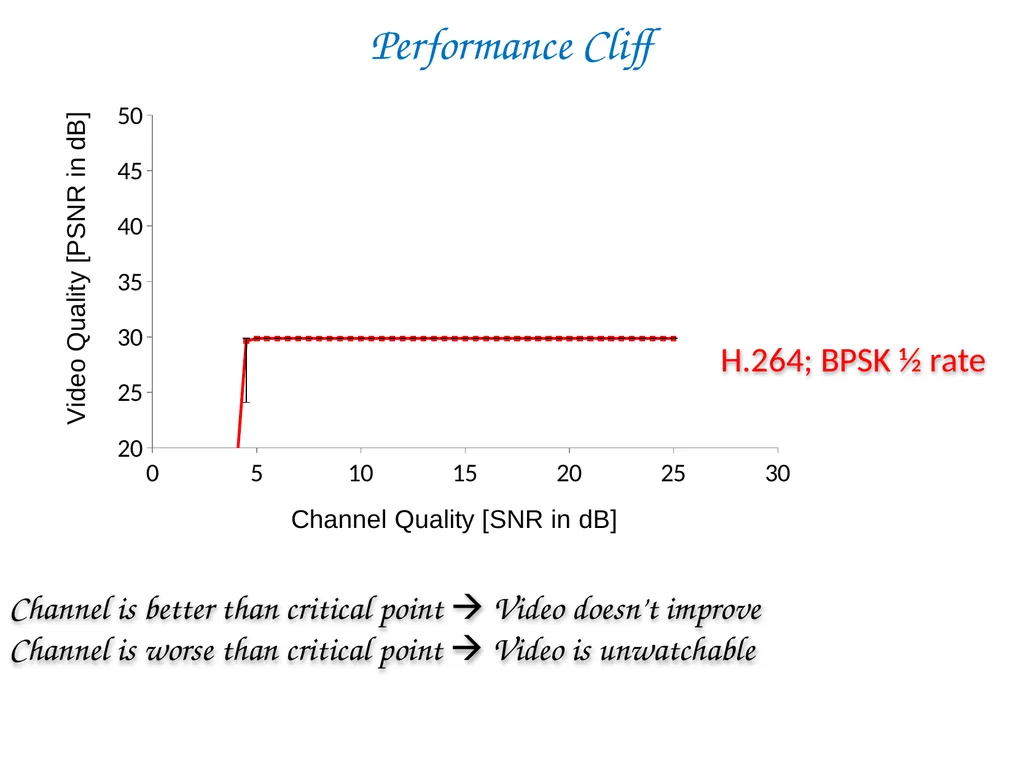
Performance Cliff Channel is better than critical point Video doesn’t improve
Channel is worse than critical point Video is unwatchable H.264; BPSK ½ rate<br>
13
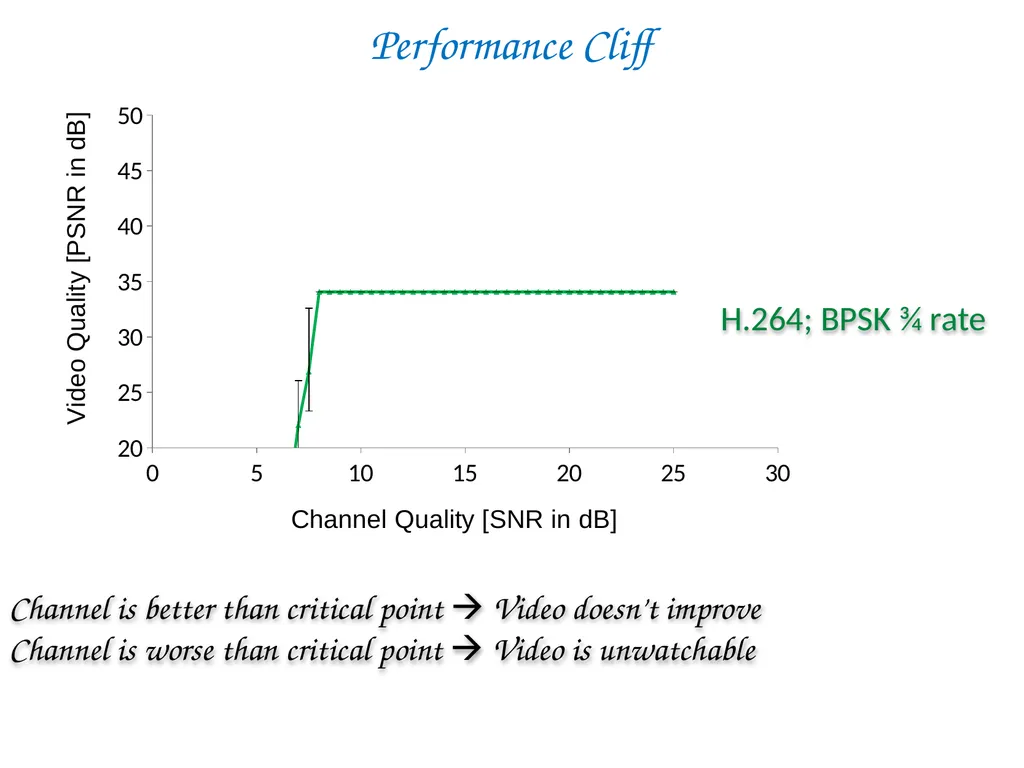
Performance Cliff Channel is better than critical point Video doesn’t improve
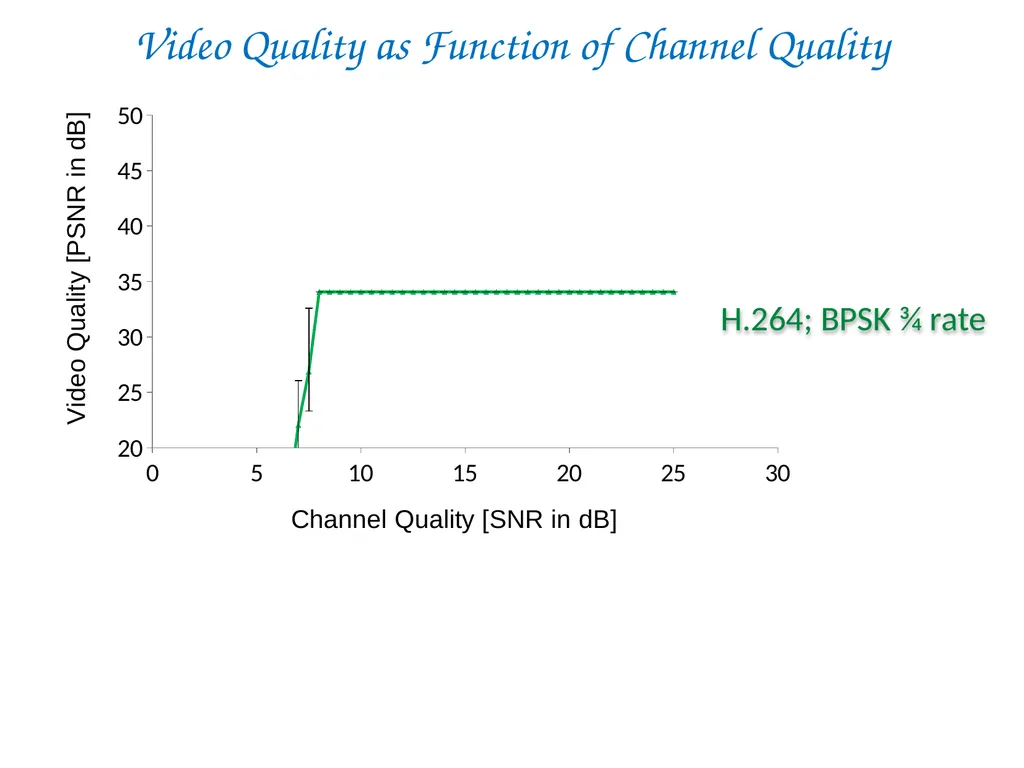
Channel is worse than critical point Video is unwatchable H.264; BPSK ¾ rate<br>
14
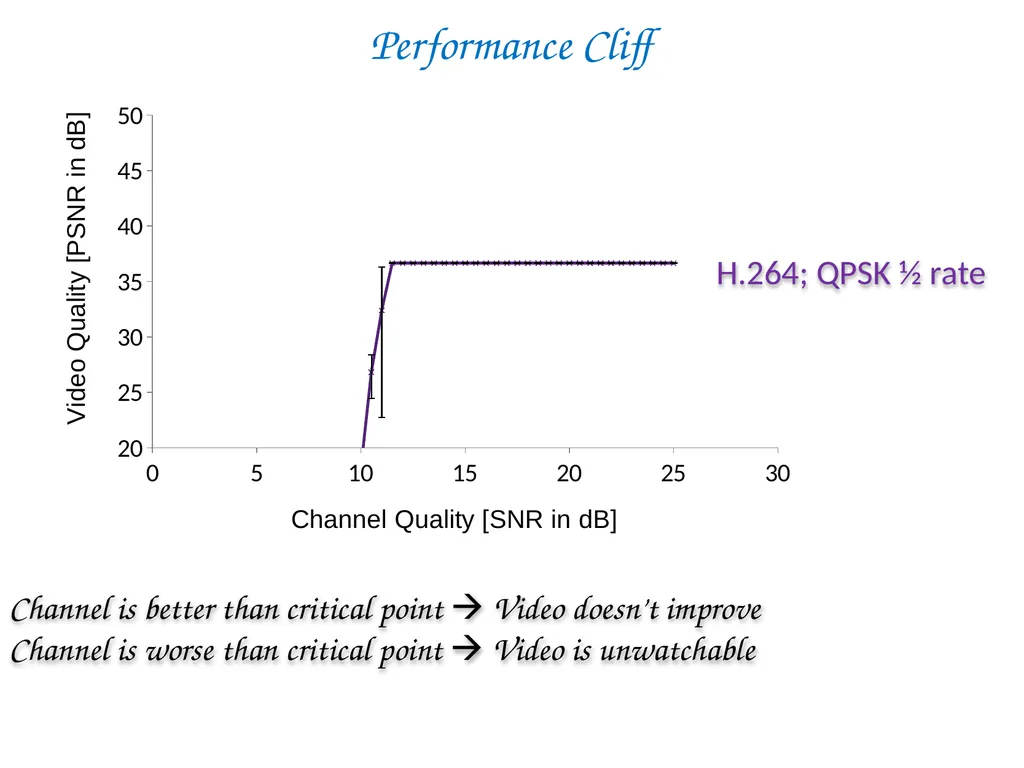
Performance Cliff Channel is better than critical point Video doesn’t improve
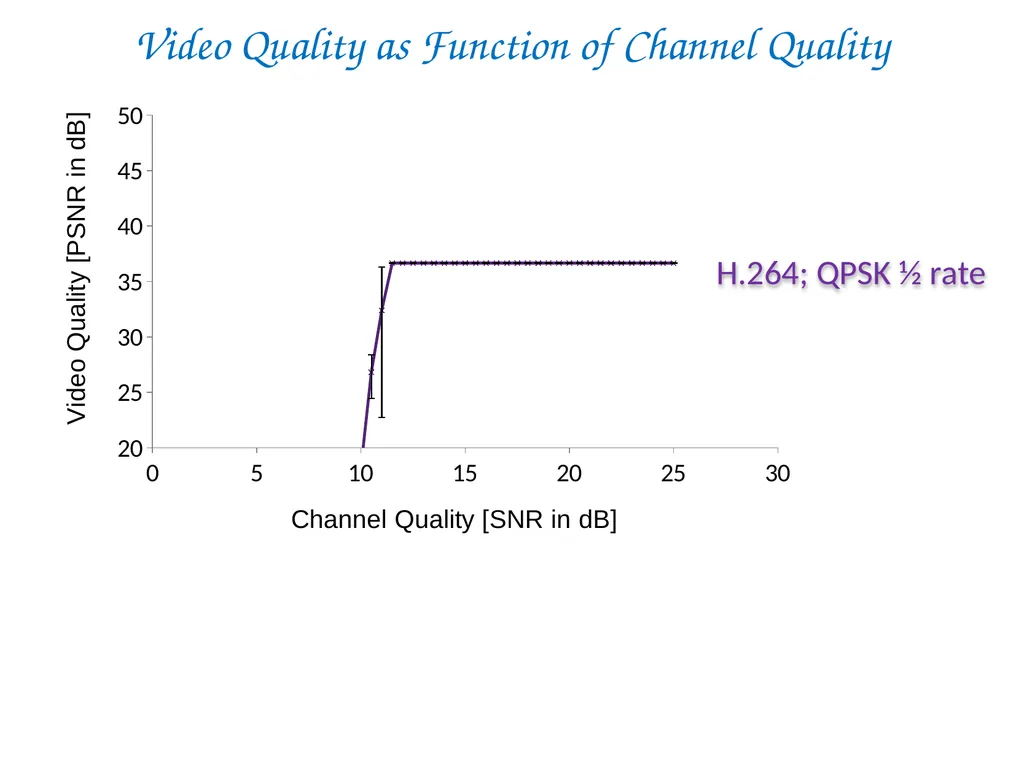
Channel is worse than critical point Video is unwatchable H.264; QPSK ½ rate<br>
15
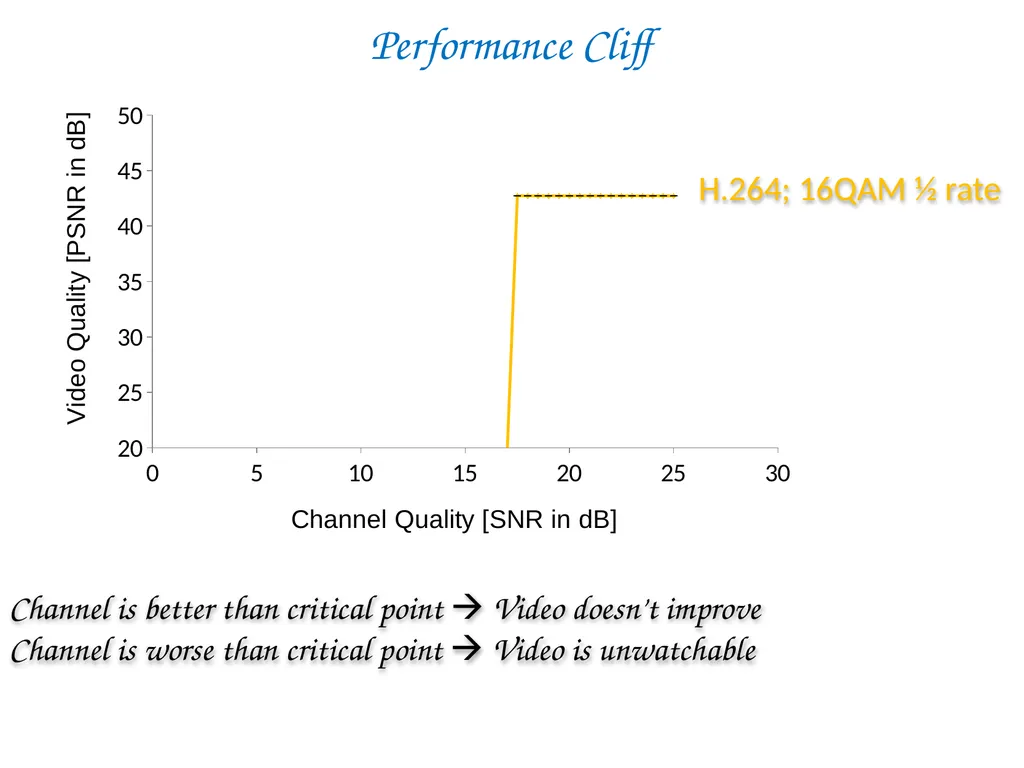
Performance Cliff Channel is better than critical point Video doesn’t improve
Channel is worse than critical point Video is unwatchable H.264; 16QAM ½ rate<br>
16
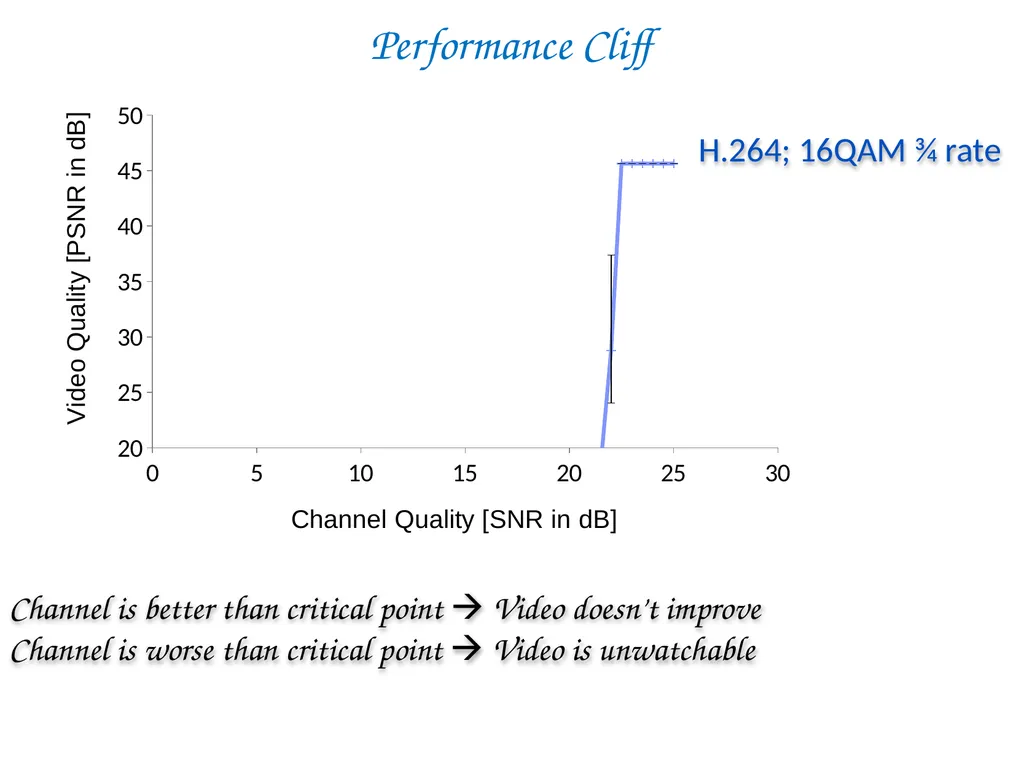
Performance Cliff Channel is better than critical point Video doesn’t improve
Channel is worse than critical point Video is unwatchable H.264; 16QAM ¾ rate<br>
17
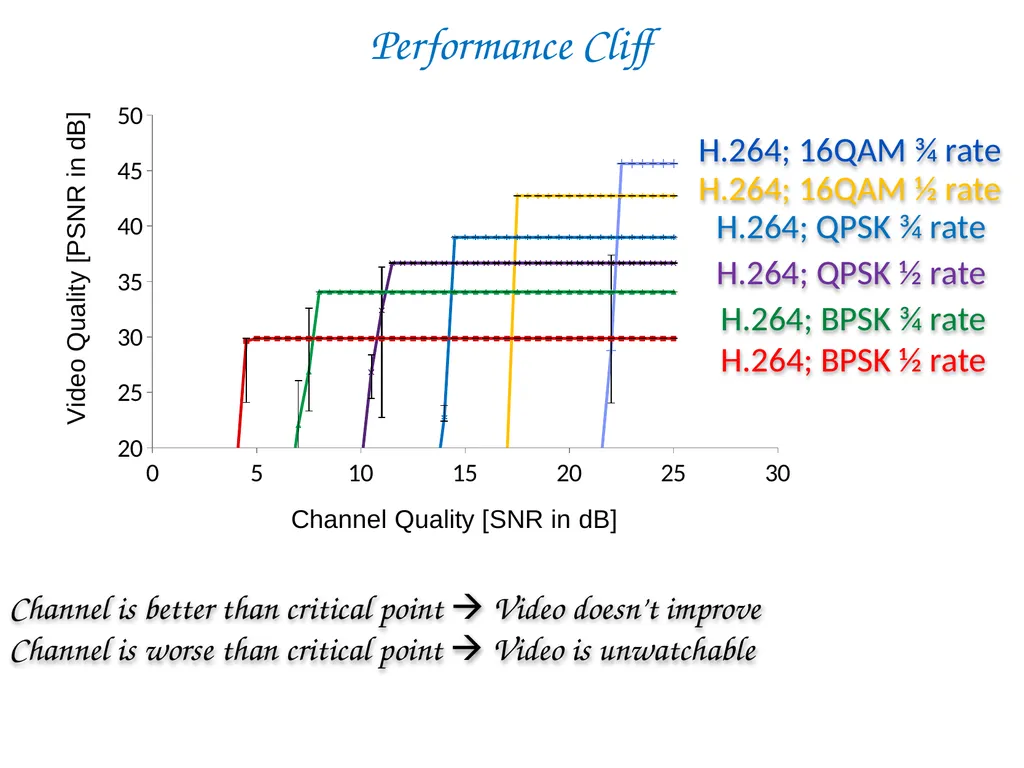
Performance Cliff Channel is better than critical point Video doesn’t improve
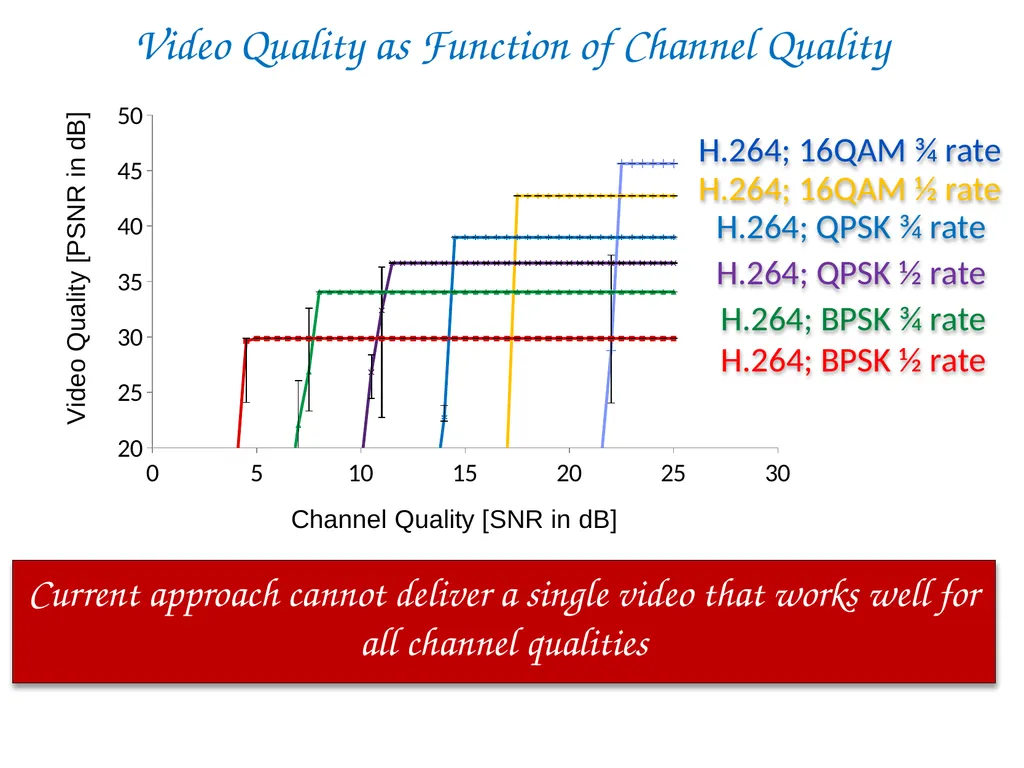
Channel is worse than critical point Video is unwatchable H.264; BPSK ½ rate H.264; BPSK ¾ rate H.264; QPSK ½ rate H.264; 16QAM ½ rate H.264; 16QAM ¾ rate H.264; QPSK ¾ rate<br>
18
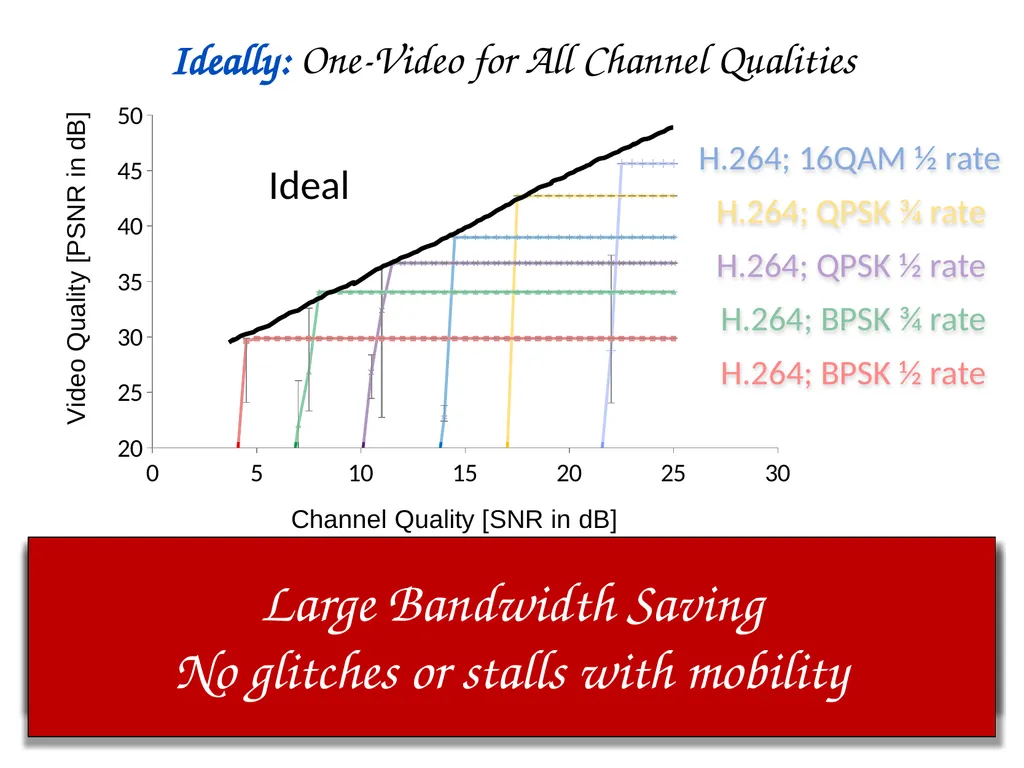
H.264; BPSK ½ rate H.264; BPSK ¾ rate H.264; QPSK ½ rate H.264; QPSK ¾ rate H.264; 16QAM ½ rate Ideal Ideally: One-Video for All Channel Qualities Transmitter broadcasts one video
Each receiver decodes a video quality commensurate with its channel quality Large Bandwidth Saving
No glitches or stalls with mobility<br>
19
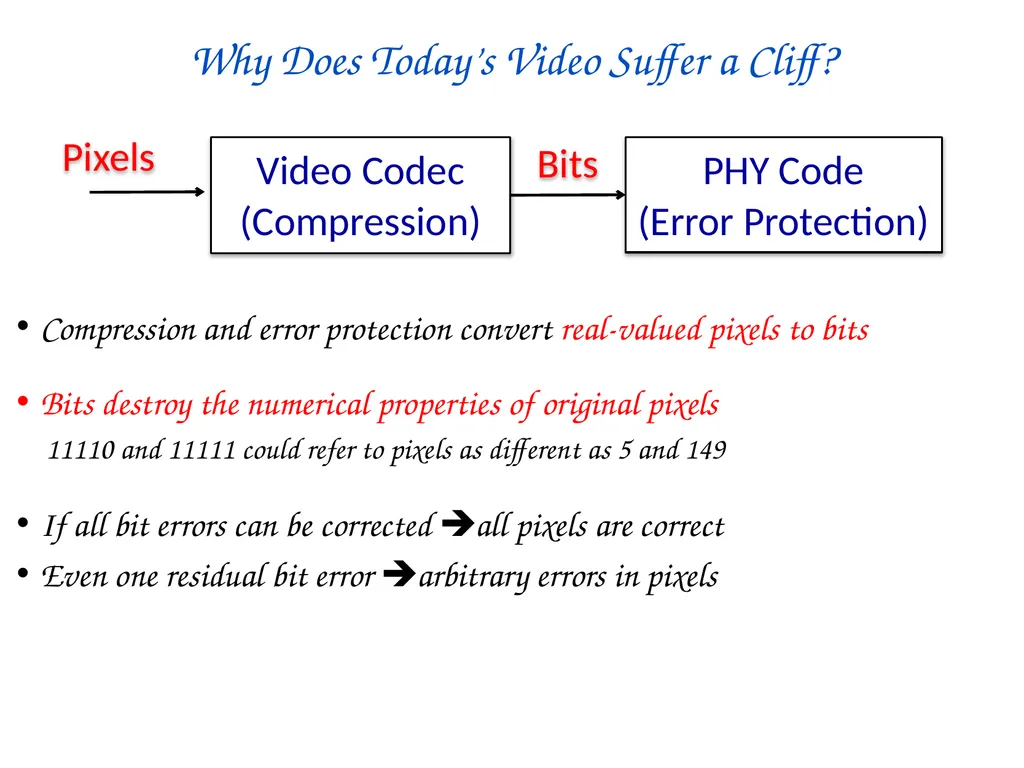
Why Does Today’s Video Suffer a Cliff? Video Codec
(Compression) PHY Code
(Error Protection) Bits Compression and error protection convert real-valued pixels to bits
Bits destroy the numerical properties of original pixels
11110 and 11111 could refer to pixels as different as 5 and 149
If all bit errors can be corrected all pixels are correct
Even one residual bit error arbitrary errors in pixels Pixels<br>
20
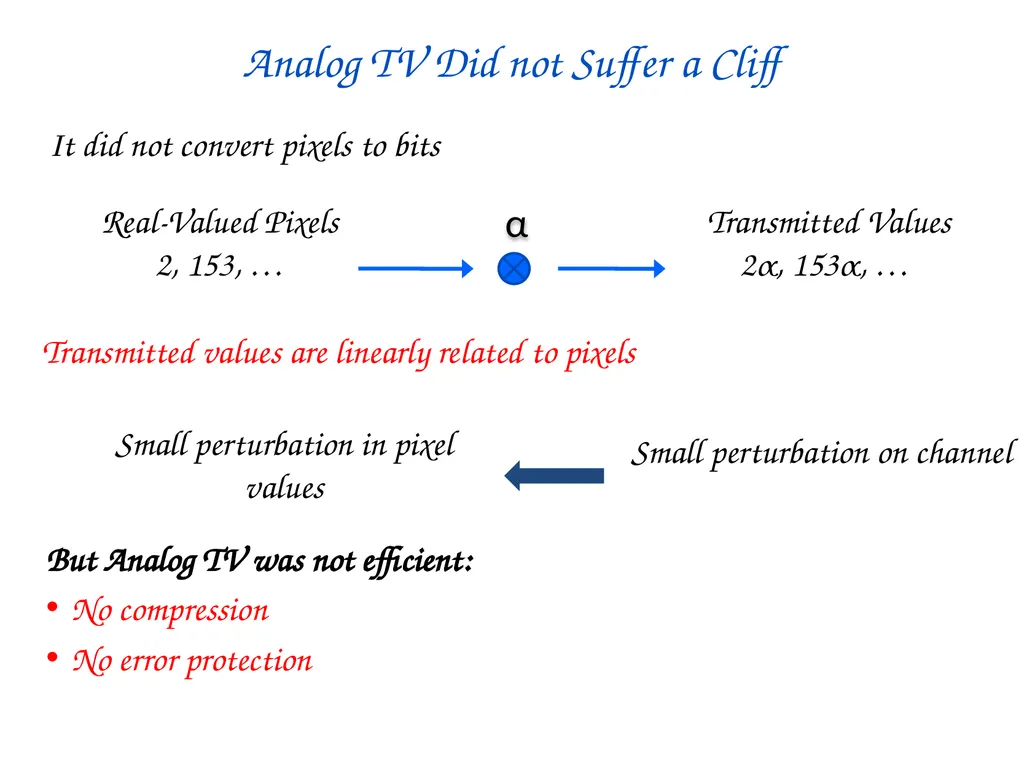
Analog TV Did not Suffer a Cliff Real-Valued Pixels�2, 153, … Transmitted Values
2α, 153α, … Transmitted values are linearly related to pixels But Analog TV was not efficient:
No compression
No error protection Small perturbation on channel Small perturbation in pixel values It did not convert pixels to bits<br>
21
SoftCast + SoftCast combines the best of both worlds Is as efficient as digital video Has no cliff effect, like analog video<br>
23
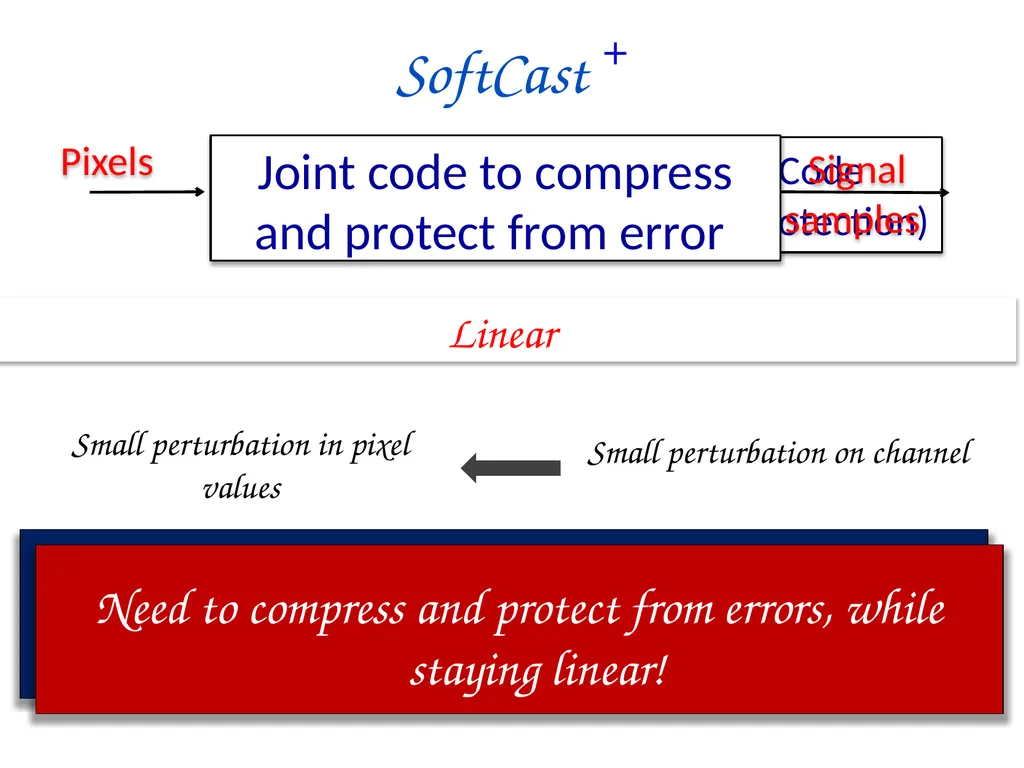
Linear Video Codec
(Compression) PHY Code
(Error Protection) Bits Pixels Joint code to compress and protect from error Signal samples SoftCast + Small perturbation on channel Small perturbation in pixel values No Cliff Effect Need to compress and protect from errors, while staying linear!<br>
24
Existing compression is not linear Challenge 1<br>
25
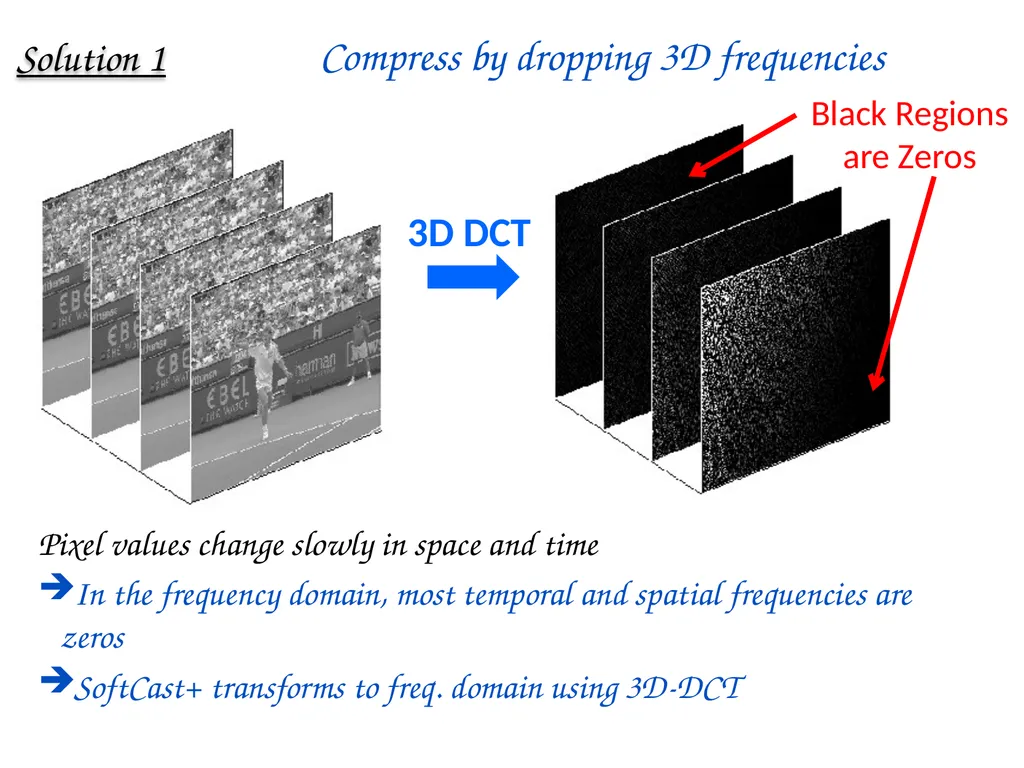
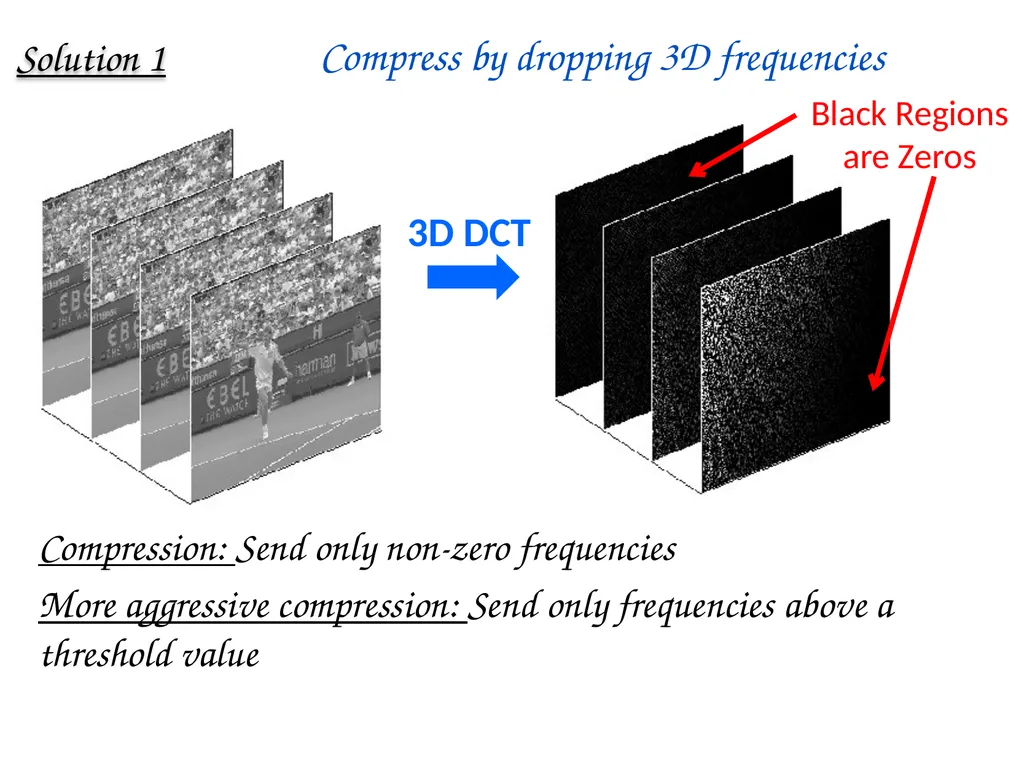
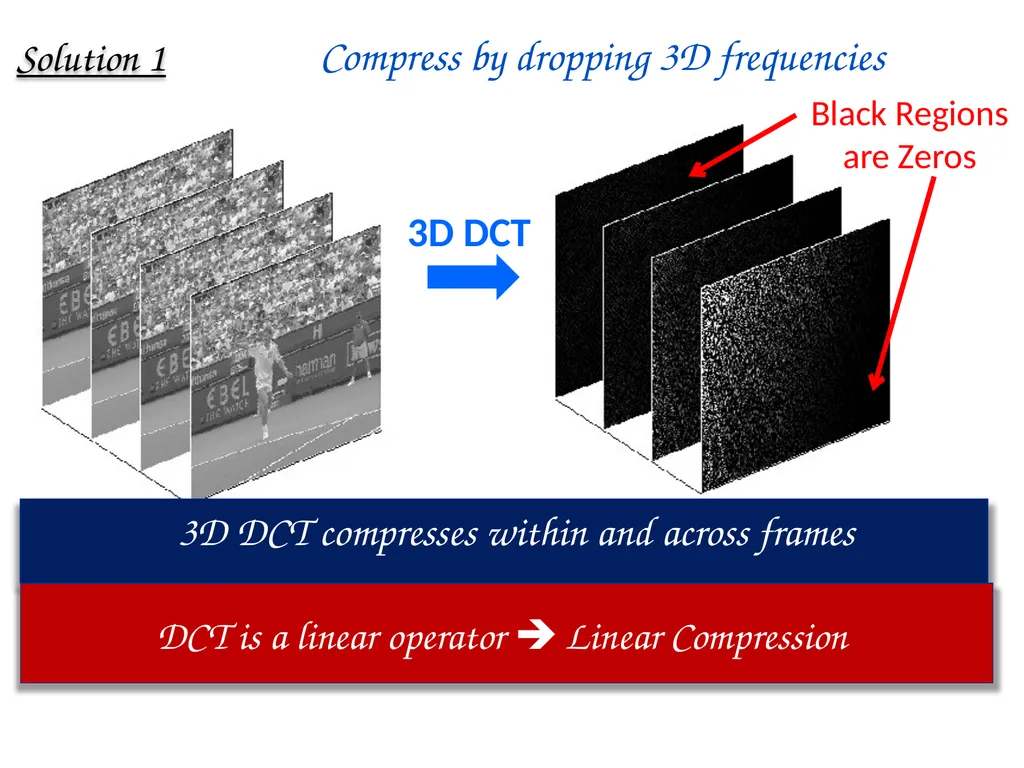
Pixel values change slowly in space and time
In the frequency domain, most temporal and spatial frequencies are zeros
SoftCast+ transforms to freq. domain using 3D-DCT 3D DCT Black Regions are Zeros Compress by dropping 3D frequencies Solution 1<br>
26
Compression: Send only non-zero frequencies
More aggressive compression: Send only frequencies above a threshold value 3D DCT Black Regions are Zeros Compress by dropping 3D frequencies Solution 1<br>
27
Compression: Send only non-zero frequencies
More aggressive compression: Send only frequencies above a threshold value 3D DCT Black Regions are Zeros Compress by dropping 3D frequencies Solution 1 3D DCT compresses within and across frames DCT is a linear operator Linear Compression<br>
28
Existing error protection codes operate on bits not reals Challenge 2<br>
29
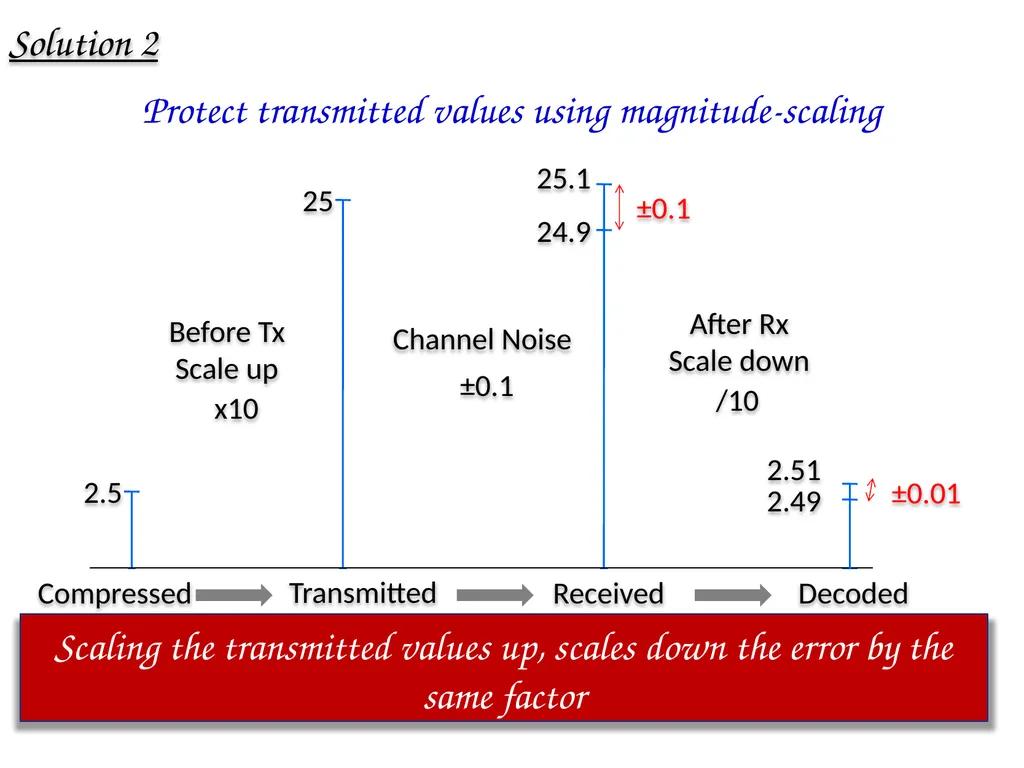
Protect transmitted values using magnitude-scaling Compressed value Transmitted Received Decoded Channel Noise ±0.1 x10 Before Tx Scale up /10 After Rx Scale down Scaling the transmitted values up, scales down the error by the same factor Solution 2<br>
30
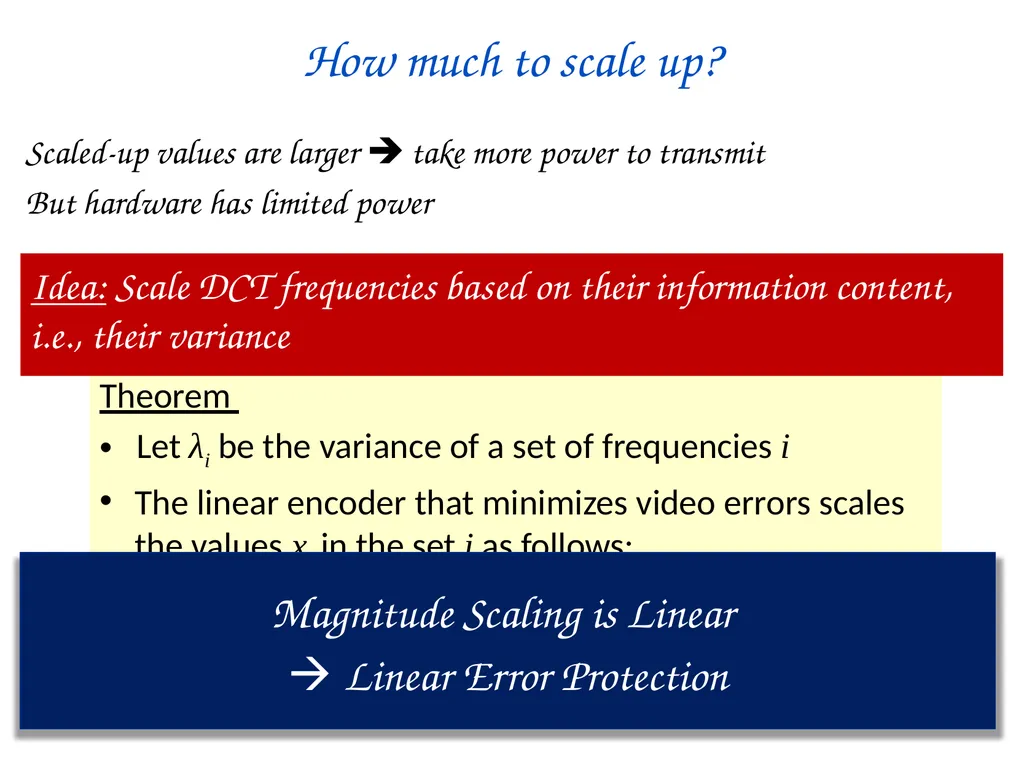
How much to scale up? Scaled-up values are larger take more power to transmit
But hardware has limited power Theorem
Let λi be the variance of a set of frequencies i
The linear encoder that minimizes video errors scales the values xi in the set i as follows:
yi = gi xi where gi ~ λi-1/4 Magnitude Scaling is Linear
Linear Error Protection Formulate it as an optimization that finds the scaling factors that minimize received video errors Idea: Scale DCT frequencies based on their information content, i.e., their variance<br>
31
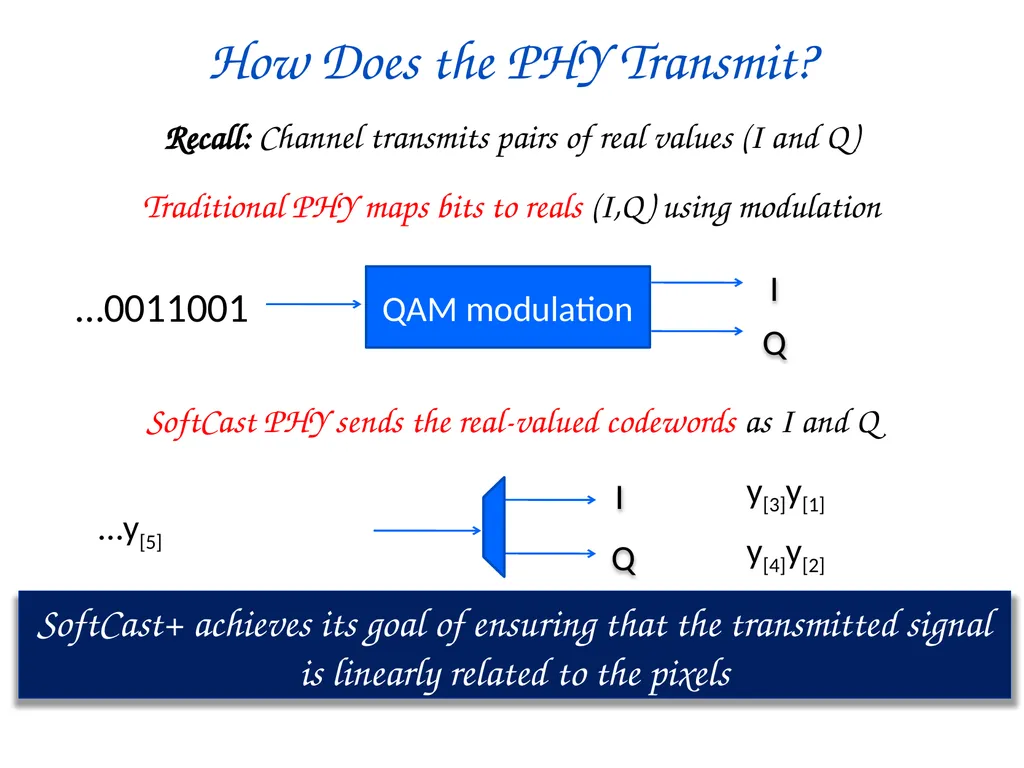
How Does the PHY Transmit? Traditional PHY maps bits to reals (I,Q) using modulation SoftCast PHY sends the real-valued codewords as I and Q Recall: Channel transmits pairs of real values (I and Q) …0011001 …y[5]y[4]y[3]y[2]y[1] SoftCast+ achieves its goal of ensuring that the transmitted signal is linearly related to the pixels …y[5]y[4]y[3] y[1] y[2] …y[5] y[3]y[1] y[4]y[2]<br>
33
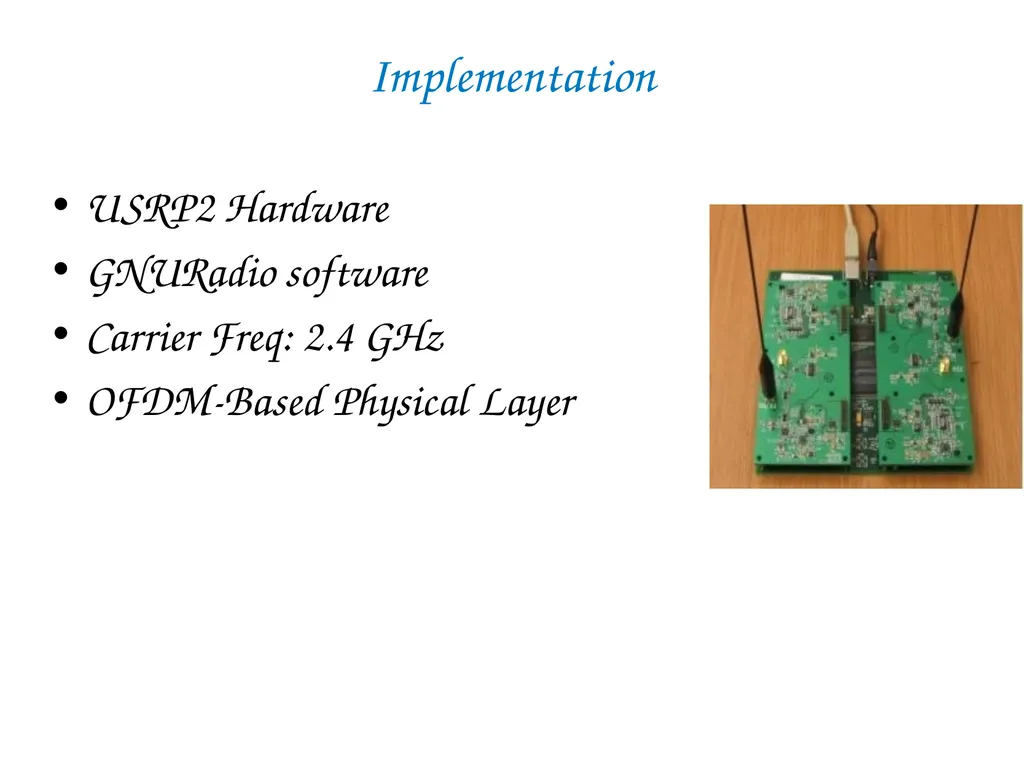
Implementation USRP2 Hardware
GNURadio software
Carrier Freq: 2.4 GHz
OFDM-Based Physical Layer<br>
34
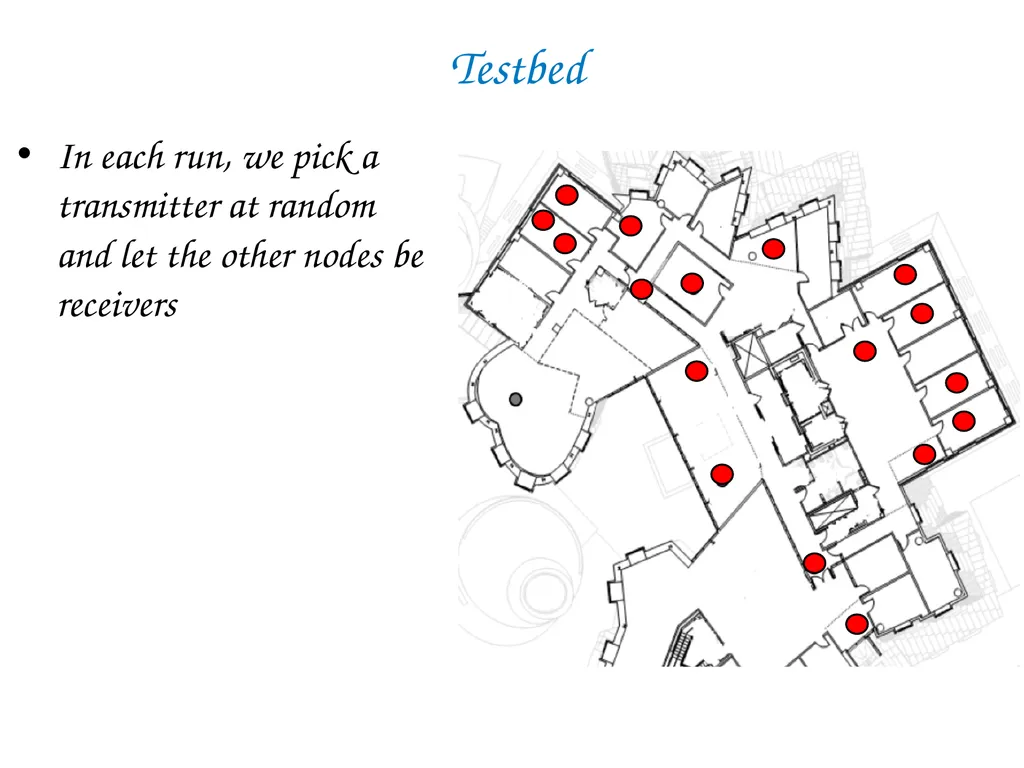
Testbed In each run, we pick a transmitter at random and let the other nodes be receivers<br>
35
Compared Schemes SoftCast +
H.264/MPEG4 over 802.11-like OFDM physical layer
Layered video (i.e., SCV) over Hierarchical Modulation<br>
36
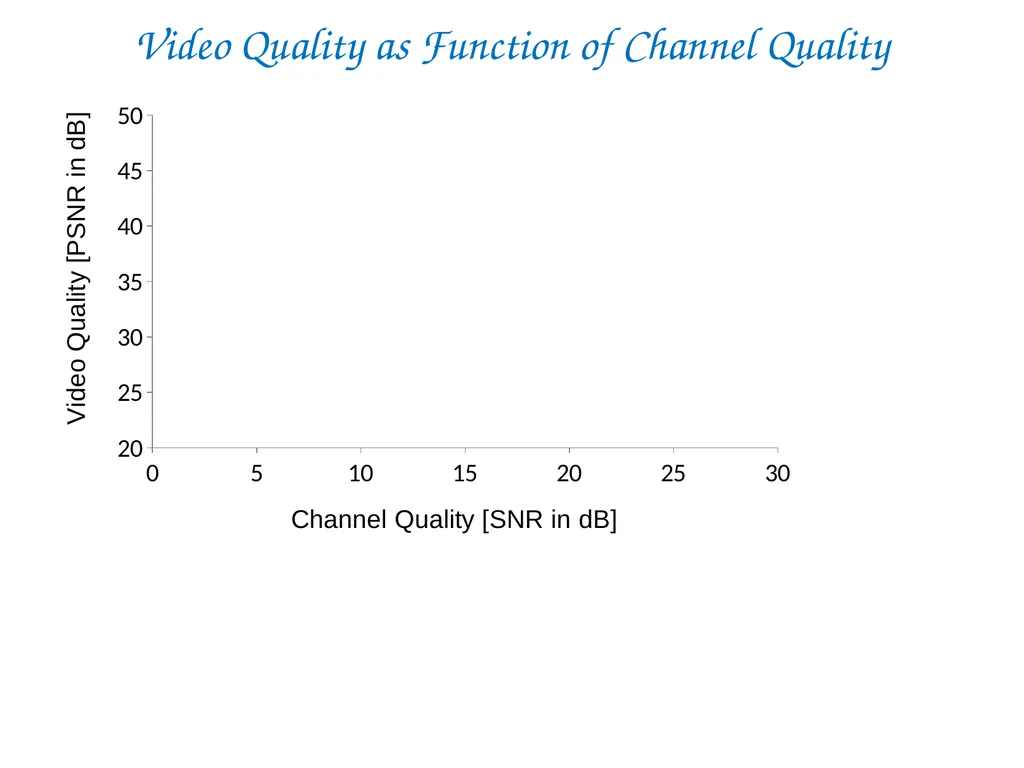
Video Quality as Function of Channel Quality<br>
37
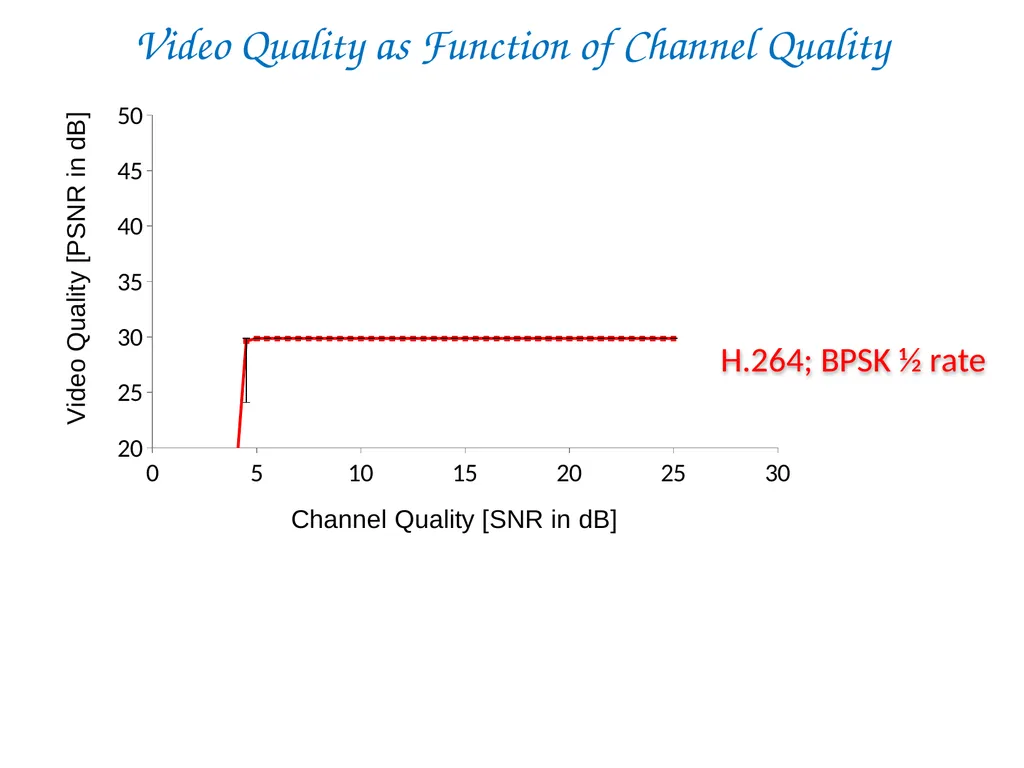
Video Quality as Function of Channel Quality H.264; BPSK ½ rate<br>
38
Video Quality as Function of Channel Quality H.264; BPSK ¾ rate<br>
39
Video Quality as Function of Channel Quality H.264; QPSK ½ rate<br>
40
Video Quality as Function of Channel Quality H.264; BPSK ½ rate H.264; BPSK ¾ rate H.264; QPSK ½ rate H.264; 16QAM ½ rate H.264; 16QAM ¾ rate H.264; QPSK ¾ rate Current approach cannot deliver a single video that works well for all channel qualities<br>
41
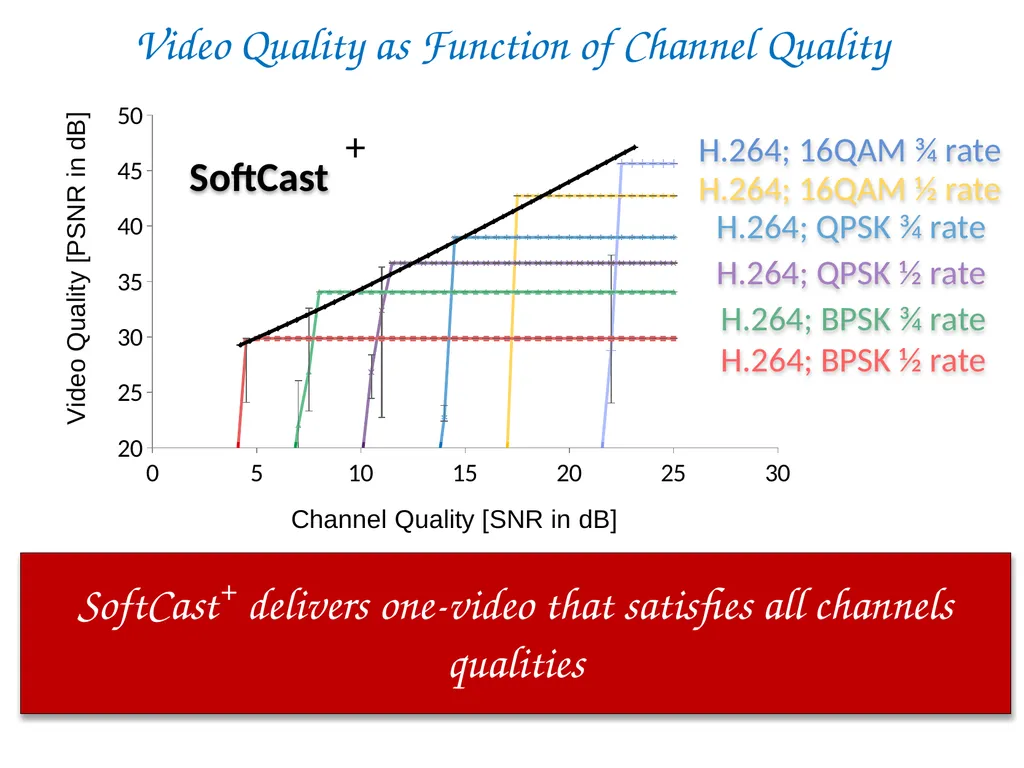
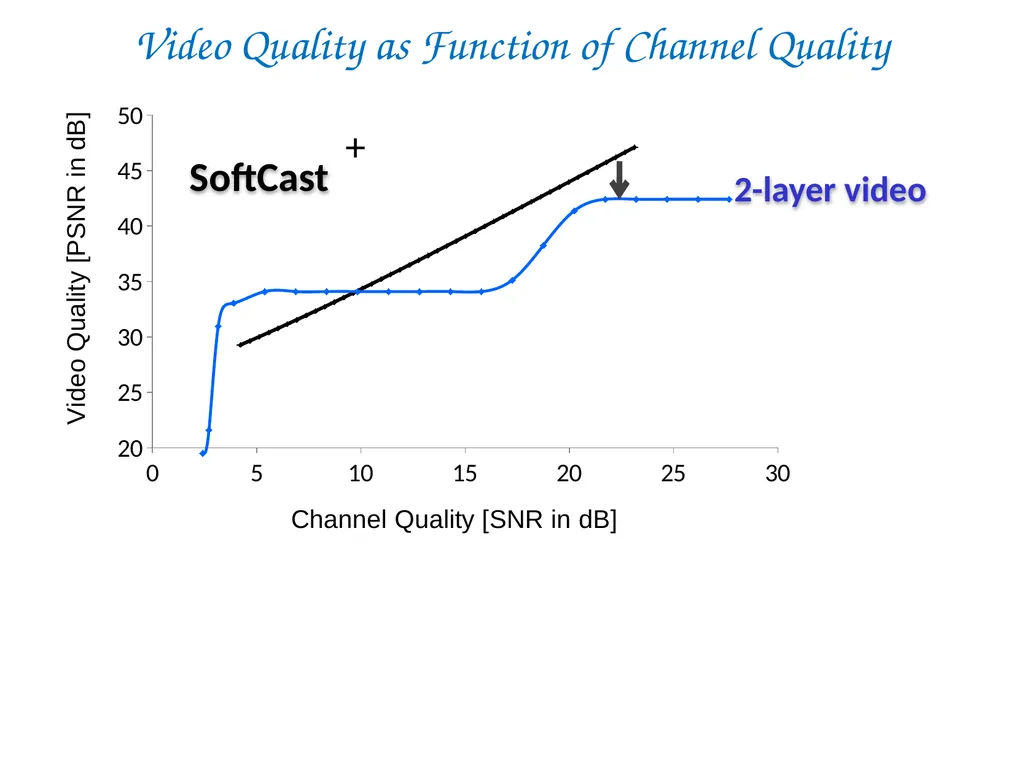
Video Quality as Function of Channel Quality SoftCast+ delivers one-video that satisfies all channels qualities +<br>
42
Video Quality as Function of Channel Quality +<br>
43
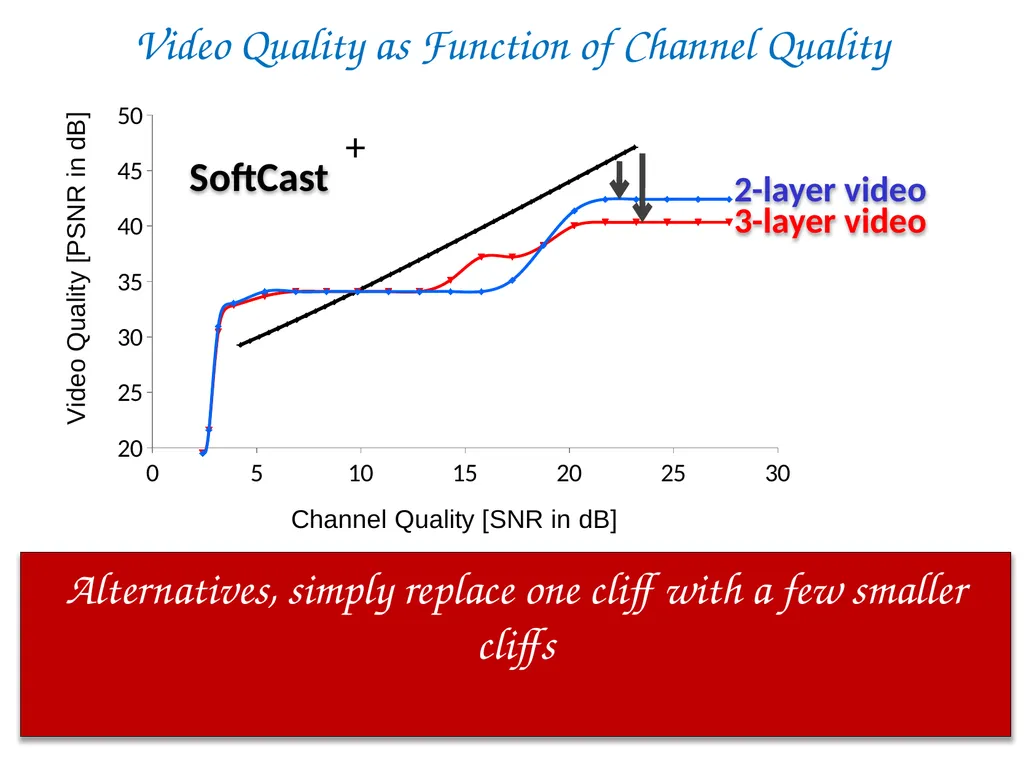
Video Quality as Function of Channel Quality Alternatives, simply replace one cliff with a few smaller cliffs +<br>
44
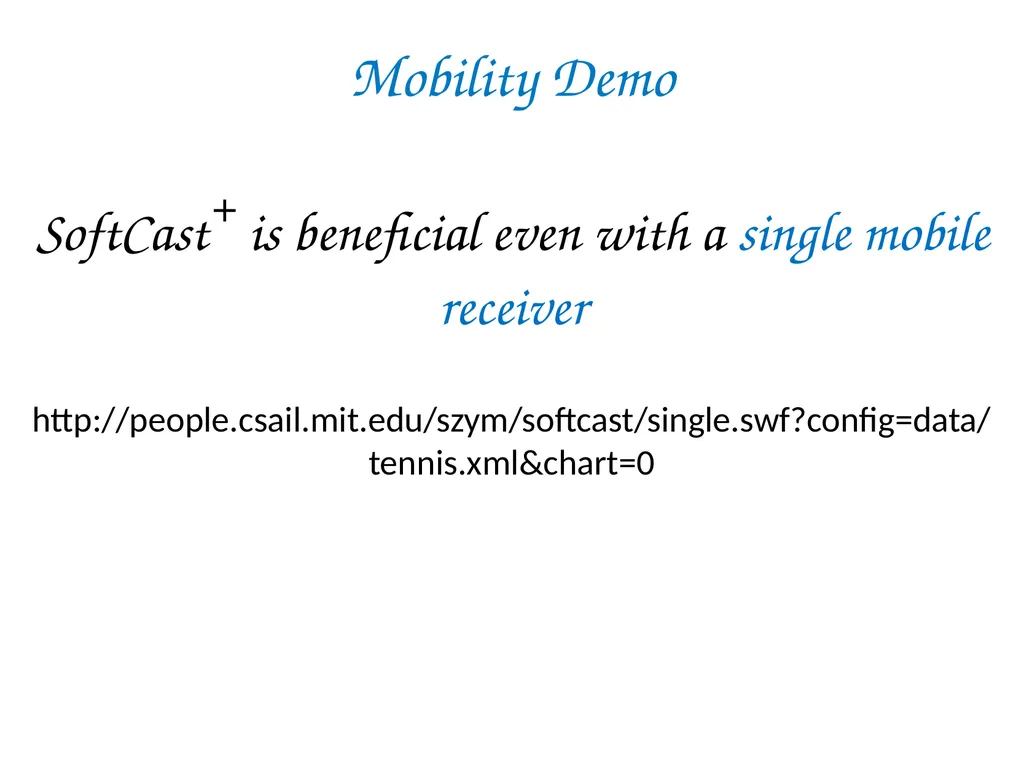
Mobility Demo SoftCast+ is beneficial even with a single mobile receiver http://people.csail.mit.edu/szym/softcast/single.swf?config=data/tennis.xml&chart=0<br>
45
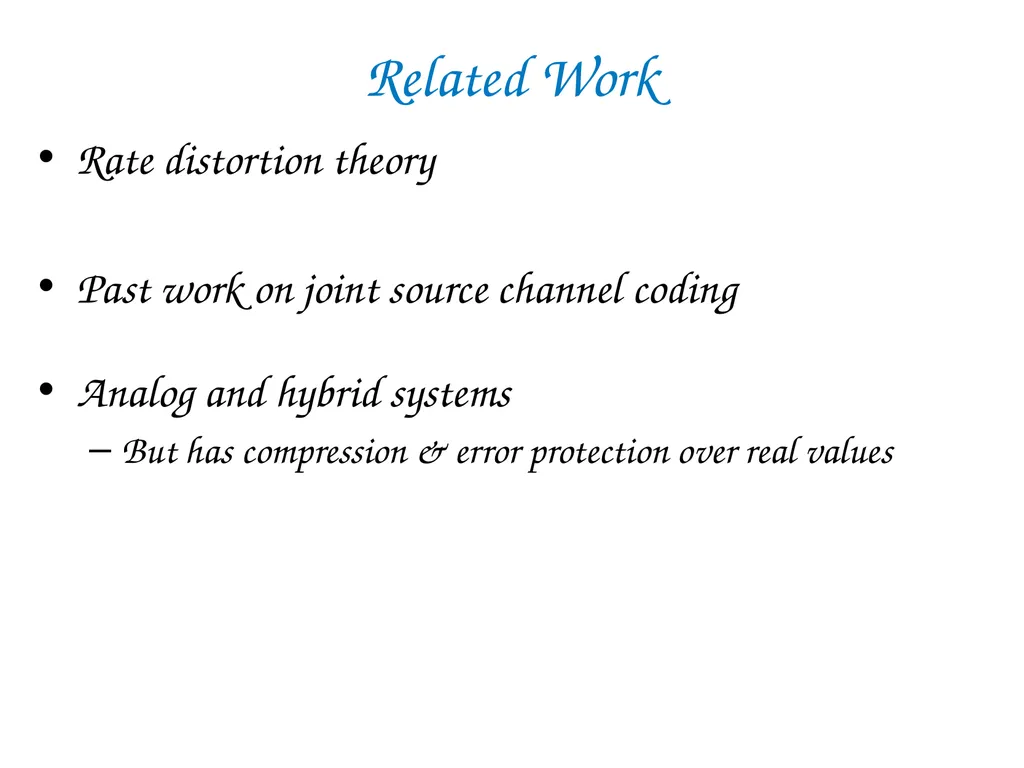
Related Work Rate distortion theory
Past work on joint source channel coding
Analog and hybrid systems
But has compression & error protection over real values<br>
46
Conclusion SoftCast+ : one video to satisfy all channel qualities
Key idea: Linear JSCC over the reals
Is implemented and evaluated in a wireless testbed
Increases scalability and robustness to mobility<br>