
Soil-Biodegradable Mulch for Crop Production Carol

Description: Soil-Biodegradable Mulch for Crop Production Carol Miles, Washington State University, Shuresh Ghimire, University of Connecticut, and Sam Wortman, University of Nebraska Alternative to PE Mulch PE mulch disposal: Recycling limited due to
Related Topics
Download Presentation
"Soil-Biodegradable Mulch for Crop Production Carol" is the property of its rightful owner. Permission is granted to download and print the materials on this website for personal, non-commercial use only, and to display it on your personal computer provided you do not modify the materials and that you retain all copyright notices contained in the materials. By downloading content from our website, you accept the terms of this agreement.
Presentation Transcript
slide1. Soil-Biodegradable Mulch for
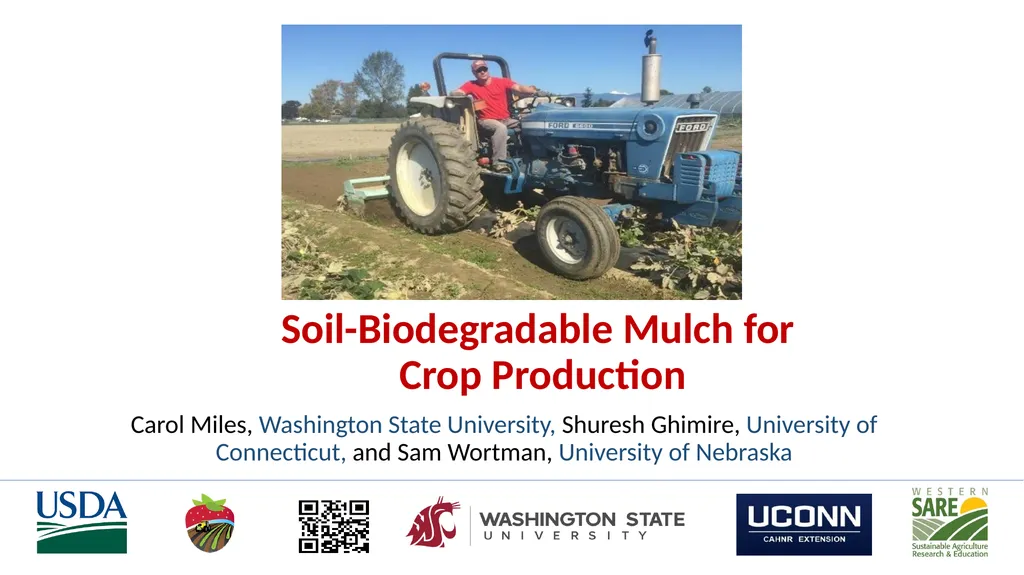
Crop Production Carol Miles, Washington State University, Shuresh Ghimire, University of Connecticut, and Sam Wortman, University of Nebraska<br>
slide2. Alternative to PE Mulch PE mulch disposal:
Recycling limited due to soil/plant debris contamination
Waste disposal through landfilling and incineration can be limited
Can be a source of environmental pollution
Mulch removal is time and labor consuming:
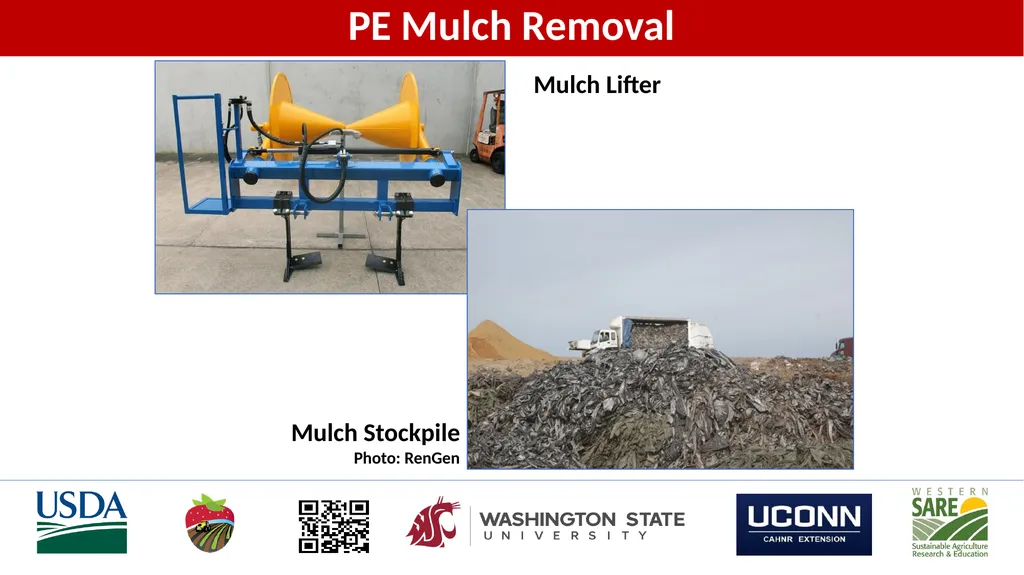
Equipment facilitates mulch removal (e.g. mulch lifter)
Up to 10% mulch reportedly left in the field<br>
slide3. PE Mulch Removal Mulch Lifter Mulch Stockpile
Photo: RenGen<br>
slide4. BDM for Crop Production BDM should completely biodegrade, not cause harm to soil ecology, and provide:
BDM designed to be tilled into the soil after use, eliminating waste and disposal challenges
BDMs rip easily, difficult to remove from field
BDMs should not go into recycling facilities, they will contaminate recyclate Weed control
Temperature modification
Soil moisture retention
Comparable yield with PE<br>
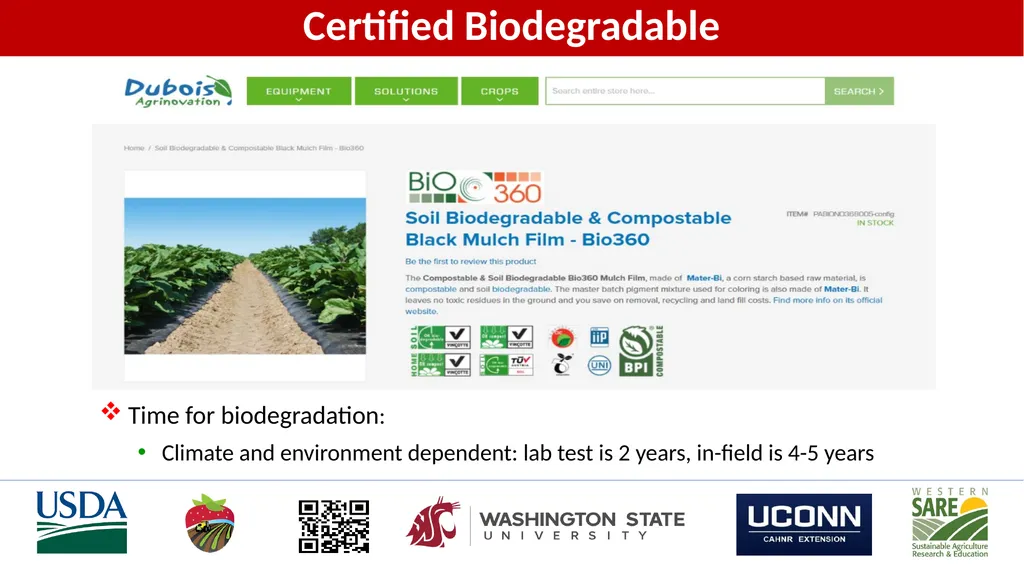
slide5. Certified Biodegradable Time for biodegradation:
Climate and environment dependent: lab test is 2 years, in-field is 4-5 years<br>
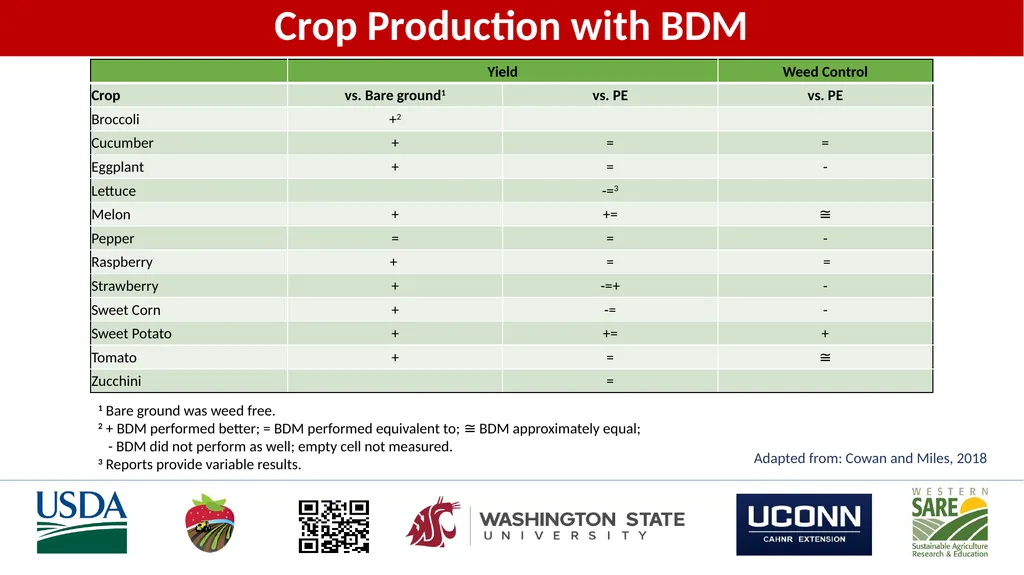
slide6. Crop Production with BDM 1 Bare ground was weed free.
2 + BDM performed better; = BDM performed equivalent to; ≅ BDM approximately equal; - BDM did not perform as well; empty cell not measured.
3 Reports provide variable results. Adapted from: Cowan and Miles, 2018<br>
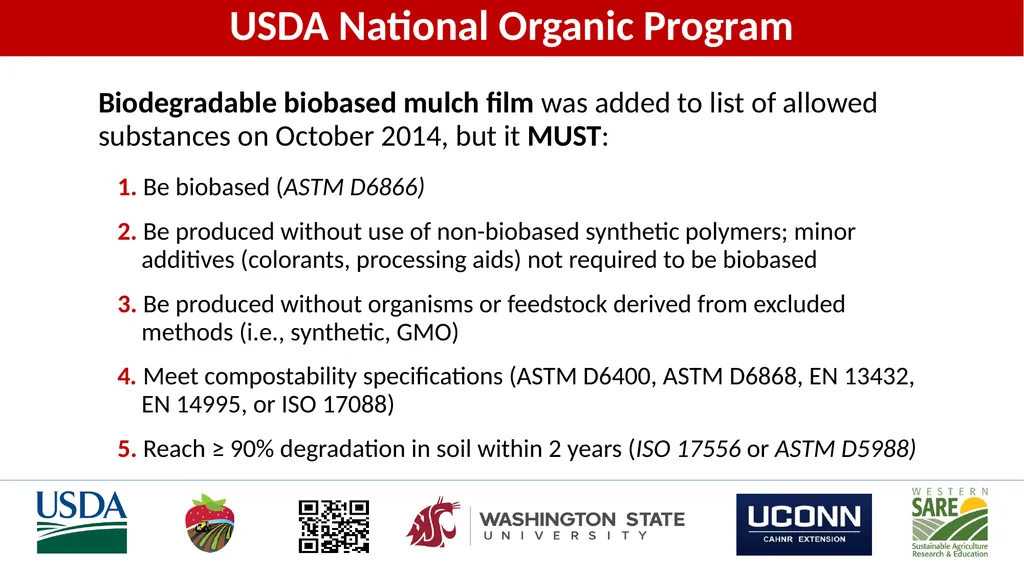
slide7. USDA National Organic Program Biodegradable biobased mulch film was added to list of allowed substances on October 2014, but it MUST:
1. Be biobased (ASTM D6866)
2. Be produced without use of non-biobased synthetic polymers; minor additives (colorants, processing aids) not required to be biobased
3. Be produced without organisms or feedstock derived from excluded methods (i.e., synthetic, GMO)
4. Meet compostability specifications (ASTM D6400, ASTM D6868, EN 13432, EN 14995, or ISO 17088)
5. Reach ≥ 90% degradation in soil within 2 years (ISO 17556 or ASTM D5988)<br>
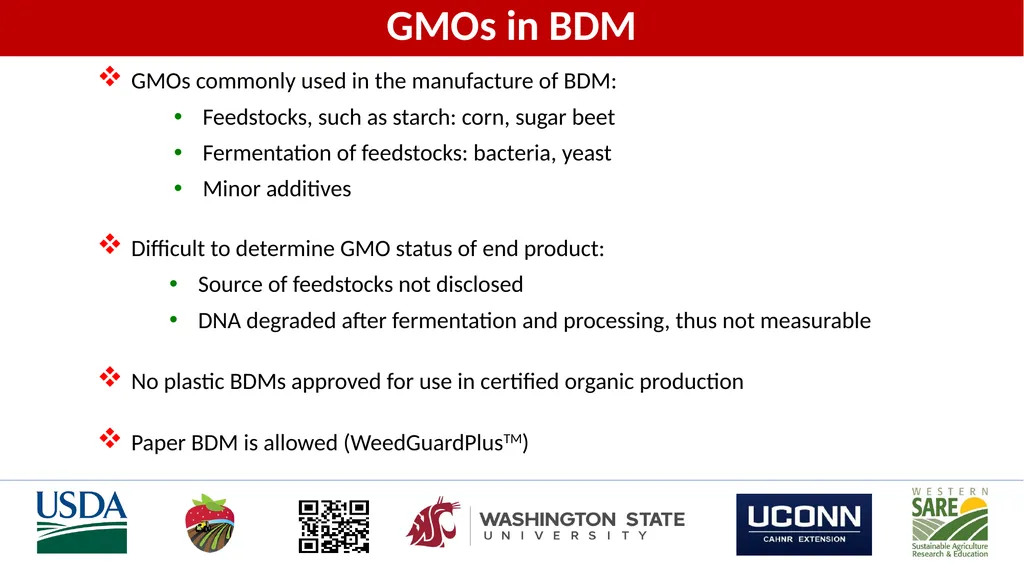
slide8. GMOs in BDM GMOs commonly used in the manufacture of BDM:
Feedstocks, such as starch: corn, sugar beet
Fermentation of feedstocks: bacteria, yeast
Minor additives
Difficult to determine GMO status of end product:
Source of feedstocks not disclosed
DNA degraded after fermentation and processing, thus not measurable
No plastic BDMs approved for use in certified organic production
Paper BDM is allowed (WeedGuardPlusTM)<br>
slide9. Resources Biodegradable Mulch Film for Organic Production Systems https://ag.tennessee.edu/biodegradablemulch/Documents/BDM_for_organic_production_rev_5Apr2016.pdf
Biodegradable Plastic Mulch and Suitability for Sustainable and Organic Agriculture http://pubs.cahnrs.wsu.edu/publications/pubs/fs103e/
Biodegradable Mulch Products https://ag.tennessee.edu/biodegradablemulch/Pages/biomulchprojects.aspx
Glossary of terms associated with biodegradable mulches for specialty crops https://ag.tennessee.edu/biodegradablemulch/Documents/BDM_glossary_May2015.pdf
Impact of Biodegradable Plastic Mulch on Specialty Crop Production https://ag.tennessee.edu/biodegradablemulch/Documents/BDM%20for%20crops-research%20summary.pdf
Video - An Introduction to "Performance and Adoptability of Biodegradable Plastic Mulch for Sustainable Specialty Crop Production https://www.youtube.com/embed/B1GGXN1d0aw
Video - Biodegradable much: a grower's experience of general benefits and disadvantages https://www.youtube.com/watch?v=kyvB1QxHAtE&list=PLuPJ_NR7ZnVuPh7t7erYYXcVw-h4xg0Xm<br>
slide2. Alternative to PE Mulch PE mulch disposal:
Recycling limited due to soil/plant debris contamination
Waste disposal through landfilling and incineration can be limited
Can be a source of environmental pollution
Mulch removal is time and labor consuming:
Equipment facilitates mulch removal (e.g. mulch lifter)
Up to 10% mulch reportedly left in the field<br>
slide3. PE Mulch Removal Mulch Lifter Mulch Stockpile
Photo: RenGen<br>
slide4. BDM for Crop Production BDM should completely biodegrade, not cause harm to soil ecology, and provide:
BDM designed to be tilled into the soil after use, eliminating waste and disposal challenges
BDMs rip easily, difficult to remove from field
BDMs should not go into recycling facilities, they will contaminate recyclate Weed control
Temperature modification
Soil moisture retention
Comparable yield with PE<br>
slide5. Certified Biodegradable Time for biodegradation:
Climate and environment dependent: lab test is 2 years, in-field is 4-5 years<br>
slide6. Crop Production with BDM 1 Bare ground was weed free.
2 + BDM performed better; = BDM performed equivalent to; ≅ BDM approximately equal; - BDM did not perform as well; empty cell not measured.
3 Reports provide variable results. Adapted from: Cowan and Miles, 2018<br>
slide7. USDA National Organic Program Biodegradable biobased mulch film was added to list of allowed substances on October 2014, but it MUST:
1. Be biobased (ASTM D6866)
2. Be produced without use of non-biobased synthetic polymers; minor additives (colorants, processing aids) not required to be biobased
3. Be produced without organisms or feedstock derived from excluded methods (i.e., synthetic, GMO)
4. Meet compostability specifications (ASTM D6400, ASTM D6868, EN 13432, EN 14995, or ISO 17088)
5. Reach ≥ 90% degradation in soil within 2 years (ISO 17556 or ASTM D5988)<br>
slide8. GMOs in BDM GMOs commonly used in the manufacture of BDM:
Feedstocks, such as starch: corn, sugar beet
Fermentation of feedstocks: bacteria, yeast
Minor additives
Difficult to determine GMO status of end product:
Source of feedstocks not disclosed
DNA degraded after fermentation and processing, thus not measurable
No plastic BDMs approved for use in certified organic production
Paper BDM is allowed (WeedGuardPlusTM)<br>
slide9. Resources Biodegradable Mulch Film for Organic Production Systems https://ag.tennessee.edu/biodegradablemulch/Documents/BDM_for_organic_production_rev_5Apr2016.pdf
Biodegradable Plastic Mulch and Suitability for Sustainable and Organic Agriculture http://pubs.cahnrs.wsu.edu/publications/pubs/fs103e/
Biodegradable Mulch Products https://ag.tennessee.edu/biodegradablemulch/Pages/biomulchprojects.aspx
Glossary of terms associated with biodegradable mulches for specialty crops https://ag.tennessee.edu/biodegradablemulch/Documents/BDM_glossary_May2015.pdf
Impact of Biodegradable Plastic Mulch on Specialty Crop Production https://ag.tennessee.edu/biodegradablemulch/Documents/BDM%20for%20crops-research%20summary.pdf
Video - An Introduction to "Performance and Adoptability of Biodegradable Plastic Mulch for Sustainable Specialty Crop Production https://www.youtube.com/embed/B1GGXN1d0aw
Video - Biodegradable much: a grower's experience of general benefits and disadvantages https://www.youtube.com/watch?v=kyvB1QxHAtE&list=PLuPJ_NR7ZnVuPh7t7erYYXcVw-h4xg0Xm<br>