
Solubility Vitamins Multi Vitamin Provides many


Description: Solubility Vitamins Multi Vitamin Provides many essential vitamins Expensive urine Water Soluble Vitamin C Must be replenished regularly Fat Soluble Can overdose Vitamin A, D, E, and K Can be ingested periodically, stored in body fat
Related Topics
Download Presentation
"Solubility Vitamins Multi Vitamin Provides many" is the property of its rightful owner. Permission is granted to download and print the materials on this website for personal, non-commercial use only, and to display it on your personal computer provided you do not modify the materials and that you retain all copyright notices contained in the materials. By downloading content from our website, you accept the terms of this agreement.
Presentation Transcript
slide1. Solubility<br>
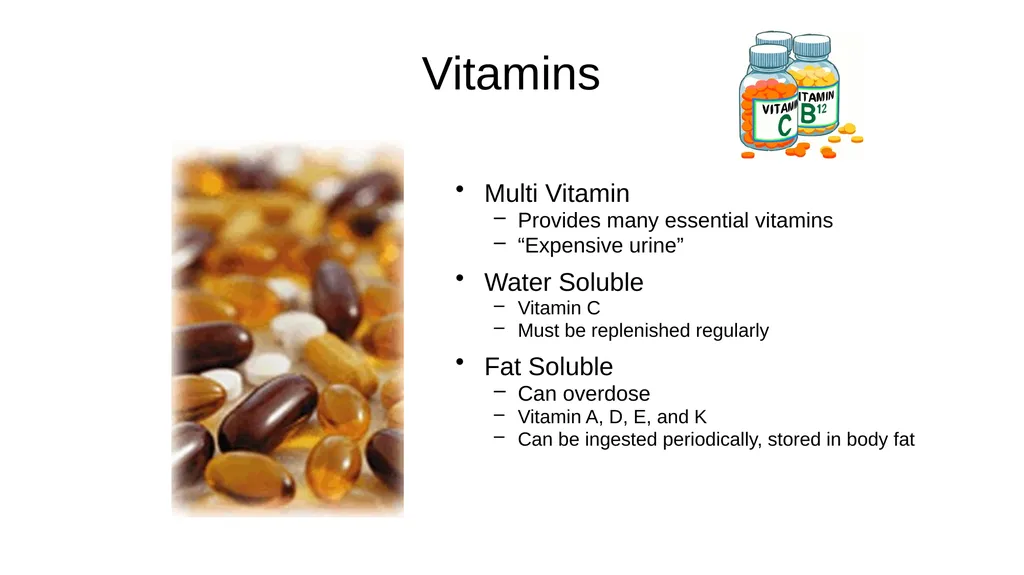
slide2. Vitamins Multi Vitamin
Provides many essential vitamins
“Expensive urine”
Water Soluble
Vitamin C
Must be replenished regularly
Fat Soluble
Can overdose
Vitamin A, D, E, and K
Can be ingested periodically, stored in body fat<br>
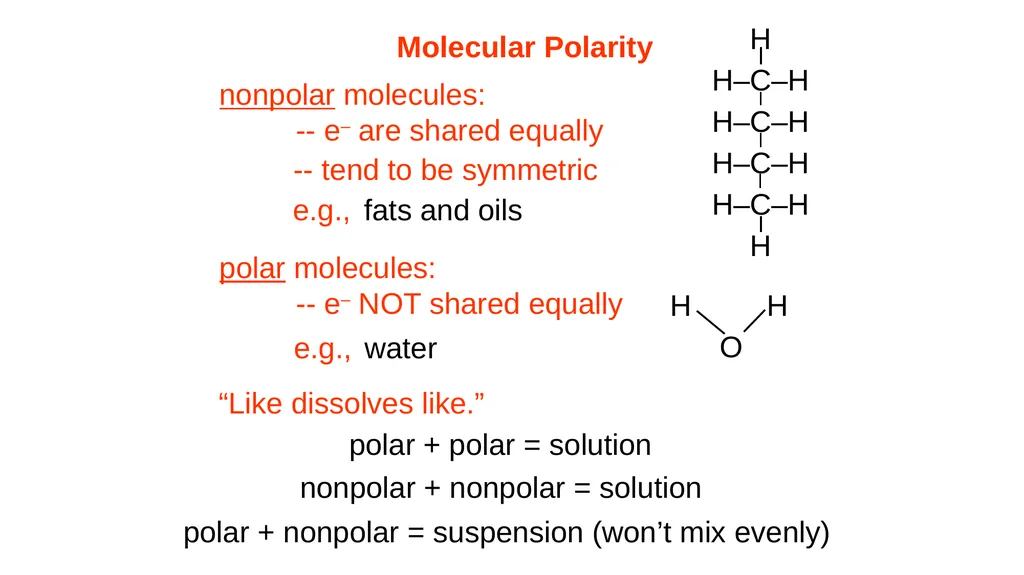
slide3. Molecular Polarity nonpolar molecules:
-- e– are shared equally -- tend to be symmetric e.g., e.g., polar molecules:
-- e– NOT shared equally “Like dissolves like.” fats and oils water polar + polar = solution nonpolar + nonpolar = solution polar + nonpolar = suspension (won’t mix evenly)<br>
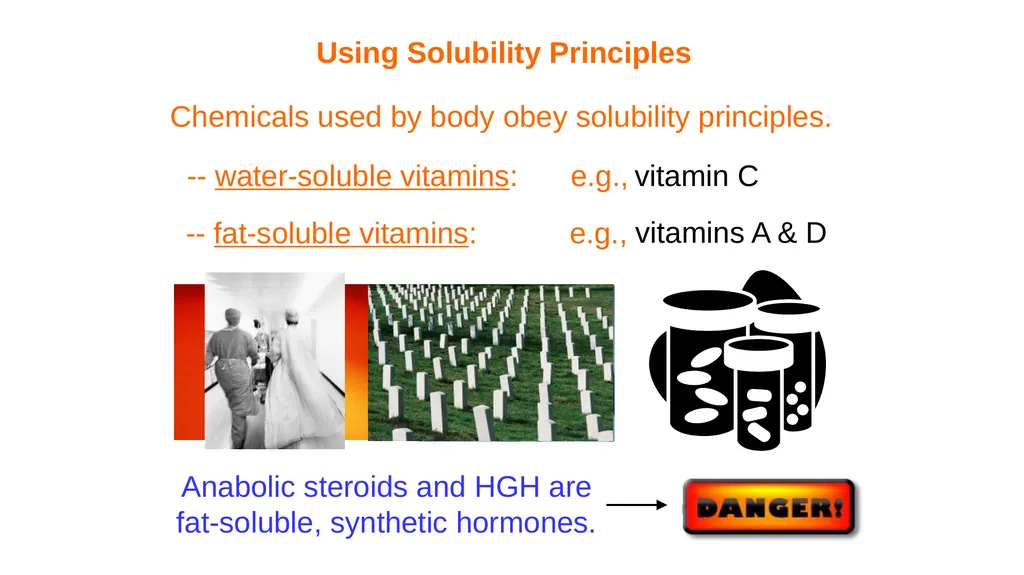
slide4. Anabolic steroids and HGH are
fat-soluble, synthetic hormones. Using Solubility Principles Chemicals used by body obey solubility principles. -- water-soluble vitamins: e.g., -- fat-soluble vitamins: e.g., vitamin C vitamins A & D<br>
slide5. Dry cleaning employs nonpolar liquids. Using Solubility Principles (cont.) -- polar liquids damage wool, silk -- also, dry clean for stubborn stains
(ink, rust, grease) -- tetrachloroethylene was in longtime use<br>
slide6. emulsifying agent (emulsifier): molecules w/both a polar AND a nonpolar end -- -- allows polar and nonpolar substances to mix<br>
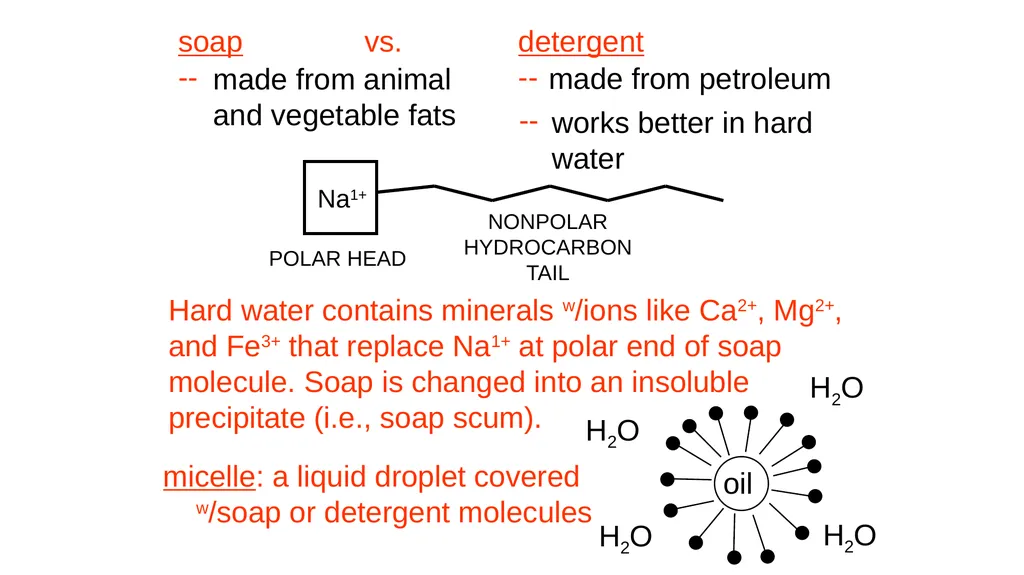
slide7. soap vs. detergent
-- -- made from animal
and vegetable fats made from petroleum -- works better in hard
water Hard water contains minerals w/ions like Ca2+, Mg2+,
and Fe3+ that replace Na1+ at polar end of soap
molecule. Soap is changed into an insoluble
precipitate (i.e., soap scum). micelle: a liquid droplet covered
w/soap or detergent molecules<br>
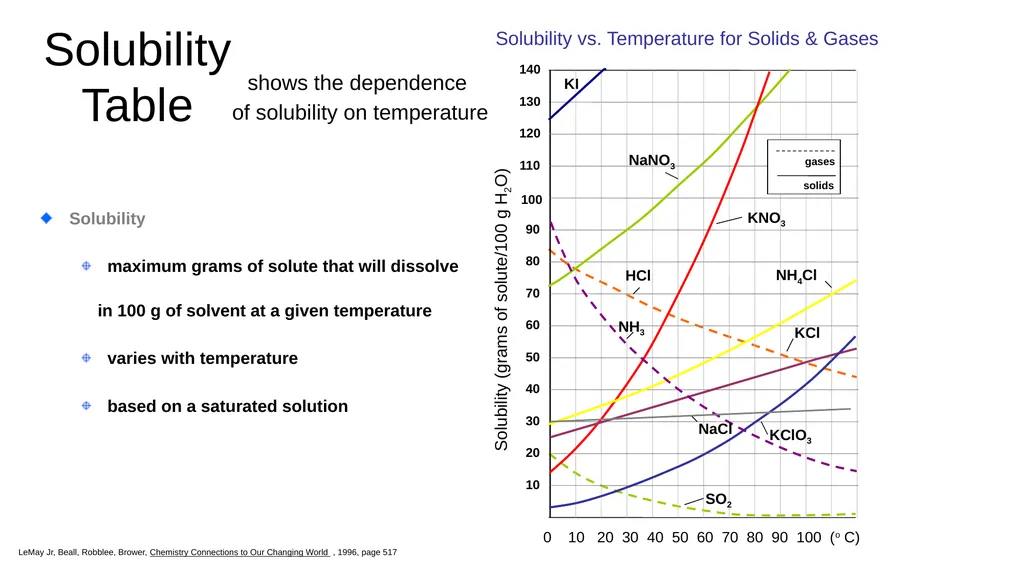
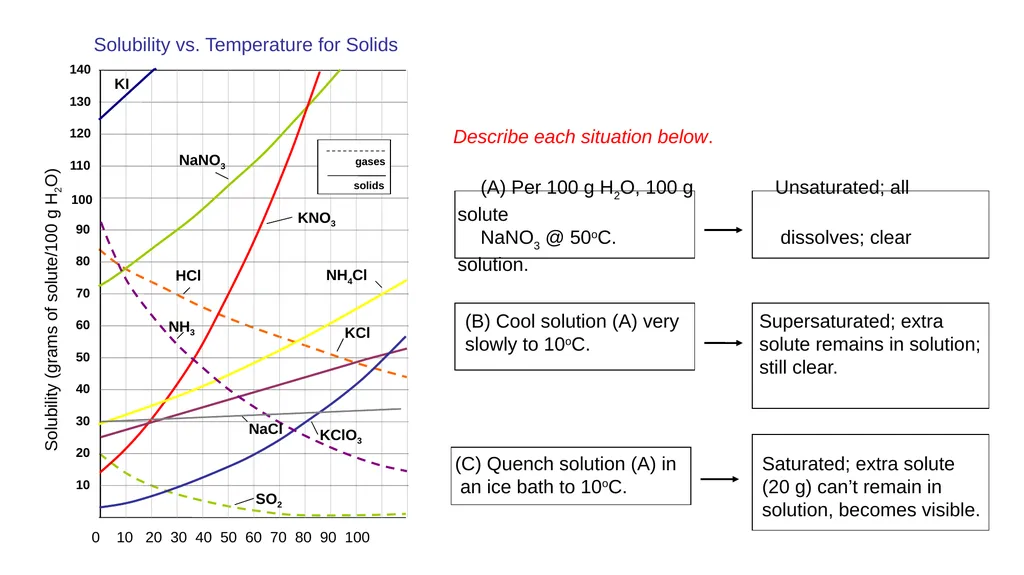
slide8. Solubility Table LeMay Jr, Beall, Robblee, Brower, Chemistry Connections to Our Changing World , 1996, page 517 0 10 20 30 40 50 60 70 80 90 100 (o C) Solubility vs. Temperature for Solids & Gases Solubility (grams of solute/100 g H2O) KI KCl 20 10 30 40 50 60 70 80 90 110 120 130 140 100 NaNO3 KNO3 HCl NH4Cl NH3 NaCl KClO3 SO2 shows the dependence
of solubility on temperature Solubility
maximum grams of solute that will dissolve
in 100 g of solvent at a given temperature
varies with temperature
based on a saturated solution<br>
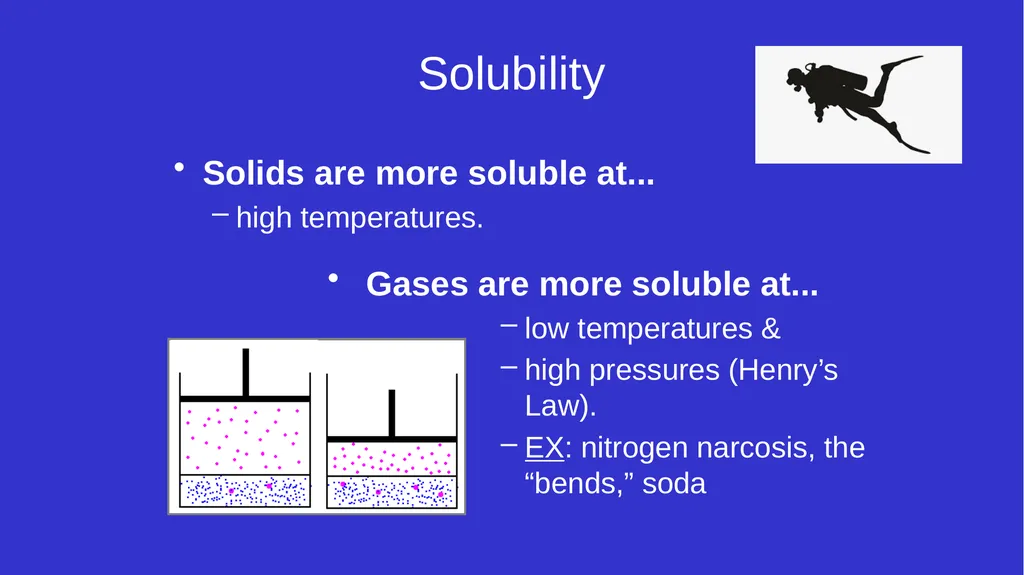
slide9. Solubility Solids are more soluble at...
high temperatures. Gases are more soluble at...
low temperatures &
high pressures (Henry’s Law).
EX: nitrogen narcosis, the “bends,” soda<br>
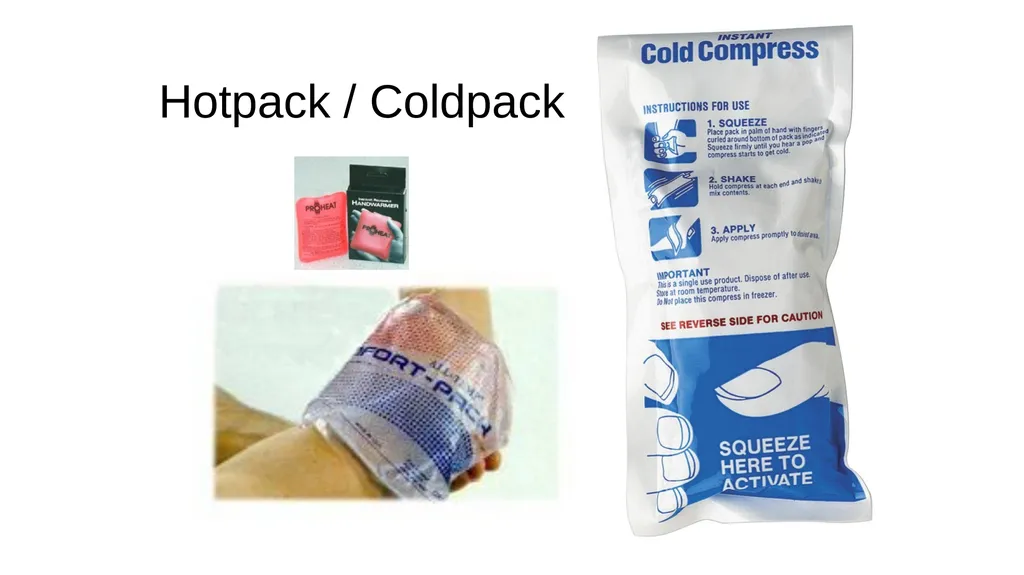
slide10. Hotpack / Coldpack<br>
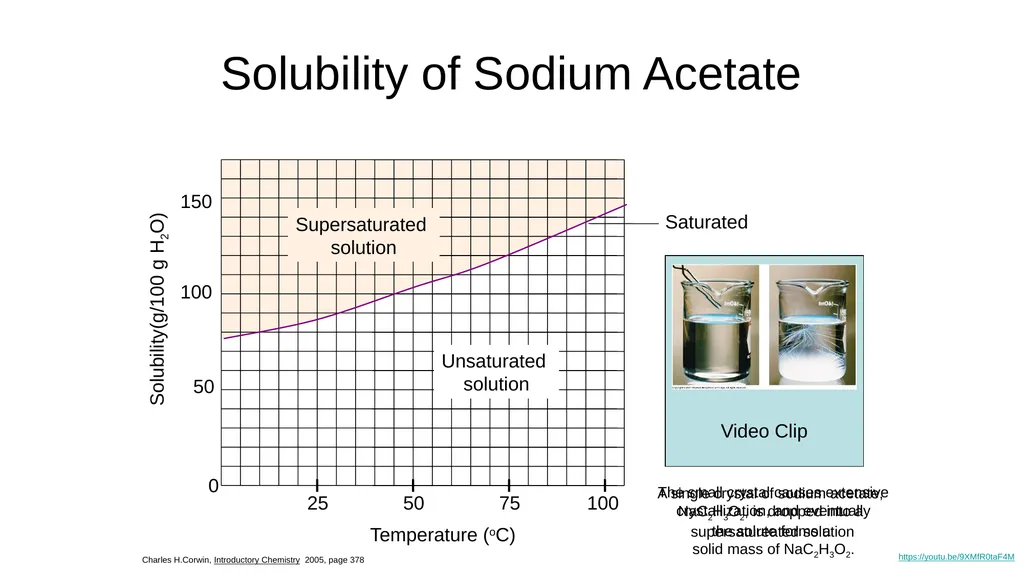
slide11. Solubility of Sodium Acetate Temperature (oC) 0 25 50 75 100 Solubility(g/100 g H2O) 50 100 150 Supersaturated
solution Unsaturated
solution Saturated Video Clip Charles H.Corwin, Introductory Chemistry 2005, page 378 A single crystal of sodium acetate,
NaC2H3O2, is dropped into a
supersatureated solution The small crystal causes extensive
crystallization, and eventually the solute forms a
solid mass of NaC2H3O2. https://youtu.be/9XMfR0taF4M<br>
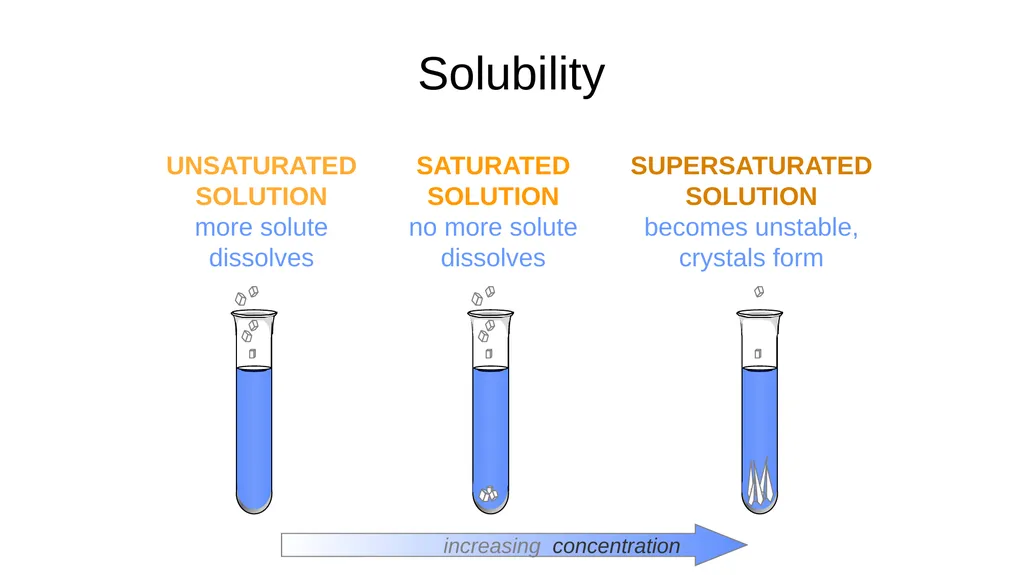
slide12. Solubility increasing concentration<br>
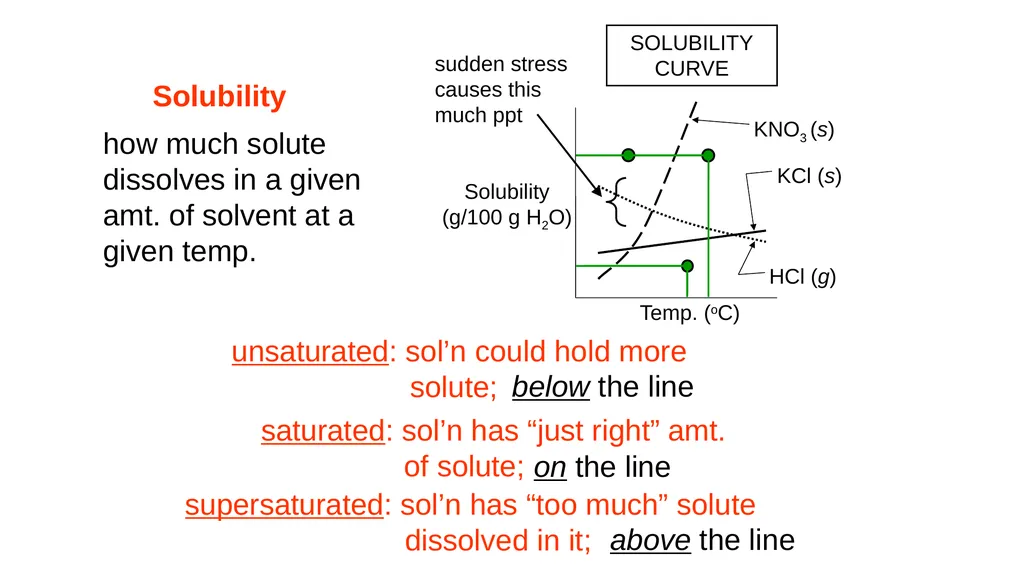
slide13. Solubility unsaturated: sol’n could hold more
solute; saturated: sol’n has “just right” amt.
of solute; supersaturated: sol’n has “too much” solute
dissolved in it; how much solute
dissolves in a given
amt. of solvent at a
given temp. below the line on the line above the line<br>
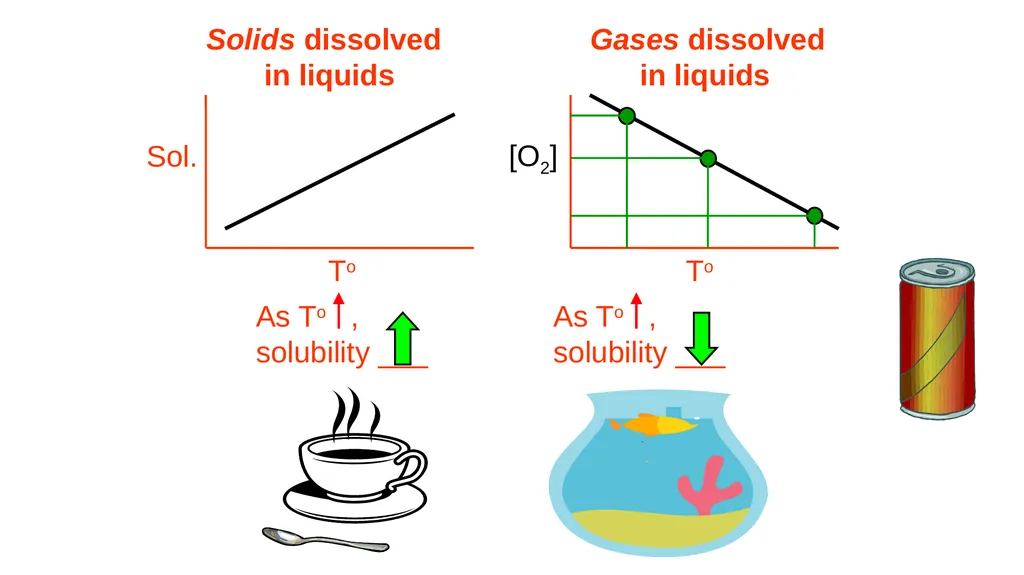
slide14. Solids dissolved Gases dissolved
in liquids in liquids [O2]<br>
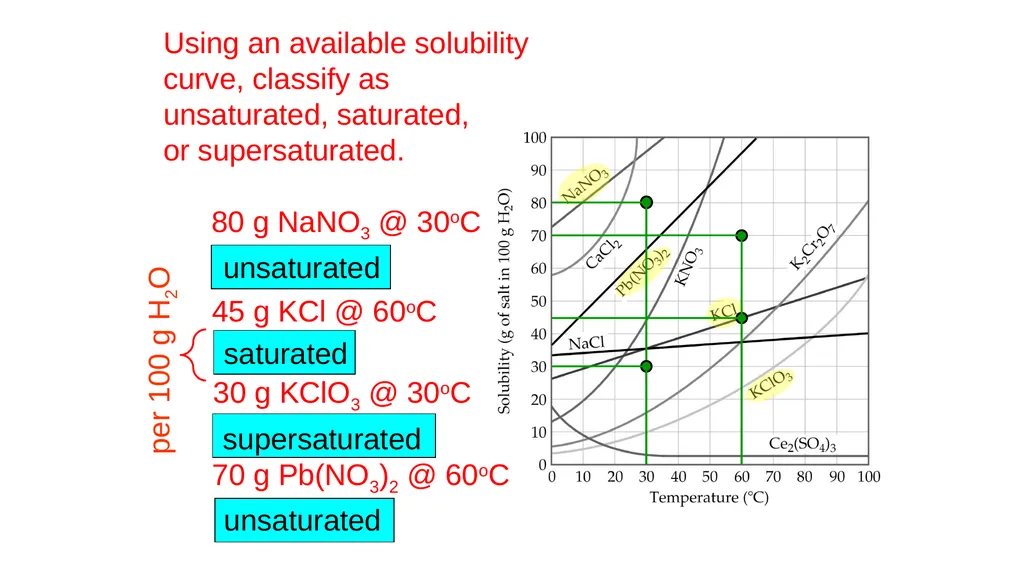
slide15. Using an available solubility
curve, classify as
unsaturated, saturated,
or supersaturated. 80 g NaNO3 @ 30oC 45 g KCl @ 60oC 30 g KClO3 @ 30oC 70 g Pb(NO3)2 @ 60oC unsaturated saturated supersaturated unsaturated<br>
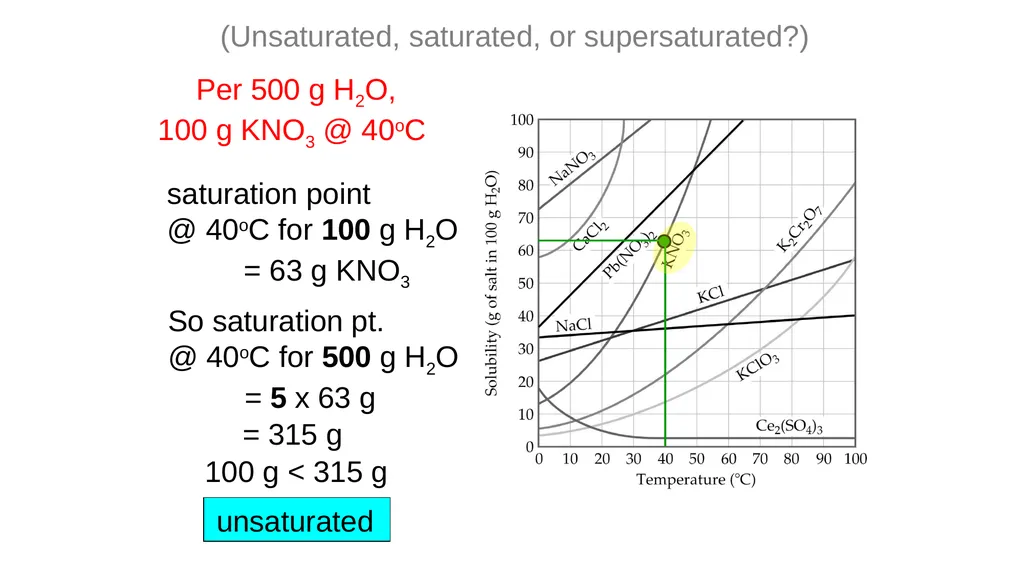
slide16. Per 500 g H2O,
100 g KNO3 @ 40oC saturation point
@ 40oC for 100 g H2O
= 63 g KNO3 So saturation pt.
@ 40oC for 500 g H2O
= 5 x 63 g = 315 g 100 g < 315 g unsaturated (Unsaturated, saturated, or supersaturated?)<br>
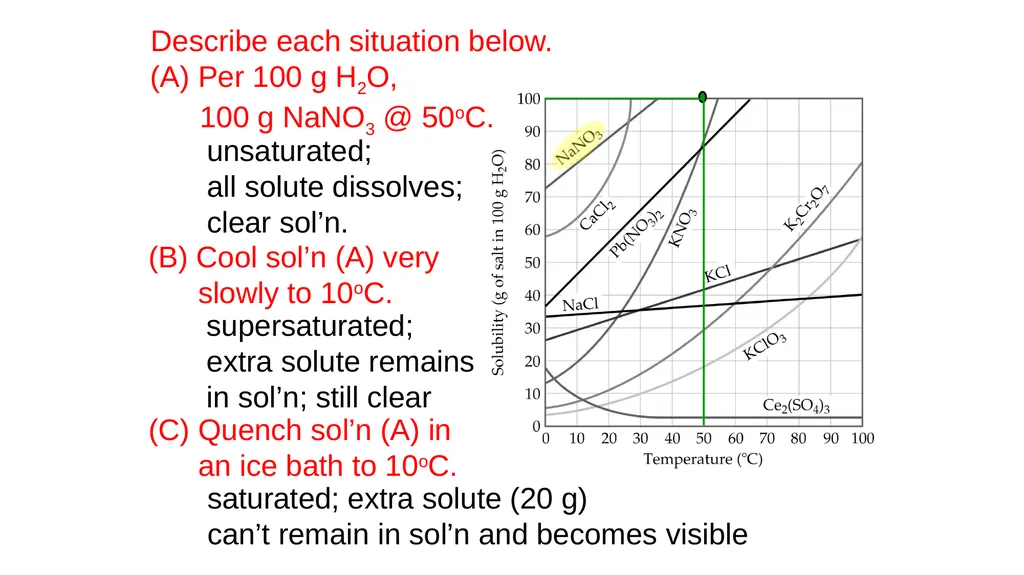
slide17. Describe each situation below. (A) Per 100 g H2O,
100 g NaNO3 @ 50oC. (B) Cool sol’n (A) very
slowly to 10oC. (C) Quench sol’n (A) in
an ice bath to 10oC. unsaturated;
all solute dissolves;
clear sol’n. supersaturated;
extra solute remains
in sol’n; still clear saturated; extra solute (20 g)
can’t remain in sol’n and becomes visible<br>
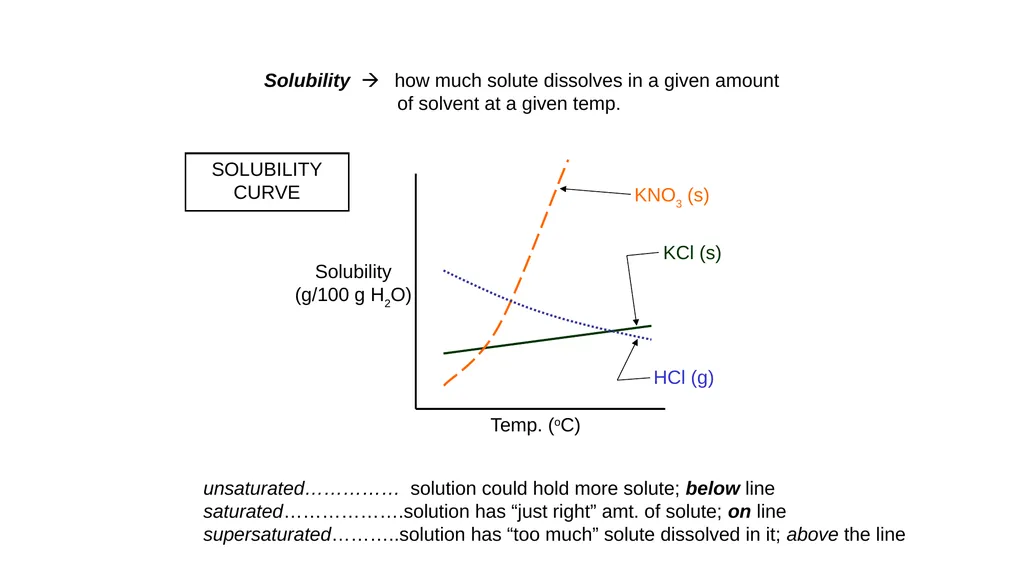
slide18. SOLUBILITY
CURVE Solubility how much solute dissolves in a given amount
of solvent at a given temp. unsaturated…………… solution could hold more solute; below line
saturated……………….solution has “just right” amt. of solute; on line
supersaturated………..solution has “too much” solute dissolved in it; above the line<br>
slide19. (A) Per 100 g H2O, 100 g Unsaturated; all solute
NaNO3 @ 50oC. dissolves; clear solution. (B) Cool solution (A) very Supersaturated; extra
slowly to 10oC. solute remains in solution;
still clear. Describe each situation below. (C) Quench solution (A) in Saturated; extra solute
an ice bath to 10oC. (20 g) can’t remain in
solution, becomes visible. 0 10 20 30 40 50 60 70 80 90 100 Solubility vs. Temperature for Solids Solubility (grams of solute/100 g H2O) KI KCl 20 10 30 40 50 60 70 80 90 110 120 130 140 100 NaNO3 KNO3 HCl NH4Cl NH3 NaCl KClO3 SO2<br>
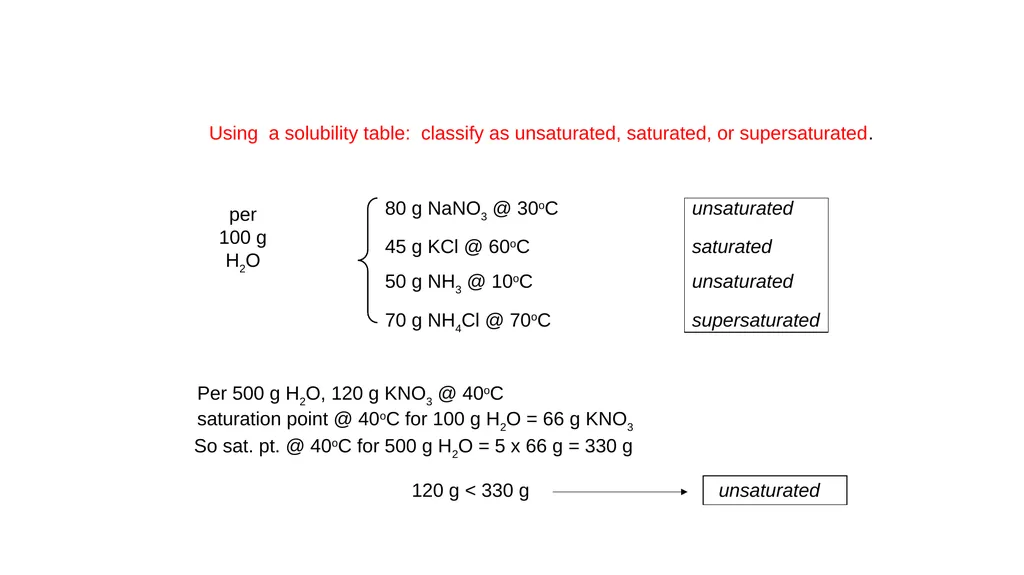
slide20. per
100 g
H2O Using a solubility table: classify as unsaturated, saturated, or supersaturated. 80 g NaNO3 @ 30oC unsaturated
45 g KCl @ 60oC saturated
50 g NH3 @ 10oC unsaturated
70 g NH4Cl @ 70oC supersaturated So sat. pt. @ 40oC for 500 g H2O = 5 x 66 g = 330 g 120 g < 330 g unsaturated saturation point @ 40oC for 100 g H2O = 66 g KNO3 Per 500 g H2O, 120 g KNO3 @ 40oC<br>
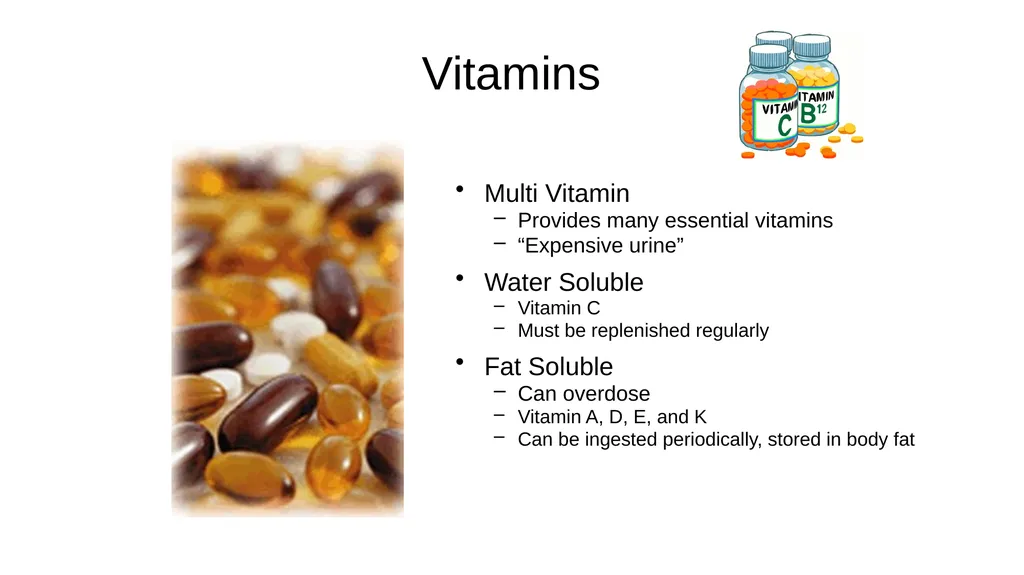
slide2. Vitamins Multi Vitamin
Provides many essential vitamins
“Expensive urine”
Water Soluble
Vitamin C
Must be replenished regularly
Fat Soluble
Can overdose
Vitamin A, D, E, and K
Can be ingested periodically, stored in body fat<br>
slide3. Molecular Polarity nonpolar molecules:
-- e– are shared equally -- tend to be symmetric e.g., e.g., polar molecules:
-- e– NOT shared equally “Like dissolves like.” fats and oils water polar + polar = solution nonpolar + nonpolar = solution polar + nonpolar = suspension (won’t mix evenly)<br>
slide4. Anabolic steroids and HGH are
fat-soluble, synthetic hormones. Using Solubility Principles Chemicals used by body obey solubility principles. -- water-soluble vitamins: e.g., -- fat-soluble vitamins: e.g., vitamin C vitamins A & D<br>
slide5. Dry cleaning employs nonpolar liquids. Using Solubility Principles (cont.) -- polar liquids damage wool, silk -- also, dry clean for stubborn stains
(ink, rust, grease) -- tetrachloroethylene was in longtime use<br>
slide6. emulsifying agent (emulsifier): molecules w/both a polar AND a nonpolar end -- -- allows polar and nonpolar substances to mix<br>
slide7. soap vs. detergent
-- -- made from animal
and vegetable fats made from petroleum -- works better in hard
water Hard water contains minerals w/ions like Ca2+, Mg2+,
and Fe3+ that replace Na1+ at polar end of soap
molecule. Soap is changed into an insoluble
precipitate (i.e., soap scum). micelle: a liquid droplet covered
w/soap or detergent molecules<br>
slide8. Solubility Table LeMay Jr, Beall, Robblee, Brower, Chemistry Connections to Our Changing World , 1996, page 517 0 10 20 30 40 50 60 70 80 90 100 (o C) Solubility vs. Temperature for Solids & Gases Solubility (grams of solute/100 g H2O) KI KCl 20 10 30 40 50 60 70 80 90 110 120 130 140 100 NaNO3 KNO3 HCl NH4Cl NH3 NaCl KClO3 SO2 shows the dependence
of solubility on temperature Solubility
maximum grams of solute that will dissolve
in 100 g of solvent at a given temperature
varies with temperature
based on a saturated solution<br>
slide9. Solubility Solids are more soluble at...
high temperatures. Gases are more soluble at...
low temperatures &
high pressures (Henry’s Law).
EX: nitrogen narcosis, the “bends,” soda<br>
slide10. Hotpack / Coldpack<br>
slide11. Solubility of Sodium Acetate Temperature (oC) 0 25 50 75 100 Solubility(g/100 g H2O) 50 100 150 Supersaturated
solution Unsaturated
solution Saturated Video Clip Charles H.Corwin, Introductory Chemistry 2005, page 378 A single crystal of sodium acetate,
NaC2H3O2, is dropped into a
supersatureated solution The small crystal causes extensive
crystallization, and eventually the solute forms a
solid mass of NaC2H3O2. https://youtu.be/9XMfR0taF4M<br>
slide12. Solubility increasing concentration<br>
slide13. Solubility unsaturated: sol’n could hold more
solute; saturated: sol’n has “just right” amt.
of solute; supersaturated: sol’n has “too much” solute
dissolved in it; how much solute
dissolves in a given
amt. of solvent at a
given temp. below the line on the line above the line<br>
slide14. Solids dissolved Gases dissolved
in liquids in liquids [O2]<br>
slide15. Using an available solubility
curve, classify as
unsaturated, saturated,
or supersaturated. 80 g NaNO3 @ 30oC 45 g KCl @ 60oC 30 g KClO3 @ 30oC 70 g Pb(NO3)2 @ 60oC unsaturated saturated supersaturated unsaturated<br>
slide16. Per 500 g H2O,
100 g KNO3 @ 40oC saturation point
@ 40oC for 100 g H2O
= 63 g KNO3 So saturation pt.
@ 40oC for 500 g H2O
= 5 x 63 g = 315 g 100 g < 315 g unsaturated (Unsaturated, saturated, or supersaturated?)<br>
slide17. Describe each situation below. (A) Per 100 g H2O,
100 g NaNO3 @ 50oC. (B) Cool sol’n (A) very
slowly to 10oC. (C) Quench sol’n (A) in
an ice bath to 10oC. unsaturated;
all solute dissolves;
clear sol’n. supersaturated;
extra solute remains
in sol’n; still clear saturated; extra solute (20 g)
can’t remain in sol’n and becomes visible<br>
slide18. SOLUBILITY
CURVE Solubility how much solute dissolves in a given amount
of solvent at a given temp. unsaturated…………… solution could hold more solute; below line
saturated……………….solution has “just right” amt. of solute; on line
supersaturated………..solution has “too much” solute dissolved in it; above the line<br>
slide19. (A) Per 100 g H2O, 100 g Unsaturated; all solute
NaNO3 @ 50oC. dissolves; clear solution. (B) Cool solution (A) very Supersaturated; extra
slowly to 10oC. solute remains in solution;
still clear. Describe each situation below. (C) Quench solution (A) in Saturated; extra solute
an ice bath to 10oC. (20 g) can’t remain in
solution, becomes visible. 0 10 20 30 40 50 60 70 80 90 100 Solubility vs. Temperature for Solids Solubility (grams of solute/100 g H2O) KI KCl 20 10 30 40 50 60 70 80 90 110 120 130 140 100 NaNO3 KNO3 HCl NH4Cl NH3 NaCl KClO3 SO2<br>
slide20. per
100 g
H2O Using a solubility table: classify as unsaturated, saturated, or supersaturated. 80 g NaNO3 @ 30oC unsaturated
45 g KCl @ 60oC saturated
50 g NH3 @ 10oC unsaturated
70 g NH4Cl @ 70oC supersaturated So sat. pt. @ 40oC for 500 g H2O = 5 x 66 g = 330 g 120 g < 330 g unsaturated saturation point @ 40oC for 100 g H2O = 66 g KNO3 Per 500 g H2O, 120 g KNO3 @ 40oC<br>