SOLUTION TYPES GASEOUS SOLUTION LIQID SLUTION , SOLID SOLUTION EXPRESSING THE CONCENTRATION OF SOLUTION MASS PERCENTAGE VOLUME PERCENTAGE PART PER MILLION MOLARITY Calculation of molar mass of the solute Find no of moles of solute ( amount
"SOLUTION TYPES GASEOUS SOLUTION LIQID SLUTION ," is the property of its rightful owner. Permission is granted to
download and print the materials on this website for personal, non-commercial use only, and to display it
on your personal computer provided you do not modify the materials and that you retain all copyright
notices contained in the materials. By downloading content from our website, you accept the terms of this
agreement.
EXPRESSING THE CONCENTRATION OF SOLUTION MASS PERCENTAGE
VOLUME PERCENTAGE
PART PER MILLION<br>
03
MOLARITY Calculation of molar mass of the solute
Find no of moles of solute ( amount of solute /molar mass)
Calculate the volume of solution in litre
Molarity = no. of moles of solute /volume of solution in litre
It is expressed by ‘M’.<br>
04
MOLALITY Finding the no. of moles of solute
Calculate the amount of solvent (mass of solution – mass of solute) in kilogram
Molality = no. of moles of solute/mass of solvent in kg
It is expressed by ‘m’.<br>
05
Mole fraction Mole fraction of a component =
No. of moles of a component / Total no. of moles of all the components
In a binary solution if the no. of moles of A and B are nA and nB , then mole fraction of A ,
nA/nA + nB
The sum of mole fraction of all the components in a solution is unity .<br>
06
Numericals Calculate the molarity of a solution containing 5g of NaOH in 450 mL of solution.
Calculate molality of 2.5 g of ethanoic acid in 75 g of benzene .
Concentrated nitric acid used in laboratory work is 68% nitric acid by mass in aqueous solution. What should be the molarity of such a sample of the acid if the density of the solution is 1.504 gram per mililitre.<br>
07
Henry’s law The solubility of a gas at a given temperature is directly proportional to the pressure at which it is dissolved .
p= KH x where KH is Henry’s constant and x is mole fraction of the gas .
The unit of Henry’s constant is torr.
This helps in calculation of solubility at a certain temperature .<br>
08
Factors afecting solubilty of solids Nature of solute:-Like Dissolves like . Eg polar solutes dissolves in polar solvents and non- polar solutes dissolve in in non- polar solvents .
Temperature:- The solubility may increase or dicrease with the rise in temperature depending upon the value of enthalpy of solution .<br>
09
Factors affecting the solubility of gas The nature of gas and the nature of solvent
Non- polar gases like Oxygen , Nitrogen etc are very less soluble in water , Whereas HCl, Carbon dioxide are highly soluble in water.
Effect of temperature
Effect of pressure<br>
10
Raoult’s law The vapor pressure of a a solution containing non- volatile solute is directly proportional to the mole – fraction of the solvent .
For a solution containing non- volatile solute , at a given temperature , the relative lowering of vapour pressure is equal to the mole fraction of the solute .<br>
11
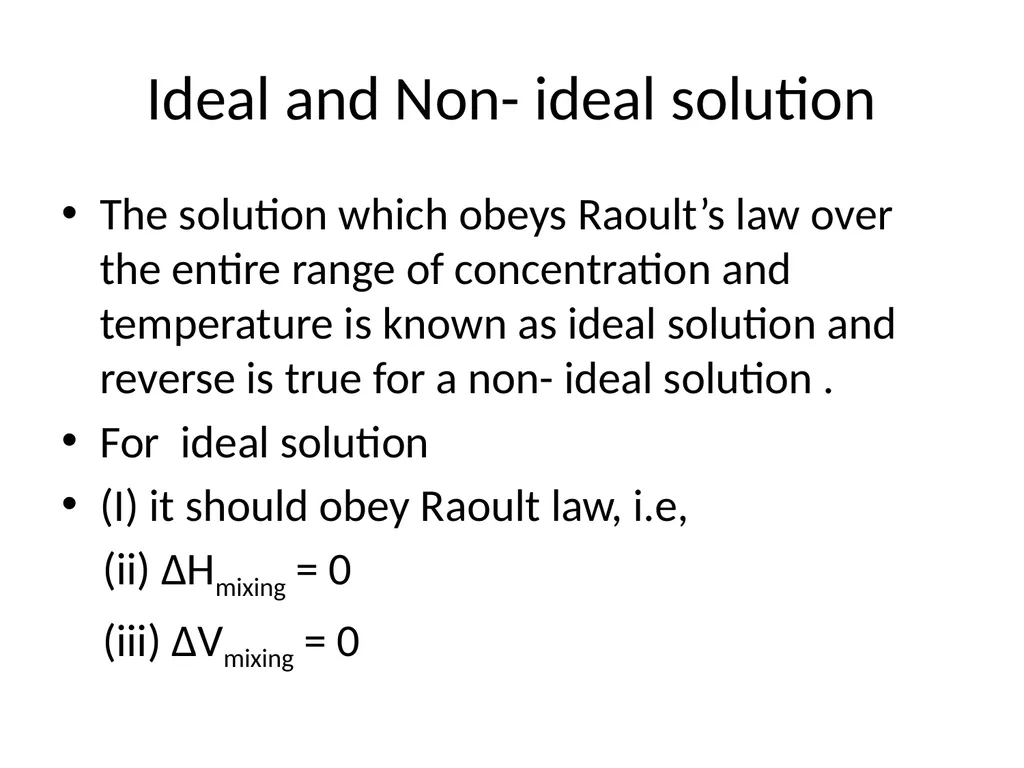
Ideal and Non- ideal solution The solution which obeys Raoult’s law over the entire range of concentration and temperature is known as ideal solution and reverse is true for a non- ideal solution .
For ideal solution
(I) it should obey Raoult law, i.e,
(ii) ∆Hmixing = 0
(iii) ∆Vmixing = 0<br>
12
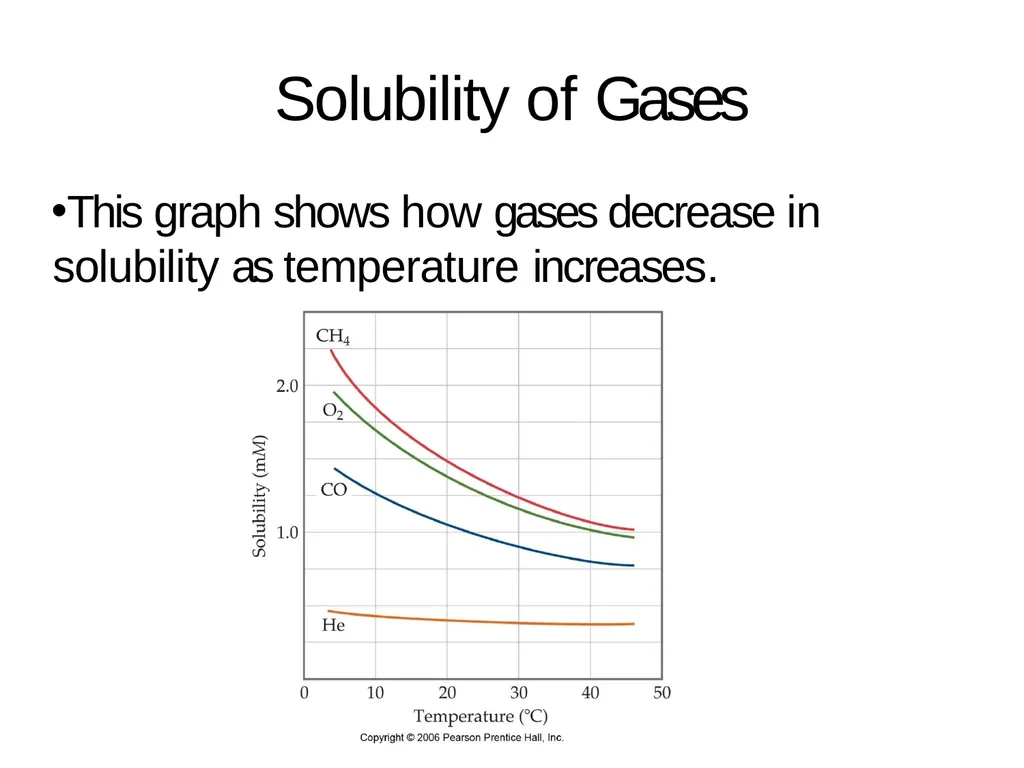
This graph shows how gases decrease in solubility as temperature increases. Solubility of Gases<br>
13
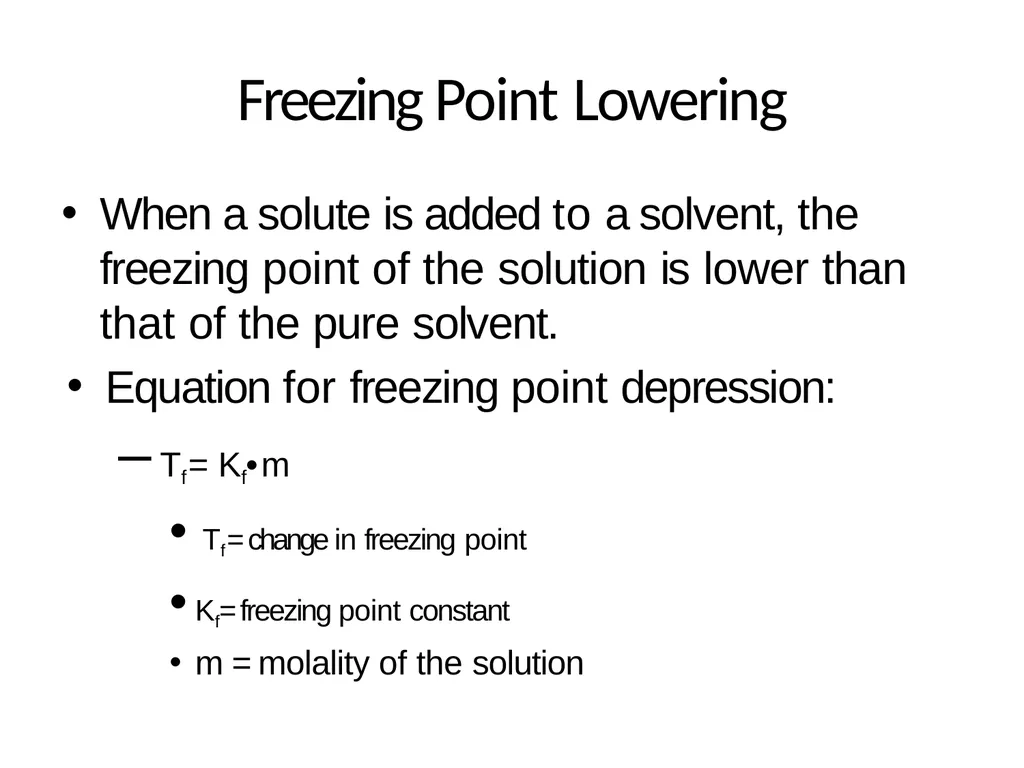
When a solute is added to a solvent, the freezing point of the solution is lower than that of the pure solvent.
Equation for freezing point depression:
Tf = Kf •m
Tf = change in freezing point
Kf = freezing point constant
m = molality of the solution Freezing Point Lowering<br>
14
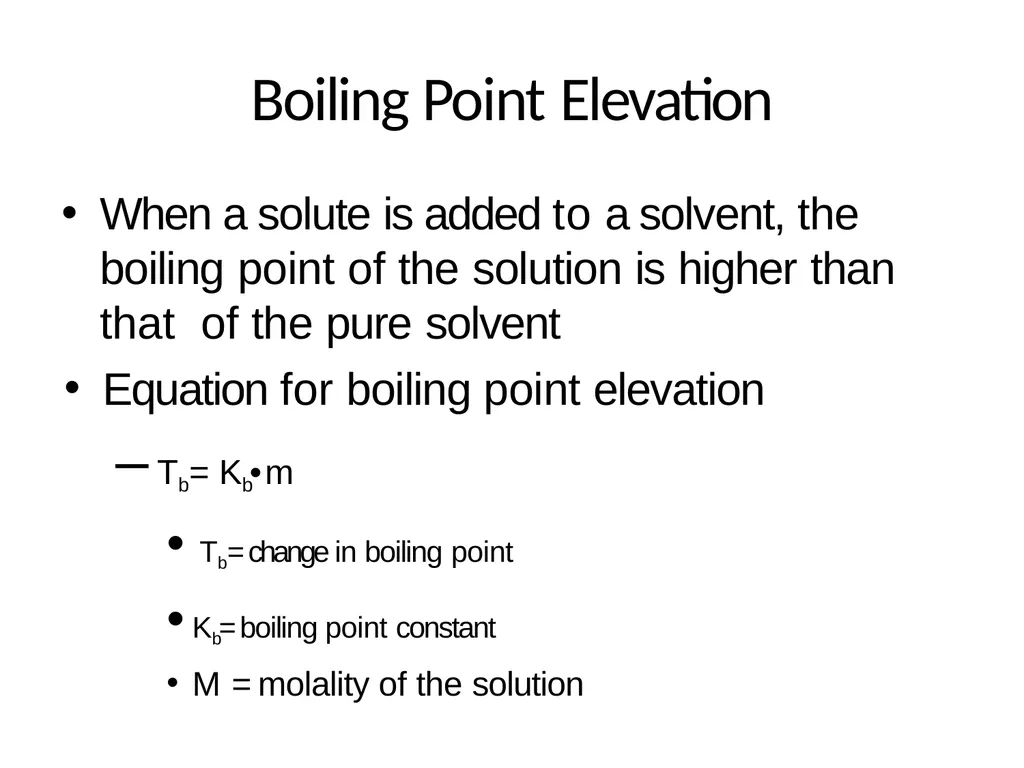
When a solute is added to a solvent, the boiling point of the solution is higher than that of the pure solvent
Equation for boiling point elevation
Tb = Kb •m
Tb = change in boiling point
Kb = boiling point constant
M = molality of the solution Boiling Point Elevation<br>
15
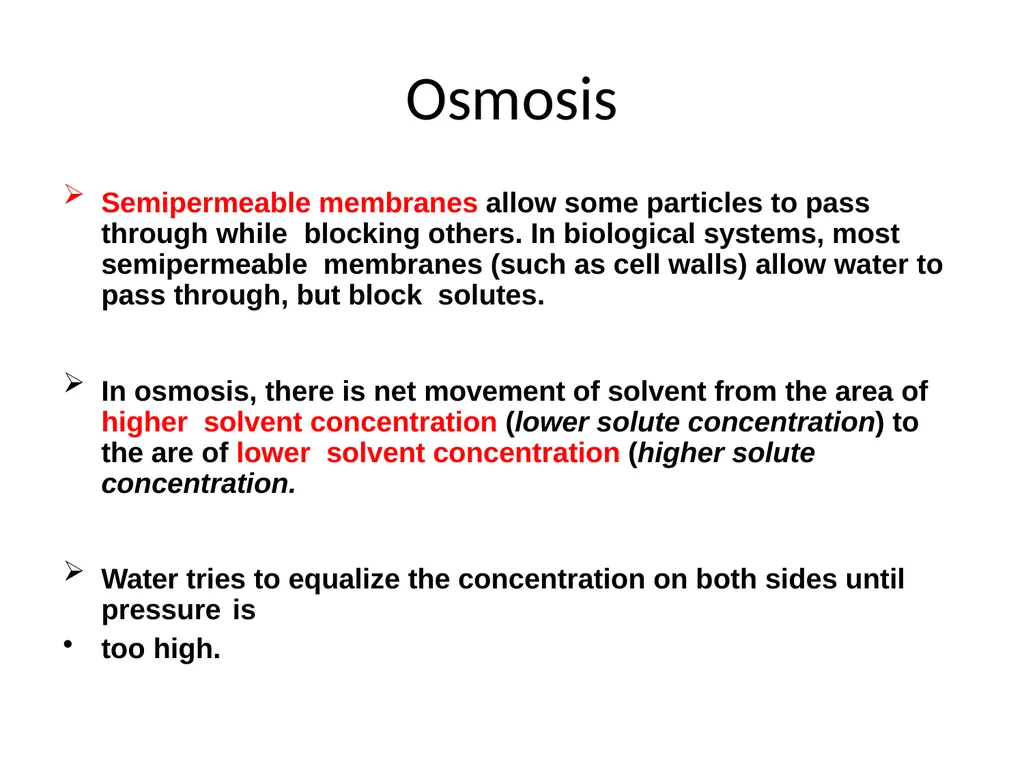
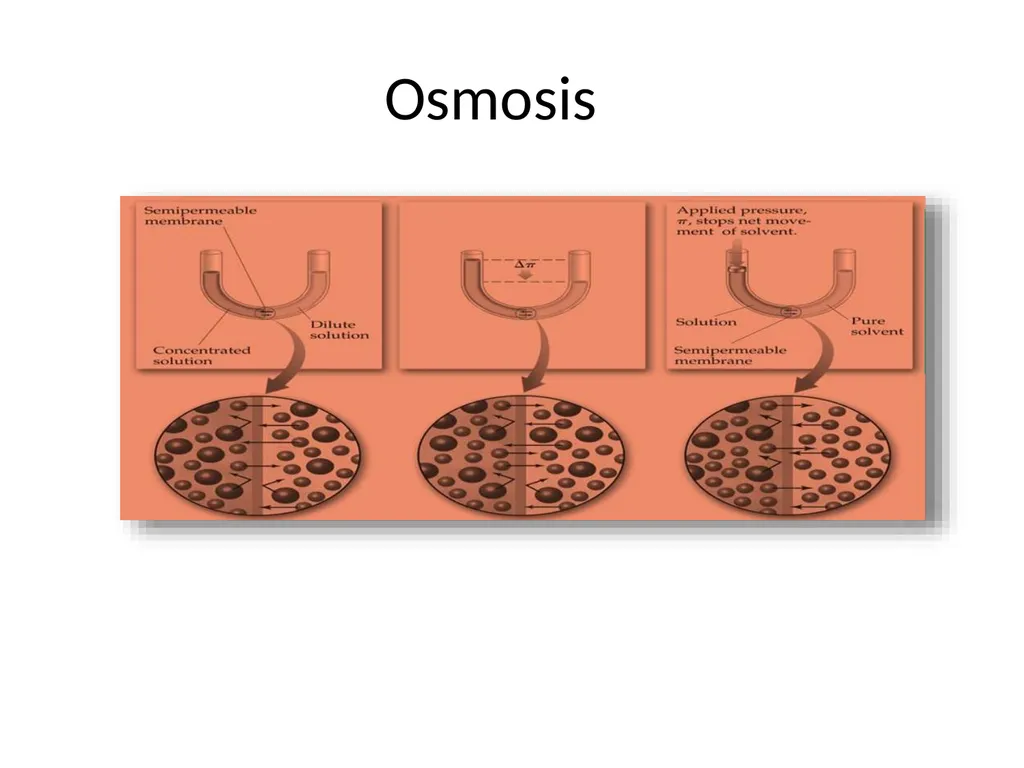
Osmosis Semipermeable membranes allow some particles to pass through while blocking others. In biological systems, most semipermeable membranes (such as cell walls) allow water to pass through, but block solutes.
In osmosis, there is net movement of solvent from the area of higher solvent concentration (lower solute concentration) to the are of lower solvent concentration (higher solute concentration.
Water tries to equalize the concentration on both sides until pressure is
too high.<br>
16
Osmosis<br>
17
One mole of NaCl in water does not really give rise to two moles of ions.
Some Na+ and Cl− re associate as hydrated ion pairs, so the true concentration of particles is somewhat less than two times the concentration of NaCl. Some Na+ and Cl− re associate as hydrated ion pairs, so the true concentration of particles is somewhat less than two times the concentration of NaCl. VAN’T - HOFF FACTOR:<br>