04
Definitions Solutions can be classified as saturated or unsaturated.
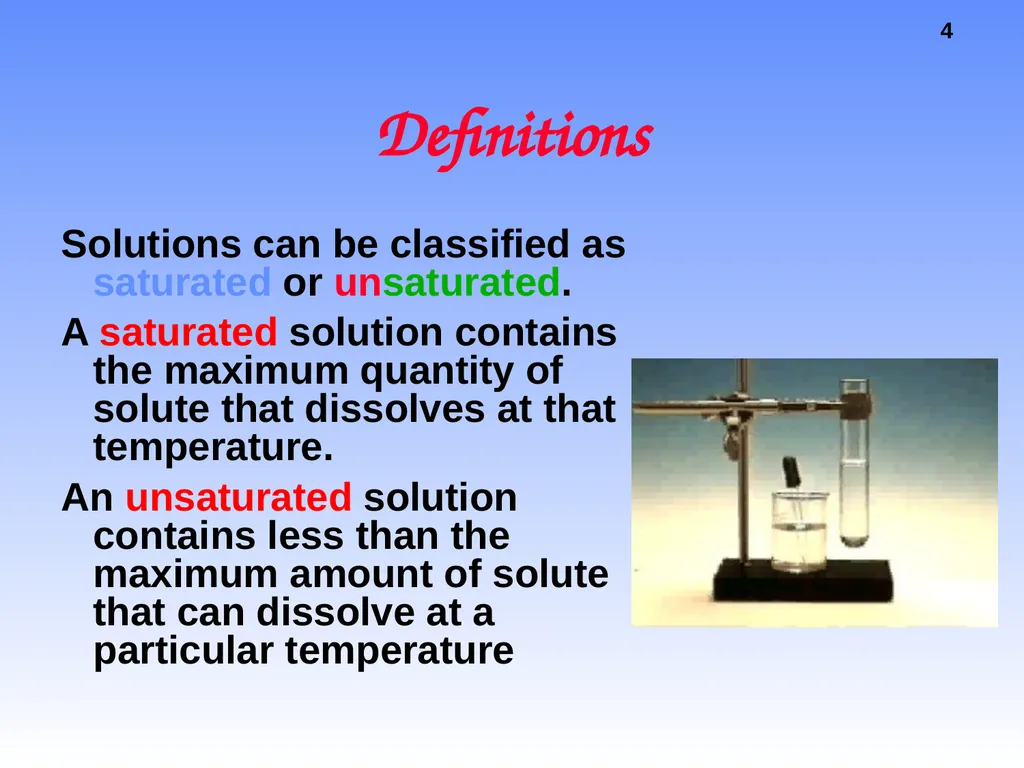
A saturated solution contains the maximum quantity of solute that dissolves at that temperature.
An unsaturated solution contains less than the maximum amount of solute that can dissolve at a particular temperature<br>
05
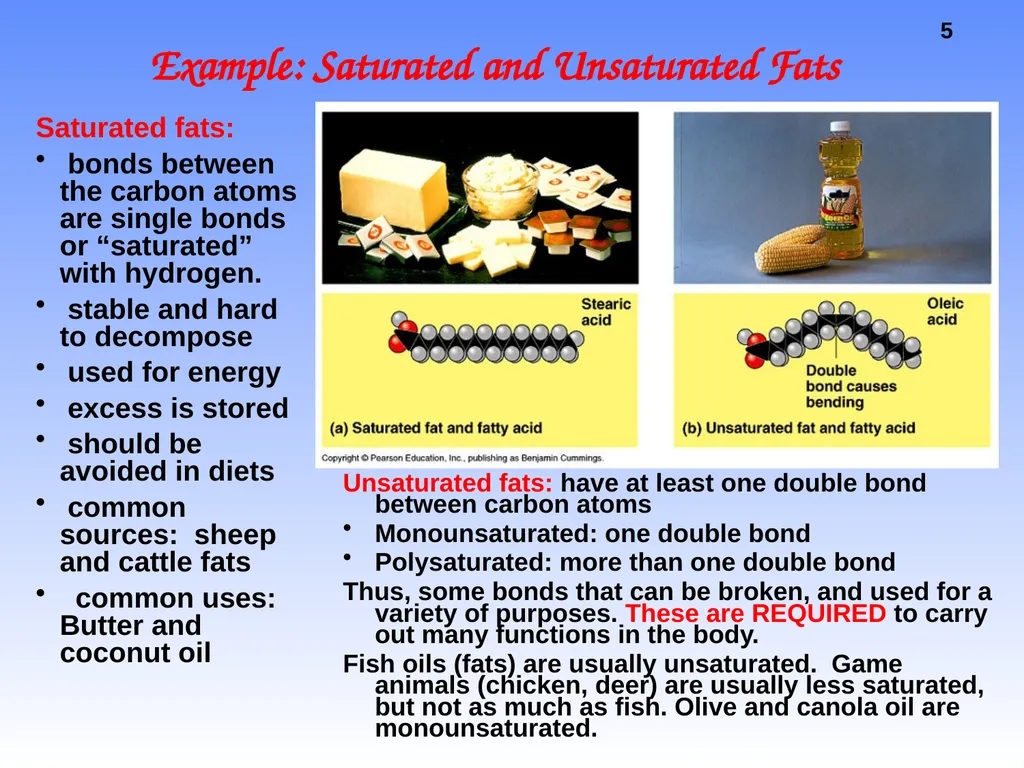
Example: Saturated and Unsaturated Fats Unsaturated fats: have at least one double bond between carbon atoms
Monounsaturated: one double bond
Polysaturated: more than one double bond
Thus, some bonds that can be broken, and used for a variety of purposes. These are REQUIRED to carry out many functions in the body.
Fish oils (fats) are usually unsaturated. Game animals (chicken, deer) are usually less saturated, but not as much as fish. Olive and canola oil are monounsaturated. Saturated fats:
bonds between the carbon atoms are single bonds or “saturated” with hydrogen.
stable and hard to decompose
used for energy
excess is stored
should be avoided in diets
common sources: sheep and cattle fats
common uses: Butter and coconut oil<br>
06
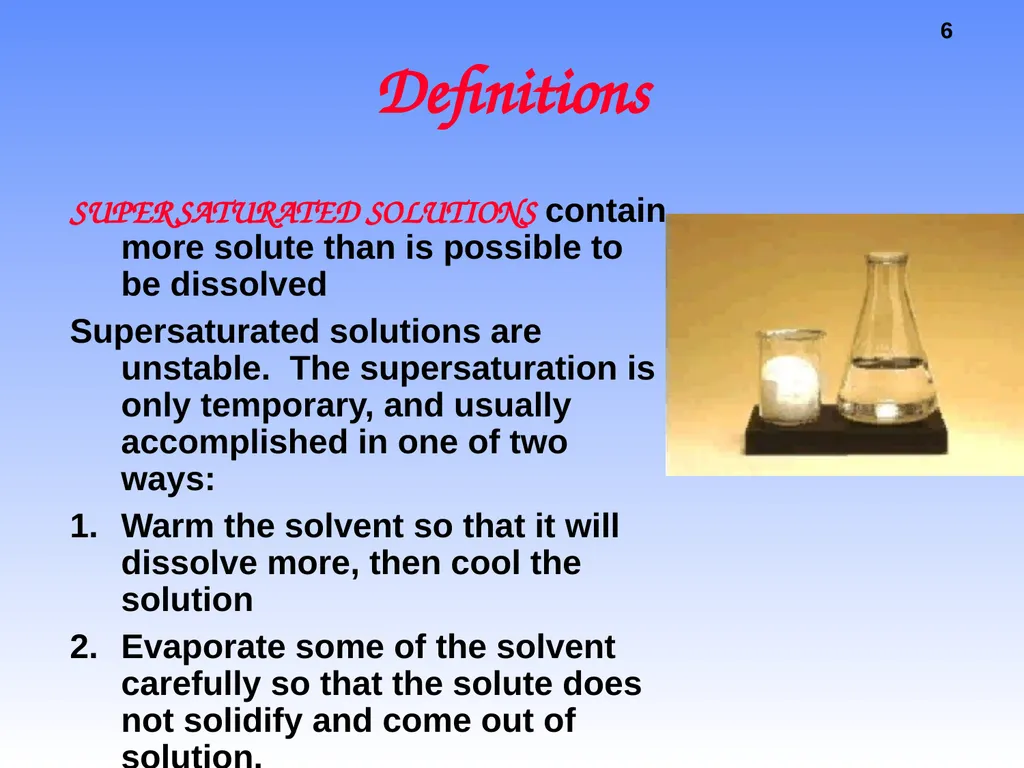
Definitions SUPERSATURATED SOLUTIONS contain more solute than is possible to be dissolved
Supersaturated solutions are unstable. The supersaturation is only temporary, and usually accomplished in one of two ways:
Warm the solvent so that it will dissolve more, then cool the solution
Evaporate some of the solvent carefully so that the solute does not solidify and come out of solution.<br>
07
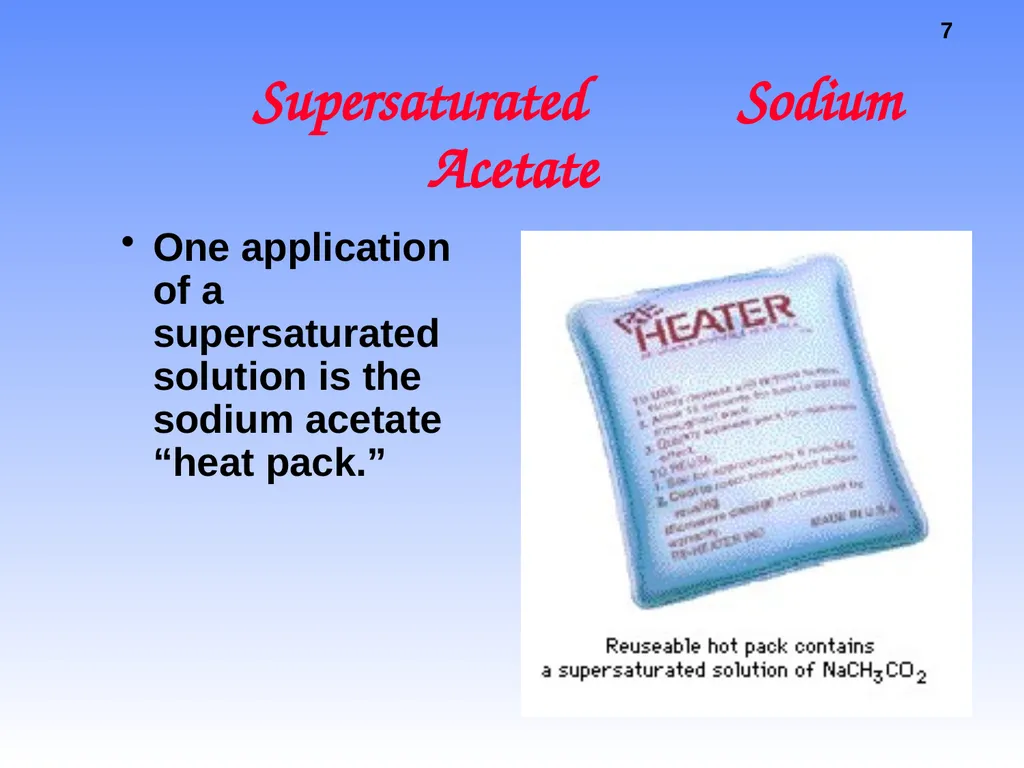
Supersaturated Sodium Acetate One application of a supersaturated solution is the sodium acetate “heat pack.”<br>
08
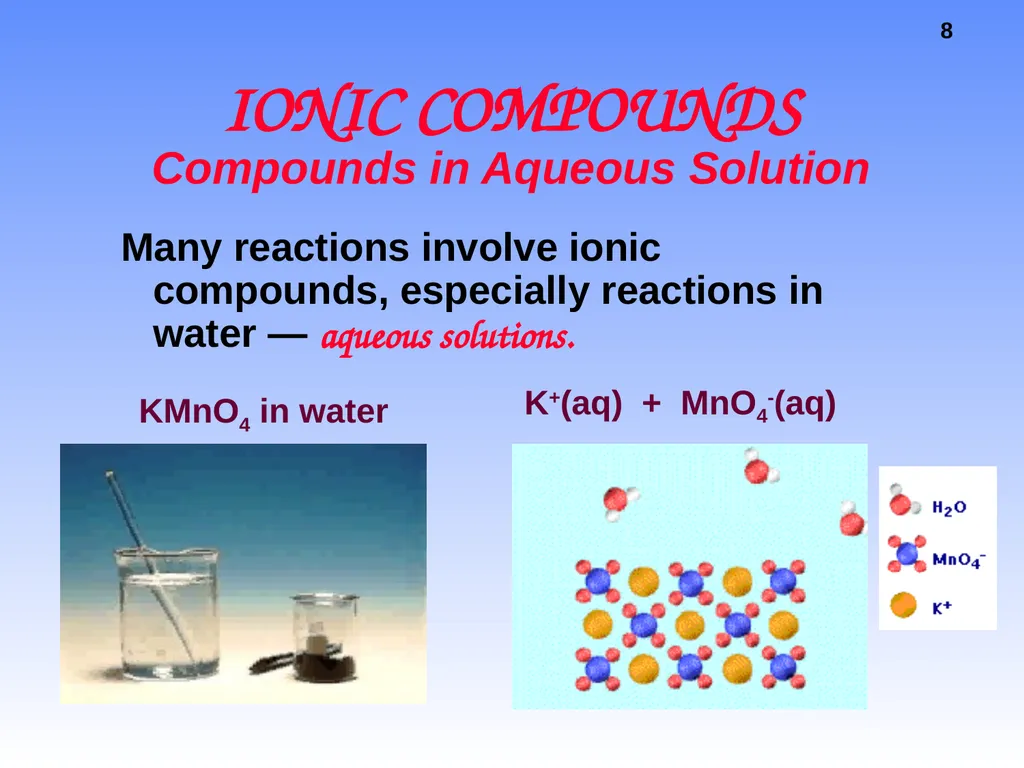
IONIC COMPOUNDS�Compounds in Aqueous Solution Many reactions involve ionic compounds, especially reactions in water — aqueous solutions. KMnO4 in water<br>
09
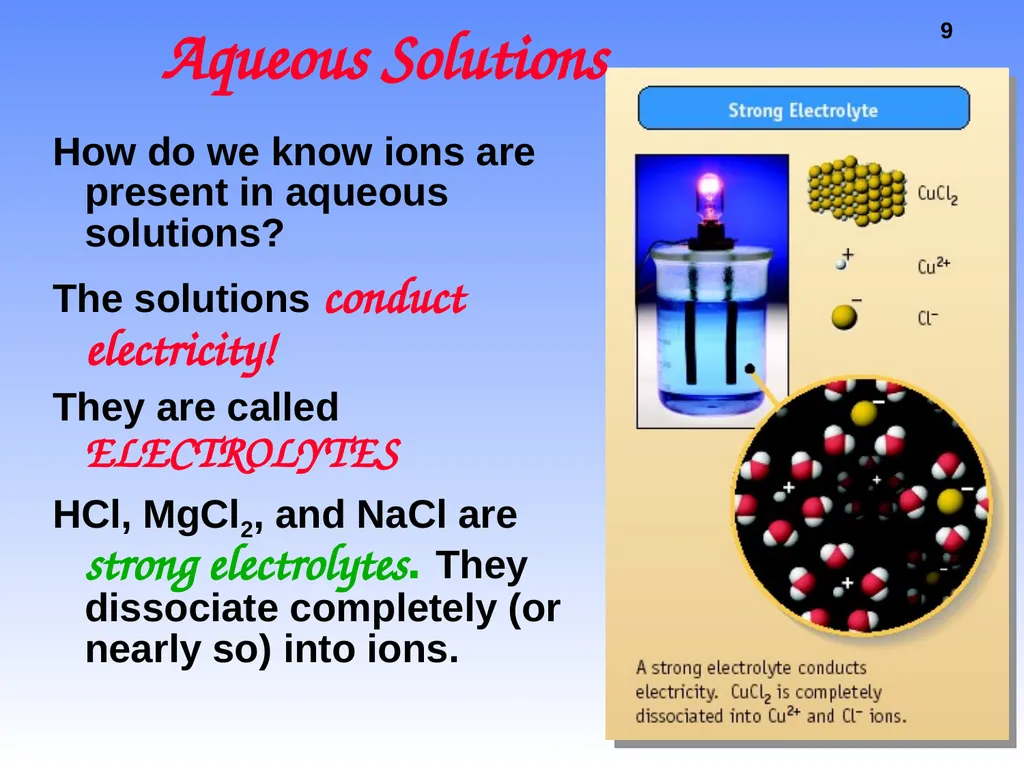
How do we know ions are present in aqueous solutions?
The solutions conduct electricity!
They are called ELECTROLYTES
HCl, MgCl2, and NaCl are strong electrolytes. They dissociate completely (or nearly so) into ions. Aqueous Solutions<br>
10
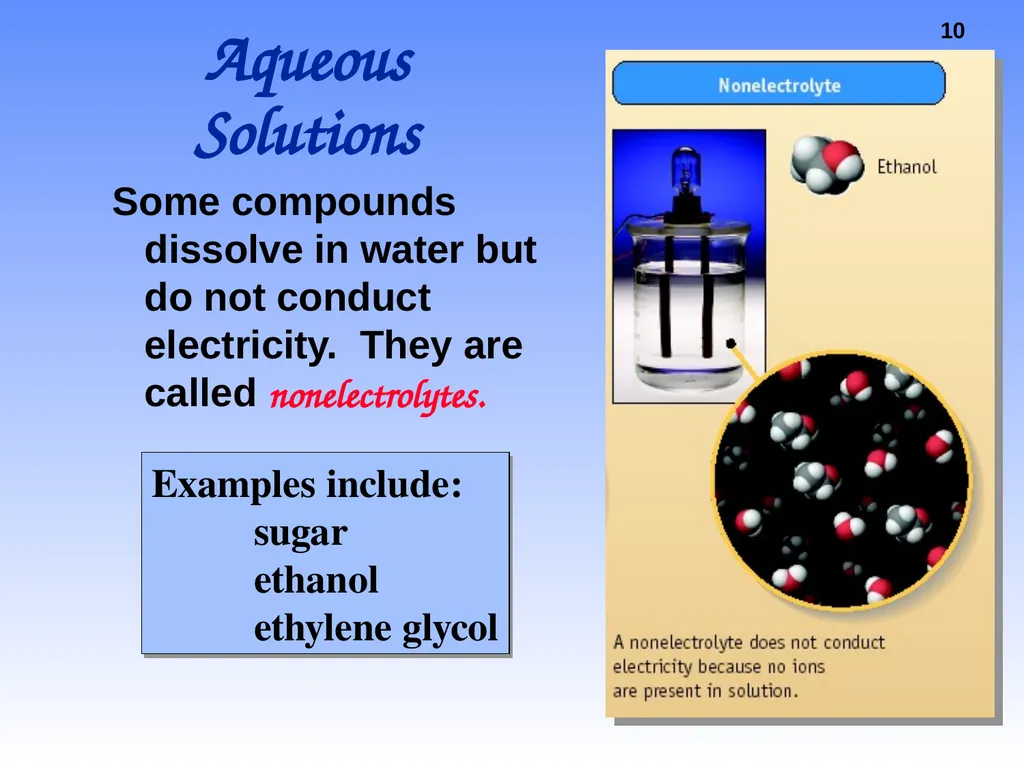
Aqueous Solutions Some compounds dissolve in water but do not conduct electricity. They are called nonelectrolytes. Examples include:
sugar
ethanol
ethylene glycol<br>
11
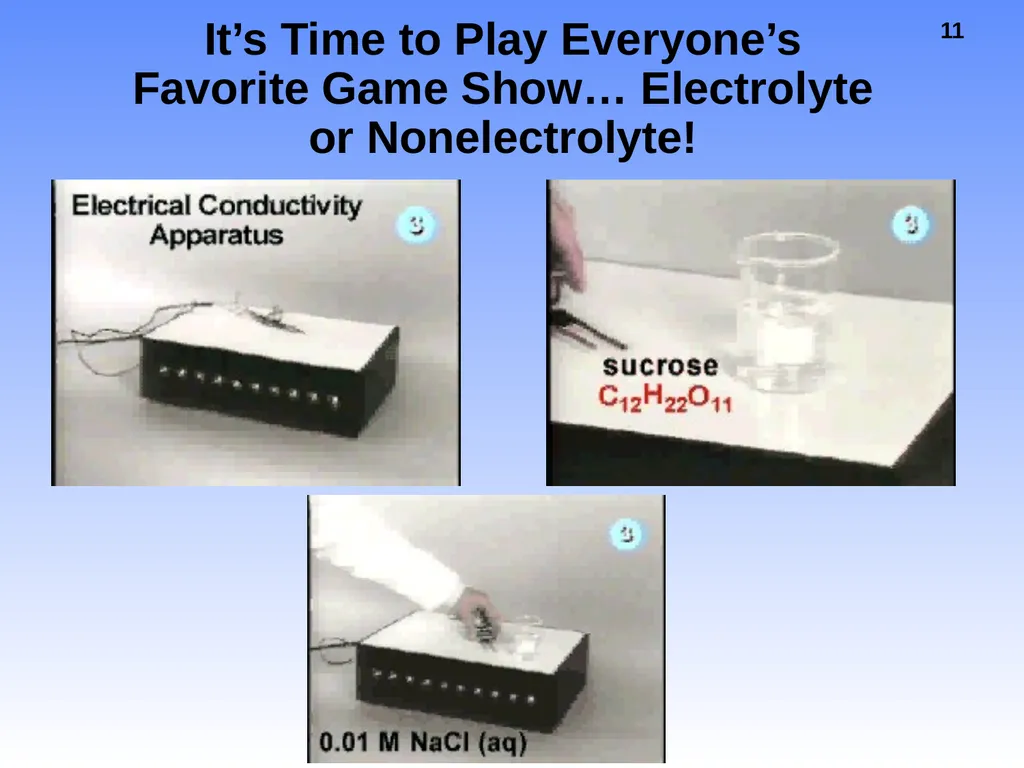
It’s Time to Play Everyone’s Favorite Game Show… Electrolyte or Nonelectrolyte!<br>
12
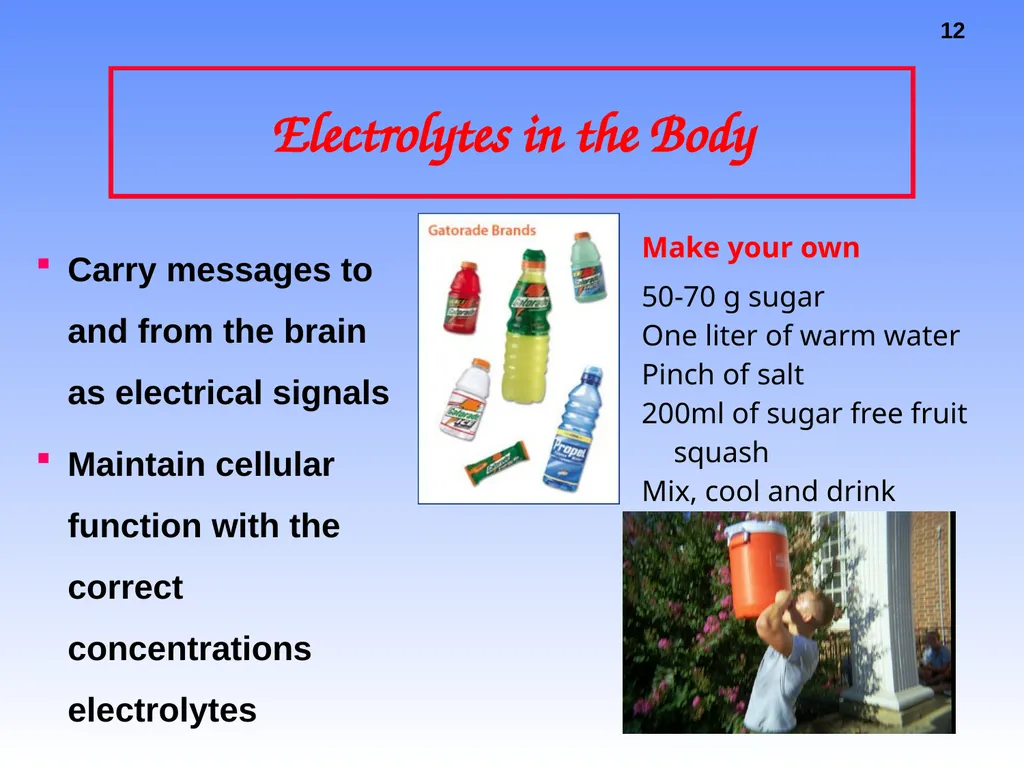
Electrolytes in the Body Carry messages to and from the brain as electrical signals
Maintain cellular function with the correct concentrations electrolytes<br>
13
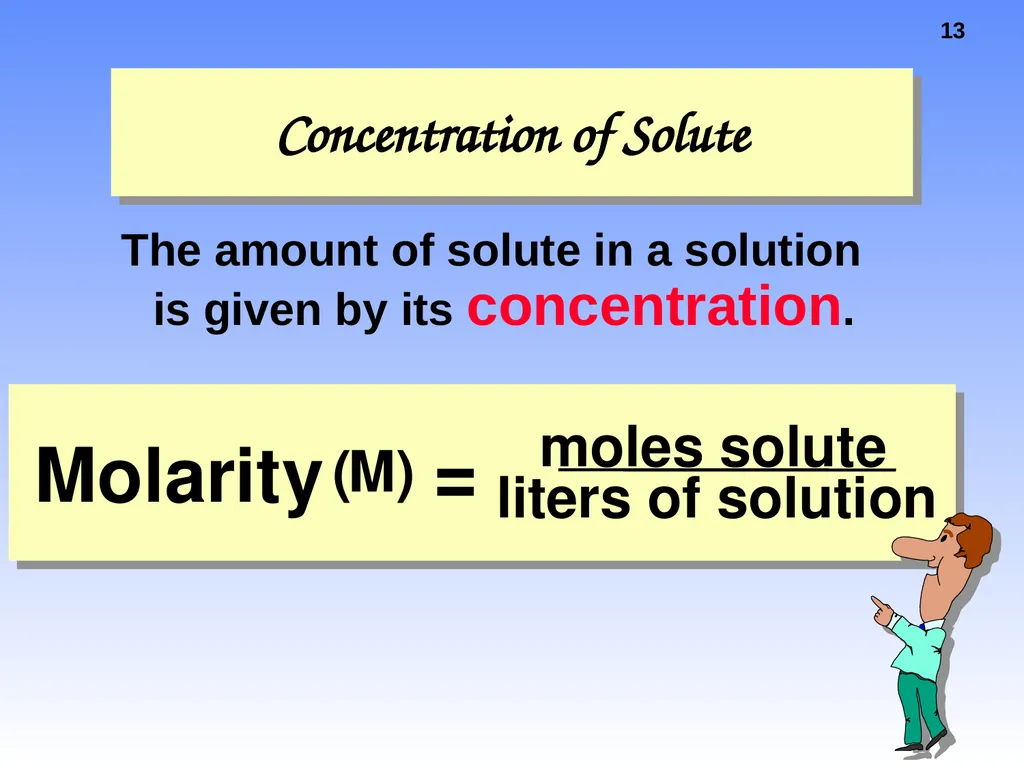
Concentration of Solute The amount of solute in a solution is given by its concentration.<br>
14
1.0 L of water was used to make 1.0 L of solution. Notice the water left over.<br>
15
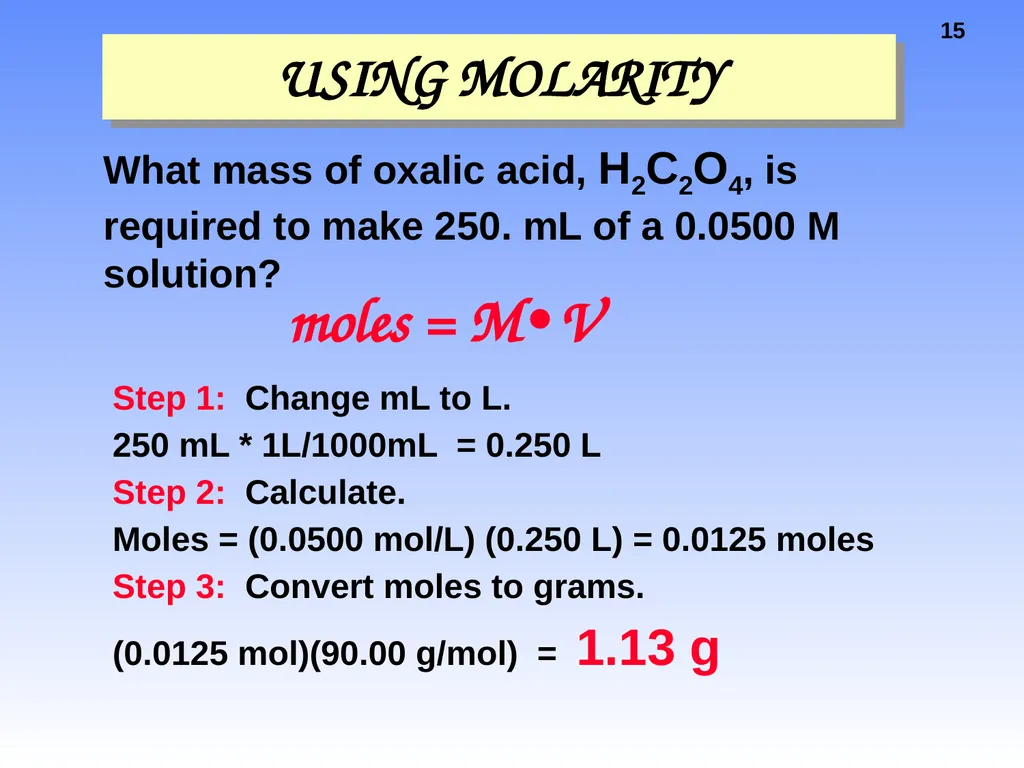
Step 1: Change mL to L.
250 mL * 1L/1000mL = 0.250 L
Step 2: Calculate.
Moles = (0.0500 mol/L) (0.250 L) = 0.0125 moles
Step 3: Convert moles to grams.
(0.0125 mol)(90.00 g/mol) = 1.13 g USING MOLARITY moles = M•V What mass of oxalic acid, H2C2O4, is
required to make 250. mL of a 0.0500 M
solution?<br>
16
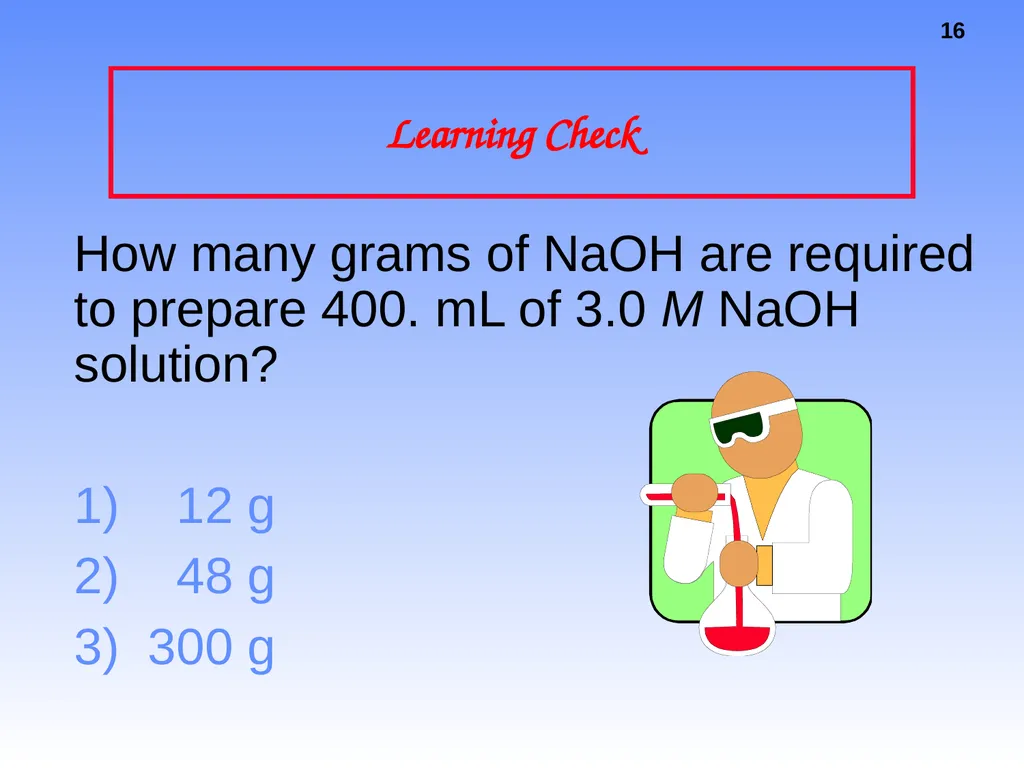
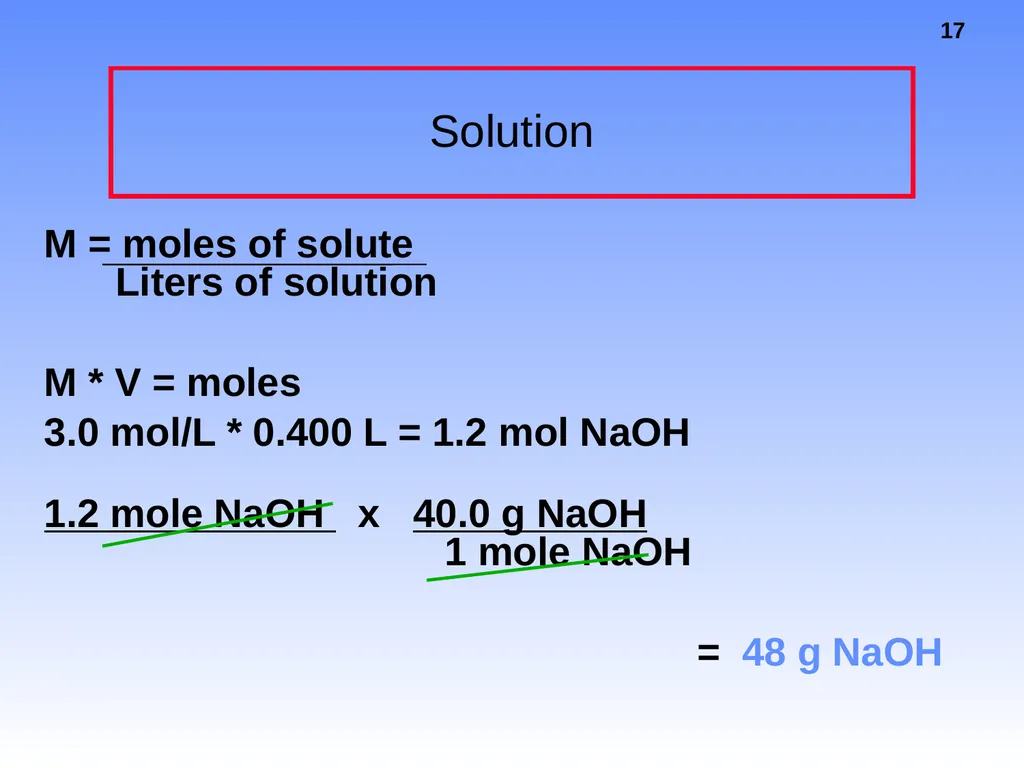
Learning Check How many grams of NaOH are required to prepare 400. mL of 3.0 M NaOH solution?
1) 12 g
2) 48 g
3) 300 g<br>
17
Solution M = moles of solute� Liters of solution
M * V = moles
3.0 mol/L * 0.400 L = 1.2 mol NaOH
1.2 mole NaOH x 40.0 g NaOH 1 mole NaOH
= 48 g NaOH<br>
18
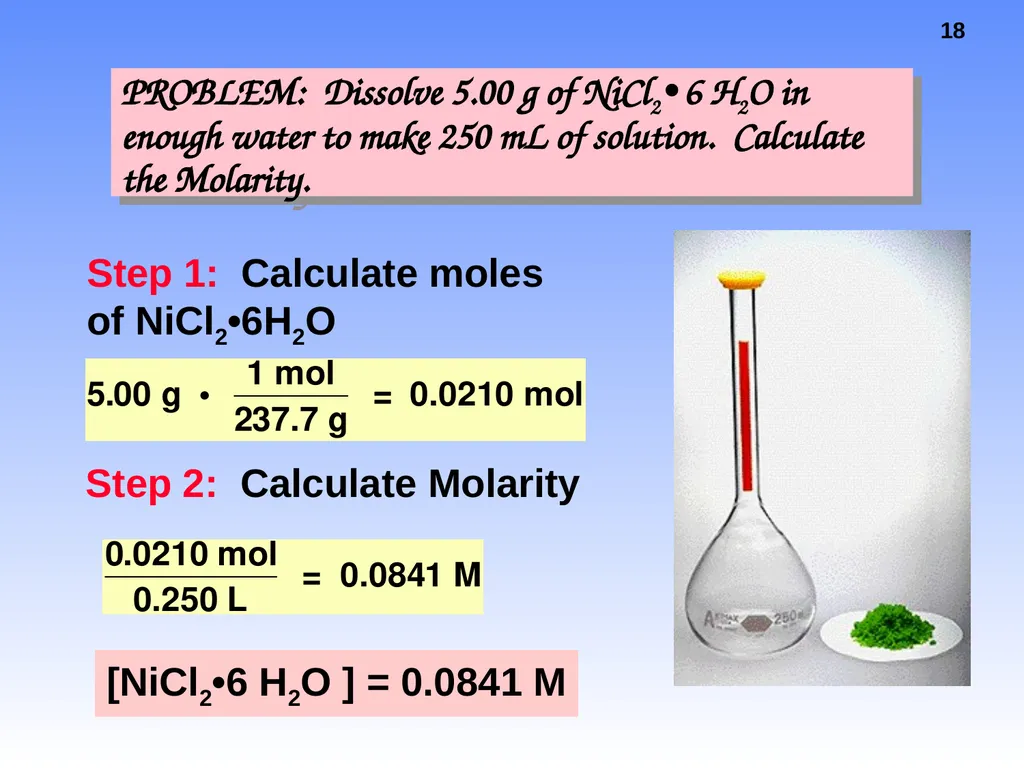
PROBLEM: Dissolve 5.00 g of NiCl2•6 H2O in enough water to make 250 mL of solution. Calculate the Molarity. Step 1: Calculate moles of NiCl2•6H2O Step 2: Calculate Molarity [NiCl2•6 H2O ] = 0.0841 M<br>
19
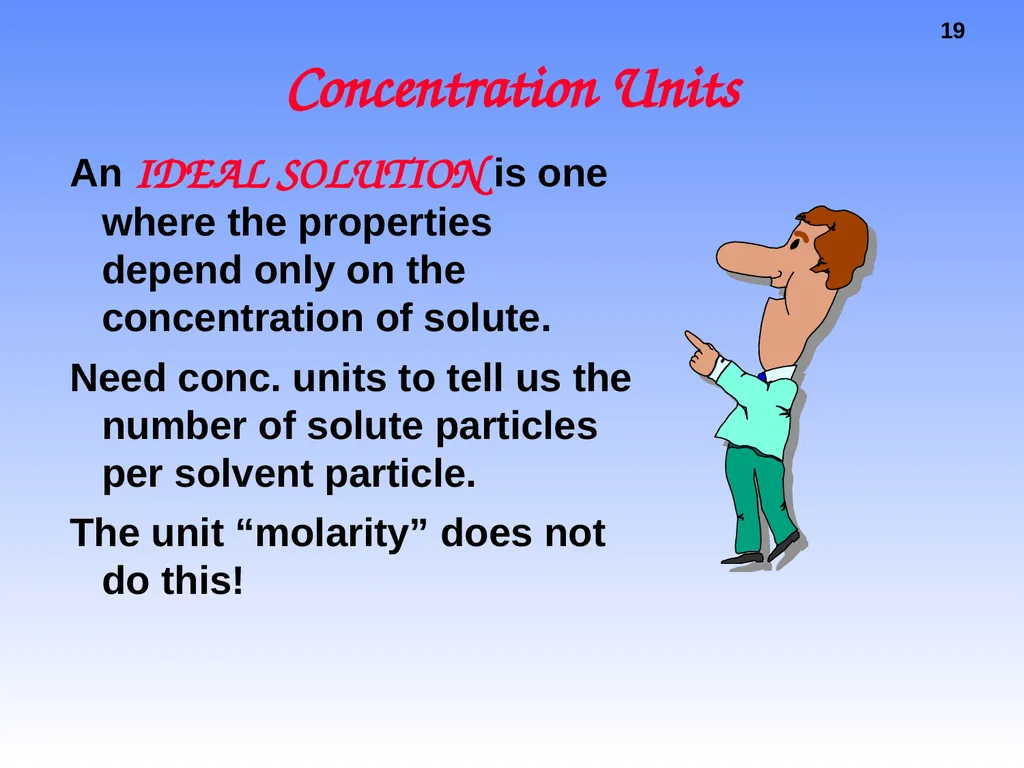
An IDEAL SOLUTION is one where the properties depend only on the concentration of solute.
Need conc. units to tell us the number of solute particles per solvent particle.
The unit “molarity” does not do this! Concentration Units<br>
20
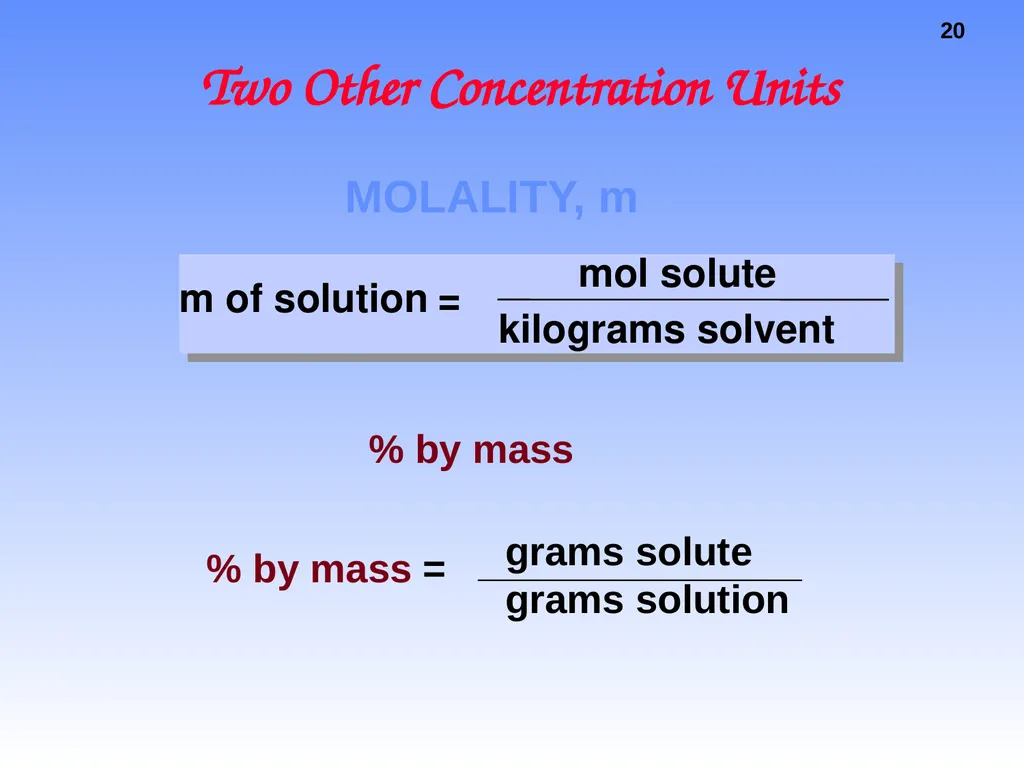
Two Other Concentration Units grams solute
grams solution MOLALITY, m % by mass = % by mass<br>
21
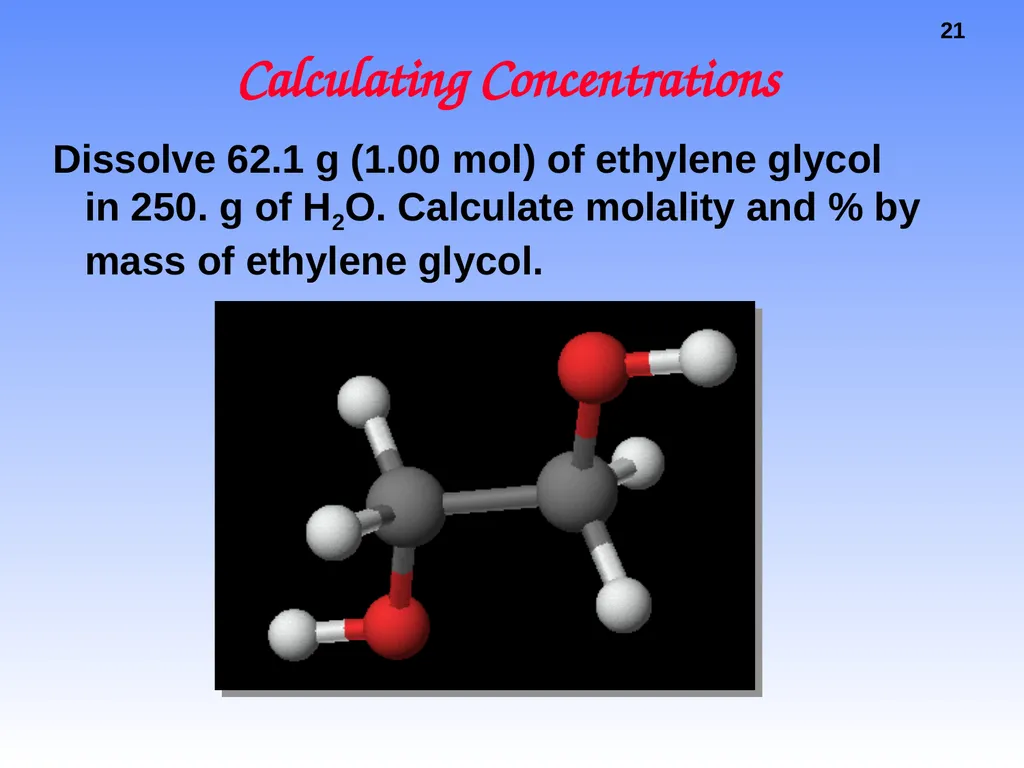
Calculating Concentrations Dissolve 62.1 g (1.00 mol) of ethylene glycol in 250. g of H2O. Calculate molality and % by mass of ethylene glycol.<br>
22
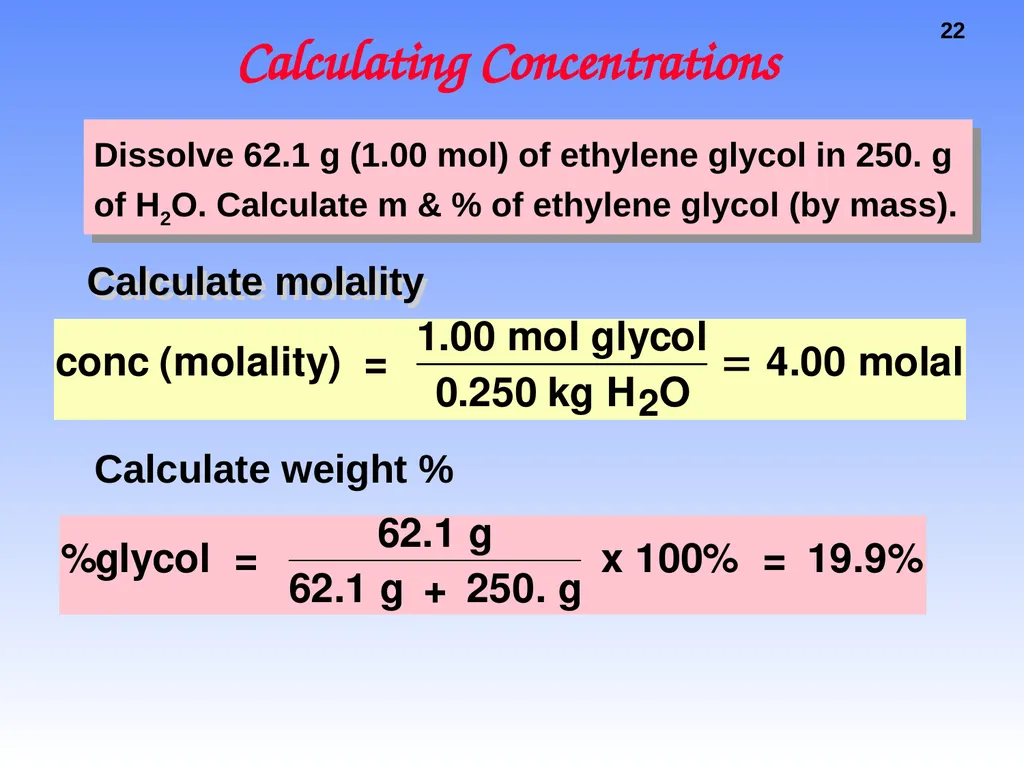
Calculating Concentrations Calculate molality Dissolve 62.1 g (1.00 mol) of ethylene glycol in 250. g of H2O. Calculate m & % of ethylene glycol (by mass). Calculate weight %<br>
23
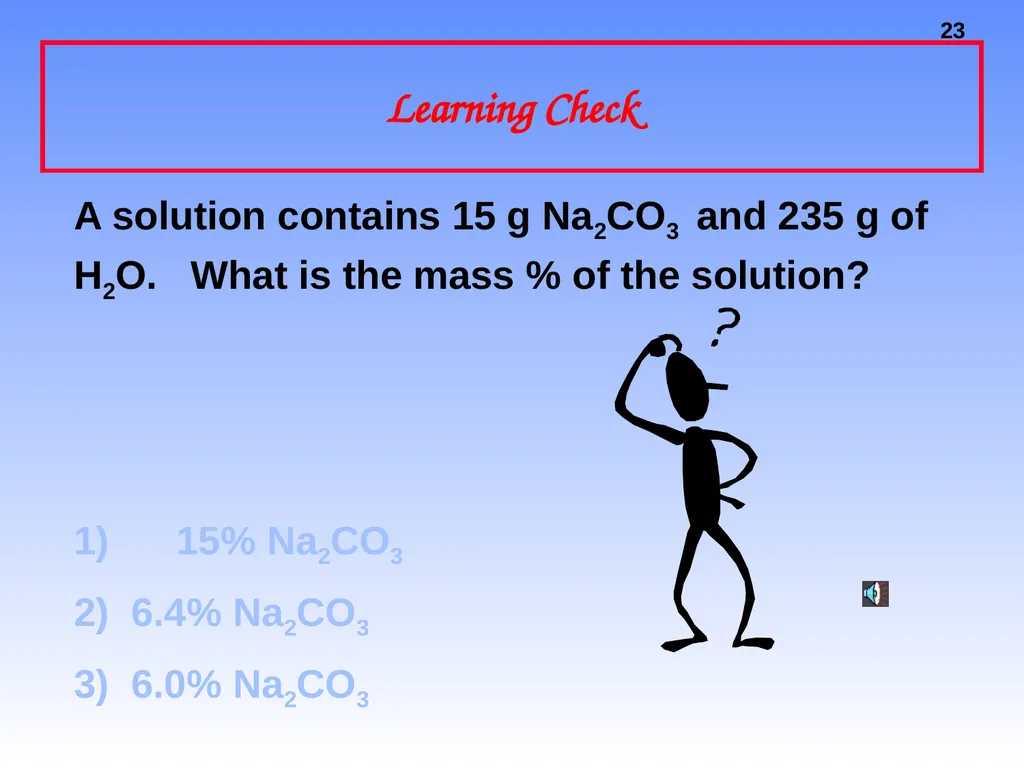
Learning Check A solution contains 15 g Na2CO3 and 235 g of H2O. What is the mass % of the solution?
1) 15% Na2CO3
2) 6.4% Na2CO3
3) 6.0% Na2CO3<br>
24
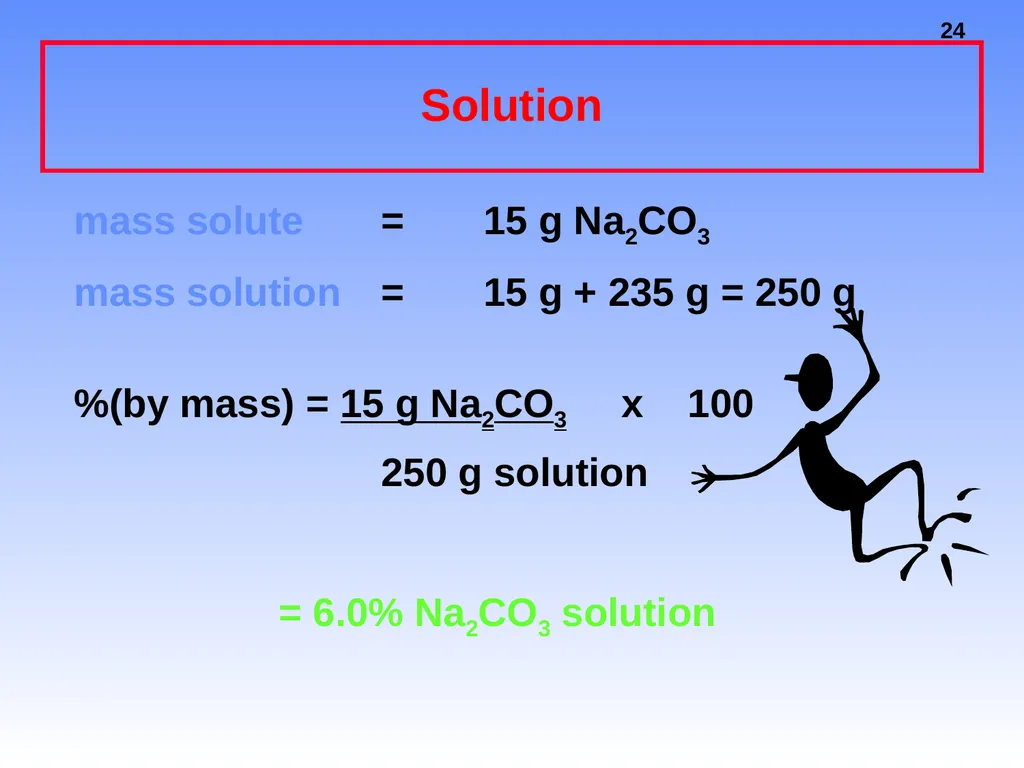
Solution mass solute = 15 g Na2CO3
mass solution = 15 g + 235 g = 250 g
%(by mass) = 15 g Na2CO3 x 100 250 g solution
= 6.0% Na2CO3 solution<br>
25
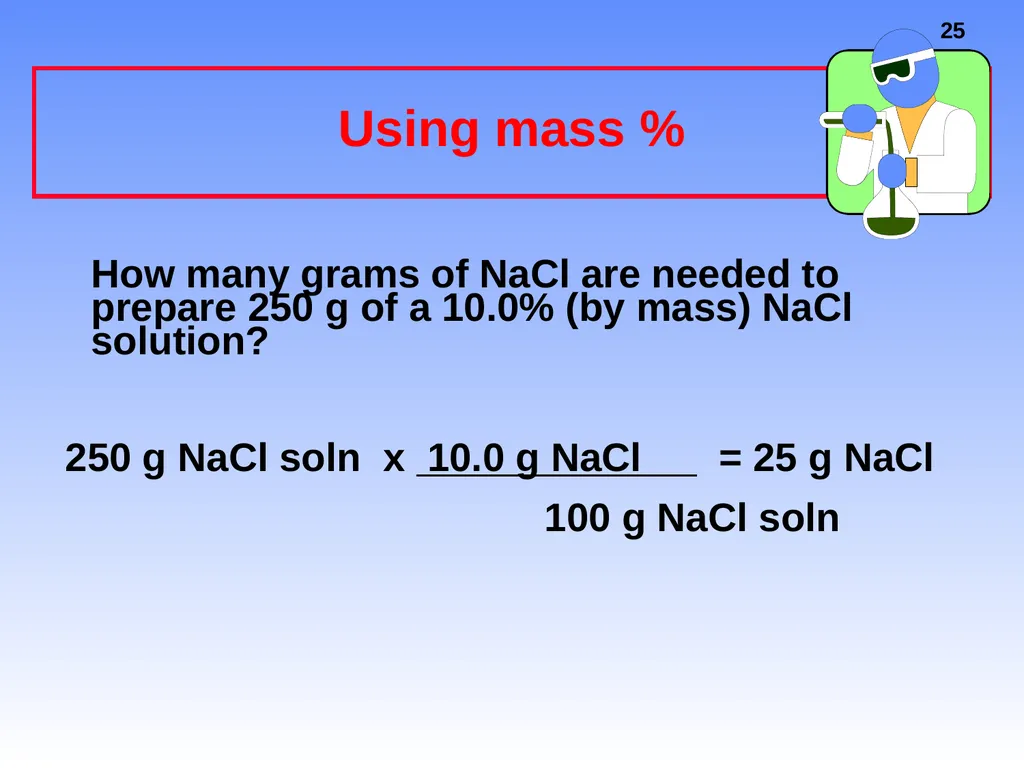
Using mass % How many grams of NaCl are needed to prepare 250 g of a 10.0% (by mass) NaCl solution?
250 g NaCl soln x 10.0 g NaCl = 25 g NaCl 100 g NaCl soln<br>
26
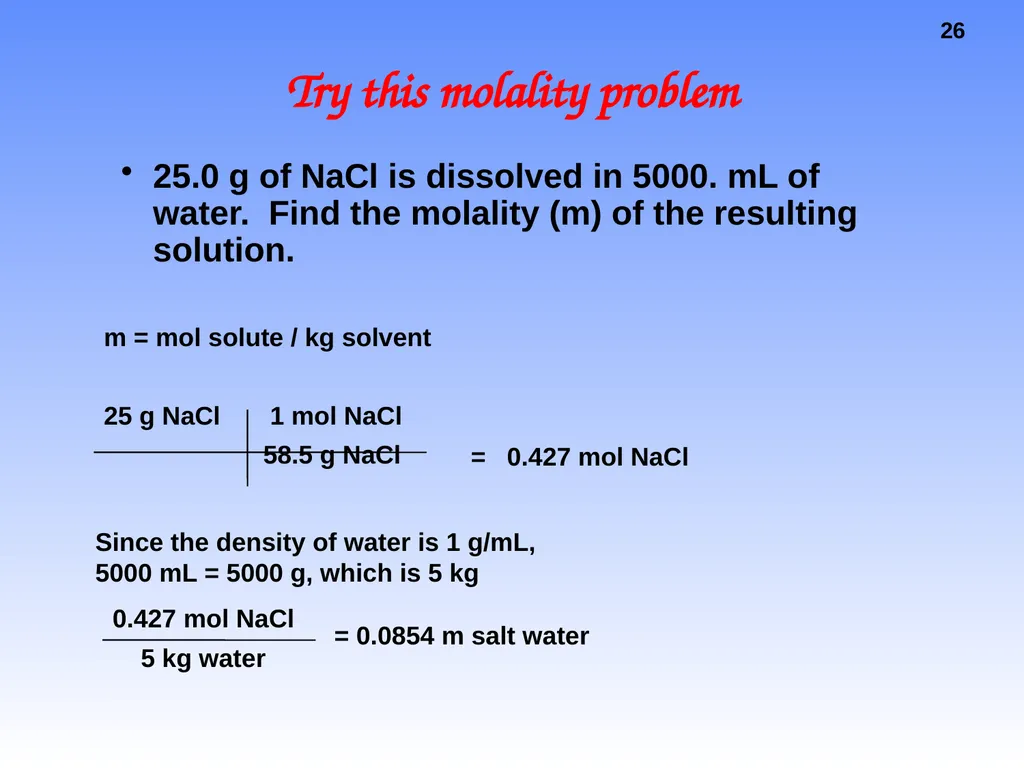
Try this molality problem 25.0 g of NaCl is dissolved in 5000. mL of water. Find the molality (m) of the resulting solution. m = mol solute / kg solvent
25 g NaCl 1 mol NaCl
58.5 g NaCl = 0.427 mol NaCl Since the density of water is 1 g/mL, 5000 mL = 5000 g, which is 5 kg 0.427 mol NaCl
5 kg water = 0.0854 m salt water<br>
27
1.0 L of water was used to make 1.0 L of solution. Notice the water left over.<br>
28
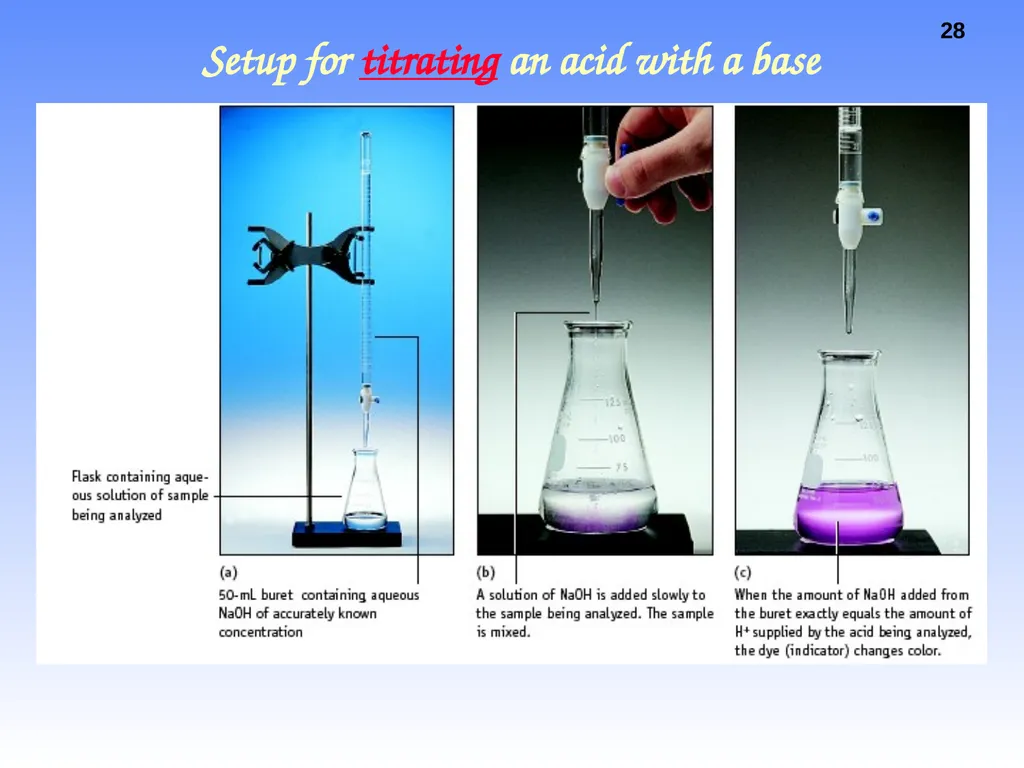
Setup for titrating an acid with a base<br>
29
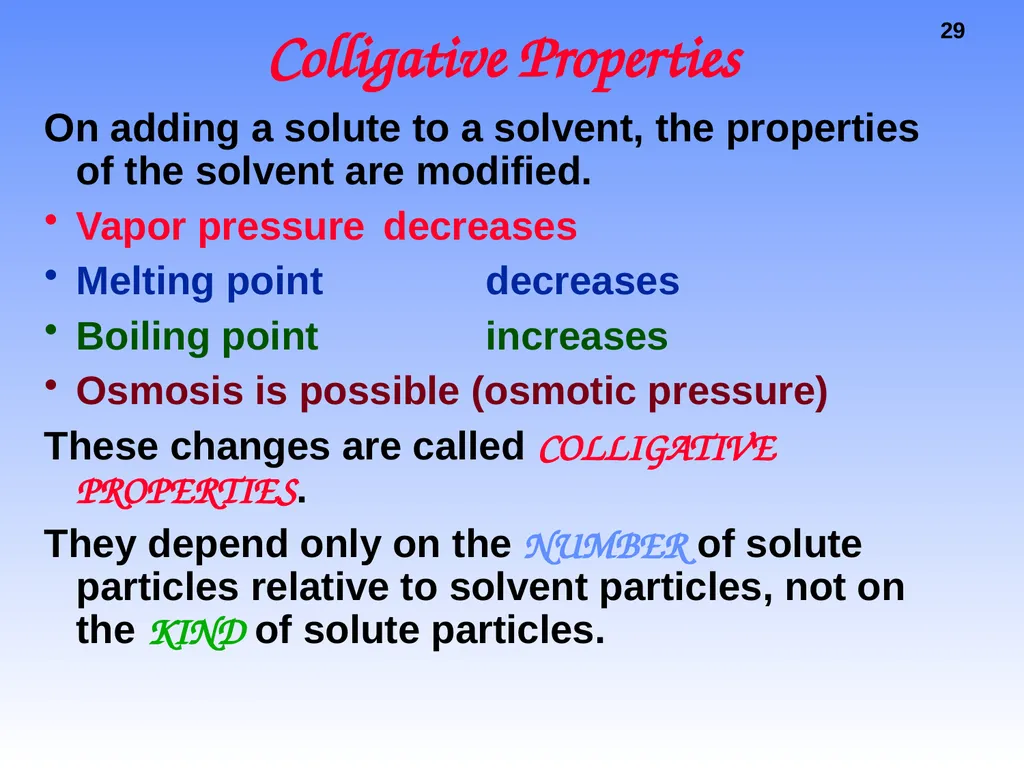
Colligative Properties On adding a solute to a solvent, the properties of the solvent are modified.
Vapor pressure decreases
Melting point decreases
Boiling point increases
Osmosis is possible (osmotic pressure)
These changes are called COLLIGATIVE PROPERTIES.
They depend only on the NUMBER of solute particles relative to solvent particles, not on the KIND of solute particles.<br>
30
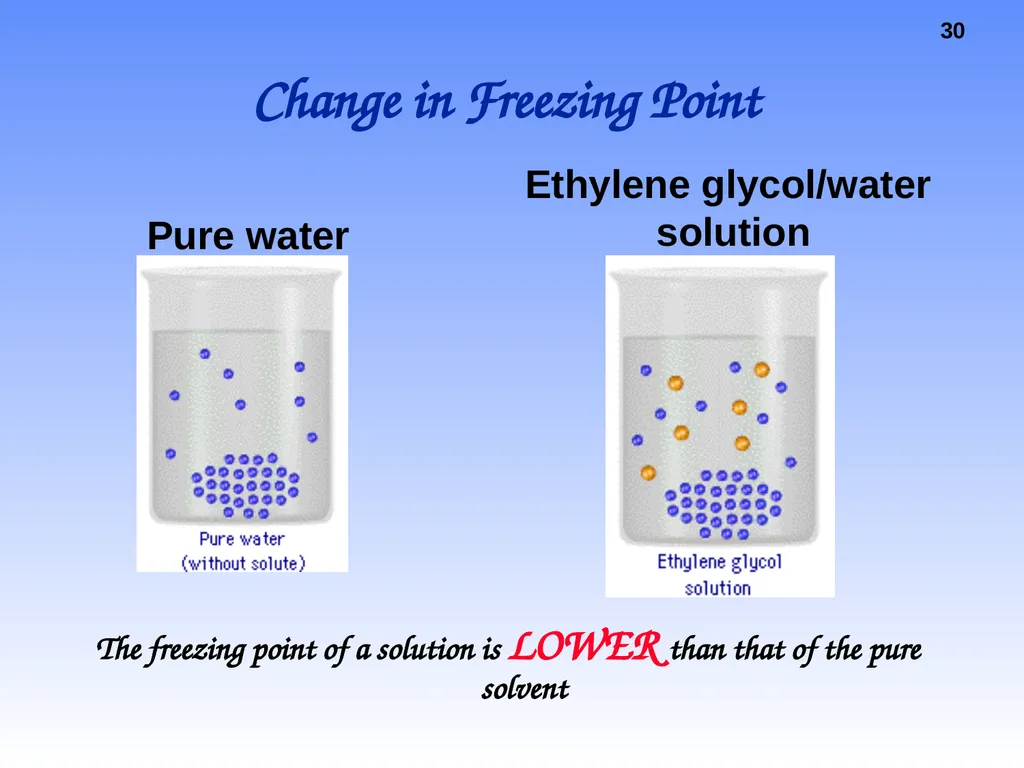
Change in Freezing Point The freezing point of a solution is LOWER than that of the pure solvent Pure water Ethylene glycol/water
solution<br>
31
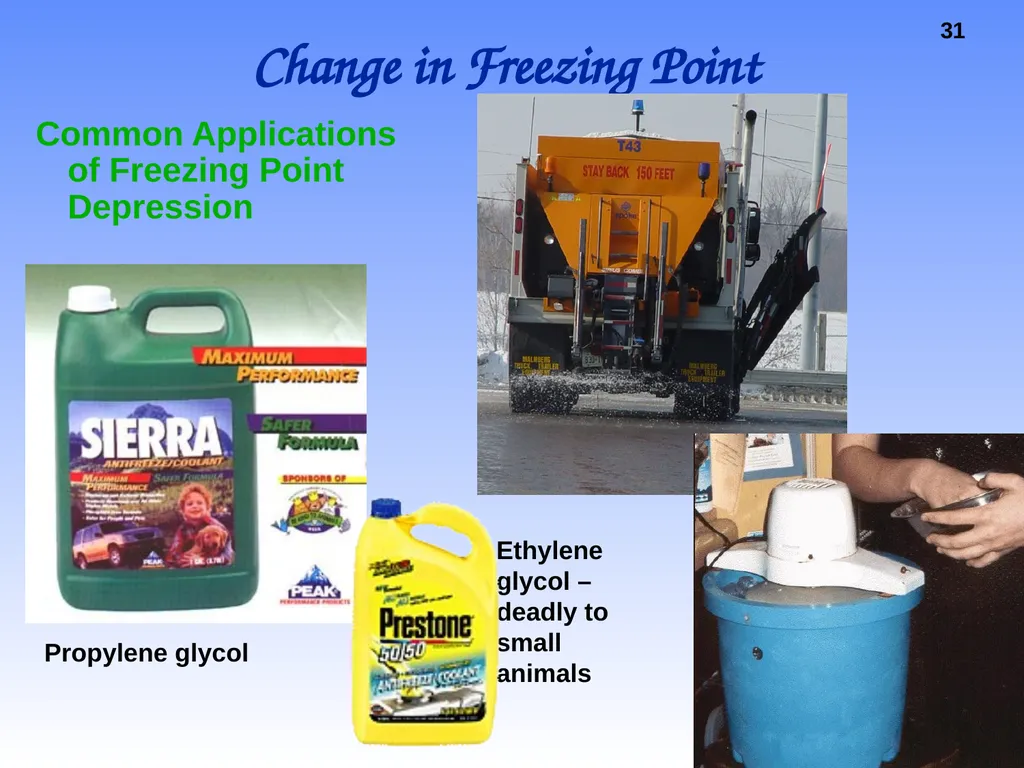
Change in Freezing Point Common Applications of Freezing Point Depression Propylene glycol Ethylene glycol – deadly to small animals<br>
32
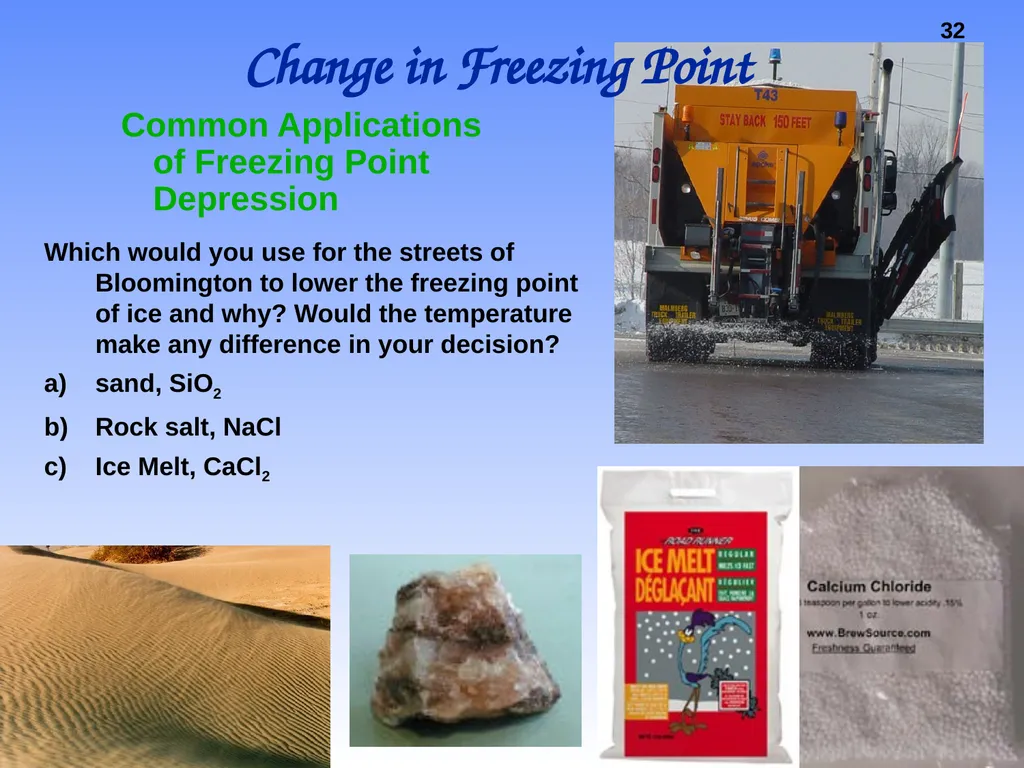
Common Applications of Freezing Point Depression Which would you use for the streets of Bloomington to lower the freezing point of ice and why? Would the temperature make any difference in your decision?
sand, SiO2
Rock salt, NaCl
Ice Melt, CaCl2 Change in Freezing Point<br>
33
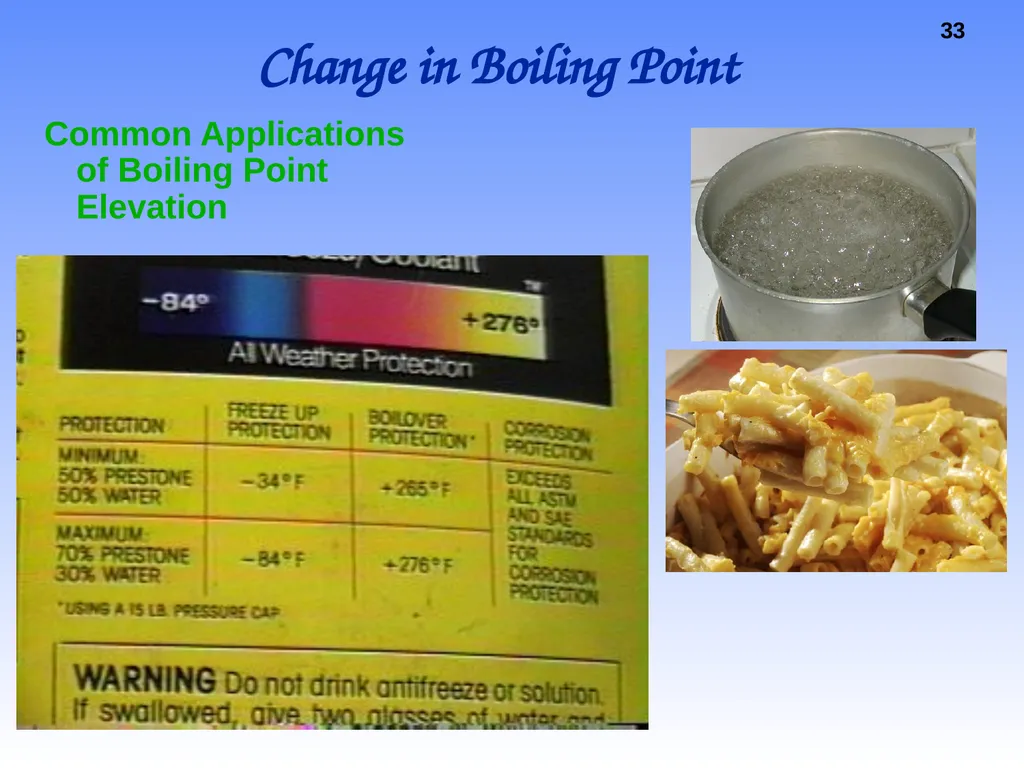
Change in Boiling Point Common Applications of Boiling Point Elevation<br>
34
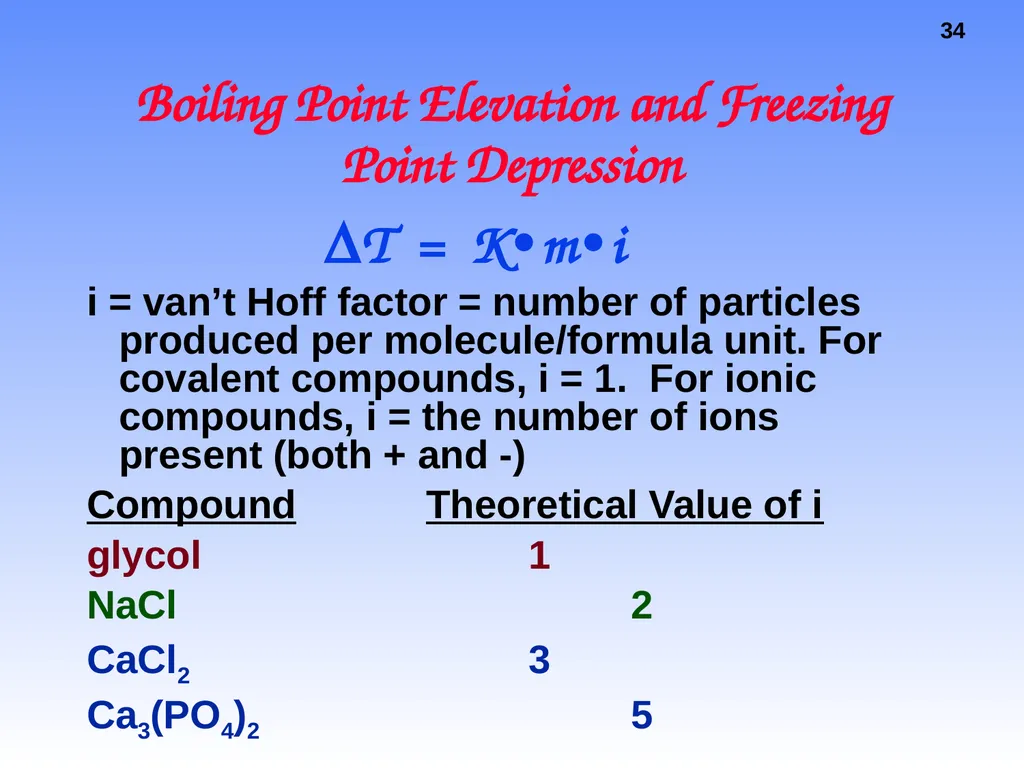
Boiling Point Elevation and Freezing Point Depression ∆T = K•m•i
i = van’t Hoff factor = number of particles produced per molecule/formula unit. For covalent compounds, i = 1. For ionic compounds, i = the number of ions present (both + and -)
Compound Theoretical Value of i
glycol 1
NaCl 2
CaCl2 3
Ca3(PO4)2 5<br>
35
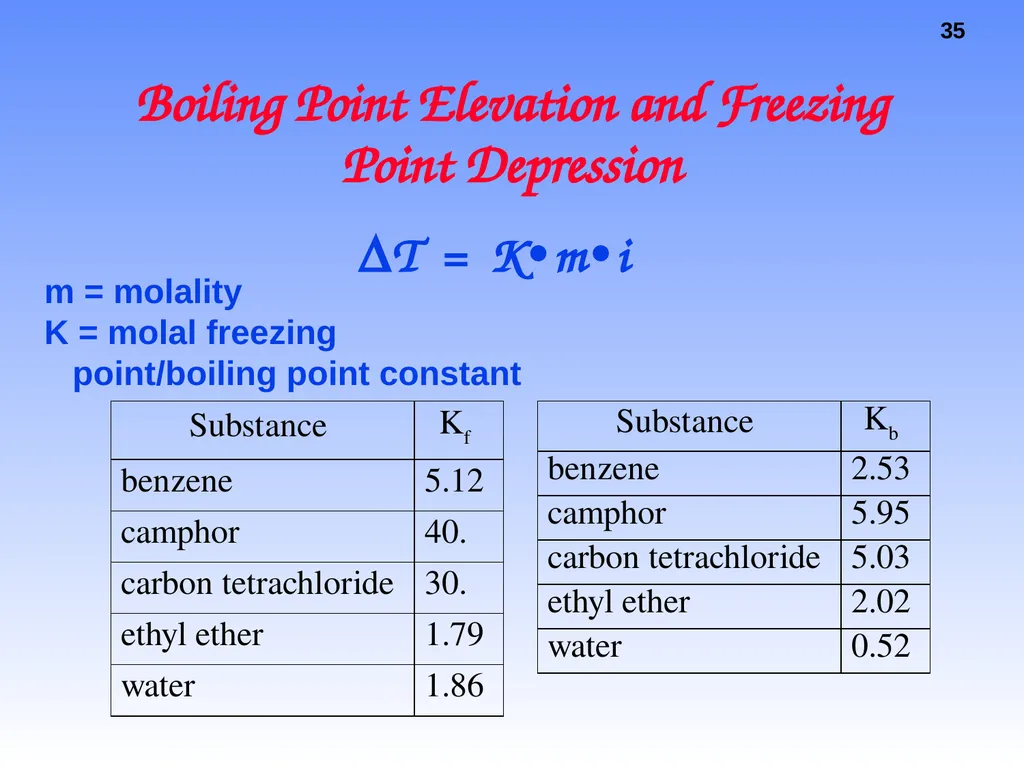
Boiling Point Elevation and Freezing Point Depression ∆T = K•m•i m = molality
K = molal freezing � point/boiling point constant<br>
36
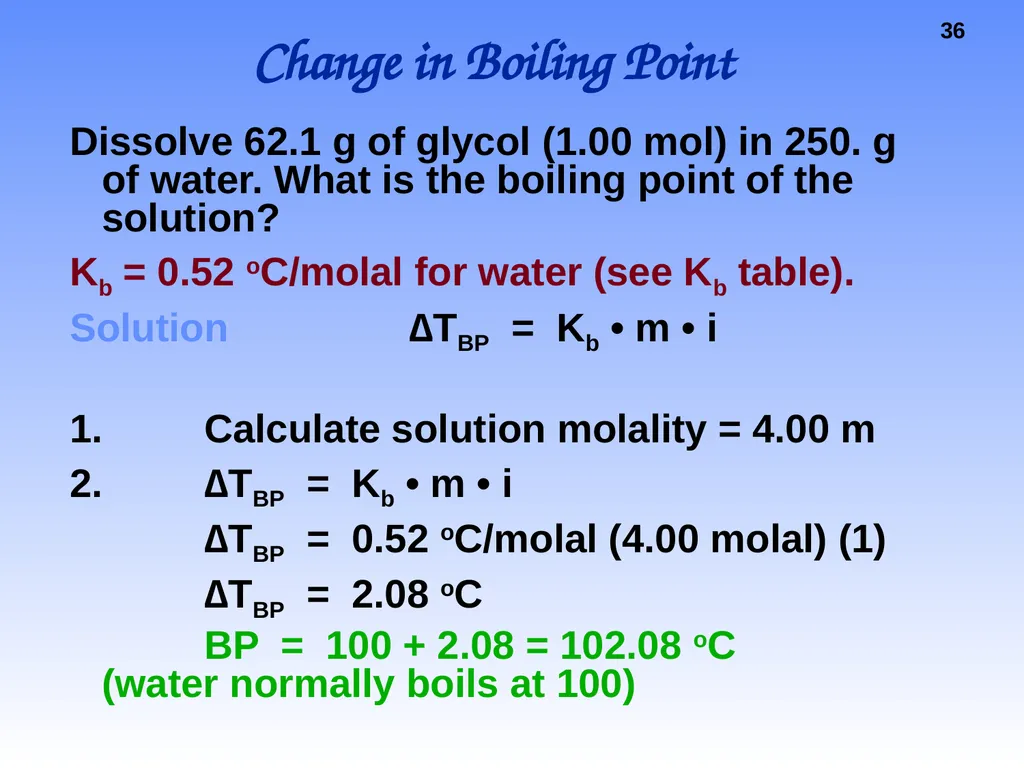
Change in Boiling Point Dissolve 62.1 g of glycol (1.00 mol) in 250. g of water. What is the boiling point of the solution?
Kb = 0.52 oC/molal for water (see Kb table).
Solution ∆TBP = Kb • m • i
1. Calculate solution molality = 4.00 m
2. ∆TBP = Kb • m • i
∆TBP = 0.52 oC/molal (4.00 molal) (1)
∆TBP = 2.08 oC
BP = 100 + 2.08 = 102.08 oC �(water normally boils at 100)<br>
37
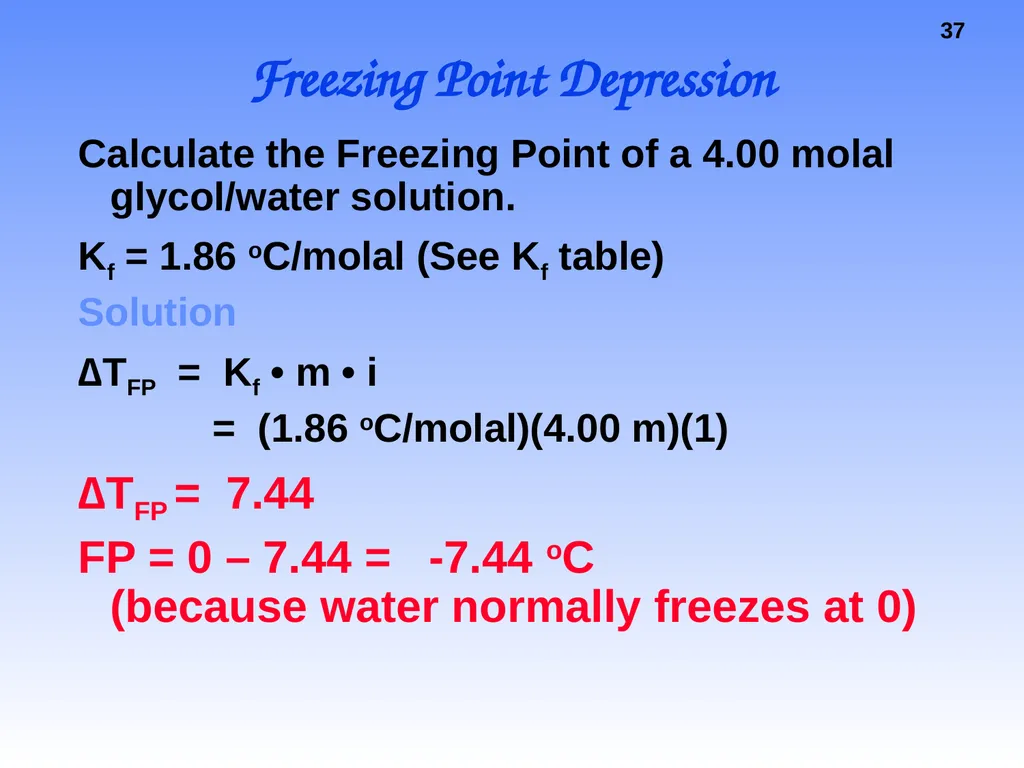
Calculate the Freezing Point of a 4.00 molal glycol/water solution.
Kf = 1.86 oC/molal (See Kf table)
Solution
∆TFP = Kf • m • i
= (1.86 oC/molal)(4.00 m)(1)
∆TFP = 7.44
FP = 0 – 7.44 = -7.44 oC�(because water normally freezes at 0) Freezing Point Depression<br>
38
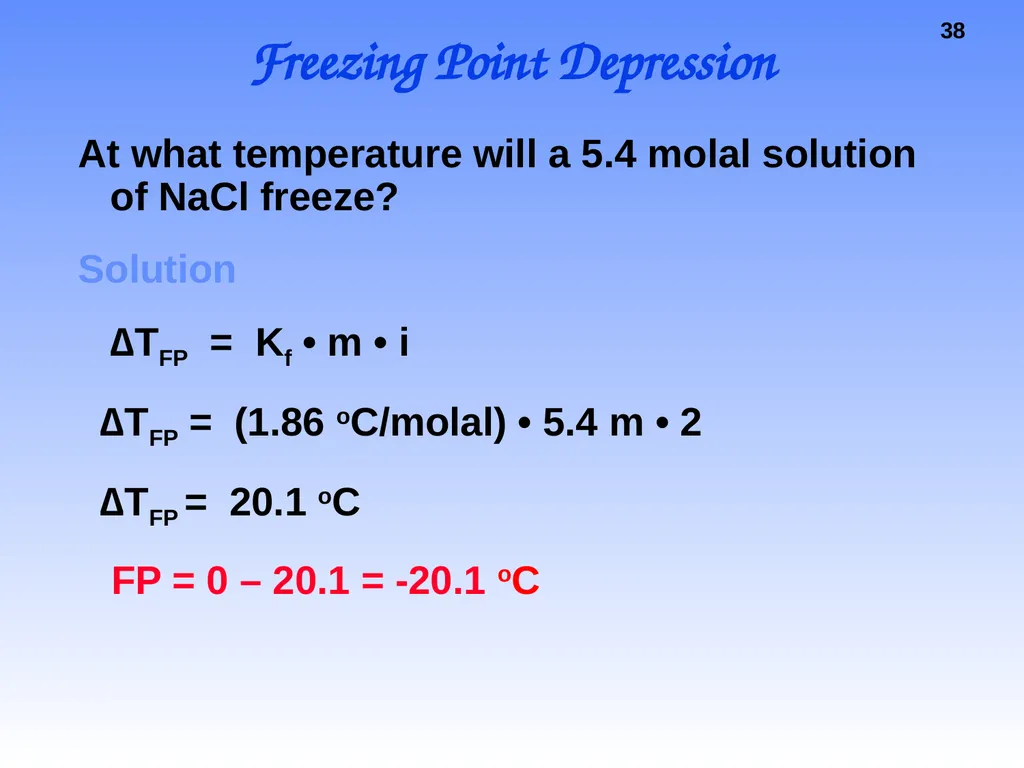
At what temperature will a 5.4 molal solution of NaCl freeze?
Solution
∆TFP = Kf • m • i
∆TFP = (1.86 oC/molal) • 5.4 m • 2
∆TFP = 20.1 oC
FP = 0 – 20.1 = -20.1 oC Freezing Point Depression<br>
39
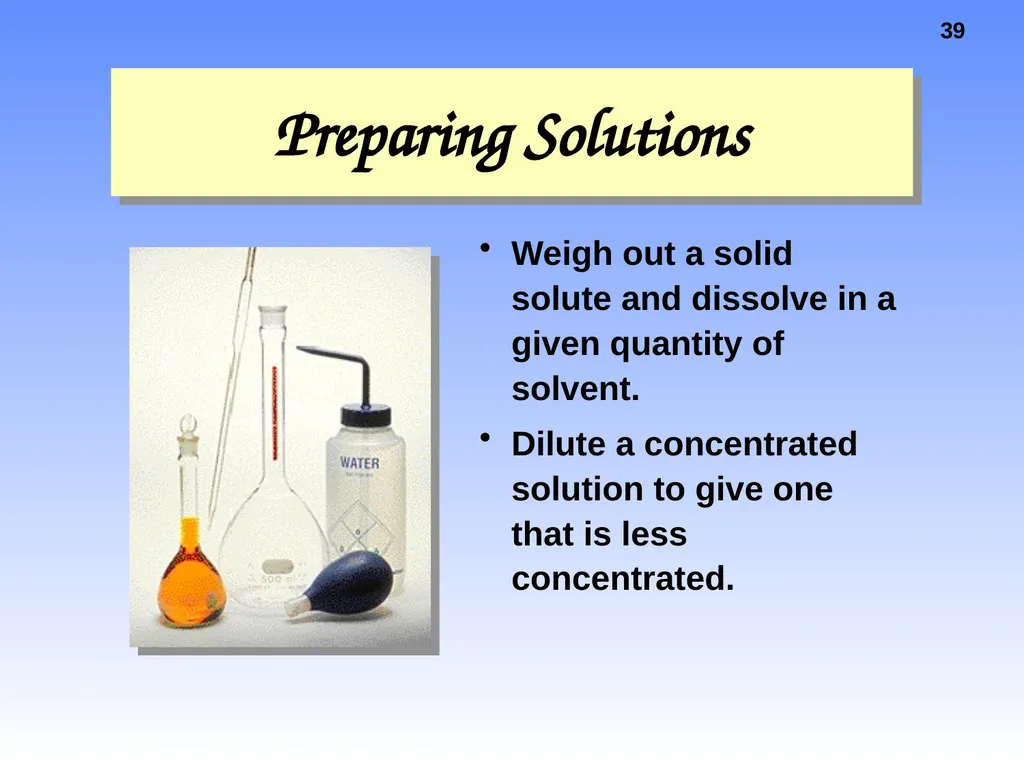
Preparing Solutions Weigh out a solid solute and dissolve in a given quantity of solvent.
Dilute a concentrated solution to give one that is less concentrated.<br>