Solvency II Reporting and disclosure Insurance and Reinsurance Stakeholder Group meeting 12 December 2011 Solvency II Reporting and disclosure Development process of EIOPA guidelines and standards on reporting and disclosure General
"Solvency II – Reporting and disclosure Insurance" is the property of its rightful owner. Permission is granted to
download and print the materials on this website for personal, non-commercial use only, and to display it
on your personal computer provided you do not modify the materials and that you retain all copyright
notices contained in the materials. By downloading content from our website, you accept the terms of this
agreement.
Presentation Transcript
01
Solvency II – Reporting and disclosure Insurance and Reinsurance Stakeholder Group meeting
12 December 2011<br>
02
Solvency II – Reporting and disclosure Development process of EIOPA guidelines and standards on reporting and disclosure
General framework, objectives and means
Explanation on narrative reporting and disclosure, quantitative reporting templates, predefined events
Towards a formal opinion from the Insurance and Reinsurance Stakeholder Group<br>
03
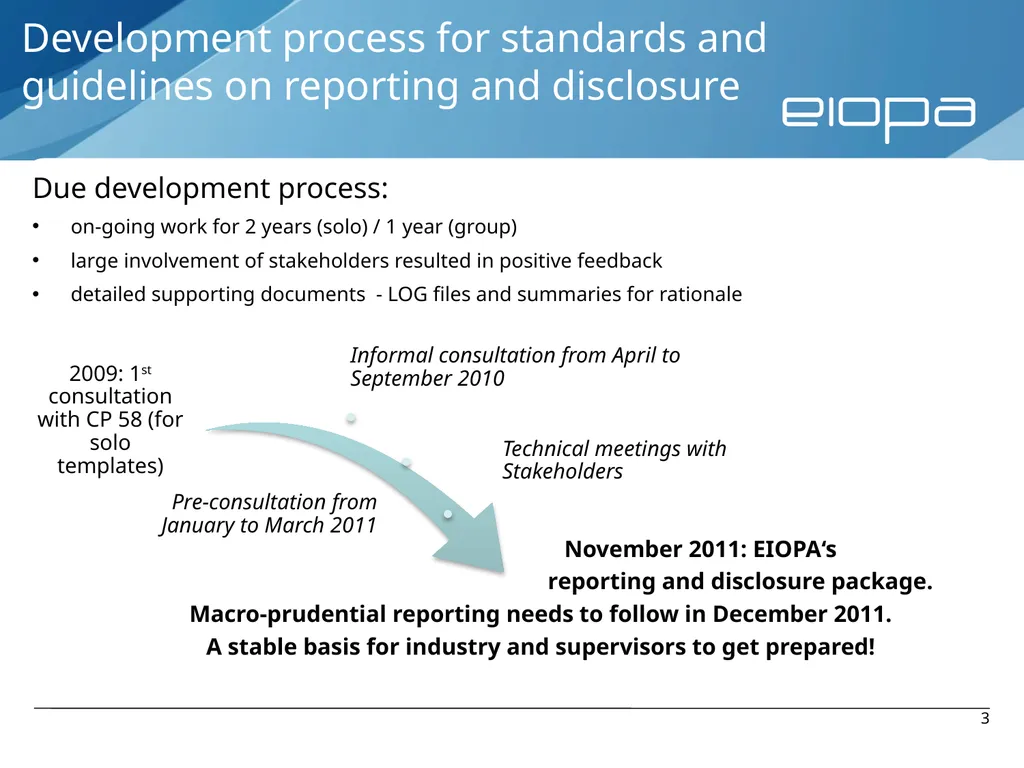
Due development process:
on-going work for 2 years (solo) / 1 year (group)
large involvement of stakeholders resulted in positive feedback
detailed supporting documents - LOG files and summaries for rationale Development process for standards and guidelines on reporting and disclosure<br>
04
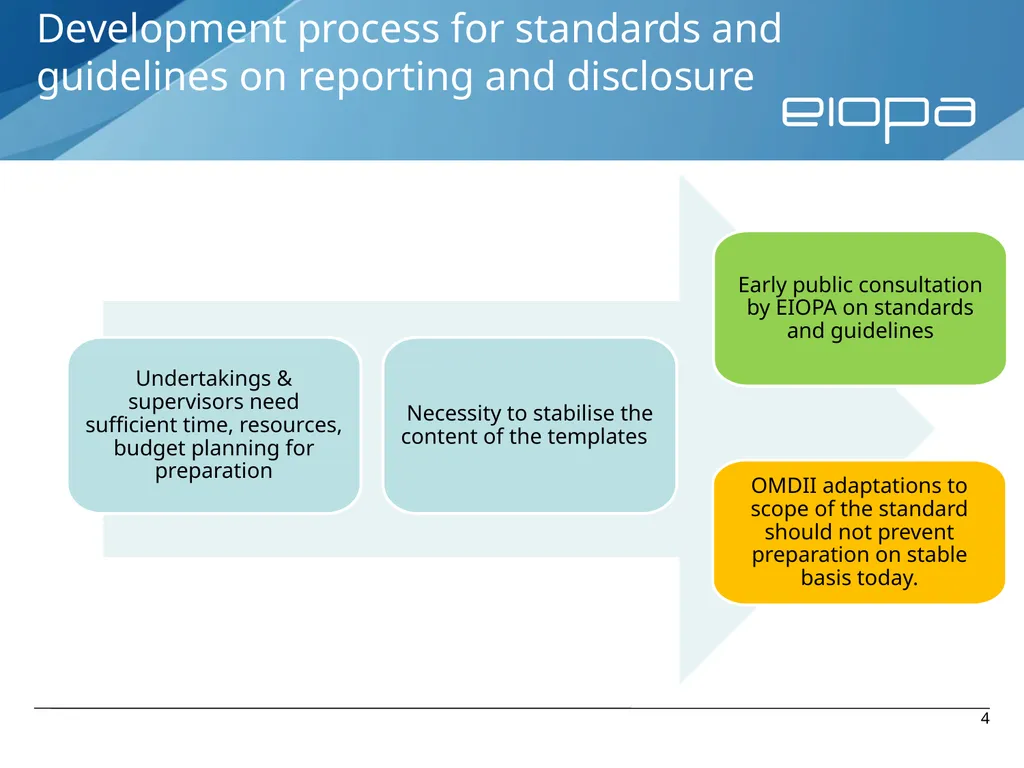
Development process for standards and guidelines on reporting and disclosure Early public consultation by EIOPA on standards and guidelines<br>
05
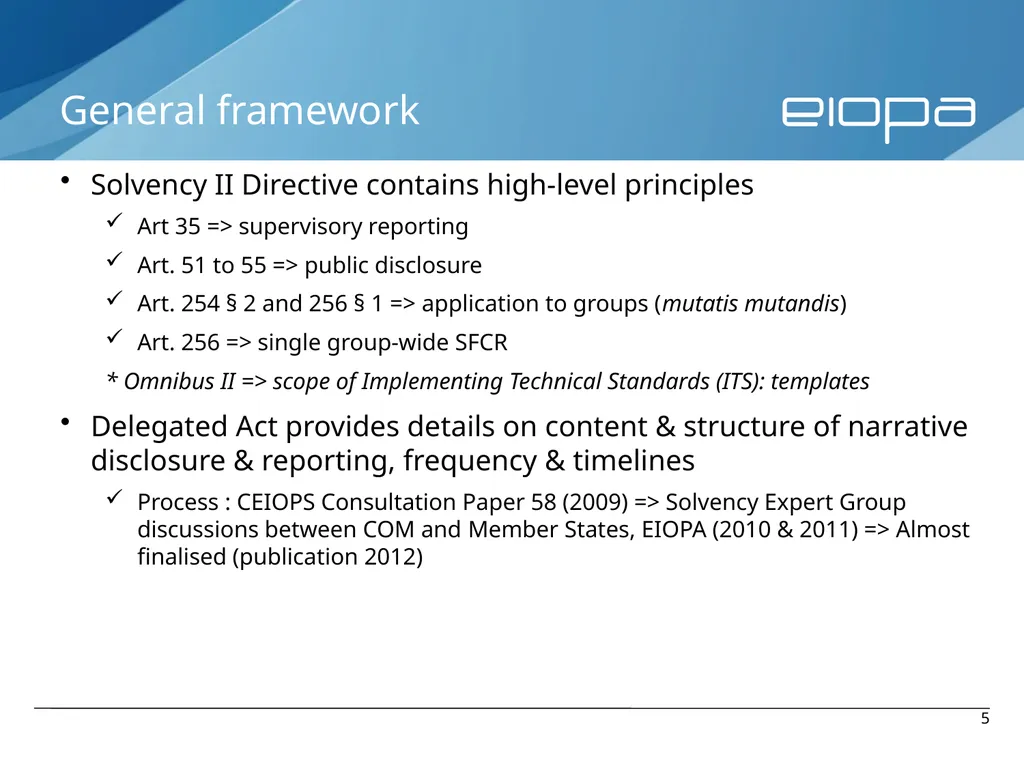
General framework Solvency II Directive contains high-level principles
Art 35 => supervisory reporting
Art. 51 to 55 => public disclosure
Art. 254 § 2 and 256 § 1 => application to groups (mutatis mutandis)
Art. 256 => single group-wide SFCR
* Omnibus II => scope of Implementing Technical Standards (ITS): templates
Delegated Act provides details on content & structure of narrative disclosure & reporting, frequency & timelines
Process : CEIOPS Consultation Paper 58 (2009) => Solvency Expert Group discussions between COM and Member States, EIOPA (2010 & 2011) => Almost finalised (publication 2012)<br>
06
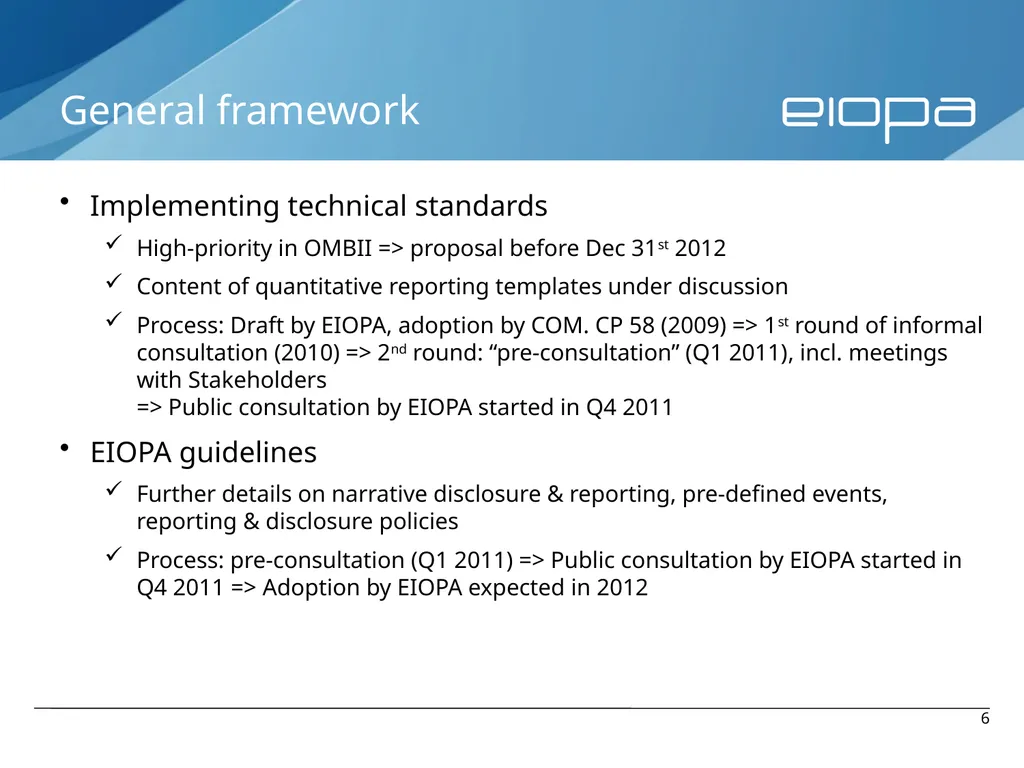
General framework Implementing technical standards
High-priority in OMBII => proposal before Dec 31st 2012
Content of quantitative reporting templates under discussion
Process: Draft by EIOPA, adoption by COM. CP 58 (2009) => 1st round of informal consultation (2010) => 2nd round: “pre-consultation” (Q1 2011), incl. meetings with Stakeholders => Public consultation by EIOPA started in Q4 2011
EIOPA guidelines
Further details on narrative disclosure & reporting, pre-defined events, reporting & disclosure policies
Process: pre-consultation (Q1 2011) => Public consultation by EIOPA started in Q4 2011 => Adoption by EIOPA expected in 2012<br>
07
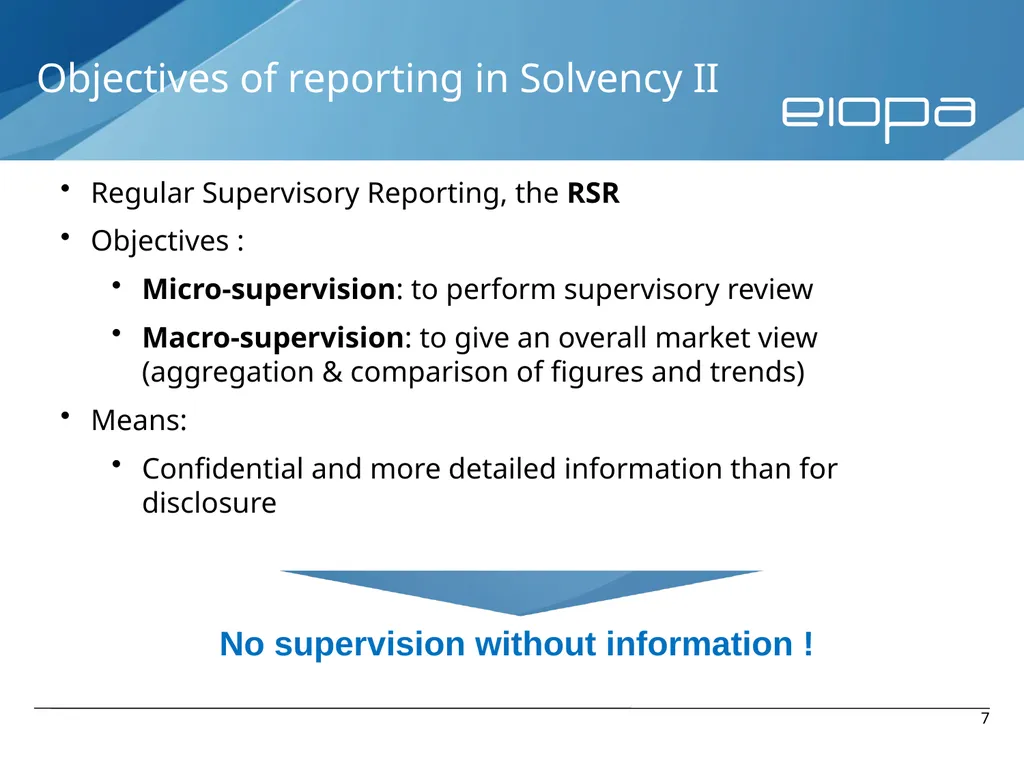
Objectives of reporting in Solvency II Regular Supervisory Reporting, the RSR
Objectives :
Micro-supervision: to perform supervisory review
Macro-supervision: to give an overall market view (aggregation & comparison of figures and trends)
Means:
Confidential and more detailed information than for disclosure
No supervision without information !<br>
08
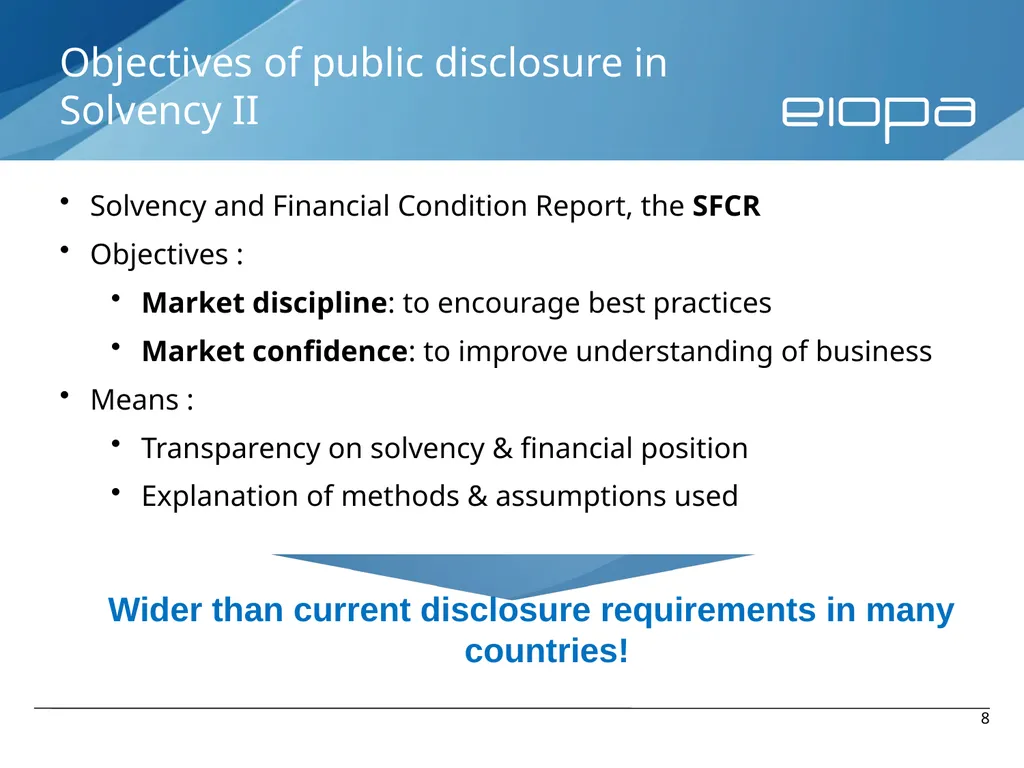
Objectives of public disclosure in Solvency II Solvency and Financial Condition Report, the SFCR
Objectives :
Market discipline: to encourage best practices
Market confidence: to improve understanding of business
Means :
Transparency on solvency & financial position
Explanation of methods & assumptions used
Wider than current disclosure requirements in many countries!<br>
09
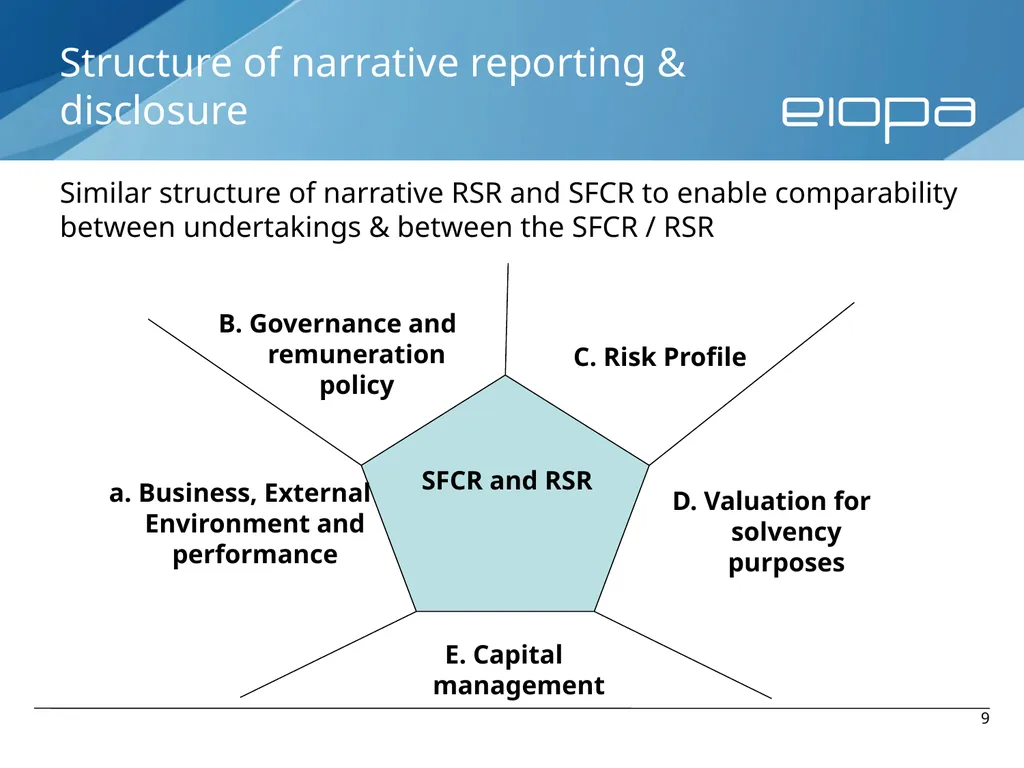
Structure of narrative reporting & disclosure Similar structure of narrative RSR and SFCR to enable comparability between undertakings & between the SFCR / RSR<br>
10
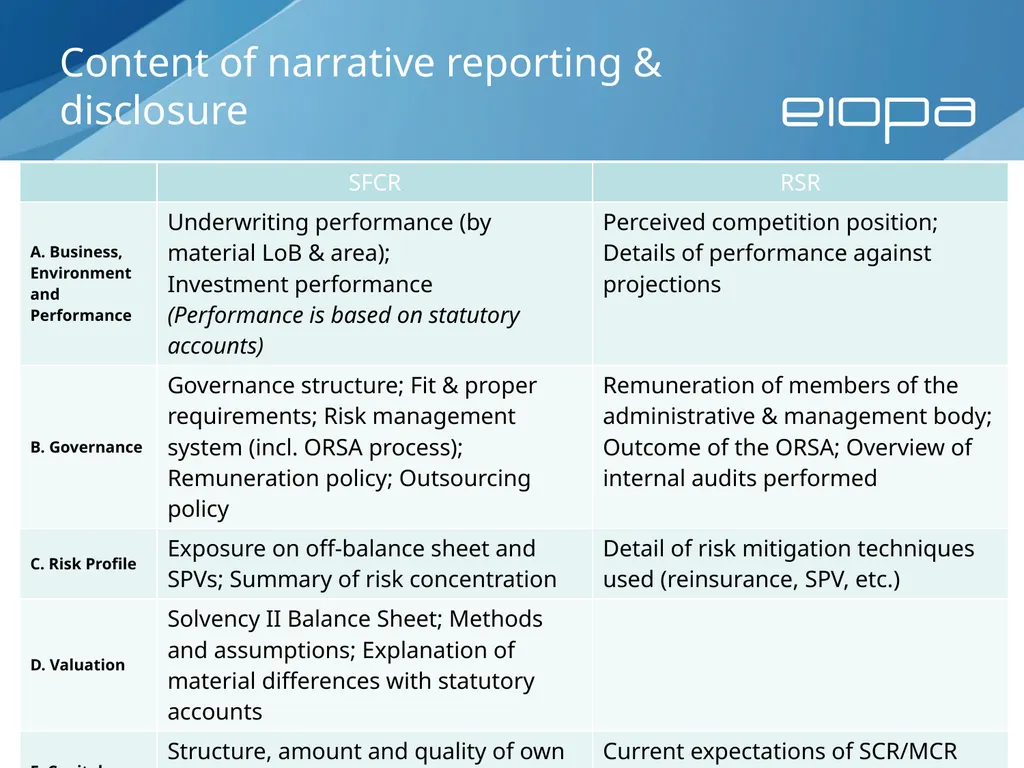
Content of narrative reporting & disclosure<br>
11
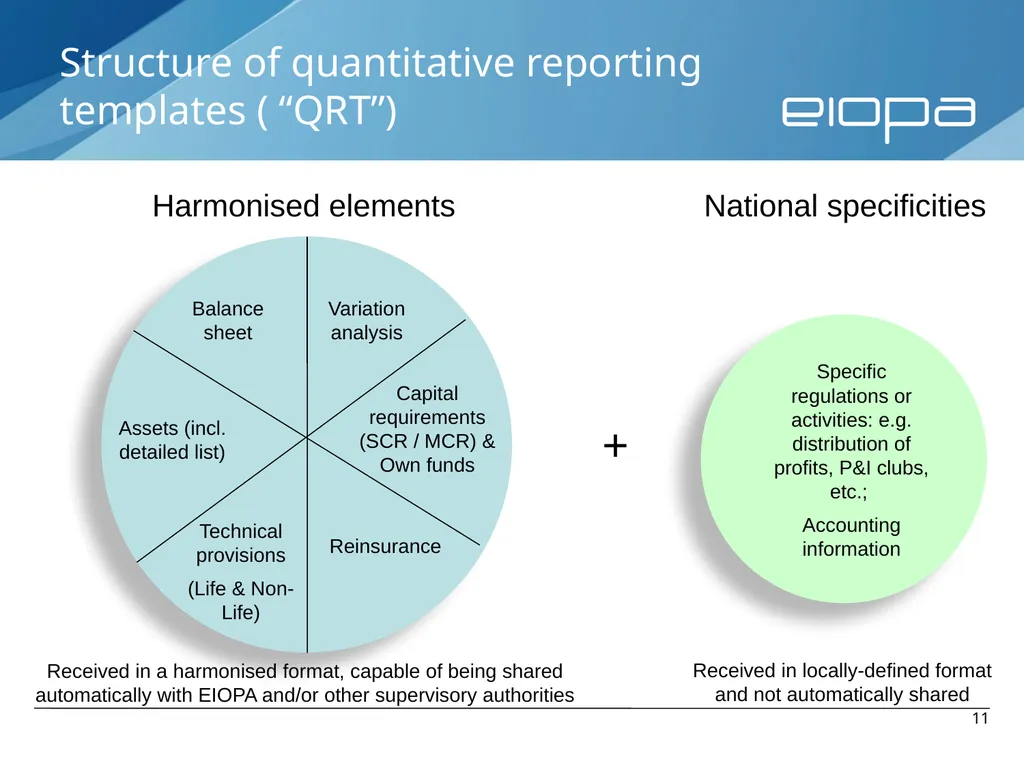
Structure of quantitative reporting templates ( “QRT”)<br>
12
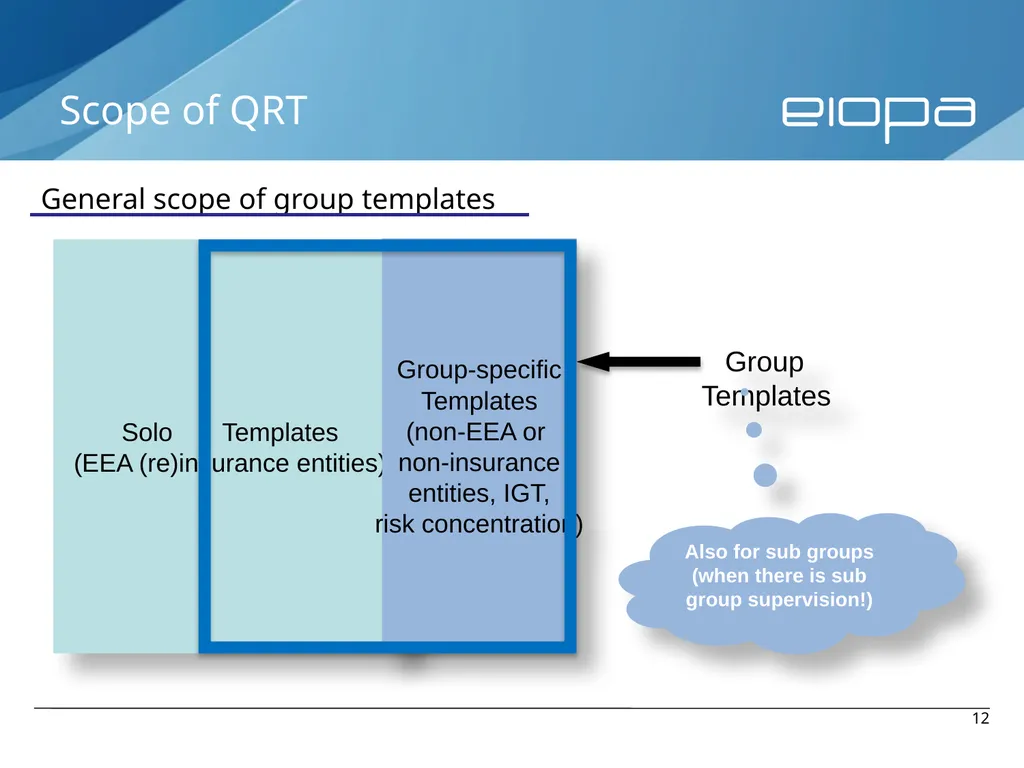
General scope of group templates Scope of QRT<br>
13
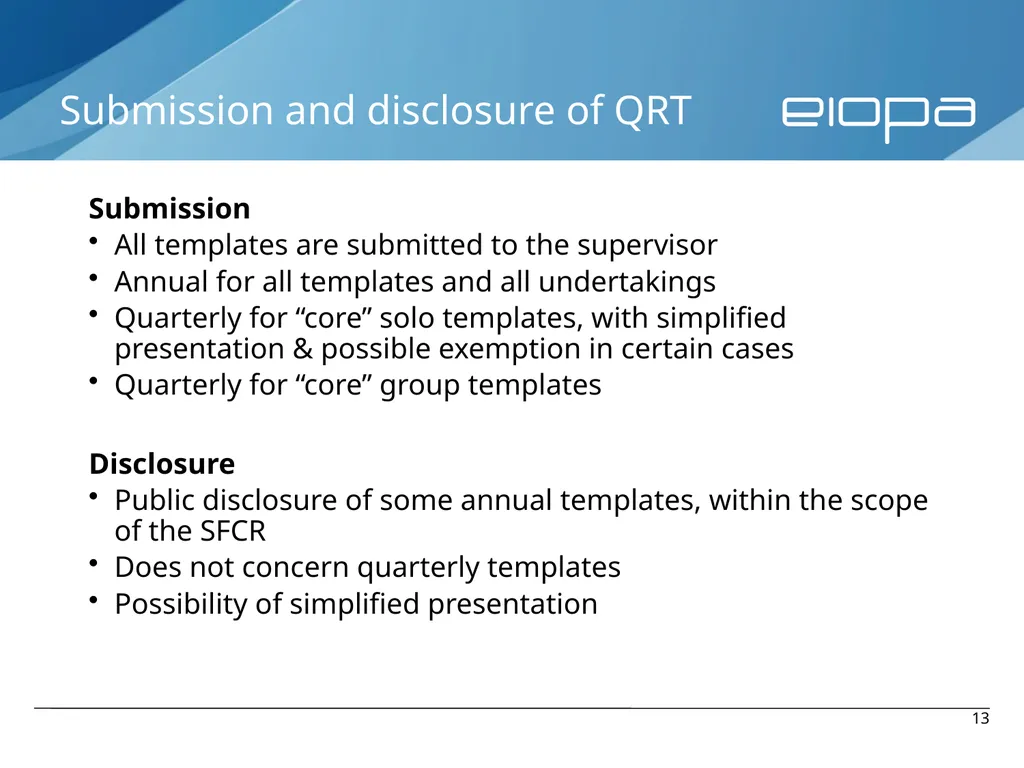
Submission and disclosure of QRT<br>
14
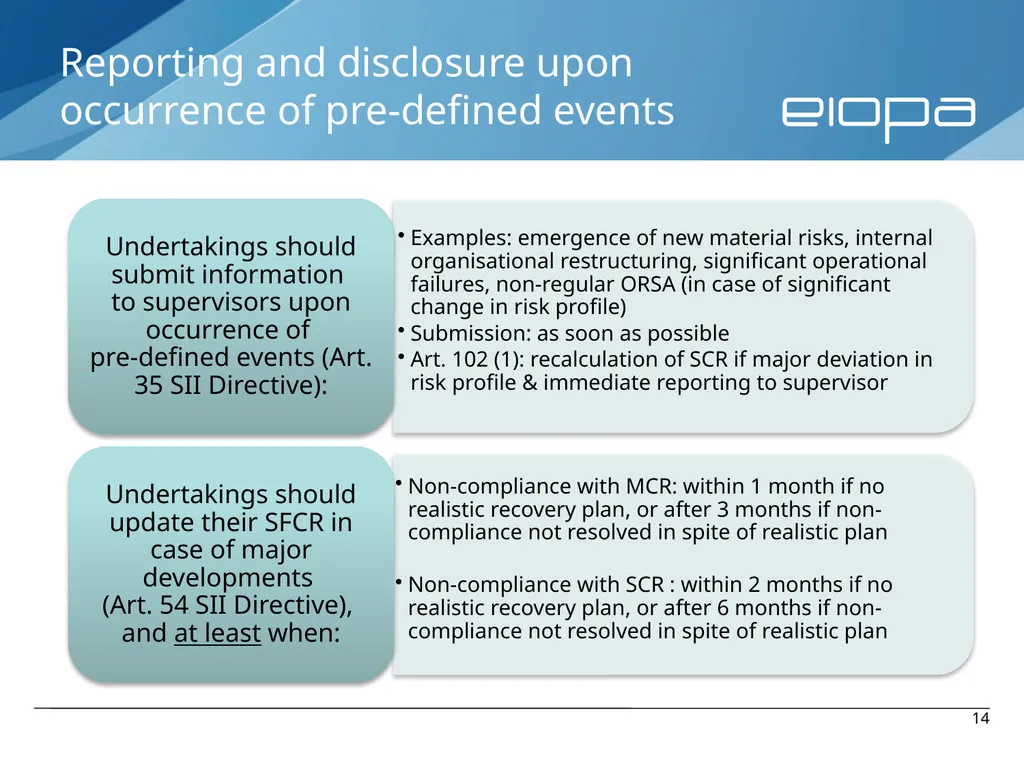
Reporting and disclosure upon occurrence of pre-defined events<br>
15
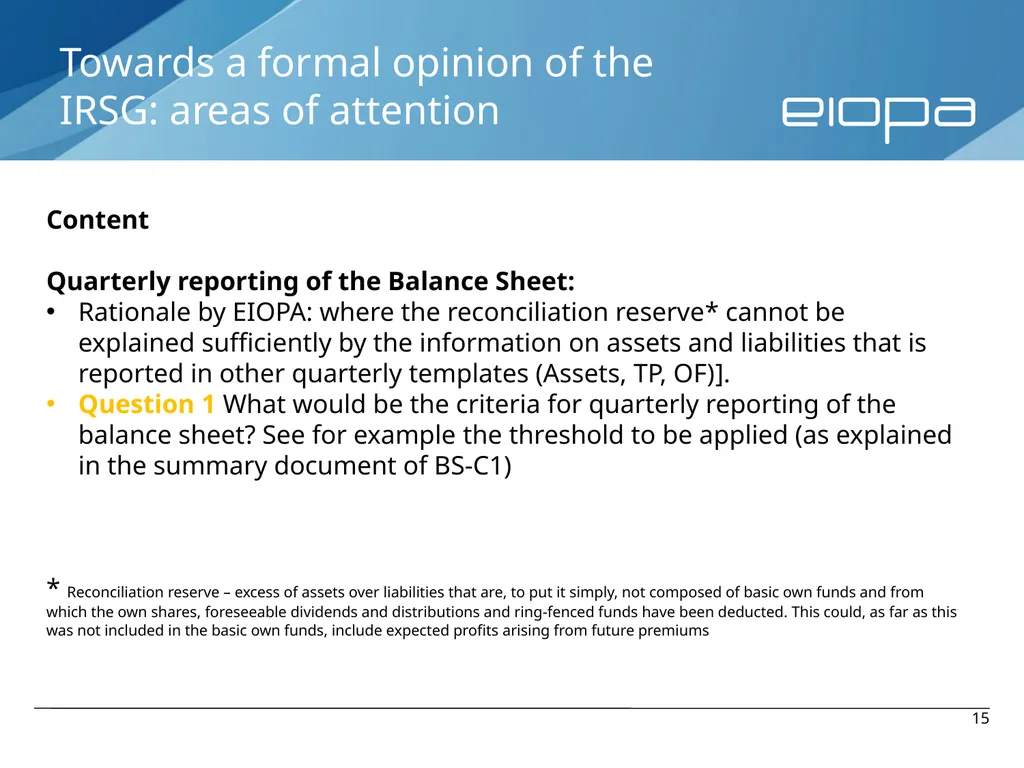
Content
Quarterly reporting of the Balance Sheet:
Rationale by EIOPA: where the reconciliation reserve* cannot be explained sufficiently by the information on assets and liabilities that is reported in other quarterly templates (Assets, TP, OF)].
Question 1 What would be the criteria for quarterly reporting of the balance sheet? See for example the threshold to be applied (as explained in the summary document of BS-C1)
* Reconciliation reserve – excess of assets over liabilities that are, to put it simply, not composed of basic own funds and from which the own shares, foreseeable dividends and distributions and ring-fenced funds have been deducted. This could, as far as this was not included in the basic own funds, include expected profits arising from future premiums Towards a formal opinion of the IRSG: areas of attention<br>
16
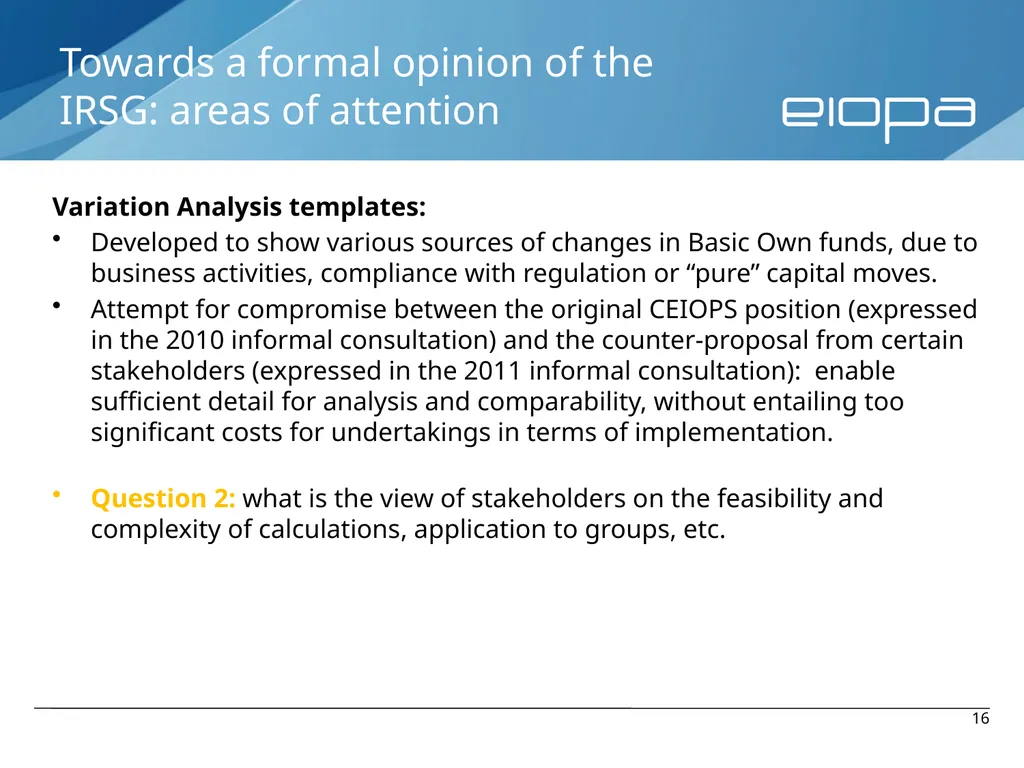
Variation Analysis templates:
Developed to show various sources of changes in Basic Own funds, due to business activities, compliance with regulation or “pure” capital moves.
Attempt for compromise between the original CEIOPS position (expressed in the 2010 informal consultation) and the counter-proposal from certain stakeholders (expressed in the 2011 informal consultation): enable sufficient detail for analysis and comparability, without entailing too significant costs for undertakings in terms of implementation.
Question 2: what is the view of stakeholders on the feasibility and complexity of calculations, application to groups, etc. Towards a formal opinion of the IRSG: areas of attention<br>
17
Risk Concentration reporting through a group-specific template:
The aim of the risk concentration template: list the most important exposures by counterparty (group or/and entity) outside the scope of the re/insurance group (maximum exposure per contract and if a reinsurer fails; off balance sheet risk concentration). Only the most important exposure by counterparty should be listed. The thresholds could be fixed by the group supervisor after consulting the group itself and the College.
Question 3: Should risk concentration exposures be reporting through narrative reporting only, or supported by a specific quantitative template? What should the corresponding guidelines contain in either case? Towards a formal opinion of the IRSG: areas of attention<br>
18
Question 4: Are there any practical or operational issues with the application of the reporting and disclosure requirments which can be identified by undertakings? If any, please describe your concerns and how they could be addressed.
Impact
Question 5: Do you agree with the analysis of the costs and benefits for the implementation of the reporting and disclosure requirements? Are there other costs and negative impacts EIOPA should consider? What benefits may flow from the proposed reporting and disclosure requirements?
For example, what would be the potential impact of ORSA on the pricing, design and availability of insurance products, the corresponding effects for consumers and the wider social or economic impacts even if indirectly?
Other? Towards a formal opinion of the IRSG: areas of attention<br>