Sourcing materials and services Procurement MGT804
Description: Sourcing materials and services Procurement MGT804 Value Chain Management Week 12 Learning Objectives Understand how important sourcing decisions go beyond simple material purchasing decisions. Demonstrate the bullwhip effect and how it
Related Topics
Download Presentation
"Sourcing materials and services Procurement MGT804" is the property of its rightful owner. Permission is granted to download and print the materials on this website for personal, non-commercial use only, and to display it on your personal computer provided you do not modify the materials and that you retain all copyright notices contained in the materials. By downloading content from our website, you accept the terms of this agreement.
Presentation Transcript
slide2. Sourcing materials and services Procurement MGT804 Value Chain Management
Week 12<br>
slide3. Learning Objectives Understand how important sourcing decisions go beyond simple material purchasing decisions.
Demonstrate the “bullwhip effect” and how it is important to synchronize the flow of material between supply chain partners.
Describe how characteristics of supply and demand have an impact on structuring supply chains.
Know the reason for outsourcing capabilities.
Illustrate what “green” sourcing is.
Analyze the total cost of ownership.
Calculate inventory turnover and days of supply.<br>
slide4. Strategic Sourcing Strategic sourcing: the development and management of supplier relationships to acquire goods and services in a way that aids in achieving the immediate needs of the business
In the past, sourcing was another name for purchasing
As a result of globalization, sourcing implies a more complex process suitable for products that are strategically important<br>
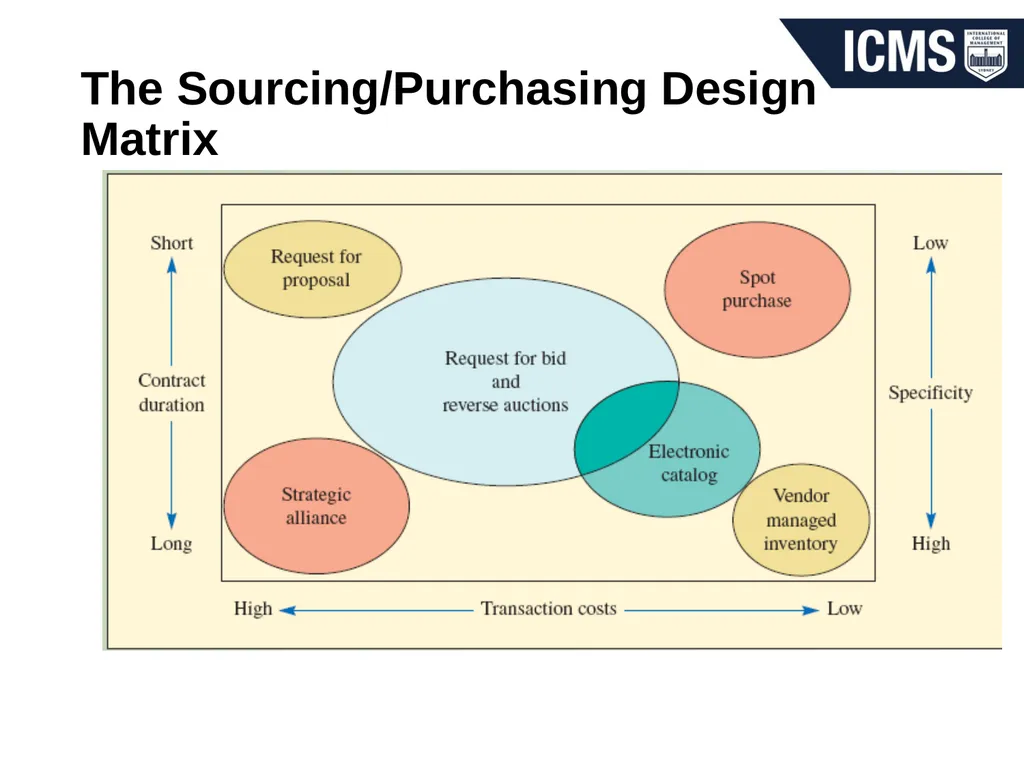
slide5. The Sourcing/Purchasing Design Matrix<br>
slide7. Strategic Sourcing Continued Specificity: refers to how common the item is and, in a relative sense, how many substitutes might be available
Commonly available products can be purchased using a relatively simple process
A request for proposal (RFP) is used for purchasing items that are more complex or expensive and where there may be a number of potential vendors
Vendor managed inventory: when a customer actually allows the supplier to manage an item or group of items for them<br>
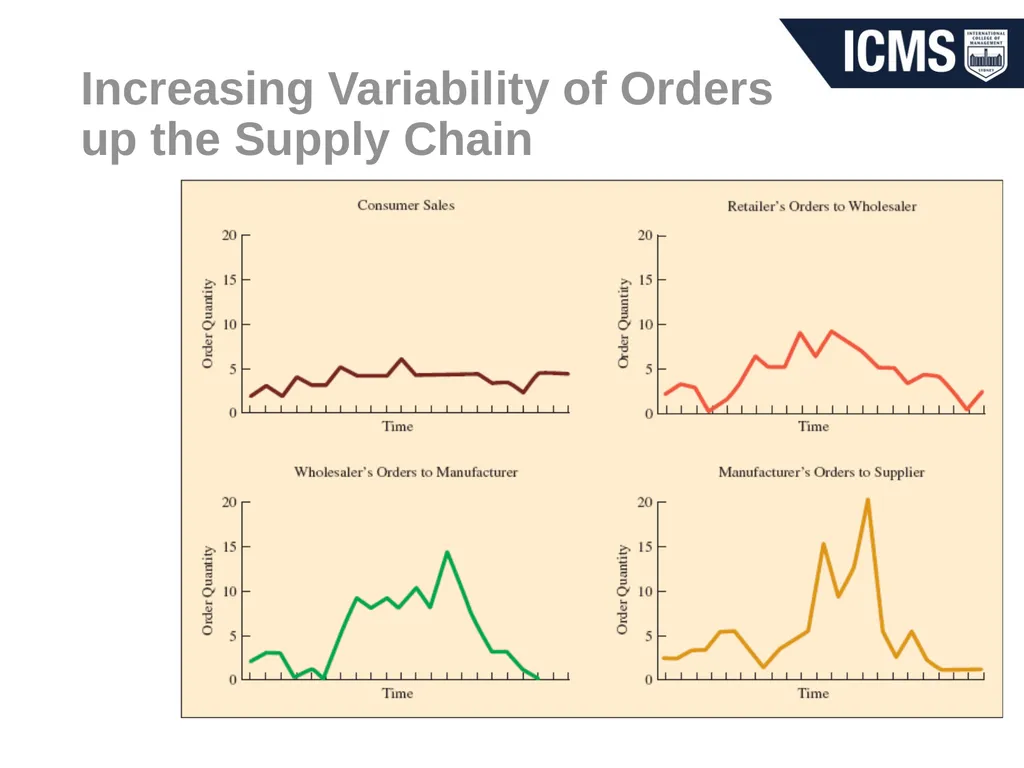
slide8. Increasing Variability of Orders up the Supply Chain<br>
slide9. The Bullwhip Effect Bullwhip effect: phenomenon of variability magnification as we move from the customer to the producer in the supply chain
A slight change in consumer sales ripples backward as magnified oscillations upstream, like the result of a flick of a bullwhip handle
Continuous replenishment: inventory is replaced frequently, as part of an ongoing process<br>
slide10. Functional Products Functional products include the staples that people buy in a wide range of retail outlets, such as grocery stores and gas stations
Product life cycle of more than two years
Contribution margin of 5 to 20 percent
Only 10 to 20 product variations
An average forecast error of only 10 percent
Lead time for make-to-order products of from six months to one year<br>
slide11. Innovative Products Innovation can enable a company to achieve higher profit margins
Newness of the innovative products makes demand
for them unpredictable
Typically have a life cycle of just a few months
Imitators quickly erode the competitive advantage that innovative products enjoy
Companies are forced to introduce a steady stream of newer innovations
The short life cycles and the great variety typical of these products further increase unpredictability<br>
slide12. Four Types of Supply Chain Strategies Efficient supply chains: utilize strategies aimed at creating the highest cost efficiency
Risk-hedging supply chains: utilize strategies aimed at pooling and sharing resources in a supply chain to share risk
Responsive supply chains: utilize strategies aimed at being responsive and flexible
Agile supply chains: utilize strategies aimed at being responsive and flexible to customer needs<br>
slide13. Outsourcing Outsourcing: the act of moving a firm’s internal activities and decision responsibility to outside providers
Allows a company to create a competitive advantage while reducing cost
An entire function may be outsourced, or some elements of an activity may be outsourced, with the rest kept in-house<br>
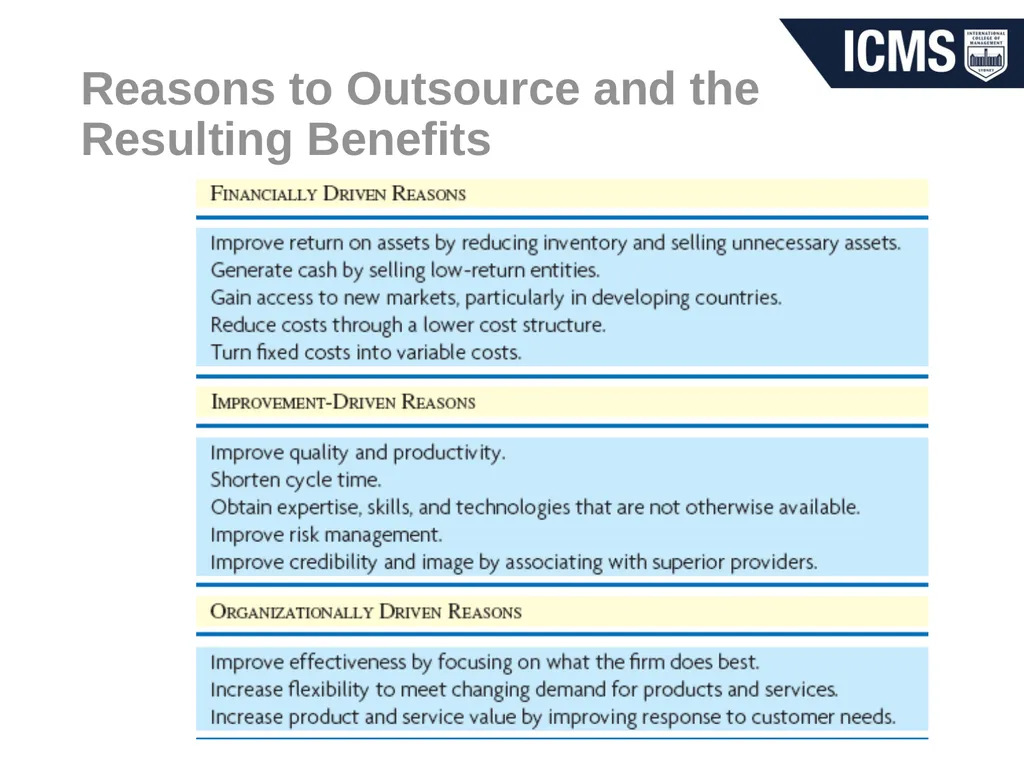
slide14. Reasons to Outsource and the Resulting Benefits<br>
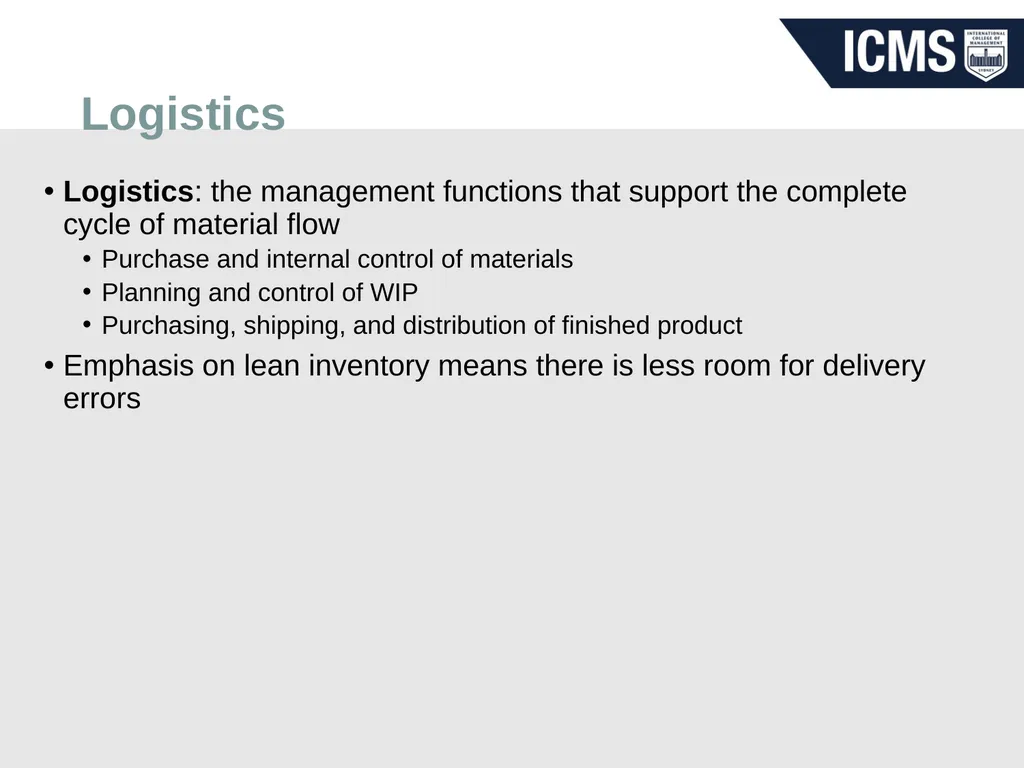
slide15. Logistics Logistics: the management functions that support the complete cycle of material flow
Purchase and internal control of materials
Planning and control of WIP
Purchasing, shipping, and distribution of finished product
Emphasis on lean inventory means there is less room for delivery errors<br>
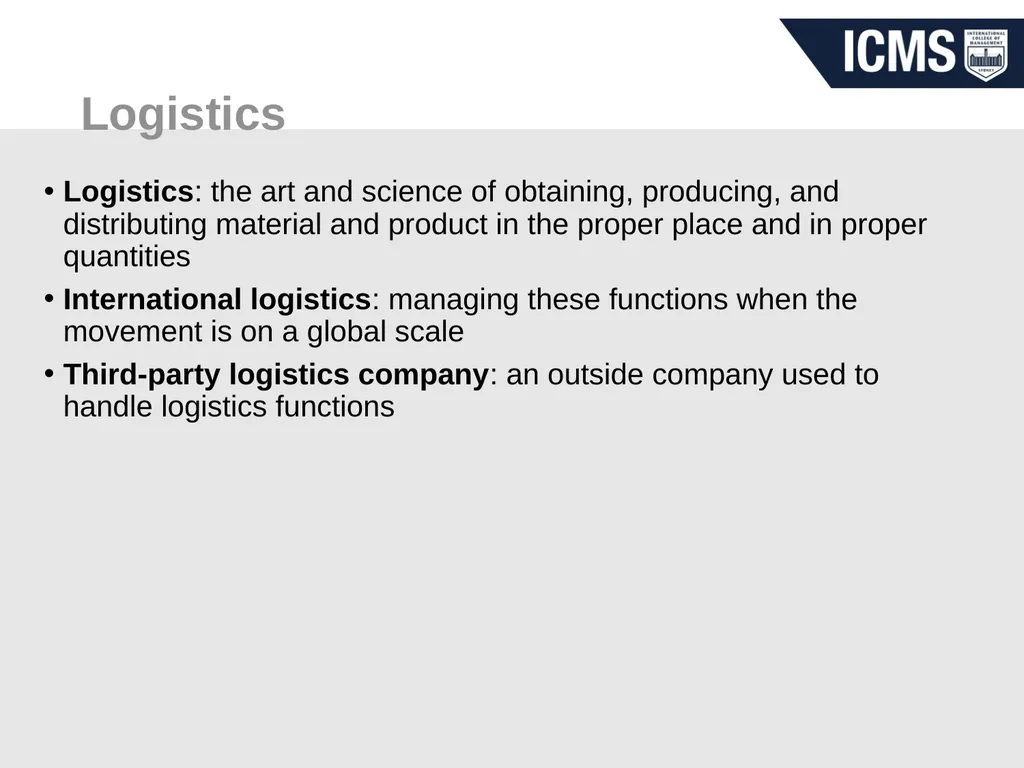
slide16. Logistics Logistics: the art and science of obtaining, producing, and distributing material and product in the proper place and in proper quantities
International logistics: managing these functions when the movement is on a global scale
Third-party logistics company: an outside company used to handle logistics functions<br>
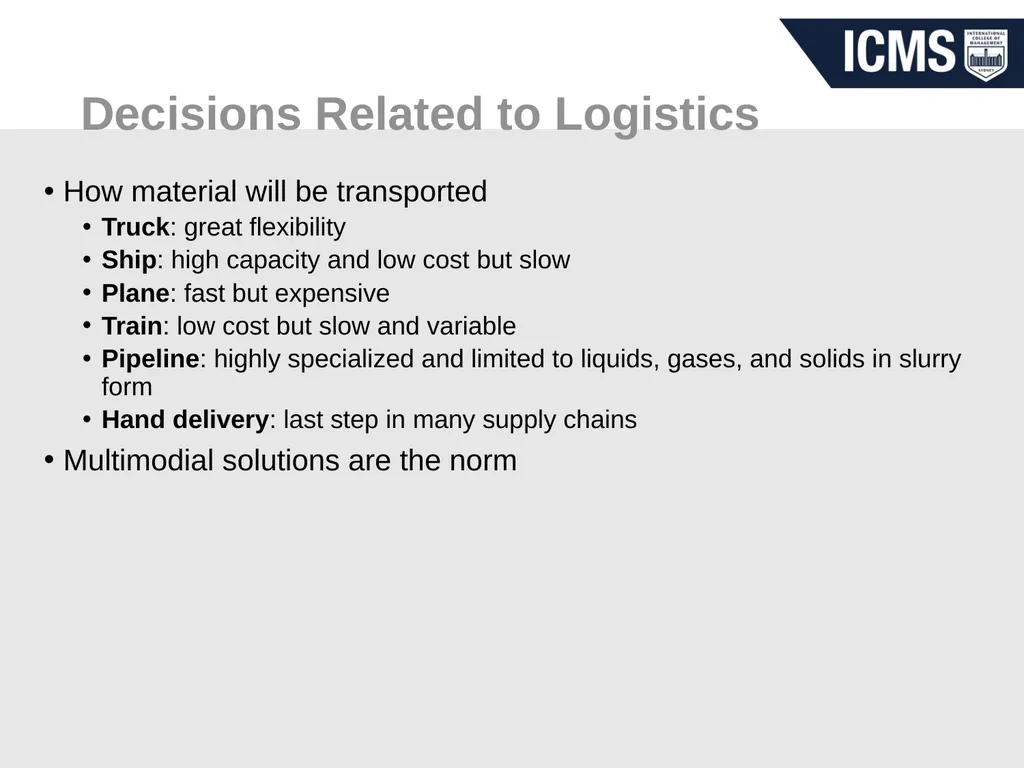
slide17. Decisions Related to Logistics How material will be transported
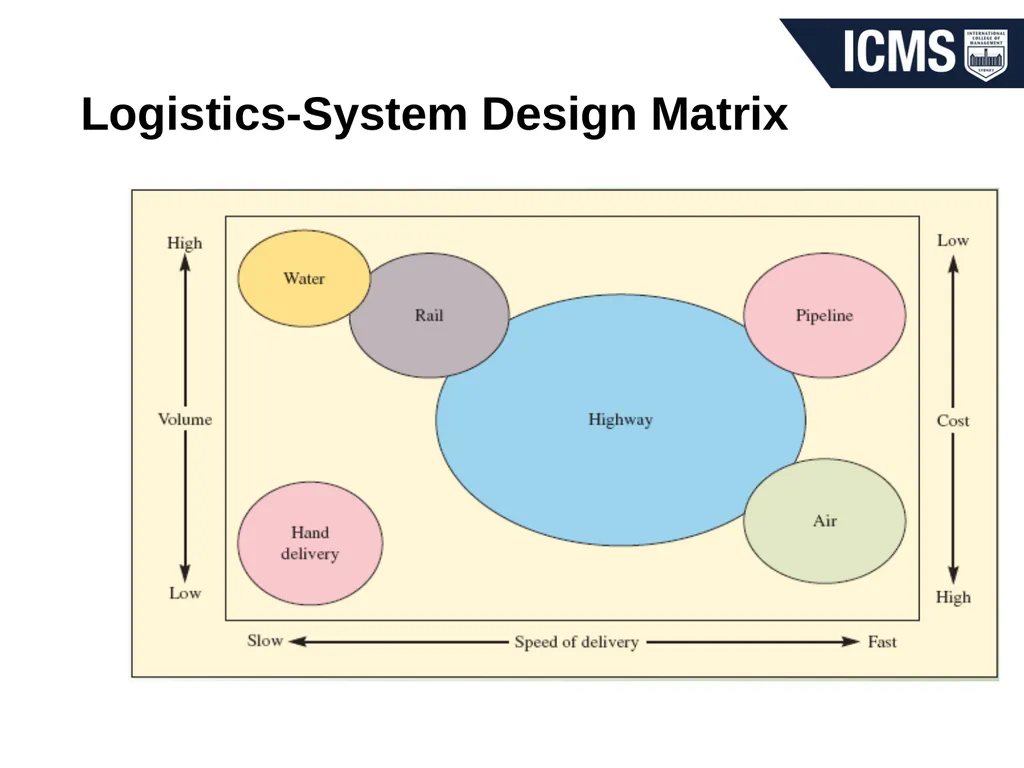
Truck: great flexibility
Ship: high capacity and low cost but slow
Plane: fast but expensive
Train: low cost but slow and variable
Pipeline: highly specialized and limited to liquids, gases, and solids in slurry form
Hand delivery: last step in many supply chains
Multimodial solutions are the norm<br>
slide18. Logistics-System Design Matrix<br>
slide19. Cross-Docking Cross-docking: large shipments are broken down into small shipments for local delivery in an area
Minimizes inventory in the warehouse
Hub-and-spoke systems: the sole purpose of the warehouse (the hub) is sorting goods to consolidation areas, where each area is designed for shipment to a specific location<br>
slide20. Green Sourcing Being environmentally responsible has become a business imperative
Many firms are looking to their supply chains to deliver “green” results
Financial results can often be improved Through going green
A comprehensive green sourcing effort should assess how a company uses items that are purchased internally
It is also important to reduce waste<br>
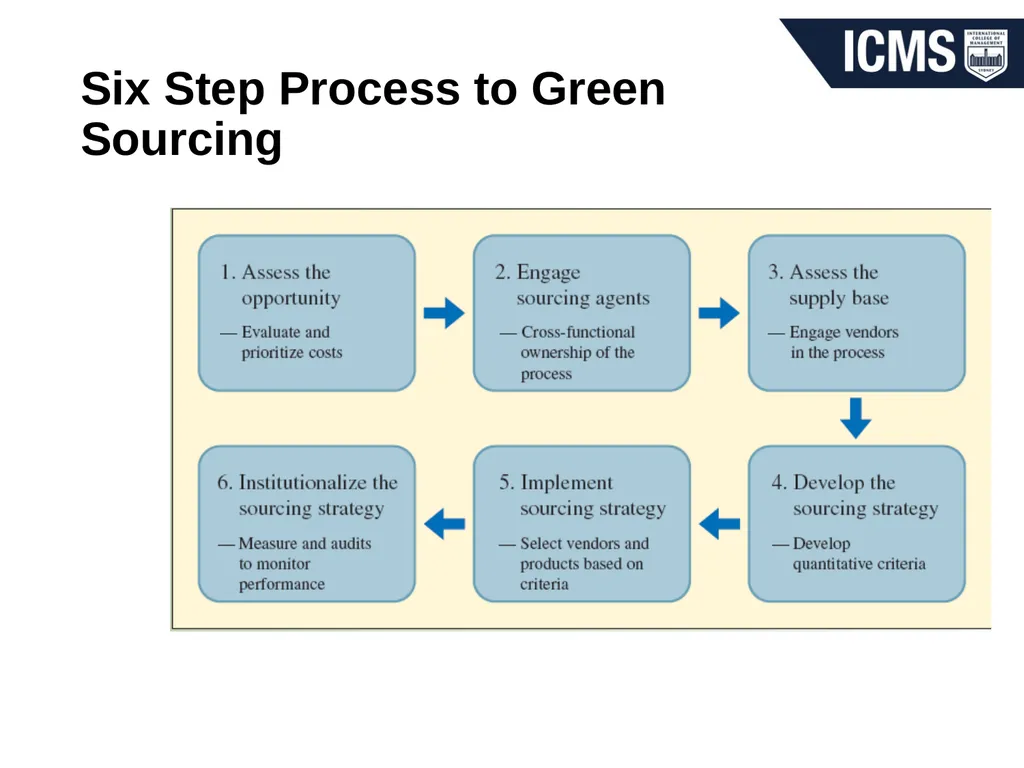
slide21. Six Step Process to Green Sourcing<br>
slide22. Total Cost of Ownership Total cost of ownership (TCO): an estimate of the cost of an item that includes all the costs related to the procurement and use of an item, including any related costs in disposing of the item
Can be applied to internal costs or more broadly to costs throughout the supply chain<br>
slide23. Measuring Sourcing Performance Inventory turnover: how often inventory is replaced during the year
Cost of goods sold: the annual cost for a company to produce the goods or services provided to customers
Average aggregate inventory value: the total value of all items held in inventory
Weeks of supply: how many weeks’ worth of inventory is in the system at a particular point in time<br>
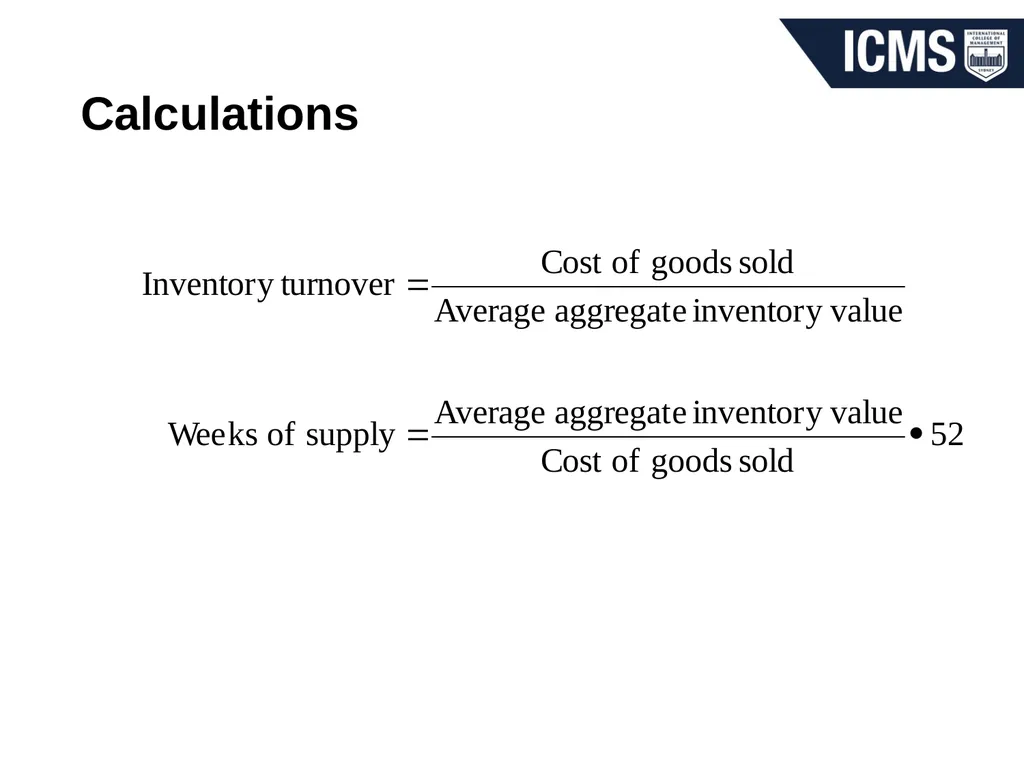
slide24. Calculations<br>
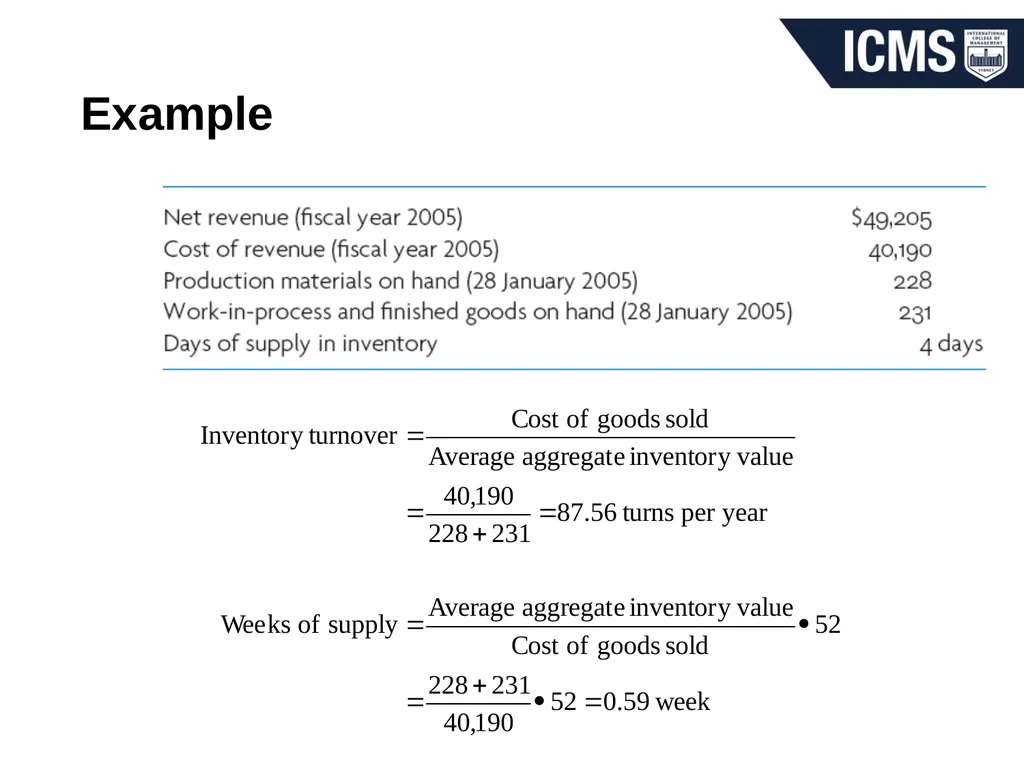
slide25. Example<br>
slide26. Further Reading: Baily, P. (2017). Procurement. In Contracting for Project Management (pp. 105-116). Routledge.
Zincir, O., Ünal, A., & Erdal, M. (2017). Lean and Digital: A Case Study on Procurement and Supply Chain Professionals' Online Social Network. In Key Challenges and Opportunities in Web Entrepreneurship (pp. 79-102). IGI Global.
Kaur, H., & Singh, S. P. (2018). Heuristic modeling for sustainable procurement and logistics in a supply chain using big data. Computers & Operations Research, 98, 301-321.<br>
slide27. Ensafian, H., & Yaghoubi, S. (2017). Robust optimization model for integrated procurement, production and distribution in platelet supply chain. Transportation Research Part E: Logistics and Transportation Review, 103, 32-55.
Ghadge, A., Kidd, E., Bhattacharjee, A., & Tiwari, M. (2018). Sustainable procurement performance of large enterprises across supply chain tiers and geographic regions.
van Dijk, L., & Gunnarsson, J. (2017). Procurement of Sustainable Logistics: Application, transfer, and response to sustainable requirements in the supply chain.<br>

Week 12<br>
slide3. Learning Objectives Understand how important sourcing decisions go beyond simple material purchasing decisions.
Demonstrate the “bullwhip effect” and how it is important to synchronize the flow of material between supply chain partners.
Describe how characteristics of supply and demand have an impact on structuring supply chains.
Know the reason for outsourcing capabilities.
Illustrate what “green” sourcing is.
Analyze the total cost of ownership.
Calculate inventory turnover and days of supply.<br>
slide4. Strategic Sourcing Strategic sourcing: the development and management of supplier relationships to acquire goods and services in a way that aids in achieving the immediate needs of the business
In the past, sourcing was another name for purchasing
As a result of globalization, sourcing implies a more complex process suitable for products that are strategically important<br>
slide5. The Sourcing/Purchasing Design Matrix<br>
slide7. Strategic Sourcing Continued Specificity: refers to how common the item is and, in a relative sense, how many substitutes might be available
Commonly available products can be purchased using a relatively simple process
A request for proposal (RFP) is used for purchasing items that are more complex or expensive and where there may be a number of potential vendors
Vendor managed inventory: when a customer actually allows the supplier to manage an item or group of items for them<br>
slide8. Increasing Variability of Orders up the Supply Chain<br>
slide9. The Bullwhip Effect Bullwhip effect: phenomenon of variability magnification as we move from the customer to the producer in the supply chain
A slight change in consumer sales ripples backward as magnified oscillations upstream, like the result of a flick of a bullwhip handle
Continuous replenishment: inventory is replaced frequently, as part of an ongoing process<br>
slide10. Functional Products Functional products include the staples that people buy in a wide range of retail outlets, such as grocery stores and gas stations
Product life cycle of more than two years
Contribution margin of 5 to 20 percent
Only 10 to 20 product variations
An average forecast error of only 10 percent
Lead time for make-to-order products of from six months to one year<br>
slide11. Innovative Products Innovation can enable a company to achieve higher profit margins
Newness of the innovative products makes demand
for them unpredictable
Typically have a life cycle of just a few months
Imitators quickly erode the competitive advantage that innovative products enjoy
Companies are forced to introduce a steady stream of newer innovations
The short life cycles and the great variety typical of these products further increase unpredictability<br>
slide12. Four Types of Supply Chain Strategies Efficient supply chains: utilize strategies aimed at creating the highest cost efficiency
Risk-hedging supply chains: utilize strategies aimed at pooling and sharing resources in a supply chain to share risk
Responsive supply chains: utilize strategies aimed at being responsive and flexible
Agile supply chains: utilize strategies aimed at being responsive and flexible to customer needs<br>
slide13. Outsourcing Outsourcing: the act of moving a firm’s internal activities and decision responsibility to outside providers
Allows a company to create a competitive advantage while reducing cost
An entire function may be outsourced, or some elements of an activity may be outsourced, with the rest kept in-house<br>
slide14. Reasons to Outsource and the Resulting Benefits<br>
slide15. Logistics Logistics: the management functions that support the complete cycle of material flow
Purchase and internal control of materials
Planning and control of WIP
Purchasing, shipping, and distribution of finished product
Emphasis on lean inventory means there is less room for delivery errors<br>
slide16. Logistics Logistics: the art and science of obtaining, producing, and distributing material and product in the proper place and in proper quantities
International logistics: managing these functions when the movement is on a global scale
Third-party logistics company: an outside company used to handle logistics functions<br>
slide17. Decisions Related to Logistics How material will be transported
Truck: great flexibility
Ship: high capacity and low cost but slow
Plane: fast but expensive
Train: low cost but slow and variable
Pipeline: highly specialized and limited to liquids, gases, and solids in slurry form
Hand delivery: last step in many supply chains
Multimodial solutions are the norm<br>
slide18. Logistics-System Design Matrix<br>
slide19. Cross-Docking Cross-docking: large shipments are broken down into small shipments for local delivery in an area
Minimizes inventory in the warehouse
Hub-and-spoke systems: the sole purpose of the warehouse (the hub) is sorting goods to consolidation areas, where each area is designed for shipment to a specific location<br>
slide20. Green Sourcing Being environmentally responsible has become a business imperative
Many firms are looking to their supply chains to deliver “green” results
Financial results can often be improved Through going green
A comprehensive green sourcing effort should assess how a company uses items that are purchased internally
It is also important to reduce waste<br>
slide21. Six Step Process to Green Sourcing<br>
slide22. Total Cost of Ownership Total cost of ownership (TCO): an estimate of the cost of an item that includes all the costs related to the procurement and use of an item, including any related costs in disposing of the item
Can be applied to internal costs or more broadly to costs throughout the supply chain<br>
slide23. Measuring Sourcing Performance Inventory turnover: how often inventory is replaced during the year
Cost of goods sold: the annual cost for a company to produce the goods or services provided to customers
Average aggregate inventory value: the total value of all items held in inventory
Weeks of supply: how many weeks’ worth of inventory is in the system at a particular point in time<br>
slide24. Calculations<br>
slide25. Example<br>
slide26. Further Reading: Baily, P. (2017). Procurement. In Contracting for Project Management (pp. 105-116). Routledge.
Zincir, O., Ünal, A., & Erdal, M. (2017). Lean and Digital: A Case Study on Procurement and Supply Chain Professionals' Online Social Network. In Key Challenges and Opportunities in Web Entrepreneurship (pp. 79-102). IGI Global.
Kaur, H., & Singh, S. P. (2018). Heuristic modeling for sustainable procurement and logistics in a supply chain using big data. Computers & Operations Research, 98, 301-321.<br>
slide27. Ensafian, H., & Yaghoubi, S. (2017). Robust optimization model for integrated procurement, production and distribution in platelet supply chain. Transportation Research Part E: Logistics and Transportation Review, 103, 32-55.
Ghadge, A., Kidd, E., Bhattacharjee, A., & Tiwari, M. (2018). Sustainable procurement performance of large enterprises across supply chain tiers and geographic regions.
van Dijk, L., & Gunnarsson, J. (2017). Procurement of Sustainable Logistics: Application, transfer, and response to sustainable requirements in the supply chain.<br>