SPACE ANALYSIS Adequacy of space is the first criterion for a well-aligned dental arch. Early correction of the space discrepancies prevent unfavourable events such as crowding of teeth. The difference between the amount of space available
"SPACE ANALYSIS Adequacy of space is the first" is the property of its rightful owner. Permission is granted to
download and print the materials on this website for personal, non-commercial use only, and to display it
on your personal computer provided you do not modify the materials and that you retain all copyright
notices contained in the materials. By downloading content from our website, you accept the terms of this
agreement.
Share
Embed code
Presentation Transcript
01
SPACE ANALYSIS Adequacy of space is the first criterion for a well-aligned dental arch.
Early correction of the space discrepancies prevent unfavourable events such as crowding of teeth.
The difference between the amount of space available in the arch perimeter and the amount of space required to accommodate erupting permanent teeth has to be measured to identify these space discrepancies. This is done by space analysis.
Space analysis constitutes assessment of the arch length, arch perimeter, arch width, and tooth material.
It is an ideal tool that measures the space available for erupting and the space required for their normal positioning in the dental arch.
It is used to predict, anticipate and prevent malocclusion or reduce its severity.
The space analysis can be done at the mixed dentition period and permanent dentition period.
The mixed dentition is done when the permanent lower incisors and 1st permanent molars are present<br>
02
TANAKA- JOHNSTON ANALYSIS According to this method width of lower permanent incisors is proportional to the combined width of permanent canine and premolars in both upper and lower arch.
ADVANTAGES;
1.The technique is simple.
2. Minimal material needs.
3. It does not use prediction charts or radiographs.
LIMITATIONS;
May show some error if patient are not of Northwestern European descent.<br>
03
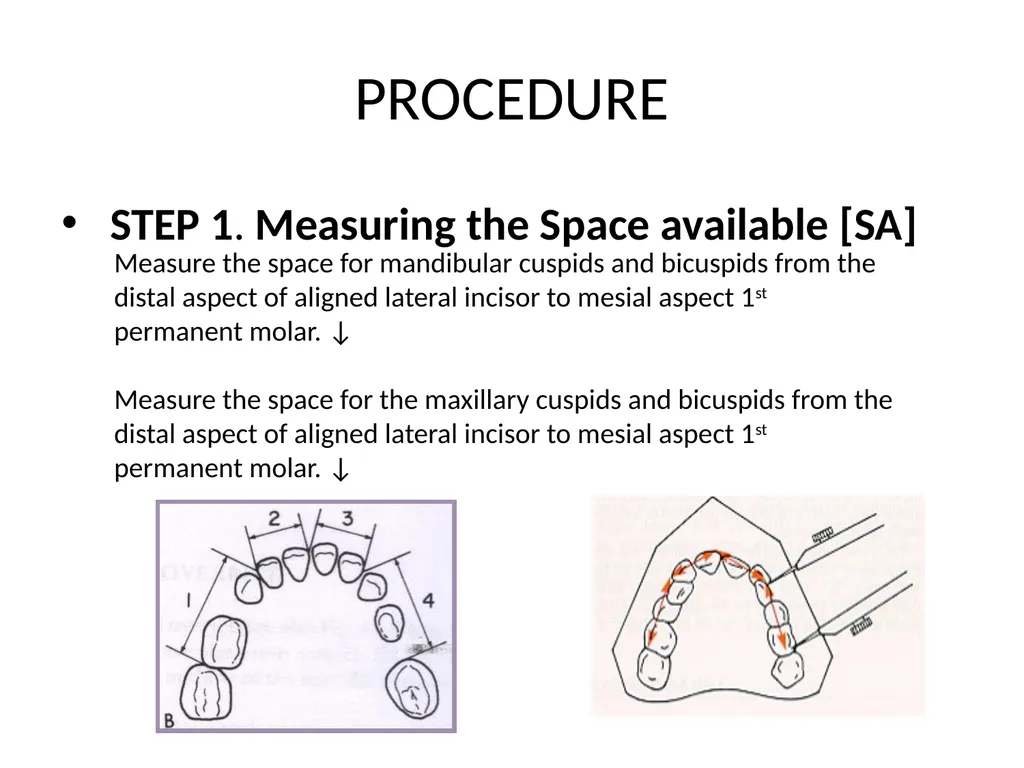
PROCEDURE STEP 1. Measuring the Space available [SA] Measure the space for mandibular cuspids and bicuspids from the distal aspect of aligned lateral incisor to mesial aspect 1st permanent molar. ↓
Measure the space for the maxillary cuspids and bicuspids from the distal aspect of aligned lateral incisor to mesial aspect 1st permanent molar. ↓<br>
04
STEP 2. Measuring lower incisors Measure the mesiodistal width of mandibular central and lateral incisors and divide the sum by 2. [#31 + #32 + #41 +#42]mm ÷ 2 = A
STEP 3. Add the constant value & calculating the Space required[SR]
→ For Maxilla-- add 11mm [ A + 11mm]= Predicted sum of width of maxillary canine and premolar on one side.
→ For Mandible– add 10.5 [ A + 10.5mm]= Predicted sum of width of mandibular canine and premolar on one side.
THIS TOTAL GIVES THE ESTIMATED SIZE OF CANINE AND TWO PREMOLARS IN ONE QUADRANT.<br>
05
STEP 4. Measuring space discrepancy
Difference between SA and SR for maxillary and mandibular arches measured [SA –SR]
STEP 5 . Conclusion
Positive value means space is adequate. Negative value means space is deficient.<br>
06
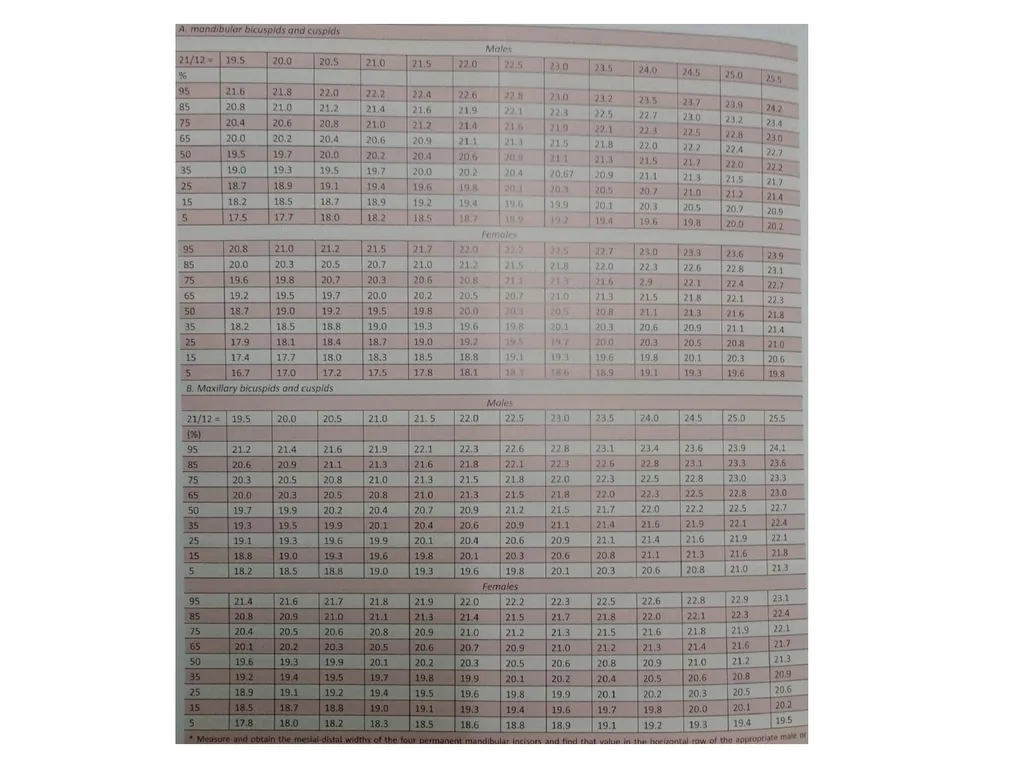
MOYER’S MIXED DENTITION ANALYSIS According to Moyer’s there exist a high correlation between the width of permanent lower incisors, permanent canines and premolars, thus making it possible to predict the size of un-erupted teeth
If the M-D width of the permanent lower incisors is known, the sum of widths of unerupted canine and premolars can be predicted from Moyer’s prediction chart.
The chart gives different sets of predicted sizes for a given width of lower incisors.
The 75% prediction value is generally used for predicting the size of unerupted teeth, with the hope that the reliability is higher. That means the prediction value is applicable for 75% of the population.<br>
07
ADVANTAGES;
It is less time consuming.
It requires no special equipment.
It may be used on both the arches.<br>
08
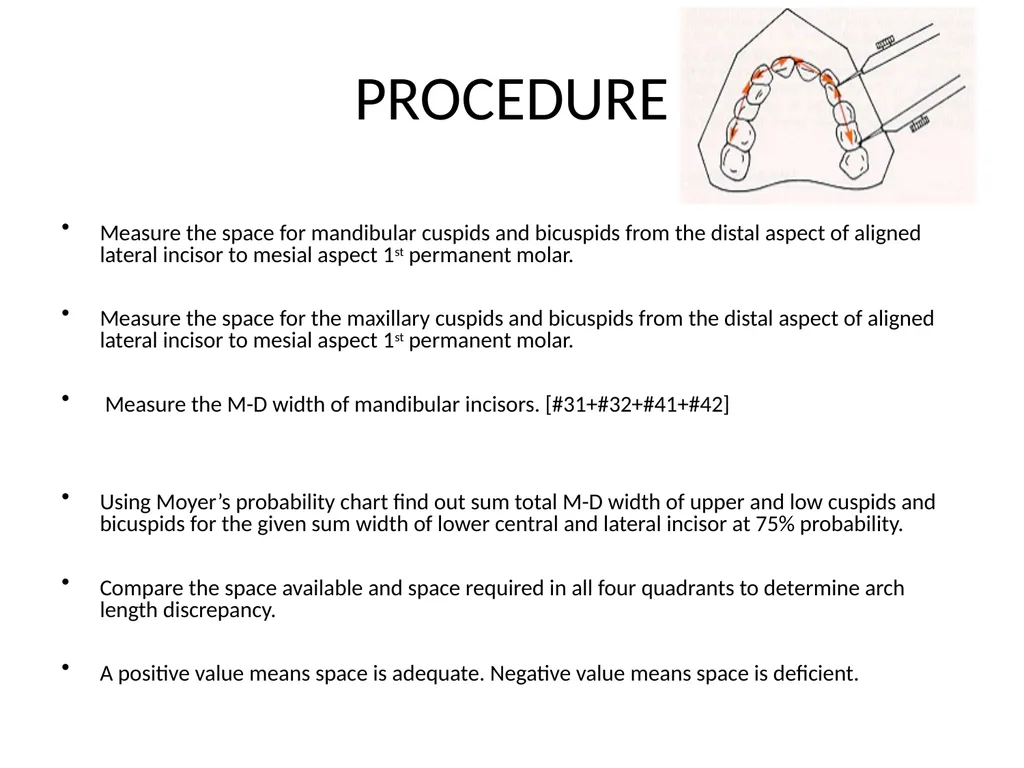
PROCEDURE Measure the space for mandibular cuspids and bicuspids from the distal aspect of aligned lateral incisor to mesial aspect 1st permanent molar.
Measure the space for the maxillary cuspids and bicuspids from the distal aspect of aligned lateral incisor to mesial aspect 1st permanent molar.
Measure the M-D width of mandibular incisors. [#31+#32+#41+#42]
Using Moyer’s probability chart find out sum total M-D width of upper and low cuspids and bicuspids for the given sum width of lower central and lateral incisor at 75% probability.
Compare the space available and space required in all four quadrants to determine arch length discrepancy.
A positive value means space is adequate. Negative value means space is deficient.<br>
09
HUCKABA’S ANALYSIS He used both study cast and radiograph for determining the width of unerupted tooth.
To compensate for enlargment of radiographic images, measure an object that can be seen both in radiograph and on the cast.
This technique can be used both in maxillary and mandibular arches in all ethical groups.<br>
10
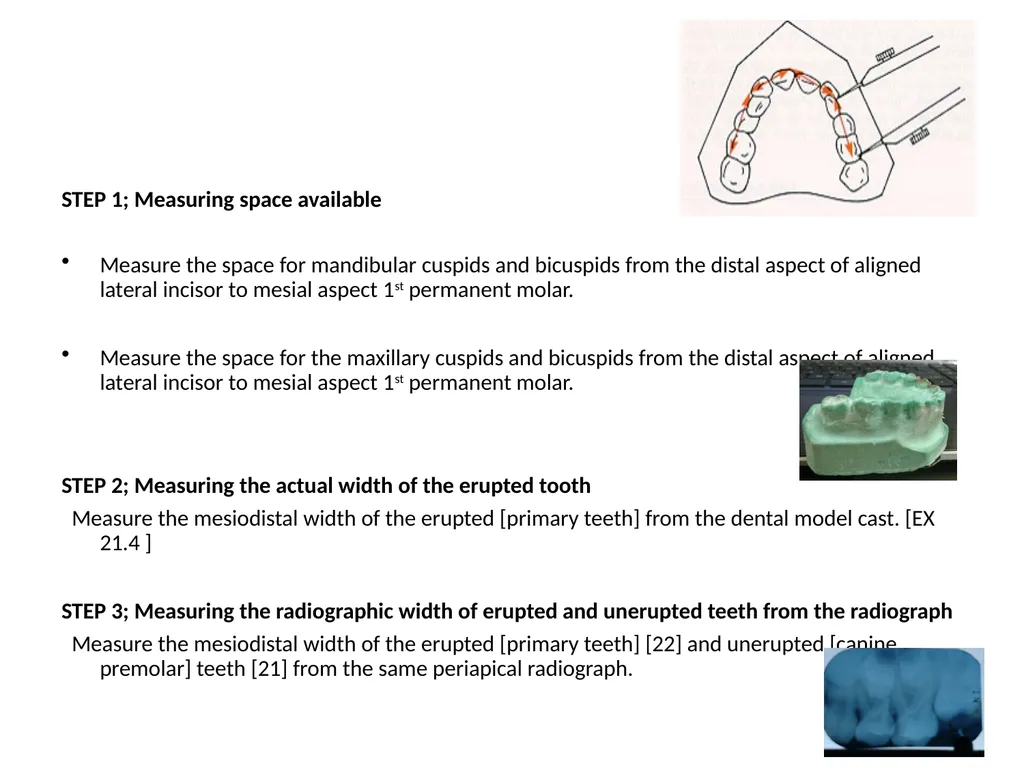
STEP 1; Measuring space available
Measure the space for mandibular cuspids and bicuspids from the distal aspect of aligned lateral incisor to mesial aspect 1st permanent molar.
Measure the space for the maxillary cuspids and bicuspids from the distal aspect of aligned lateral incisor to mesial aspect 1st permanent molar.
STEP 2; Measuring the actual width of the erupted tooth
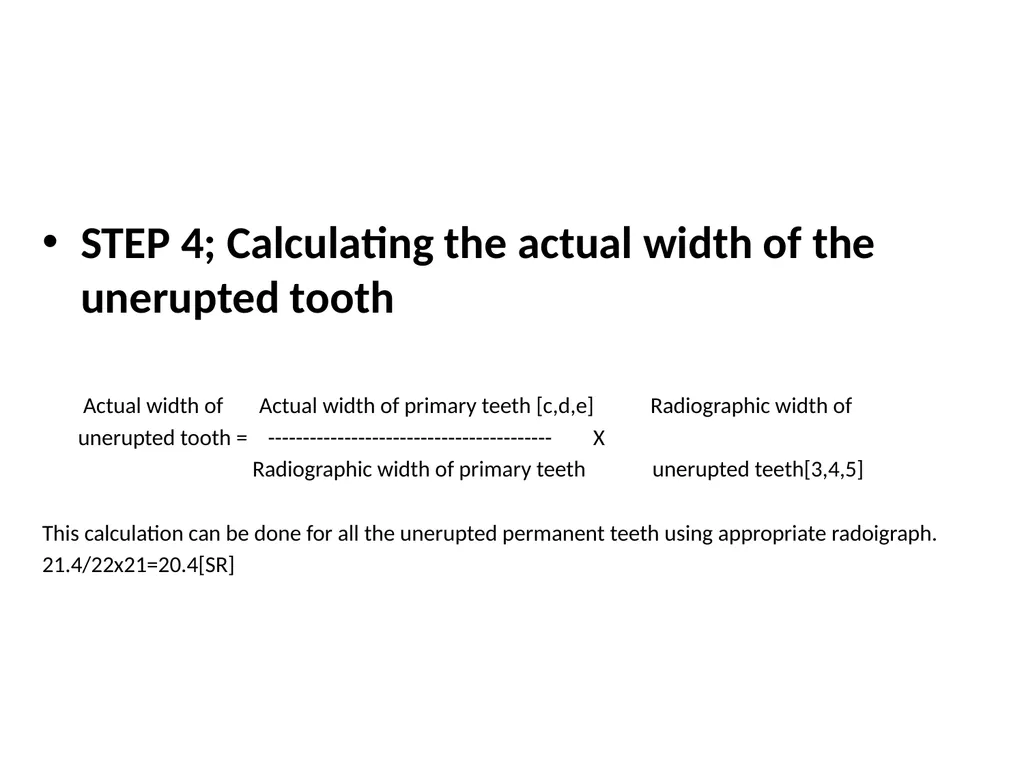
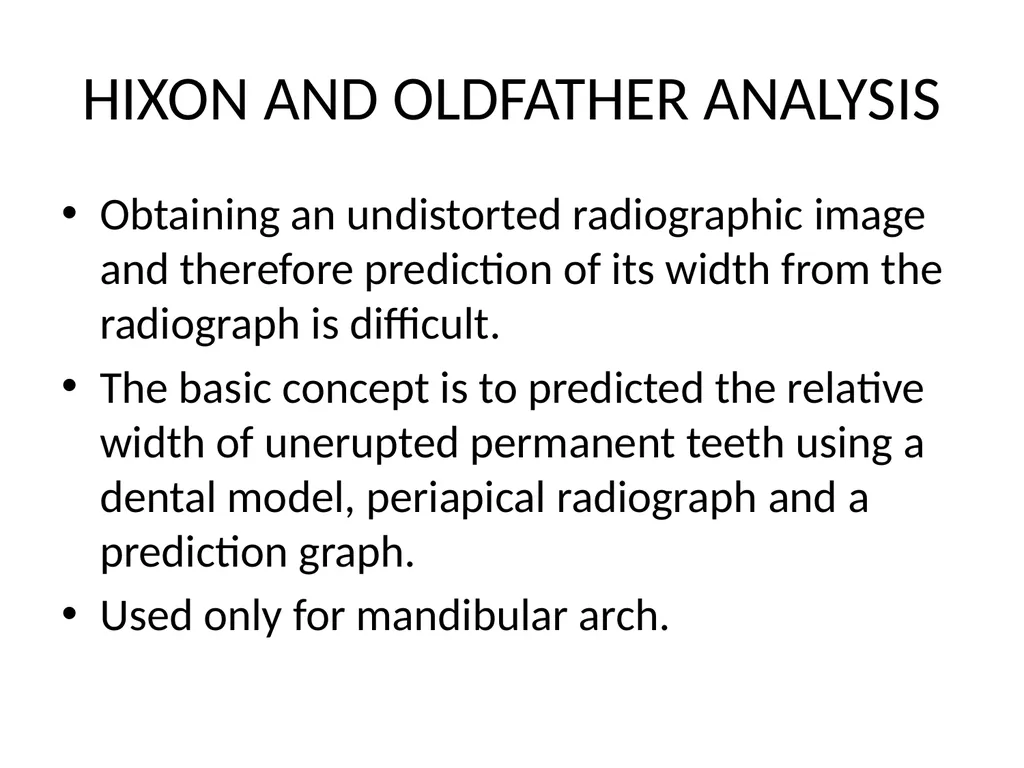
Measure the mesiodistal width of the erupted [primary teeth] from the dental model cast. [EX 21.4 ]
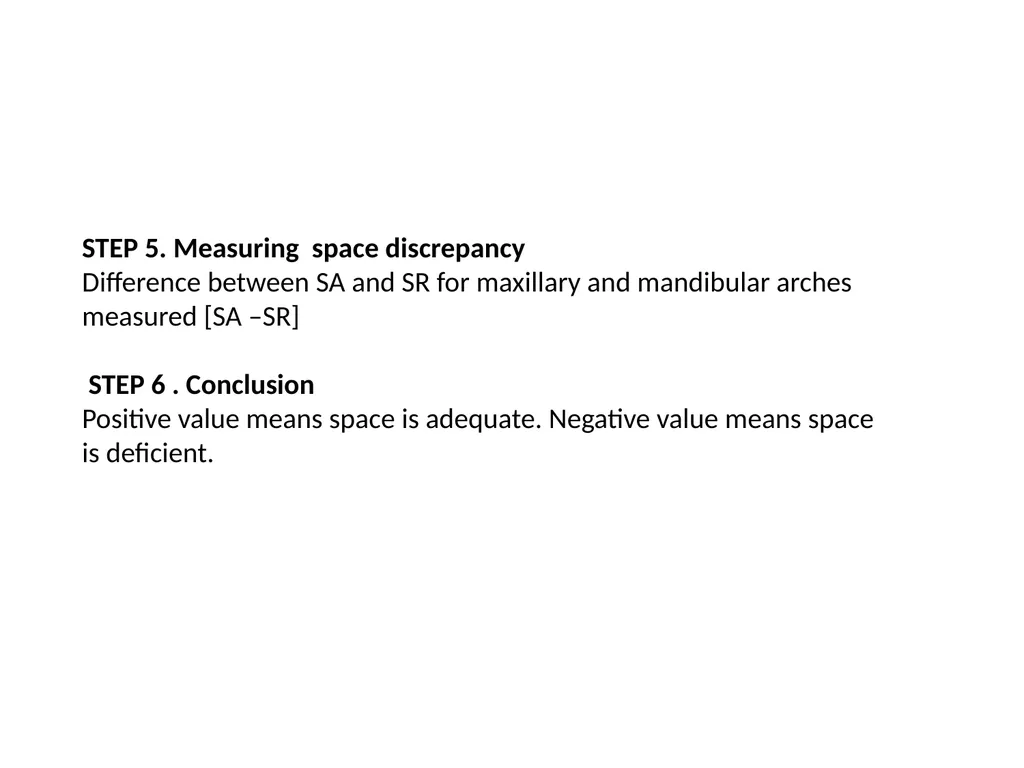
STEP 3; Measuring the radiographic width of erupted and unerupted teeth from the radiograph
Measure the mesiodistal width of the erupted [primary teeth] [22] and unerupted [canine, premolar] teeth [21] from the same periapical radiograph.<br>
11
STEP 4; Calculating the actual width of the unerupted tooth
Actual width of Actual width of primary teeth [c,d,e] Radiographic width of
unerupted tooth = ----------------------------------------- X
Radiographic width of primary teeth unerupted teeth[3,4,5]
This calculation can be done for all the unerupted permanent teeth using appropriate radoigraph.
21.4/22x21=20.4[SR]<br>
12
STEP 5. Measuring space discrepancy
Difference between SA and SR for maxillary and mandibular arches measured [SA –SR]
STEP 6 . Conclusion
Positive value means space is adequate. Negative value means space is deficient.<br>
13
HIXON AND OLDFATHER ANALYSIS Obtaining an undistorted radiographic image and therefore prediction of its width from the radiograph is difficult.
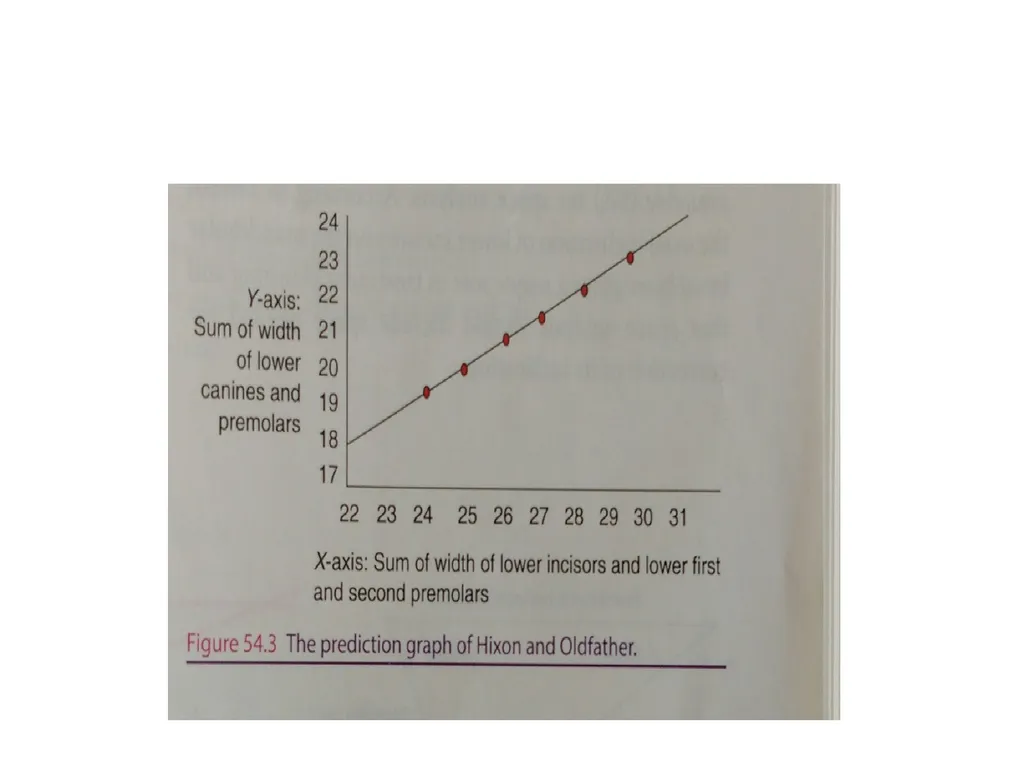
The basic concept is to predicted the relative width of unerupted permanent teeth using a dental model, periapical radiograph and a prediction graph.
Used only for mandibular arch.<br>
14
PROCEDURE STEP 1; Measuring space available [S A]
Measure the space from the distal aspect of aligned lateral incisor to mesial aspect 1st permanent molar.
STEP 2. Measuring lower incisors
From the cast , on one side, measure the M-D width of permanent central and lateral incisors. [#31+#32=11]
STEP 3. Measuring the radiographic width of premolars
Determine the M - D width of the unerupted premolars from the IOPAR with paralleling technique. [Ex {Mand 4+5} 7+7 =14]
STEP 4. Sum up Step 2 and 3
Sum up the width of central and lateral incisor along with the width of unerupted premolars of that particular side.[ 11+14 =25]
STEP 5. Estimate the actual width of unerupted teeth
Estimated sum width of the cuspids and bicuspids of that particular side can be obtained from the standard graph.
Measured sum width of incisors and bicuspids has a corresponding sum width of the cuspids and premolars in the graph.<br>