Space Careers Communicating in Space 1 There are many challenges associated with space exploration whether it be retrieving data collected by satellites or communicating with astronauts aboard a rocket bound for the Moon. Just one of these
"Space Careers Communicating in Space 1 There are" is the property of its rightful owner. Permission is granted to
download and print the materials on this website for personal, non-commercial use only, and to display it
on your personal computer provided you do not modify the materials and that you retain all copyright
notices contained in the materials. By downloading content from our website, you accept the terms of this
agreement.
Presentation Transcript
01
Space Careers Communicating in Space 1 There are many challenges associated with space exploration whether it be retrieving data collected by satellites or communicating with astronauts aboard a rocket bound for the Moon. Just one of these is the rate/speed at which we are able to carry out these tasks.
To give some idea of this challenge here are a few simple calculations to perform.
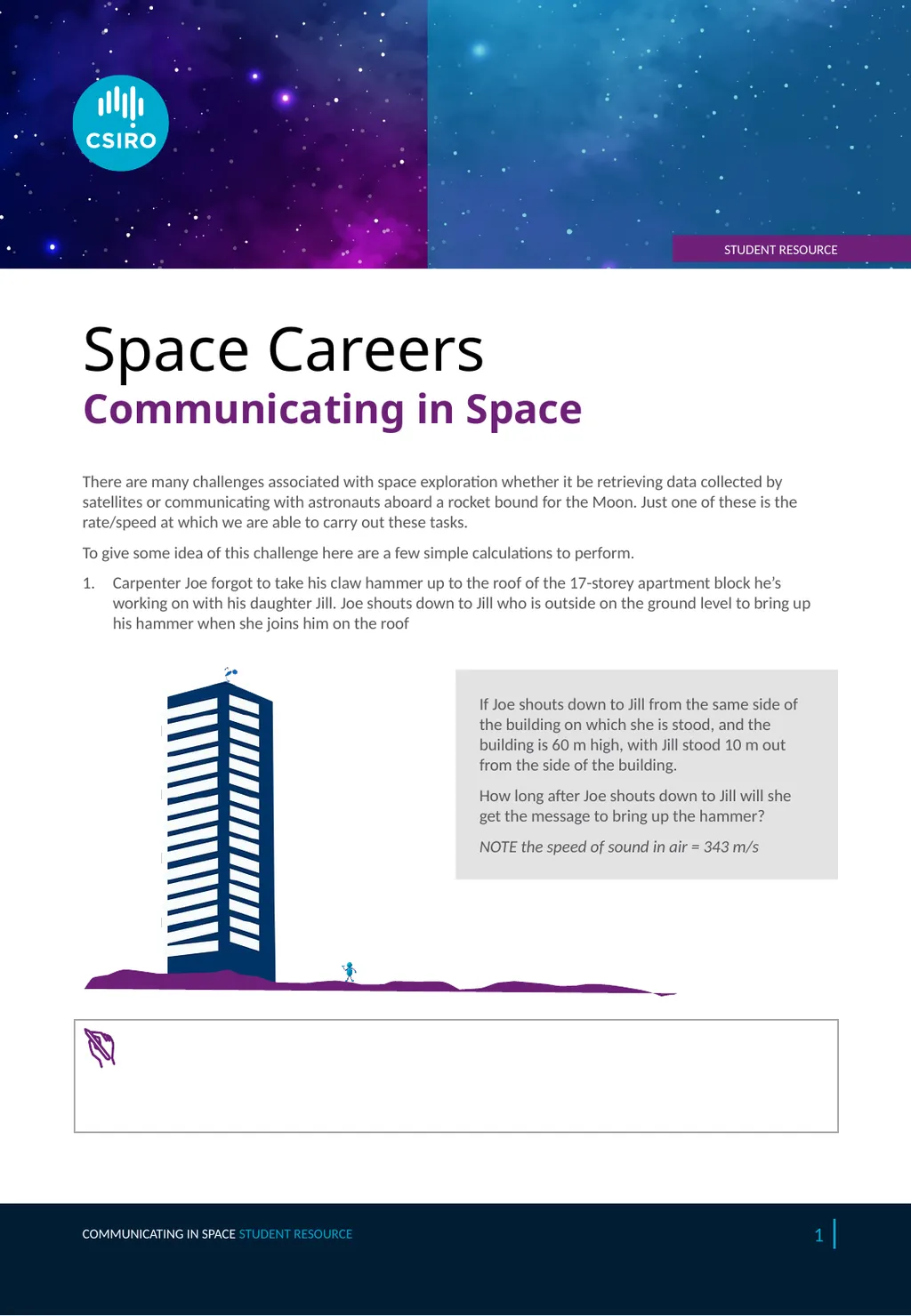
Carpenter Joe forgot to take his claw hammer up to the roof of the 17-storey apartment block he’s working on with his daughter Jill. Joe shouts down to Jill who is outside on the ground level to bring up his hammer when she joins him on the roof If Joe shouts down to Jill from the same side of the building on which she is stood, and the building is 60 m high, with Jill stood 10 m out from the side of the building.
How long after Joe shouts down to Jill will she get the message to bring up the hammer?
NOTE the speed of sound in air = 343 m/s Communicating in space STUDENT RESOURCE<br>
02
Communicating in Space, page 2 If Joe had taken the UHF radio with him to communicate his request to Jill, how long would the message take in this instance. Assuming the message is travelling the same distance and the radio wave travels at the speed of light
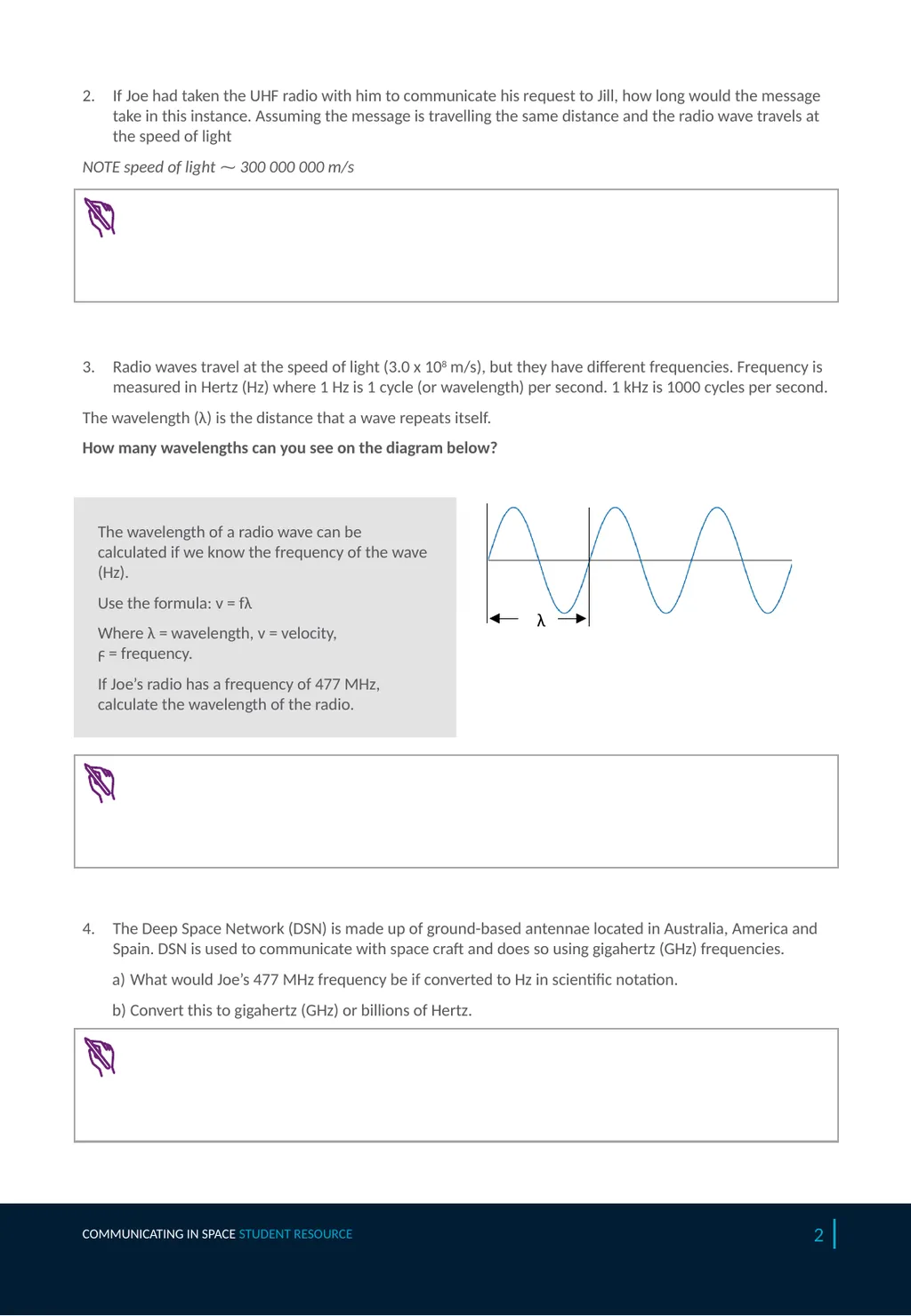
NOTE speed of light ⁓ 300 000 000 m/s 2 Radio waves travel at the speed of light (3.0 x 10⁸ m/s), but they have different frequencies. Frequency is measured in Hertz (Hz) where 1 Hz is 1 cycle (or wavelength) per second. 1 kHz is 1000 cycles per second.
The wavelength (λ) is the distance that a wave repeats itself.
How many wavelengths can you see on the diagram below? The wavelength of a radio wave can be calculated if we know the frequency of the wave (Hz).
Use the formula: v = fλ
Where λ = wavelength, v = velocity, ϝ = frequency.
If Joe’s radio has a frequency of 477 MHz, calculate the wavelength of the radio. λ The Deep Space Network (DSN) is made up of ground-based antennae located in Australia, America and Spain. DSN is used to communicate with space craft and does so using gigahertz (GHz) frequencies.
What would Joe’s 477 MHz frequency be if converted to Hz in scientific notation.
Convert this to gigahertz (GHz) or billions of Hertz. Communicating in space STUDENT RESOURCE<br>
03
Communicating in Space, page 3 3 If radio signals used for communication do travel at the speed of light (⁓ 300 000 000 m/s) how long would it take to get a message to the following:
International Space Station, mean distance from Earth 400 km
The Moon, mean distance from Earth 384 400 km
Mars, when 225 000 000 km distance from Earth
Robots or remote-control units on other planets?
Robots can use sensors and make predetermined decisions based on these inputs without any further input from people. They have automatic responses in many respects. Remote control units have information that can be sent to people but will not deviate in speed or pathway unless instructions are sent to the unit by people on Earth. They are manual units and not automatic.
A remote-control Mars unit is travelling at maximum speed (4.2 cm/s) in a straight line. If ordered to halt immediately, it can stop within a negligible distance. Scientists on Earth watching from an onboard camera notice a deep ravine exactly 50 metres ahead and immediately send a ‘stop’ message.
Assuming it takes one second for humans to react and send the ‘stop’ message, how far will the unit move before it stops? Would you recommend using robots or remote control for Mars vehicles?
Hint – Factor in the time it takes for the camera footage to travel from Mars to Earth. Use the result from 5 iii.
Compare this with the time delays with communications between the Earth and the moon. Communicating in space STUDENT RESOURCE<br>
04
Communicating in Space, page 4 4 As we explore the outer reaches of space and NASA plan a return to the Moon and beyond, scientists are looking at ways they can accommodate the ever-increasing amount of data being collected. Traditionally the data has been beamed back to Earth using radio waves. Now agencies such as NASA are actively investigating the use of lasers to perform this task.
Using the internet and other sources compile a table comparing the radio wave communication with laser communication. Your table should include any advantages and disadvantages of each system, any challenges and possible solutions to the challenges. Scientists predict the increased likelihood of climate change and the impact this might have on the environment. One of the real and ever-present dangers in Australia is the devastation and threat to life of large bushfires. Various proposals have been put forward which aim to address the issue or at least provide sufficient warning of a potential issue.
The majority of these proposals include the use of satellites. One such proposal from Professor Carl Pennypacker, UC Berkeley incorporates the use of a satellite telescope normally used for detecting bright spots across the universe, along with on-ground cameras to confirm the satellite images.
The creators of the system claim they have the ability to notify emergency services within one to three minutes of the fire starting1.
Satellites orbiting the Earth tend to be located in one of three orbital heights, Low Earth Orbit (LEO), Medium Earth Orbit (MEO), and Geostationary (GEO). Which of the three orbital heights would you most likely find the UC Berkeley system and why? SPACE CAREERS WAYFINDER IS A COLLABORATION BETWEEN THE CSIRO AND THE AUSTRALIAN NATIONAL UNIVERSITY 1 https://www.innoosamagazine.com.au/new-fire-technology-will-help-save-lives/ Communicating in space STUDENT RESOURCE<br>