Space, Place and Movement in Atlantic Slave Societies: Brazil, Cuba, and West Africa, 1791-1888 HIS39 Welcome! The course overall The making, and decline, of two nineteenth-century slave societies: Brazil and Cuba Space and movement as a
"Space, Place and Movement in Atlantic Slave" is the property of its rightful owner. Permission is granted to
download and print the materials on this website for personal, non-commercial use only, and to display it
on your personal computer provided you do not modify the materials and that you retain all copyright
notices contained in the materials. By downloading content from our website, you accept the terms of this
agreement.
Presentation Transcript
01
Space, Place and Movement in Atlantic Slave Societies: Brazil, Cuba, and West Africa, 1791-1888 [HIS39] Welcome!<br>
02
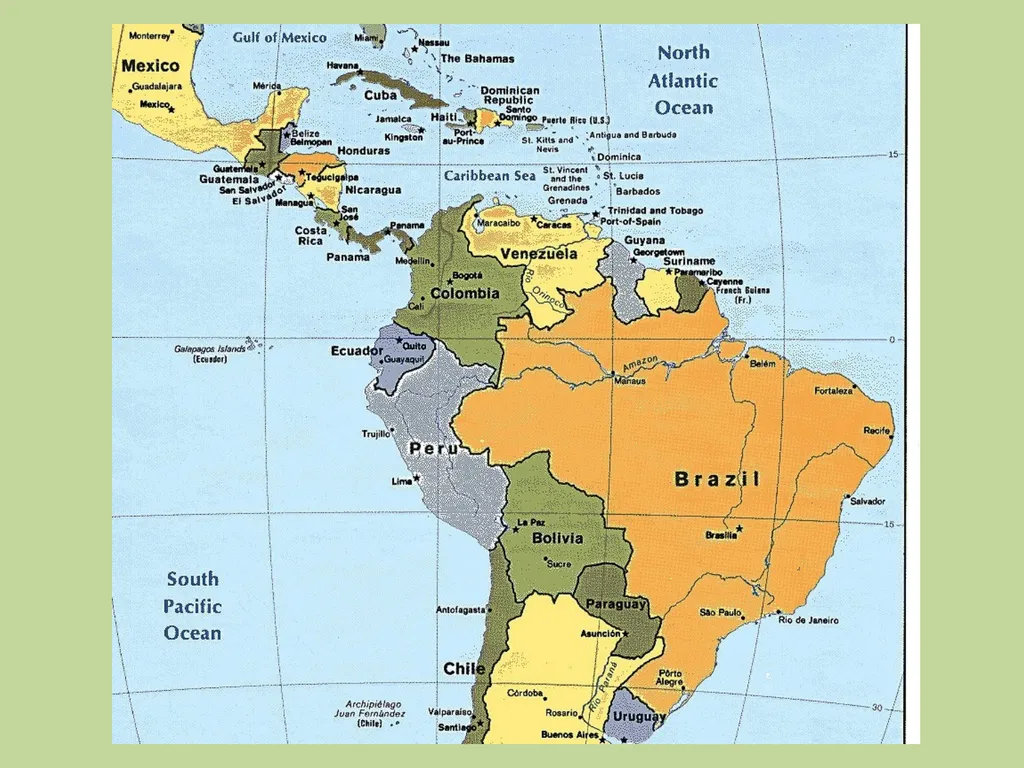
The course overall The making, and decline, of two nineteenth-century slave societies: Brazil and Cuba
Space and movement as a function of slaveholding power but also of enslaved people’s challenge to slavery
“Simultaneous apotheosis and vulnerability of C19 slavery” (Schmidt-Nowara)
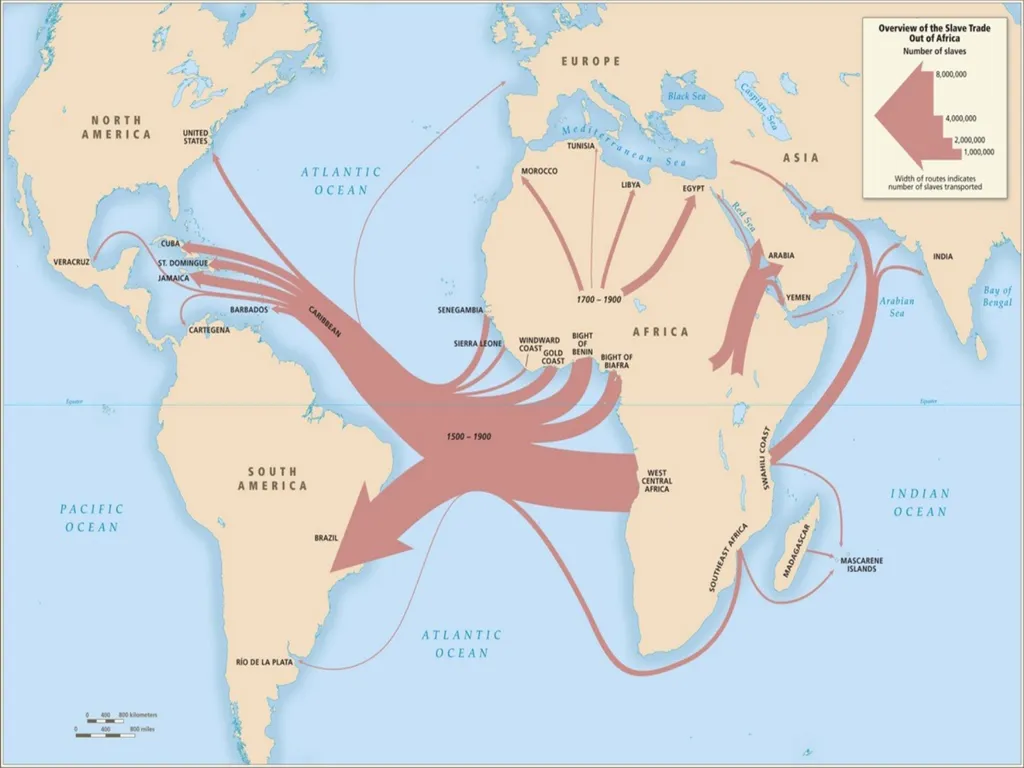
Comparative history but also Atlantic World history. Connections of trade, ideas, and especially FLOWS OF PEOPLE
So we also cover: Britain; other Caribbean islands (esp St Domingue/ Haiti); US South; West Africa; West Central Africa…<br>
03
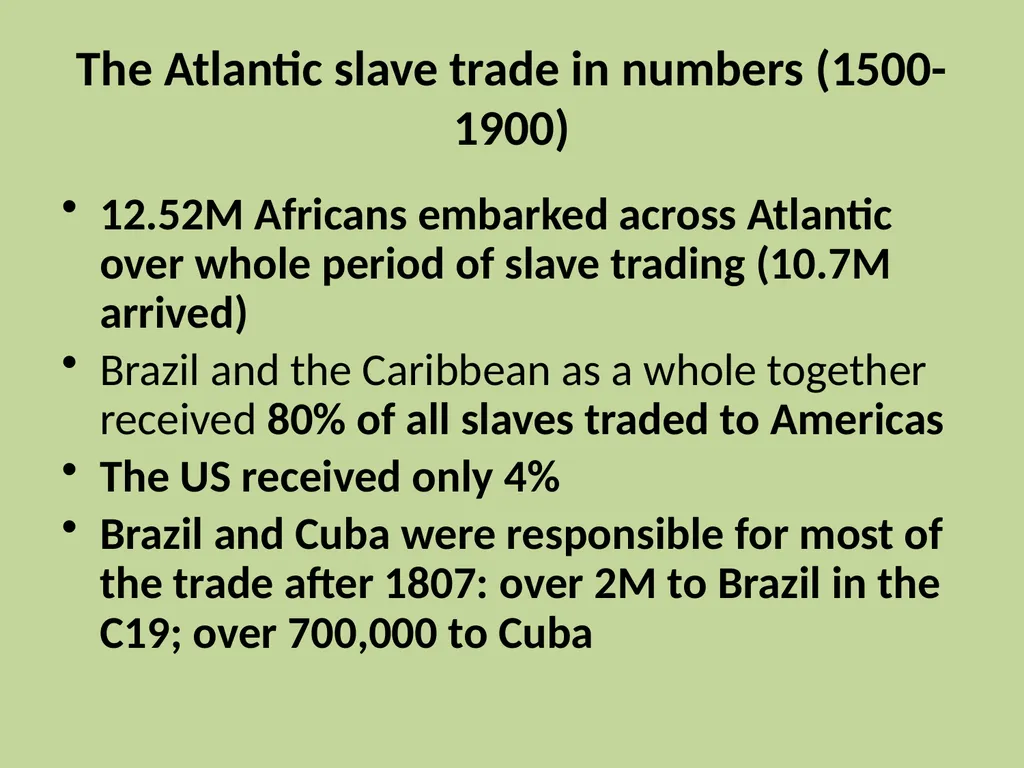
The Atlantic slave trade in numbers (1500-1900) 12.52M Africans embarked across Atlantic over whole period of slave trading (10.7M arrived)
Brazil and the Caribbean as a whole together received 80% of all slaves traded to Americas
The US received only 4%
Brazil and Cuba were responsible for most of the trade after 1807: over 2M to Brazil in the C19; over 700,000 to Cuba<br>
04
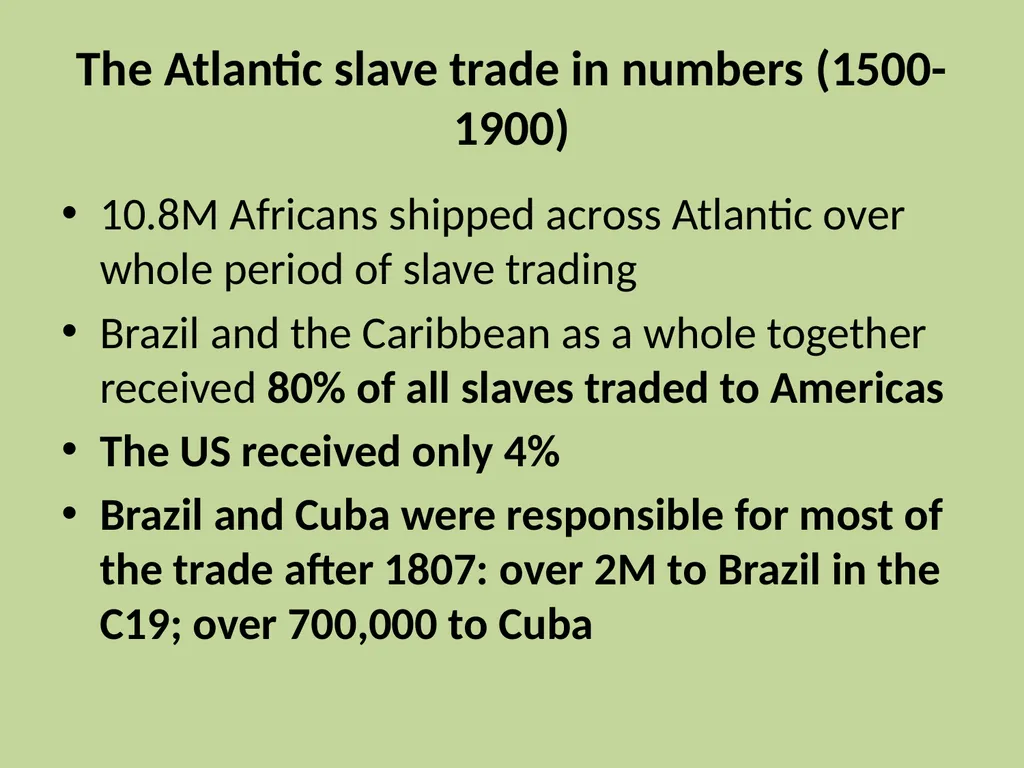
The Atlantic slave trade in numbers (1500-1900) 10.8M Africans shipped across Atlantic over whole period of slave trading
Brazil and the Caribbean as a whole together received 80% of all slaves traded to Americas
The US received only 4%
Brazil and Cuba were responsible for most of the trade after 1807: over 2M to Brazil in the C19; over 700,000 to Cuba<br>
05
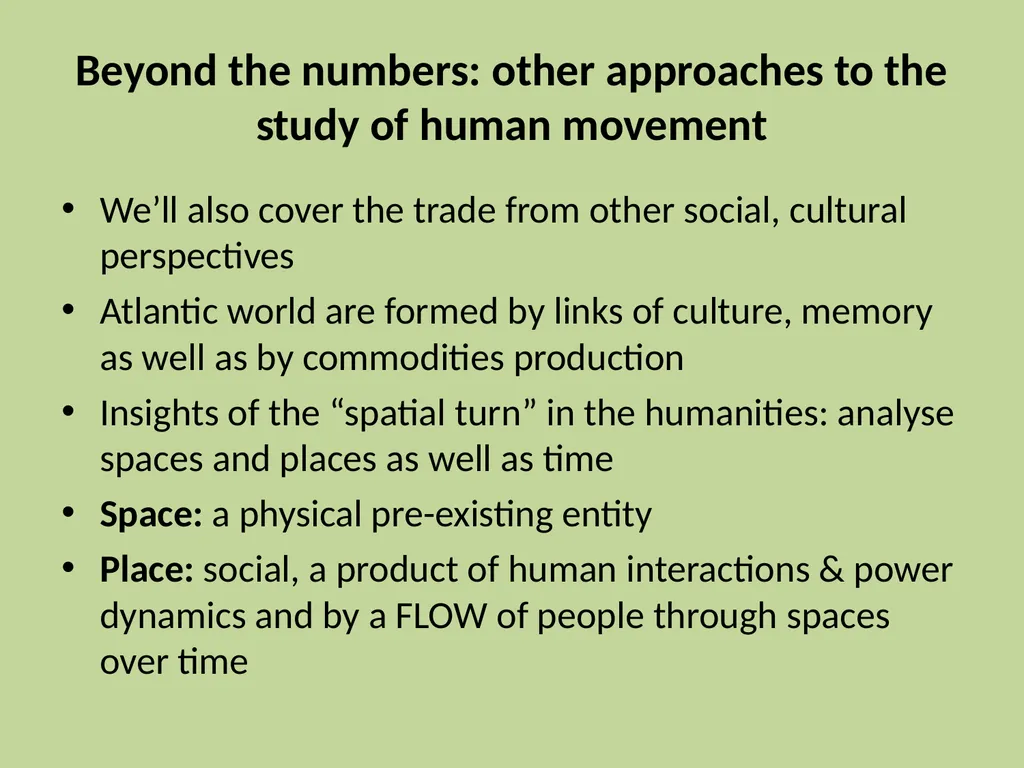
Beyond the numbers: other approaches to the study of human movement We’ll also cover the trade from other social, cultural perspectives
Atlantic world are formed by links of culture, memory as well as by commodities production
Insights of the “spatial turn” in the humanities: analyse spaces and places as well as time
Space: a physical pre-existing entity
Place: social, a product of human interactions & power dynamics and by a FLOW of people through spaces over time<br>
06
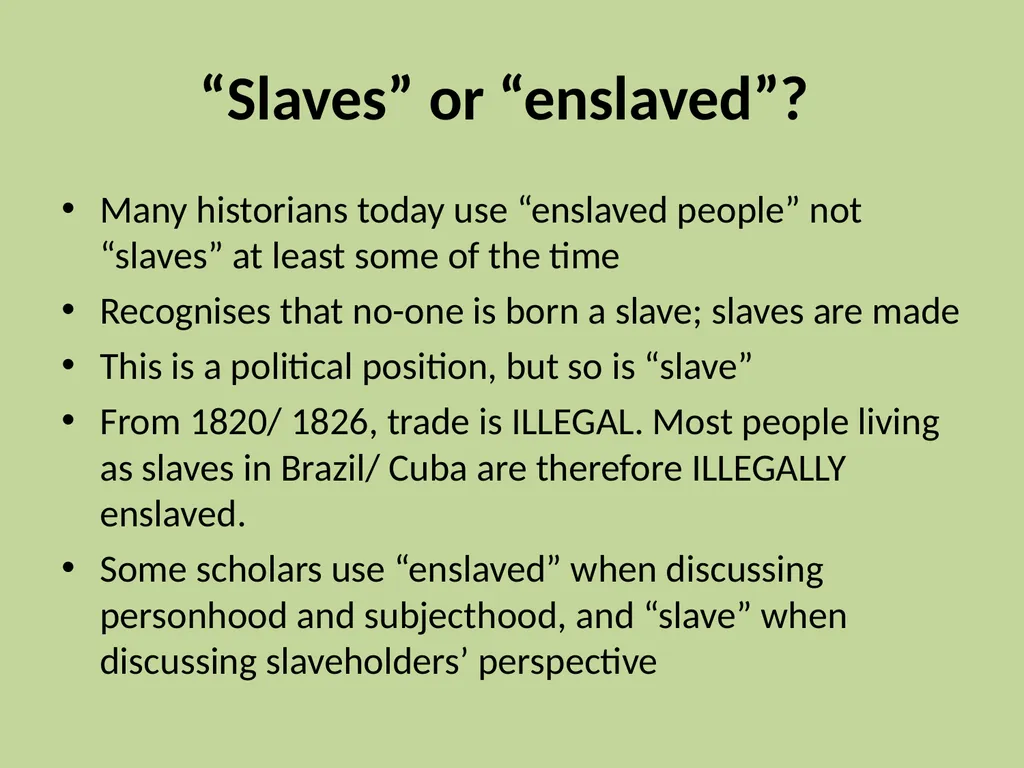
“Slaves” or “enslaved”? Many historians today use “enslaved people” not “slaves” at least some of the time
Recognises that no-one is born a slave; slaves are made
This is a political position, but so is “slave”
From 1820/ 1826, trade is ILLEGAL. Most people living as slaves in Brazil/ Cuba are therefore ILLEGALLY enslaved.
Some scholars use “enslaved” when discussing personhood and subjecthood, and “slave” when discussing slaveholders’ perspective<br>
07
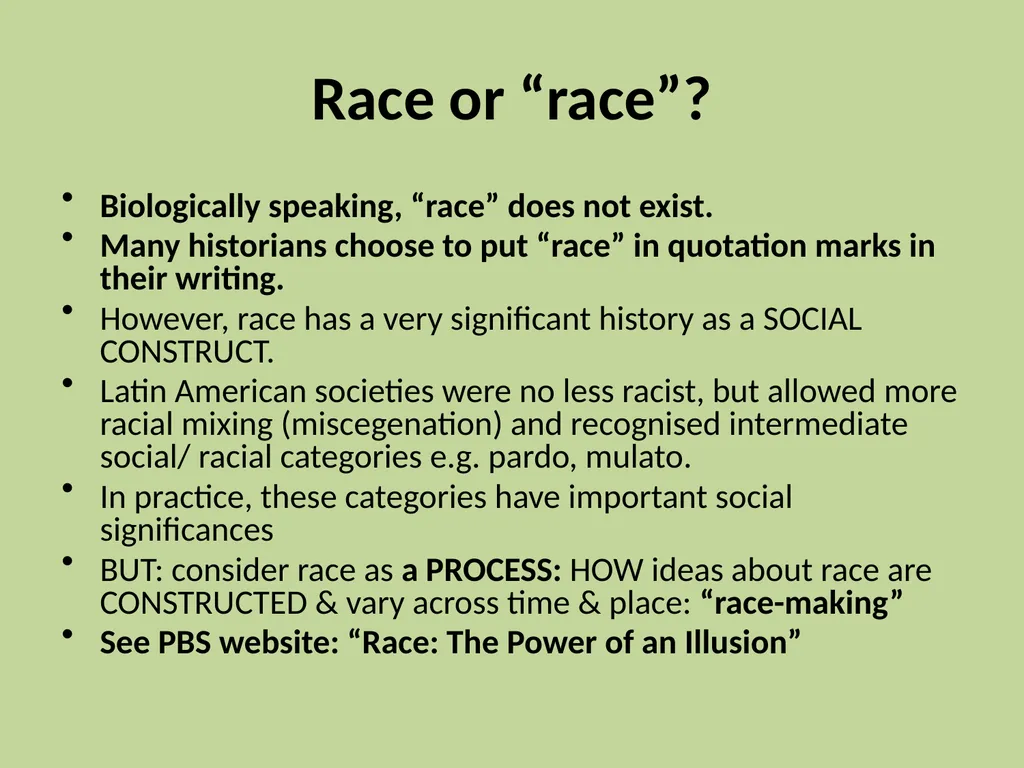
Race or “race”? Biologically speaking, “race” does not exist.
Many historians choose to put “race” in quotation marks in their writing.
However, race has a very significant history as a SOCIAL CONSTRUCT.
Latin American societies were no less racist, but allowed more racial mixing (miscegenation) and recognised intermediate social/ racial categories e.g. pardo, mulato.
In practice, these categories have important social significances
BUT: consider race as a PROCESS: HOW ideas about race are CONSTRUCTED & vary across time & place: “race-making”
See PBS website: “Race: The Power of an Illusion”<br>
08
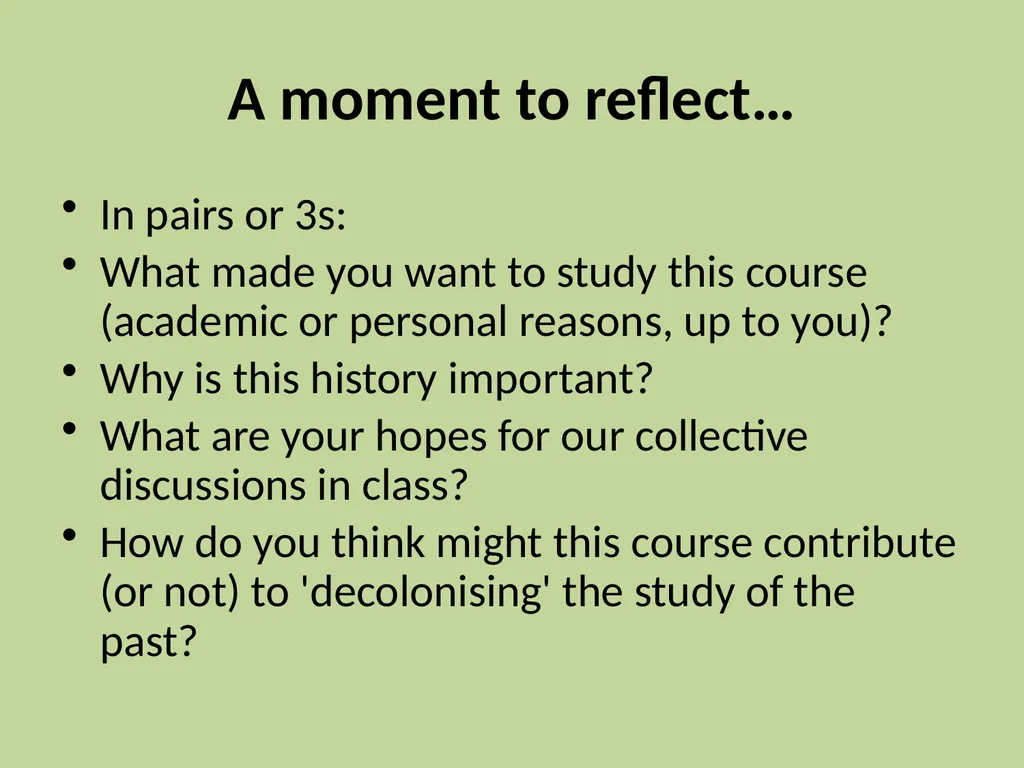
A moment to reflect… In pairs or 3s:
What made you want to study this course (academic or personal reasons, up to you)?
Why is this history important?
What are your hopes for our collective discussions in class?
How do you think might this course contribute (or not) to 'decolonising' the study of the past?<br>
09
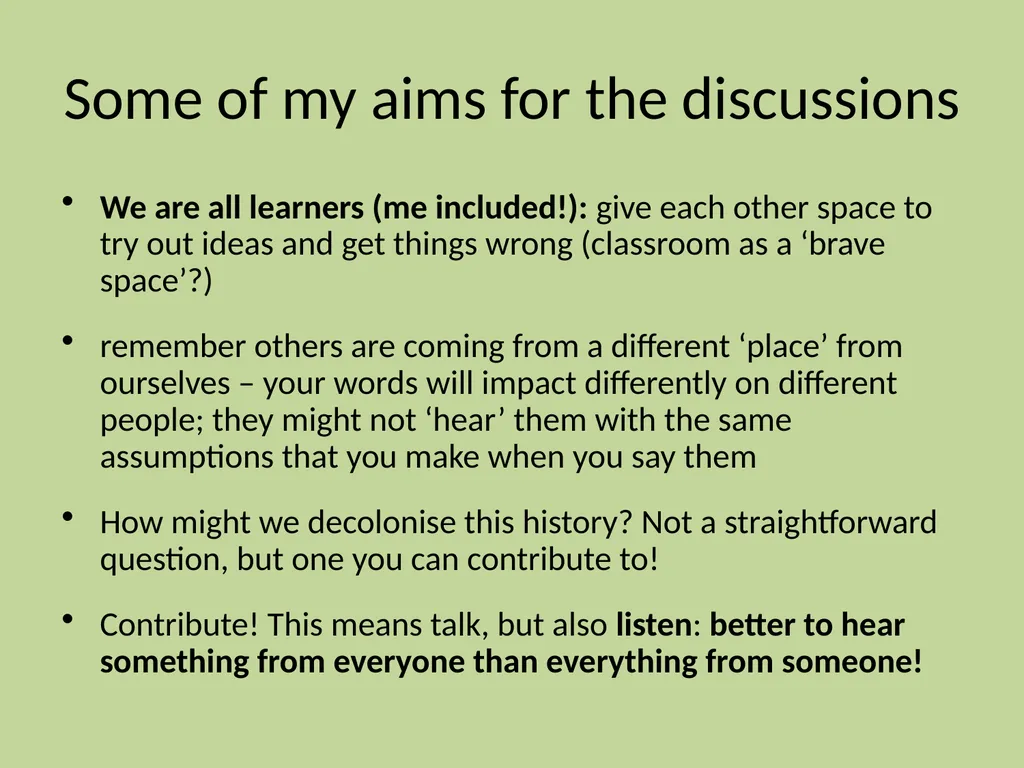
Some of my aims for the discussions We are all learners (me included!): give each other space to try out ideas and get things wrong (classroom as a ‘brave space’?)
remember others are coming from a different ‘place’ from ourselves – your words will impact differently on different people; they might not ‘hear’ them with the same assumptions that you make when you say them
How might we decolonise this history? Not a straightforward question, but one you can contribute to!
Contribute! This means talk, but also listen: better to hear something from everyone than everything from someone!<br>
10
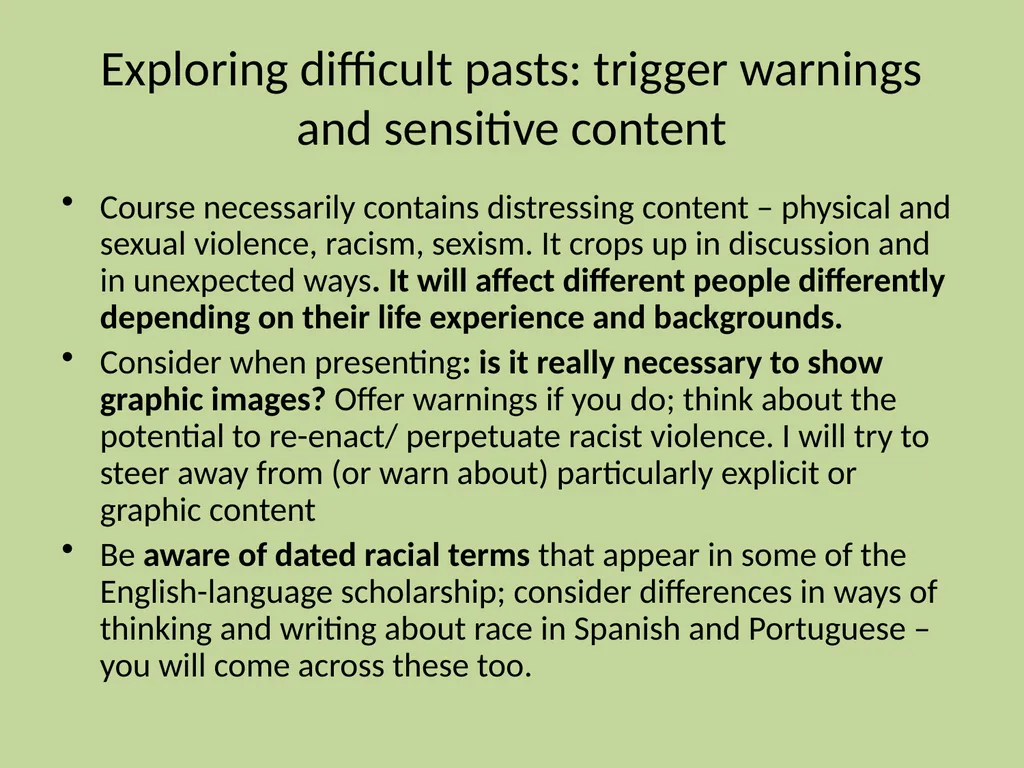
Exploring difficult pasts: trigger warnings and sensitive content Course necessarily contains distressing content – physical and sexual violence, racism, sexism. It crops up in discussion and in unexpected ways. It will affect different people differently depending on their life experience and backgrounds.
Consider when presenting: is it really necessary to show graphic images? Offer warnings if you do; think about the potential to re-enact/ perpetuate racist violence. I will try to steer away from (or warn about) particularly explicit or graphic content
Be aware of dated racial terms that appear in some of the English-language scholarship; consider differences in ways of thinking and writing about race in Spanish and Portuguese – you will come across these too.<br>
11
Reading Schmidt-Nowara, Christopher. Slavery, Freedom, and Abolition in Latin America and the Atlantic World (2011) Introduction; Chapter Four: “The Resurgence and Destruction of Slavery in Cuba, Puerto Rico, and Brazil,”
Gloria Garcia, Voices of the Enslaved in Nineteenth-Century Cuba: A Documentary History (2011) – choose 1 case<br>
12
Questions Choose one case about an enslaved person's actions from Gloria Garcia's documentary collection, Voices of the Enslaved. What did you find surprising about it? What light does it shed on enslaved people's quest to alter the conditions of their enslavement? What are the limitations of these sources?
What were the similarities and differences between the kinds of slave regimes established across the Americas? How did they vary across place and time?
What role did slavery play in the national histories of Brazil and Cuba in the nineteenth century and before?
Was the nineteenth century an era of abolition, or of an intensification of slavery and the trade?<br>