SPAM-L Semantic Priming Across Many - Languages
Description: SPAM-L Semantic Priming Across Many - Languages Overview Semantic Priming Semantic priming occurs when: Target responses are facilitated (faster) When a previously shown cue is related to the target Semantic Priming Priming measurement:
Related Topics
Download Presentation
"SPAM-L Semantic Priming Across Many - Languages" is the property of its rightful owner. Permission is granted to download and print the materials on this website for personal, non-commercial use only, and to display it on your personal computer provided you do not modify the materials and that you retain all copyright notices contained in the materials. By downloading content from our website, you accept the terms of this agreement.
Presentation Transcript
slide1. SPAM-L Semantic Priming Across Many - Languages<br>
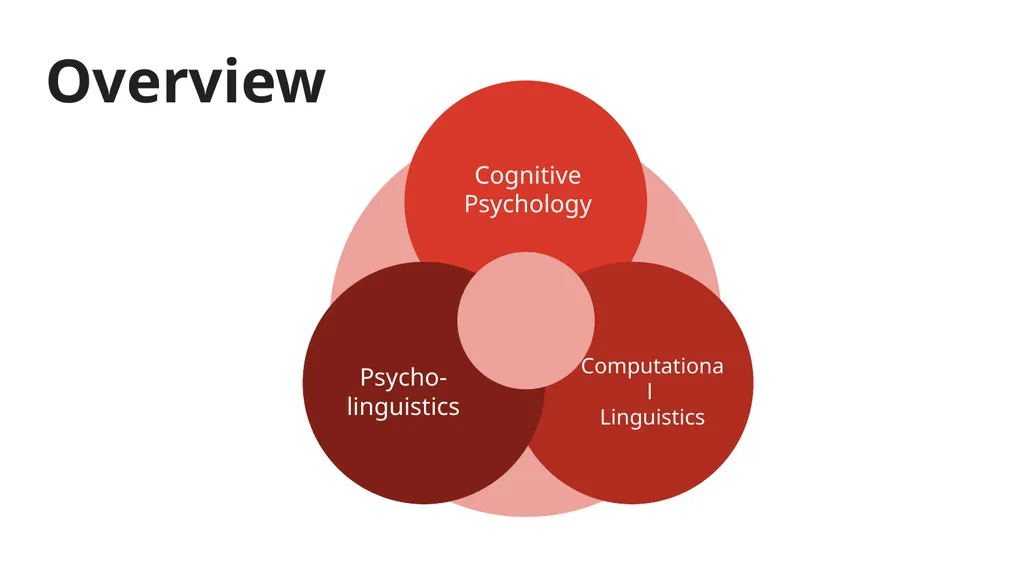
slide2. Overview<br>
slide3. Semantic Priming Semantic priming occurs when:
Target responses are facilitated (faster)
When a previously shown cue is related to the target<br>
slide4. Semantic Priming Priming measurement:
Lexical Decision Task
Naming Task<br>
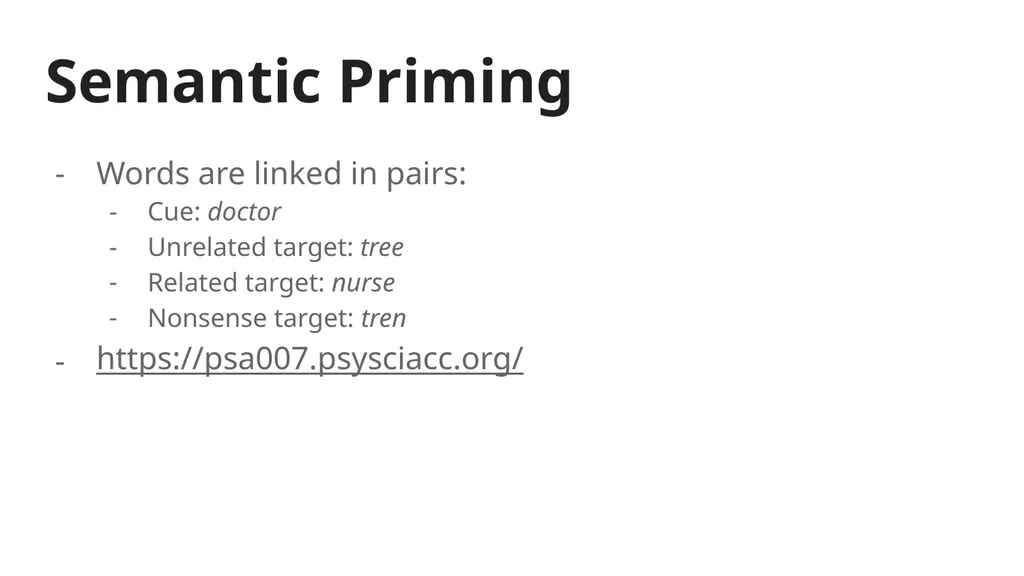
slide5. Semantic Priming Words are linked in pairs:
Cue: doctor
Unrelated target: tree
Related target: nurse
Nonsense target: tren
https://psa007.psysciacc.org/<br>
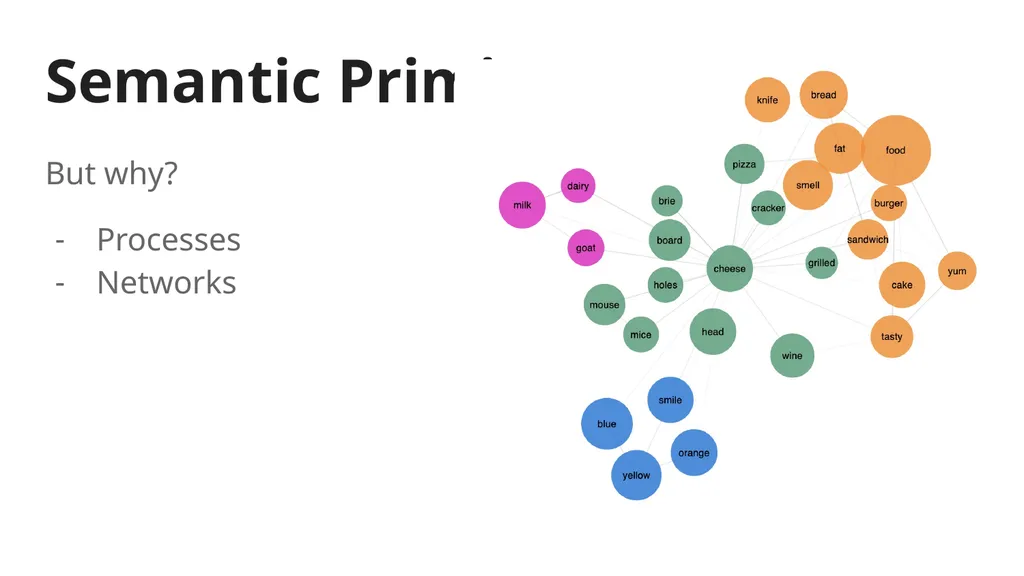
slide6. Semantic Priming But why?
Processes
Networks<br>
slide7. Semantic Priming Semantic priming replicates pretty well
But not always …
Every lab has their words “that work”
How can we leverage the computational skills found in natural language processing with the open data publications to improve this research?<br>
slide8. What do we want to do? Online platform for data collection
Semantic priming data + many languages + matching variables
R/Python/Shiny packages to connect to the data
Secondary data challenge<br>
slide9. Outcome 1: Online Portal We will create an online portal to collect, store, and share the data
https://smallworldofwords.org/en
Lowers the burden on research labs
Allows for data collection to occur in waves
Publication updates for data versus one-shot paper<br>
slide10. Outcome 1: Online Portal The experiment will be programmed with labjs (what you saw in the demo!)
Labjs has extensively worked on millisecond timing in browser (it’s good stuff)
Some precident for collecting this data online (SPALEX: Aguasvivas et al., 2018)<br>
slide11. Outcome 1: Online Portal Data is stored in a sqlite file, which can be accessed for the online display of data or through the packages (outcome 3)
Labs can used specialized links
Many languages can be provided for participants<br>
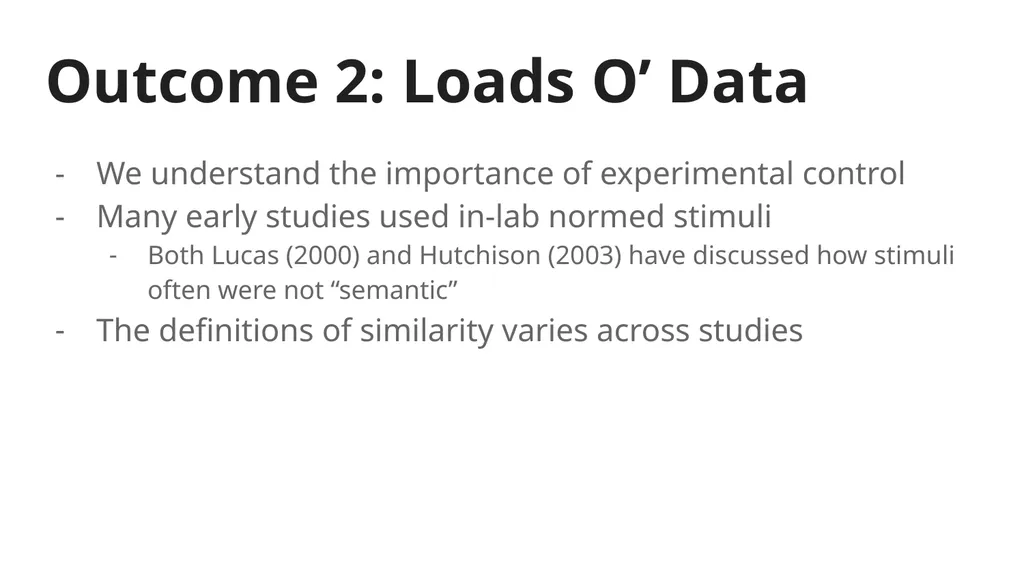
slide12. Outcome 2: Loads O’ Data We understand the importance of experimental control
Many early studies used in-lab normed stimuli
Both Lucas (2000) and Hutchison (2003) have discussed how stimuli often were not “semantic”
The definitions of similarity varies across studies<br>
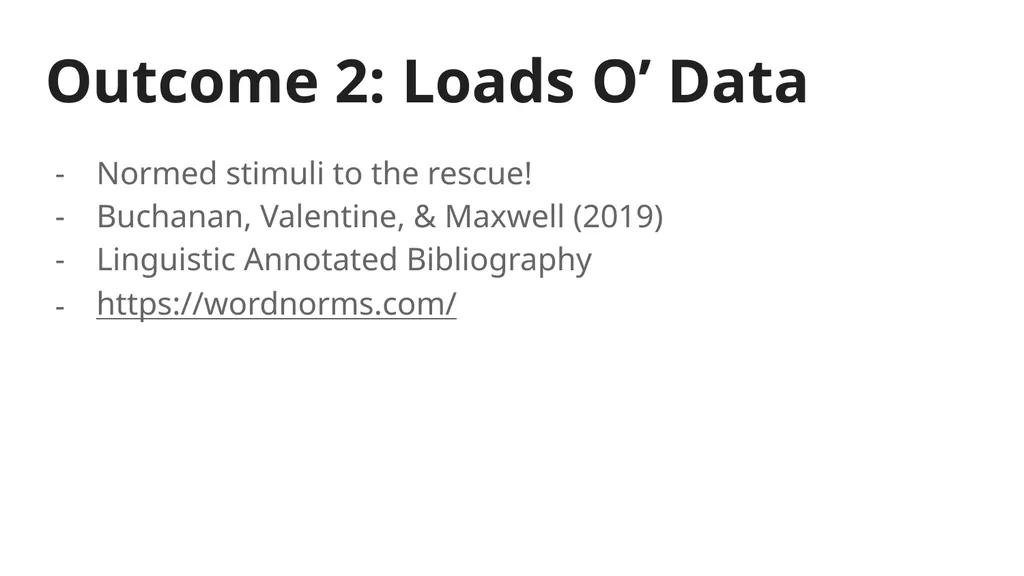
slide13. Outcome 2: Loads O’ Data Normed stimuli to the rescue!
Buchanan, Valentine, & Maxwell (2019)
Linguistic Annotated Bibliography
https://wordnorms.com/<br>
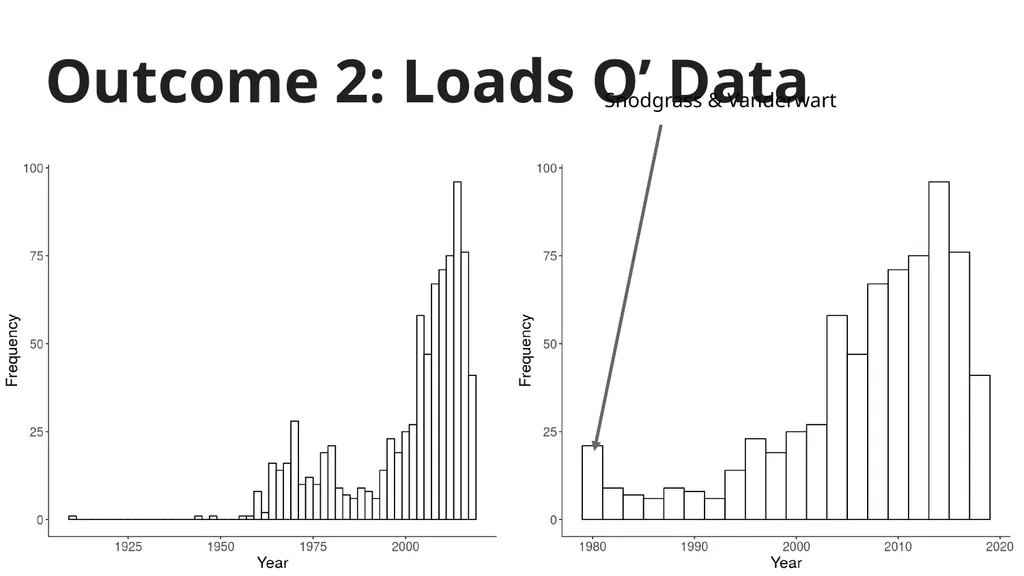
slide14. Outcome 2: Loads O’ Data Snodgrass & Vanderwart<br>
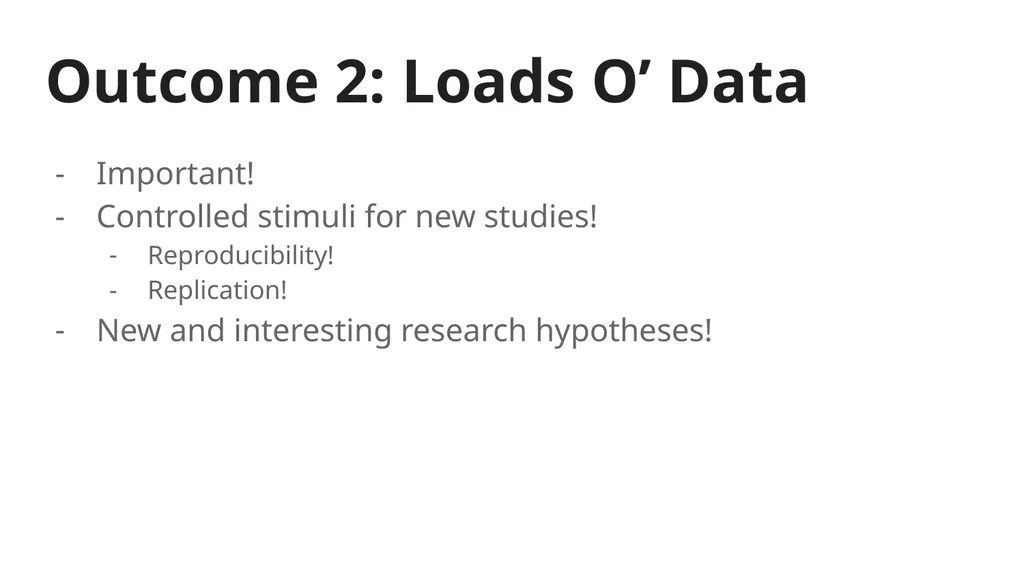
slide15. Outcome 2: Loads O’ Data Important!
Controlled stimuli for new studies!
Reproducibility!
Replication!
New and interesting research hypotheses!<br>
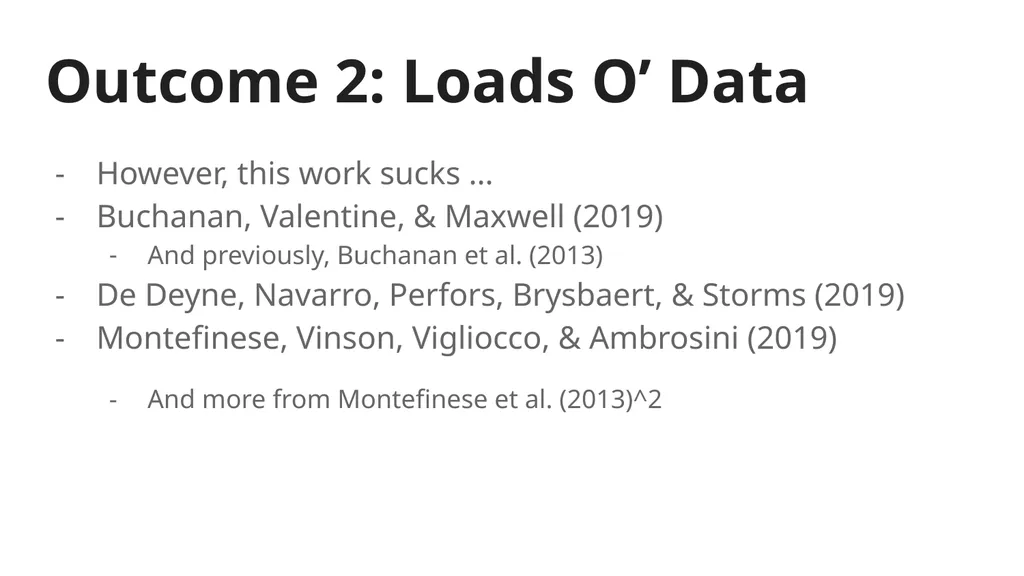
slide16. Outcome 2: Loads O’ Data However, this work sucks …
Buchanan, Valentine, & Maxwell (2019)
And previously, Buchanan et al. (2013)
De Deyne, Navarro, Perfors, Brysbaert, & Storms (2019)
Montefinese, Vinson, Vigliocco, & Ambrosini (2019)
And more from Montefinese et al. (2013)^2<br>
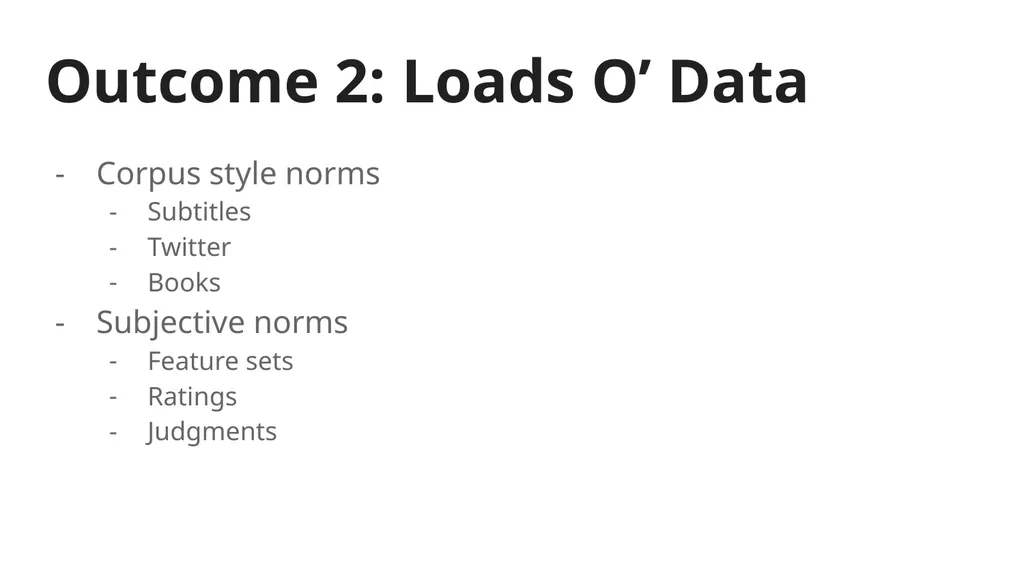
slide17. Outcome 2: Loads O’ Data Corpus style norms
Subtitles
Twitter
Books
Subjective norms
Feature sets
Ratings
Judgments<br>
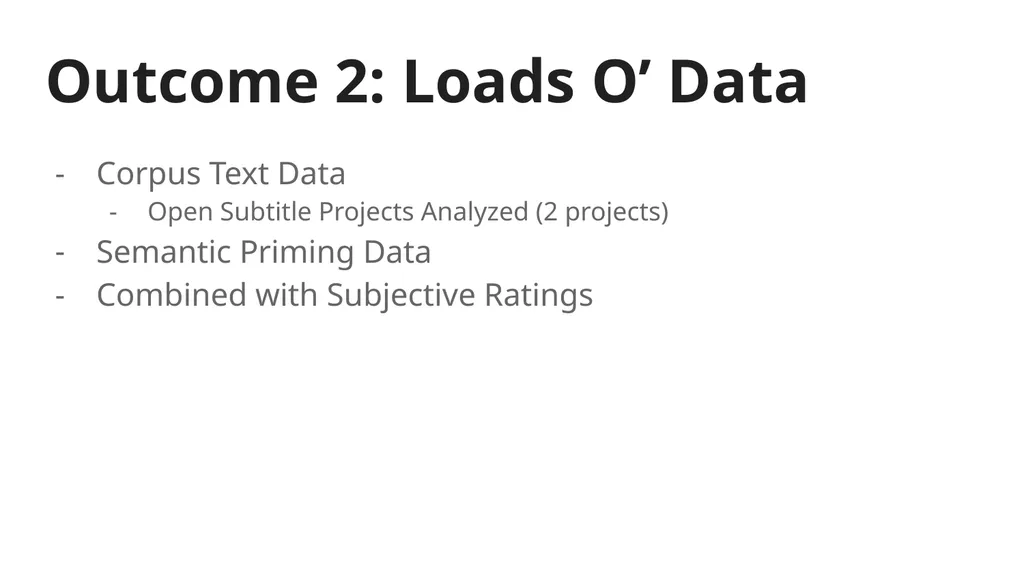
slide18. Outcome 2: Loads O’ Data Corpus Text Data
Open Subtitle Projects Analyzed (2 projects)
Semantic Priming Data
Combined with Subjective Ratings<br>
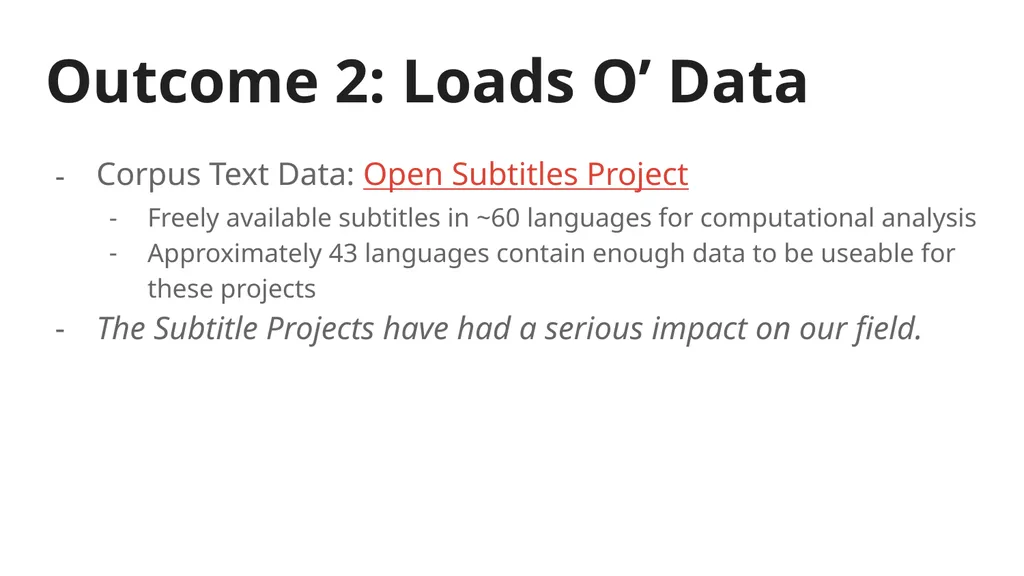
slide19. Outcome 2: Loads O’ Data Corpus Text Data: Open Subtitles Project
Freely available subtitles in ~60 languages for computational analysis
Approximately 43 languages contain enough data to be useable for these projects
The Subtitle Projects have had a serious impact on our field.<br>
slide21. Outcome 2: Loads O’ Data Corpus Text Data: Ongoing projects
Subs2strudel
Convert the subtitle data into concept-feature pairs
Example: zebra (concept) has stripes (feature)
STRUDEL: structured dimension extraction and labeling (Baroni et al., 2010)
Concept-feature pairs can be used to calculate similarity!<br>
slide22. Outcome 2: Loads O’ Data Corpus Text Data: Ongoing projects
Words2manylanguages
A recent publication of subs2vec, which converts the subtitle projects to FastText computational models
Provide word2vec models of each subtitle language, which allows for similarity calculation<br>
slide23. Outcome 2: Loads O’ Data Selection Procedure:
Nouns, verbs, adjectives, and adverbs
Using udpipe, we can do this across many languages
Using word frequency, the top 10,000 words in each language were selected<br>
slide24. Outcome 2: Loads O’ Data Selection Procedure:
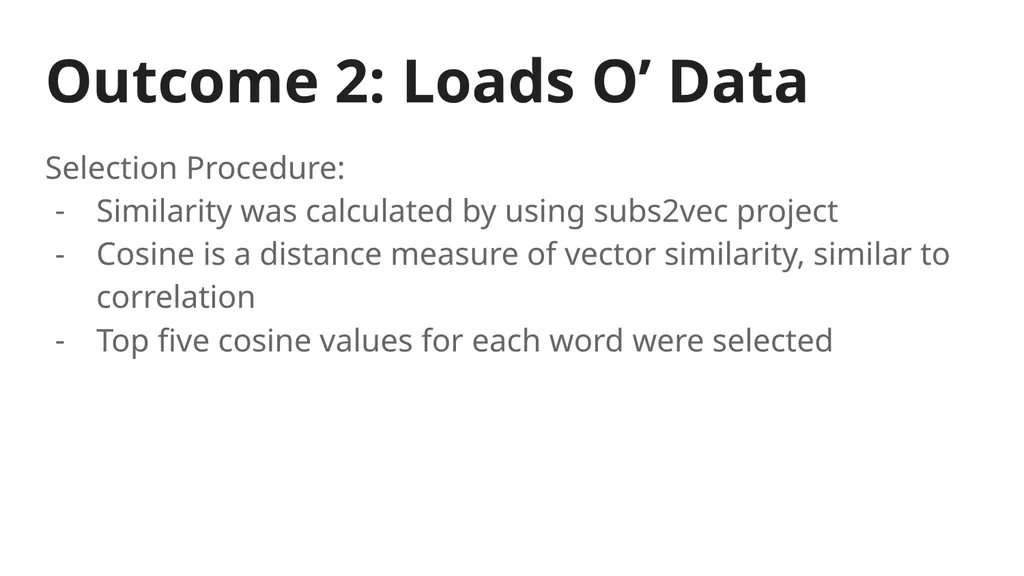
Similarity was calculated by using subs2vec project
Cosine is a distance measure of vector similarity, similar to correlation
Top five cosine values for each word were selected<br>
slide25. Outcome 2: Loads O’ Data Selection Procedure:
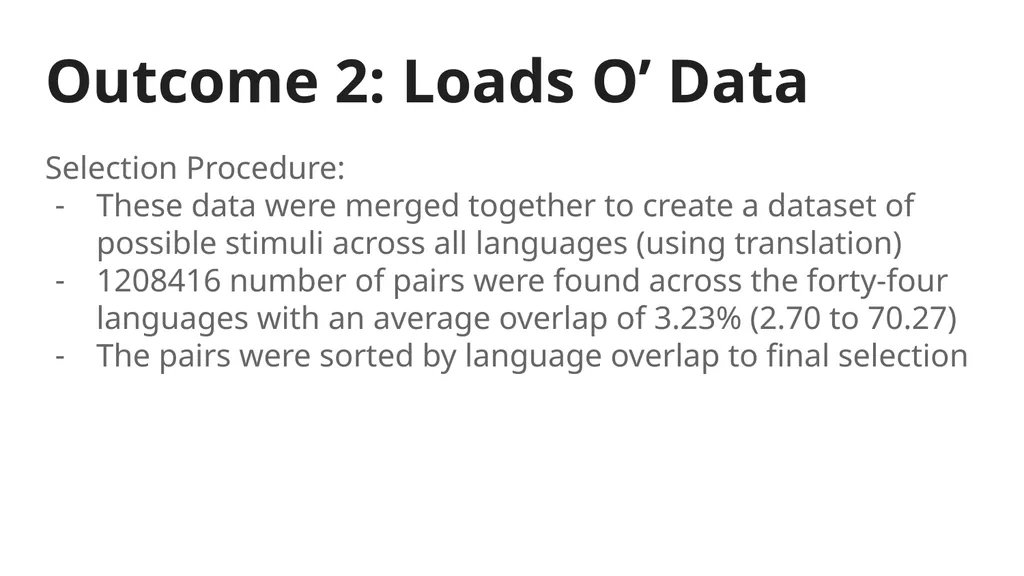
These data were merged together to create a dataset of possible stimuli across all languages (using translation)
1208416 number of pairs were found across the forty-four languages with an average overlap of 3.23% (2.70 to 70.27)
The pairs were sorted by language overlap to final selection<br>
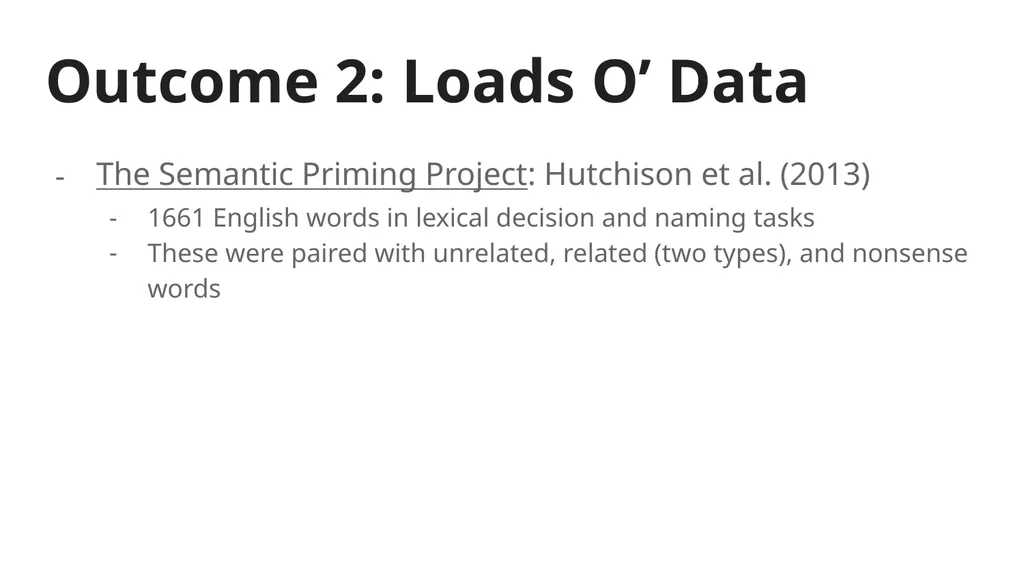
slide26. Outcome 2: Loads O’ Data The Semantic Priming Project: Hutchison et al. (2013)
1661 English words in lexical decision and naming tasks
These were paired with unrelated, related (two types), and nonsense words<br>
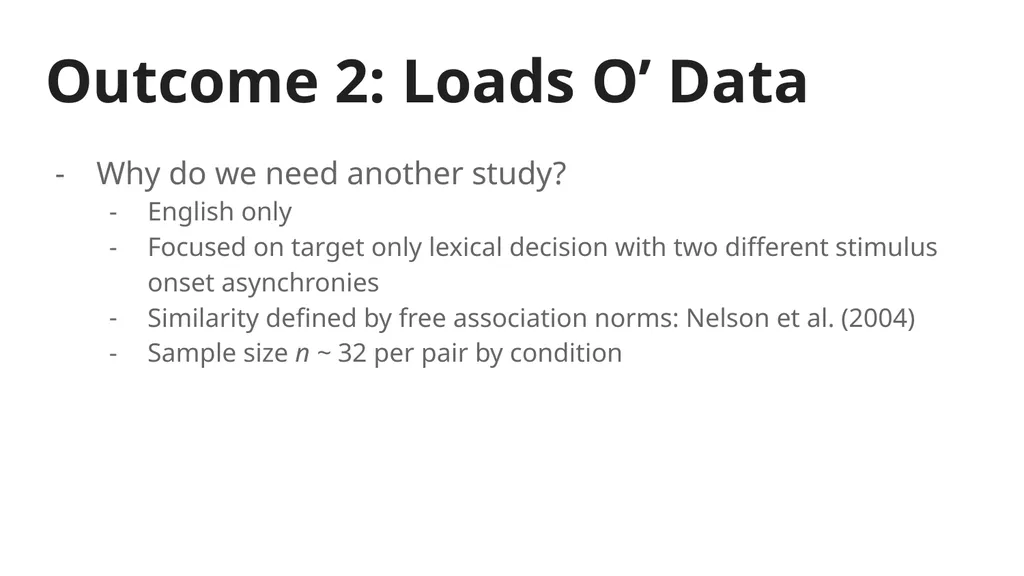
slide27. Outcome 2: Loads O’ Data Why do we need another study?
English only
Focused on target only lexical decision with two different stimulus onset asynchronies
Similarity defined by free association norms: Nelson et al. (2004)
Sample size n ~ 32 per pair by condition<br>
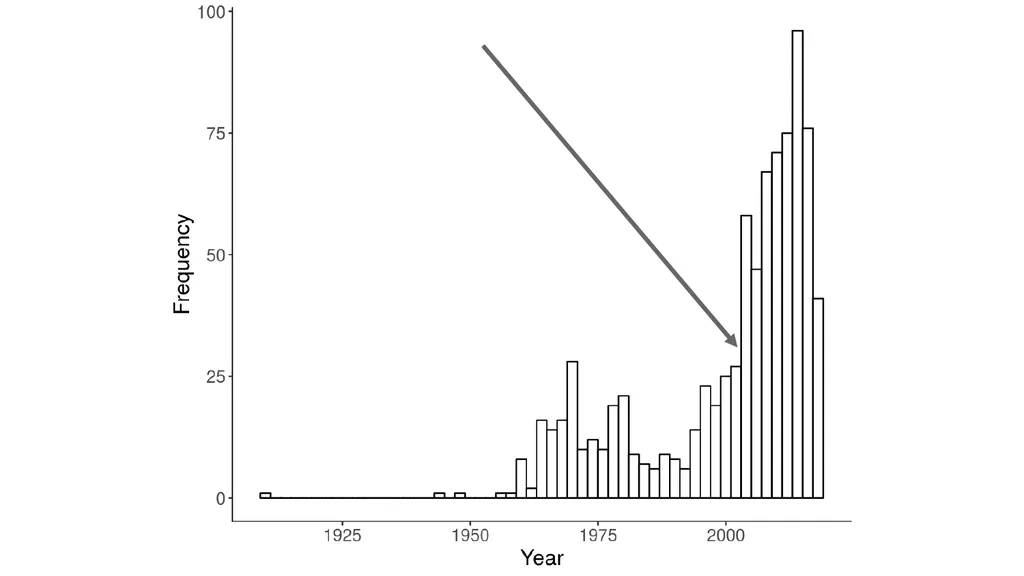
slide28. Outcome 2: Loads O’ Data Sample size is probably too small for coverage/power
Overlap with other stimuli still poor
Is priming even reliable?
Heyman et al. (2016, 2018)
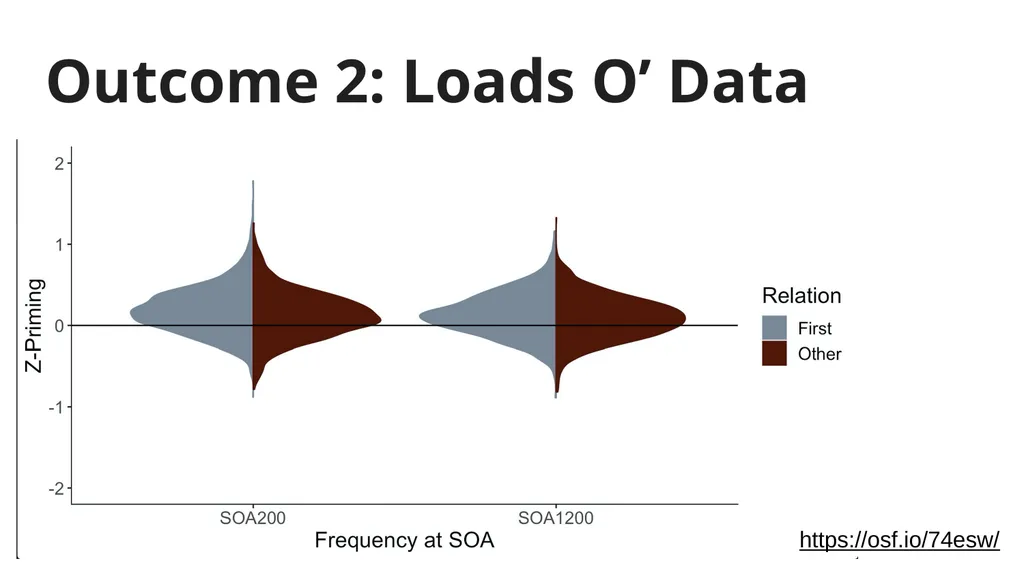
Is priming even predictable?
Hutchison et al. (2008), see next slide<br>
slide29. Outcome 2: Loads O’ Data https://osf.io/74esw/<br>
slide30. Outcome 2: Loads O’ Data Semantic Priming Data
Related stimuli will be selected using similarity values from the first two analyses described
Unrelated stimuli are re-paired words with no similarity (close to zero as possible)
Nonsense words are created by using the Wuggy algorithm, while maintaining valid phonetic pronunciation<br>
slide31. Outcome 2: Loads O’ Data Semantic Priming Data
A single stream lexical decision task will be used
Trials are formatted as:
A fixation cross (+) for 500 ms
CUE or TARGET in uppercase Serif font
Lexical decision response (word, nonsense word)<br>
slide32. Outcome 2: Loads O’ Data Semantic Priming Data
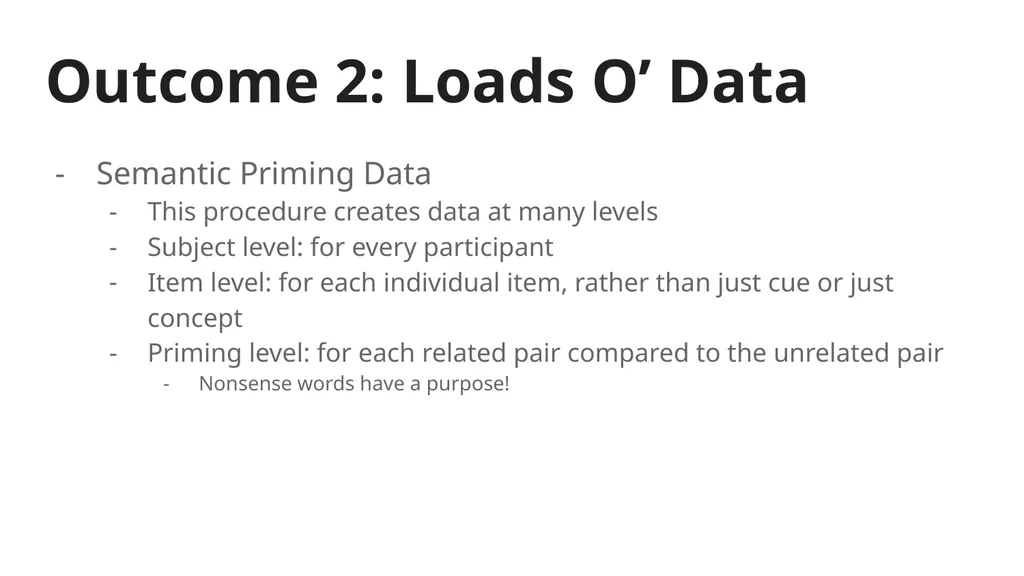
This procedure creates data at many levels
Subject level: for every participant
Item level: for each individual item, rather than just cue or just concept
Priming level: for each related pair compared to the unrelated pair
Nonsense words have a purpose!<br>
slide33. Outcome 2: Loads O’ Data Subjective Rating data
Merge data from our known sources using the LAB
Target variables: age of acquisition, imageability, concreteness, valence, arousal, dominance, familiarity
These are the most studied and popular measures!<br>
slide34. Outcome 2: Loads O’ Participants Power for non-hypothesis tests is tricky
AIPE: Accuracy in parameter estimation approach may be best (see anything by Ken Kelley)
Power to create a “sufficiently narrow” confidence interval
So, we simulated using the English Lexicon Project (Balota et al., 2007) and the previous priming data<br>
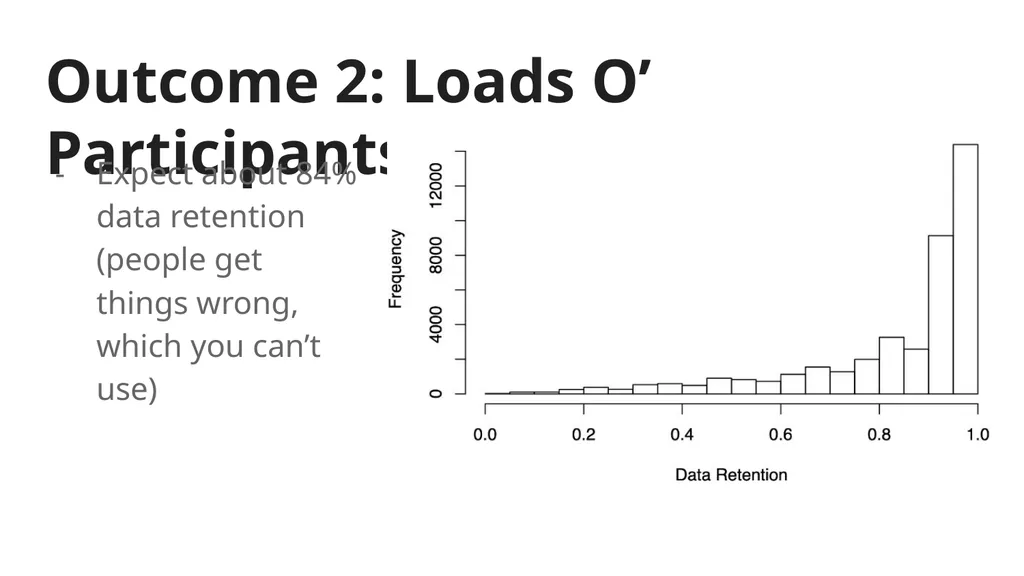
slide35. Outcome 2: Loads O’ Participants Expect about 84% data retention (people get things wrong, which you can’t use)<br>
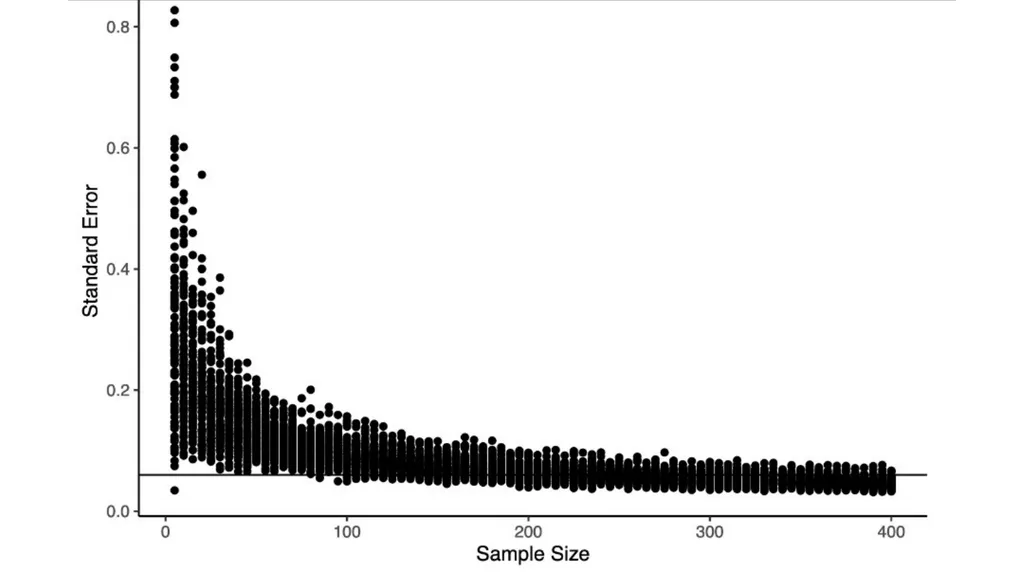
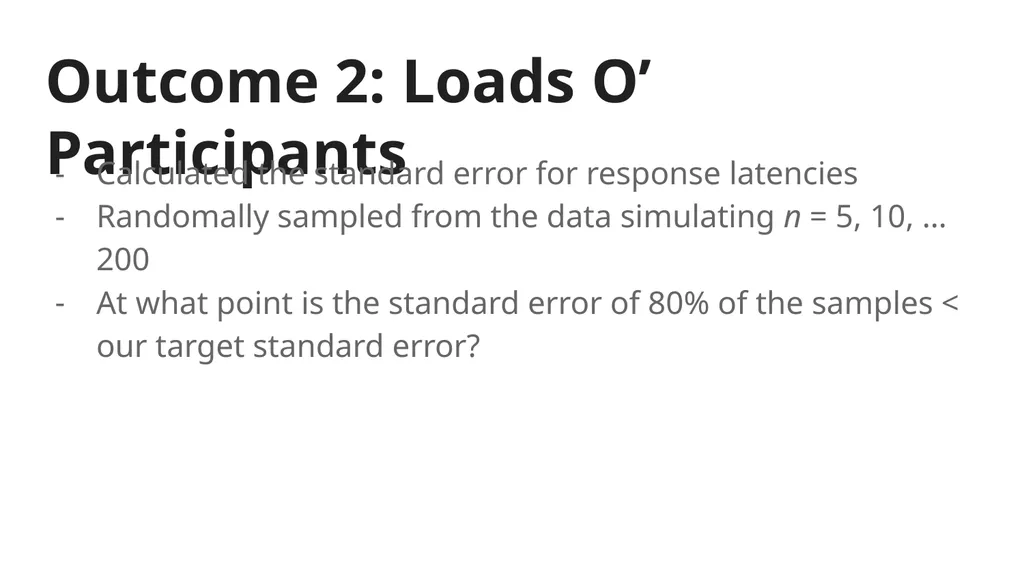
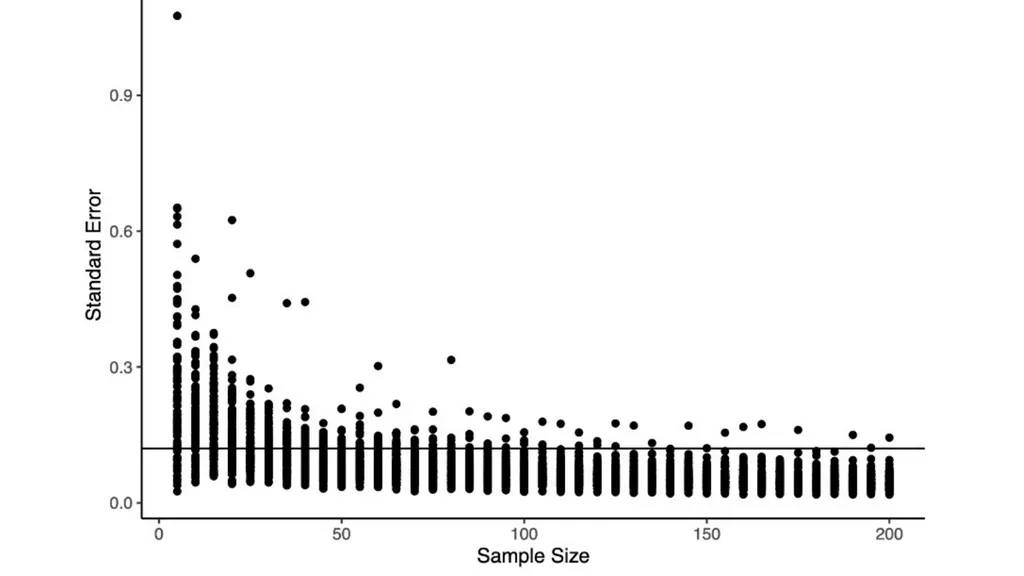
slide36. Outcome 2: Loads O’ Participants Calculated the standard error for response latencies
Randomally sampled from the data simulating n = 5, 10, … 200
At what point is the standard error of 80% of the samples < our target standard error?<br>
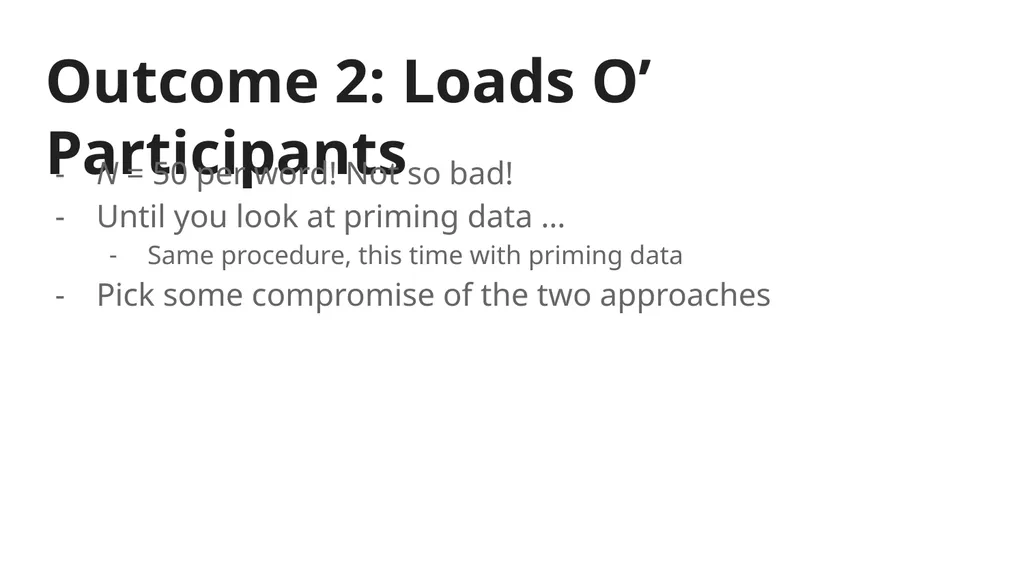
slide38. Outcome 2: Loads O’ Participants N = 50 per word! Not so bad!
Until you look at priming data …
Same procedure, this time with priming data
Pick some compromise of the two approaches<br>
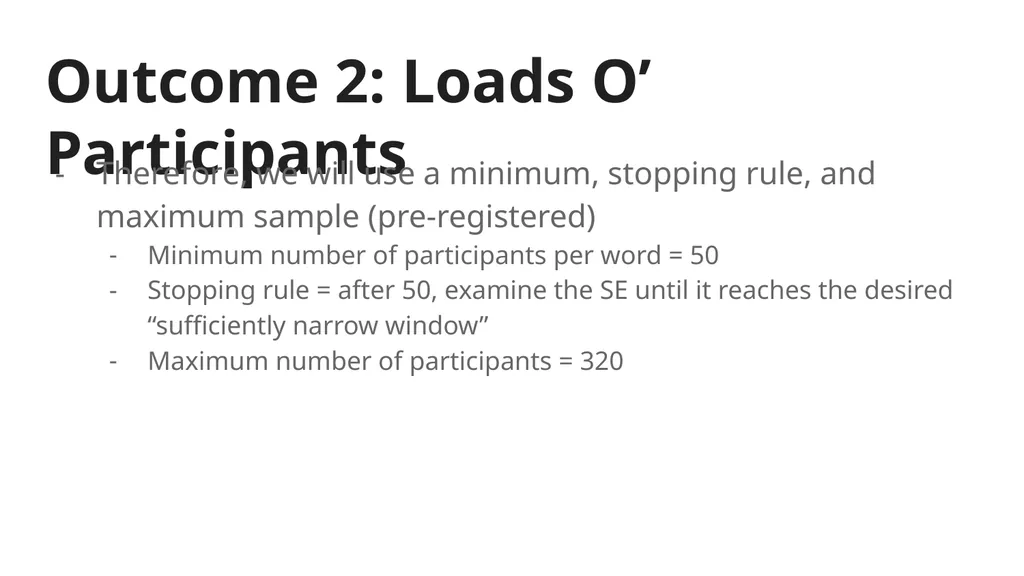
slide40. Outcome 2: Loads O’ Participants Therefore, we will use a minimum, stopping rule, and maximum sample (pre-registered)
Minimum number of participants per word = 50
Stopping rule = after 50, examine the SE until it reaches the desired “sufficiently narrow window”
Maximum number of participants = 320<br>
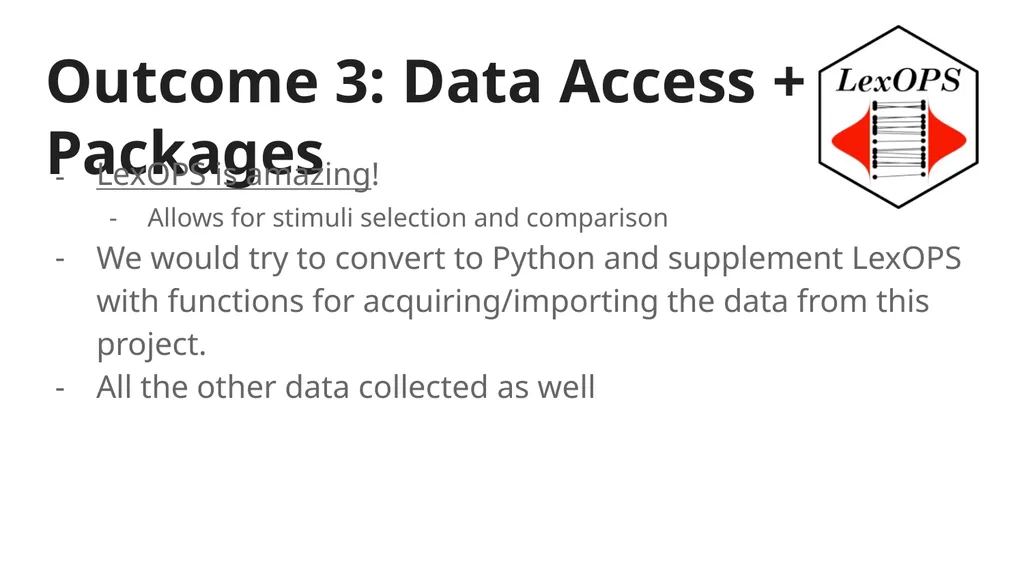
slide41. Outcome 3: Data Access + Packages LexOPS is amazing!
Allows for stimuli selection and comparison
We would try to convert to Python and supplement LexOPS with functions for acquiring/importing the data from this project.
All the other data collected as well<br>
slide42. Outcome 4: Secondary Data Challenge We will support a secondary data challenge timed with the release of the first round of data.
Computational linguistics rejoice!<br>
slide43. WHere are We now? Registered Report: R&R at Nature Human Behaviour
Stimuli selection is complete
Experiment programming mostly complete
Started translation (checking/instructions)
Writing $ funding requests
Pilot testing soon<br>
slide44. WHere are We now? Can you join?
Yes please!
What can you do?
Data collection
Translation
And much more!
Other works described are being written<br>
slide45. Questions All thoughts welcome!
https://github.com/SemanticPriming/SPAML/
Twitter: @aggieerin
Email: buchananlab@gmail.com
GitHub: doomlab
Find me on the PSA Slack<br>

slide2. Overview<br>
slide3. Semantic Priming Semantic priming occurs when:
Target responses are facilitated (faster)
When a previously shown cue is related to the target<br>
slide4. Semantic Priming Priming measurement:
Lexical Decision Task
Naming Task<br>
slide5. Semantic Priming Words are linked in pairs:
Cue: doctor
Unrelated target: tree
Related target: nurse
Nonsense target: tren
https://psa007.psysciacc.org/<br>
slide6. Semantic Priming But why?
Processes
Networks<br>
slide7. Semantic Priming Semantic priming replicates pretty well
But not always …
Every lab has their words “that work”
How can we leverage the computational skills found in natural language processing with the open data publications to improve this research?<br>
slide8. What do we want to do? Online platform for data collection
Semantic priming data + many languages + matching variables
R/Python/Shiny packages to connect to the data
Secondary data challenge<br>
slide9. Outcome 1: Online Portal We will create an online portal to collect, store, and share the data
https://smallworldofwords.org/en
Lowers the burden on research labs
Allows for data collection to occur in waves
Publication updates for data versus one-shot paper<br>
slide10. Outcome 1: Online Portal The experiment will be programmed with labjs (what you saw in the demo!)
Labjs has extensively worked on millisecond timing in browser (it’s good stuff)
Some precident for collecting this data online (SPALEX: Aguasvivas et al., 2018)<br>
slide11. Outcome 1: Online Portal Data is stored in a sqlite file, which can be accessed for the online display of data or through the packages (outcome 3)
Labs can used specialized links
Many languages can be provided for participants<br>
slide12. Outcome 2: Loads O’ Data We understand the importance of experimental control
Many early studies used in-lab normed stimuli
Both Lucas (2000) and Hutchison (2003) have discussed how stimuli often were not “semantic”
The definitions of similarity varies across studies<br>
slide13. Outcome 2: Loads O’ Data Normed stimuli to the rescue!
Buchanan, Valentine, & Maxwell (2019)
Linguistic Annotated Bibliography
https://wordnorms.com/<br>
slide14. Outcome 2: Loads O’ Data Snodgrass & Vanderwart<br>
slide15. Outcome 2: Loads O’ Data Important!
Controlled stimuli for new studies!
Reproducibility!
Replication!
New and interesting research hypotheses!<br>
slide16. Outcome 2: Loads O’ Data However, this work sucks …
Buchanan, Valentine, & Maxwell (2019)
And previously, Buchanan et al. (2013)
De Deyne, Navarro, Perfors, Brysbaert, & Storms (2019)
Montefinese, Vinson, Vigliocco, & Ambrosini (2019)
And more from Montefinese et al. (2013)^2<br>
slide17. Outcome 2: Loads O’ Data Corpus style norms
Subtitles
Books
Subjective norms
Feature sets
Ratings
Judgments<br>
slide18. Outcome 2: Loads O’ Data Corpus Text Data
Open Subtitle Projects Analyzed (2 projects)
Semantic Priming Data
Combined with Subjective Ratings<br>
slide19. Outcome 2: Loads O’ Data Corpus Text Data: Open Subtitles Project
Freely available subtitles in ~60 languages for computational analysis
Approximately 43 languages contain enough data to be useable for these projects
The Subtitle Projects have had a serious impact on our field.<br>
slide21. Outcome 2: Loads O’ Data Corpus Text Data: Ongoing projects
Subs2strudel
Convert the subtitle data into concept-feature pairs
Example: zebra (concept) has stripes (feature)
STRUDEL: structured dimension extraction and labeling (Baroni et al., 2010)
Concept-feature pairs can be used to calculate similarity!<br>
slide22. Outcome 2: Loads O’ Data Corpus Text Data: Ongoing projects
Words2manylanguages
A recent publication of subs2vec, which converts the subtitle projects to FastText computational models
Provide word2vec models of each subtitle language, which allows for similarity calculation<br>
slide23. Outcome 2: Loads O’ Data Selection Procedure:
Nouns, verbs, adjectives, and adverbs
Using udpipe, we can do this across many languages
Using word frequency, the top 10,000 words in each language were selected<br>
slide24. Outcome 2: Loads O’ Data Selection Procedure:
Similarity was calculated by using subs2vec project
Cosine is a distance measure of vector similarity, similar to correlation
Top five cosine values for each word were selected<br>
slide25. Outcome 2: Loads O’ Data Selection Procedure:
These data were merged together to create a dataset of possible stimuli across all languages (using translation)
1208416 number of pairs were found across the forty-four languages with an average overlap of 3.23% (2.70 to 70.27)
The pairs were sorted by language overlap to final selection<br>
slide26. Outcome 2: Loads O’ Data The Semantic Priming Project: Hutchison et al. (2013)
1661 English words in lexical decision and naming tasks
These were paired with unrelated, related (two types), and nonsense words<br>
slide27. Outcome 2: Loads O’ Data Why do we need another study?
English only
Focused on target only lexical decision with two different stimulus onset asynchronies
Similarity defined by free association norms: Nelson et al. (2004)
Sample size n ~ 32 per pair by condition<br>
slide28. Outcome 2: Loads O’ Data Sample size is probably too small for coverage/power
Overlap with other stimuli still poor
Is priming even reliable?
Heyman et al. (2016, 2018)
Is priming even predictable?
Hutchison et al. (2008), see next slide<br>
slide29. Outcome 2: Loads O’ Data https://osf.io/74esw/<br>
slide30. Outcome 2: Loads O’ Data Semantic Priming Data
Related stimuli will be selected using similarity values from the first two analyses described
Unrelated stimuli are re-paired words with no similarity (close to zero as possible)
Nonsense words are created by using the Wuggy algorithm, while maintaining valid phonetic pronunciation<br>
slide31. Outcome 2: Loads O’ Data Semantic Priming Data
A single stream lexical decision task will be used
Trials are formatted as:
A fixation cross (+) for 500 ms
CUE or TARGET in uppercase Serif font
Lexical decision response (word, nonsense word)<br>
slide32. Outcome 2: Loads O’ Data Semantic Priming Data
This procedure creates data at many levels
Subject level: for every participant
Item level: for each individual item, rather than just cue or just concept
Priming level: for each related pair compared to the unrelated pair
Nonsense words have a purpose!<br>
slide33. Outcome 2: Loads O’ Data Subjective Rating data
Merge data from our known sources using the LAB
Target variables: age of acquisition, imageability, concreteness, valence, arousal, dominance, familiarity
These are the most studied and popular measures!<br>
slide34. Outcome 2: Loads O’ Participants Power for non-hypothesis tests is tricky
AIPE: Accuracy in parameter estimation approach may be best (see anything by Ken Kelley)
Power to create a “sufficiently narrow” confidence interval
So, we simulated using the English Lexicon Project (Balota et al., 2007) and the previous priming data<br>
slide35. Outcome 2: Loads O’ Participants Expect about 84% data retention (people get things wrong, which you can’t use)<br>
slide36. Outcome 2: Loads O’ Participants Calculated the standard error for response latencies
Randomally sampled from the data simulating n = 5, 10, … 200
At what point is the standard error of 80% of the samples < our target standard error?<br>
slide38. Outcome 2: Loads O’ Participants N = 50 per word! Not so bad!
Until you look at priming data …
Same procedure, this time with priming data
Pick some compromise of the two approaches<br>
slide40. Outcome 2: Loads O’ Participants Therefore, we will use a minimum, stopping rule, and maximum sample (pre-registered)
Minimum number of participants per word = 50
Stopping rule = after 50, examine the SE until it reaches the desired “sufficiently narrow window”
Maximum number of participants = 320<br>
slide41. Outcome 3: Data Access + Packages LexOPS is amazing!
Allows for stimuli selection and comparison
We would try to convert to Python and supplement LexOPS with functions for acquiring/importing the data from this project.
All the other data collected as well<br>
slide42. Outcome 4: Secondary Data Challenge We will support a secondary data challenge timed with the release of the first round of data.
Computational linguistics rejoice!<br>
slide43. WHere are We now? Registered Report: R&R at Nature Human Behaviour
Stimuli selection is complete
Experiment programming mostly complete
Started translation (checking/instructions)
Writing $ funding requests
Pilot testing soon<br>
slide44. WHere are We now? Can you join?
Yes please!
What can you do?
Data collection
Translation
And much more!
Other works described are being written<br>
slide45. Questions All thoughts welcome!
https://github.com/SemanticPriming/SPAML/
Twitter: @aggieerin
Email: buchananlab@gmail.com
GitHub: doomlab
Find me on the PSA Slack<br>