SPECIAL EDUCATION Presented by: Cindy Rodas,
Description: SPECIAL EDUCATION Presented by: Cindy Rodas, Education Advocate Megan Stanton-Trehan, Education Attorney Learning Objectives You will be able to identify: Who is an appropriate education rights holder? Common warning signs that a child
Related Topics
Download Presentation
"SPECIAL EDUCATION Presented by: Cindy Rodas," is the property of its rightful owner. Permission is granted to download and print the materials on this website for personal, non-commercial use only, and to display it on your personal computer provided you do not modify the materials and that you retain all copyright notices contained in the materials. By downloading content from our website, you accept the terms of this agreement.
Presentation Transcript
slide1. SPECIAL EDUCATION Presented by: Cindy Rodas, Education Advocate
Megan Stanton-Trehan, Education Attorney<br>
slide2. Learning Objectives<br>
slide3. You will be able to identify: Who is an appropriate education rights holder?
Common warning signs that a child might need special education and related services?
How to request a special education assessment?
How to prepare for an IEP meeting?<br>
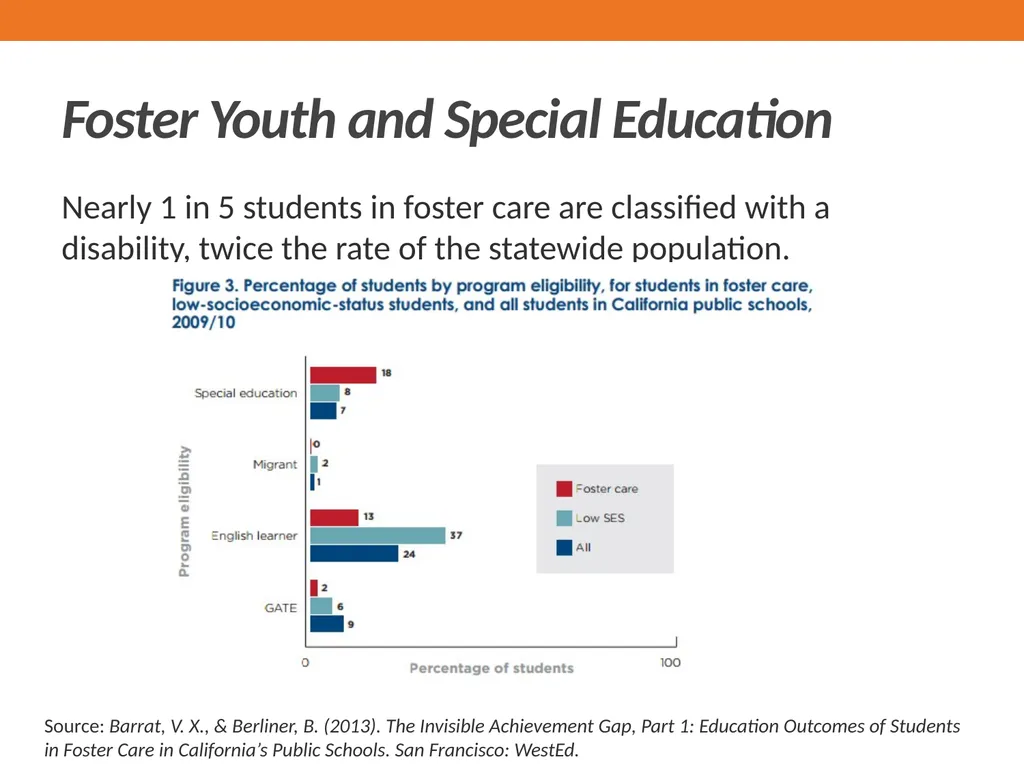
slide4. Foster Youth and Special Education Nearly 1 in 5 students in foster care are classified with a disability, twice the rate of the statewide population. Source: Barrat, V. X., & Berliner, B. (2013). The Invisible Achievement Gap, Part 1: Education Outcomes of Students in Foster Care in California’s Public Schools. San Francisco: WestEd.<br>
slide5. The Truth About Children who Need an IEP All children develop and learn in different ways.
Being eligible for special education services does not mean that the child is “dumb” or cannot learn.
It means the child learns in different ways, and/or needs specialized services to assist with their learning. Education Manual, Page 2<br>
slide6. What is special education?<br>
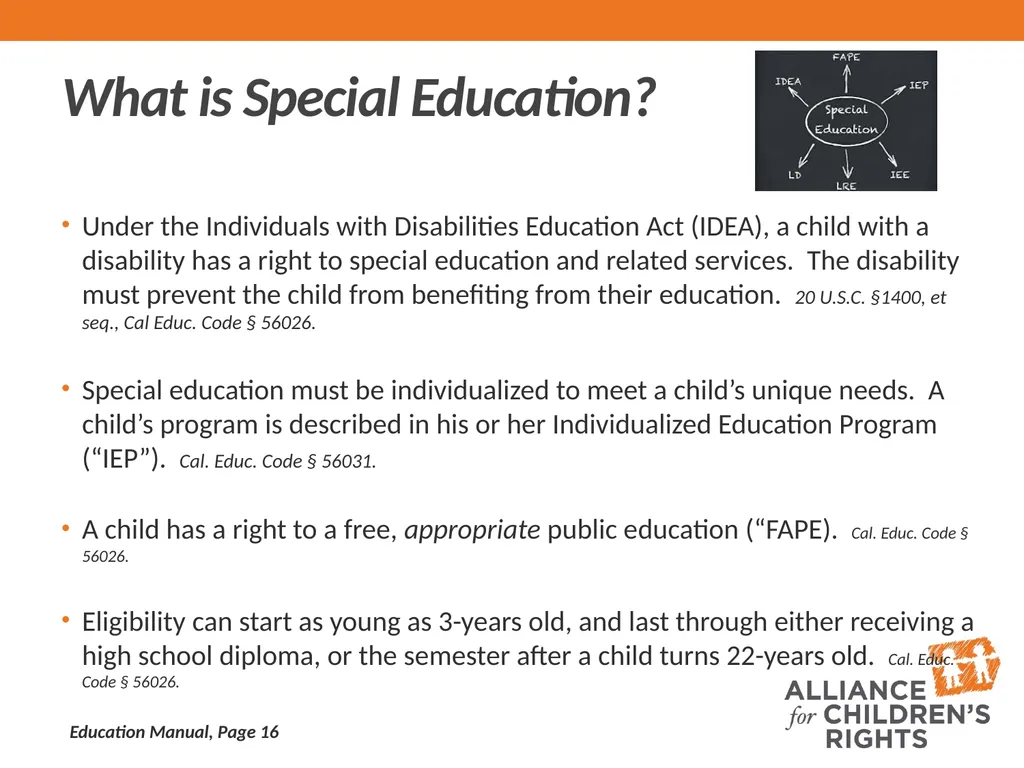
slide7. What is Special Education? Under the Individuals with Disabilities Education Act (IDEA), a child with a disability has a right to special education and related services. The disability must prevent the child from benefiting from their education. 20 U.S.C. §1400, et seq., Cal Educ. Code § 56026.
Special education must be individualized to meet a child’s unique needs. A child’s program is described in his or her Individualized Education Program (“IEP”). Cal. Educ. Code § 56031.
A child has a right to a free, appropriate public education (“FAPE). Cal. Educ. Code § 56026.
Eligibility can start as young as 3-years old, and last through either receiving a high school diploma, or the semester after a child turns 22-years old. Cal. Educ. Code § 56026. Education Manual, Page 16<br>
slide8. Who has the legal authority to make education decisions?<br>
slide9. What are education rights? An Education Rights Holder (ERH) has the legal right to make education-related decisions for a child, including:
Requesting records,
Requesting special education assessments, and
Consenting to special education services and placements in the Individualized Education Program (IEP).
An IEP is a contract between the ERH and the school district for special education services. Education Manual, Page 4<br>
slide10. Who can be an ERH? Biological Parents (from birth)
Automatically:
Legal Guardians
Adoptive Parents
With a court order (JV 535 or minute order)
Prospective Adoptive Parents
Foster Caregivers
Relative caregivers
CASA
Court-trained volunteer
If you are unsure who holds education rights, ask the child’s court-appointed attorney or social worker. Education Manual, Page 4<br>
slide11. Prohibited Education Rights Holders Who cannot hold education rights?
Social worker
Probation officer
Group home staff
Therapist
Attorney
School staff<br>
slide12. What are the warning signs that a child might need special education?<br>
slide13. Signs: Poor grades or attendance
Problems with memory or attention
Difficulty with classroom activities such as writing, reading or doing math
Behavior problems, such as acting out when frustrated or being defiant
Social or emotional problems
Speech and language problems, such as poor vocabulary, sentence structure, or problems pronouncing words/sounds Education Manual, Page 16<br>
slide14. Records Request See Handout 1: Records Request
See Handout 2: Education Records Review Grid Education Manual, Page 5<br>
slide15. How to get help?<br>
slide16. Requesting An Assessment What is the standard for assessing a child for special education? A suspected area of disability. This is a very low standard, requiring only a suspicion that a disability may be preventing the child from accessing his or her education. Cal. Educ. Code § § 56301, 56320
Who can refer a child for a special education assessment? Anyone. Cal Educ. Code § 56029, Education Manual, Page 17<br>
slide17. Requesting an Assessment How do you make the request?
Submit the request in writing.
See Handout: Assessment Request
What should the assessment request include?
Identify the suspected disability (i.e. areas of educational concern)
Identify assessments needed
ERH contact information<br>
slide18. Types of assessments: Psycho-Educational, including:
Cognitive/IQ
Academic
Psychological processing including visual, auditory, sensory motor and attention processing
Social, emotional, behavioral
Health and physical development including hearing and vision
Speech and language by a speech and language pathologist
Fine motor and/or sensory processing by an occupational therapist
Functional Behavior Assessment
Educationally Related Mental Health Services (ERMHS) Assessment. Education Manual, Page 17<br>
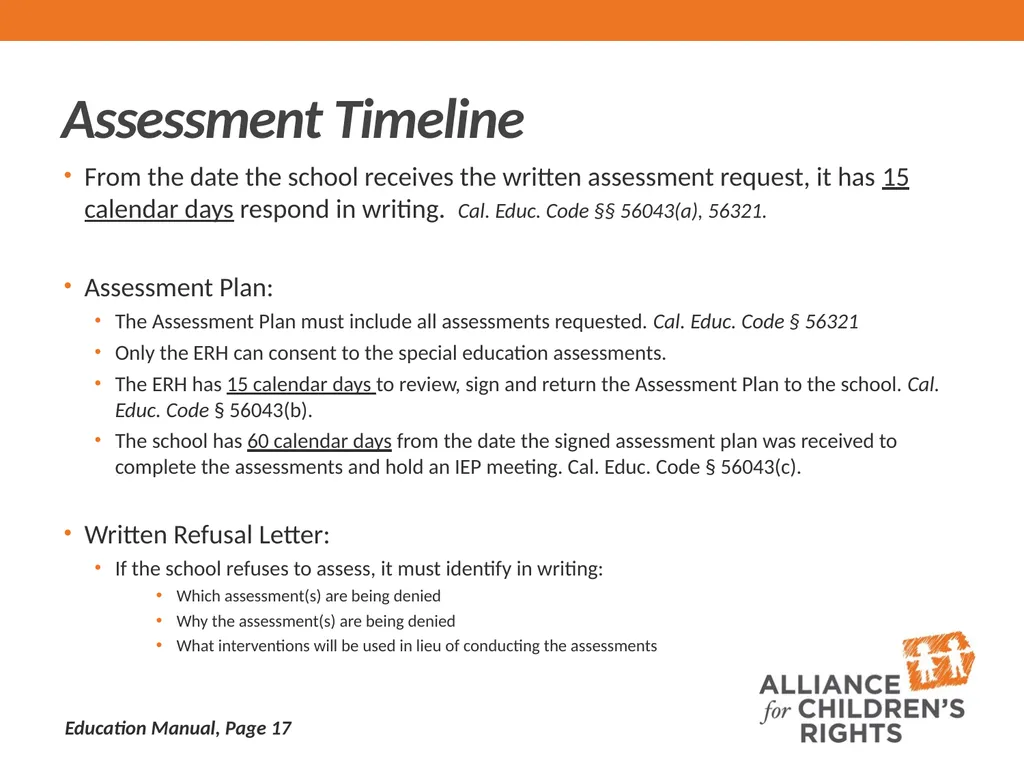
slide19. From the date the school receives the written assessment request, it has 15 calendar days respond in writing. Cal. Educ. Code §§ 56043(a), 56321.
Assessment Plan:
The Assessment Plan must include all assessments requested. Cal. Educ. Code § 56321
Only the ERH can consent to the special education assessments.
The ERH has 15 calendar days to review, sign and return the Assessment Plan to the school. Cal. Educ. Code § 56043(b).
The school has 60 calendar days from the date the signed assessment plan was received to complete the assessments and hold an IEP meeting. Cal. Educ. Code § 56043(c).
Written Refusal Letter:
If the school refuses to assess, it must identify in writing:
Which assessment(s) are being denied
Why the assessment(s) are being denied
What interventions will be used in lieu of conducting the assessments Assessment Timeline Education Manual, Page 17<br>
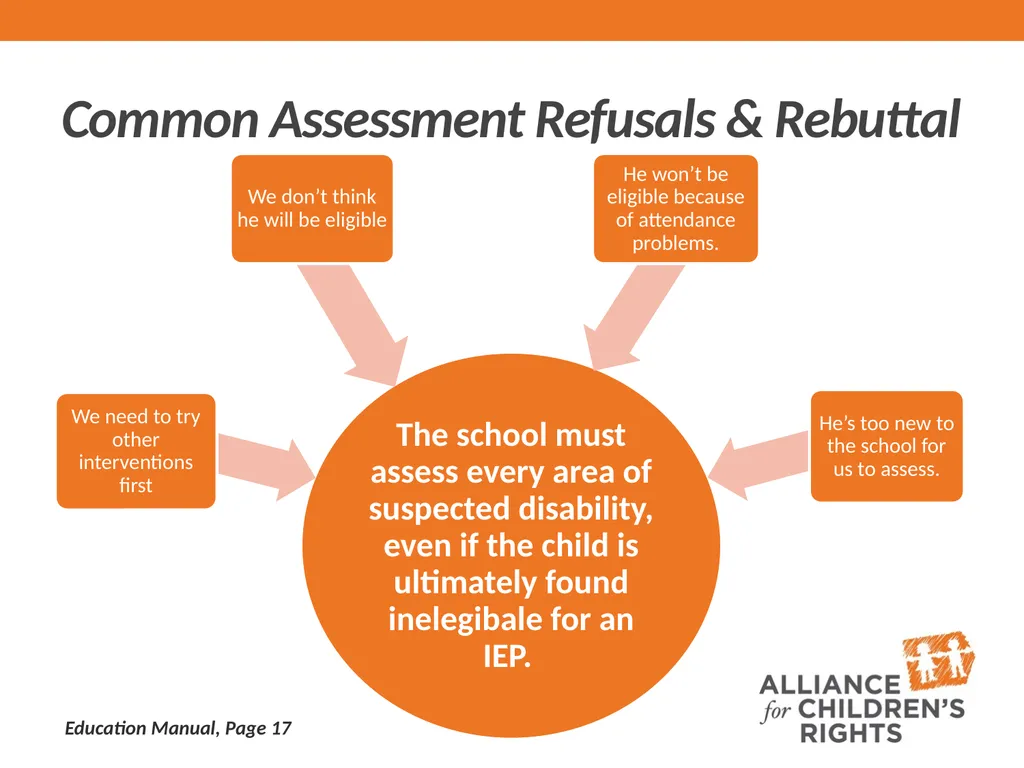
slide20. Common Assessment Refusals & Rebuttal Education Manual, Page 17<br>
slide21. Preparing for the IEP Meeting<br>
slide22. Before the IEP Meeting you should: Request a copy of the assessment reports 5-business days before the scheduled meeting
Review assessment reports
Discuss the education concerns with the caregiver, ERH, mental health professionals and others working with the child
Bring a list of questions and concerns to the IEP meeting Education Manual, Page 17<br>
slide23. Please attend the IEP workshop scheduled on 11/08/16! Learn about what an IEP is; the different kinds of IEP’s; components and much more!<br>
slide24. Overview: Who is an appropriate education rights holder?
Common warning signs that a child might need special education and related services?
How to request a special education assessment?
How to prepare for an IEP meeting?<br>
slide25. For more help… If you have exhausted every outlet, seek help.
Ask the minor’s attorney to complete a referral for a 317(e) attorney to be appointed
Call the Alliance for Children’s Rights (213) 368-6010 or visit our website: www.kids-alliance.org<br>

Megan Stanton-Trehan, Education Attorney<br>
slide2. Learning Objectives<br>
slide3. You will be able to identify: Who is an appropriate education rights holder?
Common warning signs that a child might need special education and related services?
How to request a special education assessment?
How to prepare for an IEP meeting?<br>
slide4. Foster Youth and Special Education Nearly 1 in 5 students in foster care are classified with a disability, twice the rate of the statewide population. Source: Barrat, V. X., & Berliner, B. (2013). The Invisible Achievement Gap, Part 1: Education Outcomes of Students in Foster Care in California’s Public Schools. San Francisco: WestEd.<br>
slide5. The Truth About Children who Need an IEP All children develop and learn in different ways.
Being eligible for special education services does not mean that the child is “dumb” or cannot learn.
It means the child learns in different ways, and/or needs specialized services to assist with their learning. Education Manual, Page 2<br>
slide6. What is special education?<br>
slide7. What is Special Education? Under the Individuals with Disabilities Education Act (IDEA), a child with a disability has a right to special education and related services. The disability must prevent the child from benefiting from their education. 20 U.S.C. §1400, et seq., Cal Educ. Code § 56026.
Special education must be individualized to meet a child’s unique needs. A child’s program is described in his or her Individualized Education Program (“IEP”). Cal. Educ. Code § 56031.
A child has a right to a free, appropriate public education (“FAPE). Cal. Educ. Code § 56026.
Eligibility can start as young as 3-years old, and last through either receiving a high school diploma, or the semester after a child turns 22-years old. Cal. Educ. Code § 56026. Education Manual, Page 16<br>
slide8. Who has the legal authority to make education decisions?<br>
slide9. What are education rights? An Education Rights Holder (ERH) has the legal right to make education-related decisions for a child, including:
Requesting records,
Requesting special education assessments, and
Consenting to special education services and placements in the Individualized Education Program (IEP).
An IEP is a contract between the ERH and the school district for special education services. Education Manual, Page 4<br>
slide10. Who can be an ERH? Biological Parents (from birth)
Automatically:
Legal Guardians
Adoptive Parents
With a court order (JV 535 or minute order)
Prospective Adoptive Parents
Foster Caregivers
Relative caregivers
CASA
Court-trained volunteer
If you are unsure who holds education rights, ask the child’s court-appointed attorney or social worker. Education Manual, Page 4<br>
slide11. Prohibited Education Rights Holders Who cannot hold education rights?
Social worker
Probation officer
Group home staff
Therapist
Attorney
School staff<br>
slide12. What are the warning signs that a child might need special education?<br>
slide13. Signs: Poor grades or attendance
Problems with memory or attention
Difficulty with classroom activities such as writing, reading or doing math
Behavior problems, such as acting out when frustrated or being defiant
Social or emotional problems
Speech and language problems, such as poor vocabulary, sentence structure, or problems pronouncing words/sounds Education Manual, Page 16<br>
slide14. Records Request See Handout 1: Records Request
See Handout 2: Education Records Review Grid Education Manual, Page 5<br>
slide15. How to get help?<br>
slide16. Requesting An Assessment What is the standard for assessing a child for special education? A suspected area of disability. This is a very low standard, requiring only a suspicion that a disability may be preventing the child from accessing his or her education. Cal. Educ. Code § § 56301, 56320
Who can refer a child for a special education assessment? Anyone. Cal Educ. Code § 56029, Education Manual, Page 17<br>
slide17. Requesting an Assessment How do you make the request?
Submit the request in writing.
See Handout: Assessment Request
What should the assessment request include?
Identify the suspected disability (i.e. areas of educational concern)
Identify assessments needed
ERH contact information<br>
slide18. Types of assessments: Psycho-Educational, including:
Cognitive/IQ
Academic
Psychological processing including visual, auditory, sensory motor and attention processing
Social, emotional, behavioral
Health and physical development including hearing and vision
Speech and language by a speech and language pathologist
Fine motor and/or sensory processing by an occupational therapist
Functional Behavior Assessment
Educationally Related Mental Health Services (ERMHS) Assessment. Education Manual, Page 17<br>
slide19. From the date the school receives the written assessment request, it has 15 calendar days respond in writing. Cal. Educ. Code §§ 56043(a), 56321.
Assessment Plan:
The Assessment Plan must include all assessments requested. Cal. Educ. Code § 56321
Only the ERH can consent to the special education assessments.
The ERH has 15 calendar days to review, sign and return the Assessment Plan to the school. Cal. Educ. Code § 56043(b).
The school has 60 calendar days from the date the signed assessment plan was received to complete the assessments and hold an IEP meeting. Cal. Educ. Code § 56043(c).
Written Refusal Letter:
If the school refuses to assess, it must identify in writing:
Which assessment(s) are being denied
Why the assessment(s) are being denied
What interventions will be used in lieu of conducting the assessments Assessment Timeline Education Manual, Page 17<br>
slide20. Common Assessment Refusals & Rebuttal Education Manual, Page 17<br>
slide21. Preparing for the IEP Meeting<br>
slide22. Before the IEP Meeting you should: Request a copy of the assessment reports 5-business days before the scheduled meeting
Review assessment reports
Discuss the education concerns with the caregiver, ERH, mental health professionals and others working with the child
Bring a list of questions and concerns to the IEP meeting Education Manual, Page 17<br>
slide23. Please attend the IEP workshop scheduled on 11/08/16! Learn about what an IEP is; the different kinds of IEP’s; components and much more!<br>
slide24. Overview: Who is an appropriate education rights holder?
Common warning signs that a child might need special education and related services?
How to request a special education assessment?
How to prepare for an IEP meeting?<br>
slide25. For more help… If you have exhausted every outlet, seek help.
Ask the minor’s attorney to complete a referral for a 317(e) attorney to be appointed
Call the Alliance for Children’s Rights (213) 368-6010 or visit our website: www.kids-alliance.org<br>