
Special Emphasis Program Manager (SEPM) Training
OM
Published · 48 slides · 0 views
1 / 1

Description
Special Emphasis Program Manager (SEPM) Training What are the Special Emphasis Programs? 2 Disability Emphasis Program Federal Womens Program Hispanic Emphasis Program Asian American and Pacific Islander Program American Indian and
Related Topics
Share
Embed code
Download this presentation From Below
"Special Emphasis Program Manager (SEPM) Training" is the property of its rightful owner. Permission is granted to download and print the materials on this website for personal, non-commercial use only, and to display it on your personal computer provided you do not modify the materials and that you retain all copyright notices contained in the materials. By downloading content from our website, you accept the terms of this agreement.
Presentation Transcript
01
Special Emphasis Program Manager (SEPM) Training<br>
02
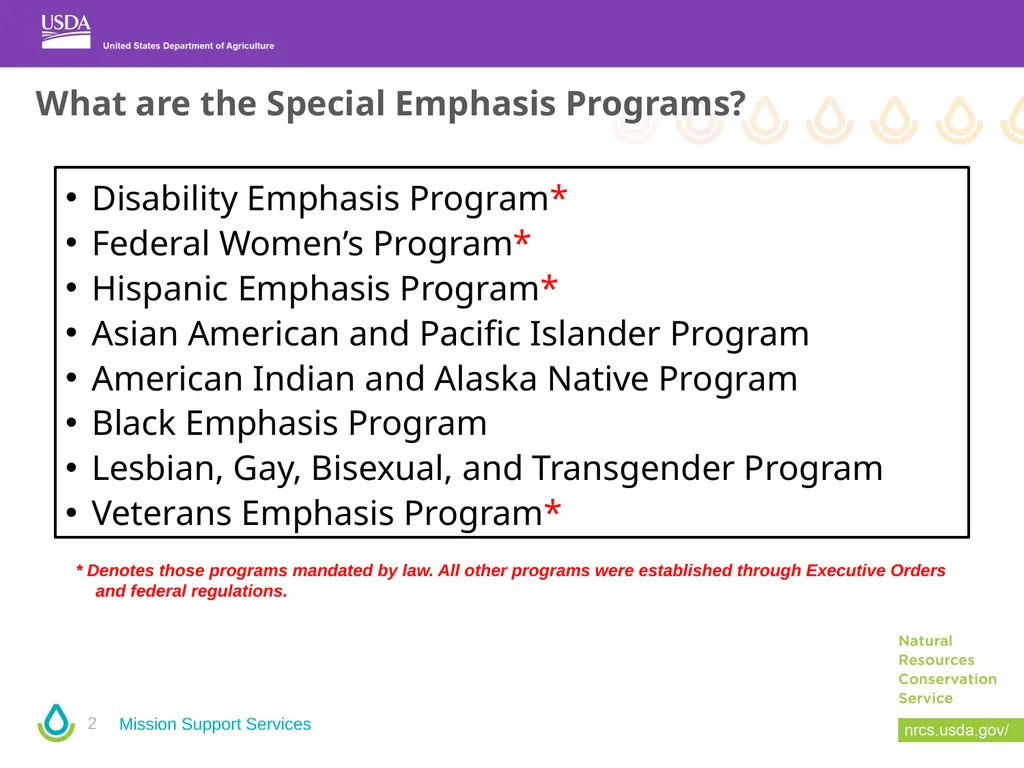
What are the Special Emphasis Programs? 2 Disability Emphasis Program*
Federal Women’s Program*
Hispanic Emphasis Program*
Asian American and Pacific Islander Program
American Indian and Alaska Native Program
Black Emphasis Program
Lesbian, Gay, Bisexual, and Transgender Program
Veterans Emphasis Program* * Denotes those programs mandated by law. All other programs were established through Executive Orders and federal regulations.<br>
Federal Women’s Program*
Hispanic Emphasis Program*
Asian American and Pacific Islander Program
American Indian and Alaska Native Program
Black Emphasis Program
Lesbian, Gay, Bisexual, and Transgender Program
Veterans Emphasis Program* * Denotes those programs mandated by law. All other programs were established through Executive Orders and federal regulations.<br>
03
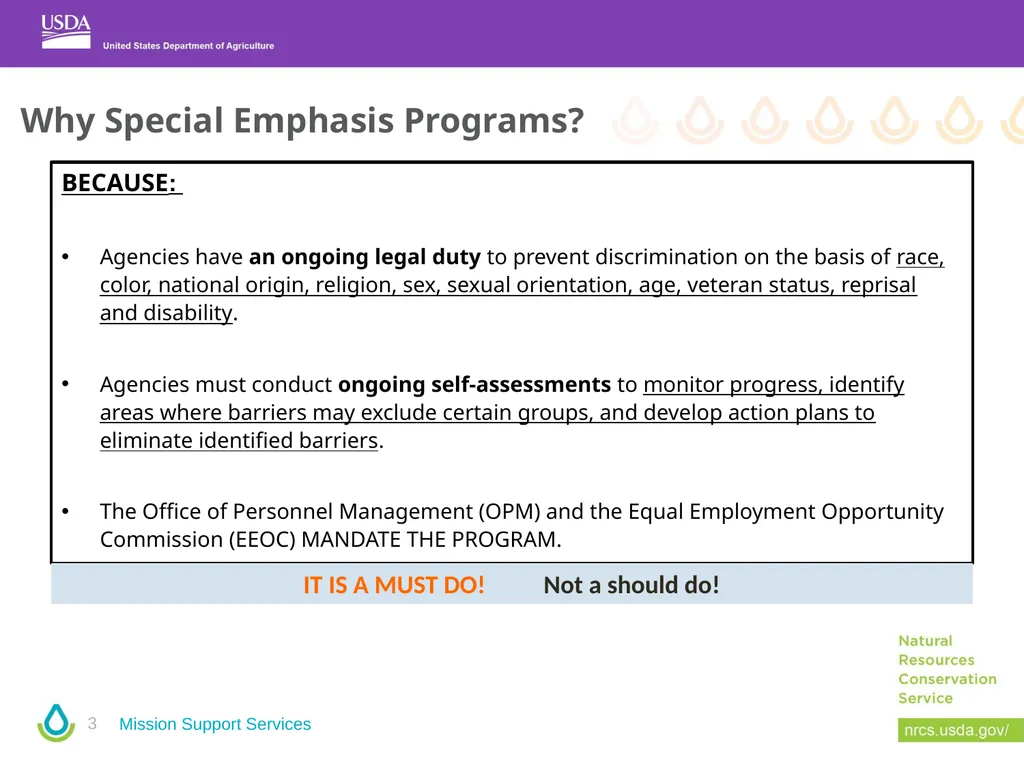
Why Special Emphasis Programs? BECAUSE:
Agencies have an ongoing legal duty to prevent discrimination on the basis of race, color, national origin, religion, sex, sexual orientation, age, veteran status, reprisal and disability.
Agencies must conduct ongoing self-assessments to monitor progress, identify areas where barriers may exclude certain groups, and develop action plans to eliminate identified barriers.
The Office of Personnel Management (OPM) and the Equal Employment Opportunity Commission (EEOC) MANDATE THE PROGRAM. 3 IT IS A MUST DO! Not a should do!<br>
Agencies have an ongoing legal duty to prevent discrimination on the basis of race, color, national origin, religion, sex, sexual orientation, age, veteran status, reprisal and disability.
Agencies must conduct ongoing self-assessments to monitor progress, identify areas where barriers may exclude certain groups, and develop action plans to eliminate identified barriers.
The Office of Personnel Management (OPM) and the Equal Employment Opportunity Commission (EEOC) MANDATE THE PROGRAM. 3 IT IS A MUST DO! Not a should do!<br>
04
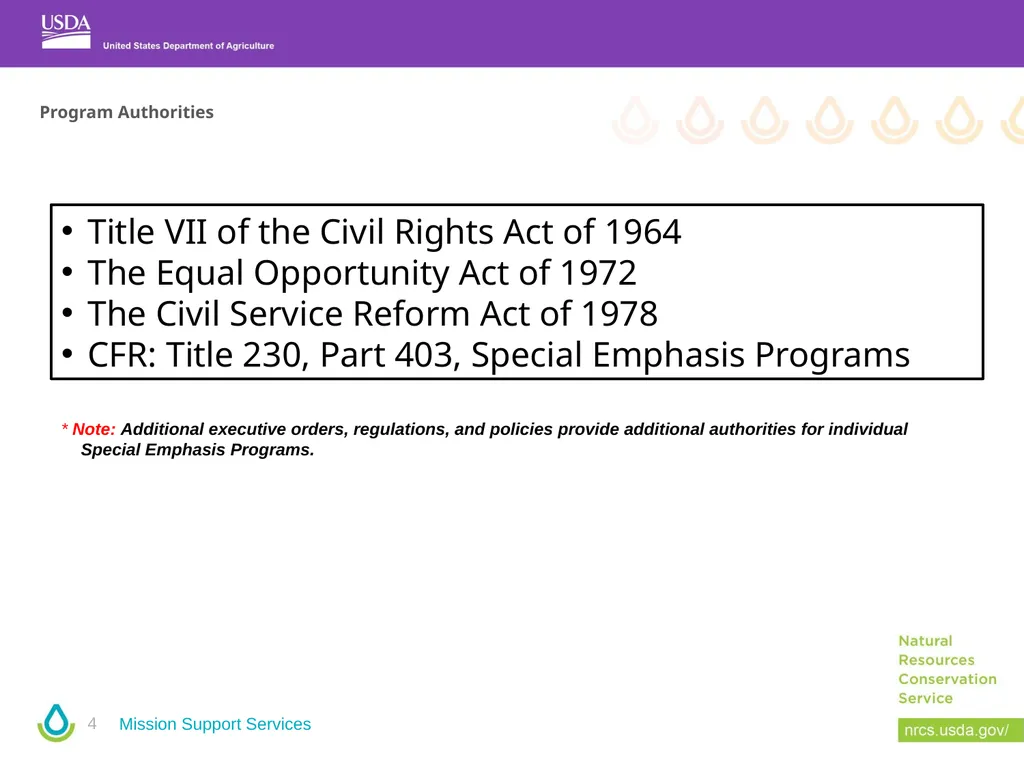
Program Authorities 4 Title VII of the Civil Rights Act of 1964
The Equal Opportunity Act of 1972
The Civil Service Reform Act of 1978
CFR: Title 230, Part 403, Special Emphasis Programs * Note: Additional executive orders, regulations, and policies provide additional authorities for individual Special Emphasis Programs.<br>
The Equal Opportunity Act of 1972
The Civil Service Reform Act of 1978
CFR: Title 230, Part 403, Special Emphasis Programs * Note: Additional executive orders, regulations, and policies provide additional authorities for individual Special Emphasis Programs.<br>
05
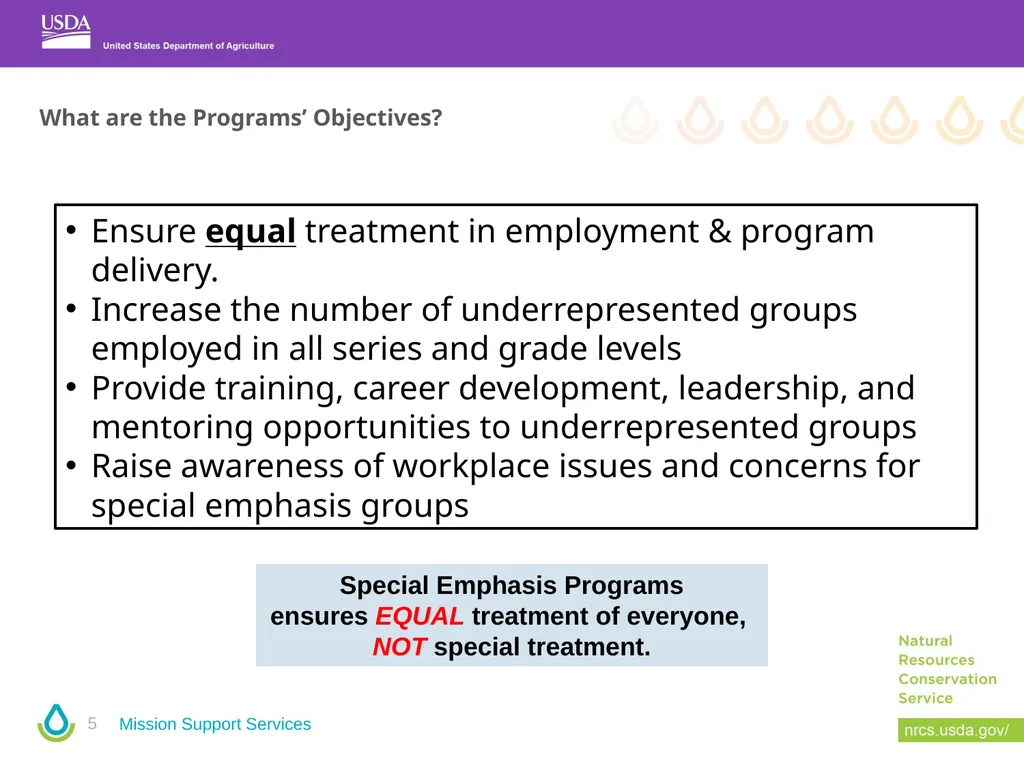
What are the Programs’ Objectives? 5 Ensure equal treatment in employment & program delivery.
Increase the number of underrepresented groups employed in all series and grade levels
Provide training, career development, leadership, and mentoring opportunities to underrepresented groups
Raise awareness of workplace issues and concerns for special emphasis groups Special Emphasis Programs
ensures EQUAL treatment of everyone,
NOT special treatment.<br>
Increase the number of underrepresented groups employed in all series and grade levels
Provide training, career development, leadership, and mentoring opportunities to underrepresented groups
Raise awareness of workplace issues and concerns for special emphasis groups Special Emphasis Programs
ensures EQUAL treatment of everyone,
NOT special treatment.<br>
06
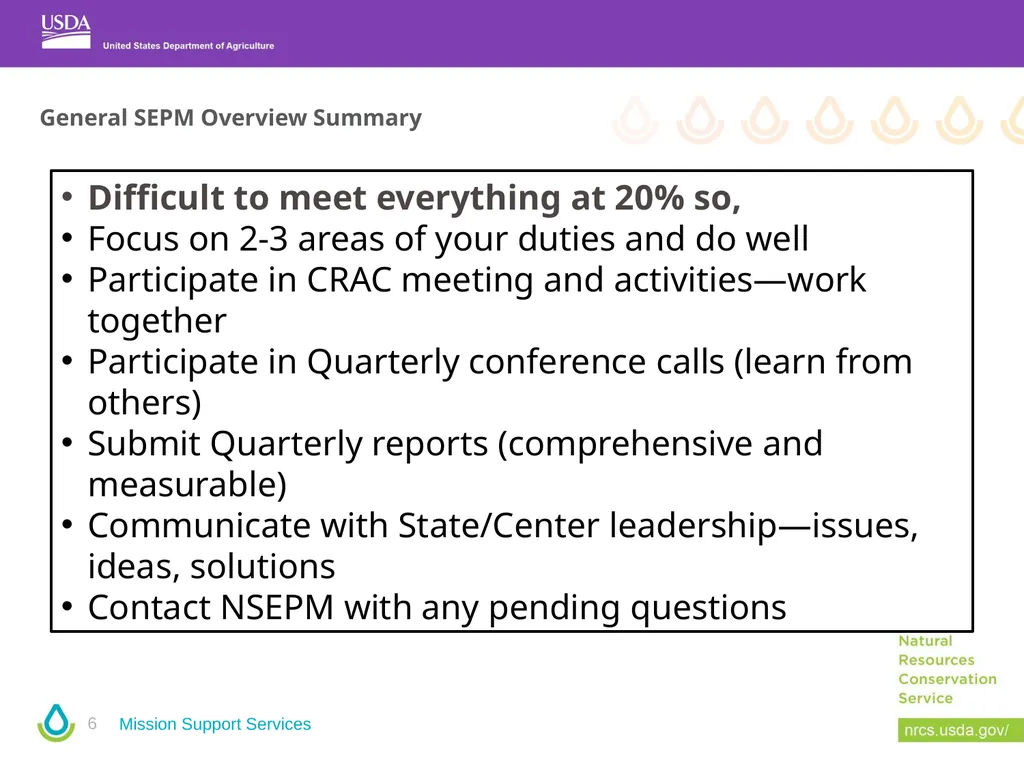
General SEPM Overview Summary 6 Difficult to meet everything at 20% so,
Focus on 2-3 areas of your duties and do well
Participate in CRAC meeting and activities—work together
Participate in Quarterly conference calls (learn from others)
Submit Quarterly reports (comprehensive and measurable)
Communicate with State/Center leadership—issues, ideas, solutions
Contact NSEPM with any pending questions<br>
Focus on 2-3 areas of your duties and do well
Participate in CRAC meeting and activities—work together
Participate in Quarterly conference calls (learn from others)
Submit Quarterly reports (comprehensive and measurable)
Communicate with State/Center leadership—issues, ideas, solutions
Contact NSEPM with any pending questions<br>
07
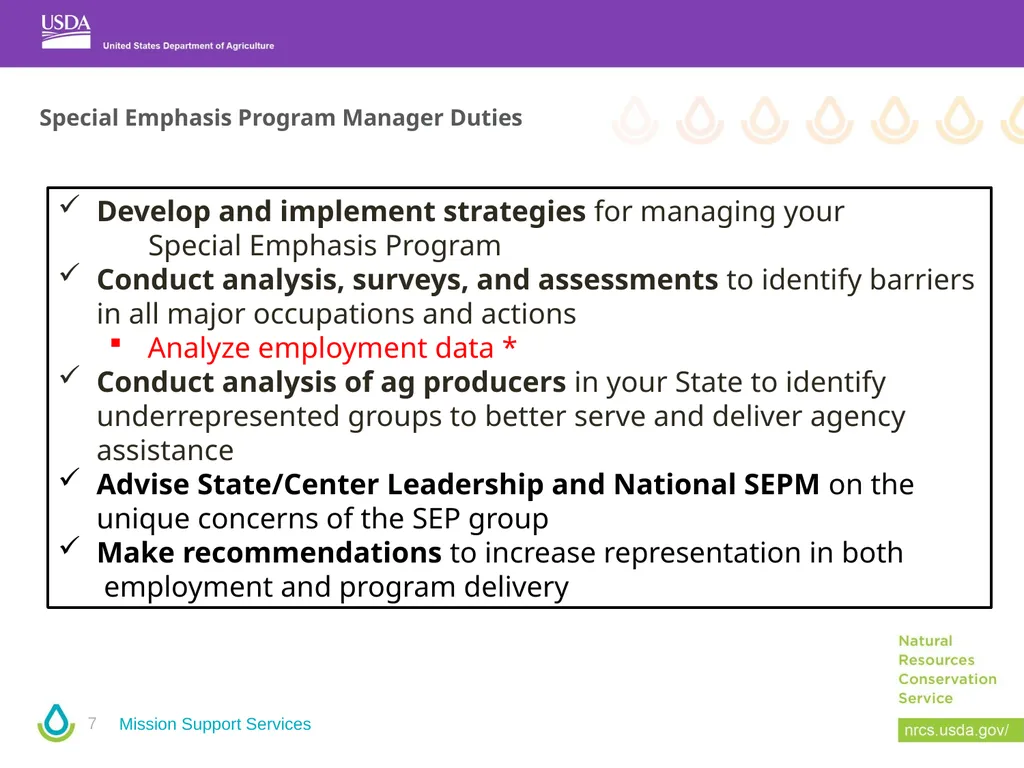
Special Emphasis Program Manager Duties 7 Develop and implement strategies for managing your Special Emphasis Program
Conduct analysis, surveys, and assessments to identify barriers in all major occupations and actions
Analyze employment data *
Conduct analysis of ag producers in your State to identify underrepresented groups to better serve and deliver agency assistance
Advise State/Center Leadership and National SEPM on the unique concerns of the SEP group
Make recommendations to increase representation in both employment and program delivery<br>
Conduct analysis, surveys, and assessments to identify barriers in all major occupations and actions
Analyze employment data *
Conduct analysis of ag producers in your State to identify underrepresented groups to better serve and deliver agency assistance
Advise State/Center Leadership and National SEPM on the unique concerns of the SEP group
Make recommendations to increase representation in both employment and program delivery<br>
08
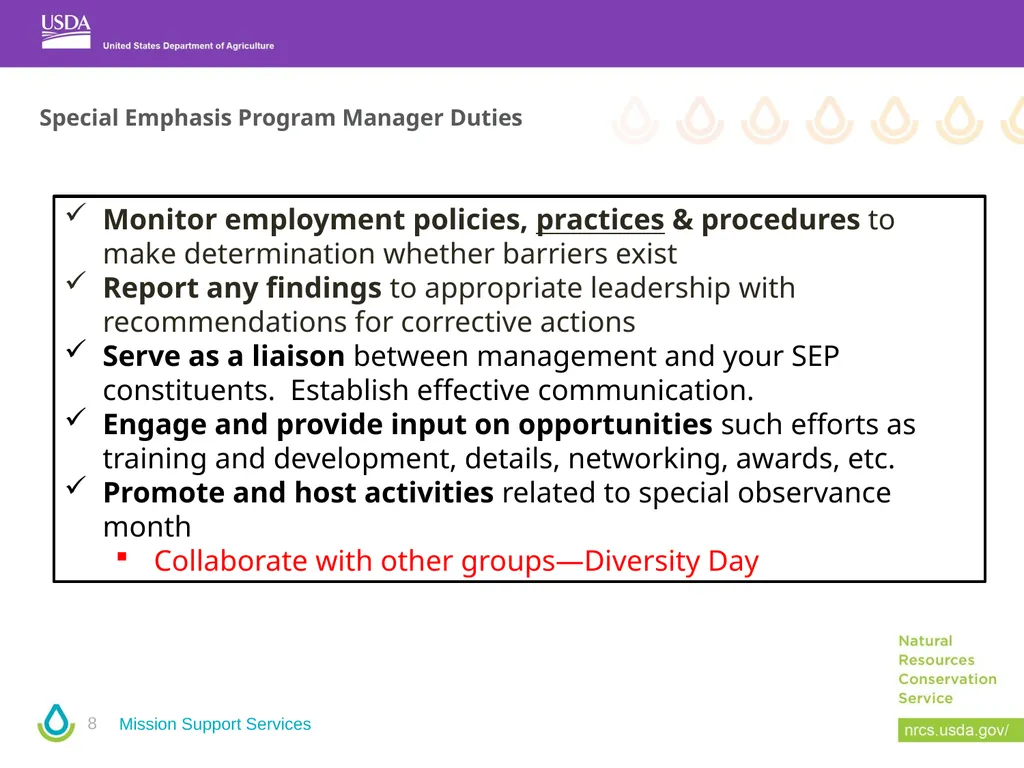
Special Emphasis Program Manager Duties 8 Monitor employment policies, practices & procedures to make determination whether barriers exist
Report any findings to appropriate leadership with recommendations for corrective actions
Serve as a liaison between management and your SEP constituents. Establish effective communication.
Engage and provide input on opportunities such efforts as training and development, details, networking, awards, etc.
Promote and host activities related to special observance month
Collaborate with other groups—Diversity Day<br>
Report any findings to appropriate leadership with recommendations for corrective actions
Serve as a liaison between management and your SEP constituents. Establish effective communication.
Engage and provide input on opportunities such efforts as training and development, details, networking, awards, etc.
Promote and host activities related to special observance month
Collaborate with other groups—Diversity Day<br>
09
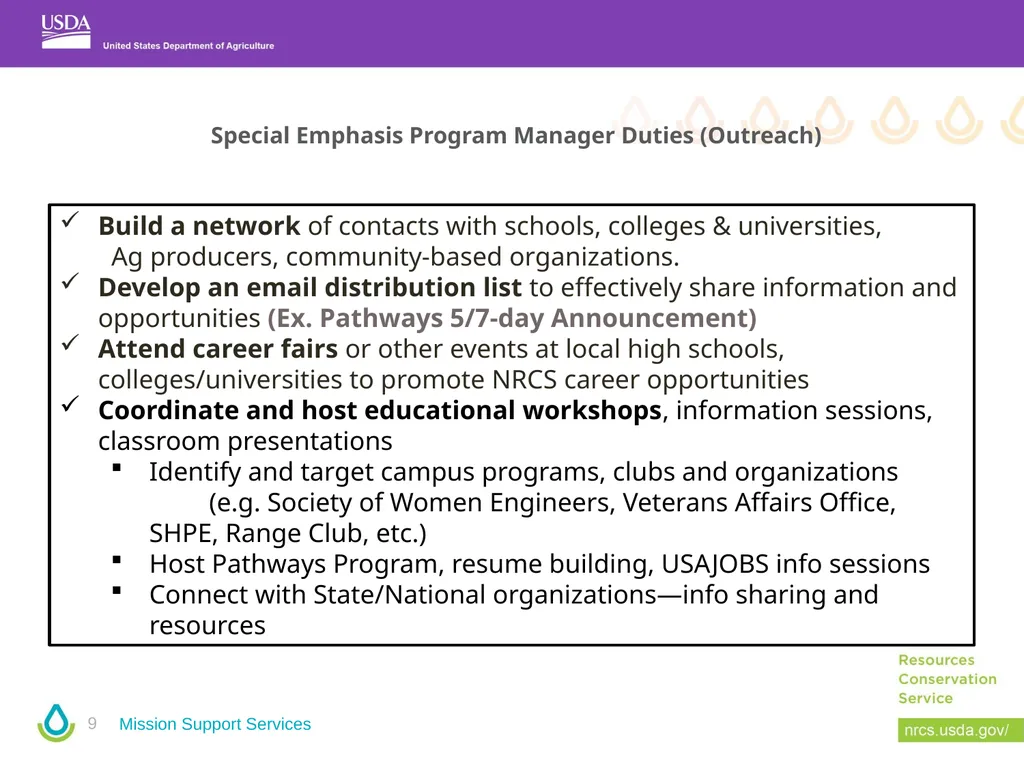
Special Emphasis Program Manager Duties (Outreach) 9 Build a network of contacts with schools, colleges & universities, Ag producers, community-based organizations.
Develop an email distribution list to effectively share information and opportunities (Ex. Pathways 5/7-day Announcement)
Attend career fairs or other events at local high schools, colleges/universities to promote NRCS career opportunities
Coordinate and host educational workshops, information sessions, classroom presentations
Identify and target campus programs, clubs and organizations (e.g. Society of Women Engineers, Veterans Affairs Office, SHPE, Range Club, etc.)
Host Pathways Program, resume building, USAJOBS info sessions
Connect with State/National organizations—info sharing and resources<br>
Develop an email distribution list to effectively share information and opportunities (Ex. Pathways 5/7-day Announcement)
Attend career fairs or other events at local high schools, colleges/universities to promote NRCS career opportunities
Coordinate and host educational workshops, information sessions, classroom presentations
Identify and target campus programs, clubs and organizations (e.g. Society of Women Engineers, Veterans Affairs Office, SHPE, Range Club, etc.)
Host Pathways Program, resume building, USAJOBS info sessions
Connect with State/National organizations—info sharing and resources<br>
10
What are the Barriers? History of Discrimination- Applicable Federal Law 10<br>
11
Disability Emphasis Program 11 Matt Perry, SEPM<br>
12
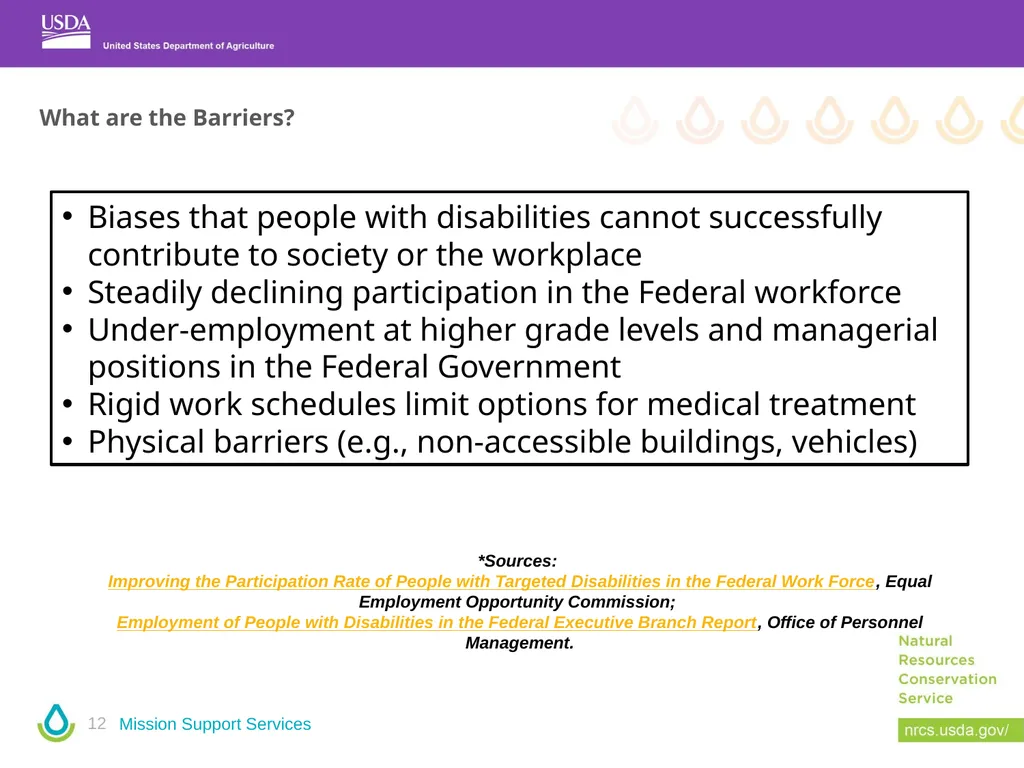
What are the Barriers? 12 Biases that people with disabilities cannot successfully contribute to society or the workplace
Steadily declining participation in the Federal workforce
Under-employment at higher grade levels and managerial positions in the Federal Government
Rigid work schedules limit options for medical treatment
Physical barriers (e.g., non-accessible buildings, vehicles) *Sources: Improving the Participation Rate of People with Targeted Disabilities in the Federal Work Force, Equal Employment Opportunity Commission; Employment of People with Disabilities in the Federal Executive Branch Report, Office of Personnel Management.<br>
Steadily declining participation in the Federal workforce
Under-employment at higher grade levels and managerial positions in the Federal Government
Rigid work schedules limit options for medical treatment
Physical barriers (e.g., non-accessible buildings, vehicles) *Sources: Improving the Participation Rate of People with Targeted Disabilities in the Federal Work Force, Equal Employment Opportunity Commission; Employment of People with Disabilities in the Federal Executive Branch Report, Office of Personnel Management.<br>
13
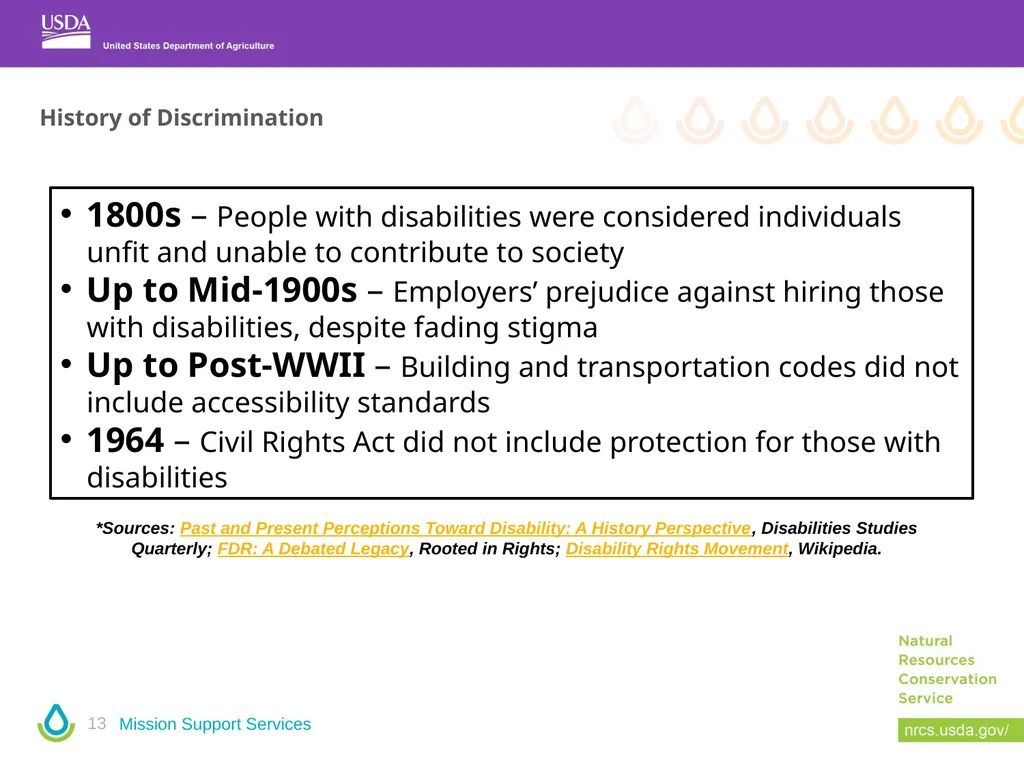
History of Discrimination 13 1800s – People with disabilities were considered individuals unfit and unable to contribute to society
Up to Mid-1900s – Employers’ prejudice against hiring those with disabilities, despite fading stigma
Up to Post-WWII – Building and transportation codes did not include accessibility standards
1964 – Civil Rights Act did not include protection for those with disabilities *Sources: Past and Present Perceptions Toward Disability: A History Perspective, Disabilities Studies Quarterly; FDR: A Debated Legacy, Rooted in Rights; Disability Rights Movement, Wikipedia.<br>
Up to Mid-1900s – Employers’ prejudice against hiring those with disabilities, despite fading stigma
Up to Post-WWII – Building and transportation codes did not include accessibility standards
1964 – Civil Rights Act did not include protection for those with disabilities *Sources: Past and Present Perceptions Toward Disability: A History Perspective, Disabilities Studies Quarterly; FDR: A Debated Legacy, Rooted in Rights; Disability Rights Movement, Wikipedia.<br>
14
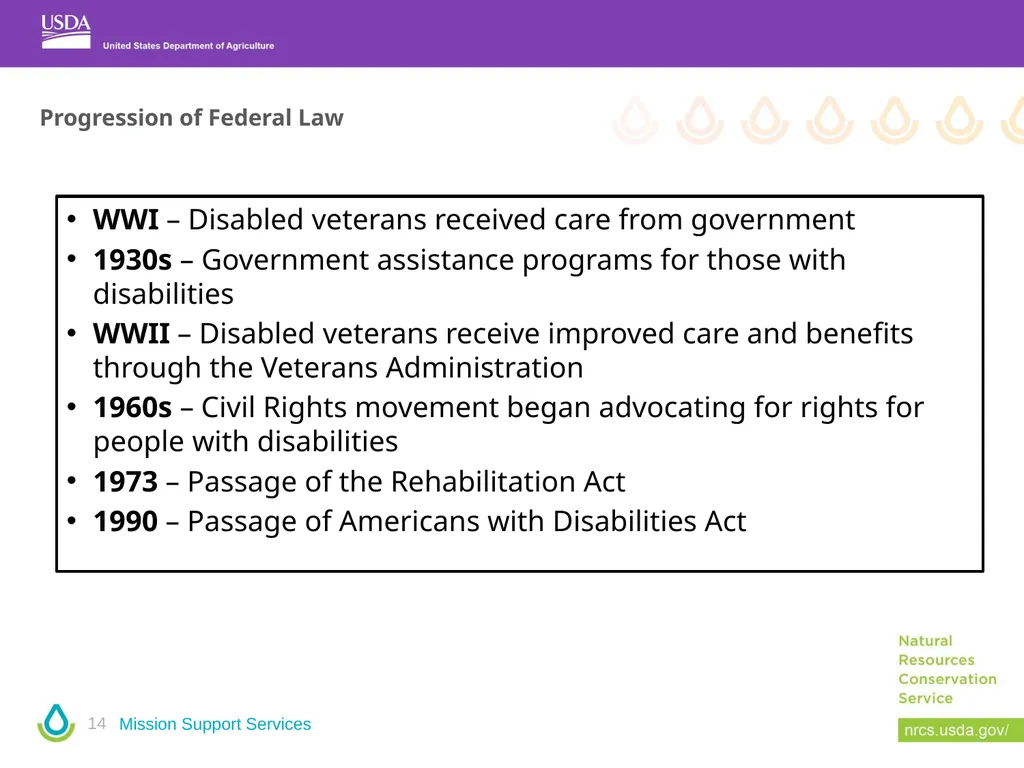
Progression of Federal Law WWI – Disabled veterans received care from government
1930s – Government assistance programs for those with disabilities
WWII – Disabled veterans receive improved care and benefits through the Veterans Administration
1960s – Civil Rights movement began advocating for rights for people with disabilities
1973 – Passage of the Rehabilitation Act
1990 – Passage of Americans with Disabilities Act 14<br>
1930s – Government assistance programs for those with disabilities
WWII – Disabled veterans receive improved care and benefits through the Veterans Administration
1960s – Civil Rights movement began advocating for rights for people with disabilities
1973 – Passage of the Rehabilitation Act
1990 – Passage of Americans with Disabilities Act 14<br>
15
Black Emphasis Program 15 Wynea Buford, SEPM<br>
16
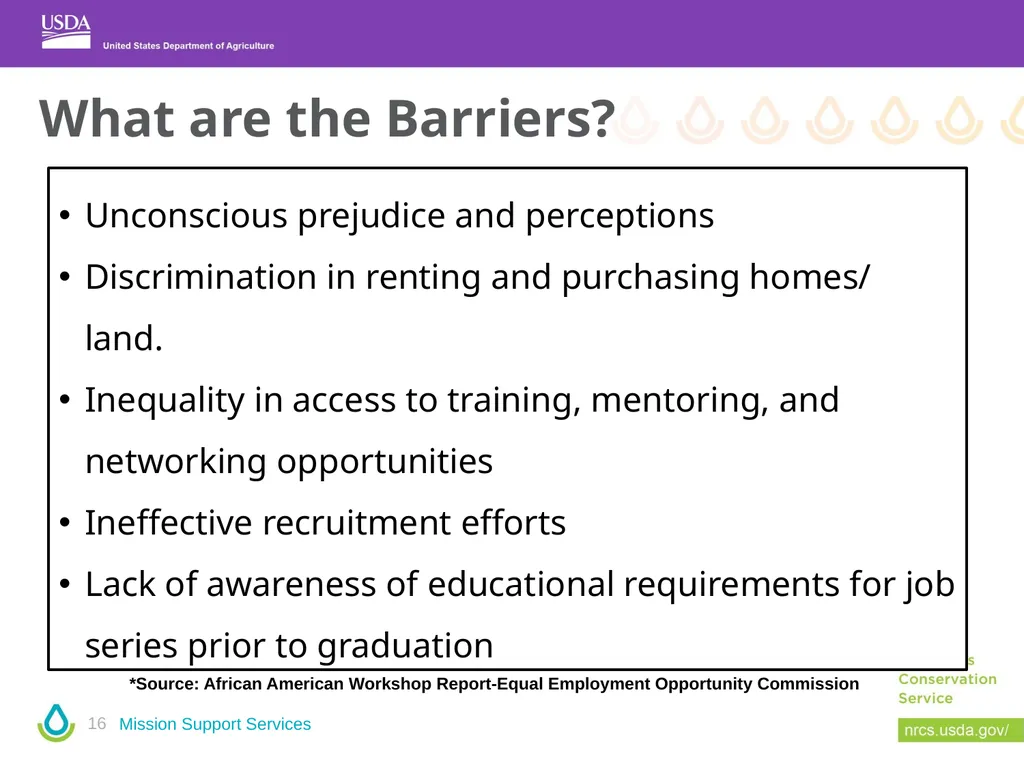
What are the Barriers? 16 Unconscious prejudice and perceptions
Discrimination in renting and purchasing homes/ land.
Inequality in access to training, mentoring, and networking opportunities
Ineffective recruitment efforts
Lack of awareness of educational requirements for job series prior to graduation *Source: African American Workshop Report-Equal Employment Opportunity Commission<br>
Discrimination in renting and purchasing homes/ land.
Inequality in access to training, mentoring, and networking opportunities
Ineffective recruitment efforts
Lack of awareness of educational requirements for job series prior to graduation *Source: African American Workshop Report-Equal Employment Opportunity Commission<br>
17
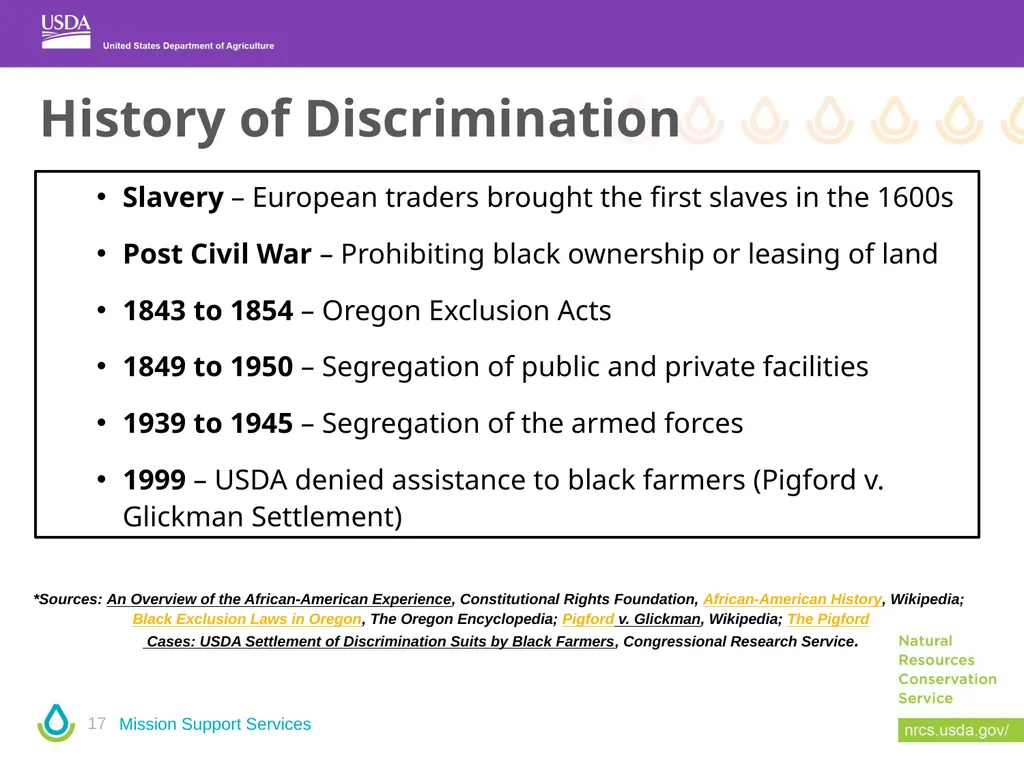
History of Discrimination 17 Slavery – European traders brought the first slaves in the 1600s
Post Civil War – Prohibiting black ownership or leasing of land
1843 to 1854 – Oregon Exclusion Acts
1849 to 1950 – Segregation of public and private facilities
1939 to 1945 – Segregation of the armed forces
1999 – USDA denied assistance to black farmers (Pigford v. Glickman Settlement) *Sources: An Overview of the African-American Experience, Constitutional Rights Foundation, African-American History, Wikipedia; Black Exclusion Laws in Oregon, The Oregon Encyclopedia; Pigford v. Glickman, Wikipedia; The Pigford Cases: USDA Settlement of Discrimination Suits by Black Farmers, Congressional Research Service.<br>
Post Civil War – Prohibiting black ownership or leasing of land
1843 to 1854 – Oregon Exclusion Acts
1849 to 1950 – Segregation of public and private facilities
1939 to 1945 – Segregation of the armed forces
1999 – USDA denied assistance to black farmers (Pigford v. Glickman Settlement) *Sources: An Overview of the African-American Experience, Constitutional Rights Foundation, African-American History, Wikipedia; Black Exclusion Laws in Oregon, The Oregon Encyclopedia; Pigford v. Glickman, Wikipedia; The Pigford Cases: USDA Settlement of Discrimination Suits by Black Farmers, Congressional Research Service.<br>
18
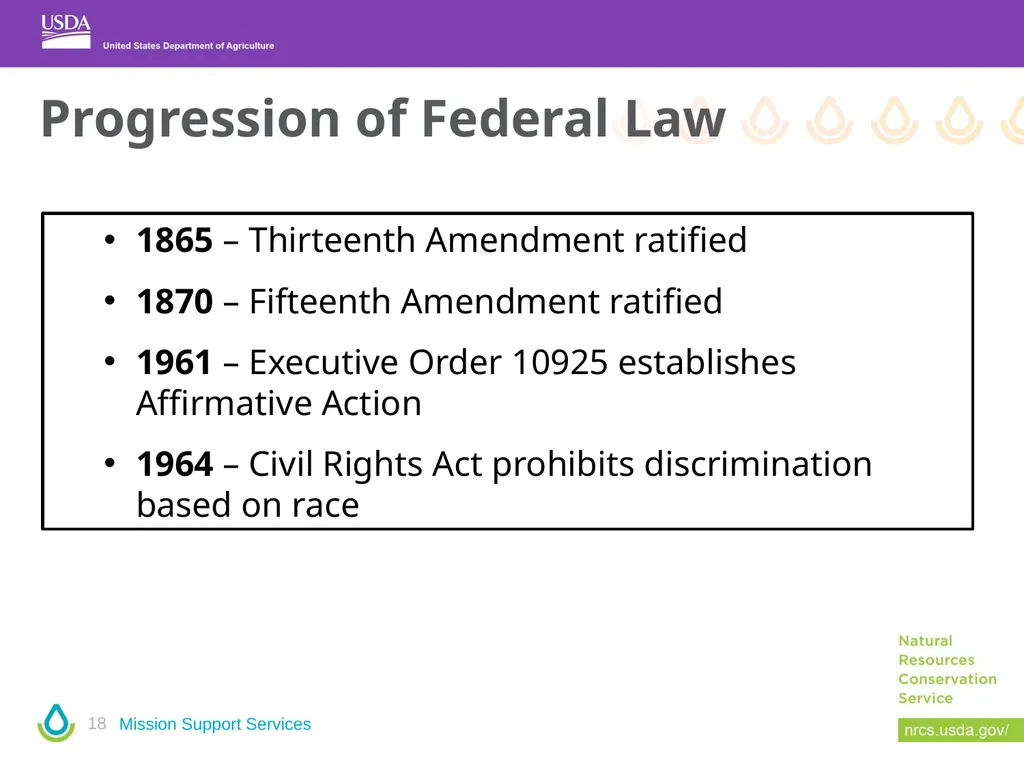
Progression of Federal Law 18 1865 – Thirteenth Amendment ratified
1870 – Fifteenth Amendment ratified
1961 – Executive Order 10925 establishes Affirmative Action
1964 – Civil Rights Act prohibits discrimination based on race<br>
1870 – Fifteenth Amendment ratified
1961 – Executive Order 10925 establishes Affirmative Action
1964 – Civil Rights Act prohibits discrimination based on race<br>
19
American Indian and Alaska Native
Emphasis Program 19 Meredith Albers, SEPM<br>
20
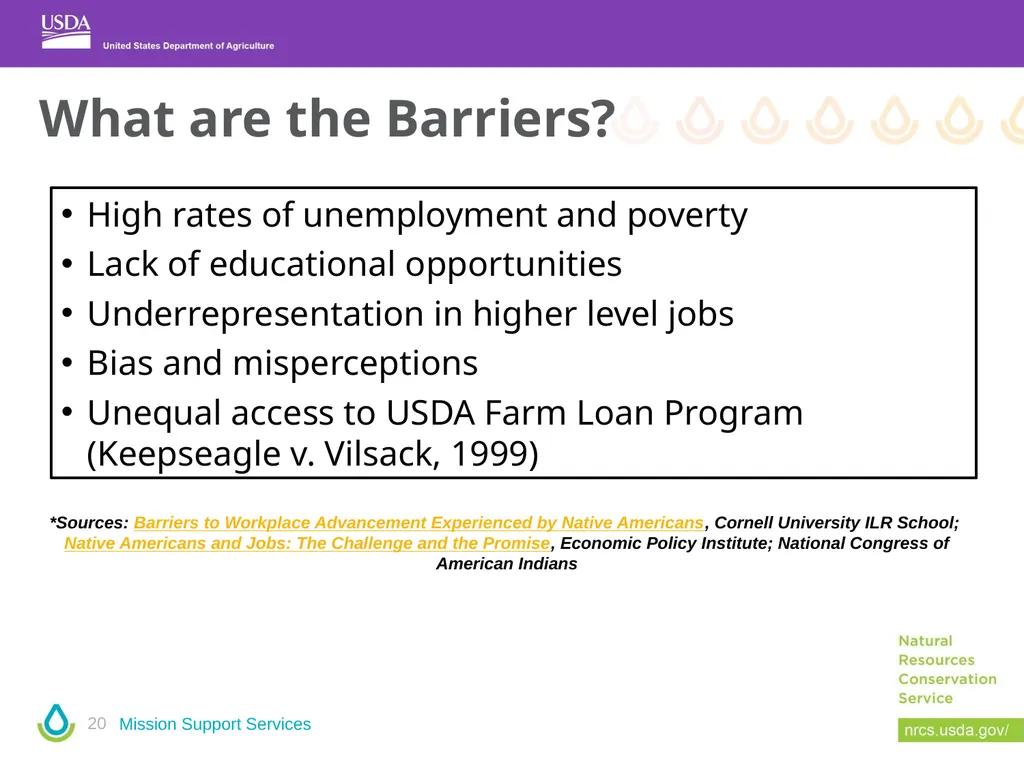
What are the Barriers? 20 High rates of unemployment and poverty
Lack of educational opportunities
Underrepresentation in higher level jobs
Bias and misperceptions
Unequal access to USDA Farm Loan Program (Keepseagle v. Vilsack, 1999) *Sources: Barriers to Workplace Advancement Experienced by Native Americans, Cornell University ILR School; Native Americans and Jobs: The Challenge and the Promise, Economic Policy Institute; National Congress of American Indians<br>
Lack of educational opportunities
Underrepresentation in higher level jobs
Bias and misperceptions
Unequal access to USDA Farm Loan Program (Keepseagle v. Vilsack, 1999) *Sources: Barriers to Workplace Advancement Experienced by Native Americans, Cornell University ILR School; Native Americans and Jobs: The Challenge and the Promise, Economic Policy Institute; National Congress of American Indians<br>
21
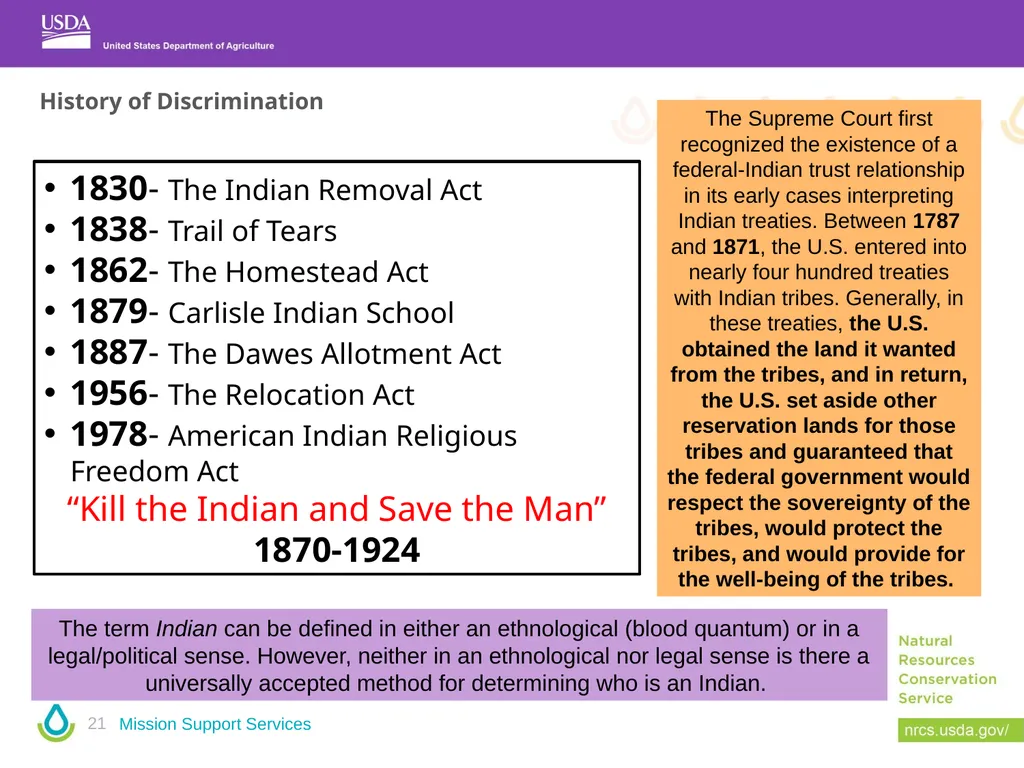
History of Discrimination 21 1830- The Indian Removal Act
1838- Trail of Tears
1862- The Homestead Act
1879- Carlisle Indian School
1887- The Dawes Allotment Act
1956- The Relocation Act
1978- American Indian Religious Freedom Act
“Kill the Indian and Save the Man” 1870-1924 The term Indian can be defined in either an ethnological (blood quantum) or in a legal/political sense. However, neither in an ethnological nor legal sense is there a universally accepted method for determining who is an Indian. The Supreme Court first recognized the existence of a federal-Indian trust relationship in its early cases interpreting Indian treaties. Between 1787 and 1871, the U.S. entered into nearly four hundred treaties with Indian tribes. Generally, in these treaties, the U.S. obtained the land it wanted from the tribes, and in return, the U.S. set aside other reservation lands for those tribes and guaranteed that the federal government would respect the sovereignty of the tribes, would protect the tribes, and would provide for the well-being of the tribes.<br>
1838- Trail of Tears
1862- The Homestead Act
1879- Carlisle Indian School
1887- The Dawes Allotment Act
1956- The Relocation Act
1978- American Indian Religious Freedom Act
“Kill the Indian and Save the Man” 1870-1924 The term Indian can be defined in either an ethnological (blood quantum) or in a legal/political sense. However, neither in an ethnological nor legal sense is there a universally accepted method for determining who is an Indian. The Supreme Court first recognized the existence of a federal-Indian trust relationship in its early cases interpreting Indian treaties. Between 1787 and 1871, the U.S. entered into nearly four hundred treaties with Indian tribes. Generally, in these treaties, the U.S. obtained the land it wanted from the tribes, and in return, the U.S. set aside other reservation lands for those tribes and guaranteed that the federal government would respect the sovereignty of the tribes, would protect the tribes, and would provide for the well-being of the tribes.<br>
22
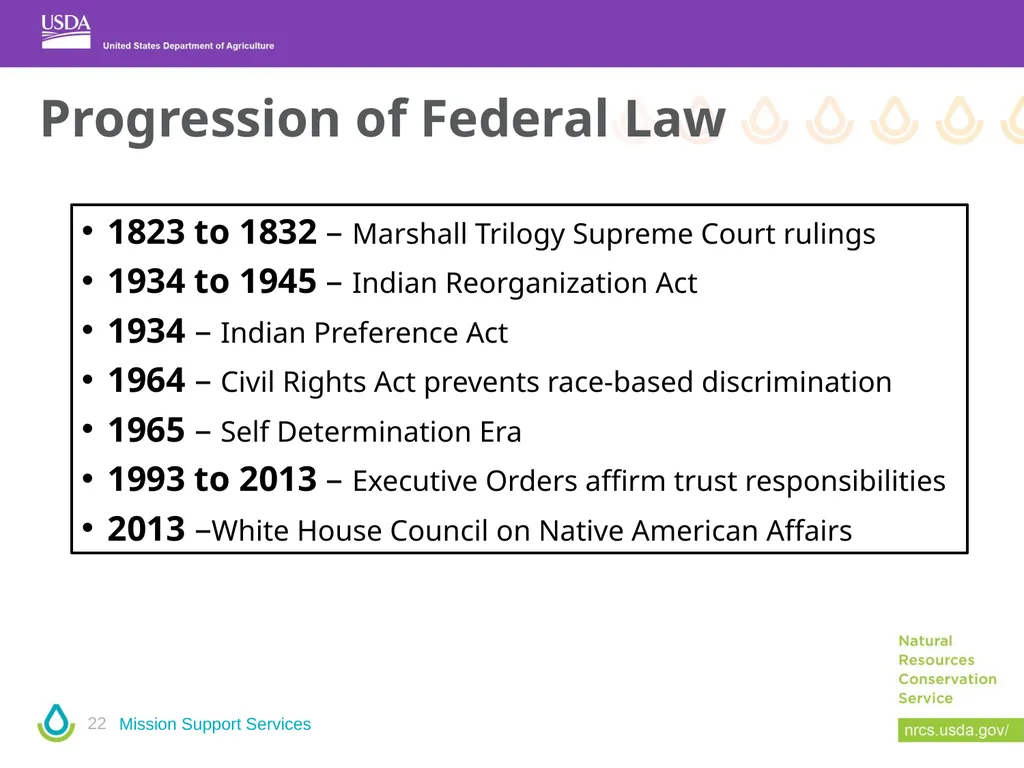
Progression of Federal Law 22 1823 to 1832 – Marshall Trilogy Supreme Court rulings
1934 to 1945 – Indian Reorganization Act
1934 – Indian Preference Act
1964 – Civil Rights Act prevents race-based discrimination
1965 – Self Determination Era
1993 to 2013 – Executive Orders affirm trust responsibilities
2013 –White House Council on Native American Affairs<br>
1934 to 1945 – Indian Reorganization Act
1934 – Indian Preference Act
1964 – Civil Rights Act prevents race-based discrimination
1965 – Self Determination Era
1993 to 2013 – Executive Orders affirm trust responsibilities
2013 –White House Council on Native American Affairs<br>
23
Federal Women’s Program 23 Marian Jordan, SEPM<br>
24
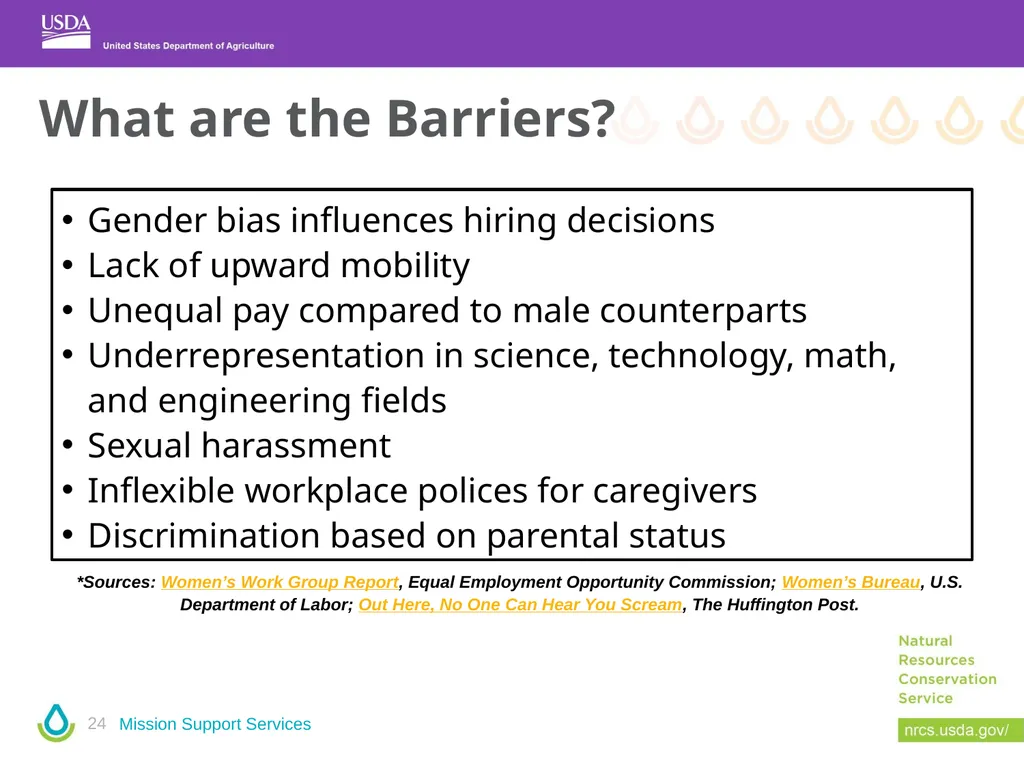
What are the Barriers? 24 Gender bias influences hiring decisions
Lack of upward mobility
Unequal pay compared to male counterparts
Underrepresentation in science, technology, math, and engineering fields
Sexual harassment
Inflexible workplace polices for caregivers
Discrimination based on parental status *Sources: Women’s Work Group Report, Equal Employment Opportunity Commission; Women’s Bureau, U.S. Department of Labor; Out Here, No One Can Hear You Scream, The Huffington Post.<br>
Lack of upward mobility
Unequal pay compared to male counterparts
Underrepresentation in science, technology, math, and engineering fields
Sexual harassment
Inflexible workplace polices for caregivers
Discrimination based on parental status *Sources: Women’s Work Group Report, Equal Employment Opportunity Commission; Women’s Bureau, U.S. Department of Labor; Out Here, No One Can Hear You Scream, The Huffington Post.<br>
25
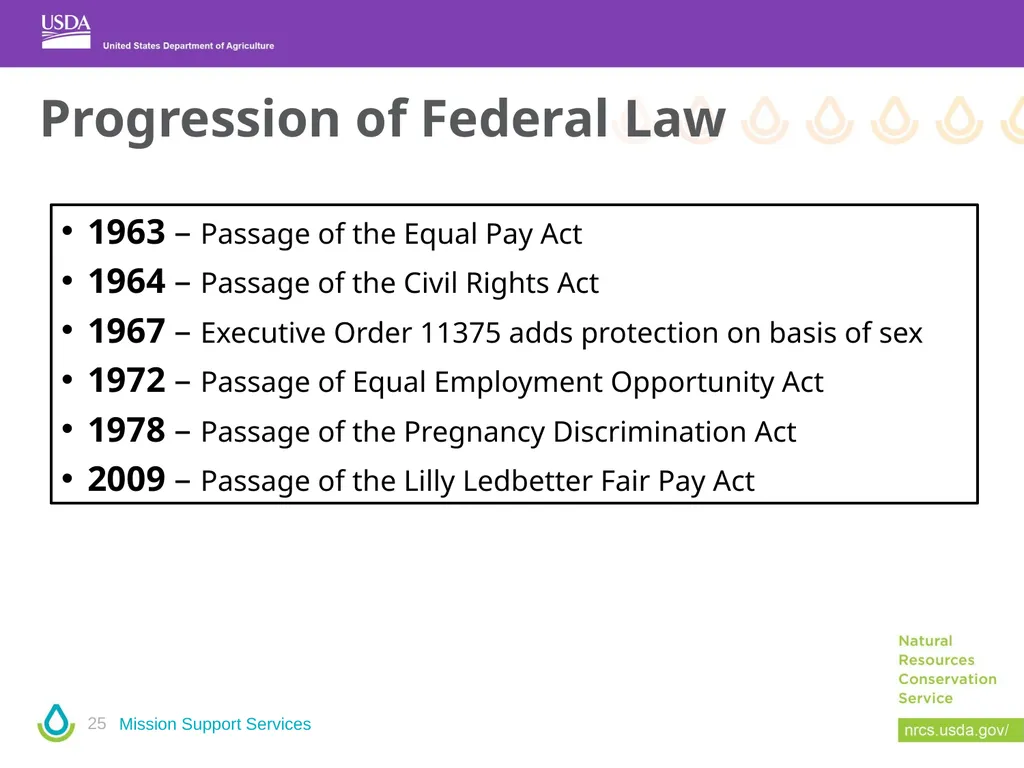
Progression of Federal Law 25 1963 – Passage of the Equal Pay Act
1964 – Passage of the Civil Rights Act
1967 – Executive Order 11375 adds protection on basis of sex
1972 – Passage of Equal Employment Opportunity Act
1978 – Passage of the Pregnancy Discrimination Act
2009 – Passage of the Lilly Ledbetter Fair Pay Act<br>
1964 – Passage of the Civil Rights Act
1967 – Executive Order 11375 adds protection on basis of sex
1972 – Passage of Equal Employment Opportunity Act
1978 – Passage of the Pregnancy Discrimination Act
2009 – Passage of the Lilly Ledbetter Fair Pay Act<br>
26
LGBTQ + Special Emphasis Program 26 Joshua Allen, SEPM<br>
27
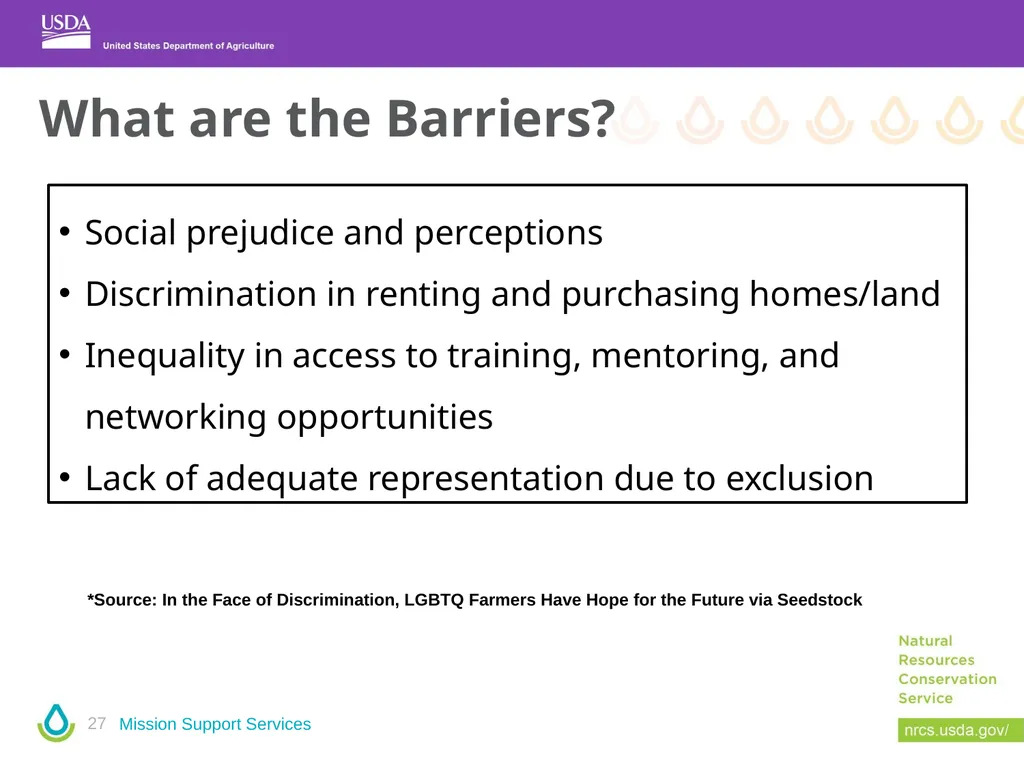
What are the Barriers? 27 Social prejudice and perceptions
Discrimination in renting and purchasing homes/land
Inequality in access to training, mentoring, and networking opportunities
Lack of adequate representation due to exclusion *Source: In the Face of Discrimination, LGBTQ Farmers Have Hope for the Future via Seedstock<br>
Discrimination in renting and purchasing homes/land
Inequality in access to training, mentoring, and networking opportunities
Lack of adequate representation due to exclusion *Source: In the Face of Discrimination, LGBTQ Farmers Have Hope for the Future via Seedstock<br>
28
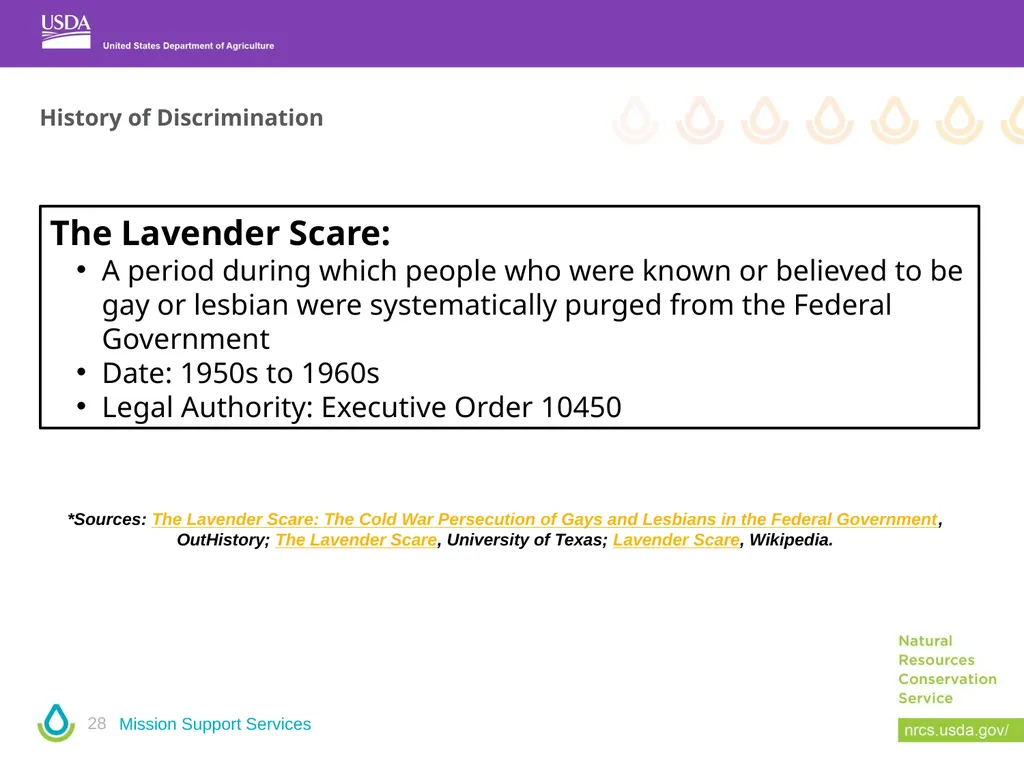
History of Discrimination 28 The Lavender Scare:
A period during which people who were known or believed to be gay or lesbian were systematically purged from the Federal Government
Date: 1950s to 1960s
Legal Authority: Executive Order 10450 *Sources: The Lavender Scare: The Cold War Persecution of Gays and Lesbians in the Federal Government, OutHistory; The Lavender Scare, University of Texas; Lavender Scare, Wikipedia.<br>
A period during which people who were known or believed to be gay or lesbian were systematically purged from the Federal Government
Date: 1950s to 1960s
Legal Authority: Executive Order 10450 *Sources: The Lavender Scare: The Cold War Persecution of Gays and Lesbians in the Federal Government, OutHistory; The Lavender Scare, University of Texas; Lavender Scare, Wikipedia.<br>
29
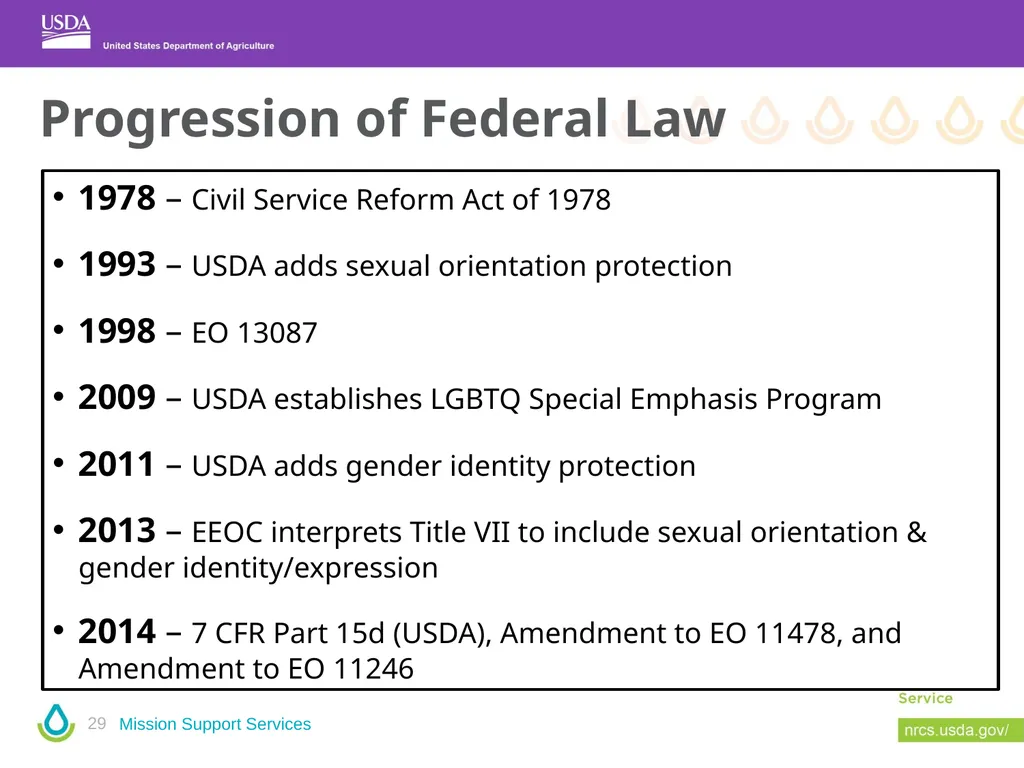
Progression of Federal Law 29 1978 – Civil Service Reform Act of 1978
1993 – USDA adds sexual orientation protection
1998 – EO 13087
2009 – USDA establishes LGBTQ Special Emphasis Program
2011 – USDA adds gender identity protection
2013 – EEOC interprets Title VII to include sexual orientation & gender identity/expression
2014 – 7 CFR Part 15d (USDA), Amendment to EO 11478, and Amendment to EO 11246<br>
1993 – USDA adds sexual orientation protection
1998 – EO 13087
2009 – USDA establishes LGBTQ Special Emphasis Program
2011 – USDA adds gender identity protection
2013 – EEOC interprets Title VII to include sexual orientation & gender identity/expression
2014 – 7 CFR Part 15d (USDA), Amendment to EO 11478, and Amendment to EO 11246<br>
30
Hispanic Emphasis Program 30 Felix Jimenez, SEPM<br>
31
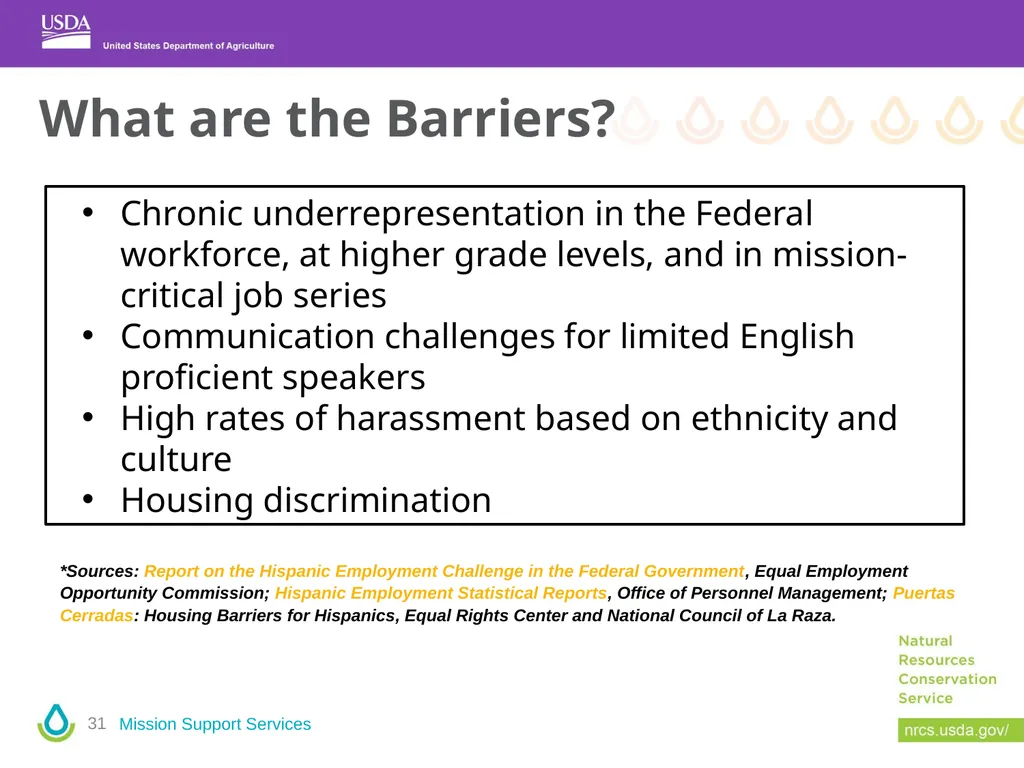
What are the Barriers? 31 Chronic underrepresentation in the Federal workforce, at higher grade levels, and in mission-critical job series
Communication challenges for limited English proficient speakers
High rates of harassment based on ethnicity and culture
Housing discrimination *Sources: Report on the Hispanic Employment Challenge in the Federal Government, Equal Employment Opportunity Commission; Hispanic Employment Statistical Reports, Office of Personnel Management; Puertas Cerradas: Housing Barriers for Hispanics, Equal Rights Center and National Council of La Raza.<br>
Communication challenges for limited English proficient speakers
High rates of harassment based on ethnicity and culture
Housing discrimination *Sources: Report on the Hispanic Employment Challenge in the Federal Government, Equal Employment Opportunity Commission; Hispanic Employment Statistical Reports, Office of Personnel Management; Puertas Cerradas: Housing Barriers for Hispanics, Equal Rights Center and National Council of La Raza.<br>
32
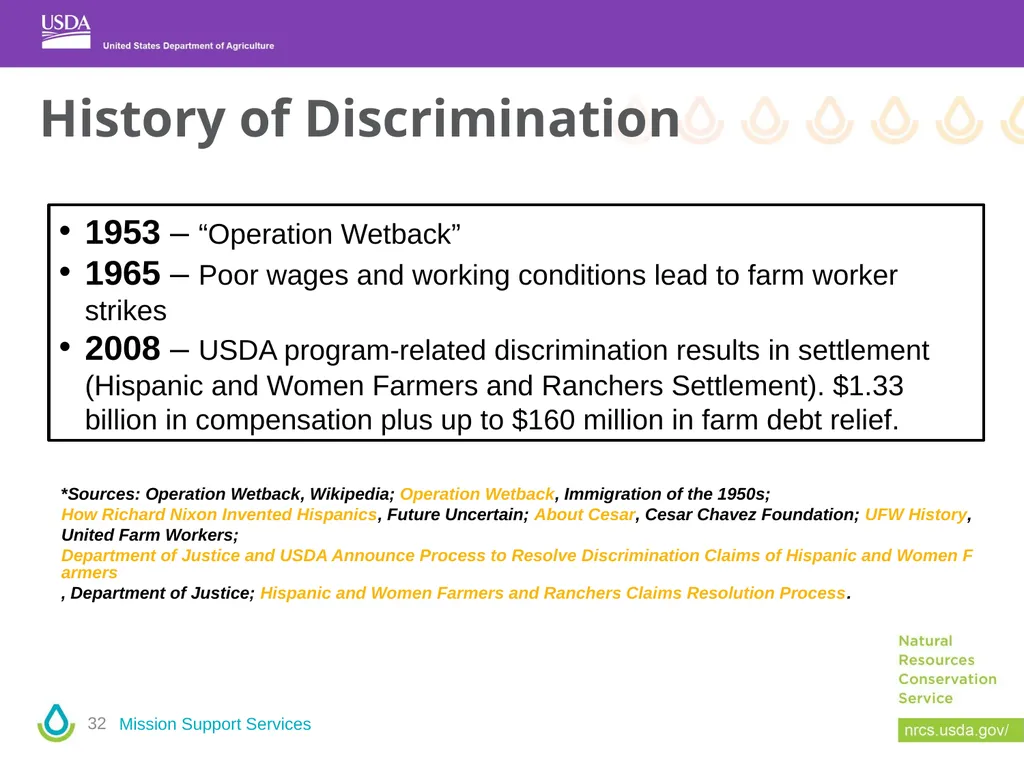
History of Discrimination 32 1953 – “Operation Wetback”
1965 – Poor wages and working conditions lead to farm worker strikes
2008 – USDA program-related discrimination results in settlement (Hispanic and Women Farmers and Ranchers Settlement). $1.33 billion in compensation plus up to $160 million in farm debt relief. *Sources: Operation Wetback, Wikipedia; Operation Wetback, Immigration of the 1950s; How Richard Nixon Invented Hispanics, Future Uncertain; About Cesar, Cesar Chavez Foundation; UFW History, United Farm Workers; Department of Justice and USDA Announce Process to Resolve Discrimination Claims of Hispanic and Women Farmers, Department of Justice; Hispanic and Women Farmers and Ranchers Claims Resolution Process.<br>
1965 – Poor wages and working conditions lead to farm worker strikes
2008 – USDA program-related discrimination results in settlement (Hispanic and Women Farmers and Ranchers Settlement). $1.33 billion in compensation plus up to $160 million in farm debt relief. *Sources: Operation Wetback, Wikipedia; Operation Wetback, Immigration of the 1950s; How Richard Nixon Invented Hispanics, Future Uncertain; About Cesar, Cesar Chavez Foundation; UFW History, United Farm Workers; Department of Justice and USDA Announce Process to Resolve Discrimination Claims of Hispanic and Women Farmers, Department of Justice; Hispanic and Women Farmers and Ranchers Claims Resolution Process.<br>
33
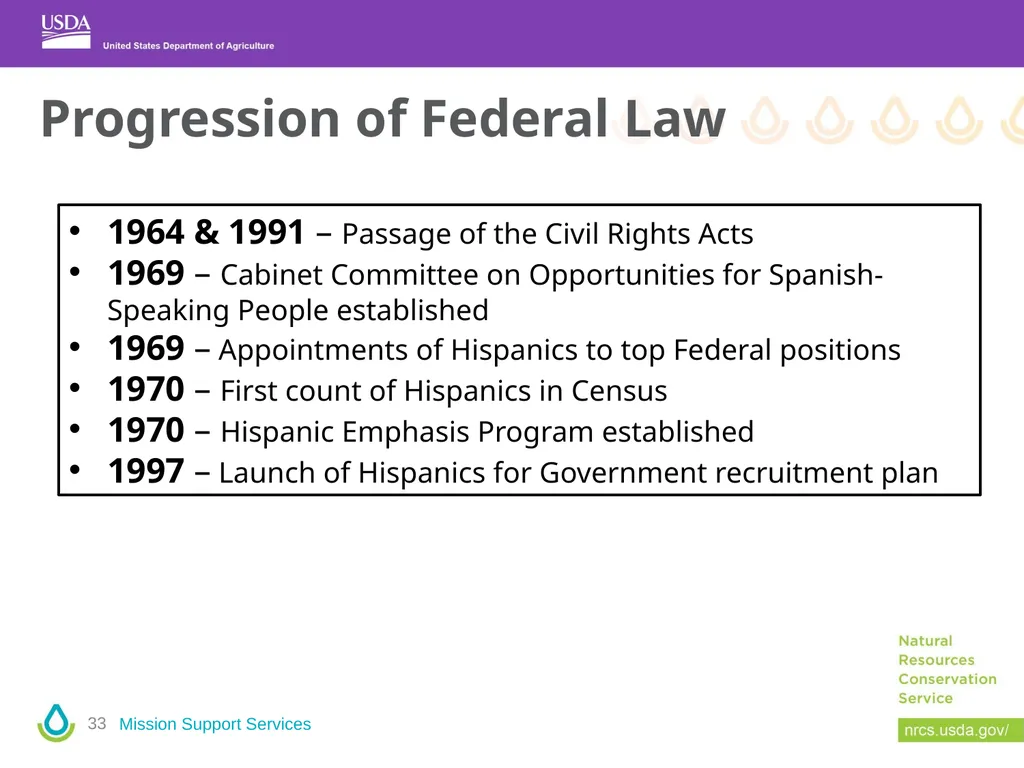
Progression of Federal Law 33 1964 & 1991 – Passage of the Civil Rights Acts
1969 – Cabinet Committee on Opportunities for Spanish-Speaking People established
1969 – Appointments of Hispanics to top Federal positions
1970 – First count of Hispanics in Census
1970 – Hispanic Emphasis Program established
1997 – Launch of Hispanics for Government recruitment plan<br>
1969 – Cabinet Committee on Opportunities for Spanish-Speaking People established
1969 – Appointments of Hispanics to top Federal positions
1970 – First count of Hispanics in Census
1970 – Hispanic Emphasis Program established
1997 – Launch of Hispanics for Government recruitment plan<br>
34
Veterans Emphasis Program 34 Matt Perry, SEPM<br>
35
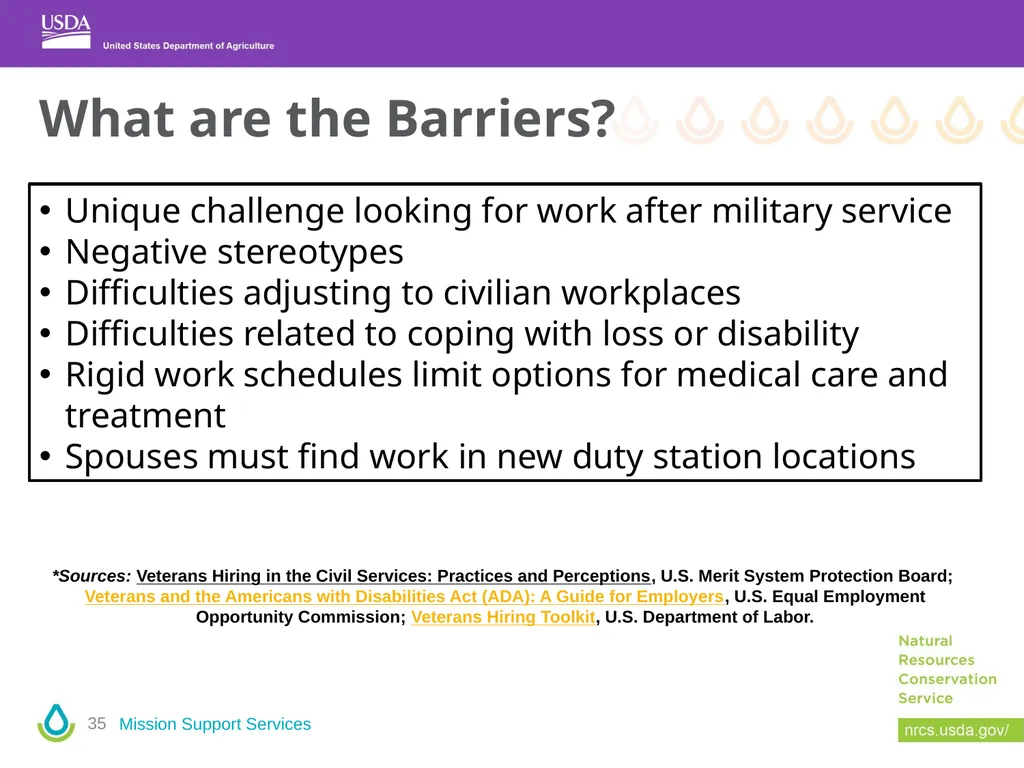
What are the Barriers? 35 Unique challenge looking for work after military service
Negative stereotypes
Difficulties adjusting to civilian workplaces
Difficulties related to coping with loss or disability
Rigid work schedules limit options for medical care and treatment
Spouses must find work in new duty station locations *Sources: Veterans Hiring in the Civil Services: Practices and Perceptions, U.S. Merit System Protection Board; Veterans and the Americans with Disabilities Act (ADA): A Guide for Employers, U.S. Equal Employment Opportunity Commission; Veterans Hiring Toolkit, U.S. Department of Labor.<br>
Negative stereotypes
Difficulties adjusting to civilian workplaces
Difficulties related to coping with loss or disability
Rigid work schedules limit options for medical care and treatment
Spouses must find work in new duty station locations *Sources: Veterans Hiring in the Civil Services: Practices and Perceptions, U.S. Merit System Protection Board; Veterans and the Americans with Disabilities Act (ADA): A Guide for Employers, U.S. Equal Employment Opportunity Commission; Veterans Hiring Toolkit, U.S. Department of Labor.<br>
36
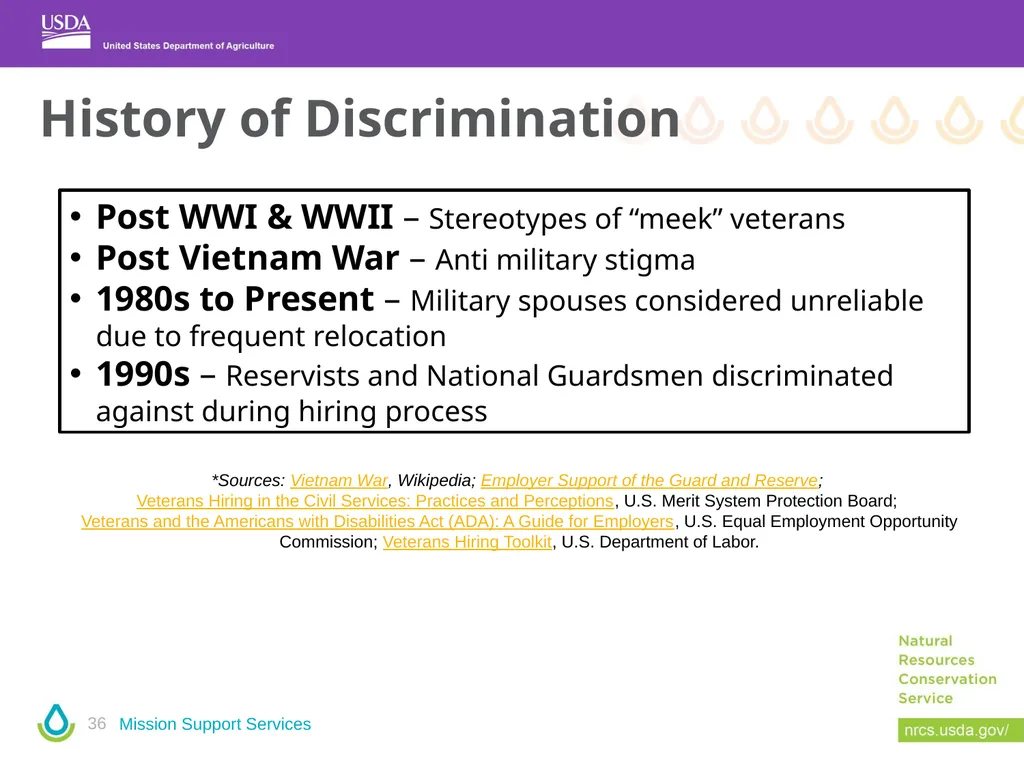
History of Discrimination 36 Post WWI & WWII – Stereotypes of “meek” veterans
Post Vietnam War – Anti military stigma
1980s to Present – Military spouses considered unreliable due to frequent relocation
1990s – Reservists and National Guardsmen discriminated against during hiring process *Sources: Vietnam War, Wikipedia; Employer Support of the Guard and Reserve; Veterans Hiring in the Civil Services: Practices and Perceptions, U.S. Merit System Protection Board; Veterans and the Americans with Disabilities Act (ADA): A Guide for Employers, U.S. Equal Employment Opportunity Commission; Veterans Hiring Toolkit, U.S. Department of Labor.<br>
Post Vietnam War – Anti military stigma
1980s to Present – Military spouses considered unreliable due to frequent relocation
1990s – Reservists and National Guardsmen discriminated against during hiring process *Sources: Vietnam War, Wikipedia; Employer Support of the Guard and Reserve; Veterans Hiring in the Civil Services: Practices and Perceptions, U.S. Merit System Protection Board; Veterans and the Americans with Disabilities Act (ADA): A Guide for Employers, U.S. Equal Employment Opportunity Commission; Veterans Hiring Toolkit, U.S. Department of Labor.<br>
37
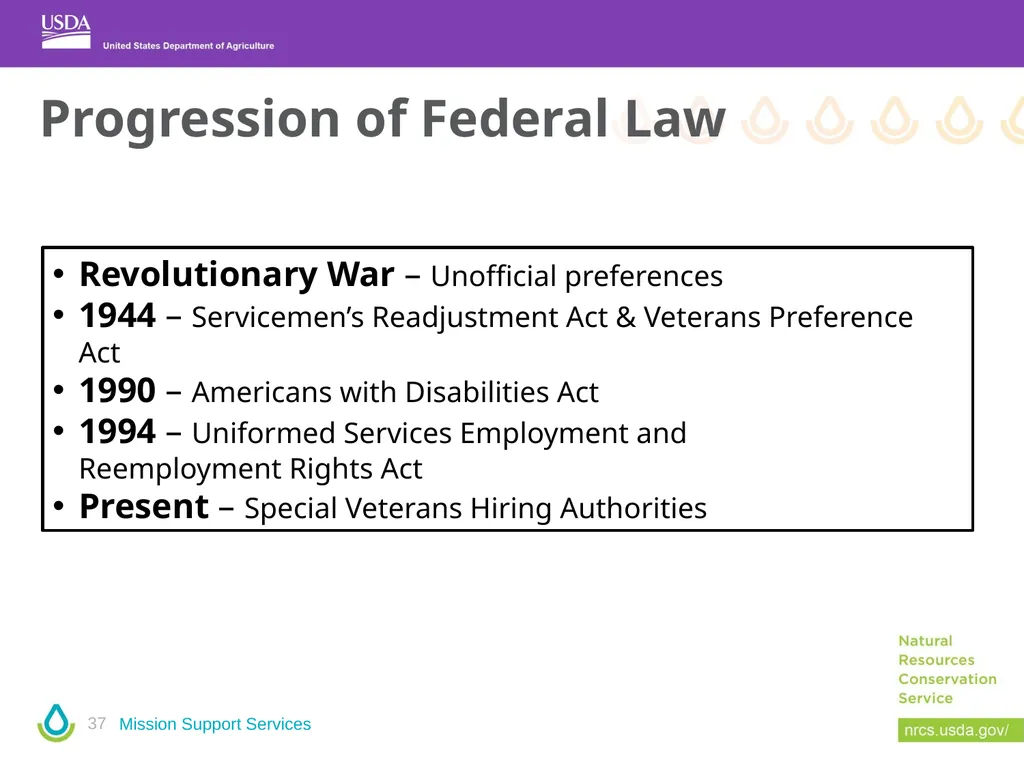
Progression of Federal Law 37 Revolutionary War – Unofficial preferences
1944 – Servicemen’s Readjustment Act & Veterans Preference Act
1990 – Americans with Disabilities Act
1994 – Uniformed Services Employment and Reemployment Rights Act
Present – Special Veterans Hiring Authorities<br>
1944 – Servicemen’s Readjustment Act & Veterans Preference Act
1990 – Americans with Disabilities Act
1994 – Uniformed Services Employment and Reemployment Rights Act
Present – Special Veterans Hiring Authorities<br>
38
Asian American and Pacific Islander
Emphasis Program 38 Maggie Hayes, SEPM<br>
39
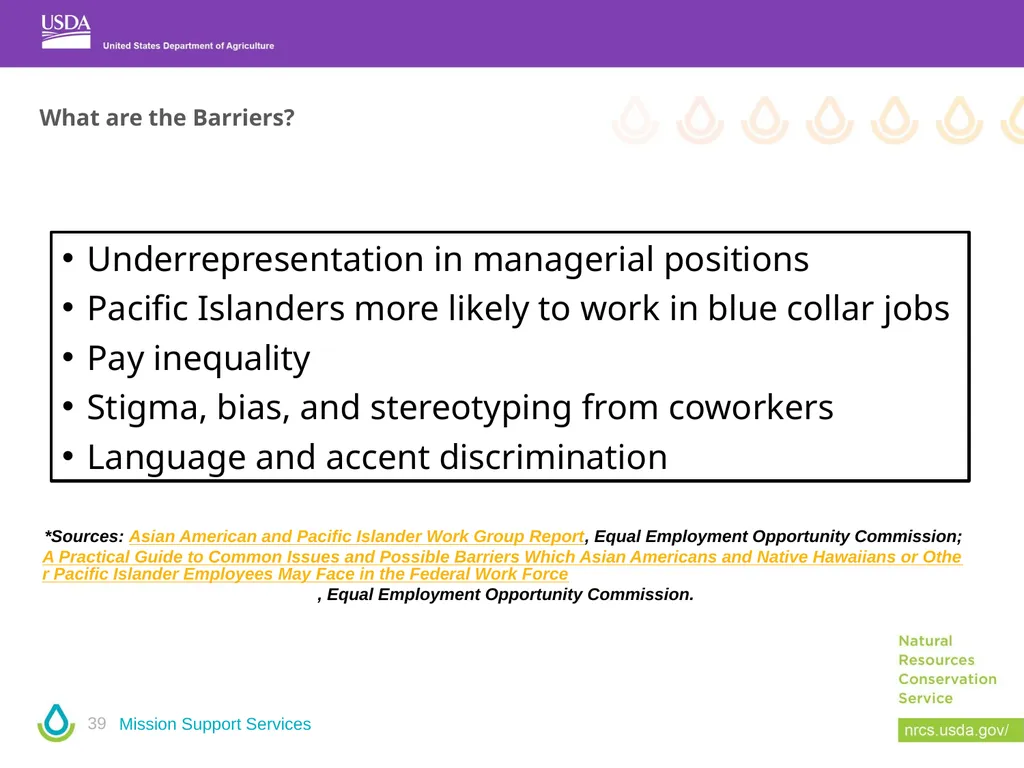
What are the Barriers? 39 Underrepresentation in managerial positions
Pacific Islanders more likely to work in blue collar jobs
Pay inequality
Stigma, bias, and stereotyping from coworkers
Language and accent discrimination *Sources: Asian American and Pacific Islander Work Group Report, Equal Employment Opportunity Commission; A Practical Guide to Common Issues and Possible Barriers Which Asian Americans and Native Hawaiians or Other Pacific Islander Employees May Face in the Federal Work Force, Equal Employment Opportunity Commission.<br>
Pacific Islanders more likely to work in blue collar jobs
Pay inequality
Stigma, bias, and stereotyping from coworkers
Language and accent discrimination *Sources: Asian American and Pacific Islander Work Group Report, Equal Employment Opportunity Commission; A Practical Guide to Common Issues and Possible Barriers Which Asian Americans and Native Hawaiians or Other Pacific Islander Employees May Face in the Federal Work Force, Equal Employment Opportunity Commission.<br>
40
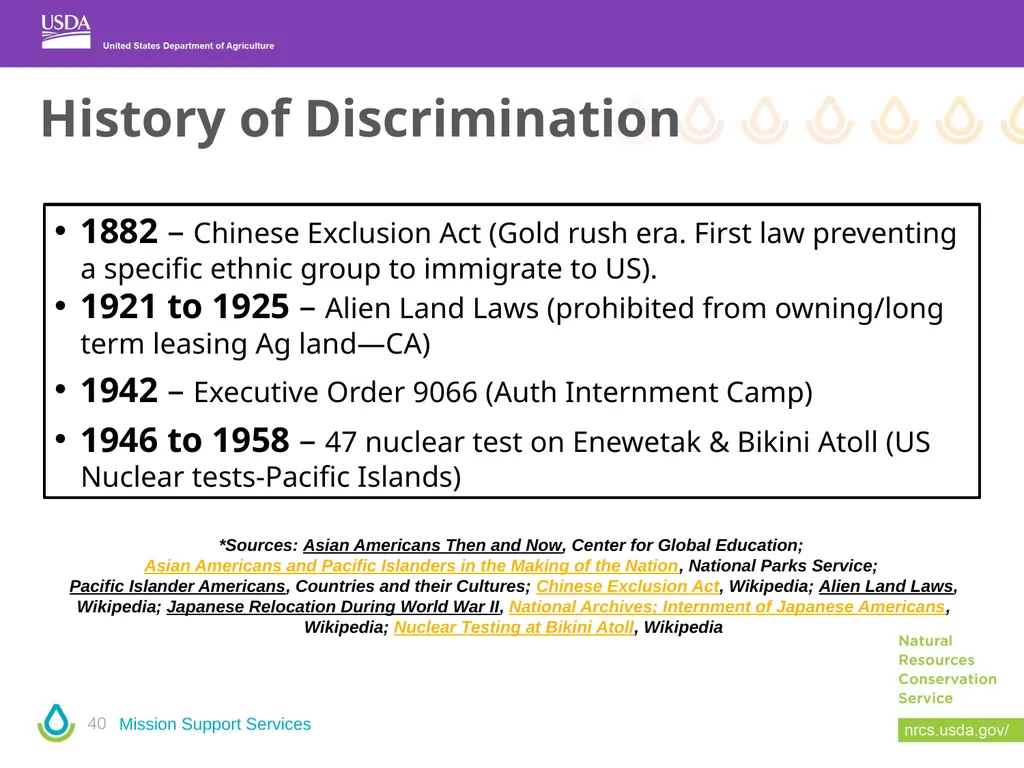
History of Discrimination 40 1882 – Chinese Exclusion Act (Gold rush era. First law preventing a specific ethnic group to immigrate to US).
1921 to 1925 – Alien Land Laws (prohibited from owning/long term leasing Ag land—CA)
1942 – Executive Order 9066 (Auth Internment Camp)
1946 to 1958 – 47 nuclear test on Enewetak & Bikini Atoll (US Nuclear tests-Pacific Islands) *Sources: Asian Americans Then and Now, Center for Global Education; Asian Americans and Pacific Islanders in the Making of the Nation, National Parks Service; Pacific Islander Americans, Countries and their Cultures; Chinese Exclusion Act, Wikipedia; Alien Land Laws, Wikipedia; Japanese Relocation During World War II, National Archives; Internment of Japanese Americans, Wikipedia; Nuclear Testing at Bikini Atoll, Wikipedia<br>
1921 to 1925 – Alien Land Laws (prohibited from owning/long term leasing Ag land—CA)
1942 – Executive Order 9066 (Auth Internment Camp)
1946 to 1958 – 47 nuclear test on Enewetak & Bikini Atoll (US Nuclear tests-Pacific Islands) *Sources: Asian Americans Then and Now, Center for Global Education; Asian Americans and Pacific Islanders in the Making of the Nation, National Parks Service; Pacific Islander Americans, Countries and their Cultures; Chinese Exclusion Act, Wikipedia; Alien Land Laws, Wikipedia; Japanese Relocation During World War II, National Archives; Internment of Japanese Americans, Wikipedia; Nuclear Testing at Bikini Atoll, Wikipedia<br>
41
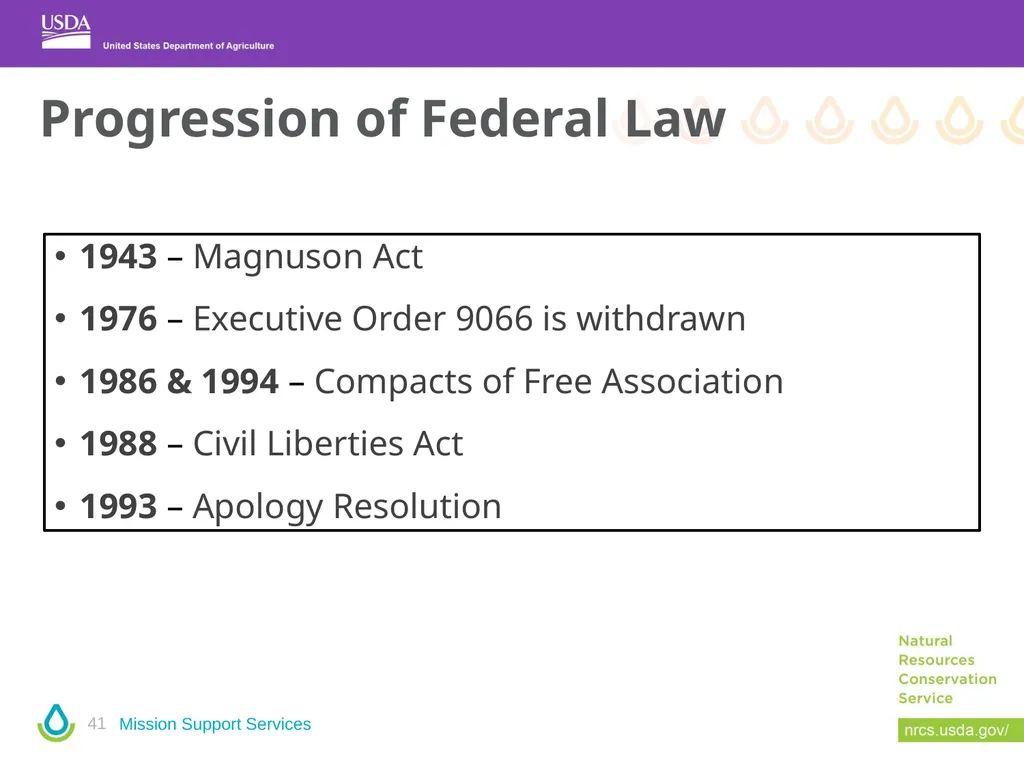
Progression of Federal Law 41 1943 – Magnuson Act
1976 – Executive Order 9066 is withdrawn
1986 & 1994 – Compacts of Free Association
1988 – Civil Liberties Act
1993 – Apology Resolution<br>
1976 – Executive Order 9066 is withdrawn
1986 & 1994 – Compacts of Free Association
1988 – Civil Liberties Act
1993 – Apology Resolution<br>
42
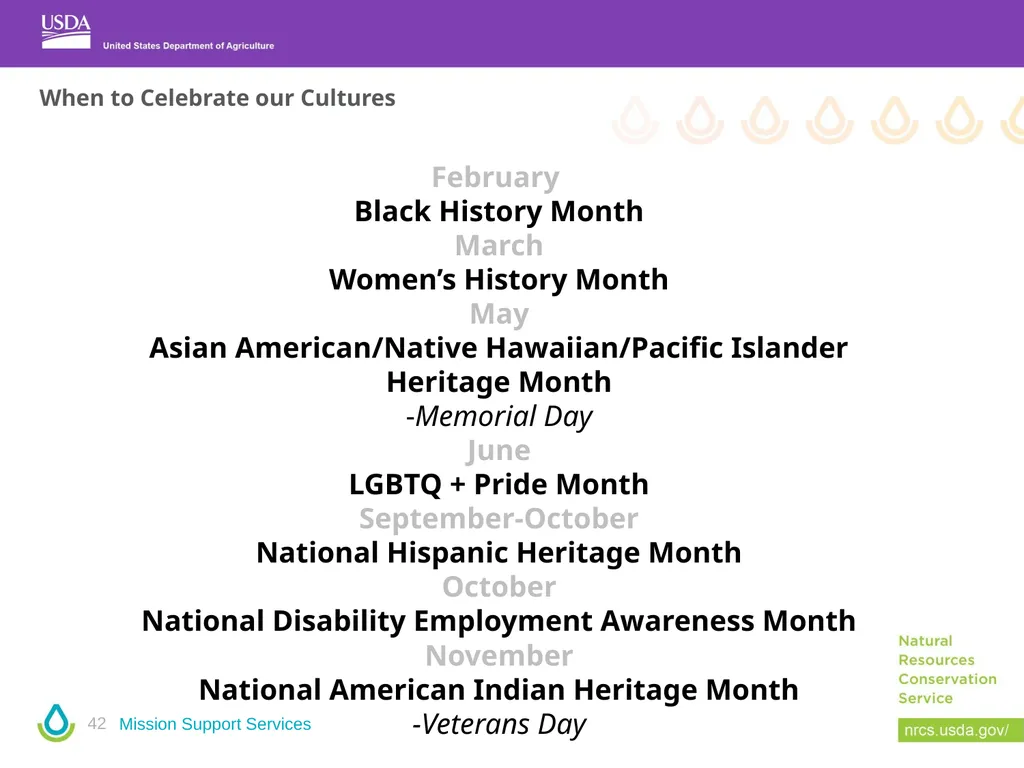
When to Celebrate our Cultures February
Black History Month
March
Women’s History Month
May
Asian American/Native Hawaiian/Pacific Islander Heritage Month
-Memorial Day
June
LGBTQ + Pride Month
September-October
National Hispanic Heritage Month
October
National Disability Employment Awareness Month
November
National American Indian Heritage Month
-Veterans Day 42<br>
Black History Month
March
Women’s History Month
May
Asian American/Native Hawaiian/Pacific Islander Heritage Month
-Memorial Day
June
LGBTQ + Pride Month
September-October
National Hispanic Heritage Month
October
National Disability Employment Awareness Month
November
National American Indian Heritage Month
-Veterans Day 42<br>
43
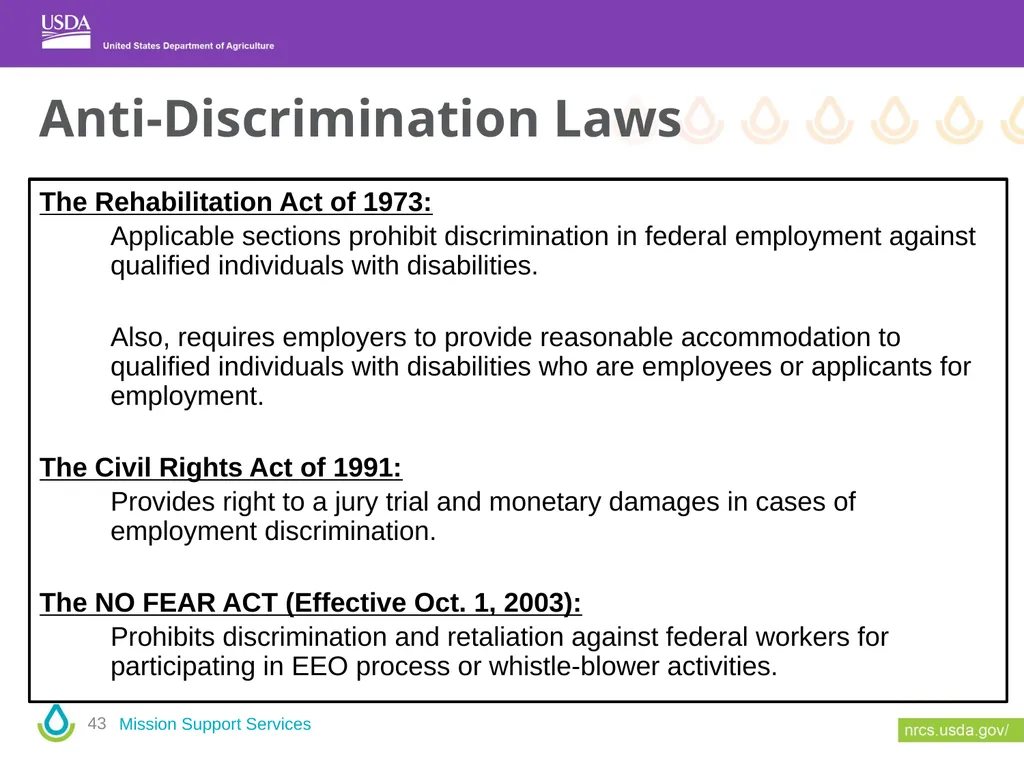
Anti-Discrimination Laws The Rehabilitation Act of 1973:
Applicable sections prohibit discrimination in federal employment against qualified individuals with disabilities.
Also, requires employers to provide reasonable accommodation to qualified individuals with disabilities who are employees or applicants for employment.
The Civil Rights Act of 1991:
Provides right to a jury trial and monetary damages in cases of employment discrimination.
The NO FEAR ACT (Effective Oct. 1, 2003):
Prohibits discrimination and retaliation against federal workers for participating in EEO process or whistle-blower activities. 43<br>
Applicable sections prohibit discrimination in federal employment against qualified individuals with disabilities.
Also, requires employers to provide reasonable accommodation to qualified individuals with disabilities who are employees or applicants for employment.
The Civil Rights Act of 1991:
Provides right to a jury trial and monetary damages in cases of employment discrimination.
The NO FEAR ACT (Effective Oct. 1, 2003):
Prohibits discrimination and retaliation against federal workers for participating in EEO process or whistle-blower activities. 43<br>
44
Employee
Assistance Program (EAP) 44<br>
45
Sand Creek Group, LTD 45<br>
46
46 Sand Creek is the NRCS Employee Assistance Provider
Can be contacted directly at: www.sandcreekeap.com
Initiation of Services: You can start the process in two ways:
Submit an online intake form by clicking here http://sandcreekeap.com/intake-form-to-access-services/
2. Call Sand Creek directly at 888.243.5744 to speak with an intake consultant
Please choose which method is most convenient for you
Staff hours are Monday through Friday from 7:30 am to 5:00 pm CT
If you need in the moment support, counselors are available 24/7
Call 888.243.5744
For any questions, suggestions, feedback or comments, please email info@sandcreekeap.com<br>
Can be contacted directly at: www.sandcreekeap.com
Initiation of Services: You can start the process in two ways:
Submit an online intake form by clicking here http://sandcreekeap.com/intake-form-to-access-services/
2. Call Sand Creek directly at 888.243.5744 to speak with an intake consultant
Please choose which method is most convenient for you
Staff hours are Monday through Friday from 7:30 am to 5:00 pm CT
If you need in the moment support, counselors are available 24/7
Call 888.243.5744
For any questions, suggestions, feedback or comments, please email info@sandcreekeap.com<br>
47
47 Questions/Discussion Diversity and Recruitment Branch-Workforce Management Division The U.S. Department of Agriculture (USDA) prohibits discrimination against its customers, employees, and applicants for employment on the bases of race, color, national origin, age, disability, sex, gender identity, religion, reprisal, and where applicable, political beliefs, marital status, familial or parental status, sexual orientation, or all or part of an individual's income is derived from any public assistance program, or protected genetic information in employment or in any program or activity conducted or funded by the Department. USDA is an equal opportunity provider, employer and lender.<br>
48
Thank You 48<br>