
Spelling Information September 2021 Mrs Ralph





Description: Spelling Information September 2021 Mrs Ralph English Lead Educational Visits Lead Year 6 Teacher Librarian Aims To explain the spelling programme of study as set out by the National Curriculum To help you to develop an understanding of how
Related Topics
Download Presentation
"Spelling Information September 2021 Mrs Ralph" is the property of its rightful owner. Permission is granted to download and print the materials on this website for personal, non-commercial use only, and to display it on your personal computer provided you do not modify the materials and that you retain all copyright notices contained in the materials. By downloading content from our website, you accept the terms of this agreement.
Presentation Transcript
slide1. Spelling Information
September 2021<br>
slide2. Mrs Ralph
English Lead
Educational Visits Lead
Year 6 Teacher
Librarian<br>
slide3. Aims To explain the spelling programme of study as set out by the National Curriculum
To help you to develop an understanding of how we teach spelling at Glapton Academy to ensure progress
To help you to understand what you can do to support your child’s learning at home<br>
slide4. What is spelling? Spelling is how we translate speech sounds into writing.<br>
slide5. The National Curriculum states:
Writing down ideas fluently depends on … spelling quickly and accurately through knowing the relationship between sounds and letters (phonics) and understanding the morphology (word structure) and orthography (spelling structure) of words.<br>
slide6. Most people read words more accurately than they spell them. The younger pupils are, the truer this is.
Why is learning to spell so hard?
English words come from all over the world.
There are many ways to spell the same sound – sigh lie mine try eye buy dye<br>
slide7. Some words sound the same but have different spellings - homophones.
witch/which
there/their/they’re
hair/hare
Some words have totally different meanings but sound the same and are spelt the same.
bat
park
palm<br>
slide8. Some words are spelt the same but pronounced differently. These are called homonyms:
tear
close
present
desert<br>
slide9. How is spelling taught at Glapton Academy?
EYFS
Spelling guidance is out in the Early Years Foundation Stage
Statutory Framework (updated 2021).
Children are encouraged to link sounds and letters and to
begin to read and write.
Children use their phonic knowledge to write words in ways
that match their spoken sounds.
They also write some irregular common words.
They write simple sentences which can be read by themselves and
others.
Some words are spelt correctly and others are phonetically
plausible (can be identified for what they are, even if they are not
spelt correctly).<br>
slide10. EYFS (cont.)
Spelling is taught through the Letters and Sounds phonics
programme
In Nursery (F1), children follow Phase 1 which helps to
develop their speaking and listening skills and linking of
sounds to letters
In Reception (F2), children start Phase 2 where they start
to blend and segment sounds to help them read and spell
words.
Most children should be on Phase 4 by the end of Reception.
The main aim of this phase is to consolidate the children's
knowledge and to help them learn to read and spell words
which have adjacent consonants, such as trap, string and milk.<br>
slide11. Key Stage 1 and Key Stage 2
The statutory and non-statutory requirements are
set out in the English Appendix 1 of The National Curriculum.
Copy on dojo and website.
Has examples of words embodying each pattern taught for
each year group in KS1 and KS2.
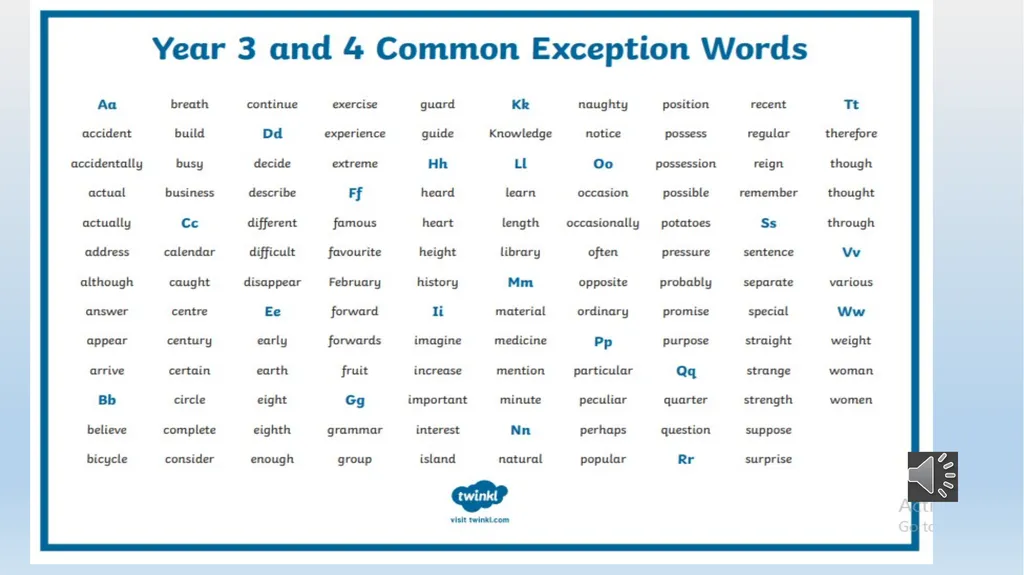
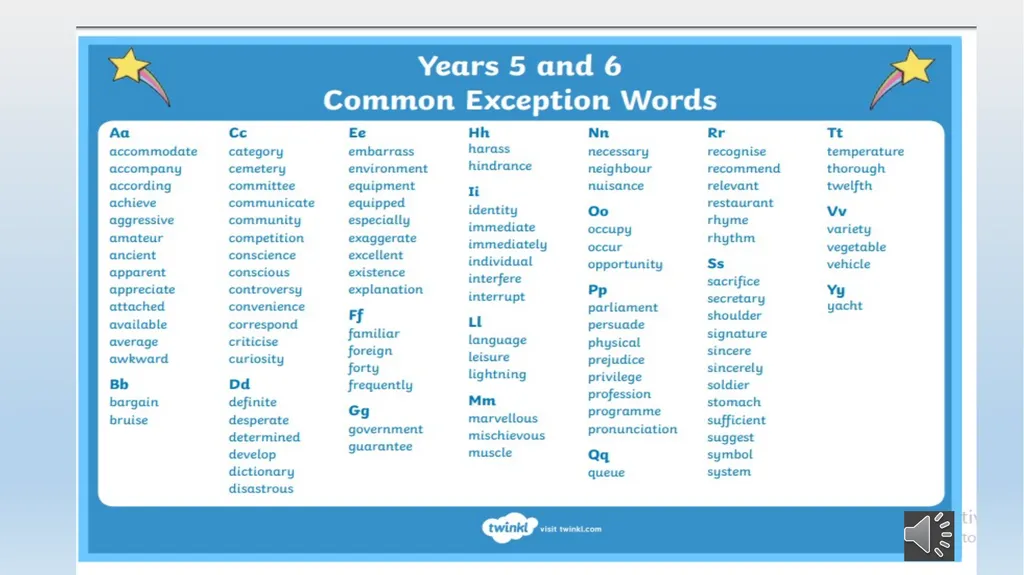
Lists the common exception words for each year
group.<br>
slide12. Key Stage 1
Children in KS1 continue to be taught spelling
through twice daily phonics lessons.
In these lessons they are taught spelling rules,
patterns and common exception words.
These are reinforced in English lessons and
across the curriculum.<br>
slide13. Year 1
By the time children get to Year 1, most of them should be following Phase 4 of the Letters and Sounds programme.
By the end of Year 1, they should have completed Phase 5.<br>
slide14. Year 2
By the time children get to Year 2, most of them should have completed Phase 5 of the Letters and Sounds programme.
By the end of Year 2, they should have completed Phase 6.
In Phase 6, they will increase their accuracy in spelling and will be taught rules in line with the National Curriculum.<br>
slide15. Key Stage 2 The National Curriculum splits spelling into Lower Key
Stage 2 (Years 3 and 4) and Upper Key Stage 2 (Years 5
and 6).
Each Year group will be taught a combination of spelling
rules and common exception words.<br>
slide16. Children in KS2 are taught spelling in three 15 minute sessions a week.
In these lessons they are taught spelling rules, patterns and common exception words.
These are reinforced in English lessons and across the curriculum.
Children who are still not secure in the phonics phases will receive further phonic tuition alongside class spelling and English lessons.<br>
slide17. Common Exception Words
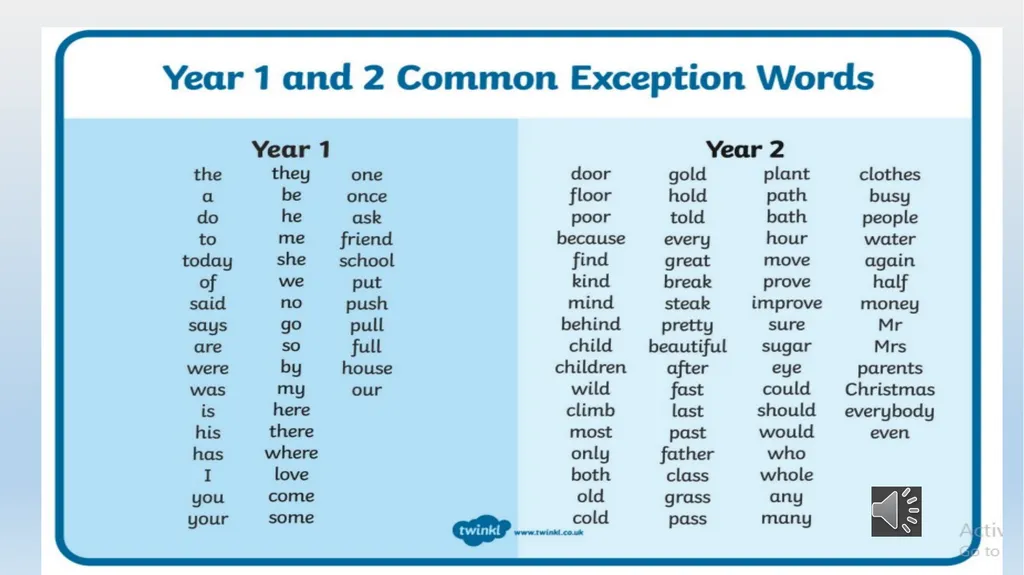
Common exception words are words in which the English
Spelling code works in an unusual or uncommon way.
They are not words for which phonics 'doesn't work', but
they may be exceptions to spelling rules, or words which use
a particular combination of letters to represent sound
patterns in a rare or unique way.
They have been chosen because they are often used in
a child’s writing.<br>
slide18. High Frequency Words
High frequency words are words that appear very often in written texts.
They are a mixture of decodable words and tricky/exception words.
By the end of KS1, children should be able to spell all of the first 100 high frequency words.<br>
slide19. High Frequency Words/Tricky Words In F2 and KS1, the children are taught the high frequency words
and tricky words alongside phonics.
These have been named ‘Animal Words’ at Glapton Academy and
have been grouped into blocks of 5 with each block having its own
animal name.
They are sent home in blocks of 5 and are closely aligned to the
phonics phases.
Initially, the children will practise reading these words but by
the time they have reached Phase 3, they will be expected to
learn how to spell these words too.
At first, the spelling will be oral but as soon as they are able to,
they should practise writing down the words too.<br>
slide20. Once children reach Phase 5 ( Year 1), they will be need to practise reading and spelling the words they take home. They will take 10 words home to learn: 5 of these will be ‘Animal Words’ ; 5 will be phonically decodable words.
All children are expected to complete Phase 5 in Year 2 and most will have completed Phase 6 by the end of the year.
When children are on Phase 6, they will continue to take 10 words home: 5 words will be ‘Animal Words’; 5 words will follow the patterns and rules being taught in Phase 6 phonics.
By the end of Year 2, children are expected to be able to read and spell all of the ‘Animal Words’ which include Phase 6 tricky words and common exception words for Year 2.<br>
slide22. Key Stage 2
The common exception words are statutory and are a mixture of words children often use in their writing and words they often misspell.<br>
slide25. Key Stage 2
All children are assessed using the same spellings at the start of each academic year.
These assessments are used to target teaching to the children’s needs.
Spellings will be taught in three 15 minute sessions during which children will be taught spelling rules and common exception words.
In the last session, the children will have an informal test, through dictation of passages, of the rules and patterns taught that week plus common exception words.
In addition to this, spellings are reinforced in English lessons and across the curriculum.<br>
slide26. Testing Spellings
EYFS/KS1
By the time a child is following Phase 3 of the phonics programme, they will be expected to learn to read and spell the words they take home to learn.
These words will be sent home on a Friday and children will be tested informally on the following Friday.<br>
slide27. Key Stage 2
In Key Stage 2, the children take home ten spellings
to learn. These will be seven words that follow the pattern
or rule being taught that week plus three common exception
words.
These will be sent home every Friday and the children
will be tested on them informally the following Friday.
They will be tested on the three common exception words
plus seven other words that follow the same rule or pattern
as the words they take home.<br>
slide28. By testing children on different words, they will learn to apply
the rules and patterns they have been taught in their writing.
If they learn the spelling by rote, when they come to a new word
they will not be able to apply these rules and patterns.
Testing children on the rule means that we are creating lifelong
spellers as they are learning the rule rather than individual words.<br>
slide29. Assessment
Key Stage 1
At the end of Key Stage 1, in Year 2, the children will complete SATs in English.
Spellings based on patterns and rules will be tested as part of the Grammar, Punctuation and Spelling test.
Common exception words and rules will be assessed in writing.
In order for a child to be assessed as working at the expected level for KS1, they must spell correctly ‘many’ exception words.<br>
slide30. Key Stage 2
At the end of Key Stage 2, in Year 6, children will complete SATs in English.
Spellings based on patterns and rules will be tested as part of the Grammar, Punctuation and Spelling test.
Common exception words and rules will be assessed in their writing.
In order for a child to be assessed as working at the expected level for the end of KS2, they must be able to spell correctly most words from the year 5/6 spelling list, and use a dictionary to check the spelling of uncommon or more ambitious vocabulary.<br>
slide31. Years 1,3,4 and 5
Spellings based on patterns and rules will be tested as part of a Grammar, Punctuation and Spelling test at the end of each year.
Common exception words and rules will be assessed in the children’s writing.
In order for a child to be assessed as working at the expected level for the end of each year, they must be able to spell correctly many/most words from the appropriate year spelling list.<br>
slide32. Helping at Home
Use Look Cover Write Check
Help your child to think of other words that follow the same rules and patterns
Spelling Frame and Spellzone are fantastic websites which have activities to support the learning of patterns and rules being taught.
They are both free to use. Just follow the links below:
https://spellingframe.co.uk/
https://www.spellzone.com/word_lists/index.cfm<br>
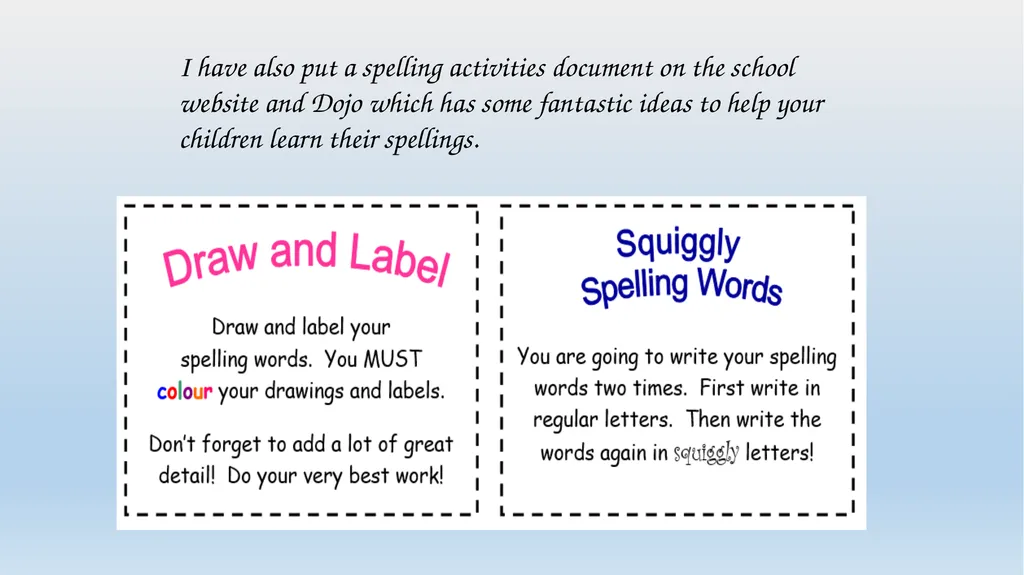
slide33. I have also put a spelling activities document on the school
website and Dojo which has some fantastic ideas to help your
children learn their spellings.<br>
slide34. Thank you for taking the time to listen to my information session.
I hope it has given you a clearer picture of how spelling is taught at
Glapton Academy and provided you with some useful resources to
help you support your child when learning spellings at home.<br>
September 2021<br>
slide2. Mrs Ralph
English Lead
Educational Visits Lead
Year 6 Teacher
Librarian<br>
slide3. Aims To explain the spelling programme of study as set out by the National Curriculum
To help you to develop an understanding of how we teach spelling at Glapton Academy to ensure progress
To help you to understand what you can do to support your child’s learning at home<br>
slide4. What is spelling? Spelling is how we translate speech sounds into writing.<br>
slide5. The National Curriculum states:
Writing down ideas fluently depends on … spelling quickly and accurately through knowing the relationship between sounds and letters (phonics) and understanding the morphology (word structure) and orthography (spelling structure) of words.<br>
slide6. Most people read words more accurately than they spell them. The younger pupils are, the truer this is.
Why is learning to spell so hard?
English words come from all over the world.
There are many ways to spell the same sound – sigh lie mine try eye buy dye<br>
slide7. Some words sound the same but have different spellings - homophones.
witch/which
there/their/they’re
hair/hare
Some words have totally different meanings but sound the same and are spelt the same.
bat
park
palm<br>
slide8. Some words are spelt the same but pronounced differently. These are called homonyms:
tear
close
present
desert<br>
slide9. How is spelling taught at Glapton Academy?
EYFS
Spelling guidance is out in the Early Years Foundation Stage
Statutory Framework (updated 2021).
Children are encouraged to link sounds and letters and to
begin to read and write.
Children use their phonic knowledge to write words in ways
that match their spoken sounds.
They also write some irregular common words.
They write simple sentences which can be read by themselves and
others.
Some words are spelt correctly and others are phonetically
plausible (can be identified for what they are, even if they are not
spelt correctly).<br>
slide10. EYFS (cont.)
Spelling is taught through the Letters and Sounds phonics
programme
In Nursery (F1), children follow Phase 1 which helps to
develop their speaking and listening skills and linking of
sounds to letters
In Reception (F2), children start Phase 2 where they start
to blend and segment sounds to help them read and spell
words.
Most children should be on Phase 4 by the end of Reception.
The main aim of this phase is to consolidate the children's
knowledge and to help them learn to read and spell words
which have adjacent consonants, such as trap, string and milk.<br>
slide11. Key Stage 1 and Key Stage 2
The statutory and non-statutory requirements are
set out in the English Appendix 1 of The National Curriculum.
Copy on dojo and website.
Has examples of words embodying each pattern taught for
each year group in KS1 and KS2.
Lists the common exception words for each year
group.<br>
slide12. Key Stage 1
Children in KS1 continue to be taught spelling
through twice daily phonics lessons.
In these lessons they are taught spelling rules,
patterns and common exception words.
These are reinforced in English lessons and
across the curriculum.<br>
slide13. Year 1
By the time children get to Year 1, most of them should be following Phase 4 of the Letters and Sounds programme.
By the end of Year 1, they should have completed Phase 5.<br>
slide14. Year 2
By the time children get to Year 2, most of them should have completed Phase 5 of the Letters and Sounds programme.
By the end of Year 2, they should have completed Phase 6.
In Phase 6, they will increase their accuracy in spelling and will be taught rules in line with the National Curriculum.<br>
slide15. Key Stage 2 The National Curriculum splits spelling into Lower Key
Stage 2 (Years 3 and 4) and Upper Key Stage 2 (Years 5
and 6).
Each Year group will be taught a combination of spelling
rules and common exception words.<br>
slide16. Children in KS2 are taught spelling in three 15 minute sessions a week.
In these lessons they are taught spelling rules, patterns and common exception words.
These are reinforced in English lessons and across the curriculum.
Children who are still not secure in the phonics phases will receive further phonic tuition alongside class spelling and English lessons.<br>
slide17. Common Exception Words
Common exception words are words in which the English
Spelling code works in an unusual or uncommon way.
They are not words for which phonics 'doesn't work', but
they may be exceptions to spelling rules, or words which use
a particular combination of letters to represent sound
patterns in a rare or unique way.
They have been chosen because they are often used in
a child’s writing.<br>
slide18. High Frequency Words
High frequency words are words that appear very often in written texts.
They are a mixture of decodable words and tricky/exception words.
By the end of KS1, children should be able to spell all of the first 100 high frequency words.<br>
slide19. High Frequency Words/Tricky Words In F2 and KS1, the children are taught the high frequency words
and tricky words alongside phonics.
These have been named ‘Animal Words’ at Glapton Academy and
have been grouped into blocks of 5 with each block having its own
animal name.
They are sent home in blocks of 5 and are closely aligned to the
phonics phases.
Initially, the children will practise reading these words but by
the time they have reached Phase 3, they will be expected to
learn how to spell these words too.
At first, the spelling will be oral but as soon as they are able to,
they should practise writing down the words too.<br>
slide20. Once children reach Phase 5 ( Year 1), they will be need to practise reading and spelling the words they take home. They will take 10 words home to learn: 5 of these will be ‘Animal Words’ ; 5 will be phonically decodable words.
All children are expected to complete Phase 5 in Year 2 and most will have completed Phase 6 by the end of the year.
When children are on Phase 6, they will continue to take 10 words home: 5 words will be ‘Animal Words’; 5 words will follow the patterns and rules being taught in Phase 6 phonics.
By the end of Year 2, children are expected to be able to read and spell all of the ‘Animal Words’ which include Phase 6 tricky words and common exception words for Year 2.<br>
slide22. Key Stage 2
The common exception words are statutory and are a mixture of words children often use in their writing and words they often misspell.<br>
slide25. Key Stage 2
All children are assessed using the same spellings at the start of each academic year.
These assessments are used to target teaching to the children’s needs.
Spellings will be taught in three 15 minute sessions during which children will be taught spelling rules and common exception words.
In the last session, the children will have an informal test, through dictation of passages, of the rules and patterns taught that week plus common exception words.
In addition to this, spellings are reinforced in English lessons and across the curriculum.<br>
slide26. Testing Spellings
EYFS/KS1
By the time a child is following Phase 3 of the phonics programme, they will be expected to learn to read and spell the words they take home to learn.
These words will be sent home on a Friday and children will be tested informally on the following Friday.<br>
slide27. Key Stage 2
In Key Stage 2, the children take home ten spellings
to learn. These will be seven words that follow the pattern
or rule being taught that week plus three common exception
words.
These will be sent home every Friday and the children
will be tested on them informally the following Friday.
They will be tested on the three common exception words
plus seven other words that follow the same rule or pattern
as the words they take home.<br>
slide28. By testing children on different words, they will learn to apply
the rules and patterns they have been taught in their writing.
If they learn the spelling by rote, when they come to a new word
they will not be able to apply these rules and patterns.
Testing children on the rule means that we are creating lifelong
spellers as they are learning the rule rather than individual words.<br>
slide29. Assessment
Key Stage 1
At the end of Key Stage 1, in Year 2, the children will complete SATs in English.
Spellings based on patterns and rules will be tested as part of the Grammar, Punctuation and Spelling test.
Common exception words and rules will be assessed in writing.
In order for a child to be assessed as working at the expected level for KS1, they must spell correctly ‘many’ exception words.<br>
slide30. Key Stage 2
At the end of Key Stage 2, in Year 6, children will complete SATs in English.
Spellings based on patterns and rules will be tested as part of the Grammar, Punctuation and Spelling test.
Common exception words and rules will be assessed in their writing.
In order for a child to be assessed as working at the expected level for the end of KS2, they must be able to spell correctly most words from the year 5/6 spelling list, and use a dictionary to check the spelling of uncommon or more ambitious vocabulary.<br>
slide31. Years 1,3,4 and 5
Spellings based on patterns and rules will be tested as part of a Grammar, Punctuation and Spelling test at the end of each year.
Common exception words and rules will be assessed in the children’s writing.
In order for a child to be assessed as working at the expected level for the end of each year, they must be able to spell correctly many/most words from the appropriate year spelling list.<br>
slide32. Helping at Home
Use Look Cover Write Check
Help your child to think of other words that follow the same rules and patterns
Spelling Frame and Spellzone are fantastic websites which have activities to support the learning of patterns and rules being taught.
They are both free to use. Just follow the links below:
https://spellingframe.co.uk/
https://www.spellzone.com/word_lists/index.cfm<br>
slide33. I have also put a spelling activities document on the school
website and Dojo which has some fantastic ideas to help your
children learn their spellings.<br>
slide34. Thank you for taking the time to listen to my information session.
I hope it has given you a clearer picture of how spelling is taught at
Glapton Academy and provided you with some useful resources to
help you support your child when learning spellings at home.<br>