
Spiritual Assessment and Interventions The
A
Published · 26 slides · 0 views

1 / 1

Description
Spiritual Assessment and Interventions The Institute of Medicine, Education, and Spirituality: A Spiritual Culture at Ochsner IMESO 2020 Key Concepts Institute of Medicine, Education, and Spirituality 2 Why have a spiritual assessment?
Related Topics
Share
Embed code
Download this presentation From Below
"Spiritual Assessment and Interventions The" is the property of its rightful owner. Permission is granted to download and print the materials on this website for personal, non-commercial use only, and to display it on your personal computer provided you do not modify the materials and that you retain all copyright notices contained in the materials. By downloading content from our website, you accept the terms of this agreement.
Presentation Transcript
01
Spiritual Assessment and Interventions The Institute of Medicine, Education, and Spirituality: A Spiritual Culture at Ochsner
©IMESO 2020<br>
©IMESO 2020<br>
02
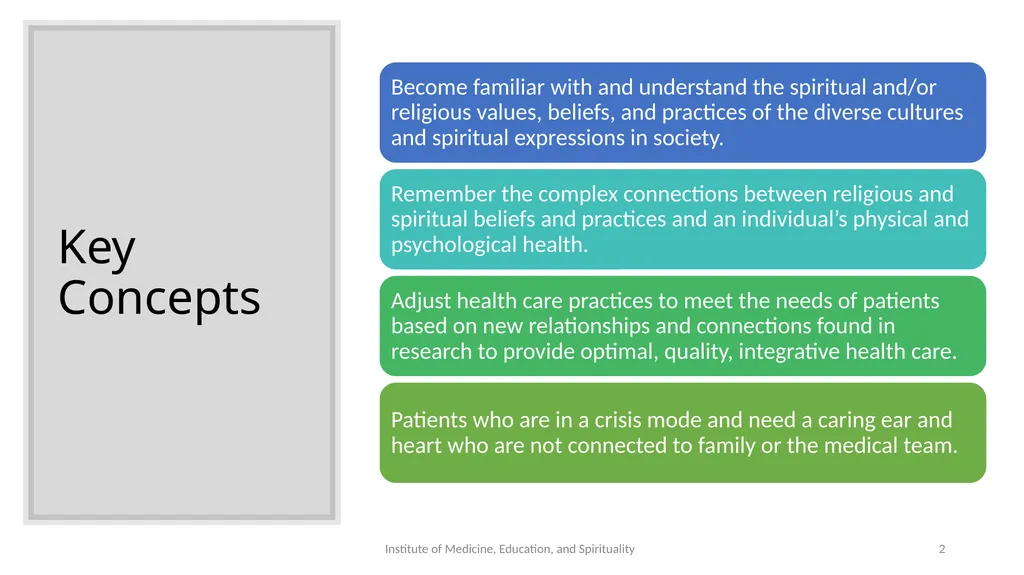
Key Concepts Institute of Medicine, Education, and Spirituality 2<br>
03
Why have a spiritual assessment? Institute of Medicine, Education, and Spirituality 3<br>
04
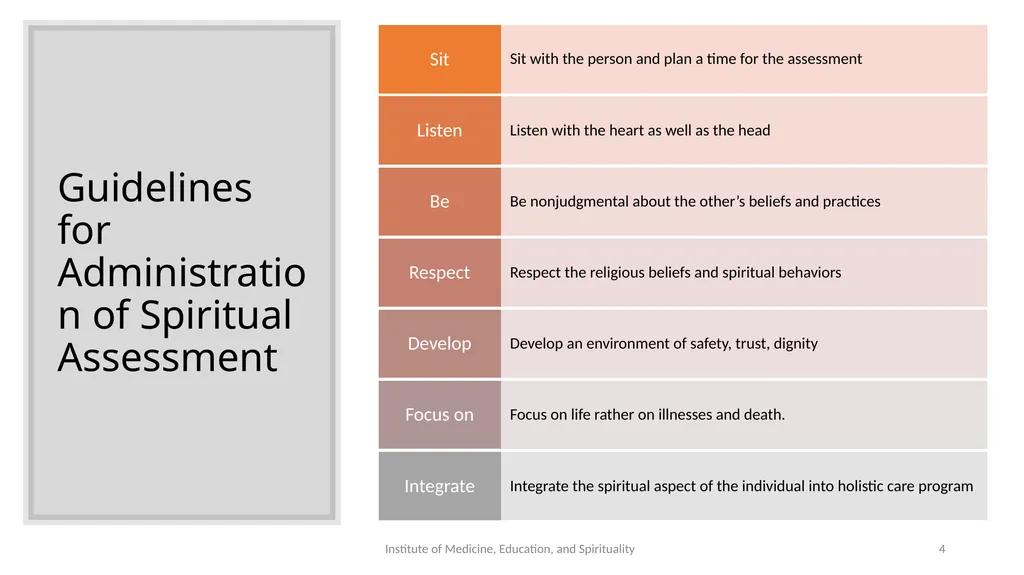
Guidelines for Administration of Spiritual Assessment Institute of Medicine, Education, and Spirituality 4<br>
05
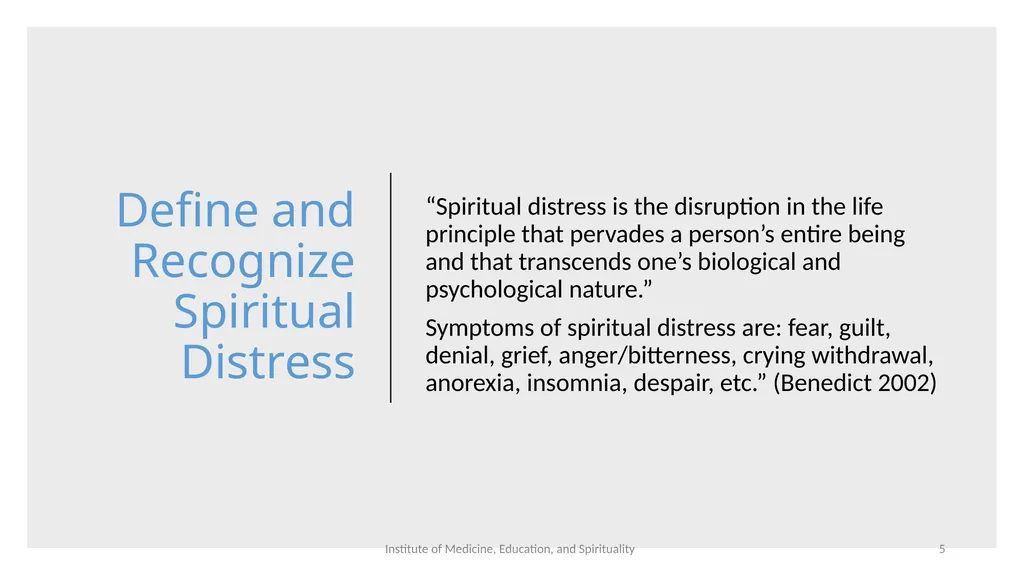
Define and Recognize Spiritual Distress “Spiritual distress is the disruption in the life principle that pervades a person’s entire being and that transcends one’s biological and psychological nature.”
Symptoms of spiritual distress are: fear, guilt, denial, grief, anger/bitterness, crying withdrawal, anorexia, insomnia, despair, etc.” (Benedict 2002) Institute of Medicine, Education, and Spirituality 5<br>
Symptoms of spiritual distress are: fear, guilt, denial, grief, anger/bitterness, crying withdrawal, anorexia, insomnia, despair, etc.” (Benedict 2002) Institute of Medicine, Education, and Spirituality 5<br>
06
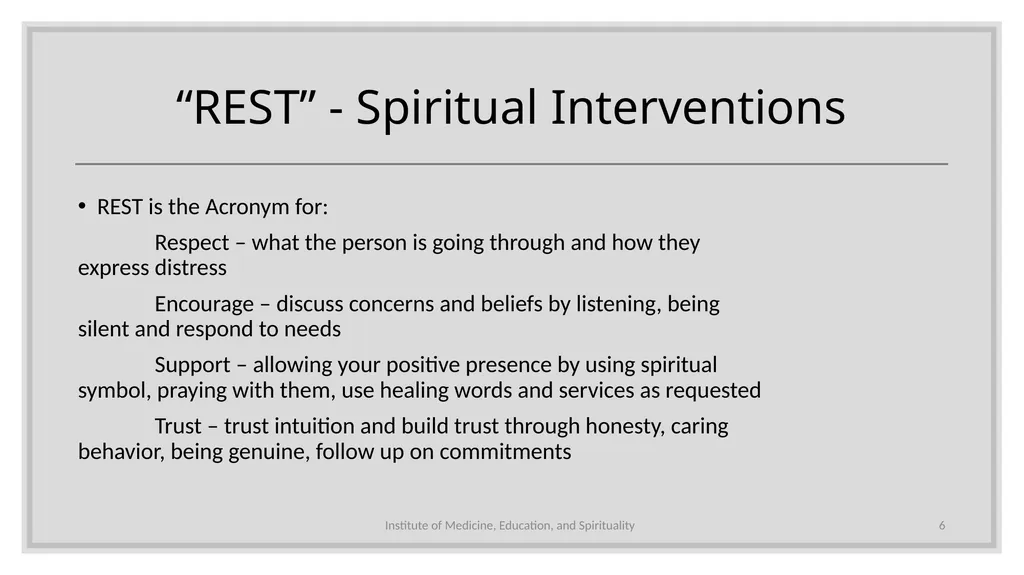
“REST” - Spiritual Interventions REST is the Acronym for:
Respect – what the person is going through and how they express distress
Encourage – discuss concerns and beliefs by listening, being silent and respond to needs
Support – allowing your positive presence by using spiritual symbol, praying with them, use healing words and services as requested
Trust – trust intuition and build trust through honesty, caring behavior, being genuine, follow up on commitments Institute of Medicine, Education, and Spirituality 6<br>
Respect – what the person is going through and how they express distress
Encourage – discuss concerns and beliefs by listening, being silent and respond to needs
Support – allowing your positive presence by using spiritual symbol, praying with them, use healing words and services as requested
Trust – trust intuition and build trust through honesty, caring behavior, being genuine, follow up on commitments Institute of Medicine, Education, and Spirituality 6<br>
07
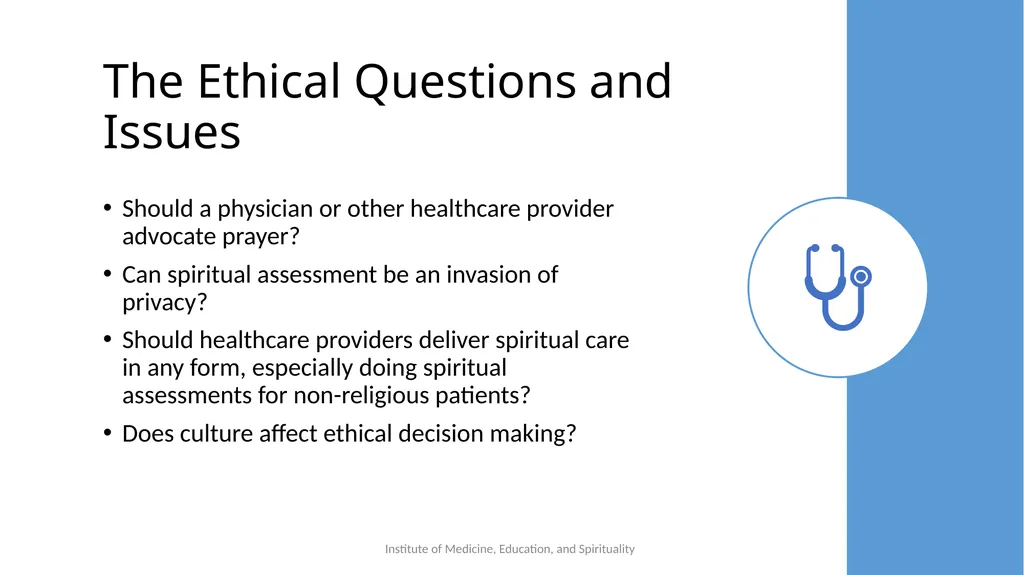
The Ethical Questions and Issues Should a physician or other healthcare provider advocate prayer?
Can spiritual assessment be an invasion of privacy?
Should healthcare providers deliver spiritual care in any form, especially doing spiritual assessments for non-religious patients?
Does culture affect ethical decision making? Institute of Medicine, Education, and Spirituality 7<br>
Can spiritual assessment be an invasion of privacy?
Should healthcare providers deliver spiritual care in any form, especially doing spiritual assessments for non-religious patients?
Does culture affect ethical decision making? Institute of Medicine, Education, and Spirituality 7<br>
08
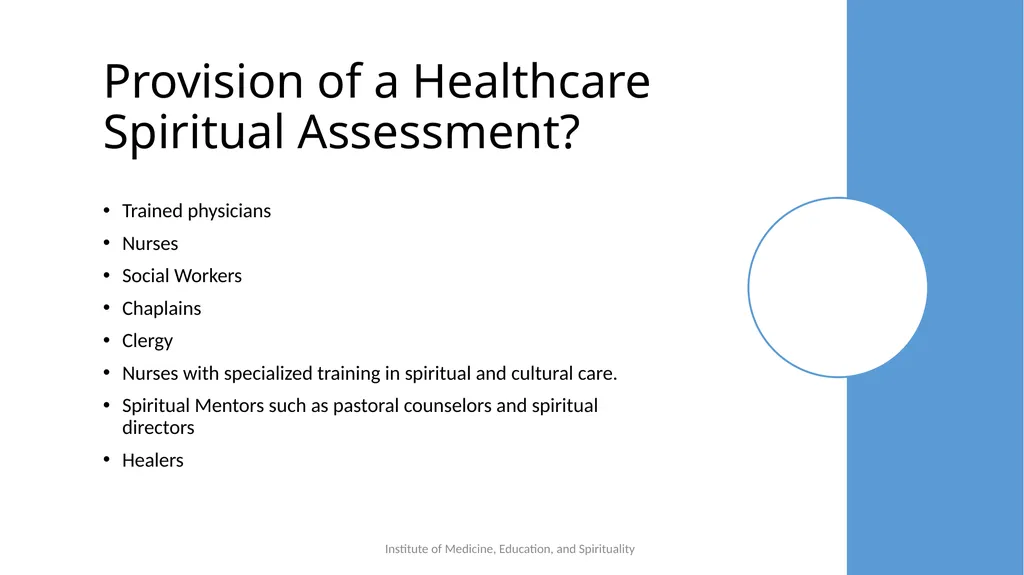
Provision of a Healthcare Spiritual Assessment? Trained physicians
Nurses
Social Workers
Chaplains
Clergy
Nurses with specialized training in spiritual and cultural care.
Spiritual Mentors such as pastoral counselors and spiritual directors
Healers Institute of Medicine, Education, and Spirituality 8<br>
Nurses
Social Workers
Chaplains
Clergy
Nurses with specialized training in spiritual and cultural care.
Spiritual Mentors such as pastoral counselors and spiritual directors
Healers Institute of Medicine, Education, and Spirituality 8<br>
09
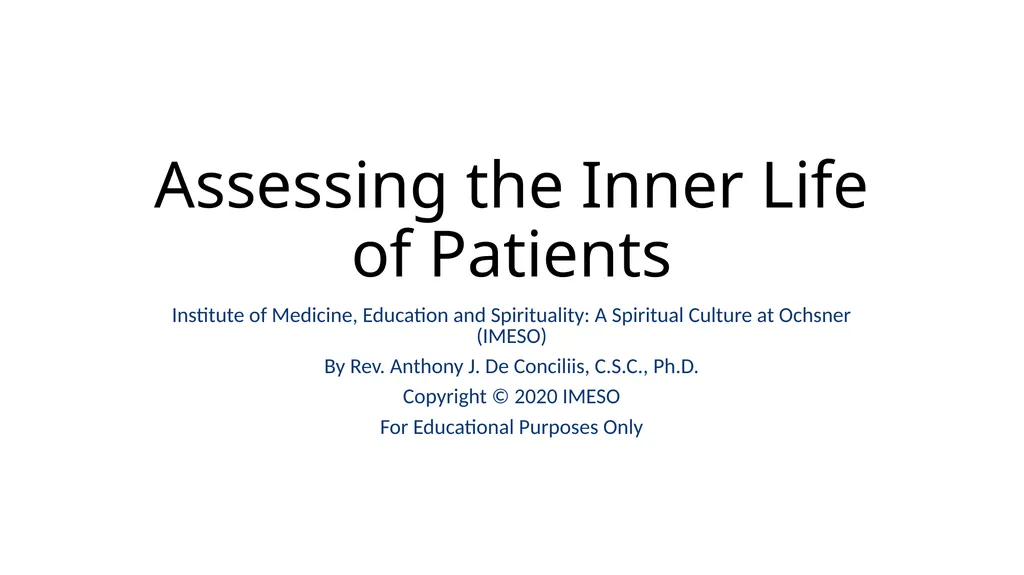
Assessing the Inner Life of Patients Institute of Medicine, Education and Spirituality: A Spiritual Culture at Ochsner (IMESO)
By Rev. Anthony J. De Conciliis, C.S.C., Ph.D.
Copyright © 2020 IMESO
For Educational Purposes Only<br>
By Rev. Anthony J. De Conciliis, C.S.C., Ph.D.
Copyright © 2020 IMESO
For Educational Purposes Only<br>
10
Introduction The relationship between spirituality (values and beliefs) and medicine as a positive aspect of healing is a major topic of discussion in healthcare.
The spiritual aspects of healing are now studied as a major factor in healing. An indication of the importance of spirituality in the practice of medicine is the fact that over 50 medical schools currently offer courses in spirituality and medicine.
Major approaches to assess spirituality in patients are presented. Institute of Medicine, Education, and Spirituality 10<br>
The spiritual aspects of healing are now studied as a major factor in healing. An indication of the importance of spirituality in the practice of medicine is the fact that over 50 medical schools currently offer courses in spirituality and medicine.
Major approaches to assess spirituality in patients are presented. Institute of Medicine, Education, and Spirituality 10<br>
11
Introduction Institute of Medicine, Education, and Spirituality 11<br>
12
Patient Satisfaction and Spirituality Institute of Medicine, Education, and Spirituality 12<br>
13
Spirituality
Experienced Spirituality in healthcare can be defined as “the conscious striving to integrate life in terms not of isolation or self-absorption, but of self-transcendence toward an ultimate value one perceives.” (Schneiders)
This is a broad-based definition that encompasses religious and non-religious perspectives.
Spirituality can be experienced through many avenues: an organized religion; a personal relationship with the divine or transcendent; communion with nature, music or the arts; practicing virtues and principles; and a quest for scientific truth. Institute of Medicine, Education, and Spirituality 13<br>
This is a broad-based definition that encompasses religious and non-religious perspectives.
Spirituality can be experienced through many avenues: an organized religion; a personal relationship with the divine or transcendent; communion with nature, music or the arts; practicing virtues and principles; and a quest for scientific truth. Institute of Medicine, Education, and Spirituality 13<br>
14
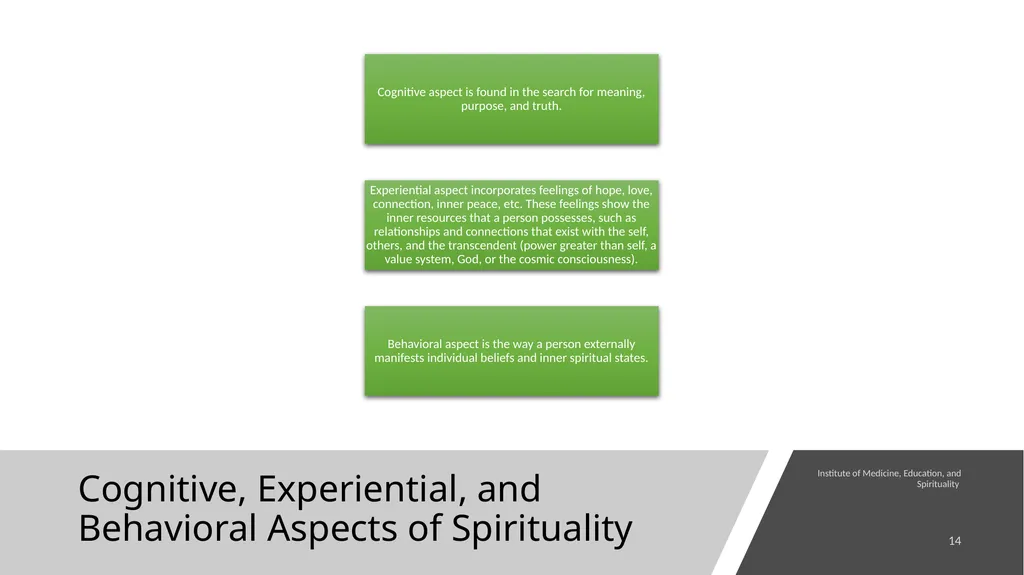
Cognitive, Experiential, and Behavioral Aspects of Spirituality Institute of Medicine, Education, and Spirituality 14<br>
15
Formal Spiritual Assessment A formal spiritual assessment involves asking specific questions during a medical interview to determine whether spiritual factors may possibly play a role in the patient’s illness and/or recovery and whether these factors might affect or moderate the medical treatment plan. Institute of Medicine, Education, and Spirituality 15<br>
16
A Spiritual Assessment and Care A spiritual assessment is the process of identifying a patient’s spiritual needs and strengths and their potential role in the healing process.
Spiritual care is the recognition and the development of a plan to respond to patients’ and families’ spiritual needs. It involves compassionate presence, listening, encouragement, and treatment approaches/plans.
Medical personnel can learn to assess spiritual needs by listening to a patient’s distress and determining the potential spiritual resources. Many times, this assessment involves a consultation with trained spiritual care advisors. Institute of Medicine, Education, and Spirituality 16<br>
Spiritual care is the recognition and the development of a plan to respond to patients’ and families’ spiritual needs. It involves compassionate presence, listening, encouragement, and treatment approaches/plans.
Medical personnel can learn to assess spiritual needs by listening to a patient’s distress and determining the potential spiritual resources. Many times, this assessment involves a consultation with trained spiritual care advisors. Institute of Medicine, Education, and Spirituality 16<br>
17
Spiritual and Religious Areas Cultural background and metaphysical outlook
Religious affiliation
Religious orthodoxy
Religious problem-solving style
Spiritual identity
God image
Value-lifestyle congruence
Doctrinal knowledge
Spiritual and religious health and maturity
Source: Richards PS, Bergin AE. Institute of Medicine, Education, and Spirituality 17<br>
Religious affiliation
Religious orthodoxy
Religious problem-solving style
Spiritual identity
God image
Value-lifestyle congruence
Doctrinal knowledge
Spiritual and religious health and maturity
Source: Richards PS, Bergin AE. Institute of Medicine, Education, and Spirituality 17<br>
18
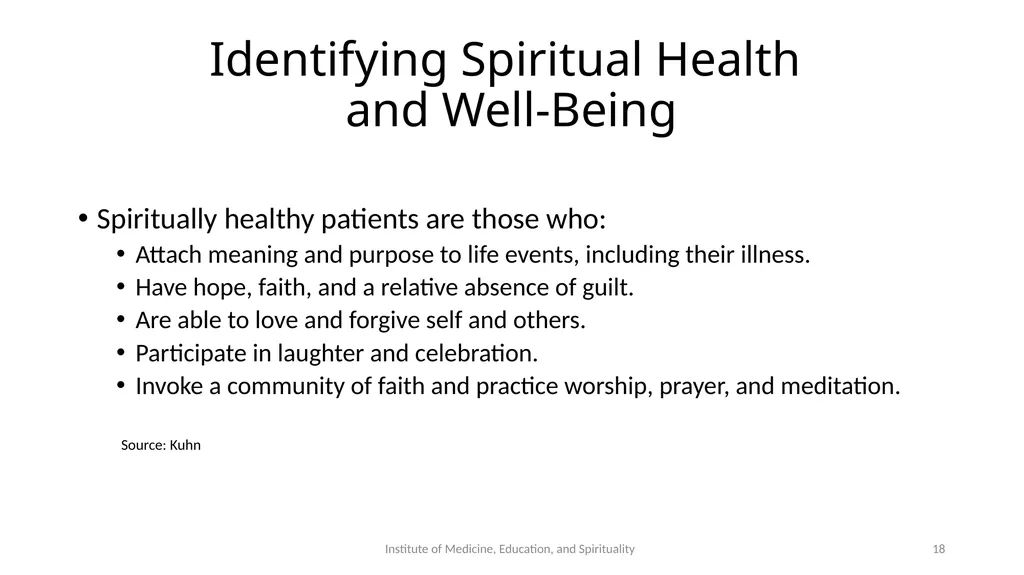
Identifying Spiritual Health
and Well-Being Spiritually healthy patients are those who:
Attach meaning and purpose to life events, including their illness.
Have hope, faith, and a relative absence of guilt.
Are able to love and forgive self and others.
Participate in laughter and celebration.
Invoke a community of faith and practice worship, prayer, and meditation.
Source: Kuhn Institute of Medicine, Education, and Spirituality 18<br>
Attach meaning and purpose to life events, including their illness.
Have hope, faith, and a relative absence of guilt.
Are able to love and forgive self and others.
Participate in laughter and celebration.
Invoke a community of faith and practice worship, prayer, and meditation.
Source: Kuhn Institute of Medicine, Education, and Spirituality 18<br>
19
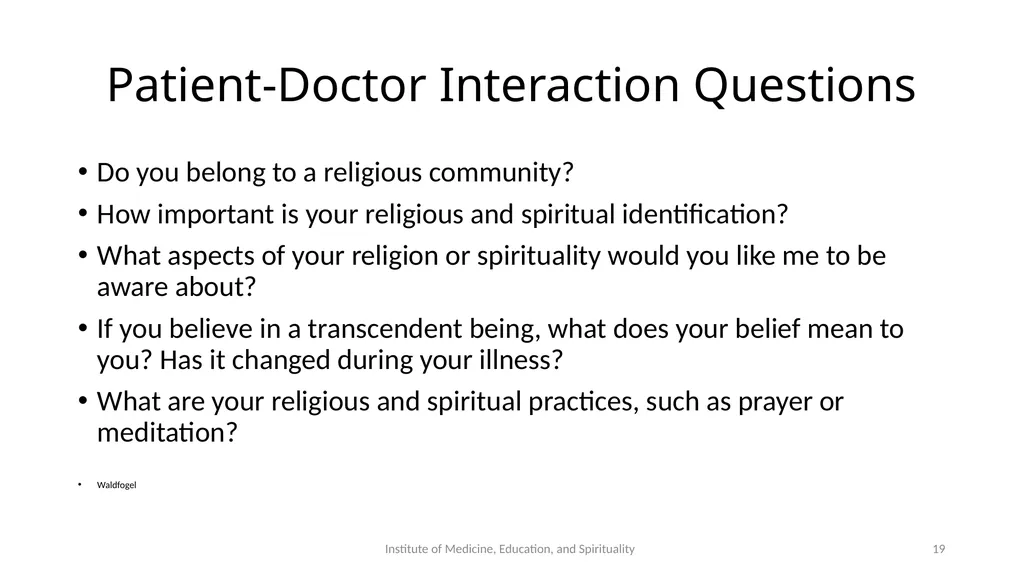
Patient-Doctor Interaction Questions Do you belong to a religious community?
How important is your religious and spiritual identification?
What aspects of your religion or spirituality would you like me to be aware about?
If you believe in a transcendent being, what does your belief mean to you? Has it changed during your illness?
What are your religious and spiritual practices, such as prayer or meditation?
Waldfogel Institute of Medicine, Education, and Spirituality 19<br>
How important is your religious and spiritual identification?
What aspects of your religion or spirituality would you like me to be aware about?
If you believe in a transcendent being, what does your belief mean to you? Has it changed during your illness?
What are your religious and spiritual practices, such as prayer or meditation?
Waldfogel Institute of Medicine, Education, and Spirituality 19<br>
20
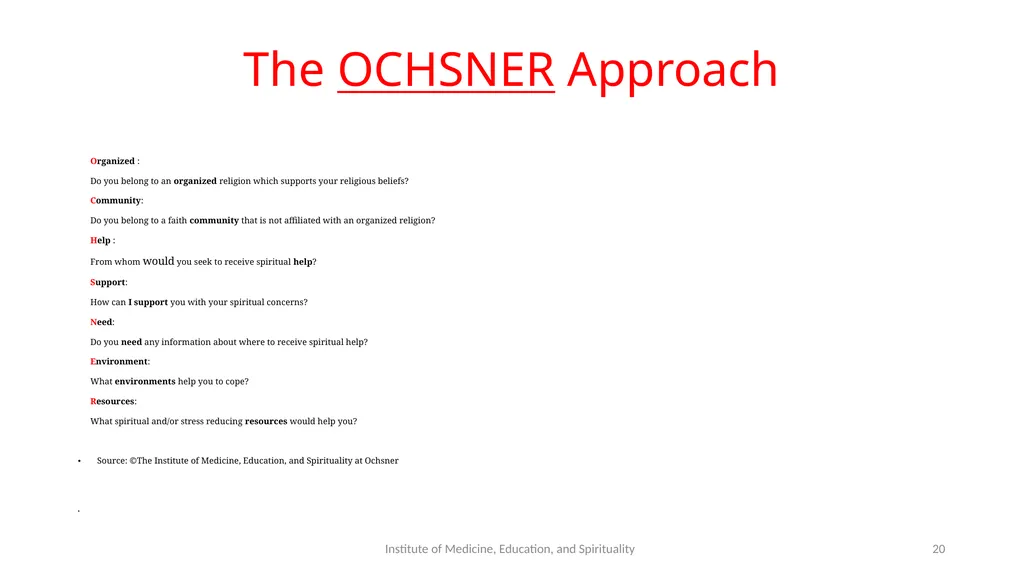
The OCHSNER Approach Organized :
Do you belong to an organized religion which supports your religious beliefs?
Community:
Do you belong to a faith community that is not affiliated with an organized religion?
Help :
From whom would you seek to receive spiritual help?
Support:
How can I support you with your spiritual concerns?
Need:
Do you need any information about where to receive spiritual help?
Environment:
What environments help you to cope?
Resources:
What spiritual and/or stress reducing resources would help you?
Source: ©The Institute of Medicine, Education, and Spirituality at Ochsner Institute of Medicine, Education, and Spirituality 20<br>
Do you belong to an organized religion which supports your religious beliefs?
Community:
Do you belong to a faith community that is not affiliated with an organized religion?
Help :
From whom would you seek to receive spiritual help?
Support:
How can I support you with your spiritual concerns?
Need:
Do you need any information about where to receive spiritual help?
Environment:
What environments help you to cope?
Resources:
What spiritual and/or stress reducing resources would help you?
Source: ©The Institute of Medicine, Education, and Spirituality at Ochsner Institute of Medicine, Education, and Spirituality 20<br>
21
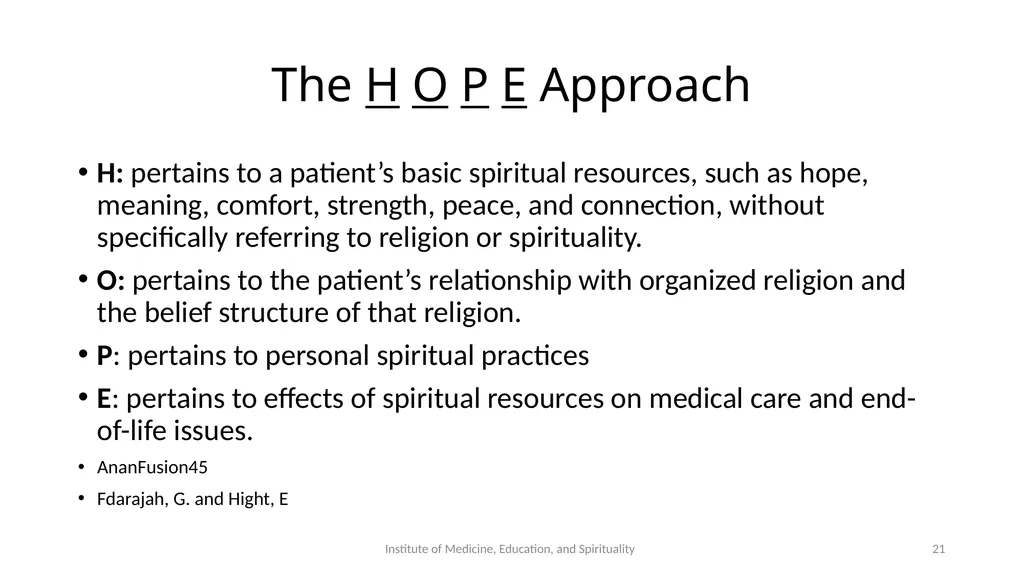
The H O P E Approach H: pertains to a patient’s basic spiritual resources, such as hope, meaning, comfort, strength, peace, and connection, without specifically referring to religion or spirituality.
O: pertains to the patient’s relationship with organized religion and the belief structure of that religion.
P: pertains to personal spiritual practices
E: pertains to effects of spiritual resources on medical care and end-of-life issues.
AnanFusion45
Fdarajah, G. and Hight, E Institute of Medicine, Education, and Spirituality 21<br>
O: pertains to the patient’s relationship with organized religion and the belief structure of that religion.
P: pertains to personal spiritual practices
E: pertains to effects of spiritual resources on medical care and end-of-life issues.
AnanFusion45
Fdarajah, G. and Hight, E Institute of Medicine, Education, and Spirituality 21<br>
22
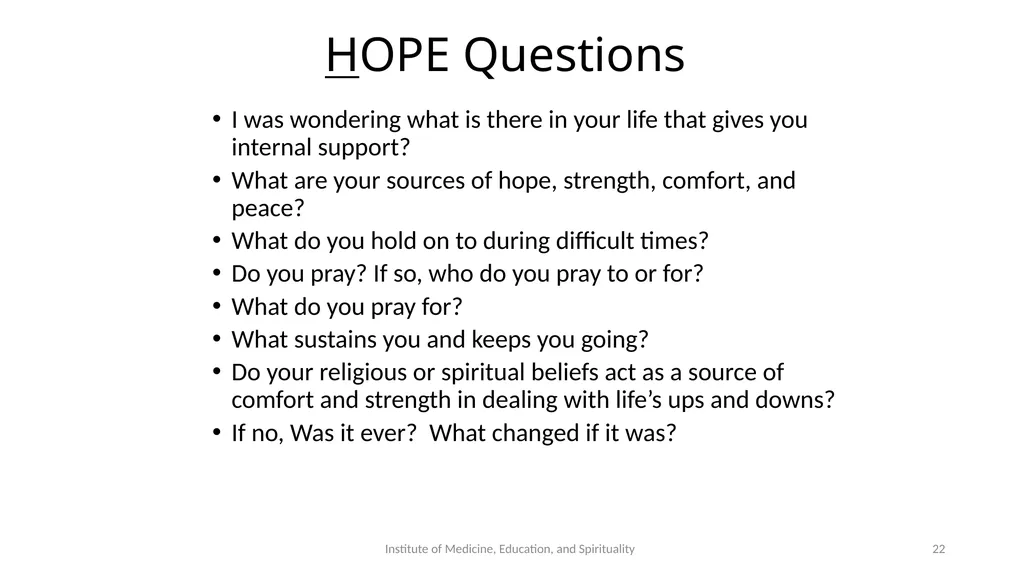
HOPE Questions I was wondering what is there in your life that gives you internal support?
What are your sources of hope, strength, comfort, and peace?
What do you hold on to during difficult times?
Do you pray? If so, who do you pray to or for?
What do you pray for?
What sustains you and keeps you going?
Do your religious or spiritual beliefs act as a source of comfort and strength in dealing with life’s ups and downs?
If no, Was it ever? What changed if it was? Institute of Medicine, Education, and Spirituality 22<br>
What are your sources of hope, strength, comfort, and peace?
What do you hold on to during difficult times?
Do you pray? If so, who do you pray to or for?
What do you pray for?
What sustains you and keeps you going?
Do your religious or spiritual beliefs act as a source of comfort and strength in dealing with life’s ups and downs?
If no, Was it ever? What changed if it was? Institute of Medicine, Education, and Spirituality 22<br>
23
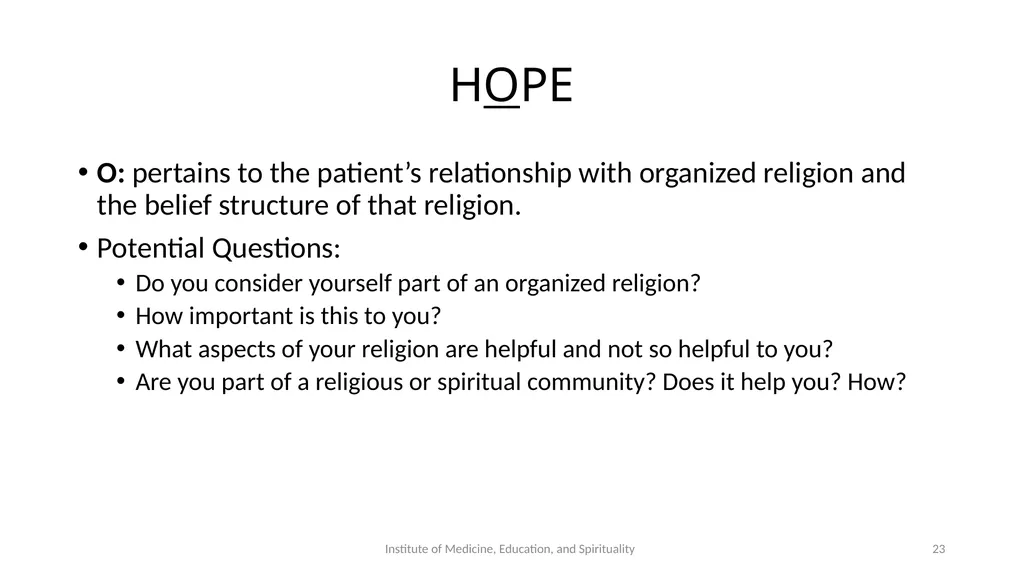
HOPE O: pertains to the patient’s relationship with organized religion and the belief structure of that religion.
Potential Questions:
Do you consider yourself part of an organized religion?
How important is this to you?
What aspects of your religion are helpful and not so helpful to you?
Are you part of a religious or spiritual community? Does it help you? How? Institute of Medicine, Education, and Spirituality 23<br>
Potential Questions:
Do you consider yourself part of an organized religion?
How important is this to you?
What aspects of your religion are helpful and not so helpful to you?
Are you part of a religious or spiritual community? Does it help you? How? Institute of Medicine, Education, and Spirituality 23<br>
24
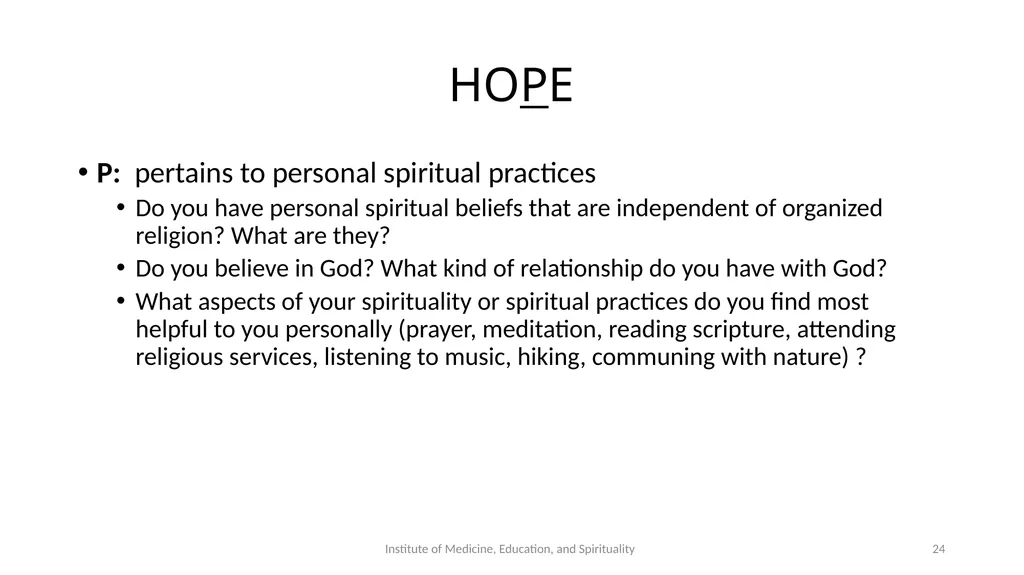
HOPE P: pertains to personal spiritual practices
Do you have personal spiritual beliefs that are independent of organized religion? What are they?
Do you believe in God? What kind of relationship do you have with God?
What aspects of your spirituality or spiritual practices do you find most helpful to you personally (prayer, meditation, reading scripture, attending religious services, listening to music, hiking, communing with nature) ? Institute of Medicine, Education, and Spirituality 24<br>
Do you have personal spiritual beliefs that are independent of organized religion? What are they?
Do you believe in God? What kind of relationship do you have with God?
What aspects of your spirituality or spiritual practices do you find most helpful to you personally (prayer, meditation, reading scripture, attending religious services, listening to music, hiking, communing with nature) ? Institute of Medicine, Education, and Spirituality 24<br>
25
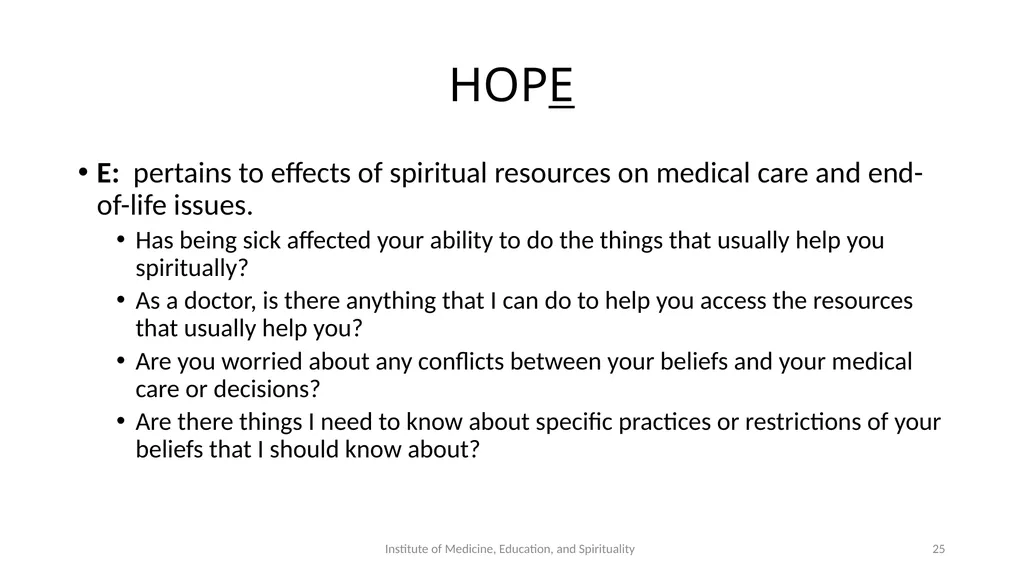
HOPE E: pertains to effects of spiritual resources on medical care and end-of-life issues.
Has being sick affected your ability to do the things that usually help you spiritually?
As a doctor, is there anything that I can do to help you access the resources that usually help you?
Are you worried about any conflicts between your beliefs and your medical care or decisions?
Are there things I need to know about specific practices or restrictions of your beliefs that I should know about? Institute of Medicine, Education, and Spirituality 25<br>
Has being sick affected your ability to do the things that usually help you spiritually?
As a doctor, is there anything that I can do to help you access the resources that usually help you?
Are you worried about any conflicts between your beliefs and your medical care or decisions?
Are there things I need to know about specific practices or restrictions of your beliefs that I should know about? Institute of Medicine, Education, and Spirituality 25<br>
26
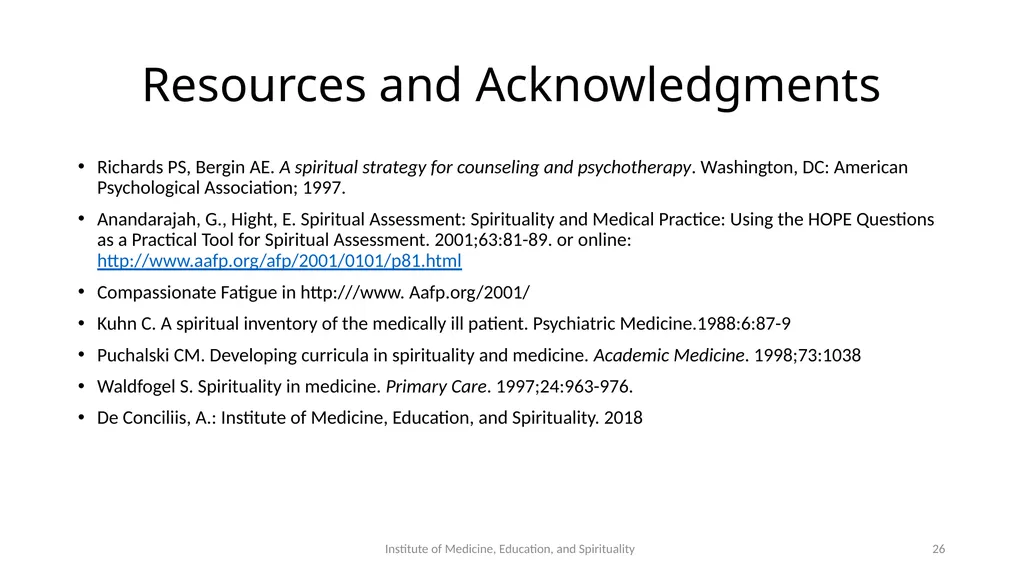
Resources and Acknowledgments Richards PS, Bergin AE. A spiritual strategy for counseling and psychotherapy. Washington, DC: American Psychological Association; 1997.
Anandarajah, G., Hight, E. Spiritual Assessment: Spirituality and Medical Practice: Using the HOPE Questions as a Practical Tool for Spiritual Assessment. 2001;63:81-89. or online: http://www.aafp.org/afp/2001/0101/p81.html
Compassionate Fatigue in http:///www. Aafp.org/2001/
Kuhn C. A spiritual inventory of the medically ill patient. Psychiatric Medicine.1988:6:87-9
Puchalski CM. Developing curricula in spirituality and medicine. Academic Medicine. 1998;73:1038
Waldfogel S. Spirituality in medicine. Primary Care. 1997;24:963-976.
De Conciliis, A.: Institute of Medicine, Education, and Spirituality. 2018 Institute of Medicine, Education, and Spirituality 26<br>
Anandarajah, G., Hight, E. Spiritual Assessment: Spirituality and Medical Practice: Using the HOPE Questions as a Practical Tool for Spiritual Assessment. 2001;63:81-89. or online: http://www.aafp.org/afp/2001/0101/p81.html
Compassionate Fatigue in http:///www. Aafp.org/2001/
Kuhn C. A spiritual inventory of the medically ill patient. Psychiatric Medicine.1988:6:87-9
Puchalski CM. Developing curricula in spirituality and medicine. Academic Medicine. 1998;73:1038
Waldfogel S. Spirituality in medicine. Primary Care. 1997;24:963-976.
De Conciliis, A.: Institute of Medicine, Education, and Spirituality. 2018 Institute of Medicine, Education, and Spirituality 26<br>