
Sponsored Research Compliance Reviews CLASP
MY
Published · 15 slides · 0 views

1 / 1
Description
Sponsored Research Compliance Reviews CLASP Meeting November 28, 2023 Presented by the Office of University Audit Christopher Butler, Chief Audit Executive Shirley Brown, Audit Manager Kimberly Davis, Senior Internal Auditor Scott Lawlor,
Related Topics
Share
Embed code
Download this presentation From Below
"Sponsored Research Compliance Reviews CLASP" is the property of its rightful owner. Permission is granted to download and print the materials on this website for personal, non-commercial use only, and to display it on your personal computer provided you do not modify the materials and that you retain all copyright notices contained in the materials. By downloading content from our website, you accept the terms of this agreement.
Presentation Transcript
01
Sponsored Research Compliance Reviews
CLASP Meeting – November 28, 2023
Presented by the Office of University Audit Christopher Butler, Chief Audit Executive
Shirley Brown, Audit Manager
Kimberly Davis, Senior Internal Auditor
Scott Lawlor, Audit Manager<br>
CLASP Meeting – November 28, 2023
Presented by the Office of University Audit Christopher Butler, Chief Audit Executive
Shirley Brown, Audit Manager
Kimberly Davis, Senior Internal Auditor
Scott Lawlor, Audit Manager<br>
02
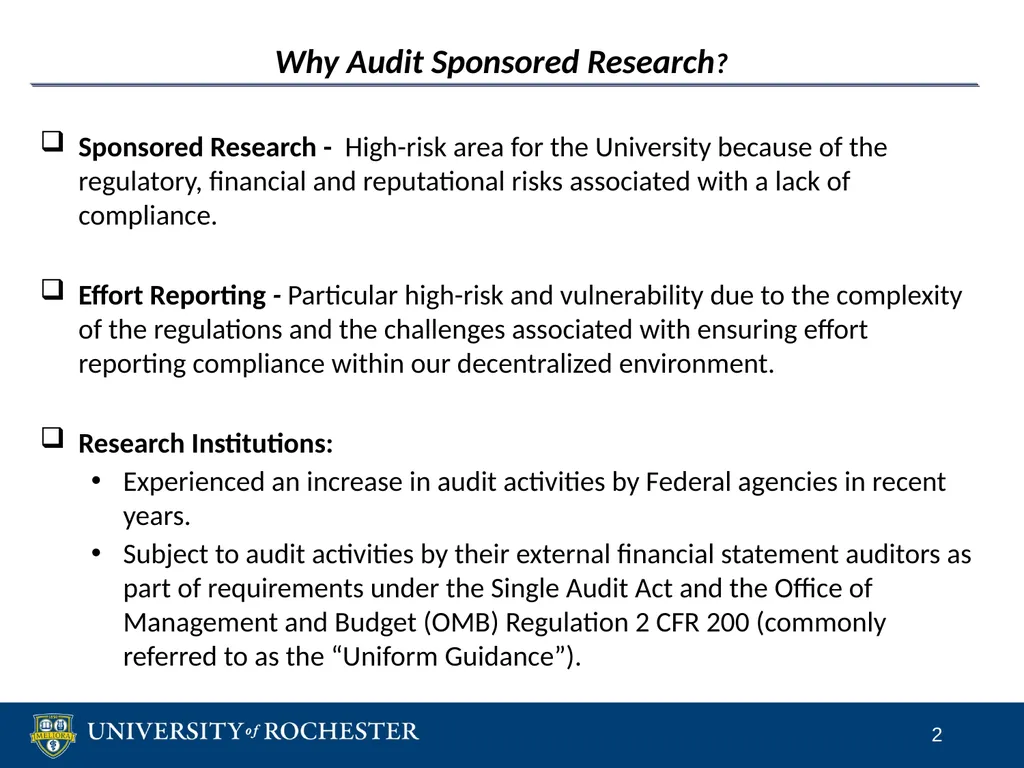
Sponsored Research - High-risk area for the University because of the regulatory, financial and reputational risks associated with a lack of compliance.
Effort Reporting - Particular high-risk and vulnerability due to the complexity of the regulations and the challenges associated with ensuring effort reporting compliance within our decentralized environment.
Research Institutions:
Experienced an increase in audit activities by Federal agencies in recent years.
Subject to audit activities by their external financial statement auditors as part of requirements under the Single Audit Act and the Office of Management and Budget (OMB) Regulation 2 CFR 200 (commonly referred to as the “Uniform Guidance”). Why Audit Sponsored Research?<br>
Effort Reporting - Particular high-risk and vulnerability due to the complexity of the regulations and the challenges associated with ensuring effort reporting compliance within our decentralized environment.
Research Institutions:
Experienced an increase in audit activities by Federal agencies in recent years.
Subject to audit activities by their external financial statement auditors as part of requirements under the Single Audit Act and the Office of Management and Budget (OMB) Regulation 2 CFR 200 (commonly referred to as the “Uniform Guidance”). Why Audit Sponsored Research?<br>
03
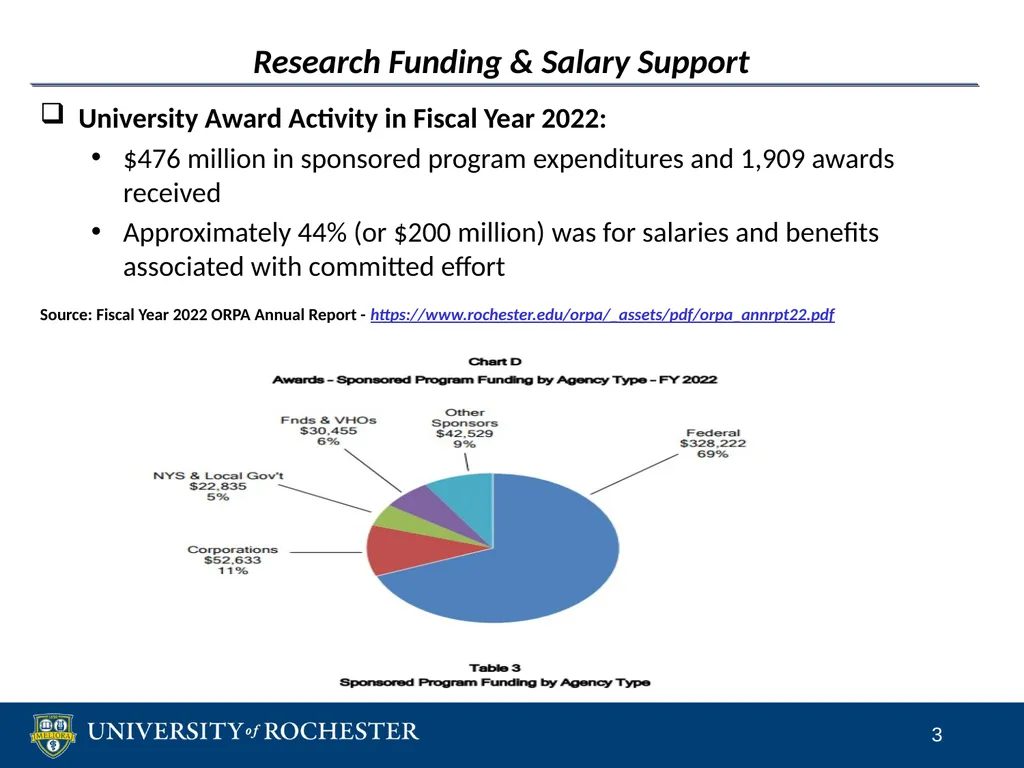
University Award Activity in Fiscal Year 2022:
$476 million in sponsored program expenditures and 1,909 awards received
Approximately 44% (or $200 million) was for salaries and benefits associated with committed effort
Source: Fiscal Year 2022 ORPA Annual Report - https://www.rochester.edu/orpa/_assets/pdf/orpa_annrpt22.pdf Research Funding & Salary Support<br>
$476 million in sponsored program expenditures and 1,909 awards received
Approximately 44% (or $200 million) was for salaries and benefits associated with committed effort
Source: Fiscal Year 2022 ORPA Annual Report - https://www.rochester.edu/orpa/_assets/pdf/orpa_annrpt22.pdf Research Funding & Salary Support<br>
04
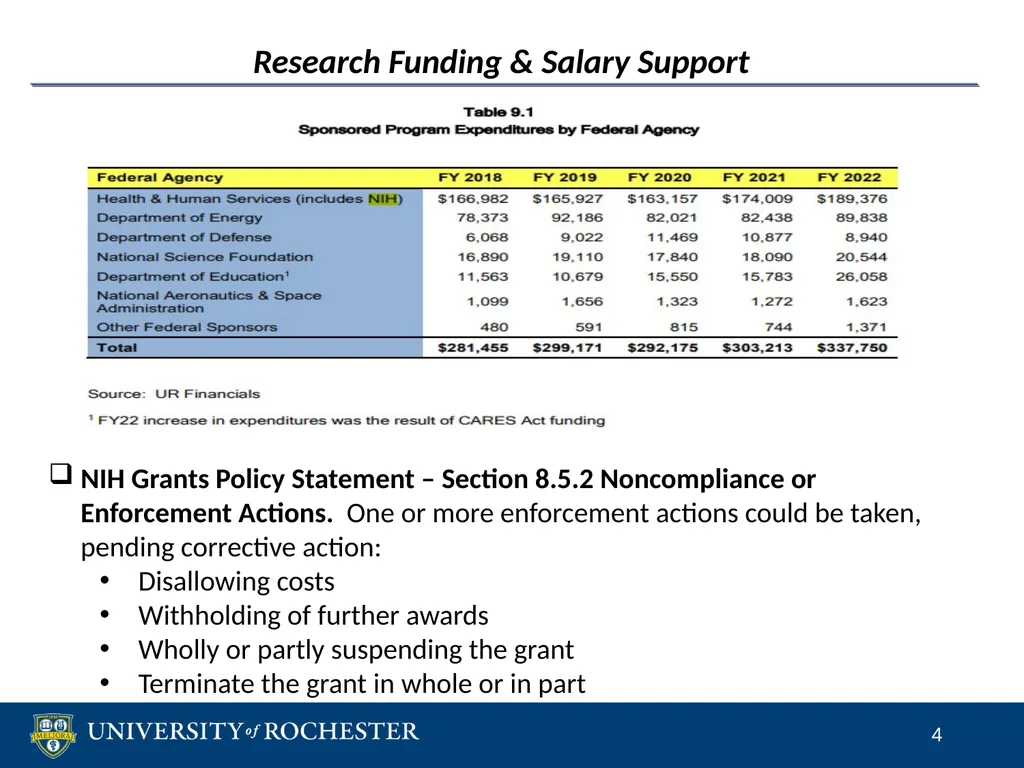
NIH Grants Policy Statement – Section 8.5.2 Noncompliance or Enforcement Actions. One or more enforcement actions could be taken, pending corrective action:
Disallowing costs
Withholding of further awards
Wholly or partly suspending the grant
Terminate the grant in whole or in part Research Funding & Salary Support<br>
Disallowing costs
Withholding of further awards
Wholly or partly suspending the grant
Terminate the grant in whole or in part Research Funding & Salary Support<br>
05
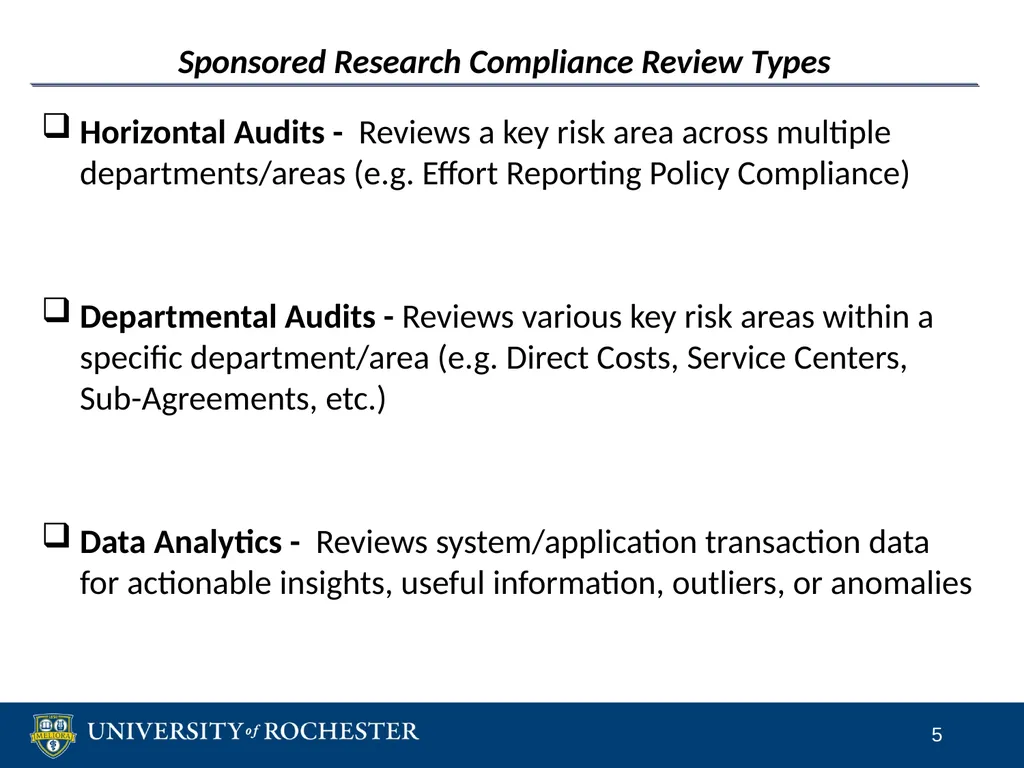
Horizontal Audits - Reviews a key risk area across multiple departments/areas (e.g. Effort Reporting Policy Compliance)
Departmental Audits - Reviews various key risk areas within a specific department/area (e.g. Direct Costs, Service Centers, Sub-Agreements, etc.)
Data Analytics - Reviews system/application transaction data for actionable insights, useful information, outliers, or anomalies Sponsored Research Compliance Review Types<br>
Departmental Audits - Reviews various key risk areas within a specific department/area (e.g. Direct Costs, Service Centers, Sub-Agreements, etc.)
Data Analytics - Reviews system/application transaction data for actionable insights, useful information, outliers, or anomalies Sponsored Research Compliance Review Types<br>
06
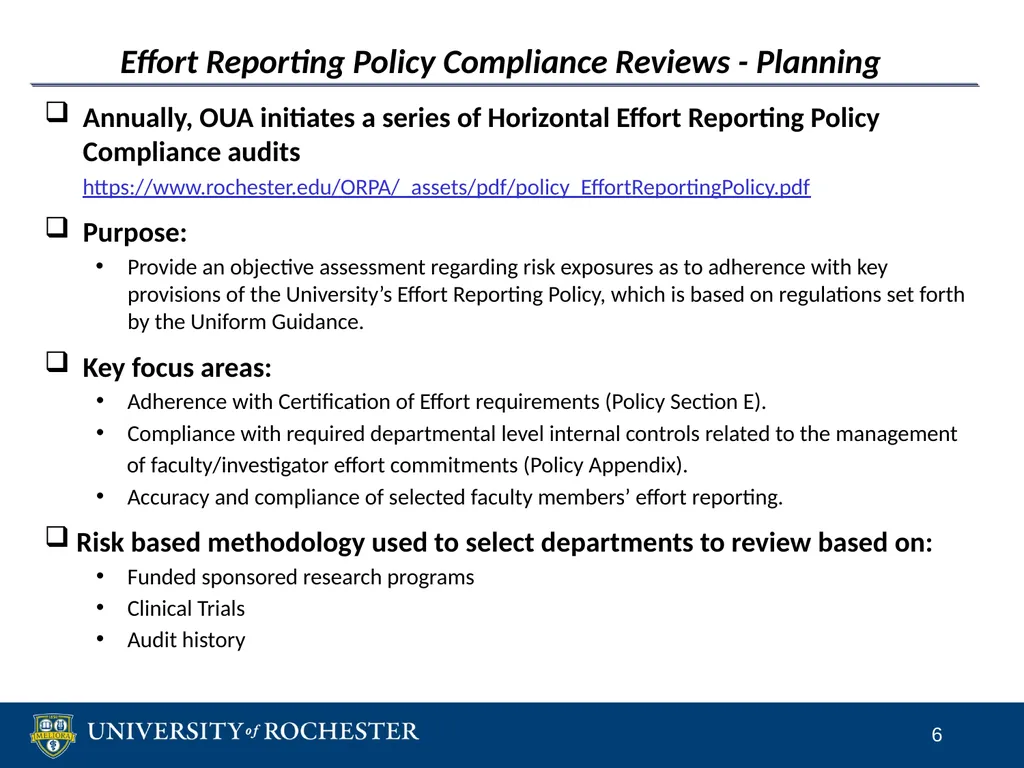
Annually, OUA initiates a series of Horizontal Effort Reporting Policy Compliance audits
https://www.rochester.edu/ORPA/_assets/pdf/policy_EffortReportingPolicy.pdf
Purpose:
Provide an objective assessment regarding risk exposures as to adherence with key provisions of the University’s Effort Reporting Policy, which is based on regulations set forth by the Uniform Guidance.
Key focus areas:
Adherence with Certification of Effort requirements (Policy Section E).
Compliance with required departmental level internal controls related to the management
of faculty/investigator effort commitments (Policy Appendix).
Accuracy and compliance of selected faculty members’ effort reporting.
Risk based methodology used to select departments to review based on:
Funded sponsored research programs
Clinical Trials
Audit history Effort Reporting Policy Compliance Reviews - Planning<br>
https://www.rochester.edu/ORPA/_assets/pdf/policy_EffortReportingPolicy.pdf
Purpose:
Provide an objective assessment regarding risk exposures as to adherence with key provisions of the University’s Effort Reporting Policy, which is based on regulations set forth by the Uniform Guidance.
Key focus areas:
Adherence with Certification of Effort requirements (Policy Section E).
Compliance with required departmental level internal controls related to the management
of faculty/investigator effort commitments (Policy Appendix).
Accuracy and compliance of selected faculty members’ effort reporting.
Risk based methodology used to select departments to review based on:
Funded sponsored research programs
Clinical Trials
Audit history Effort Reporting Policy Compliance Reviews - Planning<br>
07
Effort Certification:
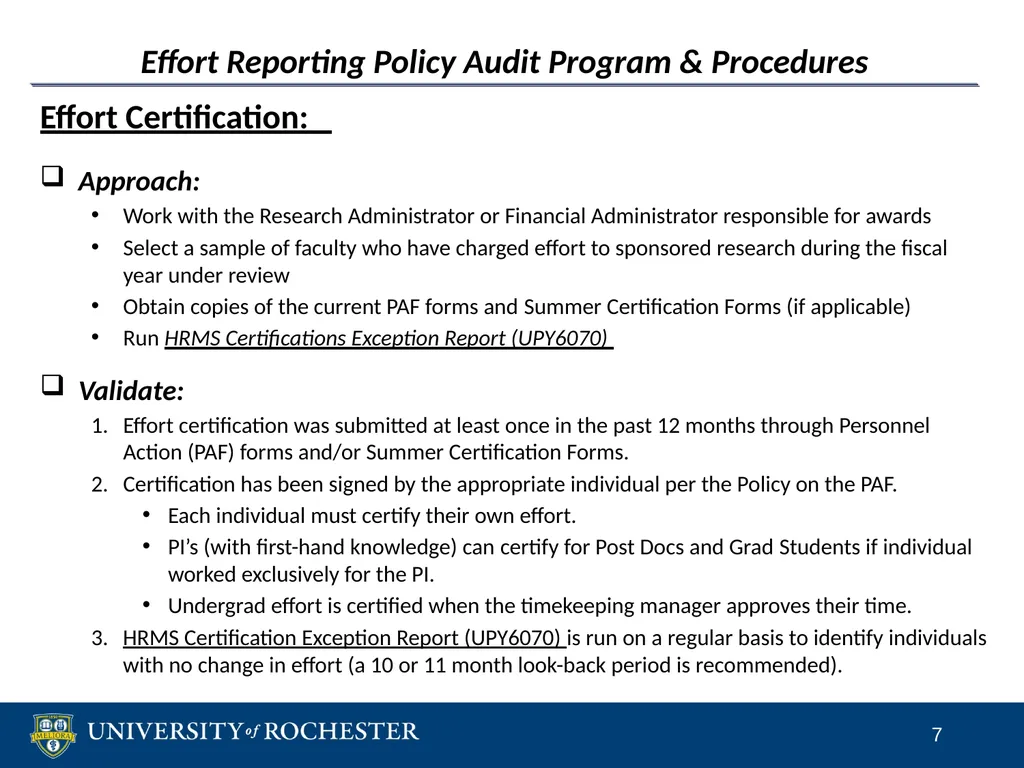
Approach:
Work with the Research Administrator or Financial Administrator responsible for awards
Select a sample of faculty who have charged effort to sponsored research during the fiscal year under review
Obtain copies of the current PAF forms and Summer Certification Forms (if applicable)
Run HRMS Certifications Exception Report (UPY6070)
Validate:
Effort certification was submitted at least once in the past 12 months through Personnel Action (PAF) forms and/or Summer Certification Forms.
Certification has been signed by the appropriate individual per the Policy on the PAF.
Each individual must certify their own effort.
PI’s (with first-hand knowledge) can certify for Post Docs and Grad Students if individual worked exclusively for the PI.
Undergrad effort is certified when the timekeeping manager approves their time.
HRMS Certification Exception Report (UPY6070) is run on a regular basis to identify individuals with no change in effort (a 10 or 11 month look-back period is recommended). Effort Reporting Policy Audit Program & Procedures<br>
Approach:
Work with the Research Administrator or Financial Administrator responsible for awards
Select a sample of faculty who have charged effort to sponsored research during the fiscal year under review
Obtain copies of the current PAF forms and Summer Certification Forms (if applicable)
Run HRMS Certifications Exception Report (UPY6070)
Validate:
Effort certification was submitted at least once in the past 12 months through Personnel Action (PAF) forms and/or Summer Certification Forms.
Certification has been signed by the appropriate individual per the Policy on the PAF.
Each individual must certify their own effort.
PI’s (with first-hand knowledge) can certify for Post Docs and Grad Students if individual worked exclusively for the PI.
Undergrad effort is certified when the timekeeping manager approves their time.
HRMS Certification Exception Report (UPY6070) is run on a regular basis to identify individuals with no change in effort (a 10 or 11 month look-back period is recommended). Effort Reporting Policy Audit Program & Procedures<br>
08
Department’s Internal Control Procedures for Monitoring Effort & Payroll Allocations
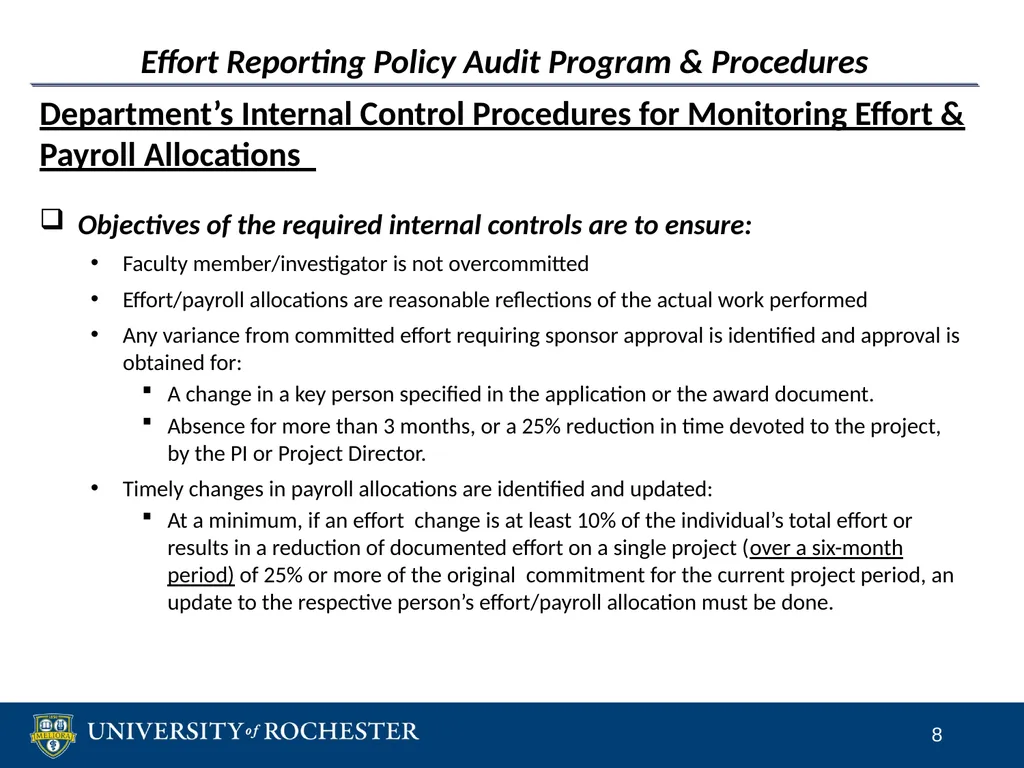
Objectives of the required internal controls are to ensure:
Faculty member/investigator is not overcommitted
Effort/payroll allocations are reasonable reflections of the actual work performed
Any variance from committed effort requiring sponsor approval is identified and approval is obtained for:
A change in a key person specified in the application or the award document.
Absence for more than 3 months, or a 25% reduction in time devoted to the project, by the PI or Project Director.
Timely changes in payroll allocations are identified and updated:
At a minimum, if an effort change is at least 10% of the individual’s total effort or results in a reduction of documented effort on a single project (over a six-month period) of 25% or more of the original commitment for the current project period, an update to the respective person’s effort/payroll allocation must be done. Effort Reporting Policy Audit Program & Procedures<br>
Objectives of the required internal controls are to ensure:
Faculty member/investigator is not overcommitted
Effort/payroll allocations are reasonable reflections of the actual work performed
Any variance from committed effort requiring sponsor approval is identified and approval is obtained for:
A change in a key person specified in the application or the award document.
Absence for more than 3 months, or a 25% reduction in time devoted to the project, by the PI or Project Director.
Timely changes in payroll allocations are identified and updated:
At a minimum, if an effort change is at least 10% of the individual’s total effort or results in a reduction of documented effort on a single project (over a six-month period) of 25% or more of the original commitment for the current project period, an update to the respective person’s effort/payroll allocation must be done. Effort Reporting Policy Audit Program & Procedures<br>
09
Approach:
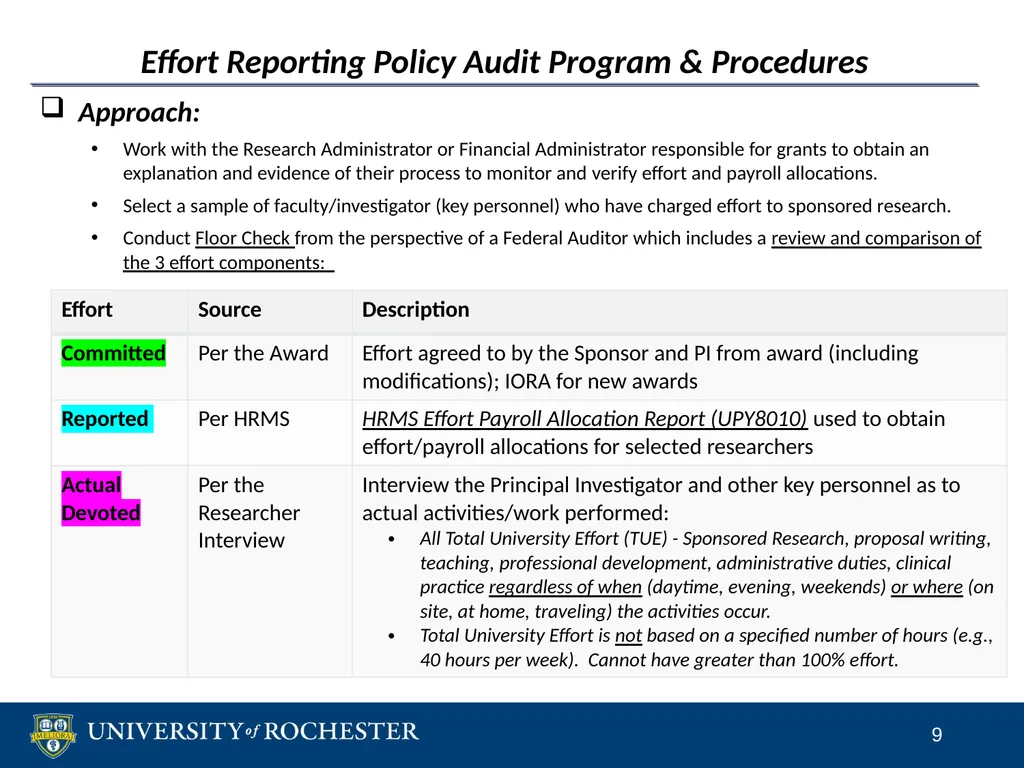
Work with the Research Administrator or Financial Administrator responsible for grants to obtain an explanation and evidence of their process to monitor and verify effort and payroll allocations.
Select a sample of faculty/investigator (key personnel) who have charged effort to sponsored research.
Conduct Floor Check from the perspective of a Federal Auditor which includes a review and comparison of the 3 effort components: Effort Reporting Policy Audit Program & Procedures<br>
Work with the Research Administrator or Financial Administrator responsible for grants to obtain an explanation and evidence of their process to monitor and verify effort and payroll allocations.
Select a sample of faculty/investigator (key personnel) who have charged effort to sponsored research.
Conduct Floor Check from the perspective of a Federal Auditor which includes a review and comparison of the 3 effort components: Effort Reporting Policy Audit Program & Procedures<br>
10
Validate:
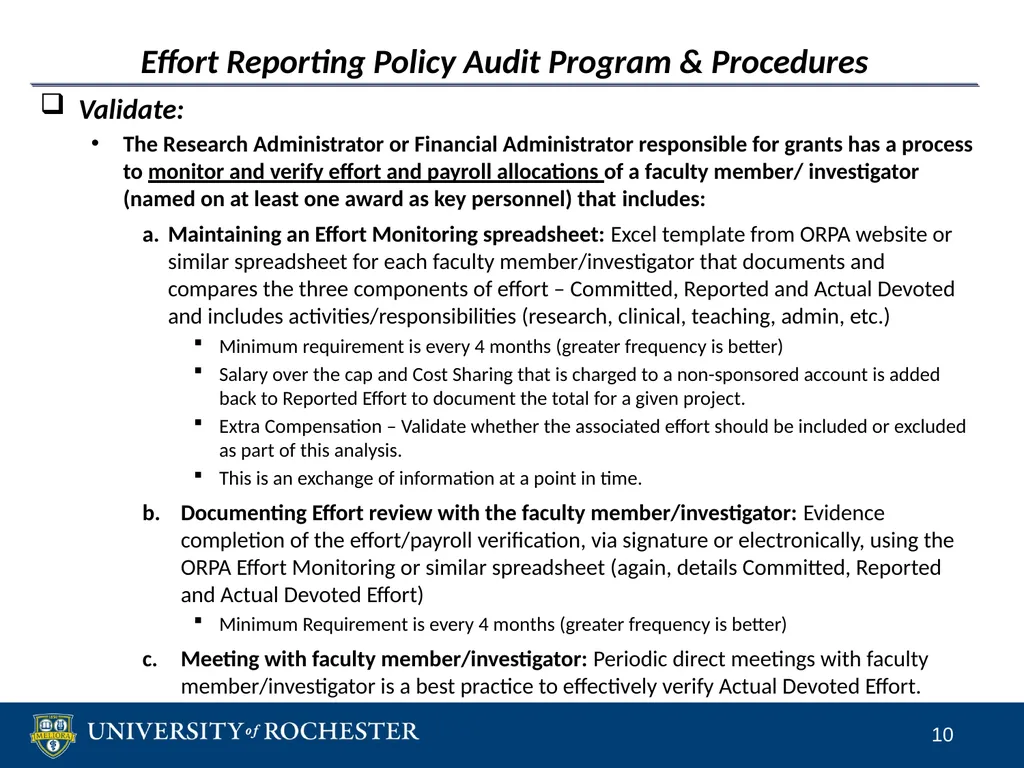
The Research Administrator or Financial Administrator responsible for grants has a process to monitor and verify effort and payroll allocations of a faculty member/ investigator (named on at least one award as key personnel) that includes:
Maintaining an Effort Monitoring spreadsheet: Excel template from ORPA website or similar spreadsheet for each faculty member/investigator that documents and compares the three components of effort – Committed, Reported and Actual Devoted and includes activities/responsibilities (research, clinical, teaching, admin, etc.)
Minimum requirement is every 4 months (greater frequency is better)
Salary over the cap and Cost Sharing that is charged to a non-sponsored account is added back to Reported Effort to document the total for a given project.
Extra Compensation – Validate whether the associated effort should be included or excluded as part of this analysis.
This is an exchange of information at a point in time.
Documenting Effort review with the faculty member/investigator: Evidence completion of the effort/payroll verification, via signature or electronically, using the ORPA Effort Monitoring or similar spreadsheet (again, details Committed, Reported and Actual Devoted Effort)
Minimum Requirement is every 4 months (greater frequency is better)
Meeting with faculty member/investigator: Periodic direct meetings with faculty member/investigator is a best practice to effectively verify Actual Devoted Effort. Effort Reporting Policy Audit Program & Procedures<br>
The Research Administrator or Financial Administrator responsible for grants has a process to monitor and verify effort and payroll allocations of a faculty member/ investigator (named on at least one award as key personnel) that includes:
Maintaining an Effort Monitoring spreadsheet: Excel template from ORPA website or similar spreadsheet for each faculty member/investigator that documents and compares the three components of effort – Committed, Reported and Actual Devoted and includes activities/responsibilities (research, clinical, teaching, admin, etc.)
Minimum requirement is every 4 months (greater frequency is better)
Salary over the cap and Cost Sharing that is charged to a non-sponsored account is added back to Reported Effort to document the total for a given project.
Extra Compensation – Validate whether the associated effort should be included or excluded as part of this analysis.
This is an exchange of information at a point in time.
Documenting Effort review with the faculty member/investigator: Evidence completion of the effort/payroll verification, via signature or electronically, using the ORPA Effort Monitoring or similar spreadsheet (again, details Committed, Reported and Actual Devoted Effort)
Minimum Requirement is every 4 months (greater frequency is better)
Meeting with faculty member/investigator: Periodic direct meetings with faculty member/investigator is a best practice to effectively verify Actual Devoted Effort. Effort Reporting Policy Audit Program & Procedures<br>
11
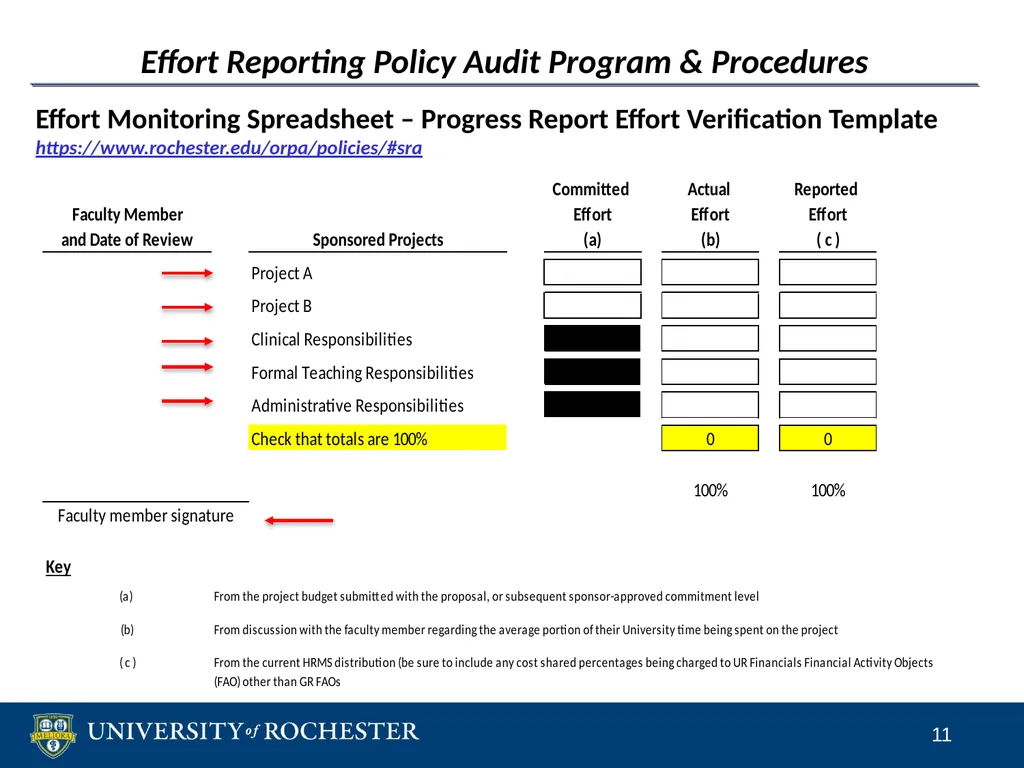
Effort Monitoring Spreadsheet – Progress Report Effort Verification Template
https://www.rochester.edu/orpa/policies/#sra Effort Reporting Policy Audit Program & Procedures<br>
https://www.rochester.edu/orpa/policies/#sra Effort Reporting Policy Audit Program & Procedures<br>
12
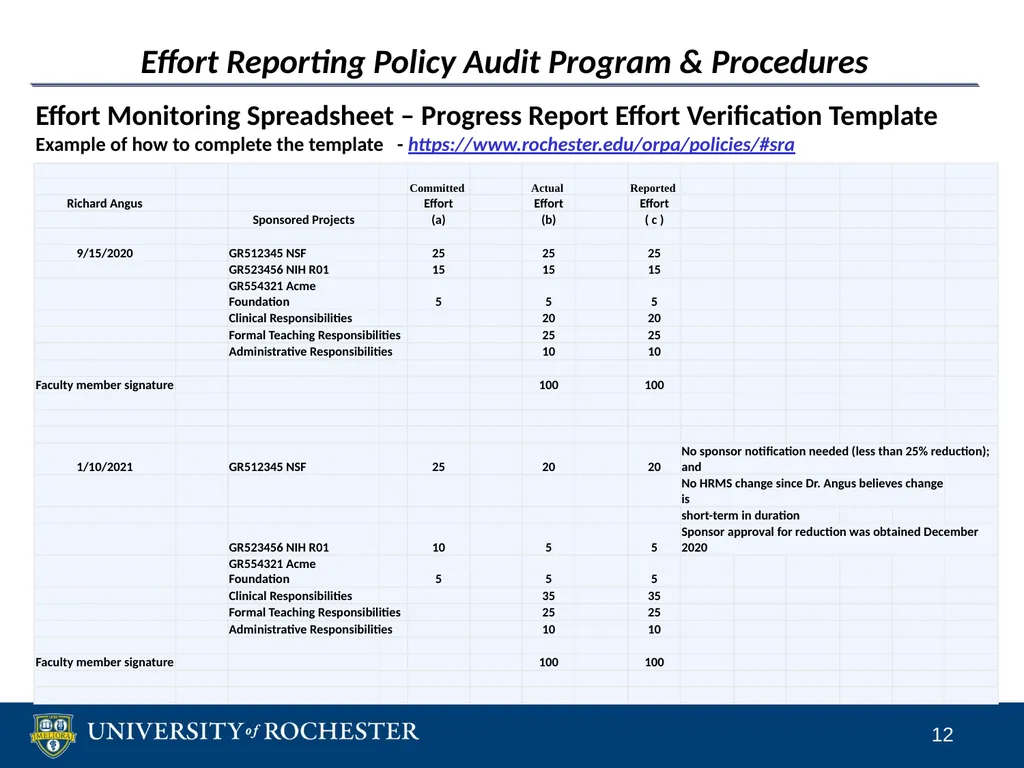
Effort Monitoring Spreadsheet – Progress Report Effort Verification Template
Example of how to complete the template - https://www.rochester.edu/orpa/policies/#sra Effort Reporting Policy Audit Program & Procedures<br>
Example of how to complete the template - https://www.rochester.edu/orpa/policies/#sra Effort Reporting Policy Audit Program & Procedures<br>
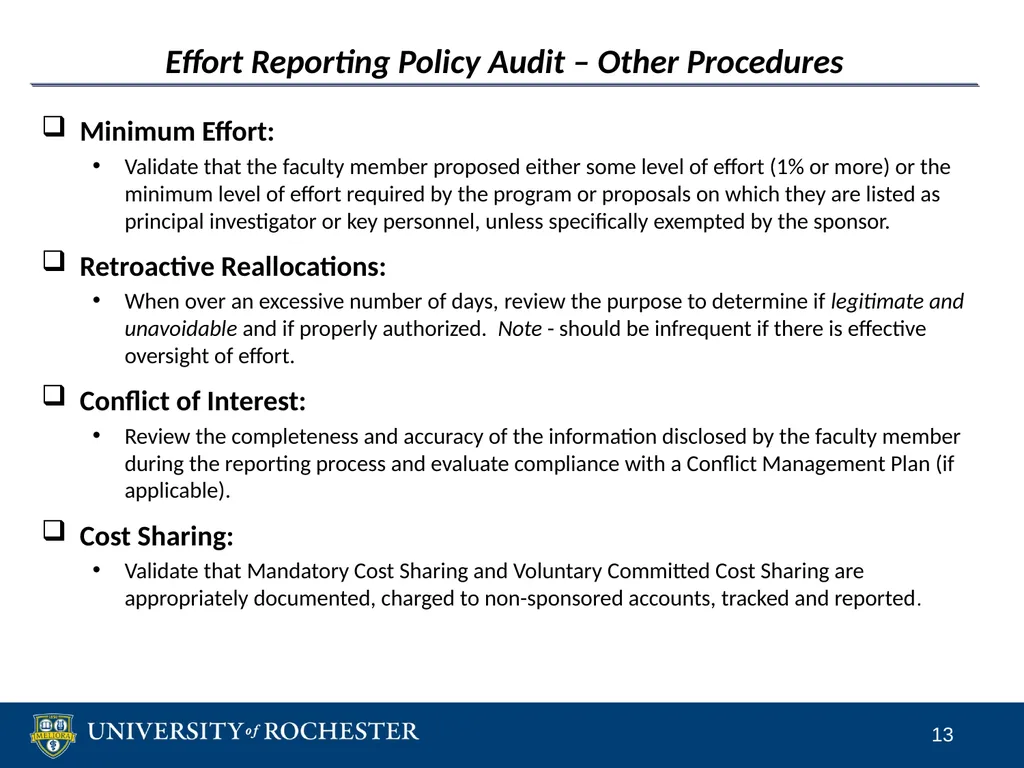
13
Minimum Effort:
Validate that the faculty member proposed either some level of effort (1% or more) or the minimum level of effort required by the program or proposals on which they are listed as principal investigator or key personnel, unless specifically exempted by the sponsor.
Retroactive Reallocations:
When over an excessive number of days, review the purpose to determine if legitimate and unavoidable and if properly authorized. Note - should be infrequent if there is effective oversight of effort.
Conflict of Interest:
Review the completeness and accuracy of the information disclosed by the faculty member during the reporting process and evaluate compliance with a Conflict Management Plan (if applicable).
Cost Sharing:
Validate that Mandatory Cost Sharing and Voluntary Committed Cost Sharing are appropriately documented, charged to non-sponsored accounts, tracked and reported. Effort Reporting Policy Audit – Other Procedures<br>
Validate that the faculty member proposed either some level of effort (1% or more) or the minimum level of effort required by the program or proposals on which they are listed as principal investigator or key personnel, unless specifically exempted by the sponsor.
Retroactive Reallocations:
When over an excessive number of days, review the purpose to determine if legitimate and unavoidable and if properly authorized. Note - should be infrequent if there is effective oversight of effort.
Conflict of Interest:
Review the completeness and accuracy of the information disclosed by the faculty member during the reporting process and evaluate compliance with a Conflict Management Plan (if applicable).
Cost Sharing:
Validate that Mandatory Cost Sharing and Voluntary Committed Cost Sharing are appropriately documented, charged to non-sponsored accounts, tracked and reported. Effort Reporting Policy Audit – Other Procedures<br>
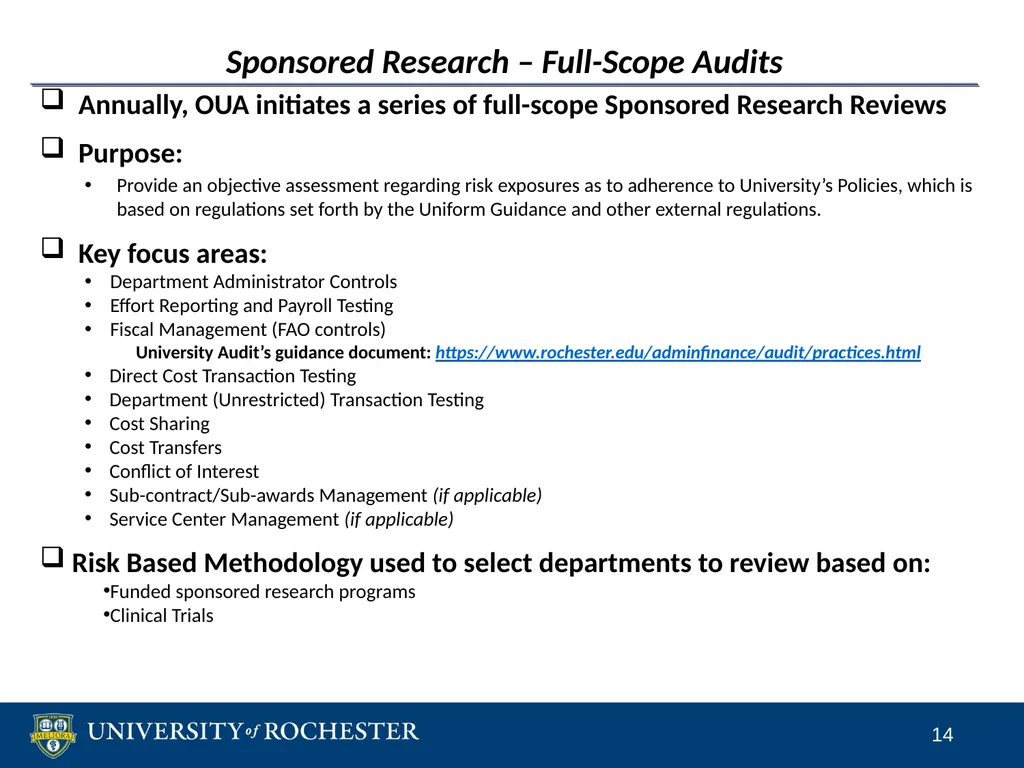
14
Annually, OUA initiates a series of full-scope Sponsored Research Reviews
Purpose:
Provide an objective assessment regarding risk exposures as to adherence to University’s Policies, which is based on regulations set forth by the Uniform Guidance and other external regulations.
Key focus areas:
Department Administrator Controls
Effort Reporting and Payroll Testing
Fiscal Management (FAO controls)
University Audit’s guidance document: https://www.rochester.edu/adminfinance/audit/practices.html
Direct Cost Transaction Testing
Department (Unrestricted) Transaction Testing
Cost Sharing
Cost Transfers
Conflict of Interest
Sub-contract/Sub-awards Management (if applicable)
Service Center Management (if applicable)
Risk Based Methodology used to select departments to review based on:
Funded sponsored research programs
Clinical Trials Sponsored Research – Full-Scope Audits<br>
Purpose:
Provide an objective assessment regarding risk exposures as to adherence to University’s Policies, which is based on regulations set forth by the Uniform Guidance and other external regulations.
Key focus areas:
Department Administrator Controls
Effort Reporting and Payroll Testing
Fiscal Management (FAO controls)
University Audit’s guidance document: https://www.rochester.edu/adminfinance/audit/practices.html
Direct Cost Transaction Testing
Department (Unrestricted) Transaction Testing
Cost Sharing
Cost Transfers
Conflict of Interest
Sub-contract/Sub-awards Management (if applicable)
Service Center Management (if applicable)
Risk Based Methodology used to select departments to review based on:
Funded sponsored research programs
Clinical Trials Sponsored Research – Full-Scope Audits<br>
15
Christopher W. Butler, CPA
Chief Audit Executive, Office of University Audit
University of Rochester, Box 278931, Rochester, NY 14627
Phone: (585) 275-1099; Fax (585) 256-3444
E-Mail: chris.w.butler@rochester.edu
Kimberly A. Davis, MBA (Main Contact)
Senior Internal Auditor
University of Rochester, Box 278931, Rochester, NY 14627
Phone: (585) 275-0671; Fax: (585) 256-3444
E-mail: kdavis56@ur.rochester.edu
Shirley F. Brown, CIA, CISA, MBA, MMM
Audit Manager
University of Rochester, Box 278931, Rochester, NY 14627
Phone: (585) 313-3866; Fax: (585) 256-3444
E-Mail: Shirley.brown@Rochester.edu
Scott M. Lawlor, MBA, CHIAP®
Audit Manager
University of Rochester, Box 278931, Rochester, NY 14627
Phone: (585) 275-8536; Fax: (585) 256-3444
E-mail: scott.lawlor@rochester.edu Sponsored Research University Audit Contacts<br>
Chief Audit Executive, Office of University Audit
University of Rochester, Box 278931, Rochester, NY 14627
Phone: (585) 275-1099; Fax (585) 256-3444
E-Mail: chris.w.butler@rochester.edu
Kimberly A. Davis, MBA (Main Contact)
Senior Internal Auditor
University of Rochester, Box 278931, Rochester, NY 14627
Phone: (585) 275-0671; Fax: (585) 256-3444
E-mail: kdavis56@ur.rochester.edu
Shirley F. Brown, CIA, CISA, MBA, MMM
Audit Manager
University of Rochester, Box 278931, Rochester, NY 14627
Phone: (585) 313-3866; Fax: (585) 256-3444
E-Mail: Shirley.brown@Rochester.edu
Scott M. Lawlor, MBA, CHIAP®
Audit Manager
University of Rochester, Box 278931, Rochester, NY 14627
Phone: (585) 275-8536; Fax: (585) 256-3444
E-mail: scott.lawlor@rochester.edu Sponsored Research University Audit Contacts<br>