
Sponsored Search Auctions 1 2 Traffic estimator
NS
Published · 36 slides · 0 views

1 / 1

Description
Sponsored Search Auctions 1 2 Traffic estimator Sponsored Search Auctions Search advertising is a huge auction market Google ad revenue in 2013: 50.5 billion. Hal Varian, Google Chief Economist Most people dont realize that all that
Related Topics
Share
Embed code
Download this presentation From Below
"Sponsored Search Auctions 1 2 Traffic estimator" is the property of its rightful owner. Permission is granted to download and print the materials on this website for personal, non-commercial use only, and to display it on your personal computer provided you do not modify the materials and that you retain all copyright notices contained in the materials. By downloading content from our website, you accept the terms of this agreement.
Presentation Transcript
01
Sponsored Search Auctions 1<br>
02
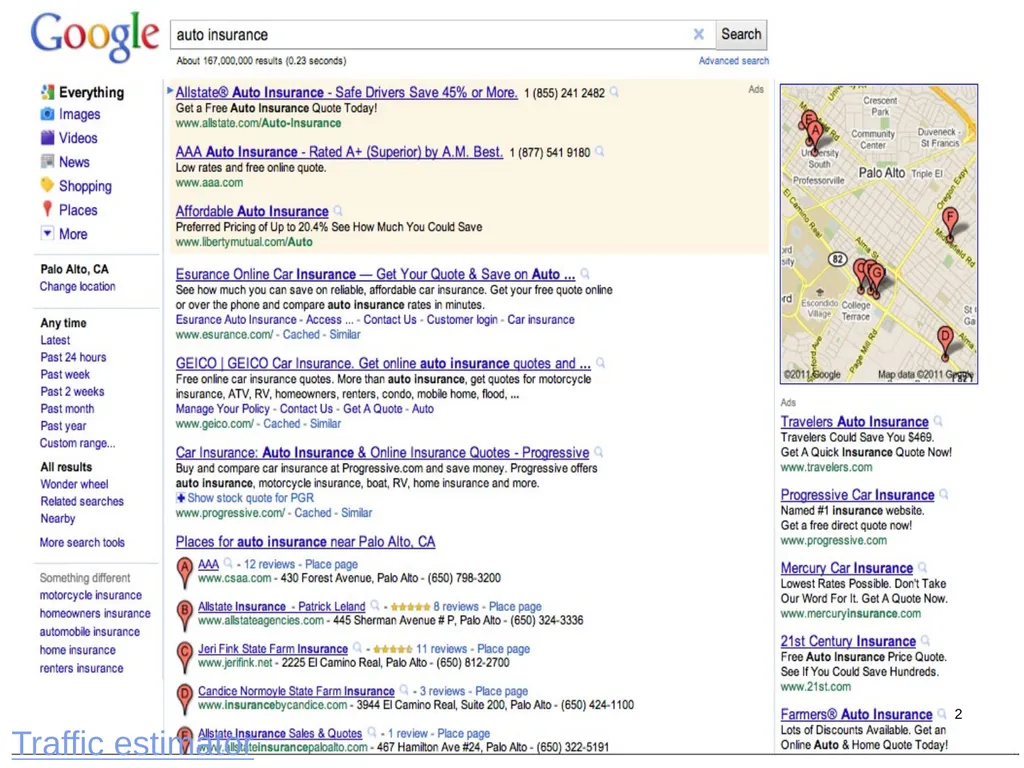
2 Traffic estimator<br>
03
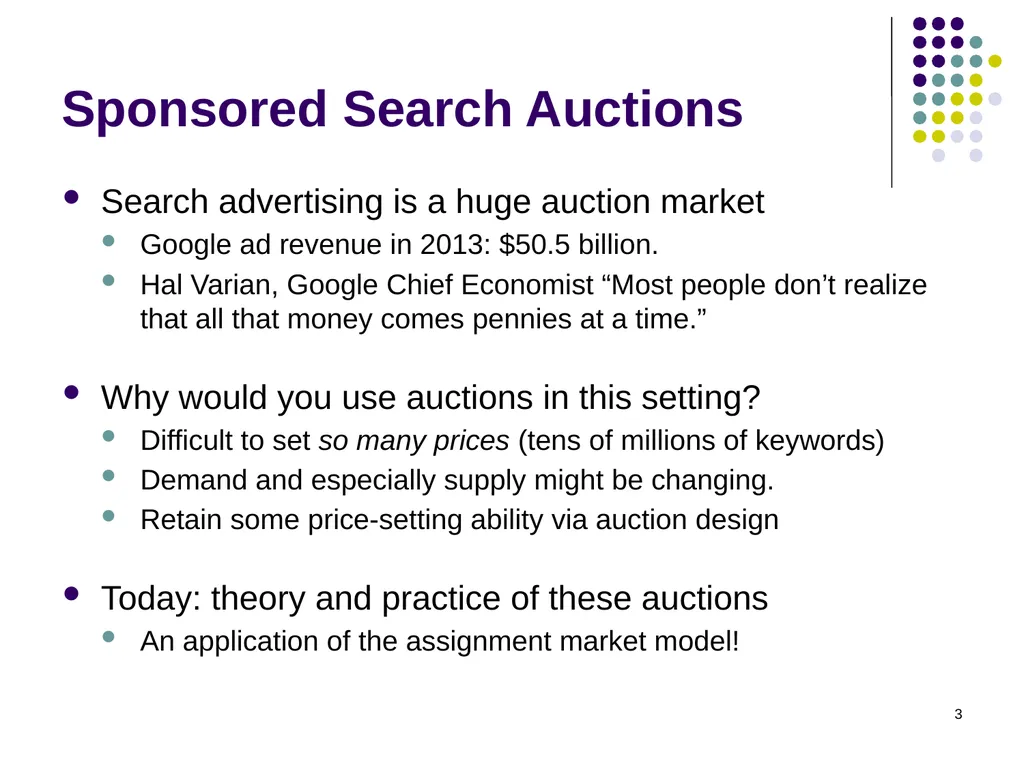
Sponsored Search Auctions Search advertising is a huge auction market
Google ad revenue in 2013: $50.5 billion.
Hal Varian, Google Chief Economist “Most people don’t realize that all that money comes pennies at a time.”
Why would you use auctions in this setting?
Difficult to set so many prices (tens of millions of keywords)
Demand and especially supply might be changing.
Retain some price-setting ability via auction design
Today: theory and practice of these auctions
An application of the assignment market model! 3<br>
Google ad revenue in 2013: $50.5 billion.
Hal Varian, Google Chief Economist “Most people don’t realize that all that money comes pennies at a time.”
Why would you use auctions in this setting?
Difficult to set so many prices (tens of millions of keywords)
Demand and especially supply might be changing.
Retain some price-setting ability via auction design
Today: theory and practice of these auctions
An application of the assignment market model! 3<br>
04
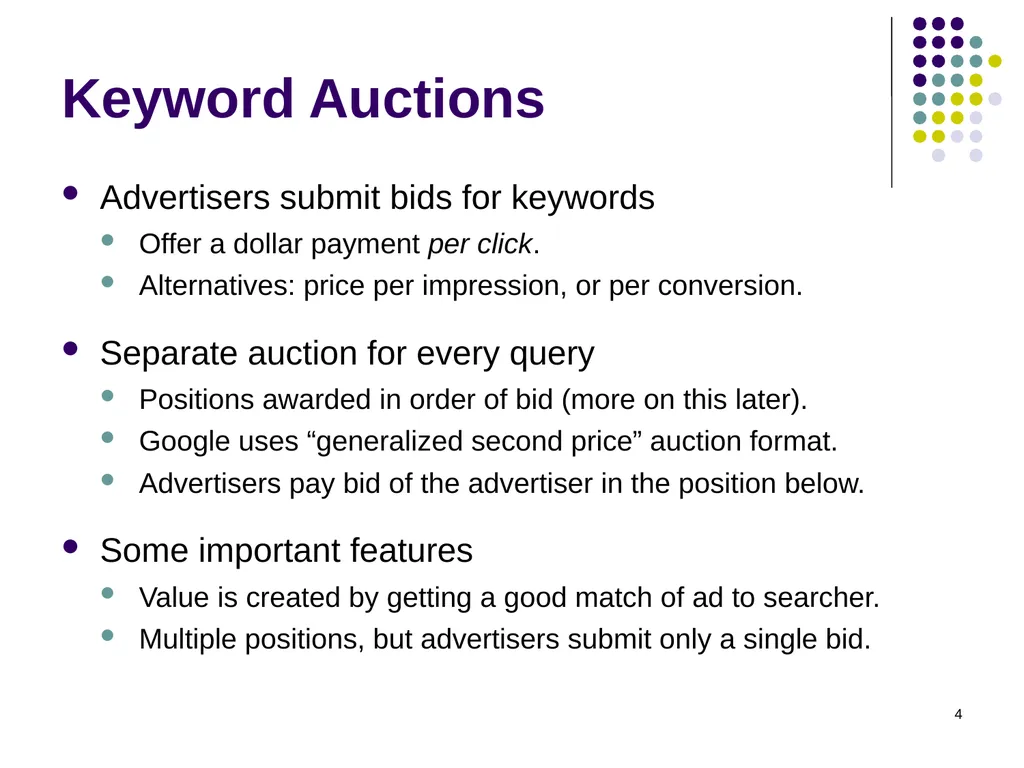
Keyword Auctions Advertisers submit bids for keywords
Offer a dollar payment per click.
Alternatives: price per impression, or per conversion.
Separate auction for every query
Positions awarded in order of bid (more on this later).
Google uses “generalized second price” auction format.
Advertisers pay bid of the advertiser in the position below.
Some important features
Value is created by getting a good match of ad to searcher.
Multiple positions, but advertisers submit only a single bid. 4<br>
Offer a dollar payment per click.
Alternatives: price per impression, or per conversion.
Separate auction for every query
Positions awarded in order of bid (more on this later).
Google uses “generalized second price” auction format.
Advertisers pay bid of the advertiser in the position below.
Some important features
Value is created by getting a good match of ad to searcher.
Multiple positions, but advertisers submit only a single bid. 4<br>
05
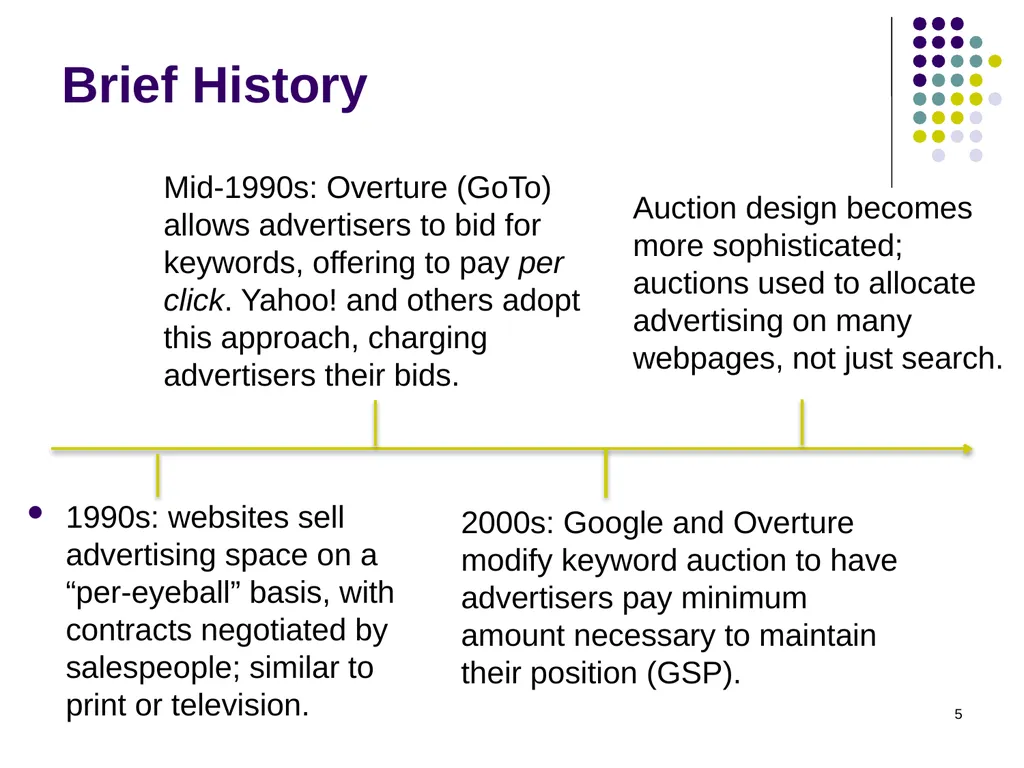
Brief History 1990s: websites sell advertising space on a “per-eyeball” basis, with contracts negotiated by salespeople; similar to print or television. Mid-1990s: Overture (GoTo) allows advertisers to bid for keywords, offering to pay per click. Yahoo! and others adopt this approach, charging advertisers their bids. 2000s: Google and Overture modify keyword auction to have advertisers pay minimum amount necessary to maintain their position (GSP). Auction design becomes more sophisticated; auctions used to allocate advertising on many webpages, not just search. 5<br>
06
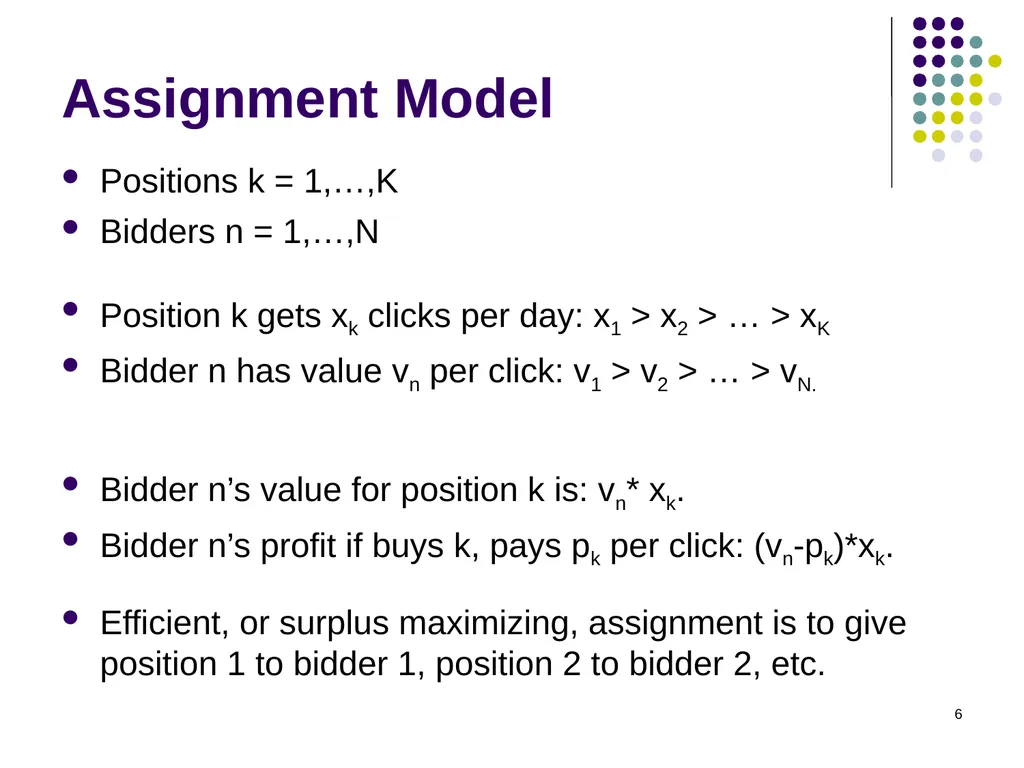
Assignment Model Positions k = 1,…,K
Bidders n = 1,…,N
Position k gets xk clicks per day: x1 > x2 > … > xK
Bidder n has value vn per click: v1 > v2 > … > vN.
Bidder n’s value for position k is: vn* xk.
Bidder n’s profit if buys k, pays pk per click: (vn-pk)*xk.
Efficient, or surplus maximizing, assignment is to give position 1 to bidder 1, position 2 to bidder 2, etc. 6<br>
Bidders n = 1,…,N
Position k gets xk clicks per day: x1 > x2 > … > xK
Bidder n has value vn per click: v1 > v2 > … > vN.
Bidder n’s value for position k is: vn* xk.
Bidder n’s profit if buys k, pays pk per click: (vn-pk)*xk.
Efficient, or surplus maximizing, assignment is to give position 1 to bidder 1, position 2 to bidder 2, etc. 6<br>
07
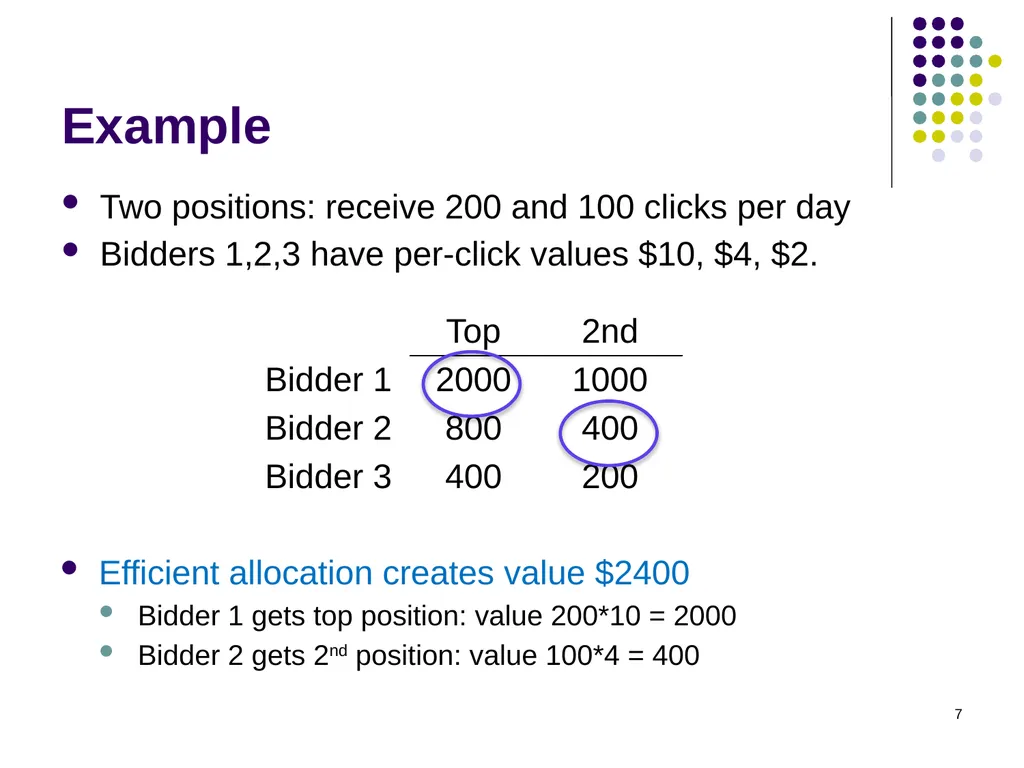
Example Two positions: receive 200 and 100 clicks per day
Bidders 1,2,3 have per-click values $10, $4, $2. Efficient allocation creates value $2400
Bidder 1 gets top position: value 200*10 = 2000
Bidder 2 gets 2nd position: value 100*4 = 400 7<br>
Bidders 1,2,3 have per-click values $10, $4, $2. Efficient allocation creates value $2400
Bidder 1 gets top position: value 200*10 = 2000
Bidder 2 gets 2nd position: value 100*4 = 400 7<br>
08
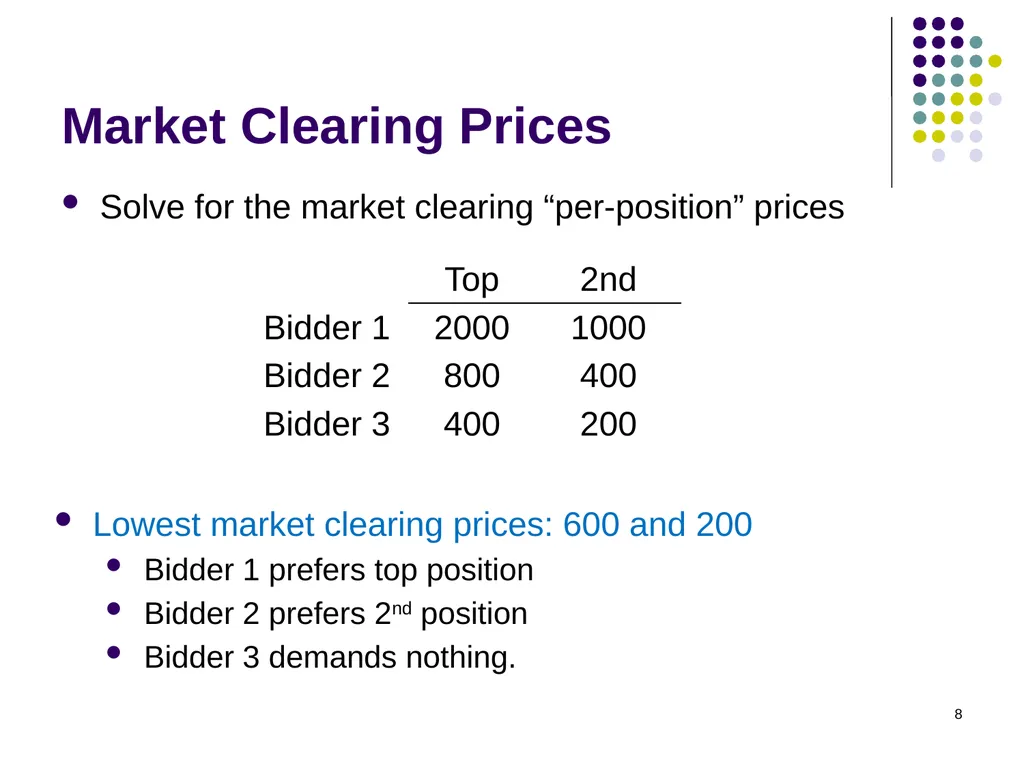
Market Clearing Prices Solve for the market clearing “per-position” prices Lowest market clearing prices: 600 and 200
Bidder 1 prefers top position
Bidder 2 prefers 2nd position
Bidder 3 demands nothing. 8<br>
Bidder 1 prefers top position
Bidder 2 prefers 2nd position
Bidder 3 demands nothing. 8<br>
09
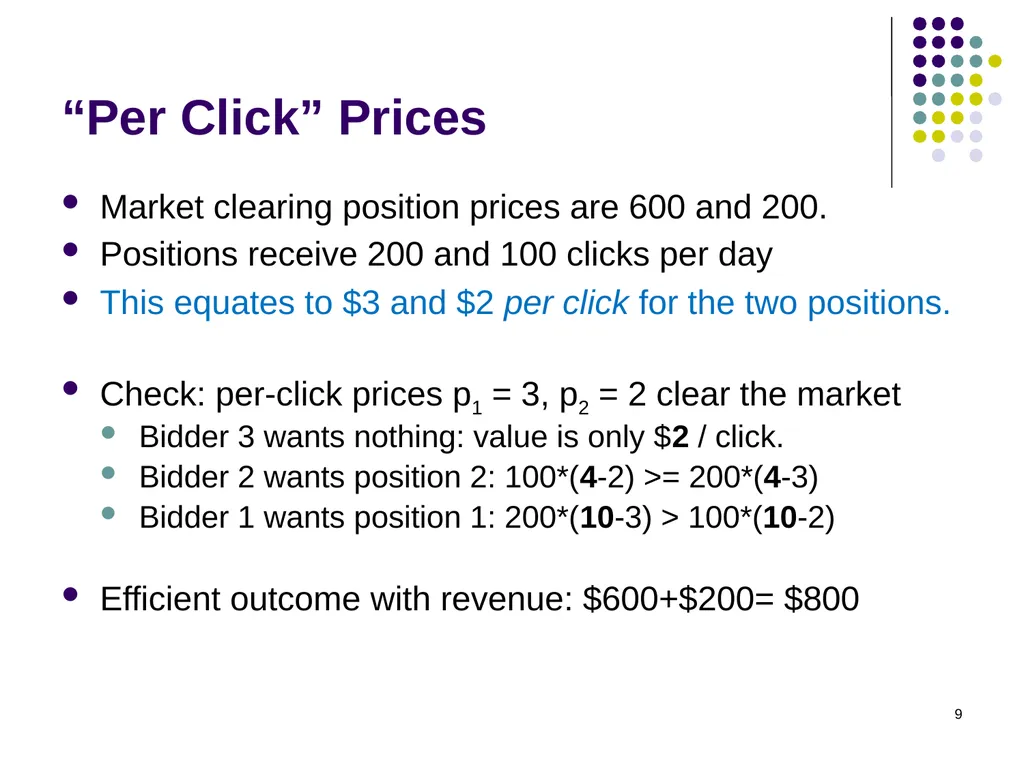
“Per Click” Prices Market clearing position prices are 600 and 200.
Positions receive 200 and 100 clicks per day
This equates to $3 and $2 per click for the two positions.
Check: per-click prices p1 = 3, p2 = 2 clear the market
Bidder 3 wants nothing: value is only $2 / click.
Bidder 2 wants position 2: 100*(4-2) >= 200*(4-3)
Bidder 1 wants position 1: 200*(10-3) > 100*(10-2)
Efficient outcome with revenue: $600+$200= $800 9<br>
Positions receive 200 and 100 clicks per day
This equates to $3 and $2 per click for the two positions.
Check: per-click prices p1 = 3, p2 = 2 clear the market
Bidder 3 wants nothing: value is only $2 / click.
Bidder 2 wants position 2: 100*(4-2) >= 200*(4-3)
Bidder 1 wants position 1: 200*(10-3) > 100*(10-2)
Efficient outcome with revenue: $600+$200= $800 9<br>
10
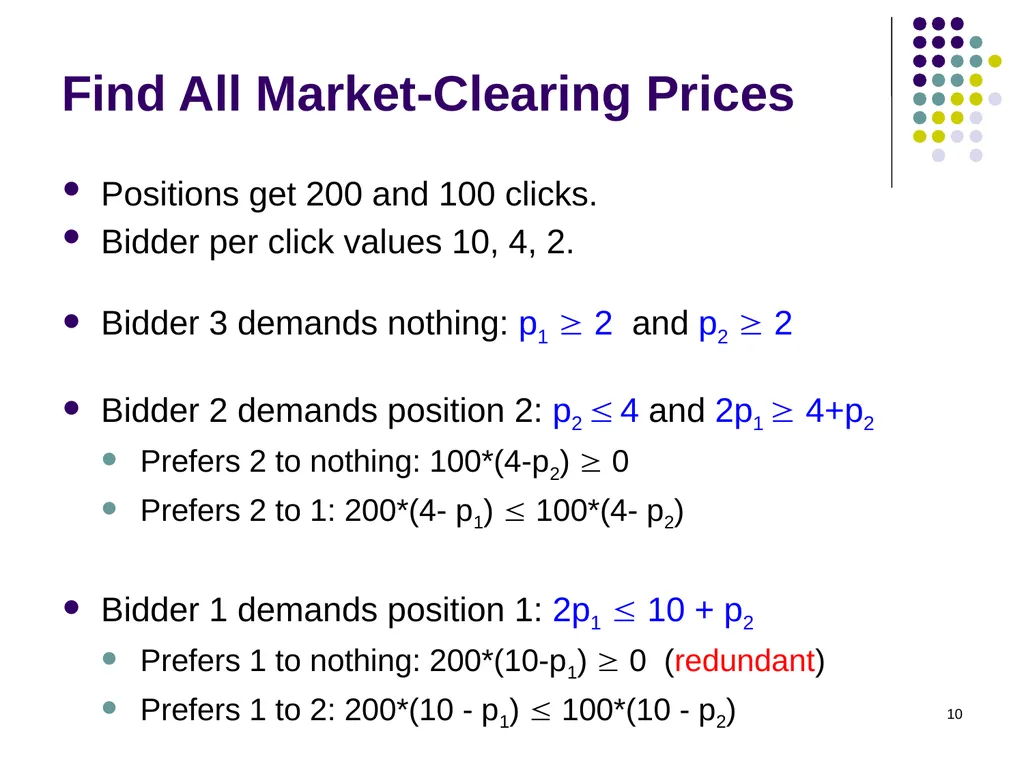
Find All Market-Clearing Prices Positions get 200 and 100 clicks.
Bidder per click values 10, 4, 2.
Bidder 3 demands nothing: p1 2 and p2 2
Bidder 2 demands position 2: p2 4 and 2p1 4+p2
Prefers 2 to nothing: 100*(4-p2) 0
Prefers 2 to 1: 200*(4- p1) 100*(4- p2)
Bidder 1 demands position 1: 2p1 10 + p2
Prefers 1 to nothing: 200*(10-p1) 0 (redundant)
Prefers 1 to 2: 200*(10 - p1) 100*(10 - p2) 10<br>
Bidder per click values 10, 4, 2.
Bidder 3 demands nothing: p1 2 and p2 2
Bidder 2 demands position 2: p2 4 and 2p1 4+p2
Prefers 2 to nothing: 100*(4-p2) 0
Prefers 2 to 1: 200*(4- p1) 100*(4- p2)
Bidder 1 demands position 1: 2p1 10 + p2
Prefers 1 to nothing: 200*(10-p1) 0 (redundant)
Prefers 1 to 2: 200*(10 - p1) 100*(10 - p2) 10<br>
11
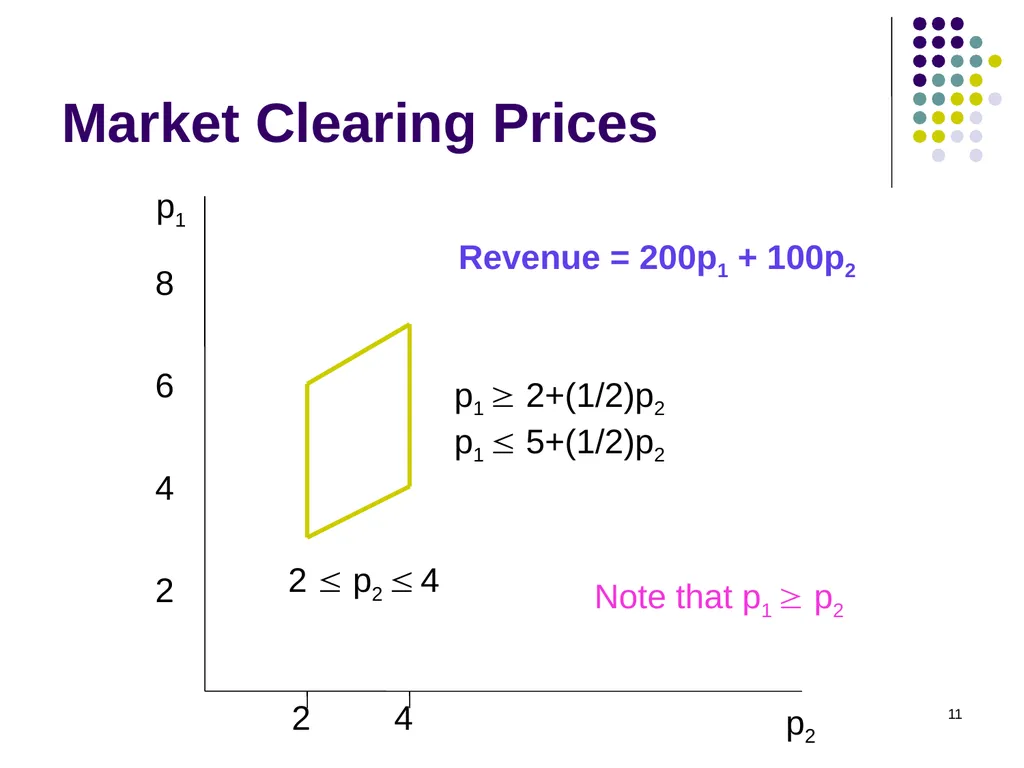
Market Clearing Prices p2 p1 2 4 4 8 6 2 Revenue = 200p1 + 100p2 2 p2 4 p1 2+(1/2)p2
p1 5+(1/2)p2 11 Note that p1 p2<br>
p1 5+(1/2)p2 11 Note that p1 p2<br>
12
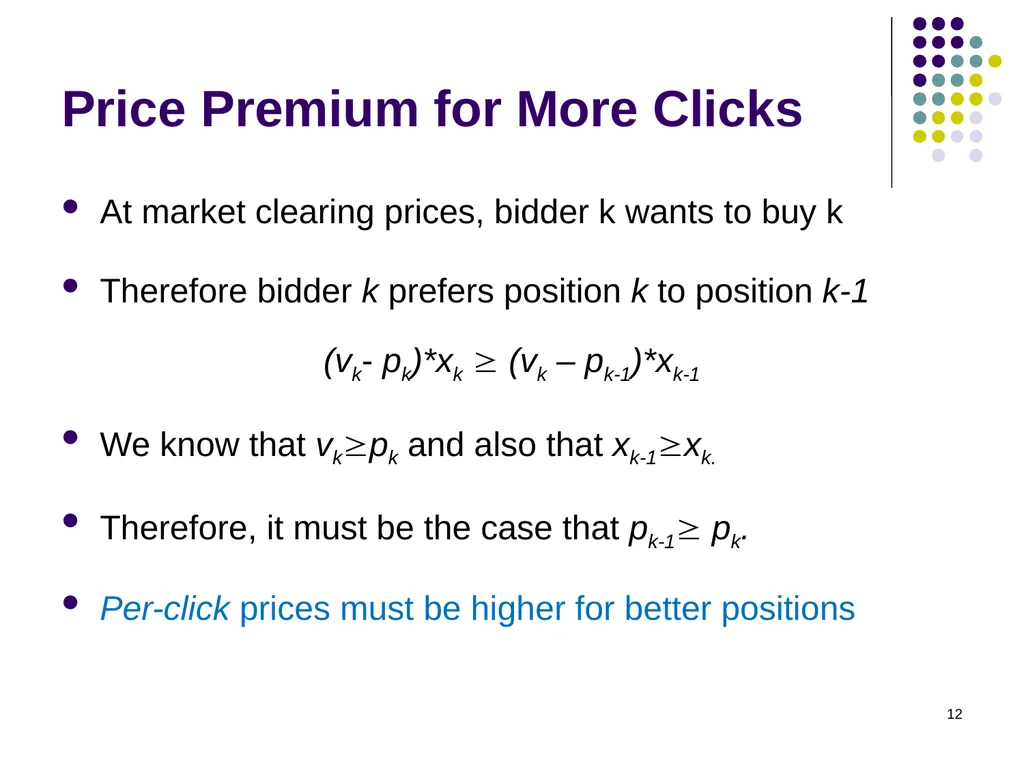
Price Premium for More Clicks At market clearing prices, bidder k wants to buy k
Therefore bidder k prefers position k to position k-1
(vk- pk)*xk (vk – pk-1)*xk-1
We know that vkpk and also that xk-1xk.
Therefore, it must be the case that pk-1 pk.
Per-click prices must be higher for better positions 12<br>
Therefore bidder k prefers position k to position k-1
(vk- pk)*xk (vk – pk-1)*xk-1
We know that vkpk and also that xk-1xk.
Therefore, it must be the case that pk-1 pk.
Per-click prices must be higher for better positions 12<br>
13
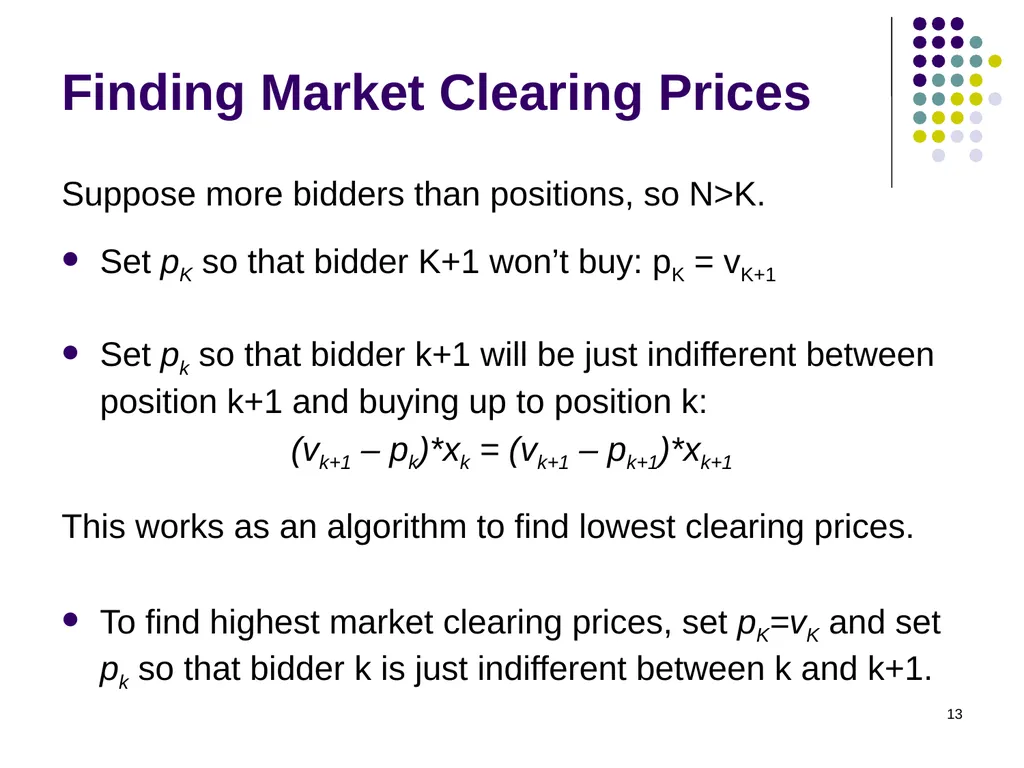
Finding Market Clearing Prices Suppose more bidders than positions, so N>K.
Set pK so that bidder K+1 won’t buy: pK = vK+1
Set pk so that bidder k+1 will be just indifferent between position k+1 and buying up to position k:
(vk+1 – pk)*xk = (vk+1 – pk+1)*xk+1
This works as an algorithm to find lowest clearing prices.
To find highest market clearing prices, set pK=vK and set pk so that bidder k is just indifferent between k and k+1. 13<br>
Set pK so that bidder K+1 won’t buy: pK = vK+1
Set pk so that bidder k+1 will be just indifferent between position k+1 and buying up to position k:
(vk+1 – pk)*xk = (vk+1 – pk+1)*xk+1
This works as an algorithm to find lowest clearing prices.
To find highest market clearing prices, set pK=vK and set pk so that bidder k is just indifferent between k and k+1. 13<br>
14
Sponsored Search Auctions Can we design an auction to find market clearing prices?
The auctions we studied before for the assignment market require relatively complex bids (each bidder must bid separately for each of the K positions or items).
Ideally want to use the structure of the problem to design a simpler auction. We’ll consider several options. 14<br>
The auctions we studied before for the assignment market require relatively complex bids (each bidder must bid separately for each of the K positions or items).
Ideally want to use the structure of the problem to design a simpler auction. We’ll consider several options. 14<br>
15
Pay-As-Bid Auction Overture “Pay-as-Bid” Auction
Each bidder submits a single bid (in $ per click)
Top bid gets position 1, second bid position 2, etc.
Bidders pay their bid for each click they get. 15<br>
Each bidder submits a single bid (in $ per click)
Top bid gets position 1, second bid position 2, etc.
Bidders pay their bid for each click they get. 15<br>
16
Example: Pay-as-Bid Two positions: receive 200 and 100 clicks per day
Bidders 1,2,3 have per-click values $10, $4, $2.
Overture auction (pay as bid)
Bidder 3 will offer up to $2 per click
Bidder 2 has to bid $2.01 to get second slot
Bidder 1 wants to bid $2.02 to get top slot.
But then bidder 2 wants to top this, and so on.
Pay as bid auction is unstable! 16<br>
Bidders 1,2,3 have per-click values $10, $4, $2.
Overture auction (pay as bid)
Bidder 3 will offer up to $2 per click
Bidder 2 has to bid $2.01 to get second slot
Bidder 1 wants to bid $2.02 to get top slot.
But then bidder 2 wants to top this, and so on.
Pay as bid auction is unstable! 16<br>
17
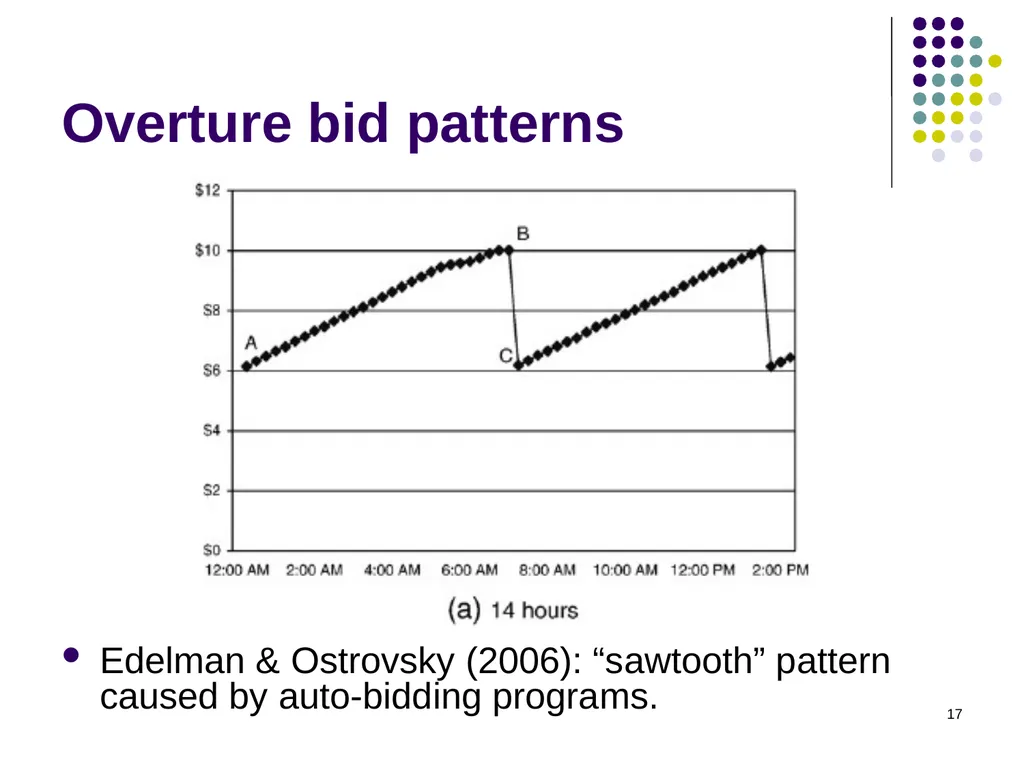
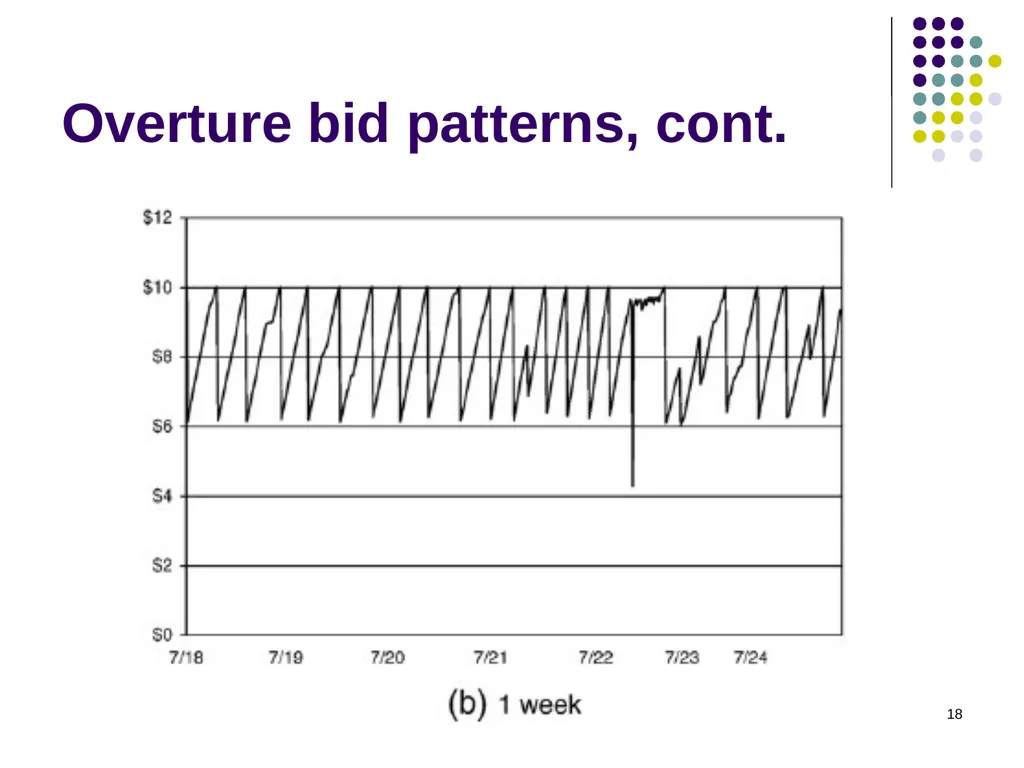
Overture bid patterns Edelman & Ostrovsky (2006): “sawtooth” pattern caused by auto-bidding programs. 17<br>
18
Overture bid patterns, cont. 18<br>
19
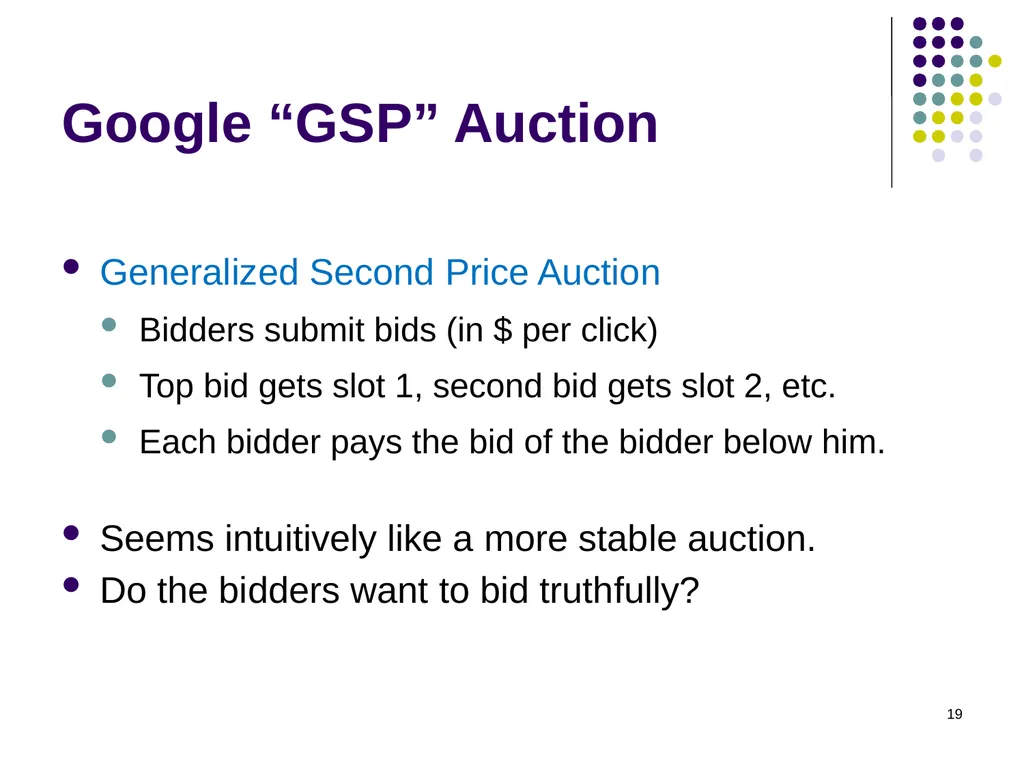
Google “GSP” Auction Generalized Second Price Auction
Bidders submit bids (in $ per click)
Top bid gets slot 1, second bid gets slot 2, etc.
Each bidder pays the bid of the bidder below him.
Seems intuitively like a more stable auction.
Do the bidders want to bid truthfully? 19<br>
Bidders submit bids (in $ per click)
Top bid gets slot 1, second bid gets slot 2, etc.
Each bidder pays the bid of the bidder below him.
Seems intuitively like a more stable auction.
Do the bidders want to bid truthfully? 19<br>
20
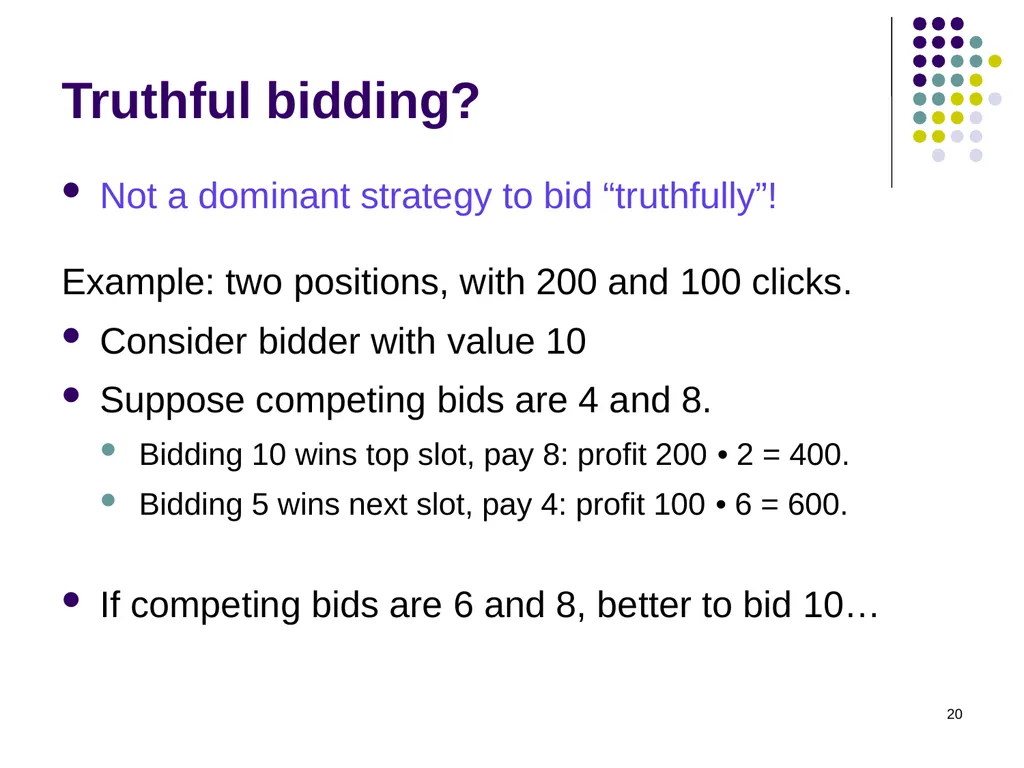
Truthful bidding? Not a dominant strategy to bid “truthfully”!
Example: two positions, with 200 and 100 clicks.
Consider bidder with value 10
Suppose competing bids are 4 and 8.
Bidding 10 wins top slot, pay 8: profit 200 • 2 = 400.
Bidding 5 wins next slot, pay 4: profit 100 • 6 = 600.
If competing bids are 6 and 8, better to bid 10… 20<br>
Example: two positions, with 200 and 100 clicks.
Consider bidder with value 10
Suppose competing bids are 4 and 8.
Bidding 10 wins top slot, pay 8: profit 200 • 2 = 400.
Bidding 5 wins next slot, pay 4: profit 100 • 6 = 600.
If competing bids are 6 and 8, better to bid 10… 20<br>
21
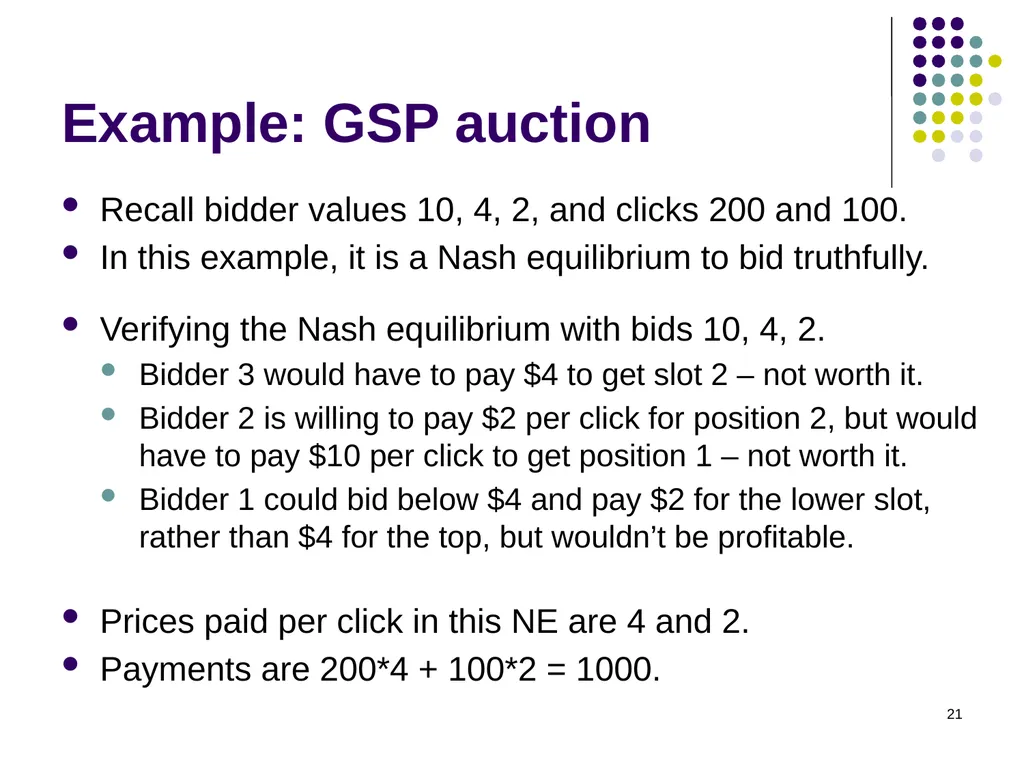
Example: GSP auction Recall bidder values 10, 4, 2, and clicks 200 and 100.
In this example, it is a Nash equilibrium to bid truthfully.
Verifying the Nash equilibrium with bids 10, 4, 2.
Bidder 3 would have to pay $4 to get slot 2 – not worth it.
Bidder 2 is willing to pay $2 per click for position 2, but would have to pay $10 per click to get position 1 – not worth it.
Bidder 1 could bid below $4 and pay $2 for the lower slot, rather than $4 for the top, but wouldn’t be profitable.
Prices paid per click in this NE are 4 and 2.
Payments are 200*4 + 100*2 = 1000. 21<br>
In this example, it is a Nash equilibrium to bid truthfully.
Verifying the Nash equilibrium with bids 10, 4, 2.
Bidder 3 would have to pay $4 to get slot 2 – not worth it.
Bidder 2 is willing to pay $2 per click for position 2, but would have to pay $10 per click to get position 1 – not worth it.
Bidder 1 could bid below $4 and pay $2 for the lower slot, rather than $4 for the top, but wouldn’t be profitable.
Prices paid per click in this NE are 4 and 2.
Payments are 200*4 + 100*2 = 1000. 21<br>
22
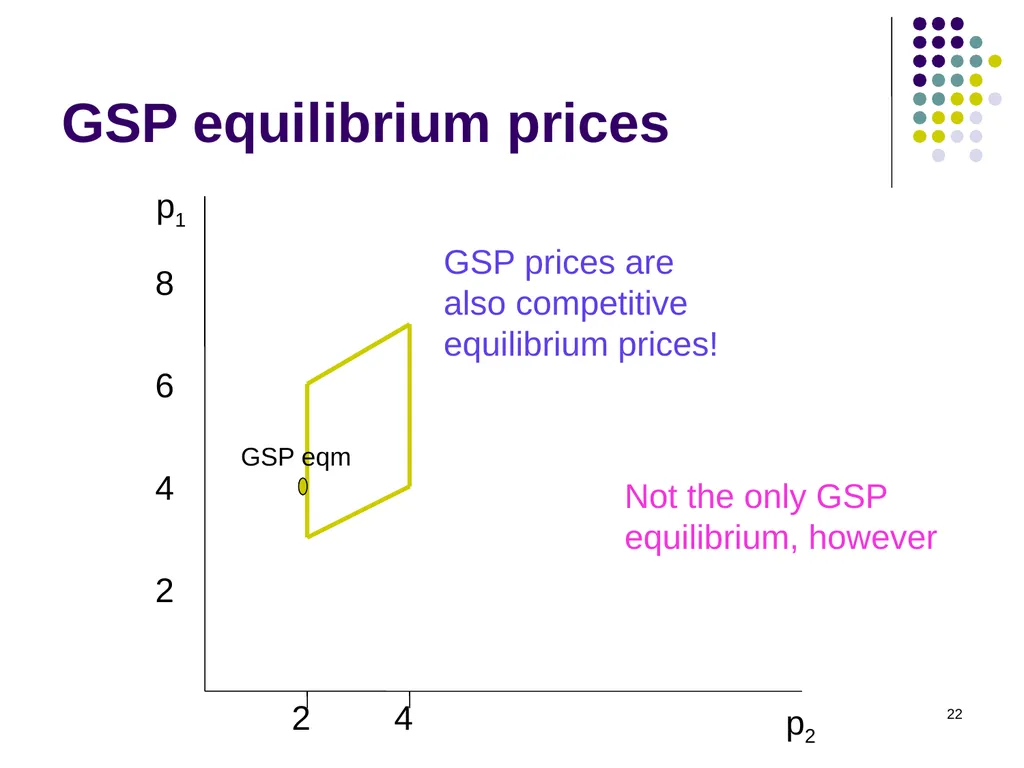
GSP equilibrium prices p2 p1 2 4 4 8 6 2 GSP prices are
also competitive
equilibrium prices! GSP eqm Not the only GSP
equilibrium, however 22<br>
also competitive
equilibrium prices! GSP eqm Not the only GSP
equilibrium, however 22<br>
23
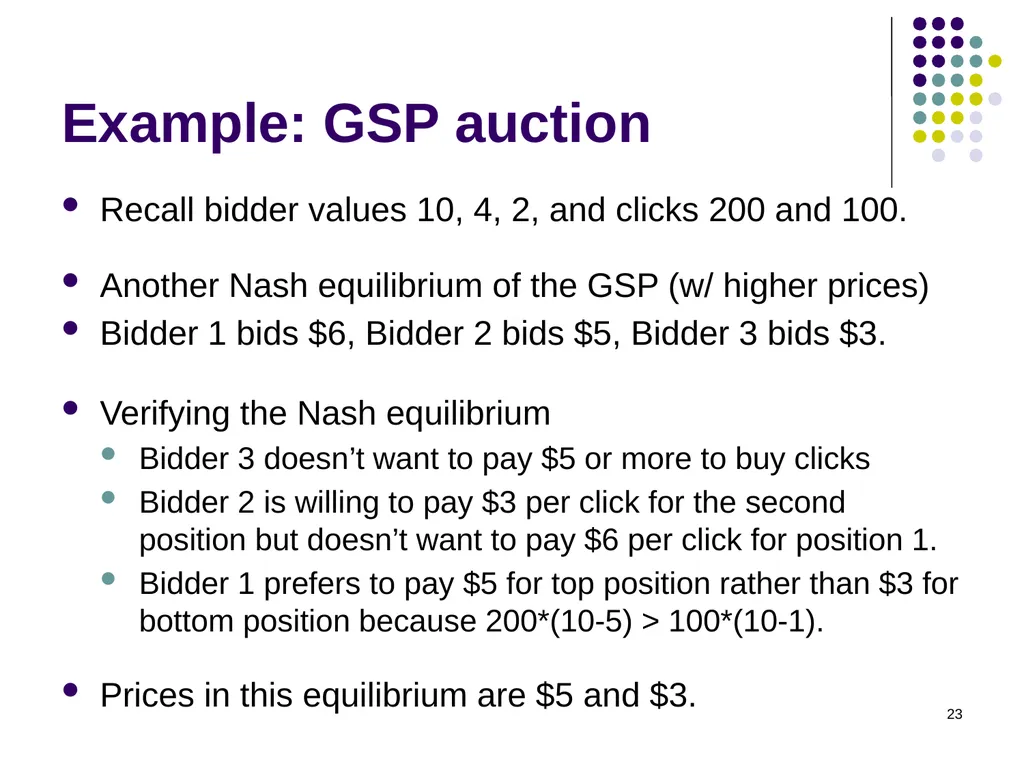
Example: GSP auction Recall bidder values 10, 4, 2, and clicks 200 and 100.
Another Nash equilibrium of the GSP (w/ higher prices)
Bidder 1 bids $6, Bidder 2 bids $5, Bidder 3 bids $3.
Verifying the Nash equilibrium
Bidder 3 doesn’t want to pay $5 or more to buy clicks
Bidder 2 is willing to pay $3 per click for the second position but doesn’t want to pay $6 per click for position 1.
Bidder 1 prefers to pay $5 for top position rather than $3 for bottom position because 200*(10-5) > 100*(10-1).
Prices in this equilibrium are $5 and $3. 23<br>
Another Nash equilibrium of the GSP (w/ higher prices)
Bidder 1 bids $6, Bidder 2 bids $5, Bidder 3 bids $3.
Verifying the Nash equilibrium
Bidder 3 doesn’t want to pay $5 or more to buy clicks
Bidder 2 is willing to pay $3 per click for the second position but doesn’t want to pay $6 per click for position 1.
Bidder 1 prefers to pay $5 for top position rather than $3 for bottom position because 200*(10-5) > 100*(10-1).
Prices in this equilibrium are $5 and $3. 23<br>
24
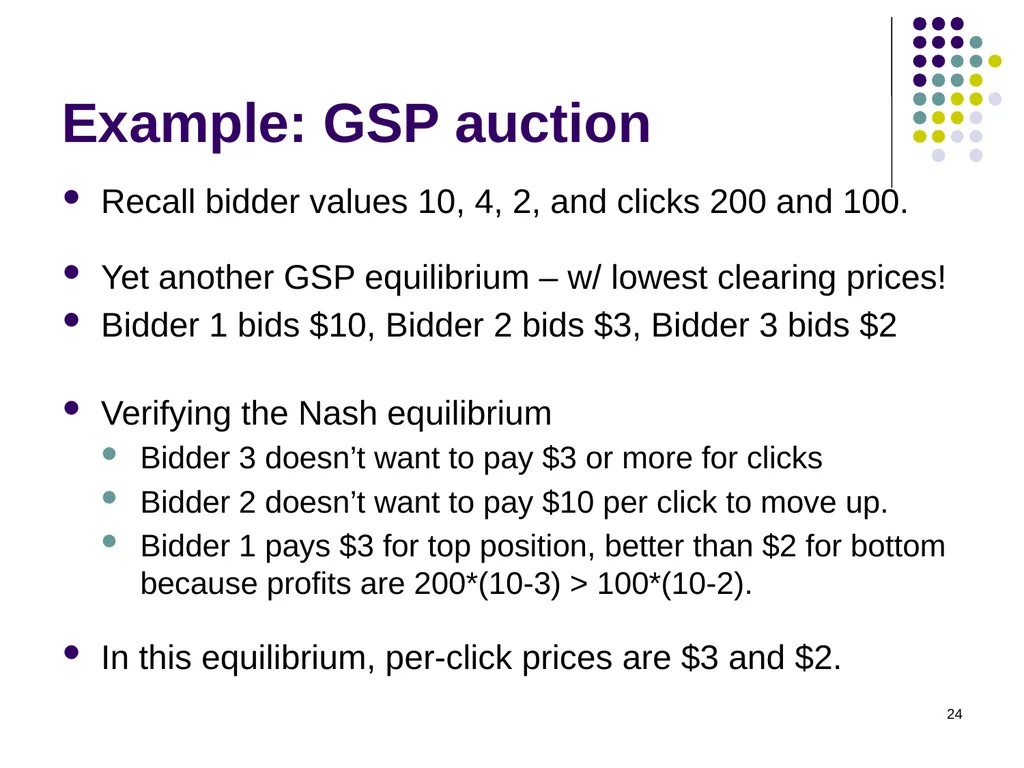
Example: GSP auction Recall bidder values 10, 4, 2, and clicks 200 and 100.
Yet another GSP equilibrium – w/ lowest clearing prices!
Bidder 1 bids $10, Bidder 2 bids $3, Bidder 3 bids $2
Verifying the Nash equilibrium
Bidder 3 doesn’t want to pay $3 or more for clicks
Bidder 2 doesn’t want to pay $10 per click to move up.
Bidder 1 pays $3 for top position, better than $2 for bottom because profits are 200*(10-3) > 100*(10-2).
In this equilibrium, per-click prices are $3 and $2. 24<br>
Yet another GSP equilibrium – w/ lowest clearing prices!
Bidder 1 bids $10, Bidder 2 bids $3, Bidder 3 bids $2
Verifying the Nash equilibrium
Bidder 3 doesn’t want to pay $3 or more for clicks
Bidder 2 doesn’t want to pay $10 per click to move up.
Bidder 1 pays $3 for top position, better than $2 for bottom because profits are 200*(10-3) > 100*(10-2).
In this equilibrium, per-click prices are $3 and $2. 24<br>
25
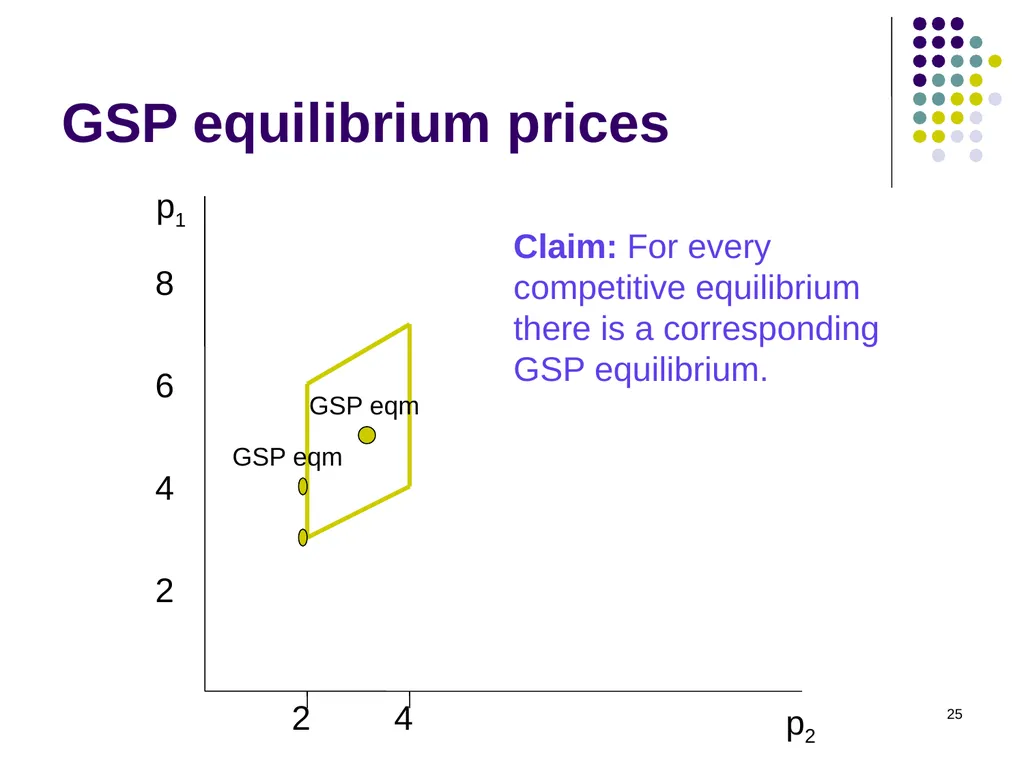
GSP equilibrium prices p2 p1 2 4 4 8 6 2 GSP eqm GSP eqm Claim: For every competitive equilibrium there is a corresponding GSP equilibrium. 25<br>
26
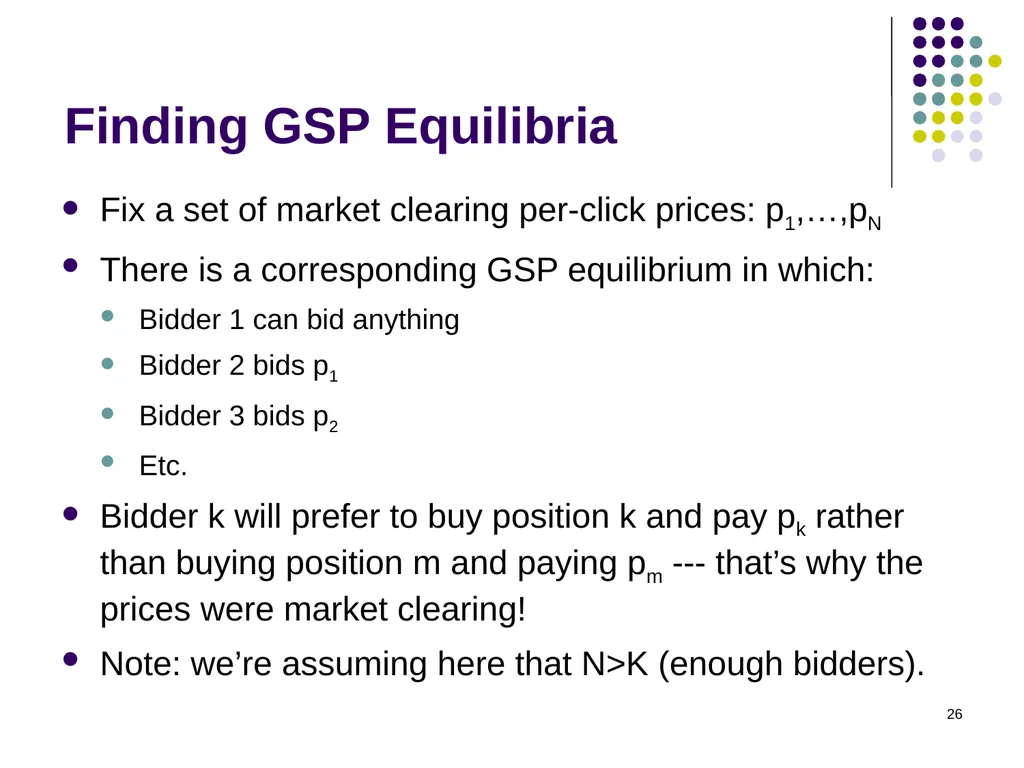
Finding GSP Equilibria Fix a set of market clearing per-click prices: p1,…,pN
There is a corresponding GSP equilibrium in which:
Bidder 1 can bid anything
Bidder 2 bids p1
Bidder 3 bids p2
Etc.
Bidder k will prefer to buy position k and pay pk rather than buying position m and paying pm --- that’s why the prices were market clearing!
Note: we’re assuming here that N>K (enough bidders). 26<br>
There is a corresponding GSP equilibrium in which:
Bidder 1 can bid anything
Bidder 2 bids p1
Bidder 3 bids p2
Etc.
Bidder k will prefer to buy position k and pay pk rather than buying position m and paying pm --- that’s why the prices were market clearing!
Note: we’re assuming here that N>K (enough bidders). 26<br>
27
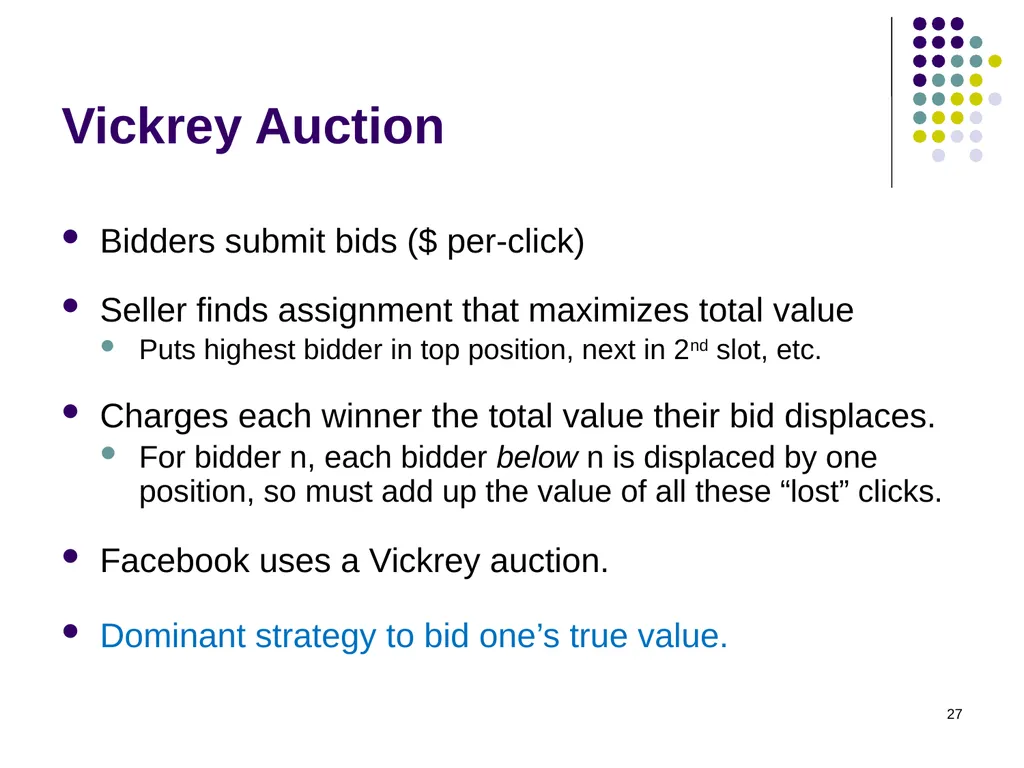
Vickrey Auction Bidders submit bids ($ per-click)
Seller finds assignment that maximizes total value
Puts highest bidder in top position, next in 2nd slot, etc.
Charges each winner the total value their bid displaces.
For bidder n, each bidder below n is displaced by one position, so must add up the value of all these “lost” clicks.
Facebook uses a Vickrey auction.
Dominant strategy to bid one’s true value. 27<br>
Seller finds assignment that maximizes total value
Puts highest bidder in top position, next in 2nd slot, etc.
Charges each winner the total value their bid displaces.
For bidder n, each bidder below n is displaced by one position, so must add up the value of all these “lost” clicks.
Facebook uses a Vickrey auction.
Dominant strategy to bid one’s true value. 27<br>
28
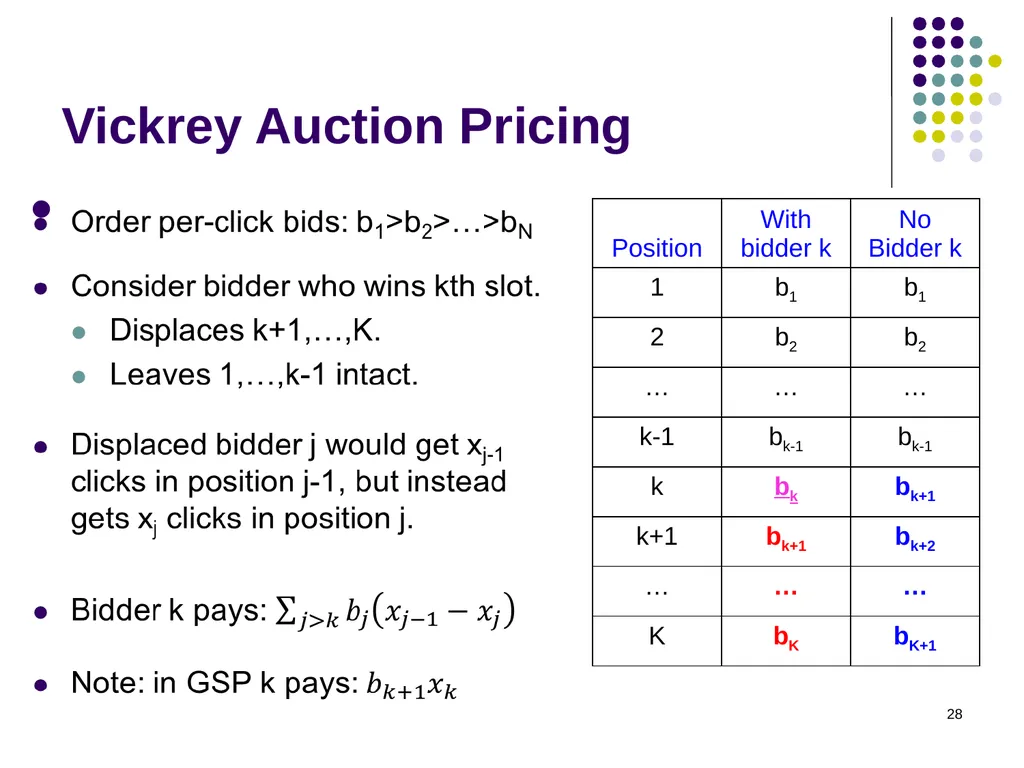
Vickrey Auction Pricing 28<br>
29
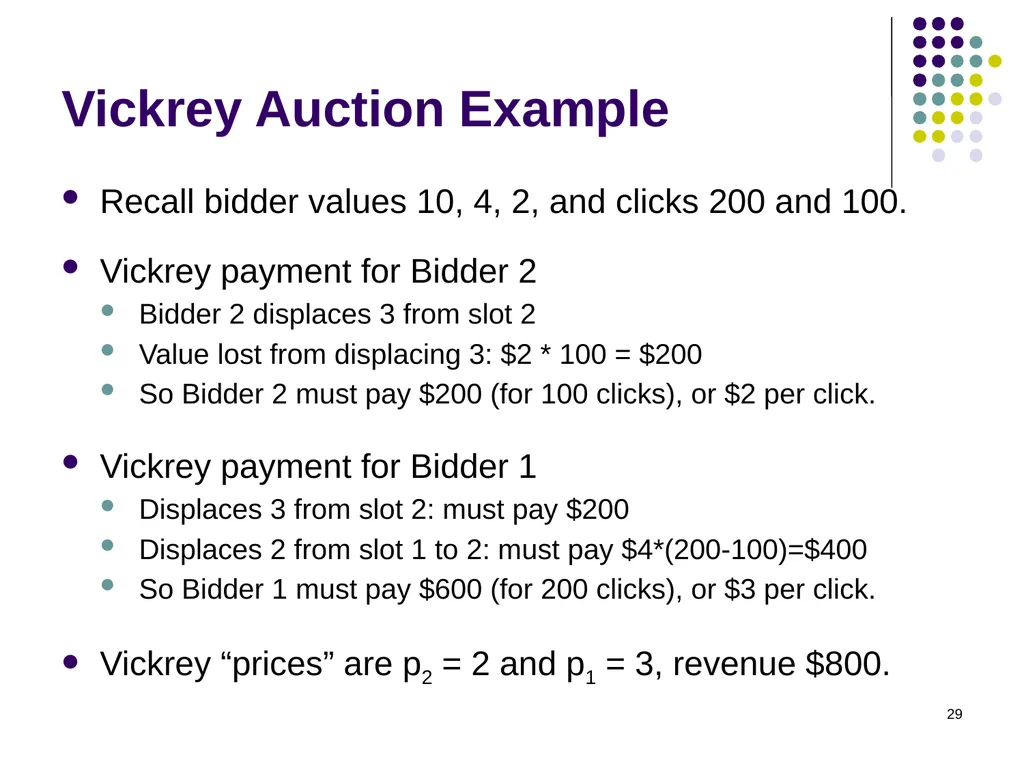
Vickrey Auction Example Recall bidder values 10, 4, 2, and clicks 200 and 100.
Vickrey payment for Bidder 2
Bidder 2 displaces 3 from slot 2
Value lost from displacing 3: $2 * 100 = $200
So Bidder 2 must pay $200 (for 100 clicks), or $2 per click.
Vickrey payment for Bidder 1
Displaces 3 from slot 2: must pay $200
Displaces 2 from slot 1 to 2: must pay $4*(200-100)=$400
So Bidder 1 must pay $600 (for 200 clicks), or $3 per click.
Vickrey “prices” are p2 = 2 and p1 = 3, revenue $800. 29<br>
Vickrey payment for Bidder 2
Bidder 2 displaces 3 from slot 2
Value lost from displacing 3: $2 * 100 = $200
So Bidder 2 must pay $200 (for 100 clicks), or $2 per click.
Vickrey payment for Bidder 1
Displaces 3 from slot 2: must pay $200
Displaces 2 from slot 1 to 2: must pay $4*(200-100)=$400
So Bidder 1 must pay $600 (for 200 clicks), or $3 per click.
Vickrey “prices” are p2 = 2 and p1 = 3, revenue $800. 29<br>
30
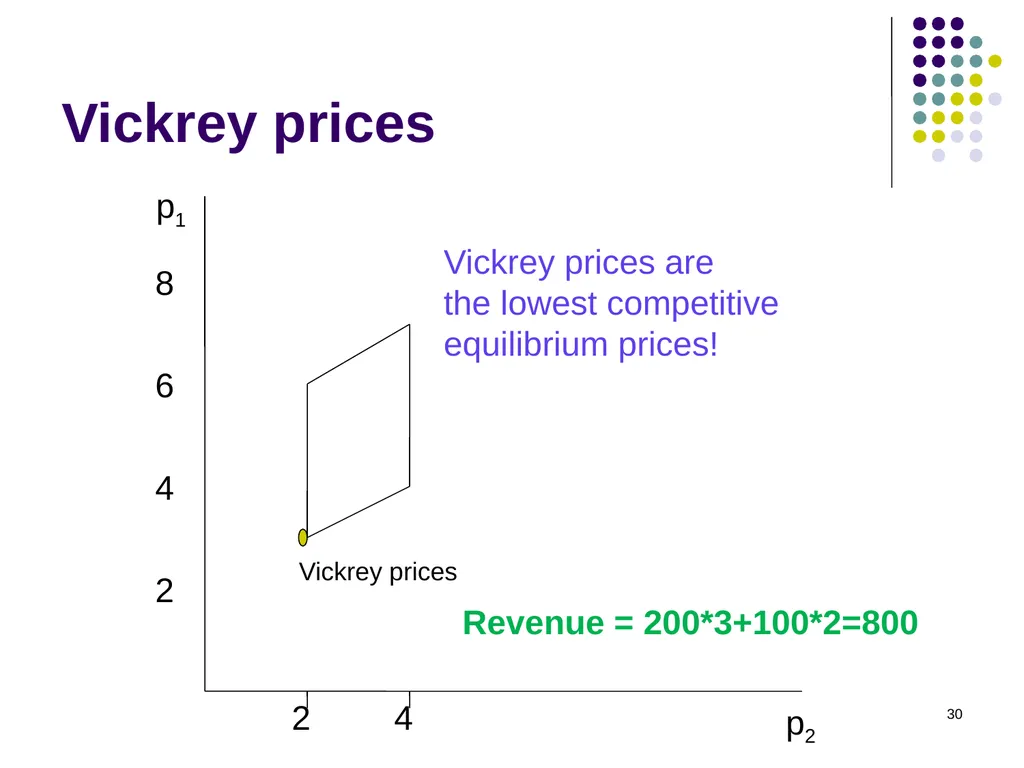
Vickrey prices p2 p1 2 4 4 8 6 2 Vickrey prices are
the lowest competitive
equilibrium prices! Vickrey prices Revenue = 200*3+100*2=800 30<br>
the lowest competitive
equilibrium prices! Vickrey prices Revenue = 200*3+100*2=800 30<br>
31
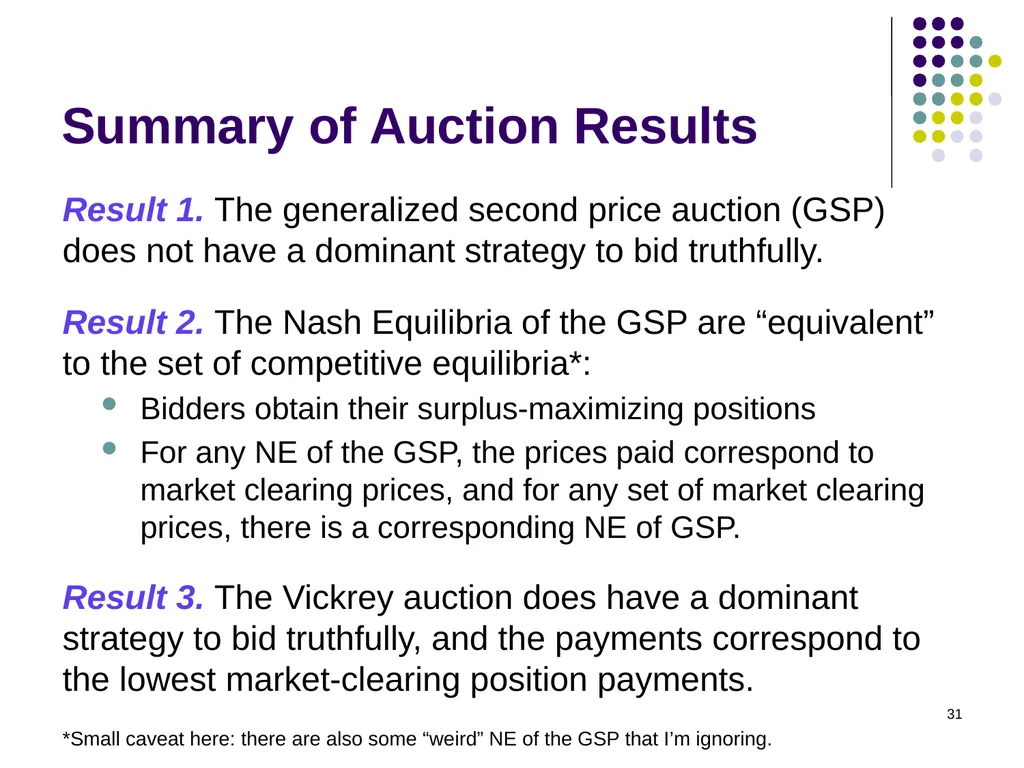
Summary of Auction Results Result 1. The generalized second price auction (GSP) does not have a dominant strategy to bid truthfully.
Result 2. The Nash Equilibria of the GSP are “equivalent” to the set of competitive equilibria*:
Bidders obtain their surplus-maximizing positions
For any NE of the GSP, the prices paid correspond to market clearing prices, and for any set of market clearing prices, there is a corresponding NE of GSP.
Result 3. The Vickrey auction does have a dominant strategy to bid truthfully, and the payments correspond to the lowest market-clearing position payments.
*Small caveat here: there are also some “weird” NE of the GSP that I’m ignoring. 31<br>
Result 2. The Nash Equilibria of the GSP are “equivalent” to the set of competitive equilibria*:
Bidders obtain their surplus-maximizing positions
For any NE of the GSP, the prices paid correspond to market clearing prices, and for any set of market clearing prices, there is a corresponding NE of GSP.
Result 3. The Vickrey auction does have a dominant strategy to bid truthfully, and the payments correspond to the lowest market-clearing position payments.
*Small caveat here: there are also some “weird” NE of the GSP that I’m ignoring. 31<br>
32
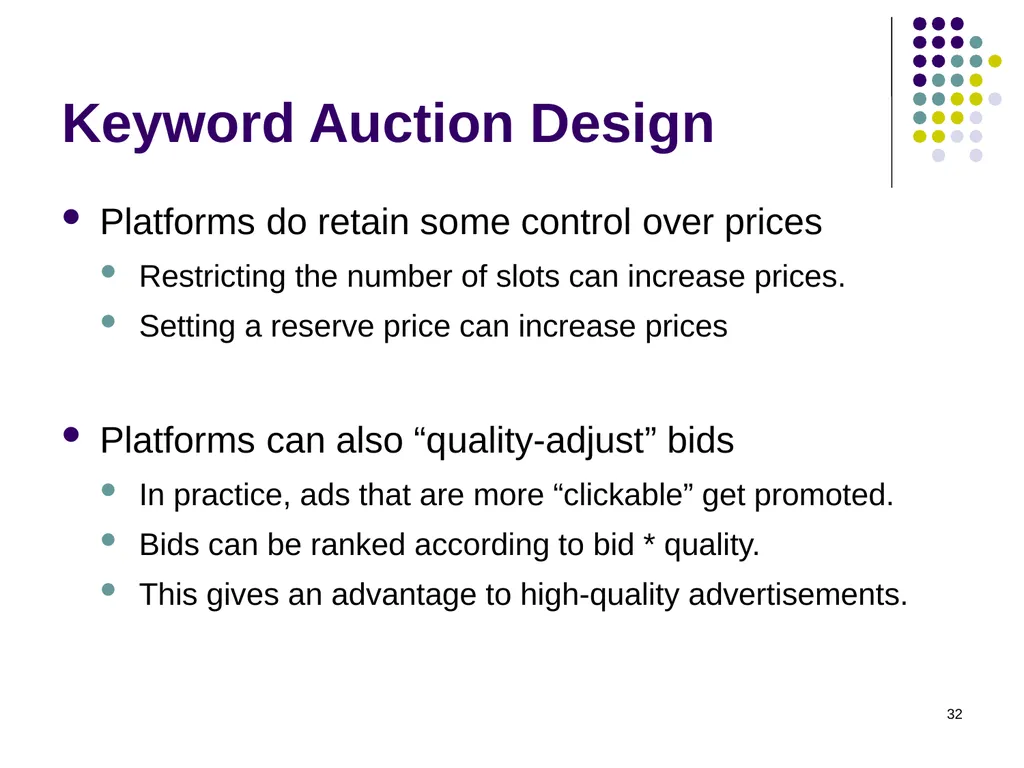
Keyword Auction Design Platforms do retain some control over prices
Restricting the number of slots can increase prices.
Setting a reserve price can increase prices
Platforms can also “quality-adjust” bids
In practice, ads that are more “clickable” get promoted.
Bids can be ranked according to bid * quality.
This gives an advantage to high-quality advertisements. 32<br>
Restricting the number of slots can increase prices.
Setting a reserve price can increase prices
Platforms can also “quality-adjust” bids
In practice, ads that are more “clickable” get promoted.
Bids can be ranked according to bid * quality.
This gives an advantage to high-quality advertisements. 32<br>
33
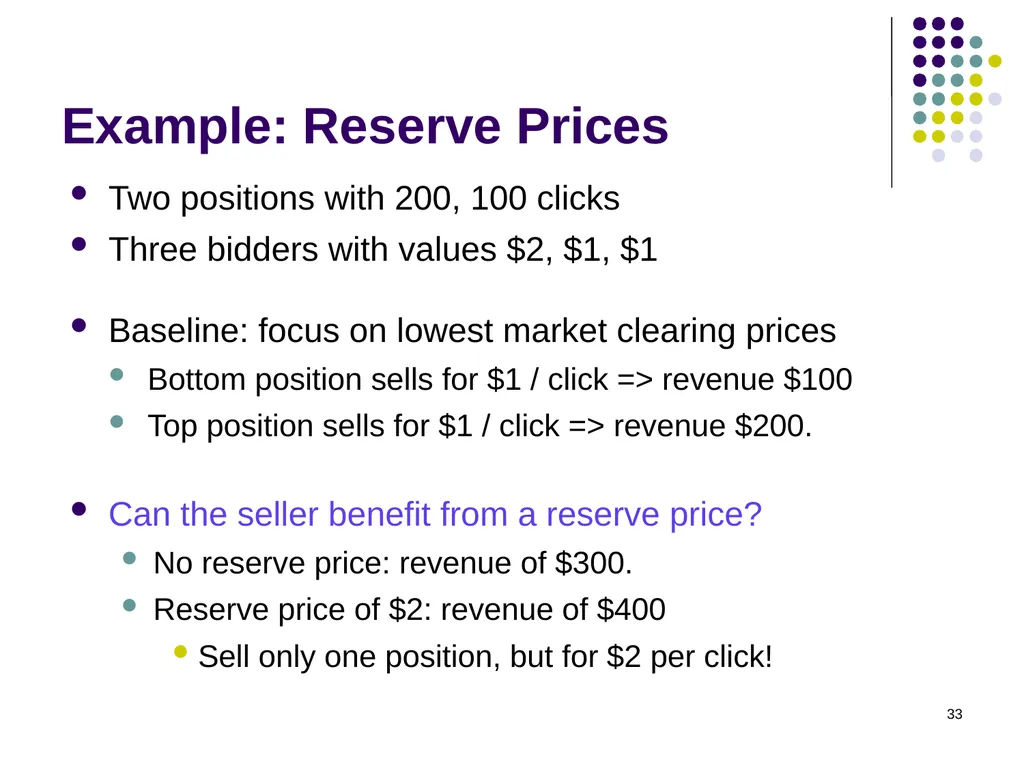
Example: Reserve Prices Two positions with 200, 100 clicks
Three bidders with values $2, $1, $1
Baseline: focus on lowest market clearing prices
Bottom position sells for $1 / click => revenue $100
Top position sells for $1 / click => revenue $200.
Can the seller benefit from a reserve price?
No reserve price: revenue of $300.
Reserve price of $2: revenue of $400
Sell only one position, but for $2 per click! 33<br>
Three bidders with values $2, $1, $1
Baseline: focus on lowest market clearing prices
Bottom position sells for $1 / click => revenue $100
Top position sells for $1 / click => revenue $200.
Can the seller benefit from a reserve price?
No reserve price: revenue of $300.
Reserve price of $2: revenue of $400
Sell only one position, but for $2 per click! 33<br>
34
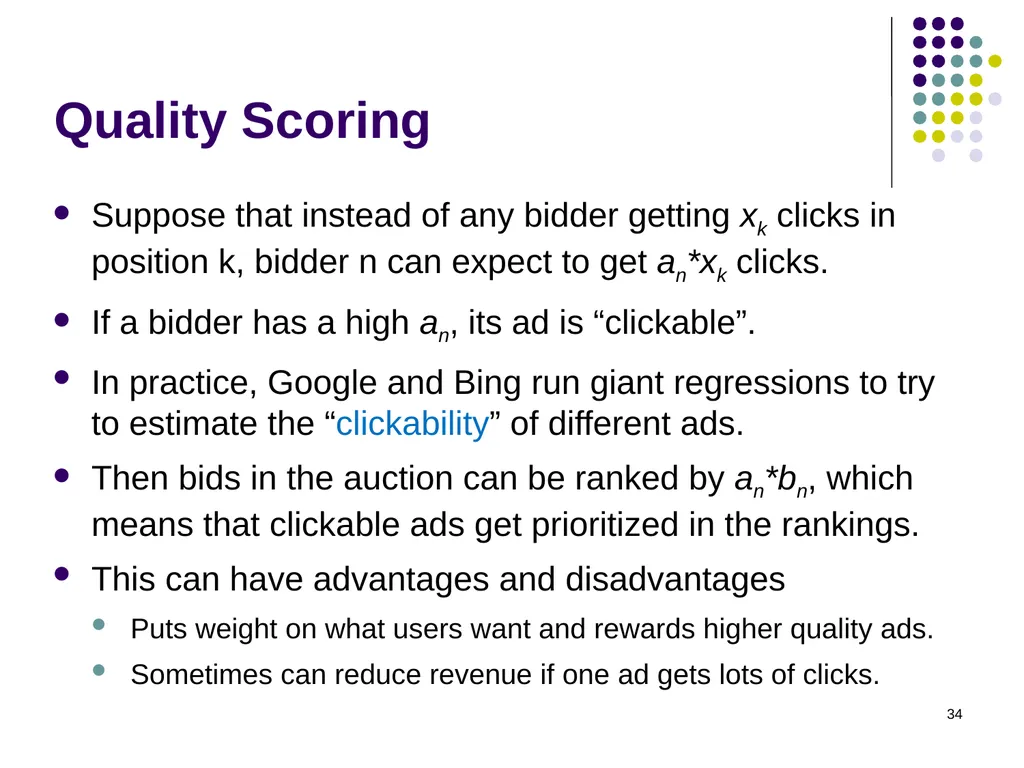
Quality Scoring Suppose that instead of any bidder getting xk clicks in position k, bidder n can expect to get an*xk clicks.
If a bidder has a high an, its ad is “clickable”.
In practice, Google and Bing run giant regressions to try to estimate the “clickability” of different ads.
Then bids in the auction can be ranked by an*bn, which means that clickable ads get prioritized in the rankings.
This can have advantages and disadvantages
Puts weight on what users want and rewards higher quality ads.
Sometimes can reduce revenue if one ad gets lots of clicks. 34<br>
If a bidder has a high an, its ad is “clickable”.
In practice, Google and Bing run giant regressions to try to estimate the “clickability” of different ads.
Then bids in the auction can be ranked by an*bn, which means that clickable ads get prioritized in the rankings.
This can have advantages and disadvantages
Puts weight on what users want and rewards higher quality ads.
Sometimes can reduce revenue if one ad gets lots of clicks. 34<br>
35
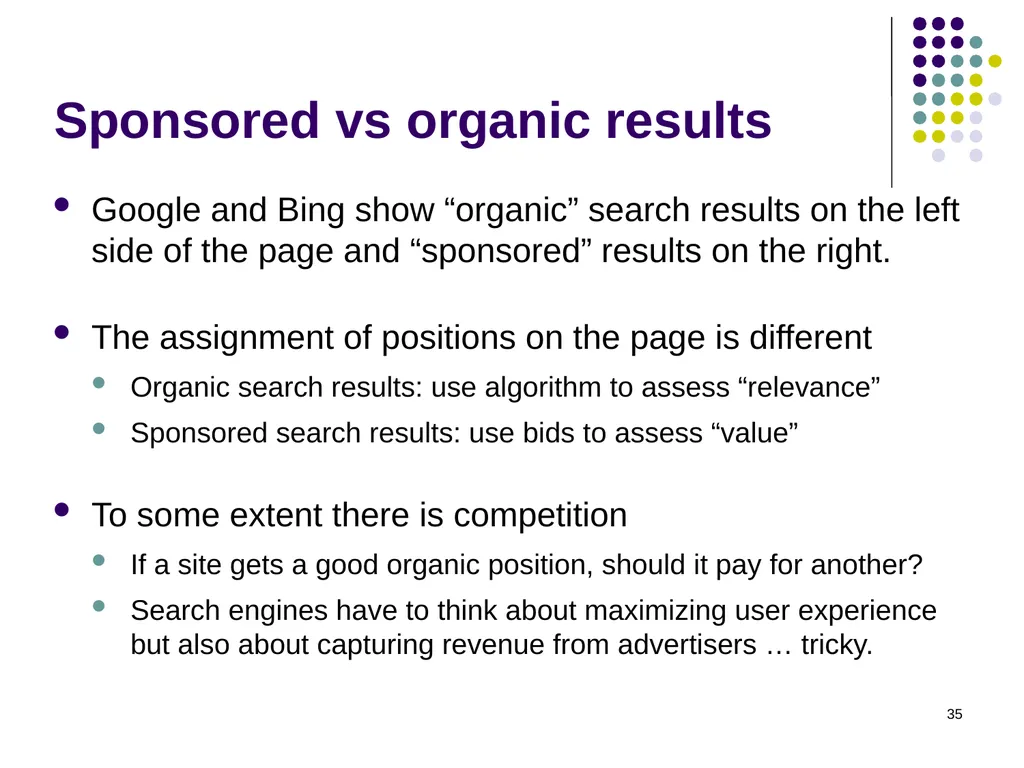
Sponsored vs organic results Google and Bing show “organic” search results on the left side of the page and “sponsored” results on the right.
The assignment of positions on the page is different
Organic search results: use algorithm to assess “relevance”
Sponsored search results: use bids to assess “value”
To some extent there is competition
If a site gets a good organic position, should it pay for another?
Search engines have to think about maximizing user experience but also about capturing revenue from advertisers … tricky. 35<br>
The assignment of positions on the page is different
Organic search results: use algorithm to assess “relevance”
Sponsored search results: use bids to assess “value”
To some extent there is competition
If a site gets a good organic position, should it pay for another?
Search engines have to think about maximizing user experience but also about capturing revenue from advertisers … tricky. 35<br>
36
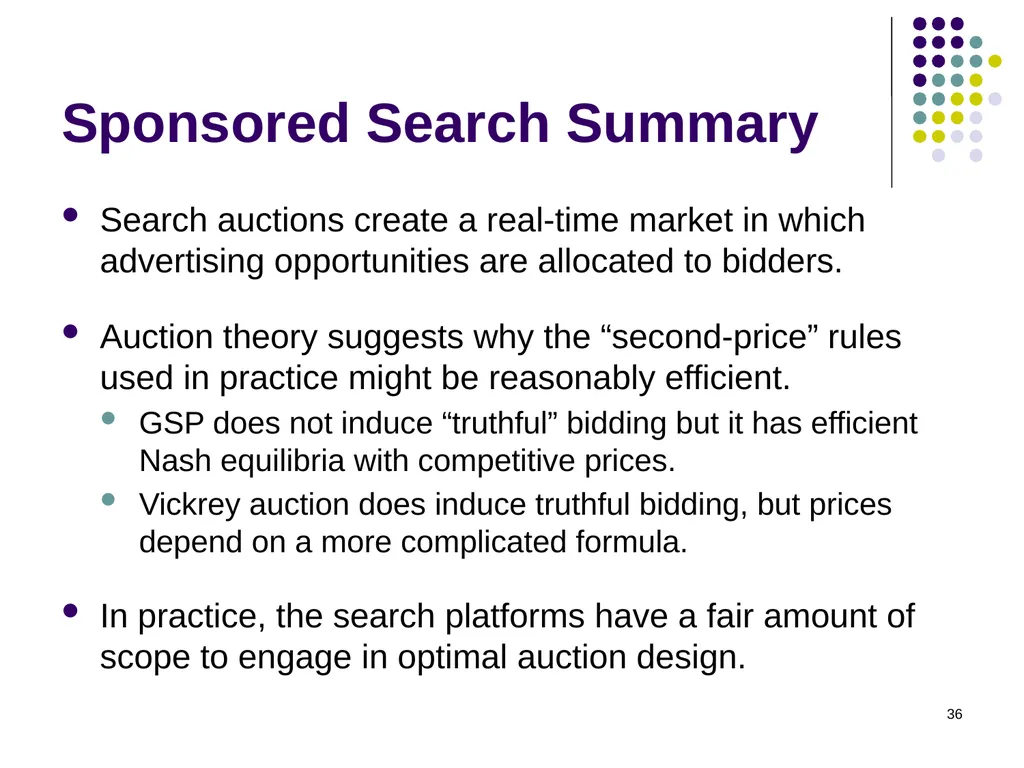
Sponsored Search Summary Search auctions create a real-time market in which advertising opportunities are allocated to bidders.
Auction theory suggests why the “second-price” rules used in practice might be reasonably efficient.
GSP does not induce “truthful” bidding but it has efficient Nash equilibria with competitive prices.
Vickrey auction does induce truthful bidding, but prices depend on a more complicated formula.
In practice, the search platforms have a fair amount of scope to engage in optimal auction design. 36<br>
Auction theory suggests why the “second-price” rules used in practice might be reasonably efficient.
GSP does not induce “truthful” bidding but it has efficient Nash equilibria with competitive prices.
Vickrey auction does induce truthful bidding, but prices depend on a more complicated formula.
In practice, the search platforms have a fair amount of scope to engage in optimal auction design. 36<br>