"Spring Semester Course Name : Endocrinology Stage:" is the property of its rightful owner. Permission is granted to
download and print the materials on this website for personal, non-commercial use only, and to display it
on your personal computer provided you do not modify the materials and that you retain all copyright
notices contained in the materials. By downloading content from our website, you accept the terms of this
agreement.
Presentation Transcript
01
Spring Semester
Course Name : Endocrinology
Stage: 3rd Grade
Lecturer: Khder Hussein Rasul
Lecture 8 Female reproductive endocrinology<br>
02
29/04/2023 Khder Hussein Rasul 2 Objectives Parts of female reproductive system
Ovaries and ovulation
Hormones of ovaries
Phases of menstrual cycle
Hormones of pregnancy<br>
03
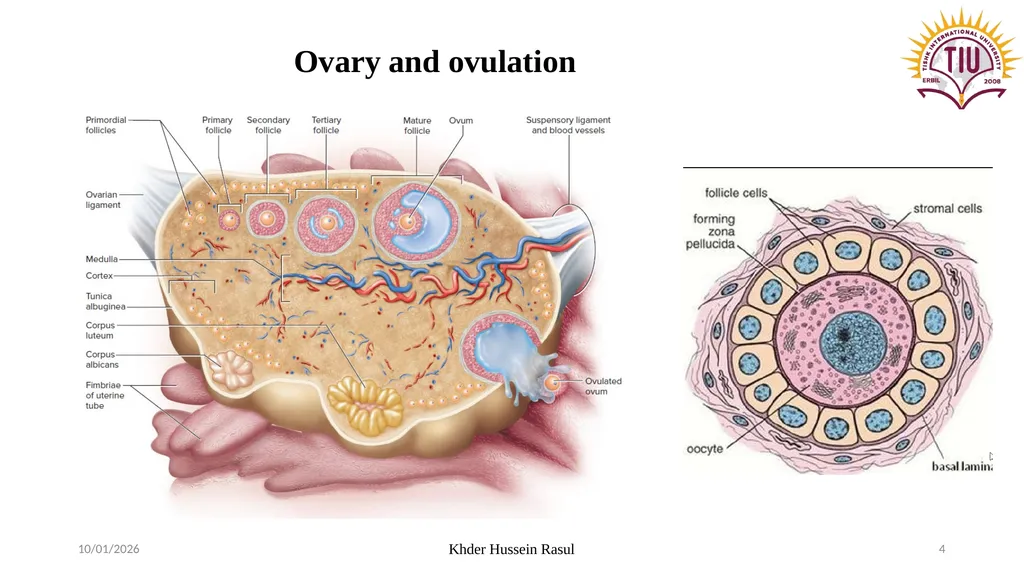
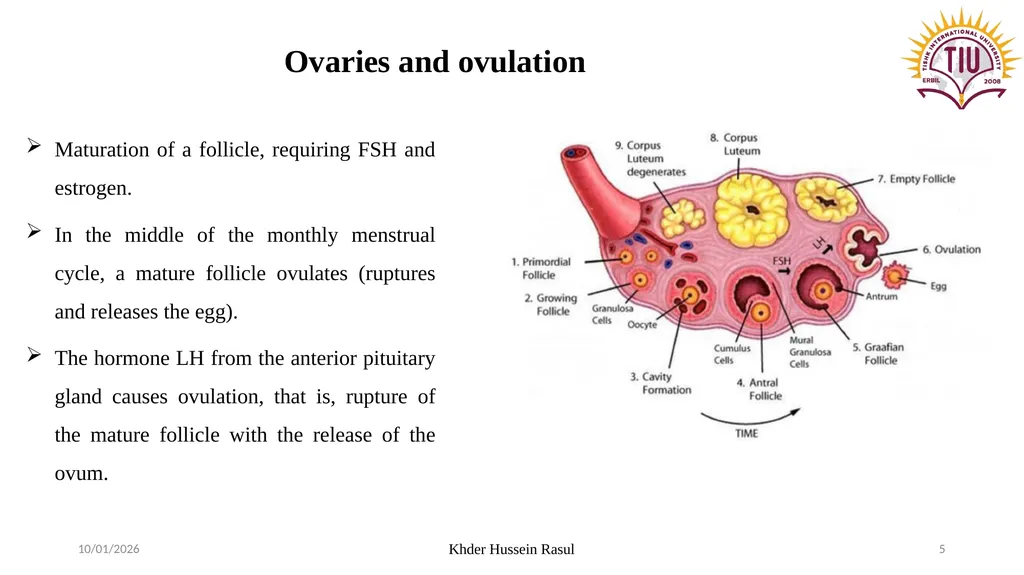
29/04/2023 Khder Hussein Rasul 3 Parts of female reproductive system The female reproductive system consists of the paired ovaries and fallopian tubes, the single uterus and vagina, and the external genital structures.
Ovaries are female gonads, which produce egg cells (ova) and sex hormones.
Within an ovary are several hundred thousand primary follicles, which are present at birth. During a woman’s childbearing years, only 300 to 400 of these follicles will produce mature ova. Each primary ovarian follicle contains an oocyte, a potential ovum, or egg cell. Surrounding the oocyte are the follicle cells, which secrete estrogen.<br>
04
29/04/2023 Khder Hussein Rasul 4 Ovary and ovulation<br>
05
29/04/2023 Khder Hussein Rasul 5 Ovaries and ovulation Maturation of a follicle, requiring FSH and estrogen.
In the middle of the monthly menstrual cycle, a mature follicle ovulates (ruptures and releases the egg).
The hormone LH from the anterior pituitary gland causes ovulation, that is, rupture of the mature follicle with the release of the ovum.<br>
06
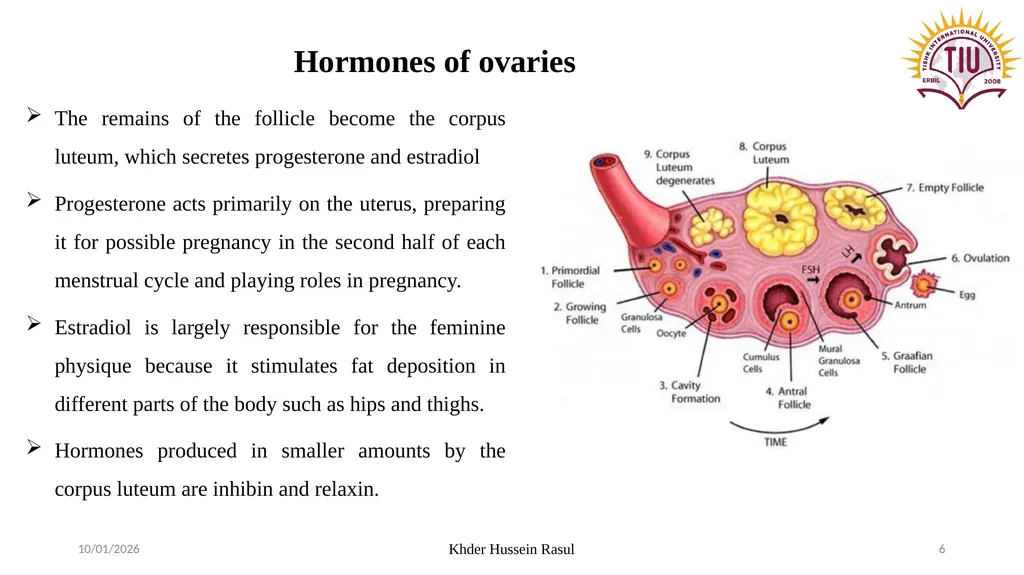
29/04/2023 Khder Hussein Rasul 6 Hormones of ovaries The remains of the follicle become the corpus luteum, which secretes progesterone and estradiol
Progesterone acts primarily on the uterus, preparing it for possible pregnancy in the second half of each menstrual cycle and playing roles in pregnancy.
Estradiol is largely responsible for the feminine physique because it stimulates fat deposition in different parts of the body such as hips and thighs.
Hormones produced in smaller amounts by the corpus luteum are inhibin and relaxin.<br>
07
29/04/2023 Khder Hussein Rasul 7 Estradiol and progesterone regulation Estrogens and progesterone also regulate FSH and LH secretion through negative feedback inhibition of the anterior pituitary.
Inhibin, which is also secreted by the follicle and corpus luteum, suppresses FSH.<br>
08
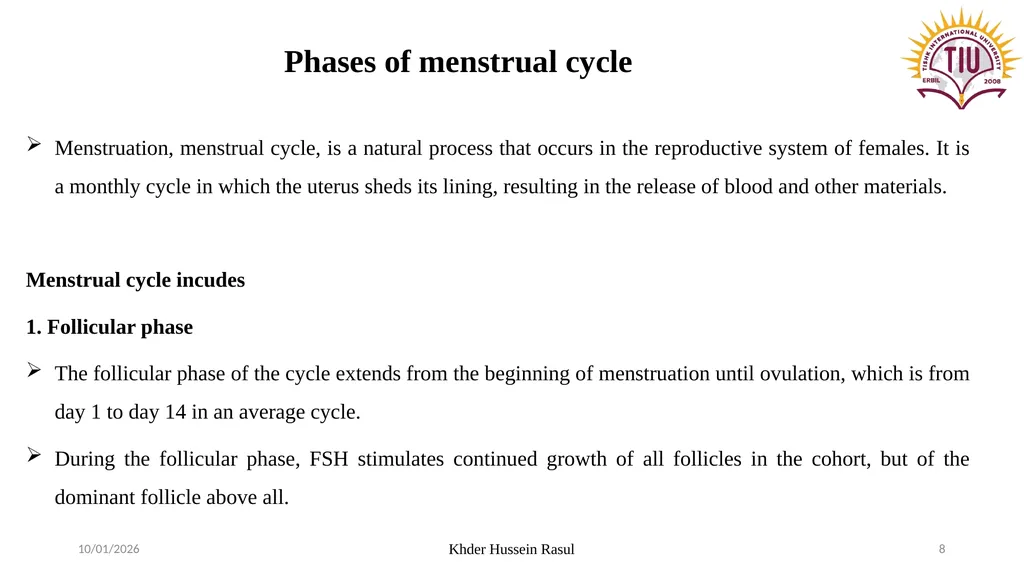
29/04/2023 Khder Hussein Rasul 8 Phases of menstrual cycle Menstruation, menstrual cycle, is a natural process that occurs in the reproductive system of females. It is a monthly cycle in which the uterus sheds its lining, resulting in the release of blood and other materials.
Menstrual cycle incudes
1. Follicular phase
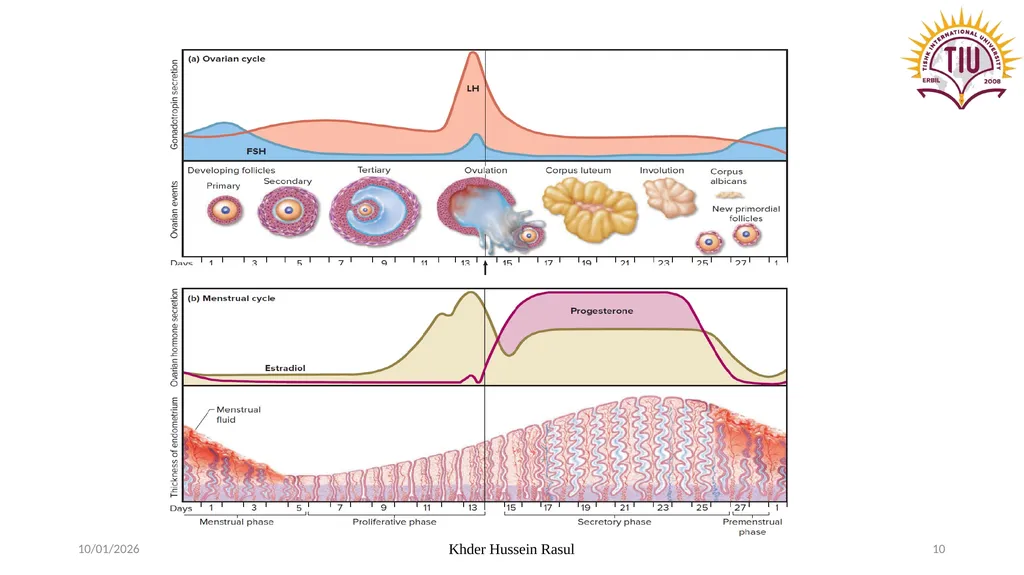
The follicular phase of the cycle extends from the beginning of menstruation until ovulation, which is from day 1 to day 14 in an average cycle.
During the follicular phase, FSH stimulates continued growth of all follicles in the cohort, but of the dominant follicle above all.<br>
09
29/04/2023 Khder Hussein Rasul 9 Phases of menstrual cycle 2. Ovulation
Ovulation is the release of egg from ovary
Ovulation happens on day 14th of menstrual cycle
LH of anterior pituitary gland stimulates the process of ovulation 3. Luteal phase
Days 15 to 28, from just after ovulation to the onset of menstruation, are called the luteal phase.
LH stimulates the corpus luteum to continue growing and to secrete rising levels of estradiol and progesterone.<br>
10
29/04/2023 Khder Hussein Rasul 10<br>
11
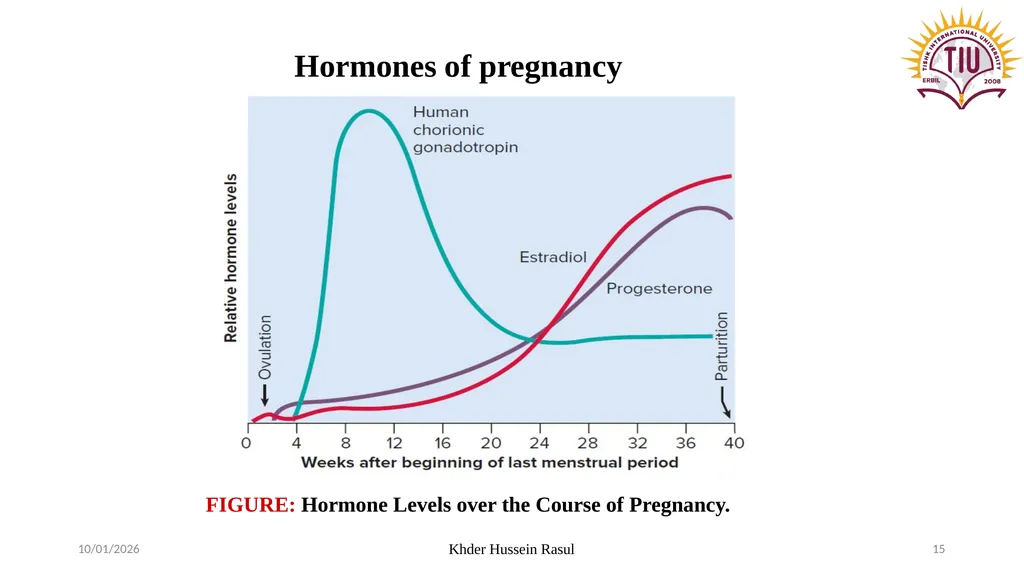
29/04/2023 Khder Hussein Rasul 11 Hormones of pregnancy The hormones with the strongest influences on pregnancy are estrogens, progesterone, and human chorionic gonadotropin.
The levels of these hormones in the maternal blood over the course of the pregnancy provide a good indicator of the well-being of the fetus.
They are secreted primarily by the placenta, but the corpus luteum is an important source of hormones in the first several weeks.
If the corpus luteum is removed before week 7, the pregnancy almost always miscarries (abortion).
From weeks 7 to 17, the corpus luteum degenerates and the placenta takes over its endocrine functions.<br>
12
29/04/2023 Khder Hussein Rasul 12 Estrogen The corpus luteum is an important source of estrogen for the first 12 weeks; after that, it comes mainly from the placenta.
Estrogen stimulates tissue growth in the fetus and mother.
It causes the mother’s uterus and external genitalia to enlarge, the mammary ducts to grow, and the breasts to increase to nearly twice their former size.
It makes the pubic symphysis more elastic and the sacroiliac joints more limber, so the pelvis widens during pregnancy and the pelvic outlet expands during childbirth.<br>
13
29/04/2023 Khder Hussein Rasul 13 Progesterone The placenta secretes a great deal of progesterone, and early in the pregnancy, so does the corpus luteum.
Progesterone suppresses uterine contractions, so the conceptus isn’t prematurely expelled.
Progesterone prevents menstruation and promotes the proliferation of decidual cells of the endometrium, on which the blastocyst feeds.
Once estrogen has stimulated growth of the mammary ducts, progesterone stimulates development of the secretory acini—another step toward lactation.
Progesterone and estrogen suppress pituitary secretion of FSH and LH, thereby preventing more follicles from developing during pregnancy.<br>
14
29/04/2023 Khder Hussein Rasul 14 Human Chorionic Gonadotropin Human chorionic gonadotropin (HCG) is secreted by placenta.
HCG presence in the urine is the basis of pregnancy tests.
Like LH, it stimulates growth of the corpus luteum, which doubles in size and secretes increasing amounts of progesterone and estrogen.
Without HCG, the corpus luteum would atrophy and the uterus would expel the conceptus.<br>
15
29/04/2023 Khder Hussein Rasul 15 Hormones of pregnancy<br>
16
29/04/2023 Khder Hussein Rasul 16 Other hormones A pregnant woman’s pituitary gland grows about 50% larger and produces markedly elevated levels of thyrotropin, prolactin, and ACTH.
The corpus luteum and placenta secrete relaxin, which synergizes progesterone in stimulating the multiplication of decidual cells in early pregnancy and promotes the growth of blood vessels in the pregnant uterus.<br>
17
Next lecture will be about male reproductive endocrinology Questions and suggestions<br>