
SPRING TRAINING CONFERENCE Saturday, April 16th,
TA
Published · 56 slides · 0 views

1 / 1




Description
SPRING TRAINING CONFERENCE Saturday, April 16th, 2016 Hyatt Regency Bethesda WELCOME . . . REVIEWING OUR DAY Introductions What is the NCSRC? Why are we here? What should you expect? Maximizing the SRC WIOA RespectAbilityUSA What else do
Related Topics
Share
Embed code
Download this presentation From Below
"SPRING TRAINING CONFERENCE Saturday, April 16th," is the property of its rightful owner. Permission is granted to download and print the materials on this website for personal, non-commercial use only, and to display it on your personal computer provided you do not modify the materials and that you retain all copyright notices contained in the materials. By downloading content from our website, you accept the terms of this agreement.
Presentation Transcript
01
SPRING TRAINING CONFERENCE Saturday, April 16th, 2016
Hyatt Regency Bethesda<br>
Hyatt Regency Bethesda<br>
02
WELCOME . . .<br>
03
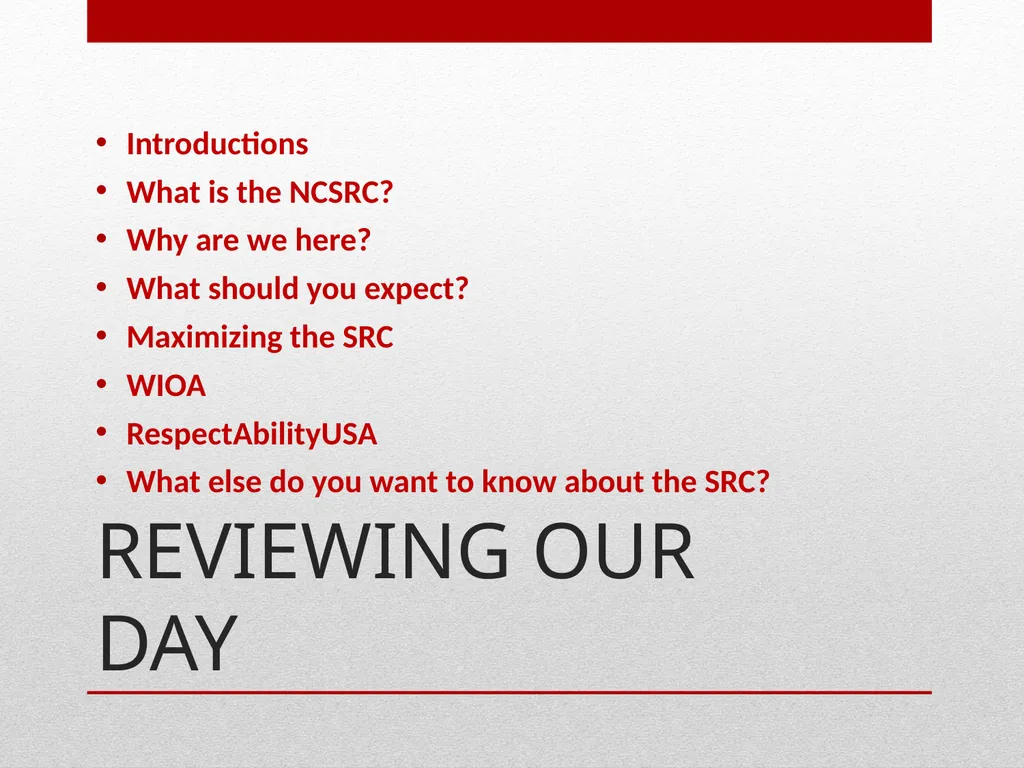
REVIEWING OUR DAY Introductions
What is the NCSRC?
Why are we here?
What should you expect?
Maximizing the SRC
WIOA
RespectAbilityUSA
What else do you want to know about the SRC?<br>
What is the NCSRC?
Why are we here?
What should you expect?
Maximizing the SRC
WIOA
RespectAbilityUSA
What else do you want to know about the SRC?<br>
04
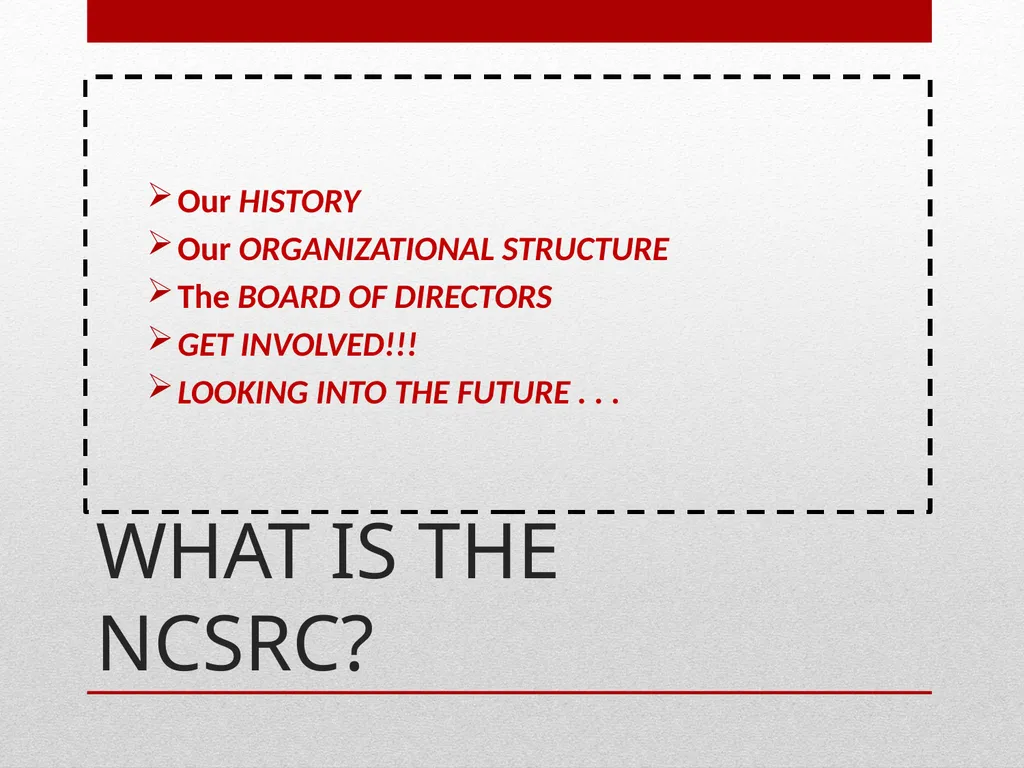
WHAT IS THE NCSRC? Our HISTORY
Our ORGANIZATIONAL STRUCTURE
The BOARD OF DIRECTORS
GET INVOLVED!!!
LOOKING INTO THE FUTURE . . .<br>
Our ORGANIZATIONAL STRUCTURE
The BOARD OF DIRECTORS
GET INVOLVED!!!
LOOKING INTO THE FUTURE . . .<br>
05
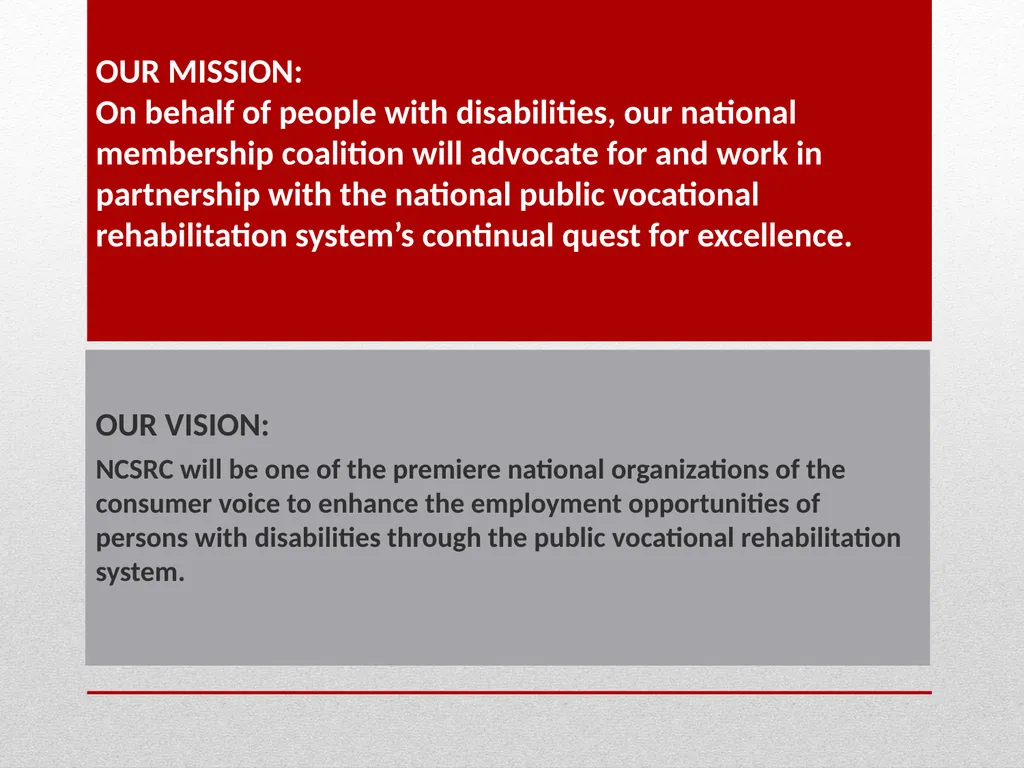
OUR MISSION:
On behalf of people with disabilities, our national membership coalition will advocate for and work in partnership with the national public vocational rehabilitation system’s continual quest for excellence. OUR VISION:
NCSRC will be one of the premiere national organizations of the consumer voice to enhance the employment opportunities of persons with disabilities through the public vocational rehabilitation system.<br>
NCSRC will be one of the premiere national organizations of the consumer voice to enhance the employment opportunities of persons with disabilities through the public vocational rehabilitation system.<br>
06
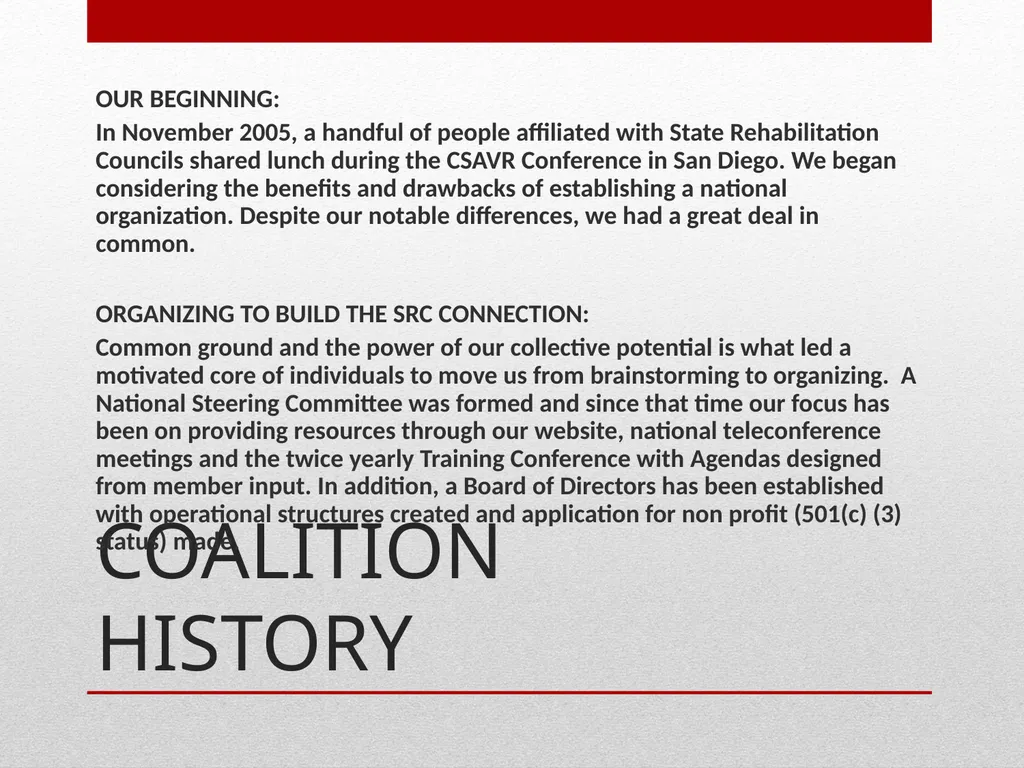
COALITION HISTORY OUR BEGINNING:
In November 2005, a handful of people affiliated with State Rehabilitation Councils shared lunch during the CSAVR Conference in San Diego. We began considering the benefits and drawbacks of establishing a national organization. Despite our notable differences, we had a great deal in common.
ORGANIZING TO BUILD THE SRC CONNECTION:
Common ground and the power of our collective potential is what led a motivated core of individuals to move us from brainstorming to organizing. A National Steering Committee was formed and since that time our focus has been on providing resources through our website, national teleconference meetings and the twice yearly Training Conference with Agendas designed from member input. In addition, a Board of Directors has been established with operational structures created and application for non profit (501(c) (3) status) made.<br>
In November 2005, a handful of people affiliated with State Rehabilitation Councils shared lunch during the CSAVR Conference in San Diego. We began considering the benefits and drawbacks of establishing a national organization. Despite our notable differences, we had a great deal in common.
ORGANIZING TO BUILD THE SRC CONNECTION:
Common ground and the power of our collective potential is what led a motivated core of individuals to move us from brainstorming to organizing. A National Steering Committee was formed and since that time our focus has been on providing resources through our website, national teleconference meetings and the twice yearly Training Conference with Agendas designed from member input. In addition, a Board of Directors has been established with operational structures created and application for non profit (501(c) (3) status) made.<br>
07
Why are we here & what are the expectations?<br>
08
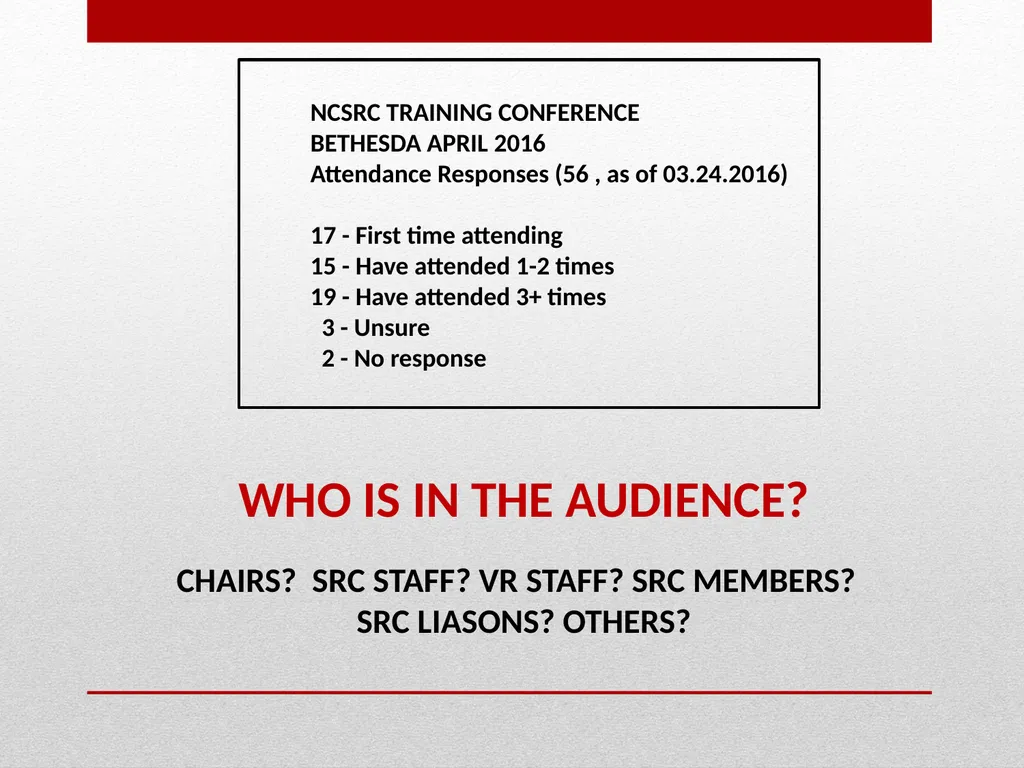
WHO IS IN THE AUDIENCE?
CHAIRS? SRC STAFF? VR STAFF? SRC MEMBERS?
SRC LIASONS? OTHERS? NCSRC TRAINING CONFERENCE
BETHESDA APRIL 2016
Attendance Responses (56 , as of 03.24.2016)
17 - First time attending
15 - Have attended 1-2 times
19 - Have attended 3+ times
3 - Unsure
2 - No response<br>
CHAIRS? SRC STAFF? VR STAFF? SRC MEMBERS?
SRC LIASONS? OTHERS? NCSRC TRAINING CONFERENCE
BETHESDA APRIL 2016
Attendance Responses (56 , as of 03.24.2016)
17 - First time attending
15 - Have attended 1-2 times
19 - Have attended 3+ times
3 - Unsure
2 - No response<br>
09
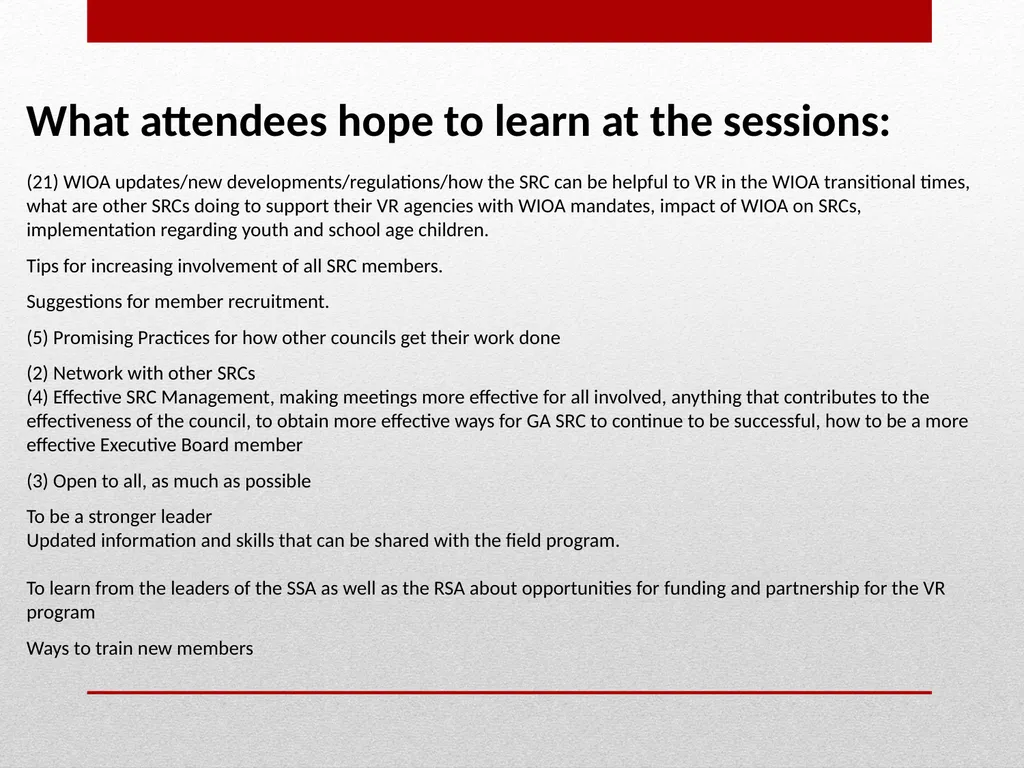
What attendees hope to learn at the sessions:
(21) WIOA updates/new developments/regulations/how the SRC can be helpful to VR in the WIOA transitional times, what are other SRCs doing to support their VR agencies with WIOA mandates, impact of WIOA on SRCs, implementation regarding youth and school age children.
Tips for increasing involvement of all SRC members.
Suggestions for member recruitment.
(5) Promising Practices for how other councils get their work done
(2) Network with other SRCs
(4) Effective SRC Management, making meetings more effective for all involved, anything that contributes to the effectiveness of the council, to obtain more effective ways for GA SRC to continue to be successful, how to be a more effective Executive Board member
(3) Open to all, as much as possible
To be a stronger leader
Updated information and skills that can be shared with the field program.
To learn from the leaders of the SSA as well as the RSA about opportunities for funding and partnership for the VR program
Ways to train new members<br>
(21) WIOA updates/new developments/regulations/how the SRC can be helpful to VR in the WIOA transitional times, what are other SRCs doing to support their VR agencies with WIOA mandates, impact of WIOA on SRCs, implementation regarding youth and school age children.
Tips for increasing involvement of all SRC members.
Suggestions for member recruitment.
(5) Promising Practices for how other councils get their work done
(2) Network with other SRCs
(4) Effective SRC Management, making meetings more effective for all involved, anything that contributes to the effectiveness of the council, to obtain more effective ways for GA SRC to continue to be successful, how to be a more effective Executive Board member
(3) Open to all, as much as possible
To be a stronger leader
Updated information and skills that can be shared with the field program.
To learn from the leaders of the SSA as well as the RSA about opportunities for funding and partnership for the VR program
Ways to train new members<br>
10
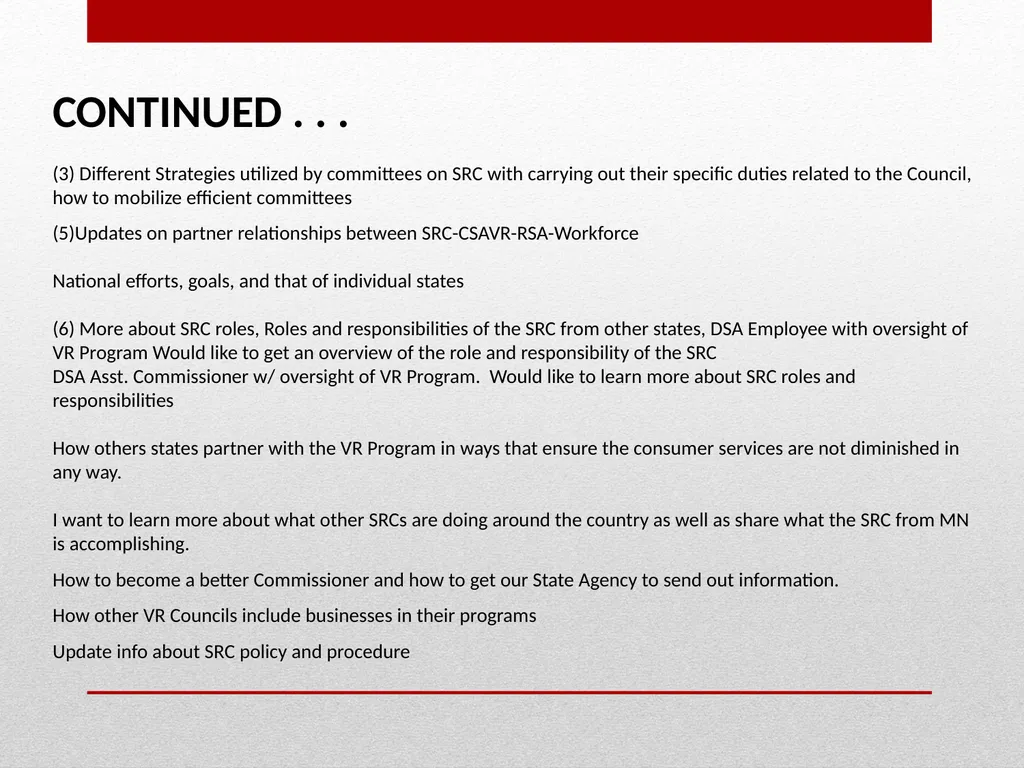
CONTINUED . . .
(3) Different Strategies utilized by committees on SRC with carrying out their specific duties related to the Council, how to mobilize efficient committees
(5)Updates on partner relationships between SRC-CSAVR-RSA-Workforce
National efforts, goals, and that of individual states
(6) More about SRC roles, Roles and responsibilities of the SRC from other states, DSA Employee with oversight of VR Program Would like to get an overview of the role and responsibility of the SRC
DSA Asst. Commissioner w/ oversight of VR Program. Would like to learn more about SRC roles and responsibilities
How others states partner with the VR Program in ways that ensure the consumer services are not diminished in any way.
I want to learn more about what other SRCs are doing around the country as well as share what the SRC from MN is accomplishing.
How to become a better Commissioner and how to get our State Agency to send out information.
How other VR Councils include businesses in their programs
Update info about SRC policy and procedure<br>
(3) Different Strategies utilized by committees on SRC with carrying out their specific duties related to the Council, how to mobilize efficient committees
(5)Updates on partner relationships between SRC-CSAVR-RSA-Workforce
National efforts, goals, and that of individual states
(6) More about SRC roles, Roles and responsibilities of the SRC from other states, DSA Employee with oversight of VR Program Would like to get an overview of the role and responsibility of the SRC
DSA Asst. Commissioner w/ oversight of VR Program. Would like to learn more about SRC roles and responsibilities
How others states partner with the VR Program in ways that ensure the consumer services are not diminished in any way.
I want to learn more about what other SRCs are doing around the country as well as share what the SRC from MN is accomplishing.
How to become a better Commissioner and how to get our State Agency to send out information.
How other VR Councils include businesses in their programs
Update info about SRC policy and procedure<br>
11
MAXIMIZING THE SRC POTENTIAL REVIEWING THE FEDERAL FUNCTIONS & RELATED WORK TASKS WHAT DO THEY MEAN? WHAT YOU SHOULD LEARN NCSRC BOARD MEMBERS
Marlene Malloy, Michigan Blind & General SRC
Claire Reeve, Minnesota General SRC<br>
Marlene Malloy, Michigan Blind & General SRC
Claire Reeve, Minnesota General SRC<br>
12
WORKFORCE INNOVATION AND OPPORTUNITY ACT (WIOA) – REHABILITATION ACT, AS AMENDED 2015
SECTION 105 – STATE REHABILITATION COUNCIL
(h) Functions. The Council must, after consulting with the State workforce investment board--
(1) Review, analyze, and advise the designated State unit regarding the performance of the State unit's responsibilities under this part, particularly responsibilities related to--
(i) Eligibility, including order of selection;
WHAT THIS MEANS: The SRC should be provided the data that indicates the DSUs ability to serve everyone who is determined eligible for services.<br>
SECTION 105 – STATE REHABILITATION COUNCIL
(h) Functions. The Council must, after consulting with the State workforce investment board--
(1) Review, analyze, and advise the designated State unit regarding the performance of the State unit's responsibilities under this part, particularly responsibilities related to--
(i) Eligibility, including order of selection;
WHAT THIS MEANS: The SRC should be provided the data that indicates the DSUs ability to serve everyone who is determined eligible for services.<br>
13
(ii) The extent, scope, and effectiveness of services provided; and
(iii) Functions performed by State agencies that affect or potentially affect the ability of individuals with disabilities in achieving employment outcomes under this part;
WHAT THIS MEANS: A review of program data by the SRC should determine if the DSU is providing opportunities for employment outcomes within their system.<br>
(iii) Functions performed by State agencies that affect or potentially affect the ability of individuals with disabilities in achieving employment outcomes under this part;
WHAT THIS MEANS: A review of program data by the SRC should determine if the DSU is providing opportunities for employment outcomes within their system.<br>
14
(2) In partnership with the designated State unit--
(i) Develop, agree to, and review State goals and priorities in accordance with Sec. 361.29(c); and
WHAT THIS MEANS: The SRC should be involved with the DSU in their process of creating the goals and priorities, along with agreement of the SRC.
(ii) Evaluate the effectiveness of the vocational rehabilitation program and submit reports of progress to the Secretary in accordance with Sec. 361.29(e);
WHAT THIS MEANS: The SRC should receive data that illustrates the return on investment of the DSU service system.<br>
(i) Develop, agree to, and review State goals and priorities in accordance with Sec. 361.29(c); and
WHAT THIS MEANS: The SRC should be involved with the DSU in their process of creating the goals and priorities, along with agreement of the SRC.
(ii) Evaluate the effectiveness of the vocational rehabilitation program and submit reports of progress to the Secretary in accordance with Sec. 361.29(e);
WHAT THIS MEANS: The SRC should receive data that illustrates the return on investment of the DSU service system.<br>
15
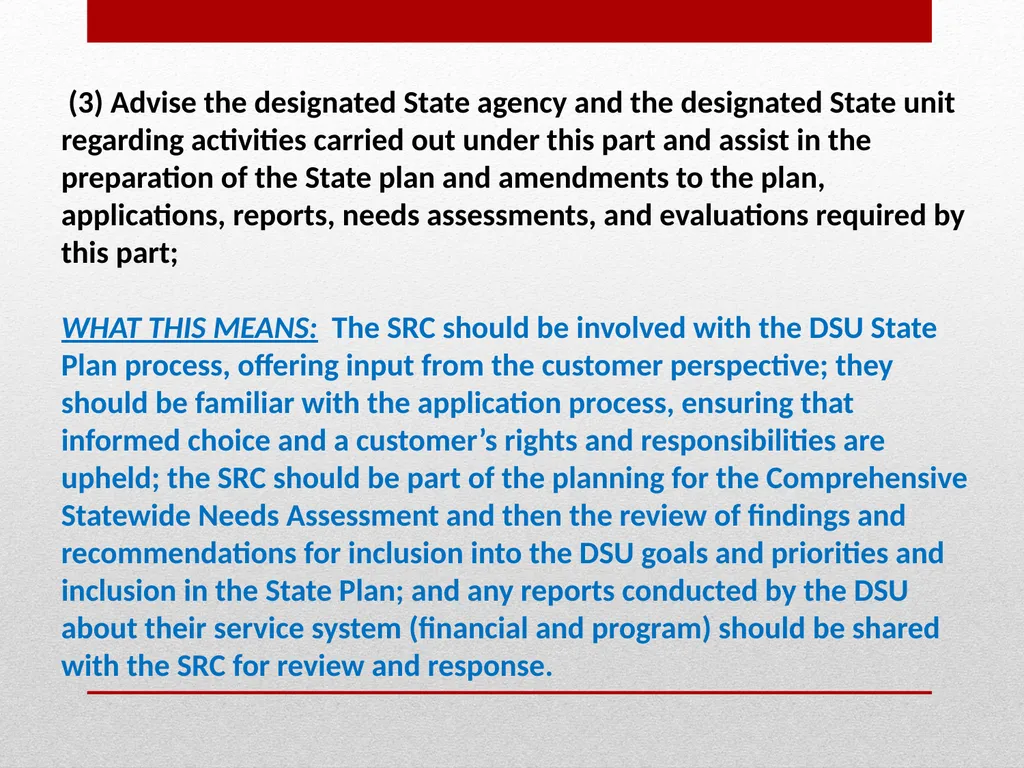
(3) Advise the designated State agency and the designated State unit regarding activities carried out under this part and assist in the preparation of the State plan and amendments to the plan, applications, reports, needs assessments, and evaluations required by this part;
WHAT THIS MEANS: The SRC should be involved with the DSU State Plan process, offering input from the customer perspective; they should be familiar with the application process, ensuring that informed choice and a customer’s rights and responsibilities are upheld; the SRC should be part of the planning for the Comprehensive Statewide Needs Assessment and then the review of findings and recommendations for inclusion into the DSU goals and priorities and inclusion in the State Plan; and any reports conducted by the DSU about their service system (financial and program) should be shared with the SRC for review and response.<br>
WHAT THIS MEANS: The SRC should be involved with the DSU State Plan process, offering input from the customer perspective; they should be familiar with the application process, ensuring that informed choice and a customer’s rights and responsibilities are upheld; the SRC should be part of the planning for the Comprehensive Statewide Needs Assessment and then the review of findings and recommendations for inclusion into the DSU goals and priorities and inclusion in the State Plan; and any reports conducted by the DSU about their service system (financial and program) should be shared with the SRC for review and response.<br>
16
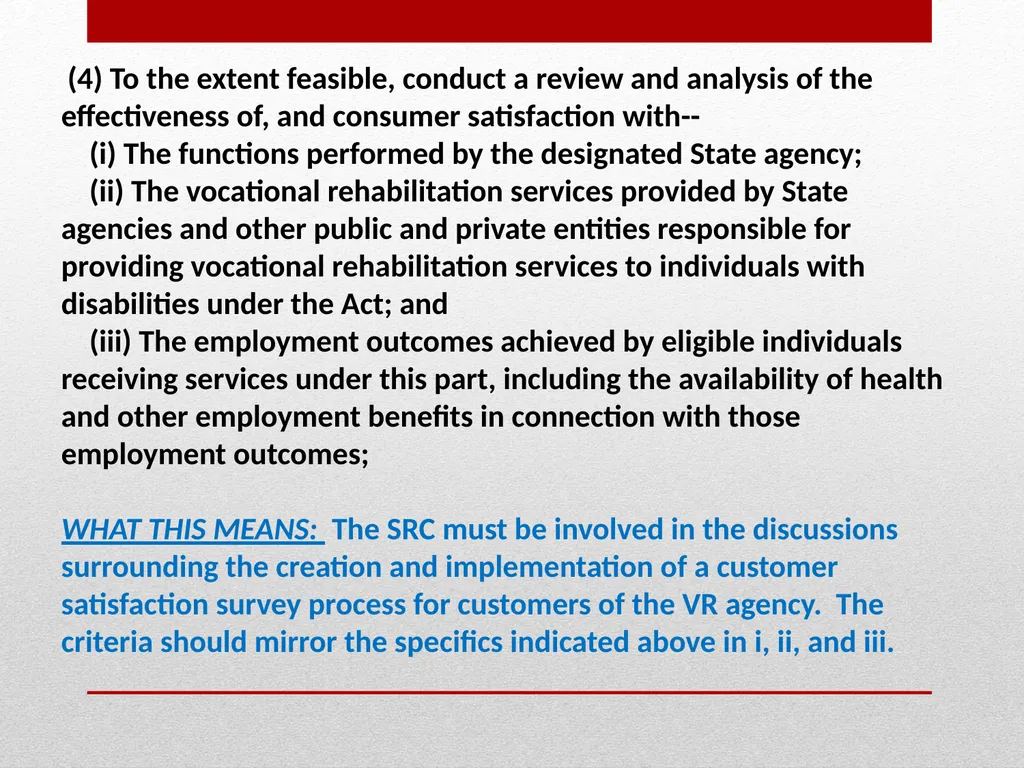
(4) To the extent feasible, conduct a review and analysis of the effectiveness of, and consumer satisfaction with--
(i) The functions performed by the designated State agency;
(ii) The vocational rehabilitation services provided by State agencies and other public and private entities responsible for providing vocational rehabilitation services to individuals with disabilities under the Act; and
(iii) The employment outcomes achieved by eligible individuals receiving services under this part, including the availability of health and other employment benefits in connection with those employment outcomes;
WHAT THIS MEANS: The SRC must be involved in the discussions surrounding the creation and implementation of a customer satisfaction survey process for customers of the VR agency. The criteria should mirror the specifics indicated above in i, ii, and iii.<br>
(i) The functions performed by the designated State agency;
(ii) The vocational rehabilitation services provided by State agencies and other public and private entities responsible for providing vocational rehabilitation services to individuals with disabilities under the Act; and
(iii) The employment outcomes achieved by eligible individuals receiving services under this part, including the availability of health and other employment benefits in connection with those employment outcomes;
WHAT THIS MEANS: The SRC must be involved in the discussions surrounding the creation and implementation of a customer satisfaction survey process for customers of the VR agency. The criteria should mirror the specifics indicated above in i, ii, and iii.<br>
17
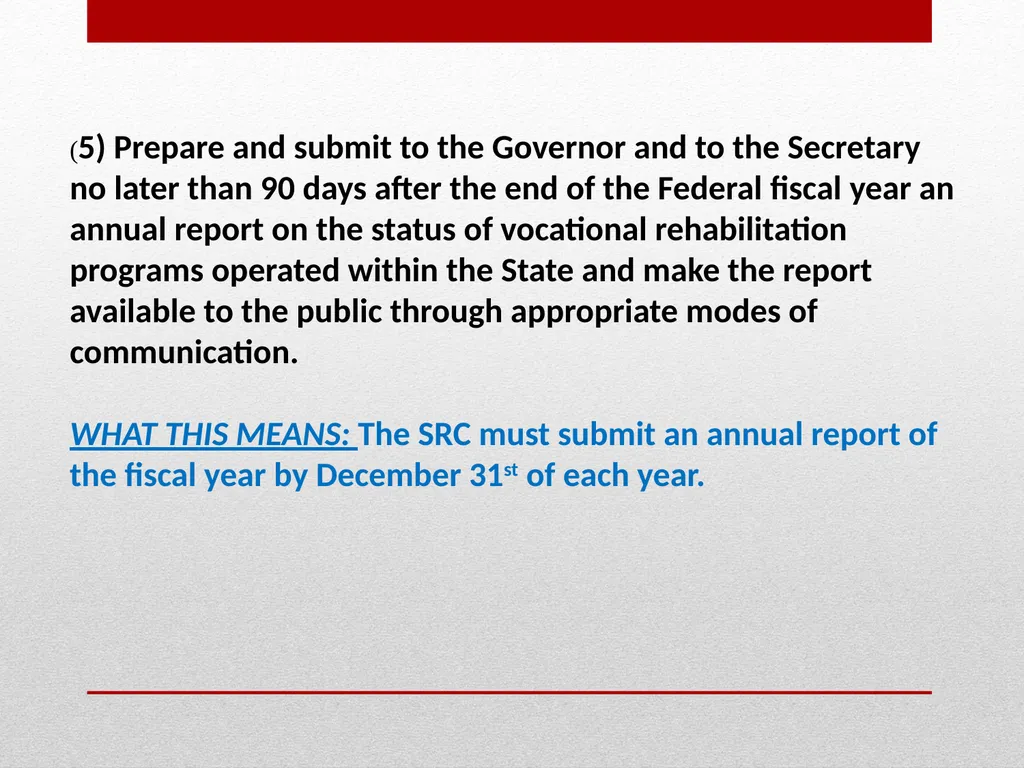
(5) Prepare and submit to the Governor and to the Secretary no later than 90 days after the end of the Federal fiscal year an annual report on the status of vocational rehabilitation programs operated within the State and make the report available to the public through appropriate modes of communication.
WHAT THIS MEANS: The SRC must submit an annual report of the fiscal year by December 31st of each year.<br>
WHAT THIS MEANS: The SRC must submit an annual report of the fiscal year by December 31st of each year.<br>
18
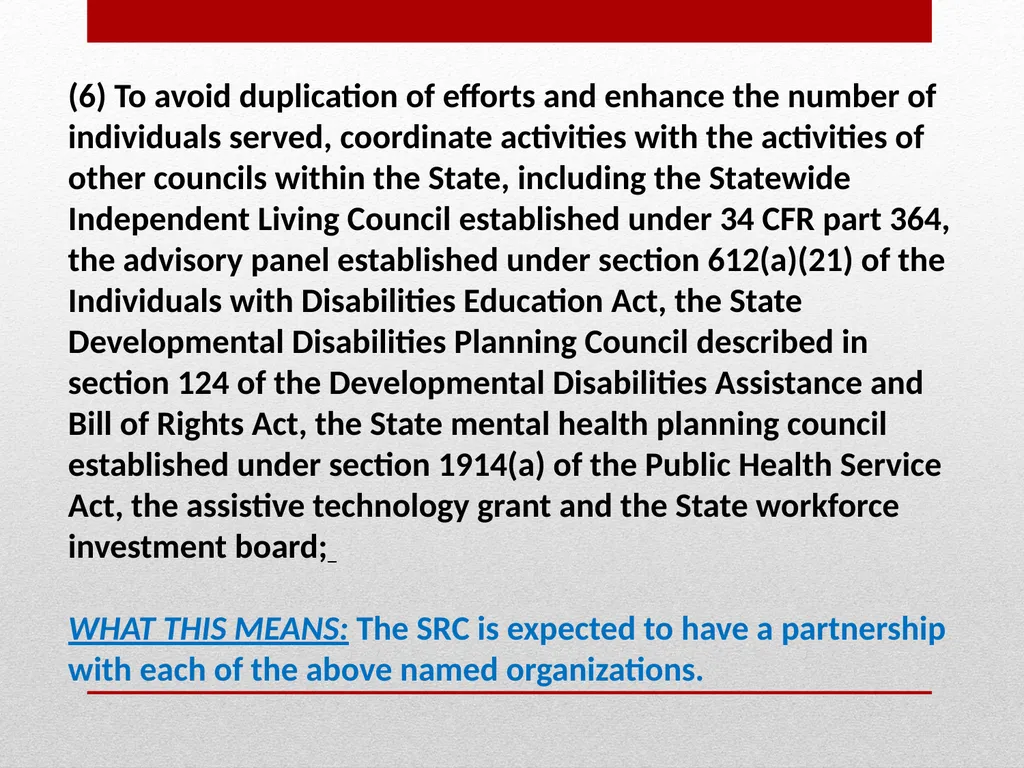
(6) To avoid duplication of efforts and enhance the number of individuals served, coordinate activities with the activities of other councils within the State, including the Statewide Independent Living Council established under 34 CFR part 364, the advisory panel established under section 612(a)(21) of the Individuals with Disabilities Education Act, the State Developmental Disabilities Planning Council described in section 124 of the Developmental Disabilities Assistance and Bill of Rights Act, the State mental health planning council established under section 1914(a) of the Public Health Service Act, the assistive technology grant and the State workforce investment board;
WHAT THIS MEANS: The SRC is expected to have a partnership with each of the above named organizations.<br>
WHAT THIS MEANS: The SRC is expected to have a partnership with each of the above named organizations.<br>
19
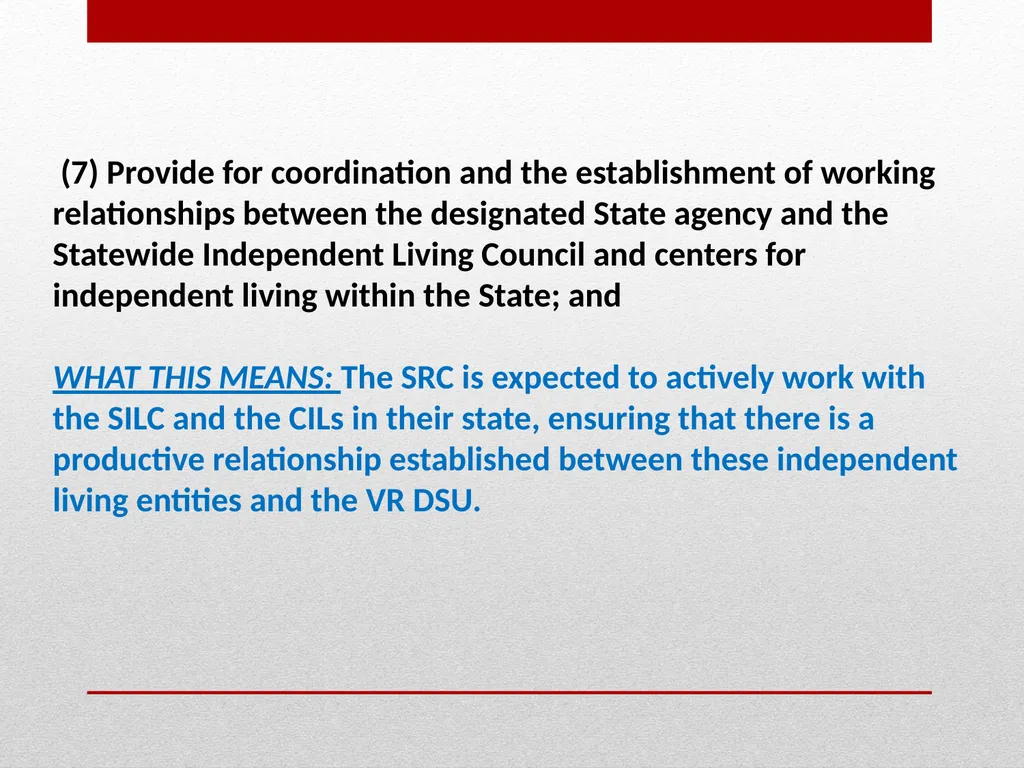
(7) Provide for coordination and the establishment of working relationships between the designated State agency and the Statewide Independent Living Council and centers for independent living within the State; and
WHAT THIS MEANS: The SRC is expected to actively work with the SILC and the CILs in their state, ensuring that there is a productive relationship established between these independent living entities and the VR DSU.<br>
WHAT THIS MEANS: The SRC is expected to actively work with the SILC and the CILs in their state, ensuring that there is a productive relationship established between these independent living entities and the VR DSU.<br>
20
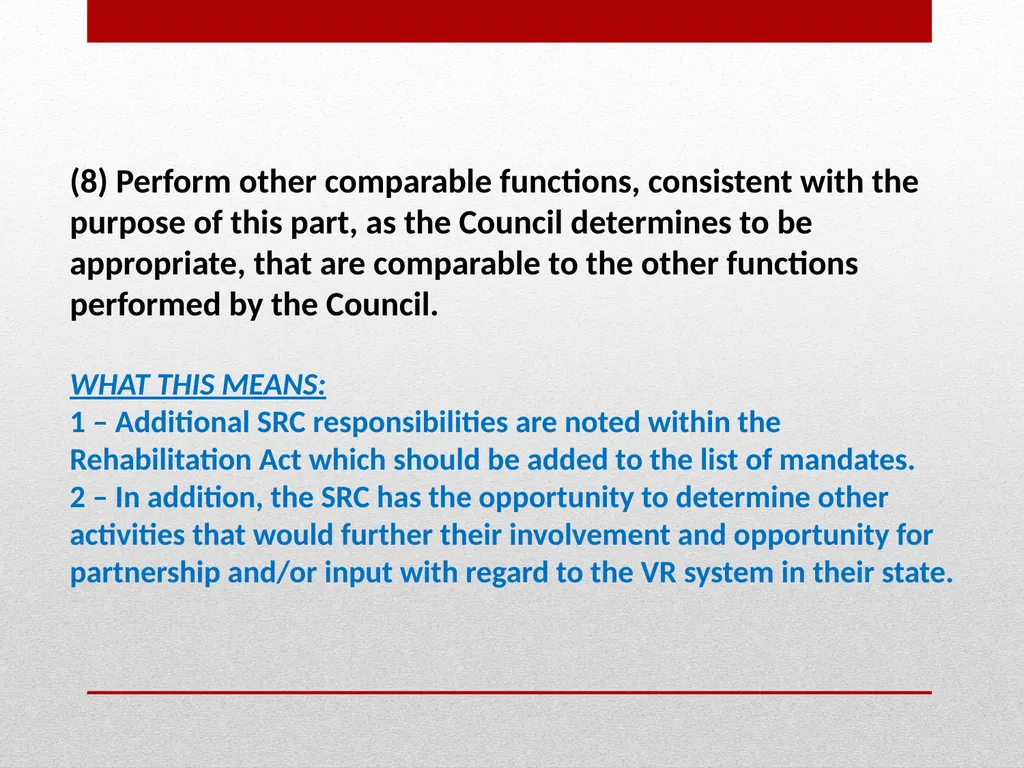
(8) Perform other comparable functions, consistent with the purpose of this part, as the Council determines to be appropriate, that are comparable to the other functions performed by the Council.
WHAT THIS MEANS:
1 – Additional SRC responsibilities are noted within the Rehabilitation Act which should be added to the list of mandates.
2 – In addition, the SRC has the opportunity to determine other activities that would further their involvement and opportunity for partnership and/or input with regard to the VR system in their state.<br>
WHAT THIS MEANS:
1 – Additional SRC responsibilities are noted within the Rehabilitation Act which should be added to the list of mandates.
2 – In addition, the SRC has the opportunity to determine other activities that would further their involvement and opportunity for partnership and/or input with regard to the VR system in their state.<br>
21
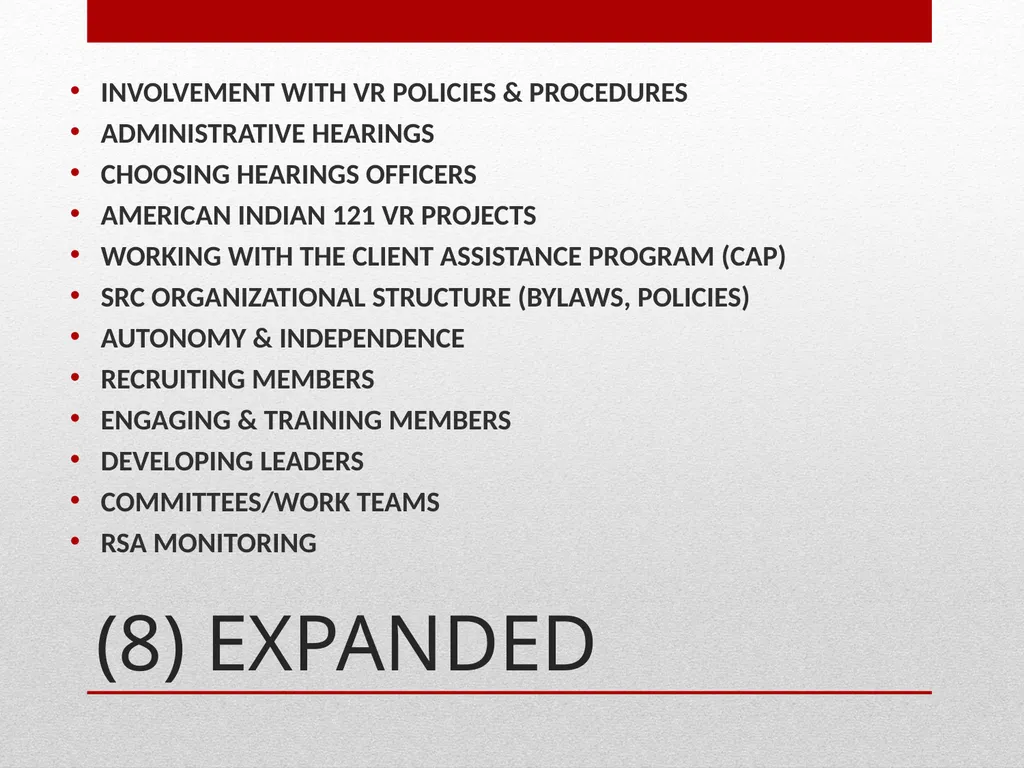
(8) EXPANDED INVOLVEMENT WITH VR POLICIES & PROCEDURES
ADMINISTRATIVE HEARINGS
CHOOSING HEARINGS OFFICERS
AMERICAN INDIAN 121 VR PROJECTS
WORKING WITH THE CLIENT ASSISTANCE PROGRAM (CAP)
SRC ORGANIZATIONAL STRUCTURE (BYLAWS, POLICIES)
AUTONOMY & INDEPENDENCE
RECRUITING MEMBERS
ENGAGING & TRAINING MEMBERS
DEVELOPING LEADERS
COMMITTEES/WORK TEAMS
RSA MONITORING<br>
ADMINISTRATIVE HEARINGS
CHOOSING HEARINGS OFFICERS
AMERICAN INDIAN 121 VR PROJECTS
WORKING WITH THE CLIENT ASSISTANCE PROGRAM (CAP)
SRC ORGANIZATIONAL STRUCTURE (BYLAWS, POLICIES)
AUTONOMY & INDEPENDENCE
RECRUITING MEMBERS
ENGAGING & TRAINING MEMBERS
DEVELOPING LEADERS
COMMITTEES/WORK TEAMS
RSA MONITORING<br>
22
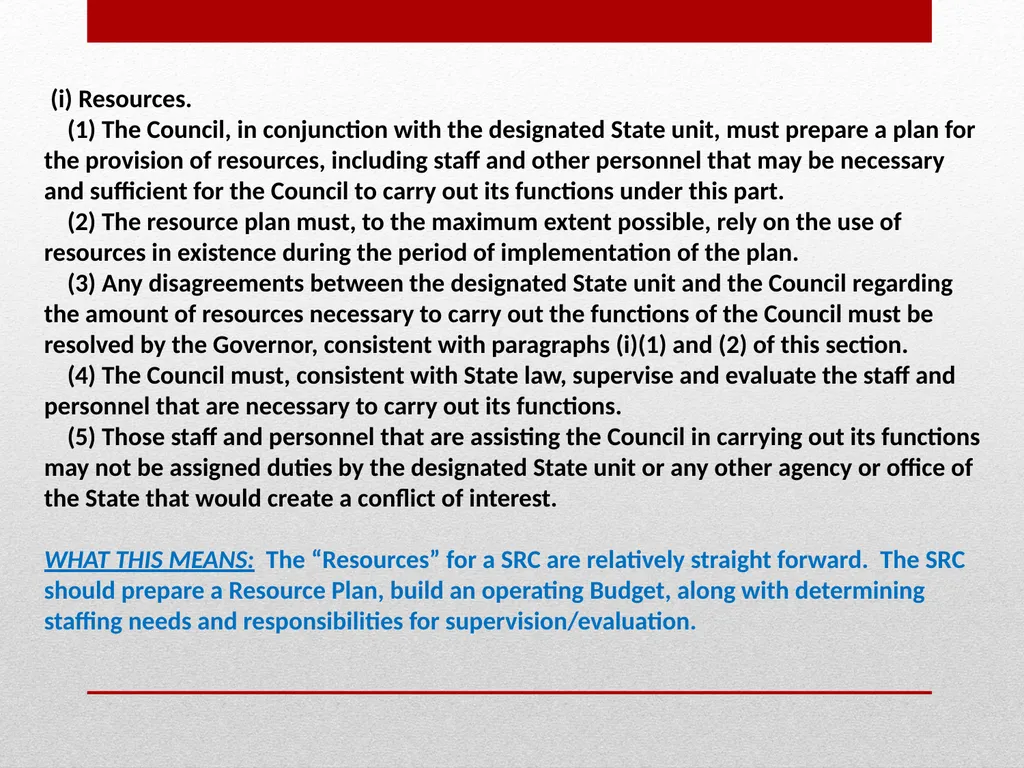
(i) Resources.
(1) The Council, in conjunction with the designated State unit, must prepare a plan for the provision of resources, including staff and other personnel that may be necessary and sufficient for the Council to carry out its functions under this part.
(2) The resource plan must, to the maximum extent possible, rely on the use of resources in existence during the period of implementation of the plan.
(3) Any disagreements between the designated State unit and the Council regarding the amount of resources necessary to carry out the functions of the Council must be resolved by the Governor, consistent with paragraphs (i)(1) and (2) of this section.
(4) The Council must, consistent with State law, supervise and evaluate the staff and personnel that are necessary to carry out its functions.
(5) Those staff and personnel that are assisting the Council in carrying out its functions may not be assigned duties by the designated State unit or any other agency or office of the State that would create a conflict of interest.
WHAT THIS MEANS: The “Resources” for a SRC are relatively straight forward. The SRC should prepare a Resource Plan, build an operating Budget, along with determining staffing needs and responsibilities for supervision/evaluation.<br>
(1) The Council, in conjunction with the designated State unit, must prepare a plan for the provision of resources, including staff and other personnel that may be necessary and sufficient for the Council to carry out its functions under this part.
(2) The resource plan must, to the maximum extent possible, rely on the use of resources in existence during the period of implementation of the plan.
(3) Any disagreements between the designated State unit and the Council regarding the amount of resources necessary to carry out the functions of the Council must be resolved by the Governor, consistent with paragraphs (i)(1) and (2) of this section.
(4) The Council must, consistent with State law, supervise and evaluate the staff and personnel that are necessary to carry out its functions.
(5) Those staff and personnel that are assisting the Council in carrying out its functions may not be assigned duties by the designated State unit or any other agency or office of the State that would create a conflict of interest.
WHAT THIS MEANS: The “Resources” for a SRC are relatively straight forward. The SRC should prepare a Resource Plan, build an operating Budget, along with determining staffing needs and responsibilities for supervision/evaluation.<br>
23
SMALL GROUP ACTIVITY SRC = OPERATIONS + PROGRAM
RESULTS IN THE
ACHIEVEMENT OF MANDATES<br>
RESULTS IN THE
ACHIEVEMENT OF MANDATES<br>
24
ASSIGNMENT Each table will be assigned the task of reviewing their assignment handout dedicated to the “mandate” and “program” design of their SRC.
Choose a facilitator and a recorder.
Determine who will report your findings to the room.
As a group:
1 – Determine what is needed to accomplish each item on your list.
2 – Determine how you will report your outcomes to your Designated State Unit (DSU) which demonstrates the credibility of your SRC.<br>
Choose a facilitator and a recorder.
Determine who will report your findings to the room.
As a group:
1 – Determine what is needed to accomplish each item on your list.
2 – Determine how you will report your outcomes to your Designated State Unit (DSU) which demonstrates the credibility of your SRC.<br>
25
WHAT DID WE LEARN?<br>
26
SO WHAT??? WERE YOUR EXPECTATIONS ACHIEVED?
DID THIS OVERVIEW PROVIDE NEW INFORMATION?
DID THIS OVERVIEW CONFIRM WHAT YOU KNEW?
DID THIS OVERVIEW CONFUSE YOU?
ARE YOU THINKING ABOUT HOW YOUR SRC CAN UTILIZE THIS INFORMATION?
ARE YOU MOTIVATED TO MAXIMIZE YOUR SRCs POTENTIAL?<br>
DID THIS OVERVIEW PROVIDE NEW INFORMATION?
DID THIS OVERVIEW CONFIRM WHAT YOU KNEW?
DID THIS OVERVIEW CONFUSE YOU?
ARE YOU THINKING ABOUT HOW YOUR SRC CAN UTILIZE THIS INFORMATION?
ARE YOU MOTIVATED TO MAXIMIZE YOUR SRCs POTENTIAL?<br>
27
LUNCH ON YOUR OWN<br>
28
WORKFORCE INNOVATION & OPPORTUNITY ACT (WIOA)
NCSRC BOARD MEMBERS:
Teesha Kirschbaum, Washington General SRC
Evelyn Oliver Knight, Connecticut General SRC
Graham Sisson, Alabama Combined SRC<br>
29
WIOA Overview April, 2016 Content Adapted from RSA Presentation, November 2014 29<br>
30
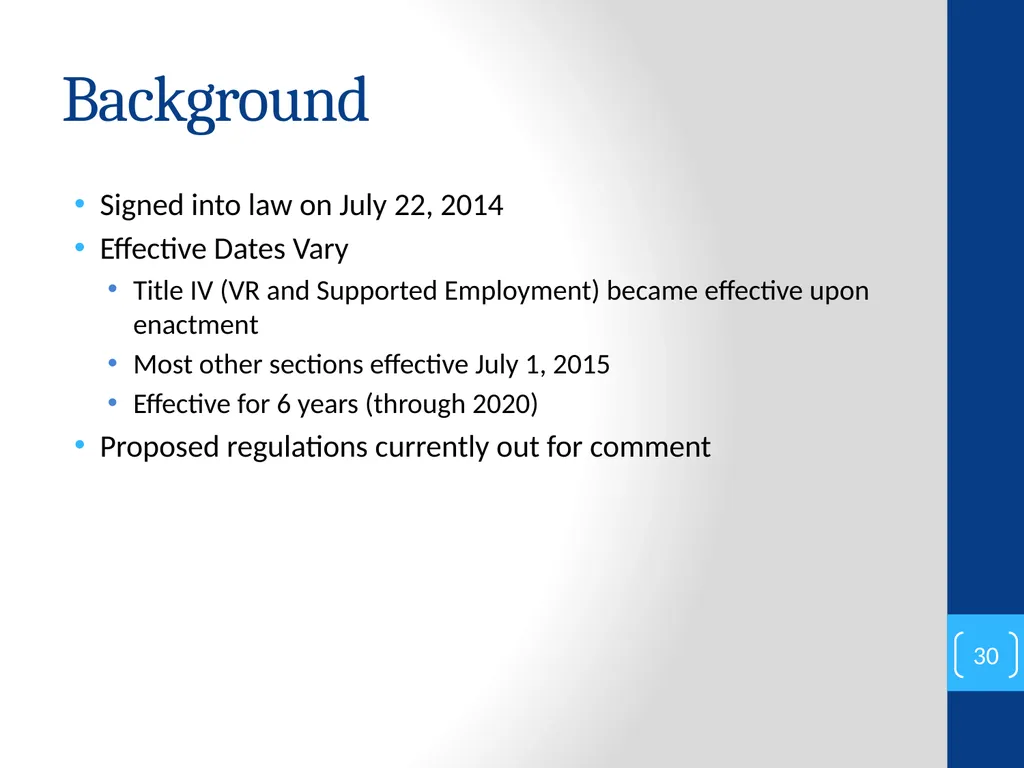
Background Signed into law on July 22, 2014
Effective Dates Vary
Title IV (VR and Supported Employment) became effective upon enactment
Most other sections effective July 1, 2015
Effective for 6 years (through 2020)
Proposed regulations currently out for comment 30<br>
Effective Dates Vary
Title IV (VR and Supported Employment) became effective upon enactment
Most other sections effective July 1, 2015
Effective for 6 years (through 2020)
Proposed regulations currently out for comment 30<br>
31
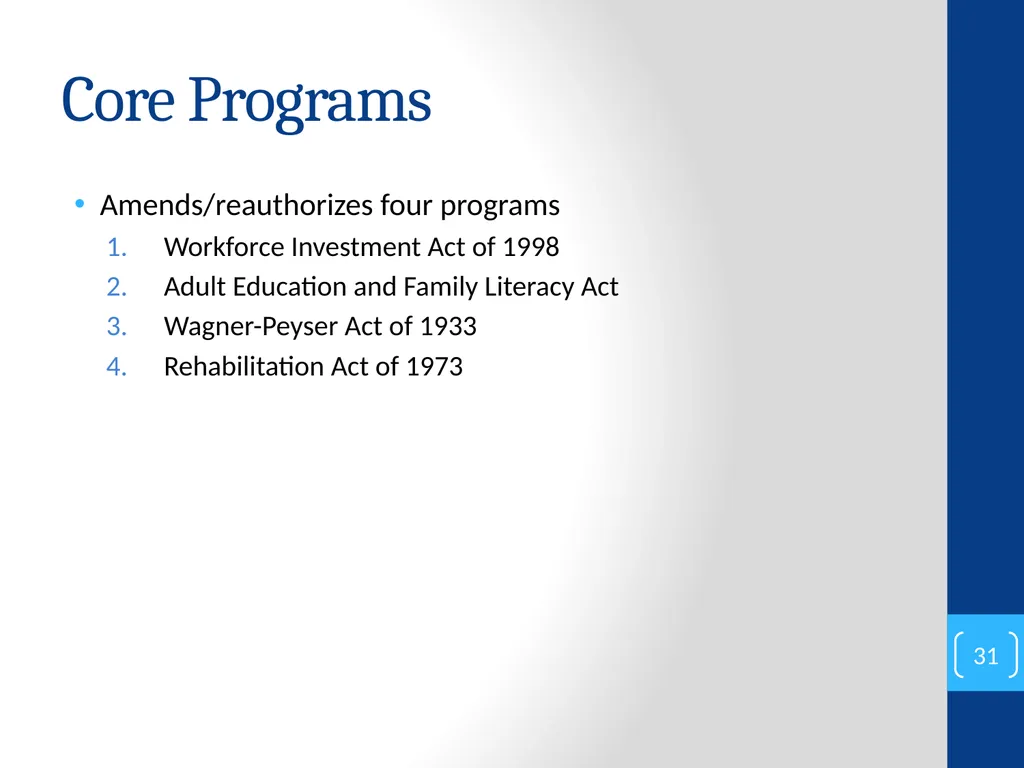
Core Programs Amends/reauthorizes four programs
Workforce Investment Act of 1998
Adult Education and Family Literacy Act
Wagner-Peyser Act of 1933
Rehabilitation Act of 1973 31<br>
Workforce Investment Act of 1998
Adult Education and Family Literacy Act
Wagner-Peyser Act of 1933
Rehabilitation Act of 1973 31<br>
32
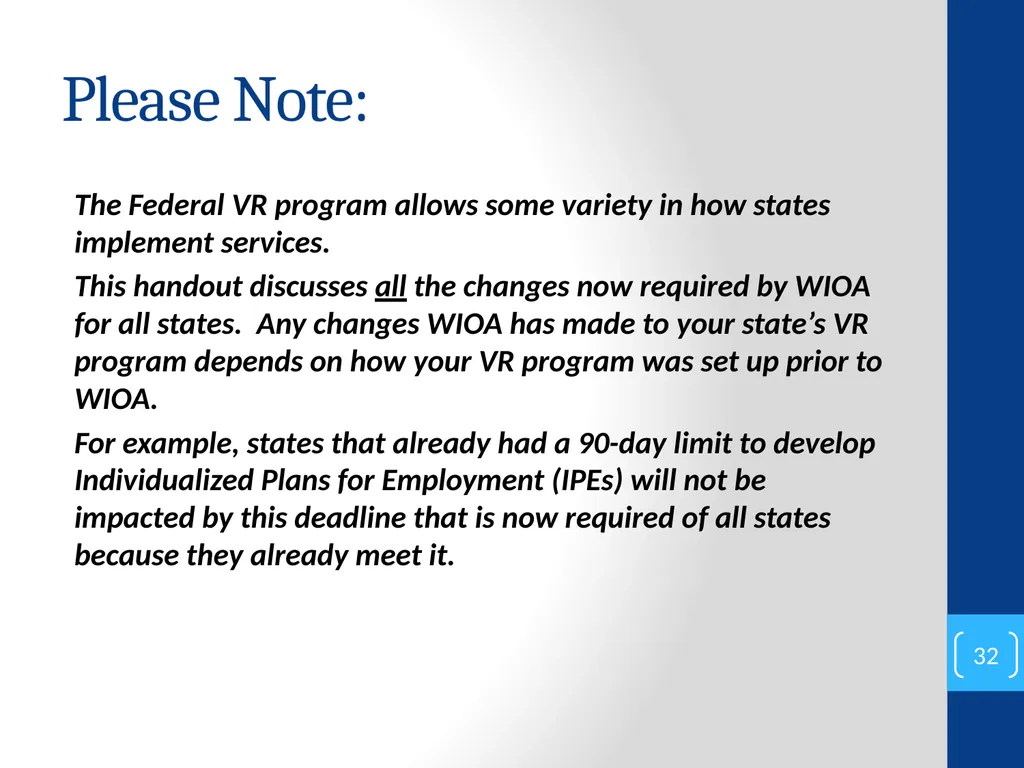
Please Note: The Federal VR program allows some variety in how states implement services.
This handout discusses all the changes now required by WIOA for all states. Any changes WIOA has made to your state’s VR program depends on how your VR program was set up prior to WIOA.
For example, states that already had a 90-day limit to develop Individualized Plans for Employment (IPEs) will not be impacted by this deadline that is now required of all states because they already meet it. 32<br>
This handout discusses all the changes now required by WIOA for all states. Any changes WIOA has made to your state’s VR program depends on how your VR program was set up prior to WIOA.
For example, states that already had a 90-day limit to develop Individualized Plans for Employment (IPEs) will not be impacted by this deadline that is now required of all states because they already meet it. 32<br>
33
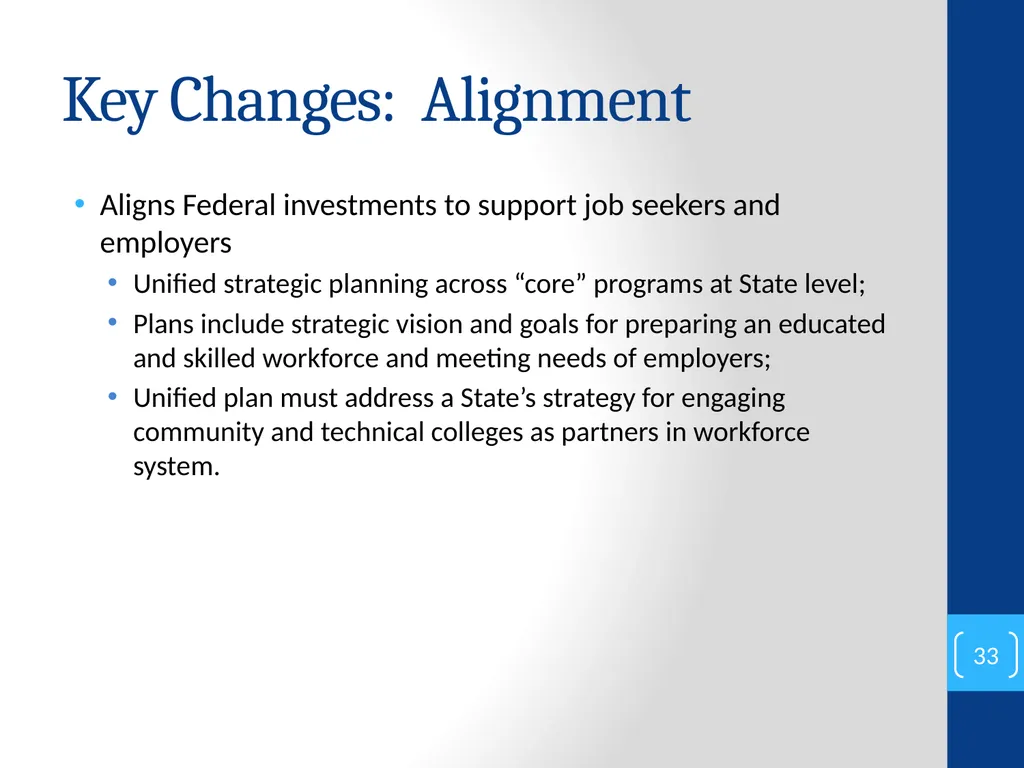
Key Changes: Alignment Aligns Federal investments to support job seekers and employers
Unified strategic planning across “core” programs at State level;
Plans include strategic vision and goals for preparing an educated and skilled workforce and meeting needs of employers;
Unified plan must address a State’s strategy for engaging community and technical colleges as partners in workforce system. 33<br>
Unified strategic planning across “core” programs at State level;
Plans include strategic vision and goals for preparing an educated and skilled workforce and meeting needs of employers;
Unified plan must address a State’s strategy for engaging community and technical colleges as partners in workforce system. 33<br>
34
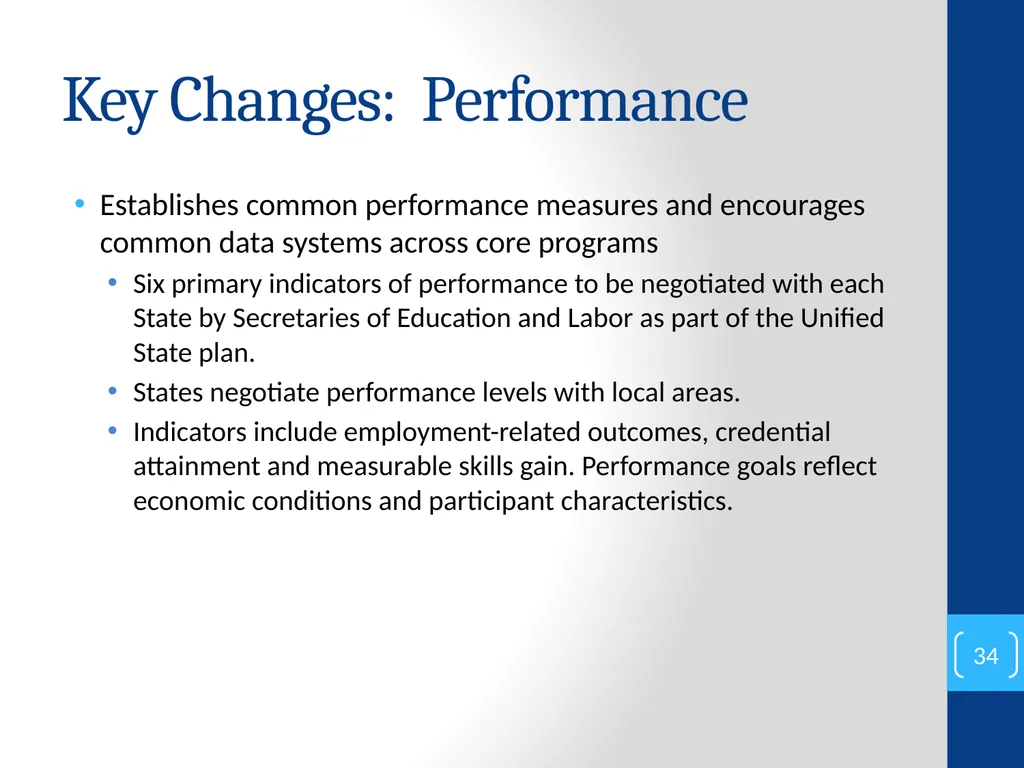
Key Changes: Performance Establishes common performance measures and encourages common data systems across core programs
Six primary indicators of performance to be negotiated with each State by Secretaries of Education and Labor as part of the Unified State plan.
States negotiate performance levels with local areas.
Indicators include employment-related outcomes, credential attainment and measurable skills gain. Performance goals reflect economic conditions and participant characteristics. 34<br>
Six primary indicators of performance to be negotiated with each State by Secretaries of Education and Labor as part of the Unified State plan.
States negotiate performance levels with local areas.
Indicators include employment-related outcomes, credential attainment and measurable skills gain. Performance goals reflect economic conditions and participant characteristics. 34<br>
35
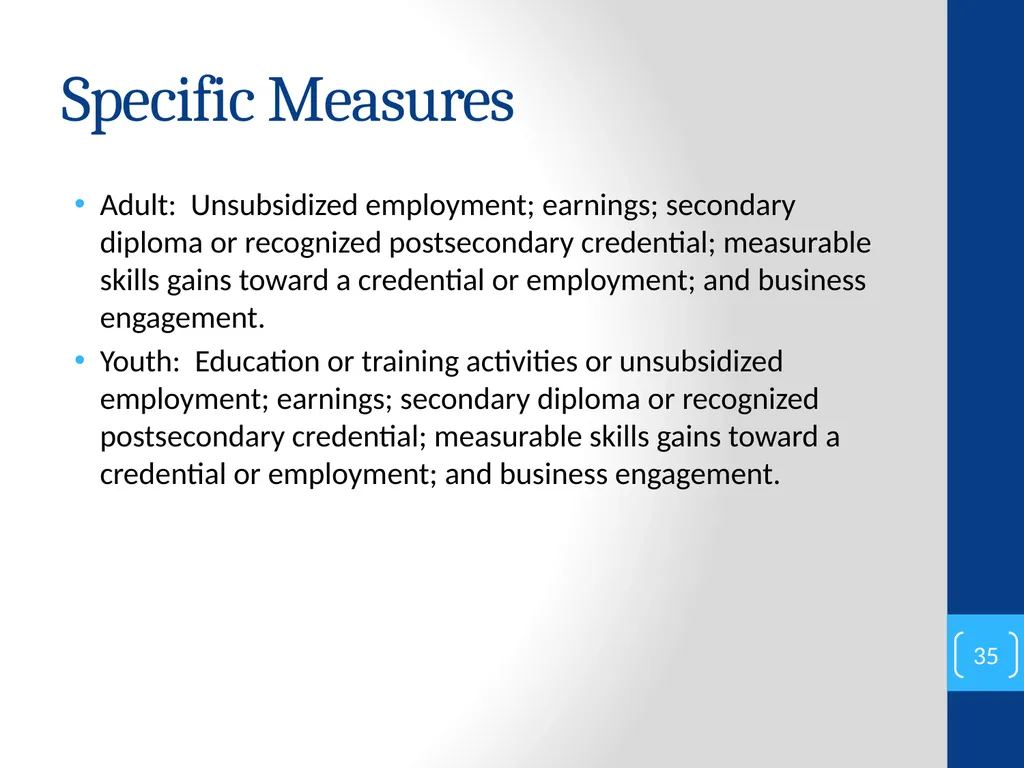
Specific Measures Adult: Unsubsidized employment; earnings; secondary diploma or recognized postsecondary credential; measurable skills gains toward a credential or employment; and business engagement.
Youth: Education or training activities or unsubsidized employment; earnings; secondary diploma or recognized postsecondary credential; measurable skills gains toward a credential or employment; and business engagement. 35<br>
Youth: Education or training activities or unsubsidized employment; earnings; secondary diploma or recognized postsecondary credential; measurable skills gains toward a credential or employment; and business engagement. 35<br>
36
Overall Emphasis Renewed commitment to workforce development with an eye to the future through innovation and support for individual, community, state and national economic growth
Increasing opportunities, particularly for those facing barriers to employment (explicitly including individuals with disabilities)
Invests in connection between education and career preparation. 36<br>
Increasing opportunities, particularly for those facing barriers to employment (explicitly including individuals with disabilities)
Invests in connection between education and career preparation. 36<br>
37
Title IV Areas of Emphasis Students with disabilities leaving school without jobs or postsecondary training, requires a focus on creating opportunities for success.
Dual customer approach, requiring addition of targeted services for employers and opportunities for input by employers. 37<br>
Dual customer approach, requiring addition of targeted services for employers and opportunities for input by employers. 37<br>
38
Key Changes: Employment Emphasizes achievement of competitive integrated employment through:
Customized employment;
Supported employment; and
Individualized services.
Emphasizes career advancement through graduate degrees, particularly in STEM careers. 38<br>
Customized employment;
Supported employment; and
Individualized services.
Emphasizes career advancement through graduate degrees, particularly in STEM careers. 38<br>
39
Key Changes: Dual Customer Expands VR focus on employer engagement to provide work-based learning experiences and to identify competitive integrated employment opportunities for individuals with disabilities in the job-driven workforce
VR portion of the Unified Plan must describe how VR agencies will work with employers to accomplish these aims;
VR agencies will assist individuals with disabilities to gain the skills and training to promote careers matching employers’ needs;
Work-based learning includes internships and apprenticeships. 39<br>
VR portion of the Unified Plan must describe how VR agencies will work with employers to accomplish these aims;
VR agencies will assist individuals with disabilities to gain the skills and training to promote careers matching employers’ needs;
Work-based learning includes internships and apprenticeships. 39<br>
40
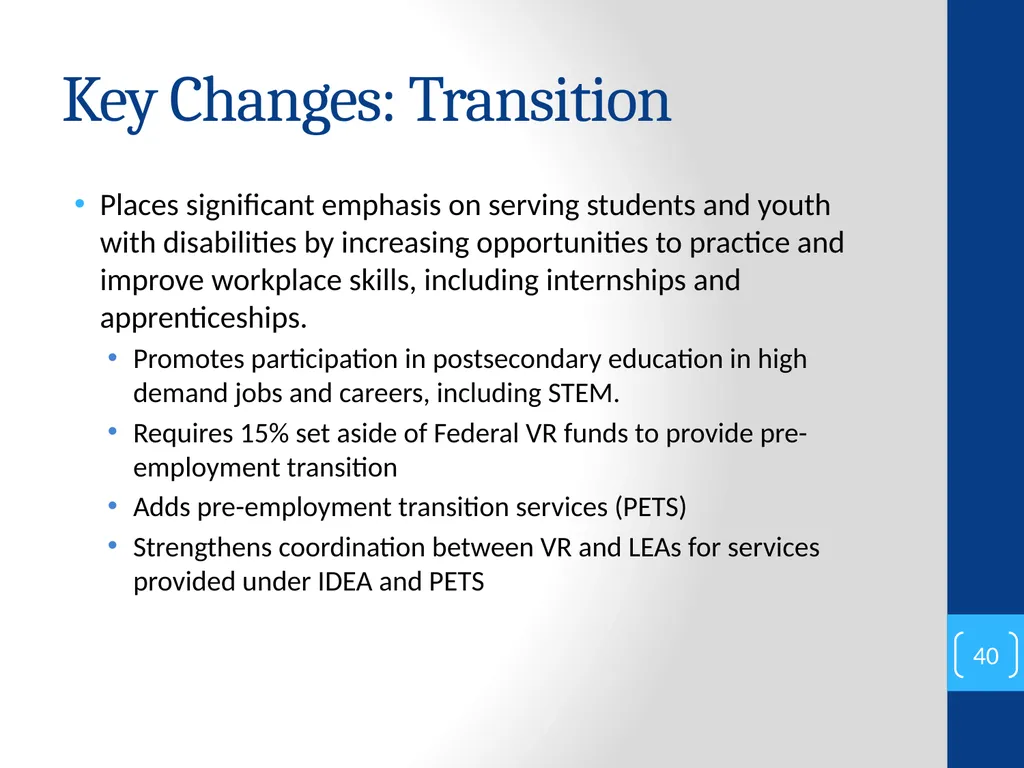
Key Changes: Transition Places significant emphasis on serving students and youth with disabilities by increasing opportunities to practice and improve workplace skills, including internships and apprenticeships.
Promotes participation in postsecondary education in high demand jobs and careers, including STEM.
Requires 15% set aside of Federal VR funds to provide pre-employment transition
Adds pre-employment transition services (PETS)
Strengthens coordination between VR and LEAs for services provided under IDEA and PETS 40<br>
Promotes participation in postsecondary education in high demand jobs and careers, including STEM.
Requires 15% set aside of Federal VR funds to provide pre-employment transition
Adds pre-employment transition services (PETS)
Strengthens coordination between VR and LEAs for services provided under IDEA and PETS 40<br>
41
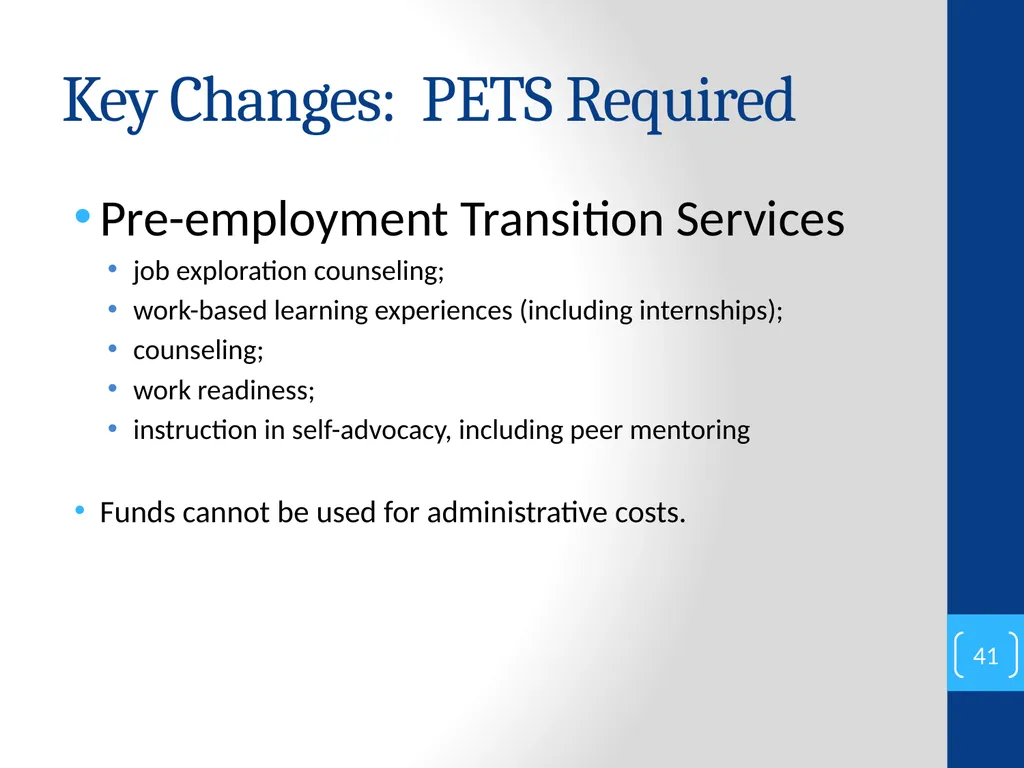
Key Changes: PETS Required Pre-employment Transition Services
job exploration counseling;
work-based learning experiences (including internships);
counseling;
work readiness;
instruction in self-advocacy, including peer mentoring
Funds cannot be used for administrative costs. 41<br>
job exploration counseling;
work-based learning experiences (including internships);
counseling;
work readiness;
instruction in self-advocacy, including peer mentoring
Funds cannot be used for administrative costs. 41<br>
42
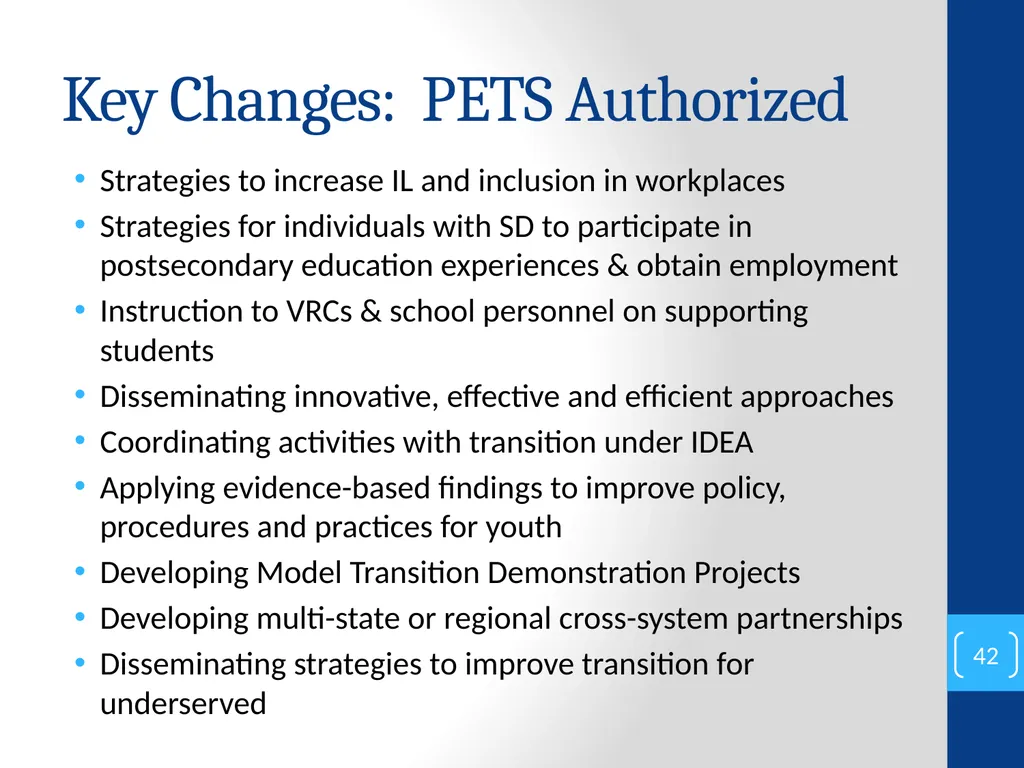
Key Changes: PETS Authorized Strategies to increase IL and inclusion in workplaces
Strategies for individuals with SD to participate in postsecondary education experiences & obtain employment
Instruction to VRCs & school personnel on supporting students
Disseminating innovative, effective and efficient approaches
Coordinating activities with transition under IDEA
Applying evidence-based findings to improve policy, procedures and practices for youth
Developing Model Transition Demonstration Projects
Developing multi-state or regional cross-system partnerships
Disseminating strategies to improve transition for underserved 42<br>
Strategies for individuals with SD to participate in postsecondary education experiences & obtain employment
Instruction to VRCs & school personnel on supporting students
Disseminating innovative, effective and efficient approaches
Coordinating activities with transition under IDEA
Applying evidence-based findings to improve policy, procedures and practices for youth
Developing Model Transition Demonstration Projects
Developing multi-state or regional cross-system partnerships
Disseminating strategies to improve transition for underserved 42<br>
43
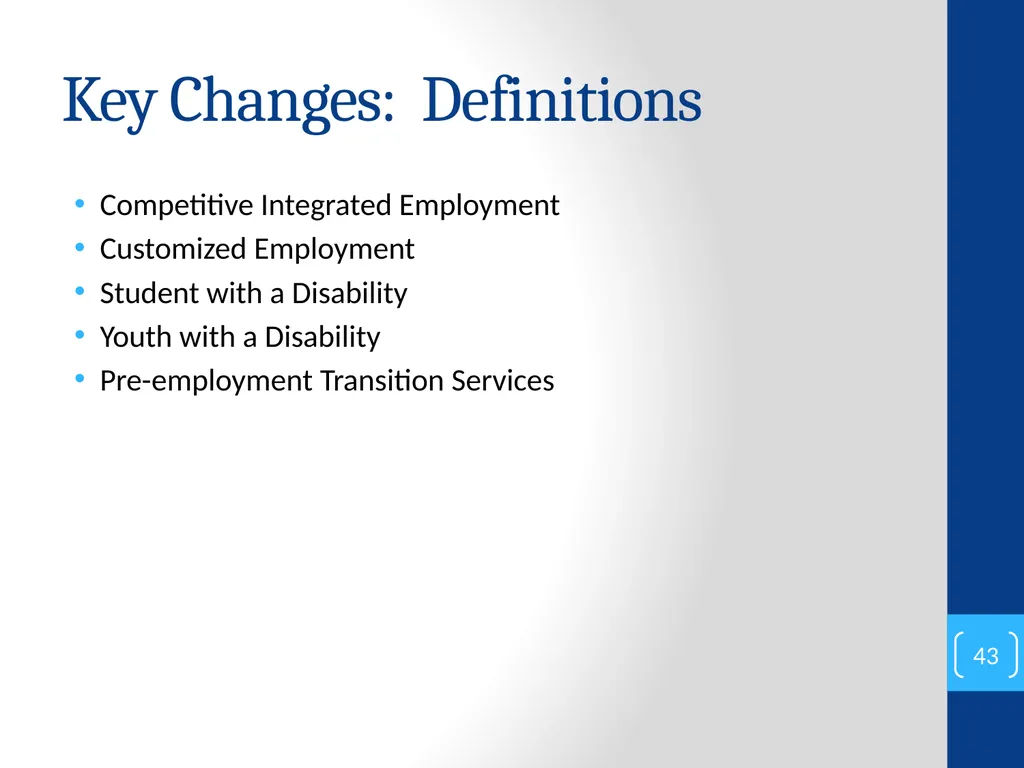
Key Changes: Definitions Competitive Integrated Employment
Customized Employment
Student with a Disability
Youth with a Disability
Pre-employment Transition Services 43<br>
Customized Employment
Student with a Disability
Youth with a Disability
Pre-employment Transition Services 43<br>
44
Key Changes: State Plan VR State plan is now the VR portion of the Unified State Plan in title I of WIOA.
VR portion includes additional descriptions on how the VR agency will work with employers to identify competitive integrated employment opportunities for individuals with disabilities. 44<br>
VR portion includes additional descriptions on how the VR agency will work with employers to identify competitive integrated employment opportunities for individuals with disabilities. 44<br>
45
Key Changes: Miscellaneous WIOA permits States under an OOS to elect to serve eligible individuals who require specific services or equipment to maintain employment.
Timeline for IPE development is as soon as possible, but not later than 90 days after the determination of eligibility, unless the individual and VR counselor agree to a specific extension.
Reporting requirements now include open-case data on some elements (training/PETS).
Emphasizes use of AT and coordination with state programs under the AT Act. 45<br>
Timeline for IPE development is as soon as possible, but not later than 90 days after the determination of eligibility, unless the individual and VR counselor agree to a specific extension.
Reporting requirements now include open-case data on some elements (training/PETS).
Emphasizes use of AT and coordination with state programs under the AT Act. 45<br>
46
Key Changes: VR Services Emphasis on customized employment
Revisions to the “Services to Groups” provisions to increase flexibility
Transition services
AT demos, loan programs and financing
Services to businesses 46<br>
Revisions to the “Services to Groups” provisions to increase flexibility
Transition services
AT demos, loan programs and financing
Services to businesses 46<br>
47
Key Changes: CSPD Requires that personnel have a 21st century understanding of the evolving labor force and the needs of individuals with disabilities.
Requires the DSU to describe in its CSPD the continuing education of rehabilitation professionals and para-professionals, particularly with respect to rehabilitation technology.
Eliminates the requirement in the VR portion of the plan that VR agencies describe the steps to be taken to retrain or hire personnel to meet the appropriate professional requirements in the State. 47<br>
Requires the DSU to describe in its CSPD the continuing education of rehabilitation professionals and para-professionals, particularly with respect to rehabilitation technology.
Eliminates the requirement in the VR portion of the plan that VR agencies describe the steps to be taken to retrain or hire personnel to meet the appropriate professional requirements in the State. 47<br>
48
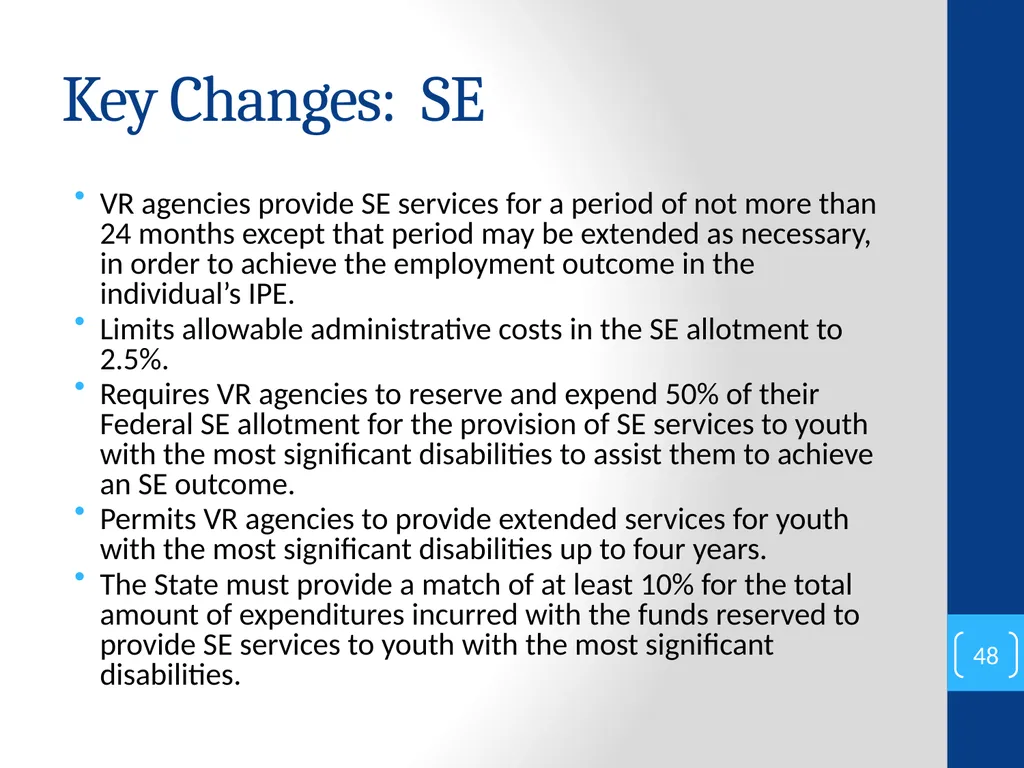
Key Changes: SE VR agencies provide SE services for a period of not more than 24 months except that period may be extended as necessary, in order to achieve the employment outcome in the individual’s IPE.
Limits allowable administrative costs in the SE allotment to 2.5%.
Requires VR agencies to reserve and expend 50% of their Federal SE allotment for the provision of SE services to youth with the most significant disabilities to assist them to achieve an SE outcome.
Permits VR agencies to provide extended services for youth with the most significant disabilities up to four years.
The State must provide a match of at least 10% for the total amount of expenditures incurred with the funds reserved to provide SE services to youth with the most significant disabilities. 48<br>
Limits allowable administrative costs in the SE allotment to 2.5%.
Requires VR agencies to reserve and expend 50% of their Federal SE allotment for the provision of SE services to youth with the most significant disabilities to assist them to achieve an SE outcome.
Permits VR agencies to provide extended services for youth with the most significant disabilities up to four years.
The State must provide a match of at least 10% for the total amount of expenditures incurred with the funds reserved to provide SE services to youth with the most significant disabilities. 48<br>
49
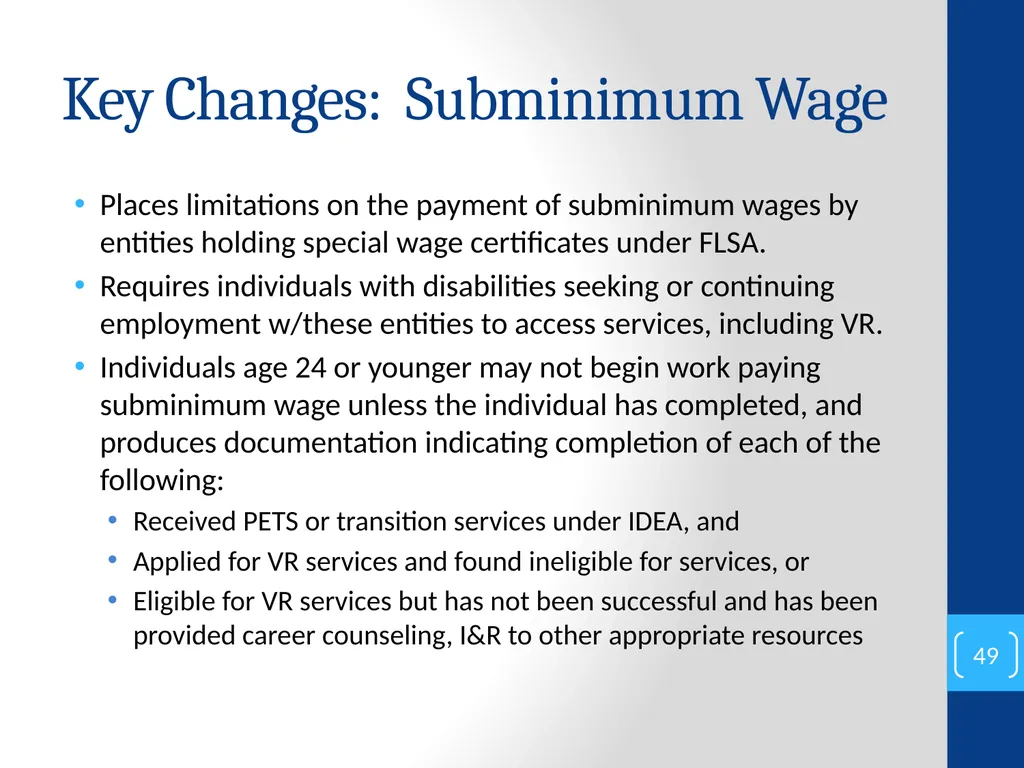
Key Changes: Subminimum Wage Places limitations on the payment of subminimum wages by entities holding special wage certificates under FLSA.
Requires individuals with disabilities seeking or continuing employment w/these entities to access services, including VR.
Individuals age 24 or younger may not begin work paying subminimum wage unless the individual has completed, and produces documentation indicating completion of each of the following:
Received PETS or transition services under IDEA, and
Applied for VR services and found ineligible for services, or
Eligible for VR services but has not been successful and has been provided career counseling, I&R to other appropriate resources 49<br>
Requires individuals with disabilities seeking or continuing employment w/these entities to access services, including VR.
Individuals age 24 or younger may not begin work paying subminimum wage unless the individual has completed, and produces documentation indicating completion of each of the following:
Received PETS or transition services under IDEA, and
Applied for VR services and found ineligible for services, or
Eligible for VR services but has not been successful and has been provided career counseling, I&R to other appropriate resources 49<br>
50
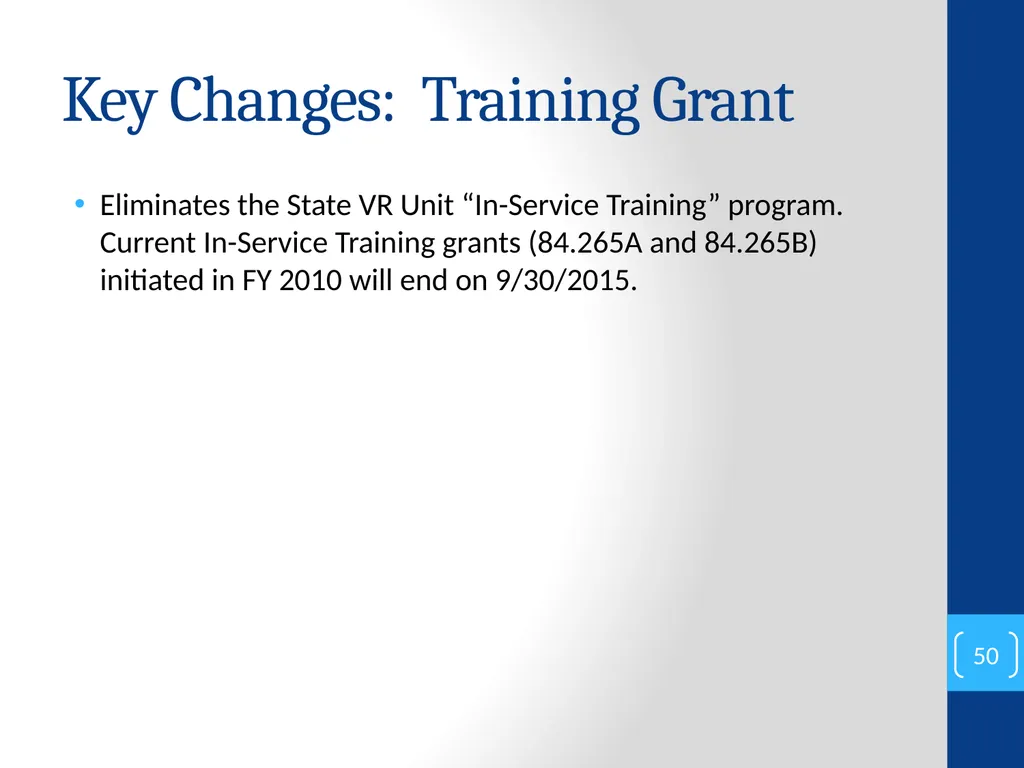
Key Changes: Training Grant Eliminates the State VR Unit “In-Service Training” program. Current In-Service Training grants (84.265A and 84.265B) initiated in FY 2010 will end on 9/30/2015. 50<br>
51
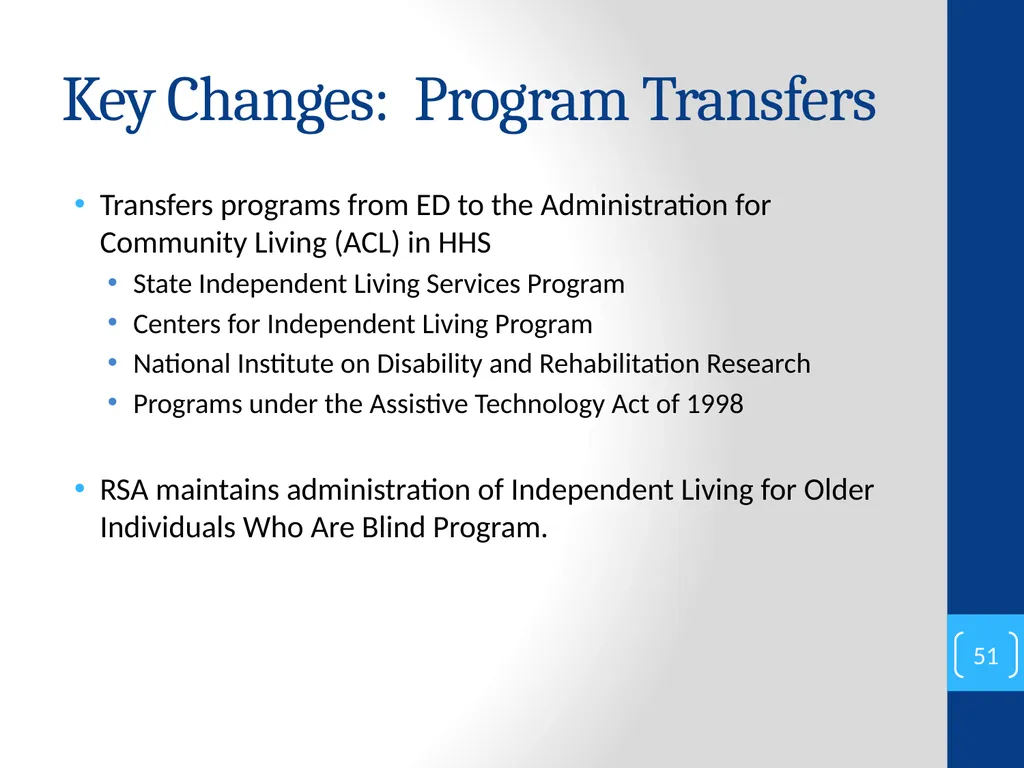
Key Changes: Program Transfers Transfers programs from ED to the Administration for Community Living (ACL) in HHS
State Independent Living Services Program
Centers for Independent Living Program
National Institute on Disability and Rehabilitation Research
Programs under the Assistive Technology Act of 1998
RSA maintains administration of Independent Living for Older Individuals Who Are Blind Program. 51<br>
State Independent Living Services Program
Centers for Independent Living Program
National Institute on Disability and Rehabilitation Research
Programs under the Assistive Technology Act of 1998
RSA maintains administration of Independent Living for Older Individuals Who Are Blind Program. 51<br>
52
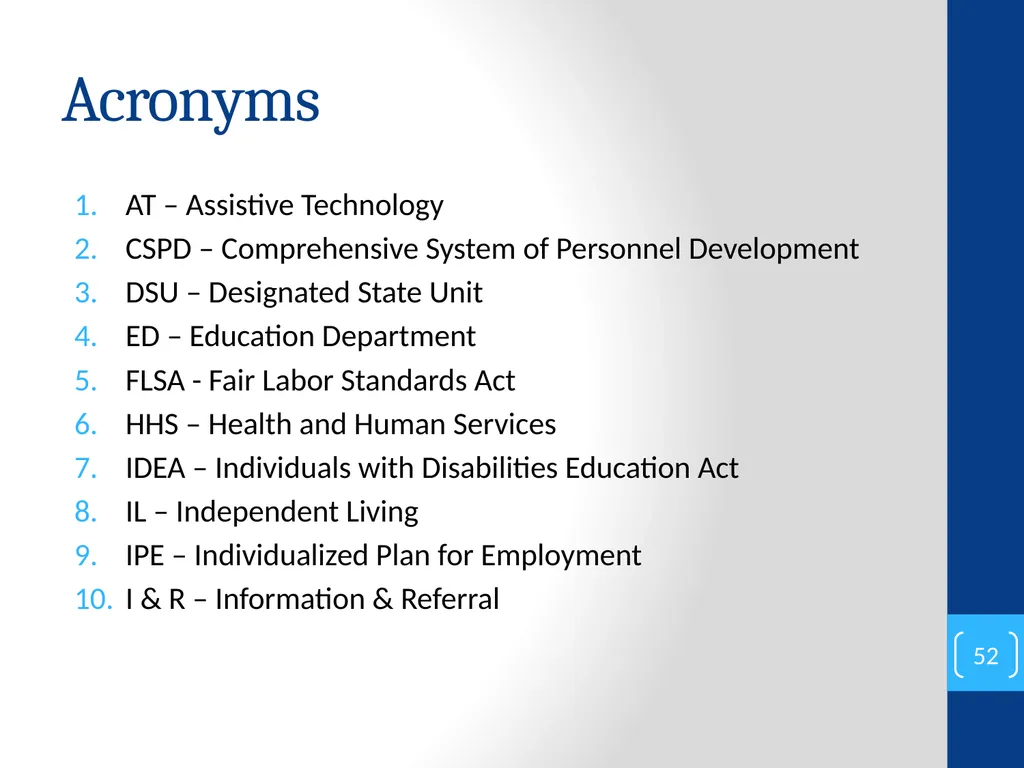
Acronyms AT – Assistive Technology
CSPD – Comprehensive System of Personnel Development
DSU – Designated State Unit
ED – Education Department
FLSA - Fair Labor Standards Act
HHS – Health and Human Services
IDEA – Individuals with Disabilities Education Act
IL – Independent Living
IPE – Individualized Plan for Employment
I & R – Information & Referral 52<br>
CSPD – Comprehensive System of Personnel Development
DSU – Designated State Unit
ED – Education Department
FLSA - Fair Labor Standards Act
HHS – Health and Human Services
IDEA – Individuals with Disabilities Education Act
IL – Independent Living
IPE – Individualized Plan for Employment
I & R – Information & Referral 52<br>
53
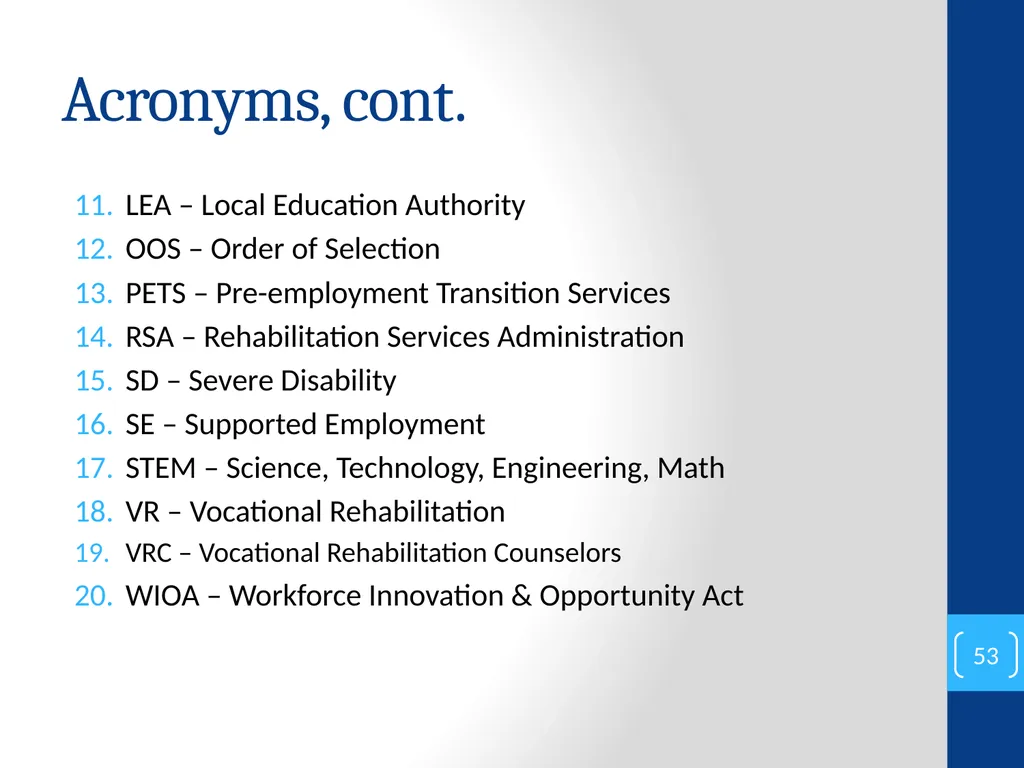
Acronyms, cont. LEA – Local Education Authority
OOS – Order of Selection
PETS – Pre-employment Transition Services
RSA – Rehabilitation Services Administration
SD – Severe Disability
SE – Supported Employment
STEM – Science, Technology, Engineering, Math
VR – Vocational Rehabilitation
VRC – Vocational Rehabilitation Counselors
WIOA – Workforce Innovation & Opportunity Act 53<br>
OOS – Order of Selection
PETS – Pre-employment Transition Services
RSA – Rehabilitation Services Administration
SD – Severe Disability
SE – Supported Employment
STEM – Science, Technology, Engineering, Math
VR – Vocational Rehabilitation
VRC – Vocational Rehabilitation Counselors
WIOA – Workforce Innovation & Opportunity Act 53<br>
54
RespectAbilityUSA
Jennifer Laszlo Mizrahi - President/CEO Phillip Pauli - WIOA specialist WELCOME!<br>
55
What else do you want to know about your SRC? NCSRC BOARD MEMBER
Linda Vegoe, Wisconsin Combined SRC<br>
Linda Vegoe, Wisconsin Combined SRC<br>
56
THANK YOU!
See you in the morning!<br>
See you in the morning!<br>