
SRMC Fall Conference 2012 Captives, Microcaptives


Description: SRMC Fall Conference 2012 Captives, Microcaptives and More.. Presentation by: Kathryn Marsh Somers Risk Consulting kmarshsomersriskconsulting.com 1 Agenda Captive Overview Micro-captives Risk Pooling Arrangements Case Studies Steps for
Related Topics
Download Presentation
"SRMC Fall Conference 2012 Captives, Microcaptives" is the property of its rightful owner. Permission is granted to download and print the materials on this website for personal, non-commercial use only, and to display it on your personal computer provided you do not modify the materials and that you retain all copyright notices contained in the materials. By downloading content from our website, you accept the terms of this agreement.
Presentation Transcript
slide1. SRMC Fall Conference 2012
Captives,
Microcaptives and More…..
Presentation by:
Kathryn Marsh
Somers Risk Consulting
kmarsh@somersriskconsulting.com 1<br>
slide2. Agenda Captive Overview
Micro-captives
Risk Pooling Arrangements
Case Studies
Steps for Looking at the Captive Option
Q&A
Info on Somers Risk and Bio Somers Risk Consulting 2102 2<br>
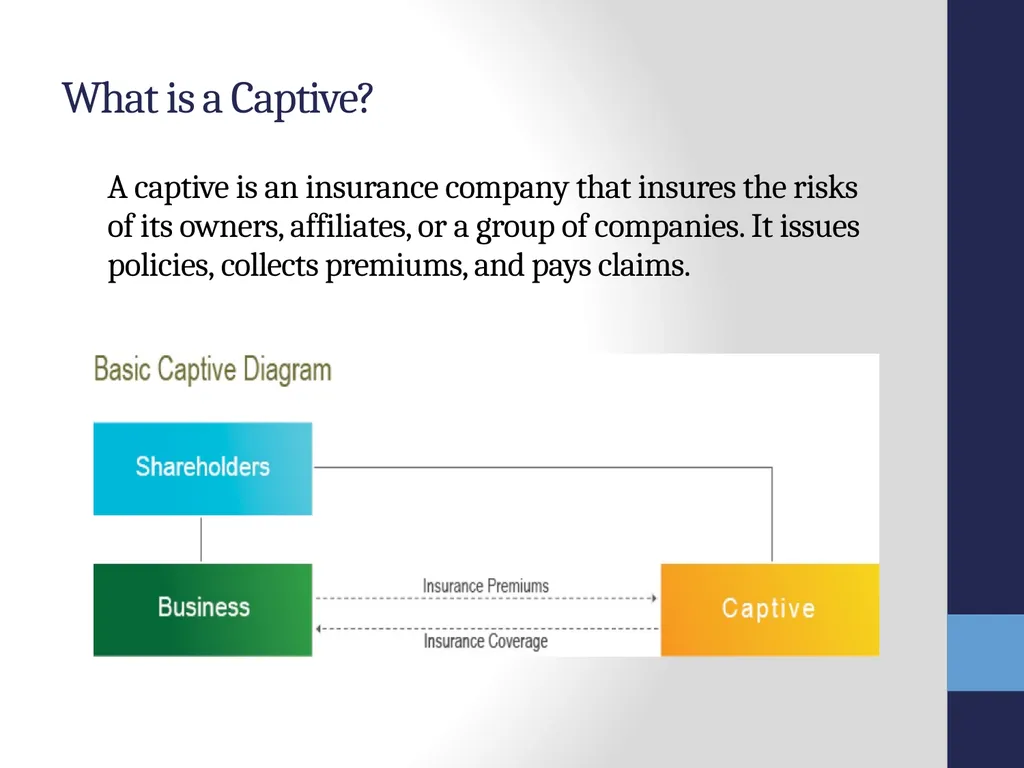
slide3. What is a Captive? A captive is an insurance company that insures the risks of its owners, affiliates, or a group of companies. It issues policies, collects premiums, and pays claims.<br>
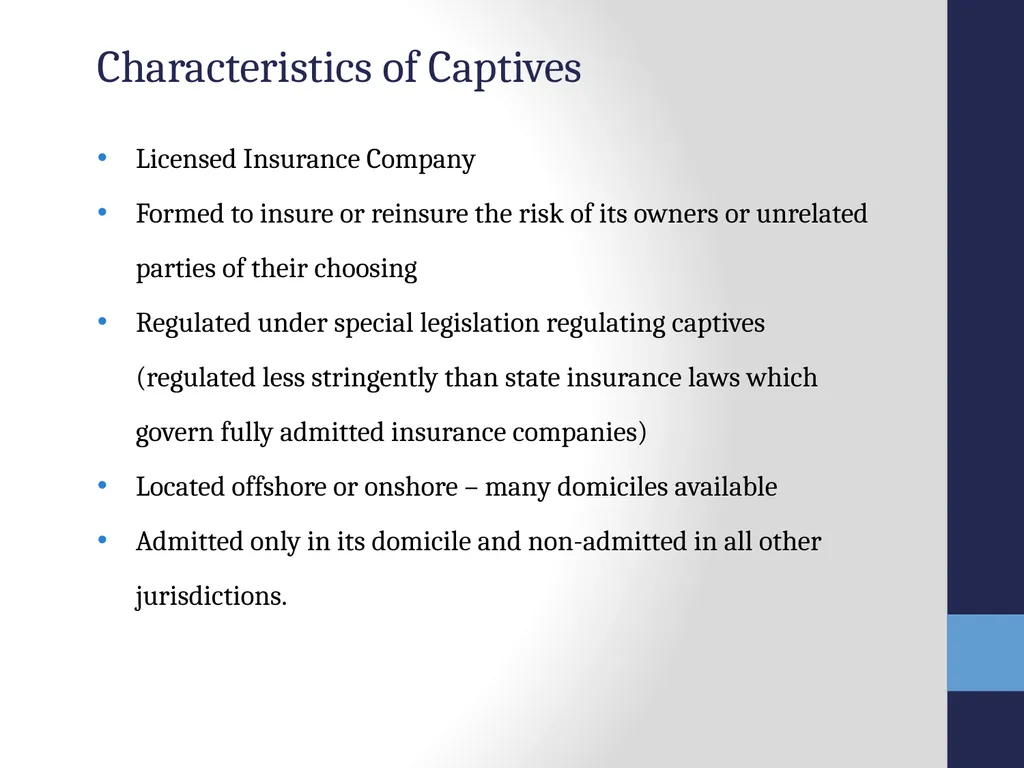
slide4. Licensed Insurance Company
Formed to insure or reinsure the risk of its owners or unrelated parties of their choosing
Regulated under special legislation regulating captives (regulated less stringently than state insurance laws which govern fully admitted insurance companies)
Located offshore or onshore – many domiciles available
Admitted only in its domicile and non-admitted in all other jurisdictions. Characteristics of Captives<br>
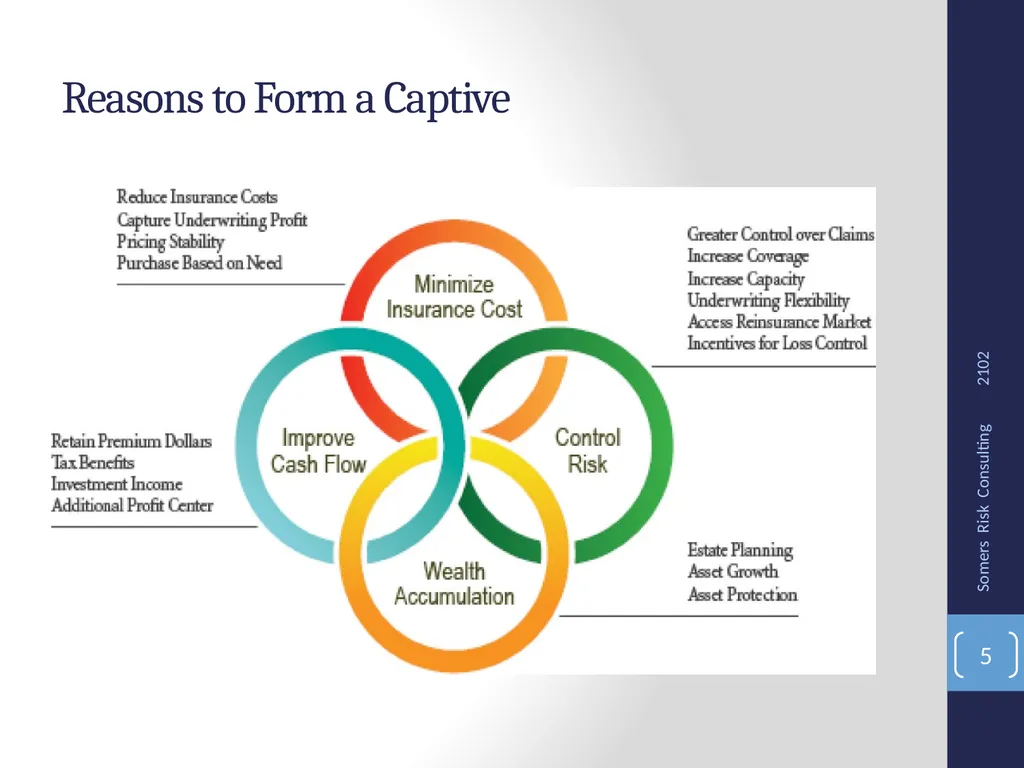
slide5. Reasons to Form a Captive Somers Risk Consulting 2102 5<br>
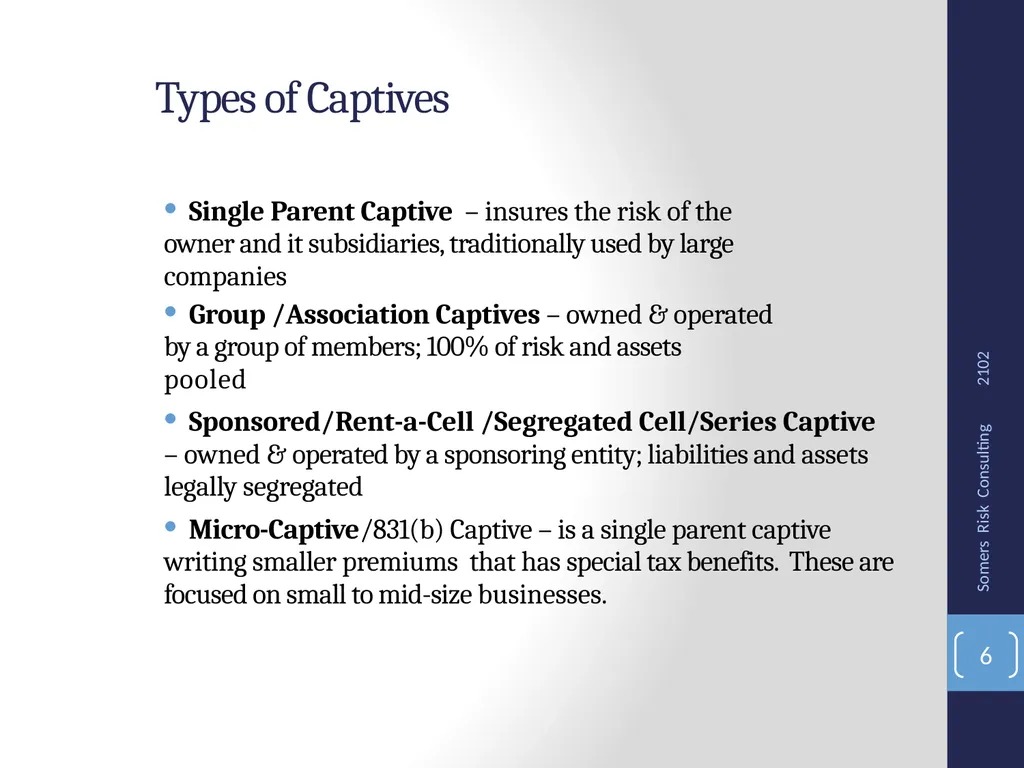
slide6. Types of Captives Single Parent Captive – insures the risk of the
owner and it subsidiaries, traditionally used by large
companies
Group /Association Captives – owned & operated
by a group of members; 100% of risk and assets
pooled
Sponsored/Rent-a-Cell /Segregated Cell/Series Captive – owned & operated by a sponsoring entity; liabilities and assets legally segregated
Micro-Captive/831(b) Captive – is a single parent captive writing smaller premiums that has special tax benefits. These are focused on small to mid-size businesses. Somers Risk Consulting 2102 6<br>
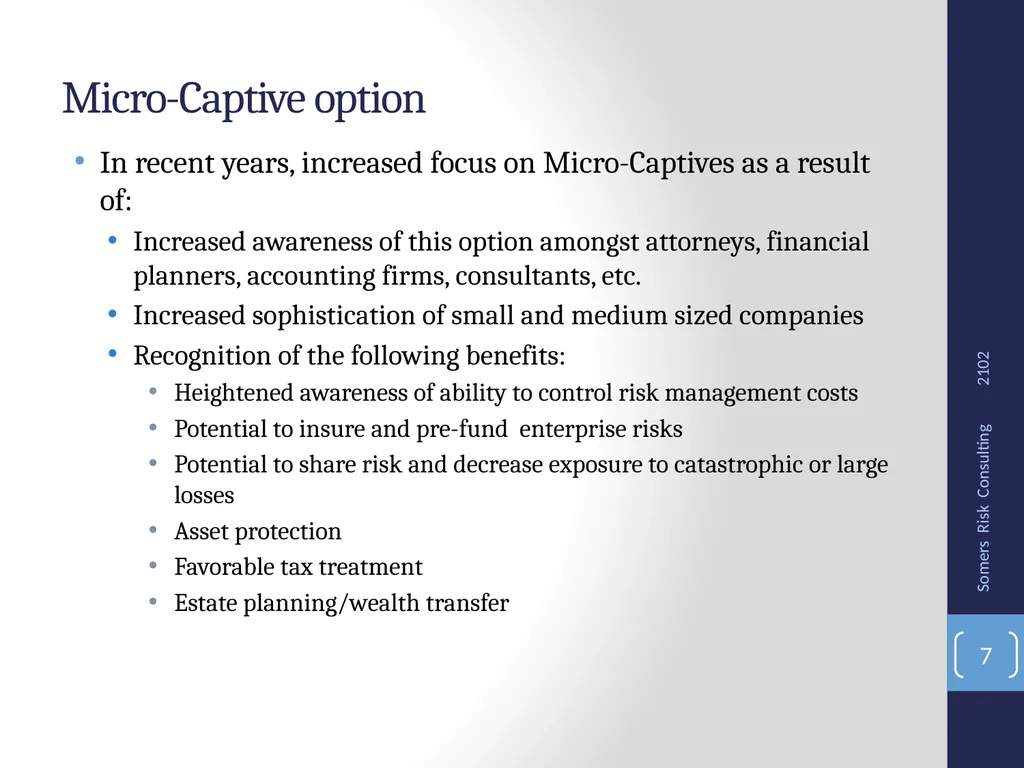
slide7. Micro-Captive option In recent years, increased focus on Micro-Captives as a result of:
Increased awareness of this option amongst attorneys, financial planners, accounting firms, consultants, etc.
Increased sophistication of small and medium sized companies
Recognition of the following benefits:
Heightened awareness of ability to control risk management costs
Potential to insure and pre-fund enterprise risks
Potential to share risk and decrease exposure to catastrophic or large losses
Asset protection
Favorable tax treatment
Estate planning/wealth transfer Somers Risk Consulting 2102 7<br>
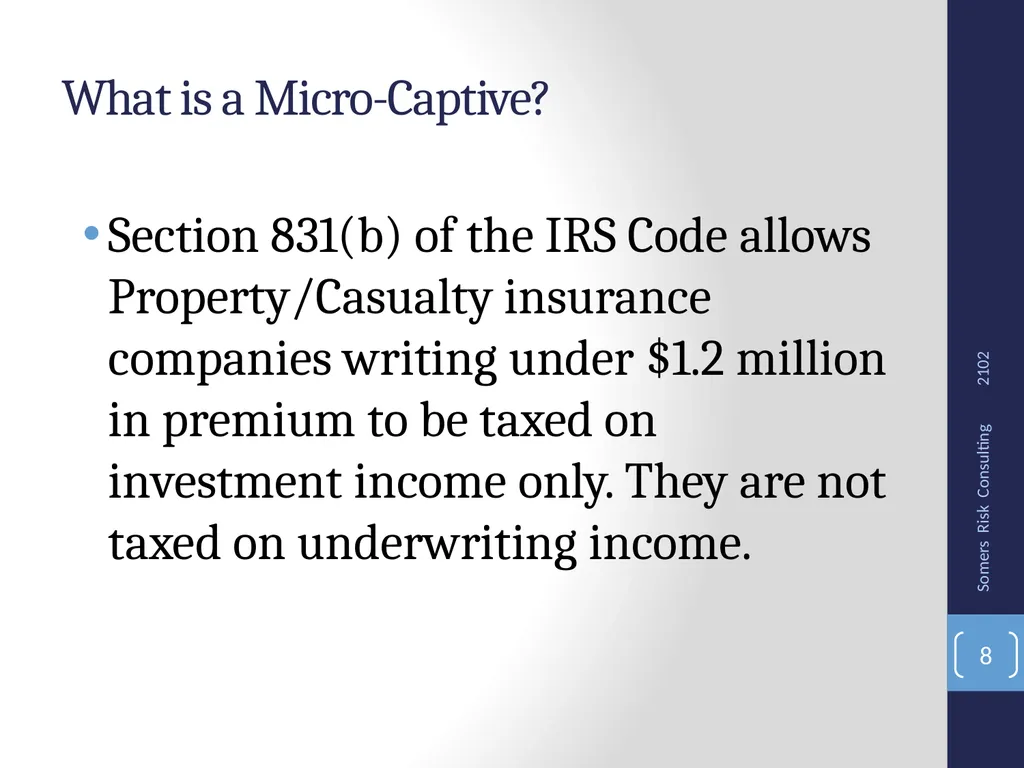
slide8. What is a Micro-Captive? Section 831(b) of the IRS Code allows Property/Casualty insurance companies writing under $1.2 million in premium to be taxed on investment income only. They are not taxed on underwriting income. Somers Risk Consulting 2102 8<br>
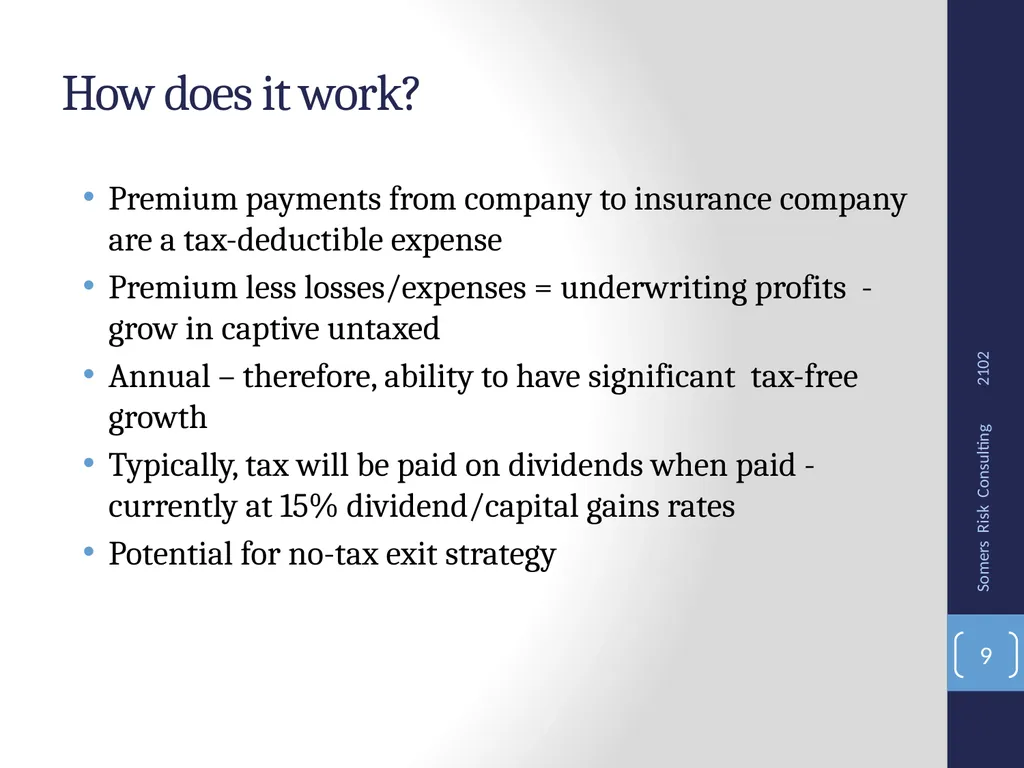
slide9. How does it work? Premium payments from company to insurance company are a tax-deductible expense
Premium less losses/expenses = underwriting profits - grow in captive untaxed
Annual – therefore, ability to have significant tax-free growth
Typically, tax will be paid on dividends when paid -currently at 15% dividend/capital gains rates
Potential for no-tax exit strategy Somers Risk Consulting 2102 9<br>
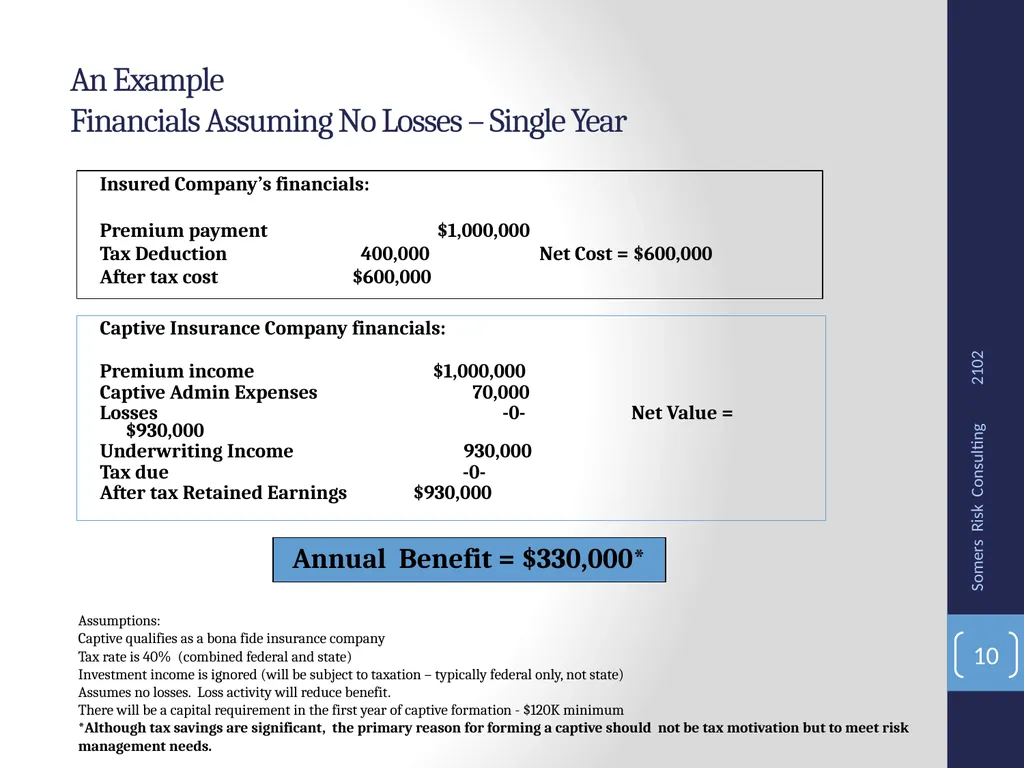
slide10. An Example Financials Assuming No Losses – Single Year Insured Company’s financials:
Premium payment $1,000,000
Tax Deduction 400,000 Net Cost = $600,000
After tax cost $600,000 Captive Insurance Company financials:
Premium income $1,000,000
Captive Admin Expenses 70,000
Losses -0- Net Value = $930,000
Underwriting Income 930,000
Tax due -0-
After tax Retained Earnings $930,000 Somers Risk Consulting 2102 10 Assumptions:
Captive qualifies as a bona fide insurance company
Tax rate is 40% (combined federal and state)
Investment income is ignored (will be subject to taxation – typically federal only, not state)
Assumes no losses. Loss activity will reduce benefit.
There will be a capital requirement in the first year of captive formation - $120K minimum
*Although tax savings are significant, the primary reason for forming a captive should not be tax motivation but to meet risk management needs.<br>
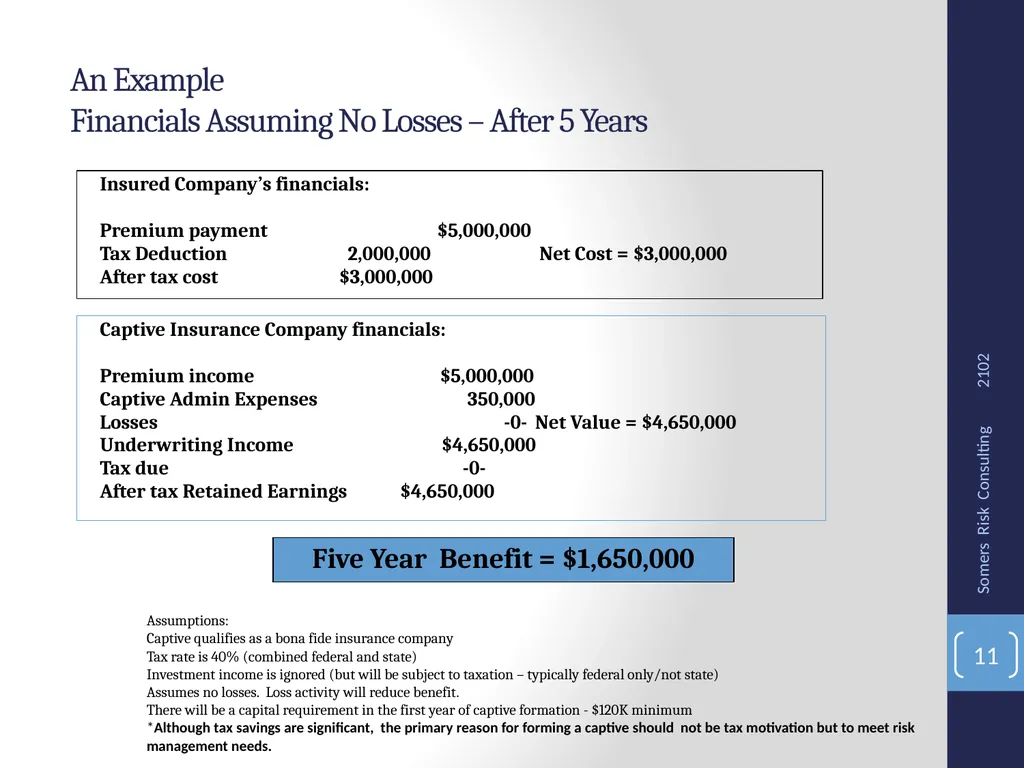
slide11. An Example Financials Assuming No Losses – After 5 Years Insured Company’s financials:
Premium payment $5,000,000
Tax Deduction 2,000,000 Net Cost = $3,000,000
After tax cost $3,000,000 Captive Insurance Company financials:
Premium income $5,000,000
Captive Admin Expenses 350,000
Losses -0- Net Value = $4,650,000
Underwriting Income $4,650,000
Tax due -0-
After tax Retained Earnings $4,650,000 Somers Risk Consulting 2102 11 Assumptions:
Captive qualifies as a bona fide insurance company
Tax rate is 40% (combined federal and state)
Investment income is ignored (but will be subject to taxation – typically federal only/not state)
Assumes no losses. Loss activity will reduce benefit.
There will be a capital requirement in the first year of captive formation - $120K minimum
*Although tax savings are significant, the primary reason for forming a captive should not be tax motivation but to meet risk management needs.<br>
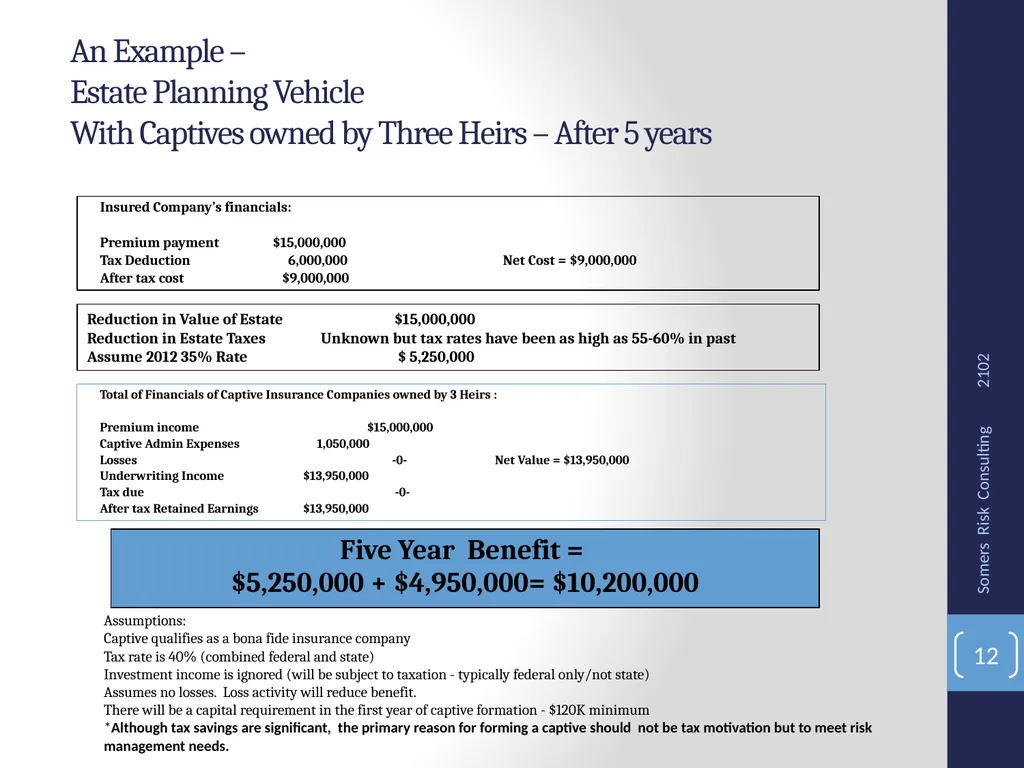
slide12. An Example – Estate Planning Vehicle With Captives owned by Three Heirs – After 5 years Insured Company’s financials:
Premium payment $15,000,000
Tax Deduction 6,000,000 Net Cost = $9,000,000
After tax cost $9,000,000 Total of Financials of Captive Insurance Companies owned by 3 Heirs :
Premium income $15,000,000
Captive Admin Expenses 1,050,000
Losses -0- Net Value = $13,950,000
Underwriting Income $13,950,000
Tax due -0-
After tax Retained Earnings $13,950,000 Somers Risk Consulting 2102 12 Assumptions:
Captive qualifies as a bona fide insurance company
Tax rate is 40% (combined federal and state)
Investment income is ignored (will be subject to taxation - typically federal only/not state)
Assumes no losses. Loss activity will reduce benefit.
There will be a capital requirement in the first year of captive formation - $120K minimum
*Although tax savings are significant, the primary reason for forming a captive should not be tax motivation but to meet risk management needs. Reduction in Value of Estate $15,000,000
Reduction in Estate Taxes Unknown but tax rates have been as high as 55-60% in past
Assume 2012 35% Rate $ 5,250,000<br>
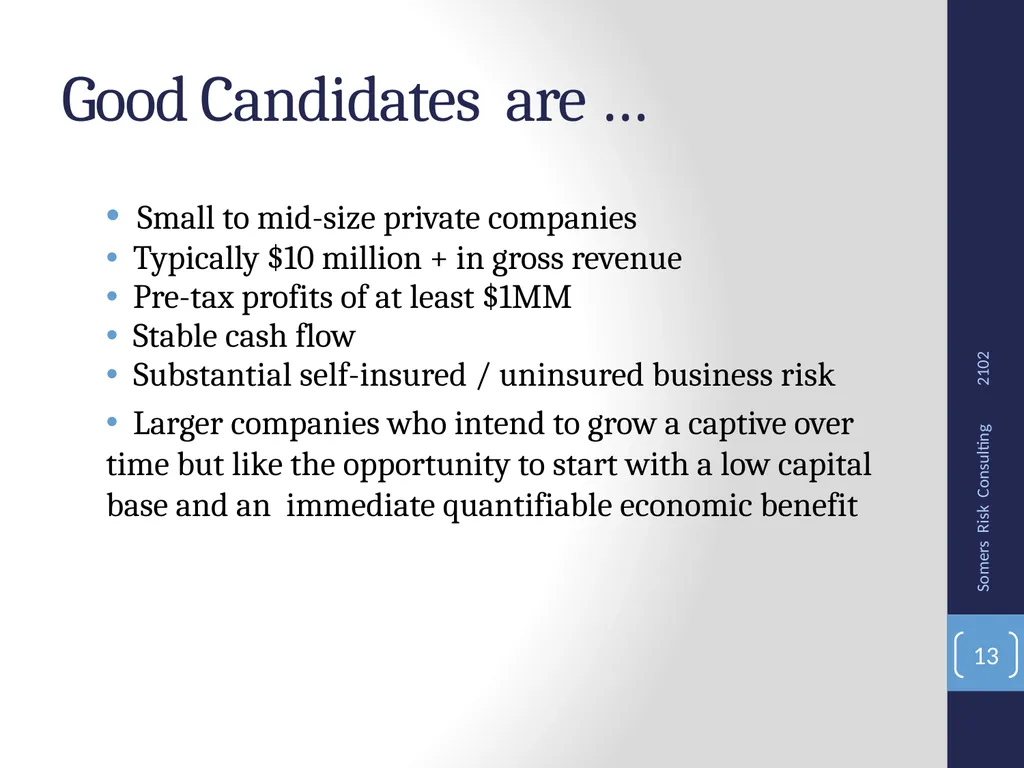
slide13. Good Candidates are … Small to mid-size private companies
Typically $10 million + in gross revenue
Pre-tax profits of at least $1MM
Stable cash flow
Substantial self-insured / uninsured business risk
Larger companies who intend to grow a captive over time but like the opportunity to start with a low capital base and an immediate quantifiable economic benefit Somers Risk Consulting 2102 13<br>
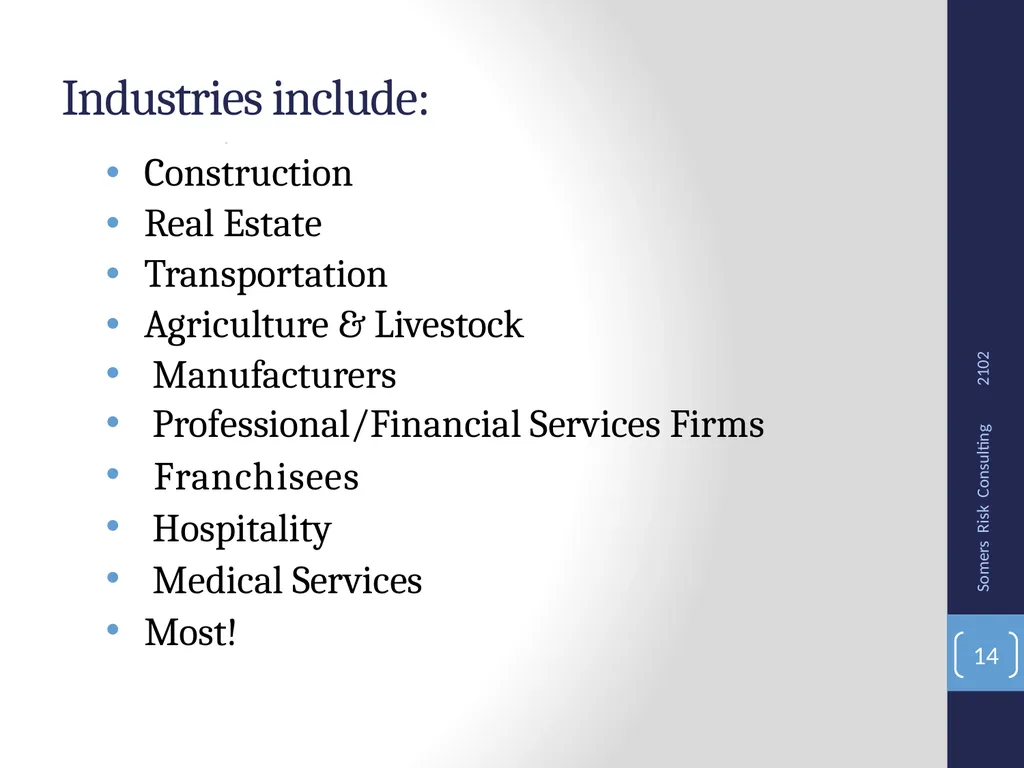
slide14. Industries include: >
Construction
Real Estate
Transportation
Agriculture & Livestock
Manufacturers
Professional/Financial Services Firms
Franchisees
Hospitality
Medical Services
Most! Somers Risk Consulting 2102 14<br>
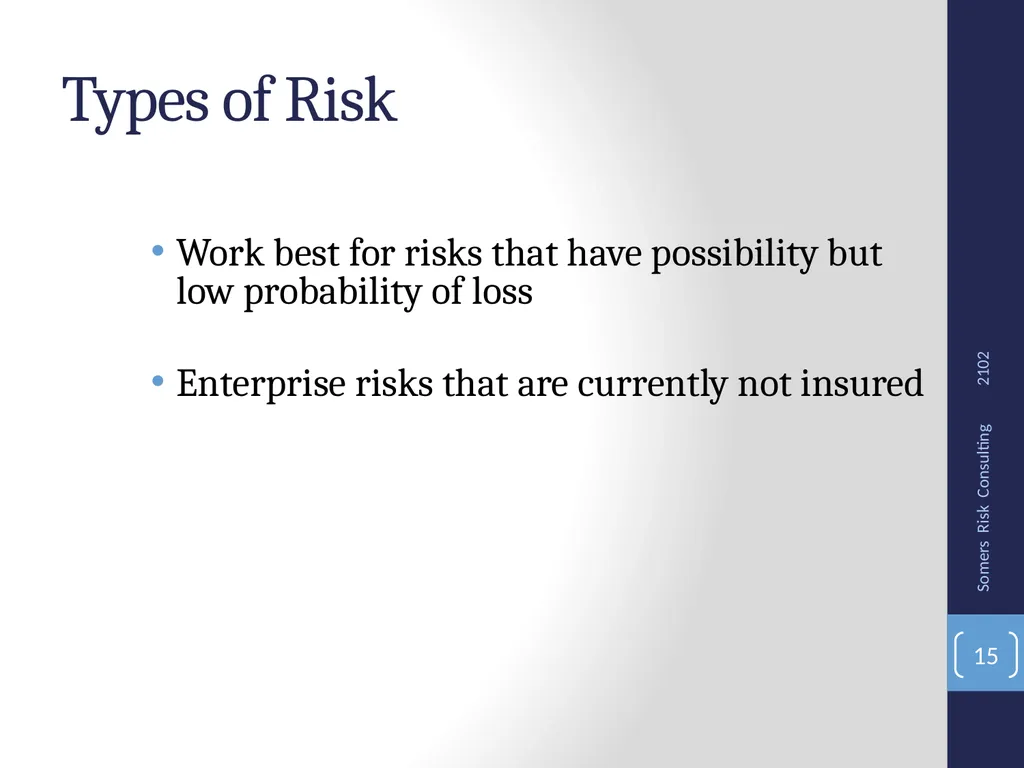
slide15. Types of Risk Work best for risks that have possibility but low probability of loss
Enterprise risks that are currently not insured Somers Risk Consulting 2102 15<br>
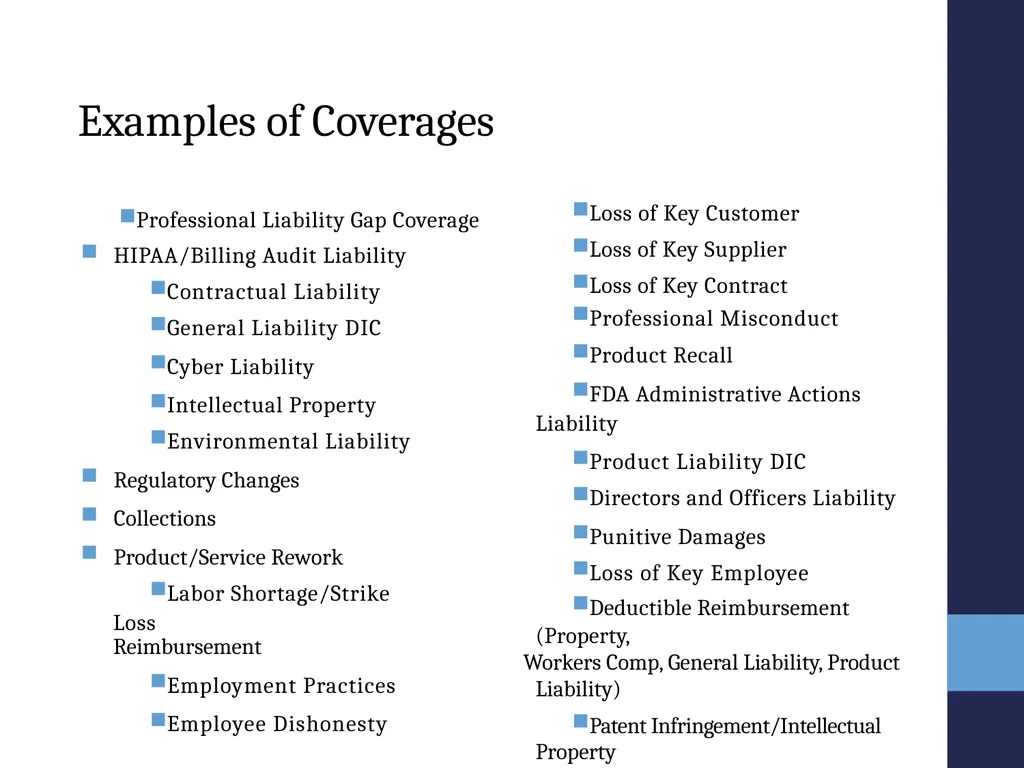
slide16. Professional Liability Gap Coverage HIPAA/Billing Audit Liability
Contractual Liability
General Liability DIC
Cyber Liability
Intellectual Property
Environmental Liability
Regulatory Changes
Collections
Product/Service Rework
Labor Shortage/Strike Loss
Reimbursement
Employment Practices
Employee Dishonesty Loss of Key Customer
Loss of Key Supplier
Loss of Key Contract
Professional Misconduct
Product Recall
FDA Administrative Actions Liability
Product Liability DIC
Directors and Officers Liability
Punitive Damages
Loss of Key Employee
Deductible Reimbursement (Property,
Workers Comp, General Liability, Product
Liability)
Patent Infringement/Intellectual
Property Examples of Coverages<br>
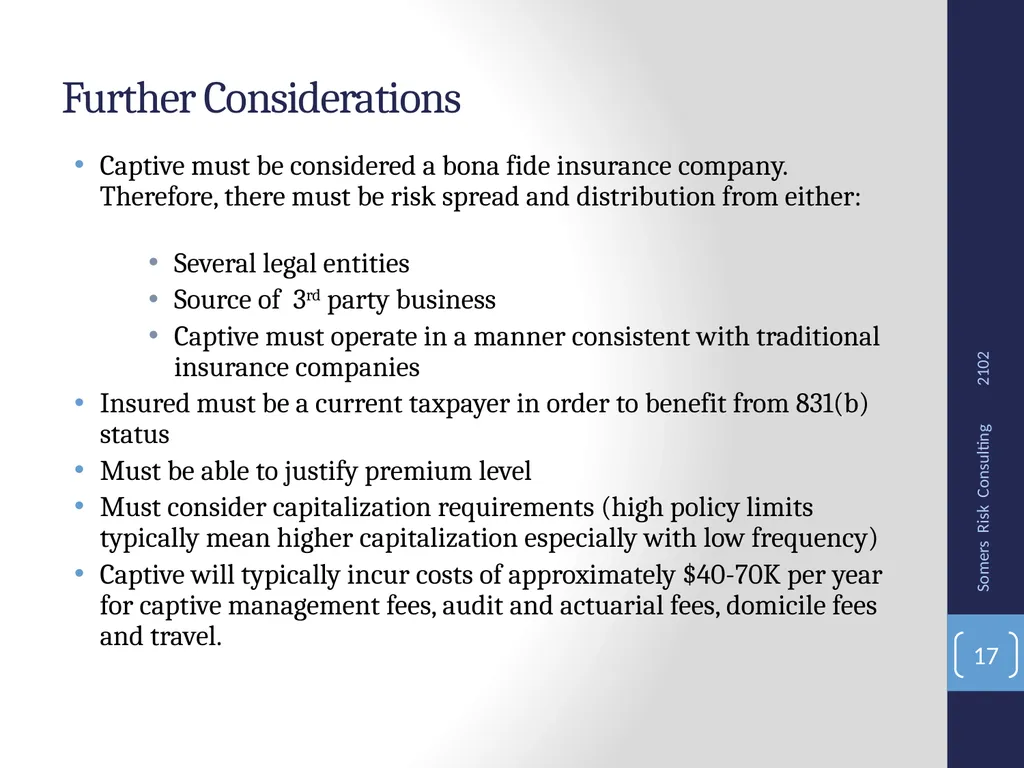
slide17. Further Considerations Captive must be considered a bona fide insurance company. Therefore, there must be risk spread and distribution from either:
Several legal entities
Source of 3rd party business
Captive must operate in a manner consistent with traditional insurance companies
Insured must be a current taxpayer in order to benefit from 831(b) status
Must be able to justify premium level
Must consider capitalization requirements (high policy limits typically mean higher capitalization especially with low frequency)
Captive will typically incur costs of approximately $40-70K per year for captive management fees, audit and actuarial fees, domicile fees and travel. Somers Risk Consulting 2102 17<br>
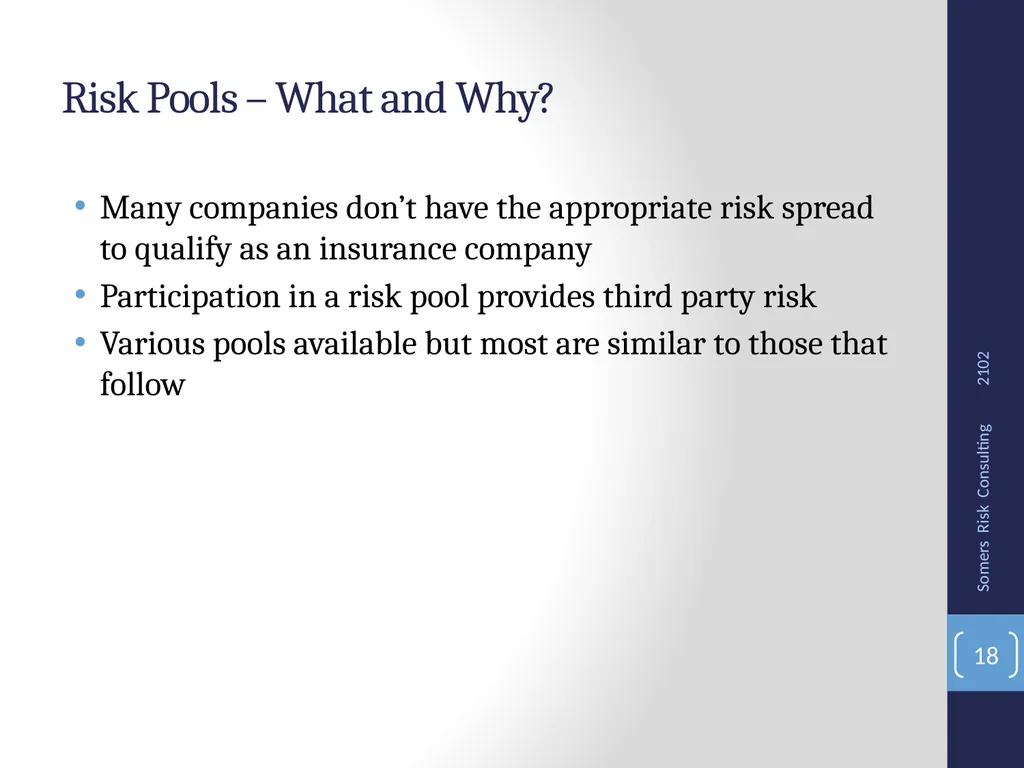
slide18. Risk Pools – What and Why? Many companies don’t have the appropriate risk spread to qualify as an insurance company
Participation in a risk pool provides third party risk
Various pools available but most are similar to those that follow Somers Risk Consulting 2102 18<br>
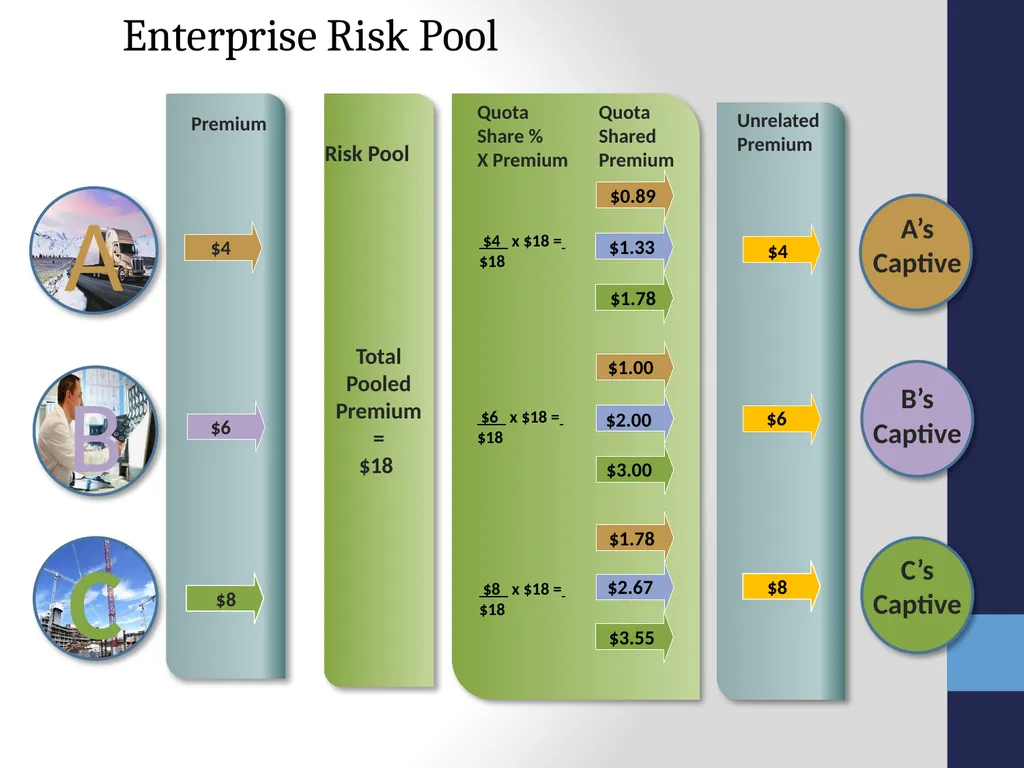
slide19. Risk Pool Total Pooled
Premium =
$18 $8 $6 Premium A B C $4 x $18 =
$18 $6 x $18 =
$18 $8 x $18 =
$18 Quota
Share %
X Premium Quota Shared Premium Unrelated Premium $1.33 $1.78 $1.00 $2.00 $3.00 $1.78 $2.67 $3.55 $8 $6 $4 $4 $0.89 A’s
Captive B’s
Captive C’s
Captive Enterprise Risk Pool<br>
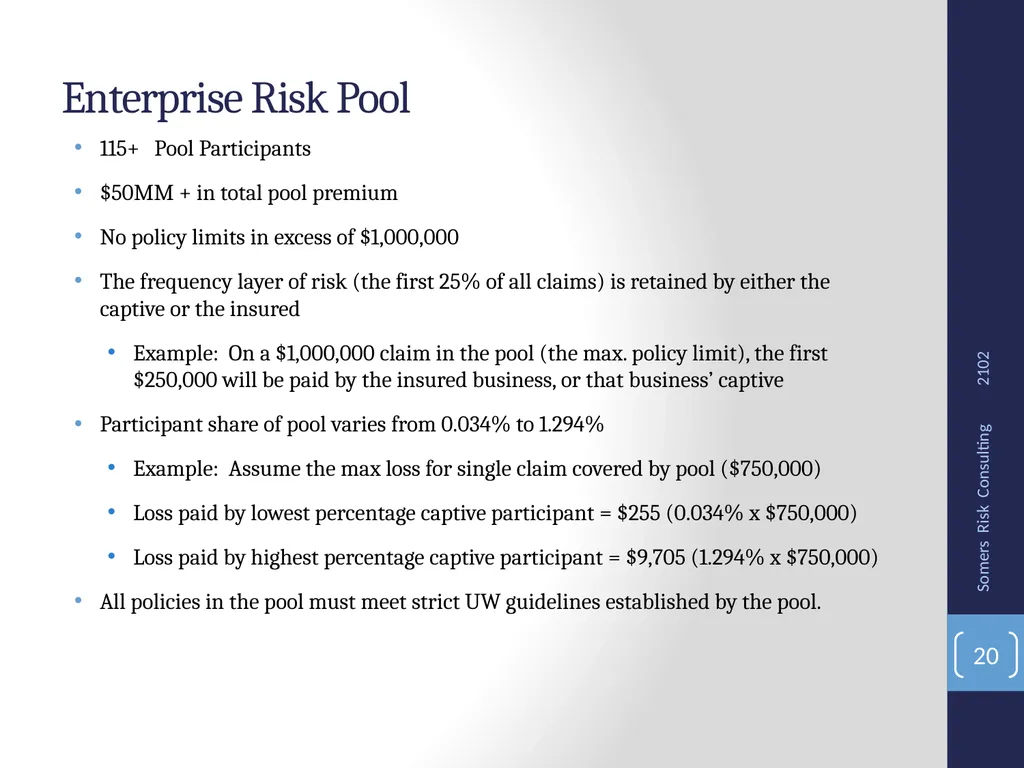
slide20. Enterprise Risk Pool 115+ Pool Participants
$50MM + in total pool premium
No policy limits in excess of $1,000,000
The frequency layer of risk (the first 25% of all claims) is retained by either the captive or the insured
Example: On a $1,000,000 claim in the pool (the max. policy limit), the first $250,000 will be paid by the insured business, or that business’ captive
Participant share of pool varies from 0.034% to 1.294%
Example: Assume the max loss for single claim covered by pool ($750,000)
Loss paid by lowest percentage captive participant = $255 (0.034% x $750,000)
Loss paid by highest percentage captive participant = $9,705 (1.294% x $750,000)
All policies in the pool must meet strict UW guidelines established by the pool. Somers Risk Consulting 2102 20<br>
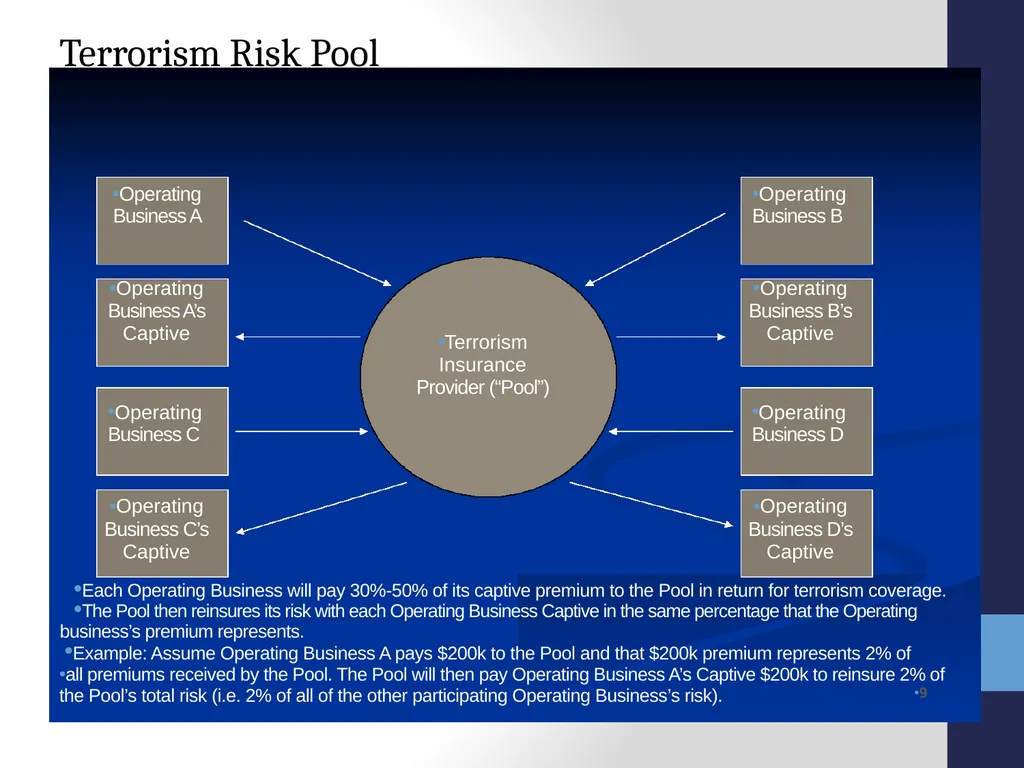
slide21. 9 all premiums received by the Pool. The Pool will then pay Operating Business A’s Captive $200k to reinsure 2% of the Pool’s total risk (i.e. 2% of all of the other participating Operating Business’s risk). Each Operating Business will pay 30%-50% of its captive premium to the Pool in return for terrorism coverage.
The Pool then reinsures its risk with each Operating Business Captive in the same percentage that the Operating business’s premium represents.
Example: Assume Operating Business A pays $200k to the Pool and that $200k premium represents 2% of Operating Business C’s Captive Operating Business A’s Captive Operating Business C Operating Business A Terrorism Insurance Provider (“Pool”) Operating Business D’s Captive Operating Business B’s Captive Operating Business D Operating Business B Terrorism Risk Pool<br>
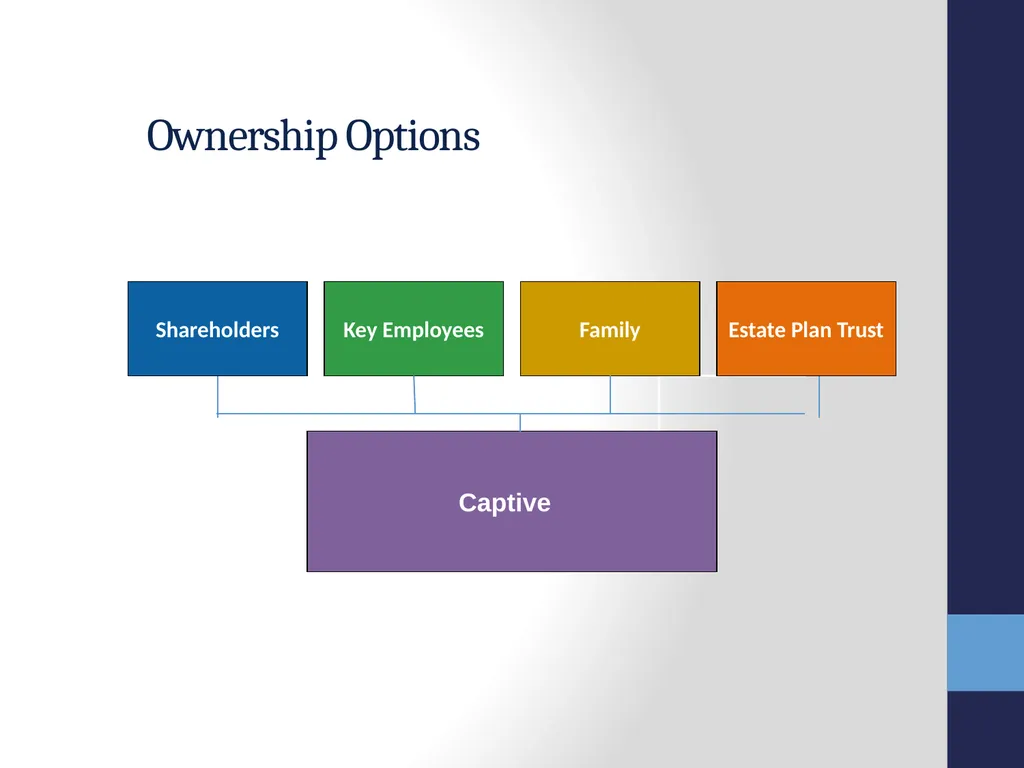
slide22. Captive Shareholders Family Key Employees Estate Plan Trust Captive Shareholders Family Key Employees Estate Plan Trust Ownership Options<br>
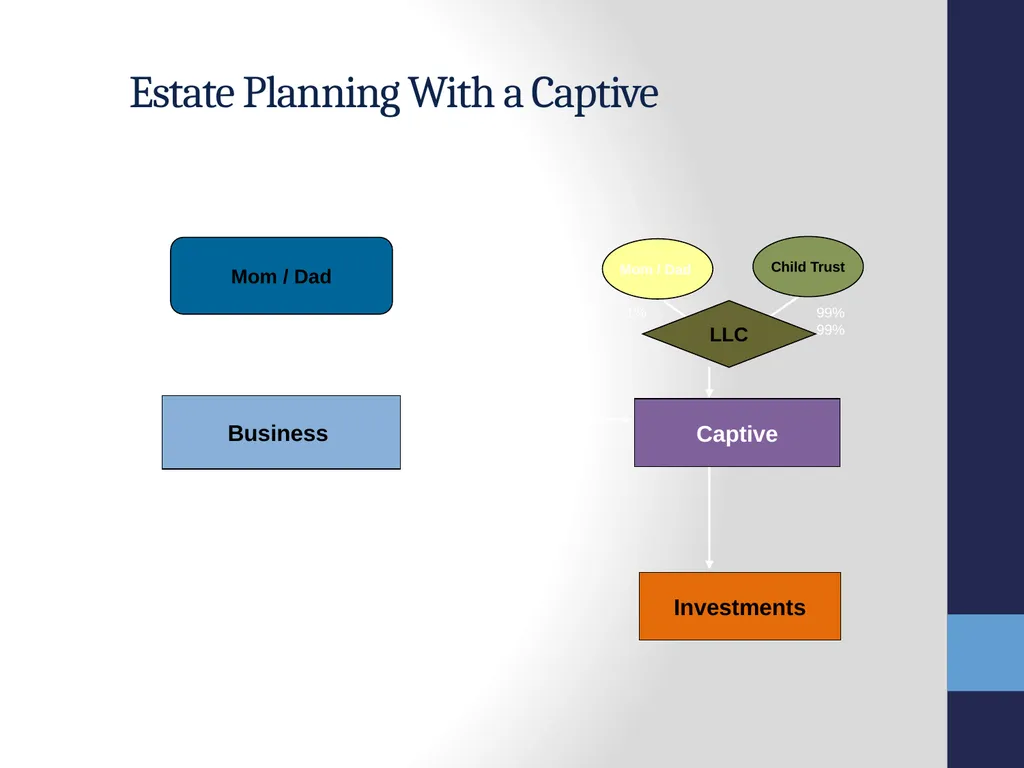
slide23. Estate Planning With a Captive Investments Mom / Dad Business Captive LLC Child Trust Mom / Dad 99%99% 1% 1.2 M P&C Premiums<br>
slide24. Case Studies<br>
slide25. Case Study 1 Client – Large Trucking Company
Facts:
Poor but improving loss experience, considerable resources committed to improvement
High premiums, no credit for improving loss experience
High AL deductibles, expensive premiums, limited cash available to establish captive
Private Company, several subsidiaries, owned by Parents with 2 sons involved in business
Solution:
Established captive and wrote $150K xs $100K first year to keep premium and capital at affordable level. Qualified for 831(b) status and aided by favorable tax treatment.
As funds in captive grew, company felt comfortable increasing retentions and decreasing commercial premium charge. Over time, increased deductibles to $500K, $750K and eventually became a qualified self-insured. Still use captive to write the self-insured risk.
Write bob-tail liability exposure of independent drivers to provide a source of third party risk to strengthen tax position.
Recently established an additional captive owned by the sons. As well as having a risk management purpose, this allows for transfer of wealth and serves as an estate planning tool.<br>
slide26. Case Study 2 Client – Time Share Company
Facts:
Wanted to establish captive as a risk management tool to ultimately have more control and less cost.
Did not have enough subsidiaries to be qualify for favorable insurance accounting treatment.
Solution:
Identified source of third party business - sell credit life and unemployment insurance on loans they finance.
Developed fronted program using an A-rated carrier
Obtained appropriate licensing (limited lines licenses – full agent’s license is typically not required)
Now have a substantial additional source of revenue and a tax-efficient captive !<br>
slide27. Case Study 3 Client – Time Share Company
Facts (similar to prior case)
Wanted to establish captive as a risk management tool to ultimately have more control and less cost.
Also was motivated by estate planning need and desire for tax efficiencies of 831(b) IRS code.
Did not have enough subsidiaries to be qualify for favorable insurance accounting treatment.
Solution:
We suggested credit life program but client did not want to go through training and licensing requirements.
Established a captive owned by combination of parents and majority aged daughter.
Used the enterprise risk pool arrangement . Sharing of exposures above primary layer for coverages including: regulatory risk, mold, general liability gap, cyber liability, etc.
Accomplishing reduced exposure to large, previously retained losses and very tax efficiently transferring wealth to daughter and providing parent’s with a retirement vehicle.<br>
slide28. Case Study 4 Client – Agricultural and Canning
Facts:
Wanted to build a fund to insure retained risk from high deductibles, environmental (holding ponds with potential substantial exposure), commodity risk and key customer/contract exposure
Business owned primarily by 2 retiring brothers and several adult children involved in business – estate planning motive
Cash rich company
Solution:
Program is still under development but initially will establish 3 Micro-captives owned by combination of children.
Will use the enterprise risk pool initially for first 3 captives. Will likely establish a forth Micro-captive using the terrorism pool.
Accomplishes risk management goals and, at the same time, is transferring over $4 million out of the parent’s estate each year in a very tax-efficient manner.<br>
slide29. Case Study 5 Client – MGA
Facts
MGA specialized in coastal homeowners policies – mainly vacation homes. State flood pool covers this exposure and their program covers ex-wind.
Have a large book of very profitable business with years of historical experience.
Want to receive more of the profits than they are receiving under current commission structure
Solution:
Established an offshore captive (onshore domiciles typically do not like unrelated, third party risks).
Established a fronted arrangement with an A-rated insurer.
Write the business on a quota share basis with excess reinsurance, with captive taking most of the risk.
Over time, intent is to write 100% of risk. In meantime, considerable profits that were previously transferred to insurance company, are being retained.<br>
slide30. Why a Captive? Benefits to Client and Consultant<br>
slide31. Why Captives are Formed – Benefits to Client To reduce total cost of risk
To provide increased control over risk management program
To provide coverage where there is a lack of available coverage in marketplace
To provide premium stability
To create a new profit center
To provide increased control over claims process
To improve consolidated tax position<br>
slide32. Additional Benefits to Consultant or Broker Proactively discussing the captive option wards off competitors who may use a captive presentation as a door opener.
Promotes a sense of goodwill – client recognition of the potential value-add and recognition that you are seeking options in client’s best interest.
Having a captive in place tends to tie a client more closely to the parties involved with that captive.
Captive provides more options when marketing program in marketplace
Good prospecting tool<br>
slide33. The Feasibility Process<br>
slide34. Captive Feasibility Feasibility study = Does a captive make sense for us?
Study should:
identify potential risks of the captive and structure the program, ownership, select domicile, etc.
analyze the business andfinancial effects of the captive on its owners
discuss the cash flow/ tax benefits
Provide all necessary information for owners to make an informed decision!<br>
slide35. Captive Formation Process Captive makes business and financial sense.
- Now What?
Draft operations plan and financial projections
Meet with regulators in chosen domicile
Submit captive application & all required documentation to regulator.
Educate, inform and respond to regulators. Amend business plan if necessary.
Obtain approval. Incorporate & capitalize company.<br>
slide36. For more information…. Contact: Kathryn Marsh Somers Risk Consulting kmarsh@somersriskconsulting.com 770-645-2242 (o) 770-286-7551 (c) Somers Risk Consulting 2102 36<br>
slide37. Kathryn Marsh, Managing Director
Somers Risk Consulting
Kathryn Marsh is a seasoned consultant within the alternative risk industry with over 30 years of experience in various facets of the industry. After many years of working for various large and small companies, she has formed Somers Risk Consulting which specializes in captive and alternative risk consulting and captive management.
Prior to establishing Somers Risk Consulting, Kathryn held high level consulting positions with boutique captive consulting firms as well as large firms such as KPMG and AON. At AON she headed the company’s regional quantitative and alternative risk groups, and was Chair of the company’s Captive Council, a network of the key captive personnel worldwide. Her employment at KPMG was within the Structured Risk Financing Group of KPMG’s Tax Practice where she was fully immersed in captive tax strategy. Kathryn also spent a number of years managing captive insurance companies in Bermuda with Marsh and was the Director of Risk Management for NCR Corporation. Most recently she was the insurance expert within the management team of a cell phone insurance company where she structured and implemented the risk program which helped grow the entrepreneurial company into one that was recently acquired by Brightstar, a $5 billion global distributor of mobile communication equipment.
Kathryn has a Bachelor of Business Administration degree majoring in Insurance from St. John’s University in New York and an MBA with a double major in Finance and Multinational Management from the Wharton School of the University of Pennsylvania. She holds the Chartered Property and Casualty Underwriter (CPCU) and Associate in Risk Management (ARM) designations. Somers Risk Consulting 2102 37<br>
slide2. Agenda Captive Overview
Micro-captives
Risk Pooling Arrangements
Case Studies
Steps for Looking at the Captive Option
Q&A
Info on Somers Risk and Bio Somers Risk Consulting 2102 2<br>
slide3. What is a Captive? A captive is an insurance company that insures the risks of its owners, affiliates, or a group of companies. It issues policies, collects premiums, and pays claims.<br>
slide4. Licensed Insurance Company
Formed to insure or reinsure the risk of its owners or unrelated parties of their choosing
Regulated under special legislation regulating captives (regulated less stringently than state insurance laws which govern fully admitted insurance companies)
Located offshore or onshore – many domiciles available
Admitted only in its domicile and non-admitted in all other jurisdictions. Characteristics of Captives<br>
slide5. Reasons to Form a Captive Somers Risk Consulting 2102 5<br>
slide6. Types of Captives Single Parent Captive – insures the risk of the
owner and it subsidiaries, traditionally used by large
companies
Group /Association Captives – owned & operated
by a group of members; 100% of risk and assets
pooled
Sponsored/Rent-a-Cell /Segregated Cell/Series Captive – owned & operated by a sponsoring entity; liabilities and assets legally segregated
Micro-Captive/831(b) Captive – is a single parent captive writing smaller premiums that has special tax benefits. These are focused on small to mid-size businesses. Somers Risk Consulting 2102 6<br>
slide7. Micro-Captive option In recent years, increased focus on Micro-Captives as a result of:
Increased awareness of this option amongst attorneys, financial planners, accounting firms, consultants, etc.
Increased sophistication of small and medium sized companies
Recognition of the following benefits:
Heightened awareness of ability to control risk management costs
Potential to insure and pre-fund enterprise risks
Potential to share risk and decrease exposure to catastrophic or large losses
Asset protection
Favorable tax treatment
Estate planning/wealth transfer Somers Risk Consulting 2102 7<br>
slide8. What is a Micro-Captive? Section 831(b) of the IRS Code allows Property/Casualty insurance companies writing under $1.2 million in premium to be taxed on investment income only. They are not taxed on underwriting income. Somers Risk Consulting 2102 8<br>
slide9. How does it work? Premium payments from company to insurance company are a tax-deductible expense
Premium less losses/expenses = underwriting profits - grow in captive untaxed
Annual – therefore, ability to have significant tax-free growth
Typically, tax will be paid on dividends when paid -currently at 15% dividend/capital gains rates
Potential for no-tax exit strategy Somers Risk Consulting 2102 9<br>
slide10. An Example Financials Assuming No Losses – Single Year Insured Company’s financials:
Premium payment $1,000,000
Tax Deduction 400,000 Net Cost = $600,000
After tax cost $600,000 Captive Insurance Company financials:
Premium income $1,000,000
Captive Admin Expenses 70,000
Losses -0- Net Value = $930,000
Underwriting Income 930,000
Tax due -0-
After tax Retained Earnings $930,000 Somers Risk Consulting 2102 10 Assumptions:
Captive qualifies as a bona fide insurance company
Tax rate is 40% (combined federal and state)
Investment income is ignored (will be subject to taxation – typically federal only, not state)
Assumes no losses. Loss activity will reduce benefit.
There will be a capital requirement in the first year of captive formation - $120K minimum
*Although tax savings are significant, the primary reason for forming a captive should not be tax motivation but to meet risk management needs.<br>
slide11. An Example Financials Assuming No Losses – After 5 Years Insured Company’s financials:
Premium payment $5,000,000
Tax Deduction 2,000,000 Net Cost = $3,000,000
After tax cost $3,000,000 Captive Insurance Company financials:
Premium income $5,000,000
Captive Admin Expenses 350,000
Losses -0- Net Value = $4,650,000
Underwriting Income $4,650,000
Tax due -0-
After tax Retained Earnings $4,650,000 Somers Risk Consulting 2102 11 Assumptions:
Captive qualifies as a bona fide insurance company
Tax rate is 40% (combined federal and state)
Investment income is ignored (but will be subject to taxation – typically federal only/not state)
Assumes no losses. Loss activity will reduce benefit.
There will be a capital requirement in the first year of captive formation - $120K minimum
*Although tax savings are significant, the primary reason for forming a captive should not be tax motivation but to meet risk management needs.<br>
slide12. An Example – Estate Planning Vehicle With Captives owned by Three Heirs – After 5 years Insured Company’s financials:
Premium payment $15,000,000
Tax Deduction 6,000,000 Net Cost = $9,000,000
After tax cost $9,000,000 Total of Financials of Captive Insurance Companies owned by 3 Heirs :
Premium income $15,000,000
Captive Admin Expenses 1,050,000
Losses -0- Net Value = $13,950,000
Underwriting Income $13,950,000
Tax due -0-
After tax Retained Earnings $13,950,000 Somers Risk Consulting 2102 12 Assumptions:
Captive qualifies as a bona fide insurance company
Tax rate is 40% (combined federal and state)
Investment income is ignored (will be subject to taxation - typically federal only/not state)
Assumes no losses. Loss activity will reduce benefit.
There will be a capital requirement in the first year of captive formation - $120K minimum
*Although tax savings are significant, the primary reason for forming a captive should not be tax motivation but to meet risk management needs. Reduction in Value of Estate $15,000,000
Reduction in Estate Taxes Unknown but tax rates have been as high as 55-60% in past
Assume 2012 35% Rate $ 5,250,000<br>
slide13. Good Candidates are … Small to mid-size private companies
Typically $10 million + in gross revenue
Pre-tax profits of at least $1MM
Stable cash flow
Substantial self-insured / uninsured business risk
Larger companies who intend to grow a captive over time but like the opportunity to start with a low capital base and an immediate quantifiable economic benefit Somers Risk Consulting 2102 13<br>
slide14. Industries include: >
Construction
Real Estate
Transportation
Agriculture & Livestock
Manufacturers
Professional/Financial Services Firms
Franchisees
Hospitality
Medical Services
Most! Somers Risk Consulting 2102 14<br>
slide15. Types of Risk Work best for risks that have possibility but low probability of loss
Enterprise risks that are currently not insured Somers Risk Consulting 2102 15<br>
slide16. Professional Liability Gap Coverage HIPAA/Billing Audit Liability
Contractual Liability
General Liability DIC
Cyber Liability
Intellectual Property
Environmental Liability
Regulatory Changes
Collections
Product/Service Rework
Labor Shortage/Strike Loss
Reimbursement
Employment Practices
Employee Dishonesty Loss of Key Customer
Loss of Key Supplier
Loss of Key Contract
Professional Misconduct
Product Recall
FDA Administrative Actions Liability
Product Liability DIC
Directors and Officers Liability
Punitive Damages
Loss of Key Employee
Deductible Reimbursement (Property,
Workers Comp, General Liability, Product
Liability)
Patent Infringement/Intellectual
Property Examples of Coverages<br>
slide17. Further Considerations Captive must be considered a bona fide insurance company. Therefore, there must be risk spread and distribution from either:
Several legal entities
Source of 3rd party business
Captive must operate in a manner consistent with traditional insurance companies
Insured must be a current taxpayer in order to benefit from 831(b) status
Must be able to justify premium level
Must consider capitalization requirements (high policy limits typically mean higher capitalization especially with low frequency)
Captive will typically incur costs of approximately $40-70K per year for captive management fees, audit and actuarial fees, domicile fees and travel. Somers Risk Consulting 2102 17<br>
slide18. Risk Pools – What and Why? Many companies don’t have the appropriate risk spread to qualify as an insurance company
Participation in a risk pool provides third party risk
Various pools available but most are similar to those that follow Somers Risk Consulting 2102 18<br>
slide19. Risk Pool Total Pooled
Premium =
$18 $8 $6 Premium A B C $4 x $18 =
$18 $6 x $18 =
$18 $8 x $18 =
$18 Quota
Share %
X Premium Quota Shared Premium Unrelated Premium $1.33 $1.78 $1.00 $2.00 $3.00 $1.78 $2.67 $3.55 $8 $6 $4 $4 $0.89 A’s
Captive B’s
Captive C’s
Captive Enterprise Risk Pool<br>
slide20. Enterprise Risk Pool 115+ Pool Participants
$50MM + in total pool premium
No policy limits in excess of $1,000,000
The frequency layer of risk (the first 25% of all claims) is retained by either the captive or the insured
Example: On a $1,000,000 claim in the pool (the max. policy limit), the first $250,000 will be paid by the insured business, or that business’ captive
Participant share of pool varies from 0.034% to 1.294%
Example: Assume the max loss for single claim covered by pool ($750,000)
Loss paid by lowest percentage captive participant = $255 (0.034% x $750,000)
Loss paid by highest percentage captive participant = $9,705 (1.294% x $750,000)
All policies in the pool must meet strict UW guidelines established by the pool. Somers Risk Consulting 2102 20<br>
slide21. 9 all premiums received by the Pool. The Pool will then pay Operating Business A’s Captive $200k to reinsure 2% of the Pool’s total risk (i.e. 2% of all of the other participating Operating Business’s risk). Each Operating Business will pay 30%-50% of its captive premium to the Pool in return for terrorism coverage.
The Pool then reinsures its risk with each Operating Business Captive in the same percentage that the Operating business’s premium represents.
Example: Assume Operating Business A pays $200k to the Pool and that $200k premium represents 2% of Operating Business C’s Captive Operating Business A’s Captive Operating Business C Operating Business A Terrorism Insurance Provider (“Pool”) Operating Business D’s Captive Operating Business B’s Captive Operating Business D Operating Business B Terrorism Risk Pool<br>
slide22. Captive Shareholders Family Key Employees Estate Plan Trust Captive Shareholders Family Key Employees Estate Plan Trust Ownership Options<br>
slide23. Estate Planning With a Captive Investments Mom / Dad Business Captive LLC Child Trust Mom / Dad 99%99% 1% 1.2 M P&C Premiums<br>
slide24. Case Studies<br>
slide25. Case Study 1 Client – Large Trucking Company
Facts:
Poor but improving loss experience, considerable resources committed to improvement
High premiums, no credit for improving loss experience
High AL deductibles, expensive premiums, limited cash available to establish captive
Private Company, several subsidiaries, owned by Parents with 2 sons involved in business
Solution:
Established captive and wrote $150K xs $100K first year to keep premium and capital at affordable level. Qualified for 831(b) status and aided by favorable tax treatment.
As funds in captive grew, company felt comfortable increasing retentions and decreasing commercial premium charge. Over time, increased deductibles to $500K, $750K and eventually became a qualified self-insured. Still use captive to write the self-insured risk.
Write bob-tail liability exposure of independent drivers to provide a source of third party risk to strengthen tax position.
Recently established an additional captive owned by the sons. As well as having a risk management purpose, this allows for transfer of wealth and serves as an estate planning tool.<br>
slide26. Case Study 2 Client – Time Share Company
Facts:
Wanted to establish captive as a risk management tool to ultimately have more control and less cost.
Did not have enough subsidiaries to be qualify for favorable insurance accounting treatment.
Solution:
Identified source of third party business - sell credit life and unemployment insurance on loans they finance.
Developed fronted program using an A-rated carrier
Obtained appropriate licensing (limited lines licenses – full agent’s license is typically not required)
Now have a substantial additional source of revenue and a tax-efficient captive !<br>
slide27. Case Study 3 Client – Time Share Company
Facts (similar to prior case)
Wanted to establish captive as a risk management tool to ultimately have more control and less cost.
Also was motivated by estate planning need and desire for tax efficiencies of 831(b) IRS code.
Did not have enough subsidiaries to be qualify for favorable insurance accounting treatment.
Solution:
We suggested credit life program but client did not want to go through training and licensing requirements.
Established a captive owned by combination of parents and majority aged daughter.
Used the enterprise risk pool arrangement . Sharing of exposures above primary layer for coverages including: regulatory risk, mold, general liability gap, cyber liability, etc.
Accomplishing reduced exposure to large, previously retained losses and very tax efficiently transferring wealth to daughter and providing parent’s with a retirement vehicle.<br>
slide28. Case Study 4 Client – Agricultural and Canning
Facts:
Wanted to build a fund to insure retained risk from high deductibles, environmental (holding ponds with potential substantial exposure), commodity risk and key customer/contract exposure
Business owned primarily by 2 retiring brothers and several adult children involved in business – estate planning motive
Cash rich company
Solution:
Program is still under development but initially will establish 3 Micro-captives owned by combination of children.
Will use the enterprise risk pool initially for first 3 captives. Will likely establish a forth Micro-captive using the terrorism pool.
Accomplishes risk management goals and, at the same time, is transferring over $4 million out of the parent’s estate each year in a very tax-efficient manner.<br>
slide29. Case Study 5 Client – MGA
Facts
MGA specialized in coastal homeowners policies – mainly vacation homes. State flood pool covers this exposure and their program covers ex-wind.
Have a large book of very profitable business with years of historical experience.
Want to receive more of the profits than they are receiving under current commission structure
Solution:
Established an offshore captive (onshore domiciles typically do not like unrelated, third party risks).
Established a fronted arrangement with an A-rated insurer.
Write the business on a quota share basis with excess reinsurance, with captive taking most of the risk.
Over time, intent is to write 100% of risk. In meantime, considerable profits that were previously transferred to insurance company, are being retained.<br>
slide30. Why a Captive? Benefits to Client and Consultant<br>
slide31. Why Captives are Formed – Benefits to Client To reduce total cost of risk
To provide increased control over risk management program
To provide coverage where there is a lack of available coverage in marketplace
To provide premium stability
To create a new profit center
To provide increased control over claims process
To improve consolidated tax position<br>
slide32. Additional Benefits to Consultant or Broker Proactively discussing the captive option wards off competitors who may use a captive presentation as a door opener.
Promotes a sense of goodwill – client recognition of the potential value-add and recognition that you are seeking options in client’s best interest.
Having a captive in place tends to tie a client more closely to the parties involved with that captive.
Captive provides more options when marketing program in marketplace
Good prospecting tool<br>
slide33. The Feasibility Process<br>
slide34. Captive Feasibility Feasibility study = Does a captive make sense for us?
Study should:
identify potential risks of the captive and structure the program, ownership, select domicile, etc.
analyze the business andfinancial effects of the captive on its owners
discuss the cash flow/ tax benefits
Provide all necessary information for owners to make an informed decision!<br>
slide35. Captive Formation Process Captive makes business and financial sense.
- Now What?
Draft operations plan and financial projections
Meet with regulators in chosen domicile
Submit captive application & all required documentation to regulator.
Educate, inform and respond to regulators. Amend business plan if necessary.
Obtain approval. Incorporate & capitalize company.<br>
slide36. For more information…. Contact: Kathryn Marsh Somers Risk Consulting kmarsh@somersriskconsulting.com 770-645-2242 (o) 770-286-7551 (c) Somers Risk Consulting 2102 36<br>
slide37. Kathryn Marsh, Managing Director
Somers Risk Consulting
Kathryn Marsh is a seasoned consultant within the alternative risk industry with over 30 years of experience in various facets of the industry. After many years of working for various large and small companies, she has formed Somers Risk Consulting which specializes in captive and alternative risk consulting and captive management.
Prior to establishing Somers Risk Consulting, Kathryn held high level consulting positions with boutique captive consulting firms as well as large firms such as KPMG and AON. At AON she headed the company’s regional quantitative and alternative risk groups, and was Chair of the company’s Captive Council, a network of the key captive personnel worldwide. Her employment at KPMG was within the Structured Risk Financing Group of KPMG’s Tax Practice where she was fully immersed in captive tax strategy. Kathryn also spent a number of years managing captive insurance companies in Bermuda with Marsh and was the Director of Risk Management for NCR Corporation. Most recently she was the insurance expert within the management team of a cell phone insurance company where she structured and implemented the risk program which helped grow the entrepreneurial company into one that was recently acquired by Brightstar, a $5 billion global distributor of mobile communication equipment.
Kathryn has a Bachelor of Business Administration degree majoring in Insurance from St. John’s University in New York and an MBA with a double major in Finance and Multinational Management from the Wharton School of the University of Pennsylvania. She holds the Chartered Property and Casualty Underwriter (CPCU) and Associate in Risk Management (ARM) designations. Somers Risk Consulting 2102 37<br>