
STAFF WRITING IN FRSC BY SCHOOL GENERAL STUDIES
MS
Published · 26 slides · 0 views

1 / 1

Description
STAFF WRITING IN FRSC BY SCHOOL GENERAL STUDIES INTRODUCTION Staff writing is a standardized way of communication. Even though it is peculiar to an organization, it must also meet the basic minimum of internationally accepted standard. A
Related Topics
Share
Embed code
Download this presentation From Below
"STAFF WRITING IN FRSC BY SCHOOL GENERAL STUDIES" is the property of its rightful owner. Permission is granted to download and print the materials on this website for personal, non-commercial use only, and to display it on your personal computer provided you do not modify the materials and that you retain all copyright notices contained in the materials. By downloading content from our website, you accept the terms of this agreement.
Presentation Transcript
01
STAFF WRITING IN FRSC
BY
SCHOOL
GENERAL STUDIES<br>
02
INTRODUCTION Staff writing is a standardized way of communication. Even though it is peculiar to an organization, it must also meet the basic minimum of internationally accepted standard. A standardized writing method becomes necessary in order to communicate logically, concisely, accurately and so on.
The Federal Road Safety Corps has developed a standardized writing manual to guide its communication within the organization and with the outside world. This is aimed at reducing the official time in coping with extracting information from diverse writing methods<br>
The Federal Road Safety Corps has developed a standardized writing manual to guide its communication within the organization and with the outside world. This is aimed at reducing the official time in coping with extracting information from diverse writing methods<br>
03
AIM Introduce the participants to the FRSC service writing.<br>
04
OBJECTIVES At the end of the presentation participants shall be able to:
list Types of writing
Explain the Characteristics of Service Writing
Apply the Basic rules and conventions in service writings
Explain types of FRSC Correspondence
Explain process of Filling and securing document
Explain the role of chairman in Conferences, and meetings
Explain Brief and list types of briefs<br>
list Types of writing
Explain the Characteristics of Service Writing
Apply the Basic rules and conventions in service writings
Explain types of FRSC Correspondence
Explain process of Filling and securing document
Explain the role of chairman in Conferences, and meetings
Explain Brief and list types of briefs<br>
05
TYPES OF WRITING Operational writing- abbreviation can be used here, it includes:
Administrative Orders
Part I and II order
Signal & Wireless Messages
Internal Memos
All Forms of Ops Reports
Non operational writing- Covers all other forms of writing from FRSC to other Organizations. Use of abbreviation is restricted. Follows normal English rules.<br>
Administrative Orders
Part I and II order
Signal & Wireless Messages
Internal Memos
All Forms of Ops Reports
Non operational writing- Covers all other forms of writing from FRSC to other Organizations. Use of abbreviation is restricted. Follows normal English rules.<br>
06
CHARACTERISTICS OF COMMISSION WRITING Accuracy
Brevity
Clarity
Relevance
Logical<br>
Brevity
Clarity
Relevance
Logical<br>
07
BASIC RULES AND CONVENTIONS The basic rules of Commission writing aid the clear presentation of facts and discussion. It helps Staff to conform to standard layout. Documents are made up of three (3) parts:
Superscript –before text
Text
Subscript- after text
The contents of each part may vary with document, but in all cases the superscript comprises everything above the text and the subscription is everything below the text.<br>
Superscript –before text
Text
Subscript- after text
The contents of each part may vary with document, but in all cases the superscript comprises everything above the text and the subscription is everything below the text.<br>
08
BASIC RULES AND CONVENTIONS Contd A. THE SUPERSCRIPTION- this is the top part of letter and consist of:
The address- usually taken care of by letter heads
The date- this is the date the letter is signed by the writer and not the date typed. The month is normally abbreviated to 3 letters only with a comma not full stop
Reference- the identity of the letter usually the reference
The addressee- this is the name and address of the recipient or distribution ( usually written see distribution)
Salutation- that is official compliment to the recipient
Attention- refers to the person who will treat the letter, it is usually used as an alternative to salutation, but it is underlined<br>
The address- usually taken care of by letter heads
The date- this is the date the letter is signed by the writer and not the date typed. The month is normally abbreviated to 3 letters only with a comma not full stop
Reference- the identity of the letter usually the reference
The addressee- this is the name and address of the recipient or distribution ( usually written see distribution)
Salutation- that is official compliment to the recipient
Attention- refers to the person who will treat the letter, it is usually used as an alternative to salutation, but it is underlined<br>
09
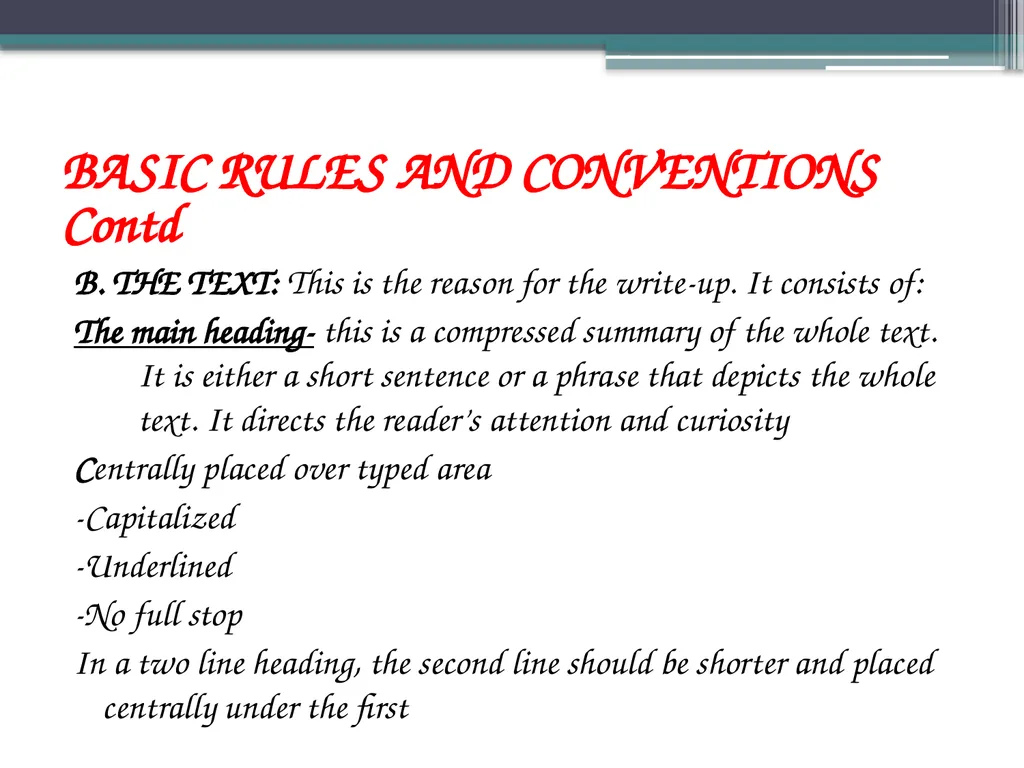
BASIC RULES AND CONVENTIONS Contd B. THE TEXT: This is the reason for the write-up. It consists of:
The main heading- this is a compressed summary of the whole text. It is either a short sentence or a phrase that depicts the whole text. It directs the reader’s attention and curiosity
Centrally placed over typed area
-Capitalized
-Underlined
-No full stop
In a two line heading, the second line should be shorter and placed centrally under the first<br>
The main heading- this is a compressed summary of the whole text. It is either a short sentence or a phrase that depicts the whole text. It directs the reader’s attention and curiosity
Centrally placed over typed area
-Capitalized
-Underlined
-No full stop
In a two line heading, the second line should be shorter and placed centrally under the first<br>
10
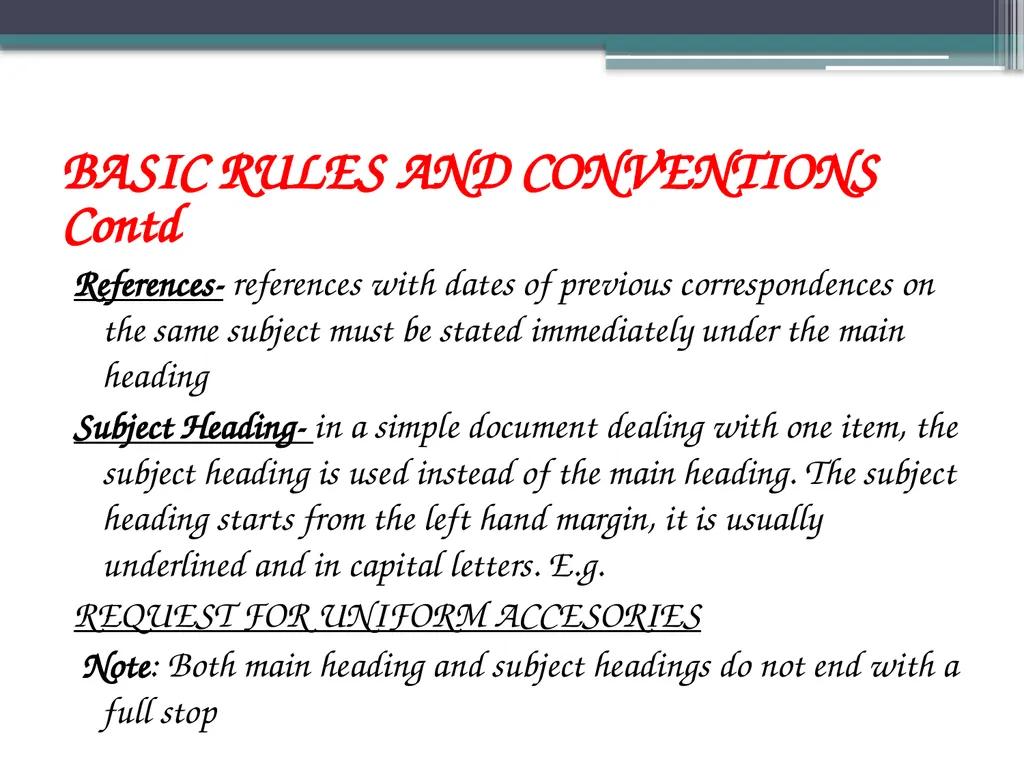
BASIC RULES AND CONVENTIONS Contd References- references with dates of previous correspondences on the same subject must be stated immediately under the main heading
Subject Heading- in a simple document dealing with one item, the subject heading is used instead of the main heading. The subject heading starts from the left hand margin, it is usually underlined and in capital letters. E.g.
REQUEST FOR UNIFORM ACCESORIES
Note: Both main heading and subject headings do not end with a full stop<br>
Subject Heading- in a simple document dealing with one item, the subject heading is used instead of the main heading. The subject heading starts from the left hand margin, it is usually underlined and in capital letters. E.g.
REQUEST FOR UNIFORM ACCESORIES
Note: Both main heading and subject headings do not end with a full stop<br>
11
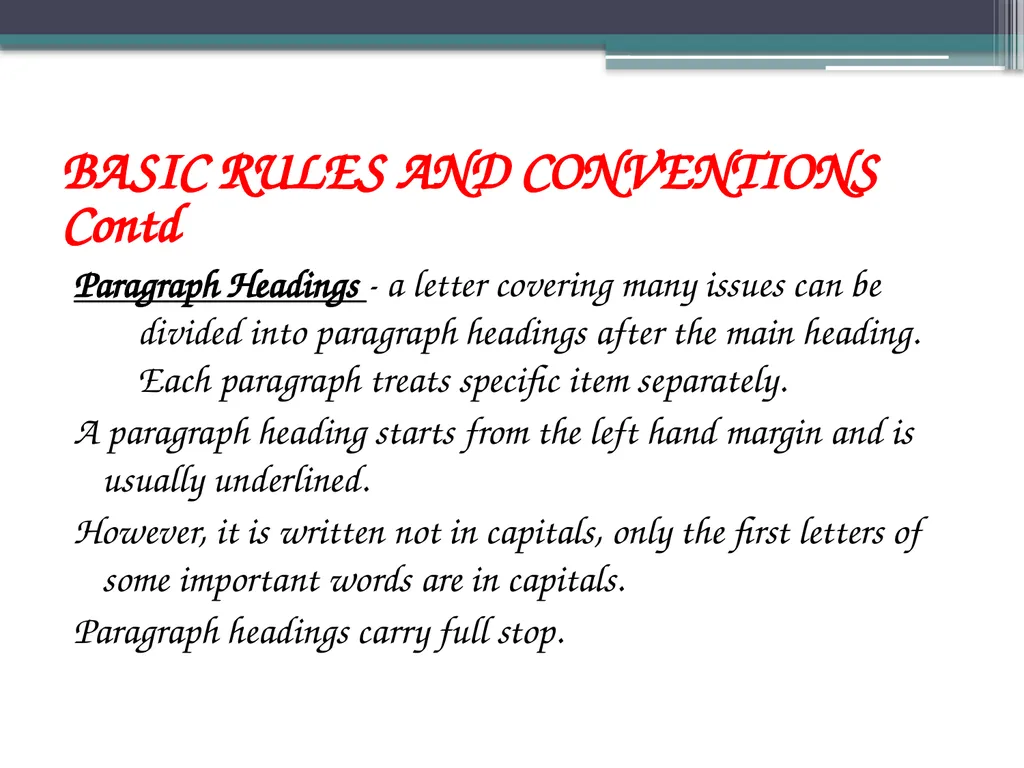
BASIC RULES AND CONVENTIONS Contd Paragraph Headings - a letter covering many issues can be divided into paragraph headings after the main heading. Each paragraph treats specific item separately.
A paragraph heading starts from the left hand margin and is usually underlined.
However, it is written not in capitals, only the first letters of some important words are in capitals.
Paragraph headings carry full stop.<br>
A paragraph heading starts from the left hand margin and is usually underlined.
However, it is written not in capitals, only the first letters of some important words are in capitals.
Paragraph headings carry full stop.<br>
12
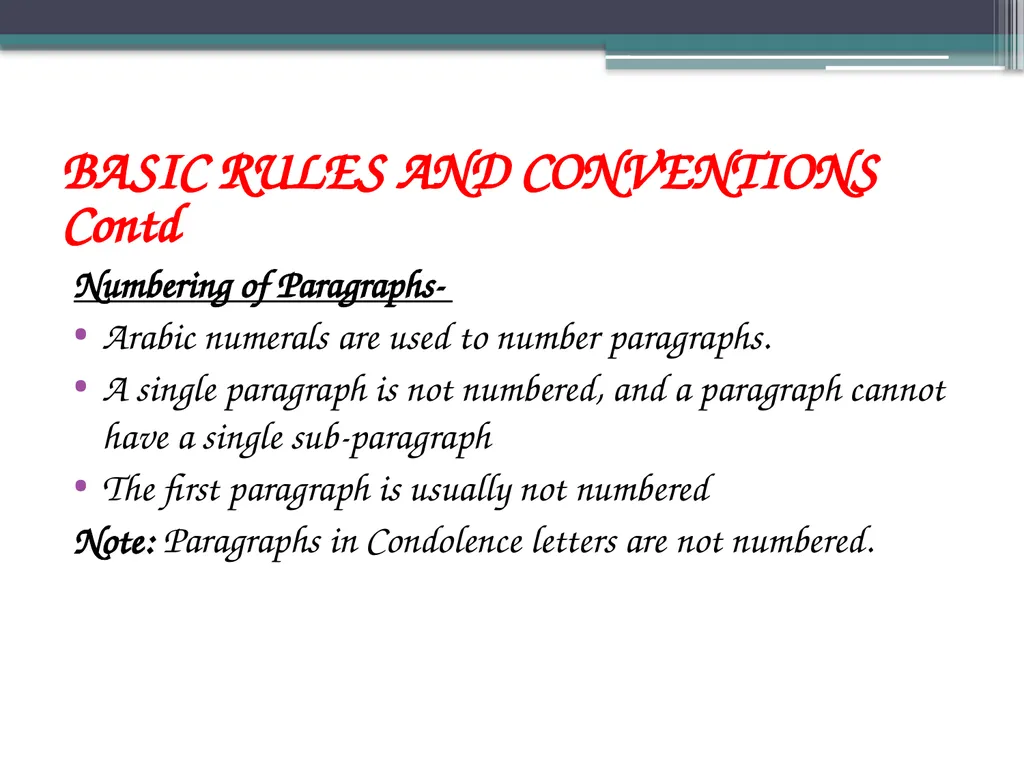
BASIC RULES AND CONVENTIONS Contd Numbering of Paragraphs-
Arabic numerals are used to number paragraphs.
A single paragraph is not numbered, and a paragraph cannot have a single sub-paragraph
The first paragraph is usually not numbered
Note: Paragraphs in Condolence letters are not numbered.<br>
Arabic numerals are used to number paragraphs.
A single paragraph is not numbered, and a paragraph cannot have a single sub-paragraph
The first paragraph is usually not numbered
Note: Paragraphs in Condolence letters are not numbered.<br>
13
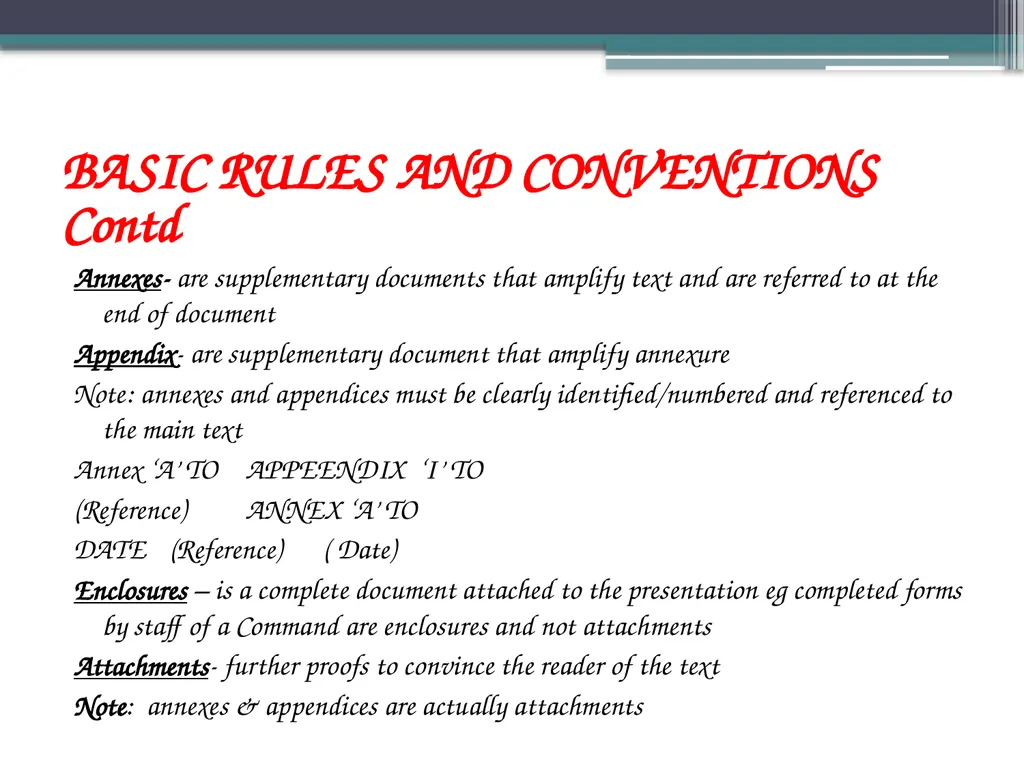
BASIC RULES AND CONVENTIONS Contd Annexes- are supplementary documents that amplify text and are referred to at the end of document
Appendix- are supplementary document that amplify annexure
Note: annexes and appendices must be clearly identified/numbered and referenced to the main text
Annex ‘A’ TO APPEENDIX ‘I’ TO
(Reference) ANNEX ‘A’ TO
DATE (Reference) ( Date)
Enclosures – is a complete document attached to the presentation eg completed forms by staff of a Command are enclosures and not attachments
Attachments- further proofs to convince the reader of the text
Note: annexes & appendices are actually attachments<br>
Appendix- are supplementary document that amplify annexure
Note: annexes and appendices must be clearly identified/numbered and referenced to the main text
Annex ‘A’ TO APPEENDIX ‘I’ TO
(Reference) ANNEX ‘A’ TO
DATE (Reference) ( Date)
Enclosures – is a complete document attached to the presentation eg completed forms by staff of a Command are enclosures and not attachments
Attachments- further proofs to convince the reader of the text
Note: annexes & appendices are actually attachments<br>
14
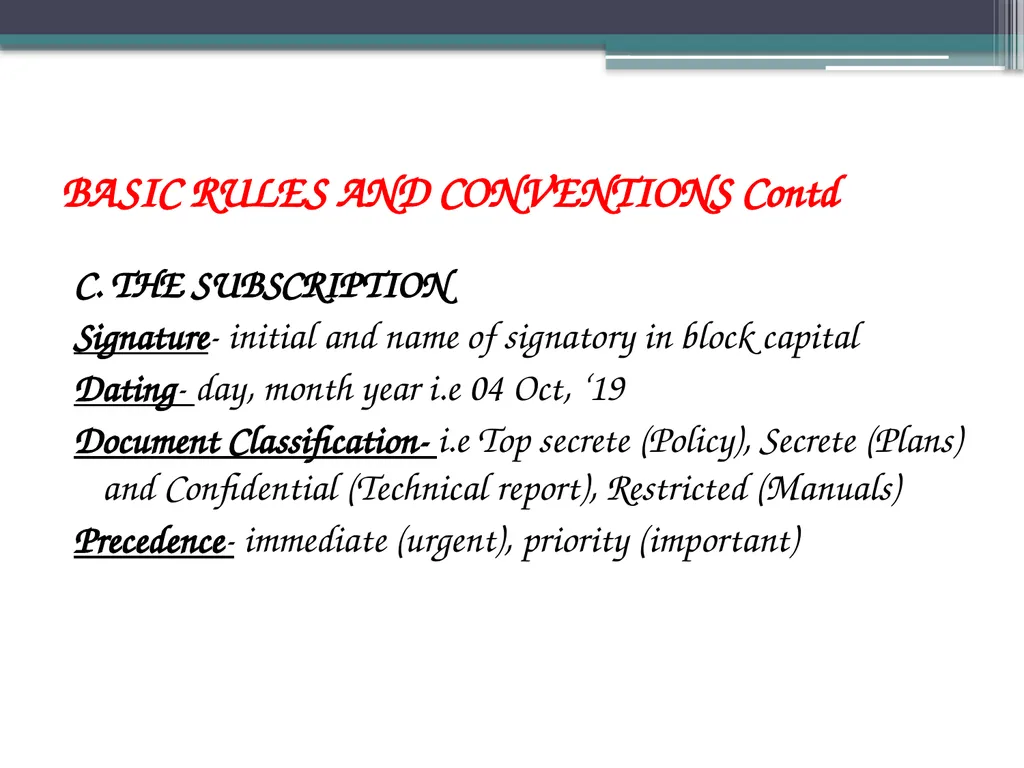
BASIC RULES AND CONVENTIONS Contd C. THE SUBSCRIPTION
Signature- initial and name of signatory in block capital
Dating- day, month year i.e 04 Oct, ‘19
Document Classification- i.e Top secrete (Policy), Secrete (Plans) and Confidential (Technical report), Restricted (Manuals)
Precedence- immediate (urgent), priority (important)<br>
Signature- initial and name of signatory in block capital
Dating- day, month year i.e 04 Oct, ‘19
Document Classification- i.e Top secrete (Policy), Secrete (Plans) and Confidential (Technical report), Restricted (Manuals)
Precedence- immediate (urgent), priority (important)<br>
15
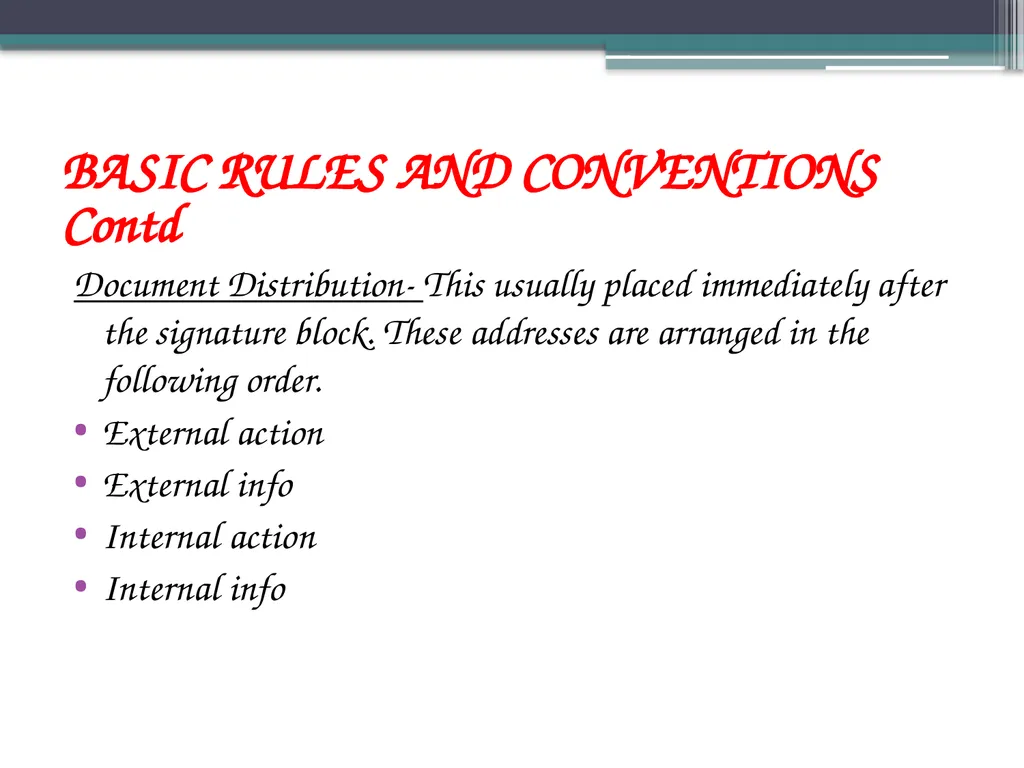
BASIC RULES AND CONVENTIONS Contd Document Distribution- This usually placed immediately after the signature block. These addresses are arranged in the following order.
External action
External info
Internal action
Internal info<br>
External action
External info
Internal action
Internal info<br>
16
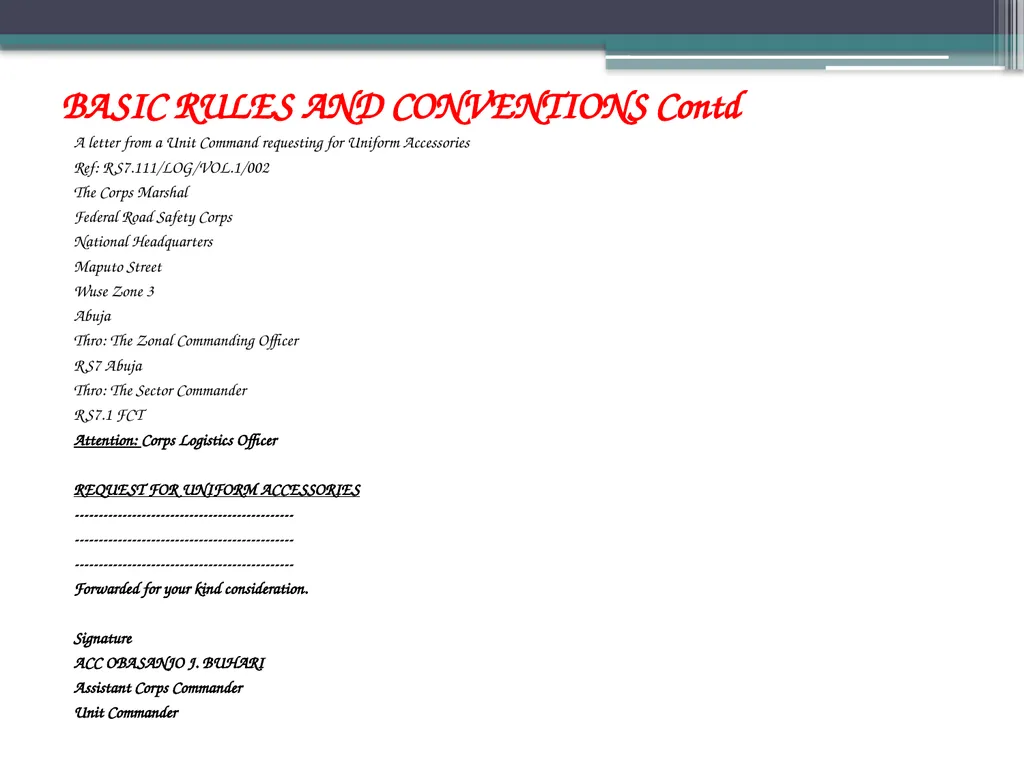
BASIC RULES AND CONVENTIONS Contd A letter from a Unit Command requesting for Uniform Accessories
Ref: RS7.111/LOG/VOL.1/002
The Corps Marshal
Federal Road Safety Corps
National Headquarters
Maputo Street
Wuse Zone 3
Abuja
Thro: The Zonal Commanding Officer
RS7 Abuja
Thro: The Sector Commander
RS7.1 FCT
Attention: Corps Logistics Officer
REQUEST FOR UNIFORM ACCESSORIES
----------------------------------------------
----------------------------------------------
----------------------------------------------
Forwarded for your kind consideration.
Signature
ACC OBASANJO J. BUHARI
Assistant Corps Commander
Unit Commander<br>
Ref: RS7.111/LOG/VOL.1/002
The Corps Marshal
Federal Road Safety Corps
National Headquarters
Maputo Street
Wuse Zone 3
Abuja
Thro: The Zonal Commanding Officer
RS7 Abuja
Thro: The Sector Commander
RS7.1 FCT
Attention: Corps Logistics Officer
REQUEST FOR UNIFORM ACCESSORIES
----------------------------------------------
----------------------------------------------
----------------------------------------------
Forwarded for your kind consideration.
Signature
ACC OBASANJO J. BUHARI
Assistant Corps Commander
Unit Commander<br>
17
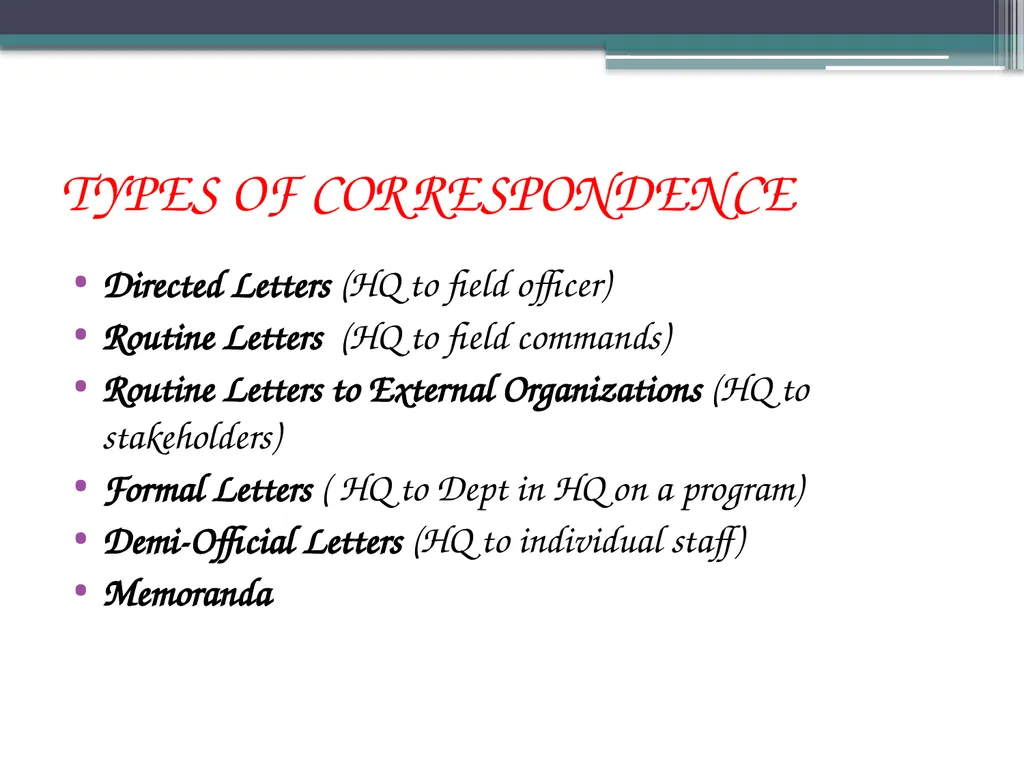
TYPES OF CORRESPONDENCE Directed Letters (HQ to field officer)
Routine Letters (HQ to field commands)
Routine Letters to External Organizations (HQ to stakeholders)
Formal Letters ( HQ to Dept in HQ on a program)
Demi-Official Letters (HQ to individual staff)
Memoranda<br>
Routine Letters (HQ to field commands)
Routine Letters to External Organizations (HQ to stakeholders)
Formal Letters ( HQ to Dept in HQ on a program)
Demi-Official Letters (HQ to individual staff)
Memoranda<br>
18
FILES AND DOCUMENTS A file store can present the whole history of one aspect of a subject under cover in chronological order of reference.
Documents include notes, letters, drawings, carbons or bonus, files photograph, slides, etc.<br>
Documents include notes, letters, drawings, carbons or bonus, files photograph, slides, etc.<br>
19
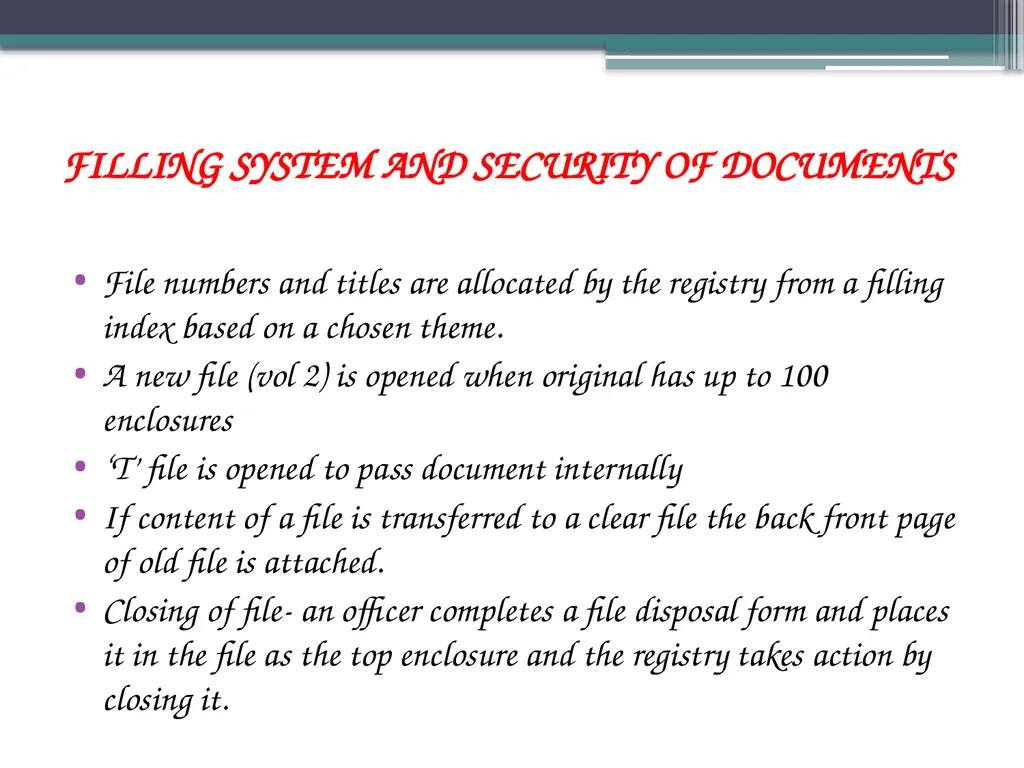
FILLING SYSTEM AND SECURITY OF DOCUMENTS File numbers and titles are allocated by the registry from a filling index based on a chosen theme.
A new file (vol 2) is opened when original has up to 100 enclosures
‘T’ file is opened to pass document internally
If content of a file is transferred to a clear file the back front page of old file is attached.
Closing of file- an officer completes a file disposal form and places it in the file as the top enclosure and the registry takes action by closing it.<br>
A new file (vol 2) is opened when original has up to 100 enclosures
‘T’ file is opened to pass document internally
If content of a file is transferred to a clear file the back front page of old file is attached.
Closing of file- an officer completes a file disposal form and places it in the file as the top enclosure and the registry takes action by closing it.<br>
20
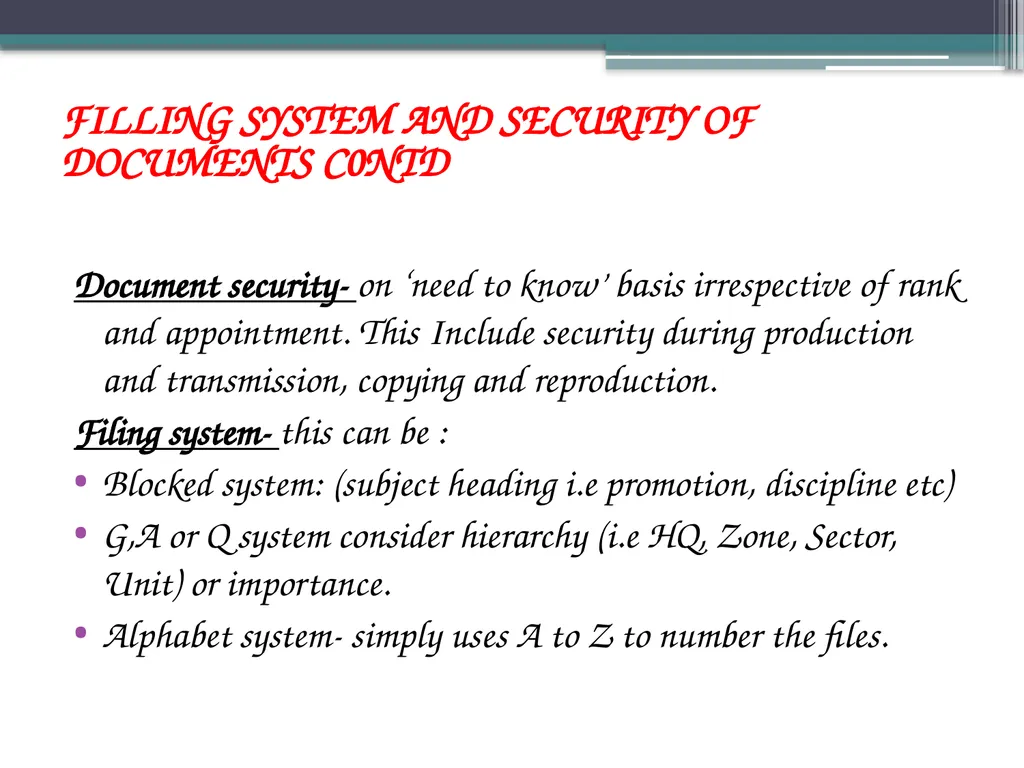
FILLING SYSTEM AND SECURITY OF DOCUMENTS C0NTD Document security- on ‘need to know’ basis irrespective of rank and appointment. This Include security during production and transmission, copying and reproduction.
Filing system- this can be :
Blocked system: (subject heading i.e promotion, discipline etc)
G,A or Q system consider hierarchy (i.e HQ, Zone, Sector, Unit) or importance.
Alphabet system- simply uses A to Z to number the files.<br>
Filing system- this can be :
Blocked system: (subject heading i.e promotion, discipline etc)
G,A or Q system consider hierarchy (i.e HQ, Zone, Sector, Unit) or importance.
Alphabet system- simply uses A to Z to number the files.<br>
21
CONFERENCE, MEETING AND MINUTES Duty of secretaries:-
record proceeding i.e manual or electronic
planning and convening
meeting control and direction
supervision of production
distribution of accurate record of proceeding.<br>
record proceeding i.e manual or electronic
planning and convening
meeting control and direction
supervision of production
distribution of accurate record of proceeding.<br>
22
CONFERENCE, MEETING AND MINUTES CONTD Duty of chairman:-
Vetting and operate agenda of meetings
Start meetings
Introduce members
State aim
Introduce items
Appoint and guide discussants
Summarize discussion
Take decision
Allocate actions.<br>
Vetting and operate agenda of meetings
Start meetings
Introduce members
State aim
Introduce items
Appoint and guide discussants
Summarize discussion
Take decision
Allocate actions.<br>
23
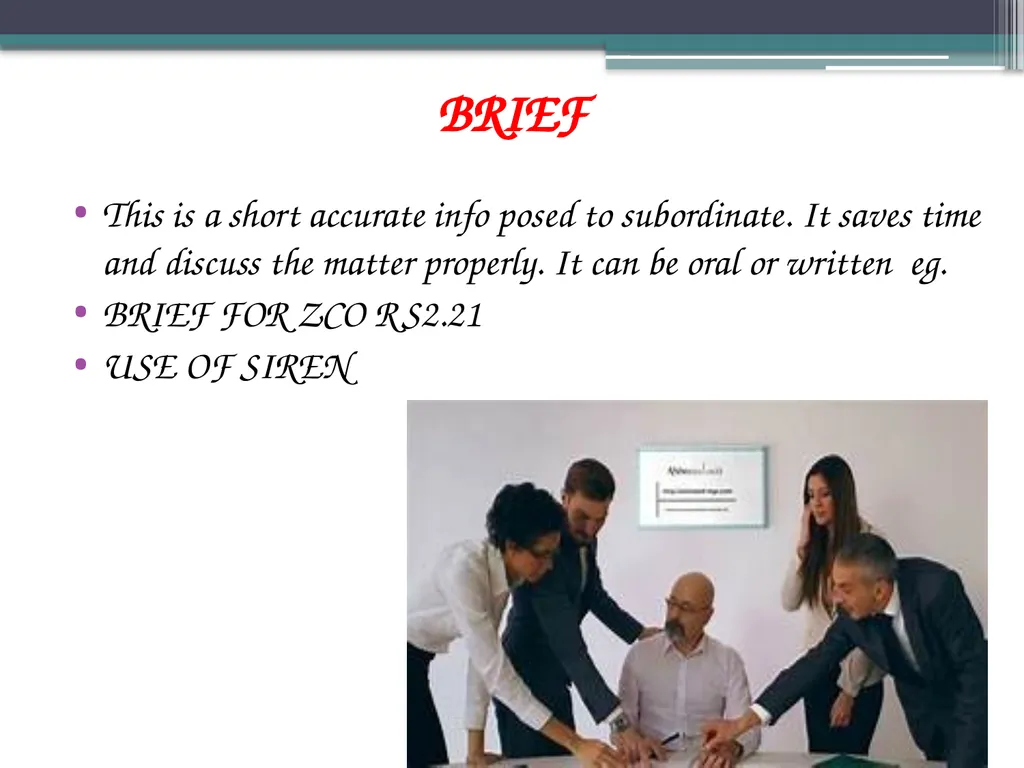
BRIEF This is a short accurate info posed to subordinate. It saves time and discuss the matter properly. It can be oral or written eg.
BRIEF FOR ZCO RS2.21
USE OF SIREN<br>
BRIEF FOR ZCO RS2.21
USE OF SIREN<br>
24
TYPES OF BRIEF Decision brief- summary of completed document
Information brief- on current problem or situation
Meeting brief- to make superior familiarize with agenda
Personality brief- details of visitors and his mission
Visiting brief- question likely to be encountered if superior is travelling<br>
Information brief- on current problem or situation
Meeting brief- to make superior familiarize with agenda
Personality brief- details of visitors and his mission
Visiting brief- question likely to be encountered if superior is travelling<br>
25
CONCLUSION I want you to note that this lecture is not exhaustive. The accuracy and completeness of the report will depend on the quality of an officer and his/her attention to detail.
It is important that you as staff officers practice writing and do read more. Remember the more you read the more you know.<br>
It is important that you as staff officers practice writing and do read more. Remember the more you read the more you know.<br>
26
Thank you.<br>