
Stakes and Challenges for REGULATING Mobile
LO
Published · 16 slides · 0 views
1 / 1
Description
Stakes and Challenges for REGULATING Mobile Insurance: THE CAMEROON CASE Presented by DJOUMESSI DONTSA Fabrice James Under-Director of Technical Resource Management and Universal Service Mobile Insurance Workshop, Abidjan, 16-17 May 2016
Related Topics
Share
Embed code
Download this presentation From Below
"Stakes and Challenges for REGULATING Mobile" is the property of its rightful owner. Permission is granted to download and print the materials on this website for personal, non-commercial use only, and to display it on your personal computer provided you do not modify the materials and that you retain all copyright notices contained in the materials. By downloading content from our website, you accept the terms of this agreement.
Presentation Transcript
01
Stakes and Challenges for REGULATING Mobile Insurance: THE CAMEROON CASE Presented by DJOUMESSI DONTSA Fabrice James
Under-Director of Technical Resource Management and Universal Service Mobile Insurance Workshop, Abidjan, 16-17 May 2016<br>
Under-Director of Technical Resource Management and Universal Service Mobile Insurance Workshop, Abidjan, 16-17 May 2016<br>
02
Presentation Outline Introduction
The Stakes Involved in Mobile Insurance
Challenges Involved in Regulating Mobile Insurance
Conclusion and Prospects Stakes and Challenges for REGULATING Mobile Insurance: THE CAMEROON CASE 2 Mobile Insurance Workshop, Abidjan, 16-17 May 2016<br>
The Stakes Involved in Mobile Insurance
Challenges Involved in Regulating Mobile Insurance
Conclusion and Prospects Stakes and Challenges for REGULATING Mobile Insurance: THE CAMEROON CASE 2 Mobile Insurance Workshop, Abidjan, 16-17 May 2016<br>
03
I. Introduction In Africa, despite the efforts to clean up and modernise the insurance, banking and finance sectors, a large proportion of the population is still deprived of access to the basic products and services in these sectors because of the prices or rates applied, which are very often deemed to be unaffordable to such an extent that these products and services are seen as “luxuries.”
Generally speaking, the insurance penetration rate (health, life, death, homeowner’s or renter’s insurance, etc.) is approximately 2%, the rate of bank service utilisation is low, and less than 20% of households have access to classic financial services (Source: World Bank reports, insurance sector stakeholders).
This situation limits populations’ capacity to anticipate and manage the various risks that hinder social mobility and households’ and companies’ capacity to protect themselves against certain—sometimes unpredictable—shocks (illness, accidents, death, food insecurity, job loss, natural disasters, etc.), and thus contributes to perpetuating a vicious cycle of poverty.
In Africa, the legal supervision of the provision of M-services (mobile insurance, mobile banking, and mobile financial services) is still embryonic, and the absence of harmonised Telecom/ICT regulations across countries does not facilitate their development. 3 Stakes and Challenges for REGULATING Mobile Insurance: THE CAMEROON CASE Mobile Insurance Workshop, Abidjan, 16-17 May 2016<br>
Generally speaking, the insurance penetration rate (health, life, death, homeowner’s or renter’s insurance, etc.) is approximately 2%, the rate of bank service utilisation is low, and less than 20% of households have access to classic financial services (Source: World Bank reports, insurance sector stakeholders).
This situation limits populations’ capacity to anticipate and manage the various risks that hinder social mobility and households’ and companies’ capacity to protect themselves against certain—sometimes unpredictable—shocks (illness, accidents, death, food insecurity, job loss, natural disasters, etc.), and thus contributes to perpetuating a vicious cycle of poverty.
In Africa, the legal supervision of the provision of M-services (mobile insurance, mobile banking, and mobile financial services) is still embryonic, and the absence of harmonised Telecom/ICT regulations across countries does not facilitate their development. 3 Stakes and Challenges for REGULATING Mobile Insurance: THE CAMEROON CASE Mobile Insurance Workshop, Abidjan, 16-17 May 2016<br>
04
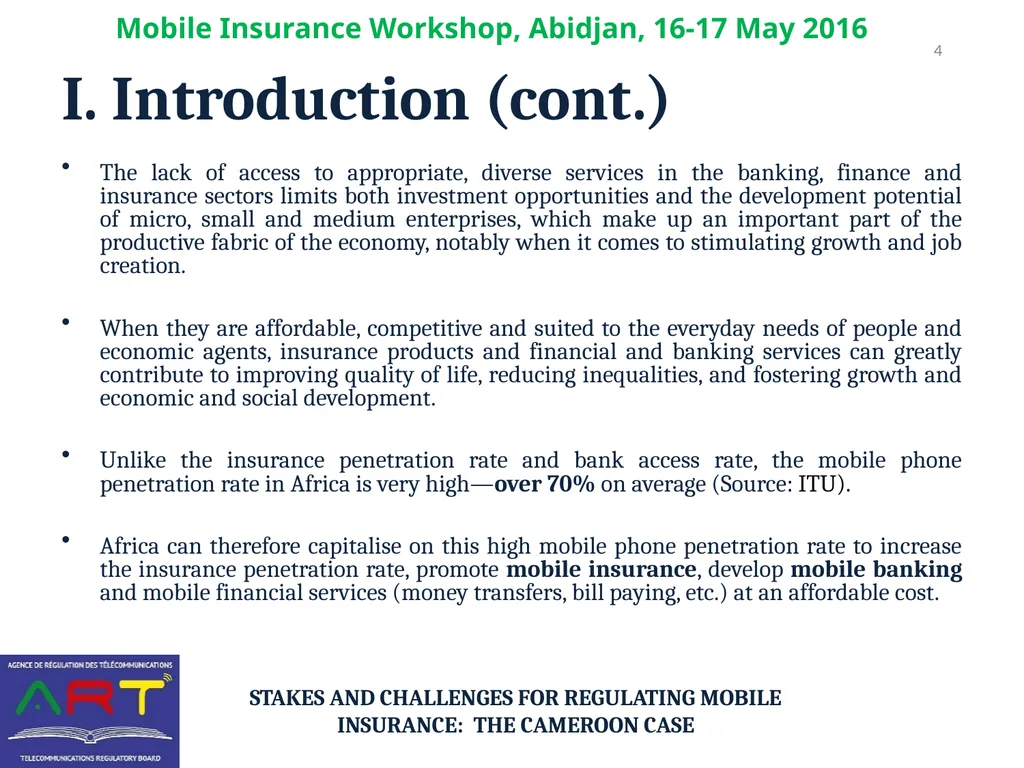
I. Introduction (cont.) The lack of access to appropriate, diverse services in the banking, finance and insurance sectors limits both investment opportunities and the development potential of micro, small and medium enterprises, which make up an important part of the productive fabric of the economy, notably when it comes to stimulating growth and job creation.
When they are affordable, competitive and suited to the everyday needs of people and economic agents, insurance products and financial and banking services can greatly contribute to improving quality of life, reducing inequalities, and fostering growth and economic and social development.
Unlike the insurance penetration rate and bank access rate, the mobile phone penetration rate in Africa is very high—over 70% on average (Source: ITU).
Africa can therefore capitalise on this high mobile phone penetration rate to increase the insurance penetration rate, promote mobile insurance, develop mobile banking and mobile financial services (money transfers, bill paying, etc.) at an affordable cost. 4 Stakes and Challenges for REGULATING Mobile Insurance: THE CAMEROON CASE Mobile Insurance Workshop, Abidjan, 16-17 May 2016<br>
When they are affordable, competitive and suited to the everyday needs of people and economic agents, insurance products and financial and banking services can greatly contribute to improving quality of life, reducing inequalities, and fostering growth and economic and social development.
Unlike the insurance penetration rate and bank access rate, the mobile phone penetration rate in Africa is very high—over 70% on average (Source: ITU).
Africa can therefore capitalise on this high mobile phone penetration rate to increase the insurance penetration rate, promote mobile insurance, develop mobile banking and mobile financial services (money transfers, bill paying, etc.) at an affordable cost. 4 Stakes and Challenges for REGULATING Mobile Insurance: THE CAMEROON CASE Mobile Insurance Workshop, Abidjan, 16-17 May 2016<br>
05
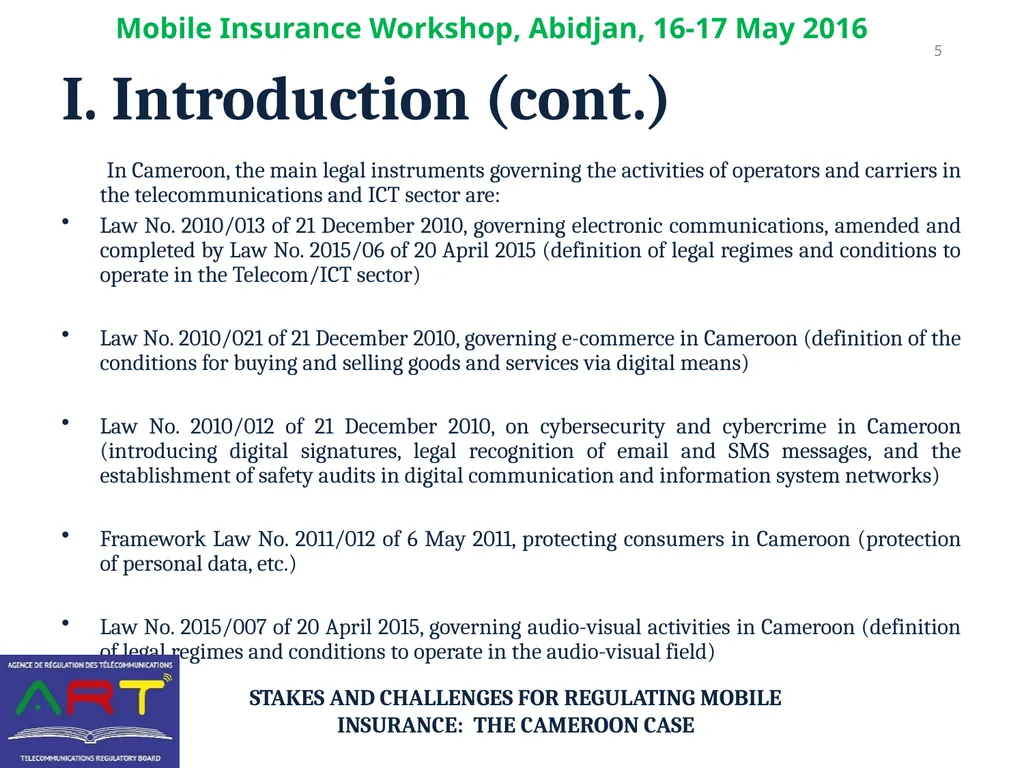
I. Introduction (cont.) In Cameroon, the main legal instruments governing the activities of operators and carriers in the telecommunications and ICT sector are:
Law No. 2010/013 of 21 December 2010, governing electronic communications, amended and completed by Law No. 2015/06 of 20 April 2015 (definition of legal regimes and conditions to operate in the Telecom/ICT sector)
Law No. 2010/021 of 21 December 2010, governing e-commerce in Cameroon (definition of the conditions for buying and selling goods and services via digital means)
Law No. 2010/012 of 21 December 2010, on cybersecurity and cybercrime in Cameroon (introducing digital signatures, legal recognition of email and SMS messages, and the establishment of safety audits in digital communication and information system networks)
Framework Law No. 2011/012 of 6 May 2011, protecting consumers in Cameroon (protection of personal data, etc.)
Law No. 2015/007 of 20 April 2015, governing audio-visual activities in Cameroon (definition of legal regimes and conditions to operate in the audio-visual field) 5 Stakes and Challenges for REGULATING Mobile Insurance: THE CAMEROON CASE Mobile Insurance Workshop, Abidjan, 16-17 May 2016<br>
Law No. 2010/013 of 21 December 2010, governing electronic communications, amended and completed by Law No. 2015/06 of 20 April 2015 (definition of legal regimes and conditions to operate in the Telecom/ICT sector)
Law No. 2010/021 of 21 December 2010, governing e-commerce in Cameroon (definition of the conditions for buying and selling goods and services via digital means)
Law No. 2010/012 of 21 December 2010, on cybersecurity and cybercrime in Cameroon (introducing digital signatures, legal recognition of email and SMS messages, and the establishment of safety audits in digital communication and information system networks)
Framework Law No. 2011/012 of 6 May 2011, protecting consumers in Cameroon (protection of personal data, etc.)
Law No. 2015/007 of 20 April 2015, governing audio-visual activities in Cameroon (definition of legal regimes and conditions to operate in the audio-visual field) 5 Stakes and Challenges for REGULATING Mobile Insurance: THE CAMEROON CASE Mobile Insurance Workshop, Abidjan, 16-17 May 2016<br>
06
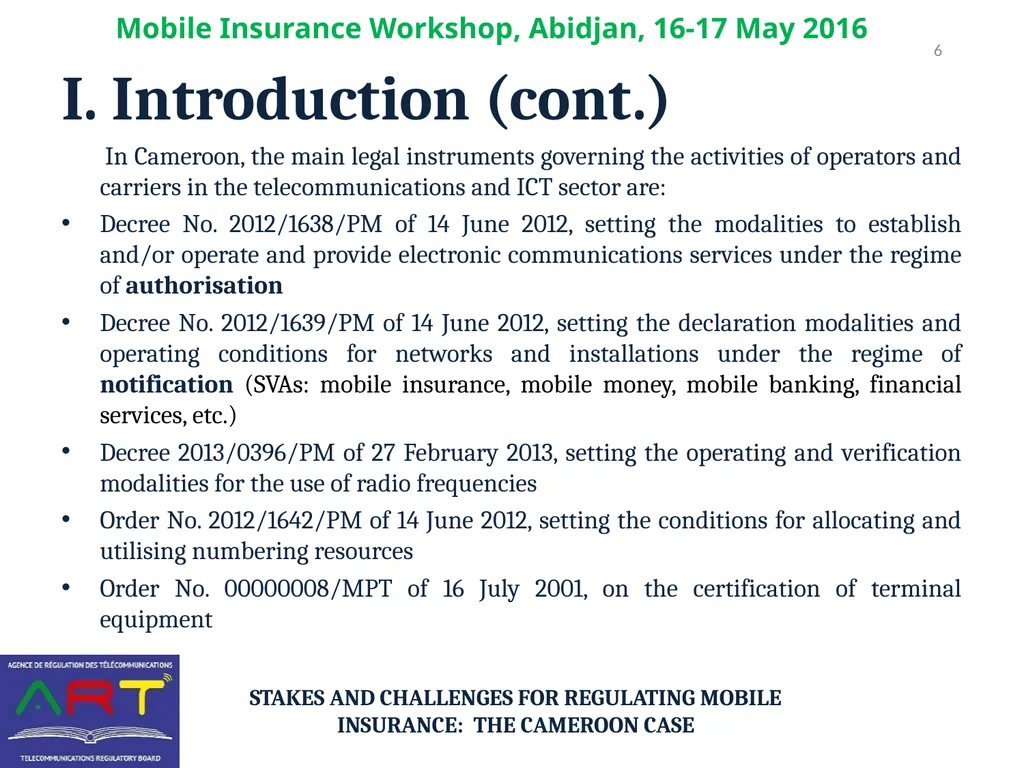
I. Introduction (cont.) In Cameroon, the main legal instruments governing the activities of operators and carriers in the telecommunications and ICT sector are:
Decree No. 2012/1638/PM of 14 June 2012, setting the modalities to establish and/or operate and provide electronic communications services under the regime of authorisation
Decree No. 2012/1639/PM of 14 June 2012, setting the declaration modalities and operating conditions for networks and installations under the regime of notification (SVAs: mobile insurance, mobile money, mobile banking, financial services, etc.)
Decree 2013/0396/PM of 27 February 2013, setting the operating and verification modalities for the use of radio frequencies
Order No. 2012/1642/PM of 14 June 2012, setting the conditions for allocating and utilising numbering resources
Order No. 00000008/MPT of 16 July 2001, on the certification of terminal equipment 6 Stakes and Challenges for REGULATING Mobile Insurance: THE CAMEROON CASE Mobile Insurance Workshop, Abidjan, 16-17 May 2016<br>
Decree No. 2012/1638/PM of 14 June 2012, setting the modalities to establish and/or operate and provide electronic communications services under the regime of authorisation
Decree No. 2012/1639/PM of 14 June 2012, setting the declaration modalities and operating conditions for networks and installations under the regime of notification (SVAs: mobile insurance, mobile money, mobile banking, financial services, etc.)
Decree 2013/0396/PM of 27 February 2013, setting the operating and verification modalities for the use of radio frequencies
Order No. 2012/1642/PM of 14 June 2012, setting the conditions for allocating and utilising numbering resources
Order No. 00000008/MPT of 16 July 2001, on the certification of terminal equipment 6 Stakes and Challenges for REGULATING Mobile Insurance: THE CAMEROON CASE Mobile Insurance Workshop, Abidjan, 16-17 May 2016<br>
07
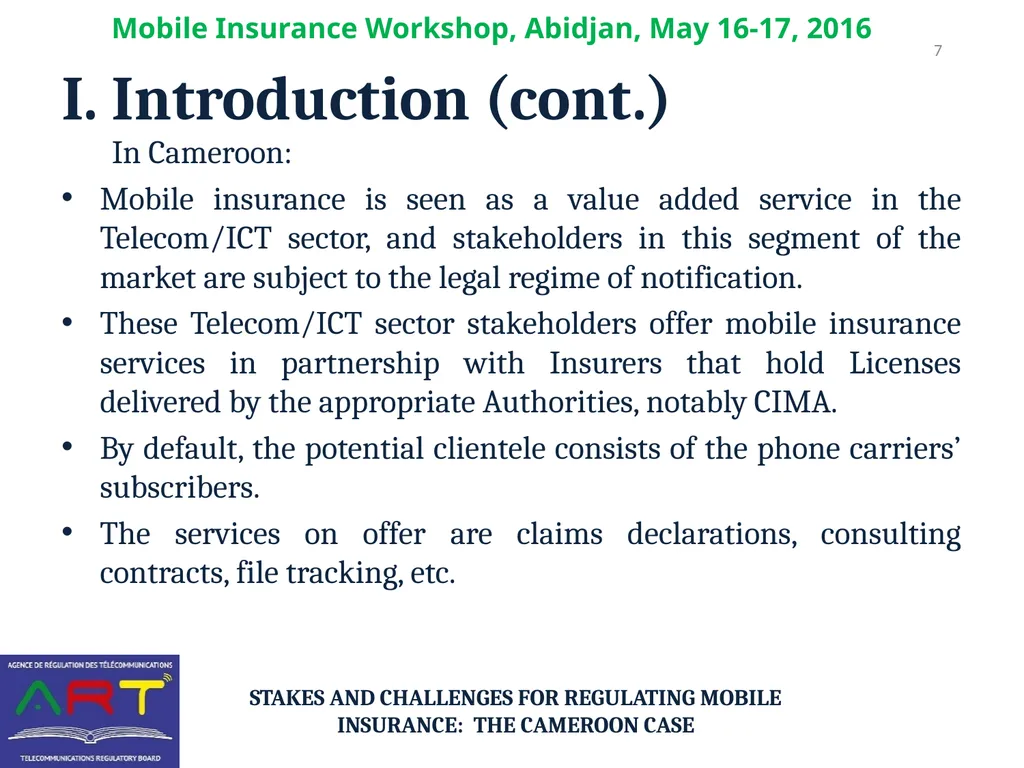
I. Introduction (cont.) In Cameroon:
Mobile insurance is seen as a value added service in the Telecom/ICT sector, and stakeholders in this segment of the market are subject to the legal regime of notification.
These Telecom/ICT sector stakeholders offer mobile insurance services in partnership with Insurers that hold Licenses delivered by the appropriate Authorities, notably CIMA.
By default, the potential clientele consists of the phone carriers’ subscribers.
The services on offer are claims declarations, consulting contracts, file tracking, etc. 7 Stakes and Challenges for REGULATING Mobile Insurance: THE CAMEROON CASE Mobile Insurance Workshop, Abidjan, May 16-17, 2016<br>
Mobile insurance is seen as a value added service in the Telecom/ICT sector, and stakeholders in this segment of the market are subject to the legal regime of notification.
These Telecom/ICT sector stakeholders offer mobile insurance services in partnership with Insurers that hold Licenses delivered by the appropriate Authorities, notably CIMA.
By default, the potential clientele consists of the phone carriers’ subscribers.
The services on offer are claims declarations, consulting contracts, file tracking, etc. 7 Stakes and Challenges for REGULATING Mobile Insurance: THE CAMEROON CASE Mobile Insurance Workshop, Abidjan, May 16-17, 2016<br>
08
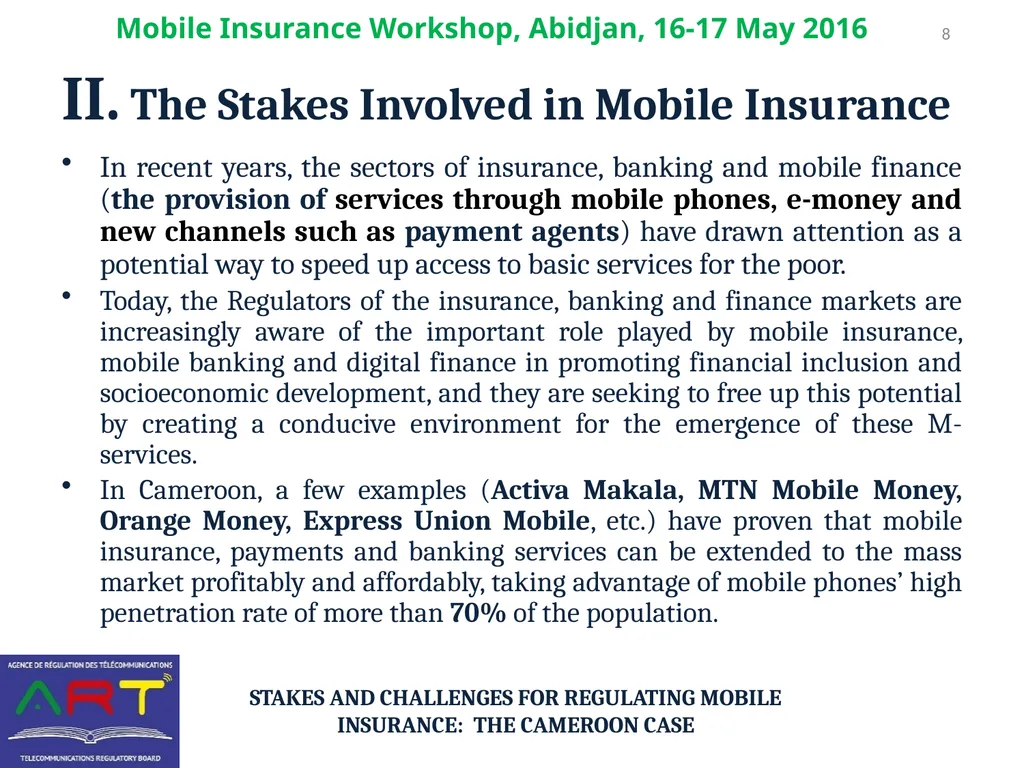
II. The Stakes Involved in Mobile Insurance In recent years, the sectors of insurance, banking and mobile finance (the provision of services through mobile phones, e-money and new channels such as payment agents) have drawn attention as a potential way to speed up access to basic services for the poor.
Today, the Regulators of the insurance, banking and finance markets are increasingly aware of the important role played by mobile insurance, mobile banking and digital finance in promoting financial inclusion and socioeconomic development, and they are seeking to free up this potential by creating a conducive environment for the emergence of these M-services.
In Cameroon, a few examples (Activa Makala, MTN Mobile Money, Orange Money, Express Union Mobile, etc.) have proven that mobile insurance, payments and banking services can be extended to the mass market profitably and affordably, taking advantage of mobile phones’ high penetration rate of more than 70% of the population. 8 Stakes and Challenges for REGULATING Mobile Insurance: THE CAMEROON CASE Mobile Insurance Workshop, Abidjan, 16-17 May 2016<br>
Today, the Regulators of the insurance, banking and finance markets are increasingly aware of the important role played by mobile insurance, mobile banking and digital finance in promoting financial inclusion and socioeconomic development, and they are seeking to free up this potential by creating a conducive environment for the emergence of these M-services.
In Cameroon, a few examples (Activa Makala, MTN Mobile Money, Orange Money, Express Union Mobile, etc.) have proven that mobile insurance, payments and banking services can be extended to the mass market profitably and affordably, taking advantage of mobile phones’ high penetration rate of more than 70% of the population. 8 Stakes and Challenges for REGULATING Mobile Insurance: THE CAMEROON CASE Mobile Insurance Workshop, Abidjan, 16-17 May 2016<br>
09
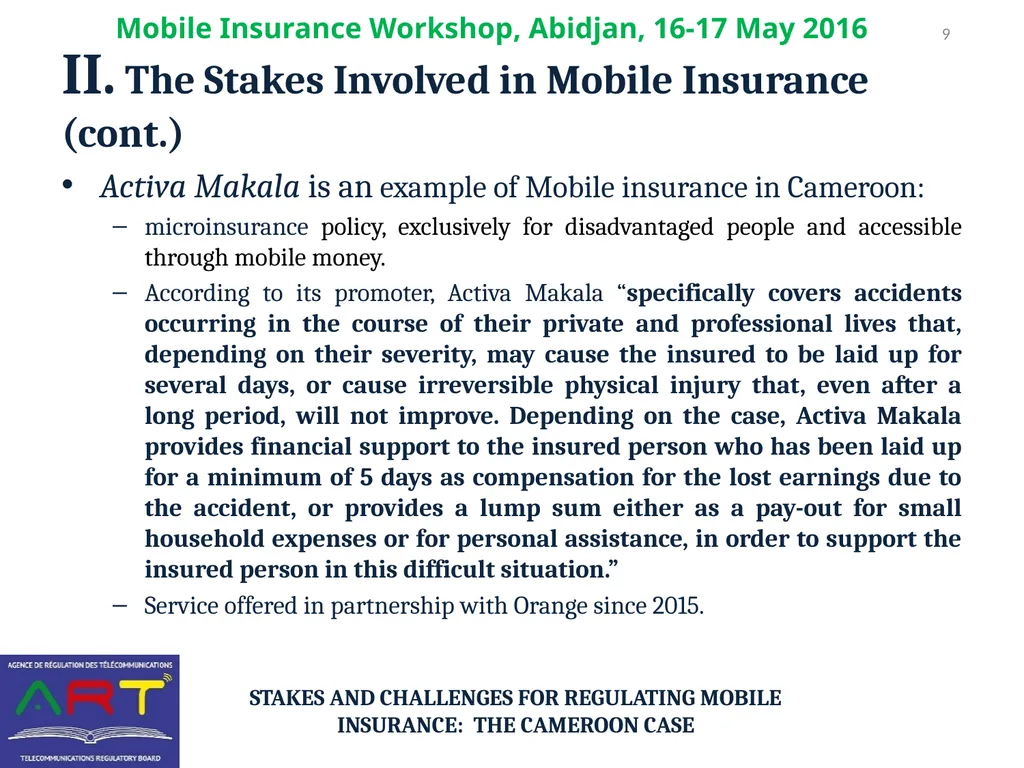
II. The Stakes Involved in Mobile Insurance (cont.) Activa Makala is an example of Mobile insurance in Cameroon:
microinsurance policy, exclusively for disadvantaged people and accessible through mobile money.
According to its promoter, Activa Makala “specifically covers accidents occurring in the course of their private and professional lives that, depending on their severity, may cause the insured to be laid up for several days, or cause irreversible physical injury that, even after a long period, will not improve. Depending on the case, Activa Makala provides financial support to the insured person who has been laid up for a minimum of 5 days as compensation for the lost earnings due to the accident, or provides a lump sum either as a pay-out for small household expenses or for personal assistance, in order to support the insured person in this difficult situation.”
Service offered in partnership with Orange since 2015. 9 Stakes and Challenges for REGULATING Mobile Insurance: THE CAMEROON CASE Mobile Insurance Workshop, Abidjan, 16-17 May 2016<br>
microinsurance policy, exclusively for disadvantaged people and accessible through mobile money.
According to its promoter, Activa Makala “specifically covers accidents occurring in the course of their private and professional lives that, depending on their severity, may cause the insured to be laid up for several days, or cause irreversible physical injury that, even after a long period, will not improve. Depending on the case, Activa Makala provides financial support to the insured person who has been laid up for a minimum of 5 days as compensation for the lost earnings due to the accident, or provides a lump sum either as a pay-out for small household expenses or for personal assistance, in order to support the insured person in this difficult situation.”
Service offered in partnership with Orange since 2015. 9 Stakes and Challenges for REGULATING Mobile Insurance: THE CAMEROON CASE Mobile Insurance Workshop, Abidjan, 16-17 May 2016<br>
10
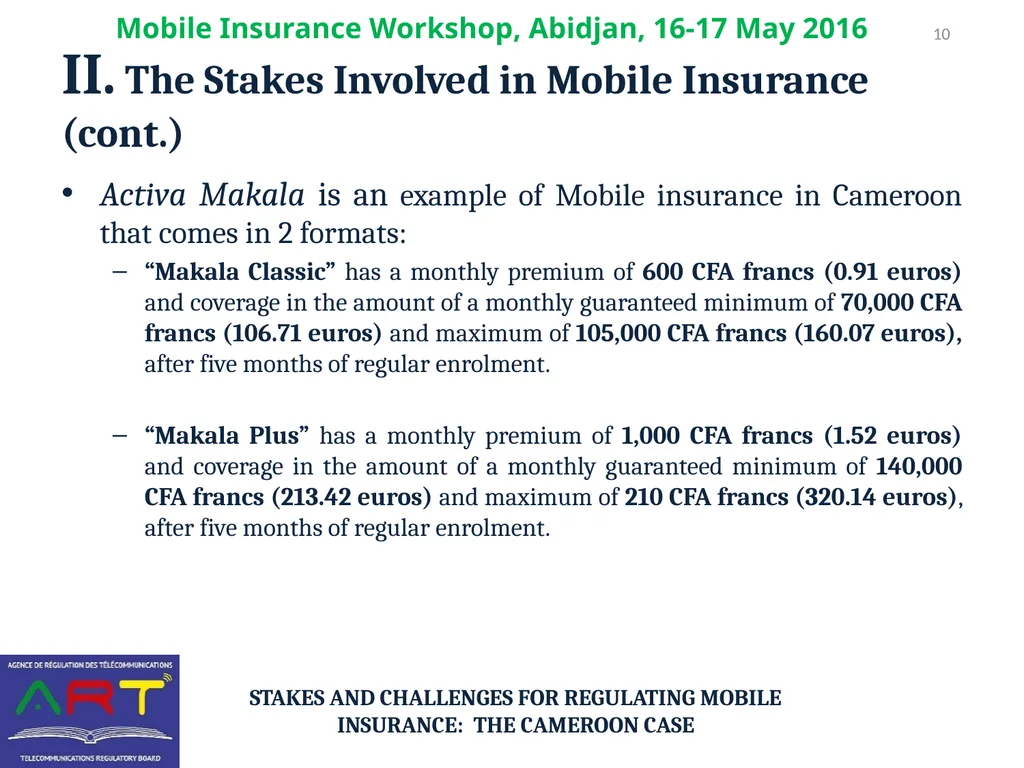
II. The Stakes Involved in Mobile Insurance (cont.) Activa Makala is an example of Mobile insurance in Cameroon that comes in 2 formats:
“Makala Classic” has a monthly premium of 600 CFA francs (0.91 euros) and coverage in the amount of a monthly guaranteed minimum of 70,000 CFA francs (106.71 euros) and maximum of 105,000 CFA francs (160.07 euros), after five months of regular enrolment.
“Makala Plus” has a monthly premium of 1,000 CFA francs (1.52 euros) and coverage in the amount of a monthly guaranteed minimum of 140,000 CFA francs (213.42 euros) and maximum of 210 CFA francs (320.14 euros), after five months of regular enrolment. 10 Stakes and Challenges for REGULATING Mobile Insurance: THE CAMEROON CASE Mobile Insurance Workshop, Abidjan, 16-17 May 2016<br>
“Makala Classic” has a monthly premium of 600 CFA francs (0.91 euros) and coverage in the amount of a monthly guaranteed minimum of 70,000 CFA francs (106.71 euros) and maximum of 105,000 CFA francs (160.07 euros), after five months of regular enrolment.
“Makala Plus” has a monthly premium of 1,000 CFA francs (1.52 euros) and coverage in the amount of a monthly guaranteed minimum of 140,000 CFA francs (213.42 euros) and maximum of 210 CFA francs (320.14 euros), after five months of regular enrolment. 10 Stakes and Challenges for REGULATING Mobile Insurance: THE CAMEROON CASE Mobile Insurance Workshop, Abidjan, 16-17 May 2016<br>
11
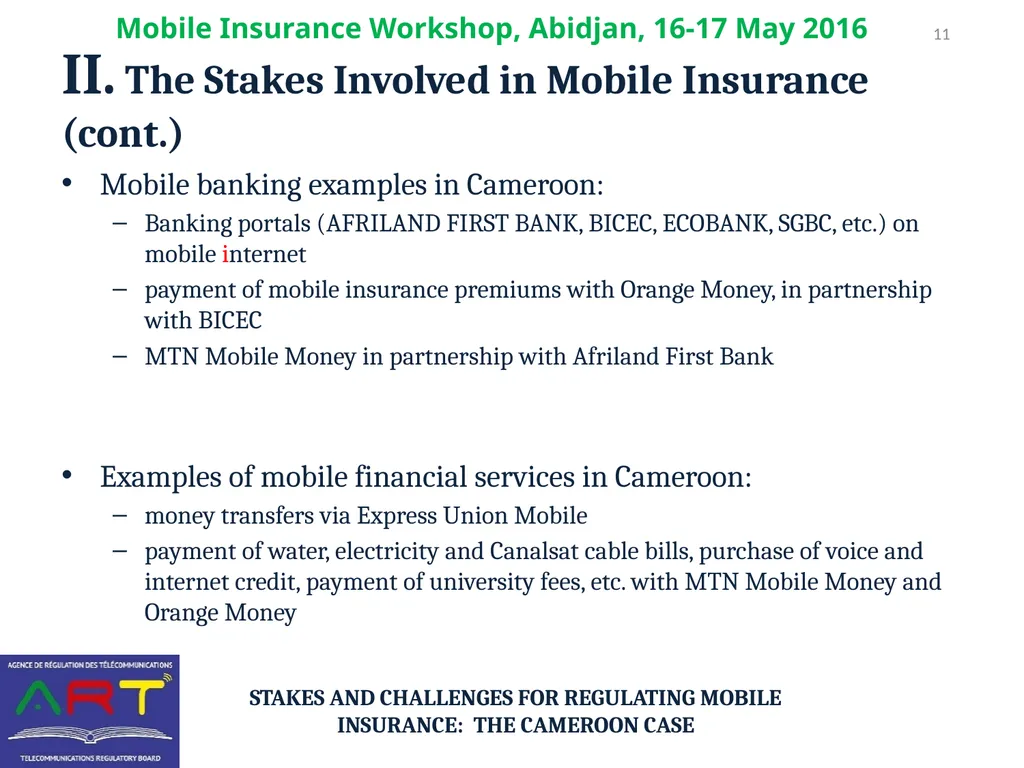
II. The Stakes Involved in Mobile Insurance (cont.) Mobile banking examples in Cameroon:
Banking portals (AFRILAND FIRST BANK, BICEC, ECOBANK, SGBC, etc.) on mobile internet
payment of mobile insurance premiums with Orange Money, in partnership with BICEC
MTN Mobile Money in partnership with Afriland First Bank
Examples of mobile financial services in Cameroon:
money transfers via Express Union Mobile
payment of water, electricity and Canalsat cable bills, purchase of voice and internet credit, payment of university fees, etc. with MTN Mobile Money and Orange Money 11 Stakes and Challenges for REGULATING Mobile Insurance: THE CAMEROON CASE Mobile Insurance Workshop, Abidjan, 16-17 May 2016<br>
Banking portals (AFRILAND FIRST BANK, BICEC, ECOBANK, SGBC, etc.) on mobile internet
payment of mobile insurance premiums with Orange Money, in partnership with BICEC
MTN Mobile Money in partnership with Afriland First Bank
Examples of mobile financial services in Cameroon:
money transfers via Express Union Mobile
payment of water, electricity and Canalsat cable bills, purchase of voice and internet credit, payment of university fees, etc. with MTN Mobile Money and Orange Money 11 Stakes and Challenges for REGULATING Mobile Insurance: THE CAMEROON CASE Mobile Insurance Workshop, Abidjan, 16-17 May 2016<br>
12
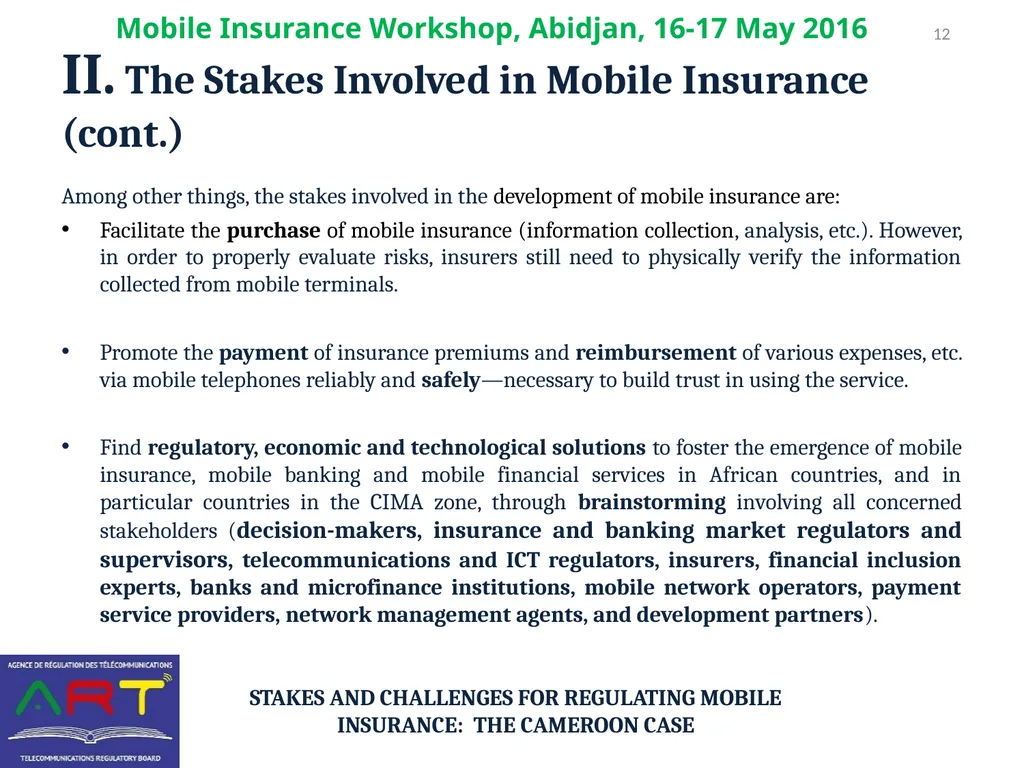
II. The Stakes Involved in Mobile Insurance (cont.) Among other things, the stakes involved in the development of mobile insurance are:
Facilitate the purchase of mobile insurance (information collection, analysis, etc.). However, in order to properly evaluate risks, insurers still need to physically verify the information collected from mobile terminals.
Promote the payment of insurance premiums and reimbursement of various expenses, etc. via mobile telephones reliably and safely—necessary to build trust in using the service.
Find regulatory, economic and technological solutions to foster the emergence of mobile insurance, mobile banking and mobile financial services in African countries, and in particular countries in the CIMA zone, through brainstorming involving all concerned stakeholders (decision-makers, insurance and banking market regulators and supervisors, telecommunications and ICT regulators, insurers, financial inclusion experts, banks and microfinance institutions, mobile network operators, payment service providers, network management agents, and development partners). 12 Stakes and Challenges for REGULATING Mobile Insurance: THE CAMEROON CASE Mobile Insurance Workshop, Abidjan, 16-17 May 2016<br>
Facilitate the purchase of mobile insurance (information collection, analysis, etc.). However, in order to properly evaluate risks, insurers still need to physically verify the information collected from mobile terminals.
Promote the payment of insurance premiums and reimbursement of various expenses, etc. via mobile telephones reliably and safely—necessary to build trust in using the service.
Find regulatory, economic and technological solutions to foster the emergence of mobile insurance, mobile banking and mobile financial services in African countries, and in particular countries in the CIMA zone, through brainstorming involving all concerned stakeholders (decision-makers, insurance and banking market regulators and supervisors, telecommunications and ICT regulators, insurers, financial inclusion experts, banks and microfinance institutions, mobile network operators, payment service providers, network management agents, and development partners). 12 Stakes and Challenges for REGULATING Mobile Insurance: THE CAMEROON CASE Mobile Insurance Workshop, Abidjan, 16-17 May 2016<br>
13
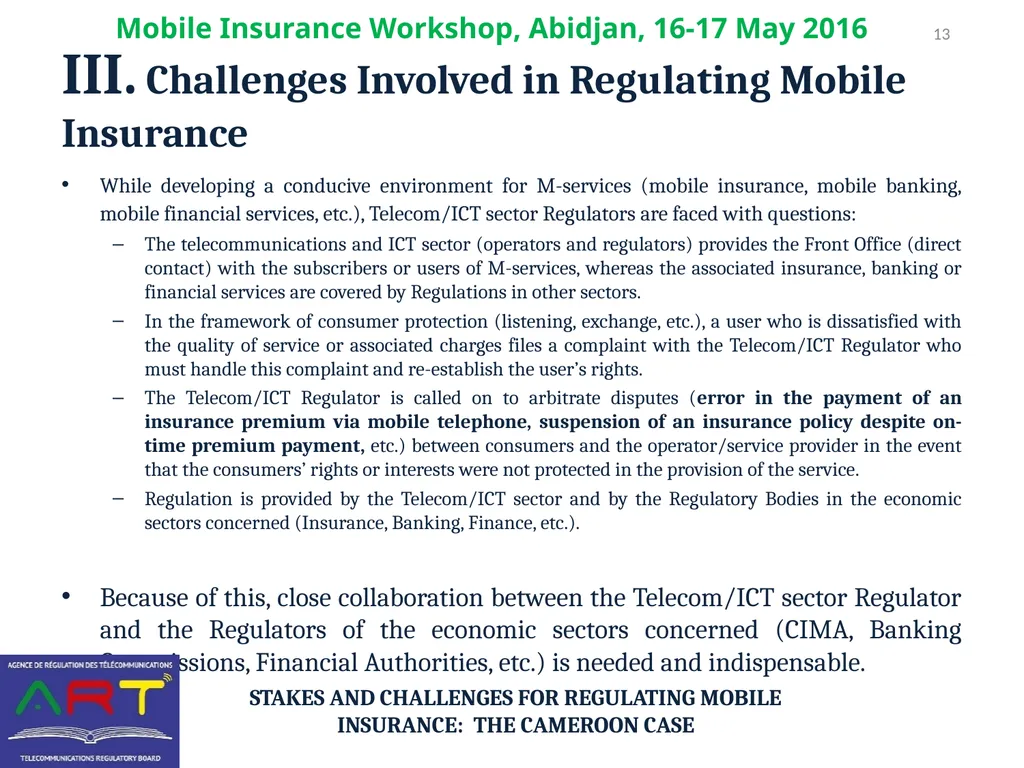
III. Challenges Involved in Regulating Mobile Insurance While developing a conducive environment for M-services (mobile insurance, mobile banking, mobile financial services, etc.), Telecom/ICT sector Regulators are faced with questions:
The telecommunications and ICT sector (operators and regulators) provides the Front Office (direct contact) with the subscribers or users of M-services, whereas the associated insurance, banking or financial services are covered by Regulations in other sectors.
In the framework of consumer protection (listening, exchange, etc.), a user who is dissatisfied with the quality of service or associated charges files a complaint with the Telecom/ICT Regulator who must handle this complaint and re-establish the user’s rights.
The Telecom/ICT Regulator is called on to arbitrate disputes (error in the payment of an insurance premium via mobile telephone, suspension of an insurance policy despite on-time premium payment, etc.) between consumers and the operator/service provider in the event that the consumers’ rights or interests were not protected in the provision of the service.
Regulation is provided by the Telecom/ICT sector and by the Regulatory Bodies in the economic sectors concerned (Insurance, Banking, Finance, etc.).
Because of this, close collaboration between the Telecom/ICT sector Regulator and the Regulators of the economic sectors concerned (CIMA, Banking Commissions, Financial Authorities, etc.) is needed and indispensable. 13 Stakes and Challenges for REGULATING Mobile Insurance: THE CAMEROON CASE Mobile Insurance Workshop, Abidjan, 16-17 May 2016<br>
The telecommunications and ICT sector (operators and regulators) provides the Front Office (direct contact) with the subscribers or users of M-services, whereas the associated insurance, banking or financial services are covered by Regulations in other sectors.
In the framework of consumer protection (listening, exchange, etc.), a user who is dissatisfied with the quality of service or associated charges files a complaint with the Telecom/ICT Regulator who must handle this complaint and re-establish the user’s rights.
The Telecom/ICT Regulator is called on to arbitrate disputes (error in the payment of an insurance premium via mobile telephone, suspension of an insurance policy despite on-time premium payment, etc.) between consumers and the operator/service provider in the event that the consumers’ rights or interests were not protected in the provision of the service.
Regulation is provided by the Telecom/ICT sector and by the Regulatory Bodies in the economic sectors concerned (Insurance, Banking, Finance, etc.).
Because of this, close collaboration between the Telecom/ICT sector Regulator and the Regulators of the economic sectors concerned (CIMA, Banking Commissions, Financial Authorities, etc.) is needed and indispensable. 13 Stakes and Challenges for REGULATING Mobile Insurance: THE CAMEROON CASE Mobile Insurance Workshop, Abidjan, 16-17 May 2016<br>
14
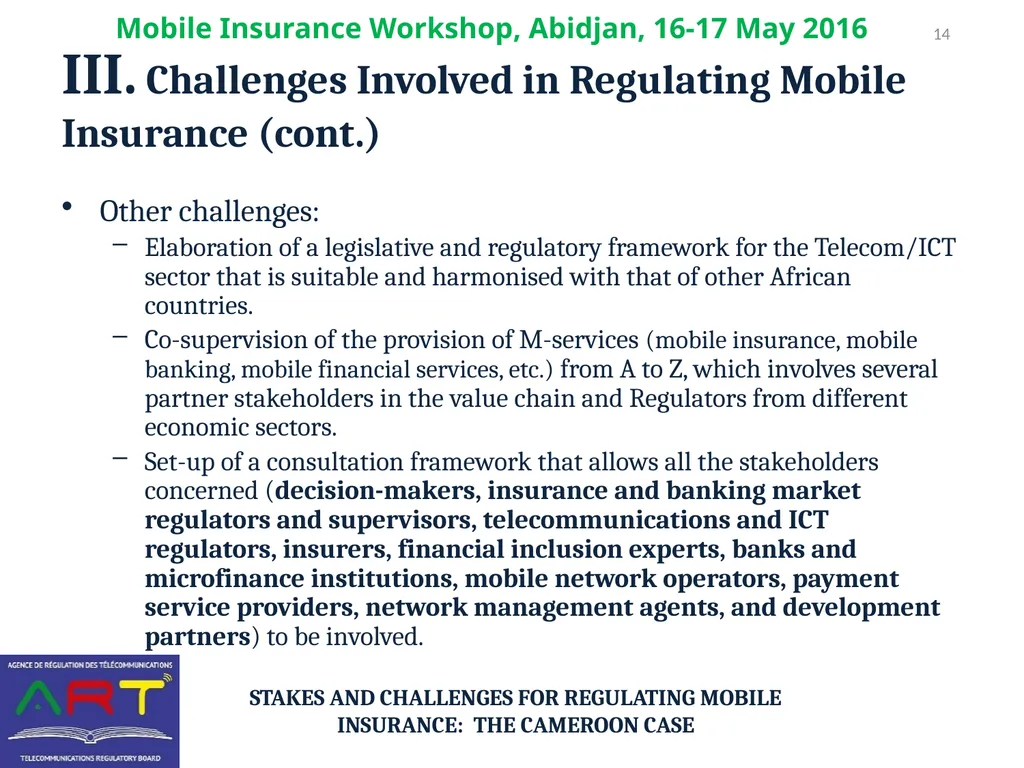
III. Challenges Involved in Regulating Mobile Insurance (cont.) Other challenges:
Elaboration of a legislative and regulatory framework for the Telecom/ICT sector that is suitable and harmonised with that of other African countries.
Co-supervision of the provision of M-services (mobile insurance, mobile banking, mobile financial services, etc.) from A to Z, which involves several partner stakeholders in the value chain and Regulators from different economic sectors.
Set-up of a consultation framework that allows all the stakeholders concerned (decision-makers, insurance and banking market regulators and supervisors, telecommunications and ICT regulators, insurers, financial inclusion experts, banks and microfinance institutions, mobile network operators, payment service providers, network management agents, and development partners) to be involved. 14 Stakes and Challenges for REGULATING Mobile Insurance: THE CAMEROON CASE Mobile Insurance Workshop, Abidjan, 16-17 May 2016<br>
Elaboration of a legislative and regulatory framework for the Telecom/ICT sector that is suitable and harmonised with that of other African countries.
Co-supervision of the provision of M-services (mobile insurance, mobile banking, mobile financial services, etc.) from A to Z, which involves several partner stakeholders in the value chain and Regulators from different economic sectors.
Set-up of a consultation framework that allows all the stakeholders concerned (decision-makers, insurance and banking market regulators and supervisors, telecommunications and ICT regulators, insurers, financial inclusion experts, banks and microfinance institutions, mobile network operators, payment service providers, network management agents, and development partners) to be involved. 14 Stakes and Challenges for REGULATING Mobile Insurance: THE CAMEROON CASE Mobile Insurance Workshop, Abidjan, 16-17 May 2016<br>
15
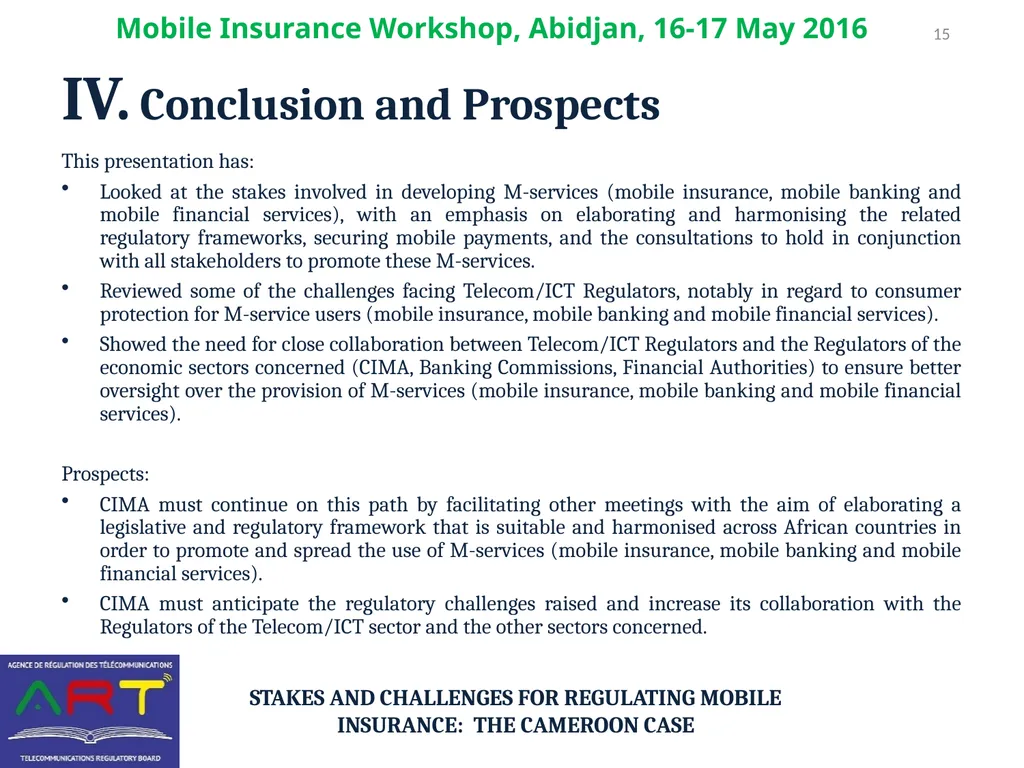
IV. Conclusion and Prospects This presentation has:
Looked at the stakes involved in developing M-services (mobile insurance, mobile banking and mobile financial services), with an emphasis on elaborating and harmonising the related regulatory frameworks, securing mobile payments, and the consultations to hold in conjunction with all stakeholders to promote these M-services.
Reviewed some of the challenges facing Telecom/ICT Regulators, notably in regard to consumer protection for M-service users (mobile insurance, mobile banking and mobile financial services).
Showed the need for close collaboration between Telecom/ICT Regulators and the Regulators of the economic sectors concerned (CIMA, Banking Commissions, Financial Authorities) to ensure better oversight over the provision of M-services (mobile insurance, mobile banking and mobile financial services).
Prospects:
CIMA must continue on this path by facilitating other meetings with the aim of elaborating a legislative and regulatory framework that is suitable and harmonised across African countries in order to promote and spread the use of M-services (mobile insurance, mobile banking and mobile financial services).
CIMA must anticipate the regulatory challenges raised and increase its collaboration with the Regulators of the Telecom/ICT sector and the other sectors concerned. 15 Stakes and Challenges for REGULATING Mobile Insurance: THE CAMEROON CASE Mobile Insurance Workshop, Abidjan, 16-17 May 2016<br>
Looked at the stakes involved in developing M-services (mobile insurance, mobile banking and mobile financial services), with an emphasis on elaborating and harmonising the related regulatory frameworks, securing mobile payments, and the consultations to hold in conjunction with all stakeholders to promote these M-services.
Reviewed some of the challenges facing Telecom/ICT Regulators, notably in regard to consumer protection for M-service users (mobile insurance, mobile banking and mobile financial services).
Showed the need for close collaboration between Telecom/ICT Regulators and the Regulators of the economic sectors concerned (CIMA, Banking Commissions, Financial Authorities) to ensure better oversight over the provision of M-services (mobile insurance, mobile banking and mobile financial services).
Prospects:
CIMA must continue on this path by facilitating other meetings with the aim of elaborating a legislative and regulatory framework that is suitable and harmonised across African countries in order to promote and spread the use of M-services (mobile insurance, mobile banking and mobile financial services).
CIMA must anticipate the regulatory challenges raised and increase its collaboration with the Regulators of the Telecom/ICT sector and the other sectors concerned. 15 Stakes and Challenges for REGULATING Mobile Insurance: THE CAMEROON CASE Mobile Insurance Workshop, Abidjan, 16-17 May 2016<br>
16
THANK YOU FOR YOUR KIND ATTENTION DJOUMESSI DONTSA Fabrice James
Under-Director of Technical Resource Management and Universal Service Mobile Insurance Workshop, Abidjan, 16-17 May 2016<br>
Under-Director of Technical Resource Management and Universal Service Mobile Insurance Workshop, Abidjan, 16-17 May 2016<br>