
Standing Together to Prevent Falls AOTA/APTA’s



Description: Standing Together to Prevent Falls AOTAAPTAs AGPT Fall Prevention Presentation Photo William Provost Are falls preventable? All Rights Reserved 2017 Photo from giftsandcollectiblesgalore.wordpress.com YES! Falls are largely preventable!
Related Topics
Download Presentation
"Standing Together to Prevent Falls AOTA/APTA’s" is the property of its rightful owner. Permission is granted to download and print the materials on this website for personal, non-commercial use only, and to display it on your personal computer provided you do not modify the materials and that you retain all copyright notices contained in the materials. By downloading content from our website, you accept the terms of this agreement.
Presentation Transcript
slide1. Standing Together to Prevent Falls AOTA/APTA’s AGPT
Fall Prevention Presentation Photo © William Provost<br>
slide2. Are falls preventable? All Rights Reserved 2017 Photo from giftsandcollectiblesgalore.wordpress.com<br>
slide3. YES! Falls are largely preventable!
Come learn how. All Rights Reserved 2017<br>
slide4. Today’s Discussion Definition of a fall
Fear of falling
Risk factors for falling
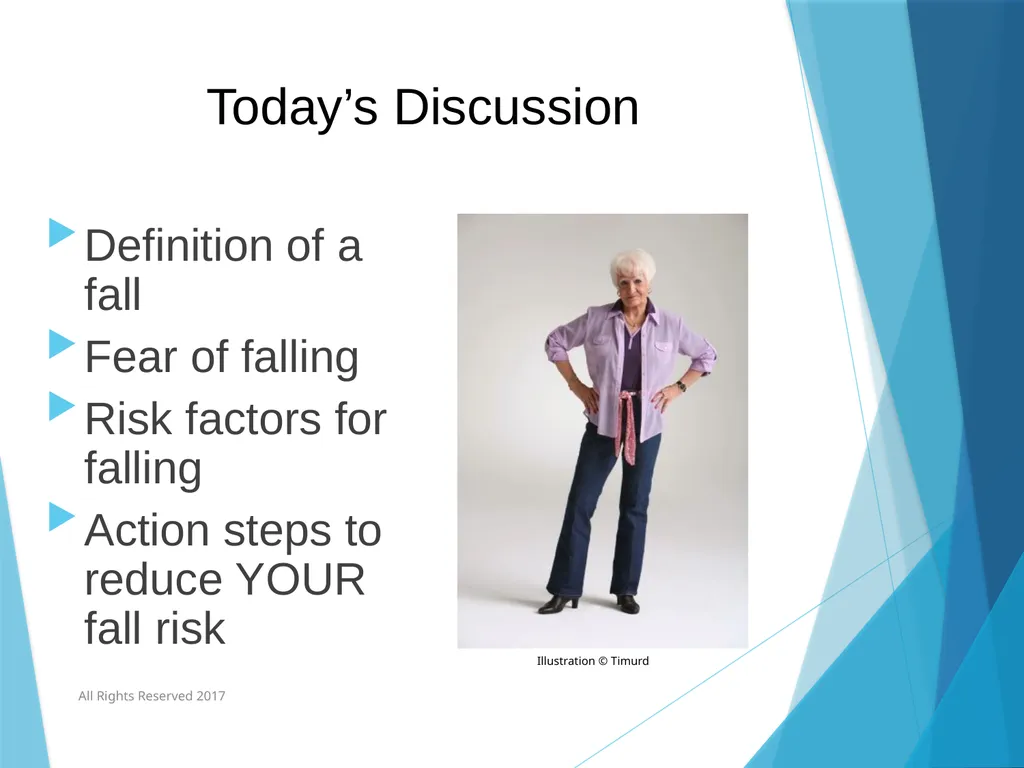
Action steps to reduce YOUR fall risk All Rights Reserved 2017 Illustration © Timurd<br>
slide5. Landing on the ground or some lower surface when you didn’t intend to be there.
Includes slips, trips, etc.
Does not include a medical event.
Schumway-Cook, 2000 What is a “fall”? All Rights Reserved 2017 Image from Creative Commons<br>
slide6. Have you had a fall? Have you had a fall in the past year? Did you tell your primary care provider?
Were you hurt?
Do you worry about falling?
Do you feel unsteady when standing or walking?
A previous fall increases your future fall risk. All Rights Reserved 2017<br>
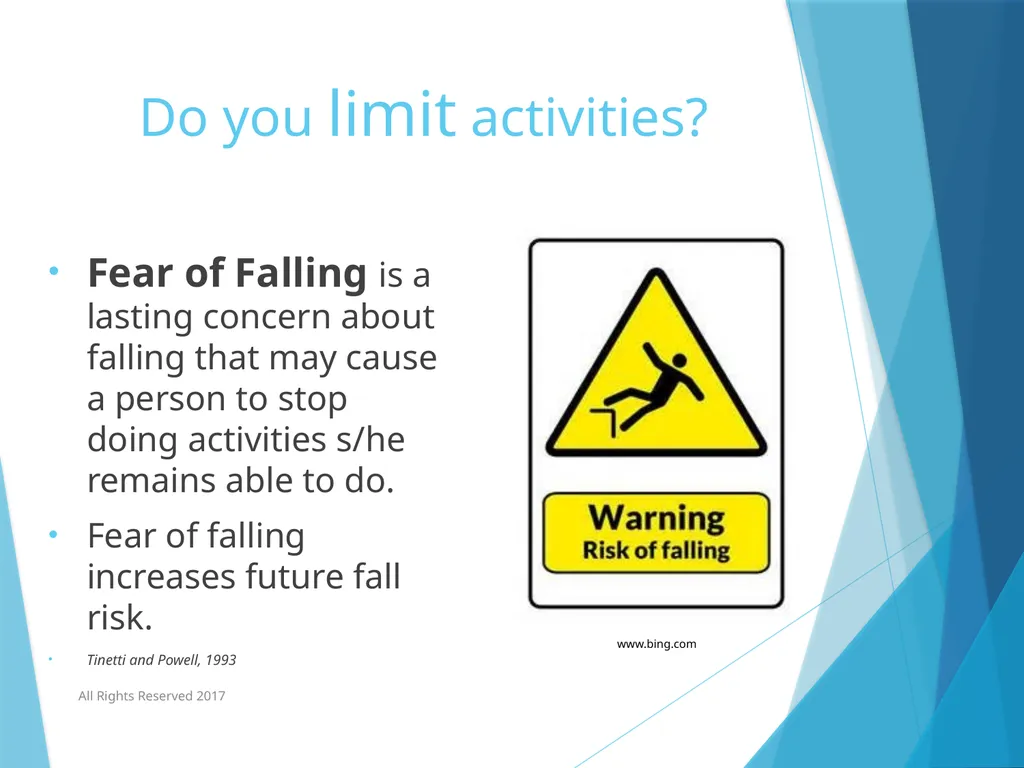
slide7. Do you limit activities? Fear of Falling is a lasting concern about falling that may cause a person to stop doing activities s/he remains able to do.
Fear of falling increases future fall risk.
Tinetti and Powell, 1993 All Rights Reserved 2017 www.bing.com<br>
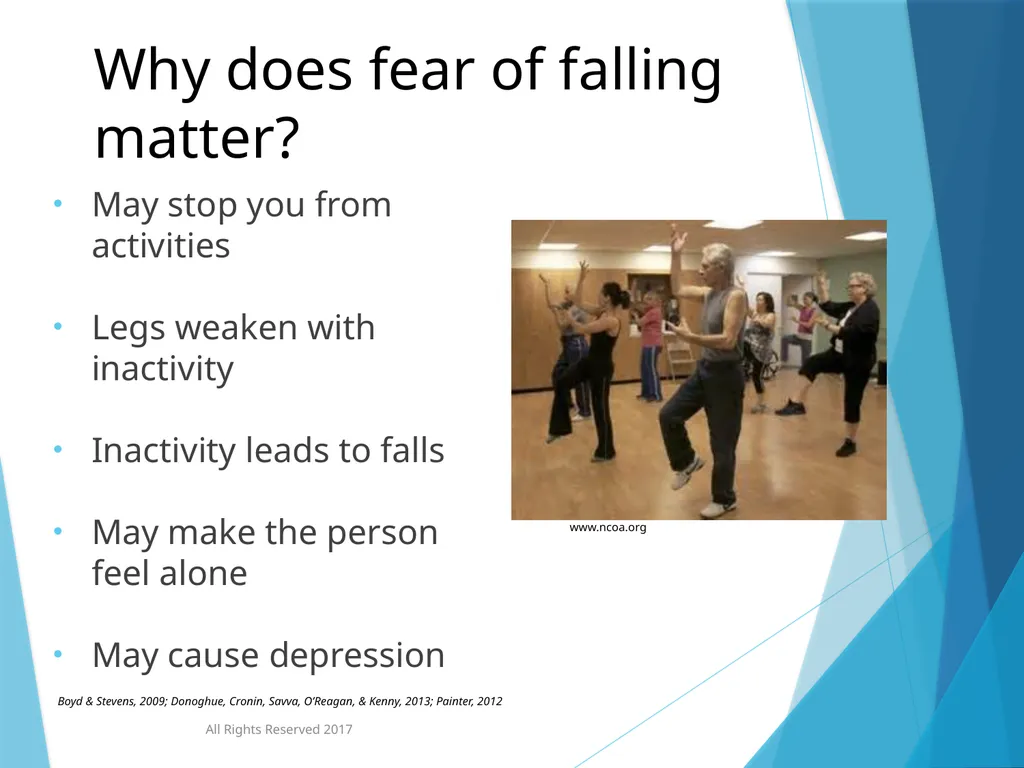
slide8. Why does fear of falling matter? May stop you from activities
Legs weaken with inactivity
Inactivity leads to falls
May make the person feel alone
May cause depression All Rights Reserved 2017 Boyd & Stevens, 2009; Donoghue, Cronin, Savva, O’Reagan, & Kenny, 2013; Painter, 2012 www.ncoa.org<br>
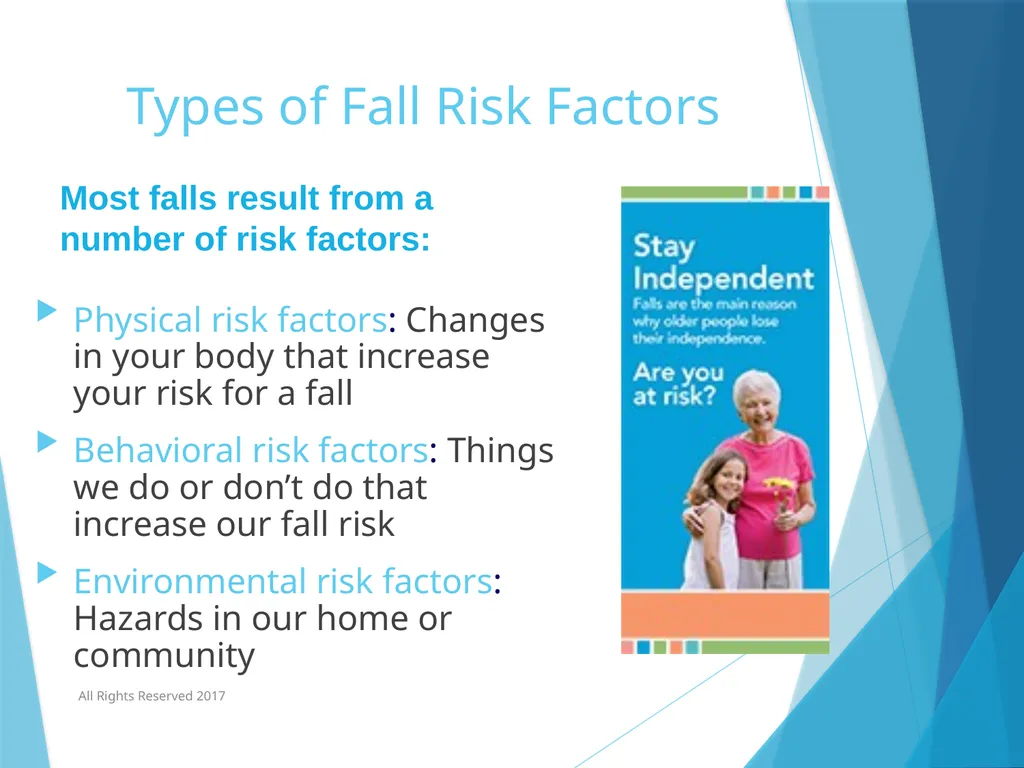
slide9. Types of Fall Risk Factors Physical risk factors: Changes in your body that increase your risk for a fall
Behavioral risk factors: Things we do or don’t do that increase our fall risk
Environmental risk factors: Hazards in our home or community Most falls result from a number of risk factors: All Rights Reserved 2017<br>
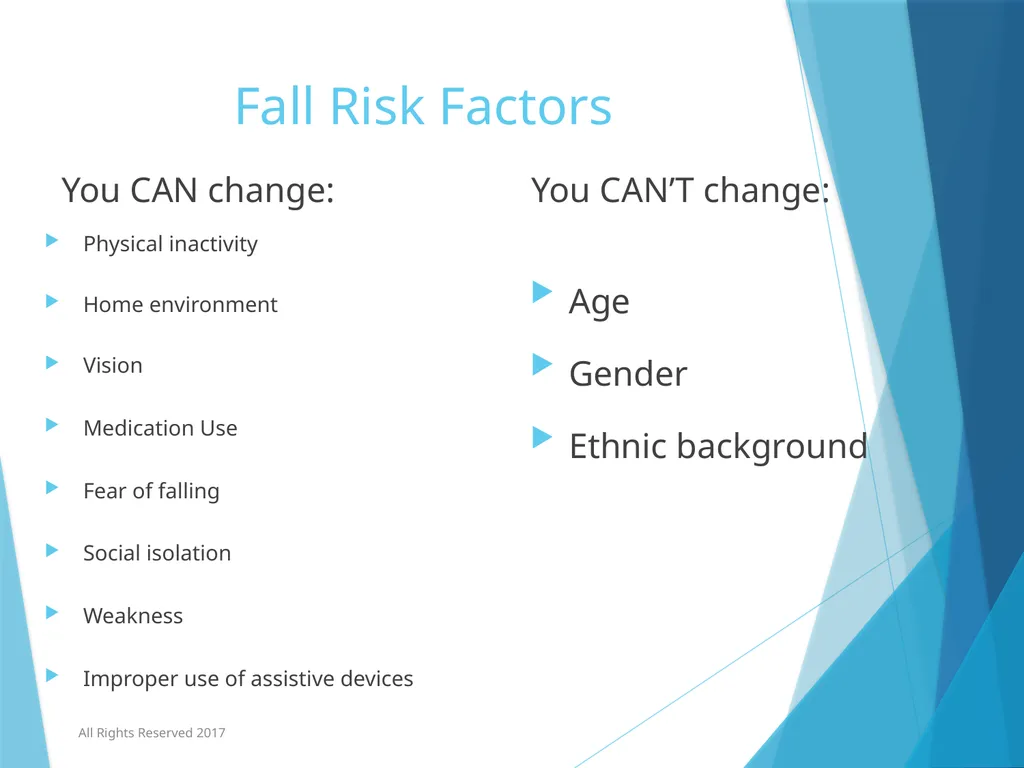
slide10. Fall Risk Factors You CAN change: Physical inactivity
Home environment
Vision
Medication Use
Fear of falling
Social isolation
Weakness
Improper use of assistive devices You CAN’T change: Age
Gender
Ethnic background All Rights Reserved 2017<br>
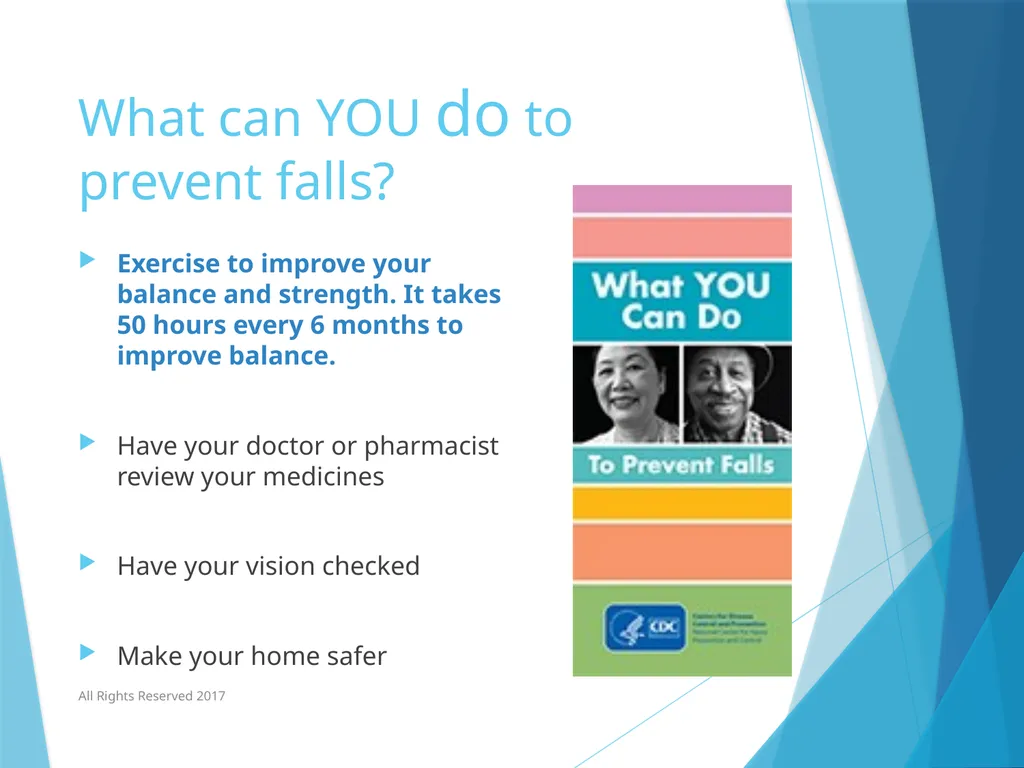
slide11. What can YOU do to prevent falls? Exercise to improve your balance and strength. It takes 50 hours every 6 months to improve balance.
Have your doctor or pharmacist review your medicines
Have your vision checked
Make your home safer All Rights Reserved 2017<br>
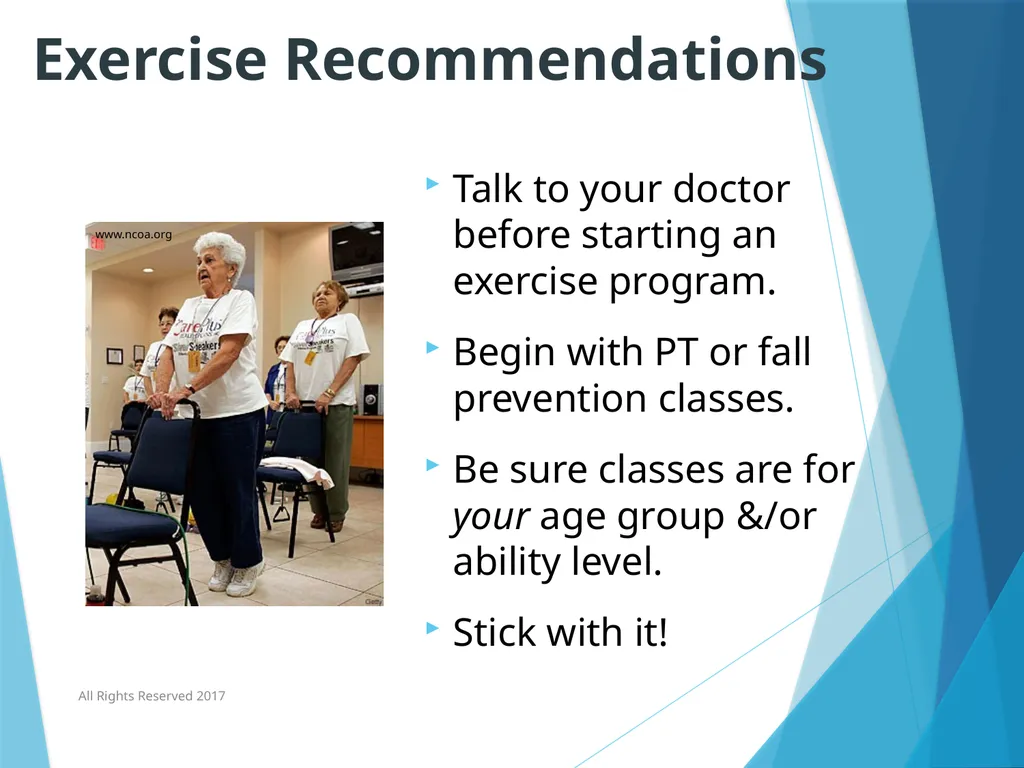
slide12. All Rights Reserved 2017 Exercise Recommendations Talk to your doctor before starting an exercise program.
Begin with PT or fall prevention classes.
Be sure classes are for your age group &/or ability level.
Stick with it! www.ncoa.org<br>
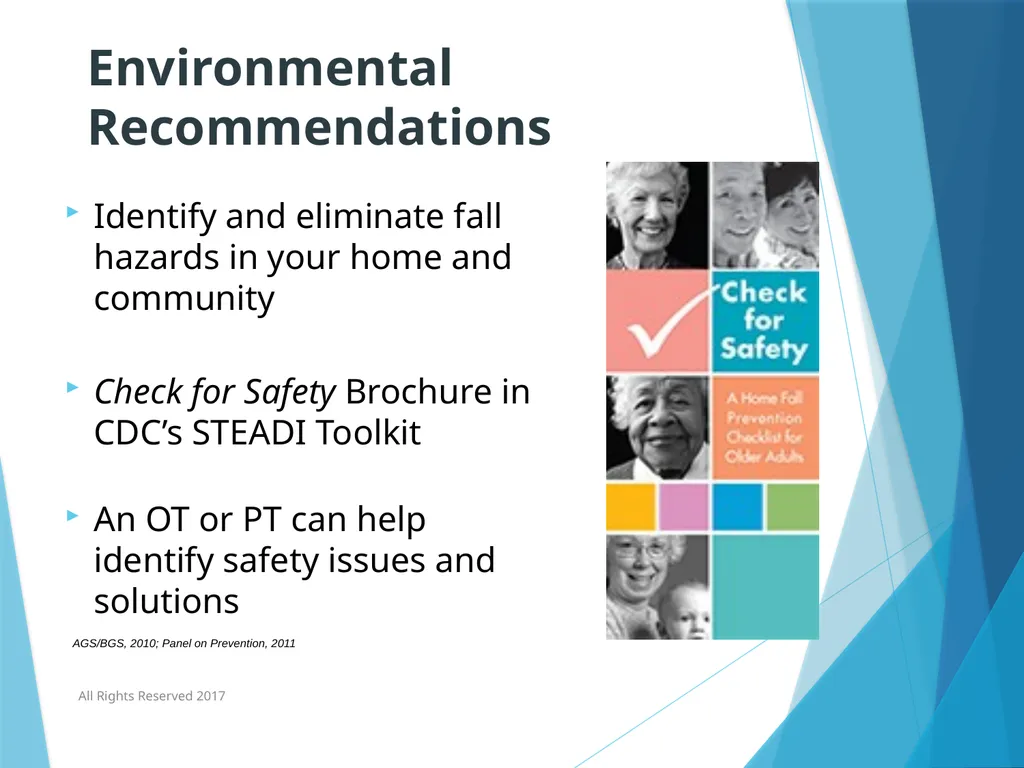
slide13. All Rights Reserved 2017 Environmental
Recommendations Identify and eliminate fall hazards in your home and community
Check for Safety Brochure in CDC’s STEADI Toolkit
An OT or PT can help identify safety issues and solutions AGS/BGS, 2010; Panel on Prevention, 2011<br>
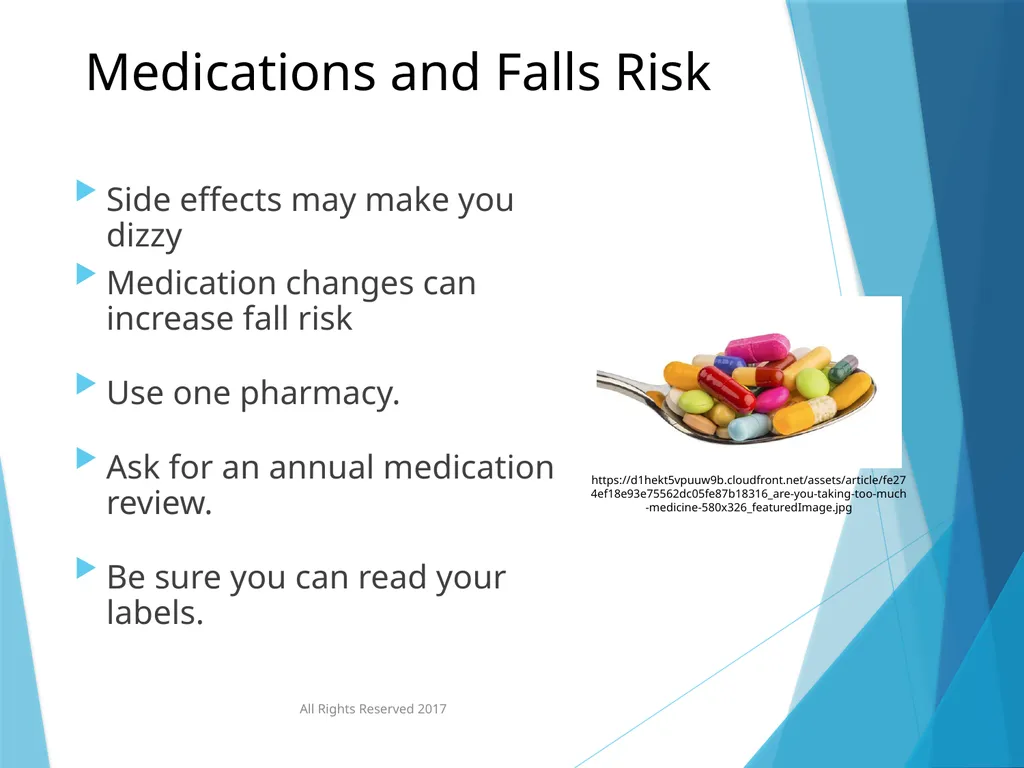
slide14. Medications and Falls Risk Side effects may make you dizzy
Medication changes can increase fall risk
Use one pharmacy.
Ask for an annual medication review.
Be sure you can read your labels. All Rights Reserved 2017 https://d1hekt5vpuuw9b.cloudfront.net/assets/article/fe27
4ef18e93e75562dc05fe87b18316_are-you-taking-too-much
-medicine-580x326_featuredImage.jpg<br>
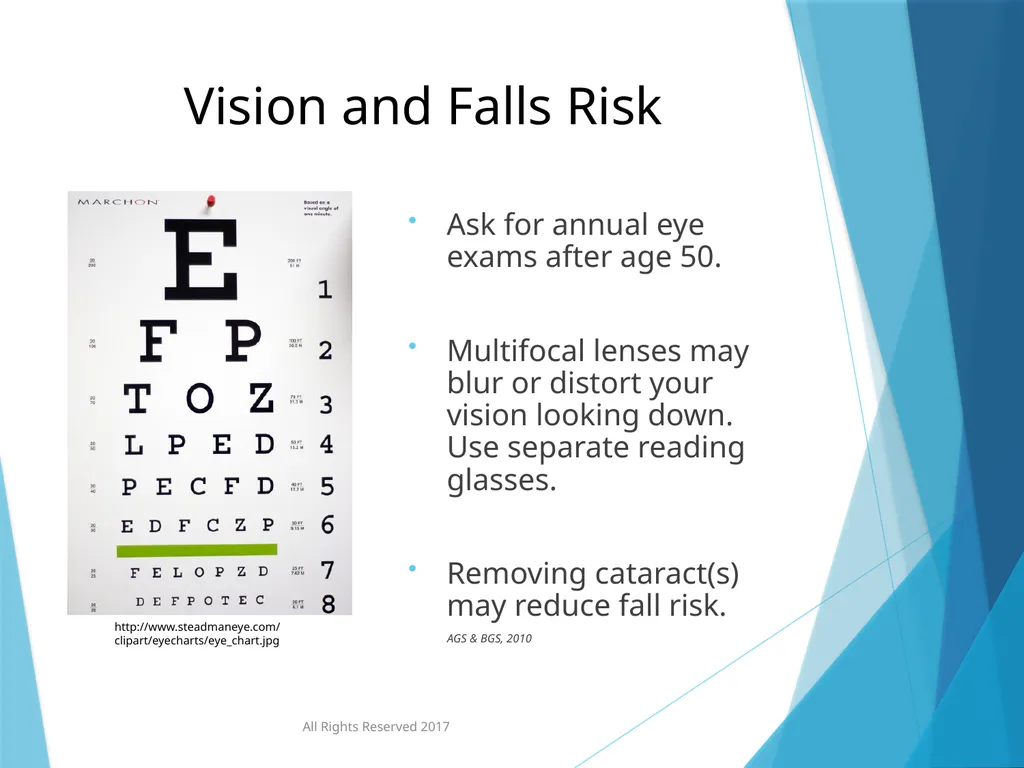
slide15. Vision and Falls Risk Ask for annual eye exams after age 50.
Multifocal lenses may blur or distort your vision looking down. Use separate reading glasses.
Removing cataract(s) may reduce fall risk.
AGS & BGS, 2010 All Rights Reserved 2017 http://www.steadmaneye.com/
clipart/eyecharts/eye_chart.jpg<br>
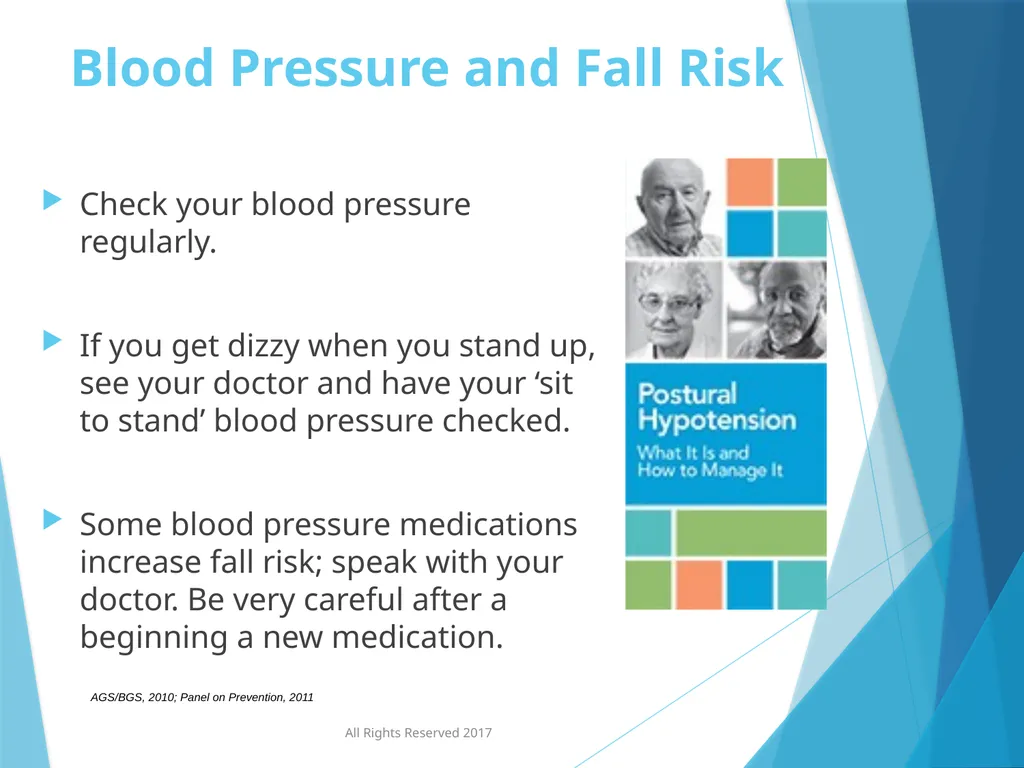
slide16. Blood Pressure and Fall Risk Check your blood pressure regularly.
If you get dizzy when you stand up, see your doctor and have your ‘sit to stand’ blood pressure checked.
Some blood pressure medications increase fall risk; speak with your doctor. Be very careful after a beginning a new medication. All Rights Reserved 2017 AGS/BGS, 2010; Panel on Prevention, 2011<br>
slide17. Chronic Conditions and Fall Risk Chronic Conditions may contribute to your fall risk. Careful management will limit the risk.
Diabetes
Arthritis
Stroke
Neurological disorders like Multiple Sclerosis (MS) or Parkinson’s
Chronic Pain
Depression
Chronic obstructive pulmonary disease (COPD)
Sleep disorders All Rights Reserved 2017 AGS/BGS, 2010; Panel on Prevention, 2011<br>
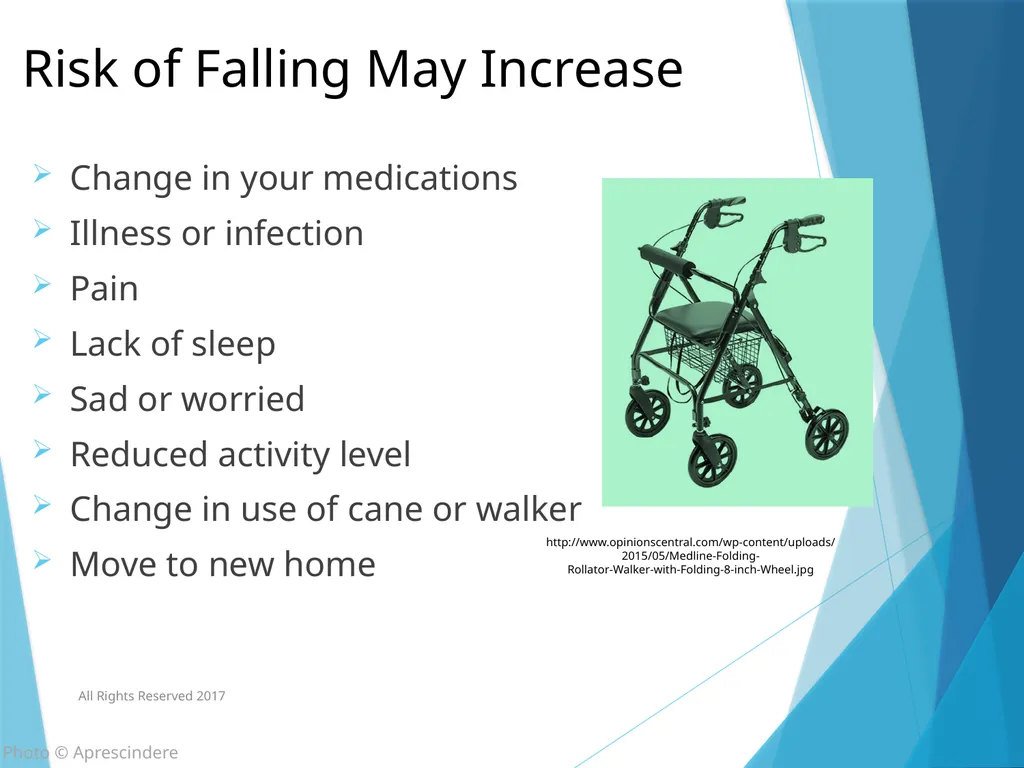
slide18. Risk of Falling May Increase Change in your medications
Illness or infection
Pain
Lack of sleep
Sad or worried
Reduced activity level
Change in use of cane or walker
Move to new home All Rights Reserved 2017 Photo © Aprescindere http://www.opinionscentral.com/wp-content/uploads/
2015/05/Medline-Folding-
Rollator-Walker-with-Folding-8-inch-Wheel.jpg<br>
slide19. Start Small Choose one risk factor to address first ---
Pharmacist & Doctor - review medications for side effects that may cause you to fall
Occupational Therapist - home assessment and recommendations to make your home safer
Physical Therapist - help with physical activity, balance, strength, and moving safely All Rights Reserved 2017<br>
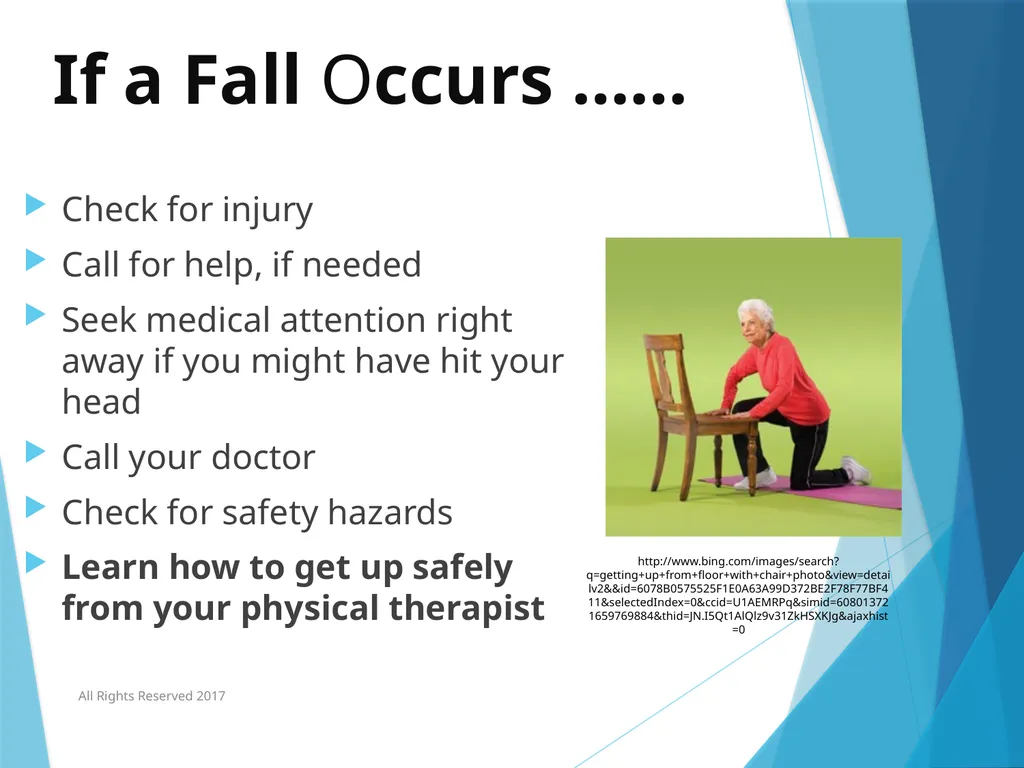
slide20. If a Fall Occurs …… Check for injury
Call for help, if needed
Seek medical attention right away if you might have hit your head
Call your doctor
Check for safety hazards
Learn how to get up safely from your physical therapist All Rights Reserved 2017 http://www.bing.com/images/search?q=getting+up+from+floor+with+chair+photo&view=detailv2&&id=6078B0575525F1E0A63A99D372BE2F78F77BF411&selectedIndex=0&ccid=U1AEMRPq&simid=608013721659769884&thid=JN.I5Qt1AlQlz9v31ZkHSXKJg&ajaxhist=0<br>
slide21. Evidence-Based Fall Prevention Programs<br>
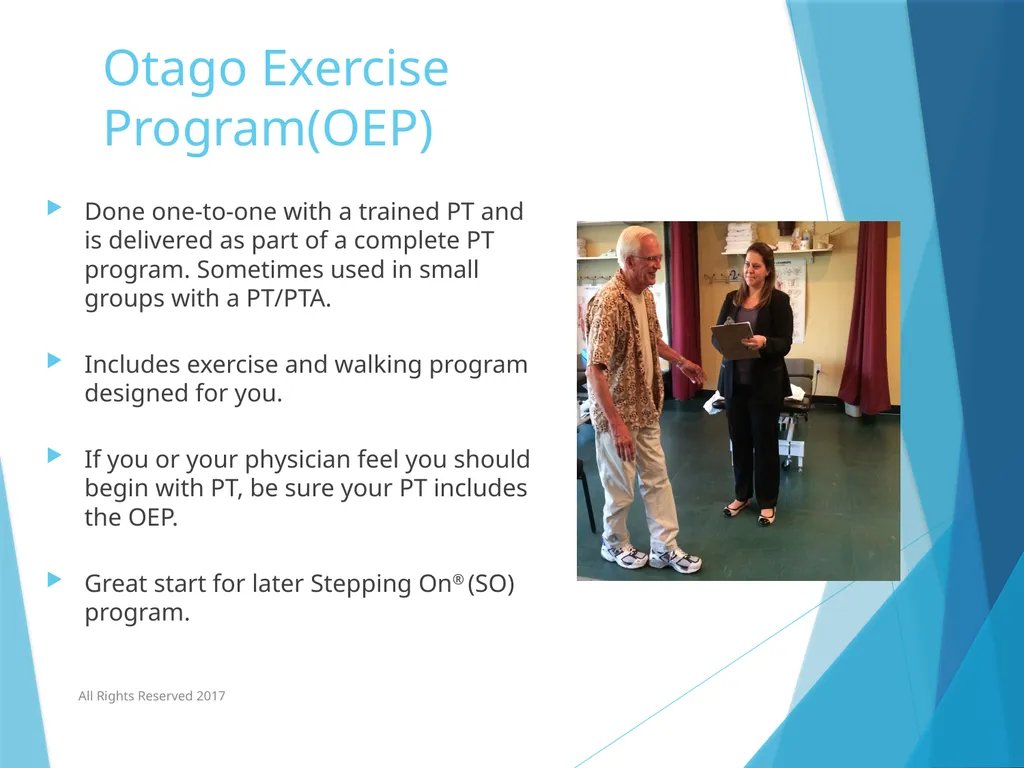
slide22. Otago Exercise Program(OEP) Done one-to-one with a trained PT and is delivered as part of a complete PT program. Sometimes used in small groups with a PT/PTA.
Includes exercise and walking program designed for you.
If you or your physician feel you should begin with PT, be sure your PT includes the OEP.
Great start for later Stepping On® (SO) program. All Rights Reserved 2017<br>
slide23. Matter of Balance Includes eight weekly 2-hour sessions including peer group discussion, exercise, education and some behavior modification.
Excellent for people who are fearful of falling.
All exercises can be done in sitting or supported standing.
Great start for later Stepping On.
Visit http://www.mainehealth.org/mob All Rights Reserved 2017 http://www.ptrc.org/modules/show
image.aspx?imageid=307<br>
slide24. Stepping On® (SO) Seven weekly 2-hour classes including peer discussion, exercise, expert lectures
Great follow-up to Otago (OEP) &/or Matter of Balance
SO classes include standing exercises that are done by a chair independently in class and at home
You should feel safe standing and walking independently before you begin SO
Visit https://wihealthyaging.org/stepping-on All Rights Reserved 2017<br>
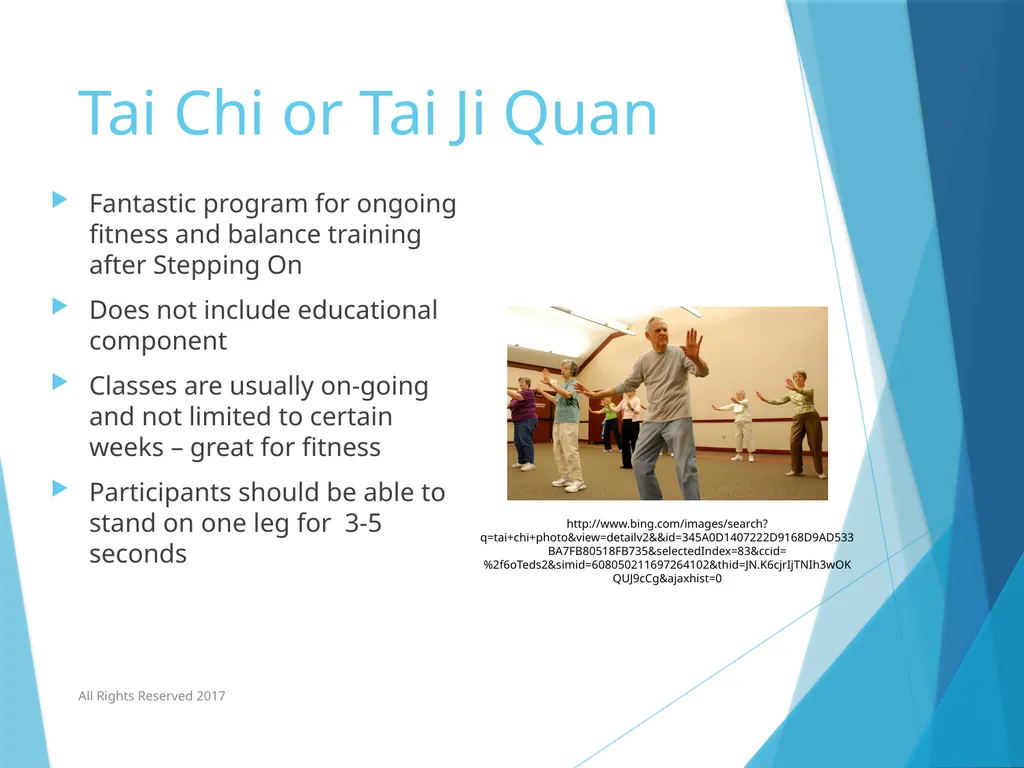
slide25. Tai Chi or Tai Ji Quan Fantastic program for ongoing fitness and balance training after Stepping On
Does not include educational component
Classes are usually on-going and not limited to certain weeks – great for fitness
Participants should be able to stand on one leg for 3-5 seconds All Rights Reserved 2017 http://www.bing.com/images/search?q=tai+chi+photo&view=detailv2&&id=345A0D1407222D9168D9AD533BA7FB80518FB735&selectedIndex=83&ccid=%2f6oTeds2&simid=608050211697264102&thid=JN.K6cjrIjTNIh3wOKQUJ9cCg&ajaxhist=0<br>
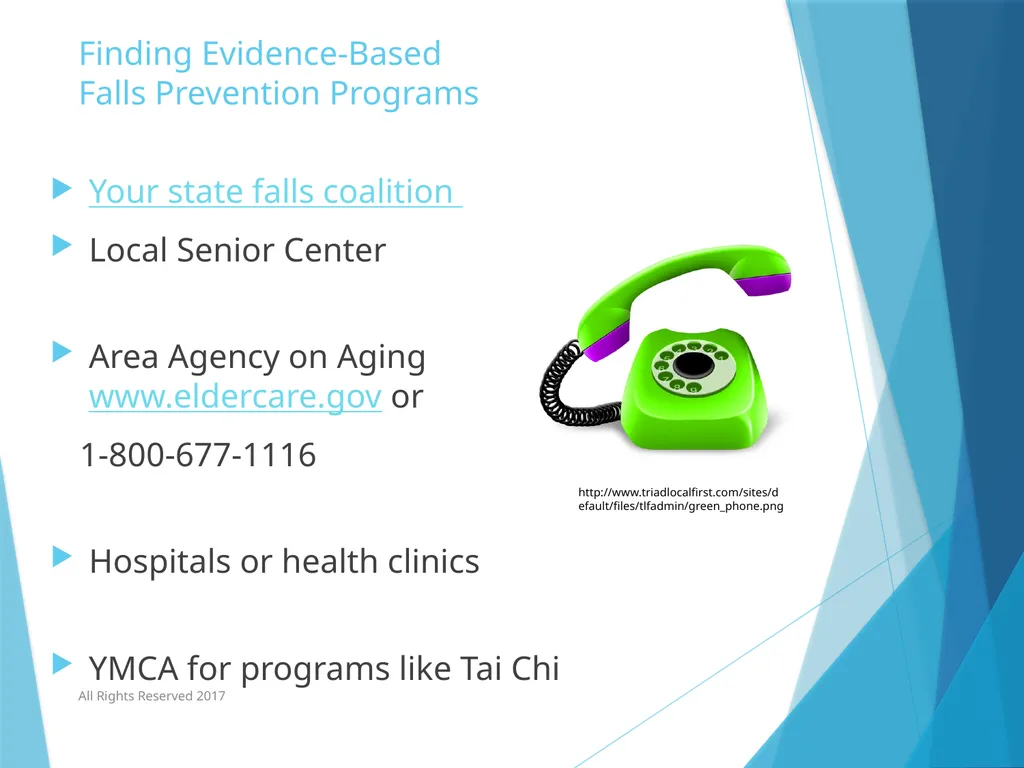
slide26. Finding Evidence-Based Falls Prevention Programs Your state falls coalition
Local Senior Center
Area Agency on Aging www.eldercare.gov or
1-800-677-1116
Hospitals or health clinics
YMCA for programs like Tai Chi http://www.triadlocalfirst.com/sites/d
efault/files/tlfadmin/green_phone.png All Rights Reserved 2017<br>
slide27. REMEMBER: Move More!<br>
slide28. Questions/Discussion All Rights Reserved 2017<br>
slide29. Evidence-Based Resources National Council on Aging: Evidence-Based Falls Prevention Programs
https://www.ncoa.org/healthy-aging/falls-prevention/falls-prevention-programs-for-older-adults/
Falls Free® Initiative: Find your state’s chapter
Provides resources and evidence-based practice to reduce fall-related injuries and death among older adults
https://www.ncoa.org/resources/falls-free-coalition-overview/ All Rights Reserved 2017<br>
slide30. Thank You for Coming!<br>
slide31. Need more information? A Physical Therapist’s Guide to Falls:
http://www.moveforwardpt.com/symptomsconditionsdetail.aspx?cid=85726fb6-14c4-4c16-9a4c-3736dceac9f0
Remaining in Your Home as you Age:
https://www.aota.org/About-Occupational-Therapy/Patients-Clients/Adults.aspx
The AARP Home Fit Guide:
http://www.aarp.org/livable-communities/info-2014/aarp-home-fit-guide-aging-in-place.html All Rights Reserved 2017<br>
slide32. References Ambrose, A. F., Paul, G., & Hausdorff, J. M. (2013). Risk factors for falls among older adults: A review of the literature. Maturitas, 75, 51-61.
American Geriatrics Society & British Geriatrics Society [AGS & BGS] (2010). Clinical Practice Guideline: Prevention of Falls in Older Persons.
Boyd, R., & Stevens, J. A. (2009). Falls and fear of falling: Burden, beliefs and behaviours. Age and Ageing, 38, 423–428. http: //dx.doi.org/10.1093/ageing/afp053
Centers for Disease Control and Prevention (CDC), (2014a). Falls among older adults: An overview. Retrieved from http://www.cdc.gov/HomeandRecreationalSafety/Falls/adultfalls.html
Donoghue, O. A., Cronin, H., Savva, G. M., O’Reagan, C., & Kenny, R. A. (2013). Effects of fear of falling and activity restriction on normal and dual task walking in community dwelling older adults. Gain & Posture, 38, 120-124. All Rights Reserved 2017<br>
slide33. References Grundstrom, A. C., Guse, C. E., & Layde, P. M. (2012). Risk factors for falls and fall-related injuries in adults 85 years of age and older. Archives of Gerontology and Geriatrics, 54, 421-428. doi: 10.1016/j.archger.2011/06.008
Kalyani, R. R., Stein, B., Valiyil, R., Manno, R., Maynard, J. W., & Crews, D. C. (2010). Vitamin D treatment for the prevention of falls in older adults: Systematic review and meta-analysis. Journal of the American Geriatrics Society, 58, 1299–1310. DOI: 10.1111/j.1532-5415.2010.02949.x
Liam, P. & Kaye, N. (2006). Tai chi for beginners and the 24 forms. Louisville, KTY: Four Colour Imports.
Nye, A. (2012). Preventing Medicattion-related falls. Presentation at the Emergency care conference, Greenville, NC
Painter, J., et al. (2012). Fear of falling and its relationship with anxiety depression, and activity engagement among community-dwelling older adults. AJOT, 66, 169-176.
Panel on Prevention … (2011). Summary of the updated AGS/BGS clinical practice guideline for prevention of falls in older persons. JAGS, 59, 148-157. All Rights Reserved 2017<br>
slide34. References Shumway-Cook, A, Brauer, S, & Woollacott,M. (2000). Predicting the probability for falls in community-dwelling older adults using the Timed Up & Go Test. Phys Ther, 80(9), 896-903.
Stevens, J. A. (2010). CDC Compendium of effective fall interventions: What works for community-dwelling older adults, 2nd Edition. Retrieved from: http://www.cdc.gov/homeandrecreationalsafety/Falls/compendium.html
Stevens, J. A. & Rudd, R. A. (2014). Circumstances and contributing causes of fall deaths among person aged 65 and older.: United States, 2010. JAGS, 62, 470-475. doi: 10.111/jgs.12702
Tinetti, M., Richman, D., & Powell, L. (1990). Falls efficacy as a measure of fear of falling. Journal of Gerontology, 45, 239-243.
Tinetti, M. E., & Powell L. (1993). Fear of falling and low self-efficacy: a case of dependence in elderly persons. Journal of Gerontology, 48, 35-38.
WHO Organization (2010). Falls Fact Sheet N.344 Retrieved from: http://www.who.int/mediacentre/factsheets/fs344/en/index.html All Rights Reserved 2017<br>
Fall Prevention Presentation Photo © William Provost<br>
slide2. Are falls preventable? All Rights Reserved 2017 Photo from giftsandcollectiblesgalore.wordpress.com<br>
slide3. YES! Falls are largely preventable!
Come learn how. All Rights Reserved 2017<br>
slide4. Today’s Discussion Definition of a fall
Fear of falling
Risk factors for falling
Action steps to reduce YOUR fall risk All Rights Reserved 2017 Illustration © Timurd<br>
slide5. Landing on the ground or some lower surface when you didn’t intend to be there.
Includes slips, trips, etc.
Does not include a medical event.
Schumway-Cook, 2000 What is a “fall”? All Rights Reserved 2017 Image from Creative Commons<br>
slide6. Have you had a fall? Have you had a fall in the past year? Did you tell your primary care provider?
Were you hurt?
Do you worry about falling?
Do you feel unsteady when standing or walking?
A previous fall increases your future fall risk. All Rights Reserved 2017<br>
slide7. Do you limit activities? Fear of Falling is a lasting concern about falling that may cause a person to stop doing activities s/he remains able to do.
Fear of falling increases future fall risk.
Tinetti and Powell, 1993 All Rights Reserved 2017 www.bing.com<br>
slide8. Why does fear of falling matter? May stop you from activities
Legs weaken with inactivity
Inactivity leads to falls
May make the person feel alone
May cause depression All Rights Reserved 2017 Boyd & Stevens, 2009; Donoghue, Cronin, Savva, O’Reagan, & Kenny, 2013; Painter, 2012 www.ncoa.org<br>
slide9. Types of Fall Risk Factors Physical risk factors: Changes in your body that increase your risk for a fall
Behavioral risk factors: Things we do or don’t do that increase our fall risk
Environmental risk factors: Hazards in our home or community Most falls result from a number of risk factors: All Rights Reserved 2017<br>
slide10. Fall Risk Factors You CAN change: Physical inactivity
Home environment
Vision
Medication Use
Fear of falling
Social isolation
Weakness
Improper use of assistive devices You CAN’T change: Age
Gender
Ethnic background All Rights Reserved 2017<br>
slide11. What can YOU do to prevent falls? Exercise to improve your balance and strength. It takes 50 hours every 6 months to improve balance.
Have your doctor or pharmacist review your medicines
Have your vision checked
Make your home safer All Rights Reserved 2017<br>
slide12. All Rights Reserved 2017 Exercise Recommendations Talk to your doctor before starting an exercise program.
Begin with PT or fall prevention classes.
Be sure classes are for your age group &/or ability level.
Stick with it! www.ncoa.org<br>
slide13. All Rights Reserved 2017 Environmental
Recommendations Identify and eliminate fall hazards in your home and community
Check for Safety Brochure in CDC’s STEADI Toolkit
An OT or PT can help identify safety issues and solutions AGS/BGS, 2010; Panel on Prevention, 2011<br>
slide14. Medications and Falls Risk Side effects may make you dizzy
Medication changes can increase fall risk
Use one pharmacy.
Ask for an annual medication review.
Be sure you can read your labels. All Rights Reserved 2017 https://d1hekt5vpuuw9b.cloudfront.net/assets/article/fe27
4ef18e93e75562dc05fe87b18316_are-you-taking-too-much
-medicine-580x326_featuredImage.jpg<br>
slide15. Vision and Falls Risk Ask for annual eye exams after age 50.
Multifocal lenses may blur or distort your vision looking down. Use separate reading glasses.
Removing cataract(s) may reduce fall risk.
AGS & BGS, 2010 All Rights Reserved 2017 http://www.steadmaneye.com/
clipart/eyecharts/eye_chart.jpg<br>
slide16. Blood Pressure and Fall Risk Check your blood pressure regularly.
If you get dizzy when you stand up, see your doctor and have your ‘sit to stand’ blood pressure checked.
Some blood pressure medications increase fall risk; speak with your doctor. Be very careful after a beginning a new medication. All Rights Reserved 2017 AGS/BGS, 2010; Panel on Prevention, 2011<br>
slide17. Chronic Conditions and Fall Risk Chronic Conditions may contribute to your fall risk. Careful management will limit the risk.
Diabetes
Arthritis
Stroke
Neurological disorders like Multiple Sclerosis (MS) or Parkinson’s
Chronic Pain
Depression
Chronic obstructive pulmonary disease (COPD)
Sleep disorders All Rights Reserved 2017 AGS/BGS, 2010; Panel on Prevention, 2011<br>
slide18. Risk of Falling May Increase Change in your medications
Illness or infection
Pain
Lack of sleep
Sad or worried
Reduced activity level
Change in use of cane or walker
Move to new home All Rights Reserved 2017 Photo © Aprescindere http://www.opinionscentral.com/wp-content/uploads/
2015/05/Medline-Folding-
Rollator-Walker-with-Folding-8-inch-Wheel.jpg<br>
slide19. Start Small Choose one risk factor to address first ---
Pharmacist & Doctor - review medications for side effects that may cause you to fall
Occupational Therapist - home assessment and recommendations to make your home safer
Physical Therapist - help with physical activity, balance, strength, and moving safely All Rights Reserved 2017<br>
slide20. If a Fall Occurs …… Check for injury
Call for help, if needed
Seek medical attention right away if you might have hit your head
Call your doctor
Check for safety hazards
Learn how to get up safely from your physical therapist All Rights Reserved 2017 http://www.bing.com/images/search?q=getting+up+from+floor+with+chair+photo&view=detailv2&&id=6078B0575525F1E0A63A99D372BE2F78F77BF411&selectedIndex=0&ccid=U1AEMRPq&simid=608013721659769884&thid=JN.I5Qt1AlQlz9v31ZkHSXKJg&ajaxhist=0<br>
slide21. Evidence-Based Fall Prevention Programs<br>
slide22. Otago Exercise Program(OEP) Done one-to-one with a trained PT and is delivered as part of a complete PT program. Sometimes used in small groups with a PT/PTA.
Includes exercise and walking program designed for you.
If you or your physician feel you should begin with PT, be sure your PT includes the OEP.
Great start for later Stepping On® (SO) program. All Rights Reserved 2017<br>
slide23. Matter of Balance Includes eight weekly 2-hour sessions including peer group discussion, exercise, education and some behavior modification.
Excellent for people who are fearful of falling.
All exercises can be done in sitting or supported standing.
Great start for later Stepping On.
Visit http://www.mainehealth.org/mob All Rights Reserved 2017 http://www.ptrc.org/modules/show
image.aspx?imageid=307<br>
slide24. Stepping On® (SO) Seven weekly 2-hour classes including peer discussion, exercise, expert lectures
Great follow-up to Otago (OEP) &/or Matter of Balance
SO classes include standing exercises that are done by a chair independently in class and at home
You should feel safe standing and walking independently before you begin SO
Visit https://wihealthyaging.org/stepping-on All Rights Reserved 2017<br>
slide25. Tai Chi or Tai Ji Quan Fantastic program for ongoing fitness and balance training after Stepping On
Does not include educational component
Classes are usually on-going and not limited to certain weeks – great for fitness
Participants should be able to stand on one leg for 3-5 seconds All Rights Reserved 2017 http://www.bing.com/images/search?q=tai+chi+photo&view=detailv2&&id=345A0D1407222D9168D9AD533BA7FB80518FB735&selectedIndex=83&ccid=%2f6oTeds2&simid=608050211697264102&thid=JN.K6cjrIjTNIh3wOKQUJ9cCg&ajaxhist=0<br>
slide26. Finding Evidence-Based Falls Prevention Programs Your state falls coalition
Local Senior Center
Area Agency on Aging www.eldercare.gov or
1-800-677-1116
Hospitals or health clinics
YMCA for programs like Tai Chi http://www.triadlocalfirst.com/sites/d
efault/files/tlfadmin/green_phone.png All Rights Reserved 2017<br>
slide27. REMEMBER: Move More!<br>
slide28. Questions/Discussion All Rights Reserved 2017<br>
slide29. Evidence-Based Resources National Council on Aging: Evidence-Based Falls Prevention Programs
https://www.ncoa.org/healthy-aging/falls-prevention/falls-prevention-programs-for-older-adults/
Falls Free® Initiative: Find your state’s chapter
Provides resources and evidence-based practice to reduce fall-related injuries and death among older adults
https://www.ncoa.org/resources/falls-free-coalition-overview/ All Rights Reserved 2017<br>
slide30. Thank You for Coming!<br>
slide31. Need more information? A Physical Therapist’s Guide to Falls:
http://www.moveforwardpt.com/symptomsconditionsdetail.aspx?cid=85726fb6-14c4-4c16-9a4c-3736dceac9f0
Remaining in Your Home as you Age:
https://www.aota.org/About-Occupational-Therapy/Patients-Clients/Adults.aspx
The AARP Home Fit Guide:
http://www.aarp.org/livable-communities/info-2014/aarp-home-fit-guide-aging-in-place.html All Rights Reserved 2017<br>
slide32. References Ambrose, A. F., Paul, G., & Hausdorff, J. M. (2013). Risk factors for falls among older adults: A review of the literature. Maturitas, 75, 51-61.
American Geriatrics Society & British Geriatrics Society [AGS & BGS] (2010). Clinical Practice Guideline: Prevention of Falls in Older Persons.
Boyd, R., & Stevens, J. A. (2009). Falls and fear of falling: Burden, beliefs and behaviours. Age and Ageing, 38, 423–428. http: //dx.doi.org/10.1093/ageing/afp053
Centers for Disease Control and Prevention (CDC), (2014a). Falls among older adults: An overview. Retrieved from http://www.cdc.gov/HomeandRecreationalSafety/Falls/adultfalls.html
Donoghue, O. A., Cronin, H., Savva, G. M., O’Reagan, C., & Kenny, R. A. (2013). Effects of fear of falling and activity restriction on normal and dual task walking in community dwelling older adults. Gain & Posture, 38, 120-124. All Rights Reserved 2017<br>
slide33. References Grundstrom, A. C., Guse, C. E., & Layde, P. M. (2012). Risk factors for falls and fall-related injuries in adults 85 years of age and older. Archives of Gerontology and Geriatrics, 54, 421-428. doi: 10.1016/j.archger.2011/06.008
Kalyani, R. R., Stein, B., Valiyil, R., Manno, R., Maynard, J. W., & Crews, D. C. (2010). Vitamin D treatment for the prevention of falls in older adults: Systematic review and meta-analysis. Journal of the American Geriatrics Society, 58, 1299–1310. DOI: 10.1111/j.1532-5415.2010.02949.x
Liam, P. & Kaye, N. (2006). Tai chi for beginners and the 24 forms. Louisville, KTY: Four Colour Imports.
Nye, A. (2012). Preventing Medicattion-related falls. Presentation at the Emergency care conference, Greenville, NC
Painter, J., et al. (2012). Fear of falling and its relationship with anxiety depression, and activity engagement among community-dwelling older adults. AJOT, 66, 169-176.
Panel on Prevention … (2011). Summary of the updated AGS/BGS clinical practice guideline for prevention of falls in older persons. JAGS, 59, 148-157. All Rights Reserved 2017<br>
slide34. References Shumway-Cook, A, Brauer, S, & Woollacott,M. (2000). Predicting the probability for falls in community-dwelling older adults using the Timed Up & Go Test. Phys Ther, 80(9), 896-903.
Stevens, J. A. (2010). CDC Compendium of effective fall interventions: What works for community-dwelling older adults, 2nd Edition. Retrieved from: http://www.cdc.gov/homeandrecreationalsafety/Falls/compendium.html
Stevens, J. A. & Rudd, R. A. (2014). Circumstances and contributing causes of fall deaths among person aged 65 and older.: United States, 2010. JAGS, 62, 470-475. doi: 10.111/jgs.12702
Tinetti, M., Richman, D., & Powell, L. (1990). Falls efficacy as a measure of fear of falling. Journal of Gerontology, 45, 239-243.
Tinetti, M. E., & Powell L. (1993). Fear of falling and low self-efficacy: a case of dependence in elderly persons. Journal of Gerontology, 48, 35-38.
WHO Organization (2010). Falls Fact Sheet N.344 Retrieved from: http://www.who.int/mediacentre/factsheets/fs344/en/index.html All Rights Reserved 2017<br>