Statistical Quality Control Dr. Tripakshi Borthakur Department of Statistics Introduction Statistical Quality Control (S.Q.C.) is one of the most important applications of the statistical techniques in industry. Quality means a level or
"Statistical Quality Control Dr. Tripakshi" is the property of its rightful owner. Permission is granted to
download and print the materials on this website for personal, non-commercial use only, and to display it
on your personal computer provided you do not modify the materials and that you retain all copyright
notices contained in the materials. By downloading content from our website, you accept the terms of this
agreement.
Presentation Transcript
01
Statistical Quality Control Dr. Tripakshi Borthakur
Department of Statistics<br>
02
Introduction Statistical Quality Control (S.Q.C.) is one of the most important applications of the statistical techniques in industry. Quality means a level or standard which depends on four M's such as material, manpower, machines and management. Quality control is the engineering and management activity by which we measure the characteristics of the product, compare them with specification. Thus it is a powerful productivity technique for effective diagnosis of lack of quality in any of the materials, processes, machines or end product. Thus, SQC is extensively<br>
03
used in almost all industries such as aircraft, automobiles, textile etc. where techniques are based on probability and sampling. The main purpose of SQC is to devise statistical techniques which would help us in separating the assignable causes from the chance causes, thus enabling us to take immediate remedial action whenever assignable causes are present.
Causes of Variation in quality- Chance & Assignable Causes:
The basis of SQC is the degree of variability in the size or the magnitude of a given characteristics of the product. The variation in SQC is mainly classified into two categories- chance causes &<br>
04
assignable causes which are described below:-
Chance Causes: Some stable pattern of variation or a constant cause system is inherent in any particular scheme of production and inspection. This pattern results from many minor causes that behave in a random manner The variation due to these causes is beyond the control of human hand and can't be prevented/ eliminated under any circumstances.
Assignable Causes: The second type of variation is due to non random or the so-called assignable causes and is termed as preventable variation. These causes may creep in at any stage of<br>
05
the process, right from the arrival of the raw materials to the final delivery of goods. Some of the important factors of anignable causes of variation are sub-standard/defective raw material, new techniques/operations, negligence of operators, faulty equipment etc. These can be identified and eliminated before it goes wrong.<br>
06
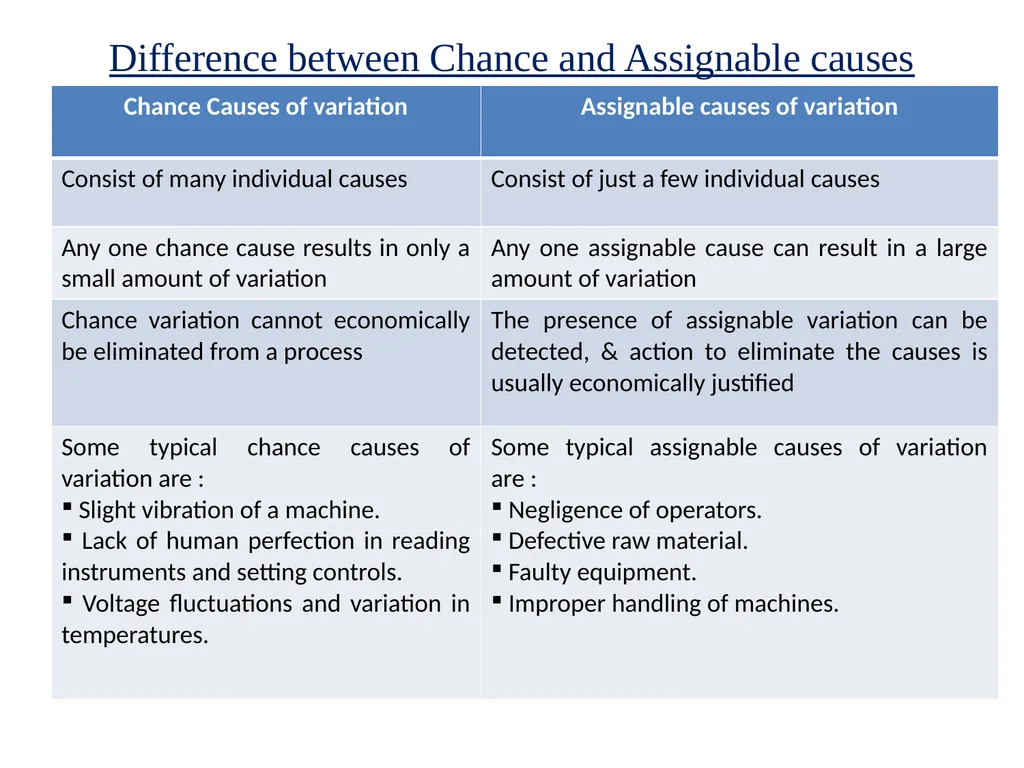
Difference between Chance and Assignable causes<br>