Statistical Simulated Models for Tornado Forecasting MISG 2020 Problem 5 Motivation Tornados are a major disaster, therefore accurate prediction of the event is an important research activity Long-range forecasts of severe convective storm
"Statistical Simulated Models for Tornado" is the property of its rightful owner. Permission is granted to
download and print the materials on this website for personal, non-commercial use only, and to display it
on your personal computer provided you do not modify the materials and that you retain all copyright
notices contained in the materials. By downloading content from our website, you accept the terms of this
agreement.
Presentation Transcript
01
Statistical Simulated Models for Tornado Forecasting MISG 2020 –Problem 5<br>
02
Motivation Tornados are a major disaster, therefore accurate prediction of the event is an important research activity
Long-range forecasts of severe convective storm activity is missing from seasonal forecasts such as how many storms can be expected along the a coastline etc.
Predicting tornado activity prior to the start of season has gained lots of attention in research
Because of large gaps in our knowledge of how climate influences severe weather and the lack of methods to forecast it on the seasonal scale , basic and applied research using statistical models are needed to predict severe weather conditions accurately<br>
03
Objective Fit/simulate statistical models to the historical tornado database is recommended
Within the current dynamic models for seasonal forecast events of interests like tornados are too small to be resolved
In dynamic seasonal models the necessary conditions do not sufficiently distinguish between days with and without tornados
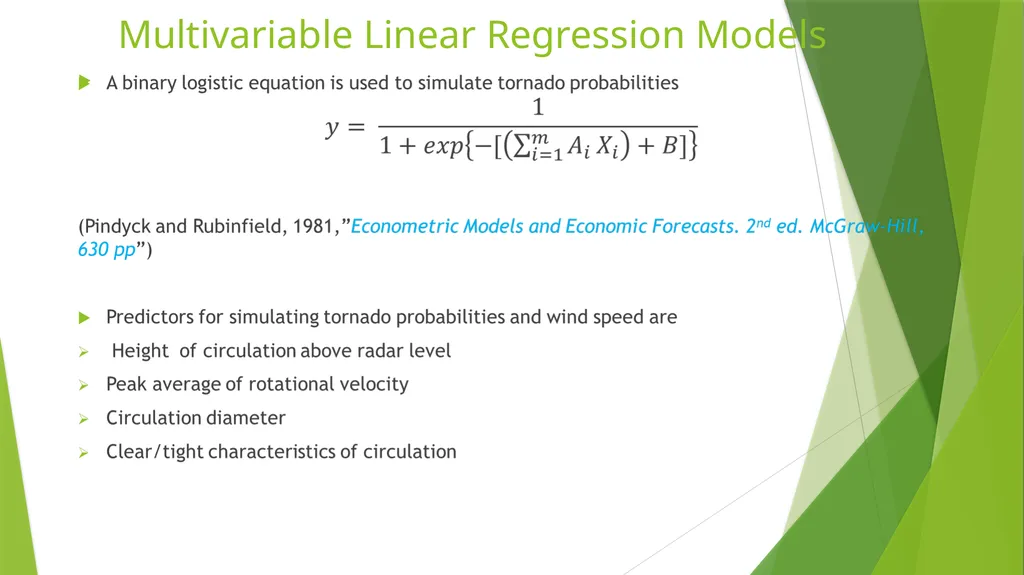
In future study, two statistical models (Cohen, 2018,”Simulating Tornado Probability and Tornado Wind Speed Based on Statistical Models”) which simulate tornado potential and wind speed are used to test the SA weather database during the time period of tornado activities in SA<br>
04
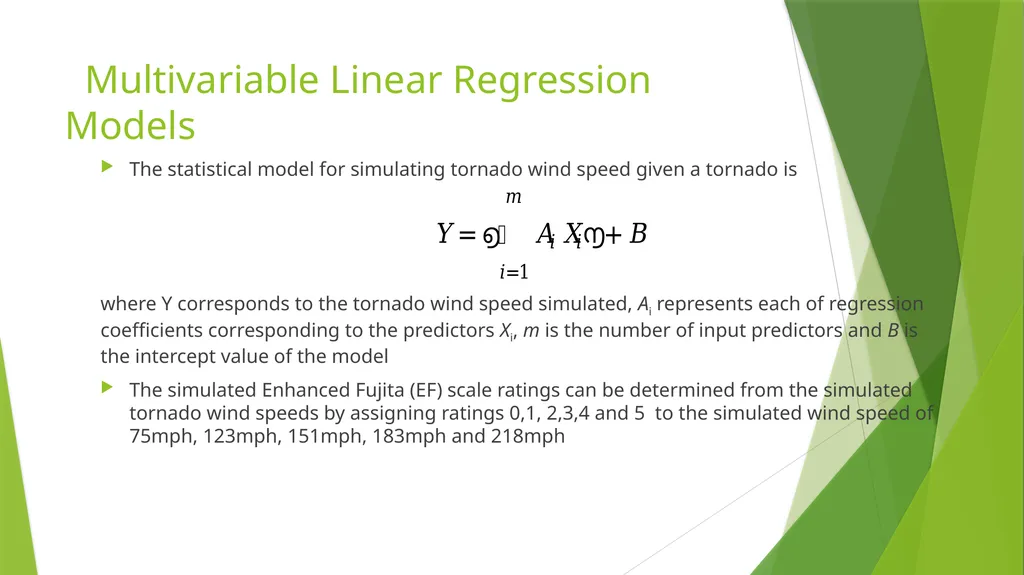
Multivariable Linear Regression Models The statistical model for simulating tornado wind speed given a tornado is
where Y corresponds to the tornado wind speed simulated, Ai represents each of regression coefficients corresponding to the predictors Xi, m is the number of input predictors and B is the intercept value of the model
The simulated Enhanced Fujita (EF) scale ratings can be determined from the simulated tornado wind speeds by assigning ratings 0,1, 2,3,4 and 5 to the simulated wind speed of 75mph, 123mph, 151mph, 183mph and 218mph<br>
05
Multivariable Linear Regression Models<br>
06
Conclusion Inputs from the independent data set can be used to statistically simulate the tornado probability and tornado wind speed for each of severe weather conditions
Differences between values of performing the model on a dataset for which the known and unknown outcomes evaluate model for further improvements<br>