
Statistics SA Vote 14 Unauthorised Expenditure
Description: Statistics SA Vote 14 Unauthorised Expenditure SCOPA Risenga Maluleke Statistician-General 17 October 2023 Contents Background Unauthorised Expenditure Change in recognition of Unauthorised Expenditure (UE) Engagements with National
Related Topics
Download Presentation
"Statistics SA Vote 14 Unauthorised Expenditure" is the property of its rightful owner. Permission is granted to download and print the materials on this website for personal, non-commercial use only, and to display it on your personal computer provided you do not modify the materials and that you retain all copyright notices contained in the materials. By downloading content from our website, you accept the terms of this agreement.
Presentation Transcript
slide1. Statistics SA
Vote 14
Unauthorised Expenditure
SCOPA
Risenga Maluleke
Statistician-General
17 October 2023<br>
slide2. Contents Background
Unauthorised Expenditure
Change in recognition of Unauthorised Expenditure (UE)
Engagements with National Treasury
Consequence Management
National Treasury Recommendations
Stats SA Recommendations & Motivation<br>
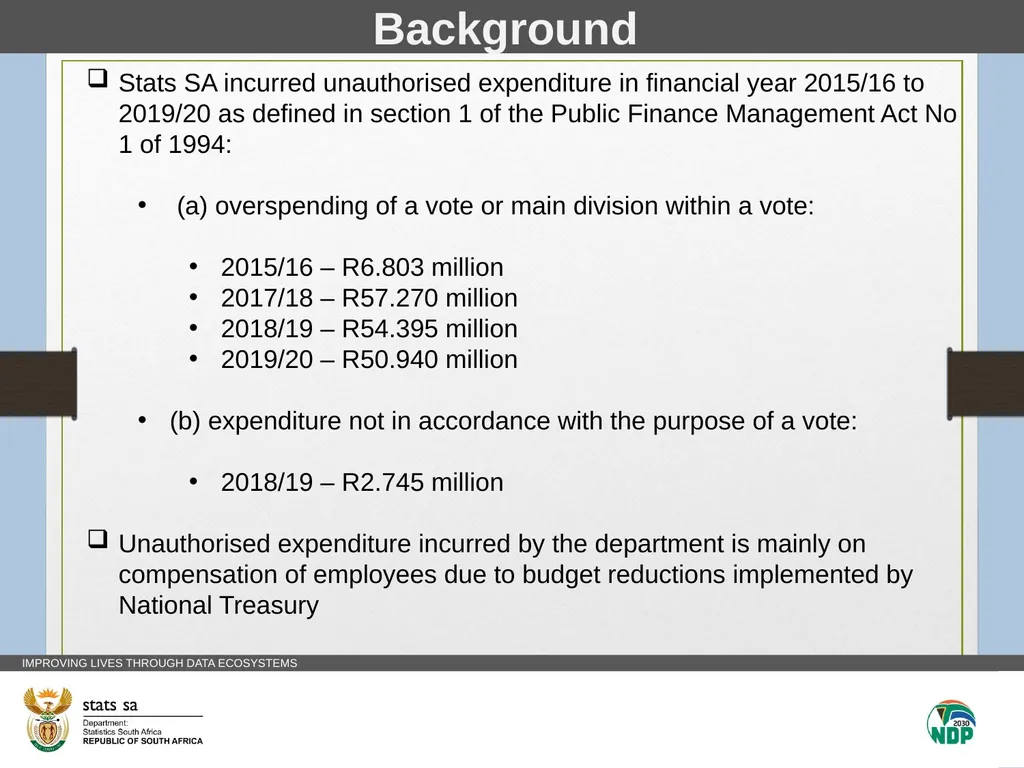
slide3. Background Stats SA incurred unauthorised expenditure in financial year 2015/16 to 2019/20 as defined in section 1 of the Public Finance Management Act No 1 of 1994:
(a) overspending of a vote or main division within a vote:
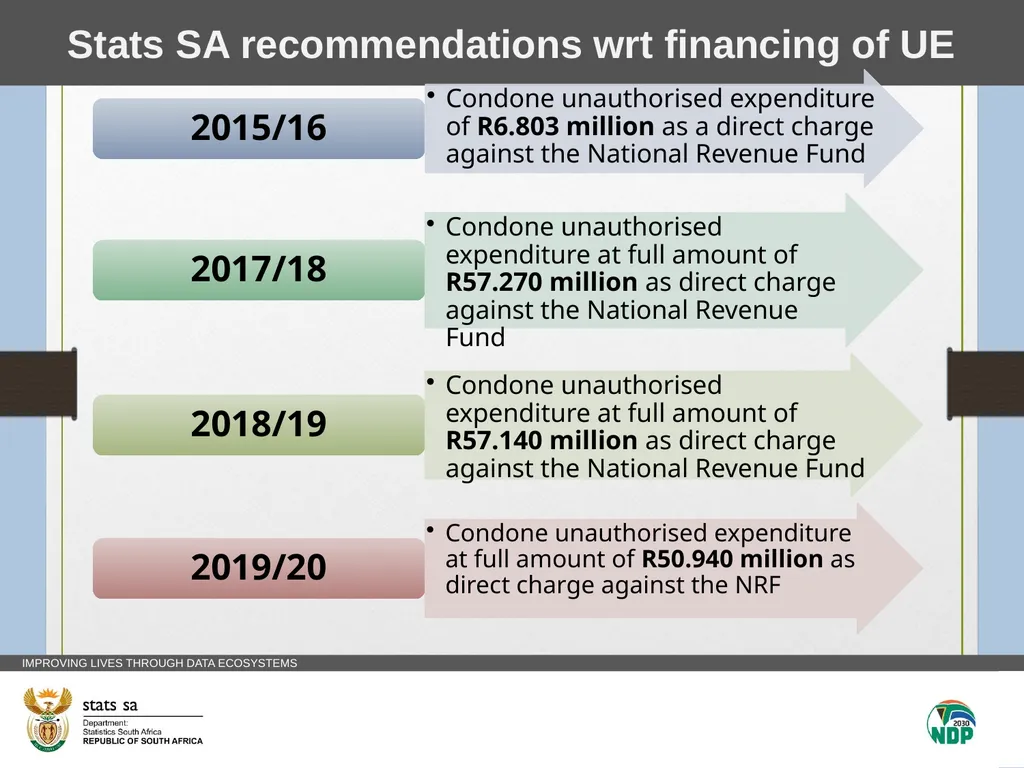
2015/16 – R6.803 million
2017/18 – R57.270 million
2018/19 – R54.395 million
2019/20 – R50.940 million
(b) expenditure not in accordance with the purpose of a vote:
2018/19 – R2.745 million
Unauthorised expenditure incurred by the department is mainly on compensation of employees due to budget reductions implemented by National Treasury<br>
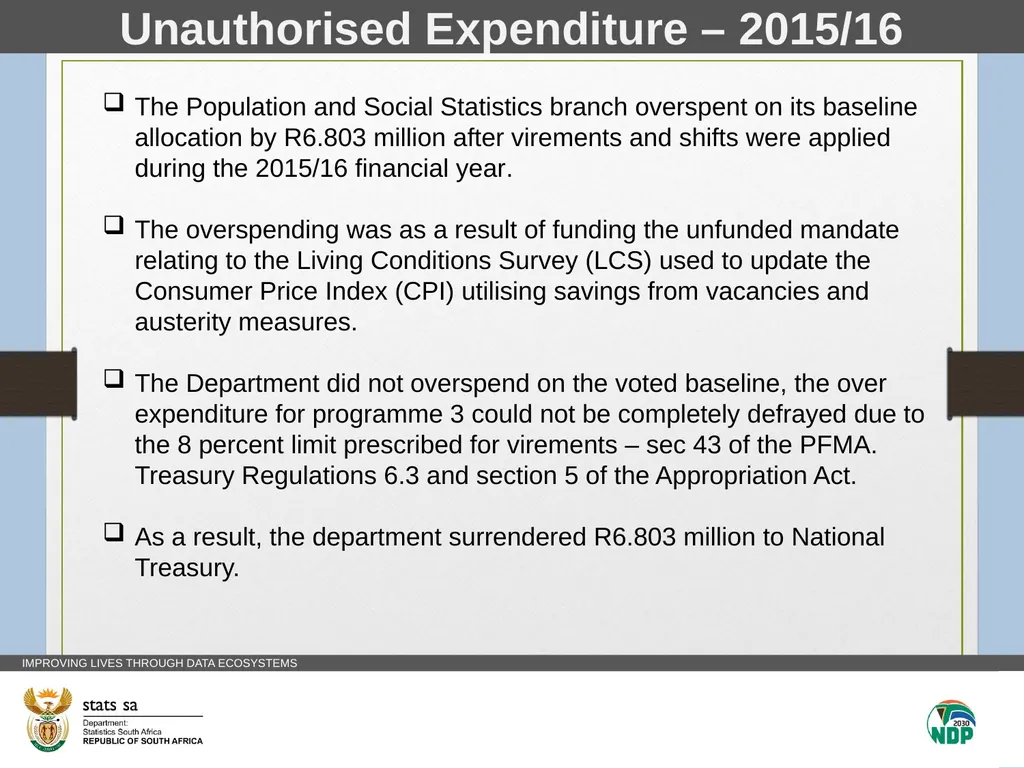
slide4. Unauthorised Expenditure – 2015/16 The Population and Social Statistics branch overspent on its baseline allocation by R6.803 million after virements and shifts were applied during the 2015/16 financial year.
The overspending was as a result of funding the unfunded mandate relating to the Living Conditions Survey (LCS) used to update the Consumer Price Index (CPI) utilising savings from vacancies and austerity measures.
The Department did not overspend on the voted baseline, the over expenditure for programme 3 could not be completely defrayed due to the 8 percent limit prescribed for virements – sec 43 of the PFMA. Treasury Regulations 6.3 and section 5 of the Appropriation Act.
As a result, the department surrendered R6.803 million to National Treasury.<br>
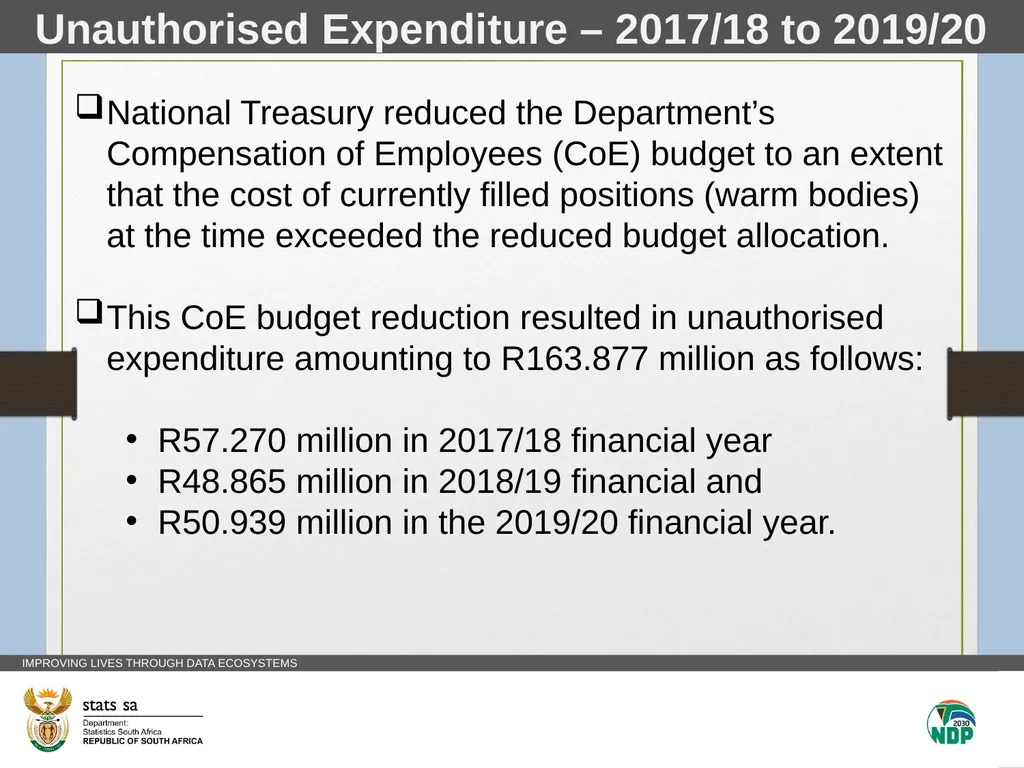
slide5. Unauthorised Expenditure – 2017/18 to 2019/20 National Treasury reduced the Department’s Compensation of Employees (CoE) budget to an extent that the cost of currently filled positions (warm bodies) at the time exceeded the reduced budget allocation.
This CoE budget reduction resulted in unauthorised expenditure amounting to R163.877 million as follows:
R57.270 million in 2017/18 financial year
R48.865 million in 2018/19 financial and
R50.939 million in the 2019/20 financial year.<br>
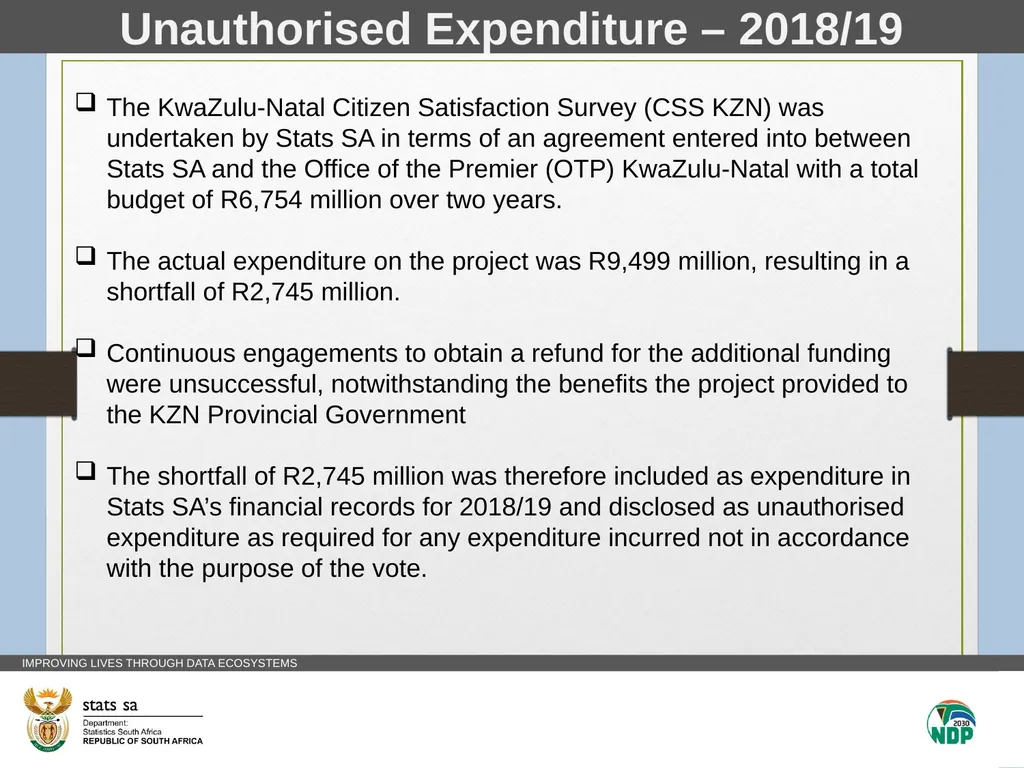
slide6. Unauthorised Expenditure – 2018/19 The KwaZulu-Natal Citizen Satisfaction Survey (CSS KZN) was undertaken by Stats SA in terms of an agreement entered into between Stats SA and the Office of the Premier (OTP) KwaZulu-Natal with a total budget of R6,754 million over two years.
The actual expenditure on the project was R9,499 million, resulting in a shortfall of R2,745 million.
Continuous engagements to obtain a refund for the additional funding were unsuccessful, notwithstanding the benefits the project provided to the KZN Provincial Government
The shortfall of R2,745 million was therefore included as expenditure in Stats SA’s financial records for 2018/19 and disclosed as unauthorised expenditure as required for any expenditure incurred not in accordance with the purpose of the vote.<br>
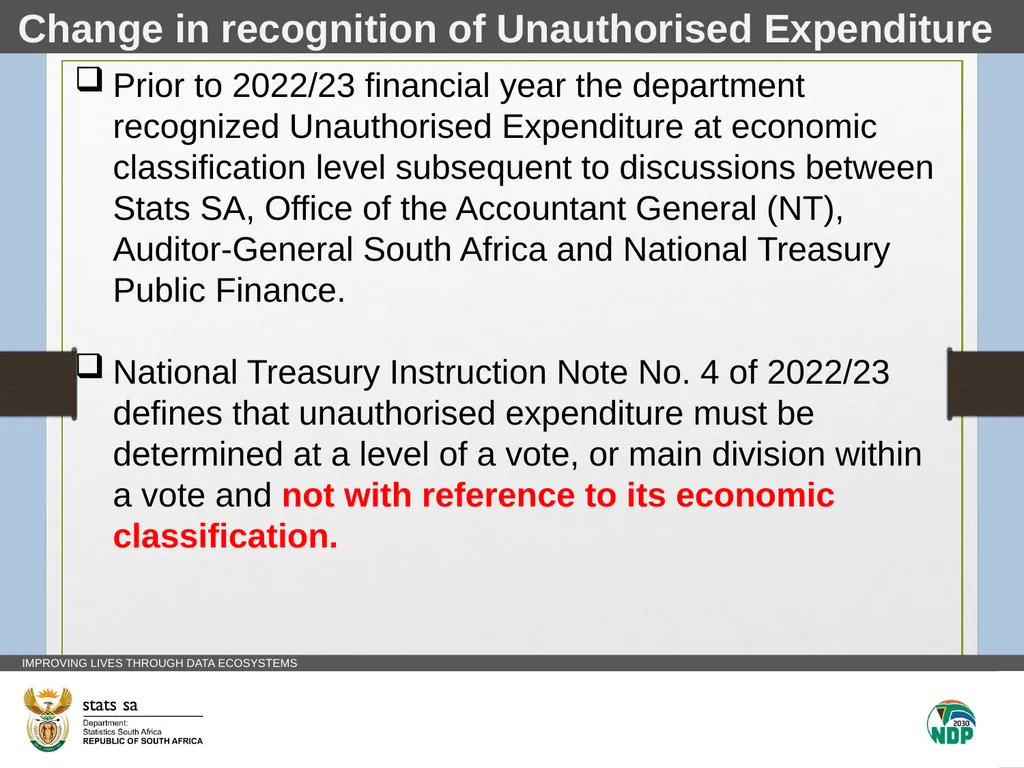
slide7. Change in recognition of Unauthorised Expenditure Prior to 2022/23 financial year the department recognized Unauthorised Expenditure at economic classification level subsequent to discussions between Stats SA, Office of the Accountant General (NT), Auditor-General South Africa and National Treasury Public Finance.
National Treasury Instruction Note No. 4 of 2022/23 defines that unauthorised expenditure must be determined at a level of a vote, or main division within a vote and not with reference to its economic classification.<br>
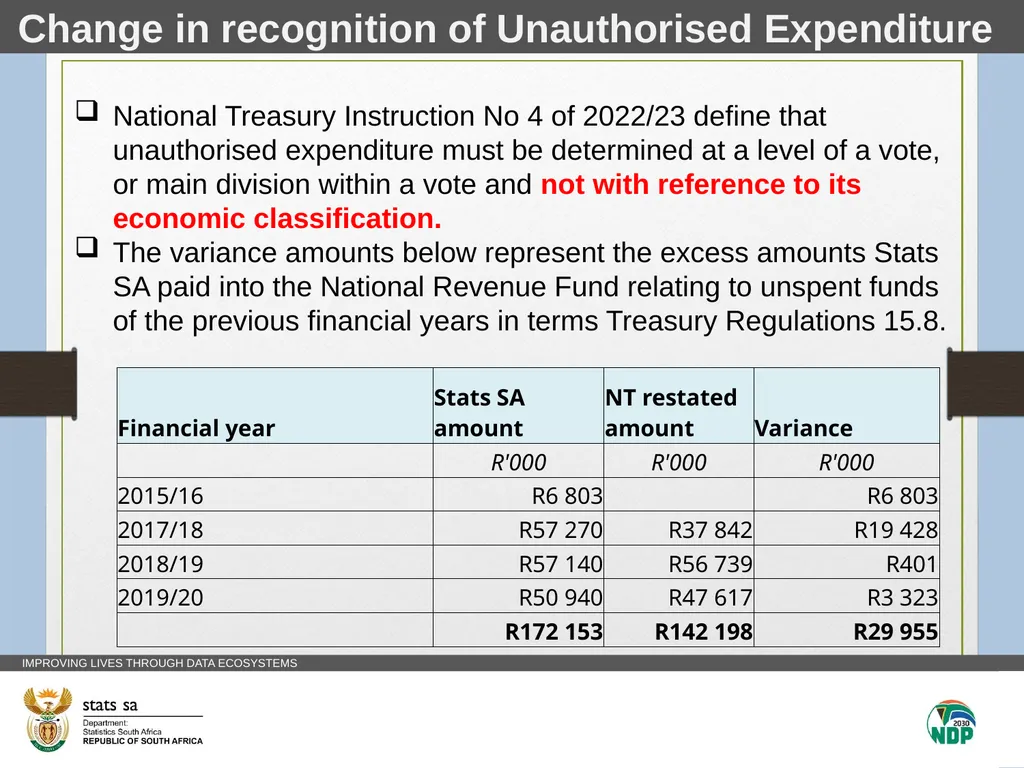
slide8. Change in recognition of Unauthorised Expenditure National Treasury Instruction No 4 of 2022/23 define that unauthorised expenditure must be determined at a level of a vote, or main division within a vote and not with reference to its economic classification.
The variance amounts below represent the excess amounts Stats SA paid into the National Revenue Fund relating to unspent funds of the previous financial years in terms Treasury Regulations 15.8.<br>
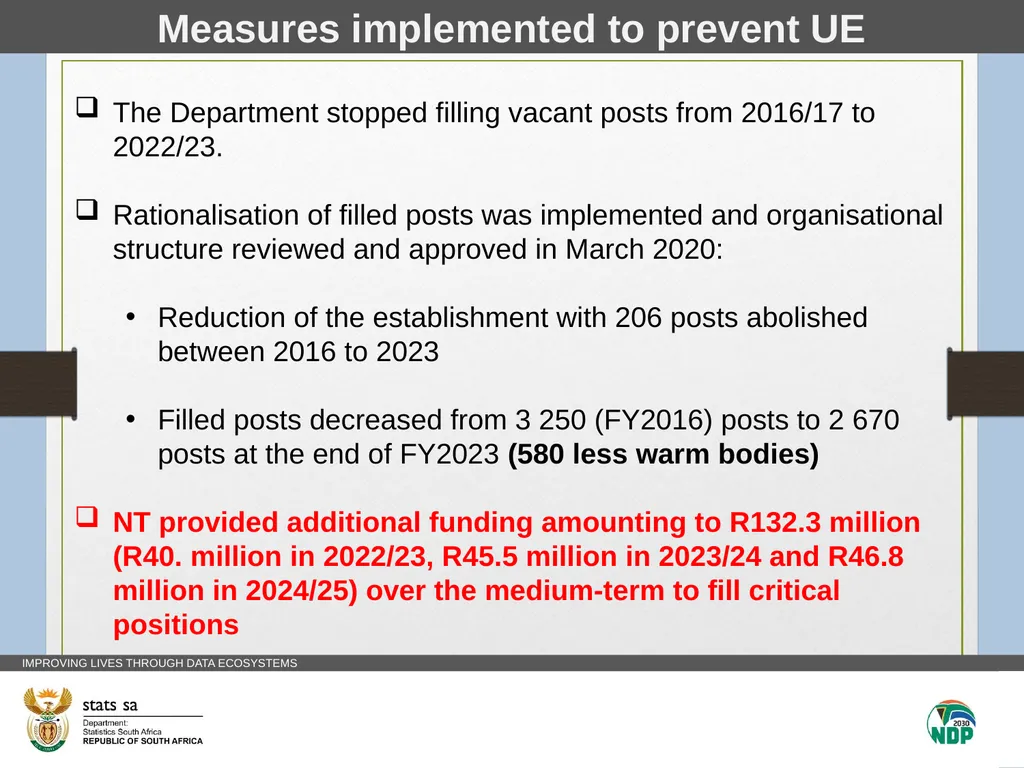
slide9. Measures implemented to prevent UE The Department stopped filling vacant posts from 2016/17 to 2022/23.
Rationalisation of filled posts was implemented and organisational structure reviewed and approved in March 2020:
Reduction of the establishment with 206 posts abolished between 2016 to 2023
Filled posts decreased from 3 250 (FY2016) posts to 2 670 posts at the end of FY2023 (580 less warm bodies)
NT provided additional funding amounting to R132.3 million (R40. million in 2022/23, R45.5 million in 2023/24 and R46.8 million in 2024/25) over the medium-term to fill critical positions<br>
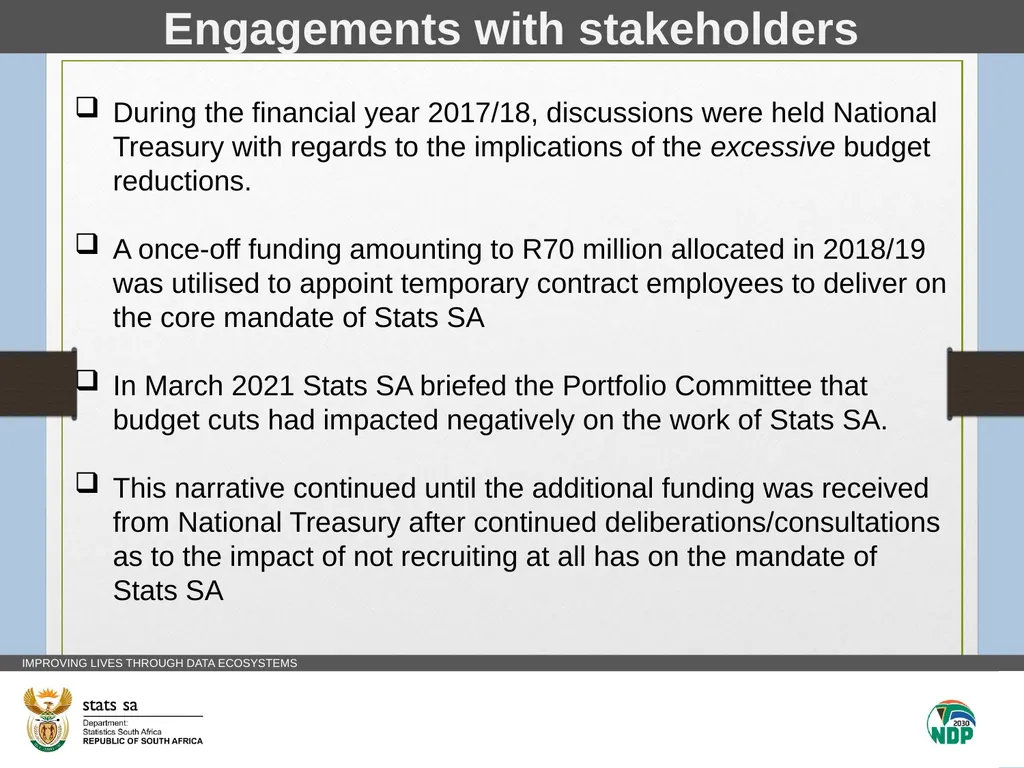
slide10. Engagements with stakeholders During the financial year 2017/18, discussions were held National Treasury with regards to the implications of the excessive budget reductions.
A once-off funding amounting to R70 million allocated in 2018/19 was utilised to appoint temporary contract employees to deliver on the core mandate of Stats SA
In March 2021 Stats SA briefed the Portfolio Committee that budget cuts had impacted negatively on the work of Stats SA.
This narrative continued until the additional funding was received from National Treasury after continued deliberations/consultations as to the impact of not recruiting at all has on the mandate of Stats SA<br>
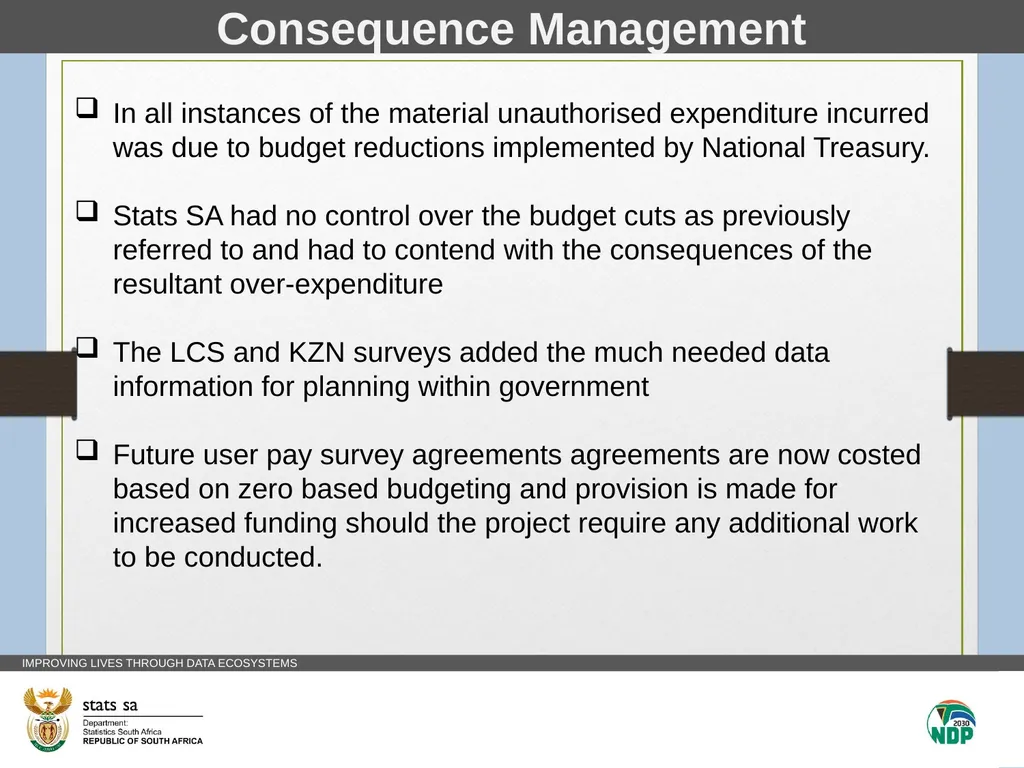
slide11. Consequence Management In all instances of the material unauthorised expenditure incurred was due to budget reductions implemented by National Treasury.
Stats SA had no control over the budget cuts as previously referred to and had to contend with the consequences of the resultant over-expenditure
The LCS and KZN surveys added the much needed data information for planning within government
Future user pay survey agreements agreements are now costed based on zero based budgeting and provision is made for increased funding should the project require any additional work to be conducted.<br>
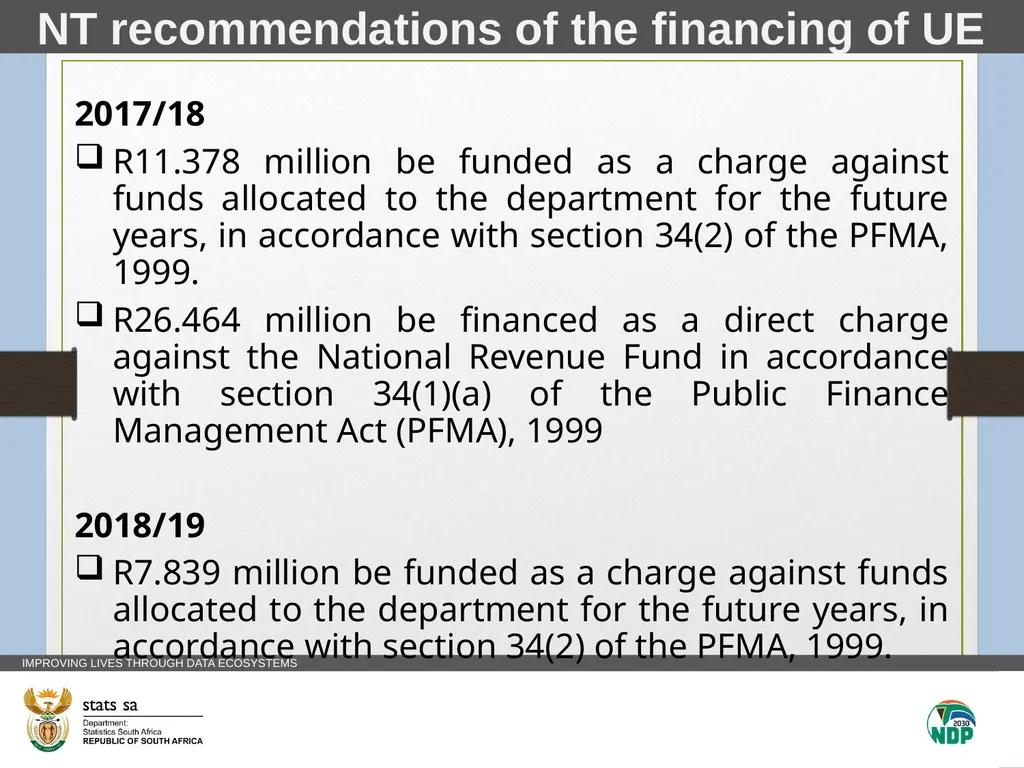
slide12. NT recommendations of the financing of UE
2017/18
R11.378 million be funded as a charge against funds allocated to the department for the future years, in accordance with section 34(2) of the PFMA, 1999.
R26.464 million be financed as a direct charge against the National Revenue Fund in accordance with section 34(1)(a) of the Public Finance Management Act (PFMA), 1999
2018/19
R7.839 million be funded as a charge against funds allocated to the department for the future years, in accordance with section 34(2) of the PFMA, 1999. <br>
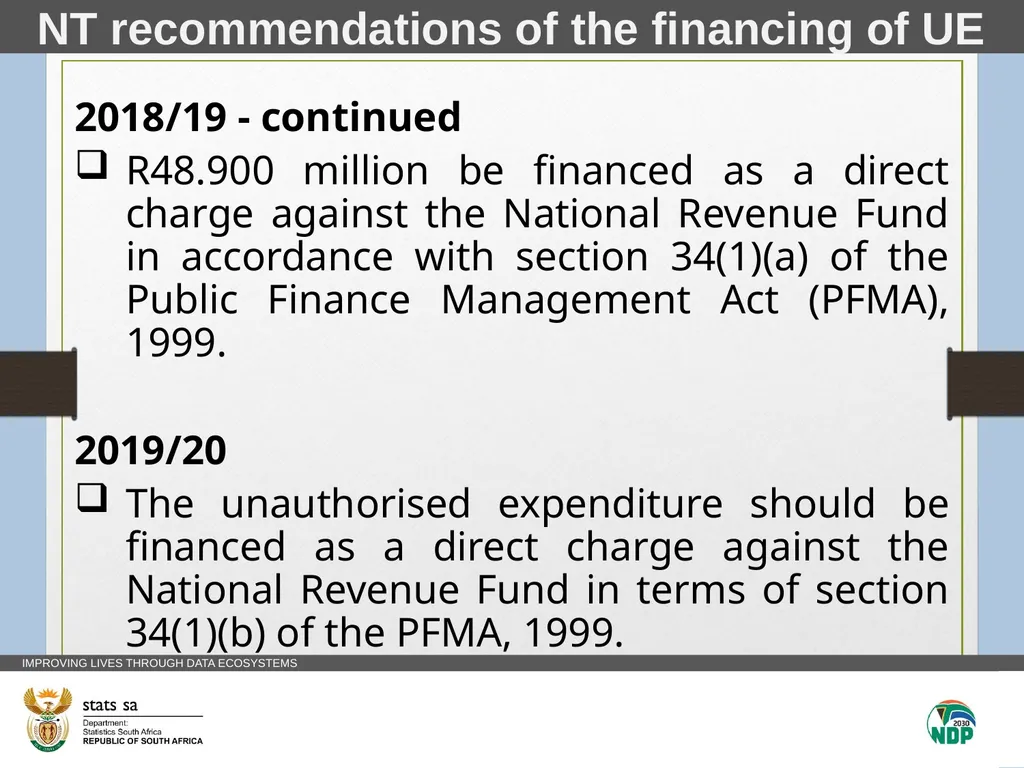
slide13. NT recommendations of the financing of UE
2018/19 - continued
R48.900 million be financed as a direct charge against the National Revenue Fund in accordance with section 34(1)(a) of the Public Finance Management Act (PFMA), 1999.
2019/20
The unauthorised expenditure should be financed as a direct charge against the National Revenue Fund in terms of section 34(1)(b) of the PFMA, 1999.<br>
slide14. Stats SA recommendations wrt financing of UE<br>
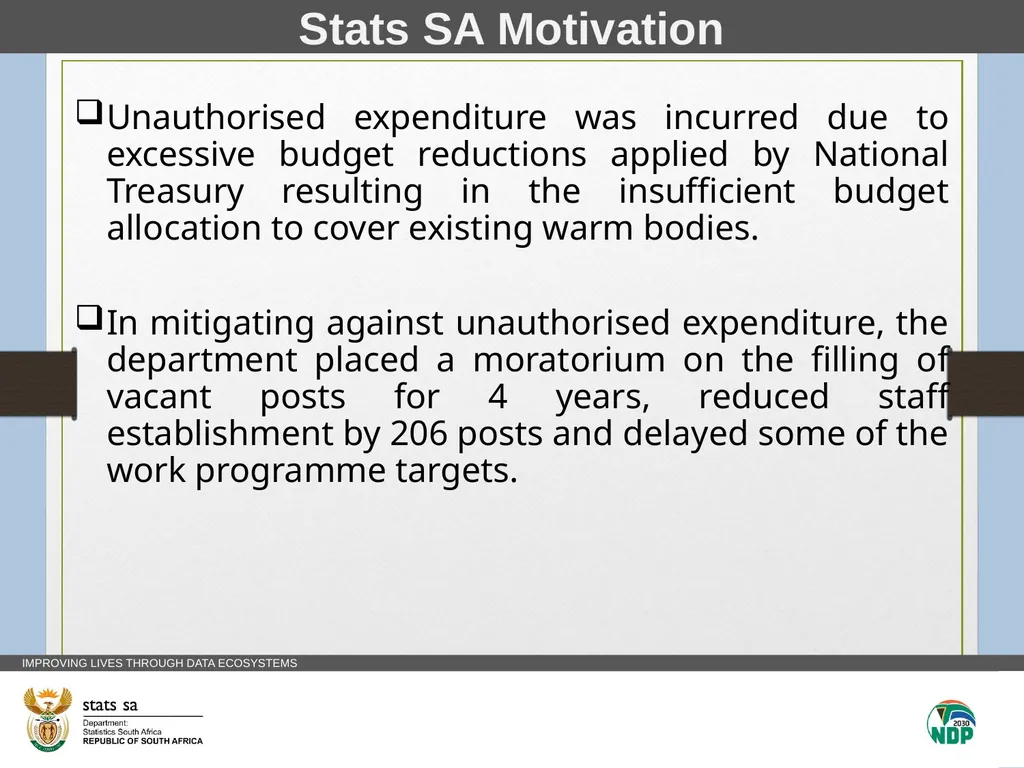
slide15. Stats SA Motivation
Unauthorised expenditure was incurred due to excessive budget reductions applied by National Treasury resulting in the insufficient budget allocation to cover existing warm bodies.
In mitigating against unauthorised expenditure, the department placed a moratorium on the filling of vacant posts for 4 years, reduced staff establishment by 206 posts and delayed some of the work programme targets.<br>
slide16. Stats SA motivation
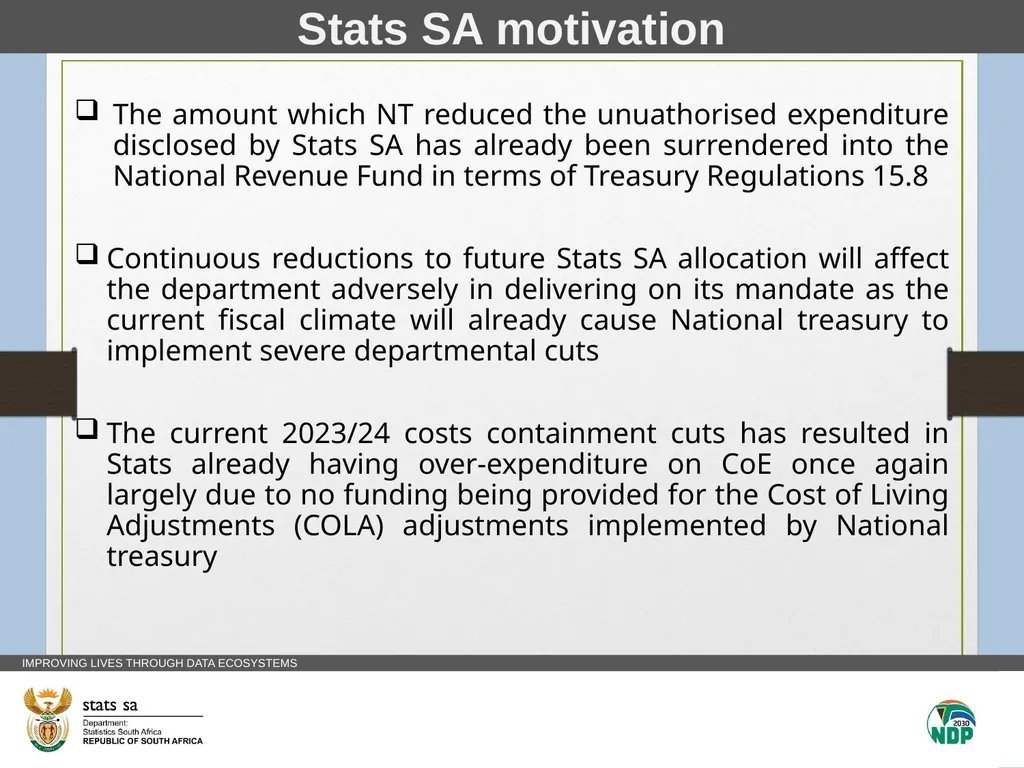
The amount which NT reduced the unuathorised expenditure disclosed by Stats SA has already been surrendered into the National Revenue Fund in terms of Treasury Regulations 15.8
Continuous reductions to future Stats SA allocation will affect the department adversely in delivering on its mandate as the current fiscal climate will already cause National treasury to implement severe departmental cuts
The current 2023/24 costs containment cuts has resulted in Stats already having over-expenditure on CoE once again largely due to no funding being provided for the Cost of Living Adjustments (COLA) adjustments implemented by National treasury<br>
slide17.
THANK YOU<br>
Vote 14
Unauthorised Expenditure
SCOPA
Risenga Maluleke
Statistician-General
17 October 2023<br>
slide2. Contents Background
Unauthorised Expenditure
Change in recognition of Unauthorised Expenditure (UE)
Engagements with National Treasury
Consequence Management
National Treasury Recommendations
Stats SA Recommendations & Motivation<br>
slide3. Background Stats SA incurred unauthorised expenditure in financial year 2015/16 to 2019/20 as defined in section 1 of the Public Finance Management Act No 1 of 1994:
(a) overspending of a vote or main division within a vote:
2015/16 – R6.803 million
2017/18 – R57.270 million
2018/19 – R54.395 million
2019/20 – R50.940 million
(b) expenditure not in accordance with the purpose of a vote:
2018/19 – R2.745 million
Unauthorised expenditure incurred by the department is mainly on compensation of employees due to budget reductions implemented by National Treasury<br>
slide4. Unauthorised Expenditure – 2015/16 The Population and Social Statistics branch overspent on its baseline allocation by R6.803 million after virements and shifts were applied during the 2015/16 financial year.
The overspending was as a result of funding the unfunded mandate relating to the Living Conditions Survey (LCS) used to update the Consumer Price Index (CPI) utilising savings from vacancies and austerity measures.
The Department did not overspend on the voted baseline, the over expenditure for programme 3 could not be completely defrayed due to the 8 percent limit prescribed for virements – sec 43 of the PFMA. Treasury Regulations 6.3 and section 5 of the Appropriation Act.
As a result, the department surrendered R6.803 million to National Treasury.<br>
slide5. Unauthorised Expenditure – 2017/18 to 2019/20 National Treasury reduced the Department’s Compensation of Employees (CoE) budget to an extent that the cost of currently filled positions (warm bodies) at the time exceeded the reduced budget allocation.
This CoE budget reduction resulted in unauthorised expenditure amounting to R163.877 million as follows:
R57.270 million in 2017/18 financial year
R48.865 million in 2018/19 financial and
R50.939 million in the 2019/20 financial year.<br>
slide6. Unauthorised Expenditure – 2018/19 The KwaZulu-Natal Citizen Satisfaction Survey (CSS KZN) was undertaken by Stats SA in terms of an agreement entered into between Stats SA and the Office of the Premier (OTP) KwaZulu-Natal with a total budget of R6,754 million over two years.
The actual expenditure on the project was R9,499 million, resulting in a shortfall of R2,745 million.
Continuous engagements to obtain a refund for the additional funding were unsuccessful, notwithstanding the benefits the project provided to the KZN Provincial Government
The shortfall of R2,745 million was therefore included as expenditure in Stats SA’s financial records for 2018/19 and disclosed as unauthorised expenditure as required for any expenditure incurred not in accordance with the purpose of the vote.<br>
slide7. Change in recognition of Unauthorised Expenditure Prior to 2022/23 financial year the department recognized Unauthorised Expenditure at economic classification level subsequent to discussions between Stats SA, Office of the Accountant General (NT), Auditor-General South Africa and National Treasury Public Finance.
National Treasury Instruction Note No. 4 of 2022/23 defines that unauthorised expenditure must be determined at a level of a vote, or main division within a vote and not with reference to its economic classification.<br>
slide8. Change in recognition of Unauthorised Expenditure National Treasury Instruction No 4 of 2022/23 define that unauthorised expenditure must be determined at a level of a vote, or main division within a vote and not with reference to its economic classification.
The variance amounts below represent the excess amounts Stats SA paid into the National Revenue Fund relating to unspent funds of the previous financial years in terms Treasury Regulations 15.8.<br>
slide9. Measures implemented to prevent UE The Department stopped filling vacant posts from 2016/17 to 2022/23.
Rationalisation of filled posts was implemented and organisational structure reviewed and approved in March 2020:
Reduction of the establishment with 206 posts abolished between 2016 to 2023
Filled posts decreased from 3 250 (FY2016) posts to 2 670 posts at the end of FY2023 (580 less warm bodies)
NT provided additional funding amounting to R132.3 million (R40. million in 2022/23, R45.5 million in 2023/24 and R46.8 million in 2024/25) over the medium-term to fill critical positions<br>
slide10. Engagements with stakeholders During the financial year 2017/18, discussions were held National Treasury with regards to the implications of the excessive budget reductions.
A once-off funding amounting to R70 million allocated in 2018/19 was utilised to appoint temporary contract employees to deliver on the core mandate of Stats SA
In March 2021 Stats SA briefed the Portfolio Committee that budget cuts had impacted negatively on the work of Stats SA.
This narrative continued until the additional funding was received from National Treasury after continued deliberations/consultations as to the impact of not recruiting at all has on the mandate of Stats SA<br>
slide11. Consequence Management In all instances of the material unauthorised expenditure incurred was due to budget reductions implemented by National Treasury.
Stats SA had no control over the budget cuts as previously referred to and had to contend with the consequences of the resultant over-expenditure
The LCS and KZN surveys added the much needed data information for planning within government
Future user pay survey agreements agreements are now costed based on zero based budgeting and provision is made for increased funding should the project require any additional work to be conducted.<br>
slide12. NT recommendations of the financing of UE
2017/18
R11.378 million be funded as a charge against funds allocated to the department for the future years, in accordance with section 34(2) of the PFMA, 1999.
R26.464 million be financed as a direct charge against the National Revenue Fund in accordance with section 34(1)(a) of the Public Finance Management Act (PFMA), 1999
2018/19
R7.839 million be funded as a charge against funds allocated to the department for the future years, in accordance with section 34(2) of the PFMA, 1999. <br>
slide13. NT recommendations of the financing of UE
2018/19 - continued
R48.900 million be financed as a direct charge against the National Revenue Fund in accordance with section 34(1)(a) of the Public Finance Management Act (PFMA), 1999.
2019/20
The unauthorised expenditure should be financed as a direct charge against the National Revenue Fund in terms of section 34(1)(b) of the PFMA, 1999.<br>
slide14. Stats SA recommendations wrt financing of UE<br>
slide15. Stats SA Motivation
Unauthorised expenditure was incurred due to excessive budget reductions applied by National Treasury resulting in the insufficient budget allocation to cover existing warm bodies.
In mitigating against unauthorised expenditure, the department placed a moratorium on the filling of vacant posts for 4 years, reduced staff establishment by 206 posts and delayed some of the work programme targets.<br>
slide16. Stats SA motivation
The amount which NT reduced the unuathorised expenditure disclosed by Stats SA has already been surrendered into the National Revenue Fund in terms of Treasury Regulations 15.8
Continuous reductions to future Stats SA allocation will affect the department adversely in delivering on its mandate as the current fiscal climate will already cause National treasury to implement severe departmental cuts
The current 2023/24 costs containment cuts has resulted in Stats already having over-expenditure on CoE once again largely due to no funding being provided for the Cost of Living Adjustments (COLA) adjustments implemented by National treasury<br>
slide17.
THANK YOU<br>