
Status Asthmaticus in the Pediatric Emergency
BR
Published · 66 slides · 0 views

1 / 1




Description
Status Asthmaticus in the Pediatric Emergency Department Valerie Davis, MD, PhD On-line Module Objectives Objectives At the end of this Module Learners will be able to: Describe the Goals of Therapy in Status Asthmaticus Evaluate children
Related Topics
Download this presentation From Below
"Status Asthmaticus in the Pediatric Emergency" is the property of its rightful owner. Permission is granted to download and print the materials on this website for personal, non-commercial use only, and to display it on your personal computer provided you do not modify the materials and that you retain all copyright notices contained in the materials. By downloading content from our website, you accept the terms of this agreement.
Share
Embed code
Presentation Transcript
01
Status Asthmaticus in the Pediatric Emergency Department Valerie Davis, MD, PhD
On-line Module<br>
On-line Module<br>
02
Objectives Objectives –At the end of this Module Learners will be able to:
Describe the Goals of Therapy in Status Asthmaticus
Evaluate children presenting in status asthmaticus using a scoring system and demonstrate application of this scoring system to case presentations.
Discuss how to manage children based on their asthma severity
Formulate how to manage severe asthma using advanced treatment modalities
Plan and discuss a managed risk approach to invasive and non-invasive ventilation for respiratory failure from status asthmaticus.
Support admission and discharge decisions and describe discharge plan/instruction to parents.<br>
Describe the Goals of Therapy in Status Asthmaticus
Evaluate children presenting in status asthmaticus using a scoring system and demonstrate application of this scoring system to case presentations.
Discuss how to manage children based on their asthma severity
Formulate how to manage severe asthma using advanced treatment modalities
Plan and discuss a managed risk approach to invasive and non-invasive ventilation for respiratory failure from status asthmaticus.
Support admission and discharge decisions and describe discharge plan/instruction to parents.<br>
03
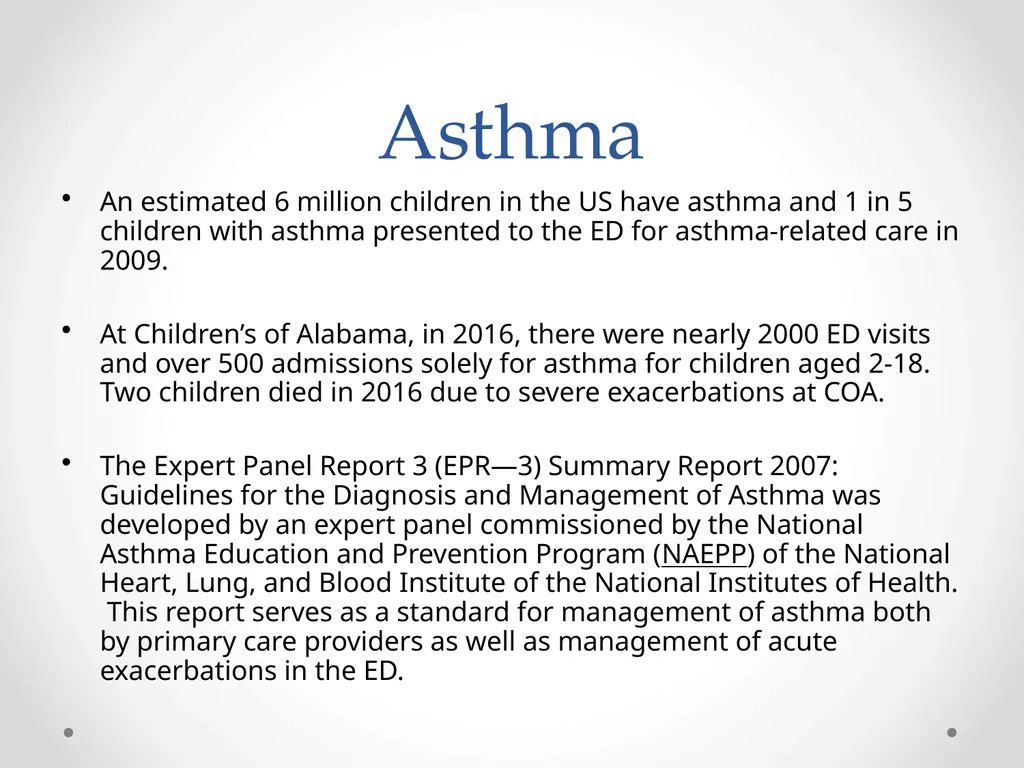
Asthma An estimated 6 million children in the US have asthma and 1 in 5 children with asthma presented to the ED for asthma-related care in 2009.
At Children’s of Alabama, in 2016, there were nearly 2000 ED visits and over 500 admissions solely for asthma for children aged 2-18. Two children died in 2016 due to severe exacerbations at COA.
The Expert Panel Report 3 (EPR—3) Summary Report 2007: Guidelines for the Diagnosis and Management of Asthma was developed by an expert panel commissioned by the National Asthma Education and Prevention Program (NAEPP) of the National Heart, Lung, and Blood Institute of the National Institutes of Health. This report serves as a standard for management of asthma both by primary care providers as well as management of acute exacerbations in the ED.<br>
At Children’s of Alabama, in 2016, there were nearly 2000 ED visits and over 500 admissions solely for asthma for children aged 2-18. Two children died in 2016 due to severe exacerbations at COA.
The Expert Panel Report 3 (EPR—3) Summary Report 2007: Guidelines for the Diagnosis and Management of Asthma was developed by an expert panel commissioned by the National Asthma Education and Prevention Program (NAEPP) of the National Heart, Lung, and Blood Institute of the National Institutes of Health. This report serves as a standard for management of asthma both by primary care providers as well as management of acute exacerbations in the ED.<br>
04
Module Section #1
Goal of Therapy in Status Asthmaticus<br>
05
Asthma in the ED Children presenting to the Pediatric Emergency Department with acute exacerbations are experiencing symptoms such as mild exacerbations with increased cough and wheeze to severe life threatening status asthmaticus. The goal of therapy in the ED is threefold.
1) Reverse Airflow Obstruction with beta agonists and steroids
2) Correct hypoxemia
3) Reduce Recurrence Risk
Recurrence risk may be reduced by providing patients and their families with education and tools, including controller medications, to better control their symptoms, prevent future exacerbations and ED visits, and improve the quality of their daily life.<br>
1) Reverse Airflow Obstruction with beta agonists and steroids
2) Correct hypoxemia
3) Reduce Recurrence Risk
Recurrence risk may be reduced by providing patients and their families with education and tools, including controller medications, to better control their symptoms, prevent future exacerbations and ED visits, and improve the quality of their daily life.<br>
06
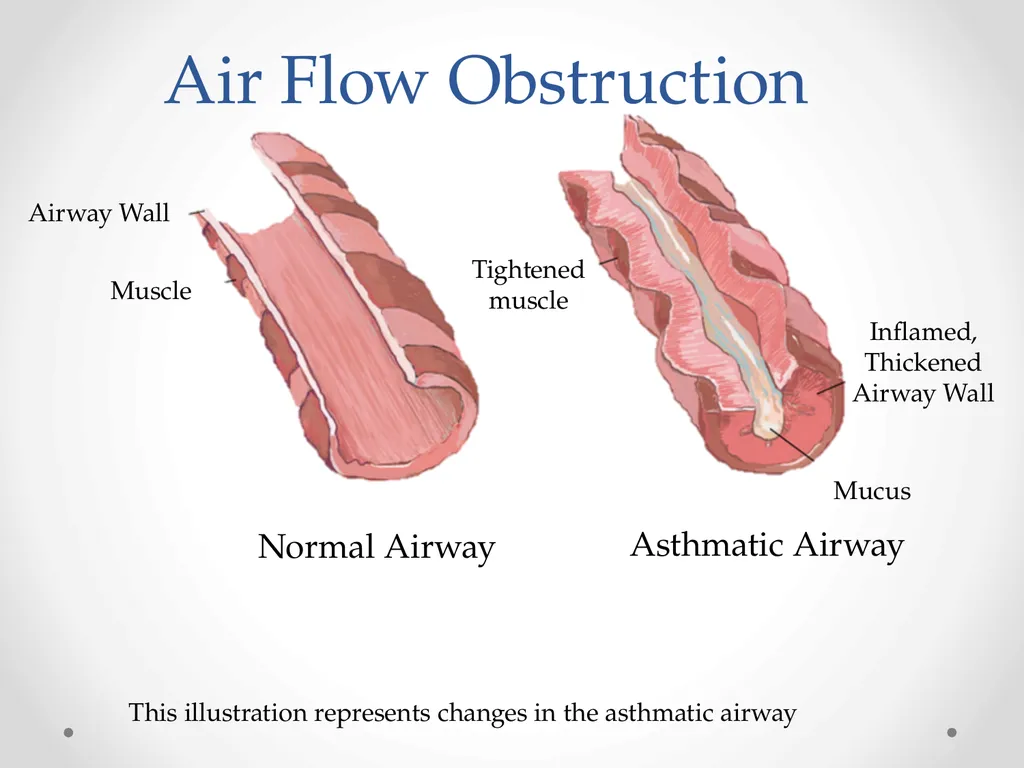
Air Flow Obstruction This illustration represents changes in the asthmatic airway<br>
07
Goal #1: Reduce Airflow Obstruction Reduced airflow obstruction is achieved by use of a bronchodilator. Albuterol is the most common inhaled beta-agonist/bronchodilator.
Also known as Proventil, ProAir, Ventolin
Onset of action < 5 min; repetitive administration produces incremental bronchodilation.
In 60-70% of patients, response to the initial 3 doses will be sufficient to discharge them.
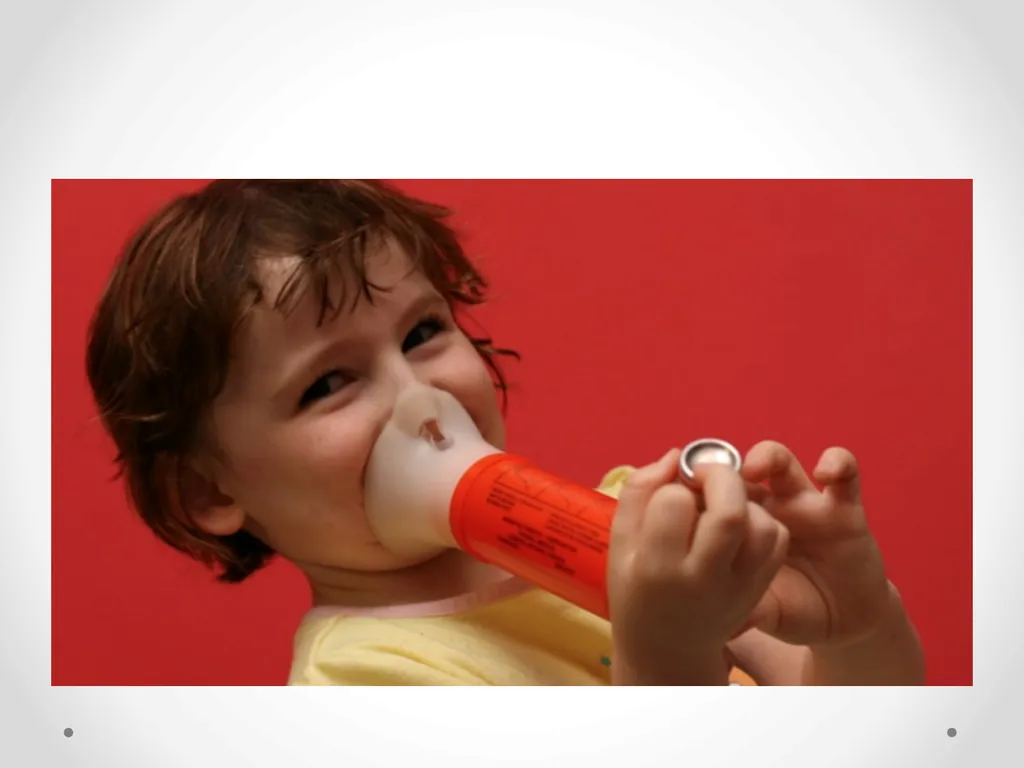
In mild to moderate exacerbations, a metered dose inhaler (MDI) plus spacer/VHC (vaulted holding chamber) is as effective as nebulized therapy
Many other EDs use MDI for treatment of acute exacerbations
Ipratropium (Atrovent) is an anticholinergic which also reduces bronchoconstriction and has been shown to be helpful in preventing hospitalization with acute exacerbations. (3)<br>
Also known as Proventil, ProAir, Ventolin
Onset of action < 5 min; repetitive administration produces incremental bronchodilation.
In 60-70% of patients, response to the initial 3 doses will be sufficient to discharge them.
In mild to moderate exacerbations, a metered dose inhaler (MDI) plus spacer/VHC (vaulted holding chamber) is as effective as nebulized therapy
Many other EDs use MDI for treatment of acute exacerbations
Ipratropium (Atrovent) is an anticholinergic which also reduces bronchoconstriction and has been shown to be helpful in preventing hospitalization with acute exacerbations. (3)<br>
08
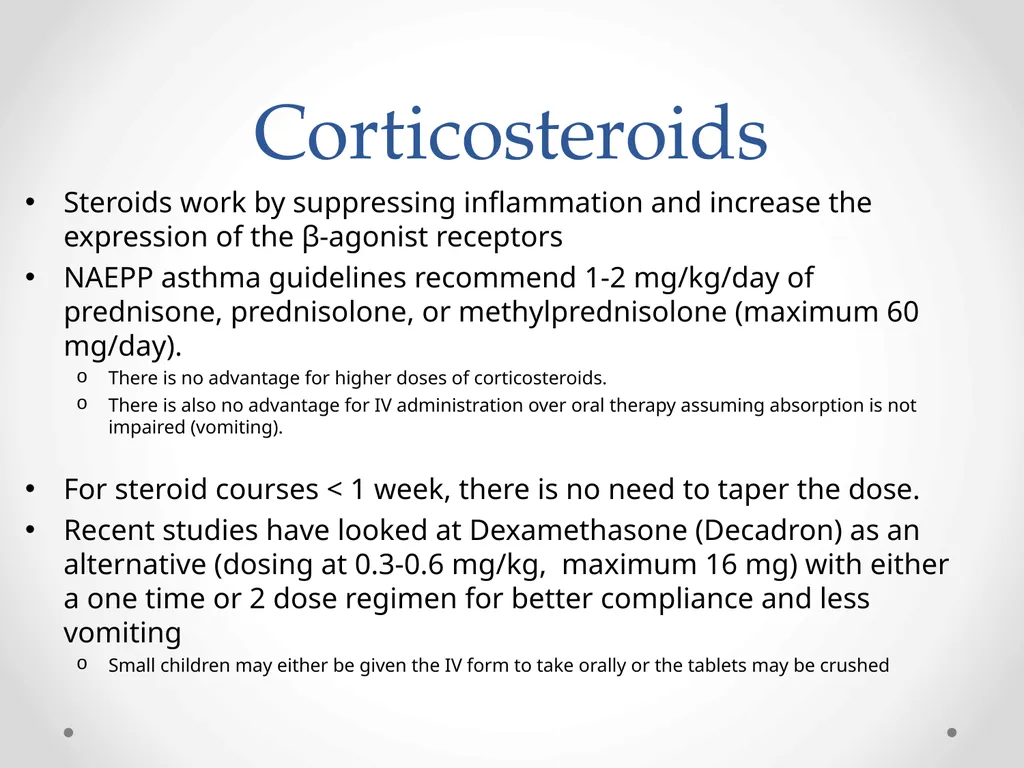
Corticosteroids Steroids work by suppressing inflammation and increase the expression of the β-agonist receptors
NAEPP asthma guidelines recommend 1-2 mg/kg/day of prednisone, prednisolone, or methylprednisolone (maximum 60 mg/day).
There is no advantage for higher doses of corticosteroids.
There is also no advantage for IV administration over oral therapy assuming absorption is not impaired (vomiting).
For steroid courses < 1 week, there is no need to taper the dose.
Recent studies have looked at Dexamethasone (Decadron) as an alternative (dosing at 0.3-0.6 mg/kg, maximum 16 mg) with either a one time or 2 dose regimen for better compliance and less vomiting
Small children may either be given the IV form to take orally or the tablets may be crushed<br>
NAEPP asthma guidelines recommend 1-2 mg/kg/day of prednisone, prednisolone, or methylprednisolone (maximum 60 mg/day).
There is no advantage for higher doses of corticosteroids.
There is also no advantage for IV administration over oral therapy assuming absorption is not impaired (vomiting).
For steroid courses < 1 week, there is no need to taper the dose.
Recent studies have looked at Dexamethasone (Decadron) as an alternative (dosing at 0.3-0.6 mg/kg, maximum 16 mg) with either a one time or 2 dose regimen for better compliance and less vomiting
Small children may either be given the IV form to take orally or the tablets may be crushed<br>
09
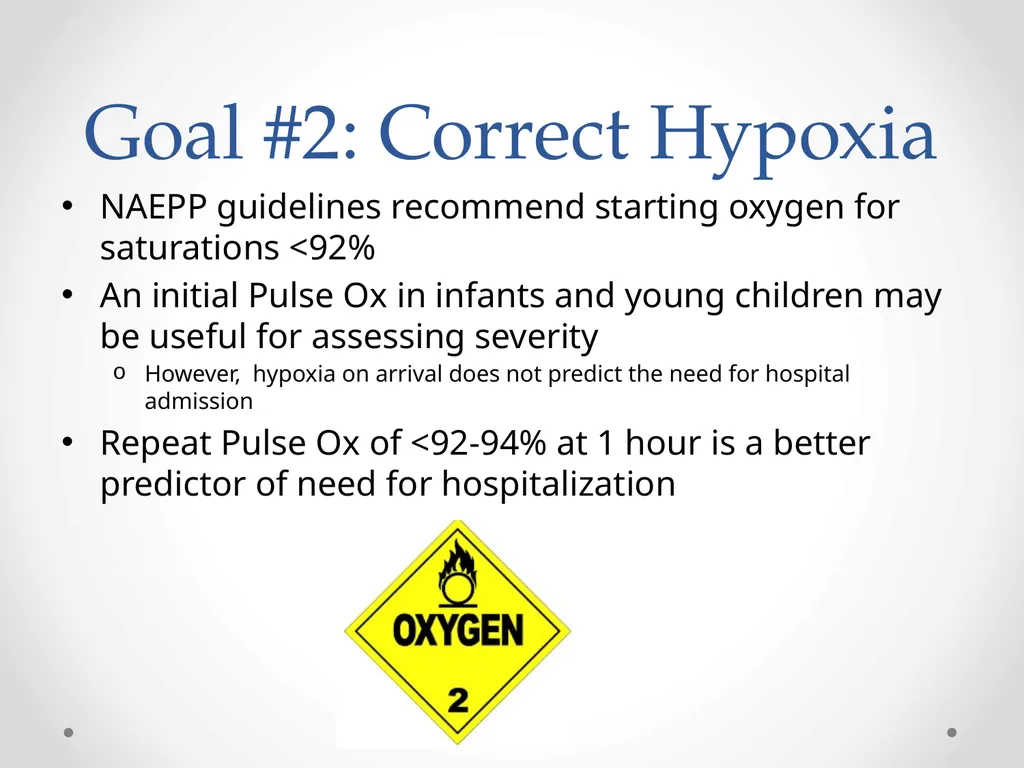
Goal #2: Correct Hypoxia NAEPP guidelines recommend starting oxygen for saturations <92%
An initial Pulse Ox in infants and young children may be useful for assessing severity
However, hypoxia on arrival does not predict the need for hospital admission
Repeat Pulse Ox of <92-94% at 1 hour is a better predictor of need for hospitalization<br>
An initial Pulse Ox in infants and young children may be useful for assessing severity
However, hypoxia on arrival does not predict the need for hospital admission
Repeat Pulse Ox of <92-94% at 1 hour is a better predictor of need for hospitalization<br>
10
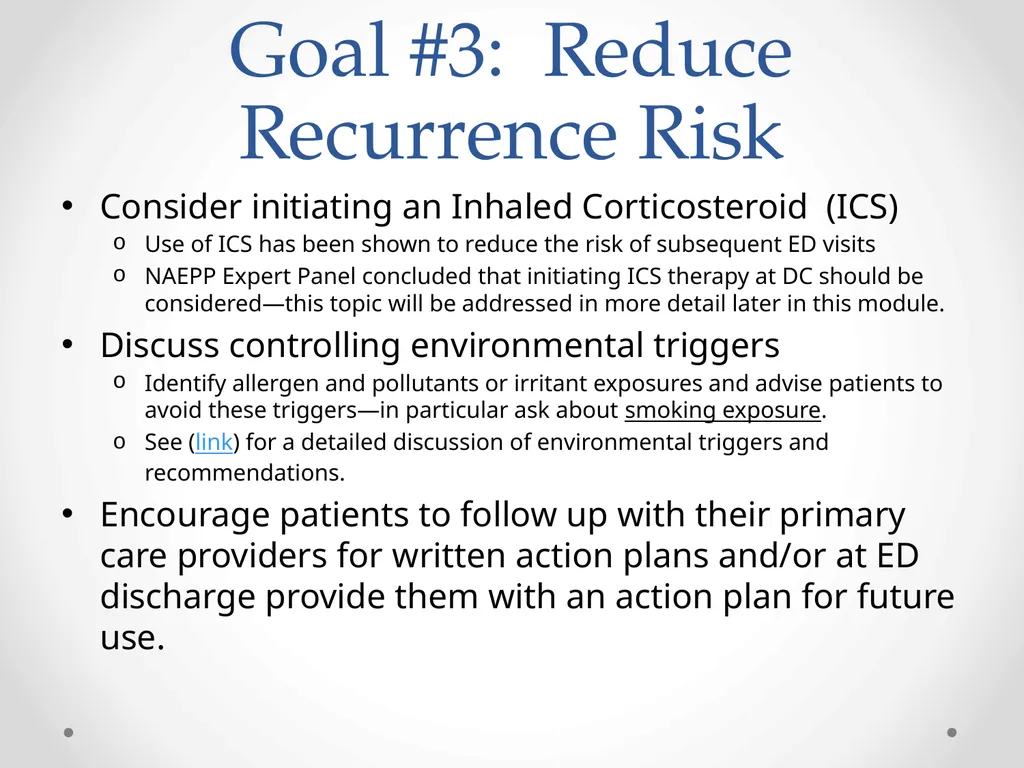
Goal #3: Reduce Recurrence Risk Consider initiating an Inhaled Corticosteroid (ICS)
Use of ICS has been shown to reduce the risk of subsequent ED visits
NAEPP Expert Panel concluded that initiating ICS therapy at DC should be considered—this topic will be addressed in more detail later in this module.
Discuss controlling environmental triggers
Identify allergen and pollutants or irritant exposures and advise patients to avoid these triggers—in particular ask about smoking exposure.
See (link) for a detailed discussion of environmental triggers and recommendations.
Encourage patients to follow up with their primary care providers for written action plans and/or at ED discharge provide them with an action plan for future use.<br>
Use of ICS has been shown to reduce the risk of subsequent ED visits
NAEPP Expert Panel concluded that initiating ICS therapy at DC should be considered—this topic will be addressed in more detail later in this module.
Discuss controlling environmental triggers
Identify allergen and pollutants or irritant exposures and advise patients to avoid these triggers—in particular ask about smoking exposure.
See (link) for a detailed discussion of environmental triggers and recommendations.
Encourage patients to follow up with their primary care providers for written action plans and/or at ED discharge provide them with an action plan for future use.<br>
11
Module Section #2: Initial Assessment of Severity<br>
12
Assessment of Severity In the last module section, we reviewed the goals of therapy in Status Asthmaticus. In this section, we will take a closer look at how to assess the severity of an exacerbation which is the first step in determining therapy when the child presents to the ED. Do not underestimate the severity of an exacerbation
Severe exacerbations can be life threatening and can occur in patients at any level of asthma severity—i.e., intermittent, or mild, moderate, or severe persistent asthma.<br>
Severe exacerbations can be life threatening and can occur in patients at any level of asthma severity—i.e., intermittent, or mild, moderate, or severe persistent asthma.<br>
13
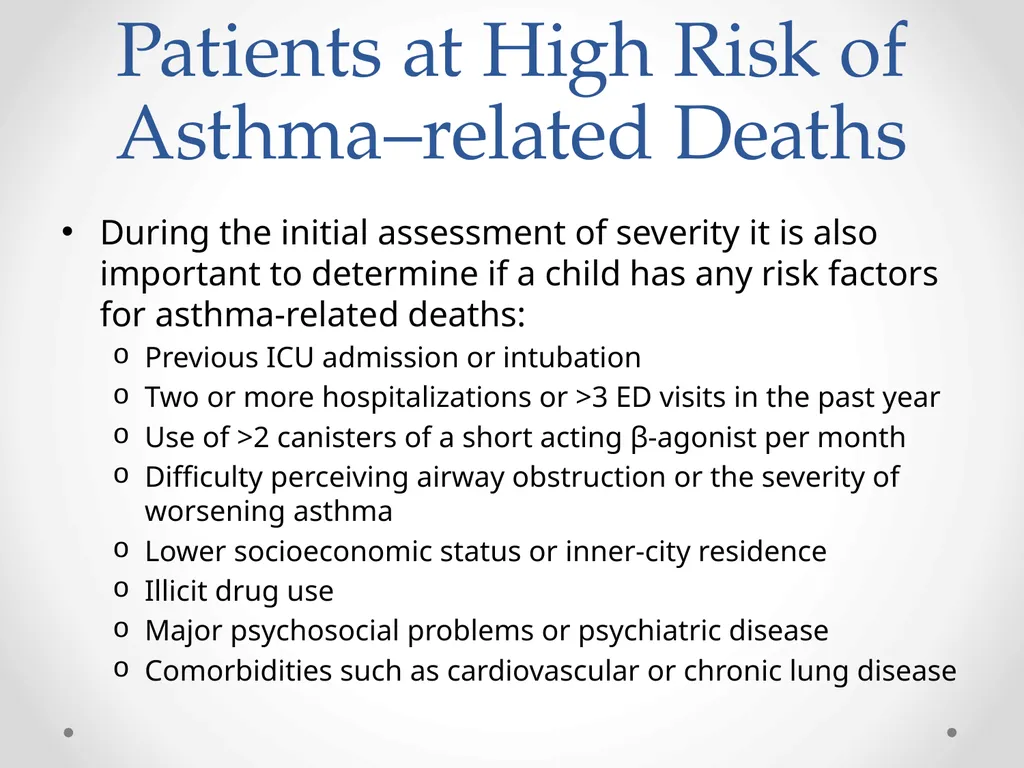
Patients at High Risk of Asthma–related Deaths During the initial assessment of severity it is also important to determine if a child has any risk factors for asthma-related deaths:
Previous ICU admission or intubation
Two or more hospitalizations or >3 ED visits in the past year
Use of >2 canisters of a short acting β-agonist per month
Difficulty perceiving airway obstruction or the severity of worsening asthma
Lower socioeconomic status or inner-city residence
Illicit drug use
Major psychosocial problems or psychiatric disease
Comorbidities such as cardiovascular or chronic lung disease<br>
Previous ICU admission or intubation
Two or more hospitalizations or >3 ED visits in the past year
Use of >2 canisters of a short acting β-agonist per month
Difficulty perceiving airway obstruction or the severity of worsening asthma
Lower socioeconomic status or inner-city residence
Illicit drug use
Major psychosocial problems or psychiatric disease
Comorbidities such as cardiovascular or chronic lung disease<br>
14
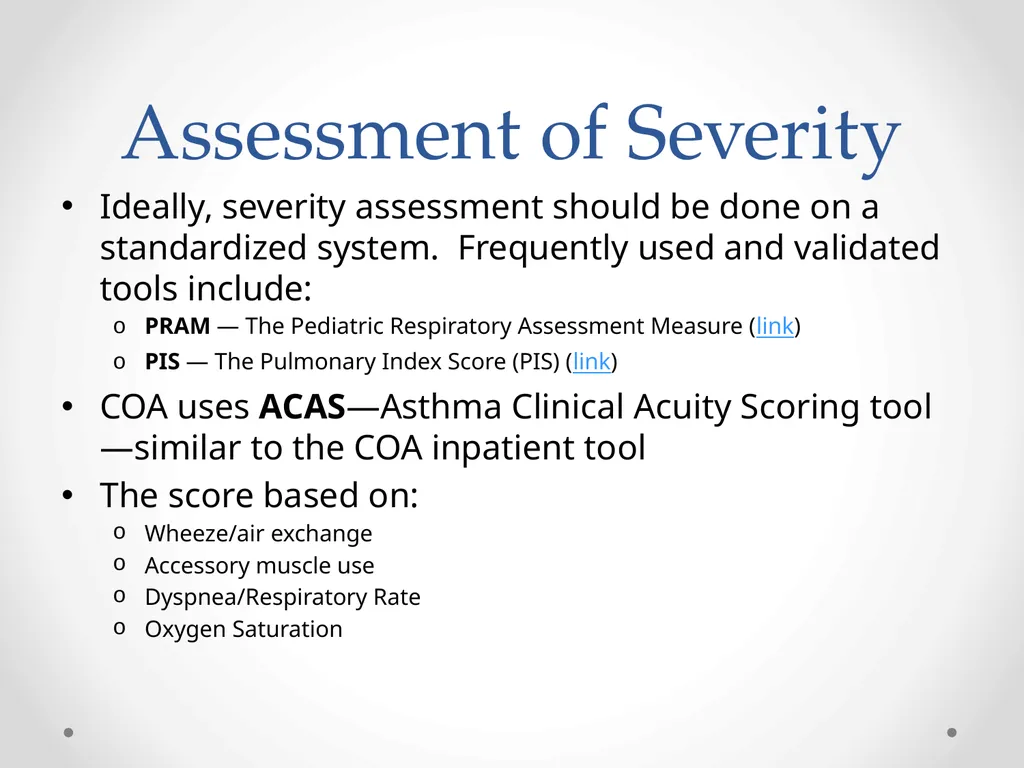
Assessment of Severity Ideally, severity assessment should be done on a standardized system. Frequently used and validated tools include:
PRAM — The Pediatric Respiratory Assessment Measure (link)
PIS — The Pulmonary Index Score (PIS) (link)
COA uses ACAS—Asthma Clinical Acuity Scoring tool—similar to the COA inpatient tool
The score based on:
Wheeze/air exchange
Accessory muscle use
Dyspnea/Respiratory Rate
Oxygen Saturation<br>
PRAM — The Pediatric Respiratory Assessment Measure (link)
PIS — The Pulmonary Index Score (PIS) (link)
COA uses ACAS—Asthma Clinical Acuity Scoring tool—similar to the COA inpatient tool
The score based on:
Wheeze/air exchange
Accessory muscle use
Dyspnea/Respiratory Rate
Oxygen Saturation<br>
15
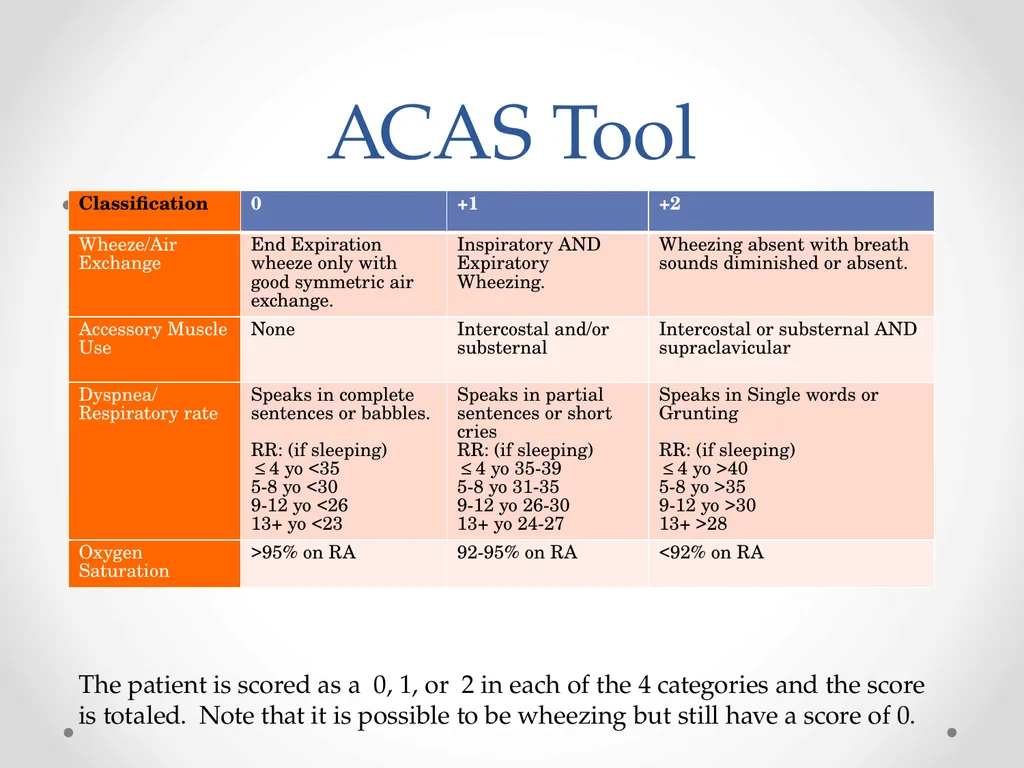
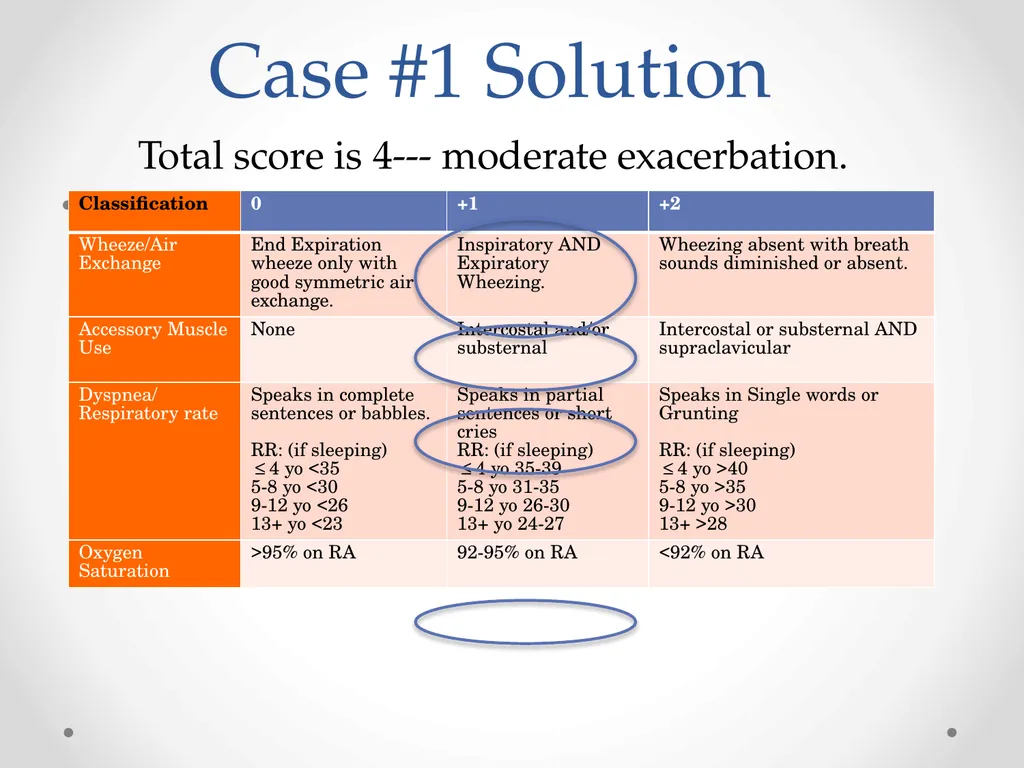
ACAS Tool . The patient is scored as a 0, 1, or 2 in each of the 4 categories and the score is totaled. Note that it is possible to be wheezing but still have a score of 0.<br>
16
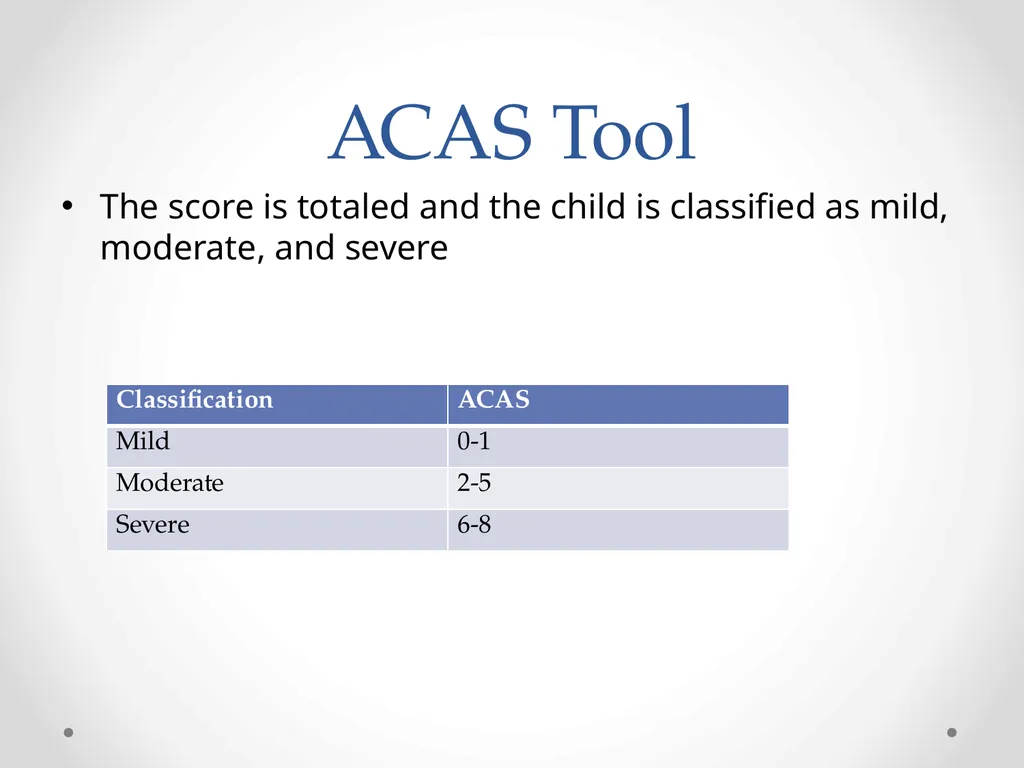
ACAS Tool The score is totaled and the child is classified as mild, moderate, and severe<br>
17
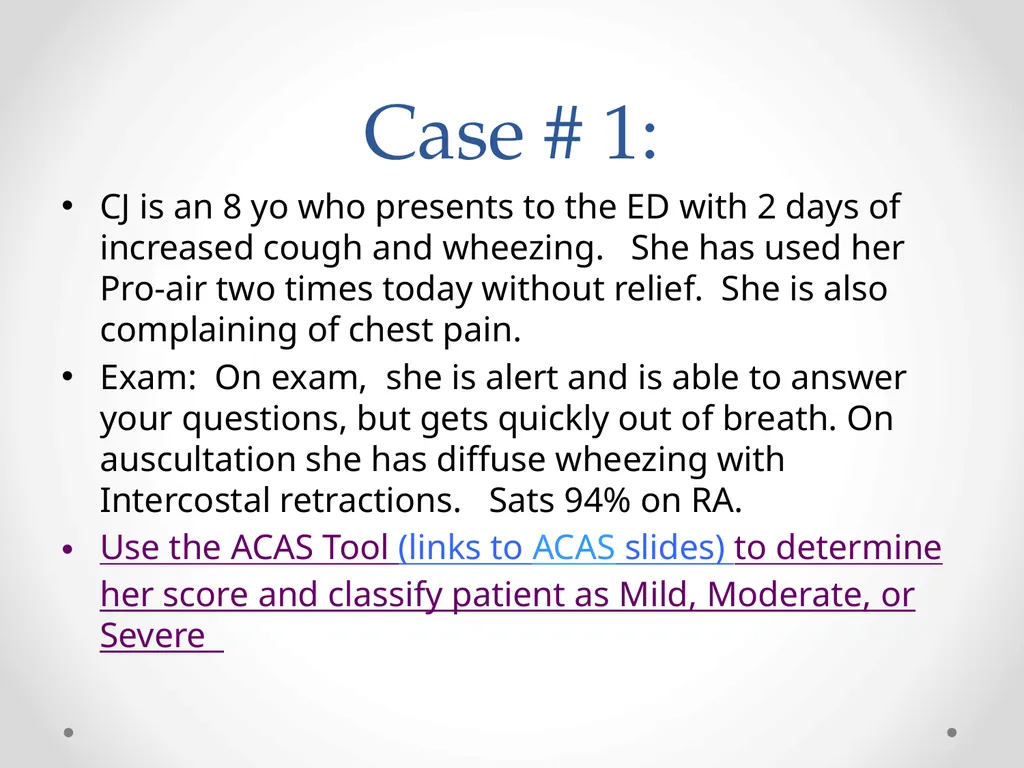
Case # 1: CJ is an 8 yo who presents to the ED with 2 days of increased cough and wheezing. She has used her Pro-air two times today without relief. She is also complaining of chest pain.
Exam: On exam, she is alert and is able to answer your questions, but gets quickly out of breath. On auscultation she has diffuse wheezing with Intercostal retractions. Sats 94% on RA.
Use the ACAS Tool (links to ACAS slides) to determine her score and classify patient as Mild, Moderate, or Severe<br>
Exam: On exam, she is alert and is able to answer your questions, but gets quickly out of breath. On auscultation she has diffuse wheezing with Intercostal retractions. Sats 94% on RA.
Use the ACAS Tool (links to ACAS slides) to determine her score and classify patient as Mild, Moderate, or Severe<br>
18
Case #1 Solution . Total score is 4--- moderate exacerbation.<br>
19
Module Section #3: Standard Treatment of Status Asthmaticus<br>
20
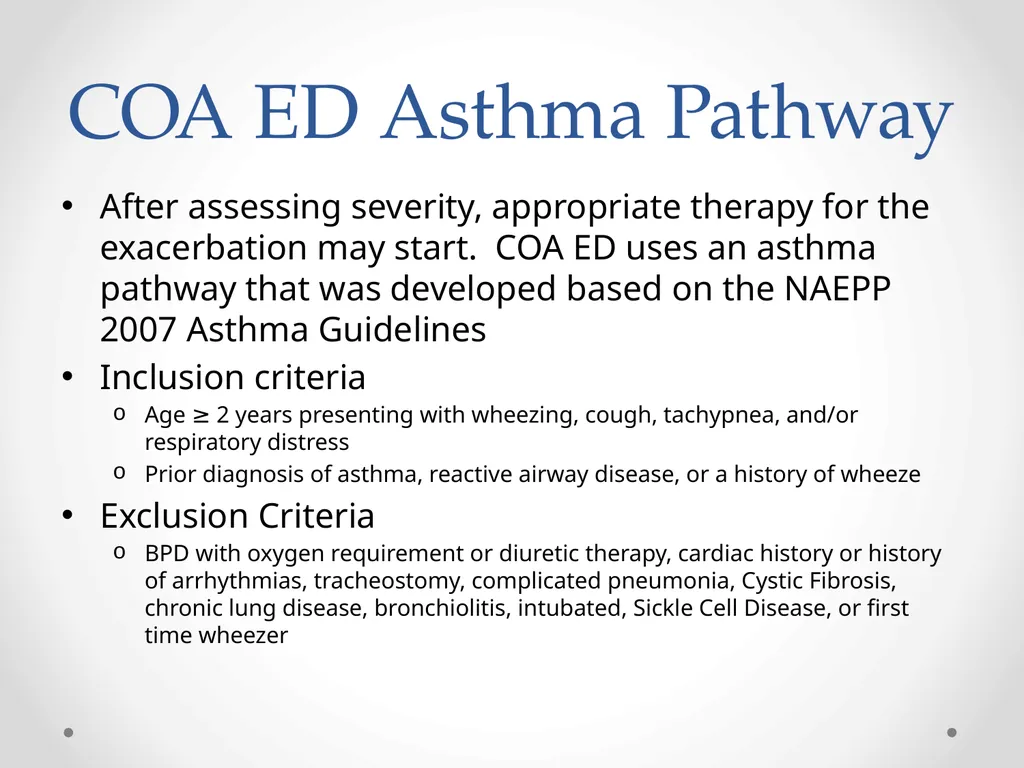
COA ED Asthma Pathway After assessing severity, appropriate therapy for the exacerbation may start. COA ED uses an asthma pathway that was developed based on the NAEPP 2007 Asthma Guidelines
Inclusion criteria
Age ≥ 2 years presenting with wheezing, cough, tachypnea, and/or respiratory distress
Prior diagnosis of asthma, reactive airway disease, or a history of wheeze
Exclusion Criteria
BPD with oxygen requirement or diuretic therapy, cardiac history or history of arrhythmias, tracheostomy, complicated pneumonia, Cystic Fibrosis, chronic lung disease, bronchiolitis, intubated, Sickle Cell Disease, or first time wheezer<br>
Inclusion criteria
Age ≥ 2 years presenting with wheezing, cough, tachypnea, and/or respiratory distress
Prior diagnosis of asthma, reactive airway disease, or a history of wheeze
Exclusion Criteria
BPD with oxygen requirement or diuretic therapy, cardiac history or history of arrhythmias, tracheostomy, complicated pneumonia, Cystic Fibrosis, chronic lung disease, bronchiolitis, intubated, Sickle Cell Disease, or first time wheezer<br>
21
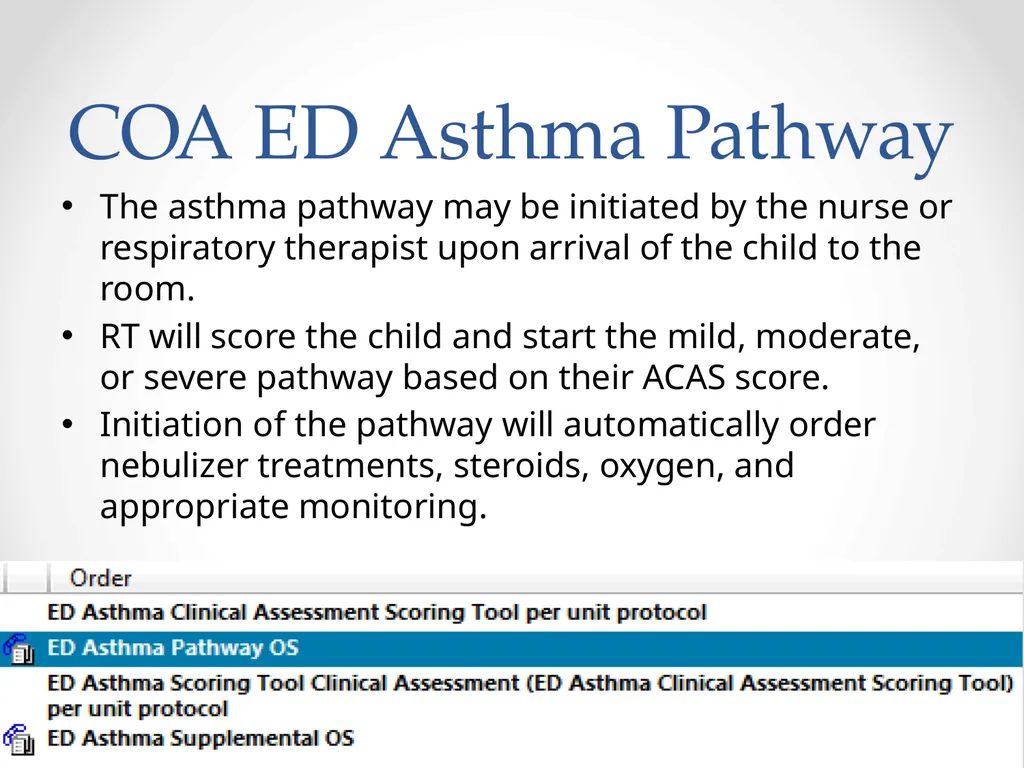
COA ED Asthma Pathway The asthma pathway may be initiated by the nurse or respiratory therapist upon arrival of the child to the room.
RT will score the child and start the mild, moderate, or severe pathway based on their ACAS score.
Initiation of the pathway will automatically order nebulizer treatments, steroids, oxygen, and appropriate monitoring.<br>
RT will score the child and start the mild, moderate, or severe pathway based on their ACAS score.
Initiation of the pathway will automatically order nebulizer treatments, steroids, oxygen, and appropriate monitoring.<br>
22
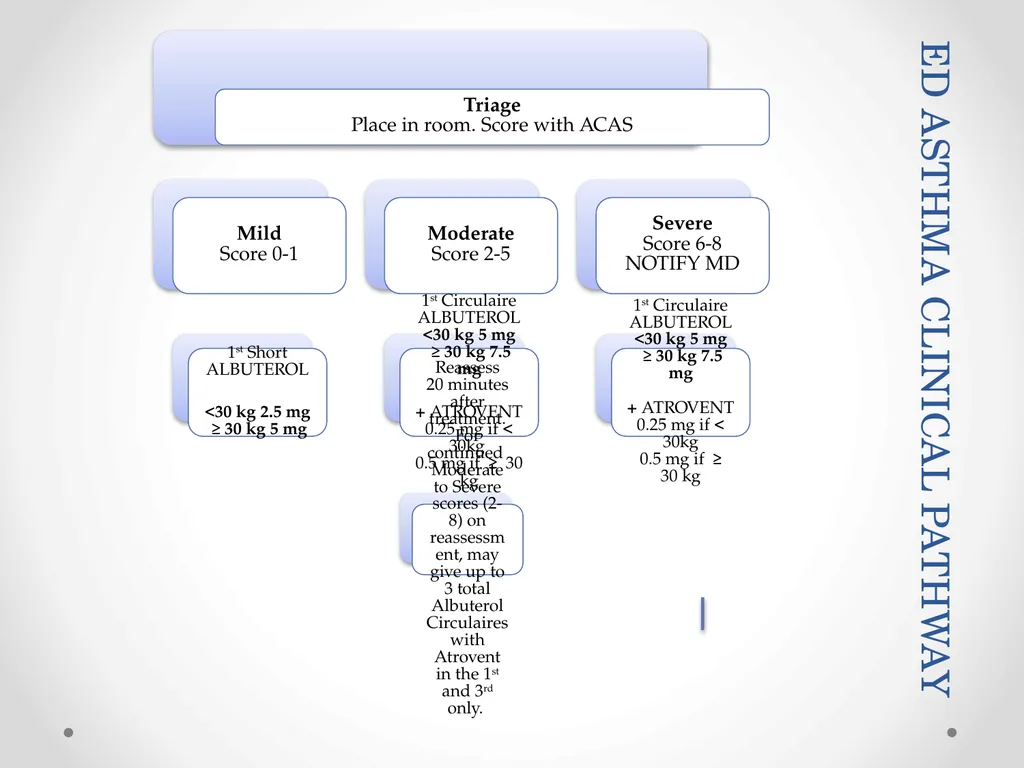
ED ASTHMA CLINICAL PATHWAY<br>
23
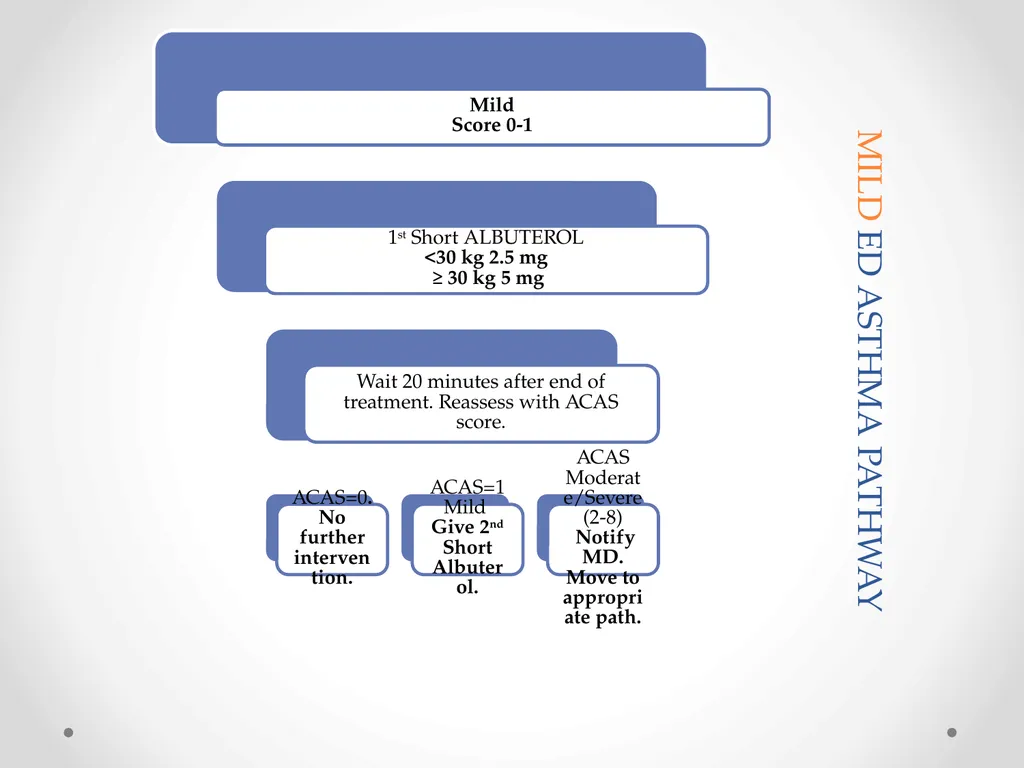
MILD ED ASTHMA PATHWAY<br>
24
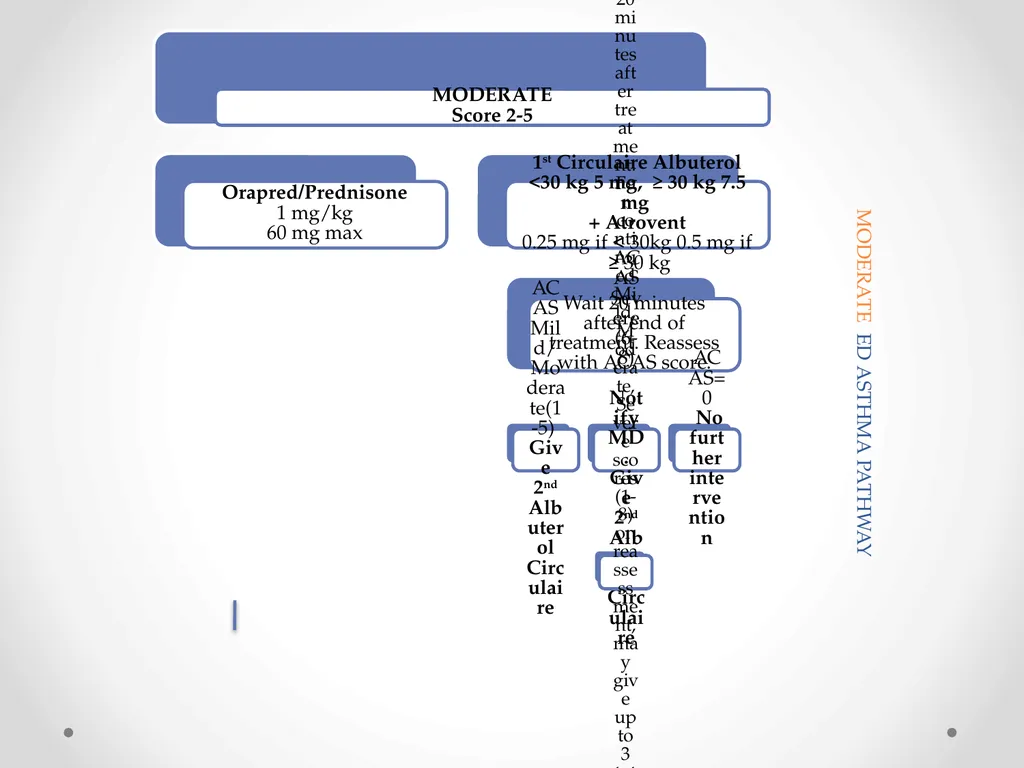
MODERATE ED ASTHMA PATHWAY<br>
25
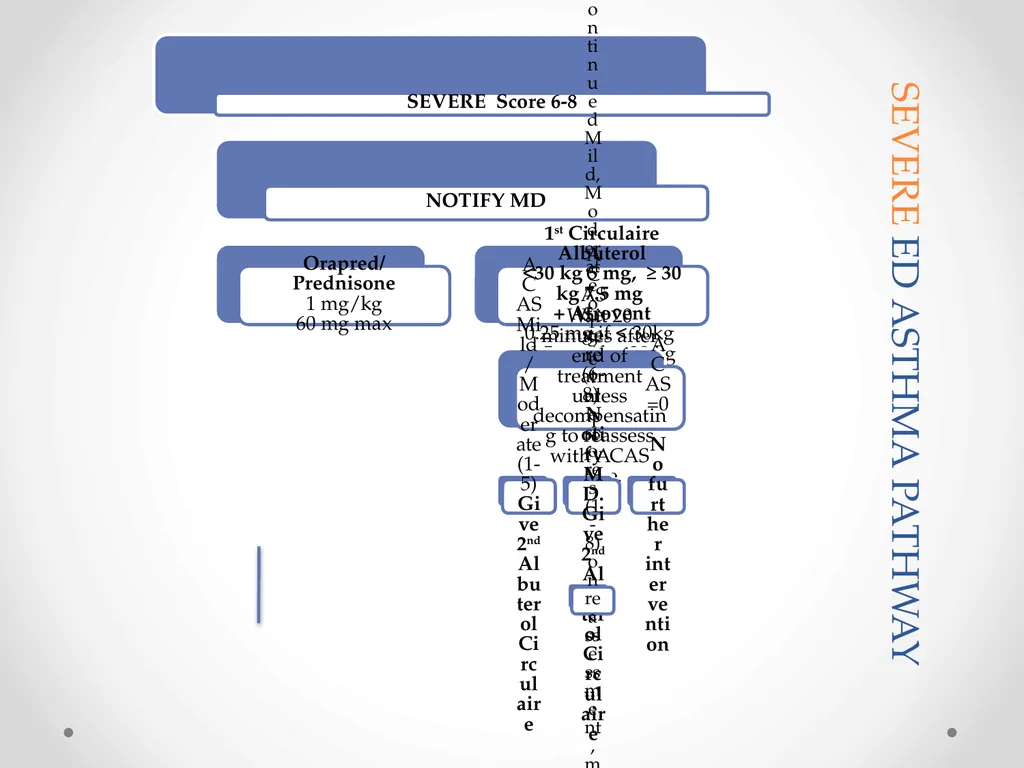
SEVERE ED ASTHMA PATHWAY<br>
26
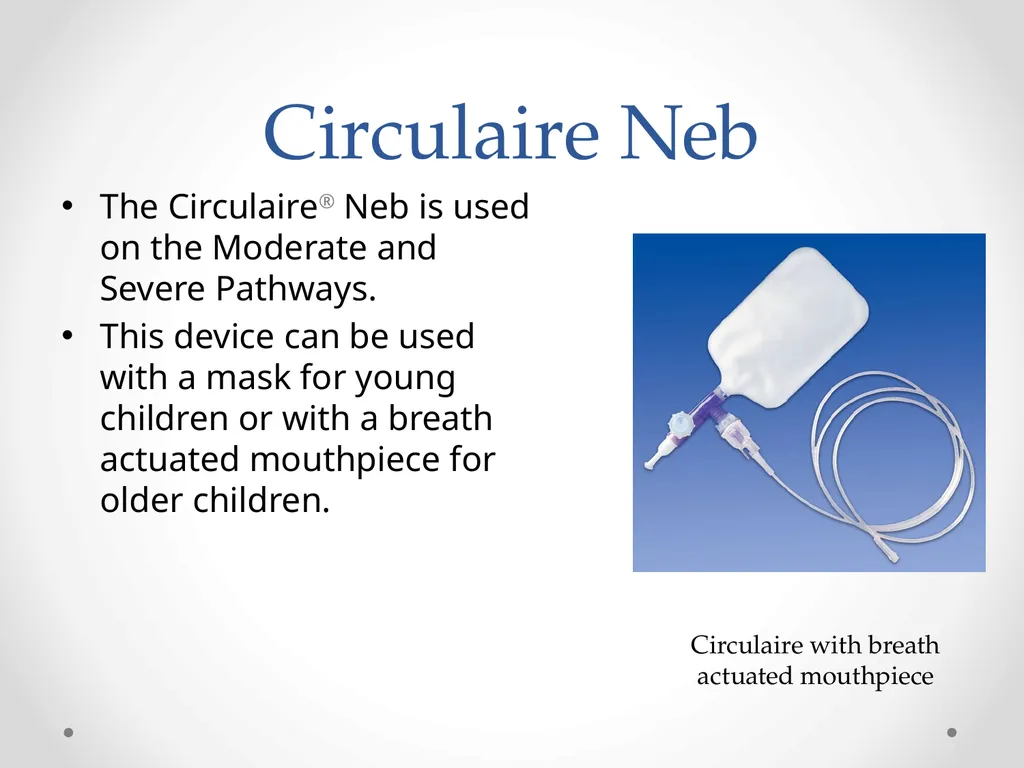
Circulaire Neb The Circulaire® Neb is used on the Moderate and Severe Pathways.
This device can be used with a mask for young children or with a breath actuated mouthpiece for older children. Circulaire with breath actuated mouthpiece<br>
This device can be used with a mask for young children or with a breath actuated mouthpiece for older children. Circulaire with breath actuated mouthpiece<br>
27
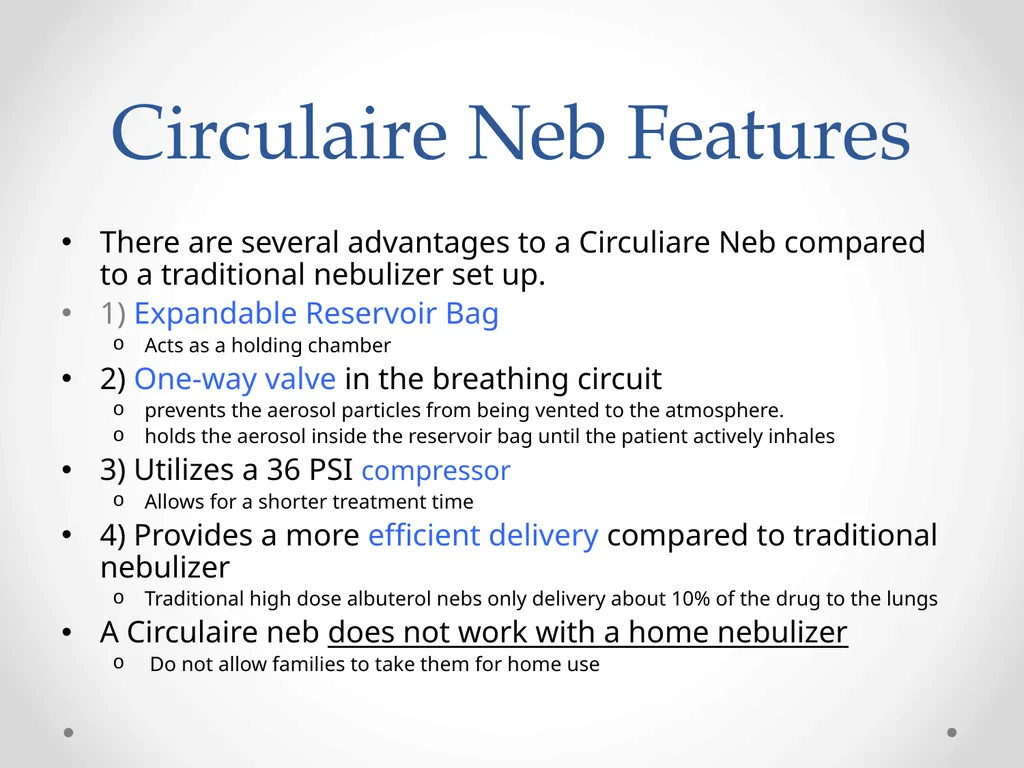
Circulaire Neb Features There are several advantages to a Circuliare Neb compared to a traditional nebulizer set up.
1) Expandable Reservoir Bag
Acts as a holding chamber
2) One-way valve in the breathing circuit
prevents the aerosol particles from being vented to the atmosphere.
holds the aerosol inside the reservoir bag until the patient actively inhales
3) Utilizes a 36 PSI compressor
Allows for a shorter treatment time
4) Provides a more efficient delivery compared to traditional nebulizer
Traditional high dose albuterol nebs only delivery about 10% of the drug to the lungs
A Circulaire neb does not work with a home nebulizer
Do not allow families to take them for home use<br>
1) Expandable Reservoir Bag
Acts as a holding chamber
2) One-way valve in the breathing circuit
prevents the aerosol particles from being vented to the atmosphere.
holds the aerosol inside the reservoir bag until the patient actively inhales
3) Utilizes a 36 PSI compressor
Allows for a shorter treatment time
4) Provides a more efficient delivery compared to traditional nebulizer
Traditional high dose albuterol nebs only delivery about 10% of the drug to the lungs
A Circulaire neb does not work with a home nebulizer
Do not allow families to take them for home use<br>
28
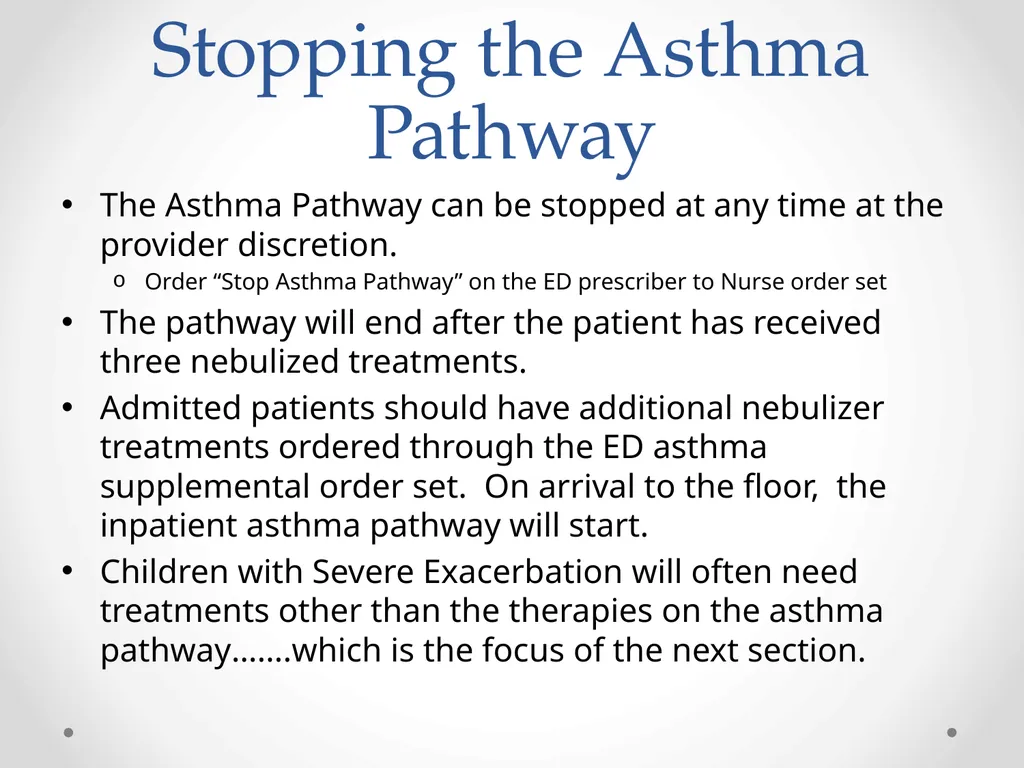
Stopping the Asthma Pathway The Asthma Pathway can be stopped at any time at the provider discretion.
Order “Stop Asthma Pathway” on the ED prescriber to Nurse order set
The pathway will end after the patient has received three nebulized treatments.
Admitted patients should have additional nebulizer treatments ordered through the ED asthma supplemental order set. On arrival to the floor, the inpatient asthma pathway will start.
Children with Severe Exacerbation will often need treatments other than the therapies on the asthma pathway…….which is the focus of the next section.<br>
Order “Stop Asthma Pathway” on the ED prescriber to Nurse order set
The pathway will end after the patient has received three nebulized treatments.
Admitted patients should have additional nebulizer treatments ordered through the ED asthma supplemental order set. On arrival to the floor, the inpatient asthma pathway will start.
Children with Severe Exacerbation will often need treatments other than the therapies on the asthma pathway…….which is the focus of the next section.<br>
29
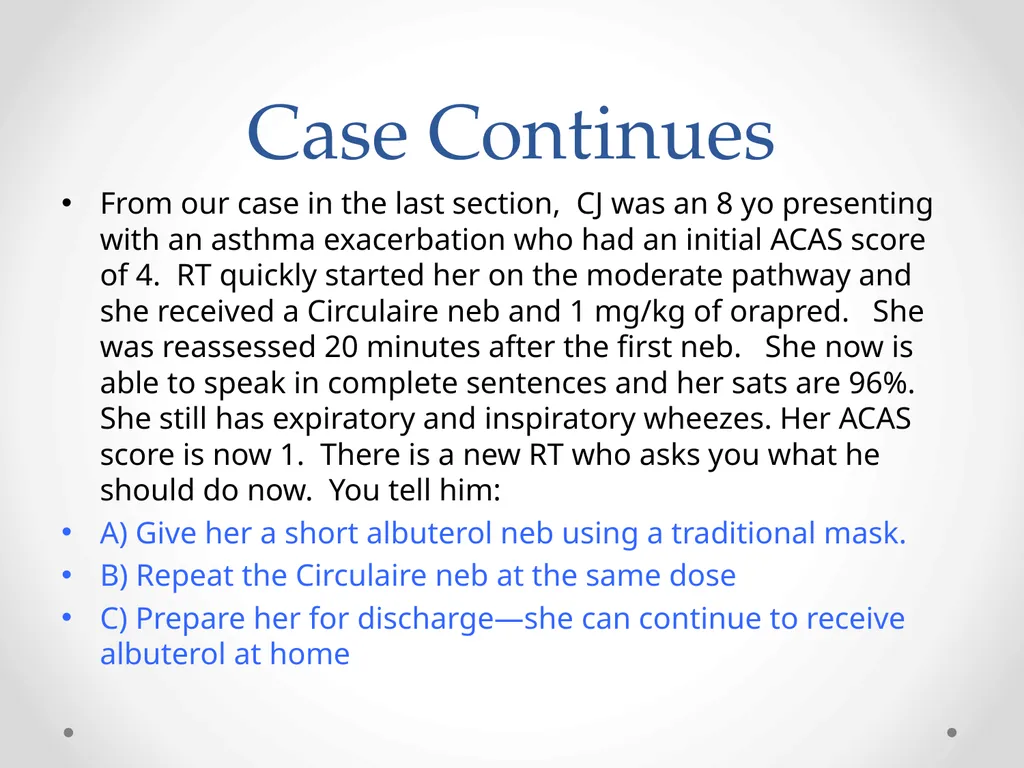
Case Continues From our case in the last section, CJ was an 8 yo presenting with an asthma exacerbation who had an initial ACAS score of 4. RT quickly started her on the moderate pathway and she received a Circulaire neb and 1 mg/kg of orapred. She was reassessed 20 minutes after the first neb. She now is able to speak in complete sentences and her sats are 96%. She still has expiratory and inspiratory wheezes. Her ACAS score is now 1. There is a new RT who asks you what he should do now. You tell him:
A) Give her a short albuterol neb using a traditional mask.
B) Repeat the Circulaire neb at the same dose
C) Prepare her for discharge—she can continue to receive albuterol at home<br>
A) Give her a short albuterol neb using a traditional mask.
B) Repeat the Circulaire neb at the same dose
C) Prepare her for discharge—she can continue to receive albuterol at home<br>
30
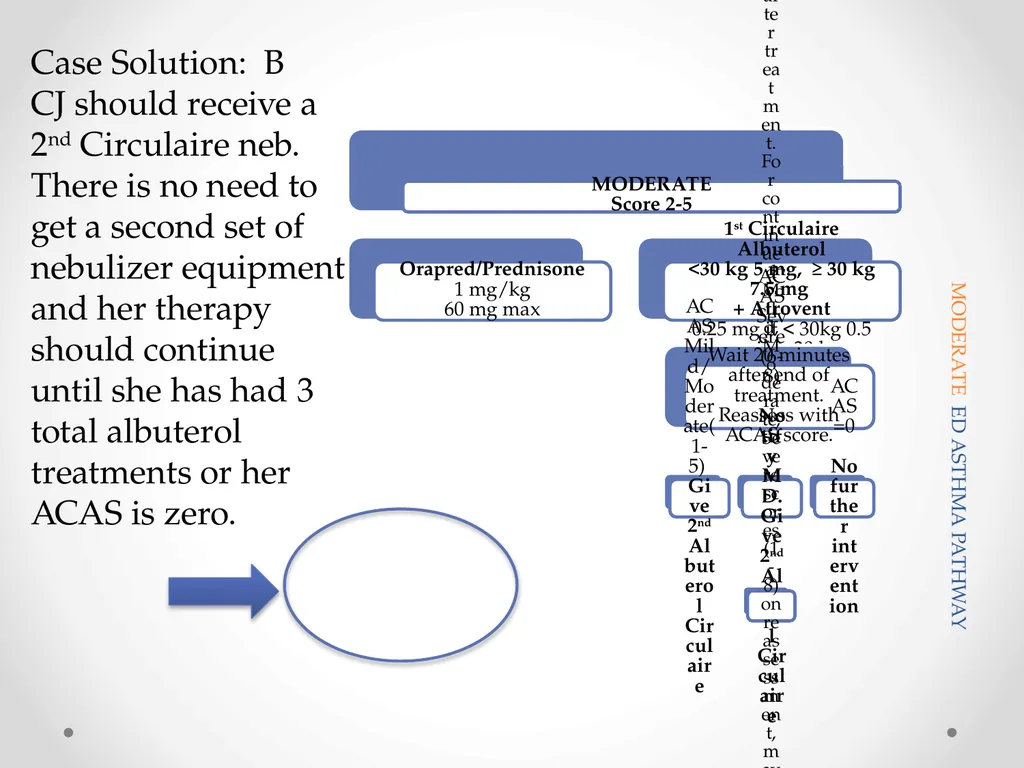
MODERATE ED ASTHMA PATHWAY Case Solution: B
CJ should receive a 2nd Circulaire neb. There is no need to get a second set of nebulizer equipment and her therapy should continue until she has had 3 total albuterol treatments or her ACAS is zero.<br>
CJ should receive a 2nd Circulaire neb. There is no need to get a second set of nebulizer equipment and her therapy should continue until she has had 3 total albuterol treatments or her ACAS is zero.<br>
31
Module Section #4
Advanced Treatment Modalities<br>
32
Advanced Treatment Modalities Children who present with severe exacerbations or who are failing to improve with intermittent albuterol and steroids, may benefit from other types of therapies. This section will look at useful adjunctive therapies as well as discuss therapies with no proven benefit.<br>
33
Continuous Albuterol For children with severe exacerbation, continuous nebulization may result in more rapid clinical improvement than intermittent nebulization. (ref)
Recommend Dosing is 0.5 mg/kg/h up to 20 mg/h
Current COA guidelines recommend
10 mg/h for children < 30 kg
15 mg/h for children >30 kg
PICU will often use much higher dosing
Side effects such as tachycardia and jitteriness may be increased compared to intermittent nebs
Hypokalemia is a possible side effect<br>
Recommend Dosing is 0.5 mg/kg/h up to 20 mg/h
Current COA guidelines recommend
10 mg/h for children < 30 kg
15 mg/h for children >30 kg
PICU will often use much higher dosing
Side effects such as tachycardia and jitteriness may be increased compared to intermittent nebs
Hypokalemia is a possible side effect<br>
34
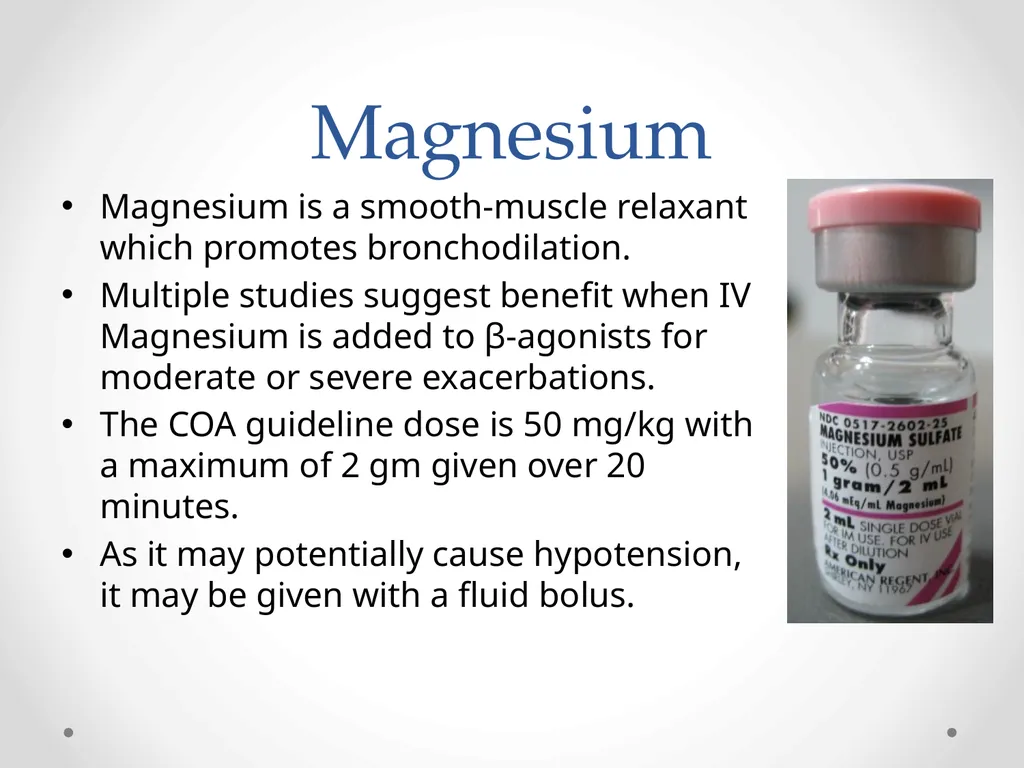
Magnesium Magnesium is a smooth-muscle relaxant which promotes bronchodilation.
Multiple studies suggest benefit when IV Magnesium is added to β-agonists for moderate or severe exacerbations.
The COA guideline dose is 50 mg/kg with a maximum of 2 gm given over 20 minutes.
As it may potentially cause hypotension, it may be given with a fluid bolus.<br>
Multiple studies suggest benefit when IV Magnesium is added to β-agonists for moderate or severe exacerbations.
The COA guideline dose is 50 mg/kg with a maximum of 2 gm given over 20 minutes.
As it may potentially cause hypotension, it may be given with a fluid bolus.<br>
35
Epinephrine & Terbutaline In severe exacerbations, air movement may be too limited to allow sufficient absorption of an inhaled beta agonist.
Terbutaline can be administered SQ (0.01 mg/kg) or IV (2-10 mcg/kg loading dose) and then started on a drip.
Epinephrine (0.01 mg/kg of 1:1000, max dose 0.5 mg) can be given IM.
However, there is very limited evidence supporting either drug’s effectiveness.<br>
Terbutaline can be administered SQ (0.01 mg/kg) or IV (2-10 mcg/kg loading dose) and then started on a drip.
Epinephrine (0.01 mg/kg of 1:1000, max dose 0.5 mg) can be given IM.
However, there is very limited evidence supporting either drug’s effectiveness.<br>
36
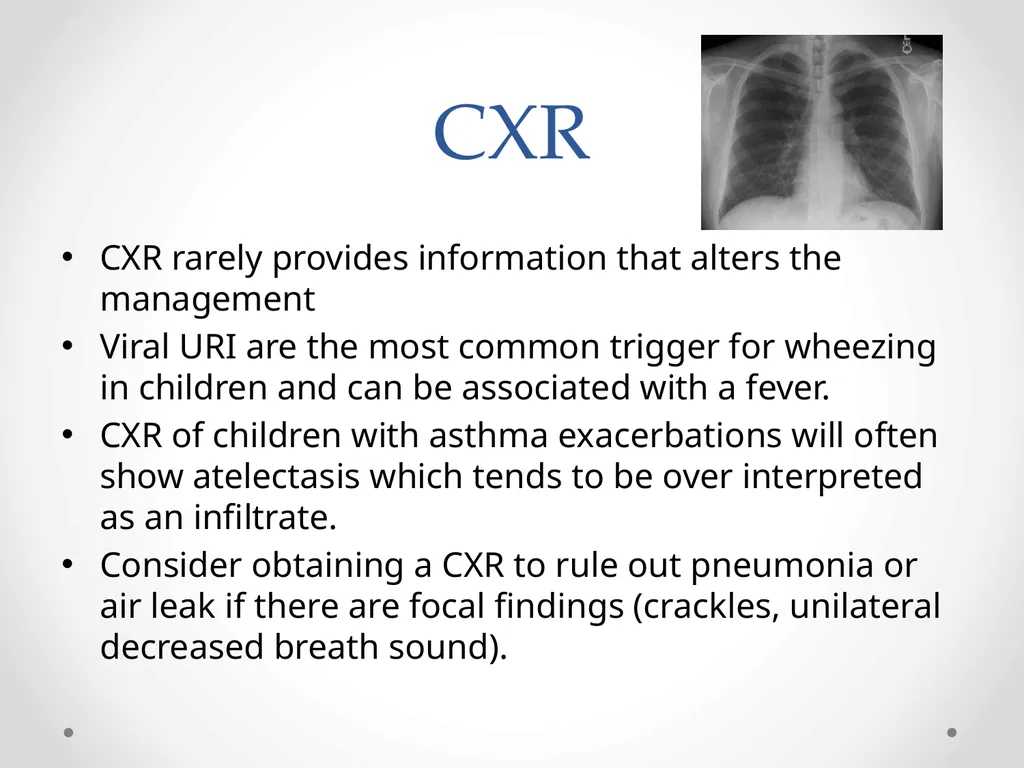
CXR CXR rarely provides information that alters the management
Viral URI are the most common trigger for wheezing in children and can be associated with a fever.
CXR of children with asthma exacerbations will often show atelectasis which tends to be over interpreted as an infiltrate.
Consider obtaining a CXR to rule out pneumonia or air leak if there are focal findings (crackles, unilateral decreased breath sound).<br>
Viral URI are the most common trigger for wheezing in children and can be associated with a fever.
CXR of children with asthma exacerbations will often show atelectasis which tends to be over interpreted as an infiltrate.
Consider obtaining a CXR to rule out pneumonia or air leak if there are focal findings (crackles, unilateral decreased breath sound).<br>
37
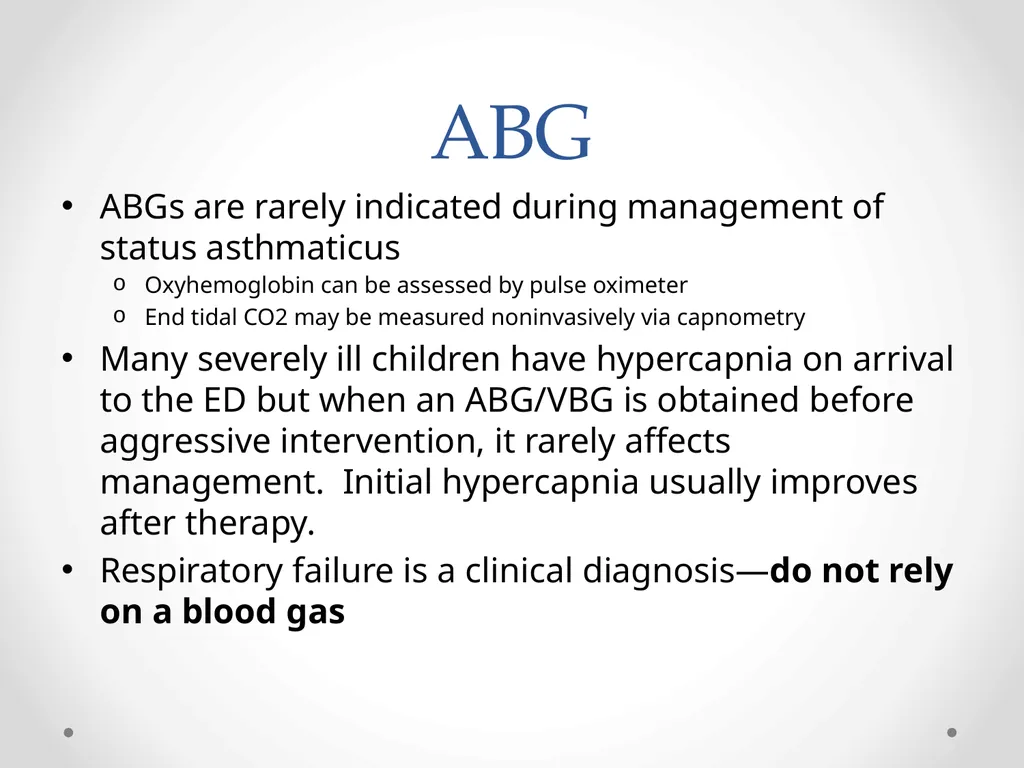
ABG ABGs are rarely indicated during management of status asthmaticus
Oxyhemoglobin can be assessed by pulse oximeter
End tidal CO2 may be measured noninvasively via capnometry
Many severely ill children have hypercapnia on arrival to the ED but when an ABG/VBG is obtained before aggressive intervention, it rarely affects management. Initial hypercapnia usually improves after therapy.
Respiratory failure is a clinical diagnosis—do not rely on a blood gas<br>
Oxyhemoglobin can be assessed by pulse oximeter
End tidal CO2 may be measured noninvasively via capnometry
Many severely ill children have hypercapnia on arrival to the ED but when an ABG/VBG is obtained before aggressive intervention, it rarely affects management. Initial hypercapnia usually improves after therapy.
Respiratory failure is a clinical diagnosis—do not rely on a blood gas<br>
38
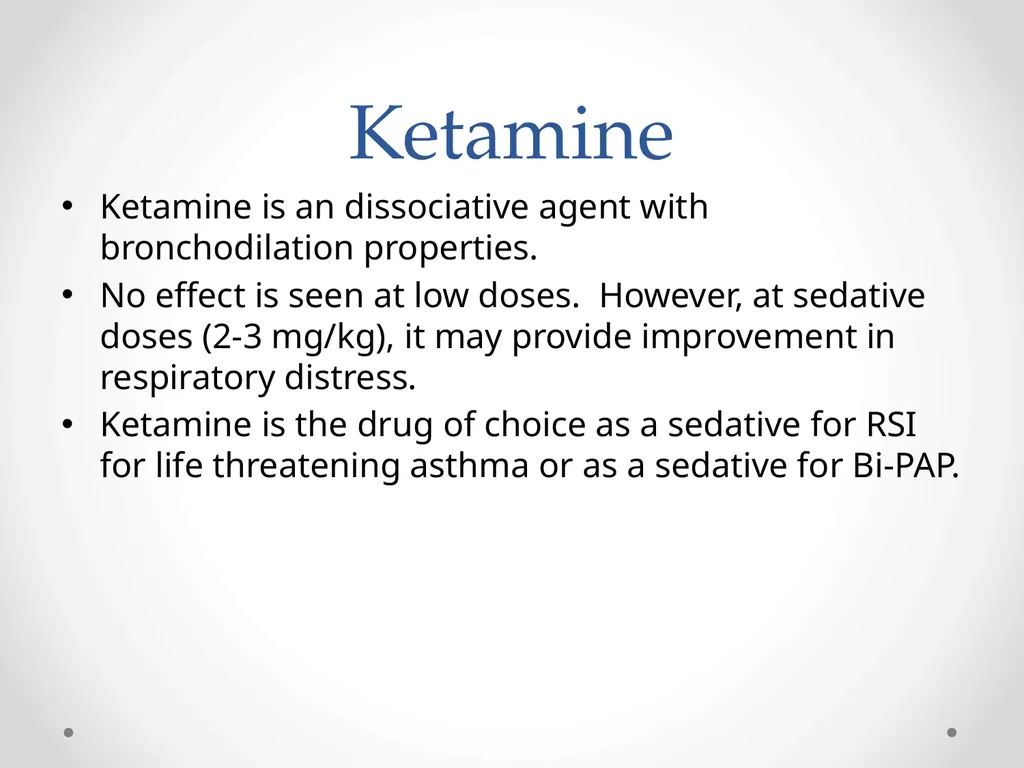
Ketamine Ketamine is an dissociative agent with bronchodilation properties.
No effect is seen at low doses. However, at sedative doses (2-3 mg/kg), it may provide improvement in respiratory distress.
Ketamine is the drug of choice as a sedative for RSI for life threatening asthma or as a sedative for Bi-PAP.<br>
No effect is seen at low doses. However, at sedative doses (2-3 mg/kg), it may provide improvement in respiratory distress.
Ketamine is the drug of choice as a sedative for RSI for life threatening asthma or as a sedative for Bi-PAP.<br>
39
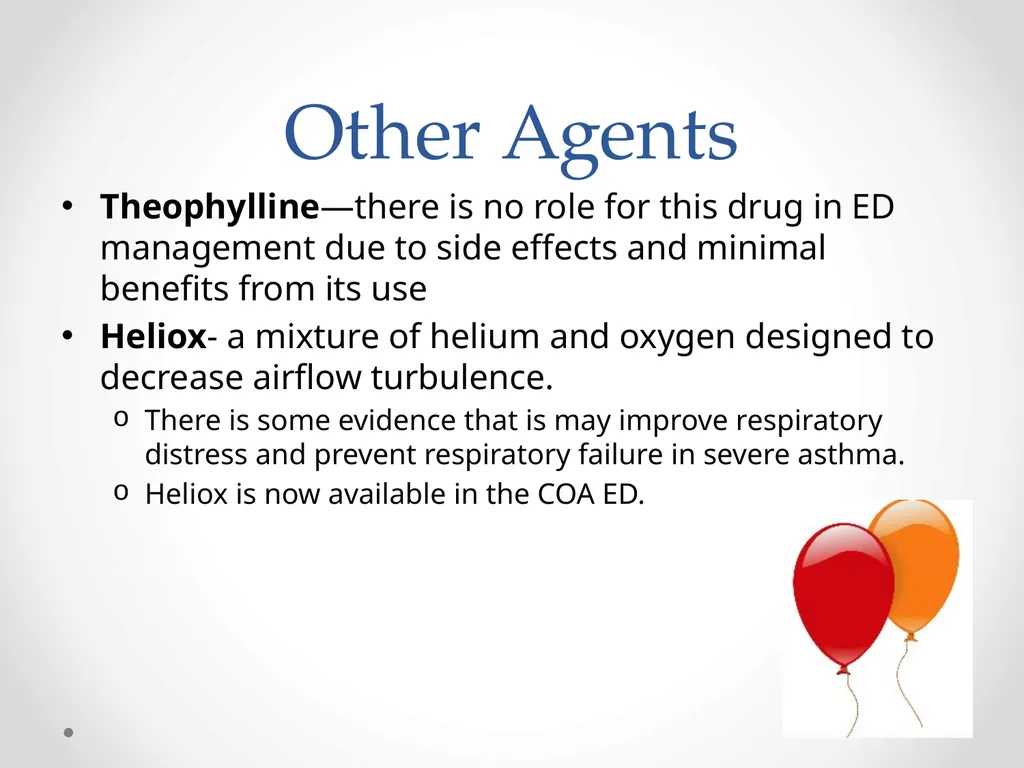
Other Agents Theophylline—there is no role for this drug in ED management due to side effects and minimal benefits from its use
Heliox- a mixture of helium and oxygen designed to decrease airflow turbulence.
There is some evidence that is may improve respiratory distress and prevent respiratory failure in severe asthma.
Heliox is now available in the COA ED.<br>
Heliox- a mixture of helium and oxygen designed to decrease airflow turbulence.
There is some evidence that is may improve respiratory distress and prevent respiratory failure in severe asthma.
Heliox is now available in the COA ED.<br>
40
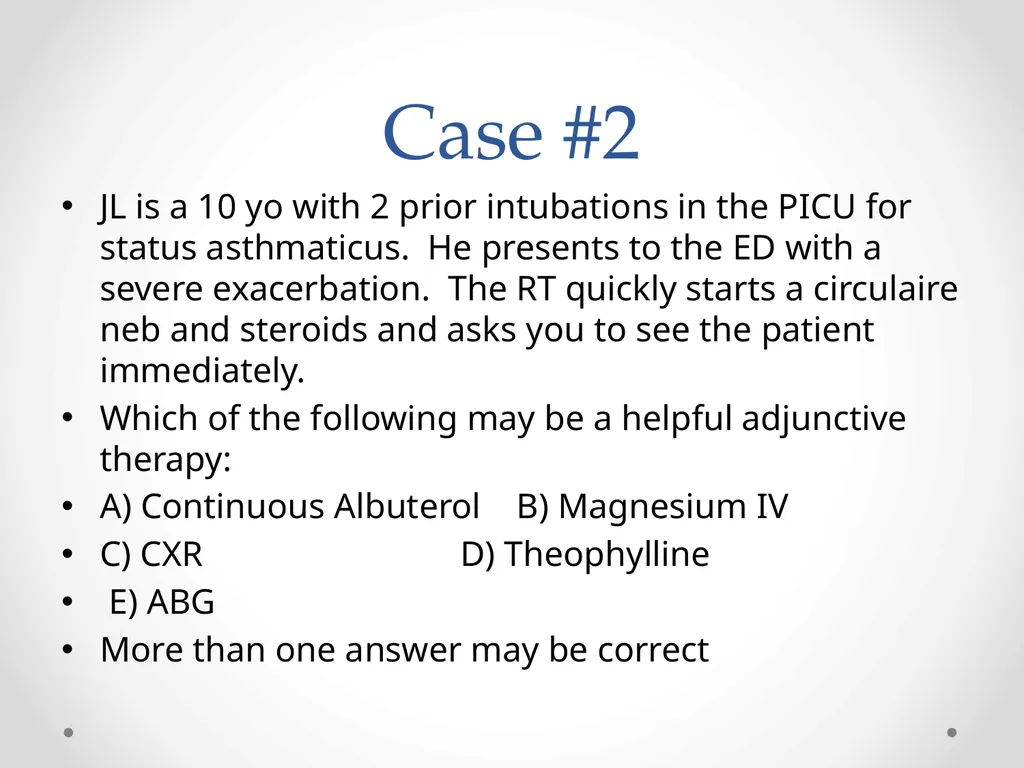
Case #2 JL is a 10 yo with 2 prior intubations in the PICU for status asthmaticus. He presents to the ED with a severe exacerbation. The RT quickly starts a circulaire neb and steroids and asks you to see the patient immediately.
Which of the following may be a helpful adjunctive therapy:
A) Continuous Albuterol B) Magnesium IV
C) CXR D) Theophylline
E) ABG
More than one answer may be correct<br>
Which of the following may be a helpful adjunctive therapy:
A) Continuous Albuterol B) Magnesium IV
C) CXR D) Theophylline
E) ABG
More than one answer may be correct<br>
41
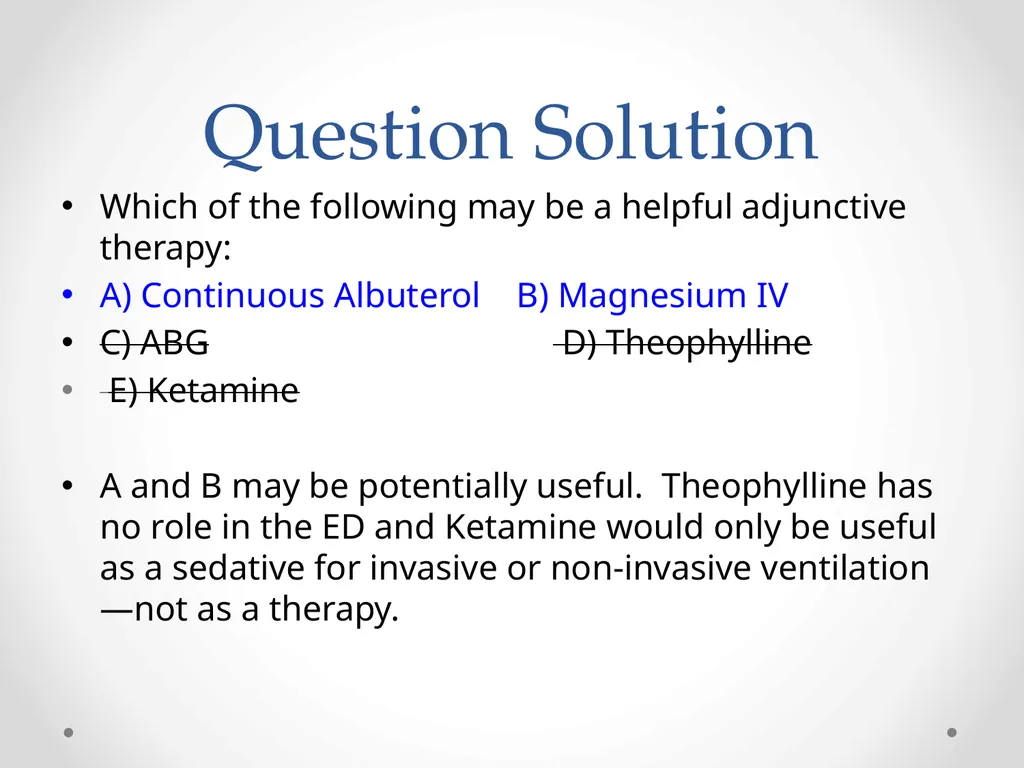
Question Solution Which of the following may be a helpful adjunctive therapy:
A) Continuous Albuterol B) Magnesium IV
C) ABG D) Theophylline
E) Ketamine
A and B may be potentially useful. Theophylline has no role in the ED and Ketamine would only be useful as a sedative for invasive or non-invasive ventilation—not as a therapy.<br>
A) Continuous Albuterol B) Magnesium IV
C) ABG D) Theophylline
E) Ketamine
A and B may be potentially useful. Theophylline has no role in the ED and Ketamine would only be useful as a sedative for invasive or non-invasive ventilation—not as a therapy.<br>
42
Section #5
Ventilation<br>
43
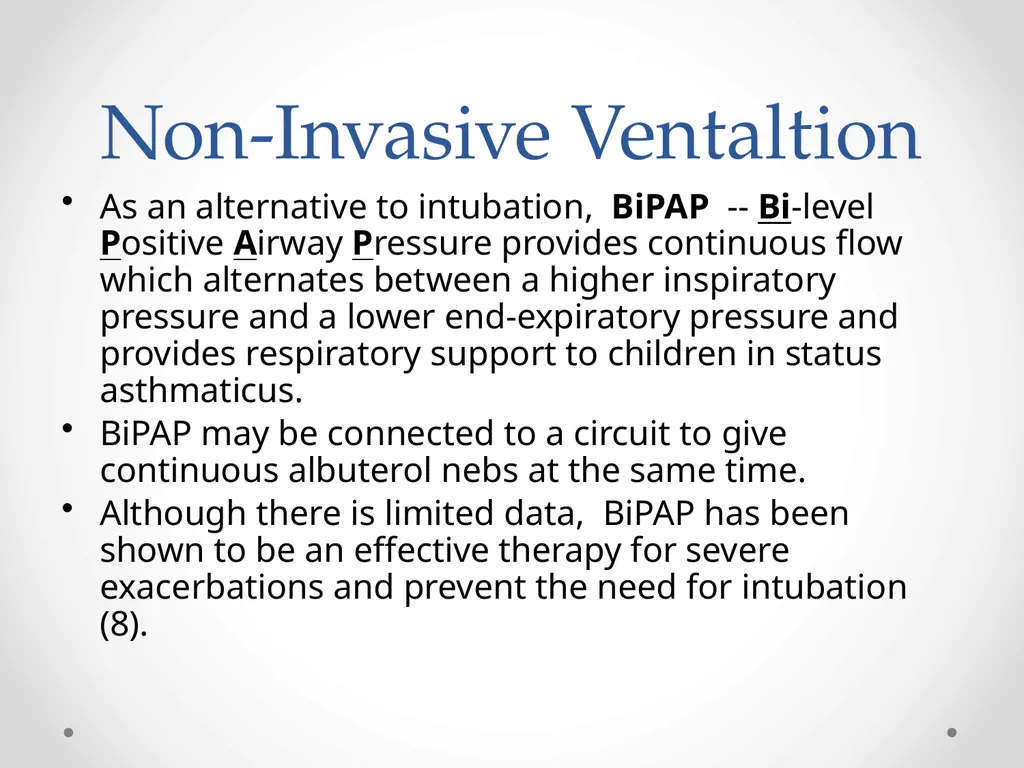
Non-Invasive Ventaltion As an alternative to intubation, BiPAP -- Bi-level Positive Airway Pressure provides continuous flow which alternates between a higher inspiratory pressure and a lower end-expiratory pressure and provides respiratory support to children in status asthmaticus.
BiPAP may be connected to a circuit to give continuous albuterol nebs at the same time.
Although there is limited data, BiPAP has been shown to be an effective therapy for severe exacerbations and prevent the need for intubation (8).<br>
BiPAP may be connected to a circuit to give continuous albuterol nebs at the same time.
Although there is limited data, BiPAP has been shown to be an effective therapy for severe exacerbations and prevent the need for intubation (8).<br>
44
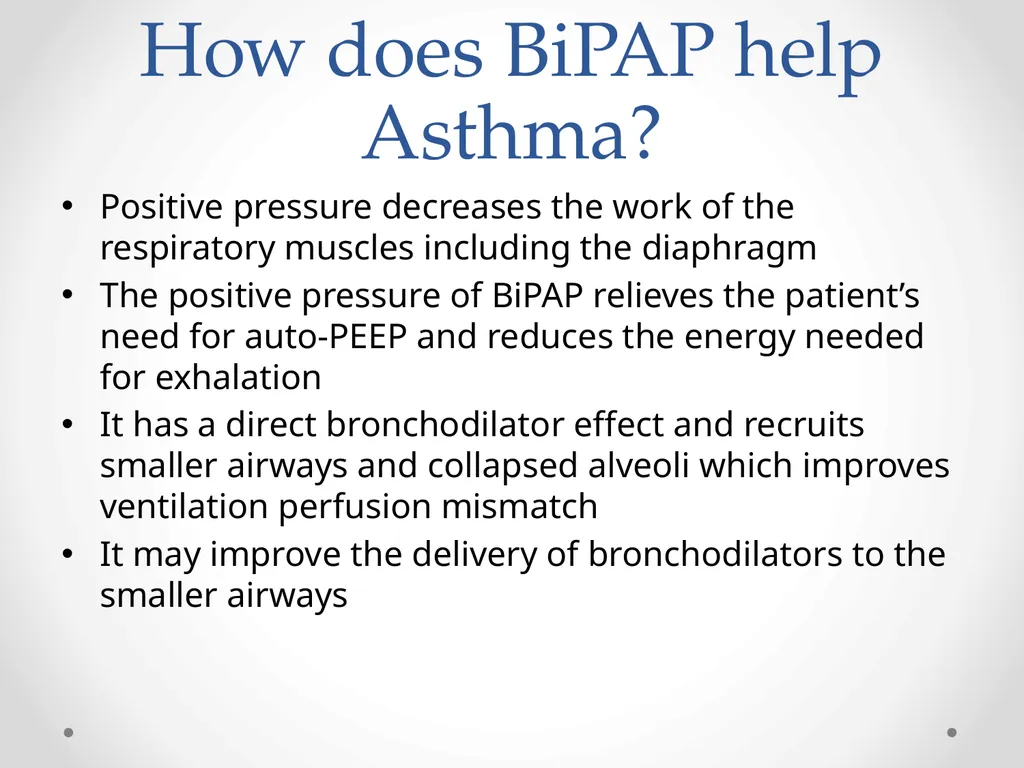
How does BiPAP help Asthma? Positive pressure decreases the work of the respiratory muscles including the diaphragm
The positive pressure of BiPAP relieves the patient’s need for auto-PEEP and reduces the energy needed for exhalation
It has a direct bronchodilator effect and recruits smaller airways and collapsed alveoli which improves ventilation perfusion mismatch
It may improve the delivery of bronchodilators to the smaller airways<br>
The positive pressure of BiPAP relieves the patient’s need for auto-PEEP and reduces the energy needed for exhalation
It has a direct bronchodilator effect and recruits smaller airways and collapsed alveoli which improves ventilation perfusion mismatch
It may improve the delivery of bronchodilators to the smaller airways<br>
45
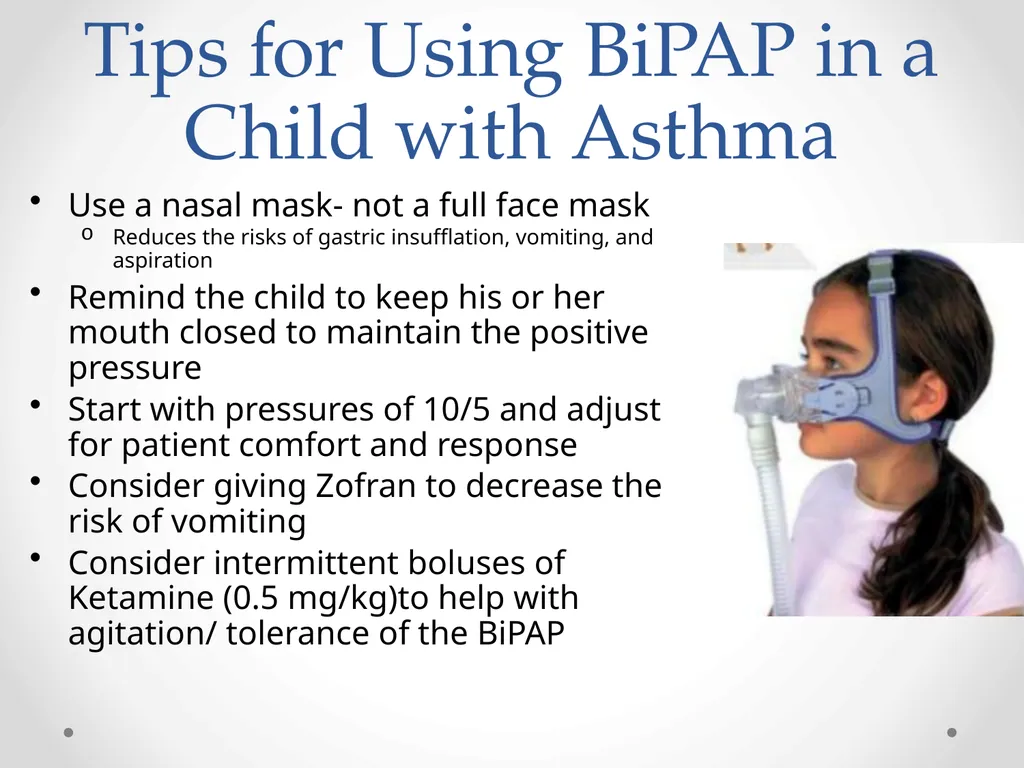
Tips for Using BiPAP in a Child with Asthma Use a nasal mask- not a full face mask
Reduces the risks of gastric insufflation, vomiting, and aspiration
Remind the child to keep his or her mouth closed to maintain the positive pressure
Start with pressures of 10/5 and adjust for patient comfort and response
Consider giving Zofran to decrease the risk of vomiting
Consider intermittent boluses of Ketamine (0.5 mg/kg)to help with agitation/ tolerance of the BiPAP<br>
Reduces the risks of gastric insufflation, vomiting, and aspiration
Remind the child to keep his or her mouth closed to maintain the positive pressure
Start with pressures of 10/5 and adjust for patient comfort and response
Consider giving Zofran to decrease the risk of vomiting
Consider intermittent boluses of Ketamine (0.5 mg/kg)to help with agitation/ tolerance of the BiPAP<br>
46
Intubation Sometimes despite maximizing other therapies, intubation may be necessary.
Intubation is to be avoided if at all possible---it is the resource of last resort and can lead to severe complications<br>
Intubation is to be avoided if at all possible---it is the resource of last resort and can lead to severe complications<br>
47
Indications for Intubation Intubation has the following indications:
1) Poor responsive to therapies
2) Severe Hypoxia
3) Fatigue or waning mental status
4) Impending respiratory arrest
5) Cardiopulmonary arrest
Do not rely on blood gases to make the determination to intubate. Some hypercapnic children can be managed with other therapies while an exhausted asthmatic child may require intubation regardless of the pCO2.<br>
1) Poor responsive to therapies
2) Severe Hypoxia
3) Fatigue or waning mental status
4) Impending respiratory arrest
5) Cardiopulmonary arrest
Do not rely on blood gases to make the determination to intubate. Some hypercapnic children can be managed with other therapies while an exhausted asthmatic child may require intubation regardless of the pCO2.<br>
48
Preparation for Intubation See the ED’s Intubation Checklist and decide on the roles for the team members.
Get supplies including appropriately sized endotracheal tubes prepared and notify pharmacy and xray.
Pre-oxygenate—ideally child is already on BiPAP. Otherwise maximize oxygenation by placing on a non-rebreather mask with concurrent placement of a Bi-nasal cannula.
Establish IV access
Consider a fluid bolus in anticipation of hypotension during or immediately after intubation.
Consider requesting PICU or anesthesia presence—intubating a child with asthma should be considered a difficult airway.<br>
Get supplies including appropriately sized endotracheal tubes prepared and notify pharmacy and xray.
Pre-oxygenate—ideally child is already on BiPAP. Otherwise maximize oxygenation by placing on a non-rebreather mask with concurrent placement of a Bi-nasal cannula.
Establish IV access
Consider a fluid bolus in anticipation of hypotension during or immediately after intubation.
Consider requesting PICU or anesthesia presence—intubating a child with asthma should be considered a difficult airway.<br>
49
RSI Perform standard RSI
No pre-medications drugs (atropine, lidocaine) are indicated in this scenario for children over age 1 following the COA ED intubation checklist.
Ketamine (2 mg/kg) is the preferred induction agent due to its bronchodilatory action.
Succinylcholine is the preferred neuromuscular blocker but Rocuronium is also acceptable (10).
Place tube, verify placement by CO2 detector, and begin post intubation management.<br>
No pre-medications drugs (atropine, lidocaine) are indicated in this scenario for children over age 1 following the COA ED intubation checklist.
Ketamine (2 mg/kg) is the preferred induction agent due to its bronchodilatory action.
Succinylcholine is the preferred neuromuscular blocker but Rocuronium is also acceptable (10).
Place tube, verify placement by CO2 detector, and begin post intubation management.<br>
50
Ventilation Complications More than 50% of the complications in asthmatic patients receiving ventilation occur during or immediately after intubation (11).
Complications include:
1) Tube Malposition
2) Hypotension and hypoxia due to Gas Trapping—hyperinflation of the lungs leads to decreased venous return and hypotension. Symptoms can be improved by fluids and slowing the respiratory rate allowing for a long expiratory time. In some patients, manual pressure on the rib cage during expiration may be required to avoid massive hyperinflation.<br>
Complications include:
1) Tube Malposition
2) Hypotension and hypoxia due to Gas Trapping—hyperinflation of the lungs leads to decreased venous return and hypotension. Symptoms can be improved by fluids and slowing the respiratory rate allowing for a long expiratory time. In some patients, manual pressure on the rib cage during expiration may be required to avoid massive hyperinflation.<br>
51
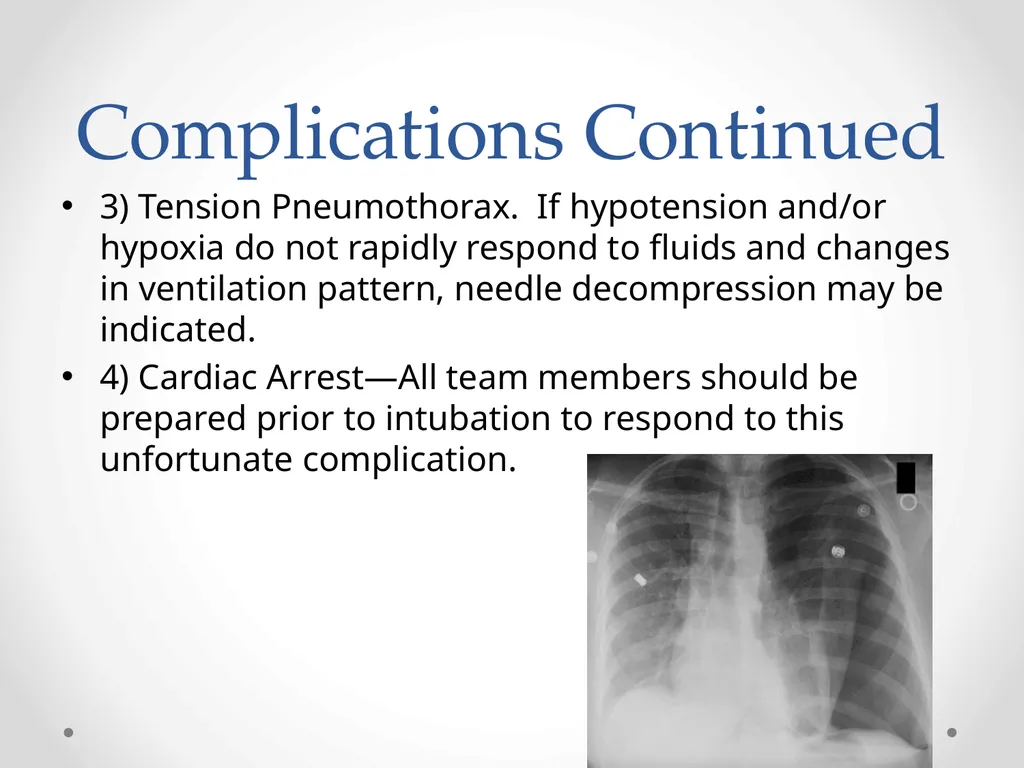
Complications Continued 3) Tension Pneumothorax. If hypotension and/or hypoxia do not rapidly respond to fluids and changes in ventilation pattern, needle decompression may be indicated.
4) Cardiac Arrest—All team members should be prepared prior to intubation to respond to this unfortunate complication.<br>
4) Cardiac Arrest—All team members should be prepared prior to intubation to respond to this unfortunate complication.<br>
52
Post-Intubation Managment Children with asthma are challenging to ventilate.
Settings should be adjusted for controlled hypoventilation with slower than traditional respiratory rates, minimal end-expiratory pressure, and short inspiratory time to minimize dynamic hyperinflation, air trapping, and barotrauma. (11)
Goal is “low and slow” (2)<br>
Settings should be adjusted for controlled hypoventilation with slower than traditional respiratory rates, minimal end-expiratory pressure, and short inspiratory time to minimize dynamic hyperinflation, air trapping, and barotrauma. (11)
Goal is “low and slow” (2)<br>
53
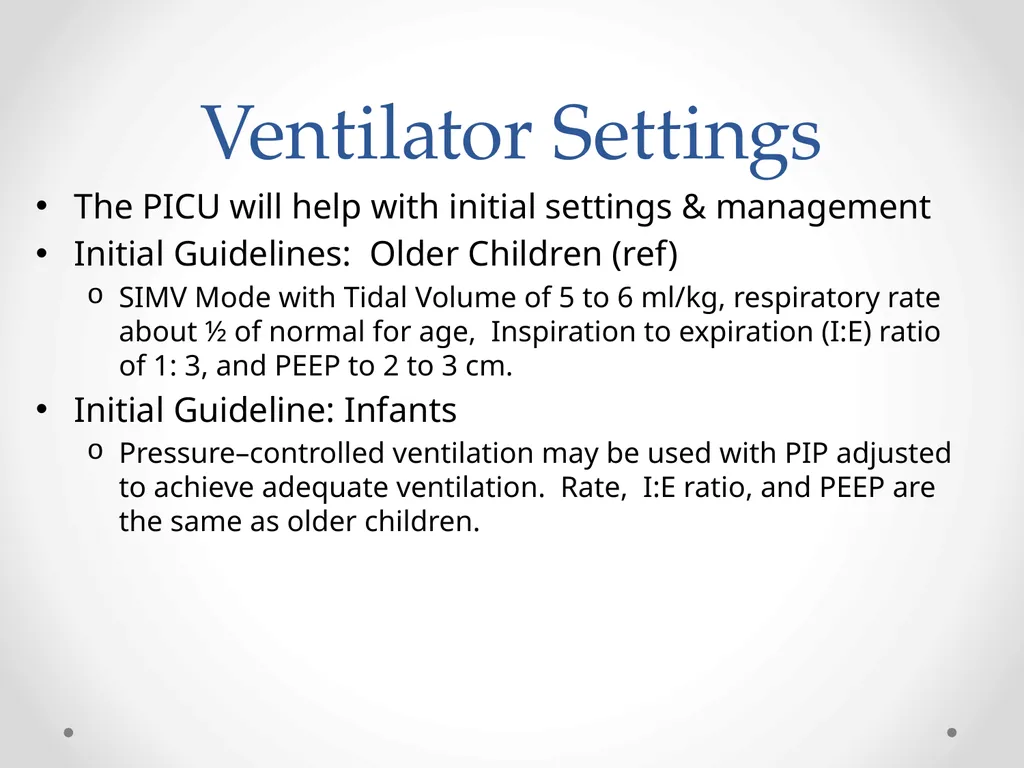
Ventilator Settings The PICU will help with initial settings & management
Initial Guidelines: Older Children (ref)
SIMV Mode with Tidal Volume of 5 to 6 ml/kg, respiratory rate about ½ of normal for age, Inspiration to expiration (I:E) ratio of 1: 3, and PEEP to 2 to 3 cm.
Initial Guideline: Infants
Pressure–controlled ventilation may be used with PIP adjusted to achieve adequate ventilation. Rate, I:E ratio, and PEEP are the same as older children.<br>
Initial Guidelines: Older Children (ref)
SIMV Mode with Tidal Volume of 5 to 6 ml/kg, respiratory rate about ½ of normal for age, Inspiration to expiration (I:E) ratio of 1: 3, and PEEP to 2 to 3 cm.
Initial Guideline: Infants
Pressure–controlled ventilation may be used with PIP adjusted to achieve adequate ventilation. Rate, I:E ratio, and PEEP are the same as older children.<br>
54
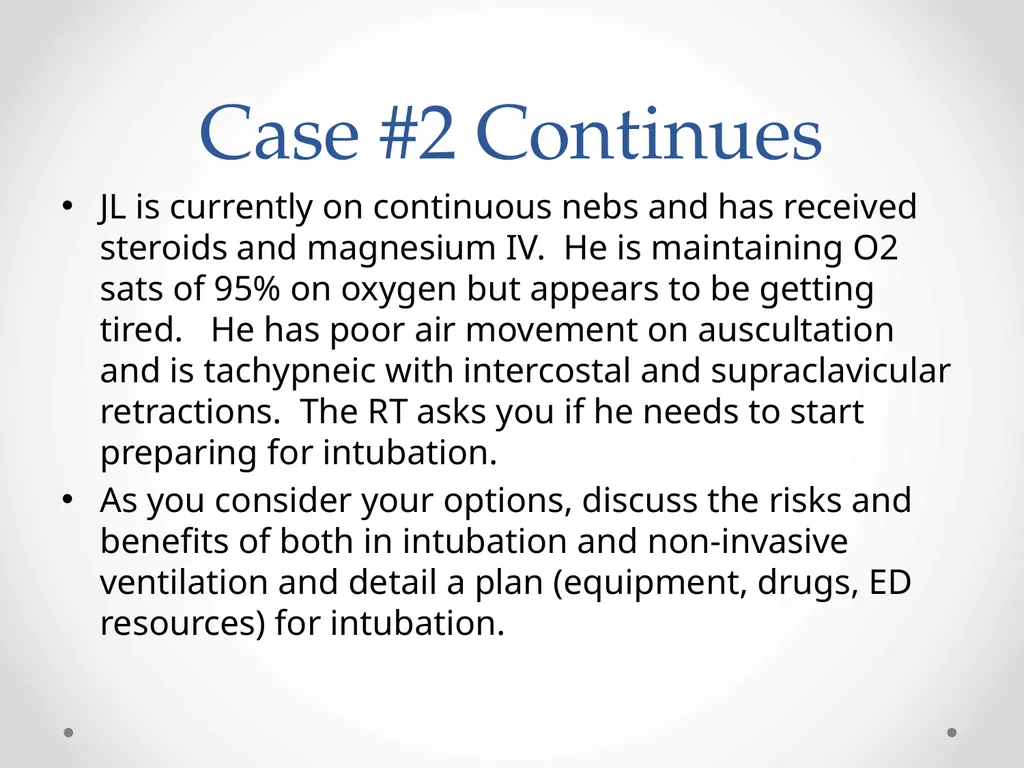
Case #2 Continues JL is currently on continuous nebs and has received steroids and magnesium IV. He is maintaining O2 sats of 95% on oxygen but appears to be getting tired. He has poor air movement on auscultation and is tachypneic with intercostal and supraclavicular retractions. The RT asks you if he needs to start preparing for intubation.
As you consider your options, discuss the risks and benefits of both in intubation and non-invasive ventilation and detail a plan (equipment, drugs, ED resources) for intubation.<br>
As you consider your options, discuss the risks and benefits of both in intubation and non-invasive ventilation and detail a plan (equipment, drugs, ED resources) for intubation.<br>
55
Section #6: Disposition<br>
56
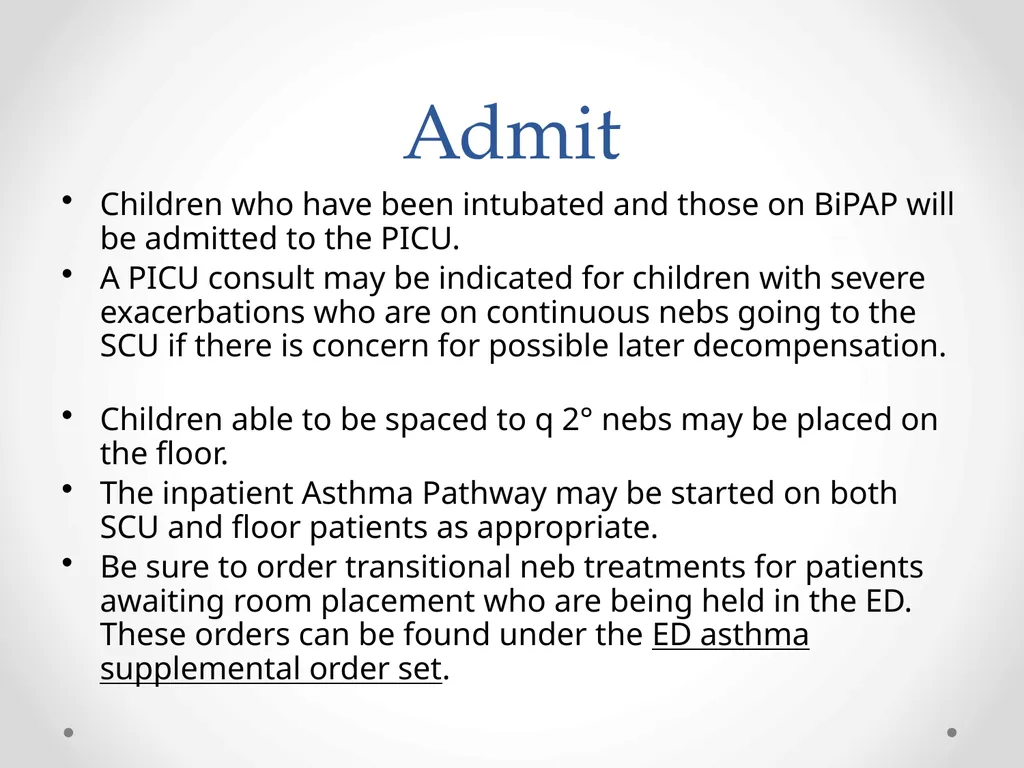
Admit Children who have been intubated and those on BiPAP will be admitted to the PICU.
A PICU consult may be indicated for children with severe exacerbations who are on continuous nebs going to the SCU if there is concern for possible later decompensation.
Children able to be spaced to q 2° nebs may be placed on the floor.
The inpatient Asthma Pathway may be started on both SCU and floor patients as appropriate.
Be sure to order transitional neb treatments for patients awaiting room placement who are being held in the ED. These orders can be found under the ED asthma supplemental order set.<br>
A PICU consult may be indicated for children with severe exacerbations who are on continuous nebs going to the SCU if there is concern for possible later decompensation.
Children able to be spaced to q 2° nebs may be placed on the floor.
The inpatient Asthma Pathway may be started on both SCU and floor patients as appropriate.
Be sure to order transitional neb treatments for patients awaiting room placement who are being held in the ED. These orders can be found under the ED asthma supplemental order set.<br>
57
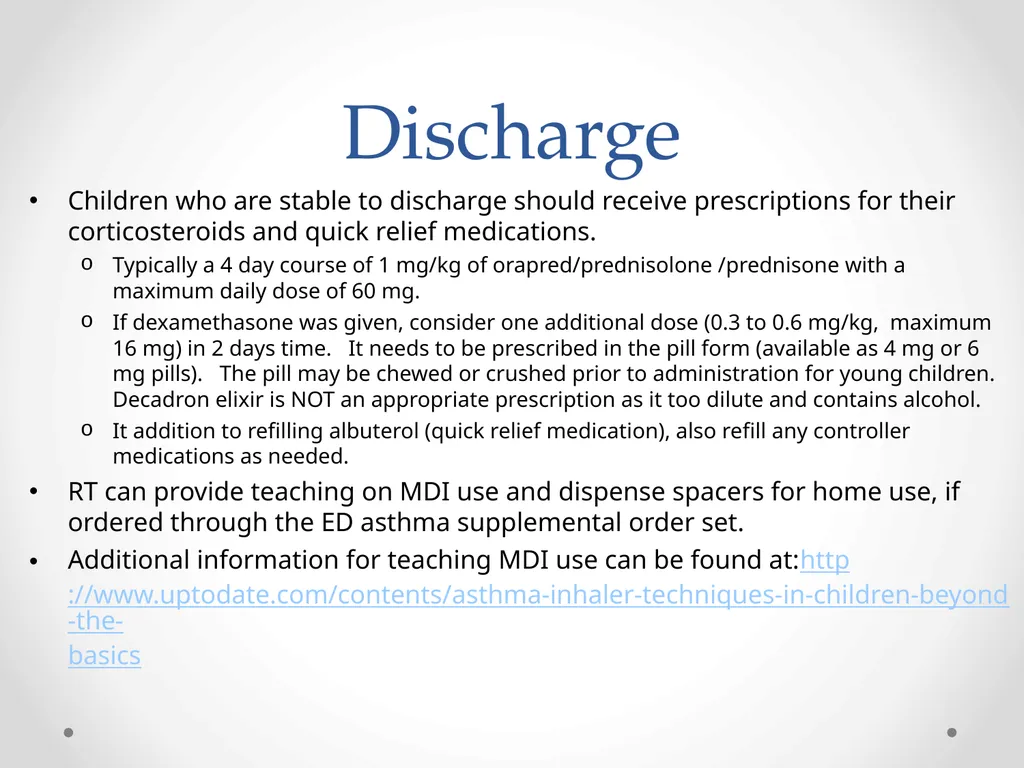
Discharge Children who are stable to discharge should receive prescriptions for their corticosteroids and quick relief medications.
Typically a 4 day course of 1 mg/kg of orapred/prednisolone /prednisone with a maximum daily dose of 60 mg.
If dexamethasone was given, consider one additional dose (0.3 to 0.6 mg/kg, maximum 16 mg) in 2 days time. It needs to be prescribed in the pill form (available as 4 mg or 6 mg pills). The pill may be chewed or crushed prior to administration for young children. Decadron elixir is NOT an appropriate prescription as it too dilute and contains alcohol.
It addition to refilling albuterol (quick relief medication), also refill any controller medications as needed.
RT can provide teaching on MDI use and dispense spacers for home use, if ordered through the ED asthma supplemental order set.
Additional information for teaching MDI use can be found at:http://www.uptodate.com/contents/asthma-inhaler-techniques-in-children-beyond-the-basics<br>
Typically a 4 day course of 1 mg/kg of orapred/prednisolone /prednisone with a maximum daily dose of 60 mg.
If dexamethasone was given, consider one additional dose (0.3 to 0.6 mg/kg, maximum 16 mg) in 2 days time. It needs to be prescribed in the pill form (available as 4 mg or 6 mg pills). The pill may be chewed or crushed prior to administration for young children. Decadron elixir is NOT an appropriate prescription as it too dilute and contains alcohol.
It addition to refilling albuterol (quick relief medication), also refill any controller medications as needed.
RT can provide teaching on MDI use and dispense spacers for home use, if ordered through the ED asthma supplemental order set.
Additional information for teaching MDI use can be found at:http://www.uptodate.com/contents/asthma-inhaler-techniques-in-children-beyond-the-basics<br>
58
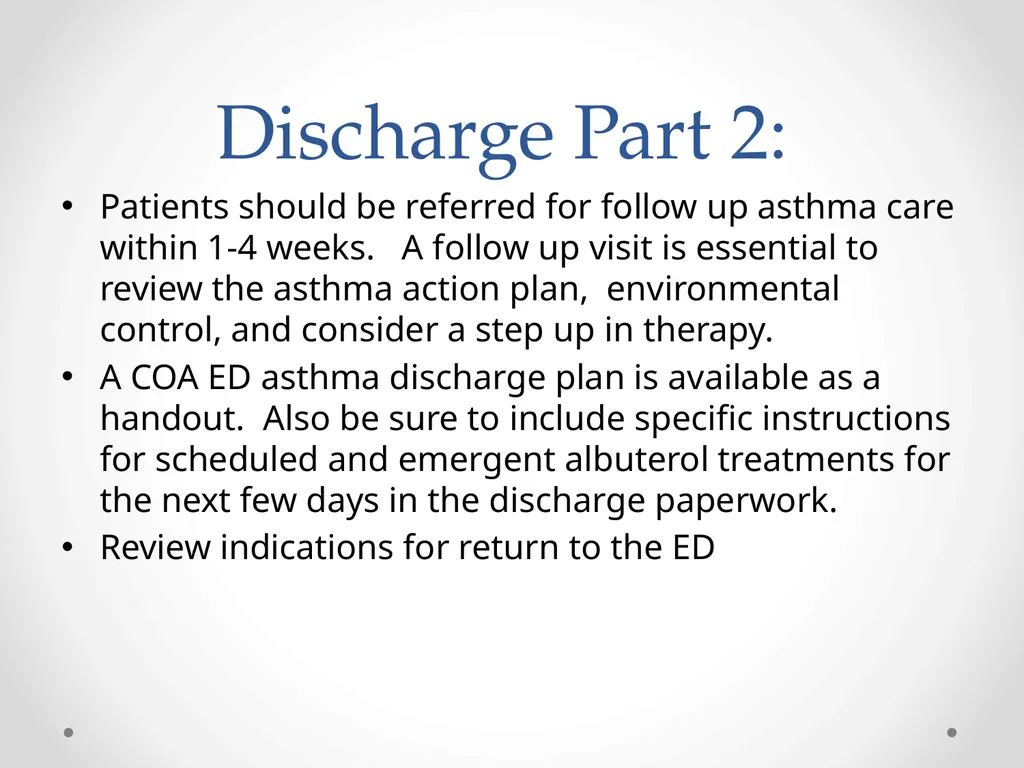
Discharge Part 2: Patients should be referred for follow up asthma care within 1-4 weeks. A follow up visit is essential to review the asthma action plan, environmental control, and consider a step up in therapy.
A COA ED asthma discharge plan is available as a handout. Also be sure to include specific instructions for scheduled and emergent albuterol treatments for the next few days in the discharge paperwork.
Review indications for return to the ED<br>
A COA ED asthma discharge plan is available as a handout. Also be sure to include specific instructions for scheduled and emergent albuterol treatments for the next few days in the discharge paperwork.
Review indications for return to the ED<br>
59
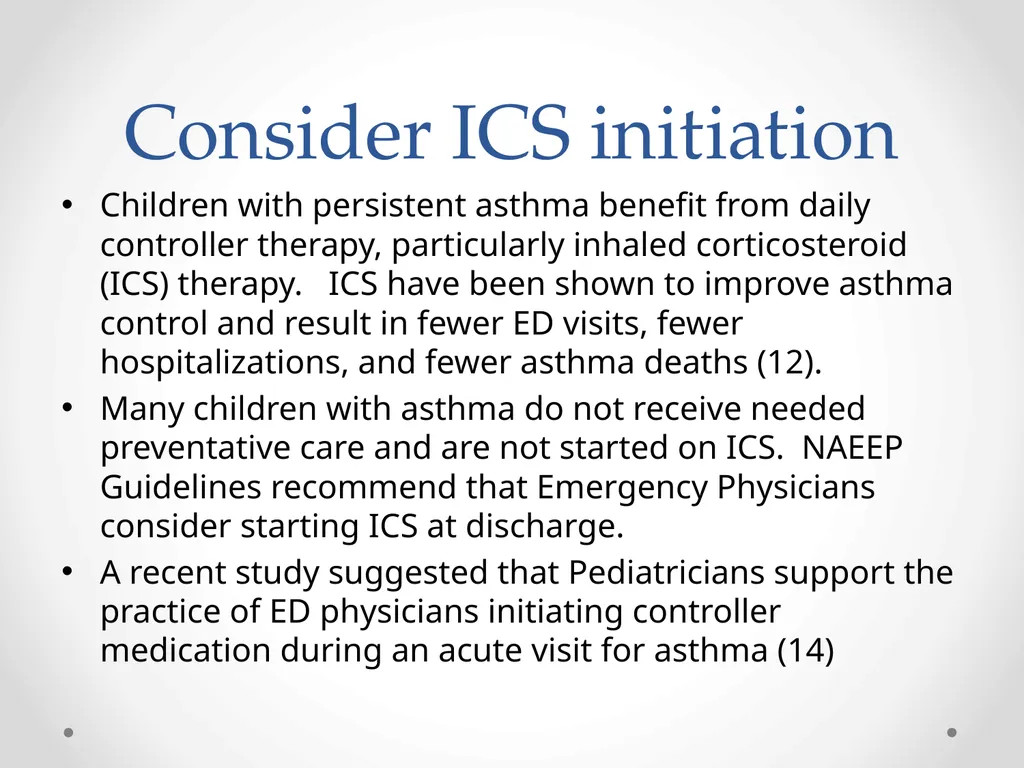
Consider ICS initiation Children with persistent asthma benefit from daily controller therapy, particularly inhaled corticosteroid (ICS) therapy. ICS have been shown to improve asthma control and result in fewer ED visits, fewer hospitalizations, and fewer asthma deaths (12).
Many children with asthma do not receive needed preventative care and are not started on ICS. NAEEP Guidelines recommend that Emergency Physicians consider starting ICS at discharge.
A recent study suggested that Pediatricians support the practice of ED physicians initiating controller medication during an acute visit for asthma (14)<br>
Many children with asthma do not receive needed preventative care and are not started on ICS. NAEEP Guidelines recommend that Emergency Physicians consider starting ICS at discharge.
A recent study suggested that Pediatricians support the practice of ED physicians initiating controller medication during an acute visit for asthma (14)<br>
60
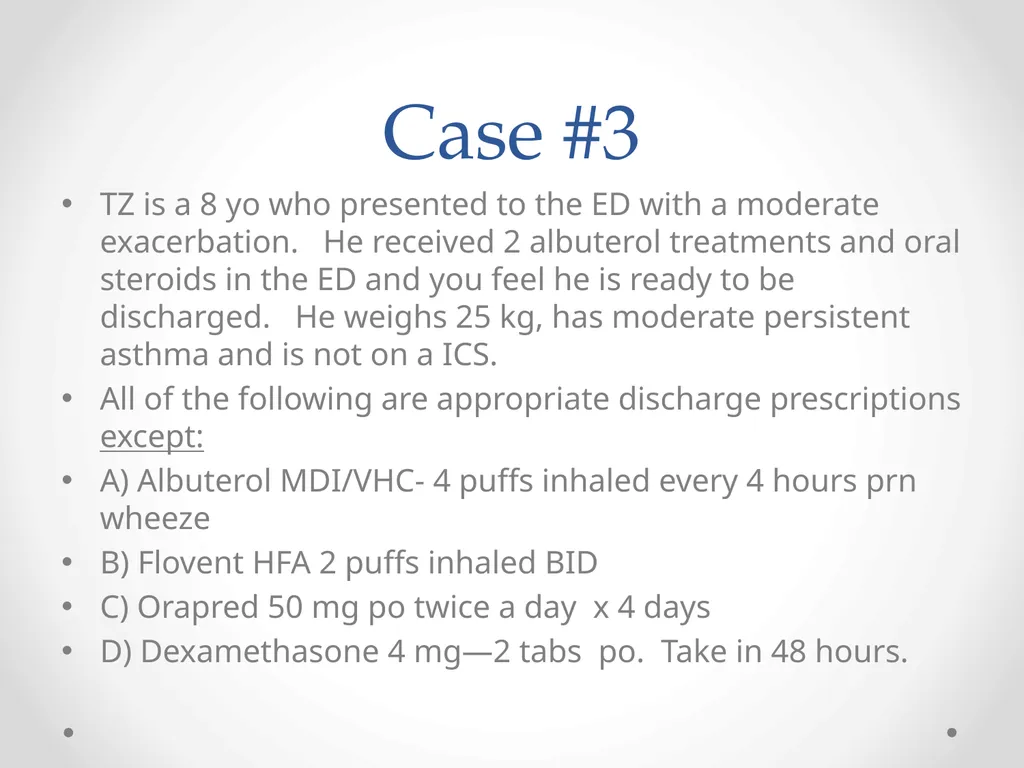
Case #3 TZ is a 8 yo who presented to the ED with a moderate exacerbation. He received 2 albuterol treatments and oral steroids in the ED and you feel he is ready to be discharged. He weighs 25 kg, has moderate persistent asthma and is not on a ICS.
All of the following are appropriate discharge prescriptions except:
A) Albuterol MDI/VHC- 4 puffs inhaled every 4 hours prn wheeze
B) Flovent HFA 2 puffs inhaled BID
C) Orapred 50 mg po twice a day x 4 days
D) Dexamethasone 4 mg—2 tabs po. Take in 48 hours.<br>
All of the following are appropriate discharge prescriptions except:
A) Albuterol MDI/VHC- 4 puffs inhaled every 4 hours prn wheeze
B) Flovent HFA 2 puffs inhaled BID
C) Orapred 50 mg po twice a day x 4 days
D) Dexamethasone 4 mg—2 tabs po. Take in 48 hours.<br>
61
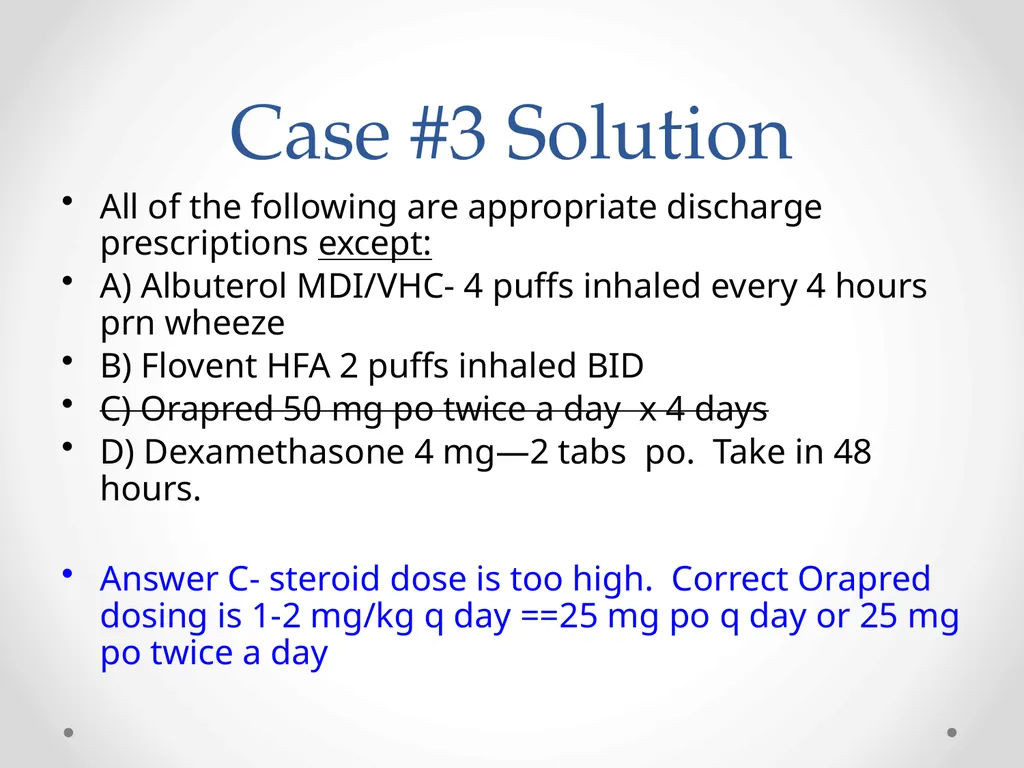
Case #3 Solution All of the following are appropriate discharge prescriptions except:
A) Albuterol MDI/VHC- 4 puffs inhaled every 4 hours prn wheeze
B) Flovent HFA 2 puffs inhaled BID
C) Orapred 50 mg po twice a day x 4 days
D) Dexamethasone 4 mg—2 tabs po. Take in 48 hours.
Answer C- steroid dose is too high. Correct Orapred dosing is 1-2 mg/kg q day ==25 mg po q day or 25 mg po twice a day<br>
A) Albuterol MDI/VHC- 4 puffs inhaled every 4 hours prn wheeze
B) Flovent HFA 2 puffs inhaled BID
C) Orapred 50 mg po twice a day x 4 days
D) Dexamethasone 4 mg—2 tabs po. Take in 48 hours.
Answer C- steroid dose is too high. Correct Orapred dosing is 1-2 mg/kg q day ==25 mg po q day or 25 mg po twice a day<br>
62
References 1) Guidelines for the Diagnosis and Management of Asthma. National Asthma Education and Prevention Program Expert Panel Report 3. National Heart Lung and Blood Institute. NIH Publication Number 08-5846. October 2007. https://www.nhlbi.nih.gov/files/docs/guidelines/asthsumm.pdf
2) Jones, BP, Paul, A. Management of Acute Asthma In the Pediatric Patient: An Evidence-Based Review. Pediatric Emergency Medicine Practice. May 2013, Vol 10 (5).
3) Griffiths B, Ducharme FM. Combined inhaled anticholinergics and short-acting beta 2-agonists for initial treatment of acute asthma in children. Cochrane Database of Systematic Reviews 2013, Issue 8.
4) Barnes PH, Adcock IM. How do corticosteroids work in asthma? Ann Intern Med. 2003:139(5 pt 1): 359-370.
5) Papo MC, Frank J, Thompson AE. A prospective, randomized study of continuous versus intermittent nebulized albuterol for severe status asthmaticus in Children. Crit Care Med. 1993;21(10):1479-1486.
6) Travers AH, Milan SJ, Jones AP, Camargo Jr CA, Rowe BH. Addition of intravenous beta2-agonists to inhaled beta2-agonists for acute asthma. Cochrane Database of Systematic Reviews 2012, Issue 12.
7) Scarfone, Richard. Acute Asthma exacerbations in children: Emergency department management. In: UptoDate, Redding G, Teach S (Eds), UpToDate, Waltham, MA, 2016.
8) Beers, SL, Abramo TJ, Bracken A, Wiebe RA. Bilevel positive airway pressure in the treatment of status asthmaticus in pediatrics. Am J Emerg Med. 2007 Jan;25(1):6-9.<br>
2) Jones, BP, Paul, A. Management of Acute Asthma In the Pediatric Patient: An Evidence-Based Review. Pediatric Emergency Medicine Practice. May 2013, Vol 10 (5).
3) Griffiths B, Ducharme FM. Combined inhaled anticholinergics and short-acting beta 2-agonists for initial treatment of acute asthma in children. Cochrane Database of Systematic Reviews 2013, Issue 8.
4) Barnes PH, Adcock IM. How do corticosteroids work in asthma? Ann Intern Med. 2003:139(5 pt 1): 359-370.
5) Papo MC, Frank J, Thompson AE. A prospective, randomized study of continuous versus intermittent nebulized albuterol for severe status asthmaticus in Children. Crit Care Med. 1993;21(10):1479-1486.
6) Travers AH, Milan SJ, Jones AP, Camargo Jr CA, Rowe BH. Addition of intravenous beta2-agonists to inhaled beta2-agonists for acute asthma. Cochrane Database of Systematic Reviews 2012, Issue 12.
7) Scarfone, Richard. Acute Asthma exacerbations in children: Emergency department management. In: UptoDate, Redding G, Teach S (Eds), UpToDate, Waltham, MA, 2016.
8) Beers, SL, Abramo TJ, Bracken A, Wiebe RA. Bilevel positive airway pressure in the treatment of status asthmaticus in pediatrics. Am J Emerg Med. 2007 Jan;25(1):6-9.<br>
63
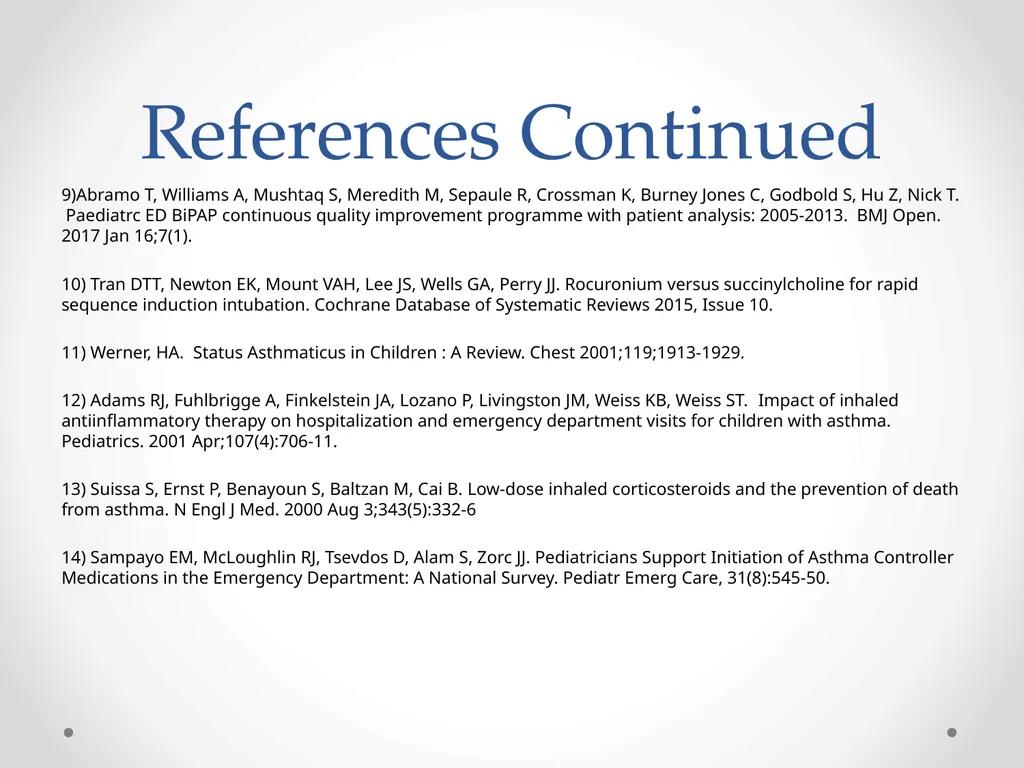
References Continued 9)Abramo T, Williams A, Mushtaq S, Meredith M, Sepaule R, Crossman K, Burney Jones C, Godbold S, Hu Z, Nick T. Paediatrc ED BiPAP continuous quality improvement programme with patient analysis: 2005-2013. BMJ Open. 2017 Jan 16;7(1).
10) Tran DTT, Newton EK, Mount VAH, Lee JS, Wells GA, Perry JJ. Rocuronium versus succinylcholine for rapid sequence induction intubation. Cochrane Database of Systematic Reviews 2015, Issue 10.
11) Werner, HA. Status Asthmaticus in Children : A Review. Chest 2001;119;1913-1929.
12) Adams RJ, Fuhlbrigge A, Finkelstein JA, Lozano P, Livingston JM, Weiss KB, Weiss ST. Impact of inhaled antiinflammatory therapy on hospitalization and emergency department visits for children with asthma. Pediatrics. 2001 Apr;107(4):706-11.
13) Suissa S, Ernst P, Benayoun S, Baltzan M, Cai B. Low-dose inhaled corticosteroids and the prevention of death from asthma. N Engl J Med. 2000 Aug 3;343(5):332-6
14) Sampayo EM, McLoughlin RJ, Tsevdos D, Alam S, Zorc JJ. Pediatricians Support Initiation of Asthma Controller Medications in the Emergency Department: A National Survey. Pediatr Emerg Care, 31(8):545-50.<br>
10) Tran DTT, Newton EK, Mount VAH, Lee JS, Wells GA, Perry JJ. Rocuronium versus succinylcholine for rapid sequence induction intubation. Cochrane Database of Systematic Reviews 2015, Issue 10.
11) Werner, HA. Status Asthmaticus in Children : A Review. Chest 2001;119;1913-1929.
12) Adams RJ, Fuhlbrigge A, Finkelstein JA, Lozano P, Livingston JM, Weiss KB, Weiss ST. Impact of inhaled antiinflammatory therapy on hospitalization and emergency department visits for children with asthma. Pediatrics. 2001 Apr;107(4):706-11.
13) Suissa S, Ernst P, Benayoun S, Baltzan M, Cai B. Low-dose inhaled corticosteroids and the prevention of death from asthma. N Engl J Med. 2000 Aug 3;343(5):332-6
14) Sampayo EM, McLoughlin RJ, Tsevdos D, Alam S, Zorc JJ. Pediatricians Support Initiation of Asthma Controller Medications in the Emergency Department: A National Survey. Pediatr Emerg Care, 31(8):545-50.<br>
64
Module Evaluation Thank you for taking a few minutes to evaluate this module. Responses will be used to improve the module. All answers will be kept confidential. Please use the box at the bottom of the section for any additional comments.
Question 1: I am a:
Emergency Medicine Resident
Pediatrics Resident
Medicine-Pediatrics Resident
PEM Fellow
Other
Question 2: The time required to complete this module was:
Much too long
A little too long
About right
A little too short
Much too short
Question 3: How would you rate your overall satisfaction with this module:
Extremely satisfied
Somewhat satisfied
Neutral
Somewhat Unsatisfied
Extremely Unsatisfied<br>
Question 1: I am a:
Emergency Medicine Resident
Pediatrics Resident
Medicine-Pediatrics Resident
PEM Fellow
Other
Question 2: The time required to complete this module was:
Much too long
A little too long
About right
A little too short
Much too short
Question 3: How would you rate your overall satisfaction with this module:
Extremely satisfied
Somewhat satisfied
Neutral
Somewhat Unsatisfied
Extremely Unsatisfied<br>
65
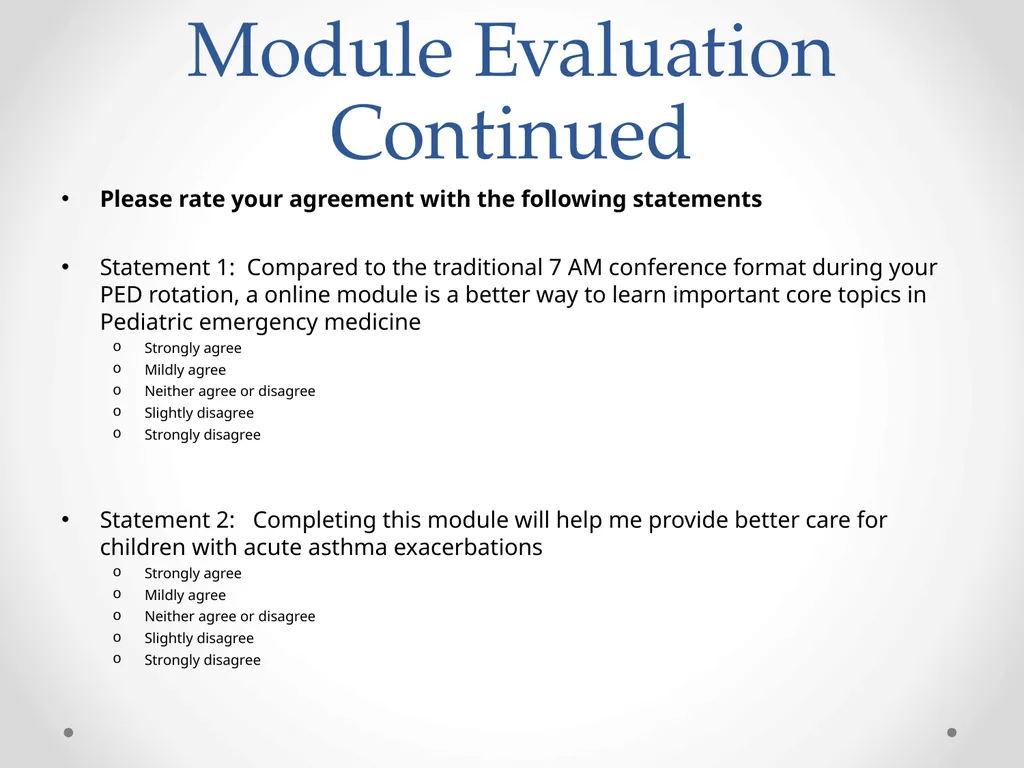
Module Evaluation Continued Please rate your agreement with the following statements
Statement 1: Compared to the traditional 7 AM conference format during your PED rotation, a online module is a better way to learn important core topics in Pediatric emergency medicine
Strongly agree
Mildly agree
Neither agree or disagree
Slightly disagree
Strongly disagree
Statement 2: Completing this module will help me provide better care for children with acute asthma exacerbations
Strongly agree
Mildly agree
Neither agree or disagree
Slightly disagree
Strongly disagree<br>
Statement 1: Compared to the traditional 7 AM conference format during your PED rotation, a online module is a better way to learn important core topics in Pediatric emergency medicine
Strongly agree
Mildly agree
Neither agree or disagree
Slightly disagree
Strongly disagree
Statement 2: Completing this module will help me provide better care for children with acute asthma exacerbations
Strongly agree
Mildly agree
Neither agree or disagree
Slightly disagree
Strongly disagree<br>