04
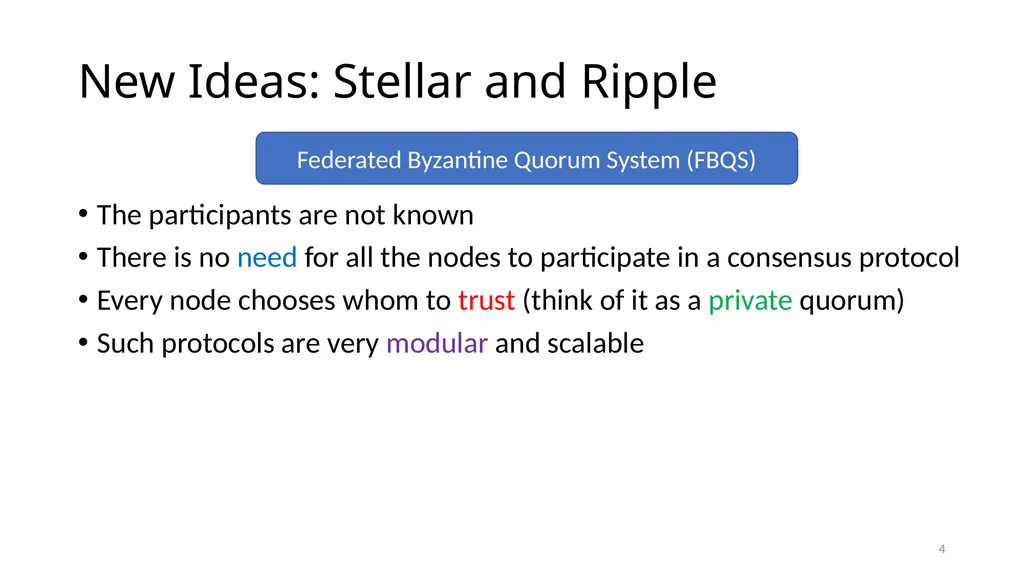
New Ideas: Stellar and Ripple The participants are not known
There is no need for all the nodes to participate in a consensus protocol
Every node chooses whom to trust (think of it as a private quorum)
Such protocols are very modular and scalable Federated Byzantine Quorum System (FBQS) 4<br>
05
Background and Assumptions The universe of nodes: V
A correct node executes as per specifications
If a node is either correct or just fails (without sending any malicious messages), then it is dubbed as honest
The rest of the nodes are faulty
Partially Synchronous Network:
After a global stabilization time (GST), all messages have a bounded delay
The clock skew is bounded. 5<br>
06
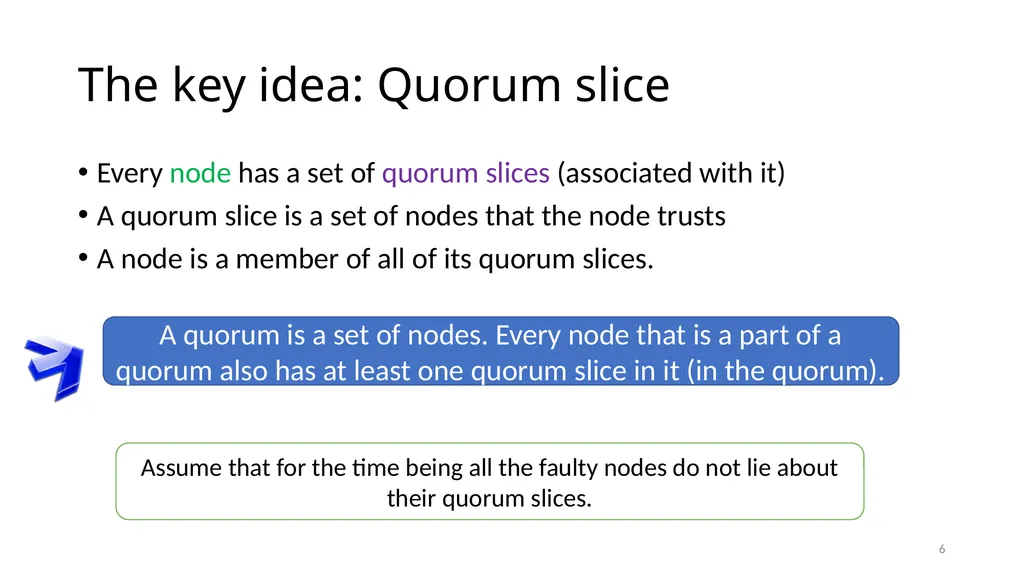
The key idea: Quorum slice Every node has a set of quorum slices (associated with it)
A quorum slice is a set of nodes that the node trusts
A node is a member of all of its quorum slices. A quorum is a set of nodes. Every node that is a part of a quorum also has at least one quorum slice in it (in the quorum). Assume that for the time being all the faulty nodes do not lie about their quorum slices. 6<br>
07
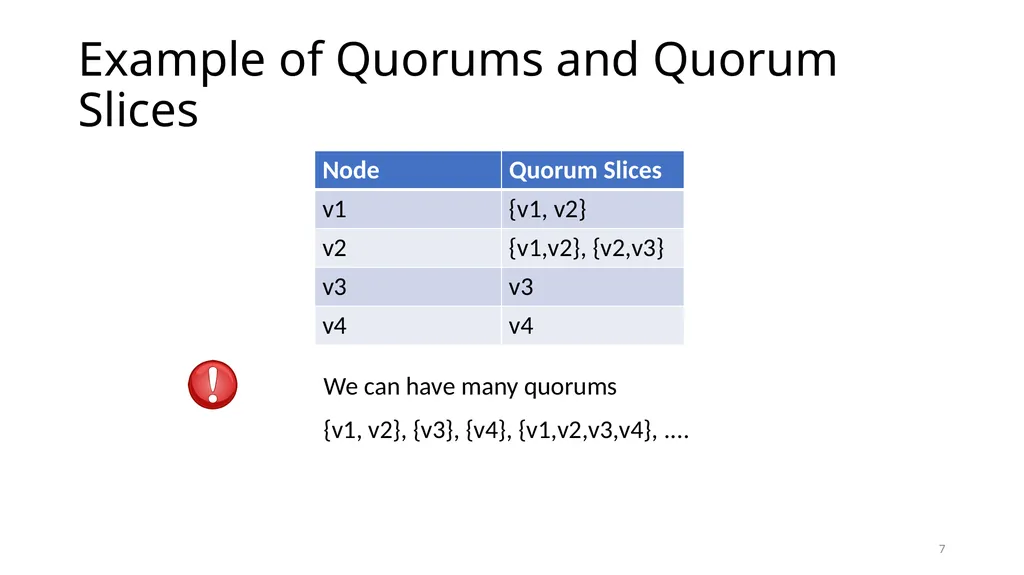
Example of Quorums and Quorum Slices We can have many quorums {v1, v2}, {v3}, {v4}, {v1,v2,v3,v4}, .... 7<br>
08
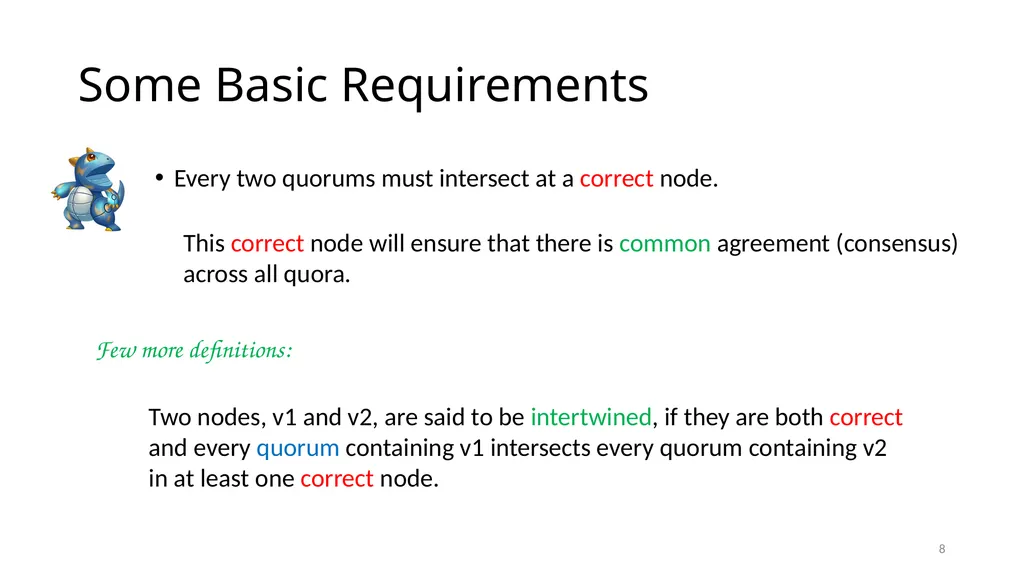
Some Basic Requirements Every two quorums must intersect at a correct node. This correct node will ensure that there is common agreement (consensus)�across all quora. Few more definitions: Two nodes, v1 and v2, are said to be intertwined, if they are both correct
and every quorum containing v1 intersects every quorum containing v2�in at least one correct node. 8<br>
09
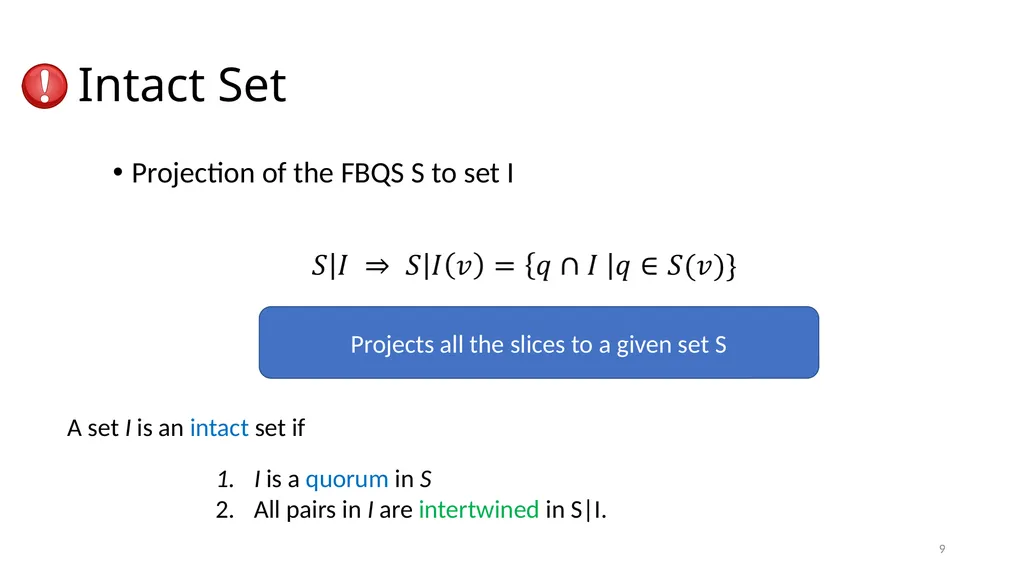
Intact Set Projection of the FBQS S to set I Projects all the slices to a given set S A set I is an intact set if I is a quorum in S
All pairs in I are intertwined in S|I. 9<br>
10
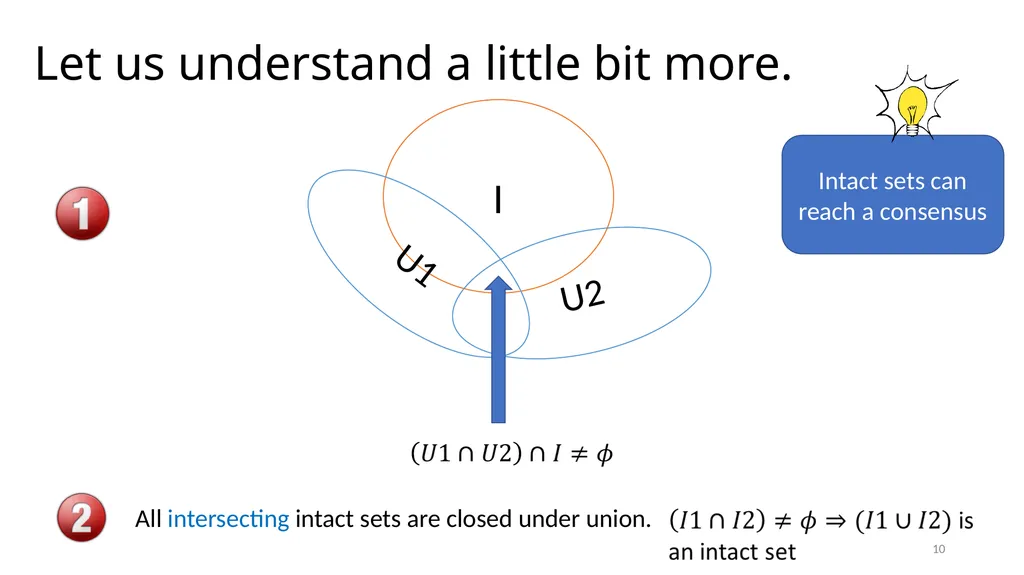
Let us understand a little bit more. I U1 U2 All intersecting intact sets are closed under union. Intact sets can reach a consensus 10<br>
11
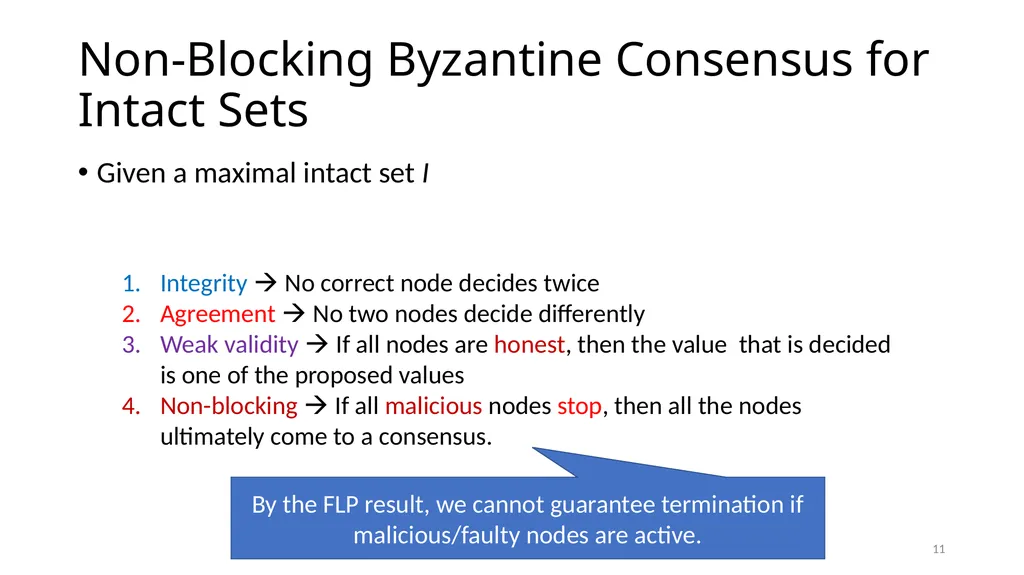
Non-Blocking Byzantine Consensus for Intact Sets Given a maximal intact set I Integrity No correct node decides twice
Agreement No two nodes decide differently
Weak validity If all nodes are honest, then the value that is decided is one of the proposed values
Non-blocking If all malicious nodes stop, then all the nodes ultimately come to a consensus. By the FLP result, we cannot guarantee termination if malicious/faulty nodes are active. 11<br>
12
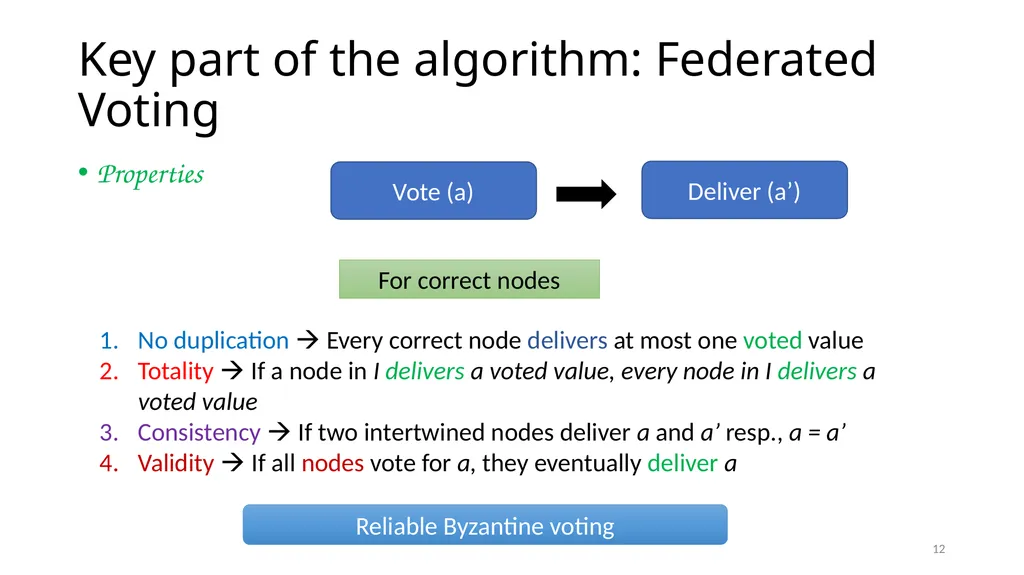
Key part of the algorithm: Federated Voting Properties No duplication Every correct node delivers at most one voted value
Totality If a node in I delivers a voted value, every node in I delivers a voted value
Consistency If two intertwined nodes deliver a and a’ resp., a = a’
Validity If all nodes vote for a, they eventually deliver a Vote (a) Deliver (a’) For correct nodes Reliable Byzantine voting 12<br>
13
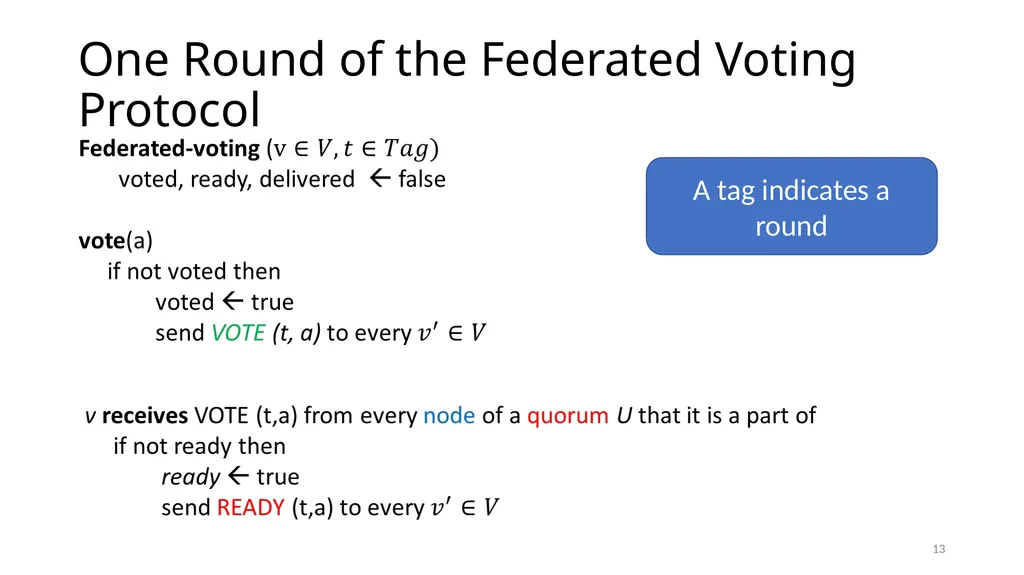
One Round of the Federated Voting Protocol A tag indicates a round 13<br>
14
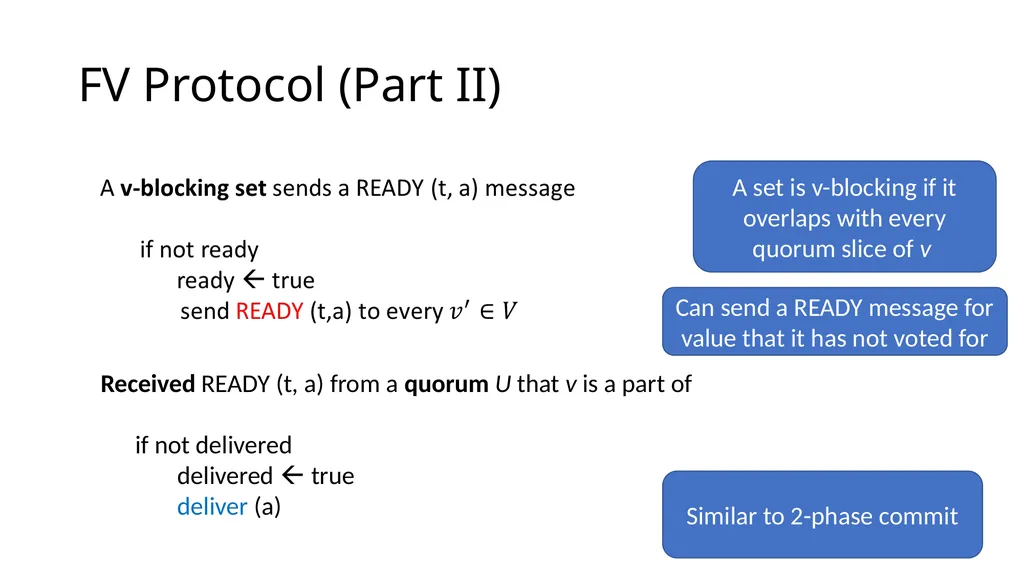
FV Protocol (Part II) A set is v-blocking if it overlaps with every quorum slice of v Received READY (t, a) from a quorum U that v is a part of
if not delivered
delivered true
deliver (a) Similar to 2-phase commit Can send a READY message for value that it has not voted for 14<br>
15
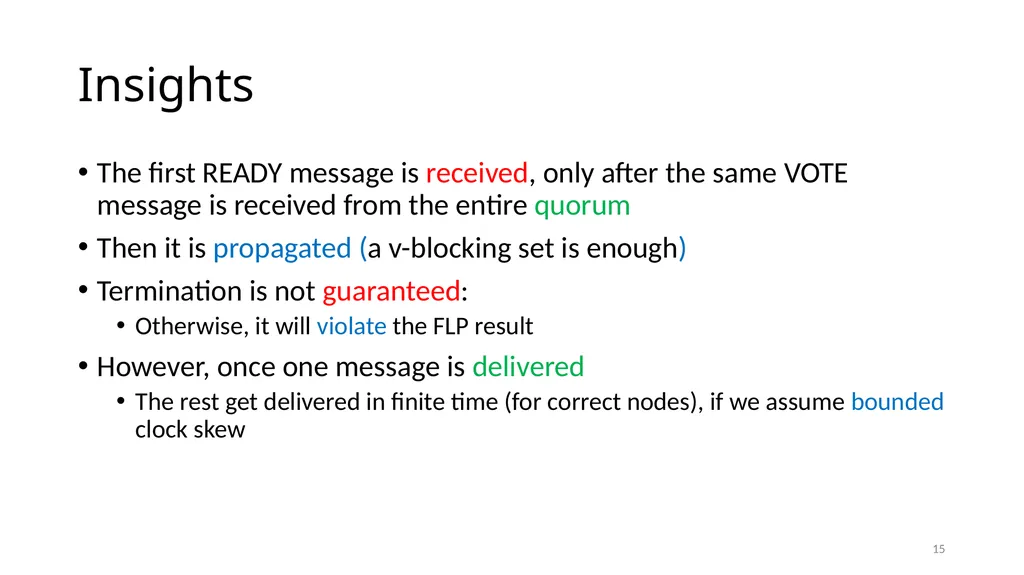
Insights The first READY message is received, only after the same VOTE message is received from the entire quorum
Then it is propagated (a v-blocking set is enough)
Termination is not guaranteed:
Otherwise, it will violate the FLP result
However, once one message is delivered
The rest get delivered in finite time (for correct nodes), if we assume bounded clock skew 15<br>
16
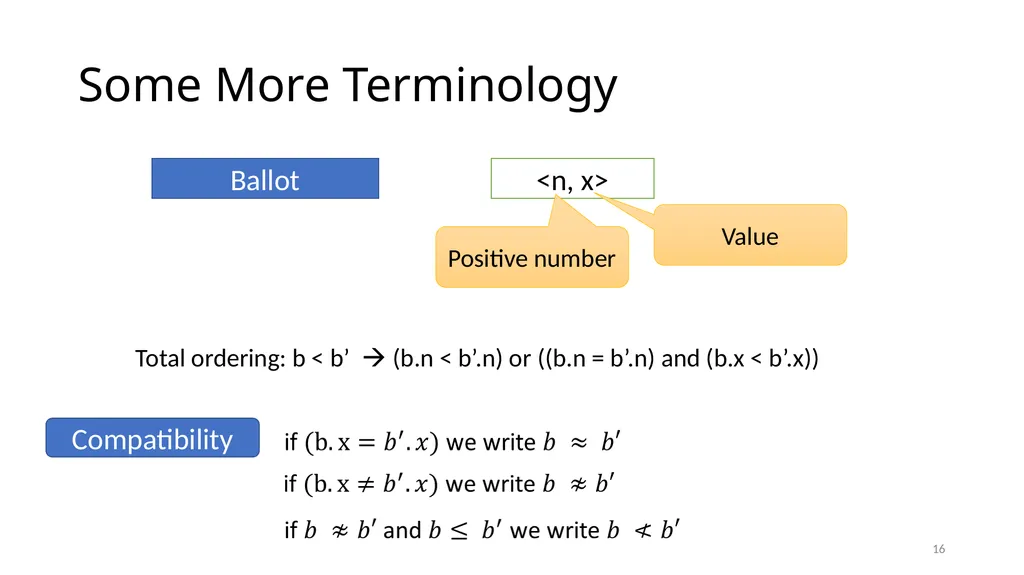
Some More Terminology Ballot <n, x> Positive number Value Total ordering: b < b’ (b.n < b’.n) or ((b.n = b’.n) and (b.x < b’.x)) Compatibility 16<br>
17
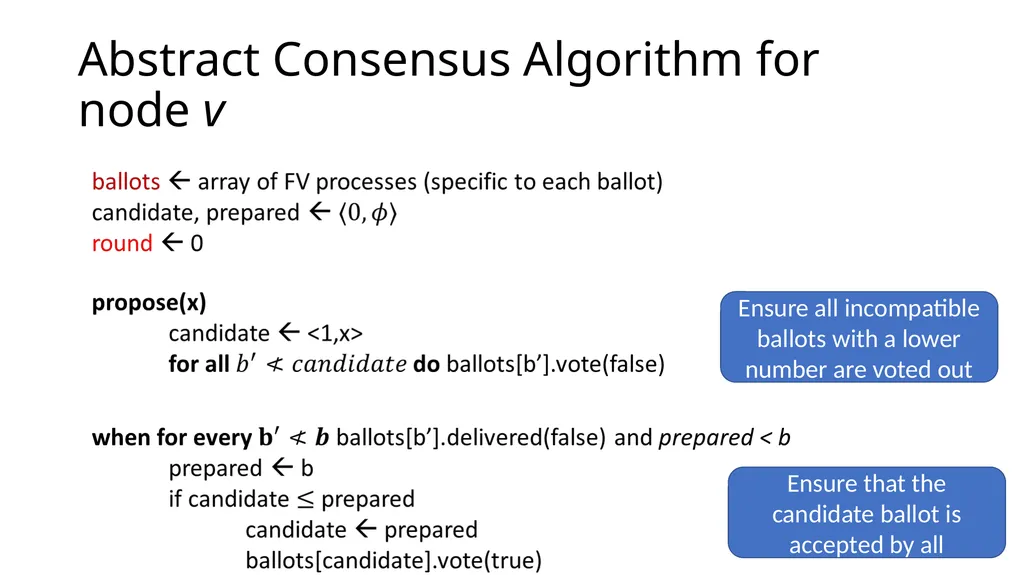
Abstract Consensus Algorithm for node v Ensure all incompatible ballots with a lower number are voted out Ensure that the candidate ballot is accepted by all 17<br>
18
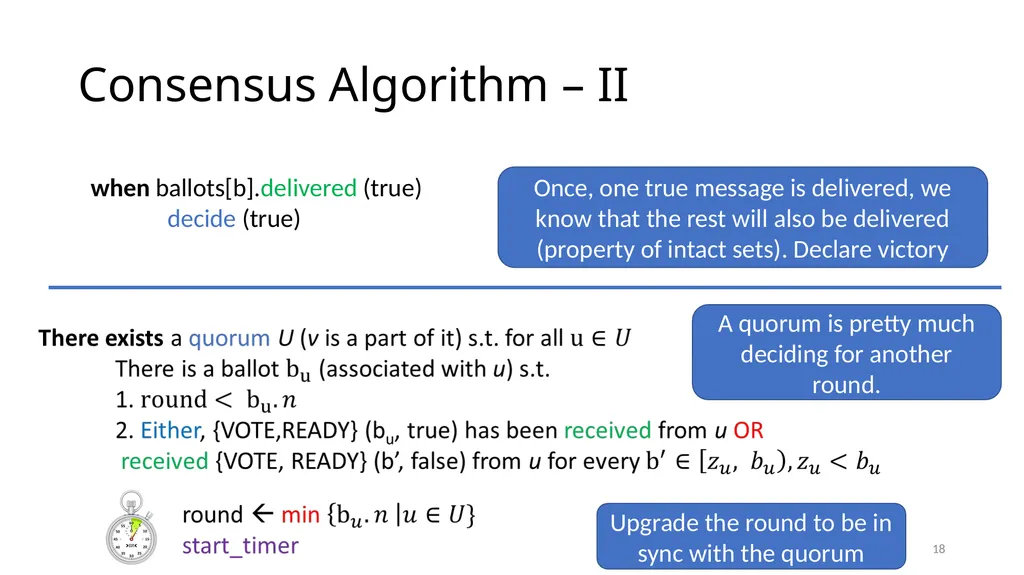
Consensus Algorithm – II when ballots[b].delivered (true)
decide (true) Once, one true message is delivered, we know that the rest will also be delivered (property of intact sets). Declare victory A quorum is pretty much deciding for another round. Upgrade the round to be in sync with the quorum 18<br>
19
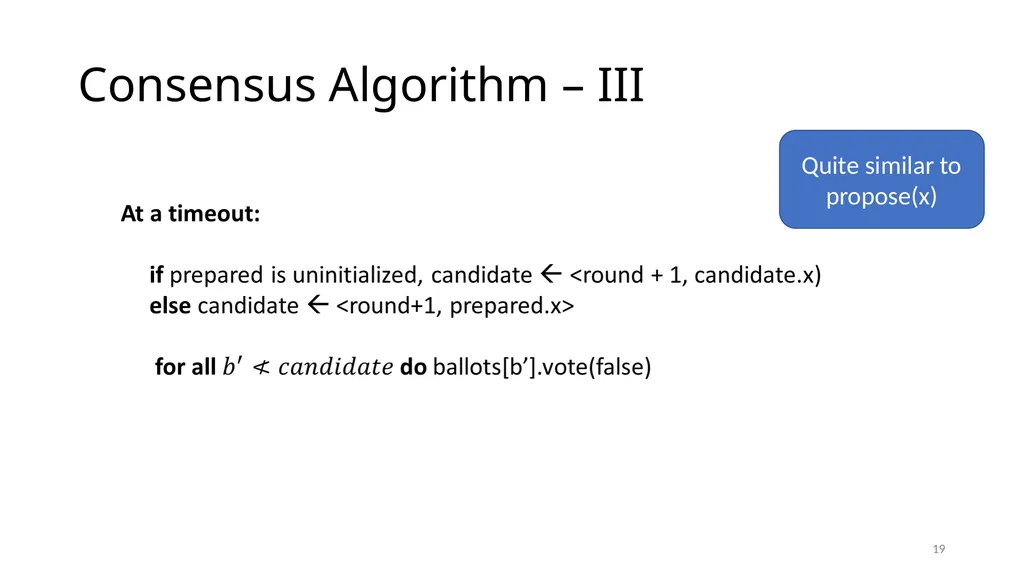
Consensus Algorithm – III Quite similar to propose(x) 19<br>
20
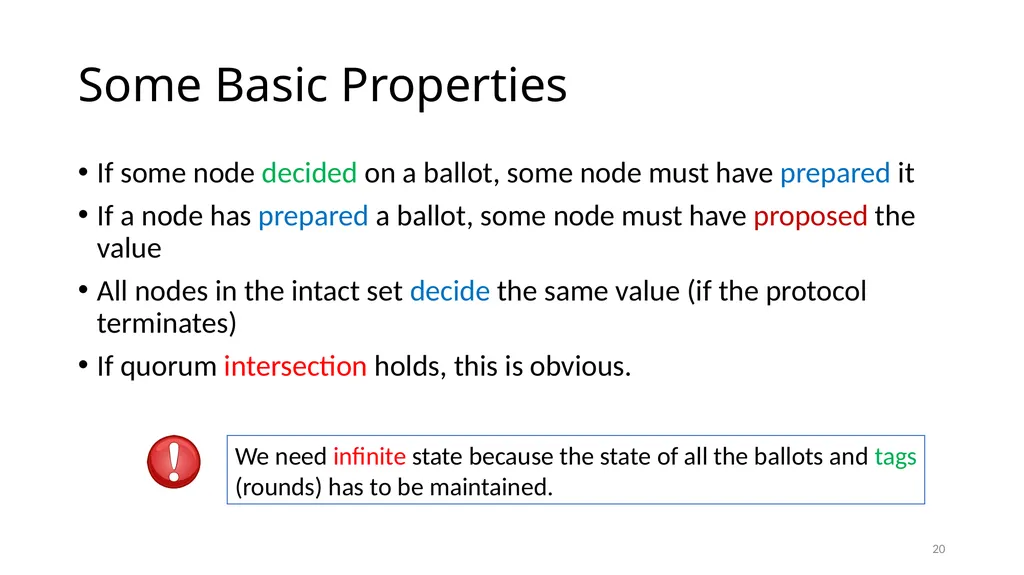
Some Basic Properties If some node decided on a ballot, some node must have prepared it
If a node has prepared a ballot, some node must have proposed the value
All nodes in the intact set decide the same value (if the protocol terminates)
If quorum intersection holds, this is obvious. We need infinite state because the state of all the ballots and tags�(rounds) has to be maintained. 20<br>
21
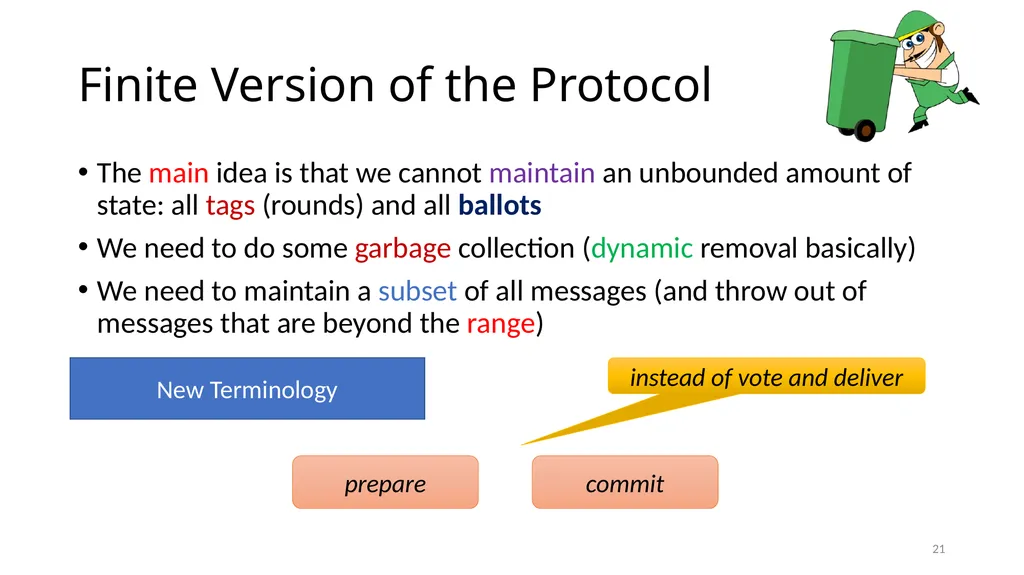
Finite Version of the Protocol The main idea is that we cannot maintain an unbounded amount of state: all tags (rounds) and all ballots
We need to do some garbage collection (dynamic removal basically)
We need to maintain a subset of all messages (and throw out of messages that are beyond the range) New Terminology prepare commit instead of vote and deliver 21<br>
22
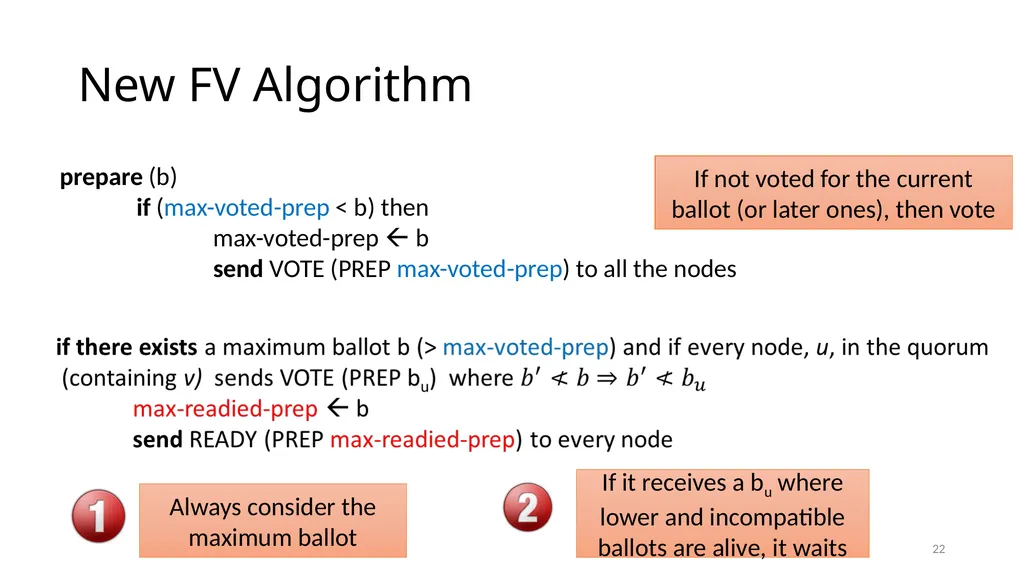
New FV Algorithm prepare (b)
if (max-voted-prep < b) then
max-voted-prep b
send VOTE (PREP max-voted-prep) to all the nodes If not voted for the current ballot (or later ones), then vote 22 Always consider the maximum ballot If it receives a bu where lower and incompatible ballots are alive, it waits<br>
23
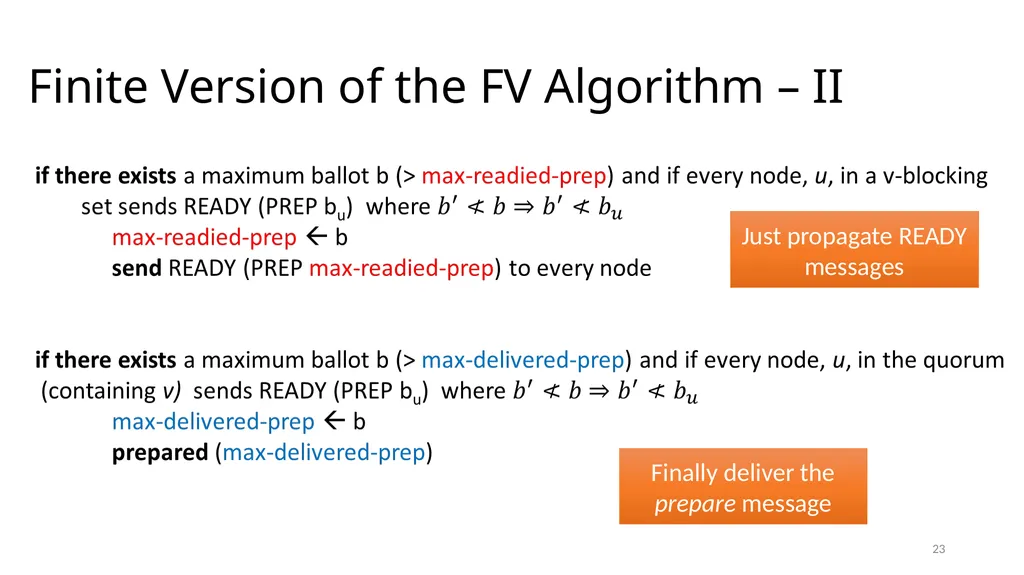
Finite Version of the FV Algorithm – II 23 Just propagate READY messages Finally deliver the prepare message<br>
24
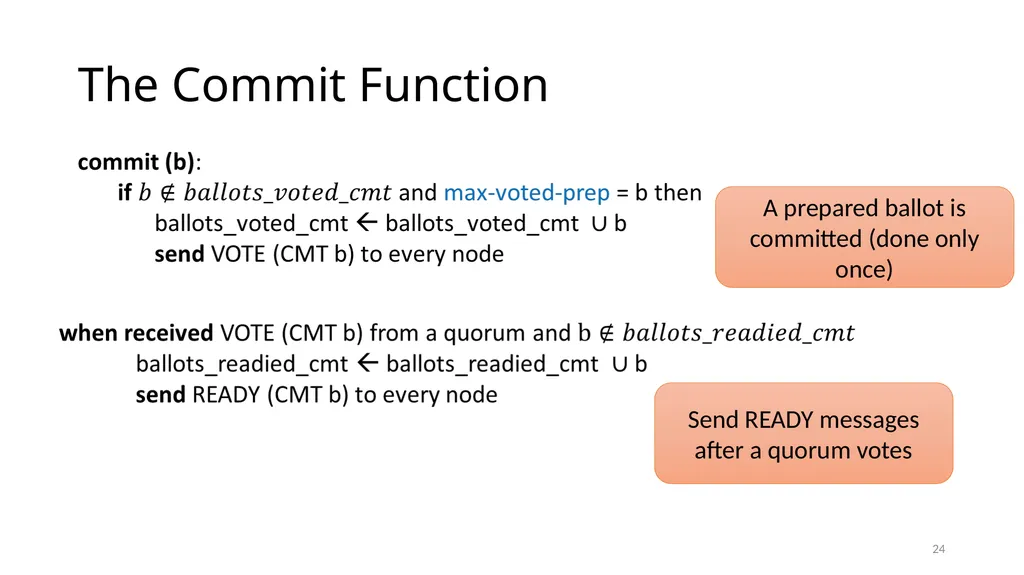
The Commit Function 24 A prepared ballot is committed (done only once) Send READY messages after a quorum votes<br>
25
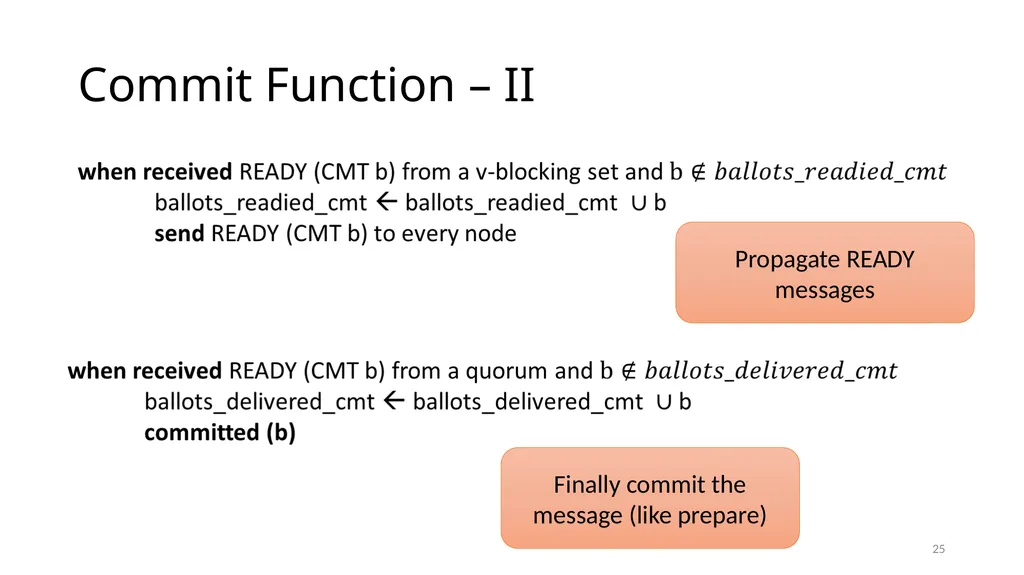
Commit Function – II 25 Propagate READY messages Finally commit the message (like prepare)<br>
26
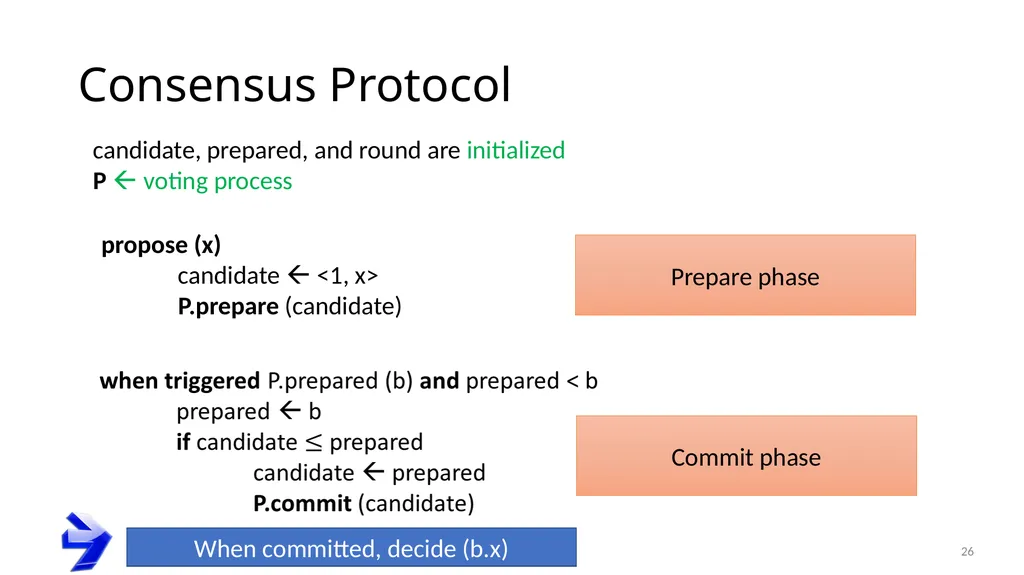
Consensus Protocol 26 candidate, prepared, and round are initialized
P voting process propose (x)
candidate <1, x>
P.prepare (candidate) Prepare phase Commit phase When committed, decide (b.x)<br>
27
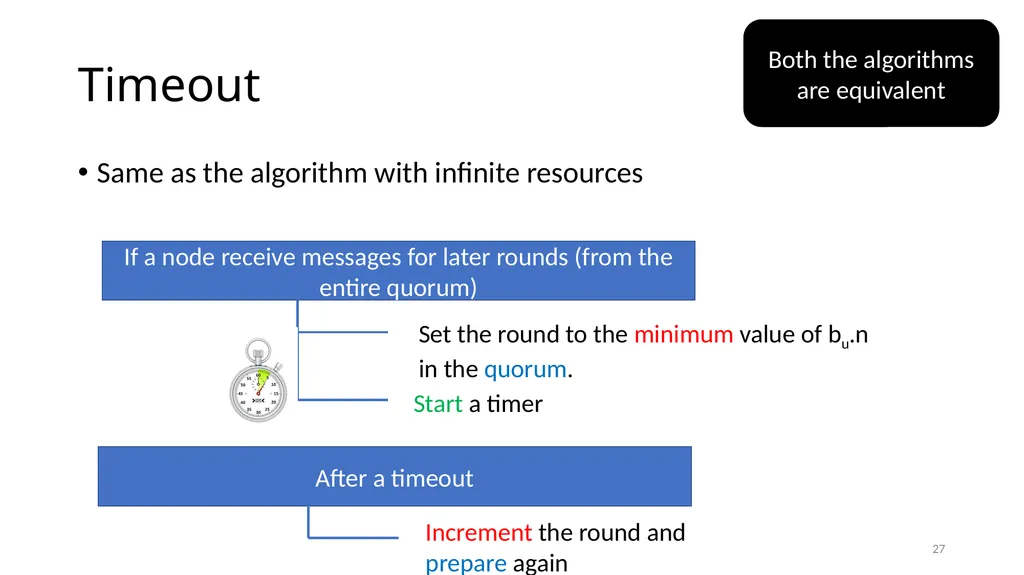
Timeout Same as the algorithm with infinite resources 27 If a node receive messages for later rounds (from the entire quorum) Set the round to the minimum value of bu.n �in the quorum. Start a timer After a timeout Increment the round and prepare again Both the algorithms are equivalent<br>
28
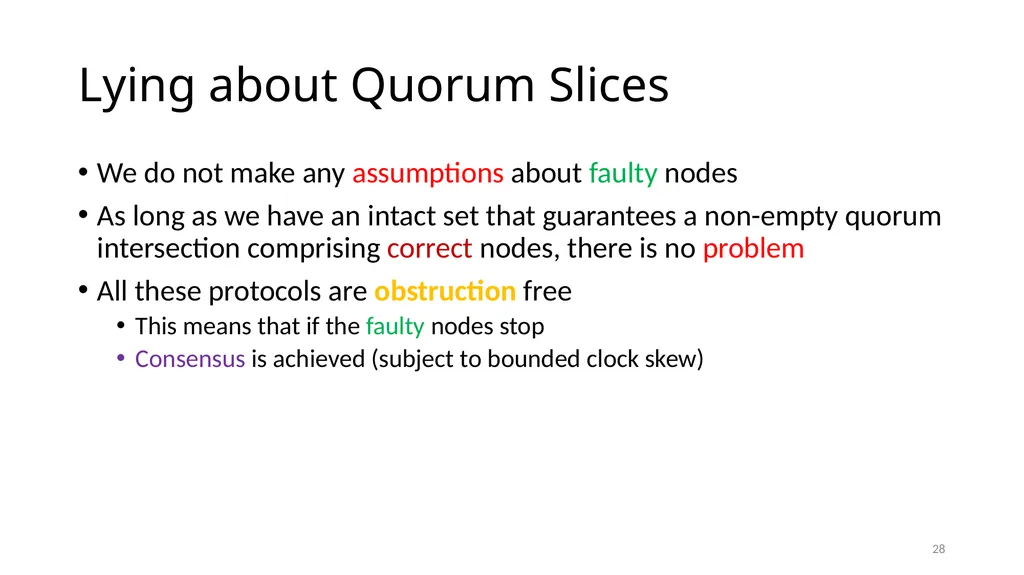
Lying about Quorum Slices We do not make any assumptions about faulty nodes
As long as we have an intact set that guarantees a non-empty quorum intersection comprising correct nodes, there is no problem
All these protocols are obstruction free
This means that if the faulty nodes stop
Consensus is achieved (subject to bounded clock skew) 28<br>
29
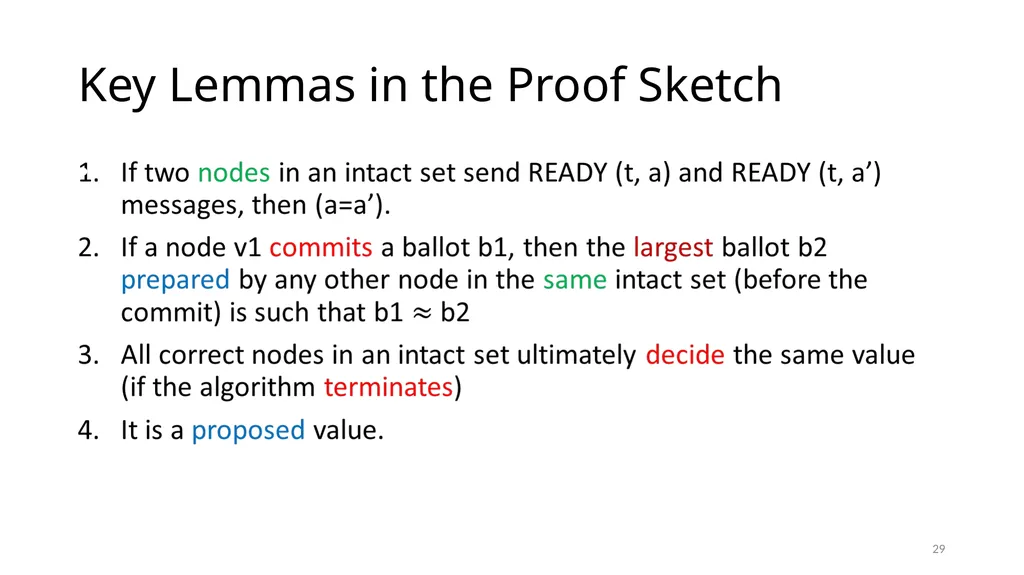
Key Lemmas in the Proof Sketch 29<br>
31
References [Main reference] García-Pérez, Álvaro, and Maria A. Schett. "Deconstructing stellar consensus (extended version)." arXiv preprint arXiv:1911.05145 (2019).
[Original paper] Mazieres, David. "The stellar consensus protocol: A federated model for internet-level consensus." Stellar Development Foundation 32 (2015): 1-45. 31<br>
32
32 Thank you (c) Smruti R. Sarangi, 2020<br>