Stepping Into the Ring with Step 1 Tony Maltagliati, MS American College of Cardiology Medical Student Leadership Group MD Candidate Class of 2021 University of Arizona College of Medicine - Tucson Disclosures Funding I am currently a
Related Topics
Share
Embed code
Download this presentation From Below
"Stepping Into the Ring with Step 1 Tony" is the property of its rightful owner. Permission is granted to
download and print the materials on this website for personal, non-commercial use only, and to display it
on your personal computer provided you do not modify the materials and that you retain all copyright
notices contained in the materials. By downloading content from our website, you accept the terms of this
agreement.
Presentation Transcript
01
Stepping Into the Ring with Step 1 Tony Maltagliati, MS
American College of Cardiology Medical Student Leadership Group
MD Candidate // Class of 2021
University of Arizona College of Medicine - Tucson<br>
02
Disclosures & Funding I am currently a fourth-year medical student and have no conflicts of interest, financial or otherwise.
The advice in this presentation is a combination of many resources and insights. This worked for me, but adjustments may be needed to fit your Step 1 goals and learning style, and there are certainly other strategies that may work as well or even better for you!
In February 2020, the National Board of Medical Examiners announced the USMLE Step 1 exam would transition to a pass/fail scoring format rather than the three-digit score, with this change occurring no earlier than January 2022. Details including changes to the minimum passing score or specific implementation, particularly given the impact of the COVID-19 crisis on the timeline, were not available as of July 2020.<br>
03
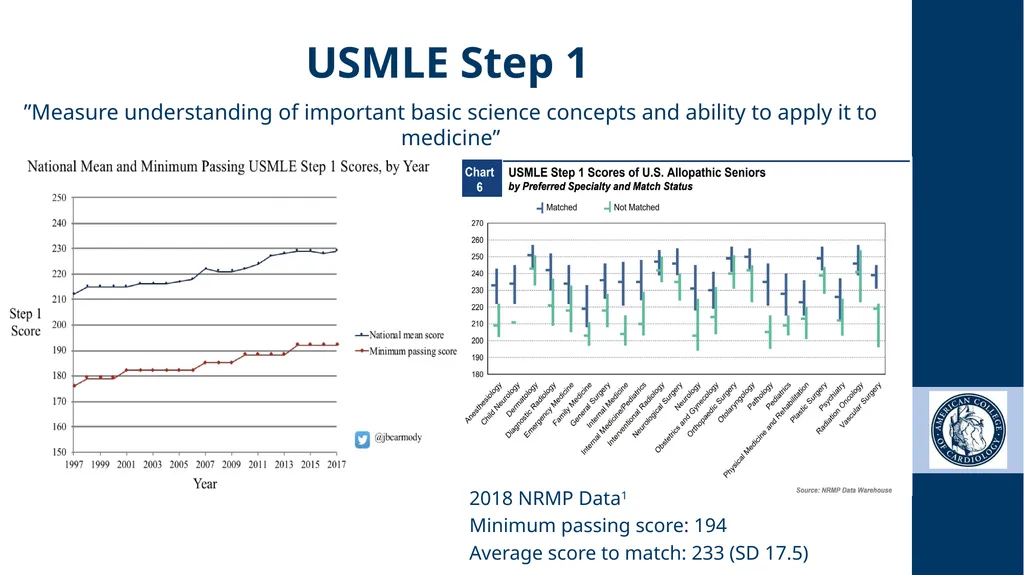
USMLE Step 1 2018 NRMP Data1
Minimum passing score: 194
Average score to match: 233 (SD 17.5) ”Measure understanding of important basic science concepts and ability to apply it to medicine”<br>
04
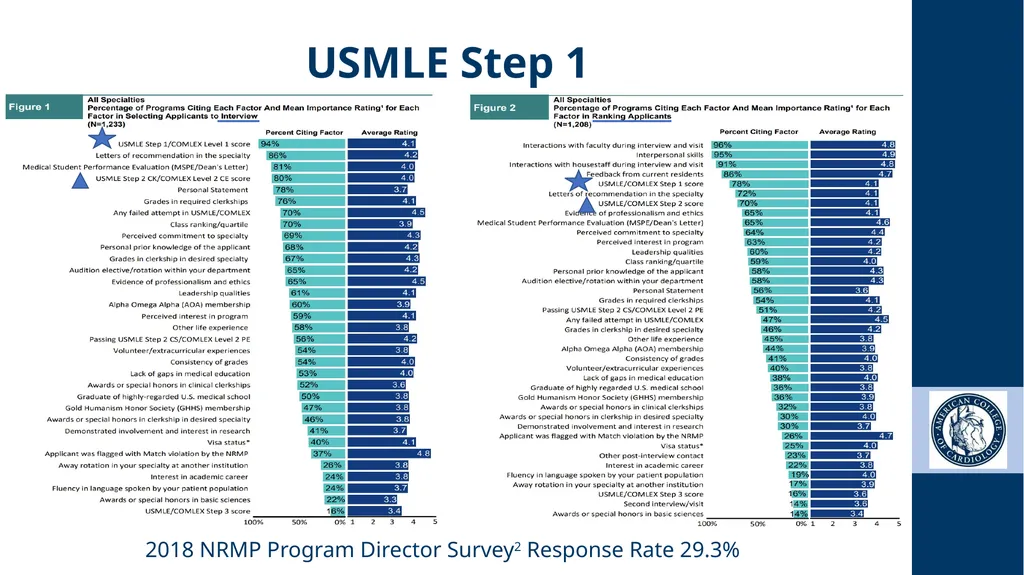
USMLE Step 1 2018 NRMP Program Director Survey2 Response Rate 29.3%<br>
05
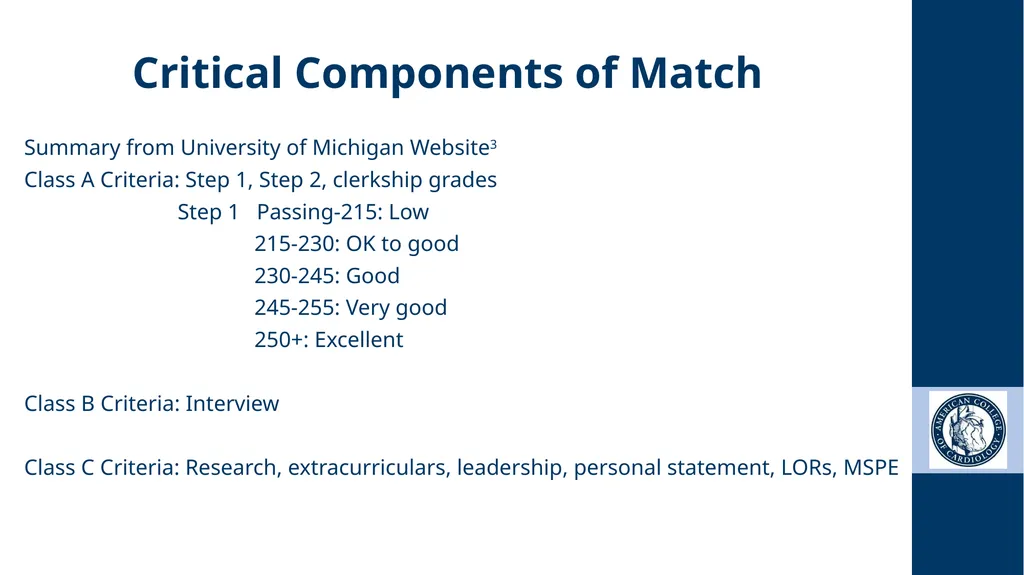
Critical Components of Match Summary from University of Michigan Website3
Class A Criteria: Step 1, Step 2, clerkship grades
Step 1 Passing-215: Low
215-230: OK to good
230-245: Good
245-255: Very good
250+: Excellent
Class B Criteria: Interview
Class C Criteria: Research, extracurriculars, leadership, personal statement, LORs, MSPE<br>
06
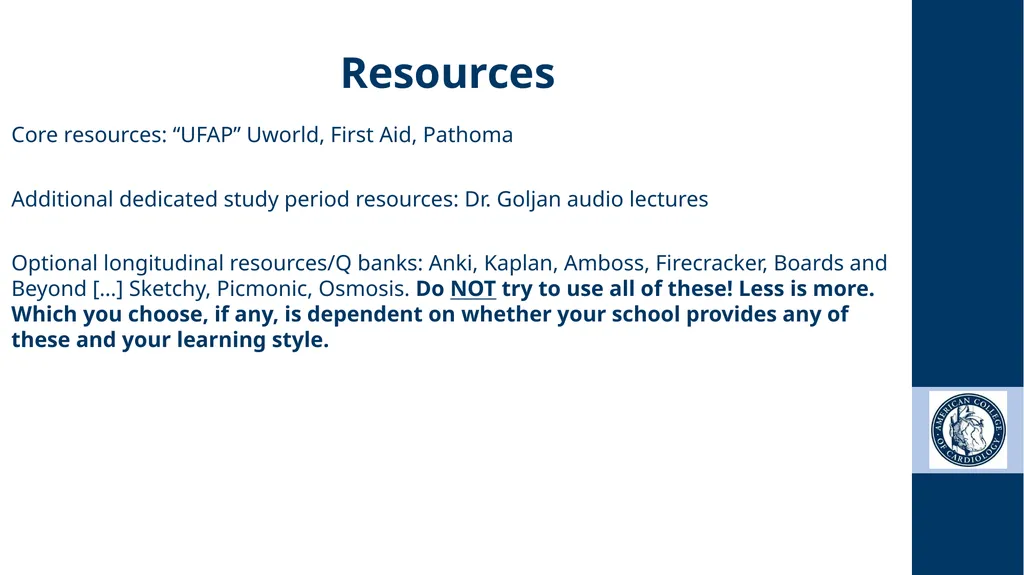
Resources Core resources: “UFAP” Uworld, First Aid, Pathoma
Additional dedicated study period resources: Dr. Goljan audio lectures
Optional longitudinal resources/Q banks: Anki, Kaplan, Amboss, Firecracker, Boards and Beyond […] Sketchy, Picmonic, Osmosis. Do NOT try to use all of these! Less is more. Which you choose, if any, is dependent on whether your school provides any of these and your learning style.<br>
07
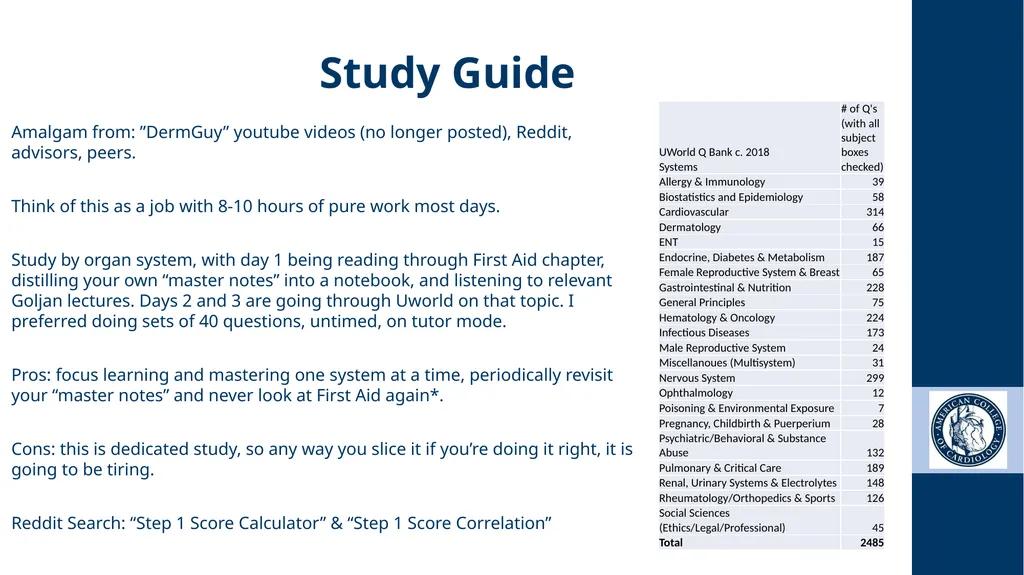
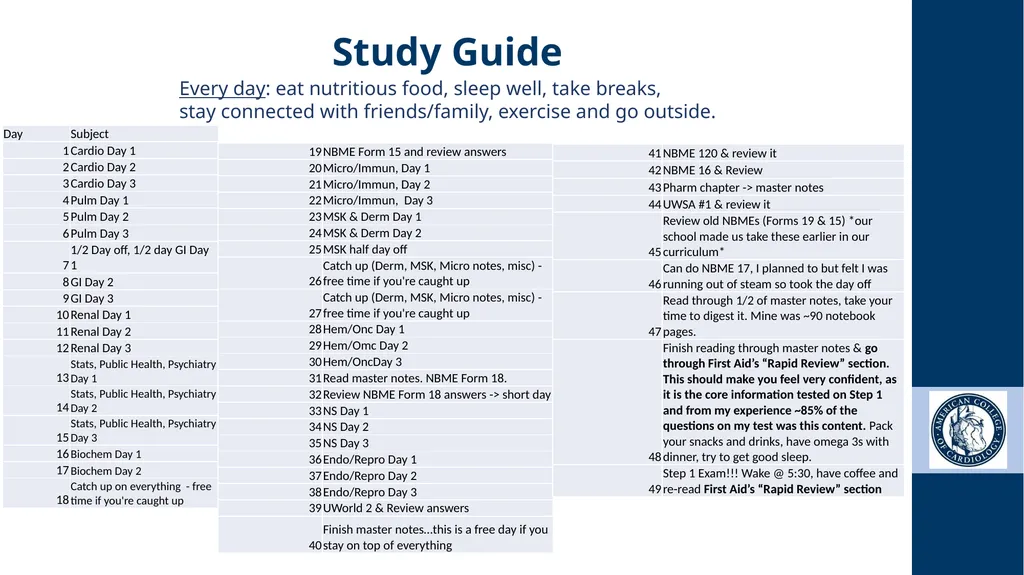
Study Guide Amalgam from: ”DermGuy” youtube videos (no longer posted), Reddit, advisors, peers.
Think of this as a job with 8-10 hours of pure work most days.
Study by organ system, with day 1 being reading through First Aid chapter, distilling your own “master notes” into a notebook, and listening to relevant Goljan lectures. Days 2 and 3 are going through Uworld on that topic. I preferred doing sets of 40 questions, untimed, on tutor mode.
Pros: focus learning and mastering one system at a time, periodically revisit your “master notes” and never look at First Aid again*.
Cons: this is dedicated study, so any way you slice it if you’re doing it right, it is going to be tiring.
Study Guide Every day: eat nutritious food, sleep well, take breaks,
stay connected with friends/family, exercise and go outside.<br>
09
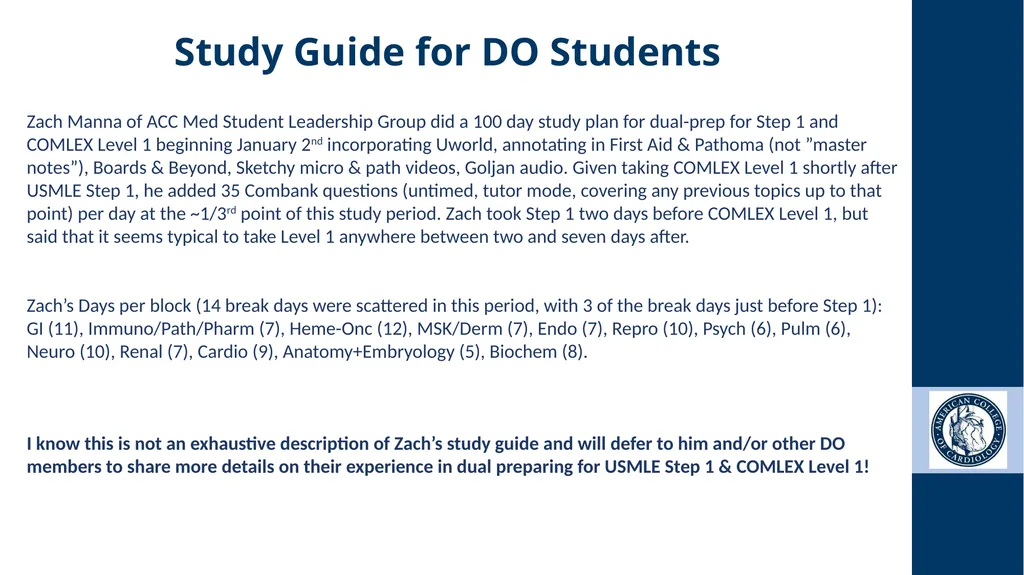
Study Guide for DO Students Zach Manna of ACC Med Student Leadership Group did a 100 day study plan for dual-prep for Step 1 and COMLEX Level 1 beginning January 2nd incorporating Uworld, annotating in First Aid & Pathoma (not ”master notes”), Boards & Beyond, Sketchy micro & path videos, Goljan audio. Given taking COMLEX Level 1 shortly after USMLE Step 1, he added 35 Combank questions (untimed, tutor mode, covering any previous topics up to that point) per day at the ~1/3rd point of this study period. Zach took Step 1 two days before COMLEX Level 1, but said that it seems typical to take Level 1 anywhere between two and seven days after.
Zach’s Days per block (14 break days were scattered in this period, with 3 of the break days just before Step 1): GI (11), Immuno/Path/Pharm (7), Heme-Onc (12), MSK/Derm (7), Endo (7), Repro (10), Psych (6), Pulm (6), Neuro (10), Renal (7), Cardio (9), Anatomy+Embryology (5), Biochem (8).
I know this is not an exhaustive description of Zach’s study guide and will defer to him and/or other DO members to share more details on their experience in dual preparing for USMLE Step 1 & COMLEX Level 1!<br>
10
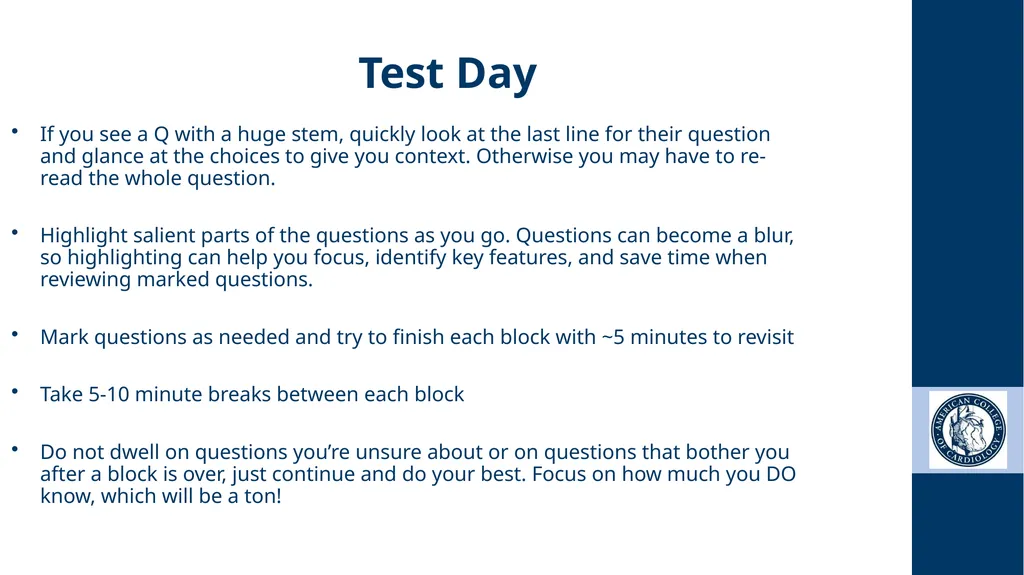
Test Day If you see a Q with a huge stem, quickly look at the last line for their question and glance at the choices to give you context. Otherwise you may have to re-read the whole question.
Highlight salient parts of the questions as you go. Questions can become a blur, so highlighting can help you focus, identify key features, and save time when reviewing marked questions.
Mark questions as needed and try to finish each block with ~5 minutes to revisit
Take 5-10 minute breaks between each block
Do not dwell on questions you’re unsure about or on questions that bother you after a block is over, just continue and do your best. Focus on how much you DO know, which will be a ton!<br>
11
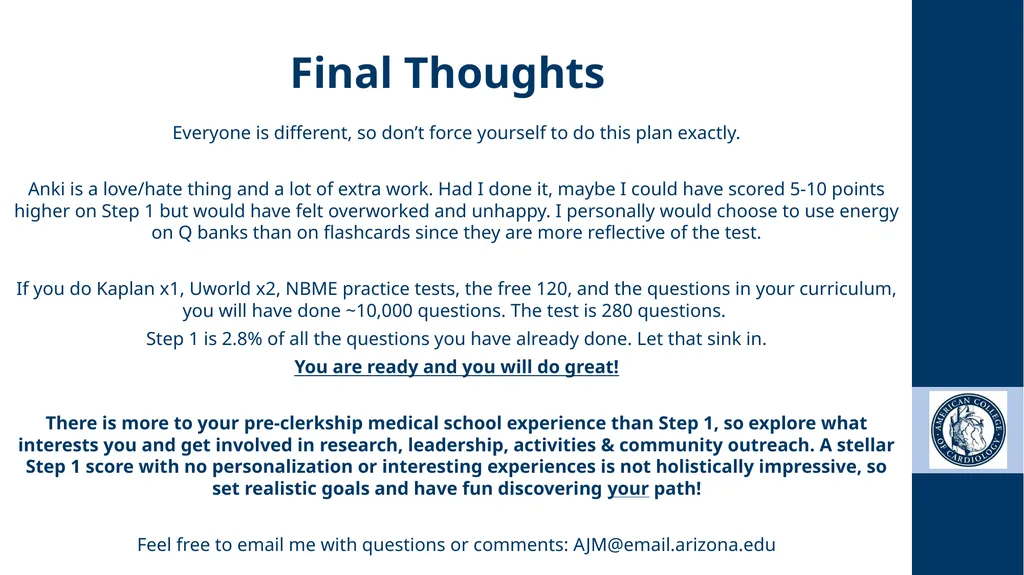
Final Thoughts Everyone is different, so don’t force yourself to do this plan exactly.
Anki is a love/hate thing and a lot of extra work. Had I done it, maybe I could have scored 5-10 points higher on Step 1 but would have felt overworked and unhappy. I personally would choose to use energy on Q banks than on flashcards since they are more reflective of the test.
If you do Kaplan x1, Uworld x2, NBME practice tests, the free 120, and the questions in your curriculum, you will have done ~10,000 questions. The test is 280 questions.
Step 1 is 2.8% of all the questions you have already done. Let that sink in.
You are ready and you will do great!
There is more to your pre-clerkship medical school experience than Step 1, so explore what interests you and get involved in research, leadership, activities & community outreach. A stellar Step 1 score with no personalization or interesting experiences is not holistically impressive, so set realistic goals and have fun discovering your path!
Feel free to email me with questions or comments: AJM@email.arizona.edu<br>
12
References 1) National Resident Matching Program. “Charting Outcomes in the Match: U.S. Allopathic Seniors 2nd edition”. 2018.
2) National Resident Matching Program. “Results of the 2018 NRMP Program Director Survey” 2018.
3) Critical Components in the Match. University of Michigan.
https://medstudents.medicine.umich.edu/student-support/match/critical-components-match<br>