
STERILIZATION OF INSTRUMENT & DISINFECTING METHOD
NS
Published · 44 slides · 0 views

1 / 1








Description
STERILIZATION OF INSTRUMENT DISINFECTING METHOD LESSON-39 BY AMANDEEP KAUR ASIANM Define sterilization, disinfection and antisepsis OBJECTIVES: 6. Explain the principles of infection control 5. List the steps in management of spills 4.
Related Topics
Share
Embed code
Download this presentation From Below
"STERILIZATION OF INSTRUMENT & DISINFECTING METHOD" is the property of its rightful owner. Permission is granted to download and print the materials on this website for personal, non-commercial use only, and to display it on your personal computer provided you do not modify the materials and that you retain all copyright notices contained in the materials. By downloading content from our website, you accept the terms of this agreement.
Presentation Transcript
01
STERILIZATION OF INSTRUMENT & DISINFECTING METHOD LESSON-39 BY
AMANDEEP KAUR
ASI/ANM<br>
AMANDEEP KAUR
ASI/ANM<br>
02
Define sterilization, disinfection and antisepsis OBJECTIVES: 6. Explain the principles of infection control 5. List the steps in management of spills 4. Describe the methods recommended for the
cleaning and disinfection of commonly used
items 3. Explain the principle of Autoclave. List the
steps in the procedure of autoclaving 2. List the physical and chemical agents used in
sterilization<br>
cleaning and disinfection of commonly used
items 3. Explain the principle of Autoclave. List the
steps in the procedure of autoclaving 2. List the physical and chemical agents used in
sterilization<br>
03
Sterilization: is defined as the process by which an article, surface or medium is freed of all living microorganisms, either in the vegetative or spore state. Antisepsis: indicates the prevention of infection,
usually by inhibiting the growth of bacteria in
wounds or tissues. Disinfection: means the destruction or removal of
all pathogenic organisms or organisms capable of
giving rise to infection.<br>
usually by inhibiting the growth of bacteria in
wounds or tissues. Disinfection: means the destruction or removal of
all pathogenic organisms or organisms capable of
giving rise to infection.<br>
04
Antiseptics: chemical disinfectants which can be safely applied to skin or mucous membrane and are used to prevent infection by inhibiting the growth of bacteria. Bactericidal agents: those which are able to kill
bacteria. Bacteriostatic agents: those which prevent
multiplication of bacteria. Decontamination: refers to the process of rendering an article or area free of danger from contaminants, including microbial, chemical, radioactive and other hazards.<br>
bacteria. Bacteriostatic agents: those which prevent
multiplication of bacteria. Decontamination: refers to the process of rendering an article or area free of danger from contaminants, including microbial, chemical, radioactive and other hazards.<br>
05
A. Physical agents:
Sunlight
Drying
Dry heat: flaming, incineration, hot air
Moist Heat: boiling, pasteurization , steam under normal pressure, steam under pressure
Filtration: candles, asbestos pads, membranes
Radiation
Ultrasonic and sonic vibration<br>
Sunlight
Drying
Dry heat: flaming, incineration, hot air
Moist Heat: boiling, pasteurization , steam under normal pressure, steam under pressure
Filtration: candles, asbestos pads, membranes
Radiation
Ultrasonic and sonic vibration<br>
06
B. Chemicals:
Alcohols: ethyl, isopropyl, trichlorbutanol
Aldehydes: formaldehyde, glutaraldehyde
Dyes
Halogens
Phenols
Surface active agents
Metallic salts
Gases: ethylene oxide, formaldehyde, beta propiolatone
Of these the relevant methods of sterilization are discussed here<br>
Alcohols: ethyl, isopropyl, trichlorbutanol
Aldehydes: formaldehyde, glutaraldehyde
Dyes
Halogens
Phenols
Surface active agents
Metallic salts
Gases: ethylene oxide, formaldehyde, beta propiolatone
Of these the relevant methods of sterilization are discussed here<br>
07
PHYSICAL DISINFECTINS AGENTS
DRY HEAT
Flaming: inoculating loop or wire, the tip of forceps and searing spatulas are held in a Bunsen flame till they become red hot. They may be dipped in a disinfectant before flaming to prevent spattering.
Incineration: excellent method for safely destroying materials such as contaminated cloth, animal carcasses and pathological materials. Polystyrene materials should not incinerated as they emit dark, dense black smoke<br>
DRY HEAT
Flaming: inoculating loop or wire, the tip of forceps and searing spatulas are held in a Bunsen flame till they become red hot. They may be dipped in a disinfectant before flaming to prevent spattering.
Incineration: excellent method for safely destroying materials such as contaminated cloth, animal carcasses and pathological materials. Polystyrene materials should not incinerated as they emit dark, dense black smoke<br>
08
Hot Air Oven: most widely used method
of sterilization by dry heat
Holding period: 1600 C for one hour
Glass ware, forceps, scissors, scalpels, all-glass syringes, swabs, some pharmaceutical products such as liquid paraffin, dusting powder and grease.
The oven is usually heated by electricity with heating elements in the wall of the chamber and fitted with a fan to ensure even distribution of air and elimination of air pockets<br>
of sterilization by dry heat
Holding period: 1600 C for one hour
Glass ware, forceps, scissors, scalpels, all-glass syringes, swabs, some pharmaceutical products such as liquid paraffin, dusting powder and grease.
The oven is usually heated by electricity with heating elements in the wall of the chamber and fitted with a fan to ensure even distribution of air and elimination of air pockets<br>
09
Test tubes and flasks should be wrapped in paper
The oven must be allowed to cool slowly for about two hours before the door is opened since the glassware may crack due to sudden or uneven cooling. Glass ware should be perfectly dry before being placed in the oven<br>
The oven must be allowed to cool slowly for about two hours before the door is opened since the glassware may crack due to sudden or uneven cooling. Glass ware should be perfectly dry before being placed in the oven<br>
10
MOIST HEAT:
Boiling:
Vegetative bacteria are killed immediately at 90 – 1000 C but sporing bacteria require prolonged periods of boiling
Boiling is not recommended for sterilizing instruments used in surgical procedures and is only a process of disinfection
Hard water should not be used<br>
Boiling:
Vegetative bacteria are killed immediately at 90 – 1000 C but sporing bacteria require prolonged periods of boiling
Boiling is not recommended for sterilizing instruments used in surgical procedures and is only a process of disinfection
Hard water should not be used<br>
11
MOIST HEAT:
Boiling:
For materials requiring only disinfection, the material should be immersed in the water and boiled for 10-30 minutes
The lid of the sterilizer should not be opened during the period.<br>
Boiling:
For materials requiring only disinfection, the material should be immersed in the water and boiled for 10-30 minutes
The lid of the sterilizer should not be opened during the period.<br>
12
STEAM UNDER PRESSURE (AUTOCLAVING):
Principle: Water boils when its vapour pressure equals that of the surrounding atmosphere. Hence when pressure inside a closed vessel increases, the temperature at which water boils also increases. Saturated steam has penetrative power. When steam comes into contact with a cooler surface, it condenses to water and gives up its latent heat to that surface. The large reduction in volume sucks in more steam to the area and the process continues<br>
Principle: Water boils when its vapour pressure equals that of the surrounding atmosphere. Hence when pressure inside a closed vessel increases, the temperature at which water boils also increases. Saturated steam has penetrative power. When steam comes into contact with a cooler surface, it condenses to water and gives up its latent heat to that surface. The large reduction in volume sucks in more steam to the area and the process continues<br>
13
till the temperature of that surface is
raised to that of the steam. The condensed water ensures moist conditions for killing the microbes present.
Autoclave basically consists of a Vertical/ Horizontal cylinder of gunmetal or stainless steel; the lid or door is fastened by screw clamps and made airtight by suitable washer.
The lid on upper side has discharge tap for air and steam, a pressure gauge and a safety valve
Heating is by gas or electricity<br>
raised to that of the steam. The condensed water ensures moist conditions for killing the microbes present.
Autoclave basically consists of a Vertical/ Horizontal cylinder of gunmetal or stainless steel; the lid or door is fastened by screw clamps and made airtight by suitable washer.
The lid on upper side has discharge tap for air and steam, a pressure gauge and a safety valve
Heating is by gas or electricity<br>
14
Procedure:
Sufficient water is put in the cylinder; the material to be sterilized is placed on the tray and the autoclave is heated
The lid is screwed tight with the discharge tap open
The safety valve is adjusted to the required pressure
The steam air mixture is allowed to escape freely till all the air has been displaced<br>
Sufficient water is put in the cylinder; the material to be sterilized is placed on the tray and the autoclave is heated
The lid is screwed tight with the discharge tap open
The safety valve is adjusted to the required pressure
The steam air mixture is allowed to escape freely till all the air has been displaced<br>
15
This can be tested by leading the escaping steam into a pail of water through a rubber tubing; when no more air bubbles come out in the pail, the discharge tap is closed
The steam pressure rises inside and when it reaches the desired set level, the safety valve opens and the period is calculated.
When the holding period is over, the heater is turned off and the autoclave allowed to cool till the pressure gauge indicates that the pressure inside is equal to the atmospheric pressure.<br>
The steam pressure rises inside and when it reaches the desired set level, the safety valve opens and the period is calculated.
When the holding period is over, the heater is turned off and the autoclave allowed to cool till the pressure gauge indicates that the pressure inside is equal to the atmospheric pressure.<br>
16
The discharge tap is opened slowly and air is let into the autoclave
If the tap is opened when the pressure inside is high, liquid media will tend to boil violently and spill from the container and sometimes an explosion may occur. If opened after the pressure inside has fallen below atmospheric pressure, an excessive amount of water would have evaporated and lost from the media.<br>
If the tap is opened when the pressure inside is high, liquid media will tend to boil violently and spill from the container and sometimes an explosion may occur. If opened after the pressure inside has fallen below atmospheric pressure, an excessive amount of water would have evaporated and lost from the media.<br>
17
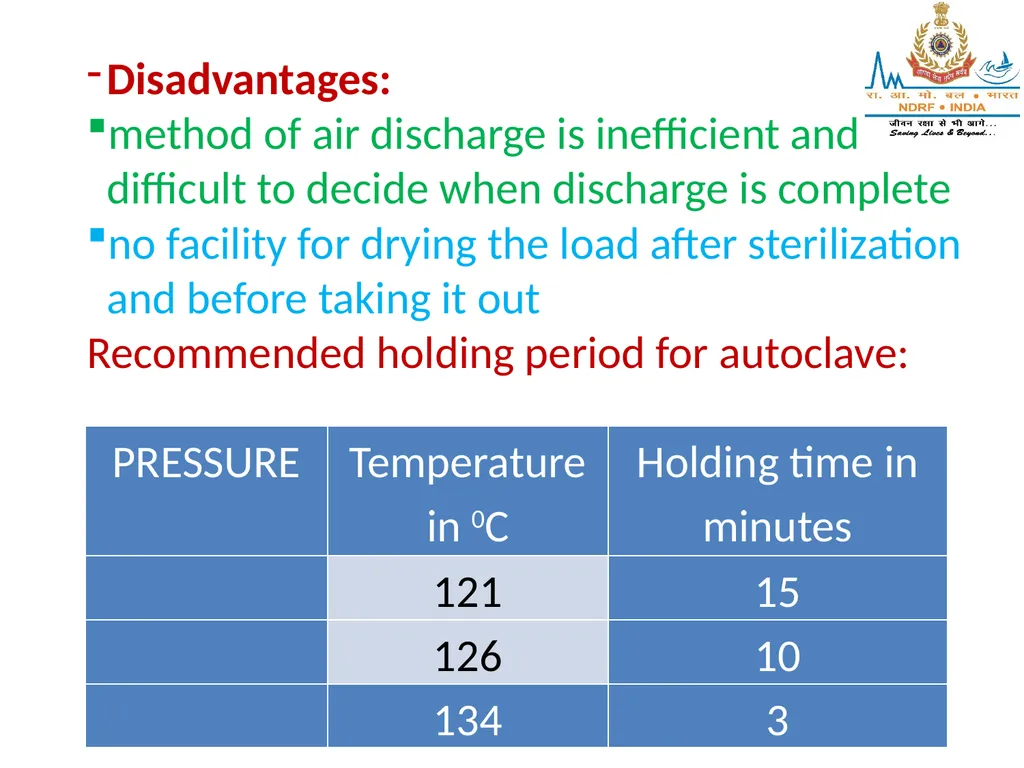
Disadvantages:
method of air discharge is inefficient and difficult to decide when discharge is complete
no facility for drying the load after sterilization and before taking it out
Recommended holding period for autoclave:<br>
method of air discharge is inefficient and difficult to decide when discharge is complete
no facility for drying the load after sterilization and before taking it out
Recommended holding period for autoclave:<br>
18
RADIATION:
Infrared radiation is used for rapid mass sterilization of pre-packed items such as syringes and catheters
Ultraviolet radiation is used for disinfecting enclosed areas such as entry ways, operation theatres and laboratories.
Gamma rays are used for commercial sterilization of plastics, syringes, swabs, catheters, animal feeds, cardboard, oils greases, fabrics and metal foils.<br>
Infrared radiation is used for rapid mass sterilization of pre-packed items such as syringes and catheters
Ultraviolet radiation is used for disinfecting enclosed areas such as entry ways, operation theatres and laboratories.
Gamma rays are used for commercial sterilization of plastics, syringes, swabs, catheters, animal feeds, cardboard, oils greases, fabrics and metal foils.<br>
19
CHEMICAL DISINFECTING AGENTS
ALCOHOLS:
Ethyl alcohol and isopropyl alcohol are frequently used as skin antiseptics and for disinfection of thermometers
Act by denaturing proteins in a concentration of 60 -90 % in water
No action on spores<br>
ALCOHOLS:
Ethyl alcohol and isopropyl alcohol are frequently used as skin antiseptics and for disinfection of thermometers
Act by denaturing proteins in a concentration of 60 -90 % in water
No action on spores<br>
20
CHEMICAL DISINFECTING AGENTS
ALDEHYDES:
Formaldehyde: It is a bactericidal, sporicidal and viricidal
Uses:
to preserve anatomical specimens
for destroying anthrax spores in hair and wool
10% formalin in 0.5% sodium tetraborate is used to sterilize clean metal instruments<br>
ALDEHYDES:
Formaldehyde: It is a bactericidal, sporicidal and viricidal
Uses:
to preserve anatomical specimens
for destroying anthrax spores in hair and wool
10% formalin in 0.5% sodium tetraborate is used to sterilize clean metal instruments<br>
21
Uses:
formaldehyde gas used for sterilizing instruments and heat sensitive catheters; fumigating wards, sick rooms and also for disinfecting clothing, bedding, furniture and books.
for fumigation of operation theatres: In a heat resistant vessel, 150g of KMnO4 + 280 ml of formalin for every 1000 cubic feet of room volume; all the windows and doors are sealed for 48 hours after fumigation<br>
formaldehyde gas used for sterilizing instruments and heat sensitive catheters; fumigating wards, sick rooms and also for disinfecting clothing, bedding, furniture and books.
for fumigation of operation theatres: In a heat resistant vessel, 150g of KMnO4 + 280 ml of formalin for every 1000 cubic feet of room volume; all the windows and doors are sealed for 48 hours after fumigation<br>
22
Disadvantage: the gas is irritant and toxic when inhaled; surfaces disinfected with formaldehyde gas emit the vapor for some time which can be nullified by ammonia vapor after disinfection<br>
23
Glutaraldehyde: action similar to formaldehyde
Specially effective against tubercle bacilli, fungi and viruses
Less toxic and irritant to the eyes and skin
No deleterious effect on the cement or lenses of instruments like cystoscopes and bronchoscopes; used to safely treat corrugated rubber anesthetic tubes and face masks, plastic endotracheal tubes, metal instruments and polythene tubing.<br>
Specially effective against tubercle bacilli, fungi and viruses
Less toxic and irritant to the eyes and skin
No deleterious effect on the cement or lenses of instruments like cystoscopes and bronchoscopes; used to safely treat corrugated rubber anesthetic tubes and face masks, plastic endotracheal tubes, metal instruments and polythene tubing.<br>
24
HALOGENS: Iodine and chlorine
Chlorine and its compounds are effective in disinfecting water supplies, swimming pools, food and dairy industries
Marked bactericidal action and wide spectrum of action against viruses.<br>
Chlorine and its compounds are effective in disinfecting water supplies, swimming pools, food and dairy industries
Marked bactericidal action and wide spectrum of action against viruses.<br>
25
HALOGENS:
Sodium Hypochlorite or house hold Bleach is a commonly used.
Concentration prescribed by WHO: 10 g of bleach in 1 L of water (1% available chlorine)
Household bleach contains 4%–5% available chlorine, should be used after diluting.
Minimum contact time recommended: 30 minutes<br>
Sodium Hypochlorite or house hold Bleach is a commonly used.
Concentration prescribed by WHO: 10 g of bleach in 1 L of water (1% available chlorine)
Household bleach contains 4%–5% available chlorine, should be used after diluting.
Minimum contact time recommended: 30 minutes<br>
26
PHENOLS: they cause cell membrane damage and cell lysis.
Phenol (Carbolic acid), Cresol, Lysol are general disinfectants used in hospitals and are toxic to humans<br>
Phenol (Carbolic acid), Cresol, Lysol are general disinfectants used in hospitals and are toxic to humans<br>
27
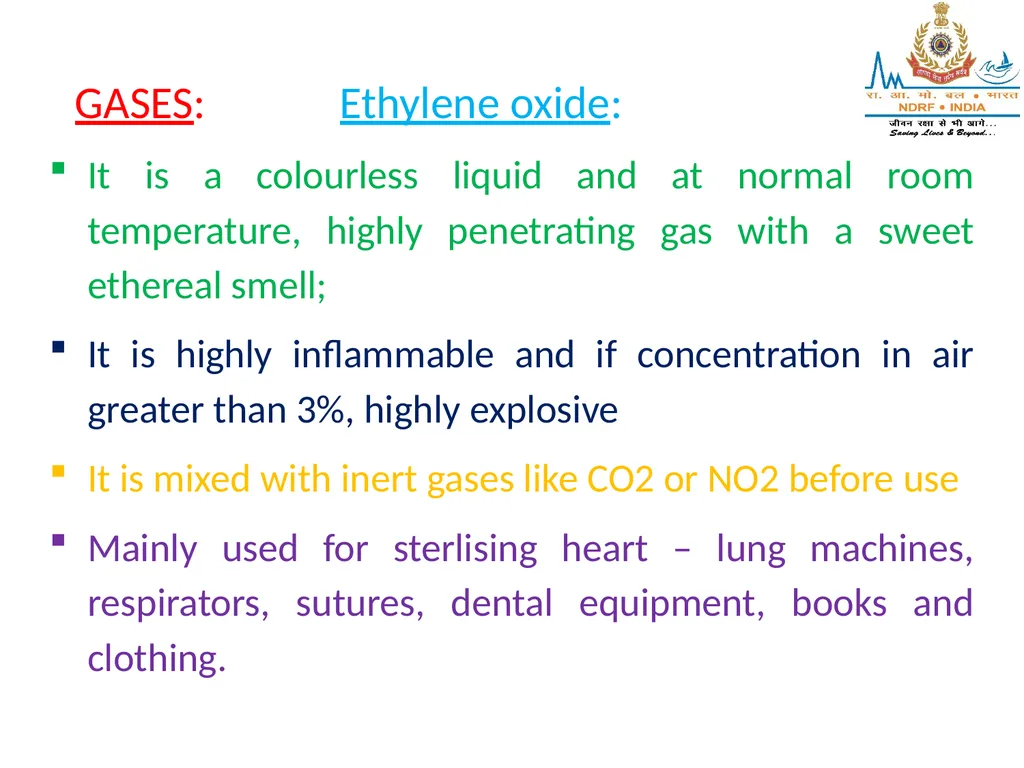
GASES: Ethylene oxide:
It is a colourless liquid and at normal room temperature, highly penetrating gas with a sweet ethereal smell;
It is highly inflammable and if concentration in air greater than 3%, highly explosive
It is mixed with inert gases like CO2 or NO2 before use
Mainly used for sterlising heart – lung machines, respirators, sutures, dental equipment, books and clothing.<br>
It is a colourless liquid and at normal room temperature, highly penetrating gas with a sweet ethereal smell;
It is highly inflammable and if concentration in air greater than 3%, highly explosive
It is mixed with inert gases like CO2 or NO2 before use
Mainly used for sterlising heart – lung machines, respirators, sutures, dental equipment, books and clothing.<br>
28
CLEANING & DISINFECTION OF COMMONLY USED ARTICLES<br>
29
LAUNDRY
Contaminated linen to be disinfected before laundry by chemical disinfectants/ boiling/ autoclaving at low pressure of steam.
Contaminated linen to be transported to laundry in thick polythene bags.
If washing mechanically in washing machine, decontaminate with hot detergent in machine.<br>
Contaminated linen to be disinfected before laundry by chemical disinfectants/ boiling/ autoclaving at low pressure of steam.
Contaminated linen to be transported to laundry in thick polythene bags.
If washing mechanically in washing machine, decontaminate with hot detergent in machine.<br>
30
DECONTAMINATION AND WASHING OF BLANKETS
Cotton/acrylic/synthetic blankets preferred to woolen blankets; to be handled like linen
Woolen blankets decontaminated by exposing to formaldehyde/autoclaving
Dry cleaning does not inactivate/kill HIV.
DECONTAMINATION OF MATTRESSES
Cover all mattresses with waterproof synthetic material.<br>
Cotton/acrylic/synthetic blankets preferred to woolen blankets; to be handled like linen
Woolen blankets decontaminated by exposing to formaldehyde/autoclaving
Dry cleaning does not inactivate/kill HIV.
DECONTAMINATION OF MATTRESSES
Cover all mattresses with waterproof synthetic material.<br>
31
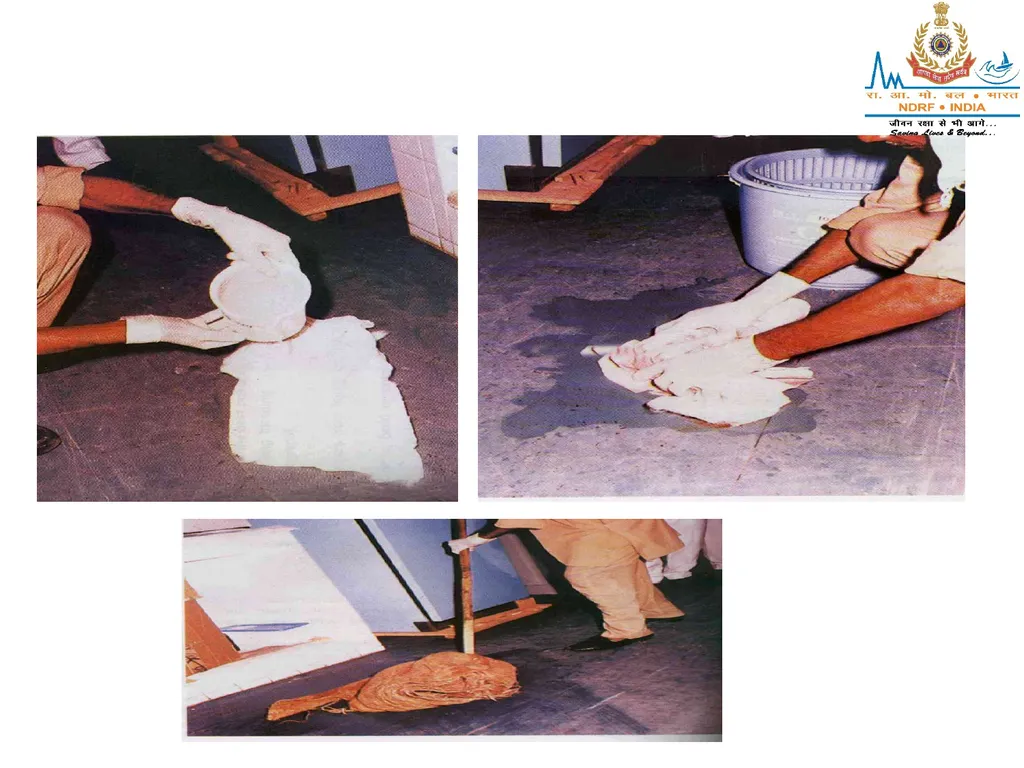
MANAGEMENT OF SPILLS
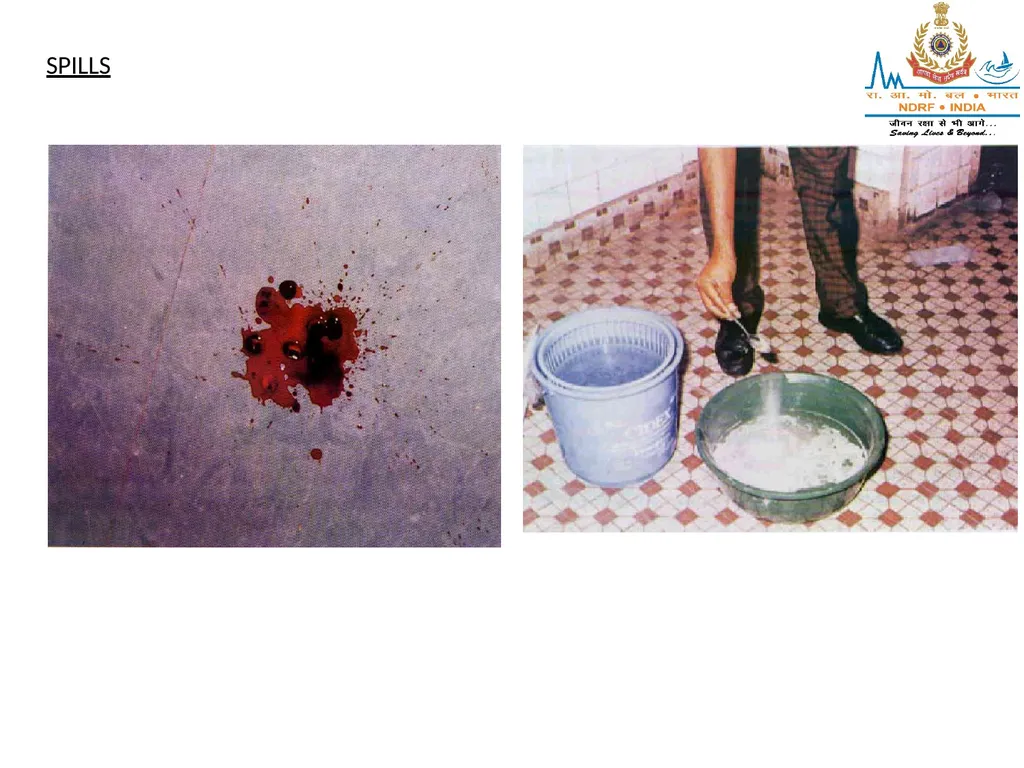
Cover with paper towel/blotting paper/ newspaper.
Pour 1% sodium hypochlorite solution on and around the spill.
Keep it covered for 20 minutes.
Remove paper with gloved hand and discard in infectious waste for incineration<br>
Cover with paper towel/blotting paper/ newspaper.
Pour 1% sodium hypochlorite solution on and around the spill.
Keep it covered for 20 minutes.
Remove paper with gloved hand and discard in infectious waste for incineration<br>
32
SPILLS<br>
33
PRINCIPLES OF INFECTION CONTROL
Infection control policy in each hospital has to be framed regarding proper handling of patients, admission procedures, antibiotic usage, lab testing, waste disposal, etc.
Hand-washing
Admit patient only when required and discharge early
Keep health-care facility clean<br>
Infection control policy in each hospital has to be framed regarding proper handling of patients, admission procedures, antibiotic usage, lab testing, waste disposal, etc.
Hand-washing
Admit patient only when required and discharge early
Keep health-care facility clean<br>
34
Reduce generation of waste
Universal work precautions to be adopted by all hospital staff
UWP are certain protective measures to be practised by all health workers at all times while providing professional services
Mainly directed at blood and body fluids and tissues to minimize the risk of HIV/ HBV transmission<br>
Universal work precautions to be adopted by all hospital staff
UWP are certain protective measures to be practised by all health workers at all times while providing professional services
Mainly directed at blood and body fluids and tissues to minimize the risk of HIV/ HBV transmission<br>
35
Components of UWP(General blood and body
fluid precautions)
Hand-washing
Careful handling of sharps
Safe techniques
Sterilization
Disinfection
Disposal of disposables/re-usable material
Adherence to correct hospital sterilization & disinfection protocols
Use of personal barrier precautions
Immunization against HBV<br>
fluid precautions)
Hand-washing
Careful handling of sharps
Safe techniques
Sterilization
Disinfection
Disposal of disposables/re-usable material
Adherence to correct hospital sterilization & disinfection protocols
Use of personal barrier precautions
Immunization against HBV<br>
36
Some specific precautions
Safe disposal of waste contaminated with body fluids
Safe handling and disposal of needles and sharp instruments
Avoid recapping needles
Hospital waste disposal
Sterlization and disinfection
Cleaning<br>
Safe disposal of waste contaminated with body fluids
Safe handling and disposal of needles and sharp instruments
Avoid recapping needles
Hospital waste disposal
Sterlization and disinfection
Cleaning<br>
37
USES OF CARBOLIC ACID, LYSOL & DETTOL
Carbolic Acid (phenol): -It is a disinfectant commonly used in hospital. The germicidal action of the phenol is by denaturing the protein of pathogenic organism.It has got high penetrations when applied locally. It is very irritant to the tissue and cause necrosis. It has also got fungicidal action.
Uses:-
1-Concentrated phenol is used to cauterize in snake bite dog bite and small wound etc.
2-Pure carbolic acid is used to disinfect the excreta.
3-To disinfect the mackintosh/draw sheet 1:20 solution should be used.
4- To disinfect the ward and operation theatre.<br>
Carbolic Acid (phenol): -It is a disinfectant commonly used in hospital. The germicidal action of the phenol is by denaturing the protein of pathogenic organism.It has got high penetrations when applied locally. It is very irritant to the tissue and cause necrosis. It has also got fungicidal action.
Uses:-
1-Concentrated phenol is used to cauterize in snake bite dog bite and small wound etc.
2-Pure carbolic acid is used to disinfect the excreta.
3-To disinfect the mackintosh/draw sheet 1:20 solution should be used.
4- To disinfect the ward and operation theatre.<br>
38
Treatment of Carbolic Acid Burns:-When the
carbolic acid accidently spread on the skin it should
be washed immediately with surgical spirit.
Lysol or Cresol:-This is a soapy solution containing cresol. Cresol is three times more potent in antiseptic action hence it is more extensively used than phenol.It is superior and cheaper than phenol.
Uses:-
1- To disinfect sharp instrument.
2-To disinfect linen & crockery for enamel use. Solution of one teaspoonful in a pint of water and soak for 1 hour.
3-To store cheatle forceps in a solution of 1 table spoon full in a pint of water.
4-Swabbing trolleys and table etc in a solution of 2 table spoon full in a pint of water.<br>
carbolic acid accidently spread on the skin it should
be washed immediately with surgical spirit.
Lysol or Cresol:-This is a soapy solution containing cresol. Cresol is three times more potent in antiseptic action hence it is more extensively used than phenol.It is superior and cheaper than phenol.
Uses:-
1- To disinfect sharp instrument.
2-To disinfect linen & crockery for enamel use. Solution of one teaspoonful in a pint of water and soak for 1 hour.
3-To store cheatle forceps in a solution of 1 table spoon full in a pint of water.
4-Swabbing trolleys and table etc in a solution of 2 table spoon full in a pint of water.<br>
39
Dettol:- This is an example of property preparation of Chlorexylenol. It is also an antiseptic and disinfectant.
Uses:-
1- To cleanse the skin before operation by applying pure and lift uncovered until dry.
2- As an antiseptic hand lotion or to clean the skin around the wound. Solution 2-3 TSF to a pint of water.
3- To wash hair as an antiseptic.
4- To wash bowls, bed pan and other toilet items.<br>
Uses:-
1- To cleanse the skin before operation by applying pure and lift uncovered until dry.
2- As an antiseptic hand lotion or to clean the skin around the wound. Solution 2-3 TSF to a pint of water.
3- To wash hair as an antiseptic.
4- To wash bowls, bed pan and other toilet items.<br>
40
ANY QUESTION
?<br>
?<br>
41
THANKS<br>