
Stimulants: Cocaine & Methamphetamine CRIT/FIT/CFS
TD
Published · 39 slides · 0 views

1 / 1





Description
Stimulants: Cocaine Methamphetamine CRITFITCFS program April 2023 Marielle Baldwin, MD, MPH I have no financial or other perceived conflicts of interest to disclose in relation to this presentation Disclosures At the end of this
Related Topics
Share
Embed code
Download this presentation From Below
"Stimulants: Cocaine & Methamphetamine CRIT/FIT/CFS" is the property of its rightful owner. Permission is granted to download and print the materials on this website for personal, non-commercial use only, and to display it on your personal computer provided you do not modify the materials and that you retain all copyright notices contained in the materials. By downloading content from our website, you accept the terms of this agreement.
Presentation Transcript
01
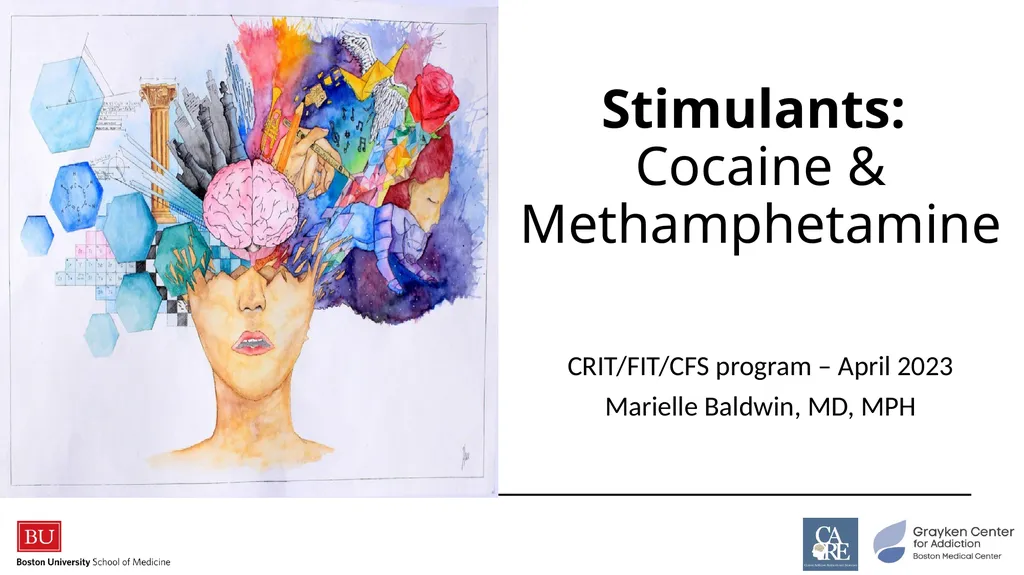
Stimulants:
Cocaine & Methamphetamine CRIT/FIT/CFS program – April 2023
Marielle Baldwin, MD, MPH<br>
Marielle Baldwin, MD, MPH<br>
02
I have no financial or other perceived conflicts of interest to disclose in relation to this presentation Disclosures<br>
03
At the end of this session, participants will be able to:
Understand how and why people use stimulants
Name the medical complications of stimulant use
Describe the current options for treatment of stimulant use disorders
Identify the characteristics of stimulant intoxication and techniques to manage overamping Learning Objectives<br>
Understand how and why people use stimulants
Name the medical complications of stimulant use
Describe the current options for treatment of stimulant use disorders
Identify the characteristics of stimulant intoxication and techniques to manage overamping Learning Objectives<br>
04
Basics of Cocaine & Methamphetamine<br>
05
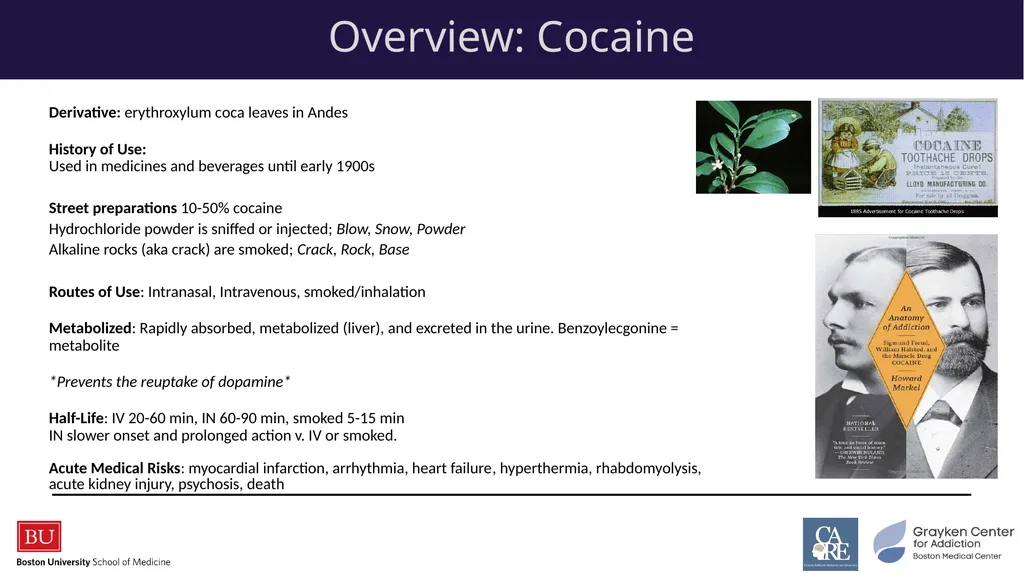
Derivative: erythroxylum coca leaves in Andes
History of Use:
Used in medicines and beverages until early 1900s
Street preparations 10-50% cocaine
Hydrochloride powder is sniffed or injected; Blow, Snow, Powder
Alkaline rocks (aka crack) are smoked; Crack, Rock, Base
Routes of Use: Intranasal, Intravenous, smoked/inhalation
Metabolized: Rapidly absorbed, metabolized (liver), and excreted in the urine. Benzoylecgonine = metabolite
*Prevents the reuptake of dopamine*
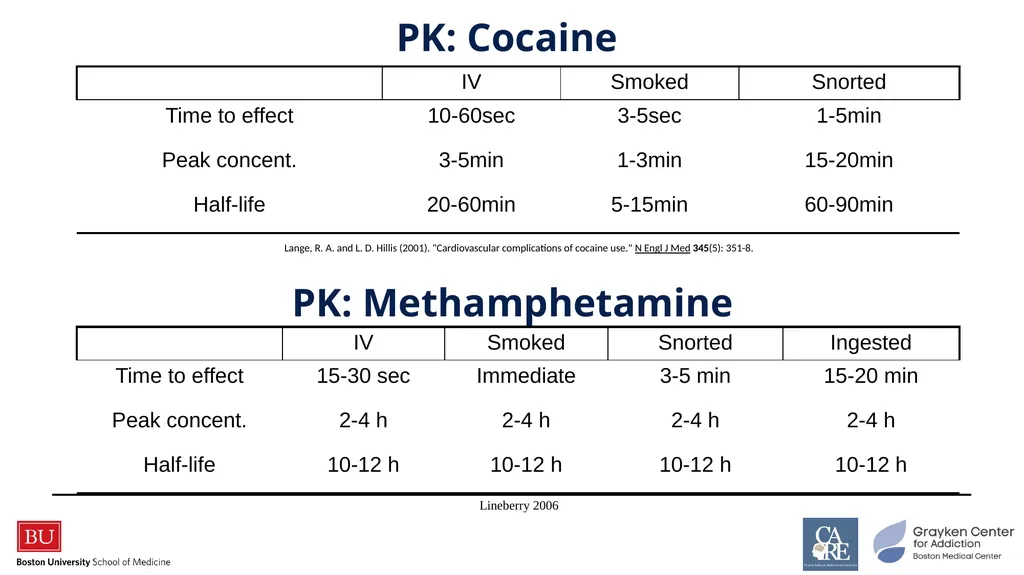
Half-Life: IV 20-60 min, IN 60-90 min, smoked 5-15 min
IN slower onset and prolonged action v. IV or smoked.
Acute Medical Risks: myocardial infarction, arrhythmia, heart failure, hyperthermia, rhabdomyolysis, acute kidney injury, psychosis, death Overview: Cocaine<br>
History of Use:
Used in medicines and beverages until early 1900s
Street preparations 10-50% cocaine
Hydrochloride powder is sniffed or injected; Blow, Snow, Powder
Alkaline rocks (aka crack) are smoked; Crack, Rock, Base
Routes of Use: Intranasal, Intravenous, smoked/inhalation
Metabolized: Rapidly absorbed, metabolized (liver), and excreted in the urine. Benzoylecgonine = metabolite
*Prevents the reuptake of dopamine*
Half-Life: IV 20-60 min, IN 60-90 min, smoked 5-15 min
IN slower onset and prolonged action v. IV or smoked.
Acute Medical Risks: myocardial infarction, arrhythmia, heart failure, hyperthermia, rhabdomyolysis, acute kidney injury, psychosis, death Overview: Cocaine<br>
06
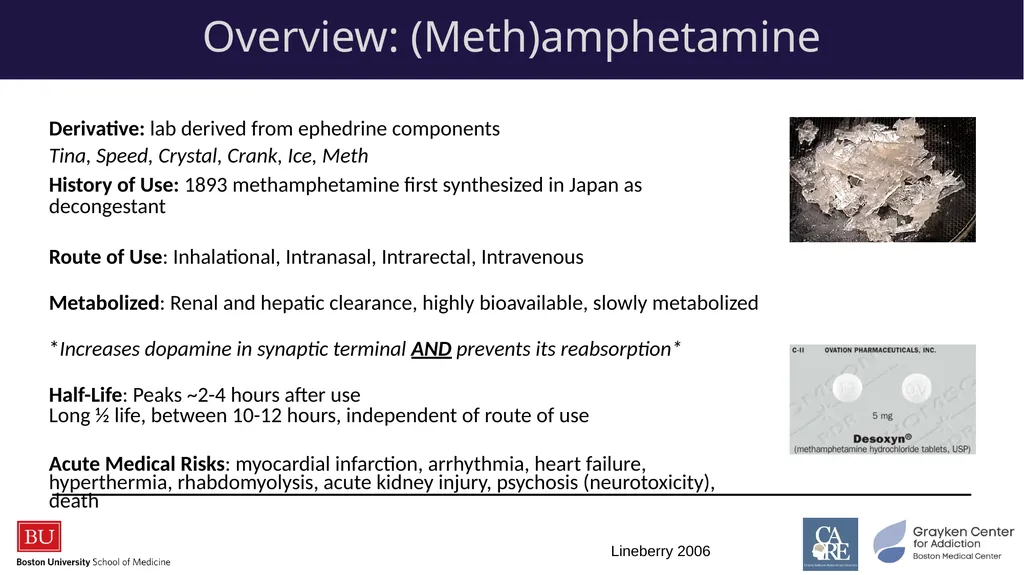
Derivative: lab derived from ephedrine components
Tina, Speed, Crystal, Crank, Ice, Meth
History of Use: 1893 methamphetamine first synthesized in Japan as decongestant
Route of Use: Inhalational, Intranasal, Intrarectal, Intravenous
Metabolized: Renal and hepatic clearance, highly bioavailable, slowly metabolized
*Increases dopamine in synaptic terminal AND prevents its reabsorption*
Half-Life: Peaks ~2-4 hours after use
Long ½ life, between 10-12 hours, independent of route of use
Acute Medical Risks: myocardial infarction, arrhythmia, heart failure, hyperthermia, rhabdomyolysis, acute kidney injury, psychosis (neurotoxicity), death Lineberry 2006 Overview: (Meth)amphetamine<br>
Tina, Speed, Crystal, Crank, Ice, Meth
History of Use: 1893 methamphetamine first synthesized in Japan as decongestant
Route of Use: Inhalational, Intranasal, Intrarectal, Intravenous
Metabolized: Renal and hepatic clearance, highly bioavailable, slowly metabolized
*Increases dopamine in synaptic terminal AND prevents its reabsorption*
Half-Life: Peaks ~2-4 hours after use
Long ½ life, between 10-12 hours, independent of route of use
Acute Medical Risks: myocardial infarction, arrhythmia, heart failure, hyperthermia, rhabdomyolysis, acute kidney injury, psychosis (neurotoxicity), death Lineberry 2006 Overview: (Meth)amphetamine<br>
07
Epidemiology<br>
08
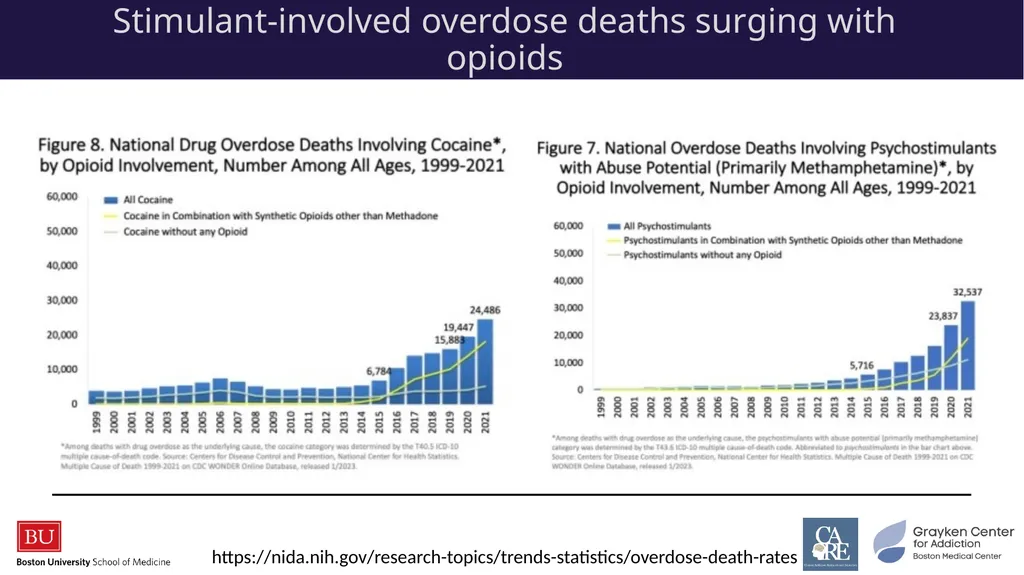
https://nida.nih.gov/research-topics/trends-statistics/overdose-death-rates Stimulant-involved overdose deaths surging with opioids<br>
09
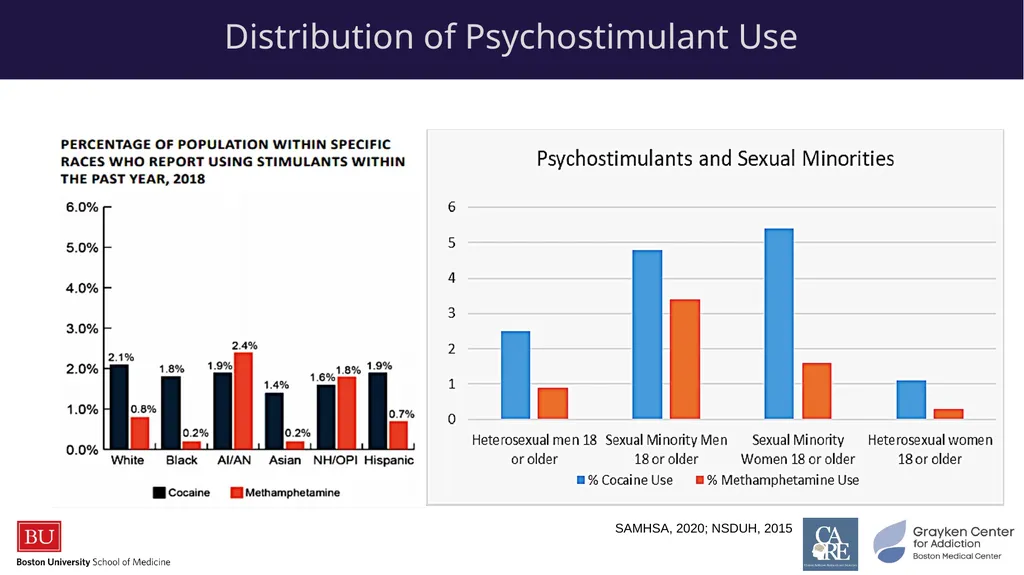
SAMHSA, 2020; NSDUH, 2015 Distribution of Psychostimulant Use<br>
10
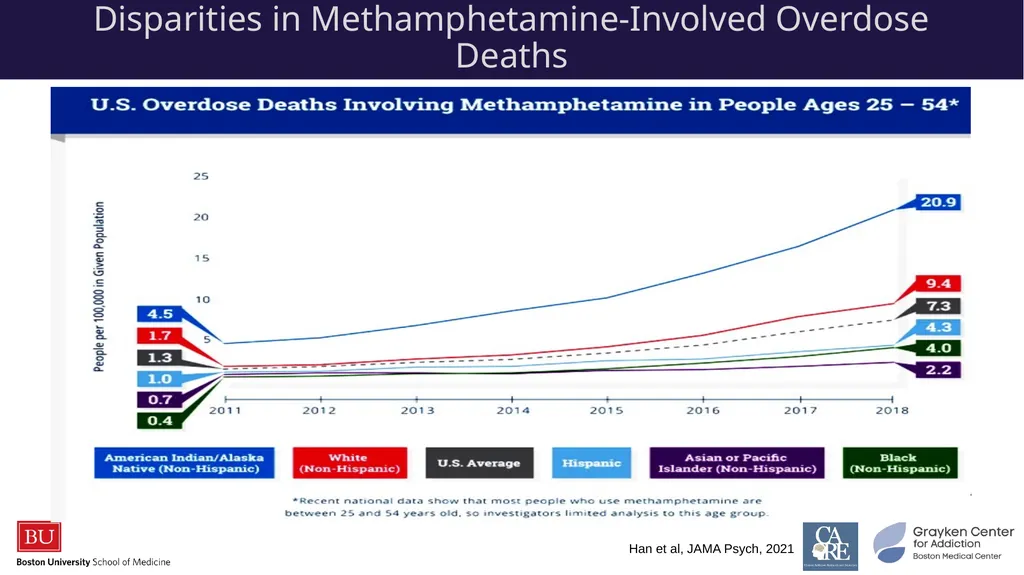
Han et al, JAMA Psych, 2021 Disparities in Methamphetamine-Involved Overdose Deaths<br>
11
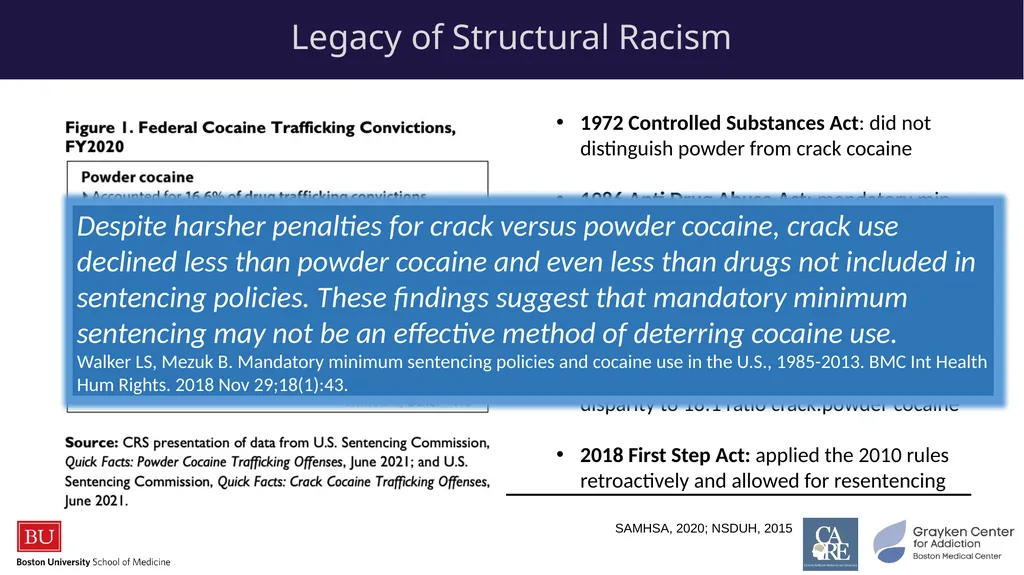
SAMHSA, 2020; NSDUH, 2015 Legacy of Structural Racism 1972 Controlled Substances Act: did not distinguish powder from crack cocaine
1986 Anti Drug Abuse Act: mandatory min sentencing for trafficking (100:1 ratio - 5 yrs for 5g crack vs 500g of powder)
1988 Anti-Drug Abuse Act: 5 year min for simple possession of crack
2010 Fair Sentencing Act: reduced sentencing disparity to 18:1 ratio crack:powder cocaine
2018 First Step Act: applied the 2010 rules retroactively and allowed for resentencing Despite harsher penalties for crack versus powder cocaine, crack use declined less than powder cocaine and even less than drugs not included in sentencing policies. These findings suggest that mandatory minimum sentencing may not be an effective method of deterring cocaine use.
Walker LS, Mezuk B. Mandatory minimum sentencing policies and cocaine use in the U.S., 1985-2013. BMC Int Health Hum Rights. 2018 Nov 29;18(1):43.<br>
1986 Anti Drug Abuse Act: mandatory min sentencing for trafficking (100:1 ratio - 5 yrs for 5g crack vs 500g of powder)
1988 Anti-Drug Abuse Act: 5 year min for simple possession of crack
2010 Fair Sentencing Act: reduced sentencing disparity to 18:1 ratio crack:powder cocaine
2018 First Step Act: applied the 2010 rules retroactively and allowed for resentencing Despite harsher penalties for crack versus powder cocaine, crack use declined less than powder cocaine and even less than drugs not included in sentencing policies. These findings suggest that mandatory minimum sentencing may not be an effective method of deterring cocaine use.
Walker LS, Mezuk B. Mandatory minimum sentencing policies and cocaine use in the U.S., 1985-2013. BMC Int Health Hum Rights. 2018 Nov 29;18(1):43.<br>
12
Stimulants: Why & How<br>
13
Euphoria / rush
Onset and intensity depends on delivery method
Increased energy, attention/focus
Increased vigilance (survival)
Diminished social inhibition
Sexual enhancement (libido)
Decreased appetite
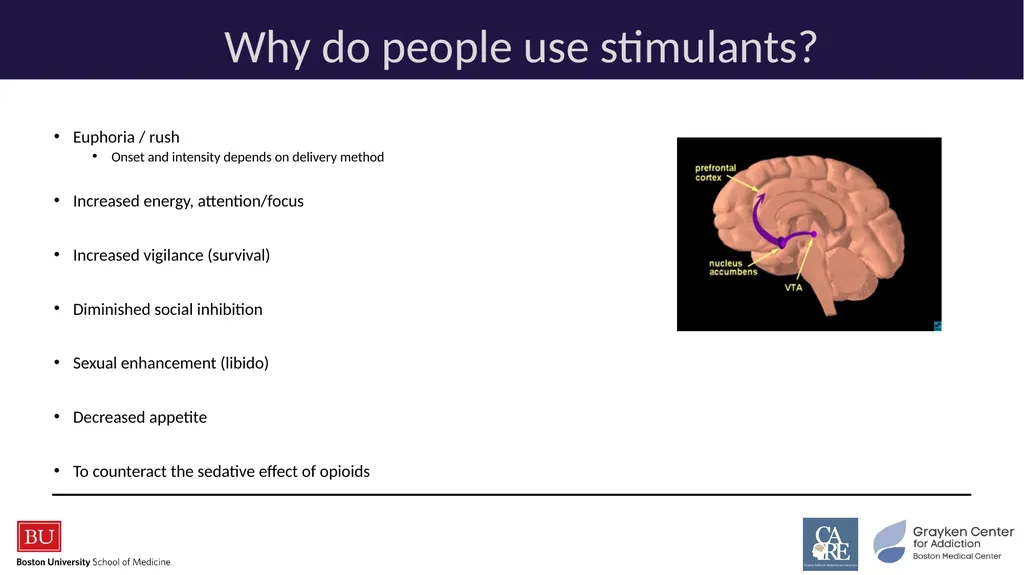
To counteract the sedative effect of opioids Why do people use stimulants?<br>
Onset and intensity depends on delivery method
Increased energy, attention/focus
Increased vigilance (survival)
Diminished social inhibition
Sexual enhancement (libido)
Decreased appetite
To counteract the sedative effect of opioids Why do people use stimulants?<br>
14
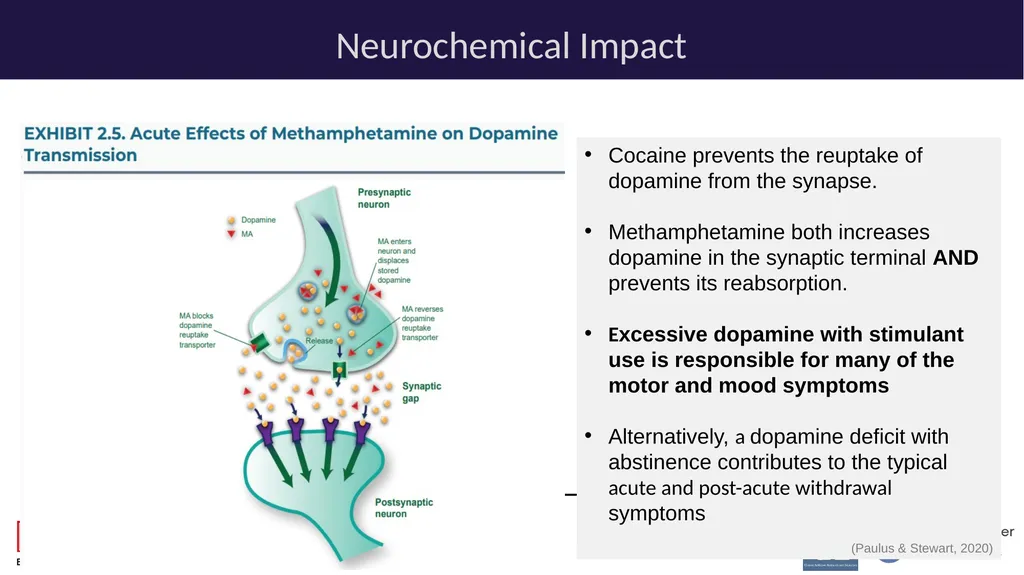
(Myers & DeWall, 2017) Cocaine prevents the reuptake of dopamine from the synapse.
Methamphetamine both increases dopamine in the synaptic terminal AND prevents its reabsorption.
Excessive dopamine with stimulant use is responsible for many of the motor and mood symptoms
Alternatively, a dopamine deficit with abstinence contributes to the typical acute and post-acute withdrawal symptoms
(Paulus & Stewart, 2020) Neurochemical Impact<br>
Methamphetamine both increases dopamine in the synaptic terminal AND prevents its reabsorption.
Excessive dopamine with stimulant use is responsible for many of the motor and mood symptoms
Alternatively, a dopamine deficit with abstinence contributes to the typical acute and post-acute withdrawal symptoms
(Paulus & Stewart, 2020) Neurochemical Impact<br>
15
PK: Cocaine PK: Methamphetamine Lange, R. A. and L. D. Hillis (2001). "Cardiovascular complications of cocaine use." N Engl J Med 345(5): 351-8. Lineberry 2006<br>
16
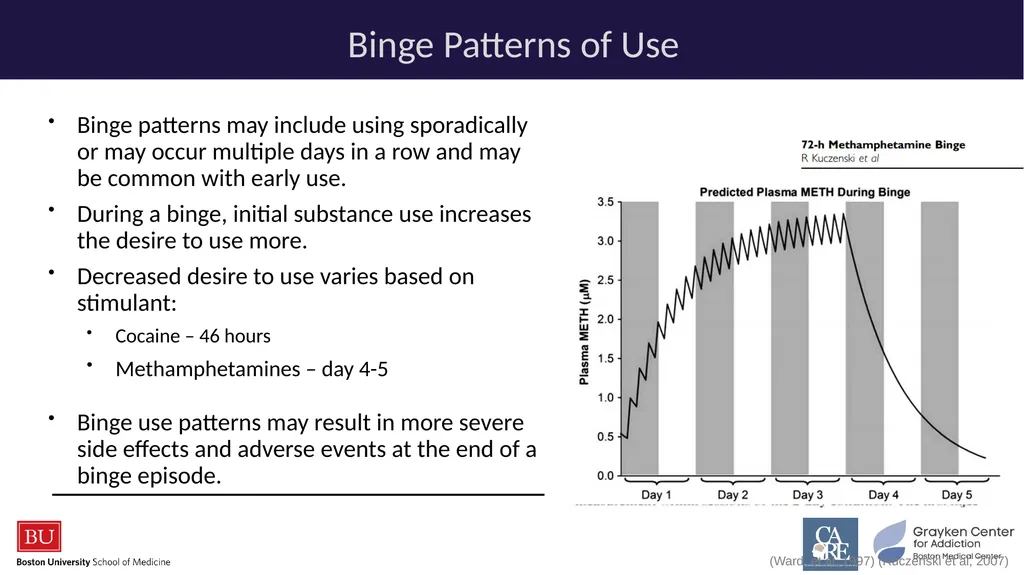
Binge patterns may include using sporadically or may occur multiple days in a row and may be common with early use.
During a binge, initial substance use increases the desire to use more.
Decreased desire to use varies based on stimulant:
Cocaine – 46 hours
Methamphetamines – day 4-5
Binge use patterns may result in more severe side effects and adverse events at the end of a binge episode. (Ward, et al, 1997) (Ruczenski et al, 2007) Binge Patterns of Use<br>
During a binge, initial substance use increases the desire to use more.
Decreased desire to use varies based on stimulant:
Cocaine – 46 hours
Methamphetamines – day 4-5
Binge use patterns may result in more severe side effects and adverse events at the end of a binge episode. (Ward, et al, 1997) (Ruczenski et al, 2007) Binge Patterns of Use<br>
17
53-97% of people experience withdrawal with abstinence after prolonged use
Dopamine stores may take 12-18 months to recover, if at all, after chronic methamphetamine use
Withdrawal symptoms may last weeks to months:
Acute (1-7 days): (severe) depression, anhedonia with suicidal ideation, anxiety, fatigue with hypersomnia or insomnia, intense cravings, poor concentration, irritability, physical discomfort (myalgias), psychomotor retardation or agitation
Post-acute (early protracted, 2-4 wks): vivid/unpleasant dreams,
intermittent cravings w/nighttime awakenings
Late protracted (> 4 weeks): mild cognitive dysfunction,
”cognitive dullness”, impairments in memory and
executive functioning, moderate depression/anxiety
intermittent cravings (S3 Practice Guidelines, 2016) Psychostimulant Withdrawal Li, M; Shoptaw, S; Addiction, 2022<br>
Dopamine stores may take 12-18 months to recover, if at all, after chronic methamphetamine use
Withdrawal symptoms may last weeks to months:
Acute (1-7 days): (severe) depression, anhedonia with suicidal ideation, anxiety, fatigue with hypersomnia or insomnia, intense cravings, poor concentration, irritability, physical discomfort (myalgias), psychomotor retardation or agitation
Post-acute (early protracted, 2-4 wks): vivid/unpleasant dreams,
intermittent cravings w/nighttime awakenings
Late protracted (> 4 weeks): mild cognitive dysfunction,
”cognitive dullness”, impairments in memory and
executive functioning, moderate depression/anxiety
intermittent cravings (S3 Practice Guidelines, 2016) Psychostimulant Withdrawal Li, M; Shoptaw, S; Addiction, 2022<br>
18
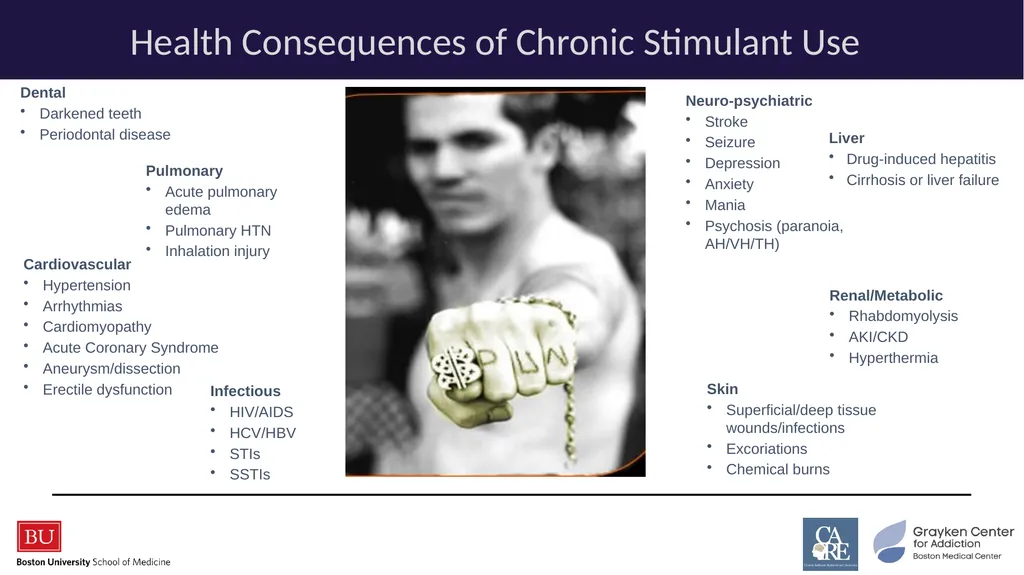
Skin
Superficial/deep tissue wounds/infections
Excoriations
Chemical burns Renal/Metabolic
Rhabdomyolysis
AKI/CKD
Hyperthermia Dental
Darkened teeth
Periodontal disease Pulmonary
Acute pulmonary edema
Pulmonary HTN
Inhalation injury Cardiovascular
Hypertension
Arrhythmias
Cardiomyopathy
Acute Coronary Syndrome
Aneurysm/dissection
Erectile dysfunction Infectious
HIV/AIDS
HCV/HBV
STIs
SSTIs Neuro-psychiatric
Stroke
Seizure
Depression
Anxiety
Mania
Psychosis (paranoia, AH/VH/TH) Health Consequences of Chronic Stimulant Use Liver
Drug-induced hepatitis
Cirrhosis or liver failure<br>
Superficial/deep tissue wounds/infections
Excoriations
Chemical burns Renal/Metabolic
Rhabdomyolysis
AKI/CKD
Hyperthermia Dental
Darkened teeth
Periodontal disease Pulmonary
Acute pulmonary edema
Pulmonary HTN
Inhalation injury Cardiovascular
Hypertension
Arrhythmias
Cardiomyopathy
Acute Coronary Syndrome
Aneurysm/dissection
Erectile dysfunction Infectious
HIV/AIDS
HCV/HBV
STIs
SSTIs Neuro-psychiatric
Stroke
Seizure
Depression
Anxiety
Mania
Psychosis (paranoia, AH/VH/TH) Health Consequences of Chronic Stimulant Use Liver
Drug-induced hepatitis
Cirrhosis or liver failure<br>
19
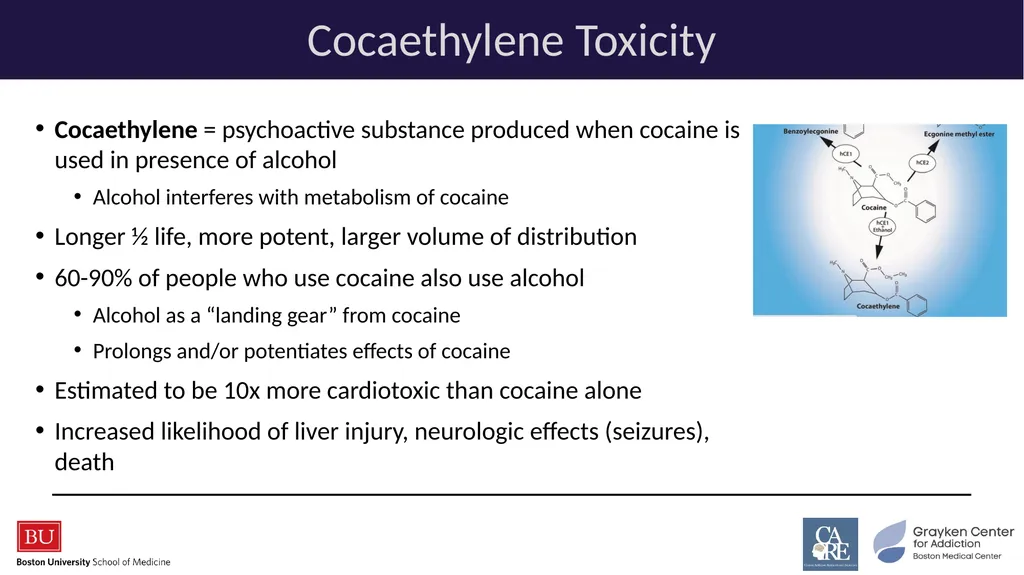
Cocaethylene Toxicity Cocaethylene = psychoactive substance produced when cocaine is used in presence of alcohol
Alcohol interferes with metabolism of cocaine
Longer ½ life, more potent, larger volume of distribution
60-90% of people who use cocaine also use alcohol
Alcohol as a “landing gear” from cocaine
Prolongs and/or potentiates effects of cocaine
Estimated to be 10x more cardiotoxic than cocaine alone
Increased likelihood of liver injury, neurologic effects (seizures), death<br>
Alcohol interferes with metabolism of cocaine
Longer ½ life, more potent, larger volume of distribution
60-90% of people who use cocaine also use alcohol
Alcohol as a “landing gear” from cocaine
Prolongs and/or potentiates effects of cocaine
Estimated to be 10x more cardiotoxic than cocaine alone
Increased likelihood of liver injury, neurologic effects (seizures), death<br>
20
Treatment of Stimulant Use Disorders<br>
21
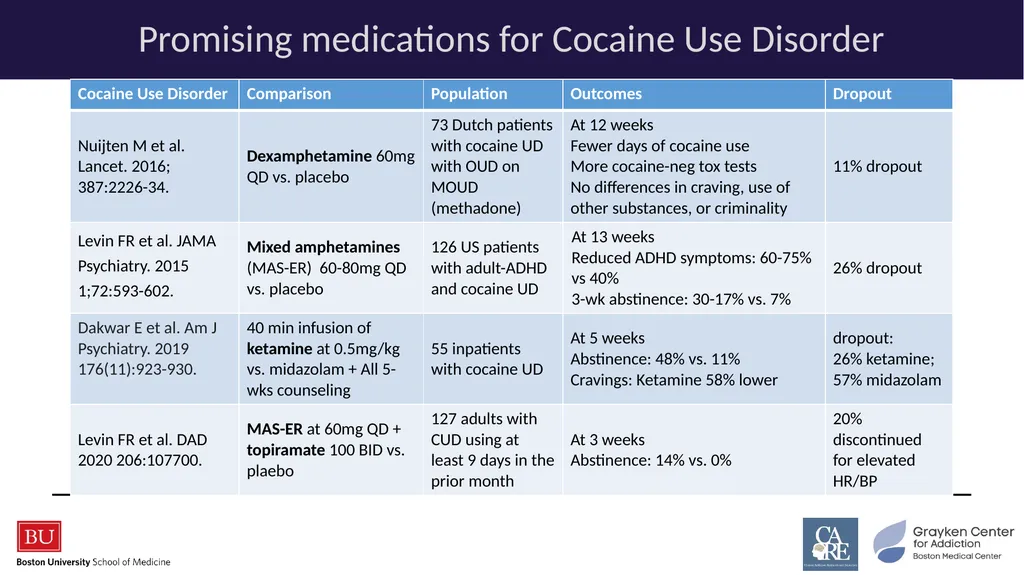
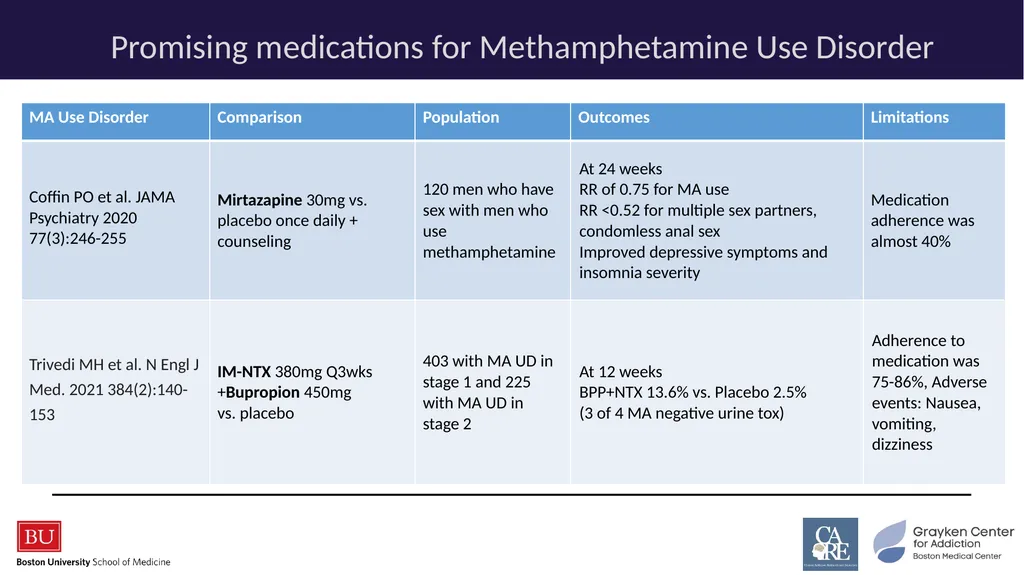
No FDA approved medications for stimulant use disorders
Preliminary research with promise for:
IM naltrexone + bupropion (methUD)
mirtazapine (methUD)
mixed amphetamine salts (CUD + ADHD, meth withdrawal)
topiramate (CUD)
topiramate + amphetamine salts (CUD)
modafinil (post-acute stimulant withdrawal) (S3 Practice Guidelines, 2016) Pharmacologic Management<br>
Preliminary research with promise for:
IM naltrexone + bupropion (methUD)
mirtazapine (methUD)
mixed amphetamine salts (CUD + ADHD, meth withdrawal)
topiramate (CUD)
topiramate + amphetamine salts (CUD)
modafinil (post-acute stimulant withdrawal) (S3 Practice Guidelines, 2016) Pharmacologic Management<br>
22
Promising medications for Cocaine Use Disorder<br>
23
Promising medications for Methamphetamine Use Disorder<br>
24
Non-pharmacologic Management<br>
25
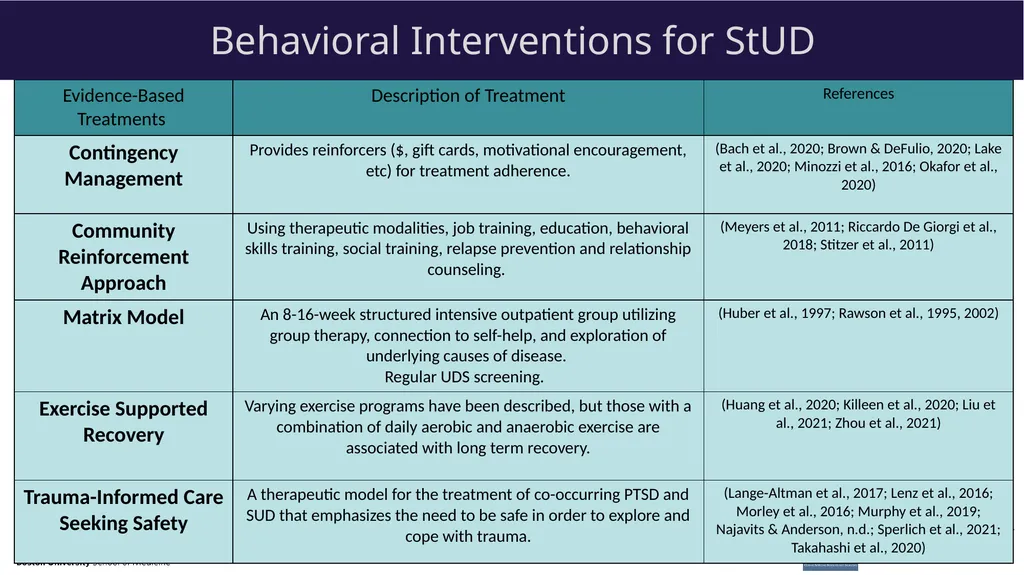
Behavioral Interventions for StUD<br>
26
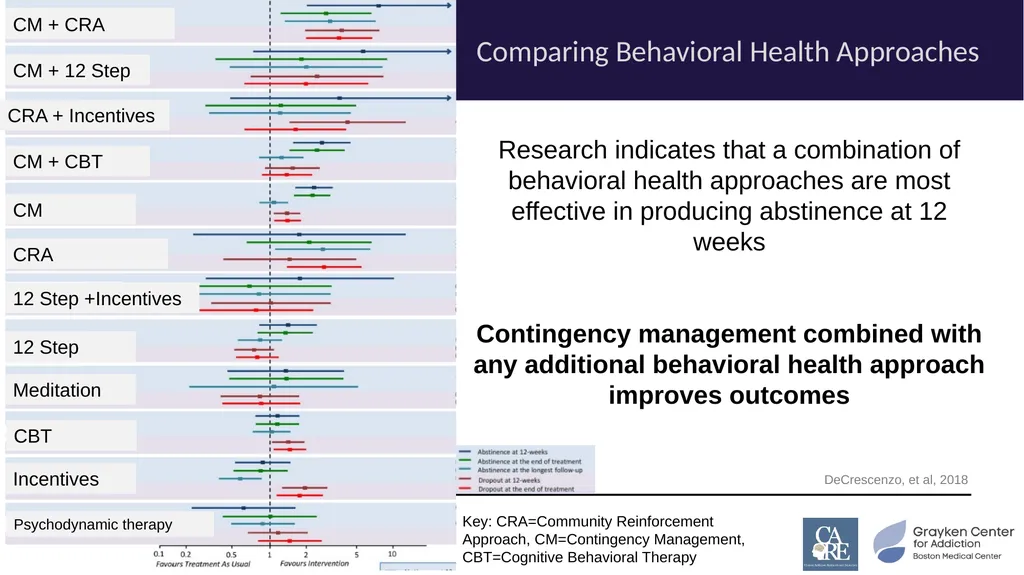
Research indicates that a combination of behavioral health approaches are most effective in producing abstinence at 12 weeks
Contingency management combined with any additional behavioral health approach improves outcomes DeCrescenzo, et al, 2018 Key: CRA=Community Reinforcement Approach, CM=Contingency Management, CBT=Cognitive Behavioral Therapy Comparing Behavioral Health Approaches<br>
Contingency management combined with any additional behavioral health approach improves outcomes DeCrescenzo, et al, 2018 Key: CRA=Community Reinforcement Approach, CM=Contingency Management, CBT=Cognitive Behavioral Therapy Comparing Behavioral Health Approaches<br>
27
CM is a behavioral health intervention based in operant conditioning principles that provides tangible reinforcers for evidence of behavior change
Essential theory behind CM: “A behavior that is reinforced in close temporal proximity to its occurrence will increase in frequency” (ex. engagement in care is reinforced with cash given to patient at the visit/point of engagement)
In CM programs that focus on abstinence, the magnitude of reinforcement provided should increase with sustained periods of abstinence Petry et al, 2011 Basics of Contingency Management<br>
Essential theory behind CM: “A behavior that is reinforced in close temporal proximity to its occurrence will increase in frequency” (ex. engagement in care is reinforced with cash given to patient at the visit/point of engagement)
In CM programs that focus on abstinence, the magnitude of reinforcement provided should increase with sustained periods of abstinence Petry et al, 2011 Basics of Contingency Management<br>
28
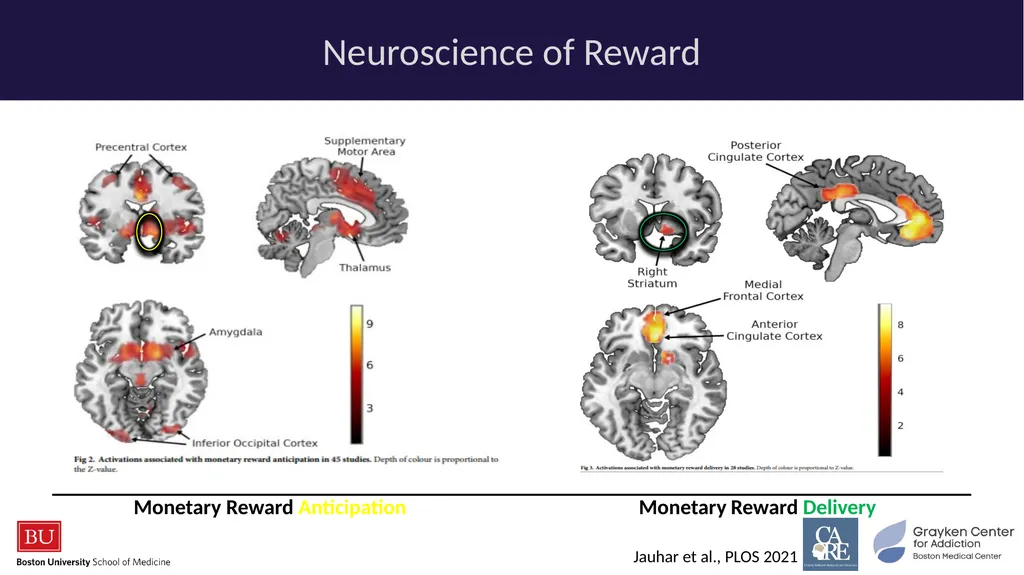
Monetary Reward Delivery Monetary Reward Anticipation Neuroscience of Reward Jauhar et al., PLOS 2021<br>
29
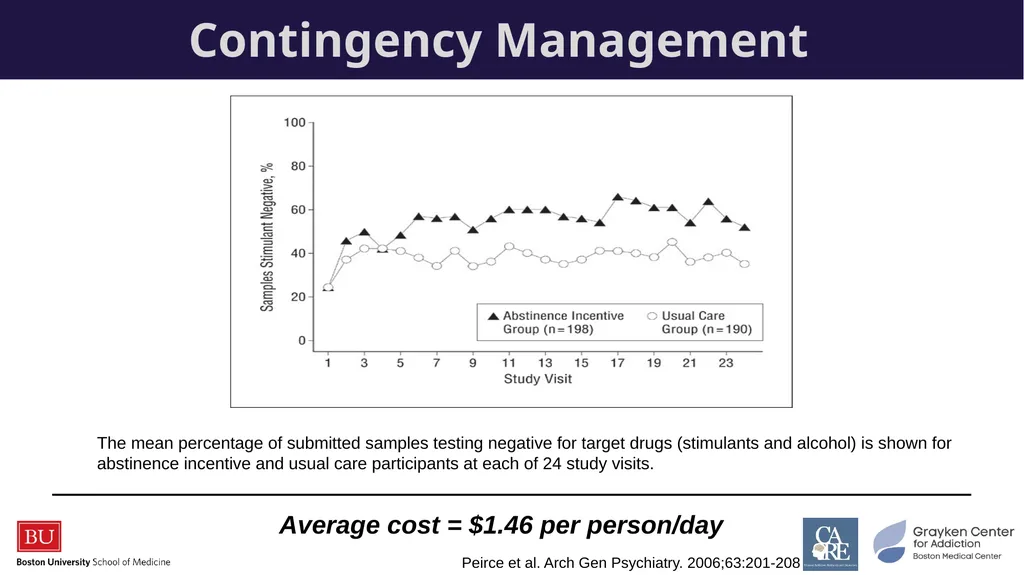
Contingency Management Peirce et al. Arch Gen Psychiatry. 2006;63:201-208 The mean percentage of submitted samples testing negative for target drugs (stimulants and alcohol) is shown for abstinence incentive and usual care participants at each of 24 study visits. Average cost = $1.46 per person/day<br>
30
Addressing Stimulant Intoxication<br>
31
Begins with extended period of euphoria
After dose exceeding the level of desired euphoria
Exacerbated by sleep deprivation, dehydration
May experience: altered mental status, psychosis (VH/AH/TH, paranoia) as result
Patients may experience acute medical complications Wood et al., 2014 Overamping<br>
After dose exceeding the level of desired euphoria
Exacerbated by sleep deprivation, dehydration
May experience: altered mental status, psychosis (VH/AH/TH, paranoia) as result
Patients may experience acute medical complications Wood et al., 2014 Overamping<br>
32
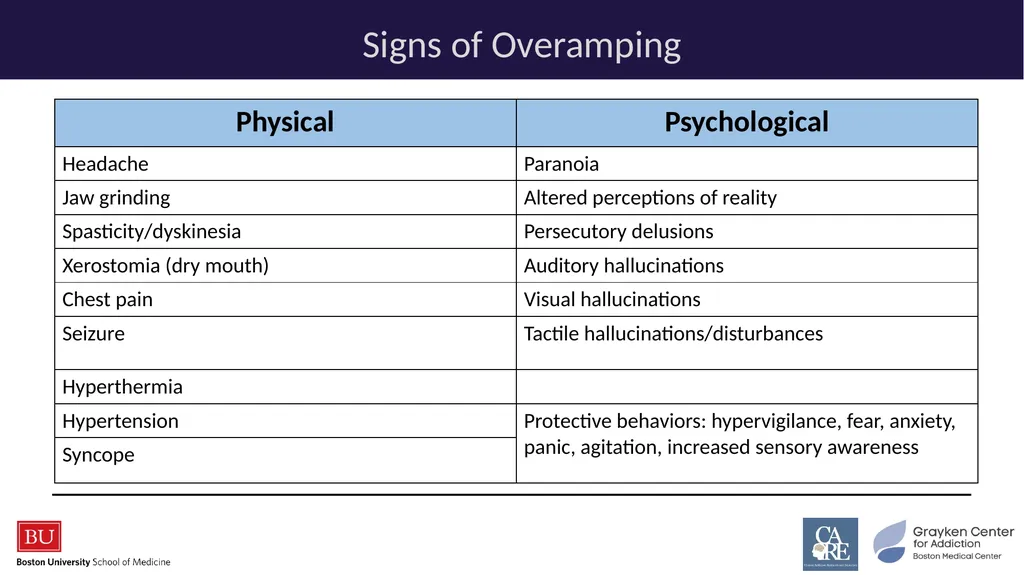
Signs of Overamping<br>
33
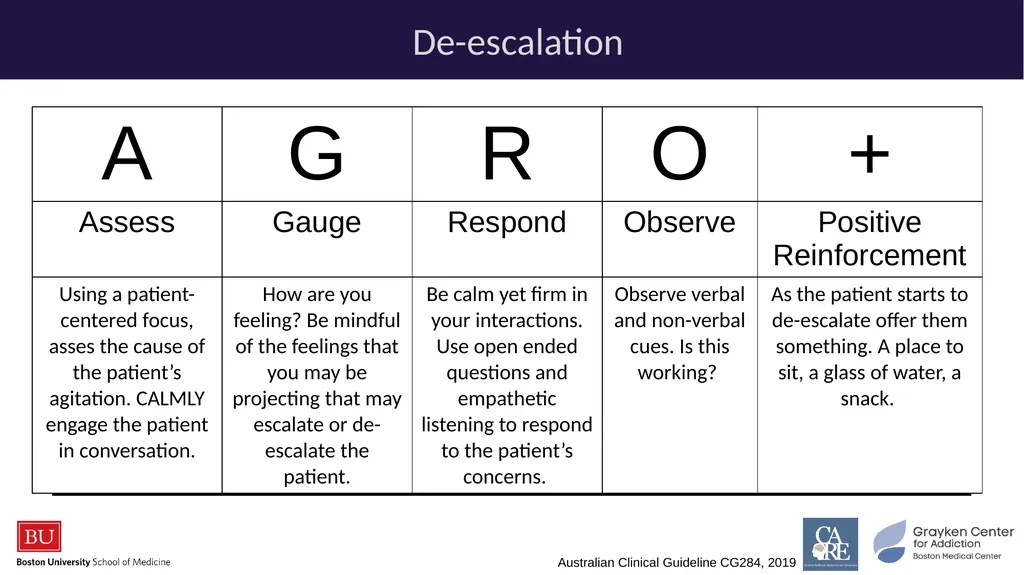
Australian Clinical Guideline CG284, 2019 De-escalation<br>
34
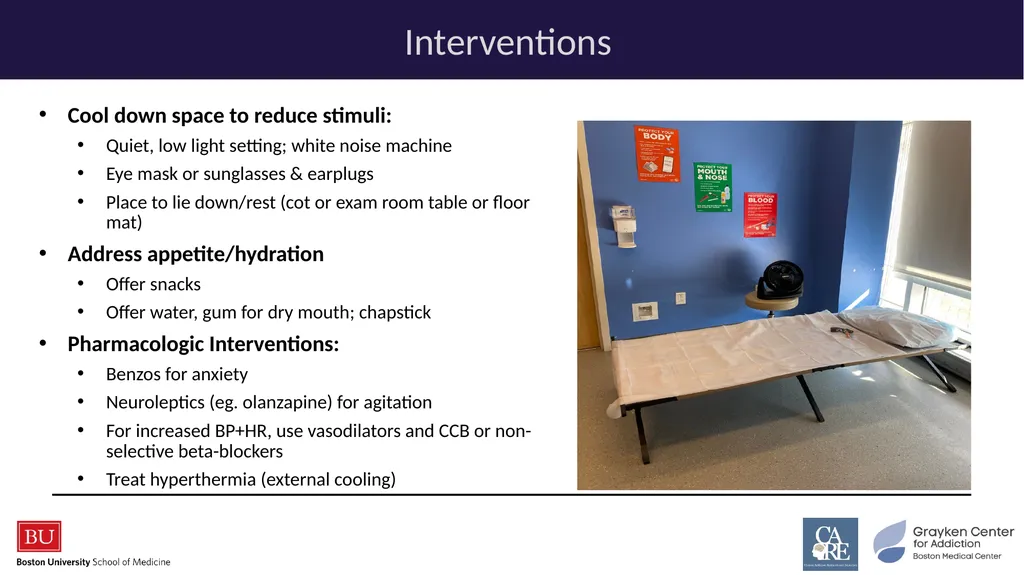
Cool down space to reduce stimuli:
Quiet, low light setting; white noise machine
Eye mask or sunglasses & earplugs
Place to lie down/rest (cot or exam room table or floor mat)
Address appetite/hydration
Offer snacks
Offer water, gum for dry mouth; chapstick
Pharmacologic Interventions:
Benzos for anxiety
Neuroleptics (eg. olanzapine) for agitation
For increased BP+HR, use vasodilators and CCB or non-selective beta-blockers
Treat hyperthermia (external cooling) Interventions<br>
Quiet, low light setting; white noise machine
Eye mask or sunglasses & earplugs
Place to lie down/rest (cot or exam room table or floor mat)
Address appetite/hydration
Offer snacks
Offer water, gum for dry mouth; chapstick
Pharmacologic Interventions:
Benzos for anxiety
Neuroleptics (eg. olanzapine) for agitation
For increased BP+HR, use vasodilators and CCB or non-selective beta-blockers
Treat hyperthermia (external cooling) Interventions<br>
35
Harm Reduction Practices<br>
36
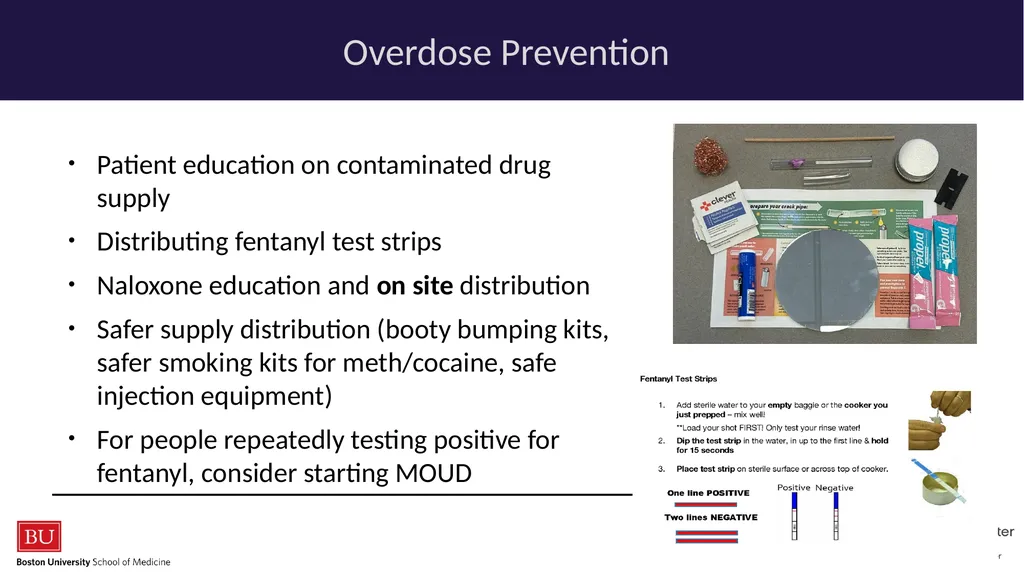
Patient education on contaminated drug supply
Distributing fentanyl test strips
Naloxone education and on site distribution
Safer supply distribution (booty bumping kits, safer smoking kits for meth/cocaine, safe injection equipment)
For people repeatedly testing positive for fentanyl, consider starting MOUD Overdose Prevention<br>
Distributing fentanyl test strips
Naloxone education and on site distribution
Safer supply distribution (booty bumping kits, safer smoking kits for meth/cocaine, safe injection equipment)
For people repeatedly testing positive for fentanyl, consider starting MOUD Overdose Prevention<br>
37
Screening for STIs and infectious diseases, including HIV, HBV, HCV at frequency based on risk or on a schedule for at risk patients.
Increased risk for HIV with rectal stimulant use associated with sex (chemsex), though less risk than IVDU
Screening for TB
Screening for syphilis (high prevalence in MSM/chemsex)
Screening for GC/CT at *all* sites of contact (pharyngeal, genital,
rectal)
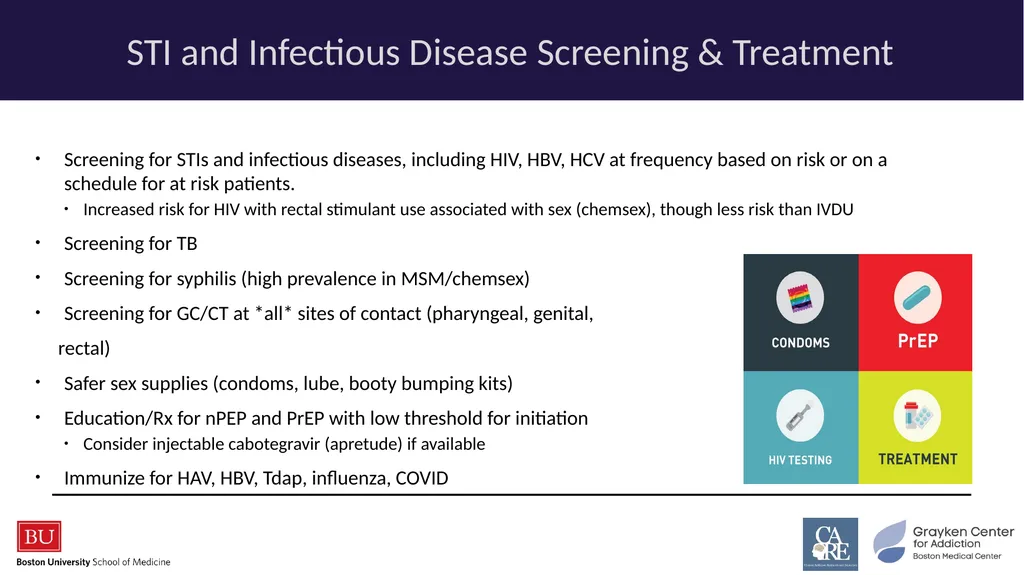
Safer sex supplies (condoms, lube, booty bumping kits)
Education/Rx for nPEP and PrEP with low threshold for initiation
Consider injectable cabotegravir (apretude) if available
Immunize for HAV, HBV, Tdap, influenza, COVID STI and Infectious Disease Screening & Treatment<br>
Increased risk for HIV with rectal stimulant use associated with sex (chemsex), though less risk than IVDU
Screening for TB
Screening for syphilis (high prevalence in MSM/chemsex)
Screening for GC/CT at *all* sites of contact (pharyngeal, genital,
rectal)
Safer sex supplies (condoms, lube, booty bumping kits)
Education/Rx for nPEP and PrEP with low threshold for initiation
Consider injectable cabotegravir (apretude) if available
Immunize for HAV, HBV, Tdap, influenza, COVID STI and Infectious Disease Screening & Treatment<br>
38
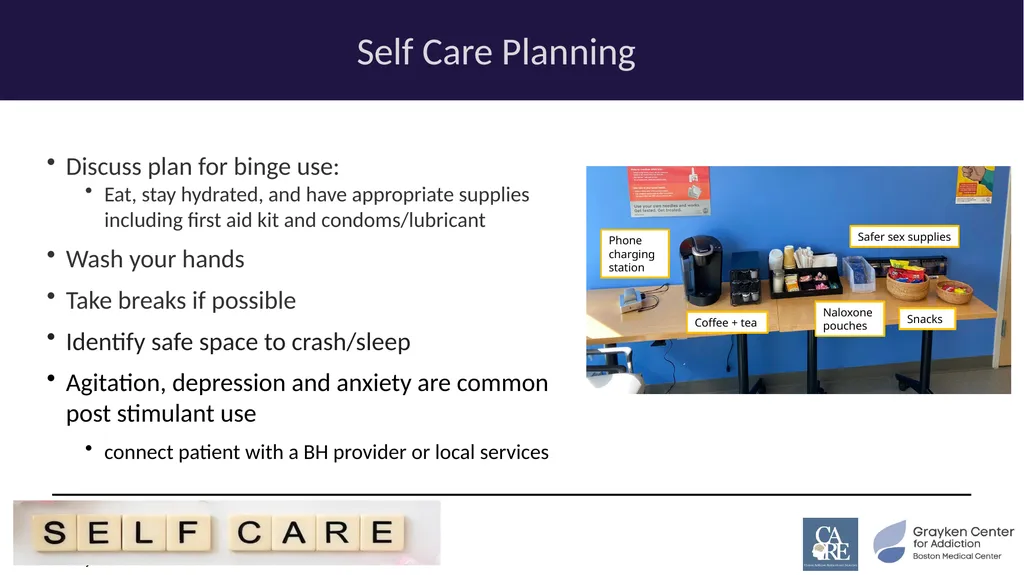
Coffee + tea Naloxone pouches Phone charging station Snacks Safer sex supplies Discuss plan for binge use:
Eat, stay hydrated, and have appropriate supplies including first aid kit and condoms/lubricant
Wash your hands
Take breaks if possible
Identify safe space to crash/sleep
Agitation, depression and anxiety are common post stimulant use
connect patient with a BH provider or local services Self Care Planning<br>
Eat, stay hydrated, and have appropriate supplies including first aid kit and condoms/lubricant
Wash your hands
Take breaks if possible
Identify safe space to crash/sleep
Agitation, depression and anxiety are common post stimulant use
connect patient with a BH provider or local services Self Care Planning<br>
39
TIP 33 TIP 33-SAMHSA<br>